
Concept
Role
Impact
MIS: support to Management
Presented by: Maria Stella Solon
Tasks of MIS
Following are activities performed during information System processing:
1. Handling of voluminous data
2. Confirmation of the validity of data & transaction
3. Complex processing of data & multidimensional analysis
4. Quick search & retrieval
5. Mass storage
6. Communication of information system to the user on time
7. Fulfilling the changing needs of information
Formal system should exist to handle all above mentioned things. Hence,
MIS uses computer technology to deal with information.
MIS and Computer
MIS relies on the HW and SW capacity of the
computer and its ability to store, process,
retrieve and communicate with no limitations.
Ability of the computer to sort and merge
helps to organize the data in a particular
manner.
Ability of a computer system to provide
security of data brings confidence in the
management.
The computer system being able to configure to
the specific needs helps to design a flexible
MIS.
Maria Stella Solon 3
MIS and Academics
Management theory and organizational behavior
Human mind as processor
Operation Research and network theory
Accounting Applications
Data Structure(DBMS)
Decision theory and Mathematical Techniques
4Maria Stella Solon
Need for MIS
 1. Increasing complexity of business activity
a) International economy
Firms of all sizes are subject to economic influences that can
originate
anywhere in the world. Such influences can be seen in the relative
values of
the currencies of each nation, where purchases are made in those
countries
with the highest currency value.
b) Worldwide competition
Competition exists on a worldwide scale. Its effects can be seen in
the
imports from foreign countries.
c) Increasing complexity of technology
Technology is used everywhere in business. Examples are bar
code scanners,
computer based airline reservation systems, automated teller
machines,
factory robots ..etc.
Purpose of MIS
Management Information Systems are primarily concerned
with the delivery of information (both internal and external)
to organizational members from the shop floor workers to the
management.
The purpose of MIS is to help the smooth running of the
business by providing information on the firms data (such as
accounting figures) employees from different levels will then
evaluate this information so that decisions can be made to
ensure that the business remains competitive and successful.
MIS have been created to support the whole range of
business's administration and regulatory activities and can be
seen in all parts of the world and in all types of industries both
public and private sector.
 In the US, for example, the National Drivers Register has MIS
facilities to report on driver license details, such as all those
within a given state whose license has been revoked or
suspended
Conceptual Design Models Of
MIS
1. The Process Model
2.The Logical Model of MIS
3.The Physical Model of MIS
The Process Model
In this model, the information system is
depicted as a collection of processes that are put
together and occur in pre-determined sequences
to gather ,capture,format,and present
information.
A process is something that converts inputs into
output.
A process needs the following entities to
function:
1.Methods or Procedures
2.Trained Operators
3.Knowledge of methods and Machinery
4.Materials
5.Machinery
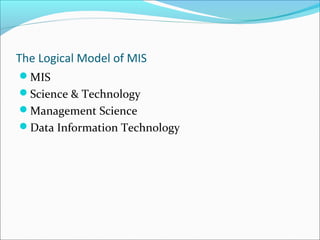
The Logical Model of MIS
MIS
Science & Technology
Management Science
Data Information Technology
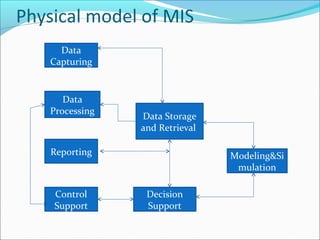
Physical model of MIS
Data
Capturing
Data
Processing
Reporting
Control
Support
Decision
Support
Data Storage
and Retrieval
Modeling&Si
mulation
MIS consist of several parts or sub-systems. These
subsystems interact with each other different ways
to finally produce the information in the format
desired.
The efficiency with which these modules interact
will determine the effectiveness of the MIS.
Some system are:
1.Data Capturing Model
The data capturing model is responsible for the
collection and capture of data that needed to
produce the information.
This module will vary according to the volume of
data and the complexity of data that needs to be
captured.
E.g. Bar Code
2.Data Storage (retrieval) Module
This module is responsible for storing the data capture in
the previous module.
The data must be stored such that it remains intact and
it is easily retrievable for processing.
3.Data Processing Module
This module is responsible for storing the data captured
into usable information.
A variety of processes may be used to combine the data
into information.
For E.g. in small org. manual processes may be used
notebooks, register, calculators.
In large org.,it may take an entire department to process
the information.
4. Information Reporting Module
This module is responsible for converting the output
from the Data Processing Module into meaningful
information.
This module thus take the processed data and lays it
out in a readable or usable form.
Computer may be used for both, the Data processing
and the Information Reporting modules, or for either
one of them, or for neither, depending on the size of
org.
5. Decision Support Module
 This module is designed to help the manager make
a decision based on the information presented .
6. Control Support Module
It enables the manager to keep control; over various
facets of the business.
This module is generally based on a feedback
mechanism, which provides information to the manager
on what is happening within the system and allows the
manager to make change during the process to achieve
the desired result.
7. Modeling and Simulation Module
This module makes it possible for a manager to see the
future of consequence of present actions.
Thus, a marketing manager may desire to know what
would happen if he dropped the price of a product by a
certain amount.
Past data is used for forecasting the future data.
This module is used basically to enhance the growth of the
business, If a manger had no such model or simulator, he
may be forced to actually take the action after which it
would be too late to take corrective action.
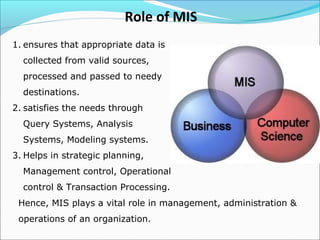
Role of MIS
1. ensures that appropriate data is
collected from valid sources,
processed and passed to needy
destinations.
2. satisfies the needs through
Query Systems, Analysis
Systems, Modeling systems.
3. Helps in strategic planning,
Management control, Operational
control & Transaction Processing.
Hence, MIS plays a vital role in management, administration &
operations of an organization.
In Operational Management
Day to Day operation of the business.
It needs information on day to day basis to
perform the operations.
Mis provide such information on a daily or even
hourly basis to the Operational Management to
enable it to control the operations.
In Middle Management
o Concerned with short term goals, problem
solving, progress monitoring and short term
target setting.
o In Top Management
o Long term growth
o SWOT
o Company goals and objectives
Can be compared to the role of heart in the body.
Information is blood and MIS is the heart.
The different information requirement at different
levels in the organization.
Impact of MIS
1. With a good support of MIS, marketing, finance, production &
personnel management becomes more efficient.
2. MIS gives better understanding of business.
3. A two-way communication flow is greatly enhanced by MIS. The
management freely tells its employees their jobs, and the ways and
means in which they are to accomplish the tasks entrusted to them.
The employees also in turn discuss their doubts, concerns and
problems.
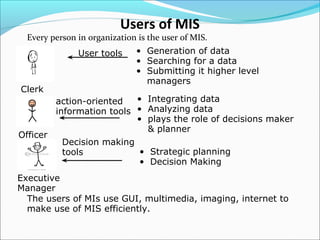
Users of MIS
Every person in organization is the user of MIS.
• Generation of data
• Searching for a data
• Submitting it higher level
managers
User tools
Clerk
Officer
• Integrating data
• Analyzing data
• plays the role of decisions maker
& planner
action-oriented
information tools
Executive
Manager
• Strategic planning
• Decision Making
Decision making
tools
The users of MIs use GUI, multimedia, imaging, internet to
make use of MIS efficiently.
 
 
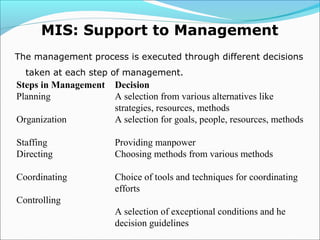
MIS: Support to Management
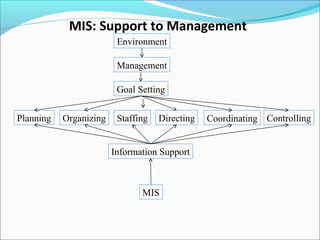
The management process is executed through different decisions
taken at each step of management.
Steps in Management
Planning
Organization
Staffing
Directing
Coordinating
Controlling
Decision
A selection from various alternatives like
strategies, resources, methods
A selection for goals, people, resources, methods
Providing manpower
Choosing methods from various methods
Choice of tools and techniques for coordinating
efforts
A selection of exceptional conditions and he
decision guidelines
MIS: Support to Management
Environment
Management
Goal Setting
Planning Organizing Staffing Directing Coordinating Controlling
Information Support
MIS
MIS Support to Management

MIS Support to Management

  • 1.
    Concept Role Impact MIS: support toManagement Presented by: Maria Stella Solon
  • 2.
    Tasks of MIS Followingare activities performed during information System processing: 1. Handling of voluminous data 2. Confirmation of the validity of data & transaction 3. Complex processing of data & multidimensional analysis 4. Quick search & retrieval 5. Mass storage 6. Communication of information system to the user on time 7. Fulfilling the changing needs of information Formal system should exist to handle all above mentioned things. Hence, MIS uses computer technology to deal with information.
  • 3.
    MIS and Computer MISrelies on the HW and SW capacity of the computer and its ability to store, process, retrieve and communicate with no limitations. Ability of the computer to sort and merge helps to organize the data in a particular manner. Ability of a computer system to provide security of data brings confidence in the management. The computer system being able to configure to the specific needs helps to design a flexible MIS. Maria Stella Solon 3
  • 4.
    MIS and Academics Managementtheory and organizational behavior Human mind as processor Operation Research and network theory Accounting Applications Data Structure(DBMS) Decision theory and Mathematical Techniques 4Maria Stella Solon
  • 5.
    Need for MIS 1. Increasing complexity of business activity a) International economy Firms of all sizes are subject to economic influences that can originate anywhere in the world. Such influences can be seen in the relative values of the currencies of each nation, where purchases are made in those countries with the highest currency value. b) Worldwide competition Competition exists on a worldwide scale. Its effects can be seen in the imports from foreign countries. c) Increasing complexity of technology Technology is used everywhere in business. Examples are bar code scanners, computer based airline reservation systems, automated teller machines, factory robots ..etc.
  • 6.
    Purpose of MIS ManagementInformation Systems are primarily concerned with the delivery of information (both internal and external) to organizational members from the shop floor workers to the management. The purpose of MIS is to help the smooth running of the business by providing information on the firms data (such as accounting figures) employees from different levels will then evaluate this information so that decisions can be made to ensure that the business remains competitive and successful. MIS have been created to support the whole range of business's administration and regulatory activities and can be seen in all parts of the world and in all types of industries both public and private sector.  In the US, for example, the National Drivers Register has MIS facilities to report on driver license details, such as all those within a given state whose license has been revoked or suspended
  • 7.
    Conceptual Design ModelsOf MIS 1. The Process Model 2.The Logical Model of MIS 3.The Physical Model of MIS
  • 8.
    The Process Model Inthis model, the information system is depicted as a collection of processes that are put together and occur in pre-determined sequences to gather ,capture,format,and present information. A process is something that converts inputs into output. A process needs the following entities to function: 1.Methods or Procedures 2.Trained Operators 3.Knowledge of methods and Machinery 4.Materials 5.Machinery
  • 9.
    The Logical Modelof MIS MIS Science & Technology Management Science Data Information Technology
  • 10.
    Physical model ofMIS Data Capturing Data Processing Reporting Control Support Decision Support Data Storage and Retrieval Modeling&Si mulation
  • 11.
    MIS consist ofseveral parts or sub-systems. These subsystems interact with each other different ways to finally produce the information in the format desired. The efficiency with which these modules interact will determine the effectiveness of the MIS. Some system are: 1.Data Capturing Model The data capturing model is responsible for the collection and capture of data that needed to produce the information. This module will vary according to the volume of data and the complexity of data that needs to be captured. E.g. Bar Code
  • 12.
    2.Data Storage (retrieval)Module This module is responsible for storing the data capture in the previous module. The data must be stored such that it remains intact and it is easily retrievable for processing. 3.Data Processing Module This module is responsible for storing the data captured into usable information. A variety of processes may be used to combine the data into information. For E.g. in small org. manual processes may be used notebooks, register, calculators. In large org.,it may take an entire department to process the information.
  • 13.
    4. Information ReportingModule This module is responsible for converting the output from the Data Processing Module into meaningful information. This module thus take the processed data and lays it out in a readable or usable form. Computer may be used for both, the Data processing and the Information Reporting modules, or for either one of them, or for neither, depending on the size of org. 5. Decision Support Module  This module is designed to help the manager make a decision based on the information presented . 6. Control Support Module It enables the manager to keep control; over various facets of the business.
  • 14.
    This module isgenerally based on a feedback mechanism, which provides information to the manager on what is happening within the system and allows the manager to make change during the process to achieve the desired result. 7. Modeling and Simulation Module This module makes it possible for a manager to see the future of consequence of present actions. Thus, a marketing manager may desire to know what would happen if he dropped the price of a product by a certain amount. Past data is used for forecasting the future data. This module is used basically to enhance the growth of the business, If a manger had no such model or simulator, he may be forced to actually take the action after which it would be too late to take corrective action.
  • 15.
    Role of MIS 1.ensures that appropriate data is collected from valid sources, processed and passed to needy destinations. 2. satisfies the needs through Query Systems, Analysis Systems, Modeling systems. 3. Helps in strategic planning, Management control, Operational control & Transaction Processing. Hence, MIS plays a vital role in management, administration & operations of an organization.
  • 16.
    In Operational Management Dayto Day operation of the business. It needs information on day to day basis to perform the operations. Mis provide such information on a daily or even hourly basis to the Operational Management to enable it to control the operations. In Middle Management o Concerned with short term goals, problem solving, progress monitoring and short term target setting. o In Top Management o Long term growth o SWOT o Company goals and objectives
  • 17.
    Can be comparedto the role of heart in the body. Information is blood and MIS is the heart. The different information requirement at different levels in the organization.
  • 18.
    Impact of MIS 1.With a good support of MIS, marketing, finance, production & personnel management becomes more efficient. 2. MIS gives better understanding of business. 3. A two-way communication flow is greatly enhanced by MIS. The management freely tells its employees their jobs, and the ways and means in which they are to accomplish the tasks entrusted to them. The employees also in turn discuss their doubts, concerns and problems.
  • 19.
    Users of MIS Everyperson in organization is the user of MIS. • Generation of data • Searching for a data • Submitting it higher level managers User tools Clerk Officer • Integrating data • Analyzing data • plays the role of decisions maker & planner action-oriented information tools Executive Manager • Strategic planning • Decision Making Decision making tools The users of MIs use GUI, multimedia, imaging, internet to make use of MIS efficiently.
  • 20.
        MIS: Support toManagement The management process is executed through different decisions taken at each step of management. Steps in Management Planning Organization Staffing Directing Coordinating Controlling Decision A selection from various alternatives like strategies, resources, methods A selection for goals, people, resources, methods Providing manpower Choosing methods from various methods Choice of tools and techniques for coordinating efforts A selection of exceptional conditions and he decision guidelines
  • 21.
    MIS: Support toManagement Environment Management Goal Setting Planning Organizing Staffing Directing Coordinating Controlling Information Support MIS