DECISION SUPPORT SYSTEM
INTRODUCTION
 Decision making is an essence of management.
 It can be said that whatever a manager does in an
organization, he/she done through decision- making.
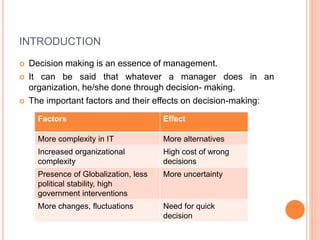
 The important factors and their effects on decision-making:
Factors Effect
More complexity in IT More alternatives
Increased organizational
complexity
High cost of wrong
decisions
Presence of Globalization, less
political stability, high
government interventions
More uncertainty
More changes, fluctuations Need for quick
decision
DECISION MAKING: A CONCEPT
 Decision making has been taken from Latin word
‘decide’ which means to “to cut off” or “ to come to a
conclusion”.
 Decision may be regarded as a ‘Choice’ or a
process of selecting one optimum alternative from
various alternatives.
Decision Final product Decision
making
process
SIMON’S MODEL OF DECISION MAKING
 Intelligence: Decision-maker scans the environment
and identifies the problem or opportunity.
Decision making process involves
Problem searching Problem formulation
(Expected & Reality) (Solving of wrong problem)
 Design: Decision maker has to explore various
alternatives creative activity
 Choice: Methods for choosing alternatives
Simon’s model of Decision Making
TYPES OF DECISIONS
 Purpose of Decision- making
 Strategic planning decision(to achieve objectives)
 Management control decision(use of resources)
 Operational control decision (day-to-day problems)
LEVEL OF PROGRAMMABILITY
o Programmed/Structured decision(well defined &
specified procedures & decision rule).
o Unprogrammed/unstructured decision(one-time
decision in case of crisis)
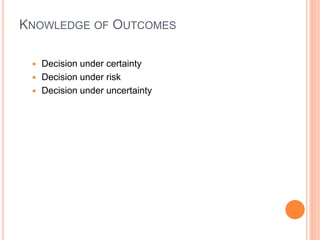
KNOWLEDGE OF OUTCOMES
 Decision under certainty
 Decision under risk
 Decision under uncertainty
DECISION SUPPORT TECHNIQUES
 Simulation- mathematical model of the situation is
created operated under different assumptions &
different conditions.
 Optimization- optimization technique used to search
for optimal values of decision variables.
 OLAP and Data mining
 Expert systems- Expert view
 Neural networks-
 Fuzzy logic
 Case-Based reasoning
 Intelligent agents
DECISION MAKING & ROLE OF MIS
 MIS plays its role in all three stages:
 Intelligence Stage:
 Provides internal(functional areas) as well as
external(Newspapers,TV,etc).
 Design Stage:
 The ability to make ad hoc queries for information in an
organization databases.
 The ability to reach a decision in an interactive process.
 Choice Stage:
 Course of action is selected & feedback is collected on
the implemented decision.
 Provides summarized & organized information to the
decision-maker.
DECISION SUPPORT SYSTEM
 WHY ?
 Fast computation- performs a large no. of computations
quickly at low cost.
 Enhanced productivity- productivity/overall performance of
the support staff.
 Data transmission-search, store & transmit data from
different locations quickly & economically.
 Better decisions
 Competitive edge-over competitors by changing their
operations quickly.
 WHAT ?
 A DSS is a specialized kind of information system, which is an
interactive system that supports in the decision-making
process of a manager in an organization, especially in semi-
structured & unstructured situations.
COMPONENTS OF DSS
 Database- master files data from internal & from
external sources.
 Model base-Libraries of models to manipulate &
analyze the data in the desired ways.
 Dialogue box: User Interface
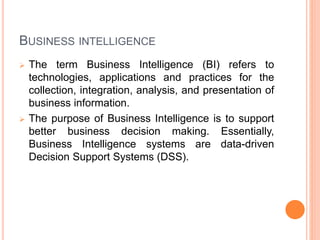
BUSINESS INTELLIGENCE
 The term Business Intelligence (BI) refers to
technologies, applications and practices for the
collection, integration, analysis, and presentation of
business information.
 The purpose of Business Intelligence is to support
better business decision making. Essentially,
Business Intelligence systems are data-driven
Decision Support Systems (DSS).
BI APPLICATIONS IN BUSINESS
 Retailing
 Customer relationship management
 Credit card management
 Insurance
 Telecommunications
 Telemarketing
 Human resource management
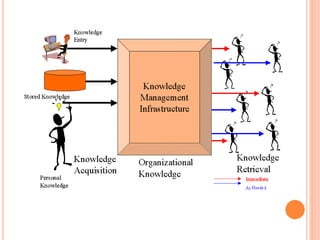
KNOWLEDGE MANAGEMENT SYSTEM
 KMS may be defined as a strategy, a framework
combination of activities, or a system that is
designed to help an organization create,
capture,analyze,apply and reuse knowledge to
improve its performance & to achieve competitive
advantage.
 Knowledge are of two types:
 Explicit – Transferable & tangible
 Tactic- Untransferable – in the minds of people
KMS STRATEGIES
 What knowledge to share?(Quality knowledge)
 With whom to share knowledge?(internal &
external audience)
 How will knowledge be shared?
 (face to face interaction)
 Why will knowledge be shared? (for supporting
business)

Decision support system

  • 1.
  • 2.
    INTRODUCTION  Decision makingis an essence of management.  It can be said that whatever a manager does in an organization, he/she done through decision- making.  The important factors and their effects on decision-making: Factors Effect More complexity in IT More alternatives Increased organizational complexity High cost of wrong decisions Presence of Globalization, less political stability, high government interventions More uncertainty More changes, fluctuations Need for quick decision
  • 3.
    DECISION MAKING: ACONCEPT  Decision making has been taken from Latin word ‘decide’ which means to “to cut off” or “ to come to a conclusion”.  Decision may be regarded as a ‘Choice’ or a process of selecting one optimum alternative from various alternatives. Decision Final product Decision making process
  • 4.
    SIMON’S MODEL OFDECISION MAKING  Intelligence: Decision-maker scans the environment and identifies the problem or opportunity. Decision making process involves Problem searching Problem formulation (Expected & Reality) (Solving of wrong problem)  Design: Decision maker has to explore various alternatives creative activity  Choice: Methods for choosing alternatives
  • 5.
    Simon’s model ofDecision Making
  • 6.
    TYPES OF DECISIONS Purpose of Decision- making  Strategic planning decision(to achieve objectives)  Management control decision(use of resources)  Operational control decision (day-to-day problems)
  • 7.
    LEVEL OF PROGRAMMABILITY oProgrammed/Structured decision(well defined & specified procedures & decision rule). o Unprogrammed/unstructured decision(one-time decision in case of crisis)
  • 8.
    KNOWLEDGE OF OUTCOMES Decision under certainty  Decision under risk  Decision under uncertainty
  • 9.
    DECISION SUPPORT TECHNIQUES Simulation- mathematical model of the situation is created operated under different assumptions & different conditions.  Optimization- optimization technique used to search for optimal values of decision variables.  OLAP and Data mining  Expert systems- Expert view  Neural networks-  Fuzzy logic  Case-Based reasoning  Intelligent agents
  • 10.
    DECISION MAKING &ROLE OF MIS  MIS plays its role in all three stages:  Intelligence Stage:  Provides internal(functional areas) as well as external(Newspapers,TV,etc).  Design Stage:  The ability to make ad hoc queries for information in an organization databases.  The ability to reach a decision in an interactive process.  Choice Stage:  Course of action is selected & feedback is collected on the implemented decision.  Provides summarized & organized information to the decision-maker.
  • 11.
    DECISION SUPPORT SYSTEM WHY ?  Fast computation- performs a large no. of computations quickly at low cost.  Enhanced productivity- productivity/overall performance of the support staff.  Data transmission-search, store & transmit data from different locations quickly & economically.  Better decisions  Competitive edge-over competitors by changing their operations quickly.  WHAT ?  A DSS is a specialized kind of information system, which is an interactive system that supports in the decision-making process of a manager in an organization, especially in semi- structured & unstructured situations.
  • 12.
    COMPONENTS OF DSS Database- master files data from internal & from external sources.  Model base-Libraries of models to manipulate & analyze the data in the desired ways.  Dialogue box: User Interface
  • 13.
    BUSINESS INTELLIGENCE  Theterm Business Intelligence (BI) refers to technologies, applications and practices for the collection, integration, analysis, and presentation of business information.  The purpose of Business Intelligence is to support better business decision making. Essentially, Business Intelligence systems are data-driven Decision Support Systems (DSS).
  • 14.
    BI APPLICATIONS INBUSINESS  Retailing  Customer relationship management  Credit card management  Insurance  Telecommunications  Telemarketing  Human resource management
  • 15.
    KNOWLEDGE MANAGEMENT SYSTEM KMS may be defined as a strategy, a framework combination of activities, or a system that is designed to help an organization create, capture,analyze,apply and reuse knowledge to improve its performance & to achieve competitive advantage.  Knowledge are of two types:  Explicit – Transferable & tangible  Tactic- Untransferable – in the minds of people
  • 17.
    KMS STRATEGIES  Whatknowledge to share?(Quality knowledge)  With whom to share knowledge?(internal & external audience)  How will knowledge be shared?  (face to face interaction)  Why will knowledge be shared? (for supporting business)