Company 
LOGO 
PowerPoint Template 
www.themegallery.com
Management Information System 
Submitted To 
Lecturer MS. Samima Parvez 
Subject : Decision Making and Information Systems 
Group : D
PRESENTER ID & NAME 
31 
2 
33 
4 
5 
1022114412 Md. Ariful Islam Saimon Chy 
1022114372 Md.Shahadat Hossain 
1021114362 Imteaj Ibna Hossain 
1022114413 Md. Rasel 
1022114384 Md.Shazzad Hossain
Decision Making and Information Systems 
Introduction: Today information systems provide 
information to all levels of management of an 
organization .So all the levels are responsible for 
decision making. 
Decision making is the developing concepts leading to the 
selection of a course of action among variations. Every 
decision making process produces a final choice, It can be 
an action or an opinion. It begins when we need to do 
something but we do not know what e.g. Decision to raise a 
Purchase Order Management Information Systems
Objectives of the project 
The objectives of our project are to find the answer of 
the following questions 
1.What is the business value of improved decision making? 
2.How many types of decisions are exist in different levels of 
management? 
3.What information system is needed for what type of decision 
making /level of management? 
4.How decision making process work? 
5.How information system effect management role take 
decision?
Business value of improved decision making 
Decisions must be made every level of 
management of an organization. Improved 
decisions can increase the average ROI 
and profitability of an organization. 
A single improved decision may effect in 
business value a little but numerous 
improved decisions can change the 
annual business value wholly.
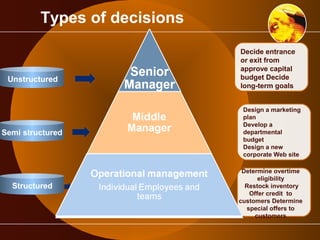
Unstructured 
Semi structured 
Structured 
Decide entrance 
or exit from 
approve capital 
budget Decide 
long-term goals 
Design a marketing 
plan 
Develop a 
departmental 
budget 
Design a new 
corporate Web site 
Determine overtime 
eligibility 
Restock inventory 
Offer credit to 
customers Determine 
special offers to 
customers 
Types of decisions
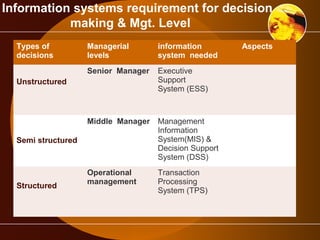
Information systems requirement for decision 
making & Mgt. Level 
Types of 
decisions 
Managerial 
levels 
information 
system needed 
Aspects 
Senior Manager Executive 
Support 
System (ESS) 
Middle Manager Management 
Information 
System(MIS) & 
Decision Support 
System (DSS) 
Operational 
management 
Transaction 
Processing 
System (TPS) 
Unstructured 
Semi structured 
Structured
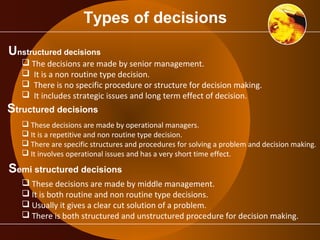
Types of decisions 
Unstructured decisions 
 The decisions are made by senior management. 
 It is a non routine type decision. 
 There is no specific procedure or structure for decision making. 
 It includes strategic issues and long term effect of decision. 
Structured decisions 
 These decisions are made by operational managers. 
 It is a repetitive and non routine type decision. 
 There are specific structures and procedures for solving a problem and decision making. 
 It involves operational issues and has a very short time effect. 
Semi structured decisions 
 These decisions are made by middle management. 
 It is both routine and non routine type decisions. 
 Usually it gives a clear cut solution of a problem. 
 There is both structured and unstructured procedure for decision making.
What information system is needed for what type 
of decision making /level of management? 
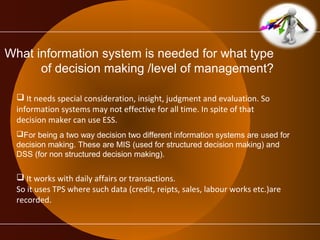
 It needs special consideration, insight, judgment and evaluation. So 
information systems may not effective for all time. In spite of that 
decision maker can use ESS. 
For being a two way decision two different information systems are used for 
decision making. These are MIS (used for structured decision making) and 
DSS (for non structured decision making). 
 It works with daily affairs or transactions. 
So it uses TPS where such data (credit, reipts, sales, labour works etc.)are 
recorded.
How decision making process work? 
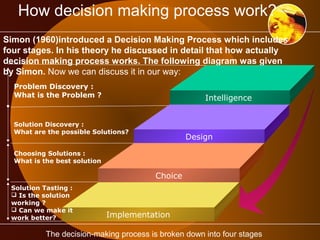
Simon (1960)introduced a Decision Making Process which includes 
four stages. In his theory he discussed in detail that how actually 
decision making process works. The following diagram was given 
by Simon. Now we can discuss it in our way: 
Intelligence 
Design 
Choice 
Implementation 
Problem Discovery : 
What is the Problem ? 
Solution Discovery : 
What are the possible Solutions? 
Choosing Solutions : 
What is the best solution 
Solution Tasting : 
 Is the solution 
working ? 
 Can we make it 
work better? 
The decision-making process is broken down into four stages
STAGES IN DECISION MAKING 
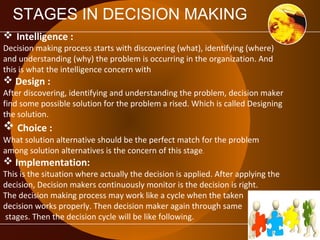
 Intelligence : 
Decision making process starts with discovering (what), identifying (where) 
and understanding (why) the problem is occurring in the organization. And 
this is what the intelligence concern with 
 Design : 
After discovering, identifying and understanding the problem, decision maker 
find some possible solution for the problem a rised. Which is called Designing 
the solution. 
 Choice : 
What solution alternative should be the perfect match for the problem 
among solution alternatives is the concern of this stage. 
 Implementation: 
This is the situation where actually the decision is applied. After applying the 
decision, Decision makers continuously monitor is the decision is right. 
The decision making process may work like a cycle when the taken 
decision works properly. Then decision maker again through same 
stages. Then the decision cycle will be like following.
Managerial Roles& Real world decision making 
Decision making is a part of Managerial role. So we first need to understand what 
roles a managers play in organization 
Managerial Roles: There are two Models to descried managerial roles 
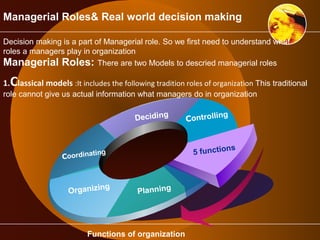
1.Classical models :It includes the following tradition roles of organization This traditional 
role cannot give us actual information what managers do in organization 
Coordinating 
Organizing 
Planning 
Controlling 
5 functions 
Deciding 
Functions of organization
Managerial Roles& Real world Decision Making 
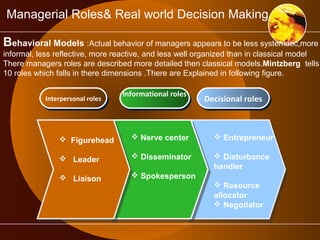
Behavioral Models :Actual behavior of managers appears to be less systematic,more 
informal, less reflective, more reactive, and less well organized than in classical model 
There managers roles are described more detailed then classical models.Mintzberg tells 
10 roles which falls in there dimensions .There are Explained in following figure. 
IInntteerrppeerrssoonnaall rroolleess IInnffoorrmmaattiioonnaall rroolleess 
DDeecciissiioonnaall rroolleess 
 Nerve center 
 Disseminator 
 Spokesperson 
 Entrepreneur 
 Disturbance 
handler 
 Resource 
allocator 
 Negotiator 
 Figurehead 
 Leader 
 Liaison
Real World Decision Making 
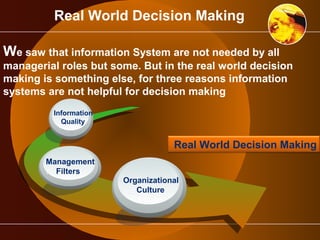
We saw that information System are not needed by all 
managerial roles but some. But in the real world decision 
making is something else, for three reasons information 
systems are not helpful for decision making 
Information 
…Quality 
Management 
….Filters 
Real World Decision Making 
Organizational 
__Culture
REAL WORLD DECISION MAKING 
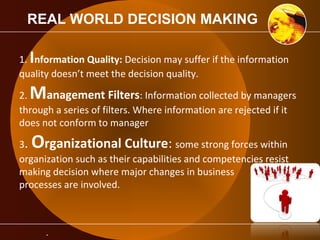
1. Information Quality: Decision may suffer if the information 
quality doesn’t meet the decision quality. 
2. Management Filters: Information collected by managers 
through a series of filters. Where information are rejected if it 
does not conform to manager 
3. Organizational Culture: some strong forces within 
organization such as their capabilities and competencies resist 
making decision where major changes in business 
processes are involved. 
.
Company 
LOGO

Decision Making and Information Systems

  • 1.
    Company LOGO PowerPointTemplate www.themegallery.com
  • 2.
    Management Information System Submitted To Lecturer MS. Samima Parvez Subject : Decision Making and Information Systems Group : D
  • 3.
    PRESENTER ID &NAME 31 2 33 4 5 1022114412 Md. Ariful Islam Saimon Chy 1022114372 Md.Shahadat Hossain 1021114362 Imteaj Ibna Hossain 1022114413 Md. Rasel 1022114384 Md.Shazzad Hossain
  • 4.
    Decision Making andInformation Systems Introduction: Today information systems provide information to all levels of management of an organization .So all the levels are responsible for decision making. Decision making is the developing concepts leading to the selection of a course of action among variations. Every decision making process produces a final choice, It can be an action or an opinion. It begins when we need to do something but we do not know what e.g. Decision to raise a Purchase Order Management Information Systems
  • 5.
    Objectives of theproject The objectives of our project are to find the answer of the following questions 1.What is the business value of improved decision making? 2.How many types of decisions are exist in different levels of management? 3.What information system is needed for what type of decision making /level of management? 4.How decision making process work? 5.How information system effect management role take decision?
  • 6.
    Business value ofimproved decision making Decisions must be made every level of management of an organization. Improved decisions can increase the average ROI and profitability of an organization. A single improved decision may effect in business value a little but numerous improved decisions can change the annual business value wholly.
  • 7.
    Unstructured Semi structured Structured Decide entrance or exit from approve capital budget Decide long-term goals Design a marketing plan Develop a departmental budget Design a new corporate Web site Determine overtime eligibility Restock inventory Offer credit to customers Determine special offers to customers Types of decisions
  • 8.
    Information systems requirementfor decision making & Mgt. Level Types of decisions Managerial levels information system needed Aspects Senior Manager Executive Support System (ESS) Middle Manager Management Information System(MIS) & Decision Support System (DSS) Operational management Transaction Processing System (TPS) Unstructured Semi structured Structured
  • 9.
    Types of decisions Unstructured decisions  The decisions are made by senior management.  It is a non routine type decision.  There is no specific procedure or structure for decision making.  It includes strategic issues and long term effect of decision. Structured decisions  These decisions are made by operational managers.  It is a repetitive and non routine type decision.  There are specific structures and procedures for solving a problem and decision making.  It involves operational issues and has a very short time effect. Semi structured decisions  These decisions are made by middle management.  It is both routine and non routine type decisions.  Usually it gives a clear cut solution of a problem.  There is both structured and unstructured procedure for decision making.
  • 10.
    What information systemis needed for what type of decision making /level of management?  It needs special consideration, insight, judgment and evaluation. So information systems may not effective for all time. In spite of that decision maker can use ESS. For being a two way decision two different information systems are used for decision making. These are MIS (used for structured decision making) and DSS (for non structured decision making).  It works with daily affairs or transactions. So it uses TPS where such data (credit, reipts, sales, labour works etc.)are recorded.
  • 11.
    How decision makingprocess work? Simon (1960)introduced a Decision Making Process which includes four stages. In his theory he discussed in detail that how actually decision making process works. The following diagram was given by Simon. Now we can discuss it in our way: Intelligence Design Choice Implementation Problem Discovery : What is the Problem ? Solution Discovery : What are the possible Solutions? Choosing Solutions : What is the best solution Solution Tasting :  Is the solution working ?  Can we make it work better? The decision-making process is broken down into four stages
  • 12.
    STAGES IN DECISIONMAKING  Intelligence : Decision making process starts with discovering (what), identifying (where) and understanding (why) the problem is occurring in the organization. And this is what the intelligence concern with  Design : After discovering, identifying and understanding the problem, decision maker find some possible solution for the problem a rised. Which is called Designing the solution.  Choice : What solution alternative should be the perfect match for the problem among solution alternatives is the concern of this stage.  Implementation: This is the situation where actually the decision is applied. After applying the decision, Decision makers continuously monitor is the decision is right. The decision making process may work like a cycle when the taken decision works properly. Then decision maker again through same stages. Then the decision cycle will be like following.
  • 13.
    Managerial Roles& Realworld decision making Decision making is a part of Managerial role. So we first need to understand what roles a managers play in organization Managerial Roles: There are two Models to descried managerial roles 1.Classical models :It includes the following tradition roles of organization This traditional role cannot give us actual information what managers do in organization Coordinating Organizing Planning Controlling 5 functions Deciding Functions of organization
  • 14.
    Managerial Roles& Realworld Decision Making Behavioral Models :Actual behavior of managers appears to be less systematic,more informal, less reflective, more reactive, and less well organized than in classical model There managers roles are described more detailed then classical models.Mintzberg tells 10 roles which falls in there dimensions .There are Explained in following figure. IInntteerrppeerrssoonnaall rroolleess IInnffoorrmmaattiioonnaall rroolleess DDeecciissiioonnaall rroolleess  Nerve center  Disseminator  Spokesperson  Entrepreneur  Disturbance handler  Resource allocator  Negotiator  Figurehead  Leader  Liaison
  • 15.
    Real World DecisionMaking We saw that information System are not needed by all managerial roles but some. But in the real world decision making is something else, for three reasons information systems are not helpful for decision making Information …Quality Management ….Filters Real World Decision Making Organizational __Culture
  • 16.
    REAL WORLD DECISIONMAKING 1. Information Quality: Decision may suffer if the information quality doesn’t meet the decision quality. 2. Management Filters: Information collected by managers through a series of filters. Where information are rejected if it does not conform to manager 3. Organizational Culture: some strong forces within organization such as their capabilities and competencies resist making decision where major changes in business processes are involved. .
  • 17.