ASSERTIVENESS
What is Assertiveness? What is it Not? How Assertive are You? Why? How do you develop Assertiveness? How do you begin? Communication Assertiveness
Collection of Behaviors Stem from a belief Your needs and wants Important as other’s people’s ASSERTIVENESS
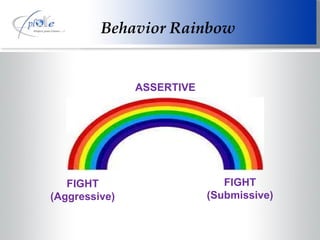
Behavior Rainbow FIGHT (Aggressive) FIGHT (Submissive) ASSERTIVE
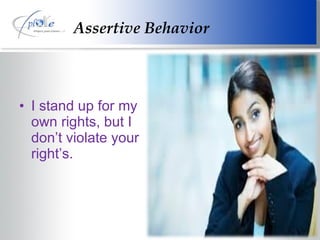
Assertive Behavior I stand up for my own rights, but I don’t violate your right’s.
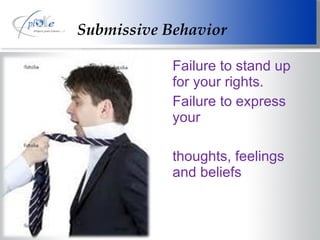
Submissive Behavior Failure to stand up for your rights. Failure to express your thoughts, feelings and beliefs
Aggressive Behavior I stand up for my rights I don’t care about yours. My rights are more important than your s.
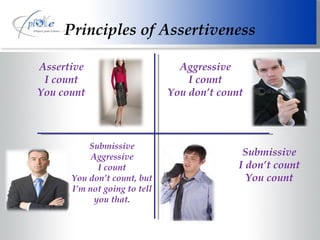
Principles of Assertiveness Assertive I count You count Aggressive I count You don’t count Submissive I don’t count You count Submissive Aggressive I count You don’t count, but I’m not going to tell you that.
What Assertiveness is and is Not Personal responsibility Awareness of other people’s rights Honesty and Respect Rational and adult behavior Ability to Negotiate Confidence Getting your own way Winning every time Using “Quick fix” tricks Manipulating people
Phases in Learning Assertive Behaviors P roject A nalyze L ook S peak up
Project Project yourself into past conflict situations See the common features Phases in Learning Assertive Behaviors
Analyze Degree of threat you felt Select a scene to improve on Phases in Learning Assertive Behaviors
Look See the emotions, language, and self- image How do you change them? Phases in Learning Assertive Behaviors
Speak up Plan a negotiating script or message Express in an affirmative manner
Barriers of Assertiveness Negative image Fear of conflict Lack of communication proficiency Culture
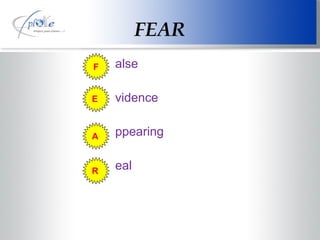
FEAR alse vidence ppearing eal F E A R
Shared information  = Shared cultures No behavior or value is universal. Be flexible to accept differences. Be sensitive to verbal nuances and non-verbal cues. Know practices of other cultures.
Self-Esteem
Beliefs Conclusions we have reached from experience. We hold them to be true. They affect our overt behavior
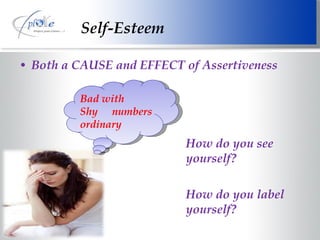
Both a CAUSE and EFFECT of Assertiveness Self-Esteem Bad with Shy  numbers  ordinary How do you see yourself? How do you label yourself?
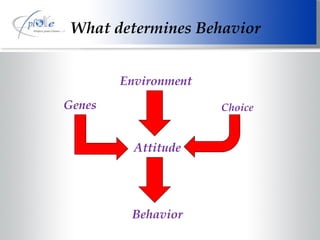
What determines Behavior Behavior Attitude Genes Environment Choice
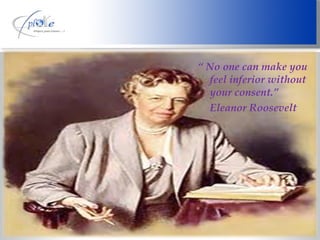
“  No one can make you feel inferior without your consent.” Eleanor Roosevelt
Aggressive Behaviors Excessive use of “I” statements Stating opinions as facts Putting others down Frequent use of ought and should  Blaming others Showing contempt and being hostile
That approach won’t work. You’d better do it. That’s only your opinion. You ought/should/must. It was your fault. Well, I blame you. Aggressive Expressions
Submissive Behaviors Ingratiating attempts to accommodate the needs of other people Long rambling statements to justify the self Qualifying phrases “ Filler” words Phrases that elicit others to ignore them
It’s only my opinion. Maybe… I wonder if… Just… Sorry to bother you, but…. Would you mind very much… I seem to be hopeless at this. It’s not important really. It doesn't matter. Submissive Behaviors
Assertive Behaviors Brief and to the point statements “ I” statements Clear distinction between fact and opinion Open-ended questions to elicit thoughts, needs and opinions of others Resolution of problems
Assertive Expressions I believe… I’d like… I want/need… In my experience… My opinion is… As I see it…
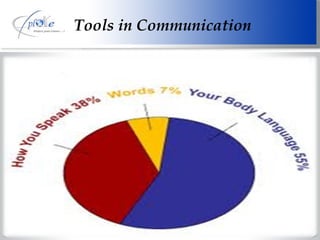
Tools in Communication
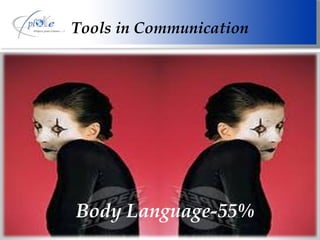
Tools in Communication Body Language-55%
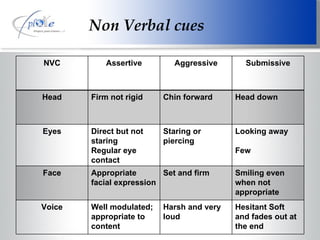
Non Verbal cues NVC Assertive Aggressive Submissive Head Firm not rigid Chin forward Head down Eyes Direct but not staring Regular eye contact Staring or  piercing Looking away Few Face Appropriate facial expression Set and firm Smiling even when not appropriate Voice Well modulated; appropriate to content Harsh and very loud Hesitant Soft and fades out at the end
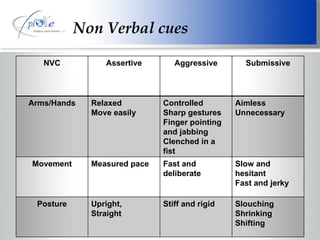
Non Verbal cues NVC Assertive Aggressive Submissive Arms/Hands Relaxed  Move easily Controlled Sharp gestures Finger pointing and jabbing Clenched in a fist Aimless Unnecessary Movement Measured pace Fast and deliberate Slow and hesitant Fast and jerky Posture Upright, Straight Stiff and rigid Slouching Shrinking Shifting
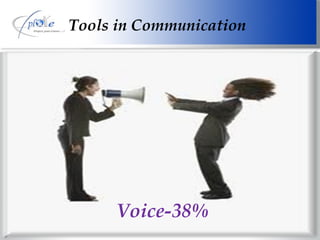
Tools in Communication Voice-38%
Tools in Communication 7%
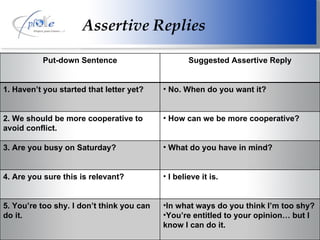
Assertive Replies Put-down Sentence Suggested Assertive Reply 1. Haven’t you started that letter yet? No. When do you want it? 2. We should be more cooperative to avoid conflict. How can we be more cooperative? 3. Are you busy on Saturday? What do you have in mind? 4. Are you sure this is relevant? I believe it is. 5. You’re too shy. I don’t think you can do it. In what ways do you think I’m too shy? You’re entitled to your opinion… but I know I can do it.
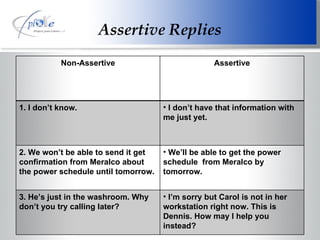
Assertive Replies Non-Assertive Assertive 1. I don’t know. I don’t have that information with me just yet. 2. We won’t be able to send it get confirmation from Meralco about the power schedule until tomorrow. We’ll be able to get the power schedule  from Meralco by tomorrow. 3. He’s just in the washroom. Why don’t you try calling later? I’m sorry but Carol is not in her workstation right now. This is Dennis. How may I help you instead?
Writing Scripts First concrete step Confidence Choice of right words Basis of rehearsal
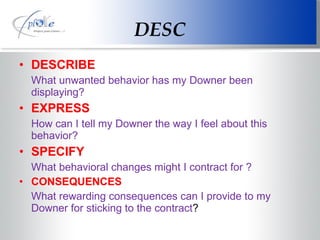
DESC DESCRIBE What unwanted behavior has my Downer been displaying? EXPRESS How can I tell my Downer the way I feel about this behavior? SPECIFY What behavioral changes might I contract for ? CONSEQUENCES What rewarding consequences can I provide to my Downer for sticking to the contract ?
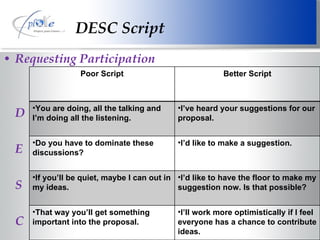
DESC Script Requesting Participation D E S C Poor Script Better Script You are doing, all the talking and I’m doing all the listening. I’ve heard your suggestions for our proposal. Do you have to dominate these discussions? I’d like to make a suggestion. If you’ll be quiet, maybe I can out in my ideas. I’d like to have the floor to make my suggestion now. Is that possible? That way you’ll get something important into the proposal. I’ll work more optimistically if I feel everyone has a chance to contribute ideas.
Simple Steps to Assertiveness
Listen Assertively
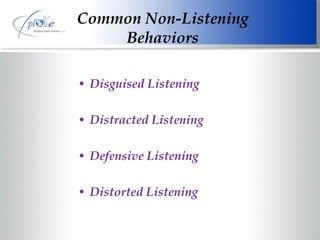
Common Non-Listening Behaviors Disguised Listening Distracted Listening Defensive Listening Distorted Listening
Bad Listening Habits Criticizing the speaker and the delivery Listening only for facts and not feelings Not taking notes or trying to write down everything Faking attention Tolerating or creating distractions
Tuning out difficult or confusing information Letter emotional words block the message Interrupting or finishing the other person’s sentence Biases and prejudices Not checking that you’ve understood Bad Listening Habits
Two Ears, One Mouth Prepare physically and psychologically. Fight off distractions. Listen for speaker’s main ideas. Be sensitive to your emotional triggers. Listen to speaker’s side first.
Reflect on differences of language. Do not trust to memory certain data that may be important. Listen actively. Repeat and clarify all key facts. Use positive body language to show that you are listening. Two Ears, One Mouth
Understanding a foreign Accent Don’t pretend to understand. Don’t rush. Don’t shout. Don’t be rude. Don’t use slang.
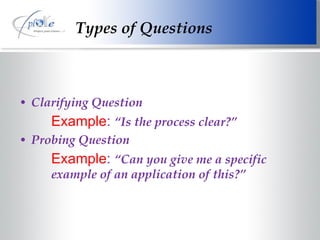
Types of Questions Clarifying Question Example :  “Is the process clear?” Probing Question Example :  “Can you give me a specific  example of an application of this?”
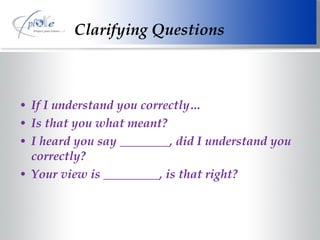
Clarifying Questions If I understand you correctly… Is that you what meant? I heard you say ________, did I understand you correctly? Your view is _________, is that right?
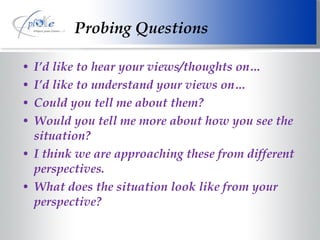
Probing Questions I’d like to hear your views/thoughts on… I’d like to understand your views on… Could you tell me about them? Would you tell me more about how you see the situation? I think we are approaching these from different perspectives. What does the situation look like from your perspective?
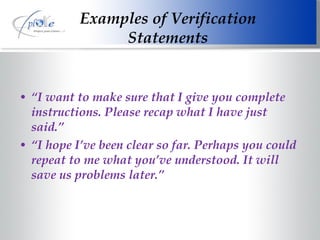
Examples of Verification Statements “ I want to make sure that I give you complete instructions. Please recap what I have just said.” “ I hope I’ve been clear so far. Perhaps you could repeat to me what you’ve understood. It will save us problems later.”
Say what you want to Happen
Use clear, direct requests or directives. Avoid hinting, being indirect, or presuming. Say what you want to Happen
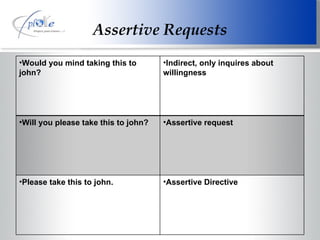
Assertive Requests Would you mind taking this to john? Indirect, only inquires about willingness Will you please take this to john? Assertive request Please take this to john. Assertive Directive
Be Direct
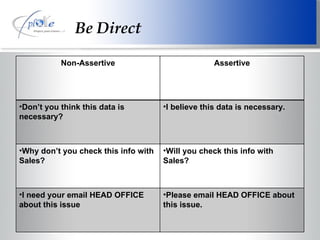
Be Direct Non-Assertive Assertive Don’t you think this data is necessary? I believe this data is necessary. Why don’t you check this info with Sales? Will you check this info with Sales? I need your email HEAD OFFICE about this issue Please email HEAD OFFICE about this issue.
Use Facts, not Judgments
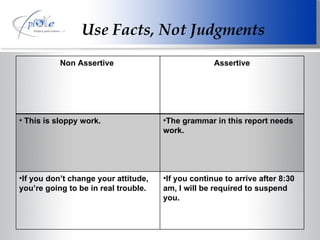
Use Facts, Not Judgments Non Assertive  Assertive This is sloppy work. The grammar in this report needs work. If you don’t change your attitude, you’re going to be in real trouble. If you continue to arrive after 8:30 am, I will be required to suspend you.
Take Responsibility
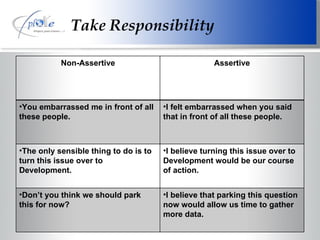
Take Responsibility Non-Assertive Assertive You embarrassed me in front of all these people. I felt embarrassed when you said that in front of all these people. The only sensible thing to do is to turn this issue over to Development. I believe turning this issue over to Development would be our course of action. Don’t you think we should park this for now? I believe that parking this question now would allow us time to gather more data.
Initiate Greeting Talk
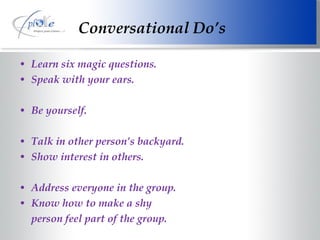
Conversational Do’s Learn six magic questions. Speak with your ears. Be yourself. Talk in other person’s backyard. Show interest in others. Address everyone in the group. Know how to make a shy person feel part of the group.
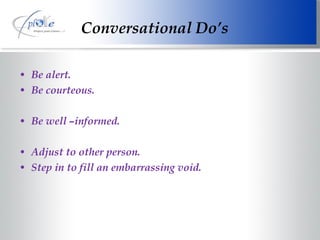
Be alert. Be courteous. Be well –informed. Adjust to other person. Step in to fill an embarrassing void. Conversational Do’s
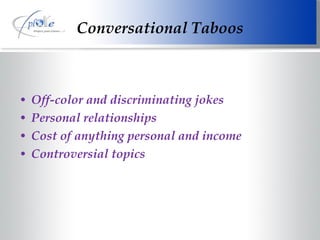
Conversational Taboos Off-color and discriminating jokes Personal relationships Cost of anything personal and income Controversial topics
Personal misfortune Demeaning terms Abrasive words or phrases Embarrassing questions Correcting another’s grammar or pronunciation in public Conversational Taboos
Give and Accept Genuine Compliments
Look, Sound, Feel Assertive
Look and Sound the Part Learn your lines. Speak with more power and expression. Speak clearly. Use body language that says YES or NO.
Learn how to say NO
Saying NO “ I open my mouth saying NO and it comes out as NO PROBLEM.” Don’t feel guilty. Start with simple situations. Be firm but polite. Give a reason, not an excuse.
Buy some thinking time. Ask for more information. Use appropriate body language and voice. Think it through. Set boundaries. Saying NO
Deal Assertively with Conflict
Focus on the content, not the behavior of the other person
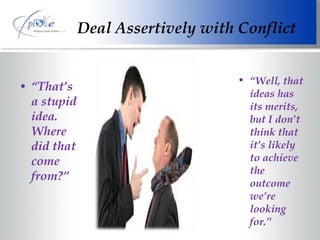
Deal Assertively with Conflict “ That’s  a stupid idea. Where did that come from?” “ Well, that ideas has its merits, but I don’t think that it’s likely to achieve the outcome we’re looking for.”
Detours These are defensive maneuvers caused by reacting to what is said. These can get off a person from his assertive track.
How to handle Detours Persist. Repeat your main point. “ That may be. I really find the volume too  loud.” Disagree. Make a direct Statement. “ I don’t agree.”
How to handle Detours Emphasize. The importance. “ This is important to me.” Agree. With the other person’s right to have  certain feelings, but disagree with the  idea that you must have the same  feelings.
How to handle Detours Redefine. Don’t accept someone’s  negative labell for your  behavior. Redefine in positive terms. “ I’m not being noisy. I’m just  naturally curious.”
Look and Feel Assertive Prepare to practice. Highlight your script Learn you lines Develop assertive body language
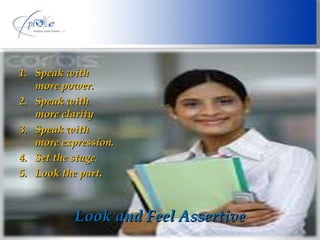
Look and Feel Assertive Speak with more power. Speak with more clarity Speak with more expression. Set the stage. Look the part.
“ The greatest discovery of my generations is that human beings can alter their lives by altering their attitudes of mind.” William James

Assertiveness

  • 1.
  • 2.
    What is Assertiveness?What is it Not? How Assertive are You? Why? How do you develop Assertiveness? How do you begin? Communication Assertiveness
  • 3.
    Collection of BehaviorsStem from a belief Your needs and wants Important as other’s people’s ASSERTIVENESS
  • 4.
    Behavior Rainbow FIGHT(Aggressive) FIGHT (Submissive) ASSERTIVE
  • 5.
    Assertive Behavior Istand up for my own rights, but I don’t violate your right’s.
  • 6.
    Submissive Behavior Failureto stand up for your rights. Failure to express your thoughts, feelings and beliefs
  • 7.
    Aggressive Behavior Istand up for my rights I don’t care about yours. My rights are more important than your s.
  • 8.
    Principles of AssertivenessAssertive I count You count Aggressive I count You don’t count Submissive I don’t count You count Submissive Aggressive I count You don’t count, but I’m not going to tell you that.
  • 9.
    What Assertiveness isand is Not Personal responsibility Awareness of other people’s rights Honesty and Respect Rational and adult behavior Ability to Negotiate Confidence Getting your own way Winning every time Using “Quick fix” tricks Manipulating people
  • 10.
    Phases in LearningAssertive Behaviors P roject A nalyze L ook S peak up
  • 11.
    Project Project yourselfinto past conflict situations See the common features Phases in Learning Assertive Behaviors
  • 12.
    Analyze Degree ofthreat you felt Select a scene to improve on Phases in Learning Assertive Behaviors
  • 13.
    Look See theemotions, language, and self- image How do you change them? Phases in Learning Assertive Behaviors
  • 14.
    Speak up Plana negotiating script or message Express in an affirmative manner
  • 15.
    Barriers of AssertivenessNegative image Fear of conflict Lack of communication proficiency Culture
  • 16.
    FEAR alse videnceppearing eal F E A R
  • 17.
    Shared information = Shared cultures No behavior or value is universal. Be flexible to accept differences. Be sensitive to verbal nuances and non-verbal cues. Know practices of other cultures.
  • 18.
  • 19.
    Beliefs Conclusions wehave reached from experience. We hold them to be true. They affect our overt behavior
  • 20.
    Both a CAUSEand EFFECT of Assertiveness Self-Esteem Bad with Shy numbers ordinary How do you see yourself? How do you label yourself?
  • 21.
    What determines BehaviorBehavior Attitude Genes Environment Choice
  • 22.
    “ Noone can make you feel inferior without your consent.” Eleanor Roosevelt
  • 23.
    Aggressive Behaviors Excessiveuse of “I” statements Stating opinions as facts Putting others down Frequent use of ought and should Blaming others Showing contempt and being hostile
  • 24.
    That approach won’twork. You’d better do it. That’s only your opinion. You ought/should/must. It was your fault. Well, I blame you. Aggressive Expressions
  • 25.
    Submissive Behaviors Ingratiatingattempts to accommodate the needs of other people Long rambling statements to justify the self Qualifying phrases “ Filler” words Phrases that elicit others to ignore them
  • 26.
    It’s only myopinion. Maybe… I wonder if… Just… Sorry to bother you, but…. Would you mind very much… I seem to be hopeless at this. It’s not important really. It doesn't matter. Submissive Behaviors
  • 27.
    Assertive Behaviors Briefand to the point statements “ I” statements Clear distinction between fact and opinion Open-ended questions to elicit thoughts, needs and opinions of others Resolution of problems
  • 28.
    Assertive Expressions Ibelieve… I’d like… I want/need… In my experience… My opinion is… As I see it…
  • 29.
  • 30.
    Tools in CommunicationBody Language-55%
  • 31.
    Non Verbal cuesNVC Assertive Aggressive Submissive Head Firm not rigid Chin forward Head down Eyes Direct but not staring Regular eye contact Staring or piercing Looking away Few Face Appropriate facial expression Set and firm Smiling even when not appropriate Voice Well modulated; appropriate to content Harsh and very loud Hesitant Soft and fades out at the end
  • 32.
    Non Verbal cuesNVC Assertive Aggressive Submissive Arms/Hands Relaxed Move easily Controlled Sharp gestures Finger pointing and jabbing Clenched in a fist Aimless Unnecessary Movement Measured pace Fast and deliberate Slow and hesitant Fast and jerky Posture Upright, Straight Stiff and rigid Slouching Shrinking Shifting
  • 33.
  • 34.
  • 35.
    Assertive Replies Put-downSentence Suggested Assertive Reply 1. Haven’t you started that letter yet? No. When do you want it? 2. We should be more cooperative to avoid conflict. How can we be more cooperative? 3. Are you busy on Saturday? What do you have in mind? 4. Are you sure this is relevant? I believe it is. 5. You’re too shy. I don’t think you can do it. In what ways do you think I’m too shy? You’re entitled to your opinion… but I know I can do it.
  • 36.
    Assertive Replies Non-AssertiveAssertive 1. I don’t know. I don’t have that information with me just yet. 2. We won’t be able to send it get confirmation from Meralco about the power schedule until tomorrow. We’ll be able to get the power schedule from Meralco by tomorrow. 3. He’s just in the washroom. Why don’t you try calling later? I’m sorry but Carol is not in her workstation right now. This is Dennis. How may I help you instead?
  • 37.
    Writing Scripts Firstconcrete step Confidence Choice of right words Basis of rehearsal
  • 38.
    DESC DESCRIBE Whatunwanted behavior has my Downer been displaying? EXPRESS How can I tell my Downer the way I feel about this behavior? SPECIFY What behavioral changes might I contract for ? CONSEQUENCES What rewarding consequences can I provide to my Downer for sticking to the contract ?
  • 39.
    DESC Script RequestingParticipation D E S C Poor Script Better Script You are doing, all the talking and I’m doing all the listening. I’ve heard your suggestions for our proposal. Do you have to dominate these discussions? I’d like to make a suggestion. If you’ll be quiet, maybe I can out in my ideas. I’d like to have the floor to make my suggestion now. Is that possible? That way you’ll get something important into the proposal. I’ll work more optimistically if I feel everyone has a chance to contribute ideas.
  • 40.
    Simple Steps toAssertiveness
  • 41.
  • 42.
    Common Non-Listening BehaviorsDisguised Listening Distracted Listening Defensive Listening Distorted Listening
  • 43.
    Bad Listening HabitsCriticizing the speaker and the delivery Listening only for facts and not feelings Not taking notes or trying to write down everything Faking attention Tolerating or creating distractions
  • 44.
    Tuning out difficultor confusing information Letter emotional words block the message Interrupting or finishing the other person’s sentence Biases and prejudices Not checking that you’ve understood Bad Listening Habits
  • 45.
    Two Ears, OneMouth Prepare physically and psychologically. Fight off distractions. Listen for speaker’s main ideas. Be sensitive to your emotional triggers. Listen to speaker’s side first.
  • 46.
    Reflect on differencesof language. Do not trust to memory certain data that may be important. Listen actively. Repeat and clarify all key facts. Use positive body language to show that you are listening. Two Ears, One Mouth
  • 47.
    Understanding a foreignAccent Don’t pretend to understand. Don’t rush. Don’t shout. Don’t be rude. Don’t use slang.
  • 48.
    Types of QuestionsClarifying Question Example : “Is the process clear?” Probing Question Example : “Can you give me a specific example of an application of this?”
  • 49.
    Clarifying Questions IfI understand you correctly… Is that you what meant? I heard you say ________, did I understand you correctly? Your view is _________, is that right?
  • 50.
    Probing Questions I’dlike to hear your views/thoughts on… I’d like to understand your views on… Could you tell me about them? Would you tell me more about how you see the situation? I think we are approaching these from different perspectives. What does the situation look like from your perspective?
  • 51.
    Examples of VerificationStatements “ I want to make sure that I give you complete instructions. Please recap what I have just said.” “ I hope I’ve been clear so far. Perhaps you could repeat to me what you’ve understood. It will save us problems later.”
  • 52.
    Say what youwant to Happen
  • 53.
    Use clear, directrequests or directives. Avoid hinting, being indirect, or presuming. Say what you want to Happen
  • 54.
    Assertive Requests Wouldyou mind taking this to john? Indirect, only inquires about willingness Will you please take this to john? Assertive request Please take this to john. Assertive Directive
  • 55.
  • 56.
    Be Direct Non-AssertiveAssertive Don’t you think this data is necessary? I believe this data is necessary. Why don’t you check this info with Sales? Will you check this info with Sales? I need your email HEAD OFFICE about this issue Please email HEAD OFFICE about this issue.
  • 57.
    Use Facts, notJudgments
  • 58.
    Use Facts, NotJudgments Non Assertive Assertive This is sloppy work. The grammar in this report needs work. If you don’t change your attitude, you’re going to be in real trouble. If you continue to arrive after 8:30 am, I will be required to suspend you.
  • 59.
  • 60.
    Take Responsibility Non-AssertiveAssertive You embarrassed me in front of all these people. I felt embarrassed when you said that in front of all these people. The only sensible thing to do is to turn this issue over to Development. I believe turning this issue over to Development would be our course of action. Don’t you think we should park this for now? I believe that parking this question now would allow us time to gather more data.
  • 61.
  • 62.
    Conversational Do’s Learnsix magic questions. Speak with your ears. Be yourself. Talk in other person’s backyard. Show interest in others. Address everyone in the group. Know how to make a shy person feel part of the group.
  • 63.
    Be alert. Becourteous. Be well –informed. Adjust to other person. Step in to fill an embarrassing void. Conversational Do’s
  • 64.
    Conversational Taboos Off-colorand discriminating jokes Personal relationships Cost of anything personal and income Controversial topics
  • 65.
    Personal misfortune Demeaningterms Abrasive words or phrases Embarrassing questions Correcting another’s grammar or pronunciation in public Conversational Taboos
  • 66.
    Give and AcceptGenuine Compliments
  • 67.
  • 68.
    Look and Soundthe Part Learn your lines. Speak with more power and expression. Speak clearly. Use body language that says YES or NO.
  • 69.
  • 70.
    Saying NO “I open my mouth saying NO and it comes out as NO PROBLEM.” Don’t feel guilty. Start with simple situations. Be firm but polite. Give a reason, not an excuse.
  • 71.
    Buy some thinkingtime. Ask for more information. Use appropriate body language and voice. Think it through. Set boundaries. Saying NO
  • 72.
  • 73.
    Focus on thecontent, not the behavior of the other person
  • 74.
    Deal Assertively withConflict “ That’s a stupid idea. Where did that come from?” “ Well, that ideas has its merits, but I don’t think that it’s likely to achieve the outcome we’re looking for.”
  • 75.
    Detours These aredefensive maneuvers caused by reacting to what is said. These can get off a person from his assertive track.
  • 76.
    How to handleDetours Persist. Repeat your main point. “ That may be. I really find the volume too loud.” Disagree. Make a direct Statement. “ I don’t agree.”
  • 77.
    How to handleDetours Emphasize. The importance. “ This is important to me.” Agree. With the other person’s right to have certain feelings, but disagree with the idea that you must have the same feelings.
  • 78.
    How to handleDetours Redefine. Don’t accept someone’s negative labell for your behavior. Redefine in positive terms. “ I’m not being noisy. I’m just naturally curious.”
  • 79.
    Look and FeelAssertive Prepare to practice. Highlight your script Learn you lines Develop assertive body language
  • 80.
    Look and FeelAssertive Speak with more power. Speak with more clarity Speak with more expression. Set the stage. Look the part.
  • 81.
    “ The greatestdiscovery of my generations is that human beings can alter their lives by altering their attitudes of mind.” William James