To Our Sales Rally
Welcome
Quote of the Month
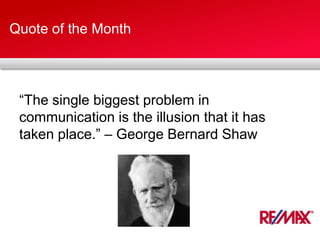
“The single biggest problem in
communication is the illusion that it has
taken place.” – George Bernard Shaw
What’s Dave Have to Say?
https://www.remax.net/News/Pages/Liniger
Top10Predictions2013.aspx
Welcome to the Fam!
State of the Office & Market
Kudos!
Motivational Moment
Crucial Conversations Are
Interactions that happen to everyone.
They’re the day to day conversations that
affect your life.
Crucial Conversations Are Ones
In Which
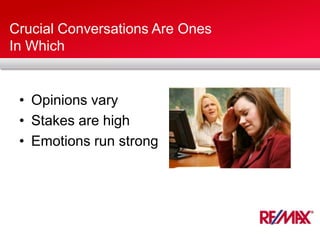
• Opinions vary
• Stakes are high
• Emotions run strong
What Makes Each Conversation
Crucial
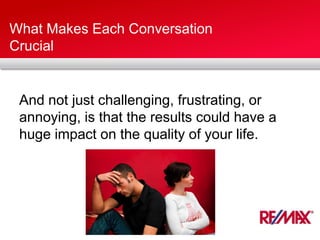
And not just challenging, frustrating, or
annoying, is that the results could have a
huge impact on the quality of your life.
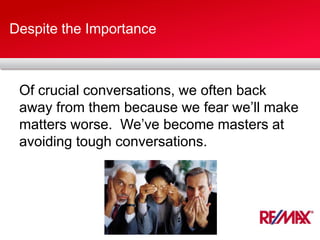
Despite the Importance
Of crucial conversations, we often back
away from them because we fear we’ll make
matters worse. We’ve become masters at
avoiding tough conversations.
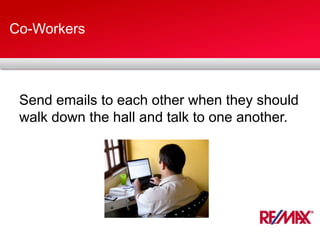
Co-Workers
Send emails to each other when they should
walk down the hall and talk to one another.
Bosses
Leave voice mail in lieu of meeting with their
direct reports.
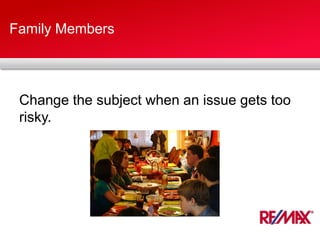
Family Members
Change the subject when an issue gets too
risky.
Three Possible Ways to Handle
Crucial Conversations
1. We can avoid them.
2. We can face them and handle them
poorly.
3. We can face them and handle them well.
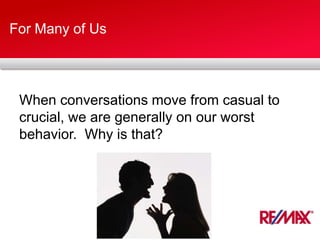
For Many of Us
When conversations move from casual to
crucial, we are generally on our worst
behavior. Why is that?
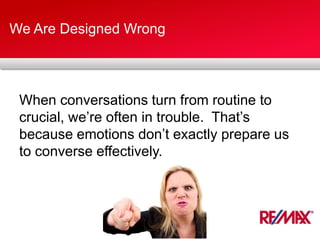
We Are Designed Wrong
When conversations turn from routine to
crucial, we’re often in trouble. That’s
because emotions don’t exactly prepare us
to converse effectively.
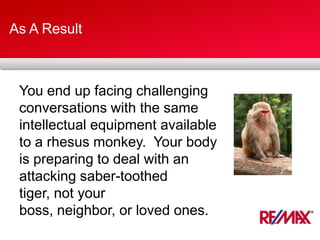
As A Result
You end up facing challenging
conversations with the same
intellectual equipment available
to a rhesus monkey. Your body
is preparing to deal with an
attacking saber-toothed
tiger, not your
boss, neighbor, or loved ones.
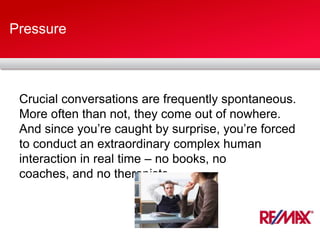
Pressure
Crucial conversations are frequently spontaneous.
More often than not, they come out of nowhere.
And since you’re caught by surprise, you’re forced
to conduct an extraordinary complex human
interaction in real time – no books, no
coaches, and no therapists.
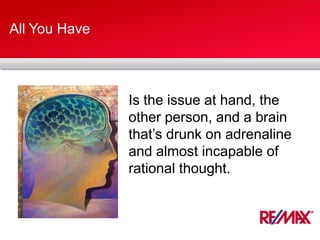
All You Have
Is the issue at hand, the
other person, and a brain
that’s drunk on adrenaline
and almost incapable of
rational thought.
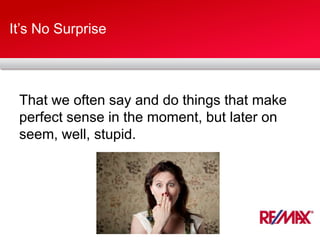
It’s No Surprise
That we often say and do things that make
perfect sense in the moment, but later on
seem, well, stupid.
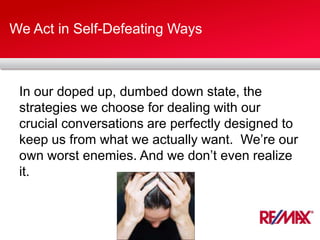
We Act in Self-Defeating Ways
In our doped up, dumbed down state, the
strategies we choose for dealing with our
crucial conversations are perfectly designed to
keep us from what we actually want. We’re our
own worst enemies. And we don’t even realize
it.
Here are Some Typical Crucial
Conversations
• Ending a relationship
• Talking to a co-worker who behaves
offensively
• Asking a friend to repay a loan
• Giving the boss feedback about her
behavior
• Critiquing a colleague’s work
Here are Some Typical Crucial
Conversations
• Resolving custody or visitation issues
• Dealing with a rebellious teen
• Asking in-laws to quit interfering
• Talking to a co-worker about personal
hygiene problems
By The Way…
In real estate, isn’t almost every
conversation a crucial one?
• Offers
• Negotiating
• Pricing a listing
• Getting a buyer contract signed
• Overcoming objections
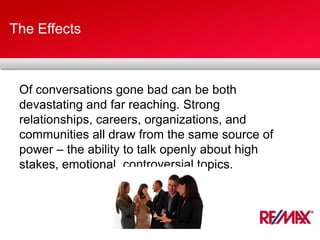
The Effects
Of conversations gone bad can be both
devastating and far reaching. Strong
relationships, careers, organizations, and
communities all draw from the same source of
power – the ability to talk openly about high
stakes, emotional, controversial topics.
The Key Skill
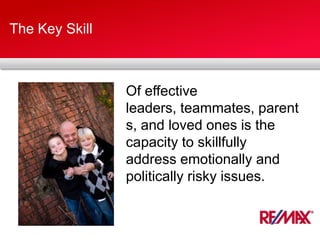
Of effective
leaders, teammates, parent
s, and loved ones is the
capacity to skillfully
address emotionally and
politically risky issues.
As it Turns Out
You don’t have to choose between being
honest and being effective. You don’t have
to choose between candor and your career.
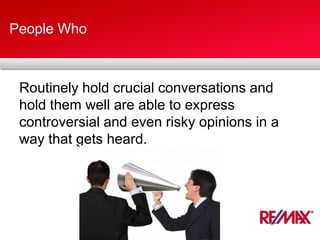
People Who
Routinely hold crucial conversations and
hold them well are able to express
controversial and even risky opinions in a
way that gets heard.
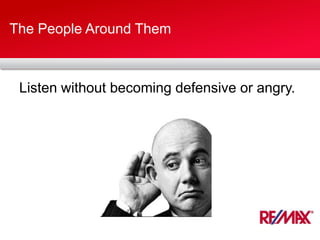
The People Around Them
Listen without becoming defensive or angry.
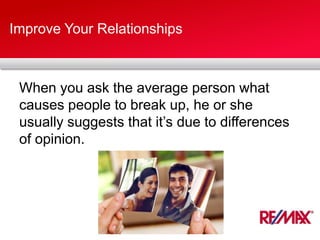
Improve Your Relationships
When you ask the average person what
causes people to break up, he or she
usually suggests that it’s due to differences
of opinion.
People Have
Different theories about how to manage their
finances, spice up their love lives, or rear
their children.
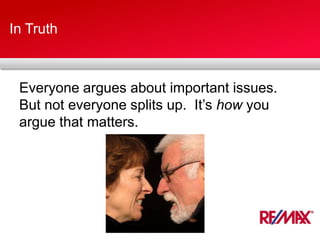
In Truth
Everyone argues about important issues.
But not everyone splits up. It’s how you
argue that matters.
Live Healthier!
The emotional pain we suffer, and the
constant battering we endure as we stumble
our way through unhealthy conversations
slowly eats away at our health.
In Some Cases
The impact of failed conversations leads to
minor problems. In others it results in
disaster. In all cases, failed conversations
never make us happier, healthier, or better
off.
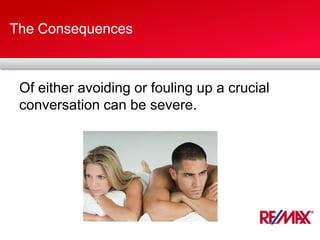
The Consequences
Of either avoiding or fouling up a crucial
conversation can be severe.
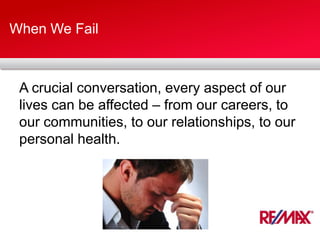
When We Fail
A crucial conversation, every aspect of our
lives can be affected – from our careers, to
our communities, to our relationships, to our
personal health.
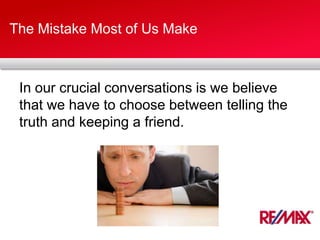
The Mistake Most of Us Make
In our crucial conversations is we believe
that we have to choose between telling the
truth and keeping a friend.
The Fool’s Choice
When we were young we learned that when
Grandma served us a large wedge of
Brussels Sprout Pie and then asked, “Do
you like it?” – she really meant, “Do you like
me?”
When We Answered Honestly
And saw the look of hurt and horror on her
face, we made a decision that affected the
rest of our lives: “From this day forward, I
will be alert for moments when I must
choose between candor and kindness.”
And From That Day Forward
We have found plenty of those same types
of moments with bosses, colleagues, and
loved ones. The consequences can be
disastrous.
When It Comes
To risky, controversial, and emotional
conversations, skilled people find a way to
get all relevant information (from themselves
and others) out into the open. That’s it.
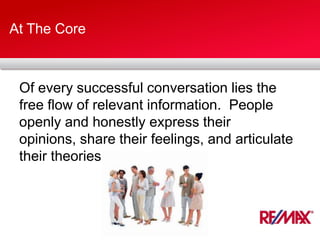
At The Core
Of every successful conversation lies the
free flow of relevant information. People
openly and honestly express their
opinions, share their feelings, and articulate
their theories.
They Willingly
And capably share their views, even when
their ideas are controversial or unpopular.
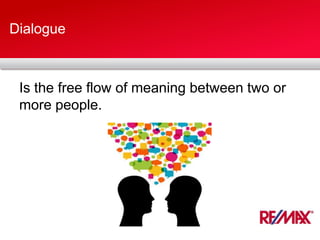
Dialogue
Is the free flow of meaning between two or
more people.
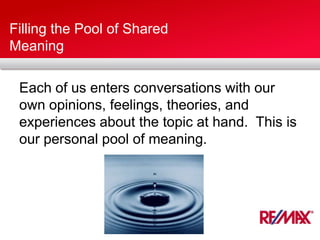
Filling the Pool of Shared
Meaning
Each of us enters conversations with our
own opinions, feelings, theories, and
experiences about the topic at hand. This is
our personal pool of meaning.
When Two or More People
Enter crucial conversations, they don’t share
the same pool. Their opinions differ.
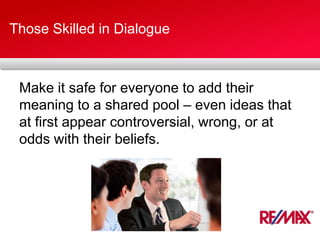
Those Skilled in Dialogue
Make it safe for everyone to add their
meaning to a shared pool – even ideas that
at first appear controversial, wrong, or at
odds with their beliefs.
The Pool of Shared Meaning
Is the birthplace of synergy.
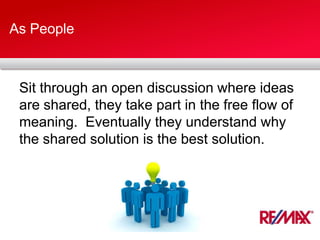
As People
Sit through an open discussion where ideas
are shared, they take part in the free flow of
meaning. Eventually they understand why
the shared solution is the best solution.
The Time You Spend
Up front establishing a shared pool of
meaning is more than paid for by
faster, more unified, and more committed
action later on.
Let’s Look At
How people who are skilled at dialogue stay
focused on their goals – particularly when
the going gets tough.
This Requires
• Work on me first, and us second
• Focus on what you really want
• Refuse the fool’s choice
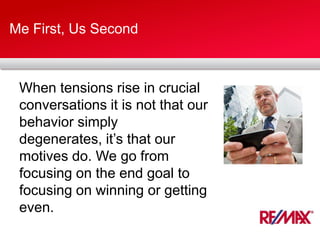
Me First, Us Second
When tensions rise in crucial
conversations it is not that our
behavior simply
degenerates, it’s that our
motives do. We go from
focusing on the end goal to
focusing on winning or getting
even.
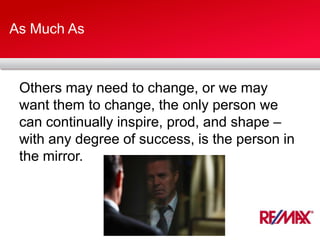
As Much As
Others may need to change, or we may
want them to change, the only person we
can continually inspire, prod, and shape –
with any degree of success, is the person in
the mirror.
Focus On What You Really Want
When conversations
become crucial, step back
and look at yourself as an
outsider. Ask
yourself, “What am I
doing, and if I had to
guess, what does it tell me
about my underlying
motive?”
Stop & Ask Yourself
• What do I really want for myself?
• What do I really want for others?
• What do I really want for the relationship?
Refuse the Fool’s Choice
Watch to see if you’re telling yourself that
you must choose between peace and
honesty, between winning and losing, and so
on. Break free of the fool’s choice by
searching for the and.
Clarify What You Don’t Want
Add to it what you do want, and ask your
brain to start searching for healthy options to
bring you to dialogue.
Learn to Look
When caught up in a crucial
conversation, it’s difficult to see exactly
what’s going on and why. When a
discussion starts to become stressful, we
often end up doing the opposite of what
works.
Learn to Spot Crucial
Conversations
• Physical Signals – stomach tightens, eyes
get dry
• Emotions – scared, hurt, angry
• Behavior – raised voice or becoming
extremely quiet
Spot Safety Problems
Those most skilled at dialogue keep an eye
on safety. If you make it safe
enough, people feel like they can talk about
anything without fear that they will be
attacked or humiliated.
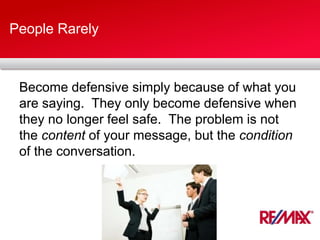
People Rarely
Become defensive simply because of what you
are saying. They only become defensive when
they no longer feel safe. The problem is not
the content of your message, but the condition
of the conversation.
If You Can Learn
To see when people start to feel unsafe, you
can take action to fix it. That means that the
first challenge is to simply see and
understand that safety is at risk.
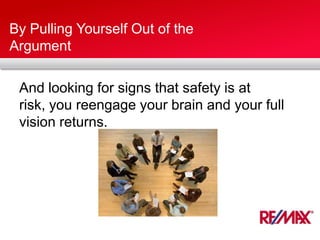
By Pulling Yourself Out of the
Argument
And looking for signs that safety is at
risk, you reengage your brain and your full
vision returns.
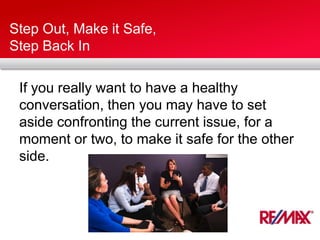
Step Out, Make it Safe,
Step Back In
If you really want to have a healthy
conversation, then you may have to set
aside confronting the current issue, for a
moment or two, to make it safe for the other
side.
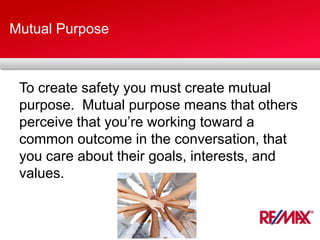
Mutual Purpose
To create safety you must create mutual
purpose. Mutual purpose means that others
perceive that you’re working toward a
common outcome in the conversation, that
you care about their goals, interests, and
values.
And Vice Versa
You believe they care about yours.
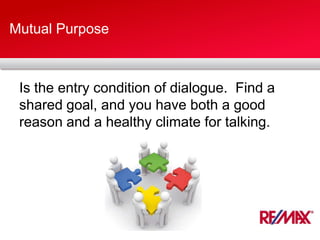
Mutual Purpose
Is the entry condition of dialogue. Find a
shared goal, and you have both a good
reason and a healthy climate for talking.
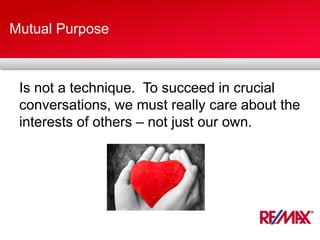
Mutual Purpose
Is not a technique. To succeed in crucial
conversations, we must really care about the
interests of others – not just our own.
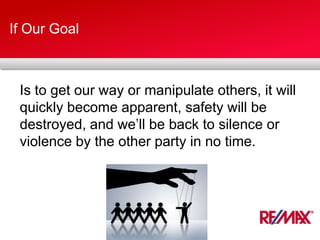
If Our Goal
Is to get our way or manipulate others, it will
quickly become apparent, safety will be
destroyed, and we’ll be back to silence or
violence by the other party in no time.
Examine Your Motives
Ask yourself:
• What do I want for me?
• What do I want for others?
• What do I want for the relationship?
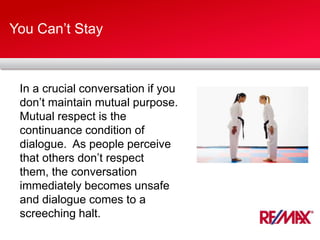
You Can’t Stay
In a crucial conversation if you
don’t maintain mutual purpose.
Mutual respect is the
continuance condition of
dialogue. As people perceive
that others don’t respect
them, the conversation
immediately becomes unsafe
and dialogue comes to a
screeching halt.
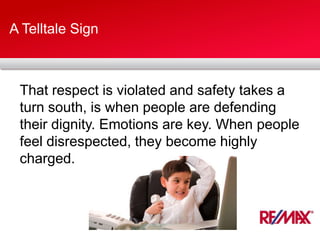
A Telltale Sign
That respect is violated and safety takes a
turn south, is when people are defending
their dignity. Emotions are key. When people
feel disrespected, they become highly
charged.
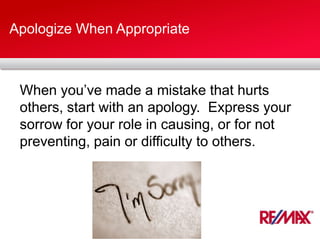
Apologize When Appropriate
When you’ve made a mistake that hurts
others, start with an apology. Express your
sorrow for your role in causing, or for not
preventing, pain or difficulty to others.
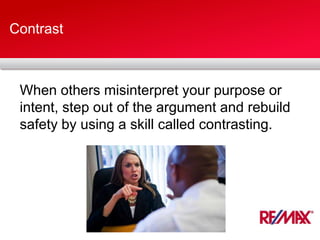
Contrast
When others misinterpret your purpose or
intent, step out of the argument and rebuild
safety by using a skill called contrasting.
Contrasting
Is a don’t/do statement that:
• Addresses others’ concerns that you don’t
respect them or that you have malicious
purpose (the don’t part).
• Confirms your respect or clarifies your real
purpose (the do part).
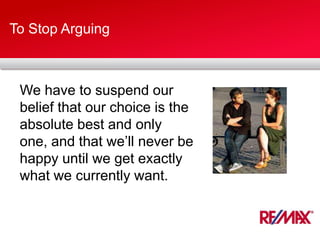
To Stop Arguing
We have to suspend our
belief that our choice is the
absolute best and only
one, and that we’ll never be
happy until we get exactly
what we currently want.
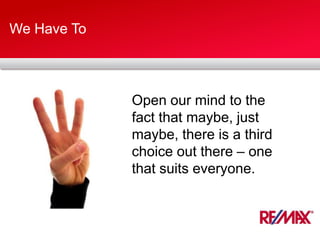
We Have To
Open our mind to the
fact that maybe, just
maybe, there is a third
choice out there – one
that suits everyone.
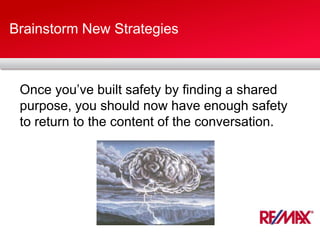
Brainstorm New Strategies
Once you’ve built safety by finding a shared
purpose, you should now have enough safety
to return to the content of the conversation.
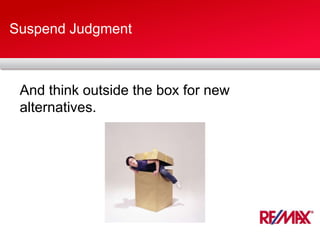
Suspend Judgment
And think outside the box for new
alternatives.
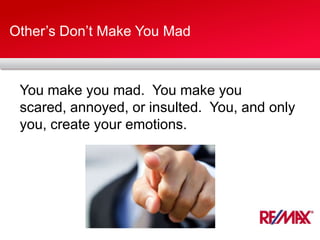
Other’s Don’t Make You Mad
You make you mad. You make you
scared, annoyed, or insulted. You, and only
you, create your emotions.
Once You’ve Created Your Upset
Emotions
You have only two options: You can act on
them or be acted on by them. When it
comes to strong emotions, you either find a
way to master them or fall hostage to them.
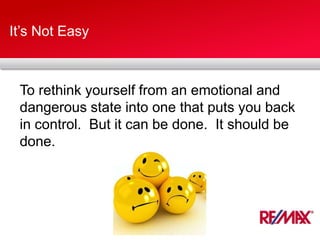
It’s Not Easy
To rethink yourself from an emotional and
dangerous state into one that puts you back
in control. But it can be done. It should be
done.
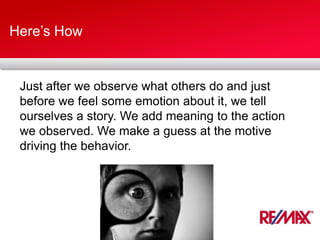
Here’s How
Just after we observe what others do and just
before we feel some emotion about it, we tell
ourselves a story. We add meaning to the action
we observed. We make a guess at the motive
driving the behavior.
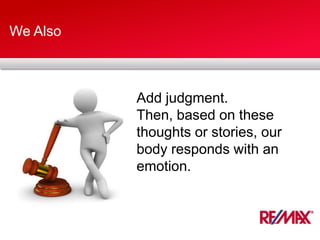
We Also
Add judgment.
Then, based on these
thoughts or stories, our
body responds with an
emotion.
If We Take Control
Of our stories, they won’t control us. People who
excel at dialogue are able to influence their
emotions during crucial conversations. They tell
themselves different stories and break the loop.
It’s the only way to break the loop.
The Best Way To
Find out the true story is not to act out the
worst story you can generate. That will lead
to self-destructive silent or violence games.
Think about other possible explanations long
enough to temper your emotions so you can
get to dialogue.
Once You’ve Worked On Yourself
To create the right conditions for
dialogue, you can then draw upon 5 distinct
skills that can help you talk about even the
most sensitive topics.
STATE
• Share your facts
• Tell your story
• Ask for others’ paths
• Talk tentatively
• Encourage testing
Share Your Facts
Start with the least controversial, most
persuasive elements from your path to
action.
Tell Your Story
Explain what you are beginning to conclude.
Ask for Others’ Paths
Encourage others to share both their facts
and their stories.
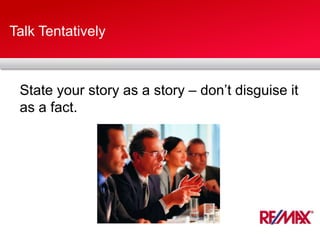
Talk Tentatively
State your story as a story – don’t disguise it
as a fact.
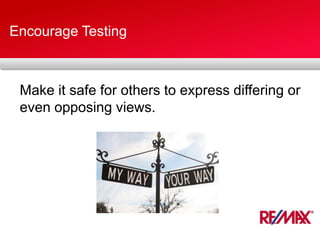
Encourage Testing
Make it safe for others to express differing or
even opposing views.
How do You Listen When Others
Blow Up or Clam Up?
Be sincere: To get others’ facts and stories
into the pool of meaning we have to invite
them to share what’s on their minds.
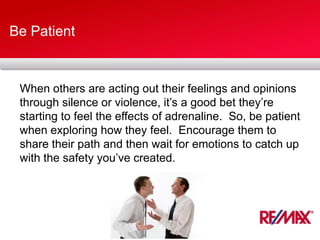
Be Patient
When others are acting out their feelings and opinions
through silence or violence, it’s a good bet they’re
starting to feel the effects of adrenaline. So, be patient
when exploring how they feel. Encourage them to
share their path and then wait for emotions to catch up
with the safety you’ve created.
4 Powerful Listening Skills to Retrace
the Other Person’s Path to Action
• Ask
• Mirror
• Paraphrase
• Prime
Ask
Start by simply expressing interest in the
other person’s views.
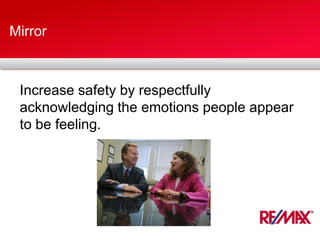
Mirror
Increase safety by respectfully
acknowledging the emotions people appear
to be feeling.
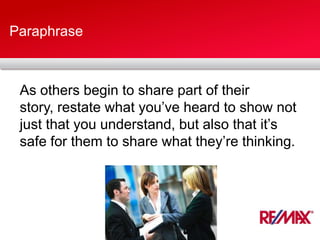
Paraphrase
As others begin to share part of their
story, restate what you’ve heard to show not
just that you understand, but also that it’s
safe for them to share what they’re thinking.
Prime
If others continue to hold back, prime. Take
your best guess at what they may be
thinking and feeling.
Final Thoughts
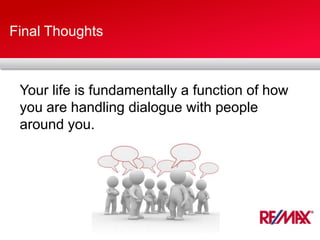
Your life is fundamentally a function of how
you are handling dialogue with people
around you.
If You Persist
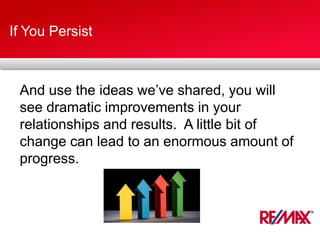
And use the ideas we’ve shared, you will
see dramatic improvements in your
relationships and results. A little bit of
change can lead to an enormous amount of
progress.
Motivational Moment
30 Second Pitch
Sharpening Your Skills
www.RealEstateCareerMentor.com
Sharpening Your Skills
www.RealEstateCareerMentor.com
Sharpening Your Skills
www.RealEstateCareerMentor.com
Sharpening Your Skills
www.RealEstateCareerMentor.com
The Mortgage Minute
Technology Tip – Stickk.com
Great Reads
Upcoming Events
As Always
As Always... if you know of anyone who would
appreciate working at a rewarding and
professional real estate office that is dedicated to
enriching the lives and careers of its agents, please
call me with their name and business number and
I would be happy to follow up and take great care
of them!
THANK YOU!

Sample Monthly Rally - 90 Mins

  • 1.
    To Our SalesRally Welcome
  • 2.
    Quote of theMonth “The single biggest problem in communication is the illusion that it has taken place.” – George Bernard Shaw
  • 7.
    What’s Dave Haveto Say? https://www.remax.net/News/Pages/Liniger Top10Predictions2013.aspx
  • 8.
  • 9.
    State of theOffice & Market
  • 10.
  • 11.
  • 12.
    Crucial Conversations Are Interactionsthat happen to everyone. They’re the day to day conversations that affect your life.
  • 13.
    Crucial Conversations AreOnes In Which • Opinions vary • Stakes are high • Emotions run strong
  • 14.
    What Makes EachConversation Crucial And not just challenging, frustrating, or annoying, is that the results could have a huge impact on the quality of your life.
  • 15.
    Despite the Importance Ofcrucial conversations, we often back away from them because we fear we’ll make matters worse. We’ve become masters at avoiding tough conversations.
  • 16.
    Co-Workers Send emails toeach other when they should walk down the hall and talk to one another.
  • 17.
    Bosses Leave voice mailin lieu of meeting with their direct reports.
  • 18.
    Family Members Change thesubject when an issue gets too risky.
  • 19.
    Three Possible Waysto Handle Crucial Conversations 1. We can avoid them. 2. We can face them and handle them poorly. 3. We can face them and handle them well.
  • 20.
    For Many ofUs When conversations move from casual to crucial, we are generally on our worst behavior. Why is that?
  • 21.
    We Are DesignedWrong When conversations turn from routine to crucial, we’re often in trouble. That’s because emotions don’t exactly prepare us to converse effectively.
  • 22.
    As A Result Youend up facing challenging conversations with the same intellectual equipment available to a rhesus monkey. Your body is preparing to deal with an attacking saber-toothed tiger, not your boss, neighbor, or loved ones.
  • 23.
    Pressure Crucial conversations arefrequently spontaneous. More often than not, they come out of nowhere. And since you’re caught by surprise, you’re forced to conduct an extraordinary complex human interaction in real time – no books, no coaches, and no therapists.
  • 24.
    All You Have Isthe issue at hand, the other person, and a brain that’s drunk on adrenaline and almost incapable of rational thought.
  • 25.
    It’s No Surprise Thatwe often say and do things that make perfect sense in the moment, but later on seem, well, stupid.
  • 26.
    We Act inSelf-Defeating Ways In our doped up, dumbed down state, the strategies we choose for dealing with our crucial conversations are perfectly designed to keep us from what we actually want. We’re our own worst enemies. And we don’t even realize it.
  • 27.
    Here are SomeTypical Crucial Conversations • Ending a relationship • Talking to a co-worker who behaves offensively • Asking a friend to repay a loan • Giving the boss feedback about her behavior • Critiquing a colleague’s work
  • 28.
    Here are SomeTypical Crucial Conversations • Resolving custody or visitation issues • Dealing with a rebellious teen • Asking in-laws to quit interfering • Talking to a co-worker about personal hygiene problems
  • 29.
    By The Way… Inreal estate, isn’t almost every conversation a crucial one? • Offers • Negotiating • Pricing a listing • Getting a buyer contract signed • Overcoming objections
  • 30.
    The Effects Of conversationsgone bad can be both devastating and far reaching. Strong relationships, careers, organizations, and communities all draw from the same source of power – the ability to talk openly about high stakes, emotional, controversial topics.
  • 31.
    The Key Skill Ofeffective leaders, teammates, parent s, and loved ones is the capacity to skillfully address emotionally and politically risky issues.
  • 32.
    As it TurnsOut You don’t have to choose between being honest and being effective. You don’t have to choose between candor and your career.
  • 33.
    People Who Routinely holdcrucial conversations and hold them well are able to express controversial and even risky opinions in a way that gets heard.
  • 34.
    The People AroundThem Listen without becoming defensive or angry.
  • 35.
    Improve Your Relationships Whenyou ask the average person what causes people to break up, he or she usually suggests that it’s due to differences of opinion.
  • 36.
    People Have Different theoriesabout how to manage their finances, spice up their love lives, or rear their children.
  • 37.
    In Truth Everyone arguesabout important issues. But not everyone splits up. It’s how you argue that matters.
  • 38.
    Live Healthier! The emotionalpain we suffer, and the constant battering we endure as we stumble our way through unhealthy conversations slowly eats away at our health.
  • 39.
    In Some Cases Theimpact of failed conversations leads to minor problems. In others it results in disaster. In all cases, failed conversations never make us happier, healthier, or better off.
  • 40.
    The Consequences Of eitheravoiding or fouling up a crucial conversation can be severe.
  • 41.
    When We Fail Acrucial conversation, every aspect of our lives can be affected – from our careers, to our communities, to our relationships, to our personal health.
  • 42.
    The Mistake Mostof Us Make In our crucial conversations is we believe that we have to choose between telling the truth and keeping a friend.
  • 43.
    The Fool’s Choice Whenwe were young we learned that when Grandma served us a large wedge of Brussels Sprout Pie and then asked, “Do you like it?” – she really meant, “Do you like me?”
  • 44.
    When We AnsweredHonestly And saw the look of hurt and horror on her face, we made a decision that affected the rest of our lives: “From this day forward, I will be alert for moments when I must choose between candor and kindness.”
  • 45.
    And From ThatDay Forward We have found plenty of those same types of moments with bosses, colleagues, and loved ones. The consequences can be disastrous.
  • 46.
    When It Comes Torisky, controversial, and emotional conversations, skilled people find a way to get all relevant information (from themselves and others) out into the open. That’s it.
  • 47.
    At The Core Ofevery successful conversation lies the free flow of relevant information. People openly and honestly express their opinions, share their feelings, and articulate their theories.
  • 48.
    They Willingly And capablyshare their views, even when their ideas are controversial or unpopular.
  • 49.
    Dialogue Is the freeflow of meaning between two or more people.
  • 50.
    Filling the Poolof Shared Meaning Each of us enters conversations with our own opinions, feelings, theories, and experiences about the topic at hand. This is our personal pool of meaning.
  • 51.
    When Two orMore People Enter crucial conversations, they don’t share the same pool. Their opinions differ.
  • 52.
    Those Skilled inDialogue Make it safe for everyone to add their meaning to a shared pool – even ideas that at first appear controversial, wrong, or at odds with their beliefs.
  • 53.
    The Pool ofShared Meaning Is the birthplace of synergy.
  • 54.
    As People Sit throughan open discussion where ideas are shared, they take part in the free flow of meaning. Eventually they understand why the shared solution is the best solution.
  • 55.
    The Time YouSpend Up front establishing a shared pool of meaning is more than paid for by faster, more unified, and more committed action later on.
  • 56.
    Let’s Look At Howpeople who are skilled at dialogue stay focused on their goals – particularly when the going gets tough.
  • 57.
    This Requires • Workon me first, and us second • Focus on what you really want • Refuse the fool’s choice
  • 58.
    Me First, UsSecond When tensions rise in crucial conversations it is not that our behavior simply degenerates, it’s that our motives do. We go from focusing on the end goal to focusing on winning or getting even.
  • 59.
    As Much As Othersmay need to change, or we may want them to change, the only person we can continually inspire, prod, and shape – with any degree of success, is the person in the mirror.
  • 60.
    Focus On WhatYou Really Want When conversations become crucial, step back and look at yourself as an outsider. Ask yourself, “What am I doing, and if I had to guess, what does it tell me about my underlying motive?”
  • 61.
    Stop & AskYourself • What do I really want for myself? • What do I really want for others? • What do I really want for the relationship?
  • 62.
    Refuse the Fool’sChoice Watch to see if you’re telling yourself that you must choose between peace and honesty, between winning and losing, and so on. Break free of the fool’s choice by searching for the and.
  • 63.
    Clarify What YouDon’t Want Add to it what you do want, and ask your brain to start searching for healthy options to bring you to dialogue.
  • 64.
    Learn to Look Whencaught up in a crucial conversation, it’s difficult to see exactly what’s going on and why. When a discussion starts to become stressful, we often end up doing the opposite of what works.
  • 65.
    Learn to SpotCrucial Conversations • Physical Signals – stomach tightens, eyes get dry • Emotions – scared, hurt, angry • Behavior – raised voice or becoming extremely quiet
  • 66.
    Spot Safety Problems Thosemost skilled at dialogue keep an eye on safety. If you make it safe enough, people feel like they can talk about anything without fear that they will be attacked or humiliated.
  • 67.
    People Rarely Become defensivesimply because of what you are saying. They only become defensive when they no longer feel safe. The problem is not the content of your message, but the condition of the conversation.
  • 68.
    If You CanLearn To see when people start to feel unsafe, you can take action to fix it. That means that the first challenge is to simply see and understand that safety is at risk.
  • 69.
    By Pulling YourselfOut of the Argument And looking for signs that safety is at risk, you reengage your brain and your full vision returns.
  • 70.
    Step Out, Makeit Safe, Step Back In If you really want to have a healthy conversation, then you may have to set aside confronting the current issue, for a moment or two, to make it safe for the other side.
  • 71.
    Mutual Purpose To createsafety you must create mutual purpose. Mutual purpose means that others perceive that you’re working toward a common outcome in the conversation, that you care about their goals, interests, and values.
  • 72.
    And Vice Versa Youbelieve they care about yours.
  • 73.
    Mutual Purpose Is theentry condition of dialogue. Find a shared goal, and you have both a good reason and a healthy climate for talking.
  • 74.
    Mutual Purpose Is nota technique. To succeed in crucial conversations, we must really care about the interests of others – not just our own.
  • 75.
    If Our Goal Isto get our way or manipulate others, it will quickly become apparent, safety will be destroyed, and we’ll be back to silence or violence by the other party in no time.
  • 76.
    Examine Your Motives Askyourself: • What do I want for me? • What do I want for others? • What do I want for the relationship?
  • 77.
    You Can’t Stay Ina crucial conversation if you don’t maintain mutual purpose. Mutual respect is the continuance condition of dialogue. As people perceive that others don’t respect them, the conversation immediately becomes unsafe and dialogue comes to a screeching halt.
  • 78.
    A Telltale Sign Thatrespect is violated and safety takes a turn south, is when people are defending their dignity. Emotions are key. When people feel disrespected, they become highly charged.
  • 79.
    Apologize When Appropriate Whenyou’ve made a mistake that hurts others, start with an apology. Express your sorrow for your role in causing, or for not preventing, pain or difficulty to others.
  • 80.
    Contrast When others misinterpretyour purpose or intent, step out of the argument and rebuild safety by using a skill called contrasting.
  • 81.
    Contrasting Is a don’t/dostatement that: • Addresses others’ concerns that you don’t respect them or that you have malicious purpose (the don’t part). • Confirms your respect or clarifies your real purpose (the do part).
  • 82.
    To Stop Arguing Wehave to suspend our belief that our choice is the absolute best and only one, and that we’ll never be happy until we get exactly what we currently want.
  • 83.
    We Have To Openour mind to the fact that maybe, just maybe, there is a third choice out there – one that suits everyone.
  • 84.
    Brainstorm New Strategies Onceyou’ve built safety by finding a shared purpose, you should now have enough safety to return to the content of the conversation.
  • 85.
    Suspend Judgment And thinkoutside the box for new alternatives.
  • 86.
    Other’s Don’t MakeYou Mad You make you mad. You make you scared, annoyed, or insulted. You, and only you, create your emotions.
  • 87.
    Once You’ve CreatedYour Upset Emotions You have only two options: You can act on them or be acted on by them. When it comes to strong emotions, you either find a way to master them or fall hostage to them.
  • 88.
    It’s Not Easy Torethink yourself from an emotional and dangerous state into one that puts you back in control. But it can be done. It should be done.
  • 89.
    Here’s How Just afterwe observe what others do and just before we feel some emotion about it, we tell ourselves a story. We add meaning to the action we observed. We make a guess at the motive driving the behavior.
  • 90.
    We Also Add judgment. Then,based on these thoughts or stories, our body responds with an emotion.
  • 91.
    If We TakeControl Of our stories, they won’t control us. People who excel at dialogue are able to influence their emotions during crucial conversations. They tell themselves different stories and break the loop. It’s the only way to break the loop.
  • 92.
    The Best WayTo Find out the true story is not to act out the worst story you can generate. That will lead to self-destructive silent or violence games. Think about other possible explanations long enough to temper your emotions so you can get to dialogue.
  • 93.
    Once You’ve WorkedOn Yourself To create the right conditions for dialogue, you can then draw upon 5 distinct skills that can help you talk about even the most sensitive topics.
  • 94.
    STATE • Share yourfacts • Tell your story • Ask for others’ paths • Talk tentatively • Encourage testing
  • 95.
    Share Your Facts Startwith the least controversial, most persuasive elements from your path to action.
  • 96.
    Tell Your Story Explainwhat you are beginning to conclude.
  • 97.
    Ask for Others’Paths Encourage others to share both their facts and their stories.
  • 98.
    Talk Tentatively State yourstory as a story – don’t disguise it as a fact.
  • 99.
    Encourage Testing Make itsafe for others to express differing or even opposing views.
  • 100.
    How do YouListen When Others Blow Up or Clam Up? Be sincere: To get others’ facts and stories into the pool of meaning we have to invite them to share what’s on their minds.
  • 101.
    Be Patient When othersare acting out their feelings and opinions through silence or violence, it’s a good bet they’re starting to feel the effects of adrenaline. So, be patient when exploring how they feel. Encourage them to share their path and then wait for emotions to catch up with the safety you’ve created.
  • 102.
    4 Powerful ListeningSkills to Retrace the Other Person’s Path to Action • Ask • Mirror • Paraphrase • Prime
  • 103.
    Ask Start by simplyexpressing interest in the other person’s views.
  • 104.
    Mirror Increase safety byrespectfully acknowledging the emotions people appear to be feeling.
  • 105.
    Paraphrase As others beginto share part of their story, restate what you’ve heard to show not just that you understand, but also that it’s safe for them to share what they’re thinking.
  • 106.
    Prime If others continueto hold back, prime. Take your best guess at what they may be thinking and feeling.
  • 107.
    Final Thoughts Your lifeis fundamentally a function of how you are handling dialogue with people around you.
  • 108.
    If You Persist Anduse the ideas we’ve shared, you will see dramatic improvements in your relationships and results. A little bit of change can lead to an enormous amount of progress.
  • 109.
  • 110.
  • 111.
  • 112.
  • 113.
  • 114.
  • 115.
  • 116.
  • 117.
  • 118.
  • 119.
  • 120.
  • 121.
  • 122.
  • 123.
  • 124.
  • 125.
  • 126.
  • 127.
  • 128.
  • 129.
    As Always As Always...if you know of anyone who would appreciate working at a rewarding and professional real estate office that is dedicated to enriching the lives and careers of its agents, please call me with their name and business number and I would be happy to follow up and take great care of them!
  • 130.