Getting Past No
www.mba-asap.com
www.mba-asap.com
www.mba-asap.com
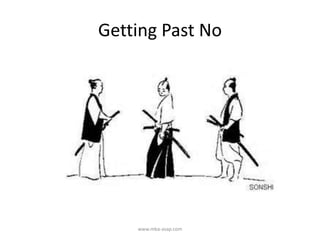
Getting Past No
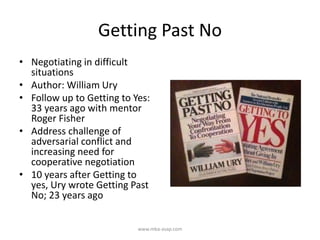
• Negotiating in difficult
situations
• Author: William Ury
• Follow up to Getting to Yes:
33 years ago with mentor
Roger Fisher
• Address challenge of
adversarial conflict and
increasing need for
cooperative negotiation
• 10 years after Getting to
yes, Ury wrote Getting Past
No; 23 years ago
www.mba-asap.com
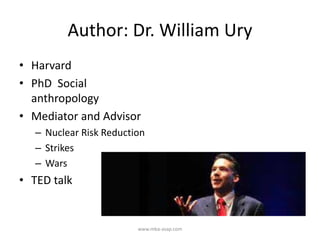
Author: Dr. William Ury
• Harvard
• PhD Social
anthropology
• Mediator and Advisor
– Nuclear Risk Reduction
– Strikes
– Wars
• TED talk
www.mba-asap.com
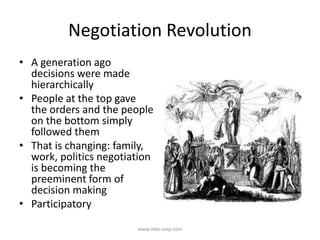
Negotiation Revolution
• A generation ago
decisions were made
hierarchically
• People at the top gave
the orders and the people
on the bottom simply
followed them
• That is changing: family,
work, politics negotiation
is becoming the
preeminent form of
decision making
• Participatory
www.mba-asap.com
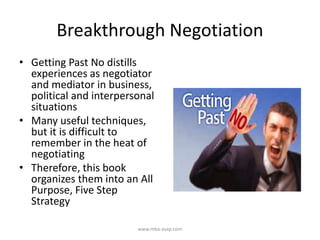
Breakthrough Negotiation
• Getting Past No distills
experiences as negotiator
and mediator in business,
political and interpersonal
situations
• Many useful techniques,
but it is difficult to
remember in the heat of
negotiating
• Therefore, this book
organizes them into an All
Purpose, Five Step
Strategy
www.mba-asap.com
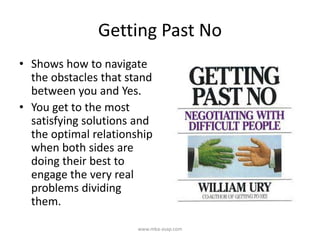
Getting Past No
• Shows how to navigate
the obstacles that stand
between you and Yes.
• You get to the most
satisfying solutions and
the optimal relationship
when both sides are
doing their best to
engage the very real
problems dividing
them.
www.mba-asap.com
Why is this Important
• Life skills necessary for
successful negotiations
• Goal: make our lives
happier, more
prosperous and the
world a better place
www.mba-asap.com
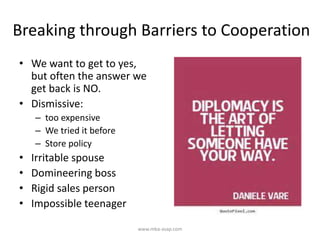
Breaking through Barriers to Cooperation
• We want to get to yes,
but often the answer we
get back is NO.
• Dismissive:
– too expensive
– We tried it before
– Store policy
• Irritable spouse
• Domineering boss
• Rigid sales person
• Impossible teenager
www.mba-asap.com
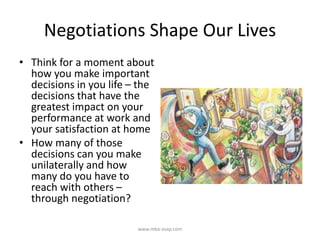
Negotiations Shape Our Lives
• Think for a moment about
how you make important
decisions in you life – the
decisions that have the
greatest impact on your
performance at work and
your satisfaction at home
• How many of those
decisions can you make
unilaterally and how
many do you have to
reach with others –
through negotiation?
www.mba-asap.com
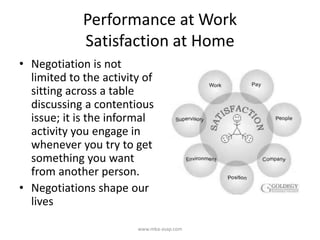
Performance at Work
Satisfaction at Home
• Negotiation is not
limited to the activity of
sitting across a table
discussing a contentious
issue; it is the informal
activity you engage in
whenever you try to get
something you want
from another person.
• Negotiations shape our
lives
www.mba-asap.com
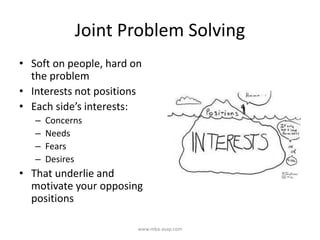
Joint Problem Solving
• Soft on people, hard on
the problem
• Interests not positions
• Each side’s interests:
– Concerns
– Needs
– Fears
– Desires
• That underlie and
motivate your opposing
positions
www.mba-asap.com
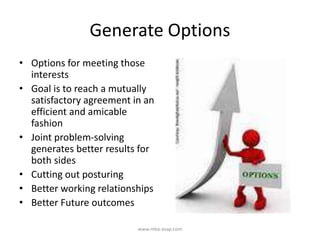
Generate Options
• Options for meeting those
interests
• Goal is to reach a mutually
satisfactory agreement in an
efficient and amicable
fashion
• Joint problem-solving
generates better results for
both sides
• Cutting out posturing
• Better working relationships
• Better Future outcomes
www.mba-asap.com
Five Barriers to Cooperation
• Easy to say
• Hard to do
• Hard to apply in the real
world of stresses and
strains, temptations and
tempests
• Ferocious emotional
battles
• Familiar routines and
positions
• Be taken advantage of
• Your Reaction
• Their Emotion
• Their Position
• Their Dissatisfaction
• Their Power
www.mba-asap.com
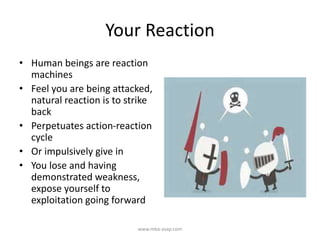
Your Reaction
• Human beings are reaction
machines
• Feel you are being attacked,
natural reaction is to strike
back
• Perpetuates action-reaction
cycle
• Or impulsively give in
• You lose and having
demonstrated weakness,
expose yourself to
exploitation going forward
www.mba-asap.com
Their Emotion
• Other side’s negative
emotions
• Behind attacks may lie
anger and hostility
• Behind rigid positions
may lie fear and distrust
• Convinced they are
right and you are
wrong, they refuse to
listen
www.mba-asap.com
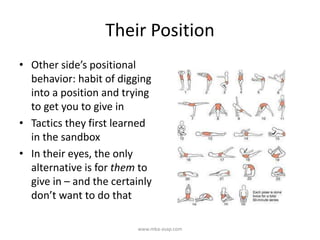
Their Position
• Other side’s positional
behavior: habit of digging
into a position and trying
to get you to give in
• Tactics they first learned
in the sandbox
• In their eyes, the only
alternative is for them to
give in – and the certainly
don’t want to do that
www.mba-asap.com
Their Dissatisfaction
• The other side is not
interested in reaching
an outcome because
they do not see how it
will benefit them
• Fear losing face if they
have to back down
• If it is your idea, they
may reject it for that
reason alone
www.mba-asap.com
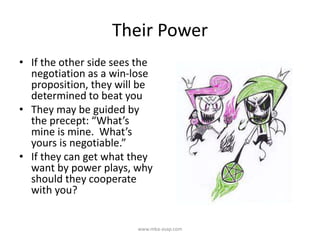
Their Power
• If the other side sees the
negotiation as a win-lose
proposition, they will be
determined to beat you
• They may be guided by
the precept: “What’s
mine is mine. What’s

yours is negotiable.”
• If they can get what they
want by power plays, why
should they cooperate
with you?
www.mba-asap.com
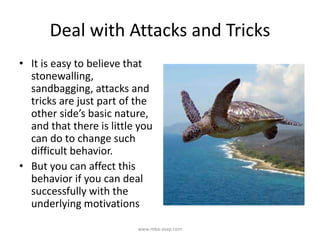
Deal with Attacks and Tricks
• It is easy to believe that
stonewalling,
sandbagging, attacks and
tricks are just part of the
other side’s basic nature,
and that there is little you
can do to change such
difficult behavior.
• But you can affect this
behavior if you can deal
successfully with the
underlying motivations
www.mba-asap.com
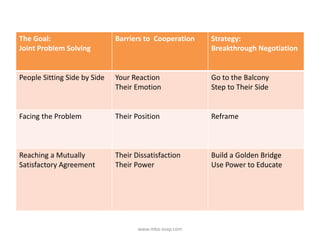
The Goal:
Joint Problem Solving
Barriers to Cooperation Strategy:
Breakthrough Negotiation
People Sitting Side by Side Your Reaction
Their Emotion
Go to the Balcony
Step to Their Side
Facing the Problem Their Position Reframe
Reaching a Mutually
Satisfactory Agreement
Their Dissatisfaction
Their Power
Build a Golden Bridge
Use Power to Educate
www.mba-asap.com
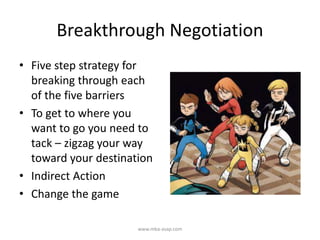
Breakthrough Negotiation
• Five step strategy for
breaking through each
of the five barriers
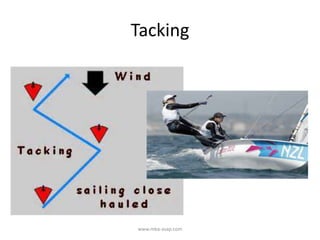
• To get to where you
want to go you need to
tack – zigzag your way
toward your destination
• Indirect Action
• Change the game
www.mba-asap.com
Tacking
www.mba-asap.com
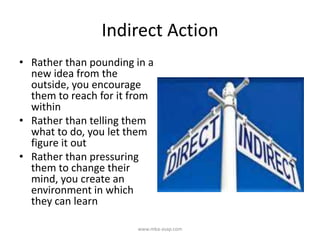
Indirect Action
• Rather than pounding in a
new idea from the
outside, you encourage
them to reach for it from
within
• Rather than telling them
what to do, you let them
figure it out
• Rather than pressuring
them to change their
mind, you create an
environment in which
they can learn
www.mba-asap.com
Indirect Action
• Rather than pounding in a
new idea from the
outside, you encourage
them to reach for it from
within
• Rather than telling them
what to do, you let them
figure it out
• Rather than pressuring
them to change their
mind, you create an
environment in which
they can learn
www.mba-asap.com
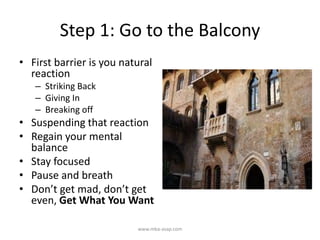
Step 1: Go to the Balcony
• First barrier is you natural
reaction
– Striking Back
– Giving In
– Breaking off
• Suspending that reaction
• Regain your mental
balance
• Stay focused
• Pause and breath
• Don’t get mad, don’t get
even, Get What You Want
www.mba-asap.com
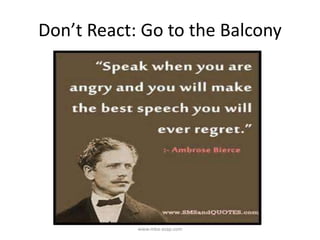
Don’t React: Go to the Balcony
www.mba-asap.com
Step 2: Step to Their Side
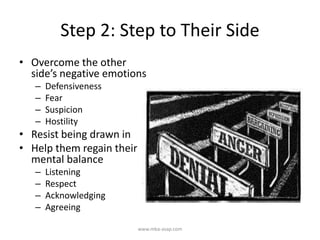
• Overcome the other
side’s negative emotions
– Defensiveness
– Fear
– Suspicion
– Hostility
• Resist being drawn in
• Help them regain their
mental balance
– Listening
– Respect
– Acknowledging
– Agreeing
www.mba-asap.com
Don’t Argue: Step to Their Side
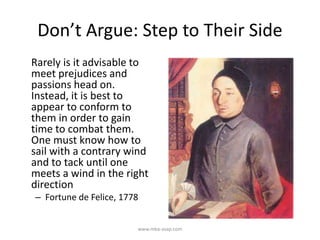
Rarely is it advisable to
meet prejudices and
passions head on.
Instead, it is best to
appear to conform to
them in order to gain
time to combat them.
One must know how to

sail with a contrary wind
and to tack until one
meets a wind in the right
direction
– Fortune de Felice, 1778
www.mba-asap.com
Step 3: Reframe
• Tackle the problem
together
• Hard to do if they dig into
their position and try to
get you to give in
• Natural to want to reject
their position, but do the
opposite:
• Accept what they say and
reframe it as an attempt
to deal with the problem
www.mba-asap.com
Don’t Reject: Reframe
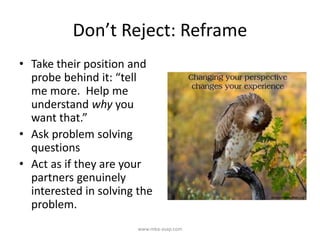
• Take their position and
probe behind it: “tell
me more. Help me
understand why you
want that.”
• Ask problem solving
questions
• Act as if they are your
partners genuinely
interested in solving the
problem.
www.mba-asap.com
Craft Against Vice I Will Apply
William Shakespeare
Measure for Measure
www.mba-asap.com
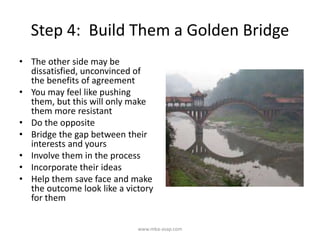
Step 4: Build Them a Golden Bridge
• The other side may be
dissatisfied, unconvinced of
the benefits of agreement
• You may feel like pushing
them, but this will only make
them more resistant
• Do the opposite
• Bridge the gap between their
interests and yours
• Involve them in the process
• Incorporate their ideas
• Help them save face and make
the outcome look like a victory
for them
www.mba-asap.com
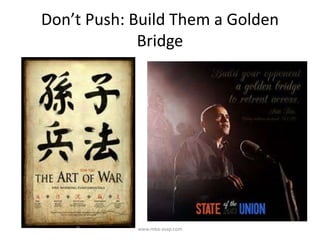
Don’t Push: Build Them a Golden
Bridge
www.mba-asap.com
Step 5: Use Power to Educate
• Despite your best efforts, the
other side may still refuse to
cooperate, believing they can
beat you at the power game.
• Threats and coercion often
backfire and lead to costly and
futile battles
• Use power not to escalate but
to educate about the costs of
not agreeing
• Demonstrate your BATNA
• Make sure they know the
golden bridge is always
available
www.mba-asap.com
Don’t Escalate; Educate
www.mba-asap.com
• The best general is the
one who never fights
– Sun Tzu
www.mba-asap.com
www.mba-asap.com
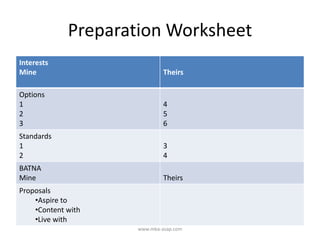
Preparation Worksheet
Interests
Mine Theirs
Options
1
2
3
4
5
6
Standards
1
2
3
4
BATNA
Mine Theirs
Proposals
•Aspire to
•Content with
•Live with
www.mba-asap.com

Become a Better Negotiator: Getting Past No

  • 1.
  • 2.
  • 3.
    Getting Past No •Negotiating in difficult situations • Author: William Ury • Follow up to Getting to Yes: 33 years ago with mentor Roger Fisher • Address challenge of adversarial conflict and increasing need for cooperative negotiation • 10 years after Getting to yes, Ury wrote Getting Past No; 23 years ago www.mba-asap.com
  • 4.
    Author: Dr. WilliamUry • Harvard • PhD Social anthropology • Mediator and Advisor – Nuclear Risk Reduction – Strikes – Wars • TED talk www.mba-asap.com
  • 5.
    Negotiation Revolution • Ageneration ago decisions were made hierarchically • People at the top gave the orders and the people on the bottom simply followed them • That is changing: family, work, politics negotiation is becoming the preeminent form of decision making • Participatory www.mba-asap.com
  • 6.
    Breakthrough Negotiation • GettingPast No distills experiences as negotiator and mediator in business, political and interpersonal situations • Many useful techniques, but it is difficult to remember in the heat of negotiating • Therefore, this book organizes them into an All Purpose, Five Step Strategy www.mba-asap.com
  • 7.
    Getting Past No •Shows how to navigate the obstacles that stand between you and Yes. • You get to the most satisfying solutions and the optimal relationship when both sides are doing their best to engage the very real problems dividing them. www.mba-asap.com
  • 8.
    Why is thisImportant • Life skills necessary for successful negotiations • Goal: make our lives happier, more prosperous and the world a better place www.mba-asap.com
  • 9.
    Breaking through Barriersto Cooperation • We want to get to yes, but often the answer we get back is NO. • Dismissive: – too expensive – We tried it before – Store policy • Irritable spouse • Domineering boss • Rigid sales person • Impossible teenager www.mba-asap.com
  • 10.
    Negotiations Shape OurLives • Think for a moment about how you make important decisions in you life – the decisions that have the greatest impact on your performance at work and your satisfaction at home • How many of those decisions can you make unilaterally and how many do you have to reach with others – through negotiation? www.mba-asap.com
  • 11.
    Performance at Work Satisfactionat Home • Negotiation is not limited to the activity of sitting across a table discussing a contentious issue; it is the informal activity you engage in whenever you try to get something you want from another person. • Negotiations shape our lives www.mba-asap.com
  • 12.
    Joint Problem Solving •Soft on people, hard on the problem • Interests not positions • Each side’s interests: – Concerns – Needs – Fears – Desires • That underlie and motivate your opposing positions www.mba-asap.com
  • 13.
    Generate Options • Optionsfor meeting those interests • Goal is to reach a mutually satisfactory agreement in an efficient and amicable fashion • Joint problem-solving generates better results for both sides • Cutting out posturing • Better working relationships • Better Future outcomes www.mba-asap.com
  • 14.
    Five Barriers toCooperation • Easy to say • Hard to do • Hard to apply in the real world of stresses and strains, temptations and tempests • Ferocious emotional battles • Familiar routines and positions • Be taken advantage of • Your Reaction • Their Emotion • Their Position • Their Dissatisfaction • Their Power www.mba-asap.com
  • 15.
    Your Reaction • Humanbeings are reaction machines • Feel you are being attacked, natural reaction is to strike back • Perpetuates action-reaction cycle • Or impulsively give in • You lose and having demonstrated weakness, expose yourself to exploitation going forward www.mba-asap.com
  • 16.
    Their Emotion • Otherside’s negative emotions • Behind attacks may lie anger and hostility • Behind rigid positions may lie fear and distrust • Convinced they are right and you are wrong, they refuse to listen www.mba-asap.com
  • 17.
    Their Position • Otherside’s positional behavior: habit of digging into a position and trying to get you to give in • Tactics they first learned in the sandbox • In their eyes, the only alternative is for them to give in – and the certainly don’t want to do that www.mba-asap.com
  • 18.
    Their Dissatisfaction • Theother side is not interested in reaching an outcome because they do not see how it will benefit them • Fear losing face if they have to back down • If it is your idea, they may reject it for that reason alone www.mba-asap.com
  • 19.
    Their Power • Ifthe other side sees the negotiation as a win-lose proposition, they will be determined to beat you • They may be guided by the precept: “What’s mine is mine. What’s yours is negotiable.” • If they can get what they want by power plays, why should they cooperate with you? www.mba-asap.com
  • 20.
    Deal with Attacksand Tricks • It is easy to believe that stonewalling, sandbagging, attacks and tricks are just part of the other side’s basic nature, and that there is little you can do to change such difficult behavior. • But you can affect this behavior if you can deal successfully with the underlying motivations www.mba-asap.com
  • 21.
    The Goal: Joint ProblemSolving Barriers to Cooperation Strategy: Breakthrough Negotiation People Sitting Side by Side Your Reaction Their Emotion Go to the Balcony Step to Their Side Facing the Problem Their Position Reframe Reaching a Mutually Satisfactory Agreement Their Dissatisfaction Their Power Build a Golden Bridge Use Power to Educate www.mba-asap.com
  • 22.
    Breakthrough Negotiation • Fivestep strategy for breaking through each of the five barriers • To get to where you want to go you need to tack – zigzag your way toward your destination • Indirect Action • Change the game www.mba-asap.com
  • 23.
  • 24.
    Indirect Action • Ratherthan pounding in a new idea from the outside, you encourage them to reach for it from within • Rather than telling them what to do, you let them figure it out • Rather than pressuring them to change their mind, you create an environment in which they can learn www.mba-asap.com
  • 25.
    Indirect Action • Ratherthan pounding in a new idea from the outside, you encourage them to reach for it from within • Rather than telling them what to do, you let them figure it out • Rather than pressuring them to change their mind, you create an environment in which they can learn www.mba-asap.com
  • 26.
    Step 1: Goto the Balcony • First barrier is you natural reaction – Striking Back – Giving In – Breaking off • Suspending that reaction • Regain your mental balance • Stay focused • Pause and breath • Don’t get mad, don’t get even, Get What You Want www.mba-asap.com
  • 27.
    Don’t React: Goto the Balcony www.mba-asap.com
  • 28.
    Step 2: Stepto Their Side • Overcome the other side’s negative emotions – Defensiveness – Fear – Suspicion – Hostility • Resist being drawn in • Help them regain their mental balance – Listening – Respect – Acknowledging – Agreeing www.mba-asap.com
  • 29.
    Don’t Argue: Stepto Their Side Rarely is it advisable to meet prejudices and passions head on. Instead, it is best to appear to conform to them in order to gain time to combat them. One must know how to sail with a contrary wind and to tack until one meets a wind in the right direction – Fortune de Felice, 1778 www.mba-asap.com
  • 30.
    Step 3: Reframe •Tackle the problem together • Hard to do if they dig into their position and try to get you to give in • Natural to want to reject their position, but do the opposite: • Accept what they say and reframe it as an attempt to deal with the problem www.mba-asap.com
  • 31.
    Don’t Reject: Reframe •Take their position and probe behind it: “tell me more. Help me understand why you want that.” • Ask problem solving questions • Act as if they are your partners genuinely interested in solving the problem. www.mba-asap.com
  • 32.
    Craft Against ViceI Will Apply William Shakespeare Measure for Measure www.mba-asap.com
  • 33.
    Step 4: BuildThem a Golden Bridge • The other side may be dissatisfied, unconvinced of the benefits of agreement • You may feel like pushing them, but this will only make them more resistant • Do the opposite • Bridge the gap between their interests and yours • Involve them in the process • Incorporate their ideas • Help them save face and make the outcome look like a victory for them www.mba-asap.com
  • 34.
    Don’t Push: BuildThem a Golden Bridge www.mba-asap.com
  • 35.
    Step 5: UsePower to Educate • Despite your best efforts, the other side may still refuse to cooperate, believing they can beat you at the power game. • Threats and coercion often backfire and lead to costly and futile battles • Use power not to escalate but to educate about the costs of not agreeing • Demonstrate your BATNA • Make sure they know the golden bridge is always available www.mba-asap.com
  • 36.
  • 37.
    • The bestgeneral is the one who never fights – Sun Tzu www.mba-asap.com
  • 38.
  • 39.
    Preparation Worksheet Interests Mine Theirs Options 1 2 3 4 5 6 Standards 1 2 3 4 BATNA MineTheirs Proposals •Aspire to •Content with •Live with www.mba-asap.com