It offers distinct advantages over traditional analog and discrete
wiring or even other digital buses — at lower total installed cost and
lower ongoing costs.
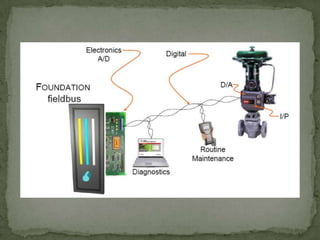
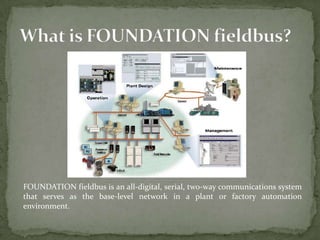
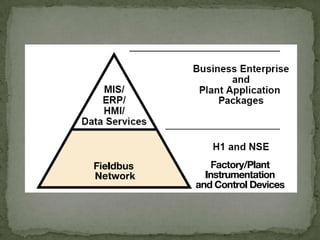
FOUNDATION fieldbus is an all-digital, serial, two-way communications system
that serves as the base-level network in a plant or factory automation
environment.
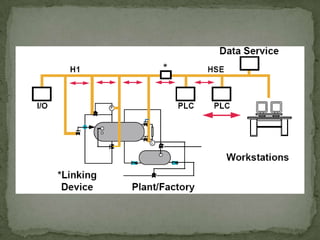
Two related implementations of FOUNDATION fieldbus have been
introduced to meet different needs within the process automation
environment.

• H1 works at 31.25 Kbit/sec and generally connects to field
devices. It provides communication and power over standard
twisted-pair wiring. H1 is currently the most common
implementation.

• HSE (High-speed Ethernet) works at 100 Mbit/sec and generally
connects input/output subsystems, host systems, linking devices,
gateways, and field devices using standard Ethernet cabling. It
doesn't currently provide power over the cable, although work is
under way to address this.
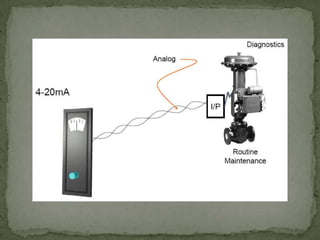
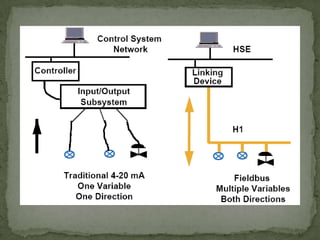
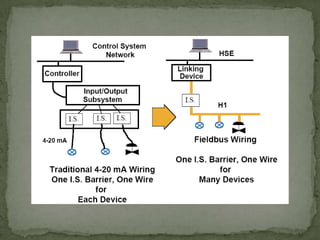
•Conventional analog and discrete field instruments use point-to-point wiring:
one wire pair per device. As a digital bus, FOUNDATION fieldbus doesn't have
those limitations.

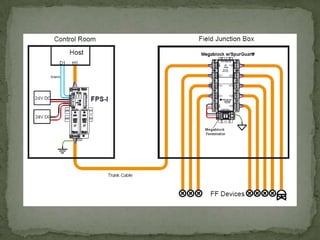
•Multidrop wiring. FOUNDATION fieldbus will support up to 32 devices on a
single pair of wires (called a segment) -- more if repeaters are used. In actual
practice, considerations such as power, process modularity, and loop execution
speed make 4 to 16 devices per H1 segment more typical.

•That means if you have 1000 devices -- which would require 1000 wire pairs
with traditional technology -- you only need 60 to 250 wire pairs with
FOUNDATION fieldbus.

•Multivariable instruments. That same wire pair can handle multiple variables
from one field device. For example, one temperature transmitter might
communicate inputs from as many as eight sensors -- reducing both wiring and
instrument costs.
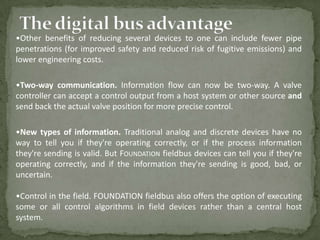
•Other benefits of reducing several devices to one can include fewer pipe
penetrations (for improved safety and reduced risk of fugitive emissions) and
lower engineering costs.

•Two-way communication. Information flow can now be two-way. A valve
controller can accept a control output from a host system or other source and
send back the actual valve position for more precise control.

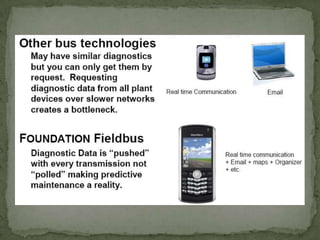
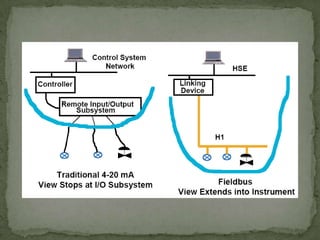
•New types of information. Traditional analog and discrete devices have no
way to tell you if they're operating correctly, or if the process information
they're sending is valid. But FOUNDATION fieldbus devices can tell you if they're
operating correctly, and if the information they're sending is good, bad, or
uncertain.

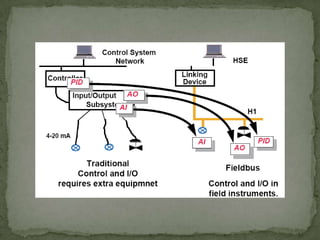
•Control in the field. FOUNDATION fieldbus also offers the option of executing
some or all control algorithms in field devices rather than a central host
system.
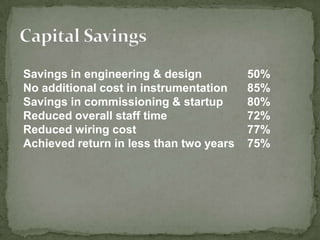
Savings in engineering & design          50%
No additional cost in instrumentation    85%
Savings in commissioning & startup       80%
Reduced overall staff time               72%
Reduced wiring cost                      77%
Achieved return in less than two years   75%
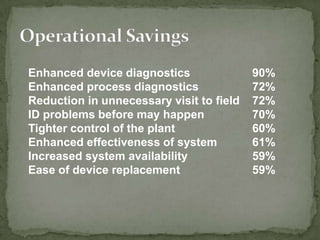
Enhanced device diagnostics               90%
Enhanced process diagnostics              72%
Reduction in unnecessary visit to field   72%
ID problems before may happen             70%
Tighter control of the plant              60%
Enhanced effectiveness of system          61%
Increased system availability             59%
Ease of device replacement                59%
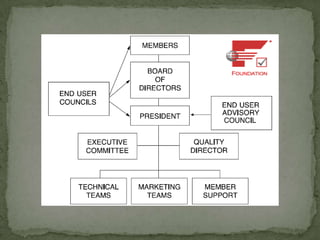
The Fieldbus Foundation is an independent, not-profit
organization based on the following principles:

• Fieldbus technology is an enabling technology; not a
differentiating technology.
• Fieldbus technology is open and available to all parties.
• Fieldbus technology is based on the work of the
International Electrotechnical Commission (IEC) and
ISA (the international society for measurement and
control).
• Fieldbus Foundation members support and work with
the international and national standards committees.
Interoperability simply means that FOUNDATION fieldbus
devices and host systems can work together while giving you
the full functionality of each component.


Host interoperability testing. Host systems undergo Foundation-
supervised tests to demonstrate their support for specific interoperability
features.
Interoperable isn't interchangeable. Interchangeable means you can freely
substitute one device for another and still get exactly the same functionality.
Interoperable, on the other hand, means different devices from different
manufacturers can work together -- but individual devices can have different
functionality.
The Stack Conformance Test ensures that the device
interfaces correctly with the bus; that is, electrical
characteristics and bus access are consistent with the
fieldbus specification.

The Device Interoperability Test ensures that the
device's function blocks will interact with other blocks
correctly, and will provide accurate information and
mode behavior.
A system's reliability is only as good as the reliability of each
of its parts. So it makes sense that the fewer the parts, the higher
the potential reliability of the system.

   Fieldbus allows the control "system" to have fewer parts
because control can now be done in the field.

    That is, control does not have to go through all the host
system's terminations, input cards, controllers, output cards, and
so on — each a potential failure point.
Introduction to foundation fieldbus

Introduction to foundation fieldbus

  • 1.
    It offers distinctadvantages over traditional analog and discrete wiring or even other digital buses — at lower total installed cost and lower ongoing costs.
  • 6.
    FOUNDATION fieldbus isan all-digital, serial, two-way communications system that serves as the base-level network in a plant or factory automation environment.
  • 10.
    Two related implementationsof FOUNDATION fieldbus have been introduced to meet different needs within the process automation environment. • H1 works at 31.25 Kbit/sec and generally connects to field devices. It provides communication and power over standard twisted-pair wiring. H1 is currently the most common implementation. • HSE (High-speed Ethernet) works at 100 Mbit/sec and generally connects input/output subsystems, host systems, linking devices, gateways, and field devices using standard Ethernet cabling. It doesn't currently provide power over the cable, although work is under way to address this.
  • 12.
    •Conventional analog anddiscrete field instruments use point-to-point wiring: one wire pair per device. As a digital bus, FOUNDATION fieldbus doesn't have those limitations. •Multidrop wiring. FOUNDATION fieldbus will support up to 32 devices on a single pair of wires (called a segment) -- more if repeaters are used. In actual practice, considerations such as power, process modularity, and loop execution speed make 4 to 16 devices per H1 segment more typical. •That means if you have 1000 devices -- which would require 1000 wire pairs with traditional technology -- you only need 60 to 250 wire pairs with FOUNDATION fieldbus. •Multivariable instruments. That same wire pair can handle multiple variables from one field device. For example, one temperature transmitter might communicate inputs from as many as eight sensors -- reducing both wiring and instrument costs.
  • 13.
    •Other benefits ofreducing several devices to one can include fewer pipe penetrations (for improved safety and reduced risk of fugitive emissions) and lower engineering costs. •Two-way communication. Information flow can now be two-way. A valve controller can accept a control output from a host system or other source and send back the actual valve position for more precise control. •New types of information. Traditional analog and discrete devices have no way to tell you if they're operating correctly, or if the process information they're sending is valid. But FOUNDATION fieldbus devices can tell you if they're operating correctly, and if the information they're sending is good, bad, or uncertain. •Control in the field. FOUNDATION fieldbus also offers the option of executing some or all control algorithms in field devices rather than a central host system.
  • 15.
    Savings in engineering& design 50% No additional cost in instrumentation 85% Savings in commissioning & startup 80% Reduced overall staff time 72% Reduced wiring cost 77% Achieved return in less than two years 75%
  • 16.
    Enhanced device diagnostics 90% Enhanced process diagnostics 72% Reduction in unnecessary visit to field 72% ID problems before may happen 70% Tighter control of the plant 60% Enhanced effectiveness of system 61% Increased system availability 59% Ease of device replacement 59%
  • 21.
    The Fieldbus Foundationis an independent, not-profit organization based on the following principles: • Fieldbus technology is an enabling technology; not a differentiating technology. • Fieldbus technology is open and available to all parties. • Fieldbus technology is based on the work of the International Electrotechnical Commission (IEC) and ISA (the international society for measurement and control). • Fieldbus Foundation members support and work with the international and national standards committees.
  • 23.
    Interoperability simply meansthat FOUNDATION fieldbus devices and host systems can work together while giving you the full functionality of each component. Host interoperability testing. Host systems undergo Foundation- supervised tests to demonstrate their support for specific interoperability features. Interoperable isn't interchangeable. Interchangeable means you can freely substitute one device for another and still get exactly the same functionality. Interoperable, on the other hand, means different devices from different manufacturers can work together -- but individual devices can have different functionality.
  • 24.
    The Stack ConformanceTest ensures that the device interfaces correctly with the bus; that is, electrical characteristics and bus access are consistent with the fieldbus specification. The Device Interoperability Test ensures that the device's function blocks will interact with other blocks correctly, and will provide accurate information and mode behavior.
  • 25.
    A system's reliabilityis only as good as the reliability of each of its parts. So it makes sense that the fewer the parts, the higher the potential reliability of the system. Fieldbus allows the control "system" to have fewer parts because control can now be done in the field. That is, control does not have to go through all the host system's terminations, input cards, controllers, output cards, and so on — each a potential failure point.