Presented by: Zain Ali
GTE, Batch 06
Instruments & Control
What is a Control System
CONTROL VALVE TRANSMITTER
CONTROLLER
A control system is an interconnection of
components forming a system configuration
that will provide a desired system response.
FIELD RACK ROOM CCR
Control Valve
What is a DCS
A distributed control system (DCS) refers to a decentralized control
system in which the controller elements are not central in location but are
distributed throughout the system with each component sub-system
controlled by one or more controllers. The entire system of controllers is
connected by networks for communication and monitoring.
Input and output modules form component parts of
the DCS. The processor receives information from
input modules and sends information to output
modules.
Transmitter
FCS
4-20 mA
4-20 mA
Vnet/IP
What is CENTUM CS 3000
CENTUM is an integrated production
control system (DCS) that is used in a
wide variety of industries to manage
and control plant operations.
In 1975, Yokogawa introduced
CENTUM, the world's first distributed
control system.
"CENTUM" comes from the Latin word
"CENT" meaning "one hundred." The
ending "UM" is commonly used for
inanimate items such as aluminum and
stadium. CS means Customer
Satisfaction
CENTUM Architecture
FFCL CENTUM Architecture
Click here:
CENTUM System Components
 Human Interface Station (HIS)
 Field Control Station (FCS)
 Safety Instrumented System (SIS)
 Vnet/IP
 Communication Gateway Unit
 Layer 2 and 3 Switches
 System Integration OPC Station
 SNTP Server
 V net Router
 Peripherals (Printer etc.)
Human Interface Station (HIS)
A minimum system consists of one
HIS and one FCS.
The total number of stations can be up to
64, including up to 16 HISes per Domain.
Number of tags that can be
entered in one HIS: Up to
1000,000
An HIS serves as a human interface
for operation, monitoring, and
engineering.
For connections to the Vnet/IP, a VI701 Control
Bus Interface Card is used.
Field Control Station
The FCS performs process control and manages
communication with subsystems such as PLCs.
 Node
 Slot
Power Supply
CPU
Communication Card
I/O Cards
Field Control Station (FCS)
PW481
SB401
EC501
ADV151
ALR121
CP451
AAI135
Node 1
Master
Node 2
Slave
FCS….FCU Hardware Specifications,
for AFV10D
Processor : VR5432 (133 MHz) Main Memory Capacity: 32 Mbyte
Battery Back-up :
for Main Memory: Max. 72 hours
Battery Recharge Time: Min. 48 hours
Vnet/IP Communication Speed
1000 Mbps Full Duplex
No. of Node Units Connectable
Max. 14/FCU
No. of I/O Modules
Max. 8/Node
Field Control Station (FCS)
EB401
ALR121
NODE 1
FCU
NODE 2
NODE 3
NODE 4
NODE 5
EB501
EB501
SB401
NODE 6
NODE 7
Communication Components
 Vnet/IP
 Vnet/FO conversion
 Ethernet
 Layer 2 Switch
 Layer 3 Switch
 Remote I/O (RIO) Bus
 Extended Serial Backboard (ESB) Bus
 Enhanced Remote (ER) Bus
Vnet/IP
Vnet/IP Communication
Speed
1000 Mbps Full Duplex
The Vnet/IP is a real-time process control network used to connect system
components.
1. Control-bus communications (Bus 1/Bus 2)
Read/Write, message communication
2. Open communications (Bus 2: 300 Mbps)
For connection with commercially available Ethernet devices.
The Vnet/IP is always dual-redundant.
•Using Vnet/IP upto 16
domains can be connected
through layer 3 switches
Communications for control
Bus-1 side 192.168.(Domain No.).1 to 129, 254
Bus-2 side 192.168.(128 + Domain No.).1 to 129, 254
Open Communications
Bus-2 Side 192.168.(128 + Domain No.).130 to 253
Vnet/FO Conversion
Vnet to Fiber
Optic conversion
is done to connect
Vnet network to
the remote FCS.
Extended Serial Backboard Bus
•Network Topology: Bus formation
•Transmission Path Redundancy:
Available
•Transmission Speed: 128 Mbps
•Transmission Cable: Dedicated cable
(YCB301)
•Transmission Distance: 10 m max.
An ESB bus is an I/O communications bus that connects the processing
unit of an FCS to a local node.
Enhanced Remote (ER) Bus
An ER bus is a remote I/O communications bus to connect
an FCU or local node unit to a remote node.
Number of ER buses: Max. 4 per FCU
 Network Topology: Bus formation
 Trans Path Redundancy: Available
 Transmission Speed: 10 Mbps
 Transmission Cable: Coaxial cable
( YCB141, YCB311)
 Transmission Distance:
Max. 185 m (for YCB141)
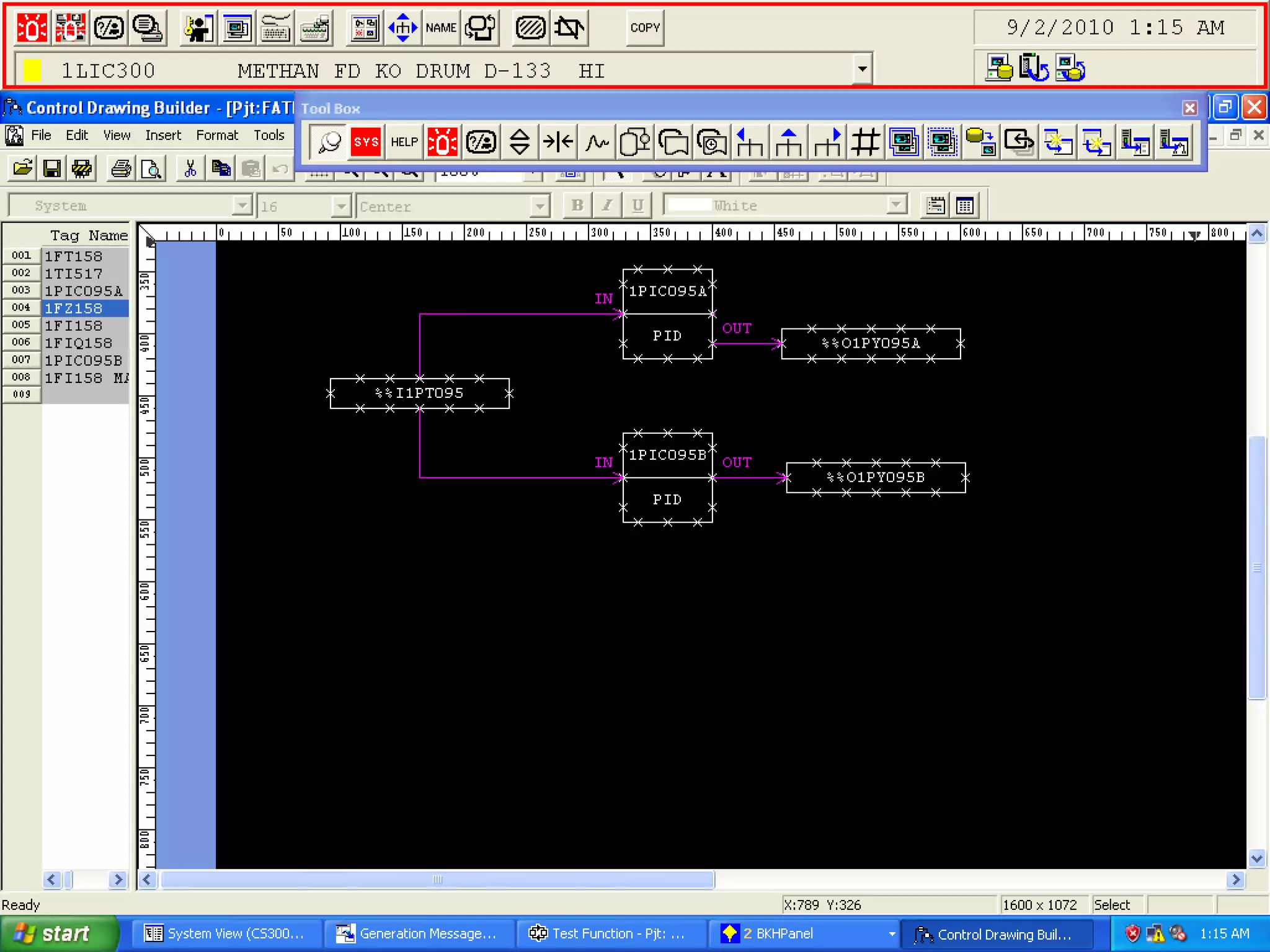
Software of CENTUM CS 3000
 Pictorial
Function Block
Wiring
Process Alarm
System Alarm
User In
Window Call Menu
Operation Menu
Tool Box
Navigator
Name Input
Trend
Graphic
Process Report
Historian
LeftUpper
Right
Larger Window
Medium
Window
Related Build Call
Related Control
Drawing Build Call
Any Question????????
Difference between DCS and PLC
 Turn the clock back 10-15 years: The programmable logic controller (PLC) is king of machine
control while the distributed control system (DCS) dominates process control.
 Today, the two technologies share kingdoms as the functional lines between them continue to
blur. We now use each where the other used to rule. However, PLCs still dominate high-speed
machine control, and DCSs prevail in complex continuous processes.
 DCSs performed hundreds of analog measurements and controlled dozens of analog outputs,
using multi-variable Proportional Integral Derivative (PID) control. With the same 8-bit
microprocessor technology that gave rise to the DCS, PLCs began replacing conventional
relay/solid-state logic in machine control. PLCs dealt with contact input/output (I/O) and
started/stopped motors by performing Boolean logic calculations.
 When PLCs were solely replacements for hard-wired relays, they had only digital I/O, PLCs
now have many DCS-like control functions (e.g., PID algorithms) and analog I/O.
 Since the PLC was integrated with Analog I/O it crosses the boundary of being just digital and
crosses to the realm of DCS in handling Analogs, Bus Systems, Distributed I/O and etc. Also,
since the DCS now handles logics of Digital I/O it also crossed the boundary to the realm of
PLC.
 However PLCs are still faster, these were used for small system or a machine, Digital I/Os and
DCS was used for Analog I/Os.
Difference between SCADA and DCS
 SCADA is an abbreviation for Supervisory Control and Data Acquisition .
DCS stands for Distributed Control System.
 Normally, a SCADA system will get the data from a RTU (remote terminal unit). A RTU runs
independently, except for some control from the central supervisory system such as fire
fighting, emergency shut-down (i.e water & oil pipelines). The communication path will be
through a GSM, wireless technology, etc...
 For a DCS system, it controls the process as a stand-alone system. It has the control loops built
into it's own controller. The communication path will be through something like a LAN high-
speed Ethernet, or other communications network. DCS is a single unit, or a group of local
units
 However, a DCS certainly does Supervisory Control and Data Acquisition (SCADA), while a
SCADA system often implements a (form of a) Distributed Control System (DCS).
 Nevertheless, in practice, SCADA is used for control and monitoring of geographically large
areas. These are typically found in distribution systems (electricity, water/wastewater,
municipal pipelines, etc), Transmission systems (oil and gas pipelines or electrical
transmission), and operations that cover a large region (such as mines and oil fields).

CENTUM CS 3000 R3.pptx

  • 1.
    Presented by: ZainAli GTE, Batch 06 Instruments & Control
  • 2.
    What is aControl System CONTROL VALVE TRANSMITTER CONTROLLER A control system is an interconnection of components forming a system configuration that will provide a desired system response.
  • 3.
    FIELD RACK ROOMCCR Control Valve What is a DCS A distributed control system (DCS) refers to a decentralized control system in which the controller elements are not central in location but are distributed throughout the system with each component sub-system controlled by one or more controllers. The entire system of controllers is connected by networks for communication and monitoring. Input and output modules form component parts of the DCS. The processor receives information from input modules and sends information to output modules. Transmitter FCS 4-20 mA 4-20 mA Vnet/IP
  • 4.
    What is CENTUMCS 3000 CENTUM is an integrated production control system (DCS) that is used in a wide variety of industries to manage and control plant operations. In 1975, Yokogawa introduced CENTUM, the world's first distributed control system. "CENTUM" comes from the Latin word "CENT" meaning "one hundred." The ending "UM" is commonly used for inanimate items such as aluminum and stadium. CS means Customer Satisfaction
  • 5.
  • 6.
  • 7.
    CENTUM System Components Human Interface Station (HIS)  Field Control Station (FCS)  Safety Instrumented System (SIS)  Vnet/IP  Communication Gateway Unit  Layer 2 and 3 Switches  System Integration OPC Station  SNTP Server  V net Router  Peripherals (Printer etc.)
  • 8.
    Human Interface Station(HIS) A minimum system consists of one HIS and one FCS. The total number of stations can be up to 64, including up to 16 HISes per Domain. Number of tags that can be entered in one HIS: Up to 1000,000 An HIS serves as a human interface for operation, monitoring, and engineering. For connections to the Vnet/IP, a VI701 Control Bus Interface Card is used.
  • 9.
    Field Control Station TheFCS performs process control and manages communication with subsystems such as PLCs.  Node  Slot Power Supply CPU Communication Card I/O Cards
  • 10.
    Field Control Station(FCS) PW481 SB401 EC501 ADV151 ALR121 CP451 AAI135 Node 1 Master Node 2 Slave
  • 11.
    FCS….FCU Hardware Specifications, forAFV10D Processor : VR5432 (133 MHz) Main Memory Capacity: 32 Mbyte Battery Back-up : for Main Memory: Max. 72 hours Battery Recharge Time: Min. 48 hours Vnet/IP Communication Speed 1000 Mbps Full Duplex No. of Node Units Connectable Max. 14/FCU No. of I/O Modules Max. 8/Node
  • 12.
    Field Control Station(FCS) EB401 ALR121 NODE 1 FCU NODE 2 NODE 3 NODE 4 NODE 5 EB501 EB501 SB401 NODE 6 NODE 7
  • 13.
    Communication Components  Vnet/IP Vnet/FO conversion  Ethernet  Layer 2 Switch  Layer 3 Switch  Remote I/O (RIO) Bus  Extended Serial Backboard (ESB) Bus  Enhanced Remote (ER) Bus
  • 14.
    Vnet/IP Vnet/IP Communication Speed 1000 MbpsFull Duplex The Vnet/IP is a real-time process control network used to connect system components. 1. Control-bus communications (Bus 1/Bus 2) Read/Write, message communication 2. Open communications (Bus 2: 300 Mbps) For connection with commercially available Ethernet devices. The Vnet/IP is always dual-redundant. •Using Vnet/IP upto 16 domains can be connected through layer 3 switches Communications for control Bus-1 side 192.168.(Domain No.).1 to 129, 254 Bus-2 side 192.168.(128 + Domain No.).1 to 129, 254 Open Communications Bus-2 Side 192.168.(128 + Domain No.).130 to 253
  • 15.
    Vnet/FO Conversion Vnet toFiber Optic conversion is done to connect Vnet network to the remote FCS.
  • 16.
    Extended Serial BackboardBus •Network Topology: Bus formation •Transmission Path Redundancy: Available •Transmission Speed: 128 Mbps •Transmission Cable: Dedicated cable (YCB301) •Transmission Distance: 10 m max. An ESB bus is an I/O communications bus that connects the processing unit of an FCS to a local node.
  • 17.
    Enhanced Remote (ER)Bus An ER bus is a remote I/O communications bus to connect an FCU or local node unit to a remote node. Number of ER buses: Max. 4 per FCU  Network Topology: Bus formation  Trans Path Redundancy: Available  Transmission Speed: 10 Mbps  Transmission Cable: Coaxial cable ( YCB141, YCB311)  Transmission Distance: Max. 185 m (for YCB141)
  • 18.
    Software of CENTUMCS 3000  Pictorial
  • 33.
  • 34.
  • 37.
    Process Alarm System Alarm UserIn Window Call Menu Operation Menu Tool Box Navigator Name Input
  • 39.
  • 47.
  • 48.
    Difference between DCSand PLC  Turn the clock back 10-15 years: The programmable logic controller (PLC) is king of machine control while the distributed control system (DCS) dominates process control.  Today, the two technologies share kingdoms as the functional lines between them continue to blur. We now use each where the other used to rule. However, PLCs still dominate high-speed machine control, and DCSs prevail in complex continuous processes.  DCSs performed hundreds of analog measurements and controlled dozens of analog outputs, using multi-variable Proportional Integral Derivative (PID) control. With the same 8-bit microprocessor technology that gave rise to the DCS, PLCs began replacing conventional relay/solid-state logic in machine control. PLCs dealt with contact input/output (I/O) and started/stopped motors by performing Boolean logic calculations.  When PLCs were solely replacements for hard-wired relays, they had only digital I/O, PLCs now have many DCS-like control functions (e.g., PID algorithms) and analog I/O.  Since the PLC was integrated with Analog I/O it crosses the boundary of being just digital and crosses to the realm of DCS in handling Analogs, Bus Systems, Distributed I/O and etc. Also, since the DCS now handles logics of Digital I/O it also crossed the boundary to the realm of PLC.  However PLCs are still faster, these were used for small system or a machine, Digital I/Os and DCS was used for Analog I/Os.
  • 49.
    Difference between SCADAand DCS  SCADA is an abbreviation for Supervisory Control and Data Acquisition . DCS stands for Distributed Control System.  Normally, a SCADA system will get the data from a RTU (remote terminal unit). A RTU runs independently, except for some control from the central supervisory system such as fire fighting, emergency shut-down (i.e water & oil pipelines). The communication path will be through a GSM, wireless technology, etc...  For a DCS system, it controls the process as a stand-alone system. It has the control loops built into it's own controller. The communication path will be through something like a LAN high- speed Ethernet, or other communications network. DCS is a single unit, or a group of local units  However, a DCS certainly does Supervisory Control and Data Acquisition (SCADA), while a SCADA system often implements a (form of a) Distributed Control System (DCS).  Nevertheless, in practice, SCADA is used for control and monitoring of geographically large areas. These are typically found in distribution systems (electricity, water/wastewater, municipal pipelines, etc), Transmission systems (oil and gas pipelines or electrical transmission), and operations that cover a large region (such as mines and oil fields).

Editor's Notes

  • #5 "CENTUM“ name was selected because this product series can flexibly handle hundreds of applications and perfectly (100%) meets customers' requirements.
  • #13 redundancy
  • #15 control bus communications are carried out via bus 1. Open communications are carried out via bus 2. If a control communications error occurs at the bus-1 side, control bus communications will be carried out via bus 2. The Vnet/IP uses general purpose communications devices for network connection. IP class C.