DCS Vs PLC
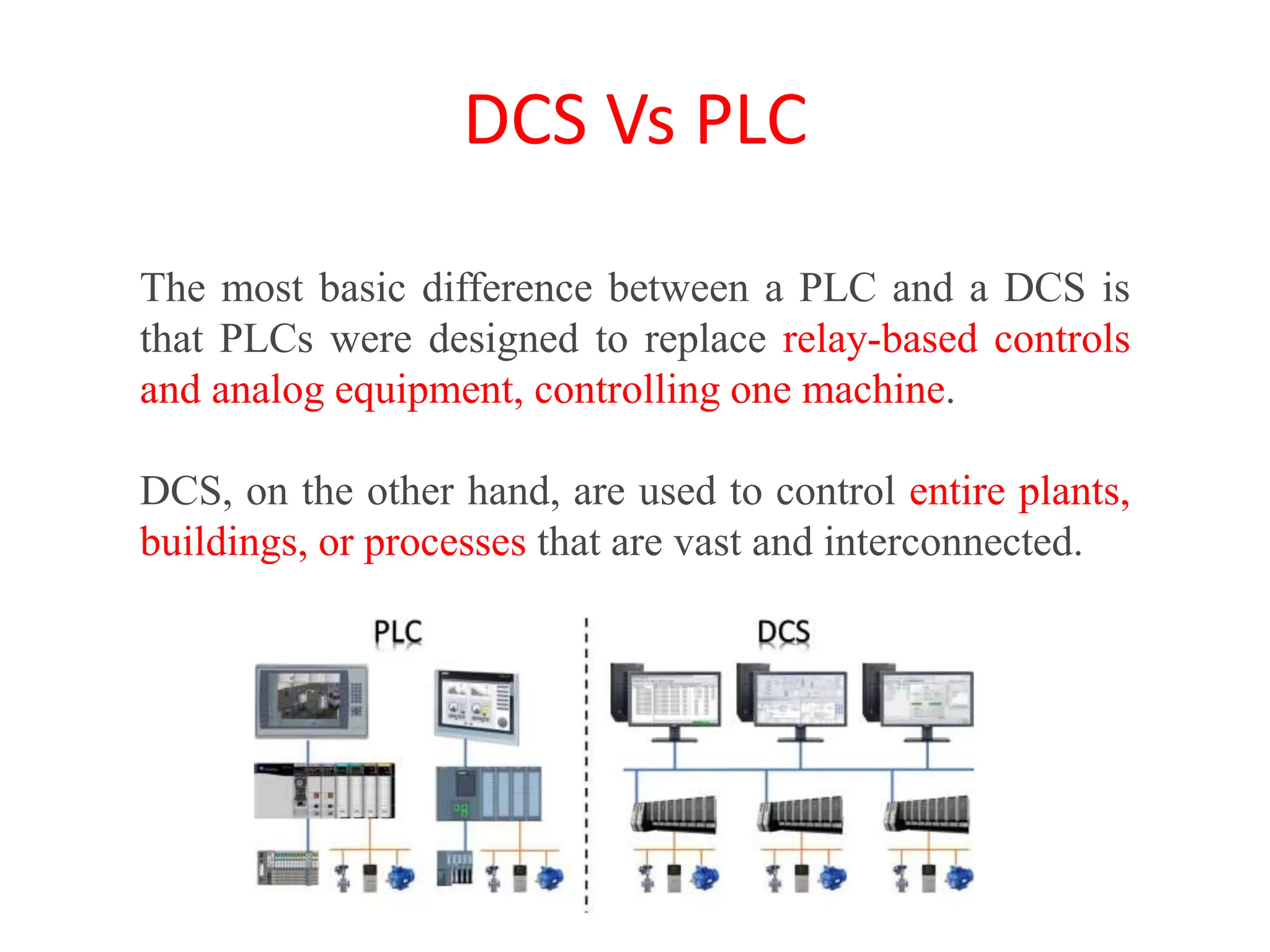
The most basic difference between a PLC and a DCS is
that PLCs were designed to replace relay-based controls
and analog equipment, controlling one machine.
DCS, on the other hand, are used to control entire plants,
buildings, or processes that are vast and interconnected.
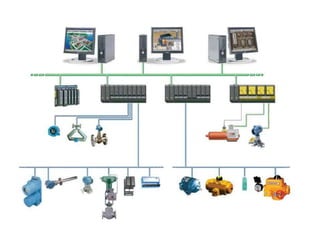
Distributed control system
A distributed control
system (DCS) is a platform
for automated control and
operation of a plant or
industrial process.
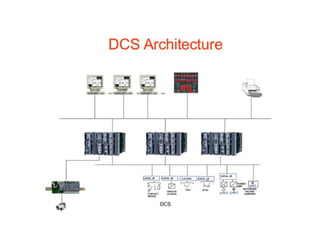
A DCS combines the
following into a single
automated system: human
machine interface (HMI),
logic solvers, historian,
common database, alarm
management, and a
common engineering suite.
DCS
DCS
Operator
Control
Panel
Main
Control
Computer
Operator
Control
Panel
Archival
Data
Storage
Supervisory (host)
Computer
PROCESS
Local
Computer
Local
Computer
Local
Computer
Local Display Local Display
Data highway
To other Processes To other Processes
Local data acquisition and
control computers
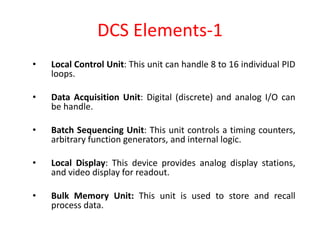
DCS Elements-1
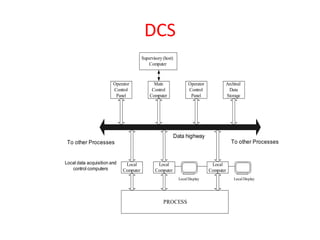
• Local Control Unit: This unit can handle 8 to 16 individual PID
loops.
• Data Acquisition Unit: Digital (discrete) and analog I/O can
be handle.
• Batch Sequencing Unit: This unit controls a timing counters,
arbitrary function generators, and internal logic.
• Local Display: This device provides analog display stations,
and video display for readout.
• Bulk Memory Unit: This unit is used to store and recall
process data.
DCS Elements-2
• General Purpose Computer : This unit is programmed by a
customer or third party to perform optimization, advance
control, expert system, etc
• Central Operator Display: This unit typically contain several
consoles for operator communication with the system, and
multiple video color graphics display units
• Data Highway : A serial digital data transmission link
connecting all other components in the system. It allow for
redundant data highway to reduce the risk of data loss
• Local area Network (LAN)
Need for DCS
• DCS is a system of sensors, controllers, and
associated computers that are distributed throughout a
plant.
• Each of these elements serves a unique purpose such
as data acquisition, process control, as well as data
storage and graphical display.
• These individual elements communicate with a
centralized computer through the plant’s local area
network – often referred to as a control network.
Example
• DCS at a power plant might automatically increase
generation capacity in order to keep up with changing
demand for electricity during hot Summer days and
then decrease it as outdoor temperatures cool
overnight and demand subsides.
• Whereas a PLC could adjust a single unit operation,
the DCS can make adjustments to each of a plant’s
many interacting unit operations.
How is a DCS Used?
• As the ‘central brain’ of the plant the DCS makes
automated decisions based on production trends it
sees them in real-time throughout a plant.
• While DCSs are used across the process control
industries to supervise complex production processes,
they are more widely deployed at large, continuous
manufacturing plants such as those in the
petrochemical industry.
• With the help of a DCS these and other manufactures
can efficiently coordinate adjustments in a top-down
fashion using a centralized network of computers.
• Instructions from the DCS are deployed throughout a
plant and fed to individual controllers.
• When configured appropriately the DCS can improve
safety while also enhancing production efficiency.
What Makes the DCS so
Important?
• A comparison of two plants may help to illustrate the
importance of the DCS.
• First, imagine a small municipal waste water
treatment facility that employs a dozen control loops.
• The plant’s engineering staff can easily keep a
mindful eye on the performance of such a limited
number of controllers.
• Next, imagine a large refinery that operates 10,000
highly dynamic and interacting control loops.
• While coordinating control at the treatment facility is
relatively easy, the task of orchestrating control at the
refinery can be overwhelming without the use of a
DCS.
• Over the years, the line between DCS and PLC has
blurred. While the DCS has traditionally been the
only solution for achieving safe and efficient plant-
wide control, advancement in processing capabilities
has allowed the PLC to rapidly take on greater
responsibility.
Advantages of DCS
• Access a large amount of real time information
from the data highway.
• Monitoring trends of past process conditions.
• Readily install new on-line measurements
together with local computers.
• Alternate quickly among standard control
strategies and read controller parameters in
software.
• A sight full engineer can use the flexibility of the
framework to implement his latest controller
design ideas on the host computer.
DCS Vendors
• Honeywell
• Fisher-Rosemont
• Baily
• Foxboro
• Yokogawa
• Siemens
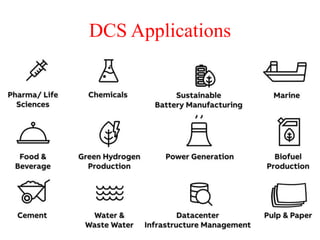
DCS Applications

Distributed control system PPT 1 2 3 4 5

  • 1.
    DCS Vs PLC Themost basic difference between a PLC and a DCS is that PLCs were designed to replace relay-based controls and analog equipment, controlling one machine. DCS, on the other hand, are used to control entire plants, buildings, or processes that are vast and interconnected.
  • 2.
    Distributed control system Adistributed control system (DCS) is a platform for automated control and operation of a plant or industrial process. A DCS combines the following into a single automated system: human machine interface (HMI), logic solvers, historian, common database, alarm management, and a common engineering suite.
  • 3.
  • 5.
  • 6.
    DCS Elements-1 • LocalControl Unit: This unit can handle 8 to 16 individual PID loops. • Data Acquisition Unit: Digital (discrete) and analog I/O can be handle. • Batch Sequencing Unit: This unit controls a timing counters, arbitrary function generators, and internal logic. • Local Display: This device provides analog display stations, and video display for readout. • Bulk Memory Unit: This unit is used to store and recall process data.
  • 7.
    DCS Elements-2 • GeneralPurpose Computer : This unit is programmed by a customer or third party to perform optimization, advance control, expert system, etc • Central Operator Display: This unit typically contain several consoles for operator communication with the system, and multiple video color graphics display units • Data Highway : A serial digital data transmission link connecting all other components in the system. It allow for redundant data highway to reduce the risk of data loss • Local area Network (LAN)
  • 13.
    Need for DCS •DCS is a system of sensors, controllers, and associated computers that are distributed throughout a plant. • Each of these elements serves a unique purpose such as data acquisition, process control, as well as data storage and graphical display. • These individual elements communicate with a centralized computer through the plant’s local area network – often referred to as a control network.
  • 14.
    Example • DCS ata power plant might automatically increase generation capacity in order to keep up with changing demand for electricity during hot Summer days and then decrease it as outdoor temperatures cool overnight and demand subsides. • Whereas a PLC could adjust a single unit operation, the DCS can make adjustments to each of a plant’s many interacting unit operations.
  • 16.
    How is aDCS Used? • As the ‘central brain’ of the plant the DCS makes automated decisions based on production trends it sees them in real-time throughout a plant. • While DCSs are used across the process control industries to supervise complex production processes, they are more widely deployed at large, continuous manufacturing plants such as those in the petrochemical industry.
  • 17.
    • With thehelp of a DCS these and other manufactures can efficiently coordinate adjustments in a top-down fashion using a centralized network of computers. • Instructions from the DCS are deployed throughout a plant and fed to individual controllers. • When configured appropriately the DCS can improve safety while also enhancing production efficiency.
  • 18.
    What Makes theDCS so Important? • A comparison of two plants may help to illustrate the importance of the DCS. • First, imagine a small municipal waste water treatment facility that employs a dozen control loops. • The plant’s engineering staff can easily keep a mindful eye on the performance of such a limited number of controllers. • Next, imagine a large refinery that operates 10,000 highly dynamic and interacting control loops.
  • 19.
    • While coordinatingcontrol at the treatment facility is relatively easy, the task of orchestrating control at the refinery can be overwhelming without the use of a DCS. • Over the years, the line between DCS and PLC has blurred. While the DCS has traditionally been the only solution for achieving safe and efficient plant- wide control, advancement in processing capabilities has allowed the PLC to rapidly take on greater responsibility.
  • 20.
    Advantages of DCS •Access a large amount of real time information from the data highway. • Monitoring trends of past process conditions. • Readily install new on-line measurements together with local computers. • Alternate quickly among standard control strategies and read controller parameters in software. • A sight full engineer can use the flexibility of the framework to implement his latest controller design ideas on the host computer.
  • 21.
    DCS Vendors • Honeywell •Fisher-Rosemont • Baily • Foxboro • Yokogawa • Siemens
  • 22.