DISTRIBUTED
SYSTEM
ARCHITECTURE
presented by students:
ID: 326.
Ayoup Ali Mohammed
ID: 327.
Rashwan
AbdulathimMurajia
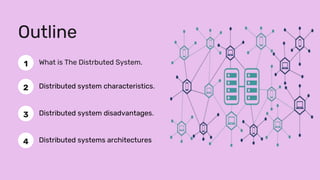
1 What is The Distrbuted System.
2 Distributed system characteristics.
3 Distributed system disadvantages.
Outline
4 Distributed systems architectures
DISTRIBUTED
SYSTEM
A distributed system is a collection of independent components
located on different machines that share messages with each
other in order to achieve common goals
In distributed architecture, components are presented on different
platforms and several components can cooperate with one
another over a communication network in order to achieve a
specific objective or goal
Resource sharing :
• Sharing of hardware and software resources
Openness :
• Use of equipment and software from
different vendors
Concurrency :
• Concurrent processing to enhance
performance
DISTRIBUTED
SYSTEM
characteristics Scalability :
• Increased throughput by adding new
resources
Fault tolerance :
• The ability to continue in operation after a
fault has occurred
Complexity:
• Typically, distributed systems are more
complex than centralised systems
Security :
• More susceptible to external attack
Manageability :
• More effort required for system management
DISTRIBUTED
SYSTEM
disadvantages
Unpredictability :
• Unpredictable responses depending on the
system organisation and network load
DISTRIBUTED
SYSTEM
ARCHITECTUREs
A distributed system is broadly divided into two
essential concepts — software architecture
(further divided into layered architecture,
object-based architecture, data-centered
architecture, and event-based architecture)
and system architecture (further divided into
client-server architecture and peer-to-peer
architecture).
Let’s understand each of these architecture
systems in detail:
1
2
3
software
architecture
The four main architectural styles of distributed
systems in software components entail:
Layered architecture
Object-based architecture
Data-centered architecture
4 Event-based architecture
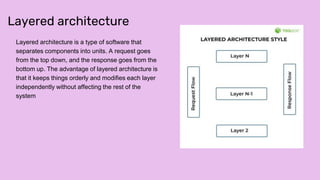
Layered architecture is a type of software that
separates components into units. A request goes
from the top down, and the response goes from the
bottom up. The advantage of layered architecture is
that it keeps things orderly and modifies each layer
independently without affecting the rest of the
system
Layered architecture
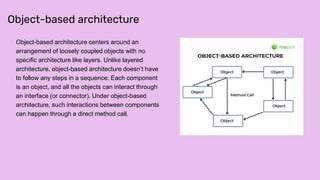
Object-based architecture centers around an
arrangement of loosely coupled objects with no
specific architecture like layers. Unlike layered
architecture, object-based architecture doesn’t have
to follow any steps in a sequence. Each component
is an object, and all the objects can interact through
an interface (or connector). Under object-based
architecture, such interactions between components
can happen through a direct method call.
Object-based architecture
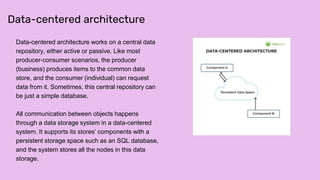
Data-centered architecture works on a central data
repository, either active or passive. Like most
producer-consumer scenarios, the producer
(business) produces items to the common data
store, and the consumer (individual) can request
data from it. Sometimes, this central repository can
be just a simple database.
All communication between objects happens
through a data storage system in a data-centered
system. It supports its stores’ components with a
persistent storage space such as an SQL database,
and the system stores all the nodes in this data
storage.
Data-centered architecture
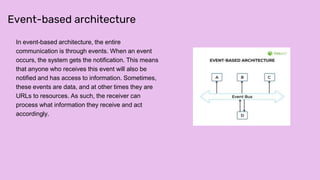
In event-based architecture, the entire
communication is through events. When an event
occurs, the system gets the notification. This means
that anyone who receives this event will also be
notified and has access to information. Sometimes,
these events are data, and at other times they are
URLs to resources. As such, the receiver can
process what information they receive and act
accordingly.
Event-based architecture
1
2
System
architecture Client-server architecture
Peer-to-peer (P2P) architecture
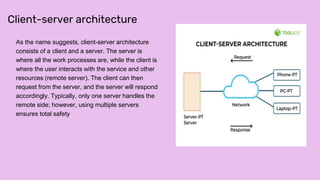
As the name suggests, client-server architecture
consists of a client and a server. The server is
where all the work processes are, while the client is
where the user interacts with the service and other
resources (remote server). The client can then
request from the server, and the server will respond
accordingly. Typically, only one server handles the
remote side; however, using multiple servers
ensures total safety
Client-server architecture
A peer-to-peer network, also called a (P2P)
network, works on the concept of no central control
in a distributed system. A node can either act as a
client or server at any given time once it joins the
network. A node that requests something is called a
client, and one that provides something is called a
server. In general, each node is called a peer
Peer-to-peer (P2P) architecture
It's so lovely
to meet all of you!
Thank you for listening.

DISTRIBUTED SYSTEM ARCHITECTURE.pptx

  • 1.
  • 2.
    presented by students: ID:326. Ayoup Ali Mohammed ID: 327. Rashwan AbdulathimMurajia
  • 3.
    1 What isThe Distrbuted System. 2 Distributed system characteristics. 3 Distributed system disadvantages. Outline 4 Distributed systems architectures
  • 4.
    DISTRIBUTED SYSTEM A distributed systemis a collection of independent components located on different machines that share messages with each other in order to achieve common goals In distributed architecture, components are presented on different platforms and several components can cooperate with one another over a communication network in order to achieve a specific objective or goal
  • 5.
    Resource sharing : •Sharing of hardware and software resources Openness : • Use of equipment and software from different vendors Concurrency : • Concurrent processing to enhance performance DISTRIBUTED SYSTEM characteristics Scalability : • Increased throughput by adding new resources Fault tolerance : • The ability to continue in operation after a fault has occurred
  • 6.
    Complexity: • Typically, distributedsystems are more complex than centralised systems Security : • More susceptible to external attack Manageability : • More effort required for system management DISTRIBUTED SYSTEM disadvantages Unpredictability : • Unpredictable responses depending on the system organisation and network load
  • 7.
    DISTRIBUTED SYSTEM ARCHITECTUREs A distributed systemis broadly divided into two essential concepts — software architecture (further divided into layered architecture, object-based architecture, data-centered architecture, and event-based architecture) and system architecture (further divided into client-server architecture and peer-to-peer architecture). Let’s understand each of these architecture systems in detail:
  • 8.
    1 2 3 software architecture The four mainarchitectural styles of distributed systems in software components entail: Layered architecture Object-based architecture Data-centered architecture 4 Event-based architecture
  • 9.
    Layered architecture isa type of software that separates components into units. A request goes from the top down, and the response goes from the bottom up. The advantage of layered architecture is that it keeps things orderly and modifies each layer independently without affecting the rest of the system Layered architecture
  • 10.
    Object-based architecture centersaround an arrangement of loosely coupled objects with no specific architecture like layers. Unlike layered architecture, object-based architecture doesn’t have to follow any steps in a sequence. Each component is an object, and all the objects can interact through an interface (or connector). Under object-based architecture, such interactions between components can happen through a direct method call. Object-based architecture
  • 11.
    Data-centered architecture workson a central data repository, either active or passive. Like most producer-consumer scenarios, the producer (business) produces items to the common data store, and the consumer (individual) can request data from it. Sometimes, this central repository can be just a simple database. All communication between objects happens through a data storage system in a data-centered system. It supports its stores’ components with a persistent storage space such as an SQL database, and the system stores all the nodes in this data storage. Data-centered architecture
  • 12.
    In event-based architecture,the entire communication is through events. When an event occurs, the system gets the notification. This means that anyone who receives this event will also be notified and has access to information. Sometimes, these events are data, and at other times they are URLs to resources. As such, the receiver can process what information they receive and act accordingly. Event-based architecture
  • 13.
  • 14.
    As the namesuggests, client-server architecture consists of a client and a server. The server is where all the work processes are, while the client is where the user interacts with the service and other resources (remote server). The client can then request from the server, and the server will respond accordingly. Typically, only one server handles the remote side; however, using multiple servers ensures total safety Client-server architecture
  • 15.
    A peer-to-peer network,also called a (P2P) network, works on the concept of no central control in a distributed system. A node can either act as a client or server at any given time once it joins the network. A node that requests something is called a client, and one that provides something is called a server. In general, each node is called a peer Peer-to-peer (P2P) architecture
  • 16.
    It's so lovely tomeet all of you! Thank you for listening.