COM and DCOM

 Sisimon Soman
COM
• Binary standard by M$
• Objects exposed from dll through well defined
  interface.
• All dll servers expose common function
  (DllGetClassObject()) so that COM subsystem
  can get the object.
• One COM object support multiple interfaces, can
  query (QueryInterface()) other interfaces from an
  interface pointer.
• All interfaces should derive from IUnknown (for
  reference counting, QueryInterface()).
• Client calls CoCreateInstance() -> dll name from
  registry->LoadLibrary-> DllGetClassObject(IID).
Foo.dll
IFoo
       Interface IFoo:public IUnknown
       {
               F1();
       }
       Class CFoo : public IFoo
       {
            F1() {….}
       };


       DllGetCLassObject (IID, pFoo)
       {
            If(IID == IID_IFoo)
            {
                pFoo = new CFoo;
                return SUCCESS;
           }
           else
           {
                return E_FAIL;
           }
       }
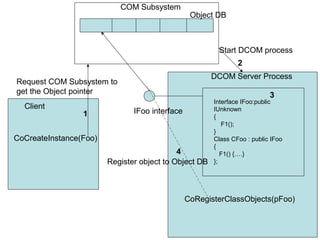
COM Subsystem
                                                 Object DB


                                                        Start DCOM process
                                                               2
                                                       DCOM Server Process
Request COM Subsystem to
get the Object pointer                                                    3
                                                       Interface IFoo:public
  Client                                               IUnknown
                 1             IFoo interface
                                                       {
                                                          F1();
                                                       }
CoCreateInstance(Foo)                                  Class CFoo : public IFoo
                                                       {
                                            4             F1() {….}
                        Register object to Object DB   };


                                                CoRegisterClassObjects(pFoo)

COM and DCOM

  • 1.
    COM and DCOM Sisimon Soman
  • 2.
    COM • Binary standardby M$ • Objects exposed from dll through well defined interface. • All dll servers expose common function (DllGetClassObject()) so that COM subsystem can get the object. • One COM object support multiple interfaces, can query (QueryInterface()) other interfaces from an interface pointer. • All interfaces should derive from IUnknown (for reference counting, QueryInterface()). • Client calls CoCreateInstance() -> dll name from registry->LoadLibrary-> DllGetClassObject(IID).
  • 3.
    Foo.dll IFoo Interface IFoo:public IUnknown { F1(); } Class CFoo : public IFoo { F1() {….} }; DllGetCLassObject (IID, pFoo) { If(IID == IID_IFoo) { pFoo = new CFoo; return SUCCESS; } else { return E_FAIL; } }
  • 4.
    COM Subsystem Object DB Start DCOM process 2 DCOM Server Process Request COM Subsystem to get the Object pointer 3 Interface IFoo:public Client IUnknown 1 IFoo interface { F1(); } CoCreateInstance(Foo) Class CFoo : public IFoo { 4 F1() {….} Register object to Object DB }; CoRegisterClassObjects(pFoo)