Object Calisthenics
Elton Minetto
@eminetto
O que é?
Conjunto de boas práticas e regras de
programação que podem ser aplicadas para
melhorar a qualidade do código
Introduzido por Jeff Bay e publicado no livro
ThoughtWorks Anthology
Inicialmente criadas tendo como base a
linguagem Java e adaptações são necessárias
para outros ambientes
Então...
Object Calisthenics
Code Calisthenics
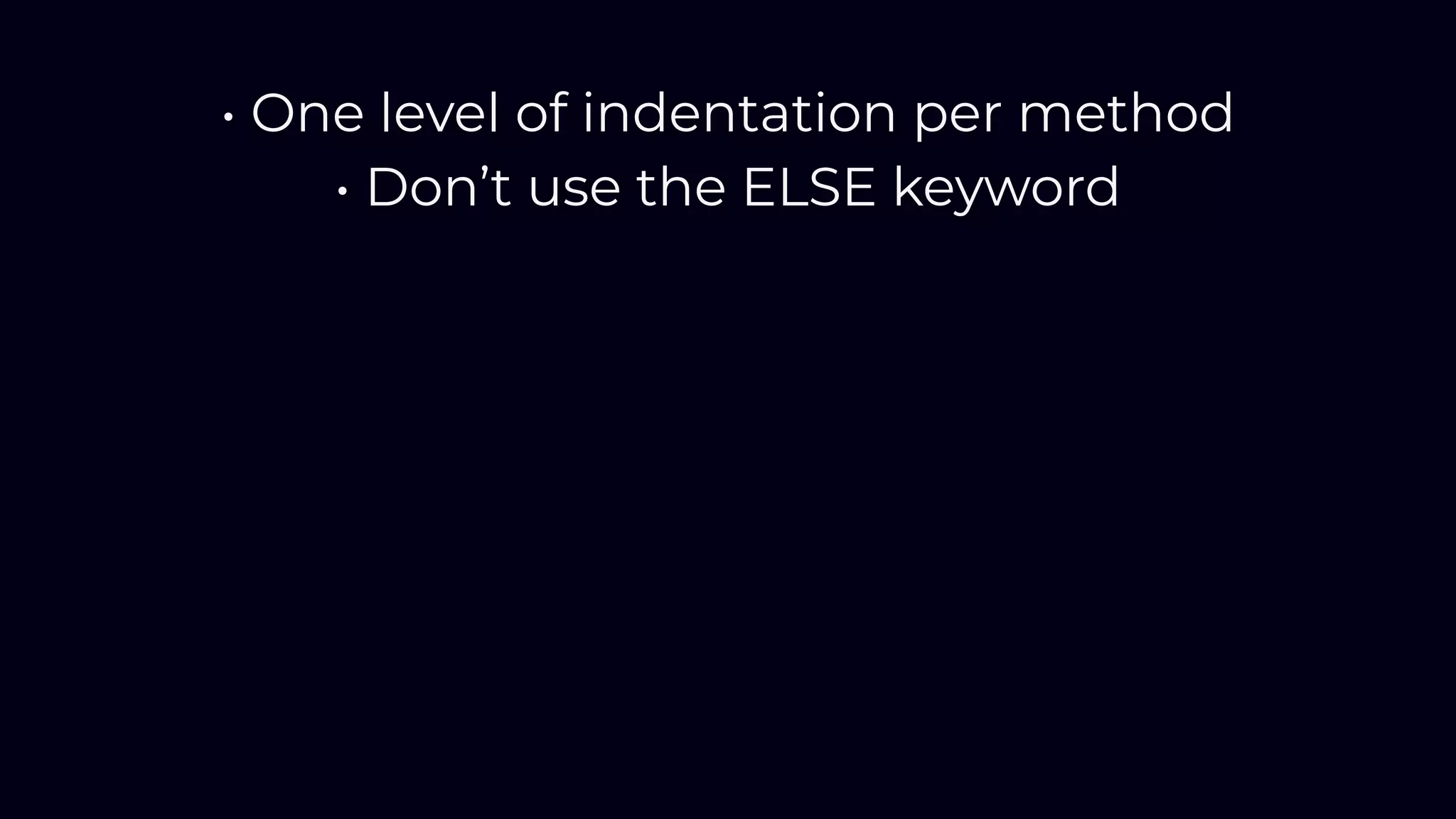
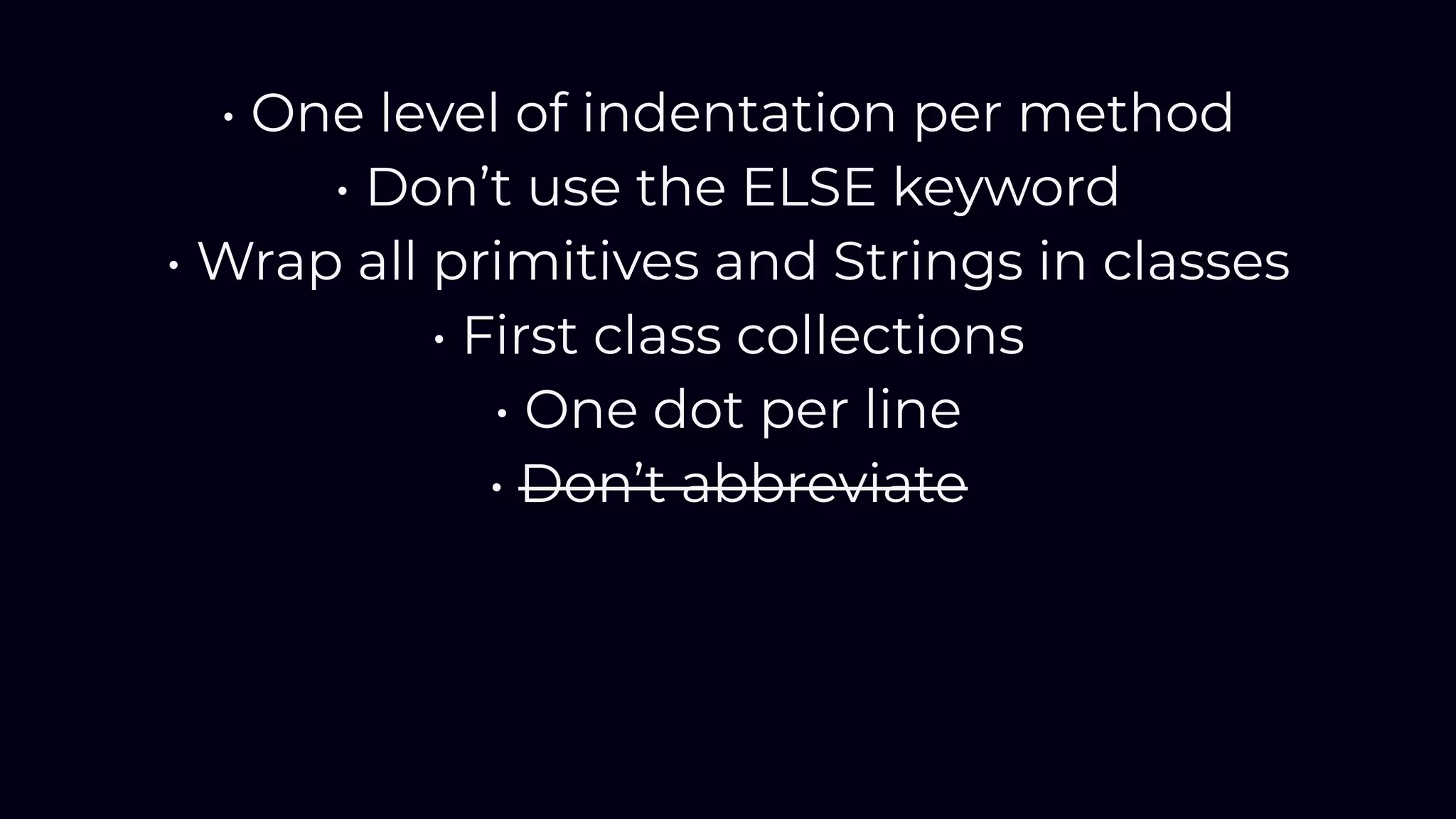
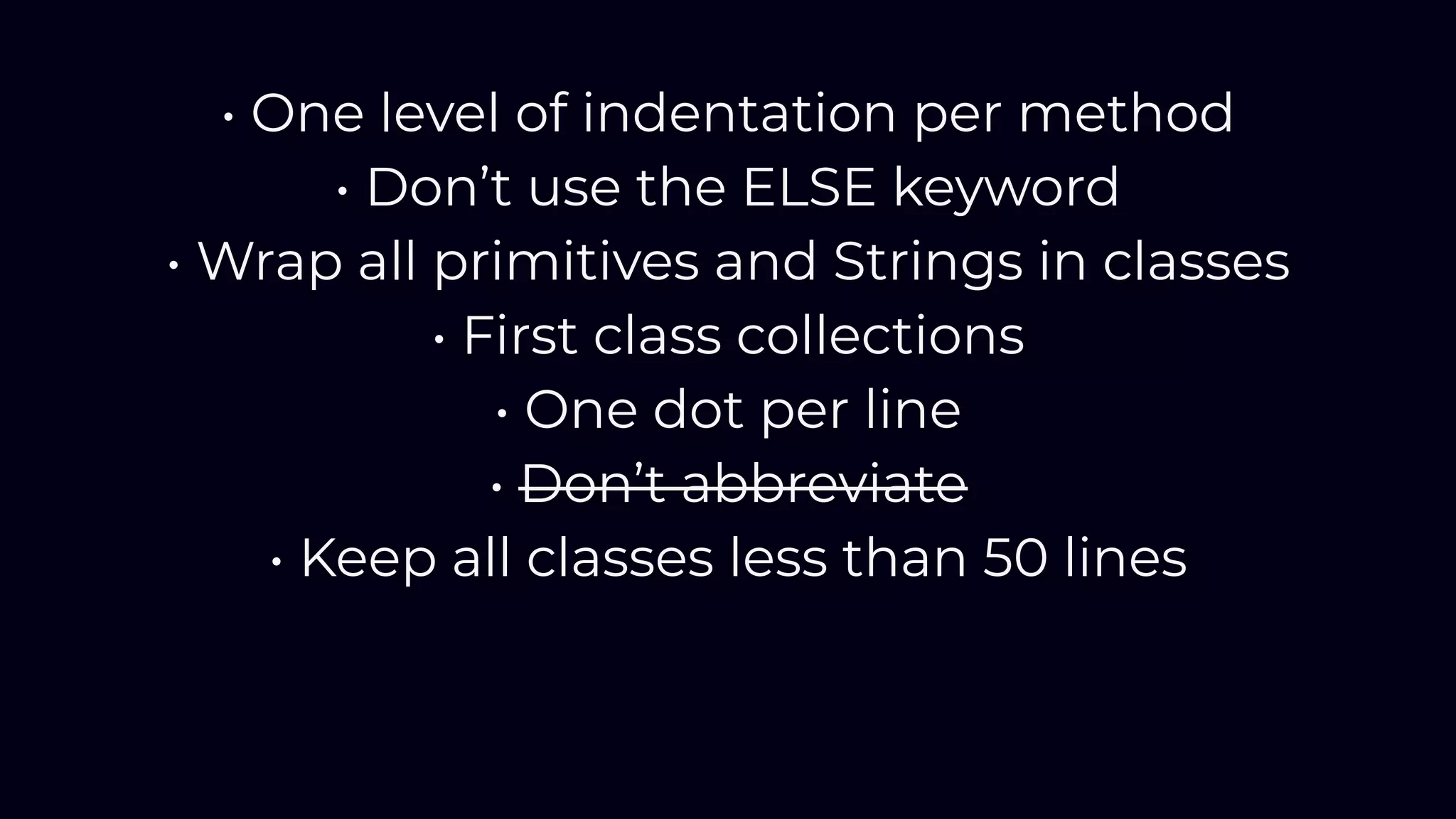
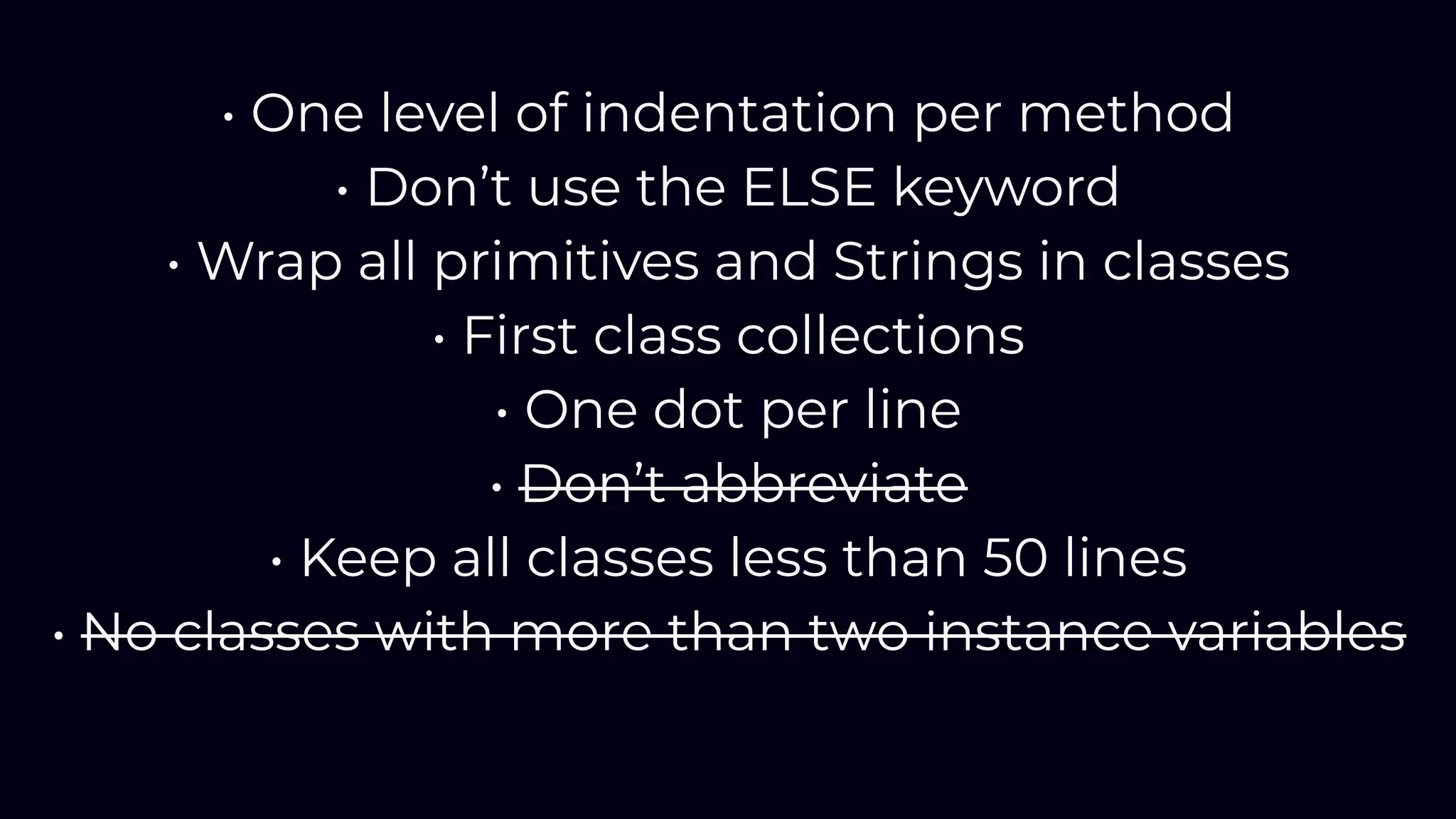
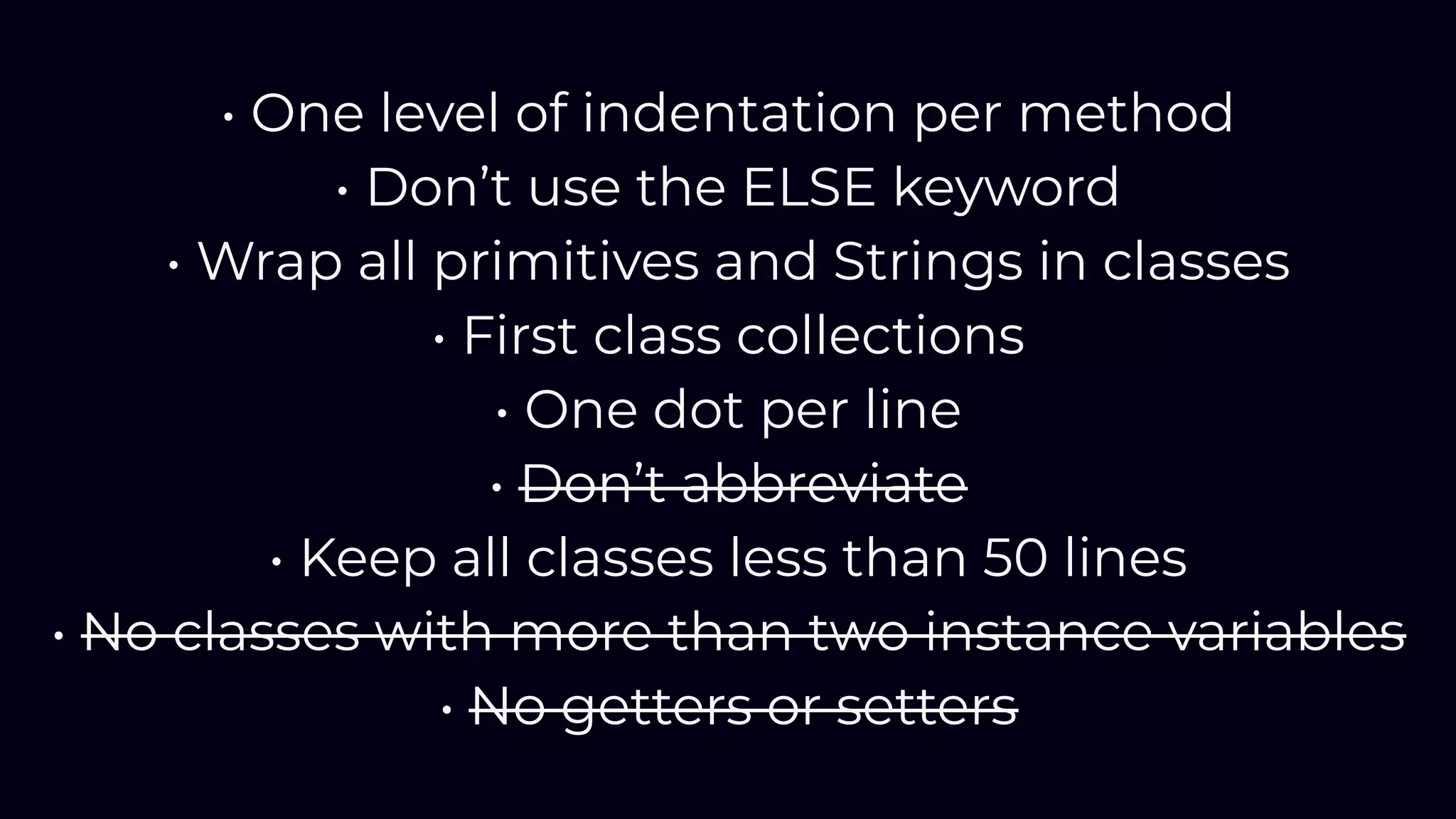
• One level of indentation per method
• Don’t use the ELSE keyword
• One level of indentation per method
• Don’t use the ELSE keyword
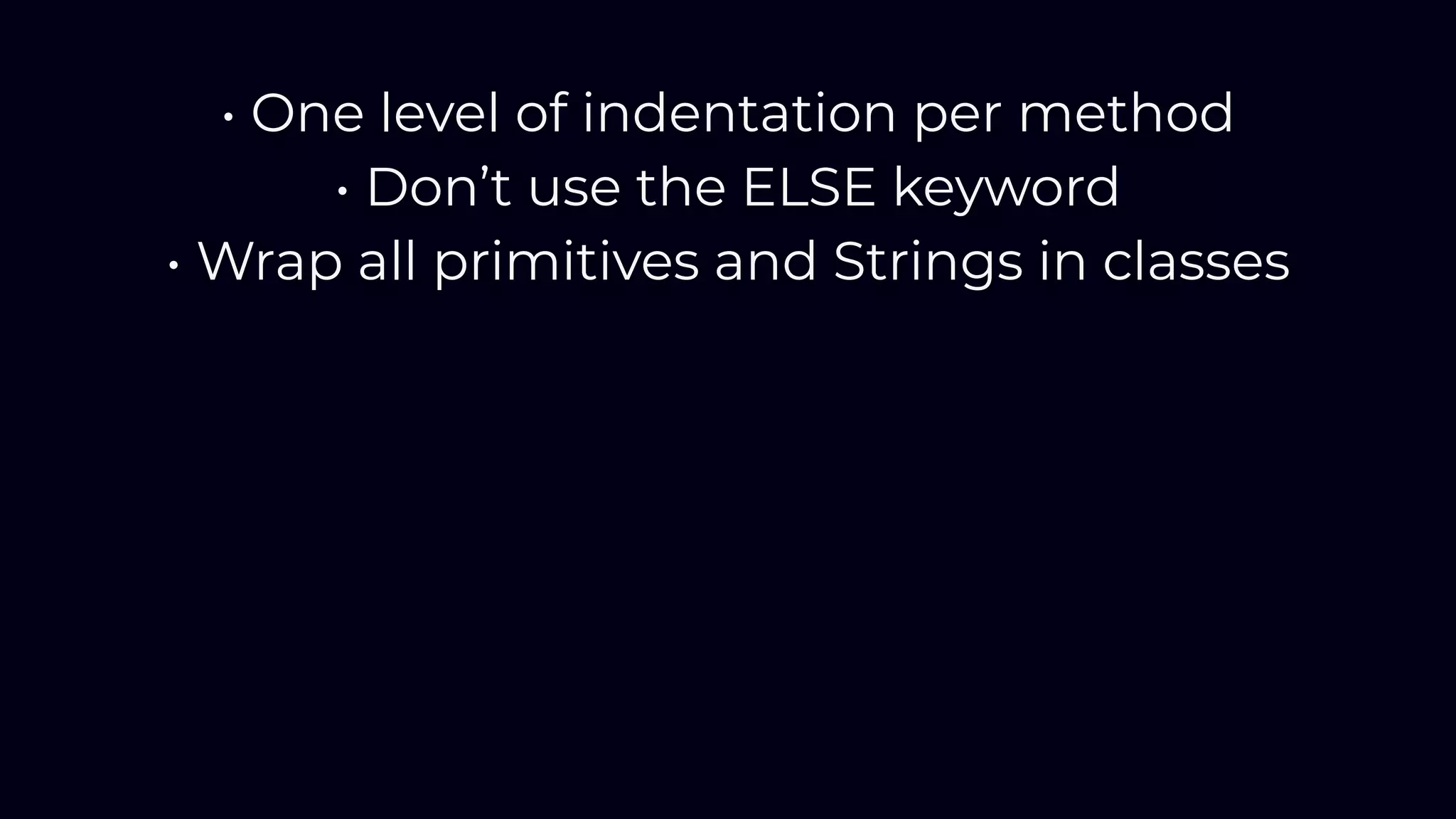
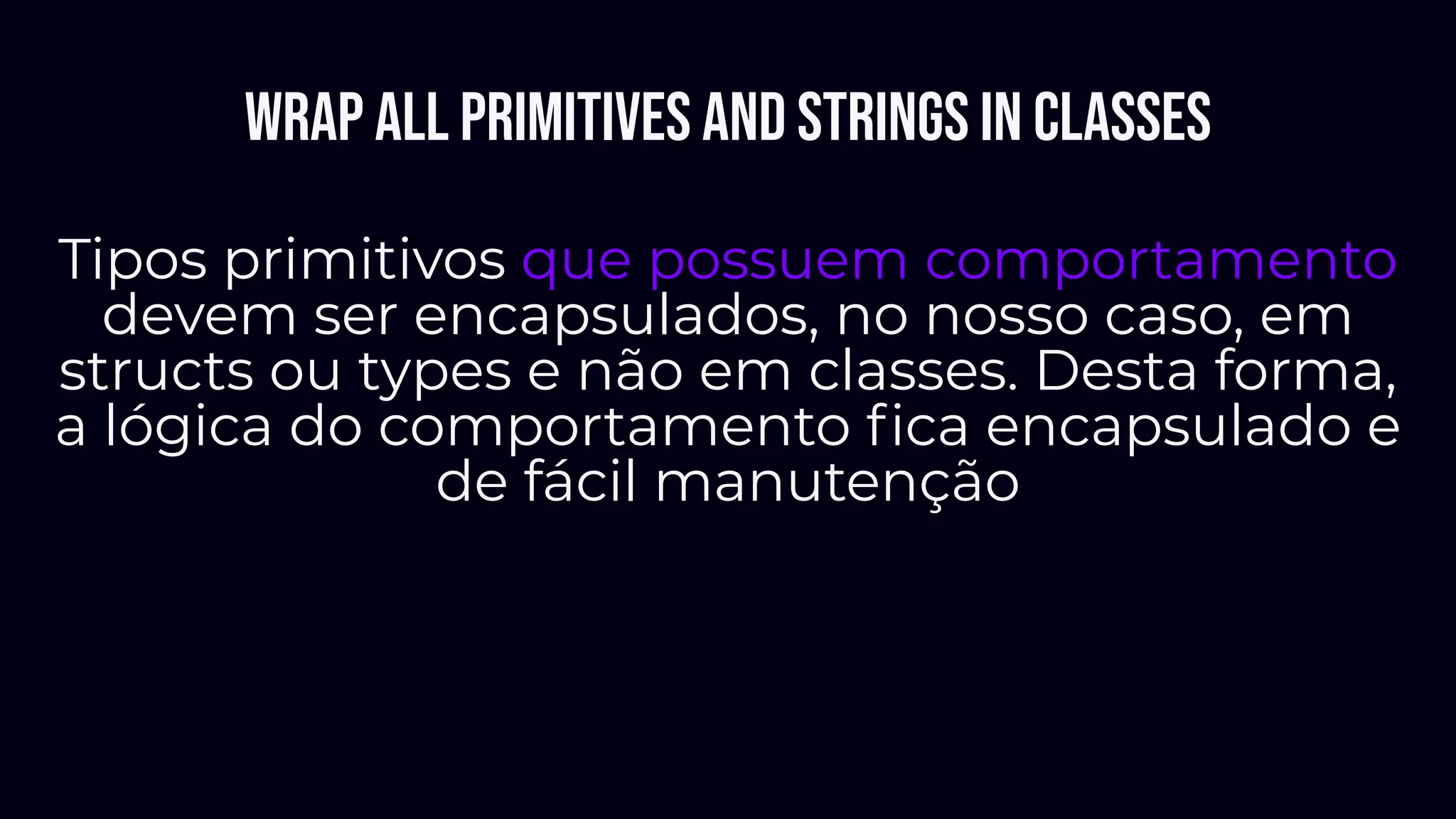
• Wrap all primitives and Strings in classes
• One level of indentation per method
• Don’t use the ELSE keyword
• Wrap all primitives and Strings in classes
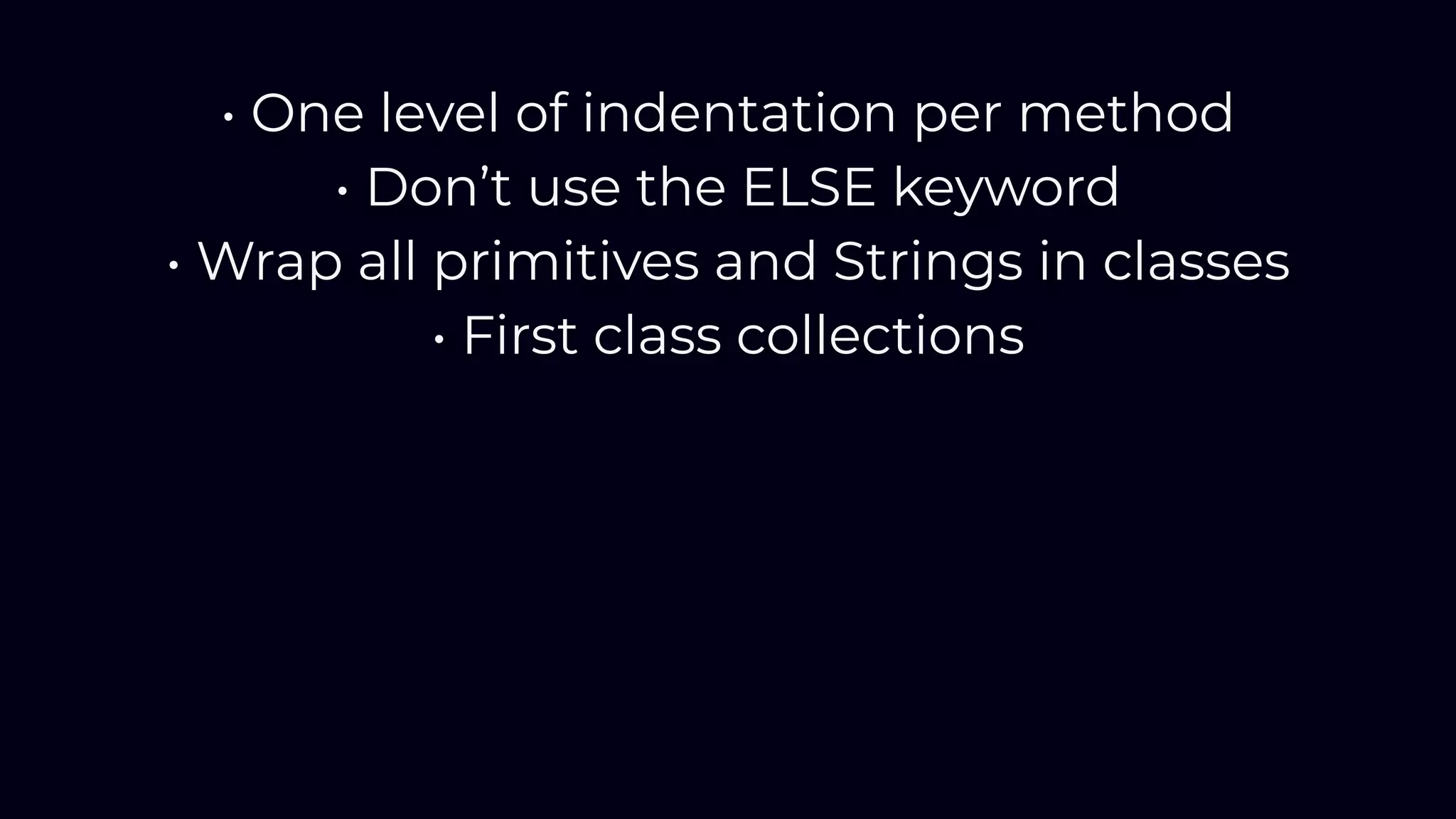
• First class collections
• One level of indentation per method
• Don’t use the ELSE keyword
• Wrap all primitives and Strings in classes
• First class collections
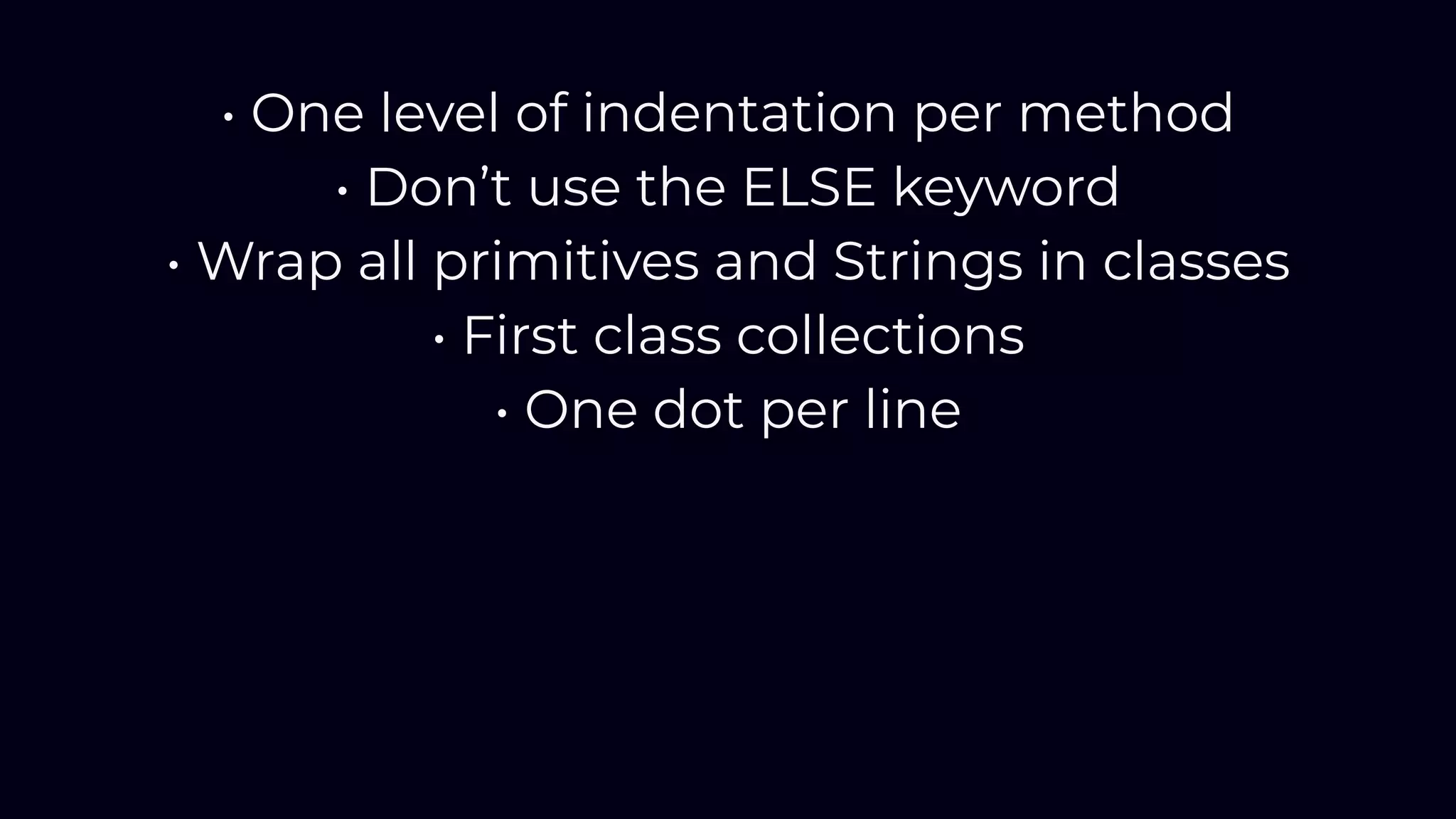
• One dot per line
• One level of indentation per method
• Don’t use the ELSE keyword
• Wrap all primitives and Strings in classes
• First class collections
• One dot per line
• Don’t abbreviate
• One level of indentation per method
• Don’t use the ELSE keyword
• Wrap all primitives and Strings in classes
• First class collections
• One dot per line
• Don’t abbreviate
• Keep all classes less than 50 lines
• One level of indentation per method
• Don’t use the ELSE keyword
• Wrap all primitives and Strings in classes
• First class collections
• One dot per line
• Don’t abbreviate
• Keep all classes less than 50 lines
• No classes with more than two instance variables
• One level of indentation per method
• Don’t use the ELSE keyword
• Wrap all primitives and Strings in classes
• First class collections
• One dot per line
• Don’t abbreviate
• Keep all classes less than 50 lines
• No classes with more than two instance variables
• No getters or setters
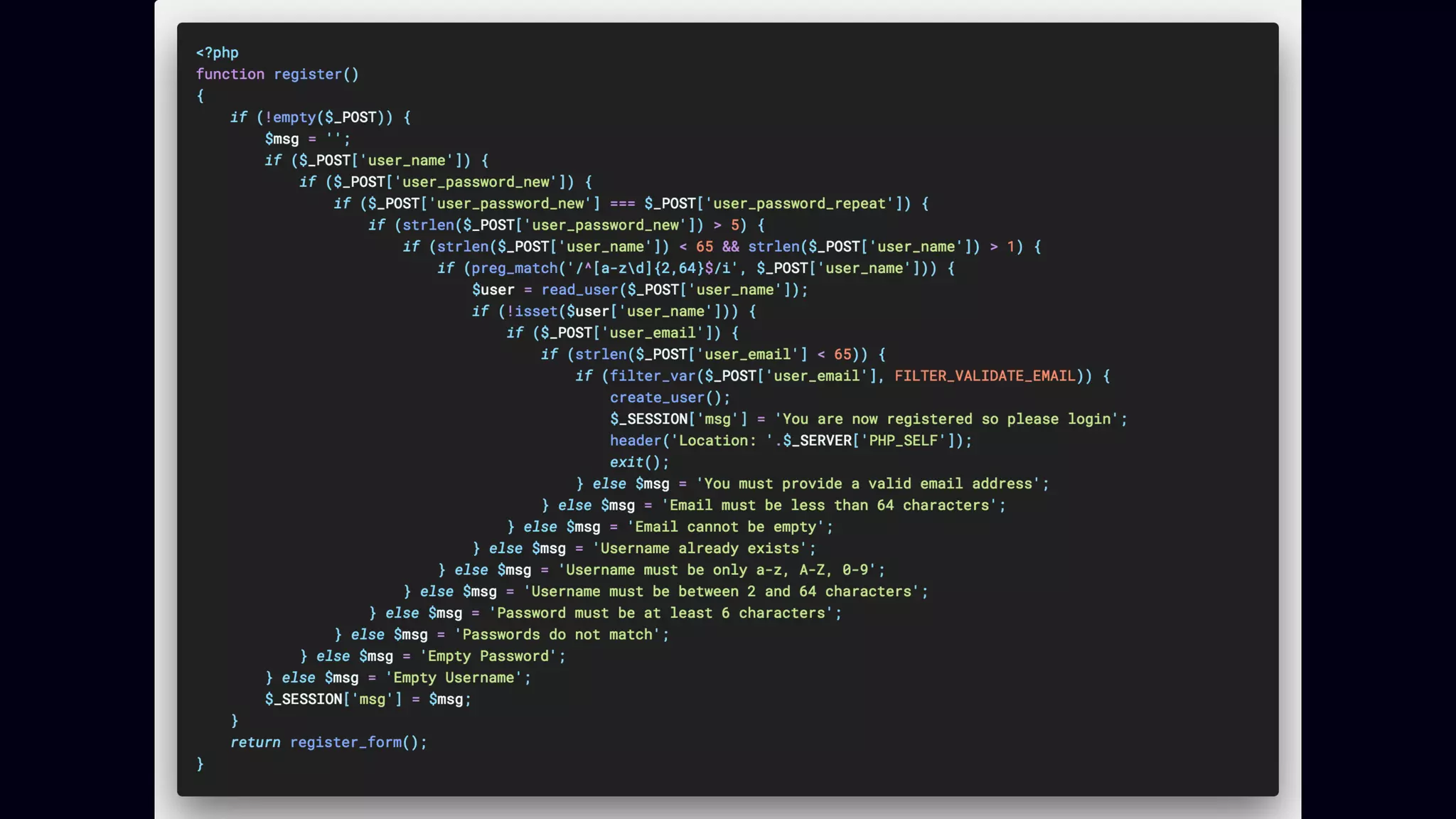
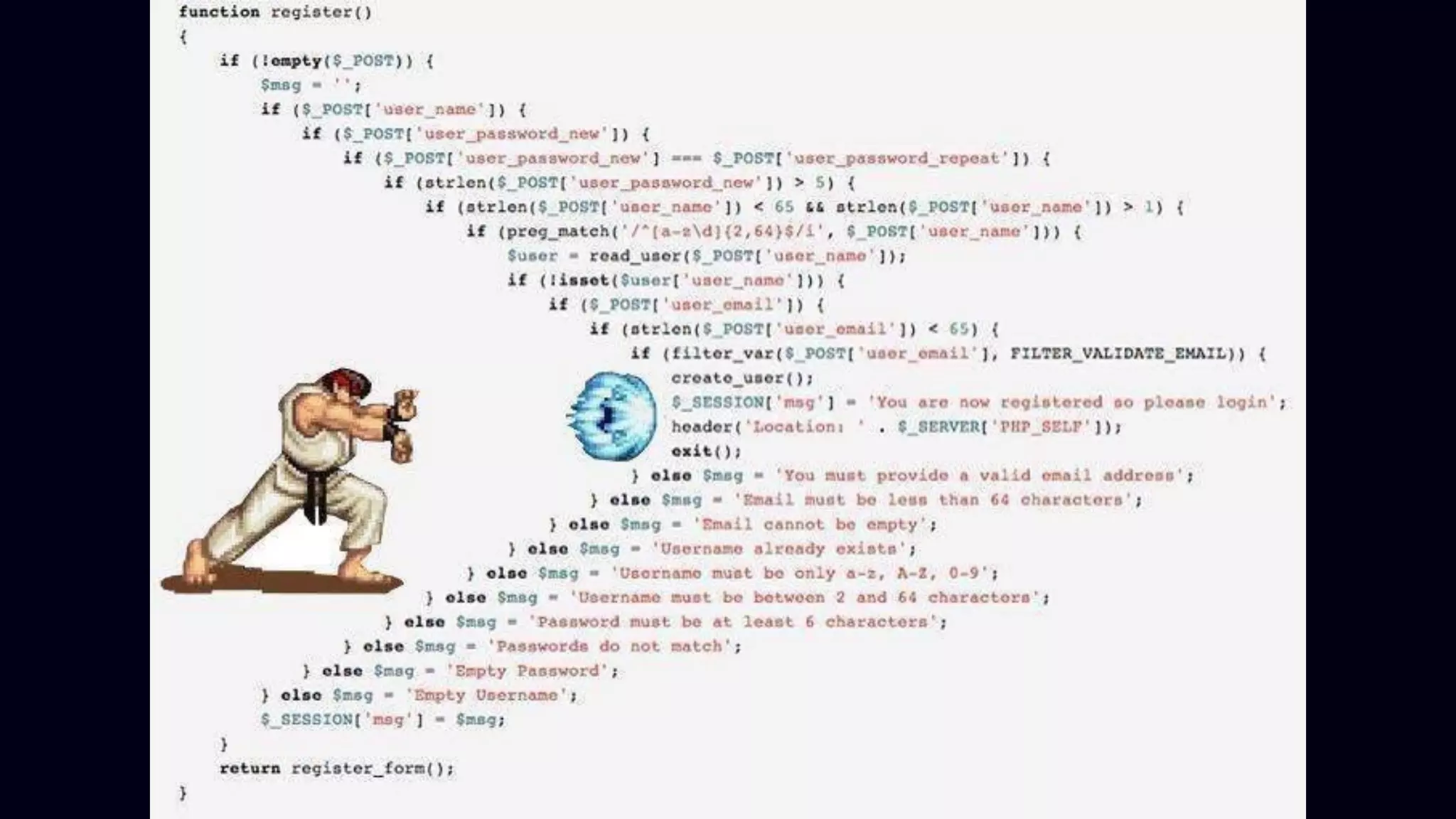
One level of indentation per method
Aplicar esta regra permite que o nosso código
seja mais legível
type board struct {
data [][]string
}
func NewBoard(data [][]string) *board {} //código omitido pra ficar legal no slide ;)
func (b *board) Board() string {
var buffer = &bytes.Buffer{}
// level 0
for i := 0; i < 10; i++ {
// level 1
for j := 0; j < 10; j++ {
// level 2
buffer.WriteString(b.data[i][j])
}
buffer.WriteString("n")
}
return buffer.String()
}
type board struct {
data [][]string
}
func NewBoard(data [][]string) *board {} //código omitido pra ficar legal no slide ;)
func (b *board) Board() string {
var buffer = &bytes.Buffer{}
// level 0
for i := 0; i < 10; i++ {
// level 1
for j := 0; j < 10; j++ {
// level 2
buffer.WriteString(b.data[i][j])
}
buffer.WriteString("n")
}
return buffer.String()
}
type board struct {
data [][]string
}
func NewBoard(data [][]string) *board {} //código omitido pra ficar legal no slide ;)
func (b *board) Board() string {
var buffer = &bytes.Buffer{}
// level 0
for i := 0; i < 10; i++ {
// level 1
for j := 0; j < 10; j++ {
// level 2
buffer.WriteString(b.data[i][j])
}
buffer.WriteString("n")
}
return buffer.String()
}
type board struct {
data [][]string
}
func NewBoard(data [][]string) *board {}
func (b *board) Board() string {
var buffer = &bytes.Buffer{}
b.collectRows(buffer)
return buffer.String()
}
func (b *board) collectRows(buffer *bytes.Buffer) {
for i := 0; i < 10; i++ {
b.collectRow(buffer, i)
}
}
func (b *board) collectRow(buffer *bytes.Buffer, row int) {
for j := 0; j < 10; j++ {
buffer.WriteString(b.data[row][j])
}
buffer.WriteString("n")
}
type board struct {
data [][]string
}
func NewBoard(data [][]string) *board {}
func (b *board) Board() string {
var buffer = &bytes.Buffer{}
b.collectRows(buffer)
return buffer.String()
}
func (b *board) collectRows(buffer *bytes.Buffer) {
for i := 0; i < 10; i++ {
b.collectRow(buffer, i)
}
}
func (b *board) collectRow(buffer *bytes.Buffer, row int) {
for j := 0; j < 10; j++ {
buffer.WriteString(b.data[row][j])
}
buffer.WriteString("n")
}
type board struct {
data [][]string
}
func NewBoard(data [][]string) *board {}
func (b *board) Board() string {
var buffer = &bytes.Buffer{}
b.collectRows(buffer)
return buffer.String()
}
func (b *board) collectRows(buffer *bytes.Buffer) {
for i := 0; i < 10; i++ {
b.collectRow(buffer, i)
}
}
func (b *board) collectRow(buffer *bytes.Buffer, row int) {
for j := 0; j < 10; j++ {
buffer.WriteString(b.data[row][j])
}
buffer.WriteString("n")
}
type board struct {
data [][]string
}
func NewBoard(data [][]string) *board {}
func (b *board) Board() string {
var buffer = &bytes.Buffer{}
b.collectRows(buffer)
return buffer.String()
}
func (b *board) collectRows(buffer *bytes.Buffer) {
for i := 0; i < 10; i++ {
b.collectRow(buffer, i)
}
}
func (b *board) collectRow(buffer *bytes.Buffer, row int) {
for j := 0; j < 10; j++ {
buffer.WriteString(b.data[row][j])
}
buffer.WriteString("n")
}
type board struct {
data [][]string
}
func NewBoard(data [][]string) *board {}
func (b *board) Board() string {
var buffer = &bytes.Buffer{}
b.collectRows(buffer)
return buffer.String()
}
func (b *board) collectRows(buffer *bytes.Buffer) {
for i := 0; i < 10; i++ {
b.collectRow(buffer, i)
}
}
func (b *board) collectRow(buffer *bytes.Buffer, row int) {
for j := 0; j < 10; j++ {
buffer.WriteString(b.data[row][j])
}
buffer.WriteString("n")
}
Don’t use the ELSE keyword
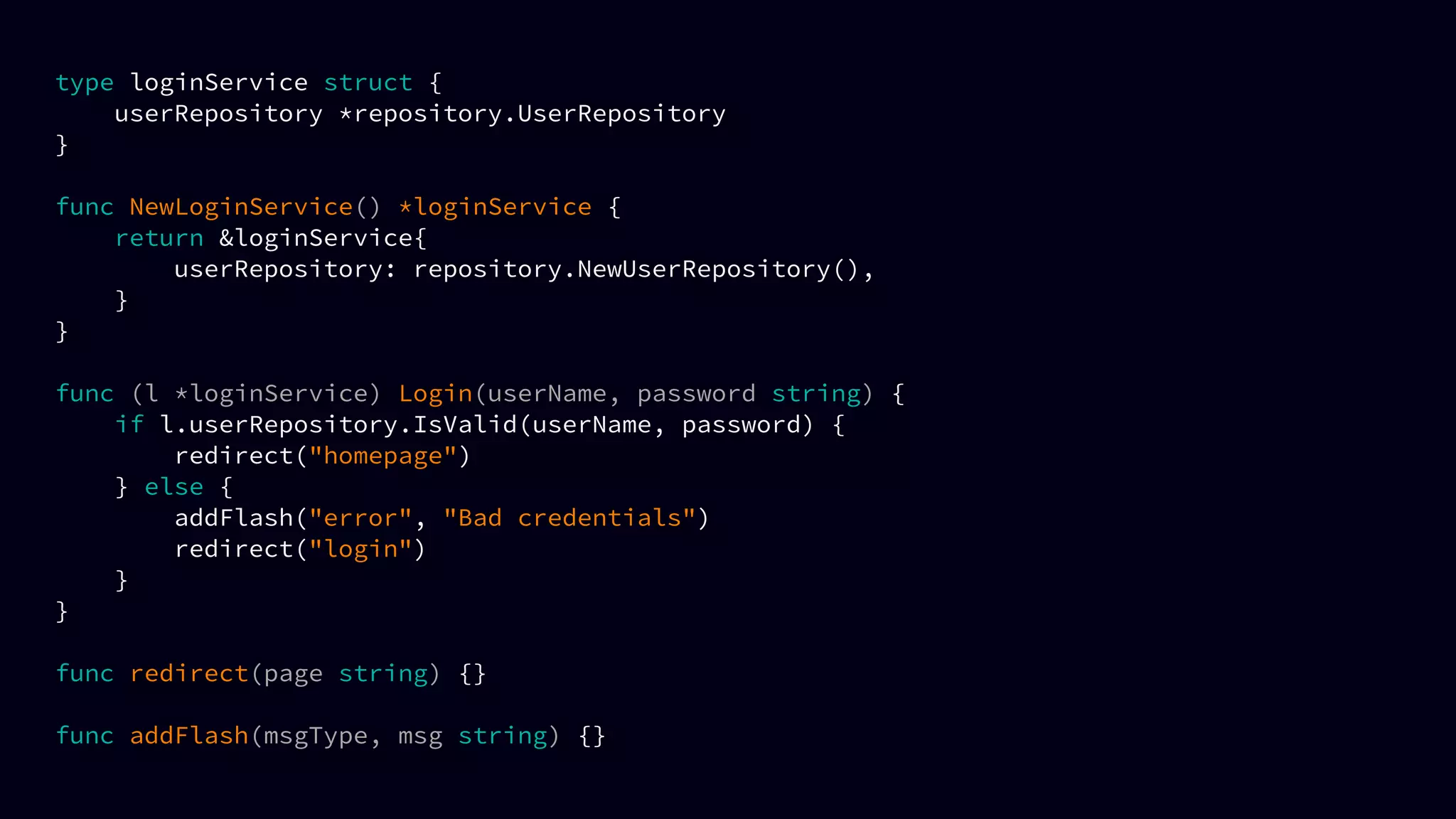
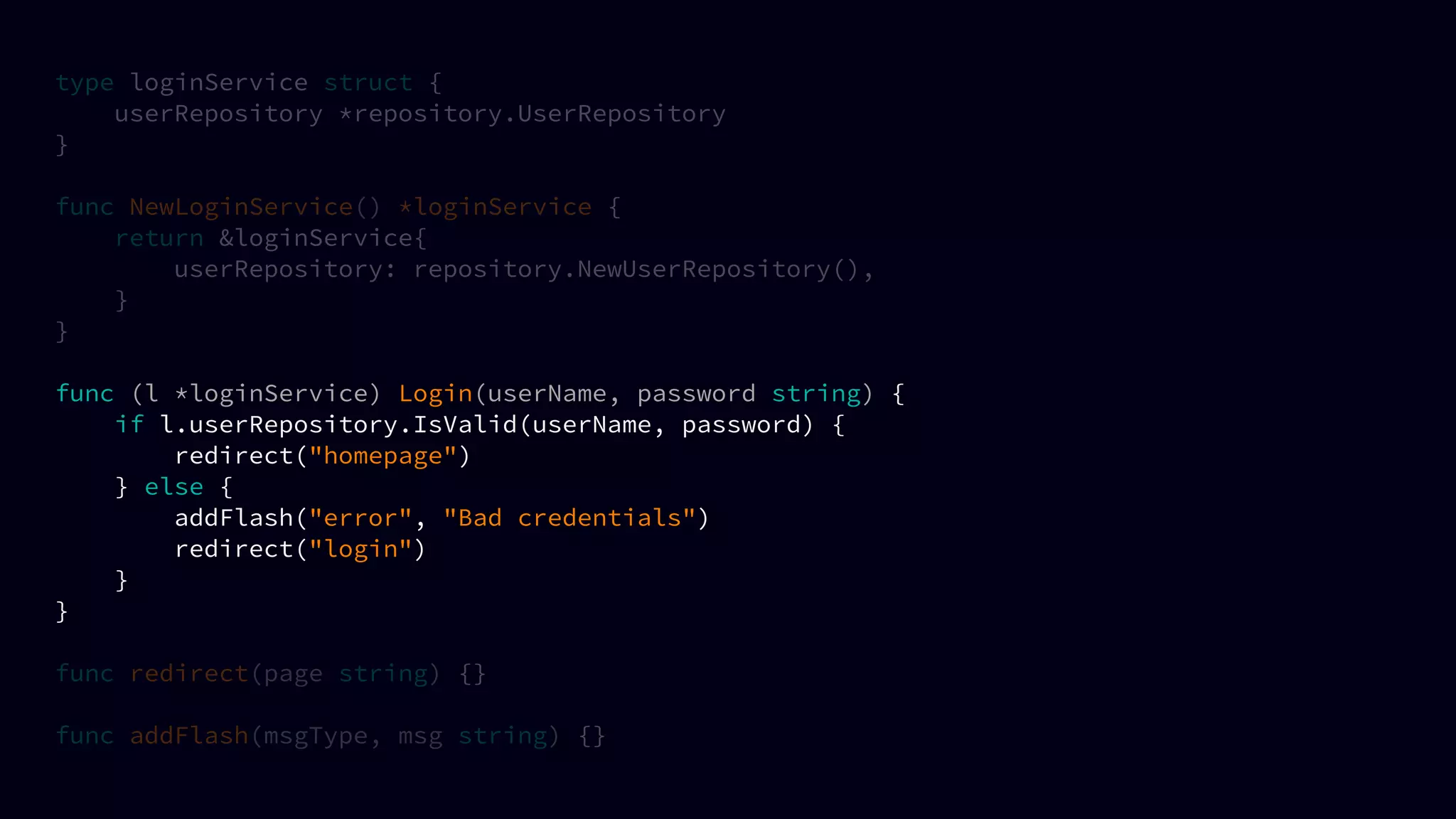
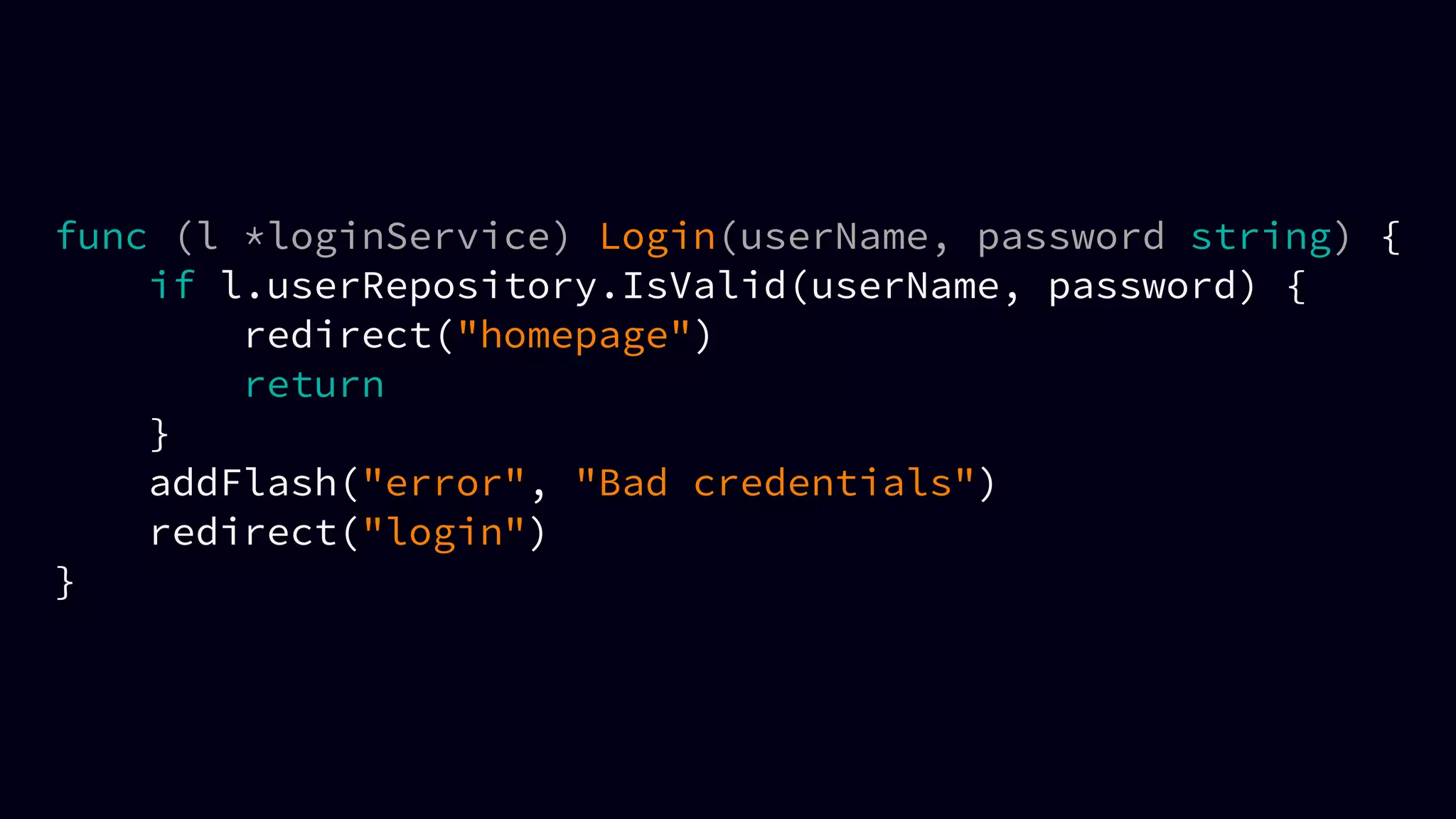
A ideia deste item é evitarmos o uso da palavra
chave else, gerando um código limpo e mais
rápido, pois tem menos fluxos de execução
type loginService struct {
userRepository *repository.UserRepository
}
func NewLoginService() *loginService {
return &loginService{
userRepository: repository.NewUserRepository(),
}
}
func (l *loginService) Login(userName, password string) {
if l.userRepository.IsValid(userName, password) {
redirect("homepage")
} else {
addFlash("error", "Bad credentials")
redirect("login")
}
}
func redirect(page string) {}
func addFlash(msgType, msg string) {}
type loginService struct {
userRepository *repository.UserRepository
}
func NewLoginService() *loginService {
return &loginService{
userRepository: repository.NewUserRepository(),
}
}
func (l *loginService) Login(userName, password string) {
if l.userRepository.IsValid(userName, password) {
redirect("homepage")
} else {
addFlash("error", "Bad credentials")
redirect("login")
}
}
func redirect(page string) {}
func addFlash(msgType, msg string) {}
type loginService struct {
userRepository *repository.UserRepository
}
func NewLoginService() *loginService {
return &loginService{
userRepository: repository.NewUserRepository(),
}
}
func (l *loginService) Login(userName, password string) {
if l.userRepository.IsValid(userName, password) {
redirect("homepage")
} else {
addFlash("error", "Bad credentials")
redirect("login")
}
}
func redirect(page string) {}
func addFlash(msgType, msg string) {}
func (l *loginService) Login(userName, password string) {
if l.userRepository.IsValid(userName, password) {
redirect("homepage")
return
}
addFlash("error", "Bad credentials")
redirect("login")
}
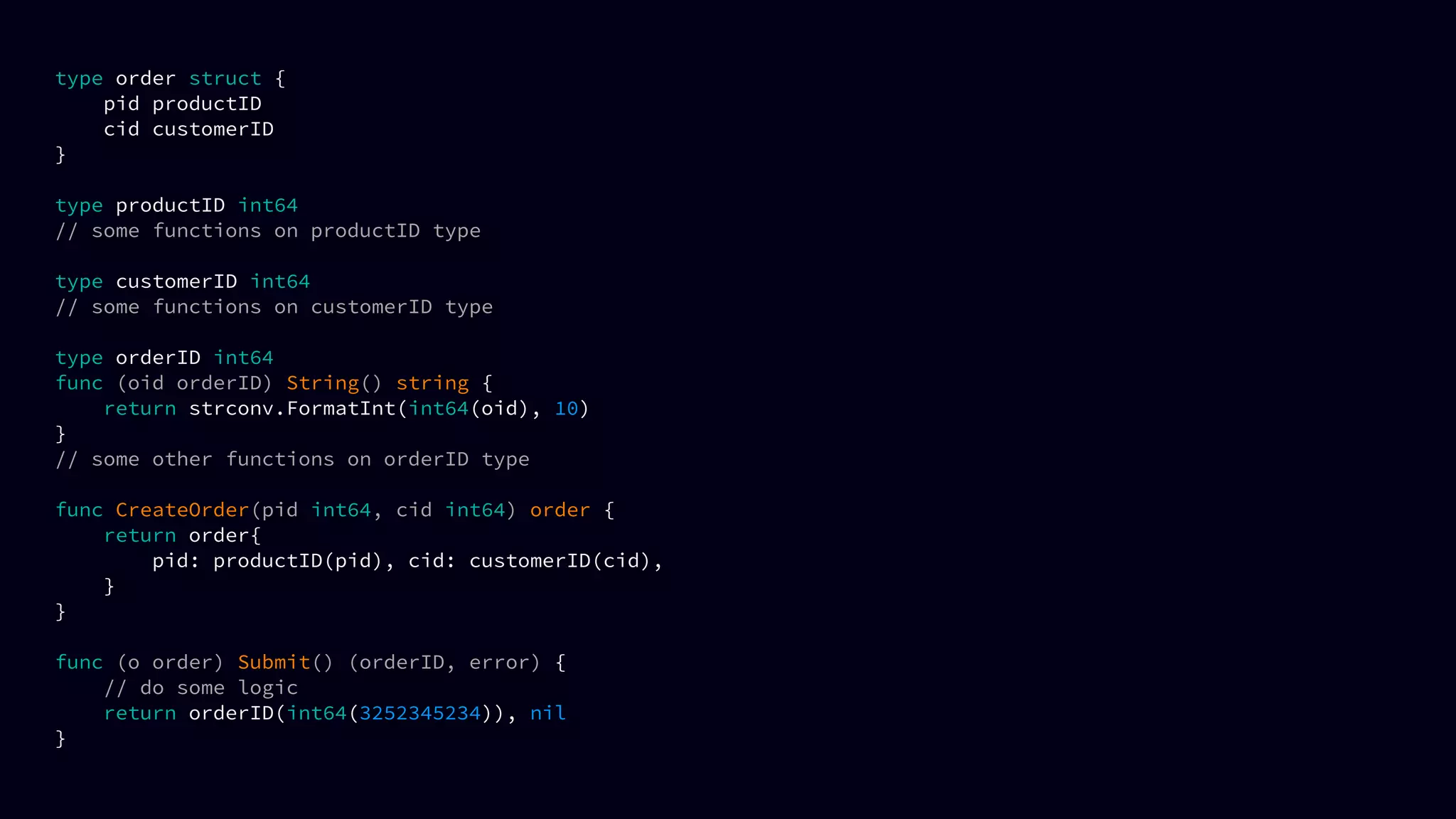
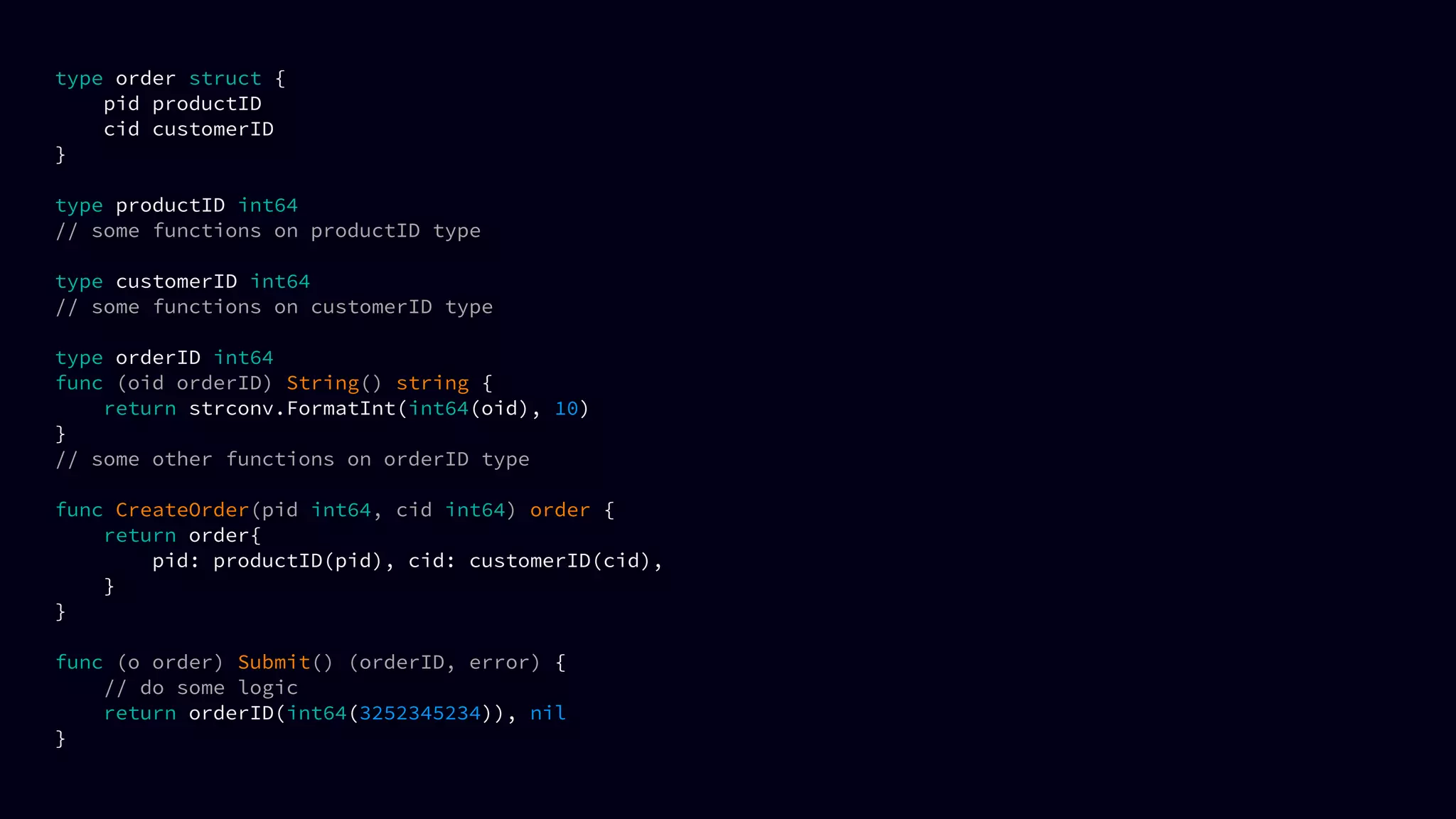
Wrap all primitives and Strings in classes
Tipos primitivos que possuem comportamento
devem ser encapsulados, no nosso caso, em
structs ou types e não em classes. Desta forma,
a lógica do comportamento fica encapsulado e
de fácil manutenção
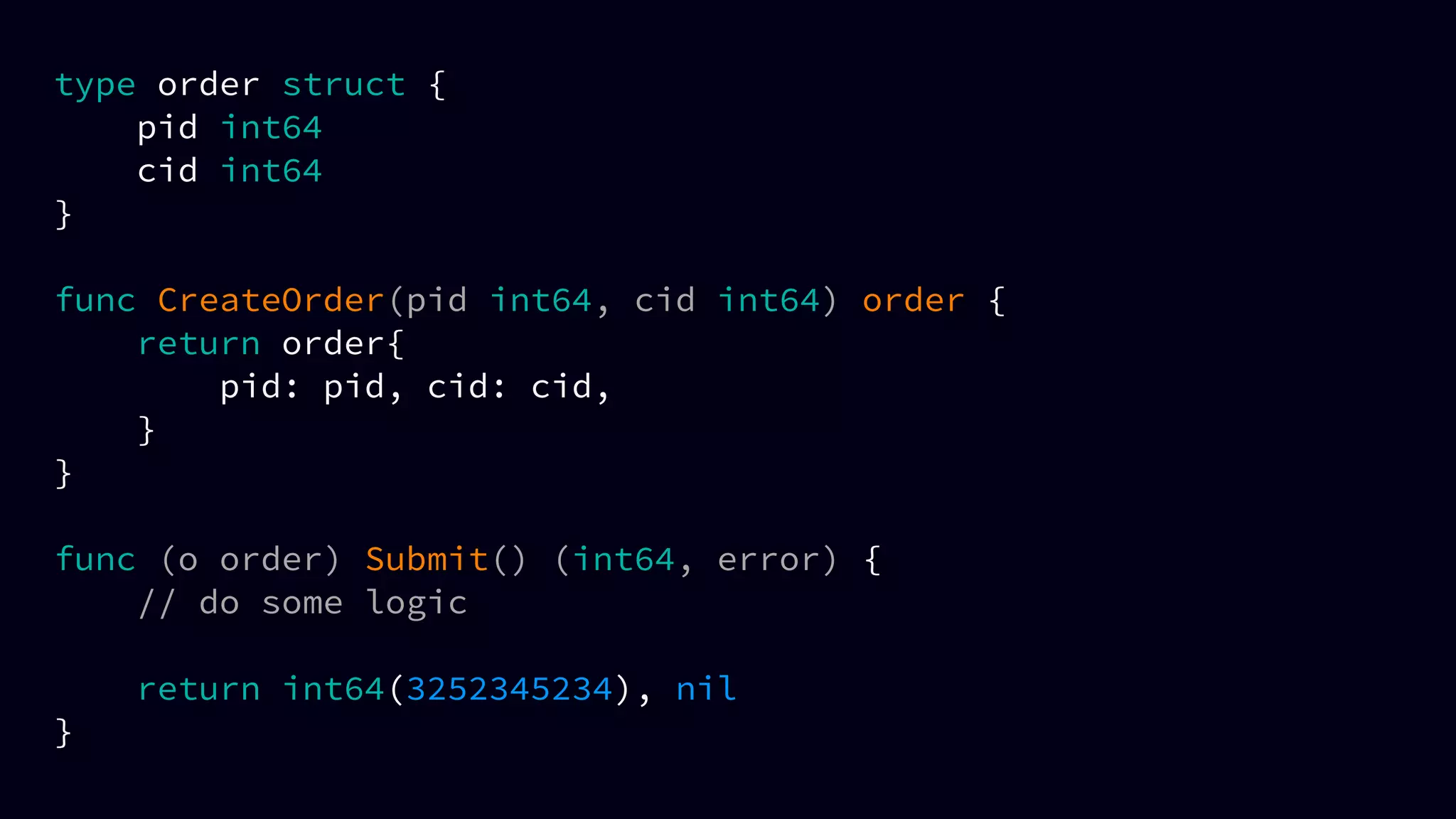
type order struct {
pid int64
cid int64
}
func CreateOrder(pid int64, cid int64) order {
return order{
pid: pid, cid: cid,
}
}
func (o order) Submit() (int64, error) {
// do some logic
return int64(3252345234), nil
}
type order struct {
pid int64
cid int64
}
func CreateOrder(pid int64, cid int64) order {
return order{
pid: pid, cid: cid,
}
}
func (o order) Submit() (int64, error) {
// do some logic
return int64(3252345234), nil
}
type order struct {
pid int64
cid int64
}
func CreateOrder(pid int64, cid int64) order {
return order{
pid: pid, cid: cid,
}
}
func (o order) Submit() (int64, error) {
// do some logic
return int64(3252345234), nil
}
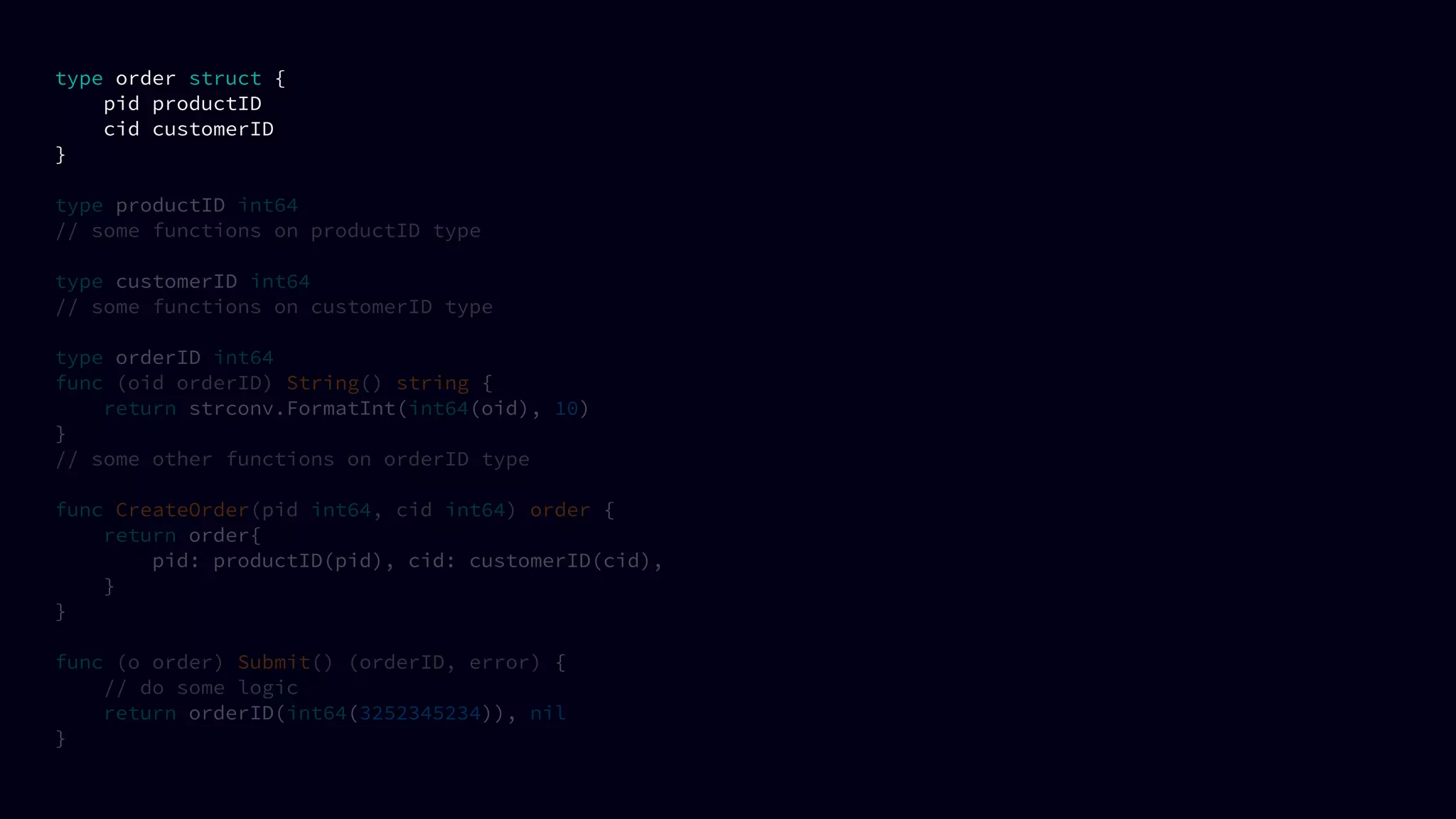
type order struct {
pid productID
cid customerID
}
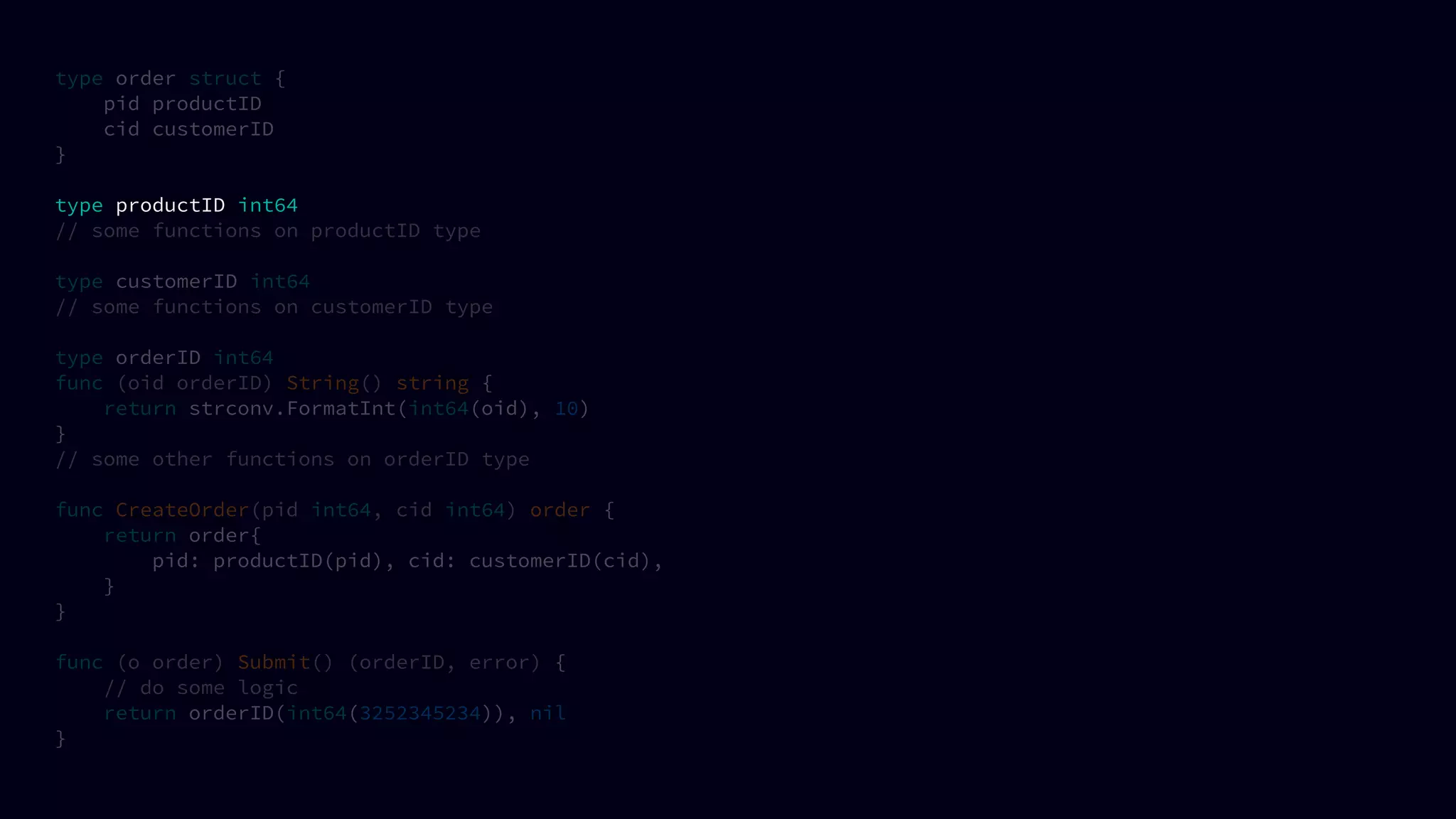
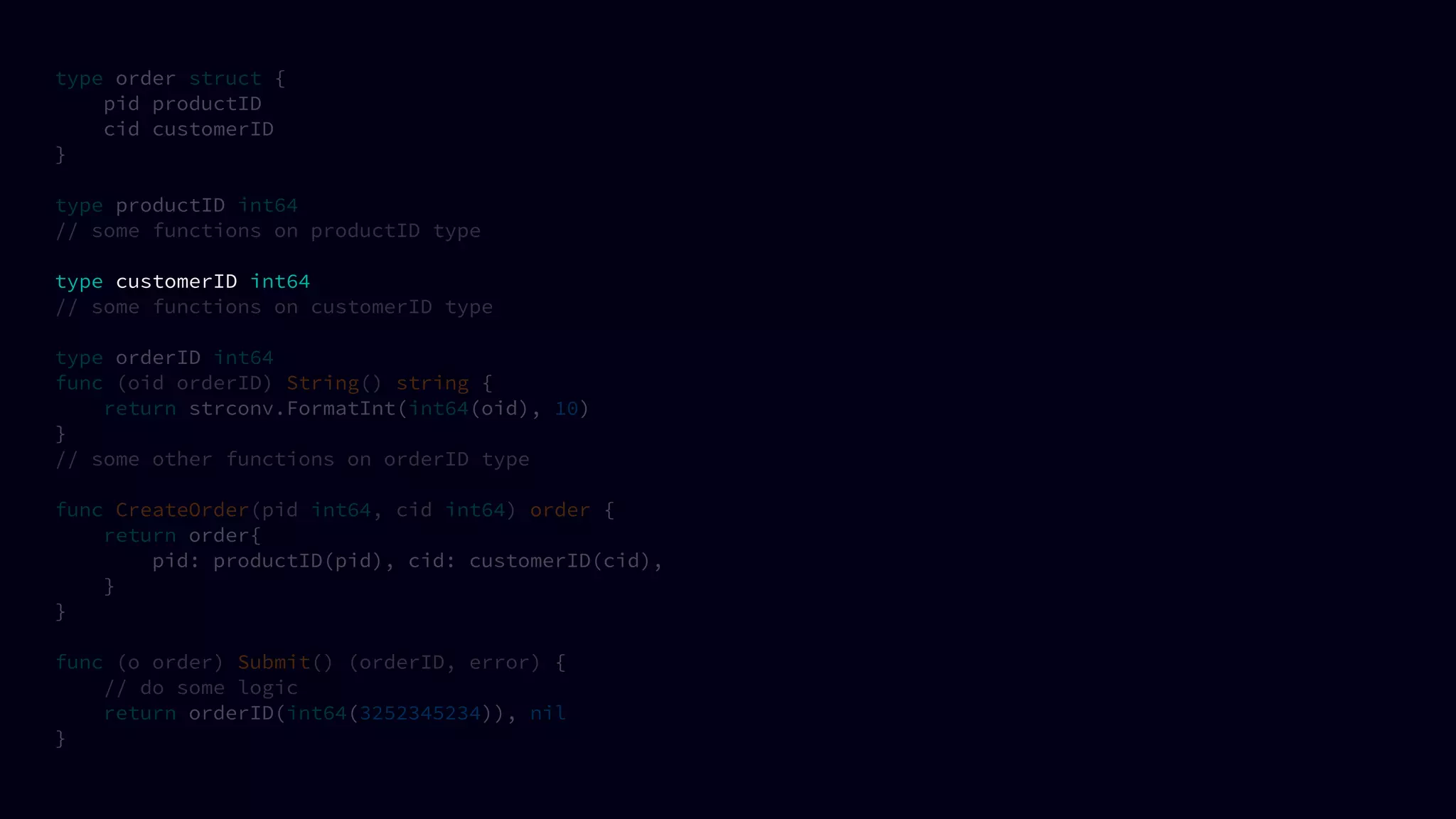
type productID int64
// some functions on productID type
type customerID int64
// some functions on customerID type
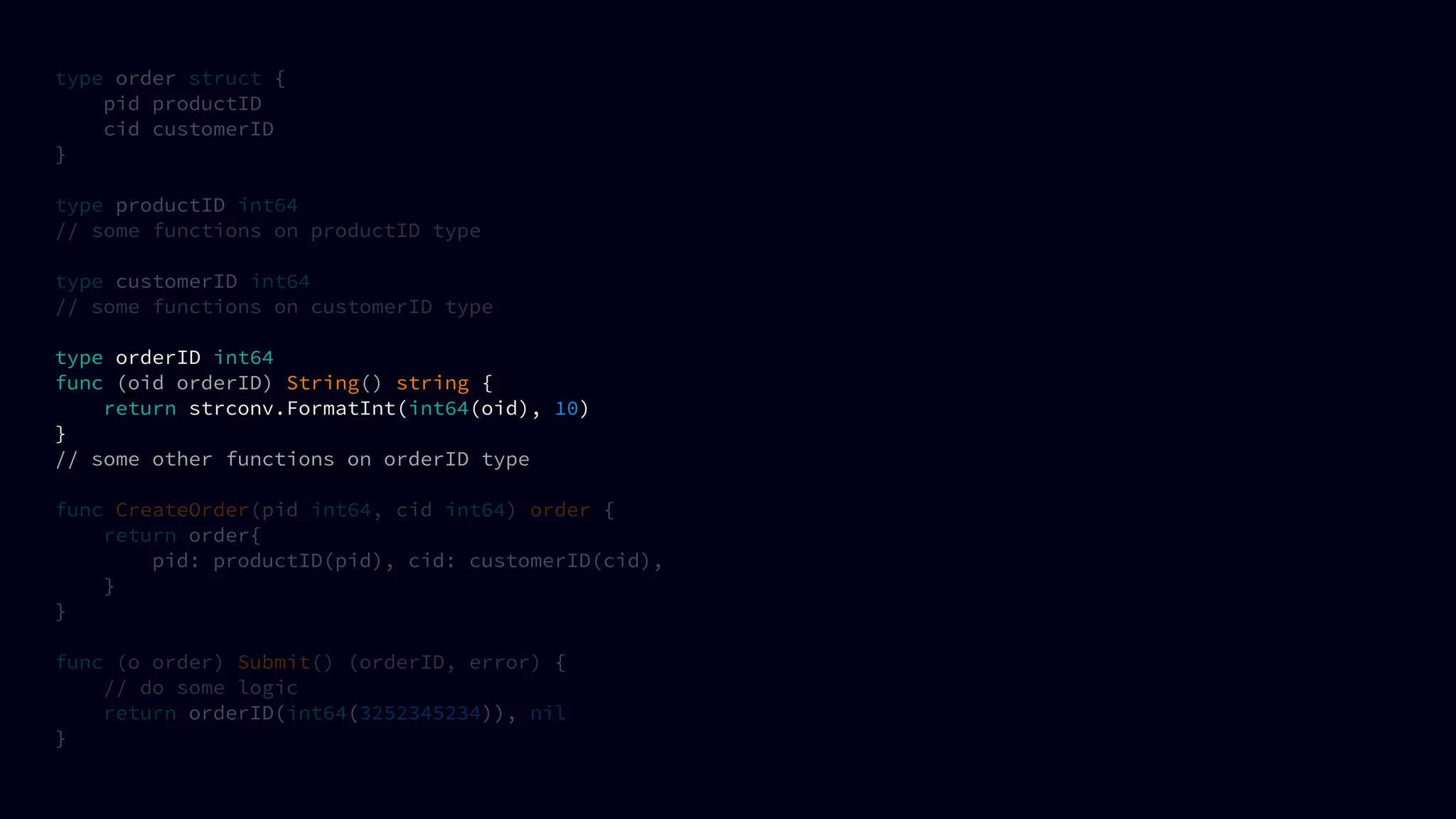
type orderID int64
func (oid orderID) String() string {
return strconv.FormatInt(int64(oid), 10)
}
// some other functions on orderID type
func CreateOrder(pid int64, cid int64) order {
return order{
pid: productID(pid), cid: customerID(cid),
}
}
func (o order) Submit() (orderID, error) {
// do some logic
return orderID(int64(3252345234)), nil
}
type order struct {
pid productID
cid customerID
}
type productID int64
// some functions on productID type
type customerID int64
// some functions on customerID type
type orderID int64
func (oid orderID) String() string {
return strconv.FormatInt(int64(oid), 10)
}
// some other functions on orderID type
func CreateOrder(pid int64, cid int64) order {
return order{
pid: productID(pid), cid: customerID(cid),
}
}
func (o order) Submit() (orderID, error) {
// do some logic
return orderID(int64(3252345234)), nil
}
type order struct {
pid productID
cid customerID
}
type productID int64
// some functions on productID type
type customerID int64
// some functions on customerID type
type orderID int64
func (oid orderID) String() string {
return strconv.FormatInt(int64(oid), 10)
}
// some other functions on orderID type
func CreateOrder(pid int64, cid int64) order {
return order{
pid: productID(pid), cid: customerID(cid),
}
}
func (o order) Submit() (orderID, error) {
// do some logic
return orderID(int64(3252345234)), nil
}
type order struct {
pid productID
cid customerID
}
type productID int64
// some functions on productID type
type customerID int64
// some functions on customerID type
type orderID int64
func (oid orderID) String() string {
return strconv.FormatInt(int64(oid), 10)
}
// some other functions on orderID type
func CreateOrder(pid int64, cid int64) order {
return order{
pid: productID(pid), cid: customerID(cid),
}
}
func (o order) Submit() (orderID, error) {
// do some logic
return orderID(int64(3252345234)), nil
}
type order struct {
pid productID
cid customerID
}
type productID int64
// some functions on productID type
type customerID int64
// some functions on customerID type
type orderID int64
func (oid orderID) String() string {
return strconv.FormatInt(int64(oid), 10)
}
// some other functions on orderID type
func CreateOrder(pid int64, cid int64) order {
return order{
pid: productID(pid), cid: customerID(cid),
}
}
func (o order) Submit() (orderID, error) {
// do some logic
return orderID(int64(3252345234)), nil
}
type order struct {
pid productID
cid customerID
}
type productID int64
// some functions on productID type
type customerID int64
// some functions on customerID type
type orderID int64
func (oid orderID) String() string {
return strconv.FormatInt(int64(oid), 10)
}
// some other functions on orderID type
func CreateOrder(pid int64, cid int64) order {
return order{
pid: productID(pid), cid: customerID(cid),
}
}
func (o order) Submit() (orderID, error) {
// do some logic
return orderID(int64(3252345234)), nil
}
type order struct {
pid productID
cid customerID
}
type productID int64
// some functions on productID type
type customerID int64
// some functions on customerID type
type orderID int64
func (oid orderID) String() string {
return strconv.FormatInt(int64(oid), 10)
}
// some other functions on orderID type
func CreateOrder(pid int64, cid int64) order {
return order{
pid: productID(pid), cid: customerID(cid),
}
}
func (o order) Submit() (orderID, error) {
// do some logic
return orderID(int64(3252345234)), nil
}
First class collections
Se você tiver um conjunto de elementos e
quiser manipulá-los, crie uma estrutura
dedicada para essa coleção. Assim
comportamentos relacionados à coleção serão
implementados por sua própria estrutura
como filtros, ordenação, storage, etc.
type person struct {
name string
friends []string
}
func NewPerson(name string) *person {
return &person{
name: name,
friends: []string{},
}
}
func (p *person) AddFriend(name string) {
p.friends = append(p.friends, name)
}
func (p *person) RemoveFriend(name string) {
new := []string{}
for _, friend := range p.friends {
if friend != name {
new = append(new, friend)
}
}
p.friends = new
}
func (p *person) GetFriends() []string {
return p.friends
}
func (p *person) String() string {
return fmt.Sprintf("%s %v", p.name, p.friends)
}
type person struct {
name string
friends []string
}
func NewPerson(name string) *person {
return &person{
name: name,
friends: []string{},
}
}
func (p *person) AddFriend(name string) {
p.friends = append(p.friends, name)
}
func (p *person) RemoveFriend(name string) {
new := []string{}
for _, friend := range p.friends {
if friend != name {
new = append(new, friend)
}
}
p.friends = new
}
func (p *person) GetFriends() []string {
return p.friends
}
func (p *person) String() string {
return fmt.Sprintf("%s %v", p.name, p.friends)
}
type person struct {
name string
friends []string
}
func NewPerson(name string) *person {
return &person{
name: name,
friends: []string{},
}
}
func (p *person) AddFriend(name string) {
p.friends = append(p.friends, name)
}
func (p *person) RemoveFriend(name string) {
new := []string{}
for _, friend := range p.friends {
if friend != name {
new = append(new, friend)
}
}
p.friends = new
}
func (p *person) GetFriends() []string {
return p.friends
}
func (p *person) String() string {
return fmt.Sprintf("%s %v", p.name, p.friends)
}
type person struct {
name string
friends []string
}
func NewPerson(name string) *person {
return &person{
name: name,
friends: []string{},
}
}
func (p *person) AddFriend(name string) {
p.friends = append(p.friends, name)
}
func (p *person) RemoveFriend(name string) {
new := []string{}
for _, friend := range p.friends {
if friend != name {
new = append(new, friend)
}
}
p.friends = new
}
func (p *person) GetFriends() []string {
return p.friends
}
func (p *person) String() string {
return fmt.Sprintf("%s %v", p.name, p.friends)
}
type person struct {
name string
friends []string
}
func NewPerson(name string) *person {
return &person{
name: name,
friends: []string{},
}
}
func (p *person) AddFriend(name string) {
p.friends = append(p.friends, name)
}
func (p *person) RemoveFriend(name string) {
new := []string{}
for _, friend := range p.friends {
if friend != name {
new = append(new, friend)
}
}
p.friends = new
}
func (p *person) GetFriends() []string {
return p.friends
}
func (p *person) String() string {
return fmt.Sprintf("%s %v", p.name, p.friends)
}
type person struct {
name string
friends []string
}
func NewPerson(name string) *person {
return &person{
name: name,
friends: []string{},
}
}
func (p *person) AddFriend(name string) {
p.friends = append(p.friends, name)
}
func (p *person) RemoveFriend(name string) {
new := []string{}
for _, friend := range p.friends {
if friend != name {
new = append(new, friend)
}
}
p.friends = new
}
func (p *person) GetFriends() []string {
return p.friends
}
func (p *person) String() string {
return fmt.Sprintf("%s %v", p.name, p.friends)
}
type friends struct {
data []string
}
type person struct {
name string
friends *friends
}
func NewFriends() *friends {} //código omitido pra ficar legal no slide ;)
func (f *friends) Add(name string) {} //código omitido pra ficar legal no slide ;)
func (f *friends) Remove(name string) {} //código omitido pra ficar legal no slide ;)
func (f *friends) String() string {} //código omitido pra ficar legal no slide ;)
func NewPerson(name string) *person {} //código omitido pra ficar legal no slide ;)
func (p *person) AddFriend(name string) {
p.friends.Add(name)
}
func (p *person) RemoveFriend(name string) {
p.friends.Remove(name)
}
func (p *person) GetFriends() *friends {
return p.friends
}
func (p *person) String() string {
return fmt.Sprintf("%s [%v]", p.name, p.friends)
}
type friends struct {
data []string
}
type person struct {
name string
friends *friends
}
func NewFriends() *friends {} //código omitido pra ficar legal no slide ;)
func (f *friends) Add(name string) {} //código omitido pra ficar legal no slide ;)
func (f *friends) Remove(name string) {} //código omitido pra ficar legal no slide ;)
func (f *friends) String() string {} //código omitido pra ficar legal no slide ;)
func NewPerson(name string) *person {} //código omitido pra ficar legal no slide ;)
func (p *person) AddFriend(name string) {
p.friends.Add(name)
}
func (p *person) RemoveFriend(name string) {
p.friends.Remove(name)
}
func (p *person) GetFriends() *friends {
return p.friends
}
func (p *person) String() string {
return fmt.Sprintf("%s [%v]", p.name, p.friends)
}
type friends struct {
data []string
}
type person struct {
name string
friends *friends
}
func NewFriends() *friends {} //código omitido pra ficar legal no slide ;)
func (f *friends) Add(name string) {} //código omitido pra ficar legal no slide ;)
func (f *friends) Remove(name string) {} //código omitido pra ficar legal no slide ;)
func (f *friends) String() string {} //código omitido pra ficar legal no slide ;)
func NewPerson(name string) *person {} //código omitido pra ficar legal no slide ;)
func (p *person) AddFriend(name string) {
p.friends.Add(name)
}
func (p *person) RemoveFriend(name string) {
p.friends.Remove(name)
}
func (p *person) GetFriends() *friends {
return p.friends
}
func (p *person) String() string {
return fmt.Sprintf("%s [%v]", p.name, p.friends)
}
type friends struct {
data []string
}
type person struct {
name string
friends *friends
}
func NewFriends() *friends {} //código omitido pra ficar legal no slide ;)
func (f *friends) Add(name string) {} //código omitido pra ficar legal no slide ;)
func (f *friends) Remove(name string) {} //código omitido pra ficar legal no slide ;)
func (f *friends) String() string {} //código omitido pra ficar legal no slide ;)
func NewPerson(name string) *person {} //código omitido pra ficar legal no slide ;)
func (p *person) AddFriend(name string) {
p.friends.Add(name)
}
func (p *person) RemoveFriend(name string) {
p.friends.Remove(name)
}
func (p *person) GetFriends() *friends {
return p.friends
}
func (p *person) String() string {
return fmt.Sprintf("%s [%v]", p.name, p.friends)
}
type friends struct {
data []string
}
type person struct {
name string
friends *friends
}
func NewFriends() *friends {} //código omitido pra ficar legal no slide ;)
func (f *friends) Add(name string) {} //código omitido pra ficar legal no slide ;)
func (f *friends) Remove(name string) {} //código omitido pra ficar legal no slide ;)
func (f *friends) String() string {} //código omitido pra ficar legal no slide ;)
func NewPerson(name string) *person {} //código omitido pra ficar legal no slide ;)
func (p *person) AddFriend(name string) {
p.friends.Add(name)
}
func (p *person) RemoveFriend(name string) {
p.friends.Remove(name)
}
func (p *person) GetFriends() *friends {
return p.friends
}
func (p *person) String() string {
return fmt.Sprintf("%s [%v]", p.name, p.friends)
}
type friends struct {
data []string
}
type person struct {
name string
friends *friends
}
func NewFriends() *friends {} //código omitido pra ficar legal no slide ;)
func (f *friends) Add(name string) {} //código omitido pra ficar legal no slide ;)
func (f *friends) Remove(name string) {} //código omitido pra ficar legal no slide ;)
func (f *friends) String() string {} //código omitido pra ficar legal no slide ;)
func NewPerson(name string) *person {} //código omitido pra ficar legal no slide ;)
func (p *person) AddFriend(name string) {
p.friends.Add(name)
}
func (p *person) RemoveFriend(name string) {
p.friends.Remove(name)
}
func (p *person) GetFriends() *friends {
return p.friends
}
func (p *person) String() string {
return fmt.Sprintf("%s [%v]", p.name, p.friends)
}
One dot per line
Essa regra cita que você não deve encadear
funções e sim usar as que fazem parte do
mesmo contexto.
type board struct {
Squares []*square
}
type square struct {
current *piece
}
type piece struct {
name string
}
func NewSquare(piece *piece) *square {}//código omitido pra ficar legal no slide
func NewPiece(name string) *piece {}//código omitido pra ficar legal no slide
func NewBoard() *board {}//código omitido pra ficar legal no slide
func (b *board) BoardRepresentation() string {
var buffer = &bytes.Buffer{}
for _, s := range b.Squares {
buffer.WriteString(s.current.name)
}
return buffer.String()
}
https://gist.github.com/eminetto/af2ac89e79f945ff2ace8c71b3299a52
type board struct {
Squares []*square
}
type square struct {
current *piece
}
type piece struct {
name string
}
func NewSquare(piece *piece) *square {}//código omitido pra ficar legal no slide
func NewPiece(name string) *piece {}//código omitido pra ficar legal no slide
func NewBoard() *board {}//código omitido pra ficar legal no slide
func (b *board) BoardRepresentation() string {
var buffer = &bytes.Buffer{}
for _, s := range b.Squares {
buffer.WriteString(s.current.name)
}
return buffer.String()
}
https://gist.github.com/eminetto/af2ac89e79f945ff2ace8c71b3299a52
type board struct {
Squares []*square
}
type square struct {
current *piece
}
type piece struct {
name string
}
func NewSquare(piece *piece) *square {}//código omitido pra ficar legal no slide
func NewPiece(name string) *piece {}//código omitido pra ficar legal no slide
func NewBoard() *board {}//código omitido pra ficar legal no slide
func (b *board) BoardRepresentation() string {
var buffer = &bytes.Buffer{}
for _, s := range b.Squares {
buffer.WriteString(s.current.name)
}
return buffer.String()
}
https://gist.github.com/eminetto/af2ac89e79f945ff2ace8c71b3299a52
Lei de Demeter
Lei de Demeter
• Cada unidade deve ter conhecimento
limitado sobre outras unidades: apenas
unidades próximas se relacionam.
Lei de Demeter
• Cada unidade deve ter conhecimento
limitado sobre outras unidades: apenas
unidades próximas se relacionam.
• Cada unidade deve apenas conversar com
seus amigos; Não fale com estranhos.
Lei de Demeter
• Cada unidade deve ter conhecimento
limitado sobre outras unidades: apenas
unidades próximas se relacionam.
• Cada unidade deve apenas conversar com
seus amigos; Não fale com estranhos.
• Apenas fale com seus amigos imediatos.
type board struct {
Squares []*square
}
type square struct {
current *piece
}
func (s *square) addTo(buffer *bytes.Buffer) {
s.current.addTo(buffer)
}
type piece struct {
name string
}
func (p *piece) addTo(buffer *bytes.Buffer) {
buffer.WriteString(p.name)
}
func NewSquare(piece *piece) *square {}//código omitido pra ficar legal no slide
func NewPiece(name string) *piece {}//código omitido pra ficar legal no slide
func NewBoard() *board {}//código omitido pra ficar legal no slide
func (b *board) BoardRepresentation() string {
var buffer = &bytes.Buffer{}
for _, s := range b.Squares {
s.addTo(buffer)
}
return buffer.String()
}
https://gist.github.com/eminetto/6a0ad46da38e2e7d068aec7fdc492b49
type board struct {
Squares []*square
}
type square struct {
current *piece
}
func (s *square) addTo(buffer *bytes.Buffer) {
s.current.addTo(buffer)
}
type piece struct {
name string
}
func (p *piece) addTo(buffer *bytes.Buffer) {
buffer.WriteString(p.name)
}
func NewSquare(piece *piece) *square {}//código omitido pra ficar legal no slide
func NewPiece(name string) *piece {}//código omitido pra ficar legal no slide
func NewBoard() *board {}//código omitido pra ficar legal no slide
func (b *board) BoardRepresentation() string {
var buffer = &bytes.Buffer{}
for _, s := range b.Squares {
s.addTo(buffer)
}
return buffer.String()
}
https://gist.github.com/eminetto/6a0ad46da38e2e7d068aec7fdc492b49
type board struct {
Squares []*square
}
type square struct {
current *piece
}
func (s *square) addTo(buffer *bytes.Buffer) {
s.current.addTo(buffer)
}
type piece struct {
name string
}
func (p *piece) addTo(buffer *bytes.Buffer) {
buffer.WriteString(p.name)
}
func NewSquare(piece *piece) *square {}//código omitido pra ficar legal no slide
func NewPiece(name string) *piece {}//código omitido pra ficar legal no slide
func NewBoard() *board {}//código omitido pra ficar legal no slide
func (b *board) BoardRepresentation() string {
var buffer = &bytes.Buffer{}
for _, s := range b.Squares {
s.addTo(buffer)
}
return buffer.String()
}
https://gist.github.com/eminetto/6a0ad46da38e2e7d068aec7fdc492b49
type board struct {
Squares []*square
}
type square struct {
current *piece
}
func (s *square) addTo(buffer *bytes.Buffer) {
s.current.addTo(buffer)
}
type piece struct {
name string
}
func (p *piece) addTo(buffer *bytes.Buffer) {
buffer.WriteString(p.name)
}
func NewSquare(piece *piece) *square {}//código omitido pra ficar legal no slide
func NewPiece(name string) *piece {}//código omitido pra ficar legal no slide
func NewBoard() *board {}//código omitido pra ficar legal no slide
func (b *board) BoardRepresentation() string {
var buffer = &bytes.Buffer{}
for _, s := range b.Squares {
s.addTo(buffer)
}
return buffer.String()
}
https://gist.github.com/eminetto/6a0ad46da38e2e7d068aec7fdc492b49
type board struct {
Squares []*square
}
type square struct {
current *piece
}
func (s *square) addTo(buffer *bytes.Buffer) {
s.current.addTo(buffer)
}
type piece struct {
name string
}
func (p *piece) addTo(buffer *bytes.Buffer) {
buffer.WriteString(p.name)
}
func NewSquare(piece *piece) *square {}//código omitido pra ficar legal no slide
func NewPiece(name string) *piece {}//código omitido pra ficar legal no slide
func NewBoard() *board {}//código omitido pra ficar legal no slide
func (b *board) BoardRepresentation() string {
var buffer = &bytes.Buffer{}
for _, s := range b.Squares {
s.addTo(buffer)
}
return buffer.String()
}
https://gist.github.com/eminetto/6a0ad46da38e2e7d068aec7fdc492b49
Don’t abbreviate
Esta regra é uma das que não se aplica
diretamente a Go. A comunidade tem suas
próprias regras para a criação de nomes de
variáveis, inclusive razões por usarmos nomes
menores. Recomendo a leitura deste capítulo
do ótimo Practical Go: Real world advice for
writing maintainable Go programs
Keep all classes less than 50 lines
Apesar de não existir o conceito de classes em
Go, a ideia desta regra é que as entidades
sejam pequenas. Podemos adaptar a ideia para
criarmos structs e interfaces pequenas e que
podem ser usadas, via composição, para formar
componentes maiores
type Repository interface {
Find(id entity.ID) (*entity.User, error)
FindByEmail(email string) (*entity.User, error)
FindByChangePasswordHash(hash string) (*entity.User, error)
FindByValidationHash(hash string) (*entity.User, error)
FindByChallengeSubmissionHash(hash string) (*entity.User, error)
FindByNickname(nickname string) (*entity.User, error)
FindAll() ([]*entity.User, error)
Update(user *entity.User) error
Store(user *entity.User) (entity.ID, error)
Remove(id entity.ID) error
}
type Reader interface {
Find(id entity.ID) (*entity.User, error)
FindByEmail(email string) (*entity.User, error)
FindByChangePasswordHash(hash string) (*entity.User, error)
FindByValidationHash(hash string) (*entity.User, error)
FindByChallengeSubmissionHash(hash string) (*entity.User, error)
FindByNickname(nickname string) (*entity.User, error)
FindAll() ([]*entity.User, error)
}
type Writer interface {
Update(user *entity.User) error
Store(user *entity.User) (entity.ID, error)
Remove(id entity.ID) error
}
type Repository interface {
Reader
Writer
}
No classes with more than two
instance variables
Esta regra não parece fazer sentido em Go
No Getters/Setters
Não é um costume da comunidade usar este
recurso, como pode ser visto neste tópico do
Effective Go
Referências
Os códigos completos e demais referências
podem ser encontrados neste post:
Object Calisthenics em Golang
https://eltonminetto.dev
https://codenation.dev
@eminetto

Object Calisthenics em Go

  • 1.
  • 2.
  • 3.
    Conjunto de boaspráticas e regras de programação que podem ser aplicadas para melhorar a qualidade do código
  • 4.
    Introduzido por JeffBay e publicado no livro ThoughtWorks Anthology
  • 5.
    Inicialmente criadas tendocomo base a linguagem Java e adaptações são necessárias para outros ambientes
  • 6.
  • 7.
  • 8.
  • 10.
    • One levelof indentation per method
  • 11.
    • One levelof indentation per method • Don’t use the ELSE keyword
  • 12.
    • One levelof indentation per method • Don’t use the ELSE keyword • Wrap all primitives and Strings in classes
  • 13.
    • One levelof indentation per method • Don’t use the ELSE keyword • Wrap all primitives and Strings in classes • First class collections
  • 14.
    • One levelof indentation per method • Don’t use the ELSE keyword • Wrap all primitives and Strings in classes • First class collections • One dot per line
  • 15.
    • One levelof indentation per method • Don’t use the ELSE keyword • Wrap all primitives and Strings in classes • First class collections • One dot per line • Don’t abbreviate
  • 16.
    • One levelof indentation per method • Don’t use the ELSE keyword • Wrap all primitives and Strings in classes • First class collections • One dot per line • Don’t abbreviate • Keep all classes less than 50 lines
  • 17.
    • One levelof indentation per method • Don’t use the ELSE keyword • Wrap all primitives and Strings in classes • First class collections • One dot per line • Don’t abbreviate • Keep all classes less than 50 lines • No classes with more than two instance variables
  • 18.
    • One levelof indentation per method • Don’t use the ELSE keyword • Wrap all primitives and Strings in classes • First class collections • One dot per line • Don’t abbreviate • Keep all classes less than 50 lines • No classes with more than two instance variables • No getters or setters
  • 19.
    One level ofindentation per method Aplicar esta regra permite que o nosso código seja mais legível
  • 20.
    type board struct{ data [][]string } func NewBoard(data [][]string) *board {} //código omitido pra ficar legal no slide ;) func (b *board) Board() string { var buffer = &bytes.Buffer{} // level 0 for i := 0; i < 10; i++ { // level 1 for j := 0; j < 10; j++ { // level 2 buffer.WriteString(b.data[i][j]) } buffer.WriteString("n") } return buffer.String() }
  • 21.
    type board struct{ data [][]string } func NewBoard(data [][]string) *board {} //código omitido pra ficar legal no slide ;) func (b *board) Board() string { var buffer = &bytes.Buffer{} // level 0 for i := 0; i < 10; i++ { // level 1 for j := 0; j < 10; j++ { // level 2 buffer.WriteString(b.data[i][j]) } buffer.WriteString("n") } return buffer.String() }
  • 22.
    type board struct{ data [][]string } func NewBoard(data [][]string) *board {} //código omitido pra ficar legal no slide ;) func (b *board) Board() string { var buffer = &bytes.Buffer{} // level 0 for i := 0; i < 10; i++ { // level 1 for j := 0; j < 10; j++ { // level 2 buffer.WriteString(b.data[i][j]) } buffer.WriteString("n") } return buffer.String() }
  • 23.
    type board struct{ data [][]string } func NewBoard(data [][]string) *board {} func (b *board) Board() string { var buffer = &bytes.Buffer{} b.collectRows(buffer) return buffer.String() } func (b *board) collectRows(buffer *bytes.Buffer) { for i := 0; i < 10; i++ { b.collectRow(buffer, i) } } func (b *board) collectRow(buffer *bytes.Buffer, row int) { for j := 0; j < 10; j++ { buffer.WriteString(b.data[row][j]) } buffer.WriteString("n") }
  • 24.
    type board struct{ data [][]string } func NewBoard(data [][]string) *board {} func (b *board) Board() string { var buffer = &bytes.Buffer{} b.collectRows(buffer) return buffer.String() } func (b *board) collectRows(buffer *bytes.Buffer) { for i := 0; i < 10; i++ { b.collectRow(buffer, i) } } func (b *board) collectRow(buffer *bytes.Buffer, row int) { for j := 0; j < 10; j++ { buffer.WriteString(b.data[row][j]) } buffer.WriteString("n") }
  • 25.
    type board struct{ data [][]string } func NewBoard(data [][]string) *board {} func (b *board) Board() string { var buffer = &bytes.Buffer{} b.collectRows(buffer) return buffer.String() } func (b *board) collectRows(buffer *bytes.Buffer) { for i := 0; i < 10; i++ { b.collectRow(buffer, i) } } func (b *board) collectRow(buffer *bytes.Buffer, row int) { for j := 0; j < 10; j++ { buffer.WriteString(b.data[row][j]) } buffer.WriteString("n") }
  • 26.
    type board struct{ data [][]string } func NewBoard(data [][]string) *board {} func (b *board) Board() string { var buffer = &bytes.Buffer{} b.collectRows(buffer) return buffer.String() } func (b *board) collectRows(buffer *bytes.Buffer) { for i := 0; i < 10; i++ { b.collectRow(buffer, i) } } func (b *board) collectRow(buffer *bytes.Buffer, row int) { for j := 0; j < 10; j++ { buffer.WriteString(b.data[row][j]) } buffer.WriteString("n") }
  • 27.
    type board struct{ data [][]string } func NewBoard(data [][]string) *board {} func (b *board) Board() string { var buffer = &bytes.Buffer{} b.collectRows(buffer) return buffer.String() } func (b *board) collectRows(buffer *bytes.Buffer) { for i := 0; i < 10; i++ { b.collectRow(buffer, i) } } func (b *board) collectRow(buffer *bytes.Buffer, row int) { for j := 0; j < 10; j++ { buffer.WriteString(b.data[row][j]) } buffer.WriteString("n") }
  • 30.
    Don’t use theELSE keyword A ideia deste item é evitarmos o uso da palavra chave else, gerando um código limpo e mais rápido, pois tem menos fluxos de execução
  • 31.
    type loginService struct{ userRepository *repository.UserRepository } func NewLoginService() *loginService { return &loginService{ userRepository: repository.NewUserRepository(), } } func (l *loginService) Login(userName, password string) { if l.userRepository.IsValid(userName, password) { redirect("homepage") } else { addFlash("error", "Bad credentials") redirect("login") } } func redirect(page string) {} func addFlash(msgType, msg string) {}
  • 32.
    type loginService struct{ userRepository *repository.UserRepository } func NewLoginService() *loginService { return &loginService{ userRepository: repository.NewUserRepository(), } } func (l *loginService) Login(userName, password string) { if l.userRepository.IsValid(userName, password) { redirect("homepage") } else { addFlash("error", "Bad credentials") redirect("login") } } func redirect(page string) {} func addFlash(msgType, msg string) {}
  • 33.
    type loginService struct{ userRepository *repository.UserRepository } func NewLoginService() *loginService { return &loginService{ userRepository: repository.NewUserRepository(), } } func (l *loginService) Login(userName, password string) { if l.userRepository.IsValid(userName, password) { redirect("homepage") } else { addFlash("error", "Bad credentials") redirect("login") } } func redirect(page string) {} func addFlash(msgType, msg string) {}
  • 34.
    func (l *loginService)Login(userName, password string) { if l.userRepository.IsValid(userName, password) { redirect("homepage") return } addFlash("error", "Bad credentials") redirect("login") }
  • 35.
    Wrap all primitivesand Strings in classes Tipos primitivos que possuem comportamento devem ser encapsulados, no nosso caso, em structs ou types e não em classes. Desta forma, a lógica do comportamento fica encapsulado e de fácil manutenção
  • 36.
    type order struct{ pid int64 cid int64 } func CreateOrder(pid int64, cid int64) order { return order{ pid: pid, cid: cid, } } func (o order) Submit() (int64, error) { // do some logic return int64(3252345234), nil }
  • 37.
    type order struct{ pid int64 cid int64 } func CreateOrder(pid int64, cid int64) order { return order{ pid: pid, cid: cid, } } func (o order) Submit() (int64, error) { // do some logic return int64(3252345234), nil }
  • 38.
    type order struct{ pid int64 cid int64 } func CreateOrder(pid int64, cid int64) order { return order{ pid: pid, cid: cid, } } func (o order) Submit() (int64, error) { // do some logic return int64(3252345234), nil }
  • 39.
    type order struct{ pid productID cid customerID } type productID int64 // some functions on productID type type customerID int64 // some functions on customerID type type orderID int64 func (oid orderID) String() string { return strconv.FormatInt(int64(oid), 10) } // some other functions on orderID type func CreateOrder(pid int64, cid int64) order { return order{ pid: productID(pid), cid: customerID(cid), } } func (o order) Submit() (orderID, error) { // do some logic return orderID(int64(3252345234)), nil }
  • 40.
    type order struct{ pid productID cid customerID } type productID int64 // some functions on productID type type customerID int64 // some functions on customerID type type orderID int64 func (oid orderID) String() string { return strconv.FormatInt(int64(oid), 10) } // some other functions on orderID type func CreateOrder(pid int64, cid int64) order { return order{ pid: productID(pid), cid: customerID(cid), } } func (o order) Submit() (orderID, error) { // do some logic return orderID(int64(3252345234)), nil }
  • 41.
    type order struct{ pid productID cid customerID } type productID int64 // some functions on productID type type customerID int64 // some functions on customerID type type orderID int64 func (oid orderID) String() string { return strconv.FormatInt(int64(oid), 10) } // some other functions on orderID type func CreateOrder(pid int64, cid int64) order { return order{ pid: productID(pid), cid: customerID(cid), } } func (o order) Submit() (orderID, error) { // do some logic return orderID(int64(3252345234)), nil }
  • 42.
    type order struct{ pid productID cid customerID } type productID int64 // some functions on productID type type customerID int64 // some functions on customerID type type orderID int64 func (oid orderID) String() string { return strconv.FormatInt(int64(oid), 10) } // some other functions on orderID type func CreateOrder(pid int64, cid int64) order { return order{ pid: productID(pid), cid: customerID(cid), } } func (o order) Submit() (orderID, error) { // do some logic return orderID(int64(3252345234)), nil }
  • 43.
    type order struct{ pid productID cid customerID } type productID int64 // some functions on productID type type customerID int64 // some functions on customerID type type orderID int64 func (oid orderID) String() string { return strconv.FormatInt(int64(oid), 10) } // some other functions on orderID type func CreateOrder(pid int64, cid int64) order { return order{ pid: productID(pid), cid: customerID(cid), } } func (o order) Submit() (orderID, error) { // do some logic return orderID(int64(3252345234)), nil }
  • 44.
    type order struct{ pid productID cid customerID } type productID int64 // some functions on productID type type customerID int64 // some functions on customerID type type orderID int64 func (oid orderID) String() string { return strconv.FormatInt(int64(oid), 10) } // some other functions on orderID type func CreateOrder(pid int64, cid int64) order { return order{ pid: productID(pid), cid: customerID(cid), } } func (o order) Submit() (orderID, error) { // do some logic return orderID(int64(3252345234)), nil }
  • 45.
    type order struct{ pid productID cid customerID } type productID int64 // some functions on productID type type customerID int64 // some functions on customerID type type orderID int64 func (oid orderID) String() string { return strconv.FormatInt(int64(oid), 10) } // some other functions on orderID type func CreateOrder(pid int64, cid int64) order { return order{ pid: productID(pid), cid: customerID(cid), } } func (o order) Submit() (orderID, error) { // do some logic return orderID(int64(3252345234)), nil }
  • 46.
    First class collections Sevocê tiver um conjunto de elementos e quiser manipulá-los, crie uma estrutura dedicada para essa coleção. Assim comportamentos relacionados à coleção serão implementados por sua própria estrutura como filtros, ordenação, storage, etc.
  • 47.
    type person struct{ name string friends []string } func NewPerson(name string) *person { return &person{ name: name, friends: []string{}, } } func (p *person) AddFriend(name string) { p.friends = append(p.friends, name) } func (p *person) RemoveFriend(name string) { new := []string{} for _, friend := range p.friends { if friend != name { new = append(new, friend) } } p.friends = new } func (p *person) GetFriends() []string { return p.friends } func (p *person) String() string { return fmt.Sprintf("%s %v", p.name, p.friends) }
  • 48.
    type person struct{ name string friends []string } func NewPerson(name string) *person { return &person{ name: name, friends: []string{}, } } func (p *person) AddFriend(name string) { p.friends = append(p.friends, name) } func (p *person) RemoveFriend(name string) { new := []string{} for _, friend := range p.friends { if friend != name { new = append(new, friend) } } p.friends = new } func (p *person) GetFriends() []string { return p.friends } func (p *person) String() string { return fmt.Sprintf("%s %v", p.name, p.friends) }
  • 49.
    type person struct{ name string friends []string } func NewPerson(name string) *person { return &person{ name: name, friends: []string{}, } } func (p *person) AddFriend(name string) { p.friends = append(p.friends, name) } func (p *person) RemoveFriend(name string) { new := []string{} for _, friend := range p.friends { if friend != name { new = append(new, friend) } } p.friends = new } func (p *person) GetFriends() []string { return p.friends } func (p *person) String() string { return fmt.Sprintf("%s %v", p.name, p.friends) }
  • 50.
    type person struct{ name string friends []string } func NewPerson(name string) *person { return &person{ name: name, friends: []string{}, } } func (p *person) AddFriend(name string) { p.friends = append(p.friends, name) } func (p *person) RemoveFriend(name string) { new := []string{} for _, friend := range p.friends { if friend != name { new = append(new, friend) } } p.friends = new } func (p *person) GetFriends() []string { return p.friends } func (p *person) String() string { return fmt.Sprintf("%s %v", p.name, p.friends) }
  • 51.
    type person struct{ name string friends []string } func NewPerson(name string) *person { return &person{ name: name, friends: []string{}, } } func (p *person) AddFriend(name string) { p.friends = append(p.friends, name) } func (p *person) RemoveFriend(name string) { new := []string{} for _, friend := range p.friends { if friend != name { new = append(new, friend) } } p.friends = new } func (p *person) GetFriends() []string { return p.friends } func (p *person) String() string { return fmt.Sprintf("%s %v", p.name, p.friends) }
  • 52.
    type person struct{ name string friends []string } func NewPerson(name string) *person { return &person{ name: name, friends: []string{}, } } func (p *person) AddFriend(name string) { p.friends = append(p.friends, name) } func (p *person) RemoveFriend(name string) { new := []string{} for _, friend := range p.friends { if friend != name { new = append(new, friend) } } p.friends = new } func (p *person) GetFriends() []string { return p.friends } func (p *person) String() string { return fmt.Sprintf("%s %v", p.name, p.friends) }
  • 53.
    type friends struct{ data []string } type person struct { name string friends *friends } func NewFriends() *friends {} //código omitido pra ficar legal no slide ;) func (f *friends) Add(name string) {} //código omitido pra ficar legal no slide ;) func (f *friends) Remove(name string) {} //código omitido pra ficar legal no slide ;) func (f *friends) String() string {} //código omitido pra ficar legal no slide ;) func NewPerson(name string) *person {} //código omitido pra ficar legal no slide ;) func (p *person) AddFriend(name string) { p.friends.Add(name) } func (p *person) RemoveFriend(name string) { p.friends.Remove(name) } func (p *person) GetFriends() *friends { return p.friends } func (p *person) String() string { return fmt.Sprintf("%s [%v]", p.name, p.friends) }
  • 54.
    type friends struct{ data []string } type person struct { name string friends *friends } func NewFriends() *friends {} //código omitido pra ficar legal no slide ;) func (f *friends) Add(name string) {} //código omitido pra ficar legal no slide ;) func (f *friends) Remove(name string) {} //código omitido pra ficar legal no slide ;) func (f *friends) String() string {} //código omitido pra ficar legal no slide ;) func NewPerson(name string) *person {} //código omitido pra ficar legal no slide ;) func (p *person) AddFriend(name string) { p.friends.Add(name) } func (p *person) RemoveFriend(name string) { p.friends.Remove(name) } func (p *person) GetFriends() *friends { return p.friends } func (p *person) String() string { return fmt.Sprintf("%s [%v]", p.name, p.friends) }
  • 55.
    type friends struct{ data []string } type person struct { name string friends *friends } func NewFriends() *friends {} //código omitido pra ficar legal no slide ;) func (f *friends) Add(name string) {} //código omitido pra ficar legal no slide ;) func (f *friends) Remove(name string) {} //código omitido pra ficar legal no slide ;) func (f *friends) String() string {} //código omitido pra ficar legal no slide ;) func NewPerson(name string) *person {} //código omitido pra ficar legal no slide ;) func (p *person) AddFriend(name string) { p.friends.Add(name) } func (p *person) RemoveFriend(name string) { p.friends.Remove(name) } func (p *person) GetFriends() *friends { return p.friends } func (p *person) String() string { return fmt.Sprintf("%s [%v]", p.name, p.friends) }
  • 56.
    type friends struct{ data []string } type person struct { name string friends *friends } func NewFriends() *friends {} //código omitido pra ficar legal no slide ;) func (f *friends) Add(name string) {} //código omitido pra ficar legal no slide ;) func (f *friends) Remove(name string) {} //código omitido pra ficar legal no slide ;) func (f *friends) String() string {} //código omitido pra ficar legal no slide ;) func NewPerson(name string) *person {} //código omitido pra ficar legal no slide ;) func (p *person) AddFriend(name string) { p.friends.Add(name) } func (p *person) RemoveFriend(name string) { p.friends.Remove(name) } func (p *person) GetFriends() *friends { return p.friends } func (p *person) String() string { return fmt.Sprintf("%s [%v]", p.name, p.friends) }
  • 57.
    type friends struct{ data []string } type person struct { name string friends *friends } func NewFriends() *friends {} //código omitido pra ficar legal no slide ;) func (f *friends) Add(name string) {} //código omitido pra ficar legal no slide ;) func (f *friends) Remove(name string) {} //código omitido pra ficar legal no slide ;) func (f *friends) String() string {} //código omitido pra ficar legal no slide ;) func NewPerson(name string) *person {} //código omitido pra ficar legal no slide ;) func (p *person) AddFriend(name string) { p.friends.Add(name) } func (p *person) RemoveFriend(name string) { p.friends.Remove(name) } func (p *person) GetFriends() *friends { return p.friends } func (p *person) String() string { return fmt.Sprintf("%s [%v]", p.name, p.friends) }
  • 58.
    type friends struct{ data []string } type person struct { name string friends *friends } func NewFriends() *friends {} //código omitido pra ficar legal no slide ;) func (f *friends) Add(name string) {} //código omitido pra ficar legal no slide ;) func (f *friends) Remove(name string) {} //código omitido pra ficar legal no slide ;) func (f *friends) String() string {} //código omitido pra ficar legal no slide ;) func NewPerson(name string) *person {} //código omitido pra ficar legal no slide ;) func (p *person) AddFriend(name string) { p.friends.Add(name) } func (p *person) RemoveFriend(name string) { p.friends.Remove(name) } func (p *person) GetFriends() *friends { return p.friends } func (p *person) String() string { return fmt.Sprintf("%s [%v]", p.name, p.friends) }
  • 59.
    One dot perline Essa regra cita que você não deve encadear funções e sim usar as que fazem parte do mesmo contexto.
  • 60.
    type board struct{ Squares []*square } type square struct { current *piece } type piece struct { name string } func NewSquare(piece *piece) *square {}//código omitido pra ficar legal no slide func NewPiece(name string) *piece {}//código omitido pra ficar legal no slide func NewBoard() *board {}//código omitido pra ficar legal no slide func (b *board) BoardRepresentation() string { var buffer = &bytes.Buffer{} for _, s := range b.Squares { buffer.WriteString(s.current.name) } return buffer.String() } https://gist.github.com/eminetto/af2ac89e79f945ff2ace8c71b3299a52
  • 61.
    type board struct{ Squares []*square } type square struct { current *piece } type piece struct { name string } func NewSquare(piece *piece) *square {}//código omitido pra ficar legal no slide func NewPiece(name string) *piece {}//código omitido pra ficar legal no slide func NewBoard() *board {}//código omitido pra ficar legal no slide func (b *board) BoardRepresentation() string { var buffer = &bytes.Buffer{} for _, s := range b.Squares { buffer.WriteString(s.current.name) } return buffer.String() } https://gist.github.com/eminetto/af2ac89e79f945ff2ace8c71b3299a52
  • 62.
    type board struct{ Squares []*square } type square struct { current *piece } type piece struct { name string } func NewSquare(piece *piece) *square {}//código omitido pra ficar legal no slide func NewPiece(name string) *piece {}//código omitido pra ficar legal no slide func NewBoard() *board {}//código omitido pra ficar legal no slide func (b *board) BoardRepresentation() string { var buffer = &bytes.Buffer{} for _, s := range b.Squares { buffer.WriteString(s.current.name) } return buffer.String() } https://gist.github.com/eminetto/af2ac89e79f945ff2ace8c71b3299a52
  • 63.
  • 64.
    Lei de Demeter •Cada unidade deve ter conhecimento limitado sobre outras unidades: apenas unidades próximas se relacionam.
  • 65.
    Lei de Demeter •Cada unidade deve ter conhecimento limitado sobre outras unidades: apenas unidades próximas se relacionam. • Cada unidade deve apenas conversar com seus amigos; Não fale com estranhos.
  • 66.
    Lei de Demeter •Cada unidade deve ter conhecimento limitado sobre outras unidades: apenas unidades próximas se relacionam. • Cada unidade deve apenas conversar com seus amigos; Não fale com estranhos. • Apenas fale com seus amigos imediatos.
  • 67.
    type board struct{ Squares []*square } type square struct { current *piece } func (s *square) addTo(buffer *bytes.Buffer) { s.current.addTo(buffer) } type piece struct { name string } func (p *piece) addTo(buffer *bytes.Buffer) { buffer.WriteString(p.name) } func NewSquare(piece *piece) *square {}//código omitido pra ficar legal no slide func NewPiece(name string) *piece {}//código omitido pra ficar legal no slide func NewBoard() *board {}//código omitido pra ficar legal no slide func (b *board) BoardRepresentation() string { var buffer = &bytes.Buffer{} for _, s := range b.Squares { s.addTo(buffer) } return buffer.String() } https://gist.github.com/eminetto/6a0ad46da38e2e7d068aec7fdc492b49
  • 68.
    type board struct{ Squares []*square } type square struct { current *piece } func (s *square) addTo(buffer *bytes.Buffer) { s.current.addTo(buffer) } type piece struct { name string } func (p *piece) addTo(buffer *bytes.Buffer) { buffer.WriteString(p.name) } func NewSquare(piece *piece) *square {}//código omitido pra ficar legal no slide func NewPiece(name string) *piece {}//código omitido pra ficar legal no slide func NewBoard() *board {}//código omitido pra ficar legal no slide func (b *board) BoardRepresentation() string { var buffer = &bytes.Buffer{} for _, s := range b.Squares { s.addTo(buffer) } return buffer.String() } https://gist.github.com/eminetto/6a0ad46da38e2e7d068aec7fdc492b49
  • 69.
    type board struct{ Squares []*square } type square struct { current *piece } func (s *square) addTo(buffer *bytes.Buffer) { s.current.addTo(buffer) } type piece struct { name string } func (p *piece) addTo(buffer *bytes.Buffer) { buffer.WriteString(p.name) } func NewSquare(piece *piece) *square {}//código omitido pra ficar legal no slide func NewPiece(name string) *piece {}//código omitido pra ficar legal no slide func NewBoard() *board {}//código omitido pra ficar legal no slide func (b *board) BoardRepresentation() string { var buffer = &bytes.Buffer{} for _, s := range b.Squares { s.addTo(buffer) } return buffer.String() } https://gist.github.com/eminetto/6a0ad46da38e2e7d068aec7fdc492b49
  • 70.
    type board struct{ Squares []*square } type square struct { current *piece } func (s *square) addTo(buffer *bytes.Buffer) { s.current.addTo(buffer) } type piece struct { name string } func (p *piece) addTo(buffer *bytes.Buffer) { buffer.WriteString(p.name) } func NewSquare(piece *piece) *square {}//código omitido pra ficar legal no slide func NewPiece(name string) *piece {}//código omitido pra ficar legal no slide func NewBoard() *board {}//código omitido pra ficar legal no slide func (b *board) BoardRepresentation() string { var buffer = &bytes.Buffer{} for _, s := range b.Squares { s.addTo(buffer) } return buffer.String() } https://gist.github.com/eminetto/6a0ad46da38e2e7d068aec7fdc492b49
  • 71.
    type board struct{ Squares []*square } type square struct { current *piece } func (s *square) addTo(buffer *bytes.Buffer) { s.current.addTo(buffer) } type piece struct { name string } func (p *piece) addTo(buffer *bytes.Buffer) { buffer.WriteString(p.name) } func NewSquare(piece *piece) *square {}//código omitido pra ficar legal no slide func NewPiece(name string) *piece {}//código omitido pra ficar legal no slide func NewBoard() *board {}//código omitido pra ficar legal no slide func (b *board) BoardRepresentation() string { var buffer = &bytes.Buffer{} for _, s := range b.Squares { s.addTo(buffer) } return buffer.String() } https://gist.github.com/eminetto/6a0ad46da38e2e7d068aec7fdc492b49
  • 72.
    Don’t abbreviate Esta regraé uma das que não se aplica diretamente a Go. A comunidade tem suas próprias regras para a criação de nomes de variáveis, inclusive razões por usarmos nomes menores. Recomendo a leitura deste capítulo do ótimo Practical Go: Real world advice for writing maintainable Go programs
  • 73.
    Keep all classesless than 50 lines Apesar de não existir o conceito de classes em Go, a ideia desta regra é que as entidades sejam pequenas. Podemos adaptar a ideia para criarmos structs e interfaces pequenas e que podem ser usadas, via composição, para formar componentes maiores
  • 74.
    type Repository interface{ Find(id entity.ID) (*entity.User, error) FindByEmail(email string) (*entity.User, error) FindByChangePasswordHash(hash string) (*entity.User, error) FindByValidationHash(hash string) (*entity.User, error) FindByChallengeSubmissionHash(hash string) (*entity.User, error) FindByNickname(nickname string) (*entity.User, error) FindAll() ([]*entity.User, error) Update(user *entity.User) error Store(user *entity.User) (entity.ID, error) Remove(id entity.ID) error }
  • 75.
    type Reader interface{ Find(id entity.ID) (*entity.User, error) FindByEmail(email string) (*entity.User, error) FindByChangePasswordHash(hash string) (*entity.User, error) FindByValidationHash(hash string) (*entity.User, error) FindByChallengeSubmissionHash(hash string) (*entity.User, error) FindByNickname(nickname string) (*entity.User, error) FindAll() ([]*entity.User, error) } type Writer interface { Update(user *entity.User) error Store(user *entity.User) (entity.ID, error) Remove(id entity.ID) error } type Repository interface { Reader Writer }
  • 76.
    No classes withmore than two instance variables Esta regra não parece fazer sentido em Go
  • 77.
    No Getters/Setters Não éum costume da comunidade usar este recurso, como pode ser visto neste tópico do Effective Go
  • 78.
    Referências Os códigos completose demais referências podem ser encontrados neste post: Object Calisthenics em Golang
  • 79.