STARTING METHODS FOR
DRIVE MOTORS
D.Citharthan
AP/EEE
CKEC
LAST CHAPTER: discussed about the DC motors (Shunt, Series, Compound) and
AC motors ( Three phase and single phase Induction motor) various
characteristics.
These motors have the tendency to draw very high current at the time of starting.
Disadvantage of Very high armature current:
 Cause damage to the motor windings
 In constant voltage system, such high inrush current may cause tremendous
line voltage fluctuations.
Such high armature current, blows out fuses
Large armature current for a longer time may burn the insulation of the
armature winding
At starting armature current is 10 to 15 times more than the full load current.
So the torque developed will also be 10 to 15 times, assuming shunt motor
operation. Due to such high torque , the shaft and other accessories subjected to
large mechanical stress.
So we need to have a device which can limit such a high starting current.
HIGH STARTING CURRENT IN DC MOTORS
WHY STARTING CURRENT IS HIGH?
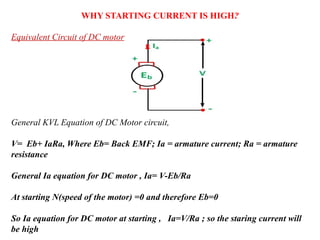
Equivalent Circuit of DC motor
General KVL Equation of DC Motor circuit,
V= Eb+ IaRa, Where Eb= Back EMF; Ia = armature current; Ra = armature
resistance
General Ia equation for DC motor , Ia= V-Eb/Ra
At starting N(speed of the motor) =0 and therefore Eb=0
So Ia equation for DC motor at starting , Ia=V/Ra ; so the staring current will
be high
STARTER AND DIFFERENT TYPES OF STARTER
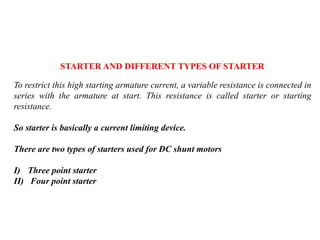
To restrict this high starting armature current, a variable resistance is connected in
series with the armature at start. This resistance is called starter or starting
resistance.
So starter is basically a current limiting device.
There are two types of starters used for DC shunt motors
I) Three point starter
II) Four point starter
THREE POINT STARTER
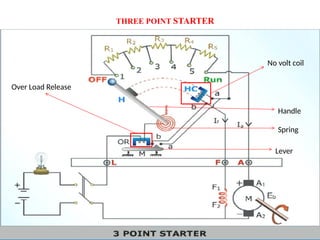
No volt coil
Over Load Release
Lever
Spring
Handle
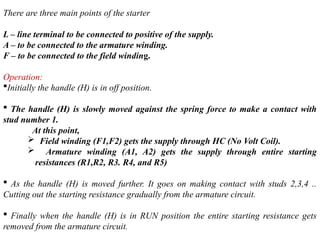
There are three main points of the starter
L – line terminal to be connected to positive of the supply.
A – to be connected to the armature winding.
F – to be connected to the field winding.
Operation:
Initially the handle (H) is in off position.
 The handle (H) is slowly moved against the spring force to make a contact with
stud number 1.
At this point,
 Field winding (F1,F2) gets the supply through HC (No Volt Coil).
 Armature winding (A1, A2) gets the supply through entire starting
resistances (R1,R2, R3. R4, and R5)
 As the handle (H) is moved further. It goes on making contact with studs 2,3,4 ..
Cutting out the starting resistance gradually from the armature circuit.
 Finally when the handle (H) is in RUN position the entire starting resistance gets
removed from the armature circuit.
How the handle (H) will remain in the RUN position as long as motor is
running?
Answer: It’s the function of No Volt Coil.
Function of No Volt Coil:
The field winding gets the supply through No Volt Coil. So the field current
magnetize the No Volt Coil. When the handle is in the RUN position the
magnetized No Volt coil will hold the soft iron piece in the RUN position.
Hence No Volt Coil also called Hold On Coil.
Whenever there is a supply failure or if field circuit is open, the current will not
passes through No Volt Coil. Hence it will not hold the handle in RUN position
and handle always come back to OFF position. This prevents the damage of the
motor caused due to accidental starting.
NVC performs the similar action under low voltage conditions and protects the
motor from such dangerous supply conditions as well.
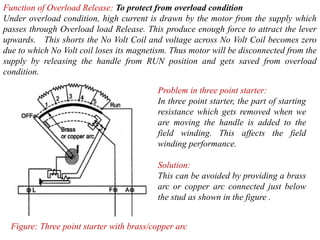
Function of Overload Release: To protect from overload condition
Under overload condition, high current is drawn by the motor from the supply which
passes through Overload load Release. This produce enough force to attract the lever
upwards. This shorts the No Volt Coil and voltage across No Volt Coil becomes zero
due to which No Volt coil loses its magnetism. Thus motor will be disconnected from the
supply by releasing the handle from RUN position and gets saved from overload
condition.
Problem in three point starter:
In three point starter, the part of starting
resistance which gets removed when we
are moving the handle is added to the
field winding. This affects the field
winding performance.
Solution:
This can be avoided by providing a brass
arc or copper arc connected just below
the stud as shown in the figure .
Figure: Three point starter with brass/copper arc
Disadvantage of Three point starter:
In this starter No Volt Coil and field winding are in series. So while controlling the
speed of the motor by adding resistance to the field winding, the current through
No Volt Coil also reduces. This will disconnect the motor from the supply by
releasing the handle from RUN position.
Solution:
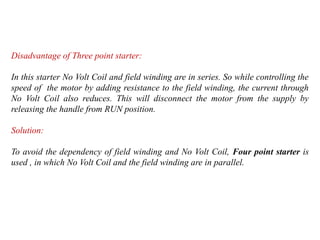
To avoid the dependency of field winding and No Volt Coil, Four point starter is
used , in which No Volt Coil and the field winding are in parallel.
CALCULATION OF STEPS OF STARTER RESISTANCE
(In Black Board )
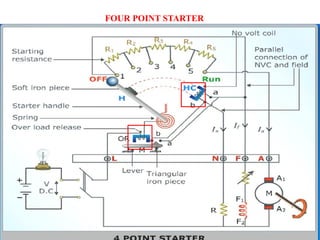
FOUR POINT STARTER
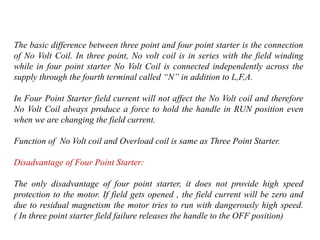
The basic difference between three point and four point starter is the connection
of No Volt Coil. In three point, No volt coil is in series with the field winding
while in four point starter No Volt Coil is connected independently across the
supply through the fourth terminal called “N” in addition to L,F,A.
In Four Point Starter field current will not affect the No Volt coil and therefore
No Volt Coil always produce a force to hold the handle in RUN position even
when we are changing the field current.
Function of No Volt coil and Overload coil is same as Three Point Starter.
Disadvantage of Four Point Starter:
The only disadvantage of four point starter, it does not provide high speed
protection to the motor. If field gets opened , the field current will be zero and
due to residual magnetism the motor tries to run with dangerously high speed.
( In three point starter field failure releases the handle to the OFF position)
AC MOTOR STARTER
HIGH STARTING CURRENT IN AC THREE PHASE INDUCTION MOTOR
These motors have the tendency to draw very high current at the time of
starting.
Disadvantage of Very high armature current:
 There is a possibility of damage of motor winding ,
 Large line voltage drop,
 Other appliances connected to the same line may subjected to voltage spikes
So we need to have a device which can limit such a high starting current.
In three phase induction motor magnitude of induced EMF in the rotor
decides the magnitude of rotor current.
At starting of the motor, the speed is zero and the magnitude of the
induced EMF is very high , since the relative motion between the magnetic
field and the rotor conductors is very high.
This very high induced EMF at starting creates very high starting current.
This current can be of the order of 5 to 8 times the full load current.
WHY STARTING CURRENT IS HIGH?
STARTER AND DIFFERENT TYPES OF STARTER
The starter is a device which is basically used to limit high starting current by
supplying reduced voltage to the motor at the time of starting.
The starter not only limits the starting current but also provides the protection to
the induction motor against overloading and low voltage situation.
Types of starter:
Stator resistance starter
Auto transformer starter
Star delta starter
Rotor resistance starter
Direct online starter
For three phase squirrel cage induction motor
For three phase slip ring induction motor
For single phase induction motor/rating less
than 5 H.P
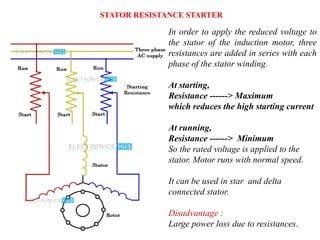
STATOR RESISTANCE STARTER
In order to apply the reduced voltage to
the stator of the induction motor, three
resistances are added in series with each
phase of the stator winding.
At starting,
Resistance ------> Maximum
which reduces the high starting current
At running,
Resistance ------> Minimum
So the rated voltage is applied to the
stator. Motor runs with normal speed.
It can be used in star and delta
connected stator.
Disadvantage :
Large power loss due to resistances.
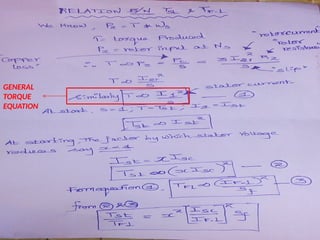
GENERAL
TORQUE
EQUATION
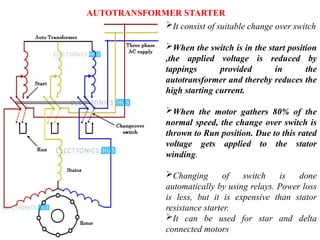
AUTOTRANSFORMER STARTER
It consist of suitable change over switch
When the switch is in the start position
,the applied voltage is reduced by
tappings provided in the
autotransformer and thereby reduces the
high starting current.
When the motor gathers 80% of the
normal speed, the change over switch is
thrown to Run position. Due to this rated
voltage gets applied to the stator
winding.
Changing of switch is done
automatically by using relays. Power loss
is less, but it is expensive than stator
resistance starter.
It can be used for star and delta
connected motors
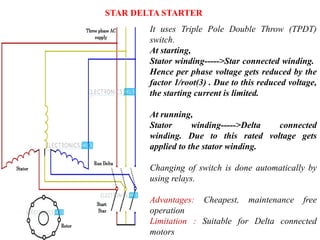
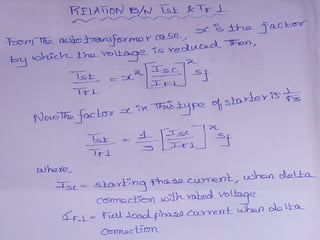
STAR DELTA STARTER
It uses Triple Pole Double Throw (TPDT)
switch.
At starting,
Stator winding----->Star connected winding.
Hence per phase voltage gets reduced by the
factor 1/root(3) . Due to this reduced voltage,
the starting current is limited.
At running,
Stator winding----->Delta connected
winding. Due to this rated voltage gets
applied to the stator winding.
Changing of switch is done automatically by
using relays.
Advantages: Cheapest, maintenance free
operation
Limitation : Suitable for Delta connected
motors
ROTOR RESISTANCE STARTER
(In Black Board)
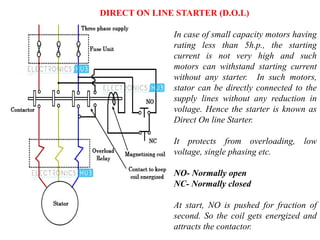
DIRECT ON LINE STARTER (D.O.L)
In case of small capacity motors having
rating less than 5h.p., the starting
current is not very high and such
motors can withstand starting current
without any starter. In such motors,
stator can be directly connected to the
supply lines without any reduction in
voltage. Hence the starter is known as
Direct On line Starter.
It protects from overloading, low
voltage, single phasing etc.
NO- Normally open
NC- Normally closed
At start, NO is pushed for fraction of
second. So the coil gets energized and
attracts the contactor.
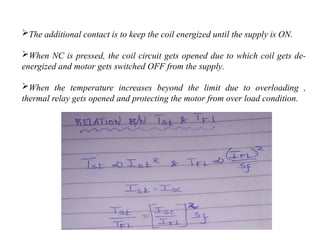
The additional contact is to keep the coil energized until the supply is ON.
When NC is pressed, the coil circuit gets opened due to which coil gets de-
energized and motor gets switched OFF from the supply.
When the temperature increases beyond the limit due to overloading ,
thermal relay gets opened and protecting the motor from over load condition.
THANKS…

starting methods for the drive motors.pptx

  • 1.
    STARTING METHODS FOR DRIVEMOTORS D.Citharthan AP/EEE CKEC
  • 2.
    LAST CHAPTER: discussedabout the DC motors (Shunt, Series, Compound) and AC motors ( Three phase and single phase Induction motor) various characteristics. These motors have the tendency to draw very high current at the time of starting. Disadvantage of Very high armature current:  Cause damage to the motor windings  In constant voltage system, such high inrush current may cause tremendous line voltage fluctuations. Such high armature current, blows out fuses Large armature current for a longer time may burn the insulation of the armature winding At starting armature current is 10 to 15 times more than the full load current. So the torque developed will also be 10 to 15 times, assuming shunt motor operation. Due to such high torque , the shaft and other accessories subjected to large mechanical stress. So we need to have a device which can limit such a high starting current. HIGH STARTING CURRENT IN DC MOTORS
  • 3.
    WHY STARTING CURRENTIS HIGH? Equivalent Circuit of DC motor General KVL Equation of DC Motor circuit, V= Eb+ IaRa, Where Eb= Back EMF; Ia = armature current; Ra = armature resistance General Ia equation for DC motor , Ia= V-Eb/Ra At starting N(speed of the motor) =0 and therefore Eb=0 So Ia equation for DC motor at starting , Ia=V/Ra ; so the staring current will be high
  • 4.
    STARTER AND DIFFERENTTYPES OF STARTER To restrict this high starting armature current, a variable resistance is connected in series with the armature at start. This resistance is called starter or starting resistance. So starter is basically a current limiting device. There are two types of starters used for DC shunt motors I) Three point starter II) Four point starter
  • 5.
    THREE POINT STARTER Novolt coil Over Load Release Lever Spring Handle
  • 6.
    There are threemain points of the starter L – line terminal to be connected to positive of the supply. A – to be connected to the armature winding. F – to be connected to the field winding. Operation: Initially the handle (H) is in off position.  The handle (H) is slowly moved against the spring force to make a contact with stud number 1. At this point,  Field winding (F1,F2) gets the supply through HC (No Volt Coil).  Armature winding (A1, A2) gets the supply through entire starting resistances (R1,R2, R3. R4, and R5)  As the handle (H) is moved further. It goes on making contact with studs 2,3,4 .. Cutting out the starting resistance gradually from the armature circuit.  Finally when the handle (H) is in RUN position the entire starting resistance gets removed from the armature circuit.
  • 7.
    How the handle(H) will remain in the RUN position as long as motor is running? Answer: It’s the function of No Volt Coil. Function of No Volt Coil: The field winding gets the supply through No Volt Coil. So the field current magnetize the No Volt Coil. When the handle is in the RUN position the magnetized No Volt coil will hold the soft iron piece in the RUN position. Hence No Volt Coil also called Hold On Coil. Whenever there is a supply failure or if field circuit is open, the current will not passes through No Volt Coil. Hence it will not hold the handle in RUN position and handle always come back to OFF position. This prevents the damage of the motor caused due to accidental starting. NVC performs the similar action under low voltage conditions and protects the motor from such dangerous supply conditions as well.
  • 8.
    Function of OverloadRelease: To protect from overload condition Under overload condition, high current is drawn by the motor from the supply which passes through Overload load Release. This produce enough force to attract the lever upwards. This shorts the No Volt Coil and voltage across No Volt Coil becomes zero due to which No Volt coil loses its magnetism. Thus motor will be disconnected from the supply by releasing the handle from RUN position and gets saved from overload condition. Problem in three point starter: In three point starter, the part of starting resistance which gets removed when we are moving the handle is added to the field winding. This affects the field winding performance. Solution: This can be avoided by providing a brass arc or copper arc connected just below the stud as shown in the figure . Figure: Three point starter with brass/copper arc
  • 9.
    Disadvantage of Threepoint starter: In this starter No Volt Coil and field winding are in series. So while controlling the speed of the motor by adding resistance to the field winding, the current through No Volt Coil also reduces. This will disconnect the motor from the supply by releasing the handle from RUN position. Solution: To avoid the dependency of field winding and No Volt Coil, Four point starter is used , in which No Volt Coil and the field winding are in parallel.
  • 10.
    CALCULATION OF STEPSOF STARTER RESISTANCE (In Black Board )
  • 11.
  • 12.
    The basic differencebetween three point and four point starter is the connection of No Volt Coil. In three point, No volt coil is in series with the field winding while in four point starter No Volt Coil is connected independently across the supply through the fourth terminal called “N” in addition to L,F,A. In Four Point Starter field current will not affect the No Volt coil and therefore No Volt Coil always produce a force to hold the handle in RUN position even when we are changing the field current. Function of No Volt coil and Overload coil is same as Three Point Starter. Disadvantage of Four Point Starter: The only disadvantage of four point starter, it does not provide high speed protection to the motor. If field gets opened , the field current will be zero and due to residual magnetism the motor tries to run with dangerously high speed. ( In three point starter field failure releases the handle to the OFF position)
  • 13.
  • 14.
    HIGH STARTING CURRENTIN AC THREE PHASE INDUCTION MOTOR These motors have the tendency to draw very high current at the time of starting. Disadvantage of Very high armature current:  There is a possibility of damage of motor winding ,  Large line voltage drop,  Other appliances connected to the same line may subjected to voltage spikes So we need to have a device which can limit such a high starting current.
  • 15.
    In three phaseinduction motor magnitude of induced EMF in the rotor decides the magnitude of rotor current. At starting of the motor, the speed is zero and the magnitude of the induced EMF is very high , since the relative motion between the magnetic field and the rotor conductors is very high. This very high induced EMF at starting creates very high starting current. This current can be of the order of 5 to 8 times the full load current. WHY STARTING CURRENT IS HIGH?
  • 16.
    STARTER AND DIFFERENTTYPES OF STARTER The starter is a device which is basically used to limit high starting current by supplying reduced voltage to the motor at the time of starting. The starter not only limits the starting current but also provides the protection to the induction motor against overloading and low voltage situation. Types of starter: Stator resistance starter Auto transformer starter Star delta starter Rotor resistance starter Direct online starter For three phase squirrel cage induction motor For three phase slip ring induction motor For single phase induction motor/rating less than 5 H.P
  • 17.
    STATOR RESISTANCE STARTER Inorder to apply the reduced voltage to the stator of the induction motor, three resistances are added in series with each phase of the stator winding. At starting, Resistance ------> Maximum which reduces the high starting current At running, Resistance ------> Minimum So the rated voltage is applied to the stator. Motor runs with normal speed. It can be used in star and delta connected stator. Disadvantage : Large power loss due to resistances.
  • 18.
  • 19.
    AUTOTRANSFORMER STARTER It consistof suitable change over switch When the switch is in the start position ,the applied voltage is reduced by tappings provided in the autotransformer and thereby reduces the high starting current. When the motor gathers 80% of the normal speed, the change over switch is thrown to Run position. Due to this rated voltage gets applied to the stator winding. Changing of switch is done automatically by using relays. Power loss is less, but it is expensive than stator resistance starter. It can be used for star and delta connected motors
  • 21.
    STAR DELTA STARTER Ituses Triple Pole Double Throw (TPDT) switch. At starting, Stator winding----->Star connected winding. Hence per phase voltage gets reduced by the factor 1/root(3) . Due to this reduced voltage, the starting current is limited. At running, Stator winding----->Delta connected winding. Due to this rated voltage gets applied to the stator winding. Changing of switch is done automatically by using relays. Advantages: Cheapest, maintenance free operation Limitation : Suitable for Delta connected motors
  • 23.
  • 24.
    DIRECT ON LINESTARTER (D.O.L) In case of small capacity motors having rating less than 5h.p., the starting current is not very high and such motors can withstand starting current without any starter. In such motors, stator can be directly connected to the supply lines without any reduction in voltage. Hence the starter is known as Direct On line Starter. It protects from overloading, low voltage, single phasing etc. NO- Normally open NC- Normally closed At start, NO is pushed for fraction of second. So the coil gets energized and attracts the contactor.
  • 25.
    The additional contactis to keep the coil energized until the supply is ON. When NC is pressed, the coil circuit gets opened due to which coil gets de- energized and motor gets switched OFF from the supply. When the temperature increases beyond the limit due to overloading , thermal relay gets opened and protecting the motor from over load condition.
  • 26.