FACULTY OF ENGINEERING
(INDUSTRIAL ELECTRONIC AND CONTROL)
DC Motor Speed Controller
by PWM technique
KGK 1500011
Khairi A. M. Elrmali
outline
• Introduction to pwm technique
• Generate PWM signal in MATLAB Simulink
1. Varying Frequency modulation ratio
2. varying amplitude modulation ratio
• PWM Spectral Modelling and Characteristics
 Bipolar Double-Edge Modulation &single-Edge Modulation
 unipolar Double-Edge Modulation & single-Edge Modulation
• DC motor speed control circuit
– switch charactristic
• simulate model by proteus8
• Pulse Width Modulator Motor Speed Control kit
• CONCLUSION
Introduction to pwm technique
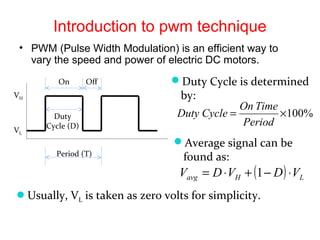
• PWM (Pulse Width Modulation) is an efficient way to
vary the speed and power of electric DC motors.
Period (T)
Duty
Cycle (D)
VL
VH
On Off
%100×=
Period
TimeOn
CycleDuty
( ) LHavg VDVDV ⋅−+⋅= 1
Duty Cycle is determined
by:
Average signal can be
found as:
Usually, VL is taken as zero volts for simplicity.
Generate PWM signal in MATLAB Simulink
A.Varying Frequency modulation ratio
sinf
f
m tri
f =
The binary PWM output
can be mathematically written as
( ) ( ) ( )[ ]tctrtb pwm −= sgn
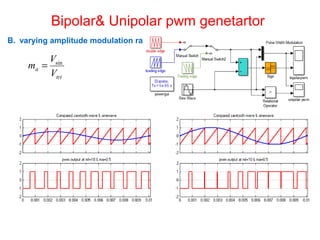
Bipolar& Unipolar pwm genetartor
B. varying amplitude modulation ratio
tri
a
V
V
m sin
=
PWM Spectral Modelling and Characteristics
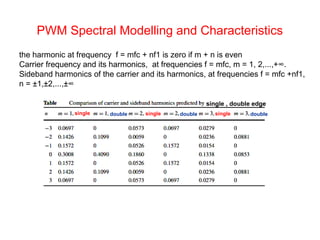
the harmonic at frequency f = mfc + nf1 is zero if m + n is even
Carrier frequency and its harmonics, at frequencies f = mfc, m = 1, 2,...,+∞.
Sideband harmonics of the carrier and its harmonics, at frequencies f = mfc +nf1,
n = ±1,±2,...,±∞
single single singledouble double double
single , double edge
PWM Spectral Models
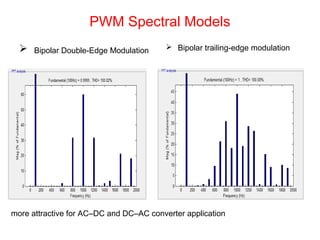
 Bipolar Double-Edge Modulation  Bipolar trailing-edge modulation
more attractive for AC–DC and DC–AC converter application
PWM Spectral Models
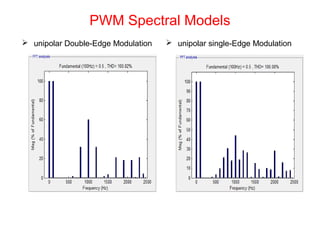
 unipolar single-Edge Modulation unipolar Double-Edge Modulation
DC motor speed control circuit
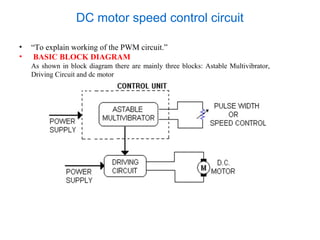
• “To explain working of the PWM circuit.”
• BASIC BLOCK DIAGRAM
As shown in block diagram there are mainly three blocks: Astable Multivibrator,
Driving Circuit and dc motor
The Basic Blocks are explained below:
( )
( )
( )
( )
(5)
1
(4)
2
44.1
(3)
2
(2)69.0
(1)69.0
21
21
21
2
21
F
T
CRR
F
RR
RR
TT
T
D
CRT
CRRT
OFFON
ON
OFF
ON
=
×+
=
+
+
=
+
=
×=
×+=
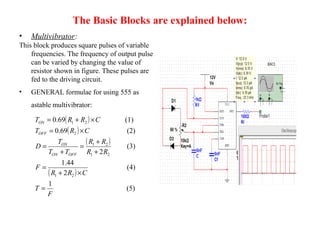
• Multivibrator:
This block produces square pulses of variable
frequencies. The frequency of output pulse
can be varied by changing the value of
resistor shown in figure. These pulses are
fed to the driving circuit.
• GENERAL formulae for using 555 as
astable multivibrator:
switch charactristic
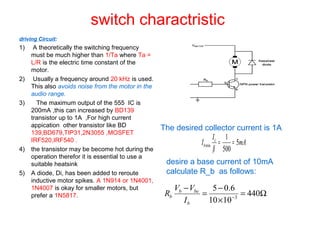
driving Circuit:
1) A theoretically the switching frequency
must be much higher than 1/Ta where Ta =
L/R is the electric time constant of the
motor.
2) Usually a frequency around 20 kHz is used.
This also avoids noise from the motor in the
audio range.
3) The maximum output of the 555 IC is
200mA ,this can increased by BD139
transistor up to 1A ,For high current
appication other transistor like BD
139,BD679,TIP31,2N3055 ,MOSFET
IRF520,IRF540 .
4) the transistor may be become hot during the
operation therefor it is essential to use a
suitable heatsink
5) A diode, Di, has been added to reroute
inductive motor spikes. A 1N914 or 1N4001,
1N4007 is okay for smaller motors, but
prefer a 1N5817.
mA
I
I c
b 5
500
1
min ==
β
The desired collector current is 1A
desire a base current of 10mA
calculate R_b as follows:
Ω=
×
−
=
−
−
440
1010
6.05
3
b
beb
b
I
VV
R
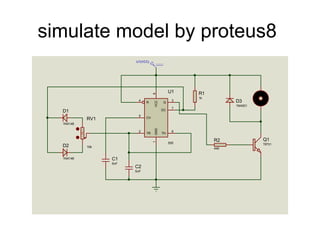
simulate model by proteus8
R
4
DC
7
Q
3
GND
1
VCC
8
TR
2
TH
6
CV
5
U1
555
U1(VCC)
C1
5nF
R1
1k
C2
5nF
D1
1N4148
D2
1N4148
7%
RV1
10k
R2
440
D3
1N4001
Q1
TIP31
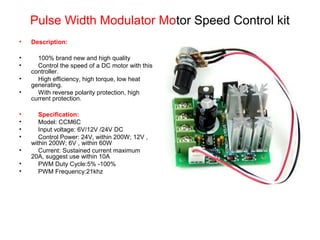
• Description:
• 100% brand new and high quality
• Control the speed of a DC motor with this
controller.
• High efficiency, high torque, low heat
generating.
• With reverse polarity protection, high
current protection.
• Specification:
• Model: CCM6C
• Input voltage: 6V/12V /24V DC
• Control Power: 24V, within 200W; 12V ,
within 200W; 6V , within 60W
• Current: Sustained current maximum
20A, suggest use within 10A
• PWM Duty Cycle:5% -100%
• PWM Frequency:21khz
Pulse Width Modulator Motor Speed Control kit
CONCLUSION
• From the project work, following points can be
concluded.
• The motor responds to the average value of the pulses
and not to the individual pulses as the chopper works at
high frequency.
• Changing the duty-cycle of the pulse by changing the
speed of regulator changes the average voltage level.

Dc motor speed controller by pwm technique

  • 1.
    FACULTY OF ENGINEERING (INDUSTRIALELECTRONIC AND CONTROL) DC Motor Speed Controller by PWM technique KGK 1500011 Khairi A. M. Elrmali
  • 2.
    outline • Introduction topwm technique • Generate PWM signal in MATLAB Simulink 1. Varying Frequency modulation ratio 2. varying amplitude modulation ratio • PWM Spectral Modelling and Characteristics  Bipolar Double-Edge Modulation &single-Edge Modulation  unipolar Double-Edge Modulation & single-Edge Modulation • DC motor speed control circuit – switch charactristic • simulate model by proteus8 • Pulse Width Modulator Motor Speed Control kit • CONCLUSION
  • 3.
    Introduction to pwmtechnique • PWM (Pulse Width Modulation) is an efficient way to vary the speed and power of electric DC motors. Period (T) Duty Cycle (D) VL VH On Off %100×= Period TimeOn CycleDuty ( ) LHavg VDVDV ⋅−+⋅= 1 Duty Cycle is determined by: Average signal can be found as: Usually, VL is taken as zero volts for simplicity.
  • 4.
    Generate PWM signalin MATLAB Simulink A.Varying Frequency modulation ratio sinf f m tri f = The binary PWM output can be mathematically written as ( ) ( ) ( )[ ]tctrtb pwm −= sgn
  • 5.
    Bipolar& Unipolar pwmgenetartor B. varying amplitude modulation ratio tri a V V m sin =
  • 6.
    PWM Spectral Modellingand Characteristics the harmonic at frequency f = mfc + nf1 is zero if m + n is even Carrier frequency and its harmonics, at frequencies f = mfc, m = 1, 2,...,+∞. Sideband harmonics of the carrier and its harmonics, at frequencies f = mfc +nf1, n = ±1,±2,...,±∞ single single singledouble double double single , double edge
  • 7.
    PWM Spectral Models Bipolar Double-Edge Modulation  Bipolar trailing-edge modulation more attractive for AC–DC and DC–AC converter application
  • 8.
    PWM Spectral Models unipolar single-Edge Modulation unipolar Double-Edge Modulation
  • 9.
    DC motor speedcontrol circuit • “To explain working of the PWM circuit.” • BASIC BLOCK DIAGRAM As shown in block diagram there are mainly three blocks: Astable Multivibrator, Driving Circuit and dc motor
  • 10.
    The Basic Blocksare explained below: ( ) ( ) ( ) ( ) (5) 1 (4) 2 44.1 (3) 2 (2)69.0 (1)69.0 21 21 21 2 21 F T CRR F RR RR TT T D CRT CRRT OFFON ON OFF ON = ×+ = + + = + = ×= ×+= • Multivibrator: This block produces square pulses of variable frequencies. The frequency of output pulse can be varied by changing the value of resistor shown in figure. These pulses are fed to the driving circuit. • GENERAL formulae for using 555 as astable multivibrator:
  • 11.
    switch charactristic driving Circuit: 1)A theoretically the switching frequency must be much higher than 1/Ta where Ta = L/R is the electric time constant of the motor. 2) Usually a frequency around 20 kHz is used. This also avoids noise from the motor in the audio range. 3) The maximum output of the 555 IC is 200mA ,this can increased by BD139 transistor up to 1A ,For high current appication other transistor like BD 139,BD679,TIP31,2N3055 ,MOSFET IRF520,IRF540 . 4) the transistor may be become hot during the operation therefor it is essential to use a suitable heatsink 5) A diode, Di, has been added to reroute inductive motor spikes. A 1N914 or 1N4001, 1N4007 is okay for smaller motors, but prefer a 1N5817. mA I I c b 5 500 1 min == β The desired collector current is 1A desire a base current of 10mA calculate R_b as follows: Ω= × − = − − 440 1010 6.05 3 b beb b I VV R
  • 12.
    simulate model byproteus8 R 4 DC 7 Q 3 GND 1 VCC 8 TR 2 TH 6 CV 5 U1 555 U1(VCC) C1 5nF R1 1k C2 5nF D1 1N4148 D2 1N4148 7% RV1 10k R2 440 D3 1N4001 Q1 TIP31
  • 13.
    • Description: • 100%brand new and high quality • Control the speed of a DC motor with this controller. • High efficiency, high torque, low heat generating. • With reverse polarity protection, high current protection. • Specification: • Model: CCM6C • Input voltage: 6V/12V /24V DC • Control Power: 24V, within 200W; 12V , within 200W; 6V , within 60W • Current: Sustained current maximum 20A, suggest use within 10A • PWM Duty Cycle:5% -100% • PWM Frequency:21khz Pulse Width Modulator Motor Speed Control kit
  • 14.
    CONCLUSION • From theproject work, following points can be concluded. • The motor responds to the average value of the pulses and not to the individual pulses as the chopper works at high frequency. • Changing the duty-cycle of the pulse by changing the speed of regulator changes the average voltage level.