

DATA
COMMUNICATION
LeCTUre-5LeCTUre-5
reCAp Of LeCTUre 4
• Categoriesof Networks
• PAN
• LAN
• MAN
• WAN
• Interconnection of Networks: Internetworks
OvervIew Of LeCTUre 5
• Protocols
• Elementsof Protocols
• Standards
• De-Jure
• De-Facto
• Standard organizations
• Internet Standards
prOTOCOLs
• A protocol isaset of rulesthat govern data
communications.
• A protocol defines
– what iscommunicated,
– how it iscommunicated,
– and when it iscommunicated.
• For communication to occur, theentitiesmust agreeon a
protocol.
• Thekey elementsof aprotocol are
– Syntax
– Semantics
– timing.
prOTOCOLs (CONT.)
• Syntax:
– The term syntaxsyntax refers to the structure or format of the
data, meaning theorder in which they arepresented.
– For example, a simple protocol might expect the first 8
bits of data to be the address of the sender, the second 8
bits to be the address of the receiver, and the rest of the
stream to bethemessageitself.
• Semantics:
– Theword semanticssemantics refersto themeaning of each section
of bits. How is a particular pattern to be interpreted, and
what action isto betaken based on that interpretation?For
example, does an address identify the route to be taken or
thefinal destination of themessage?
Protocols (cont.)
• Timing:
– Theterm timingtiming refersto two characteristics:
• when datashould besent?
• and how fast they can besent?
– For example, if a sender produces data at 100 Mbps
but the receiver can process data at only 1 Mbps, the
transmission will overload the receiver and some data
will belost.
standards
“A standard provides a model for
development that makes it possible
for a product to work regardless of
the individual manufacturer”
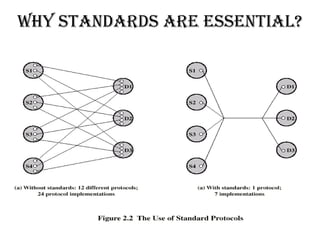
Why standards are essential?
• Standardsareessential in:
1. Creating/Maintaining Open and CompetitiveMarkets.
2. Guaranteeing National/International Interoperability of data
and telecommunicationstechnology and processes.
• Standards provide guidelines to manufacturers, vendors,
government agencies, and other service providers to ensure the
kind of interconnectivity necessary in today's marketplace and
in international communications.
Why standards are essential?
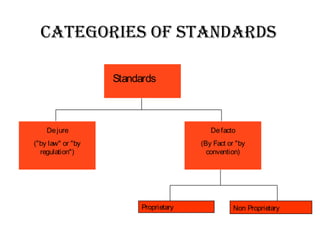
categories of standards
Proprietary Non Proprietary
Defacto
(By Fact or "by
convention)
Dejure
("by law" or "by
regulation")
Standards
De jure
• Those standards that have been legislated by
an officially recognized body.
De facto
• Standards that have not been approved by an
organized body but have been adopted as standards
through widespread use.
• De facto standards are often established originally by
manufacturers who seek to define the functionality of
anew product or technology.
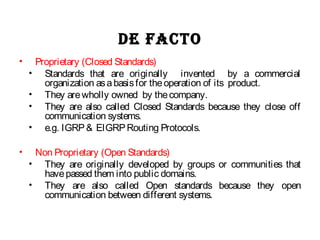
De facto
• Proprietary (Closed Standards)
• Standards that are originally invented by a commercial
organization asabasisfor theoperation of its product.
• They arewholly owned by thecompany.
• They are also called Closed Standards because they close off
communication systems.
• e.g. IGRP& EIGRPRouting Protocols.
• Non Proprietary (Open Standards)
• They are originally developed by groups or communities that
havepassed them into public domains.
• They are also called Open standards because they open
communication between different systems.
StanDarDS organizationS
• Standardsaredeveloped mainly by 3 entities:
• Standard Creation Committees
• Forums
• Regulatory Agencies
StanDarD creation committeeS
• They are procedural bodies and are slow moving and cannot
co-op with thefast growing communication industry.
• ISO
• (International Standard Organization)
• ITU-T
• (International telecommunication Union-
telecommunication Standard Sector)
• ANSI
• (TheAmerican National Standard Institute)
• IEEE
• (Instituteof Electrical and ElectronicsEngineers)
• EIA
• (Electronic Industry Association)
FORUMS
• Special Interest Groups with representatives from interested
corporations they facilitate and fasten standardization process by
working with universities, and users to test, evaluate, and
standardizenew technology.
• FrameRelay Forum
• ATM Forum
• Internet Society
• Internet Engineering Task Force(IETF)
RegUlatORy agencieSRegUlatORy agencieS
 All communication technology is subject to regulation and
laws by government agencies. The purpose is to protect
public interest by regulating radio, television and cable
communication.
 FCC
inteRnet StandaRdSinteRnet StandaRdS
• It is a thoroughly tested specification that is useful to and adhered
to by thosewho work with theInternet.
• It isaformalized regulation that must befollowed.
• There is a strict procedure by which a specification attains
Internet standard status.
• A specification beginsasan Internet draft.
• An Internet draft isaworking document (awork in progress) with
no official statusand a6-month lifetime.
• Upon recommendation from the Internet authorities, a draft may
bepublished asaRequest for Comment (RFC).
• Each RFC is edited, assigned a number, and made available to all
interested parties.
• RFCs go through maturity levels and are categorized according to
their requirement level.
SUMMaRy
• Protocols
• Elementsof Protocols
• Standards
• De-Jure
• De-Facto
• Standard organizations
• Internet Standards
SUggeSted Reading
 Section
 1.4,
 “DataCommunicationsand Networking” 4th
Edition by Behrouz
A. Forouzan
 Sections
 1.3,
 “Dataand Computer Communication” 6th Edition by William
Stallings

Dc lec-05 (protocols & standards)

  • 1.
  • 2.
    reCAp Of LeCTUre4 • Categoriesof Networks • PAN • LAN • MAN • WAN • Interconnection of Networks: Internetworks
  • 3.
    OvervIew Of LeCTUre5 • Protocols • Elementsof Protocols • Standards • De-Jure • De-Facto • Standard organizations • Internet Standards
  • 4.
    prOTOCOLs • A protocolisaset of rulesthat govern data communications. • A protocol defines – what iscommunicated, – how it iscommunicated, – and when it iscommunicated. • For communication to occur, theentitiesmust agreeon a protocol. • Thekey elementsof aprotocol are – Syntax – Semantics – timing.
  • 5.
    prOTOCOLs (CONT.) • Syntax: –The term syntaxsyntax refers to the structure or format of the data, meaning theorder in which they arepresented. – For example, a simple protocol might expect the first 8 bits of data to be the address of the sender, the second 8 bits to be the address of the receiver, and the rest of the stream to bethemessageitself. • Semantics: – Theword semanticssemantics refersto themeaning of each section of bits. How is a particular pattern to be interpreted, and what action isto betaken based on that interpretation?For example, does an address identify the route to be taken or thefinal destination of themessage?
  • 6.
    Protocols (cont.) • Timing: –Theterm timingtiming refersto two characteristics: • when datashould besent? • and how fast they can besent? – For example, if a sender produces data at 100 Mbps but the receiver can process data at only 1 Mbps, the transmission will overload the receiver and some data will belost.
  • 7.
    standards “A standard providesa model for development that makes it possible for a product to work regardless of the individual manufacturer”
  • 8.
    Why standards areessential? • Standardsareessential in: 1. Creating/Maintaining Open and CompetitiveMarkets. 2. Guaranteeing National/International Interoperability of data and telecommunicationstechnology and processes. • Standards provide guidelines to manufacturers, vendors, government agencies, and other service providers to ensure the kind of interconnectivity necessary in today's marketplace and in international communications.
  • 9.
  • 10.
    categories of standards ProprietaryNon Proprietary Defacto (By Fact or "by convention) Dejure ("by law" or "by regulation") Standards
  • 11.
    De jure • Thosestandards that have been legislated by an officially recognized body.
  • 12.
    De facto • Standardsthat have not been approved by an organized body but have been adopted as standards through widespread use. • De facto standards are often established originally by manufacturers who seek to define the functionality of anew product or technology.
  • 13.
    De facto • Proprietary(Closed Standards) • Standards that are originally invented by a commercial organization asabasisfor theoperation of its product. • They arewholly owned by thecompany. • They are also called Closed Standards because they close off communication systems. • e.g. IGRP& EIGRPRouting Protocols. • Non Proprietary (Open Standards) • They are originally developed by groups or communities that havepassed them into public domains. • They are also called Open standards because they open communication between different systems.
  • 14.
    StanDarDS organizationS • Standardsaredevelopedmainly by 3 entities: • Standard Creation Committees • Forums • Regulatory Agencies
  • 15.
    StanDarD creation committeeS •They are procedural bodies and are slow moving and cannot co-op with thefast growing communication industry. • ISO • (International Standard Organization) • ITU-T • (International telecommunication Union- telecommunication Standard Sector) • ANSI • (TheAmerican National Standard Institute) • IEEE • (Instituteof Electrical and ElectronicsEngineers) • EIA • (Electronic Industry Association)
  • 16.
    FORUMS • Special InterestGroups with representatives from interested corporations they facilitate and fasten standardization process by working with universities, and users to test, evaluate, and standardizenew technology. • FrameRelay Forum • ATM Forum • Internet Society • Internet Engineering Task Force(IETF)
  • 17.
    RegUlatORy agencieSRegUlatORy agencieS All communication technology is subject to regulation and laws by government agencies. The purpose is to protect public interest by regulating radio, television and cable communication.  FCC
  • 18.
    inteRnet StandaRdSinteRnet StandaRdS •It is a thoroughly tested specification that is useful to and adhered to by thosewho work with theInternet. • It isaformalized regulation that must befollowed. • There is a strict procedure by which a specification attains Internet standard status. • A specification beginsasan Internet draft. • An Internet draft isaworking document (awork in progress) with no official statusand a6-month lifetime. • Upon recommendation from the Internet authorities, a draft may bepublished asaRequest for Comment (RFC). • Each RFC is edited, assigned a number, and made available to all interested parties. • RFCs go through maturity levels and are categorized according to their requirement level.
  • 19.
    SUMMaRy • Protocols • ElementsofProtocols • Standards • De-Jure • De-Facto • Standard organizations • Internet Standards
  • 20.
    SUggeSted Reading  Section 1.4,  “DataCommunicationsand Networking” 4th Edition by Behrouz A. Forouzan  Sections  1.3,  “Dataand Computer Communication” 6th Edition by William Stallings