Data Communication and
Networks
VEERANAN VEERANAN
Assistant Professor in Information Technology
P.K.N. Arts & Science College, Tirumangalam, Madurai.
Syllabus
Introduction: Data Communication-Networks: Distributed Processing Network
Criteria Physical Structures –Network Models-Categories of Network-Internetwork - The
Internet Protocols and Standards – Network Models: Layers in the OSI Model - TCP/IP
Protocol Suite
Introduction
Data communication and networking have revolutionized the way we live and do business.
Modern organizations depend heavily on computer networks to exchange information
quickly and accurately. With the growth of computers and communication technologies,
sharing data such as text, images, audio, and video across the world has become possible.
The study of data communication focuses on:
How data is transmitted
How networks are designed
How devices communicate using protocols and standards
This unit mainly discusses
Data Communications
Networks
The Internet
Protocols and Standards
Network Models (OSI & TCP/IP)
Data Communications
Data communication is the process of exchanging data between two or more
devices through a transmission medium such as cables or wireless signals.
A data communication system consists of both:
Hardware (physical equipment)
Software (programs and protocols)
Characteristics
Delivery: Data must be delivered to the correct destination only.
Accuracy: Data must be transmitted without errors. Corrupted data is useless.
Timeliness: Data must reach on time. Late data is ineffective, especially in real-time
applications like video calls.
Jitter: Jitter refers to variations in packet arrival time. Excessive jitter degrades audio
and video quality.
•
Components
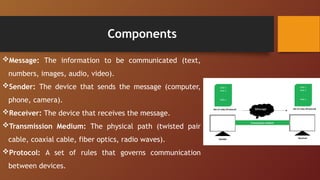
Message: The information to be communicated (text,
numbers, images, audio, video).
Sender: The device that sends the message (computer,
phone, camera).
Receiver: The device that receives the message.
Transmission Medium: The physical path (twisted pair
cable, coaxial cable, fiber optics, radio waves).
Protocol: A set of rules that governs communication
between devices.
Data Representation
Information is represented in digital form using bit patterns.
TYPES OF DATA REPRESENTATION
Text: Represented using character encoding systems such as ASCII and Unicode.
Numbers: Converted directly into binary format.
Images: Represented as pixels. Each pixel is assigned a bit pattern (black & white, grayscale, or
color using RGB).
Audio: Continuous signals converted into digital form using sampling.
Video: A sequence of images or continuous signals that convey motion.
Data Flow (Transmission Modes)
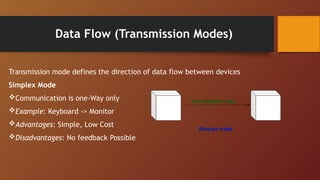
Transmission mode defines the direction of data flow between devices
Simplex Mode
Communication is one-Way only
Example: Keyboard -> Monitor
Advantages: Simple, Low Cost
Disadvantages: No feedback Possible
Data Flow (Transmission Modes)
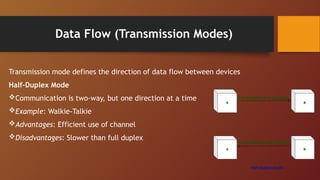
Transmission mode defines the direction of data flow between devices
Half-Duplex Mode
Communication is two-way, but one direction at a time
Example: Walkie-Talkie
Advantages: Efficient use of channel
Disadvantages: Slower than full duplex
Data Flow (Transmission Modes)
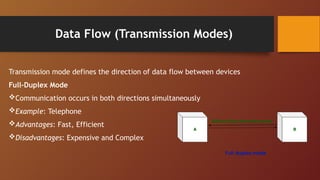
Transmission mode defines the direction of data flow between devices
Full-Duplex Mode
Communication occurs in both directions simultaneously
Example: Telephone
Advantages: Fast, Efficient
Disadvantages: Expensive and Complex
Networks
A network is a collection of interconnected devices (nodes) that communicate with
each other.
Distributed Processing
Instead of one computer handling all tasks, processing is distributed among multiple
computers, improving efficiency and reliability.
Network Criteria
Performance: Measured using throughput and delay.
Reliability: Depends on failure rate, recovery time, and network robustness
Security: Protects data using confidentiality, integrity, and availability.
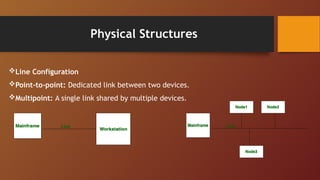
Physical Structures
Line Configuration
Point-to-point: Dedicated link between two devices.
Multipoint: A single link shared by multiple devices.
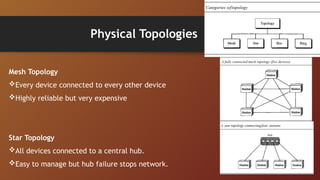
Physical Topologies
Mesh Topology
Every device connected to every other device
Highly reliable but very expensive
Star Topology
All devices connected to a central hub.
Easy to manage but hub failure stops network.
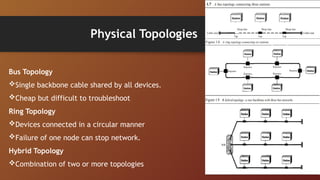
Physical Topologies
Bus Topology
Single backbone cable shared by all devices.
Cheap but difficult to troubleshoot
Ring Topology
Devices connected in a circular manner
Failure of one node can stop network.
Hybrid Topology
Combination of two or more topologies
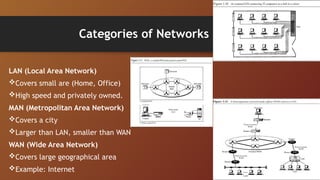
Categories of Networks
LAN (Local Area Network)
Covers small are (Home, Office)
High speed and privately owned.
MAN (Metropolitan Area Network)
Covers a city
Larger than LAN, smaller than WAN
WAN (Wide Area Network)
Covers large geographical area
Example: Internet
Internetwork
When two or more networks are connected, they form an internetwork.
The Internet is the largest internetwork in the world.
The Internet
History
Started in 1969 as ARPANET
Developed to allow communication between research computers
TCP/IP developed by Vint Cerf and Bob Kahn
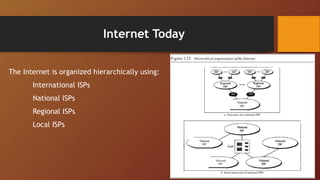
Internet Today
The Internet is organized hierarchically using:
International ISPs
National ISPs
Regional ISPs
Local ISPs
Protocols and Standards
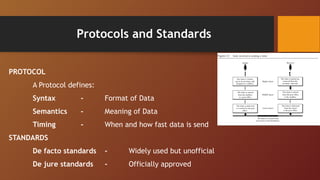
PROTOCOL
A Protocol defines:
Syntax - Format of Data
Semantics - Meaning of Data
Timing - When and how fast data is send
STANDARDS
De facto standards - Widely used but unofficial
De jure standards - Officially approved
Standards Organizations
ISO -
ITU-T -
IEEE -
ANSI -
EIA -
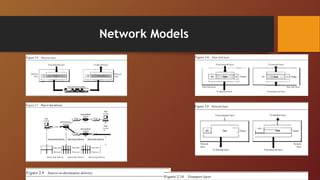
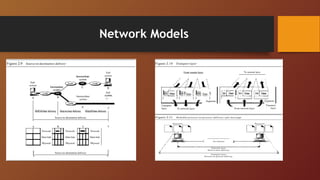
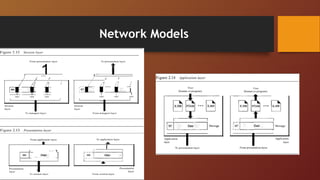
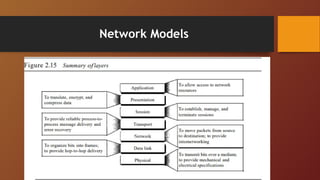
Network Models
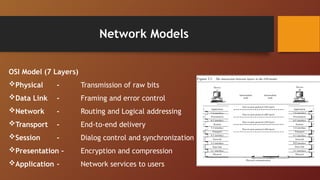
OSI Model (7 Layers)
Physical - Transmission of raw bits
Data Link - Framing and error control
Network - Routing and Logical addressing
Transport - End-to-end delivery
Session - Dialog control and synchronization
Presentation - Encryption and compression
Application - Network services to users
Network Models
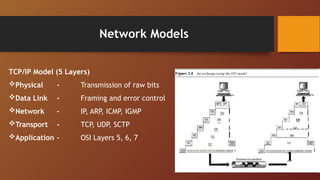
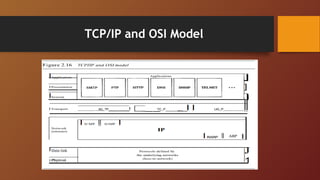
TCP/IP Model (5 Layers)
Physical - Transmission of raw bits
Data Link - Framing and error control
Network - IP, ARP, ICMP, IGMP
Transport - TCP, UDP, SCTP
Application - OSI Layers 5, 6, 7
Network Models
Network Models
Network Models
Network Models
TCP/IP and OSI Model
Network Models
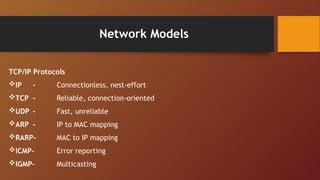
TCP/IP Protocols
IP - Connectionless, nest-effort
TCP - Reliable, connection-oriented
UDP - Fast, unreliable
ARP - IP to MAC mapping
RARP- MAC to IP mapping
ICMP- Error reporting
IGMP- Multicasting
Quick Recap
Data Communication is the exchange of data between devices using a transmission medium and
protocols.
An effective communication system requires delivery, accuracy, timeliness, and low jitter.
Transmission modes include simplex, half-duplex, and full-duplex.
A network connects devices to share data and resources; key criteria are performance,
reliability, and security.
Common network types are LAN, MAN, and WAN with different coverage areas.
The Internet is a global internetwork based on TCP/IP protocols.
Protocols and standards ensure proper and interoperable communication.
OSI model (7 layers) and TCP/IP model (5 layers) explain layered network communication.

Data Communication & Networking – Unit I

  • 1.
    Data Communication and Networks VEERANANVEERANAN Assistant Professor in Information Technology P.K.N. Arts & Science College, Tirumangalam, Madurai.
  • 2.
    Syllabus Introduction: Data Communication-Networks:Distributed Processing Network Criteria Physical Structures –Network Models-Categories of Network-Internetwork - The Internet Protocols and Standards – Network Models: Layers in the OSI Model - TCP/IP Protocol Suite
  • 3.
    Introduction Data communication andnetworking have revolutionized the way we live and do business. Modern organizations depend heavily on computer networks to exchange information quickly and accurately. With the growth of computers and communication technologies, sharing data such as text, images, audio, and video across the world has become possible. The study of data communication focuses on: How data is transmitted How networks are designed How devices communicate using protocols and standards
  • 4.
    This unit mainlydiscusses Data Communications Networks The Internet Protocols and Standards Network Models (OSI & TCP/IP)
  • 5.
    Data Communications Data communicationis the process of exchanging data between two or more devices through a transmission medium such as cables or wireless signals. A data communication system consists of both: Hardware (physical equipment) Software (programs and protocols)
  • 6.
    Characteristics Delivery: Data mustbe delivered to the correct destination only. Accuracy: Data must be transmitted without errors. Corrupted data is useless. Timeliness: Data must reach on time. Late data is ineffective, especially in real-time applications like video calls. Jitter: Jitter refers to variations in packet arrival time. Excessive jitter degrades audio and video quality. •
  • 7.
    Components Message: The informationto be communicated (text, numbers, images, audio, video). Sender: The device that sends the message (computer, phone, camera). Receiver: The device that receives the message. Transmission Medium: The physical path (twisted pair cable, coaxial cable, fiber optics, radio waves). Protocol: A set of rules that governs communication between devices.
  • 8.
    Data Representation Information isrepresented in digital form using bit patterns. TYPES OF DATA REPRESENTATION Text: Represented using character encoding systems such as ASCII and Unicode. Numbers: Converted directly into binary format. Images: Represented as pixels. Each pixel is assigned a bit pattern (black & white, grayscale, or color using RGB). Audio: Continuous signals converted into digital form using sampling. Video: A sequence of images or continuous signals that convey motion.
  • 9.
    Data Flow (TransmissionModes) Transmission mode defines the direction of data flow between devices Simplex Mode Communication is one-Way only Example: Keyboard -> Monitor Advantages: Simple, Low Cost Disadvantages: No feedback Possible
  • 10.
    Data Flow (TransmissionModes) Transmission mode defines the direction of data flow between devices Half-Duplex Mode Communication is two-way, but one direction at a time Example: Walkie-Talkie Advantages: Efficient use of channel Disadvantages: Slower than full duplex
  • 11.
    Data Flow (TransmissionModes) Transmission mode defines the direction of data flow between devices Full-Duplex Mode Communication occurs in both directions simultaneously Example: Telephone Advantages: Fast, Efficient Disadvantages: Expensive and Complex
  • 12.
    Networks A network isa collection of interconnected devices (nodes) that communicate with each other. Distributed Processing Instead of one computer handling all tasks, processing is distributed among multiple computers, improving efficiency and reliability.
  • 13.
    Network Criteria Performance: Measuredusing throughput and delay. Reliability: Depends on failure rate, recovery time, and network robustness Security: Protects data using confidentiality, integrity, and availability.
  • 14.
    Physical Structures Line Configuration Point-to-point:Dedicated link between two devices. Multipoint: A single link shared by multiple devices.
  • 15.
    Physical Topologies Mesh Topology Everydevice connected to every other device Highly reliable but very expensive Star Topology All devices connected to a central hub. Easy to manage but hub failure stops network.
  • 16.
    Physical Topologies Bus Topology Singlebackbone cable shared by all devices. Cheap but difficult to troubleshoot Ring Topology Devices connected in a circular manner Failure of one node can stop network. Hybrid Topology Combination of two or more topologies
  • 17.
    Categories of Networks LAN(Local Area Network) Covers small are (Home, Office) High speed and privately owned. MAN (Metropolitan Area Network) Covers a city Larger than LAN, smaller than WAN WAN (Wide Area Network) Covers large geographical area Example: Internet
  • 18.
    Internetwork When two ormore networks are connected, they form an internetwork. The Internet is the largest internetwork in the world. The Internet History Started in 1969 as ARPANET Developed to allow communication between research computers TCP/IP developed by Vint Cerf and Bob Kahn
  • 19.
    Internet Today The Internetis organized hierarchically using: International ISPs National ISPs Regional ISPs Local ISPs
  • 20.
    Protocols and Standards PROTOCOL AProtocol defines: Syntax - Format of Data Semantics - Meaning of Data Timing - When and how fast data is send STANDARDS De facto standards - Widely used but unofficial De jure standards - Officially approved
  • 21.
    Standards Organizations ISO - ITU-T- IEEE - ANSI - EIA -
  • 22.
    Network Models OSI Model(7 Layers) Physical - Transmission of raw bits Data Link - Framing and error control Network - Routing and Logical addressing Transport - End-to-end delivery Session - Dialog control and synchronization Presentation - Encryption and compression Application - Network services to users
  • 23.
    Network Models TCP/IP Model(5 Layers) Physical - Transmission of raw bits Data Link - Framing and error control Network - IP, ARP, ICMP, IGMP Transport - TCP, UDP, SCTP Application - OSI Layers 5, 6, 7
  • 24.
  • 25.
  • 26.
  • 27.
  • 28.
  • 29.
    Network Models TCP/IP Protocols IP- Connectionless, nest-effort TCP - Reliable, connection-oriented UDP - Fast, unreliable ARP - IP to MAC mapping RARP- MAC to IP mapping ICMP- Error reporting IGMP- Multicasting
  • 30.
    Quick Recap Data Communicationis the exchange of data between devices using a transmission medium and protocols. An effective communication system requires delivery, accuracy, timeliness, and low jitter. Transmission modes include simplex, half-duplex, and full-duplex. A network connects devices to share data and resources; key criteria are performance, reliability, and security. Common network types are LAN, MAN, and WAN with different coverage areas. The Internet is a global internetwork based on TCP/IP protocols. Protocols and standards ensure proper and interoperable communication. OSI model (7 layers) and TCP/IP model (5 layers) explain layered network communication.