
DATA
COMMUNICATION
LeCTUre-1LeCTUre-1
COUrse OUTLINeCOUrse OUTLINe
• Thecoursewill consist of :
 32 lectures
 5-10 assignments
 4 exams(3 midterm and 1 final)
• Grading Criteria:
 Two Best Midterm:40%
 Final Exam: 40%
 Assignments: 20%
TexTbOOkTexTbOOk
• “Data Communications and Networking” 4th
Edition by Behrouz A. Forouzan
• “Data and Computer Communication” 6th
Edition by William Stallings
OvervIew Of LeCTUre 1OvervIew Of LeCTUre 1
• DataCommunication
• DataCommunication System
• Factorseffecting DataCommunication system
• Componentsof datacommunication system
• DataRepresentation
DATA COMMUNICATIONDATA COMMUNICATION
“DataCommunication istheexchangeof
Data(in form of 0’sand 1’s) from one
entity (eg. Computer) to theother using
aTransmission Medium”
DATA COMMUNICATION (CONT..)DATA COMMUNICATION (CONT..)
 “Simply meanssharing of datalocally or remotely.”
 LOCAL
 communication usually occursfaceto face
 Communicating devices are present in the same building or a
similarly restricted geographical area.
 REMOTE
 remotecommunication takesplaceover distance.
 Communicating devicesarepresent farther apart.
 The term telecommunication, which includes telephony,
telegraphy, and television, means communication at a distance
(teleisGreek for "far").
DATA COMMUNICATION sysTeMDATA COMMUNICATION sysTeM
For DataCommunication to occur,
communicating devicesmust beapart of a
communication system madeup of a
combination of hardware(physical equipment)
and software(programs). Thissystem is
known as
“DATA COMMUNICATION SYSTEM”
effeCTIveNess Of DATAeffeCTIveNess Of DATA
COMM. sysTeMCOMM. sysTeM
• Effectiveness depends upon four fundamental
characteristics:
– Delivery (to thespecific/ correct destination)
– Accuracy (correctly/ accurately)
– Timeliness (data delivered in a timely manner, without
significant delay)
– Jitter (uneven/variation delay in the delivery of audio or
video packets)
• For exampleapostal mail.
Components of a simple DataComponents of a simple Data
CommuniCation systemCommuniCation system
Components of a DataComponents of a Data
CommuniCation systemCommuniCation system
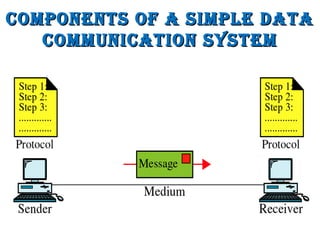
• A Data communication system is made up of 5
components:
1. Message
2. Sender
3. Receiver
4. Medium
5. Protocol
messagemessage
• The message is the information (data) to be
communicated. A message is transmitted from sender
to receiver.
• It can
 datafile
 an audio or video file
 or any text message
“A messagealso keepsinformation likesender and
destination addresses.”
senDersenDer
• It isalso called “source”.
• It is the device which generates the message and
responsiblefor itstransmission.
• It can bea
• computer
• Workstation
• telephonehandset
• video camera
• or any communication device.
reCeiverreCeiver
• It isalso called “destination/sink”.
• It isthedevicethat receivesthetransmitted message.
• It may bea
• computer
• Workstation
• telephonehandset
• Television
• or any communication device.
meDiummeDium
• The transmission medium is the physical path by
which a message travels from sender to receiver. It
may bea
• guided medium
 coaxial cable
 twisted pair cable
 fiber optic
• unguided medium
 electro-magnetic waves
 micro waves
 infrared waves
protoColprotoCol
• Protocolsarealso called languageof communication.
• A protocol isaset of rulesthat governsdatacommunication.
• Both sender & receiver must have the same protocol for
communication.
• It representsan agreement between thecommunicating devices.
• Without a protocol, two devices may be connected but not
communicating, just as a person speaking French cannot be
understood by aperson who speaksonly Japanese.
a Complex Data Comm.a Complex Data Comm.
systemsystem
Components of a DataComponents of a Data
CommuniCation systemCommuniCation system
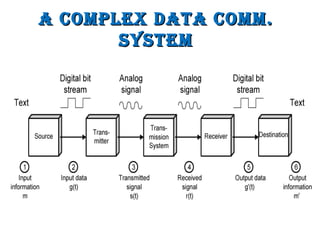
 Source
◦ generatesdatato betransmitted
 Transmitter
◦ Convertsdatainto transmittablesignals
 Transmission System
◦ Carriesdata
 Receiver
◦ Convertsreceived signal into data
 Destination
◦ Takesincoming data
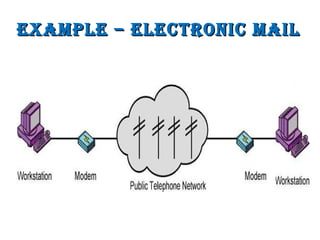
eXampLe – eLeCtroniC maiLeXampLe – eLeCtroniC maiL
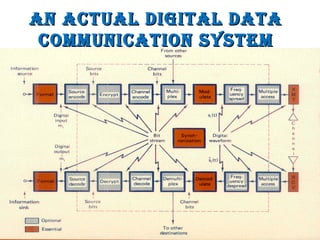
an aCtuaL DigitaL Dataan aCtuaL DigitaL Data
CommuniCation systemCommuniCation system
DataData
representationrepresentation
Data representationData representation
 Information today comesin different formssuch as;
1.Text
2.Numbers
3.Images
4.Audio
5.Video.
teXtteXt
• In data communications, text is represented as a bit pattern, a
sequence of bits (O’s or I’s).
• Different sets of bit patterns have been designed to represent
text symbols. Each set is called a code, and the process of
representing symbols is called coding.
• Today, the prevalent coding system is called Unicode, which
uses 32 bits to represent a symbol or character used in any
language in the world.
• The American Standard Code for Information Interchange
(ASCII), constitutes the first 127 characters in Unicode and is
also referred to as Basic Latin.
numbersnumbers
 Numbers are also represented by bit patterns. However, a code
such asASCII isnot used to represent numbers;
 The number is directly converted to a binary number to
simplify mathematical operations.
imagesimages
• Represented by bit patterns.
• Composed of amatrix of pixels(pictureelements).
• Pixel isasmall dot.
• The size of the pixel depends on the resolution. For example, an
imagecan bedivided into 1000 pixelsor 10,000 pixels.
• Better representation of theimage(better resolution), morememory
isneeded to storetheimage.
• After an image is divided into pixels, each pixel is assigned a bit
pattern.
• Thesizeand thevalueof thepattern depend on theimage.
• For an image made of only black and white dots (e.g., a
chessboard), aI-bit pattern isenough to represent apixel.
ImagesImages
• If an image is not made of pure white and pure black pixels, you
can increase the size of the bit pattern to include gray scale. For
example, to show four levels of gray scale, you can use 2-bit
patterns.
• A black pixel can be represented by 00, a dark gray pixel by 01, a
light gray pixel by 10, and awhitepixel by 11.
• Thereareseveral methodsto represent color images. Onemethod is
called RGB, so called because each color is made of a combination
of threeprimary colors: red, green, and blue.
• The intensity of each color is measured, and a bit pattern is
assigned to it. Another method is called YCM, in which a color is
made of a combination of three other primary colors: yellow, cyan,
and magenta.
audIoaudIo
 Audio refers to the recording or broadcasting of sound or
music.
 Audio is by nature different from text, numbers, or images. It is
continuous, not discrete.
 Even when we use a microphone to change voice or music to
an electric signal, wecreateacontinuoussignal.
VIdeoVIdeo
 Video refers to the recording or broadcasting of a picture or
movie.
 Video can either be produced as a continuous entity (e.g., by a
TV camera),
 or it can be a combination of images, each a discrete entity,
arranged to convey theideaof motion.
summarysummary
• DataCommunication
• DataCommunication System
• Factorseffecting DataCommunication system
• Componentsof datacommunication system
• DataRepresentation
suggested readIngsuggested readIng
• Section
• 1.1,
• “DataCommunicationsand Networking” 4th
Edition by Behrouz A.
Forouzan
• Sections
• 1.1,
• 1.2,
• “Dataand Computer Communication” 6th Edition by William Stallings

Dc lec-01 (intro to data com)

  • 1.
  • 2.
    COUrse OUTLINeCOUrse OUTLINe •Thecoursewill consist of :  32 lectures  5-10 assignments  4 exams(3 midterm and 1 final) • Grading Criteria:  Two Best Midterm:40%  Final Exam: 40%  Assignments: 20%
  • 3.
    TexTbOOkTexTbOOk • “Data Communicationsand Networking” 4th Edition by Behrouz A. Forouzan • “Data and Computer Communication” 6th Edition by William Stallings
  • 4.
    OvervIew Of LeCTUre1OvervIew Of LeCTUre 1 • DataCommunication • DataCommunication System • Factorseffecting DataCommunication system • Componentsof datacommunication system • DataRepresentation
  • 5.
    DATA COMMUNICATIONDATA COMMUNICATION “DataCommunicationistheexchangeof Data(in form of 0’sand 1’s) from one entity (eg. Computer) to theother using aTransmission Medium”
  • 6.
    DATA COMMUNICATION (CONT..)DATACOMMUNICATION (CONT..)  “Simply meanssharing of datalocally or remotely.”  LOCAL  communication usually occursfaceto face  Communicating devices are present in the same building or a similarly restricted geographical area.  REMOTE  remotecommunication takesplaceover distance.  Communicating devicesarepresent farther apart.  The term telecommunication, which includes telephony, telegraphy, and television, means communication at a distance (teleisGreek for "far").
  • 7.
    DATA COMMUNICATION sysTeMDATACOMMUNICATION sysTeM For DataCommunication to occur, communicating devicesmust beapart of a communication system madeup of a combination of hardware(physical equipment) and software(programs). Thissystem is known as “DATA COMMUNICATION SYSTEM”
  • 8.
    effeCTIveNess Of DATAeffeCTIveNessOf DATA COMM. sysTeMCOMM. sysTeM • Effectiveness depends upon four fundamental characteristics: – Delivery (to thespecific/ correct destination) – Accuracy (correctly/ accurately) – Timeliness (data delivered in a timely manner, without significant delay) – Jitter (uneven/variation delay in the delivery of audio or video packets) • For exampleapostal mail.
  • 9.
    Components of asimple DataComponents of a simple Data CommuniCation systemCommuniCation system
  • 10.
    Components of aDataComponents of a Data CommuniCation systemCommuniCation system • A Data communication system is made up of 5 components: 1. Message 2. Sender 3. Receiver 4. Medium 5. Protocol
  • 11.
    messagemessage • The messageis the information (data) to be communicated. A message is transmitted from sender to receiver. • It can  datafile  an audio or video file  or any text message “A messagealso keepsinformation likesender and destination addresses.”
  • 12.
    senDersenDer • It isalsocalled “source”. • It is the device which generates the message and responsiblefor itstransmission. • It can bea • computer • Workstation • telephonehandset • video camera • or any communication device.
  • 13.
    reCeiverreCeiver • It isalsocalled “destination/sink”. • It isthedevicethat receivesthetransmitted message. • It may bea • computer • Workstation • telephonehandset • Television • or any communication device.
  • 14.
    meDiummeDium • The transmissionmedium is the physical path by which a message travels from sender to receiver. It may bea • guided medium  coaxial cable  twisted pair cable  fiber optic • unguided medium  electro-magnetic waves  micro waves  infrared waves
  • 15.
    protoColprotoCol • Protocolsarealso calledlanguageof communication. • A protocol isaset of rulesthat governsdatacommunication. • Both sender & receiver must have the same protocol for communication. • It representsan agreement between thecommunicating devices. • Without a protocol, two devices may be connected but not communicating, just as a person speaking French cannot be understood by aperson who speaksonly Japanese.
  • 16.
    a Complex DataComm.a Complex Data Comm. systemsystem
  • 17.
    Components of aDataComponents of a Data CommuniCation systemCommuniCation system  Source ◦ generatesdatato betransmitted  Transmitter ◦ Convertsdatainto transmittablesignals  Transmission System ◦ Carriesdata  Receiver ◦ Convertsreceived signal into data  Destination ◦ Takesincoming data
  • 18.
    eXampLe – eLeCtroniCmaiLeXampLe – eLeCtroniC maiL
  • 19.
    an aCtuaL DigitaLDataan aCtuaL DigitaL Data CommuniCation systemCommuniCation system
  • 20.
  • 21.
    Data representationData representation Information today comesin different formssuch as; 1.Text 2.Numbers 3.Images 4.Audio 5.Video.
  • 22.
    teXtteXt • In datacommunications, text is represented as a bit pattern, a sequence of bits (O’s or I’s). • Different sets of bit patterns have been designed to represent text symbols. Each set is called a code, and the process of representing symbols is called coding. • Today, the prevalent coding system is called Unicode, which uses 32 bits to represent a symbol or character used in any language in the world. • The American Standard Code for Information Interchange (ASCII), constitutes the first 127 characters in Unicode and is also referred to as Basic Latin.
  • 23.
    numbersnumbers  Numbers arealso represented by bit patterns. However, a code such asASCII isnot used to represent numbers;  The number is directly converted to a binary number to simplify mathematical operations.
  • 24.
    imagesimages • Represented bybit patterns. • Composed of amatrix of pixels(pictureelements). • Pixel isasmall dot. • The size of the pixel depends on the resolution. For example, an imagecan bedivided into 1000 pixelsor 10,000 pixels. • Better representation of theimage(better resolution), morememory isneeded to storetheimage. • After an image is divided into pixels, each pixel is assigned a bit pattern. • Thesizeand thevalueof thepattern depend on theimage. • For an image made of only black and white dots (e.g., a chessboard), aI-bit pattern isenough to represent apixel.
  • 25.
    ImagesImages • If animage is not made of pure white and pure black pixels, you can increase the size of the bit pattern to include gray scale. For example, to show four levels of gray scale, you can use 2-bit patterns. • A black pixel can be represented by 00, a dark gray pixel by 01, a light gray pixel by 10, and awhitepixel by 11. • Thereareseveral methodsto represent color images. Onemethod is called RGB, so called because each color is made of a combination of threeprimary colors: red, green, and blue. • The intensity of each color is measured, and a bit pattern is assigned to it. Another method is called YCM, in which a color is made of a combination of three other primary colors: yellow, cyan, and magenta.
  • 26.
    audIoaudIo  Audio refersto the recording or broadcasting of sound or music.  Audio is by nature different from text, numbers, or images. It is continuous, not discrete.  Even when we use a microphone to change voice or music to an electric signal, wecreateacontinuoussignal.
  • 27.
    VIdeoVIdeo  Video refersto the recording or broadcasting of a picture or movie.  Video can either be produced as a continuous entity (e.g., by a TV camera),  or it can be a combination of images, each a discrete entity, arranged to convey theideaof motion.
  • 28.
    summarysummary • DataCommunication • DataCommunicationSystem • Factorseffecting DataCommunication system • Componentsof datacommunication system • DataRepresentation
  • 29.
    suggested readIngsuggested readIng •Section • 1.1, • “DataCommunicationsand Networking” 4th Edition by Behrouz A. Forouzan • Sections • 1.1, • 1.2, • “Dataand Computer Communication” 6th Edition by William Stallings