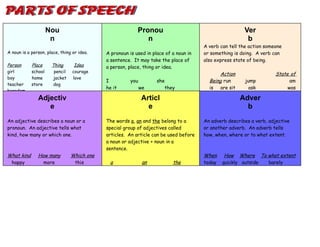
Nou
n
A noun is a person, place, thing or idea.
Person Place Thing Idea
girl school pencil courage
boy home jacket love
teacher store dog
boredom
Pronou
n
A pronoun is used in place of a noun in
a sentence. It may take the place of
a person, place, thing or idea.
I you she
he it we they
Ver
b
A verb can tell the action someone
or something is doing. A verb can
also express state of being.
Action State of
Being run jump am
is are sit ask was
were think talk
Adjectiv
e
An adjective describes a noun or a
pronoun. An adjective tells what
kind, how many or which one.
What kind How many Which one
happy more this
Articl
e
The words a, an and the belong to a
special group of adjectives called
articles. An article can be used before
a noun or adjective + noun in a
sentence.
a an the
Adver
b
An adverb describes a verb, adjective
or another adverb. An adverb tells
how, when, where or to what extent.
When How Where To what extent
today quickly outside barely
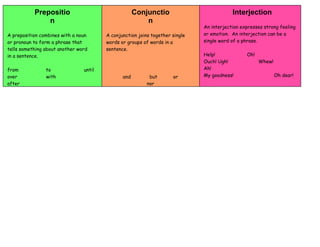
Prepositio
n
A preposition combines with a noun
or pronoun to form a phrase that
tells something about another word
in a sentence.
from to until
over with
after
Conjunctio
n
A conjunction joins together single
words or groups of words in a
sentence.
and but or
nor
Interjection
An interjection expresses strong feeling
or emotion. An interjection can be a
single word of a phrase.
Help! Oh!
Ouch! Ugh! Whew!
Ah!
My goodness! Oh dear!

Parts of Speech

  • 1.
    Nou n A noun isa person, place, thing or idea. Person Place Thing Idea girl school pencil courage boy home jacket love teacher store dog boredom Pronou n A pronoun is used in place of a noun in a sentence. It may take the place of a person, place, thing or idea. I you she he it we they Ver b A verb can tell the action someone or something is doing. A verb can also express state of being. Action State of Being run jump am is are sit ask was were think talk Adjectiv e An adjective describes a noun or a pronoun. An adjective tells what kind, how many or which one. What kind How many Which one happy more this Articl e The words a, an and the belong to a special group of adjectives called articles. An article can be used before a noun or adjective + noun in a sentence. a an the Adver b An adverb describes a verb, adjective or another adverb. An adverb tells how, when, where or to what extent. When How Where To what extent today quickly outside barely
  • 2.
    Prepositio n A preposition combineswith a noun or pronoun to form a phrase that tells something about another word in a sentence. from to until over with after Conjunctio n A conjunction joins together single words or groups of words in a sentence. and but or nor Interjection An interjection expresses strong feeling or emotion. An interjection can be a single word of a phrase. Help! Oh! Ouch! Ugh! Whew! Ah! My goodness! Oh dear!