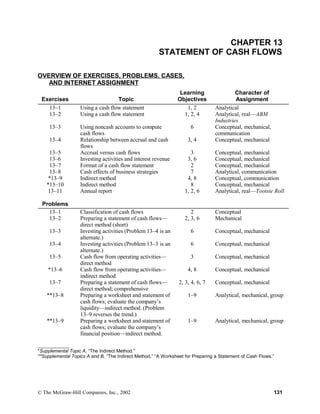
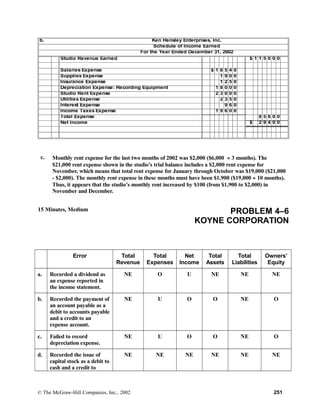
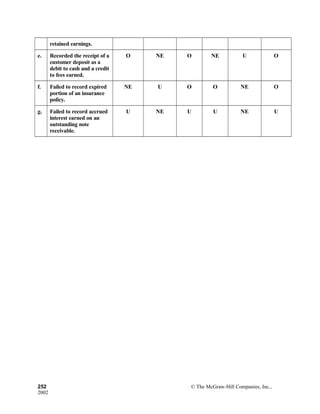
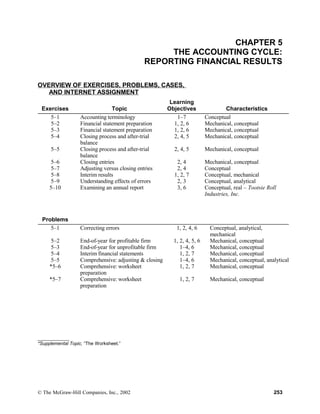
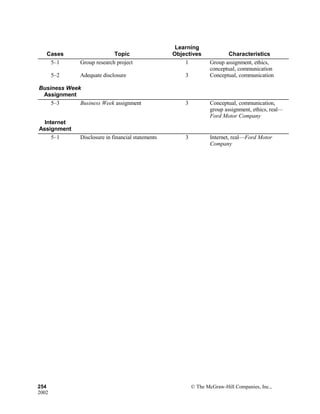
CHAPTER 9
PLANT AND INTANGIBLE ASSETS
OVERVIEW OF EXERCISES, PROBLEMS, CASES,
AND INTERNET ASSIGNMENT
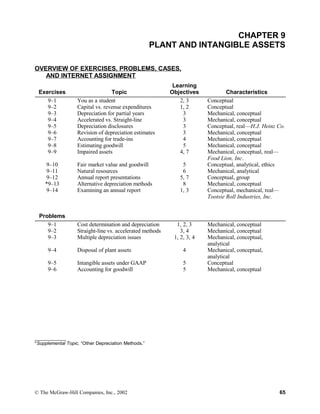
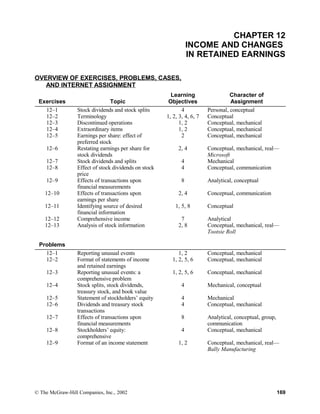
Exercises Topic
Learning
Objectives Characteristics
9–1 You as a student 2, 3 Conceptual
9–2 Capital vs. revenue expenditures 1, 2 Conceptual
9–3 Depreciation for partial years 3 Mechanical, conceptual
9–4 Accelerated vs. Straight-line 3 Mechanical, conceptual
9–5 Depreciation disclosures 3 Conceptual, real—H.J. Heinz Co.
9–6 Revision of depreciation estimates 3 Mechanical, conceptual
9–7 Accounting for trade-ins 4 Mechanical, conceptual
9–8 Estimating goodwill 5 Mechanical, conceptual
9–9 Impaired assets 4, 7 Mechanical, conceptual, real—
Food Lion, Inc.
9–10 Fair market value and goodwill 5 Conceptual, analytical, ethics
9–11 Natural resources 6 Mechanical, analytical
9–12 Annual report presentations 5, 7 Conceptual, group
*9–13 Alternative depreciation methods 8 Mechanical, conceptual
9–14 Examining an annual report 1, 3 Conceptual, mechanical, real—
Tootsie Roll Industries, Inc.
Problems
9–1 Cost determination and depreciation 1, 2, 3 Mechanical, conceptual
9–2 Straight-line vs. accelerated methods 3, 4 Mechanical, conceptual
9–3 Multiple depreciation issues 1, 2, 3, 4 Mechanical, conceptual,
analytical
9–4 Disposal of plant assets 4 Mechanical, conceptual,
analytical
9–5 Intangible assets under GAAP 5 Conceptual
9–6 Accounting for goodwill 5 Mechanical, conceptual
____________
*Supplemental Topic, “Other Depreciation Methods.”
© The McGraw-Hill Companies, Inc., 2002 65
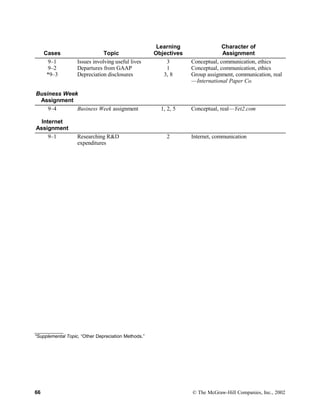
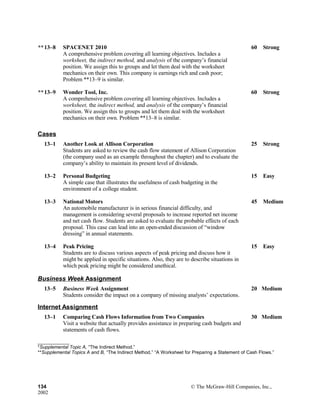
Cases Topic
Learning
Objectives
Character of
Assignment
9–1 Issues involving useful lives 3 Conceptual, communication, ethics
9–2 Departures from GAAP 1 Conceptual, communication, ethics
*9–3 Depreciation disclosures 3, 8 Group assignment, communication, real
—International Paper Co.
Business Week
Assignment
9–4 Business Week assignment 1, 2, 5 Conceptual, real—Yet2.com
Internet
Assignment
9–1 Researching R&D
expenditures
2 Internet, communication
___________
*Supplemental Topic, “Other Depreciation Methods.”
66 © The McGraw-Hill Companies, Inc., 2002
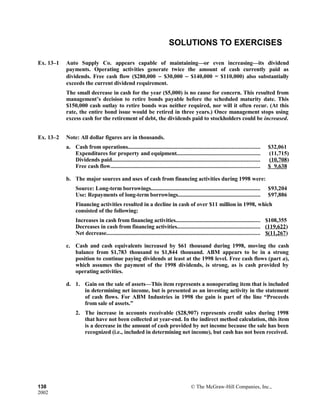
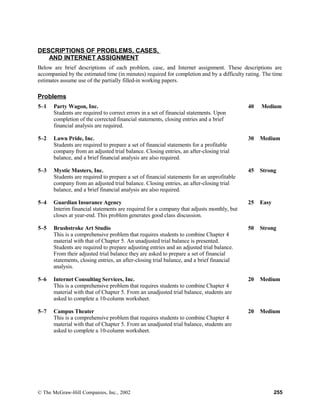
DESCRIPTIONS OF PROBLEMS, CASES,
AND INTERNET ASSIGNMENT
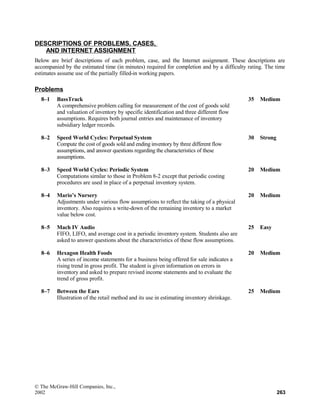
Below are brief descriptions of each problem, case, and the Internet assignment. These descriptions are
accompanied by the estimated time (in minutes) required for completion and by a difficulty rating. The time
estimates assume use of the partially filled-in working papers.
Problems
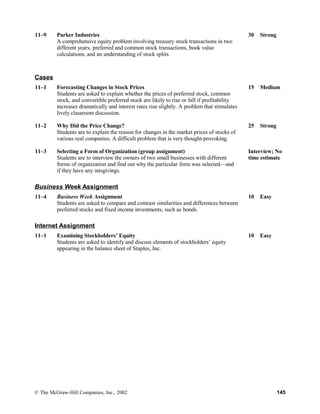
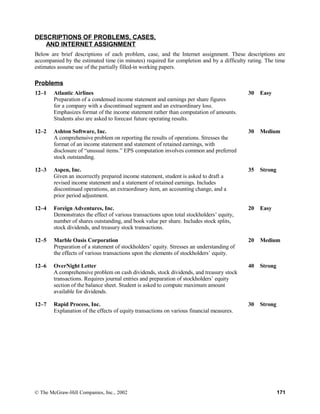
9–1 Prescott College
Students are required to distinguish between capital and revenue expenditures
and compute depreciation expense.
25 Easy 
9–2 Miller & Hiller, Inc.
Students must prepare depreciation schedules using both straight-line and
accelerated methods. They must also evaluate income and cash flow issues as
they relate to depreciation and the disposal of assets.
45 Medium 
9–3 Cole’s Hardware
After determining the cost of a depreciable asset, students are required to
prepare depreciation schedules under straight-line and accelerated methods.
They must also (1) discuss the use of straight-line for financial purposes and
accelerated depreciation for income taxes, (2) interpret the meaning of an
asset’s book value, and (3) compute the gain or loss resulting from the disposal
of a depreciable asset.
50 Strong 
9–4 Escola Developers
Numerous asset disposal transactions are presented for which students must
compute appropriate gains or losses. In addition, students are asked to discuss
how gains and losses on the disposal of plant assets are reported in the income
statement, and how the reporting of realized gains and losses differs from the
reporting of unrealized gains and losses as illustrated in Chapter 7.
25 Medium 
9–5 King Carpet
Various transactions must be evaluated in order to determine which result in the
recording of an intangible asset and which are treated as expenses of the current
period.
25 Medium 
9–6 Kivi Service Stations
Students are asked to compute estimated goodwill using an earnings multiplier
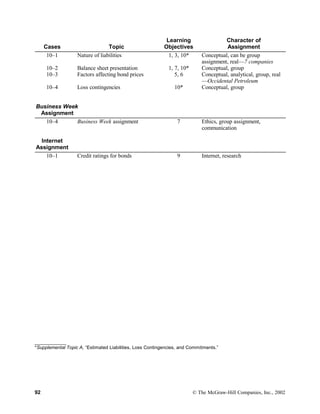
approach and a capitalization of excess earnings approach. In addition, they
must distinguish between the accounting treatment of purchased goodwill
versus the accounting treatment of internally generated goodwill.
20 Medium 
© The McGraw-Hill Companies, Inc., 2002 67
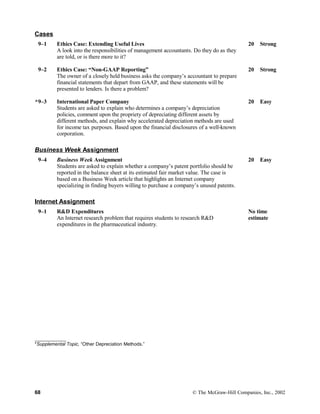
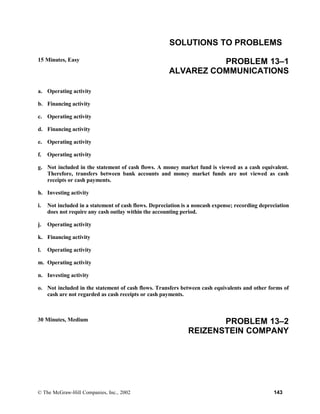
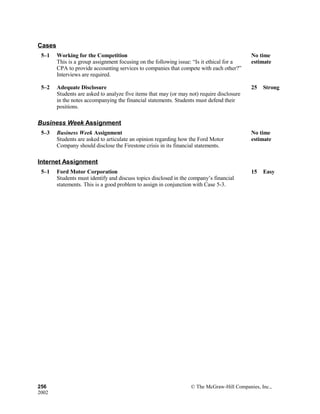
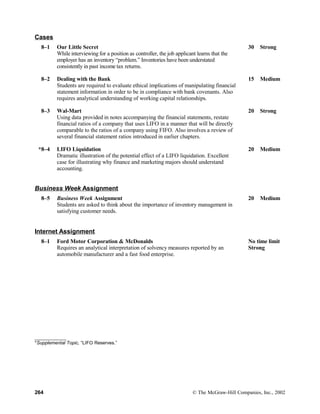
Cases
9–1 Ethics Case: Extending Useful Lives
A look into the responsibilities of management accountants. Do they do as they
are told, or is there more to it?
20 Strong 
9–2 Ethics Case: “Non-GAAP Reporting”
The owner of a closely held business asks the company’s accountant to prepare
financial statements that depart from GAAP, and these statements will be
presented to lenders. Is there a problem?
20 Strong 
*9–3 International Paper Company
Students are asked to explain who determines a company’s depreciation
policies, comment upon the propriety of depreciating different assets by
different methods, and explain why accelerated depreciation methods are used
for income tax purposes. Based upon the financial disclosures of a well-known
corporation.
20 Easy 
Business Week Assignment
9–4 Business Week Assignment
Students are asked to explain whether a company’s patent portfolio should be
reported in the balance sheet at its estimated fair market value. The case is
based on a Business Week article that highlights an Internet company
specializing in finding buyers willing to purchase a company’s unused patents.
20 Easy 
Internet Assignment
9–1 R&D Expenditures
An Internet research problem that requires students to research R&D
expenditures in the pharmaceutical industry.
No time
estimate
____________
*Supplemental Topic, “Other Depreciation Methods.”
68 © The McGraw-Hill Companies, Inc., 2002
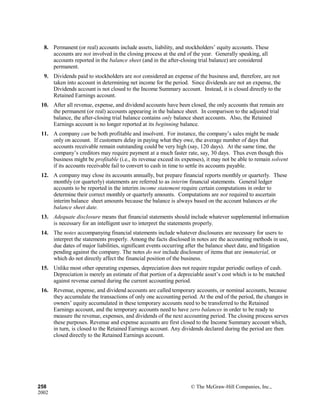
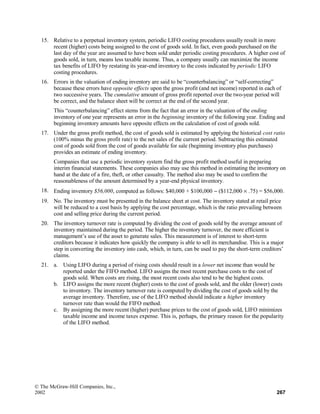
SUGGESTED ANSWERS TO DISCUSSION QUESTIONS
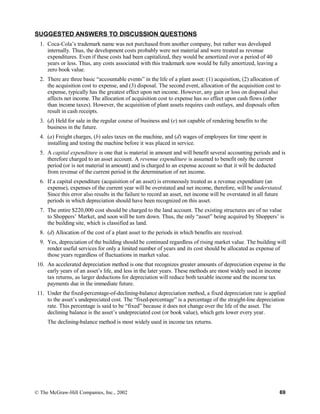
1. Coca-Cola’s trademark name was not purchased from another company, but rather was developed
internally. Thus, the development costs probably were not material and were treated as revenue
expenditures. Even if these costs had been capitalized, they would be amortized over a period of 40
years or less. Thus, any costs associated with this trademark now would be fully amortized, leaving a
zero book value.
2. There are three basic “accountable events” in the life of a plant asset: (1) acquisition, (2) allocation of
the acquisition cost to expense, and (3) disposal. The second event, allocation of the acquisition cost to
expense, typically has the greatest effect upon net income. However, any gain or loss on disposal also
affects net income. The allocation of acquisition cost to expense has no effect upon cash flows (other
than income taxes). However, the acquisition of plant assets requires cash outlays, and disposals often
result in cash receipts.
3. (d) Held for sale in the regular course of business and (e) not capable of rendering benefits to the
business in the future.
4. (a) Freight charges, (b) sales taxes on the machine, and (d) wages of employees for time spent in
installing and testing the machine before it was placed in service.
5. A capital expenditure is one that is material in amount and will benefit several accounting periods and is
therefore charged to an asset account. A revenue expenditure is assumed to benefit only the current
period (or is not material in amount) and is charged to an expense account so that it will be deducted
from revenue of the current period in the determination of net income.
6. If a capital expenditure (acquisition of an asset) is erroneously treated as a revenue expenditure (an
expense), expenses of the current year will be overstated and net income, therefore, will be understated.
Since this error also results in the failure to record an asset, net income will be overstated in all future
periods in which depreciation should have been recognized on this asset.
7. The entire $220,000 cost should be charged to the land account. The existing structures are of no value
to Shoppers’ Market, and soon will be torn down. Thus, the only “asset” being acquired by Shoppers’ is
the building site, which is classified as land.
8. (d) Allocation of the cost of a plant asset to the periods in which benefits are received.
9. Yes, depreciation of the building should be continued regardless of rising market value. The building will
render useful services for only a limited number of years and its cost should be allocated as expense of
those years regardless of fluctuations in market value.
10. An accelerated depreciation method is one that recognizes greater amounts of depreciation expense in the
early years of an asset’s life, and less in the later years. These methods are most widely used in income
tax returns, as larger deductions for depreciation will reduce both taxable income and the income tax
payments due in the immediate future.
11. Under the fixed-percentage-of-declining-balance depreciation method, a fixed depreciation rate is applied
to the asset’s undepreciated cost. The “fixed-percentage” is a percentage of the straight-line depreciation
rate. This percentage is said to be “fixed” because it does not change over the life of the asset. The
declining balance is the asset’s undepreciated cost (or book value), which gets lower every year.
The declining-balance method is most widely used in income tax returns.
© The McGraw-Hill Companies, Inc., 2002 69
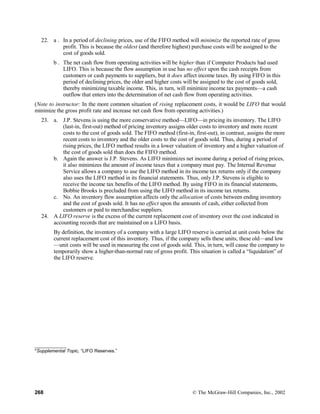
12. Most companies use only the straight-line method of depreciation in their financial statements. However,
these companies also may compute depreciation by several other methods for income tax purposes. For
example, they may use MACRS depreciation in their federal income tax returns, and various forms of
the declining-balance method in their state income tax returns.
13. The balance of the Accumulated Depreciation account does not consist of cash. It is an account with a
credit balance showing how much of the original cost of the plant assets now owned has been written off
as depreciation expense. Cash is required to pay for new assets, and the cash owned by the company is
shown by the asset account Cash.
14. Two widely used approaches to computing depreciation for a fraction of a year are (1) to round the
computation to the nearest full month and (2) the half-year convention, which takes six months of
depreciation on all assets (of a given type) acquired during the year. (The half-year convention also
requires that six months’ depreciation be recorded in the last year of the asset’s life or year of disposal.)
15. a. No; a company may use different depreciation methods for different assets. The principle of
consistency means only that once depreciation begins on a given asset, the same method should be
applied throughout its useful life.
b. Yes; a corporation may use different depreciation methods in its financial statements and its income
tax returns. In fact, most corporations use straight-line depreciation in their financial statements and
a variety of accelerated depreciation methods in their tax returns.
16. The usual method of revising depreciation rates to reflect a changed estimate of useful life is to spread
the undepreciated cost over the years of remaining useful life. This results in raising or lowering the
annual depreciation charge. In this case, the undepreciated cost is $9,000, that is, cost of $15,000 less
accumulated depreciation of $6,000. The revised estimate calls for 8 more years of use, so the new
depreciation charge will be $9,000 ÷ 8, or $1,125. This method is acceptable for income tax purposes. It
also has the theoretical merit of ensuring that depreciation expense as shown in the income statements
over the life of the asset will equal the total depreciable cost of the asset.
17. Intangible assets are a subcategory of plant assets which are lacking in physical substance and are
noncurrent. An account receivable of the type described is clearly a current asset and hence excluded on
that ground from qualifying as an intangible asset even though it is lacking in physical substance.
18. The cost of each type of intangible asset should be amortized over the period estimated to be benefited.
This period, however, is not to exceed 40 years. The straight-line method is generally used for the
amortization of intangible assets.
19. Goodwill is recorded in the accounts only when purchased. The most common example is that of an
ongoing business being purchased as an entity by new owners. If the purchase price is in excess of a fair
value of the net identifiable assets of the business, the transaction provides objective evidence that
goodwill exists and also provides a basis for objective valuation of this asset.
20. Since average annual earnings of $50,000 represent a return of only 5% on the net tangible assets of $1
million, the goodwill appears to be unsupported by operating performance. Goodwill is defined as the
present value of expected excess future earnings, and Digital Products Company appears to have
substandard earnings rather than excess earning power. The financial statements therefore give the
impression of overstated assets and owners’ equity. Elimination of the item of goodwill would appear to
be called for.
70 © The McGraw-Hill Companies, Inc., 2002
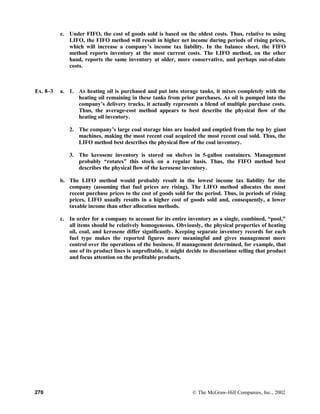
21. Depletion in the amount of $10,000,000 should be deducted from revenue in the current year. The other
$2,000,000 of depletion applicable to the current year’s operations will be included in the valuation of
the ending inventory. Depletion is a cost of producing inventory. Costs assigned to inventory represent
current assets until the goods are sold, at which time the costs are transferred to the Cost of Goods Sold
account.
22. An asset is “impaired” when the owner cannot recover the undepreciated cost either through use or sale.
In such situations, the carrying value of the asset should be reduced (written down) to net realizable
value, which results in the recognition of a loss.
23. The owner of March Metals is in error. When the company discontinued use of the trademark, the
unamortized cost of this asset should have been written off immediately. A trademark or other intangible
should not be carried as an asset after its usefulness has ended. The 40-year amortization period referred
to in the question is the maximum period for amortizing an intangible asset. There is no minimum period
of amortization.
© The McGraw-Hill Companies, Inc., 2002 71
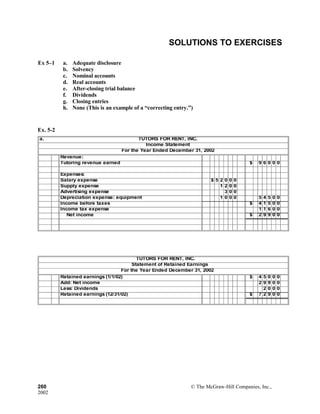
SOLUTIONS TO EXERCISES
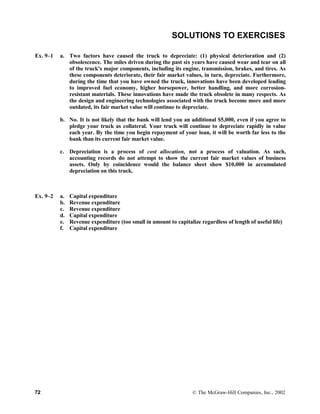
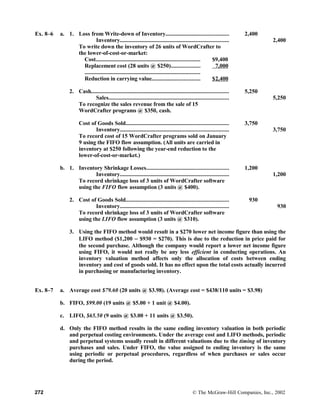
Ex. 9–1 a. Two factors have caused the truck to depreciate: (1) physical deterioration and (2)
obsolescence. The miles driven during the past six years have caused wear and tear on all
of the truck’s major components, including its engine, transmission, brakes, and tires. As
these components deteriorate, their fair market values, in turn, depreciate. Furthermore,
during the time that you have owned the truck, innovations have been developed leading
to improved fuel economy, higher horsepower, better handling, and more corrosion-
resistant materials. These innovations have made the truck obsolete in many respects. As
the design and engineering technologies associated with the truck become more and more
outdated, its fair market value will continue to depreciate.
b. No. It is not likely that the bank will lend you an additional $5,000, even if you agree to
pledge your truck as collateral. Your truck will continue to depreciate rapidly in value
each year. By the time you begin repayment of your loan, it will be worth far less to the
bank than its current fair market value.
c. Depreciation is a process of cost allocation, not a process of valuation. As such,
accounting records do not attempt to show the current fair market values of business
assets. Only by coincidence would the balance sheet show $10,000 in accumulated
depreciation on this truck.
Ex. 9–2 a. Capital expenditure
b. Revenue expenditure
c. Revenue expenditure
d. Capital expenditure
e. Revenue expenditure (too small in amount to capitalize regardless of length of useful life)
f. Capital expenditure
72 © The McGraw-Hill Companies, Inc., 2002
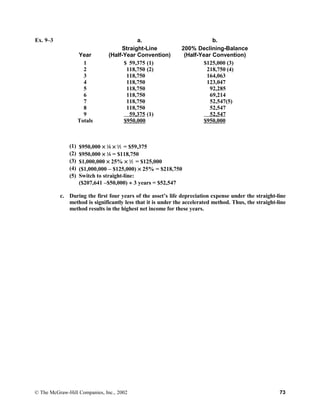
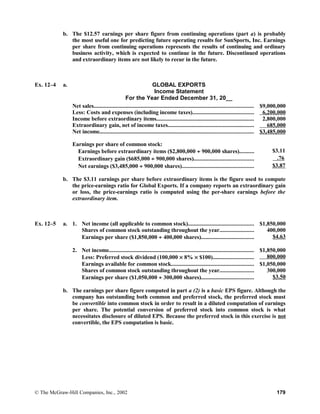
Ex. 9–3
Year
a.
Straight-Line
(Half-Year Convention)
b.
200% Declining-Balance
(Half-Year Convention)
1
2
3
4
5
6
7
8
9
Totals
$ 59,375 (1)
118,750 (2)
118,750
118,750
118,750
118,750
118,750
118,750
59,375 (1)
$950,000
$125,000 (3)
218,750 (4)
164,063
123,047
92,285
69,214
52,547(5)
52,547
52,547
$950,000
(1) $950,000 × 1
⁄8 × 1
⁄2 = $59,375
(2) $950,000 × 1
⁄8 = $118,750
(3) $1,000,000 × 25% × 1
⁄2 = $125,000
(4) ($1,000,000 – $125,000) × 25% = $218,750
(5) Switch to straight-line:
($207,641 –$50,000) ÷ 3 years = $52,547
c. During the first four years of the asset’s life depreciation expense under the straight-line
method is significantly less that it is under the accelerated method. Thus, the straight-line
method results in the highest net income for these years.
© The McGraw-Hill Companies, Inc., 2002 73
Ex. 9–4
a. (1) Straight-Line Schedule
Year Computation
Depreciation
Expense
Accumulated
Depreciation
Book
Value
1 $35,000× 1
⁄5 $7,000 $ 7,000 $33,000
2 35,000× 1
⁄5 7,000 14,000 26,000
3 35,000× 1
⁄5 7,000 21,000 19,000
4 35,000× 1
⁄5 7,000 28,000 12,000
5 35,000× 1
⁄5 7,000 35,000 5,000
(2) 200% Declining-Balance Schedule
Year Computation
Depreciation
Expense
Accumulated
Depreciation
Book
Value
1 $40,000× 40% $16,000 $16,000 $24,000
2 24,000× 40% 9,600 25,600 14,400
3 14,400× 40% 5,760 31,360 8,640
4 8,640× 40% 3,456 34,816 5,184
5 $5,184 – $5,000 184 35,000 5,000
(3) 150% Declining-Balance Schedule
Year Computation
Depreciation
Expense
Accumulated
Depreciation
Book
Value
1 $40,000× 30% $12,000 $12,000 $28,000
2 28,000× 30% 8,400 20,400 19,600
3 19,600 × 30% 5,880 26,280 13,720
4* ($13,720 – $5,000) ÷ 2 yrs. 4,360 30,640 9,360
5* ($13,720 – $5,000) ÷ 2 yrs. 4,360 35,000 5,000
* Switch to straight-line
b. Both accelerated methods result in a higher depreciation expense than the straight-line
method in the first two years of the asset’s life. This pattern reverses in years 3 through 5.
After four years, 99% of the asset’s total depreciation expense has been recorded under
the 200% declining-balance method, as compared to only 88% under the 150%
declining-balance method.
74 © The McGraw-Hill Companies, Inc., 2002
Ex. 9–5 a. No, the use of different depreciation methods in financial statements and in income tax
returns does not violate the accounting principle of consistency. The principle of
consistency means only that a company should not change from year to year the method
used to depreciate a given asset. This principle does not prohibit using a different
depreciation method for income tax purposes. Also, the principle does not prevent
management from using different depreciation methods to depreciate different assets.
b. The company probably uses accelerated depreciation methods for income tax purposes
because these methods postpone the payment of income taxes. Accelerated depreciation
methods transfer the cost of plant assets to expense more quickly than does the straight-
line method. The resulting larger charges to depreciation expense reduce “taxable
income” in the current period and, therefore, reduce the amount of income taxes due
currently.
c. Use of accelerated depreciation methods in the financial statements would be more
“conservative” than the current practice of straight-line depreciation. Accelerated
methods more quickly transfer the costs of plant assets to expense. Thus, in the immediate
future, accelerated depreciation methods produce more conservative (lower) balance
sheet valuations of plant assets and more conservative (lower) measurements of net
income.
© The McGraw-Hill Companies, Inc., 2002 75
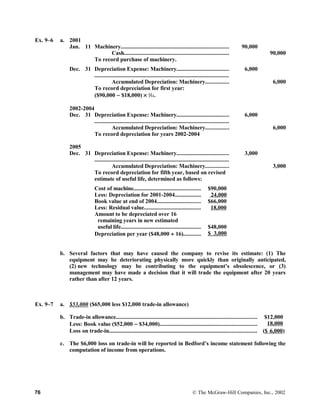
Ex. 9–6 a. 2001
Jan. 11 Machinery.......................................................................... 90,000
Cash........................................................................ 90,000
To record purchase of machinery.
Dec. 31 Depreciation Expense: Machinery....................................
............................................................................................
6,000
Accumulated Depreciation: Machinery................ 6,000
To record depreciation for first year:
($90,000 − $18,000) × 1
⁄12.
2002-2004
Dec. 31 Depreciation Expense: Machinery....................................
............................................................................................
6,000
Accumulated Depreciation: Machinery................ 6,000
To record depreciation for years 2002-2004
2005
Dec. 31 Depreciation Expense: Machinery....................................
............................................................................................
3,000
Accumulated Depreciation: Machinery................ 3,000
To record depreciation for fifth year, based on revised
estimate of useful life, determined as follows:
Cost of machine.............................................. $90,000
Less: Depreciation for 2001-2004.................. 24,000
Book value at end of 2004.............................. $66,000
Less: Residual value....................................... 18,000
Amount to be depreciated over 16
remaining years in new estimated
useful life....................................................... $48,000
Depreciation per year ($48,000 ÷ 16)............ $ 3,000
b. Several factors that may have caused the company to revise its estimate: (1) The
equipment may be deteriorating physically more quickly than originally anticipated,
(2) new technology may be contributing to the equipment’s obsolescence, or (3)
management may have made a decision that it will trade the equipment after 20 years
rather than after 12 years.
Ex. 9–7 a. $53,000 ($65,000 less $12,000 trade-in allowance)
b. Trade-in allowance................................................................................................ $12,000
Less: Book value ($52,000 − $34,000).................................................................. 18,000
Loss on trade-in..................................................................................................... ($ 6,000)
c. The $6,000 loss on trade-in will be reported in Bedford’s income statement following the
computation of income from operations.
76 © The McGraw-Hill Companies, Inc., 2002
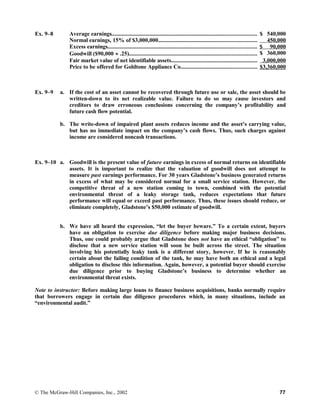
Ex. 9–8 Average earnings................................................................................................... $ 540,000
Normal earnings, 15% of $3,000,000................................................................... 450,000
Excess earnings...................................................................................................... $ 90,000
Goodwill ($90,000 ÷ .25)....................................................................................... $ 360,000
Fair market value of net identifiable assets........................................................... 3,000,000
Price to be offered for Goldtone Appliance Co.................................................... $3,360,000
Ex. 9–9 a. If the cost of an asset cannot be recovered through future use or sale, the asset should be
written-down to its net realizable value. Failure to do so may cause investors and
creditors to draw erroneous conclusions concerning the company’s profitability and
future cash flow potential.
b. The write-down of impaired plant assets reduces income and the asset’s carrying value,
but has no immediate impact on the company’s cash flows. Thus, such charges against
income are considered noncash transactions.
Ex. 9–10 a. Goodwill is the present value of future earnings in excess of normal returns on identifiable
assets. It is important to realize that the valuation of goodwill does not attempt to
measure past earnings performance. For 30 years Gladstone’s business generated returns
in excess of what may be considered normal for a small service station. However, the
competitive threat of a new station coming to town, combined with the potential
environmental threat of a leaky storage tank, reduces expectations that future
performance will equal or exceed past performance. Thus, these issues should reduce, or
eliminate completely, Gladstone’s $50,000 estimate of goodwill.
b. We have all heard the expression, “let the buyer beware.” To a certain extent, buyers
have an obligation to exercise due diligence before making major business decisions.
Thus, one could probably argue that Gladstone does not have an ethical “obligation” to
disclose that a new service station will soon be built across the street. The situation
involving his potentially leaky tank is a different story, however. If he is reasonably
certain about the failing condition of the tank, he may have both an ethical and a legal
obligation to disclose this information. Again, however, a potential buyer should exercise
due diligence prior to buying Gladstone’s business to determine whether an
environmental threat exists.
Note to instructor: Before making large loans to finance business acquisitions, banks normally require
that borrowers engage in certain due diligence procedures which, in many situations, include an
“environmental audit.”
© The McGraw-Hill Companies, Inc., 2002 77
Ex. 9–11 a. Inventory.................................................................................... 400,000
Accumulated Depletion: Northern Tier Mine............... 400,000
To record depletion on the Northern Tier Mine: 50,000 tons
mined × $8 per ton [($21,000,000 − $1,000,000) ÷ 2,500,000
tons = $8 per ton].
b. Property, plant, & equipment:
Mining property: Northern Tier Mine................................. $21,000,000
Less: Accumulated depletion................................................. 400,000 $20,600,000
c. No; the $400,000 of depletion of the mine should not all be deducted from revenue during
the first year of operations. Since only 40,000 of the 50,000 tons of ore mined were sold,
only 80% of the depletion cost ($320,000) should be deducted from revenue as part of the
cost of goods sold. The remaining 20% of this amount ($80,000) relates to the 10,000 tons
of ore still on hand and remains in the inventory account.
d. The journal entry in part a increases the current ratio, because it reclassifies an amount
of plant assets as inventory, which is a current asset. Thus, current assets are increased.
Extracting ore from the ground does make the company more liquid. Mined ore is a more
liquid asset than ore that is still in the ground.
Ex. 9–12 The purpose of this exercise is to: (1) show students that gains and losses on disposals can be
very material in amount, (2) demonstrate that such gains and losses do not directly involve
cash flows and, therefore, are typically shown as adjustments to income in the statement of
cash flows, and (3) illustrate that the reasons for disposing of fixed assets may include
restructuring activities, damage caused by natural disasters, the need to upgrade
manufacturing processes, etc.
Ex. 9–13 a. $13,000 − $4,000 $9,000
= $0.18 per mile50,000 miles = 50,000 miles
b. 1,650,000 miles × $0.18 per mile = $297,000
c. Yes. The units-of-output method recognizes more depreciation in periods in which the
cars are driven more—which means that the cars are generating more revenue. The
straight-line method would recognize the same amount of depreciation expense regardless
of how much the automobiles were used (driven).
78 © The McGraw-Hill Companies, Inc., 2002
Ex. 9–14 a. The company uses both straight-line and accelerated methods to compute depreciation
expense for financial reporting purposes.
b. The company uses accelerated methods for income tax purposes.
c. The following information was taken from the notes to the company’s consolidated
financial statements:
“Intangible assets represent the excess of cost over the acquired net tangible assets of
operating companies and is amortized on a straight-line basis over a 40-year period.
Based on this information, one may conclude that the company’s primary intangible asset
is goodwill.
© The McGraw-Hill Companies, Inc., 2002 79
SOLUTIONS TO PROBLEMS
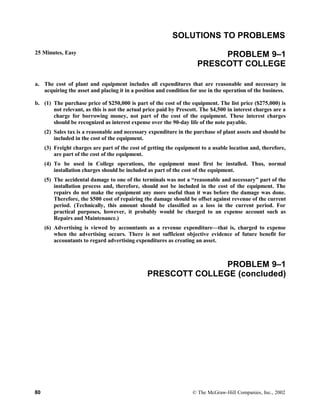
25 Minutes, Easy PROBLEM 9–1
PRESCOTT COLLEGE
a. The cost of plant and equipment includes all expenditures that are reasonable and necessary in
acquiring the asset and placing it in a position and condition for use in the operation of the business.
b. (1) The purchase price of $250,000 is part of the cost of the equipment. The list price ($275,000) is
not relevant, as this is not the actual price paid by Prescott. The $4,500 in interest charges are a
charge for borrowing money, not part of the cost of the equipment. These interest charges
should be recognized as interest expense over the 90-day life of the note payable.
(2) Sales tax is a reasonable and necessary expenditure in the purchase of plant assets and should be
included in the cost of the equipment.
(3) Freight charges are part of the cost of getting the equipment to a usable location and, therefore,
are part of the cost of the equipment.
(4) To be used in College operations, the equipment must first be installed. Thus, normal
installation charges should be included as part of the cost of the equipment.
(5) The accidental damage to one of the terminals was not a “reasonable and necessary” part of the
installation process and, therefore, should not be included in the cost of the equipment. The
repairs do not make the equipment any more useful than it was before the damage was done.
Therefore, the $500 cost of repairing the damage should be offset against revenue of the current
period. (Technically, this amount should be classified as a loss in the current period. For
practical purposes, however, it probably would be charged to an expense account such as
Repairs and Maintenance.)
(6) Advertising is viewed by accountants as a revenue expenditure—that is, charged to expense
when the advertising occurs. There is not sufficient objective evidence of future benefit for
accountants to regard advertising expenditures as creating an asset.
PROBLEM 9–1
PRESCOTT COLLEGE (concluded)
80 © The McGraw-Hill Companies, Inc., 2002
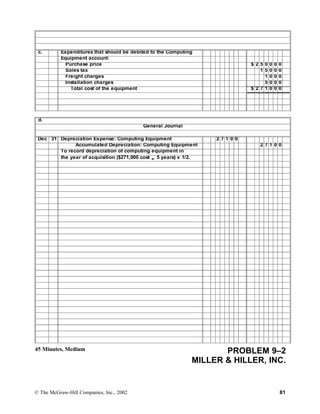
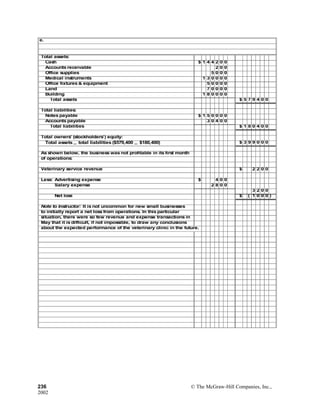
c. Expenditures that should be debited to the Computing
Equipment account:
Purchase price $ 2 5 0 0 0 0
Sales tax 1 5 0 0 0
Freight charges 1 0 0 0
Installation charges 5 0 0 0
Total cost of the equipment $ 2 7 1 0 0 0
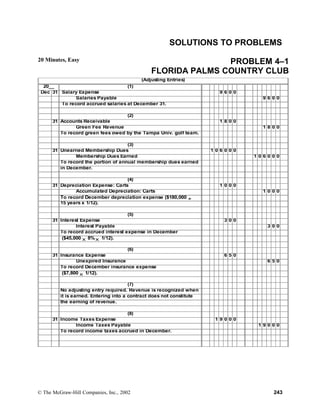
d.
General Journal
Dec 31 Depreciation Expense: Computing Equipment 2 7 1 0 0
Accumulated Depreciation: Computing Equipment 2 7 1 0 0
To record depreciation of computing equipment in
the year of acquisition ($271,000 cost ÷ 5 years) x 1/2.
45 Minutes, Medium PROBLEM 9–2
MILLER & HILLER, INC.
© The McGraw-Hill Companies, Inc., 2002 81
a. (1) Straight-Line Schedule:
Year Computation
Depreciation
Expense
Accumulated
Depreciation
Book
Value
2001 $100,000 × 1
⁄5 × 1
⁄2 $10,000 $ 10,000 $98,000
2002 100,000 × 1
⁄5 20,000 30,000 78,000
2003 100,000 × 1
⁄5 20,000 50,000 58,000
2004 100,000 × 1
⁄5 20,000 70,000 38,000
2005 100,000 × 1
⁄5 20,000 90,000 18,000
2006 $100,000 × 1
⁄5 × 1
⁄2 10,000 100,000 8,000
(2) 200% Declining-Balance Schedule:
Year Computation
Depreciation
Expense
Accumulated
Depreciation
Book
Value
2001 $108,000 × 40% x 1
⁄2 $21,600 $ 21,600 $86,400
2002 86,400 × 40% 34,560 56,160 51,840
2003 51,840 × 40% 20,736 76,896 31,104
2004 31,104 × 40% 12,442 89,338 18,662
2005 18,662 × 40% 7,465 96,803 11,197
2006 100,000 – 96,803 3,197 100,000 8,000
(3) 150% Declining-Balance Schedule:
Year Computation
Depreciation
Expense
Accumulated
Depreciation
Book
Value
2001 $108,000 × 30% x 1
⁄2 $16,200 $ 16,200 $91,800
2002 91,800 × 30% 27,540 43,740 64,260
2003 64,260 × 30% 19,278 63,018 44,982
2004 44,982 × 30% 13,495 76,513 31,487
2005* ($31,487 – $8,000) ÷ 2 yrs. 11,744 88,257 19,743
2006* ($31,487 – $8,000) ÷ 2 yrs. 11,743 100,000 8,000
* Switch to straight-line
PROBLEM 9–2
MILLER & HILLER, INC. (concluded)
b. Miller & Hiller will probably use the straight-line method for financial reporting
purposes, as this method results in the least amount of depreciation expense in the early
years of the asset’s useful life.
c. Computation of gains or losses upon disposal:
1. Straight-Line
Cash proceeds $30,000
Book value on 12/31/04 38,000
Loss on disposal ($ 8,000)
82 © The McGraw-Hill Companies, Inc., 2002
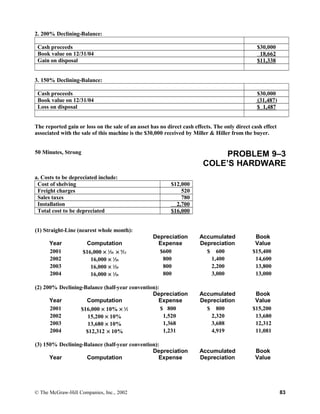
2. 200% Declining-Balance:
Cash proceeds $30,000
Book value on 12/31/04 18,662
Gain on disposal $11,338
3. 150% Declining-Balance:
Cash proceeds $30,000
Book value on 12/31/04 (31,487)
Loss on disposal $ 1,487
The reported gain or loss on the sale of an asset has no direct cash effects. The only direct cash effect
associated with the sale of this machine is the $30,000 received by Miller & Hiller from the buyer.
50 Minutes, Strong PROBLEM 9–3
COLE’S HARDWARE
a. Costs to be depreciated include:
Cost of shelving $12,000
Freight charges 520
Sales taxes 780
Installation 2,700
Total cost to be depreciated $16,000
(1) Straight-Line (nearest whole month):
Year Computation
Depreciation
Expense
Accumulated
Depreciation
Book
Value
2001 $16,000 × 1
⁄20 × 9
⁄12 $600 $ 600 $15,400
2002 16,000 × 1
⁄20 800 1,400 14,600
2003 16,000 × 1
⁄20 800 2,200 13,800
2004 16,000 × 1
⁄20 800 3,000 13,000
(2) 200% Declining-Balance (half-year convention):
Year Computation
Depreciation
Expense
Accumulated
Depreciation
Book
Value
2001 $16,000 × 10% × 1
⁄2 $ 800 $ 800 $15,200
2002 15,200 × 10% 1,520 2,320 13,680
2003 13,680 × 10% 1,368 3,688 12,312
2004 $12,312 × 10% 1,231 4,919 11,081
(3) 150% Declining-Balance (half-year convention):
Year Computation
Depreciation
Expense
Accumulated
Depreciation
Book
Value
© The McGraw-Hill Companies, Inc., 2002 83
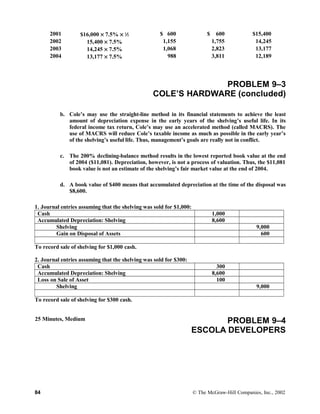
2001 $16,000 × 7.5% × 1
⁄2 $ 600 $ 600 $15,400
2002 15,400 × 7.5% 1,155 1,755 14,245
2003 14,245 × 7.5% 1,068 2,823 13,177
2004 13,177 × 7.5% 988 3,811 12,189
PROBLEM 9–3
COLE’S HARDWARE (concluded)
b. Cole’s may use the straight-line method in its financial statements to achieve the least
amount of depreciation expense in the early years of the shelving’s useful life. In its
federal income tax return, Cole’s may use an accelerated method (called MACRS). The
use of MACRS will reduce Cole’s taxable income as much as possible in the early year’s
of the shelving’s useful life. Thus, management’s goals are really not in conflict.
c. The 200% declining-balance method results in the lowest reported book value at the end
of 2004 ($11,081). Depreciation, however, is not a process of valuation. Thus, the $11,081
book value is not an estimate of the shelving’s fair market value at the end of 2004.
d. A book value of $400 means that accumulated depreciation at the time of the disposal was
$8,600.
1. Journal entries assuming that the shelving was sold for $1,000:
Cash 1,000
Accumulated Depreciation: Shelving 8,600
Shelving 9,000
Gain on Disposal of Assets 600
To record sale of shelving for $1,000 cash.
2. Journal entries assuming that the shelving was sold for $300:
Cash 300
Accumulated Depreciation: Shelving 8,600
Loss on Sale of Asset 100
Shelving 9,000
To record sale of shelving for $300 cash.
25 Minutes, Medium PROBLEM 9–4
ESCOLA DEVELOPERS
84 © The McGraw-Hill Companies, Inc., 2002
a.
General Journal
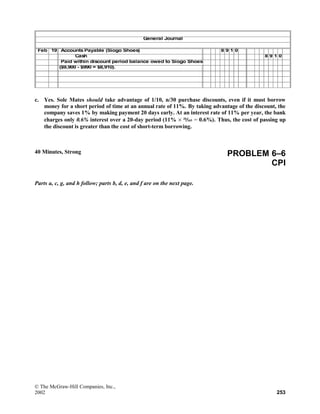
Feb 10 Loss on Disposal of Plant Assets 2 0 0
Accumulated Depreciation: Office Equipment 2 5 8 0 0
Office Equipment 2 6 0 0 0
Scrapped office equipment; received no salvage value.
Apr 1 Cash 1 0 0 0 0 0
Notes Receivable 8 0 0 0 0 0
Accumulated Depreciation: Building 2 5 0 0 0 0
Land 5 0 0 0 0
Building 5 5 0 0 0 0
Gain on Sale of Plant Assets 5 5 0 0 0 0
Sold land and building for a $100,000 cash down payment
and a 5-year, 9% note for the balance.
Aug 15 Vehicles (new truck) 3 9 0 0 0
Accumulated Depreciation: Vehicles (old truck) 1 8 0 0 0
Vehicles (old truck) 2 6 0 0 0
Gain on Disposal of Plant Assets 2 0 0 0
Cash 2 9 0 0 0
To record trade-in of old truck on new; trade-in allowance
exceeded book value by $2,000.
Oct 1 Office Equipment (new computer) 8 0 0 0
Loss on Trade-in of Plant Assets 3 5 0 0
Accumulated Depreciation: Office Equip. (old computer) 1 1 0 0 0
Office Equipment (old computer) 1 5 0 0 0
Cash 2 5 0 0
Notes Payable 5 0 0 0
Acquired new computer system by trading in old
computer, paying part cash, and issuing a 1-year,
8% note payable. Recognized loss equal to book value of
old computer ($4,000) minus trade-in allowance ($500).
b. Gains and losses on asset disposals do not affect gross profit because they are not part of the cost of
goods sold. Such gains and losses do, however, affect net income reported in a firm’s income
statement.
c. Unlike realized gains and losses on asset disposals, unrealized gains and losses on marketable
securities are not generally reported in a firm’s income statement. Instead, they are reported in the
balance sheet as a component of stockholders’ equity.
25 Minutes, Medium PROBLEM 9–5
KING CARPET CORPORATION
© The McGraw-Hill Companies, Inc., 2002 85
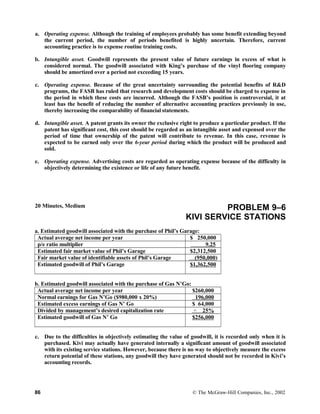
a. Operating expense. Although the training of employees probably has some benefit extending beyond
the current period, the number of periods benefited is highly uncertain. Therefore, current
accounting practice is to expense routine training costs.
b. Intangible asset. Goodwill represents the present value of future earnings in excess of what is
considered normal. The goodwill associated with King’s purchase of the vinyl flooring company
should be amortized over a period not exceeding 15 years.
c. Operating expense. Because of the great uncertainty surrounding the potential benefits of R&D
programs, the FASB has ruled that research and development costs should be charged to expense in
the period in which these costs are incurred. Although the FASB’s position is controversial, it at
least has the benefit of reducing the number of alternative accounting practices previously in use,
thereby increasing the comparability of financial statements.
d. Intangible asset. A patent grants its owner the exclusive right to produce a particular product. If the
patent has significant cost, this cost should be regarded as an intangible asset and expensed over the
period of time that ownership of the patent will contribute to revenue. In this case, revenue is
expected to be earned only over the 6-year period during which the product will be produced and
sold.
e. Operating expense. Advertising costs are regarded as operating expense because of the difficulty in
objectively determining the existence or life of any future benefit.
20 Minutes, Medium PROBLEM 9–6
KIVI SERVICE STATIONS
a. Estimated goodwill associated with the purchase of Phil’s Garage:
Actual average net income per year $ 250,000
p/e ratio multiplier 9.25
Estimated fair market value of Phil’s Garage $2,312,500
Fair market value of identifiable assets of Phil’s Garage (950,000)
Estimated goodwill of Phil’s Garage $1,362,500
b. Estimated goodwill associated with the purchase of Gas N’Go:
Actual average net income per year $260,000
Normal earnings for Gas N’Go ($980,000 x 20%) 196,000
Estimated excess earnings of Gas N’ Go $ 64,000
Divided by management’s desired capitalization rate ÷ 25%
Estimated goodwill of Gas N’ Go $256,000
c. Due to the difficulties in objectively estimating the value of goodwill, it is recorded only when it is
purchased. Kivi may actually have generated internally a significant amount of goodwill associated
with its existing service stations. However, because there is no way to objectively measure the excess
return potential of these stations, any goodwill they have generated should not be recorded in Kivi’s
accounting records.
86 © The McGraw-Hill Companies, Inc., 2002
SOLUTIONS TO CASES
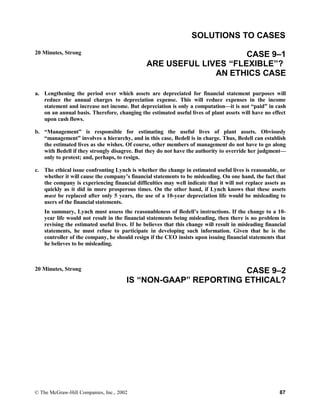
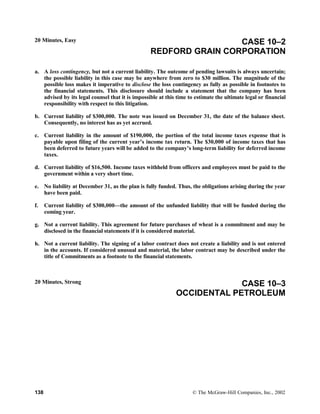
20 Minutes, Strong CASE 9–1
ARE USEFUL LIVES “FLEXIBLE”?
AN ETHICS CASE
a. Lengthening the period over which assets are depreciated for financial statement purposes will
reduce the annual charges to depreciation expense. This will reduce expenses in the income
statement and increase net income. But depreciation is only a computation—it is not “paid” in cash
on an annual basis. Therefore, changing the estimated useful lives of plant assets will have no effect
upon cash flows.
b. “Management” is responsible for estimating the useful lives of plant assets. Obviously
“management” involves a hierarchy, and in this case, Bedell is in charge. Thus, Bedell can establish
the estimated lives as she wishes. Of course, other members of management do not have to go along
with Bedell if they strongly disagree. But they do not have the authority to override her judgment—
only to protest; and, perhaps, to resign.
c. The ethical issue confronting Lynch is whether the change in estimated useful lives is reasonable, or
whether it will cause the company’s financial statements to be misleading. On one hand, the fact that
the company is experiencing financial difficulties may well indicate that it will not replace assets as
quickly as it did in more prosperous times. On the other hand, if Lynch knows that these assets
must be replaced after only 5 years, the use of a 10-year depreciation life would be misleading to
users of the financial statements.
In summary, Lynch must assess the reasonableness of Bedell’s instructions. If the change to a 10-
year life would not result in the financial statements being misleading, then there is no problem in
revising the estimated useful lives. If he believes that this change will result in misleading financial
statements, he must refuse to participate in developing such information. Given that he is the
controller of the company, he should resign if the CEO insists upon issuing financial statements that
he believes to be misleading.
20 Minutes, Strong CASE 9–2
IS “NON-GAAP” REPORTING ETHICAL?
© The McGraw-Hill Companies, Inc., 2002 87
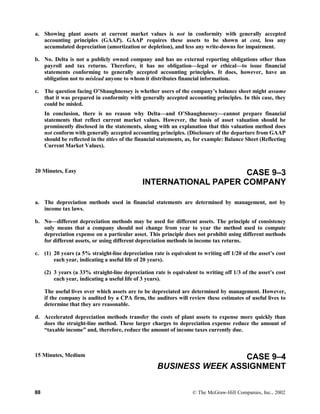
a. Showing plant assets at current market values is not in conformity with generally accepted
accounting principles (GAAP). GAAP requires these assets to be shown at cost, less any
accumulated depreciation (amortization or depletion), and less any write-downs for impairment.
b. No. Delta is not a publicly owned company and has no external reporting obligations other than
payroll and tax returns. Therefore, it has no obligation—legal or ethical—to issue financial
statements conforming to generally accepted accounting principles. It does, however, have an
obligation not to mislead anyone to whom it distributes financial information.
c. The question facing O’Shaughnessey is whether users of the company’s balance sheet might assume
that it was prepared in conformity with generally accepted accounting principles. In this case, they
could be misled.
In conclusion, there is no reason why Delta—and O’Shaughnessey—cannot prepare financial
statements that reflect current market values. However, the basis of asset valuation should be
prominently disclosed in the statements, along with an explanation that this valuation method does
not conform with generally accepted accounting principles. (Disclosure of the departure from GAAP
should be reflected in the titles of the financial statements, as, for example: Balance Sheet (Reflecting
Current Market Values).
20 Minutes, Easy CASE 9–3
INTERNATIONAL PAPER COMPANY
a. The depreciation methods used in financial statements are determined by management, not by
income tax laws.
b. No—different depreciation methods may be used for different assets. The principle of consistency
only means that a company should not change from year to year the method used to compute
depreciation expense on a particular asset. This principle does not prohibit using different methods
for different assets, or using different depreciation methods in income tax returns.
c. (1) 20 years (a 5% straight-line depreciation rate is equivalent to writing off 1/20 of the asset’s cost
each year, indicating a useful life of 20 years).
(2) 3 years (a 33% straight-line depreciation rate is equivalent to writing off 1/3 of the asset’s cost
each year, indicating a useful life of 3 years).
The useful lives over which assets are to be depreciated are determined by management. However,
if the company is audited by a CPA firm, the auditors will review these estimates of useful lives to
determine that they are reasonable.
d. Accelerated depreciation methods transfer the costs of plant assets to expense more quickly than
does the straight-line method. These larger charges to depreciation expense reduce the amount of
“taxable income” and, therefore, reduce the amount of income taxes currently due.
15 Minutes, Medium CASE 9–4
BUSINESS WEEK ASSIGNMENT
88 © The McGraw-Hill Companies, Inc., 2002
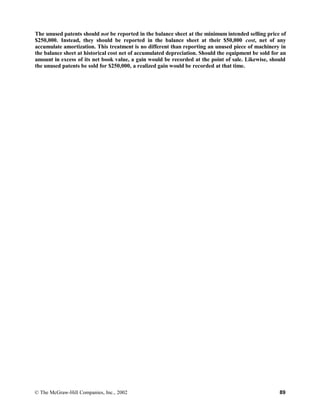
The unused patents should not be reported in the balance sheet at the minimum intended selling price of
$250,000. Instead, they should be reported in the balance sheet at their $50,000 cost, net of any
accumulate amortization. This treatment is no different than reporting an unused piece of machinery in
the balance sheet at historical cost net of accumulated depreciation. Should the equipment be sold for an
amount in excess of its net book value, a gain would be recorded at the point of sale. Likewise, should
the unused patents be sold for $250,000, a realized gain would be recorded at that time.
© The McGraw-Hill Companies, Inc., 2002 89
SOLUTION TO INTERNET ASSIGNMENT
No time estimate INTERNET 9–1
R&D EXPENDITURES
A keyword search of Pharmaceutical Companies will result in an extensive list of firms. The list will
include extremely profitable industry giants whose R&D expenditures typically amount to 15% to 25%
of total costs and expenses. In addition, many smaller companies whose primary business activity is
researching and developing new drugs will be listed. The R&D expenditures of these firms can amount
to as much as 75% to 90% of total costs and expenses. Many of these companies will report very little
(if any) sales activity, as all of their products are still in the development stage. Once they have
developed a promising new drug, these smaller companies are usually acquired by large pharmaceutical
firms which have the financial resources to manufacture and distribute the new drug on a large-scale
basis.
90 © The McGraw-Hill Companies, Inc., 2002
CHAPTER 10
LIABILITIES
OVERVIEW OF EXERCISES, PROBLEMS, CASES,
AND INTERNET ASSIGNMENT
Exercises Topic
Learning
Objectives
Character of
Assignment
10–1 You as a student 4 Personal, mechanical
10–2 Accounting equation 1–4 Conceptual
10–3 Effects of transactions upon
financial statements
1, 4, 5, 7 Conceptual
10–4 Balance sheet presentation 1, 5, 10* Conceptual
10–5 Payroll-related costs 3 Mechanical
10–6 Use of an amortization table 4 Mechanical, conceptual
10–7 Tax benefit of debt financing 5 Mechanical, conceptual
10–8 Bonds payable and interest 5 Mechanical, conceptual
10–9 Bond price volatility 5, 11** Research, conceptual
10–10 Bonds payable and interest 5, 11** Mechanical, conceptual
10–11 Accounting for leases 6 Mechanical, conceptual, ethics
10–12 Pension plans 6, 7 Mechanical, conceptual, ethics
10–13 Deferred income taxes 8 Conceptual
10–14 Analyzing solvency 9 Conceptual, analytical, real—Tyco
Toys and Hasbro
10–15 Identifying debt 9 Conceptual, real—Tootsie Roll
Problems
10–1 Effects of transactions upon the
accounting equation
1, 2, 3, 4, 7,
10*
Conceptual
10–2 Balance sheet presentation 1, 2, 4, 10* Conceptual
10–3 Notes payable 2 Mechanical, conceptual
10–4 Preparation and use of an
amortization table
4 Mechanical, conceptual
10–5 Bonds issued at par 5 Mechanical, conceptual
10–6 Bond discount and premium 11** Mechanical, conceptual
10–7 Balance sheet presentation 1, 5, 7, 8 Conceptual, mechanical
____________
*Supplemental Topic A, “Estimated Liabilities, Loss Contingencies, and Commitments.”
**Supplemental Topic B, “Bonds Issued at a Discount or a Premium.”
© The McGraw-Hill Companies, Inc., 2002 91
Cases Topic
Learning
Objectives
Character of
Assignment
10–1 Nature of liabilities 1, 3, 10* Conceptual, can be group
assignment, real—7 companies
10–2 Balance sheet presentation 1, 7, 10* Conceptual, group
10–3 Factors affecting bond prices 5, 6 Conceptual, analytical, group, real
—Occidental Petroleum
10–4 Loss contingencies 10* Conceptual, group
Business Week
Assignment
10–4 Business Week assignment 7 Ethics, group assignment,
communication
Internet
Assignment
10–1 Credit ratings for bonds 9 Internet, research
____________
*Supplemental Topic A, “Estimated Liabilities, Loss Contingencies, and Commitments.”
92 © The McGraw-Hill Companies, Inc., 2002
DESCRIPTIONS OF PROBLEMS, CASES,
AND INTERNET ASSIGNMENT
Below are brief descriptions of each problem, case, and the Internet assignment. These descriptions are
accompanied by the estimated time (in minutes) required for completion and by a difficulty rating. The time
estimates assume use of the partially filled-in working papers.
Problems
10–1 Computer Specialists, Inc.
Show the effects of various transactions upon the accounting equation. Also
calls for distinction between current and long-term liabilities. Quick and easy,
but quite comprehensive.
25 Easy 
10–2 Seattle Chocolates
From an unclassified listing of account balances and other information,
prepare current and long-term liability sections of a balance sheet. Explain
treatment of various items.
30 Medium 
10–3 Swanson Corporation
Accounting for notes payable, with interest stated separately.
25 Medium 
10–4 Quick Lube
Involves conceptual discussion of an amortization table, use of the table, and
extension of a partially completed table for two more payments.
25 Medium 
10–5 Blue Mountain Power Company
Journal entries to record issuance of bonds between interest payment dates,
payment of interest, and accrual of interest at year-end. Requires student to
know that bonds are issued at par when the prevailing market rate of interest
equals the contract rate of interest.
15 Easy 
**10–6 Park Rapids Lumber Company
Year-end adjusting entries for bond interest when bonds are issued at a
discount and when bonds are issued at a premium. Bond discount and
premium amortized by the straight-line method.
35 Strong 
10–7 Minnesota Satellite Telephone Corporation
From an unclassified list of account balances and other information, student is
asked to prepare and discuss the current and long-term liability sections of a
balance sheet.
45 Strong 
____________
**Supplemental Topic B, “Bonds Issued at a Discount or a Premium.”
Cases
10–1 Liabilities in Published Financial Statements
Discuss the nature of various liabilities appearing in the balance sheets of
30 Medium 
© The McGraw-Hill Companies, Inc., 2002 93
well-known companies.
* 10–2 Redford Grain Corporation
Students are asked to analyze eight independent events occurring at or near
year-end to determine for each event whether it creates a current liability or
should be presented elsewhere in the financial statements.
20 Easy 
* 10–3 Occidental Petroleum
Requires student to understand the relationship between a bond’s issue price
and the effective rate of interest, and to differentiate between cash flow and
interest expense. Also requires that students understand that the time
remaining until a bond matures is a factor in determining the bond’s current
value.
20 Strong 
*10–4 Loss Contingencies?
Students are asked to evaluate four situations, indicating whether the situation
describes a loss contingency and explaining the proper financial statement
treatment of the matter.
25 Medium 
Business Week Assignment
10–5 Business Week Assignment
Students are asked to discuss the ethical implications of a company’s decision
to discontinue health care benefits as part of a retirement package.
No time
estimate
Internet Assignment
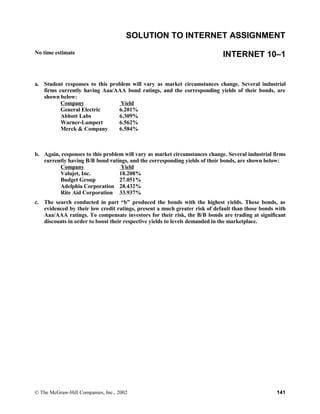
10–1 Credit Ratings
Students are introduced to bond ratings and how they correspond to bond
yields.
No time
estimate
____________
*Supplemental Topic A, “Estimated Liabilities, Loss Contingencies, and Commitments.”
94 © The McGraw-Hill Companies, Inc., 2002
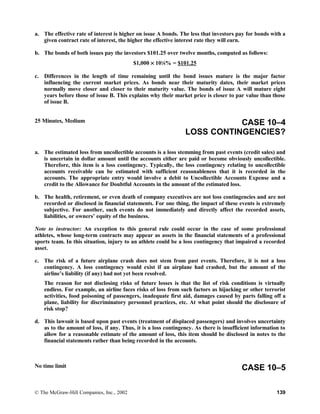
SUGGESTED ANSWERS TO DISCUSSION QUESTIONS
1. Liabilities are debts or obligations arising from past transactions or events, and which require
settlement at a future date. Liabilities and owners’ equity are the two primary means by which a
business finances ownership of its assets and its business operations.
The feature which most distinguishes liabilities from equity is that liabilities mature, whereas owners’
equity does not. In the event of liquidation of the business, the claims of creditors (liabilities) have
priority over the claims of owners (equity). Also, interest paid to creditors is deductible in the
determination of taxable income, whereas dividends paid to stockholders are not deductible.
2. In the event of liquidation of a business, the claims of creditors (liabilities) have priority over the
claims of owners (equity). The relative priorities of individual creditors, however, vary greatly.
Secured creditors have top priority with respect to proceeds stemming from the sale of the specific
assets that have been pledged as collateral securing their loans. The priority of unsecured creditors is
determined by legal statutes and indenture contracts.
3. Current liabilities are those maturing within one year or the company’s operating cycle (whichever is
longer) and expected to be paid from current assets. Liabilities classified as long-term include
obligations maturing more than one year in the future, and also shorter term obligations that will be
refinanced or paid from noncurrent assets.
A 10-year bond issue would be classified as a current liability once it comes within 12 months of the
maturity date, assuming that the issue will be paid from current assets.
A note payable maturing in 30 days would be classified as a long-term liability if (a) management had
both the intent and the ability to refinance this obligation on a long-term basis, or (b) the liability will
be paid from noncurrent assets.
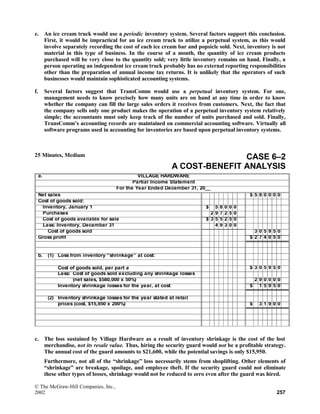
4. Accounts Payable (Smith Supply Company)................................................... 8,000
Notes Payable..................................................................................... 8,000
Issued a 12%, 90-day note payable to replace an account payable to Smith
Supply Company.
Notes Payable.................................................................................................
Interest Expense..............................................................................................
8,000
240
Cash.................................................................................................... 8,240
Paid 12%, 90-day note to Smith Supply Company.
5. All employers are required by law to pay the following payroll taxes and insurance premiums: Social
Security and Medicare taxes, unemployment taxes, and workers’ compensation insurance premiums.
In addition, many employers include the following as part of the “compensation package” provided to
employees: group health insurance premiums, contributions to employee pension plans, and
postretirement benefits (such as health insurance). Both mandated and discretionary costs are
included as part of total payroll cost in addition to the wages and salaries earned by employees.
6. Workers’ compensation premiums are a mandated payroll cost—the cost of providing insurance
coverage to employees in case of job-related injury. The dollar amount of the premiums varies by
state and by employees’ occupation. The employer pays workers’ compensation premiums. Social
Security and Medicare taxes are paid half by the employer and half by the employee.
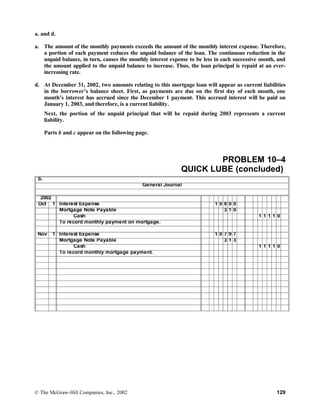
7. $62,537 [$63,210 balance at the beginning of the period, less $673 of the payment that applies to
principal ($1,200 − $527 representing interest)].
© The McGraw-Hill Companies, Inc., 2002 95
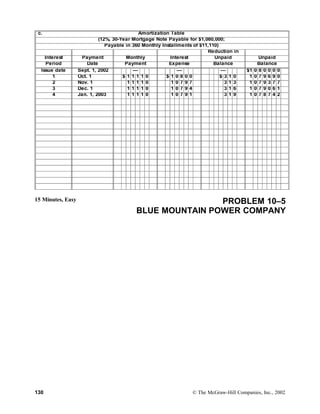
8. The analysis is incorrect, because the principal amount of the mortgage note will not be paid off at a
constant rate of $17.84 per month. The portion of each payment representing an interest charge is
based upon the unpaid balance of the loan. Since the principal amount is being reduced each month,
the portion of each successive payment representing interest will decrease, and the portion applied to
reducing the unpaid balance will increase. For example, let us look into the future to the time when
the loan has been paid down to $10,000. At this point, a $476.17 monthly payment would be
allocated as follows: interest, $91.67 ($10,000 principal × 11% × 1
⁄12), and reduction in principal,
$384.50 ($476.17 − $91.67 interest). Thus, the unpaid balance of the loan will be paid off at an ever-
increasing rate.
Note to instructor: This mortgage will be paid in full in 30 years.
9. The income tax advantage of raising capital by issuing bonds rather than stock is that interest
payments on bonds are deductible in determining income subject to income taxes. This reduces the
“after-tax” cost of borrowing. Dividend payments to stockholders, on the other hand, are not
deductible in the determination of taxable income.
10. Annual interest payments ($5 million × 10%)..................................................................... $500,000
Less: Annual tax savings ($500,000 × 30%)...................................................................... 150,000
Annual after-tax cost of borrowing..................................................................................... $350,000
After-tax cost of borrowing as a percentage of amount borrowed:
$350,000 ÷ $5,000,000 = 7%
11. The present value of a future amount is the amount that a knowledgeable investor would pay today
for the right to receive the future amount. This present value always will be less than the future
amount, because the investor will expect to earn some return while waiting to receive the future
amount.
12. From an investor’s perspective, a bond represents a series of future cash receipts that are fixed in
amount by the contract rate of interest printed on the bonds and by the bonds’ maturity value. As
market interest rates rise, a series of future receipts that are fixed in dollar amount look less
attractive in relation to other investment opportunities, and the price of the bond falls. As interest
rates fall, any series of fixed cash receipts begins to look better in relation to other opportunities, and
bond prices rise.
13. Bonds with contract rates of interest above current market interest rates should be trading at prices
above their face values. Bond prices vary inversely with interest rates.
14. The market value of $25,000 in bonds trading at 102 would be $25,500 ($25,000 par value × 102%).
The market rate of interest for bonds of this quality must be lower than the 8% contract rate, thereby
causing investors to be willing to pay a premium for these bonds.
15. A superior credit rating is one reason why one company’s bonds might trade at a higher price than
those of another company. However, the higher market price for the Interstate Power bonds does not,
in itself, prove that Interstate has the better credit rating. As current market interest rates are well
above the 6% level, it is logical that both bonds should be selling at a discount. The fact that the
Interstate Power bonds are selling at a market price very close to their par value probably indicates
that these bonds will mature in the very near future. Thus, the difference in the market price of the
two bond issues may well be explained by a difference in maturity dates, rather than by a difference in
the companies’ credit ratings.
96 © The McGraw-Hill Companies, Inc., 2002
16. The lessee accounts for an operating lease as a rental arrangement; the lease payments are recorded
as rental expense and no asset or liability (other than a short-term liability for accrued rent payable) is
recorded. A capital lease, on the other hand, should be viewed by the lessee as essentially a purchase
of the related asset. The lessee accounts for a capital lease by debiting an asset account (such as
Leased Equipment) and crediting a liability account (Lease Payment Obligation) for the present value
of the future lease payments. Lease payments made by the lessee must be allocated between interest
expense and a reduction in the liability, Lease Payment Obligation. The asset account is depreciated
over the life of the leased asset.
An operating lease is sometimes called off-balance-sheet financing because the obligation for future
lease payments does not appear as a liability in the lessee’s balance sheet.
17. As the pension plan is fully funded, Ortega Industries has paid its pension obligations to the pension
fund trustee as these obligations have accrued. Therefore, no liability need appear in Ortega’s balance
sheet relating to the pension plans. Retired employees will collect their postretirement benefits directly
from the trustee of the pension plan.
18. Most pension plans are fully funded—that is, the corporation deposits cash in the pension fund each
period in an amount equal to the current-period liability. Thus, no liability for pension payments
appears in the corporation’s balance sheet.
Most corporations, however, do not fully fund their obligations for nonpension postretirement
benefits. The difference between the amount funded and the present value of promised future benefits
—the unfunded amount—is reported as a liability. This liability gets larger each year as the funded
portion lags further and further behind the present value of promised benefits.
19. Postretirement costs are recognized as expense currently as workers earn the right to receive these
benefits. If these costs are fully funded, the company makes cash payments within the current period
equal to the expense recognized. If the benefits are not funded, the cash payments are not made until
after the employees retire.
20. Deferred income taxes are the portion of this year’s income taxes expense (as shown in the income
statement) which will appear in the income tax returns of future years. Therefore, due to differences
between income tax regulations and accounting principles, the taxpayer is able to postpone the
payment of some income taxes so long that these obligations become a long-term liability.
Note to instructor: Situations in which certain expenses are deductible for financial reporting purposes but
not for income tax purposes may cause deferred taxes to be classified as an asset instead of a liability.
21. Because the maturing bonds were paid from a sinking fund, the bonds were never classified as a
current liability. As the sinking fund was never classified as a current asset, the maturity of the bonds
had no effect upon the company’s current ratio.
The debt ratio is equal to total liabilities divided by total assets. NDP is a solvent business; therefore,
the total liabilities are less than total assets, and the debt ratio is less than 100%. Under these
circumstances, reducing the numerator and denominator of the ratio by an equal amount causes the
debt ratio to decrease. One also should arrive at this conclusion through common sense—repaying
debt reduces the percentage of total assets financed with capital provided by creditors.
22. Low-Cal’s very low interest coverage ratio should be of greater concern to stockholders than to short-
term creditors. The fact that operating income amounts to only 75% of annual interest implies that
Low-Cal may have great difficulty in remaining solvent in the long run. It does not imply, however,
that the company is not currently solvent. Short-term creditors, because of their shorter investment
horizon, should be concerned about the current relationships between the company’s liquid resources
and its short-term obligations.
© The McGraw-Hill Companies, Inc., 2002 97
23. The return on assets represents the average return that a business earns from all of the capital. If this
average rate is higher than the cost of borrowing, the business can benefit from using borrowed
capital—that is, applying leverage. In essence, if you can borrow money at a relatively low rate and
invest it at a significantly higher one, you will benefit from doing so.
But some businesses have borrowed such large amounts—and at such high interest rates—that they
have been unable to earn enough to pay the interest. In these cases, the owners must come up with
additional money to cover the interest charges, or the business eventually will “go under.”
*24. Estimated liabilities have two basic characteristics: (1) the liability is known to exist and (2) the
precise dollar amount cannot be determined until a later date. Examples include the liability to honor
warranties on products sold, liabilities for income taxes payable, and an accrual of liability relating to
a loss contingency.
*25. A loss contingency is a possible loss (or expense) stemming from past events that will be resolved as
to existence and amount by some future event. Examples include pending litigation, all estimated
liabilities, the allowance for uncollectible accounts, and the risk that the political climate in foreign
countries has impaired the value of assets in those locations.
Loss contingencies are accrued (recorded) if it is both (1) probable that a loss has been incurred, and
(2) the amount of loss can be estimated reasonably. Even if these conditions are not met, loss
contingencies should be disclosed in financial statements if it is reasonably possible that a material
loss has been incurred.
*26. A commitment is a contractual obligation to conduct future transactions on agreed-upon terms.
Examples include employment contracts, contracts with suppliers of services, and contracts to make
future purchases or sales of inventory or of other assets.
If they are material in dollar amount, the terms of commitments should be disclosed in financial
statements. No liability normally is recorded, because the commitment relates to future transactions,
rather than to past transactions.
**27. Issuing bonds at a discount increases the cost of borrowing. Not only does the issuing company have
the use of less borrowed money in exchange for its regular interest payments, but it also must repay
more than the original amount borrowed. Thus, an additional interest charge is built into the maturity
value of the bonds.
____________
*Supplemental Topic A, “Estimated Liabilities, Loss Contingencies, and Commitments.”
**Supplemental Topic B, “Bonds Issued at a Discount or a Premium.”
98 © The McGraw-Hill Companies, Inc., 2002
SOLUTIONS TO EXERCISES
Ex. 10–1 You would need to save $7,760, as shown in the following loan amortization table:
Interest
Period
Annual
Payment
Annual
Interest
Expense @ 8%
Reduction
in Unpaid
Balance
Unpaid
Balance
Date of Graduation $10,000
Year 1 $1,490 $800 $690 9,310  
Year 2 1,490  745  745  8,565  
Year 3 1,490  685  805  7,760  
Ex. 10–2
Income Statement Balance Sheet
Trans-
action Revenue − Expenses =
Net
Income Assets =
Current
Liab. +
Long-Term
Liab. +
Owners’
Equity
a.
b.
c.
d.
e.
f.
g.
h.
NE
NE
NE
NE
NE
NE
NE
NE
I
I
I
NE
I
NE
I
I
D
D
D
NE
D
NE
D
D
NE
D
D
NE
NE
I
D
NE
I
D
I
I
I
I
NE
I
NE
NE
NE
D
NE
I
NE
I
D
D
D
NE
D
NE
D
D
Ex. 10–3
Transaction
Current
Liabilities
Long-Term
Liabilities
Net
Income
Net Cash Flow
From Operating
Activities
Net Cash Flow
From All
Sources
a.
b.
c.
d.
e.
f.
g.
h.
D
D
I
D
NE
I
I
NE
NE
NE
I
NE
NE
I
I
I
NE
D
NE
D
D
D
D
D
D
D
NE
D
D
NE
NE
NE
D
D
NE
D
D
NE
NE
NE
© The McGraw-Hill Companies, Inc., 2002 99
Ex. 10–4 a. Current liabilities:
Unearned revenue......................................................................................... $300,000
Lease payment obligation (current portion)................................................ 10,000
Accrued bond interest payable..................................................................... 36,000
Total current liabilities..................................................................................... $346,000
b. Long-term liabilities:
Lease payment obligation ($80,000 − $10,000)............................................ $ 70,000
Bonds payable............................................................................................... 900,000
Notes payable to be refinanced on a long-term basis.................................. 75,000
Total long-term liabilities................................................................................. $1,045,000
• The interest expense that will arise from existing obligations is not yet a liability.
• The lawsuit pending against the company is a loss contingency. It should be disclosed,
but no liability is recorded as no reasonable estimate can be made of the dollar amount.
• The 3-year salary commitment relates to future transactions and, therefore, is not yet
a liability of the company.
Ex. 10–5 a. Total payroll related costs:
Wages and salaries expense.......................................................................... $ 7,200,000
Payroll taxes.................................................................................................. 580,000
Workers’ compensation premiums.............................................................. 250,000
Group health insurance premiums............................................................... 725,000
Contributions to employees’ pension plan................................................... 450,000
Other postretirement benefits (whether funded or not).............................. 350,000
Total payroll related costs............................................................................ $ 9,555,000
b. Employees’ “take-home pay”:
Wages and salaries earned........................................................................... $7,200,000
Amounts withheld from employees’ pay...................................................... 2,200,000
“Take-home pay”.......................................................................................... $5,000,000
c. (1) 133% ($9,555,000 ÷ $7,200,000)
(2) 191% ($9,555,000 ÷ $5,000,000)
d. The costs of postretirement benefits were determined by estimating the present value of
the future costs of retirement benefits earned during the year by today’s workforce.
These estimates are made by an actuary.
Only the unfunded portion of the postretirement costs results in a liability. The liability
represents only the present value of the expected future payments. Therefore, the actual
payments to retirees will be far larger than this liability.
100 © The McGraw-Hill Companies, Inc., 2002
Ex. 10–6 a. Amortization Table
(12% Note Payable for $150,000; Payable
in Monthly Installments of $1,543)
Monthly
Interest
Period
(A)
Monthly
Payment
(B)
Interest Expense
(1% of the Last
Unpaid Balance)
Reduction in
Unpaid Balance
(A) − (B)
Unpaid
Balance
Original balance
1
2
—
$1,543
1,543 
—
$1,500
1,500 
—
$43
43 
$150,000
149,957 
149,914 
b. Interest Expense............................................................................... 1,500
Mortgage Payable............................................................................ 43
Cash....................................................................................... 1,543
To record second monthly installment on mortgage payable.
c. Decrease. Interest expense is based on the unpaid principal balance at the end of each
month. As the unpaid principal balance decreases each period, interest expense will
decrease also.
Ex. 10–7 a. Annual interest expense ($50 million × 10%)................................................... $5,000,000
Less: Income tax savings ($5,000,000 × 40%)................................................. 2,000,000
Annual after-tax cost of borrowing................................................................... $ 3,000,000
b. 6% ($3,000,000 ÷ $50 million)
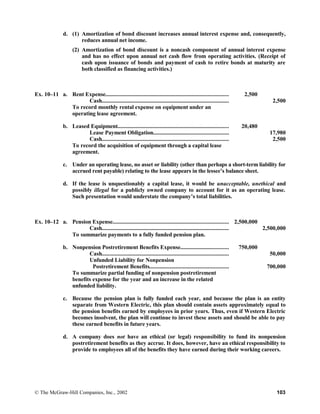
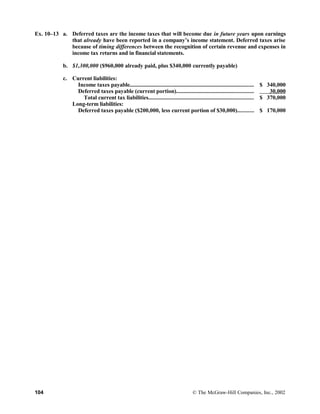
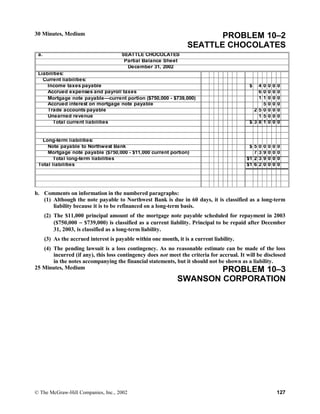
Ex. 10–8 a. Apr. 30 Cash................................................................................. 50,375
Bonds Payable.....................................................
Bond Interest Payable.........................................
50,000
375
Issued $50,000 face value of 9%, 30-year bonds at 100
plus accrued interest for one month.
b. Sept. 30 Bond Interest Payable..................................................... 375
Bond Interest Expense.................................................... 1,875
Cash..................................................................... 2,250
Paid semiannual interest on $50,000 face value
of 9% bonds.
c. Dec. 31 Bond Interest Expense.................................................... 1,125
Bond Interest Payable......................................... 1,125
Adjusting entry to recognize three months’ interest
accrued on $50,000 face value 9% bonds since
September 30.
© The McGraw-Hill Companies, Inc., 2002 101
d. This practice enables the corporation to pay a full six months’ interest on all bonds
outstanding at the semiannual interest payment date, regardless of when the bonds
were purchased. The accrued interest collected from investors who purchase
bonds between interest payment dates is, in effect, returned to them at the next
interest payment date. In this exercise, Gardner collected one month’s interest at
issuance and then paid six months’ interest on September 30 after the bonds were
outstanding for only five months.
Ex. 10–9 a. The volume of bonds traded each day will depend upon the bond issue being tracked
by the student.
b. The closing price of the bonds each day will depend upon the bond issue being
tracked by the student.
c. Factors that influence bond prices may include: (1) actions taken by the Federal
Reserve Board regarding interest rates, (2) investor demand for specific bond issues,
(3) changes in expectations regarding the rate of inflation, or (4) a change in the
company’s credit rating.
**Ex. 10–10 a. 2002
July 1  Cash............................................................................. 4,900,000
Discount on Bonds Payable........................................ 100,000
Bonds Payable................................................. 5,000,000
To record issuance of bonds at 98.
b. 2002
Dec. 31 Bond Interest Expense................................................ 237,500
Cash................................................................. 237,500
To pay interest on bonds for six months ($5,000,000
× 91
⁄2% × 1
⁄2 = $237,500).
31 Bond Interest Expense................................................ 2,500
Discount on Bonds Payable............................. 2,500
To record amortization of bond discount for six
months ($100,000 × 6
⁄240 = $2,500).
c. 2023
June 30 Bond Interest Expense................................................ 237,500
Cash................................................................. 237,500
To pay interest for six months ($5,000,000 × 91
⁄2%
× 1
⁄2 = $237,500).
30 Bond Interest Expense................................................ 2,500
Discount on Bonds Payable............................. 2,500
To record amortization of bond discount for six
months ($100,000 × 6
⁄240 = $2,500).
30 Bonds Payable............................................................. 5,000,000
Cash................................................................. 5,000,000
To retire bonds at maturity date.
____________
**Supplemental Topic B, “Bonds Issued at a Discount or a Premium.”
102 © The McGraw-Hill Companies, Inc., 2002
d. (1) Amortization of bond discount increases annual interest expense and, consequently,
reduces annual net income.
(2) Amortization of bond discount is a noncash component of annual interest expense
and has no effect upon annual net cash flow from operating activities. (Receipt of
cash upon issuance of bonds and payment of cash to retire bonds at maturity are
both classified as financing activities.)
Ex. 10–11 a. Rent Expense.................................................................................... 2,500
Cash....................................................................................... 2,500
To record monthly rental expense on equipment under an
operating lease agreement.
b. Leased Equipment............................................................................ 20,480
Lease Payment Obligation................................................... 17,980
Cash....................................................................................... 2,500
To record the acquisition of equipment through a capital lease
agreement.
c. Under an operating lease, no asset or liability (other than perhaps a short-term liability for
accrued rent payable) relating to the lease appears in the lessee’s balance sheet.
d. If the lease is unquestionably a capital lease, it would be unacceptable, unethical and
possibly illegal for a publicly owned company to account for it as an operating lease.
Such presentation would understate the company’s total liabilities.
Ex. 10–12 a. Pension Expense............................................................................... 2,500,000
Cash....................................................................................... 2,500,000
To summarize payments to a fully funded pension plan.
b. Nonpension Postretirement Benefits Expense................................. 750,000
Cash....................................................................................... 50,000
Unfunded Liability for Nonpension
Postretirement Benefits...................................................... 700,000
To summarize partial funding of nonpension postretirement
benefits expense for the year and an increase in the related
unfunded liability.
c. Because the pension plan is fully funded each year, and because the plan is an entity
separate from Western Electric, this plan should contain assets approximately equal to
the pension benefits earned by employees in prior years. Thus, even if Western Electric
becomes insolvent, the plan will continue to invest these assets and should be able to pay
these earned benefits in future years.
d. A company does not have an ethical (or legal) responsibility to fund its nonpension
postretirement benefits as they accrue. It does, however, have an ethical responsibility to
provide to employees all of the benefits they have earned during their working careers.
© The McGraw-Hill Companies, Inc., 2002 103
Ex. 10–13 a. Deferred taxes are the income taxes that will become due in future years upon earnings
that already have been reported in a company’s income statement. Deferred taxes arise
because of timing differences between the recognition of certain revenue and expenses in
income tax returns and in financial statements.
b. $1,300,000 ($960,000 already paid, plus $340,000 currently payable)
c. Current liabilities:
Income taxes payable..................................................................................... $ 340,000
Deferred taxes payable (current portion)..................................................... 30,000
Total current tax liabilities........................................................................ $ 370,000
Long-term liabilities:
Deferred taxes payable ($200,000, less current portion of $30,000)........... $ 170,000
104 © The McGraw-Hill Companies, Inc., 2002
Ex. 10–14 a. (1) Debt ratio:
Tyco:
$349,792 = 57%
$615,132
Hasbro:
$1,090,776 = 42%
$2,616,388
(2) Interest coverage ratio:
Tyco:
$13,028 = 0.46 times
$28,026
Hasbro:
$304,672 = 8.11 times
$37,588
b. Long-term creditors probably would regard Hasbro as the safer investment. Hasbro has
a smaller percentage of its assets financed by creditors’ capital, and thereby provides its
creditors with a bigger “buffer” of equity capital. Also, Hasbro earns over 8 times the
amount of its interest expense, whereas Tyco Toys earns only 46 cents for every dollar
of interest expense it incurs. Thus, interest payments pose a great burden on Tyco Toys.
Note to instructor: For the year in question, Tyco’s interest expense actually resulted in reporting an
overall net loss for the period.
© The McGraw-Hill Companies, Inc., 2002 105
Ex. 10–15
a. Current Ratio:
(1) Current assets 12/31/99 $224,532
(2) Current liabilities 12/31/99 56,109
Current ratio (1) ÷ (2) 4.00:1
Quick Ratio:
(1) Financial assets 12/31/99 $184,254
(2) Current liabilities 12/31/99 56,109
Quick ratio (1) ÷ (2) 3.28:1
Given these strong ratios, and the fact that the company has over $159 million in cash, cash
equivalents, and marketable securities, it appears that it will have no problem repaying its current
liabilities as they come due.
b. Debt Ratio:
(1) Total liabilities 12/31/99 $ 98,770
(2) Total assets 12/31/99 529,416
Debt ratio (1) ÷ (2) 18.7%
The company has a very low debt load. Only 18.7% of each asset dollar is debt financed. Of this
amount, most is short-term.
c. The company reports current liabilities of approximately $56.1 million at the end of 1999. Cash
flows from operating activities for the year amount to $72.9 million. If similar cash flows are
generated in 2000, no problems should be encountered in paying these liabilities.
106 © The McGraw-Hill Companies, Inc., 2002
25 Minutes, Easy
SOLUTIONS TO PROBLEMS
PROBLEM 10–1
COMPUTER SPECIALISTS, INC.
Income Statement Balance Sheet
Current Long-Term Owners’
Transaction Revenue − Expenses = Net Income Assets = Liabilities + Liabilities + Equity
a NE I D NE I NE D
b NE NE NE NE I D NE
c NE I D D I NE D
d I NE I NE D NE I
e NE NE NE NE D I NE
f NE I D D D NE D
g NE I D D NE D D
h NE I D D NE NE D
i NE I D D D NE D
j NE I D D NE NE D
k NE I D NE I I D
l NE I D NE I I D
*m NE I D NE I NE D
*n NE NE NE NE NE NE NE
*o NE NE NE NE NE NE NE
____________
*Supplemental Topic A, “Estimated Liabilities, Loss Contingencies, and Commitments.”
© The McGraw-Hill Companies, Inc., 2002
30 Minutes, Medium PROBLEM 10–2
SEATTLE CHOCOLATES
a. SEATTLE CHOCOLATES
Partial Balance Sheet
December 31, 2002
Liabilities:
Current liabilities:
Income taxes payable $ 4 0 0 0 0
Accrued expenses and payroll taxes 6 0 0 0 0
Mortgage note payable—current portion ($750,000 - $739,000) 1 1 0 0 0
Accrued interest on mortgage note payable 5 0 0 0
Trade accounts payable 2 5 0 0 0 0
Unearned revenue 1 5 0 0 0
Total current liabilities $ 3 8 1 0 0 0
Long-term liabilities:
Note payable to Northwest Bank $ 5 0 0 0 0 0
Mortgage note payable ($750,000 - $11,000 current portion) 7 3 9 0 0 0
Total long-term liabilities $1 2 3 9 0 0 0
Total liabilities $1 6 2 0 0 0 0
b. Comments on information in the numbered paragraphs:
(1) Although the note payable to Northwest Bank is due in 60 days, it is classified as a long-term
liability because it is to be refinanced on a long-term basis.
(2) The $11,000 principal amount of the mortgage note payable scheduled for repayment in 2003
($750,000 − $739,000) is classified as a current liability. Principal to be repaid after December
31, 2003, is classified as a long-term liability.
(3) As the accrued interest is payable within one month, it is a current liability.
(4) The pending lawsuit is a loss contingency. As no reasonable estimate can be made of the loss
incurred (if any), this loss contingency does not meet the criteria for accrual. It will be disclosed
in the notes accompanying the financial statements, but it should not be shown as a liability.
25 Minutes, Medium PROBLEM 10–3
SWANSON CORPORATION
© The McGraw-Hill Companies, Inc., 2002 127
a.
General Journal
20__
Aug 6 Cash 1 2 0 0 0
Notes Payable 1 2 0 0 0
Borrowed $12,000 @ 12% per annum from Maple Grove Bank.
issued a 45-day promissory note.
Sept 16 Office Equipment 1 8 0 0 0
Notes Payable 1 8 0 0 0
Issued 3-month, 10% note to Seawald Equipment as payment
for office equipment.
Sept 20 Notes Payable 1 2 0 0 0
Interest Expense 1 8 0
Cash 1 2 1 8 0
Paid note and interest to Maple Grove Bank ($12,000 x 12%
x 45/360 = $180).
Nov 1 Cash 2 5 0 0 0 0
Notes Payable 2 5 0 0 0 0
Obtained 90-day loan from Mike Swanson; interest @ 15%
per annum.
Dec 1 Inventory 5 0 0 0
Notes Payable 5 0 0 0
To record purchase of merchandise, and issuance of 90-day,
14% note payable to Gathman Corporation.
Dec 16 Notes Payable 1 8 0 0 0
Interest Expense 4 5 0
Cash 4 5 0
Notes Payable 1 8 0 0 0
Paid interest on note to Seawald Equipment which matured
today and issued a 30-day, 16% renewal note.
Interest: $18,000 x 10% x 3/12 = $450.
b. Adjusting Entry
Dec 31 Interest Expense 6 4 2 8
Interest Payable 6 4 2 8
To record interest accrued on notes payable:
Mike Swanson ($250,000 x 15% x 2/12 = $6,250);
Gathman Corporation ($5,000 x 14% x 1/12 = $58); and
Seawald Equipment ($18,000 x 16% x 1/12 x 1/2 = $120).
c. The Seawald Equipment note dated September 16 was due in full on December 16. The higher rate
of interest on the new note may be associated with the increased risk of collecting in 30 days the
$18,000 principal, plus accrued interest due.
25 Minutes, Medium PROBLEM 10–4
QUICK LUBE
128 © The McGraw-Hill Companies, Inc., 2002
a. and d.
a. The amount of the monthly payments exceeds the amount of the monthly interest expense. Therefore,
a portion of each payment reduces the unpaid balance of the loan. The continuous reduction in the
unpaid balance, in turn, causes the monthly interest expense to be less in each successive month, and
the amount applied to the unpaid balance to increase. Thus, the loan principal is repaid at an ever-
increasing rate.
d. At December 31, 2002, two amounts relating to this mortgage loan will appear as current liabilities
in the borrower’s balance sheet. First, as payments are due on the first day of each month, one
month’s interest has accrued since the December 1 payment. This accrued interest will be paid on
January 1, 2003, and therefore, is a current liability.
Next, the portion of the unpaid principal that will be repaid during 2003 represents a current
liability.
Parts b and c appear on the following page.
PROBLEM 10–4
QUICK LUBE (concluded)
b.
General Journal
2002
Oct 1 Interest Expense 1 0 8 0 0
Mortgage Note Payable 3 1 0
Cash 1 1 1 1 0
To record monthly payment on mortgage.
Nov 1 Interest Expense 1 0 7 9 7
Mortgage Note Payable 3 1 3
Cash 1 1 1 1 0
To record monthly mortgage payment.
© The McGraw-Hill Companies, Inc., 2002 129
c. Amortization Table
(12%, 30-Year Mortgage Note Payable for $1,080,000;
Payable in 360 Monthly Installments of $11,110)
Reduction in
Interest Payment Monthly Interest Unpaid Unpaid
Period Date Payment Expense Balance Balance
Issue date Sept. 1, 2002 — — — $1 0 8 0 0 0 0
1 Oct. 1 $ 1 1 1 1 0 $ 1 0 8 0 0 $ 3 1 0 1 0 7 9 6 9 0
2 Nov. 1 1 1 1 1 0 1 0 7 9 7 3 1 3 1 0 7 9 3 7 7
3 Dec. 1 1 1 1 1 0 1 0 7 9 4 3 1 6 1 0 7 9 0 6 1
4 Jan. 1, 2003 1 1 1 1 0 1 0 7 9 1 3 1 9 1 0 7 8 7 4 2
15 Minutes, Easy PROBLEM 10–5
BLUE MOUNTAIN POWER COMPANY
130 © The McGraw-Hill Companies, Inc., 2002
General Journal
a.
2002
Aug 1 Cash 10 2 5 0 0 0 0
Bonds Payable 10 0 0 0 0 0 0
Bond Interest Payable 2 5 0 0 0 0
Issued $10,000,000 face value of 10%, 20-year bonds at 100
plus accrued interest for three months ($10,000,000 x .10
x 3/12 = $250,000).
b.
Nov 1 Bond Interest Payable 2 5 0 0 0 0
Bond Interest Expense 2 5 0 0 0 0
Cash 5 0 0 0 0 0
Paid semiannual interest ($10,000,000 x .10 x 1/2 = $500,000).
c.
Dec 31 Bond Interest Expense 1 6 6 6 6 7
Bond Interest Payable 1 6 6 6 6 7
To accrue two months’ interest expense ($10,000,000 x .10 x
2/12 = $166,667).
d.
2003
May 1 Bond Interest Payable 1 6 6 6 6 7
Bond Interest Expense 3 3 3 3 3 3
Cash 5 0 0 0 0 0
To record semiannual bond interest payment and interest
expense for four months since Dec. 31
($10,000,000 x .10 x 4/12 = $333,333).
e. The market rate of interest on the date of issuance was 10%. Because the bonds were issued at par
(100), the market rate had to have equaled the contract interest rate printed on the bonds.
35 Minutes, Strong PROBLEM 10–6
PARK RAPIDS LUMBER COMPANY
© The McGraw-Hill Companies, Inc., 2002 131
a.
General Journal
(1) Bonds issued at 98:
2002
Dec 31 Bond Interest Expense 2 6 9 3 3 3 4
Discount on Bonds Payable 2 6 6 6 7
Bond Interest Payable 2 6 6 6 6 6 7
To record accrual of bond interest expense for four
months in 2002:
Contract interest ($80,000,000 x 10% x 4/12) $2,666,667
Discount amortization ($1,600,000 x 4/240) 26,667
Bond interest expense for four months $2,693,334
2003
Mar 1 Bond Interest Payable 2 6 6 6 6 6 7
Bond Interest Expense 1 3 4 6 6 6 7
Discount on Bonds Payable 1 3 3 3 4
Cash 4 0 0 0 0 0 0
To record semiannual bond interest payment and
interest expense for two months (1/2 of interest for
four months, as computed in preceding entry).*
(2) Bonds issued at 101:
2002
Dec 31 Bond Interest Expense 2 6 5 3 3 3 4
Premium on Bonds Payable 1 3 3 3 3
Bond Interest Payable 2 6 6 6 6 6 7
Accrual of interest on bonds for four months:
Contract interest ($80,000,000 x 10% x 4/12) $2,666,667
Less: Premium amortization
($800,000 x 4/240) (13,333)
Bond interest expense for four months $2,653,334
2003
Mar 1 Bond Interest Payable 2 6 6 6 6 6 7
Bond Interest Expense 1 3 2 6 6 6 7
Premium on Bonds Payable 6 6 6 6
Cash 4 0 0 0 0 0 0
Semiannual bond interest payment and interest
expense for two months (1/2 of interest for four
months, as computed in preceding entry).*
*Actual amount differs slightly due to rounding errors.
PROBLEM 10–6
PARK RAPIDS LUMBER COMPANY (concluded)
132 © The McGraw-Hill Companies, Inc., 2002
b. Net bond liability at Dec. 31, 2003: Bonds Bonds
Issued Issued
at 98 at 101
Bonds payable $ 80 0 0 0 0 0 0 $ 80 0 0 0 0 0 0
* Less: Discount on bonds payable ($1,600,000 - $106,667) (1 4 9 3 3 3 3 )
** Add: Premium on bonds payable ($800,000 - $53,333) 7 4 6 6 6 7
Net bond liability $ 78 5 0 6 6 6 7 $ 80 7 4 6 6 6 7
* Discount amortized at Dec. 31, 2003:
Amount amortized in 2002....................................................... $26,667
Amount amortized in 2003 ($1,600,000 x 12/240)................... 80,000
Discount amortized at 12/31/03.....................................
.......................................................................................................
$106,667
** Premium amortized at Dec. 31, 2003:
Amount amortized in 2002....................................................... $13,333
Amount amortized in 2003 ($800,000 x 12/240)...................... 40,000
Premium amortized at 12/31/03..................................... $53,333
c. The effective rate of interest would be higher under assumption 1. The less that investors pay for
bonds with a given contract rate of interest, the higher the effective interest rate they will earn.
45 Minutes, Strong PROBLEM 10–7
MINNESOTA SATELLITE TELEPHONE
CORPORATION
© The McGraw-Hill Companies, Inc., 2002 133
a. MINNESOTA SATELLITE TELEPHONE CORPORATION
Partial Balance Sheet
December 31, 2002
(in thousands)
Liabilities:
Current liabilities:
Accounts payable $ 6 5 6 0 0
Accrued expenses payable (other than interest) 1 1 3 4 7
Accrued interest payable 7 3 3 3
Notes payable (short-term) 1 1 0 0 0 0
Lease payment obligation (current portion) 4 6 2 1
Unfunded obligation for postretirement benefits other than
pensions (current portion) 1 8 0 0 0
Income taxes payable 1 7 3 0 0
Total current liabilities $ 2 3 4 2 0 1
Long-term liabilities:
6-3/4% Bonds payable, due February 1, 2003 $ 1 0 0 0 0 0
8-1/2% Bonds payable, due June 1, 2003 $ 2 5 0 0 0 0
Less: Unamortized bond discount 2 6 0 2 4 9 7 4 0
11% Bonds payable, due June 1, 2012 $ 3 0 0 0 0 0
Add: Unamortized bond premium 1 7 0 0 3 0 1 7 0 0
Lease payment obligation (less current portion) 1 8 9 7 9
Unfunded obligation for postretirement benefits other than
pensions (less current portion) 5 4 0 0 0
Deferred income taxes 1 3 0 0 0 0
Total long-term liabilities $ 8 5 4 4 1 9
Total liabilities $ 1 0 8 8 6 2 0
Part b appears on the following page.
c. (1) Computation of debt ratio:
Total liabilities (above) $ 1 0 8 8 6 2 0
Total assets (given) $ 2 0 9 3 5 0 0
Debt ratio ($1,088,620 ÷ $2,093,500) 5 2 %
(2) Computation of interest coverage ratio:
Operating income (given) $ 2 8 0 8 0 0
Annual interest expense ($61,000 + $17,000) $ 7 8 0 0 0
Interest coverage ratio ($280,800 ÷ $78,000) 3.6 times
Part d appears on the following page.
PROBLEM 10–7
MINNESOTA SATELLITE TELEPHONE
CORPORATION (concluded)
134 © The McGraw-Hill Companies, Inc., 2002
b. (1) As the 63
⁄4% bond issue is being refinanced on a long-term basis (that is, paid from the proceeds
of a long-term bond issue rather than from current assets), it is classified as a long-term liability
rather than a current liability.
(2) The 81
⁄2% bonds will be repaid from a bond sinking fund rather than from current assets.
Therefore, this liability continues to be classified as long-term, despite its maturity date in less
than one year.
(3) The portion of the capitalized lease payment obligation that will be repaid within one year
($4,621) is classified as a current liability, and the remainder of this obligation is classified as
long-term. The payments applicable to operating leases will be recognized as rental expense in
the periods in which these costs are incurred.
(4) As the pension plan is fully funded, the company has no pension liability.
(5) The $18,000 portion of the unfunded liability for nonpension postretirement benefits that will be
funded within one year is a current liability, and the remaining $54,000 ($72,000 − $18,000) is
classified as long-term.
(6) Income taxes payable relate to the current year’s income tax return and, therefore, are a current
liability. Although deferred income taxes can include a current portion, all of the deferred
income taxes are stated to be a long-term liability.
d. Based solely upon its debt ratio and interest coverage ratio, Minnesota Satellite Telephone
Corporation appears to be at least a good credit risk. One must consider, however, that Minnesota
Satellite Telephone Corporation is a telephone company, not a business organization that battles
numerous competitors on a daily basis. Telephone companies enjoy a “captive market” on a long-
term basis. Also, their rates are regulated to allow them to recover their costs and to earn a
reasonable profit, except in unusual circumstances.
In summary, the fact that Minnesota Satellite Telephone Corporation is a profitable telephone
company with a reasonable debt ratio and interest coverage ratio makes this business entity an
outstanding long-term credit risk.
Note to instructor: We do not expect students to have advance knowledge of the monopoly position of
telephone companies. However, we believe this situation enables us to make a most important point: To
properly interpret financial information about a business organization, one must understand the nature
of the company’s operations and its business environment.
© The McGraw-Hill Companies, Inc., 2002 135
30 Minutes, Medium
SOLUTIONS TO CASES
CASE 10–1
LIABILITIES IN PUBLISHED
FINANCIAL STATEMENTS
a. Wells Fargo’s liability for interest-bearing deposits represents the amounts on deposit in interest-
bearing bank accounts. This liability arises from customers depositing money in these accounts and
is discharged whenever customers make withdrawals.
b. The New York Times’ liability for unexpired subscriptions is a form of unearned revenue, arising
from customers paying in advance to receive the newspaper over a designated subscription period.
This liability is discharged through delivering newspapers to these customers throughout the
subscription period.
c. Horse racing tracks issue mutuel tickets as evidence of the bets that customers have made on specific
races. After the race, customers can present “winning” tickets and collect an amount greater than
they had paid to purchase the ticket. The track does not redeem “losing” tickets. Therefore,
Hollywood Park’s liability for outstanding mutuel tickets is its obligation to make payments to
holders of winning tickets that have not yet been redeemed. This liability comes into existence as
horses win races, and it is discharged as the track redeems the winning tickets.
d. As American Greetings is a manufacturer, it probably sells primarily to wholesalers or retailers
rather than directly to consumers. Apparently, the company allows its customers to return
merchandise that they are unable to sell and to receive a refund of the purchase price. Given the
seasonal nature of holiday greeting cards, wholesalers and retailers are quite likely to exercise this
return privilege and return to the manufacturer any cards that remain unsold at the end of the
holiday period.
The liability to pay refunds for sales returns comes into existence from making sales upon which
returns are permitted. As the returns are likely to occur in a subsequent accounting period, the
amount of this liability can only be estimated, based upon the company’s prior experiences. The
liability is discharged by making cash refunds (or crediting the account receivable of a customer
making a return).
e. Wausau Paper’s liability for “current maturities” of long-term debt is common to most large
organizations. This liability arises as debt instruments originally classified as long-term near their
maturity dates. The principal amounts scheduled for repayment within the next year (or operating
cycle) are classified as current liabilities. These liabilities normally are discharged by making
payments to creditors as the liabilities mature.
f. Club Med’s liability for future vacations is unearned revenue. This liability arises when customers
pay in advance to use the company’s resort facilities at a later date. Normally, this liability is
discharged by rendering services to the customer—that is, allowing them to use the club’s facilities.
In some instances, however, the liability may be discharged by making cash refunds for canceled
reservations.
CASE 10–1
LIABILITIES IN PUBLISHED
136 © The McGraw-Hill Companies, Inc., 2002
FINANCIAL STATEMENTS (concluded)
g. Apple’s accrued marketing and distribution liability represents accrued marketing and distribution
expenses that have not yet been paid. This liability arises as Apple incurs marketing and distribution
costs on account; it is discharged when the company makes payment to the individuals or
organizations rendering these services.
h. GM’s liability for postretirement costs is an obligation to pay retirement benefits to workers—some
of whom are already retired and some of whom are currently employed by GM. The liability arises
as employees perform services for GM and thereby earn the right to future postretirement benefits.
GM can discharge this obligation either by funding it with an independent trustee, or by making the
future benefit payments to retired workers.
© The McGraw-Hill Companies, Inc., 2002 137
20 Minutes, Easy CASE 10–2
REDFORD GRAIN CORPORATION
a. A loss contingency, but not a current liability. The outcome of pending lawsuits is always uncertain;
the possible liability in this case may be anywhere from zero to $30 million. The magnitude of the
possible loss makes it imperative to disclose the loss contingency as fully as possible in footnotes to
the financial statements. This disclosure should include a statement that the company has been
advised by its legal counsel that it is impossible at this time to estimate the ultimate legal or financial
responsibility with respect to this litigation.
b. Current liability of $300,000. The note was issued on December 31, the date of the balance sheet.
Consequently, no interest has as yet accrued.
c. Current liability in the amount of $190,000, the portion of the total income taxes expense that is
payable upon filing of the current year’s income tax return. The $30,000 of income taxes that has
been deferred to future years will be added to the company’s long-term liability for deferred income
taxes.
d. Current liability of $16,500. Income taxes withheld from officers and employees must be paid to the
government within a very short time.
e. No liability at December 31, as the plan is fully funded. Thus, the obligations arising during the year
have been paid.
f. Current liability of $300,000—the amount of the unfunded liability that will be funded during the
coming year.
g. Not a current liability. This agreement for future purchases of wheat is a commitment and may be
disclosed in the financial statements if it is considered material.
h. Not a current liability. The signing of a labor contract does not create a liability and is not entered
in the accounts. If considered unusual and material, the labor contract may be described under the
title of Commitments as a footnote to the financial statements.
20 Minutes, Strong CASE 10–3
OCCIDENTAL PETROLEUM
138 © The McGraw-Hill Companies, Inc., 2002
a. The effective rate of interest is higher on issue A bonds. The less that investors pay for bonds with a
given contract rate of interest, the higher the effective interest rate they will earn.
b. The bonds of both issues pay the investors $101.25 over twelve months, computed as follows:
$1,000 × 101
⁄8% = $101.25
c. Differences in the length of time remaining until the bond issues mature is the major factor
influencing the current market prices. As bonds near their maturity dates, their market prices
normally move closer and closer to their maturity value. The bonds of issue A will mature eight
years before those of issue B. This explains why their market price is closer to par value than those
of issue B.
25 Minutes, Medium CASE 10–4
LOSS CONTINGENCIES?
a. The estimated loss from uncollectible accounts is a loss stemming from past events (credit sales) and
is uncertain in dollar amount until the accounts either are paid or become obviously uncollectible.
Therefore, this item is a loss contingency. Typically, the loss contingency relating to uncollectible
accounts receivable can be estimated with sufficient reasonableness that it is recorded in the
accounts. The appropriate entry would involve a debit to Uncollectible Accounts Expense and a
credit to the Allowance for Doubtful Accounts in the amount of the estimated loss.
b. The health, retirement, or even death of company executives are not loss contingencies and are not
recorded or disclosed in financial statements. For one thing, the impact of these events is extremely
subjective. For another, such events do not immediately and directly affect the recorded assets,
liabilities, or owners’ equity of the business.
Note to instructor: An exception to this general rule could occur in the case of some professional
athletes, whose long-term contracts may appear as assets in the financial statements of a professional
sports team. In this situation, injury to an athlete could be a loss contingency that impaired a recorded
asset.
c. The risk of a future airplane crash does not stem from past events. Therefore, it is not a loss
contingency. A loss contingency would exist if an airplane had crashed, but the amount of the
airline’s liability (if any) had not yet been resolved.
The reason for not disclosing risks of future losses is that the list of risk conditions is virtually
endless. For example, an airline faces risks of loss from such factors as hijacking or other terrorist
activities, food poisoning of passengers, inadequate first aid, damages caused by parts falling off a
plane, liability for discriminatory personnel practices, etc. At what point should the disclosure of
risk stop?
d. This lawsuit is based upon past events (treatment of displaced passengers) and involves uncertainty
as to the amount of loss, if any. Thus, it is a loss contingency. As there is insufficient information to
allow for a reasonable estimate of the amount of loss, this item should be disclosed in notes to the
financial statements rather than being recorded in the accounts.
No time limit CASE 10–5
© The McGraw-Hill Companies, Inc., 2002 139
BUSINESS WEEK ASSIGNMENT
A company’s decision to discontinue health care benefits to its retired employees raises many complex
ethical issues. Most people argue that a company has an ethical responsibility to continue health care
benefits to its current retirees, even if it has no legal obligation to do so. Many also argue that a
company has an ethical responsibility to provide all current employees health care benefits if such
benefits were promised at the time that they joined the company. Again, many argue that the company’s
ethical responsibility to continue this benefit overrides its legal responsibility to do so.
Many people are divided, however, regarding a company’s ethical obligation to offer postretirement
health care benefits to newly hired employees. Some believe strongly that offering such benefits is
essential in fostering organizational commitment and a sense of community among employees. Others
believe that a company’s primary responsibility is to its shareholders, not its employees. These
individuals argue that rising health care costs compromise a company’s ability to maximize shareholder
wealth. As such, they support management’s decision to discontinue postretirement health care benefits
on the basis of it being a prudent cost cutting measure.
140 © The McGraw-Hill Companies, Inc., 2002
SOLUTION TO INTERNET ASSIGNMENT
No time estimate INTERNET 10–1
a. Student responses to this problem will vary as market circumstances change. Several industrial
firms currently having Aaa/AAA bond ratings, and the corresponding yields of their bonds, are
shown below:
Company Yield
General Electric 6.201%
Abbott Labs 6.309%
Warner-Lampert 6.562%
Merck & Company 6.584%
b. Again, responses to this problem will vary as market circumstances change. Several industrial firms
currently having B/B bond ratings, and the corresponding yields of their bonds, are shown below:
Company Yield
Valujet, Inc. 18.208%
Budget Group 27.051%
Adelphia Corporation 28.432%
Rite Aid Corporation 33.937%
c. The search conducted in part “b” produced the bonds with the highest yields. These bonds, as
evidenced by their low credit ratings, present a much greater risk of default than those bonds with
Aaa/AAA ratings. To compensate investors for their risk, the B/B bonds are trading at significant
discounts in order to boost their respective yields to levels demanded in the marketplace.
© The McGraw-Hill Companies, Inc., 2002 141
CHAPTER 11
STOCKHOLDERS’ EQUITY:
PAID-IN CAPITAL
OVERVIEW OF EXERCISES, PROBLEMS, CASES,
AND INTERNET ASSIGNMENT
Exercises Topic
Learning
Objectives
Character of
Assignment
11–1 Form of organization 1, 2, 3 Personal, conceptual
11–2 Accounting terminology 1–9 Conceptual
11–3 Prepare equity section 4, 5 Mechanical, conceptual
11–4 Dividends on preferred &
common
4, 5 Mechanical, conceptual
11–5 Analyzing equity 4, 5, 6, 7 Conceptual, analytical
11–6 Issuing stock for noncash assets 2, 4 Conceptual
11–7 Reporting effects of transactions 4, 7 Conceptual
11–8 Computing book value 4, 5, 6, 7 Mechanical, conceptual
11–9 Treasury stock transactions 9 Mechanical, conceptual
11–10 Effects of stock splits 8 Conceptual
11–11 Treasury stock presentation 9 Conceptual, ethical, group,
communication
11–12 Reading an annual report 4, 7 Research, real—Tootsie Roll
Problems
11–1 Reporting stockholders’ equity 4, 5, 6 Conceptual, mechanical
11–2 Reporting stockholders’ equity 4, 5, 6 Conceptual, mechanical
11–3 Reporting stockholders’ equity 4, 5, 6 Conceptual, mechanical
11–4 Comprehensive equity problem 4, 5 Conceptual, mechanical
11–5 Analysis of equity 4, 5 Conceptual, mechanical
11–6 Comprehensive equity analysis 1–7 Analytical, communication, group,
real—Quanex Corporation
11–7 Par, book, and market values 4, 7 Conceptual, group, communication
11–8 Comprehensive equity with
treasury stock transactions
4, 5, 7, 9 Conceptual, mechanical
11–9 Comprehensive equity with
treasury stock transactions and
stock splits
4, 5, 7, 8, 9 Analytical, conceptual, mechanical
142 © The McGraw-Hill Companies, Inc., 2002
Cases Topic
Learning
Objectives
Character of
Assignment
11–1 Factors affecting market prices
of preferred and common stocks
5, 7 Analytical, communication
11–2 Factors affecting market prices
of preferred and common stocks
7 Analytical, communication, group, real
—McDonnell Douglas, Citicorp, and
Ventitex
11–3 Selecting a form of business
organization
1, 2, 3 Analytical, communication, research,
group
Business Week
Assignment
11–4 Business Week assignment 5 Conceptual, communication, group
assignment
Internet
Assignment
11–1 Stockholders’ equity items 4, 5, 7, 9 Internet research, real—Staples, Inc.
© The McGraw-Hill Companies, Inc., 2002 143
DESCRIPTIONS OF PROBLEMS, CASES,
AND INTERNET ASSIGNMENT
Below are brief descriptions of each problem, case, and the Internet assignment. These descriptions are
accompanied by the estimated time (in minutes) required for completion and by a difficulty rating. The time
estimates assume use of the partially filled-in working papers.
Problems
11–1 Sinclair Press
A short problem requiring the completion of the stockholders’ equity section of
a corporate balance sheet. Includes preferred stock dividends and conceptual
issues pertaining to the market price of preferred stock.
20 Easy 
11–2 Banner Publications
A second short problem requiring the completion of the stockholders’ equity
section of a corporate balance sheet. Includes preferred stock dividends and
conceptual issues pertaining to dividends in arrears.
20 Easy 
11–3 Manhattan Transport Company
A more difficult problem requiring the completion of the stockholders’ equity
section of a corporate balance sheet. Includes preferred stock dividends and
conceptual issues pertaining to equity versus debt financing.
25 Medium 
11–4 Mobile Communications, Inc.
A short but comprehensive problem on corporations. Includes journal entries
for issuance of common stock and preferred stock. Also includes dividends on
preferred stock, closing entries, and the preparation of the stockholders’ equity
section of a corporate balance sheet.
35 Medium 
11–5 DeskTop Products
A more difficult problem involving distinction among par values, book values,
and market values.
35 Strong 
11–6 Quanex Corporation
Analysis of the stockholders’ equity of a publicly owned corporation. Includes a
discussion of why a business may opt to become publicly owned and the
reasons why the dividend yields on preferred stocks vary.
35 Medium 
11–7 Compuwiz
A straightforward discussion of the relationships (if any) among par value,
book value, and market value per share. A company has a book value 6,500
times greater than its par value, and a market value 73,000 times as high. Fun
problem that makes a point.
15 Easy 
11–8 Bell Corporation
A stockholders’ equity problem involving paid-in capital from treasury stock
transactions. Requires the computation of book value per share and statement
of cash flows.
15 Medium 
144 © The McGraw-Hill Companies, Inc., 2002
11–9 Parker Industries
A comprehensive equity problem involving treasury stock transactions in two
different years, preferred and common stock transactions, book value
calculations, and an understanding of stock splits.
30 Strong 
Cases
11–1 Forecasting Changes in Stock Prices
Students are asked to explain whether the prices of preferred stock, common
stock, and convertible preferred stock are likely to rise or fall if profitability
increases dramatically and interest rates rise slightly. A problem that stimulates
lively classroom discussion.
15 Medium 
11–2 Why Did the Price Change?
Students are to explain the reason for changes in the market prices of stocks of
various real companies. A difficult problem that is very thought-provoking.
25 Strong 
11–3 Selecting a Form of Organization (group assignment)
Students are to interview the owners of two small businesses with different
forms of organization and find out why the particular form was selected—and
if they have any misgivings.
Interview; No
time estimate
Business Week Assignment
11–4 Business Week Assignment
Students are asked to compare and contrast similarities and differences between
preferred stocks and fixed income investments, such as bonds.
10 Easy 
Internet Assignment
11–1 Examining Stockholders’ Equity
Students are asked to identify and discuss elements of stockholders’ equity
appearing in the balance sheet of Staples, Inc.
10 Easy 
© The McGraw-Hill Companies, Inc., 2002 145
SUGGESTED ANSWERS TO DISCUSSION QUESTIONS
1. Large corporations are often said to be publicly owned because they are literally owned by the general
public. The capital stock of many large corporations is actively traded on organized stock exchanges,
such as the New York Stock Exchange. Anyone may purchase an ownership interest in such
corporations, even if that interest is but a single share of capital stock. Many large corporations have
hundred of thousands, even millions, of individual stockholders.
2. a. Owners’ liability. Sole proprietors are personally liable for the debts of the business. A corporation,
however, is responsible for its own debts; the stockholders of a corporation are not personally liable
for the debts of the business entity. Thus, the amount of money that a stockholder might lose by
investing in a corporation is limited to the amount of his or her investment.
b. Transferability of ownership interest. A sole proprietor generally must sell his or her entire interest
in the business. This creates a new business owned by a new sole proprietor. Shares of stock in a
corporation are freely transferable.
c. Continuity of existence. A sole proprietorship is terminated upon sale or abandonment by the owner
and upon that person’s death or incapacitation. Corporations continue in existence regardless of
changes in ownership.
d. Federal taxation on income. A corporation is subject to federal income tax on its income, and
stockholders are also subject to a personal income tax on any amounts they receive as dividends. A
sole proprietorship is not a taxable entity, but the owner must pay personal taxes on the income
earned by the business, whether or not it is actually withdrawn by the owner.
3. There are three basic rights: (1) the right to vote, (2) the right to share in dividends when declared, and
(3) the right to share in assets upon liquidation.
A share of preferred stock is typically entitled to cumulative preference to a limited amount of dividends
and to a prior claim against assets in case of liquidation; in return, it usually has no voting power.
4. The term double taxation refers to the fact that the income of a corporation may be taxed on two
separate occasions. First, the income of a corporation is subject to corporate income taxes, which much
be paid by the corporation. Second, if the corporation distributes its earnings as dividends to
stockholders, the stockholders must pay personal income taxes on the amounts they receive. This double
taxation of income is one of the principal disadvantages of the corporate form of business organization.
5. Paid-in capital of a corporation represents the amount invested by stockholders and is generally not
available for dividends. Retained earnings represents the cumulative amount of net income not
distributed to shareholders as dividends. The distinction between paid-in capital and retained earnings is
useful because it shows how much of the total stockholders’ equity represents investments by the owners
and how much has been accumulated through profitable operations since the company started in
business.
6. Par value represents the legal capital per share, that is, the amount below which stockholders’ equity
cannot be reduced except by losses. Thus, a corporation cannot declare a dividend if this action would
reduce total stockholders’ equity below the par value of the outstanding stock.
Par value is no indication of a fair or reasonable market price for a share of stock. The market price of
stock is determined by such factors as the profitability and solvency of the issuing company, interest
rates, the amount of dividends paid by the stock, and general market conditions. The market price of a
share of stock may be above or below its par value.
146 © The McGraw-Hill Companies, Inc., 2002
7. a. Cumulative means that dividends in arrears on preferred stock must be fully paid before any
dividends can be paid on common stock.
b. Convertible means that each share of preferred stock may be returned to the corporation in exchange
for a given number of shares of common stock under specified conditions.
c. Callable means that the corporation has the option of retiring outstanding shares of preferred stock
by paying a specified amount to the stockholder.
8. Noncumulative preferred stock is entitled to dividends only if and when they are declared. If
noncumulative preferred dividends had not been declared for several years, it would be possible to
declare only the current year’s dividends on preferred and then declare a dividend on common.
Noncumulative preferred stock does not have the protection afforded by the cumulative requirements
that any dividends in arrears must be paid before dividends can be paid on common. This means a very
weak form of dividend preference, and as a result the noncumulative feature is not attractive to most
investors.
9. When noncash assets are acquired in exchange for the shares, the most pertinent evidence of the amount
that has been received by the corporation is the value of the assets. The accountant should attempt to
determine independently and objectively the value of the noncash assets as the basis for the record. This
may include retaining the services of an independent firm of appraisers. Often, the most objective
evidence of the value of these assets is the market value of the shares given in exchange. If the stock is
actively traded it will have an established market value, and we may assume that the shares could have
been sold for this amount of cash and the money used to purchase the assets.
10. (a) Cash is classified as an asset; (b) Organization Costs typically are classified as an expense; (c)
Preferred Stock, (d) Retained Earnings, (e) Donated Capital, and (f) Additional Paid-in Capital are all
classified as stockholders’ equity accounts; (g) Income Taxes Payable is classified as a liability.
11. In the baseball team’s balance sheet the asset account, Land, and the stockholders’ equity account,
Donated Capital, will both increase by the current market value of the land received as a donation from
the city. The receipt of the donated land will have no effect upon the team’s income statement. The
Donated Capital account is not regarded as revenue; it is viewed as an element of paid-in capital.
12. a. Stock transfer agent. A bank or trust company retained by a corporation to maintain records of
stock ownership and transfers.
b. Stockholders ledger. A record kept by a corporation showing the number of shares owned by each
stockholder.
c. Underwriter. An investment banking company that undertakes to sell new shares of corporate stock
to investors. The underwriter usually guarantees the corporation a specified price, and plans to make
a profit by selling to individual investors at a slightly higher price.
d. Stock registrar. An independent fiscal agent, usually a large bank, retained by a corporation to
control the issuance of stock certificates and provide assurance against overissuance.
13. Book value per share indicates the amount of net assets (or stockholders’ equity) represented by each
share of common stock. It is determined by dividing the total stockholders’ equity in the corporation, less
the amount assigned to preferred stock (liquidation value plus dividends in arrears) by the number of
common shares outstanding. Book value does not represent the amount common stockholders would
receive in the event of liquidation. If a corporation were liquidated, many assets would be sold at prices
different from their carrying values in the accounting records. The resulting gains or losses would cause
stockholders’ equity to change accordingly.
© The McGraw-Hill Companies, Inc., 2002 147
14. To compute book value per share of common stock for a company with both preferred stock and
common stock outstanding, the starting point is total stockholders’ equity, including both preferred and
common stock and all other elements of capital. Deduct from this total the preferred stock at its call
price and any dividends in arrears. The remainder is the equity of the common stockholders. Divide this
amount by the number of shares of common stock outstanding to arrive at book value (or net assets) per
share of common stock.
15. a. When a corporation obtains a bank loan there will be no effect upon book value per share of
common stock. Assets and liabilities will both increase by the amount of the loan. Net assets,
therefore, will be unchanged.
b. Declaration of a dividend reduces book value per share. Total assets are not affected by the
declaration of a dividend, but liabilities are increased. Net assets (stockholders’ equity), therefore, is
decreased.
16. A change in the market price of IBM’s outstanding shares of capital stock has no effect upon IBM’s
balance sheet. These shares belong to IBM’s stockholders, not to IBM. Therefore, a change in the
market value of these shares has no effect upon IBM’s assets, liabilities, or the recorded amount of its
stockholders’ equity. IBM’s paid-in capital accounts will continue to show the amount received by IBM
at the time the capital stock was issued. This historical amount is not affected by subsequent changes in
market price.
17. When you ask a stockbroker to purchase shares of stock for you, the stock is purchased on a secondary
market—in this case the New York Stock Exchange, because that is where Exxon stock is traded. On a
secondary market, you are purchasing the stock from another investor. The transaction will have no
effect on the financial statements of Exxon.
18. The purpose of a stock split is to bring the per-share market price of the company’s stock down into a
more appropriate “trading range”—that is, a price that is appealing to a greater number of potential
investors.
19. Treasury stock is corporate stock that has been issued and then reacquired by the issuing company.
One reason for acquiring treasury stock is to have stock available to issue to officers and employees
under profit-sharing agreements, stock options, or bonus plans. Purchases of treasury stock may also be
intended to support the market price of the stock or to increase earnings per share.
Treasury stock is not an asset; it represents a reduction in the amount of stockholders’ investment in the
corporation. For this reason the cost of the treasury shares is reported in the balance sheet as a reduction
of the stockholders’ equity.
20. The purpose of this rule is to protect corporate creditors, for whom stockholders’ equity represents the
margin of safety against loss from a shrinkage of asset values. The restriction of retained earnings for
dividend purposes to the extent of the cost of treasury shares assures creditors that the stockholders’
equity of a corporation will not, as a result of the purchase of treasury shares, be reduced below the
amount of paid-in capital. If this restriction were not imposed, a corporation might distribute assets
equal to the entire amount of its retained earnings as dividends, and then distribute additional assets in
payment for shares of its own stock, thereby reducing the net assets of the corporation below the amount
of the paid-in capital or even below the amount of stated (legal) capital.
148 © The McGraw-Hill Companies, Inc., 2002
SOLUTIONS TO EXERCISES
Ex. 11–1 a. (1) Organizing the scuba diving school as a sole proprietorship.
Advantages:
(a) Easy to form
(b) No double taxation on distributed earnings
Disadvantages:
(a) Personal liability of owner for debts of the business
(b) Business ceases with death of owner
(2) Organizing the scuba diving school as a corporation.
Advantages:
(a) No personal liability of owners for debts of the business
(b) Readily transferable ownership shares
(c) Continuous existence
Disadvantages:
(a) Double taxation on distributed earnings
(b) Greater regulation
b. A corporation would probably be the better form of organization because of the
characteristic of limited liability of the owners. Potentially, a scuba diving student could
be seriously injured in the class. With the sole proprietorship form of organization, your
personal assets would be at risk to pay for the person’s injuries, after you exhausted any
insurance coverage and assets that the business might have.
Ex. 11–2 a. Double taxation
b. Market value
c. None (Retained earnings is not an amount of cash; it is an element of owners’ equity.)
d. Common stock
e. None (Dividends in arrears are prior years’ dividends owed to holders of cumulative
preferred stock.)
f. None (This statement might be described as the “majority interest.” It does not describe
the board of directors, who do not necessarily own any stock at all.)
g. Publicly held
h. Paid-in capital
i. Retained earnings
j. None (Book value is common stockholders’ equity divided by the number of common
shares outstanding.)
k. None (The price of preferred stock varies inversely with interest rates.)
© The McGraw-Hill Companies, Inc., 2002 149
Ex. 11–3 a. Stockholders’ equity:
8% cumulative preferred stock, $100 par value, callable at $106,
5,000 shares authorized, 2,500 shares issued................................................. $ 250,000
Common stock, $2 stated value, 100,000 shares authorized,
70,000 shares issued........................................................................................ 140,000
Additional paid-in capital:
Preferred stock.............................................................................................. 7,500
Common stock............................................................................................... 770,000
Total paid-in capital.......................................................................................... $1,167,500
Retained earnings.............................................................................................. 297,000
Total stockholders’ equity............................................................................. $1,464,500
b. No. The market value of a corporation’s stock has no effect on the amount in the
financial statements. Capital stock is recorded at the amount for which it was originally
issued.
Ex. 11–4 a. Total dividends paid in third year......................................................................
Dividends on 9% cumulative preferred stock:
$
736,000
Dividends ($50 × .09 × 40,000 × 2 years).................................... $
360,000
Current year’s dividend ($50 × .09 × 40,000)............................. 180,000
Total paid on 9% cumulative preferred stock........................ $
540,000
Dividends on 12% noncumulative preferred stock:
Current year’s dividend ($100 × .12 × 8,000)............................. 96,000 636,000
Dividends on common stock in third year.......................................................... $
100,000
b. Dividends per share:
Preferred stock, 9% cumulative ($540,000 ÷ 40,000 shares)............. $13.50 per share
Preferred stock, 12% noncumulative ($96,000 ÷ 8,000 shares)......... $12.00 per share
Common stock ($100,000 ÷ 400,000 shares)....................................... $ 0.25 per share
c. The stockholders’ equity section of the balance sheet reports no additional paid-in capital.
Thus, the preferred shares must have been issued at their respective par values ($50 per
share for the 9% cumulative preferred stock, and $100 per share for the noncumulative
preferred stock).
Ex. 11–5 a. 150,000 shares ($15,000,000 total par value, divided by $100 par value per share)
b. $1,050,000 ($15,000,000 total par value × 7% or 150,000 × $100 × 7%)
c. $16 [($20 million par value + $44 million additional paid-in capital) ÷ 4,000,000 shares
issued]
d. $35,000,000 legal capital ($15,000,000 preferred, plus $20,000,000 common)
$79,300,000 total paid-in capital ($35,000,000 legal capital, plus $44,300,000 additional
paid-in capital)
150 © The McGraw-Hill Companies, Inc., 2002
e. Total stockholders’ equity............................................................................ $143,750,000
Less: Call price of preferred stock (150,000 shares × $105)....................... 15,750,000
Equity of common stockholders................................................................... $128,000,000
Common shares outstanding......................................................................... 4,000,000
Book value per share ($128 million ÷ 4 million shares)............................... $32
f. No. Changes in the market value of capital stock do not directly affect a corporation’s
financial position and are not reflected in the equity section of the balance sheet.
Ex. 11–6 a. (1) Land........................................................................................... 450,000
Common Stock............................................................... 40,000
Additional Paid-in Capital............................................. 410,000
Issued 20,000 shares of $2 par value common stock in
exchange for land with a fair market value of $450,000.
(2) Land........................................................................................... 430,000
Common Stock............................................................... 40,000
Additional Paid-in Capital............................................. 390,000
Issued 20,000 shares of $2 par value common stock with a
market value of $430,000 in exchange for land.
b. When stock is issued in exchange for assets other than cash, the amounts used in
recording the transaction should be based upon the current market value of either (1)
the shares issued, or (2) assets received in exchange—whichever can be determined
more objectively.
For a closely held corporation, there often is no objective evidence of the current value
of the stock. Therefore, there is no alternative but to rely upon the appraised value of
the assets received ($450,000).
But if Hudson is a publicly owned corporation, the value of the shares issued—$430,000
—can be determined with considerable objectivity. Also, as the seller accepts these
shares in exchange for the land, it is logical to conclude that the fair market value of the
land is not greater than this amount.
Ex. 11–7
Event
Current
Assets
Stockholders’
Equity
Net
Income
Net Cash Flow
(from Any
Source)
a I I NE I
b NE I NE NE
c NE NE NE NE
d D D NE D
e NE I NE NE
© The McGraw-Hill Companies, Inc., 2002 151
Ex. 11–8 a. Net assets (stockholders’ equity):
8% cumulative preferred stock........................................................................... $
200,000
Common stock, $5 par, 60,000 shares issued..................................................... 300,000
Additional paid-in capital.................................................................................... 452,800
Total paid-in capital......................................................................................... $
952,800
Less: Deficit......................................................................................................... 146,800
Total net assets (stockholders’ equity)................................................................ $
806,000
b. Book value per share of common stock:
Total stockholders’ equity (from part a)............................................................ $
806,000
Less: Claims of preferred stockholders (call price of
$220,000 plus dividends in arrears, $16,000).......................................... 236,000
Equity of common stockholders.......................................................................... $
570,000
Number of shares of common stock outstanding................................................ 60,000
Book value per share ($570,000 ÷ 60,000 shares).............................................. $9.50
c. No. The book value per share represents the stockholders’ share of the net book value of
the corporation’s assets, not the assets’ liquidation values. The stockholders may receive
more or less than the book value per share if the corporation is liquidated, depending
primarily on the amounts at which the corporation’s assets are sold.
Ex. 11–9 a. Feb. 10 Treasury Stock................................................................ 435,000
Cash..................................................................... 435,000
Purchased 14,500 shares of treasury stock at $30 per
share.
June 4  Cash................................................................................. 198,000
Treasury Stock.................................................... 180,000
Additional Paid-in Capital: Treasury Stock
Transactions...................................................... 18,000
Sold 6,000 shares of treasury stock, cost $180,000, for
$33 per share.
Dec. 22 Cash................................................................................. 112,000
Additional Paid-in Capital: Treasury Stock
Transactions.................................................................. 8,000
Treasury Stock.................................................... 120,000
Sold 4,000 shares of treasury stock, cost $120,000, for
$28 per share.
b. Restriction of retained earnings for treasury stock owned at year-end:
$135,000 (4,500 shares still owned × $30 per share cost)
c. No, a restriction on retained earnings does not affect the total amount of retained
earnings reported in the balance sheet. A restriction of retained earnings is disclosed,
but does not reduce the total amount of retained earnings of a company. The restriction
on retained earnings simply limits the amount of dividends the corporation can pay as
long as it holds treasury stock.
152 © The McGraw-Hill Companies, Inc., 2002
Ex. 11–10 a. Had the stock been split 2-for-1, it would begin trading at approximately $50 per share
immediately after the split ($100 ÷ 2 = $50).
b. Had the stock been split 4-for-1, it would begin trading at approximately $25 per share
immediately after the split ($100 ÷ 4 = $25).
c. When the market price of a corporation’s common stock appreciates in value
significantly, as it had in the case of Newton Corporation, it may become too expensive
for many investors (to get the “best price” per share, investors purchase stock in “lots”
of 100 shares). Thus, the decision to split the company’s stock was probably made with
the intent of making it more affordable to investors.
Ex. 11–11 a. Companies sometimes purchase shares of their own common stock to help boost the
market price per share. This practice is not generally considered unethical, given that
information pertaining to the purchase is fully disclosed in the company’s financial
statements. Furthermore, if the company acquires a significantly large amount of its
outstanding stock, the event would be reported in the financial press.
b. It is inappropriate for a company to classify its treasury stock as a short-term
investment. When treasury stock is purchased, the corporation is actually reducing its
assets (cash), and eliminating part of its stockholders’ equity. For this reason, treasury
stock should not appear in the balance sheet as a current asset.
Ex. 11–12 a. $.69 4/9 (Same for Class B common stock)
b. 120,000 shares for common stock; 40,000 shares for Class B common stock. Authorized
shares are the number of shares specified in the company’s articles of incorporation. It
represents the maximum number of shares that the company is authorized to issue by its
state of incorporation.
c. $430,646,000. This amount is not how much the outstanding stock is actually worth. The
total stockholders’ equity figure represents the amount invested in the company by
owners over time, plus the amount of earnings retained in the company. The amount
reported is an historical concept that may or may not bear a close relationship to market
value.
© The McGraw-Hill Companies, Inc., 2002 153
SOLUTIONS TO PROBLEMS
20 Minutes, Easy PROBLEM 11–1
SINCLAIR PRESS
a. SINCLAIR PRESS
Partial Balance Sheet
December 31, 2002
Stockholders’ equity
8% cumulative preferred stock, $100 par value, callable at
$105, authorized 100,000 shares, issued 10,000 shares $ 1 0 0 0 0 0 0
Common stock, $1 par value, authorized 500,000 shares,
issued 170,000 shares 1 7 0 0 0 0
Additional paid-in capital: Common stock 2 3 8 0 0 0 0
Total paid-in capital $ 3 5 5 0 0 0 0
Retained earnings* 1 9 5 0 0 0
Total stockholders’ equity $ 3 7 4 5 0 0 0
*Computation of retained earnings at December 31, 2002:
Net income for the four-year period, 1999–2002 $ 1 0 2 5 0 0 0
Less: Preferred dividends ($80,000 per year for four years) $ 3 2 0 0 0 0
Common dividends ($0.75 x 170,000 shares x 4 years) 5 1 0 0 0 0 8 3 0 0 0 0
Retained earnings, December 31, 2002 $ 1 9 5 0 0 0
b. There are no dividends in arrears at December 31, 2002. We know this because common dividends
were paid in each of the four years that the company was in existence. Common shareholders could
not have received dividends in each year of the company’s existence had any dividends been in
arrears on the preferred stock.
c. The market price of preferred stock usually decreases as interest rates increase. Thus, at December
31, 2002, the market price of Sinclair’s preferred stock was probably lower than its call price of
$105 (in fact, it may actually have fallen below its original issue price of $100 per share).
20 Minutes, Easy PROBLEM 11–2
BANNER PUBLICATIONS
154 © The McGraw-Hill Companies, Inc., 2002
a. BANNER PUBLICATIONS
Partial Balance Sheet
December 31, 2002
Stockholders’ equity:
10% cumulative preferred stock, $100 par value, callable at $105,
authorized and issued 20,000 shares $ 2 0 0 0 0 0 0
Common stock, $1 par value, authorized 1 million shares,
issued 300,000 shares 3 0 0 0 0 0
Additional paid-in capital: common stock 5 7 0 0 0 0 0
Total paid-in capital $ 8 0 0 0 0 0 0
Retained earnings* 3 6 0 0 0 0
Total stockholders’ equity $ 8 3 6 0 0 0 0
*Computation of retained earnings (or deficit) at December 31, 2002:
Net income for the five-year period, 1997–2001 $ 4 4 6 0 0 0 0
Less: Preferred dividends ($200,000 x 5 years) $1 0 0 0 0 0 0
Common dividends ($1 x 300,000 shares x 5 years) 1 5 0 0 0 0 0 2 5 0 0 0 0 0
Retained earnings, December 31, 2001 $ 1 9 6 0 0 0 0
Less: Net loss for 2002 1 6 0 0 0 0 0
Retained earnings, December 31, 2002 $ 3 6 0 0 0 0
b. Note to financial statements:
As of December 31, 2002, dividends on the 10%, $100 par value, cumulative preferred stock were
in arrears to the extent of $10 per share, amounting in total to $200,000.
c. No. Dividends do not represent a liability of the corporation until they are declared by the board of
directors.
25 Minutes, Medium PROBLEM 11–3
MANHATTAN TRANSPORT COMPANY
© The McGraw-Hill Companies, Inc., 2002 155
a. MANHATTAN TRANSPORT COMPANY
Partial Balance Sheet
December 31, 2002
Stockholders’ equity:
8% cumulative preferred stock, $100 par, 5,000 shares authorized
and issued $ 5 0 0 0 0 0
$9 cumulative preferred stock, no-par value, 10,000 shares authorized,
5,000 shares issued 5 1 2 0 0 0
Common stock, $2 par, 200,000 shares authorized, 100,000 shares
issued 2 0 0 0 0 0
Additional paid-in capital: Common stock 6 0 0 0 0 0
Total paid-in capital $ 1 8 1 2 0 0 0
Retained earnings* 6 4 0 0 0 0
Total stockholders’ equity $ 2 4 5 2 0 0 0
*Computation of retained earnings at Dec. 31, 2002:
Retained earnings at Dec. 31, 2000 $ 1 7 0 0 0 0
Add: Net income for 2001 and 2002 8 9 0 0 0 0
Net income for four-year period $ 1 0 6 0 0 0 0
Less: Dividends on 8% preferred stock:
2000 ($40,000 in arrears) $ 0
2001 ($40,000 per year for 2 years) 8 0 0 0 0
2002 (8% x $100 x 5,000 shares = $40,000) 4 0 0 0 0 ( 1 2 0 0 0 0 )
Dividends on $9 preferred stock:
2001 ($9 x 5,000 shares) $ 4 5 0 0 0
2002 ($9 x 5,000 shares) 4 5 0 0 0 ( 9 0 0 0 0 )
Dividends on common stock:
2001 ($0.50 x 100,000 shares) $ 5 0 0 0 0
2002 ($1.60 x 100,000 shares) 1 6 0 0 0 0 ( 2 1 0 0 0 0 )
Retained earnings at Dec. 31, 2002 $ 6 4 0 0 0 0
b. A corporation might decide to use cumulative preferred stock rather than debt to finance operations
for any of the following reasons (only 2 required):
1. Although cumulative dividends must eventually be paid if the corporation is profitable, they do
not have to be paid each year and do not become a legal obligation of the corporation until they
are declared. Interest on debt is a legal obligation of the corporation and must be paid each
year.
2. Debt must be repaid at some future date. To be a permanent source of capital, debt must be
periodically refinanced. Preferred stock generally does not mature.
3. Increasing the amount of debt on a balance sheet can adversely affect financial ratios.
35 Minutes, Medium PROBLEM 11–4
MOBILE COMMUNICATIONS, INC.
156 © The McGraw-Hill Companies, Inc., 2002
a.
General Journal
20__
Jan 6 Cash 2 8 0 0 0 0
Common Stock 4 0 0 0 0
Additional Paid-in Capital: Common Stock 2 4 0 0 0 0
Issued 20,000 shares of $2 par value common stock at $14
per share.
7 Organization Costs 7 0 0 0
Common Stock 1 0 0 0
Additional Paid-in Capital: Common Stock 6 0 0 0
Issued 500 shares of common stock to Gordon in exchange
for services relating to formation of the corporation.
Implied issuance price ($7,000 ÷ 500 shares) = $14 per share.
12 Cash 2 5 0 0 0 0
10% Cumulative Preferred Stock 2 5 0 0 0 0
Issued 2,500 shares of $100 par value, 10%, cumulative
preferred stock at par value.
June 4 Land 2 2 5 0 0 0
Common Stock 3 0 0 0 0
Additional Paid-in Capital: Common Stock 1 9 5 0 0 0
Issued 15,000 shares of common stock in exchange for land
valued at $225,000 (15,000 shares x $15).
Nov 15 Dividends (Preferred Stock) 2 5 0 0 0
Dividends Payable 2 5 0 0 0
To record declaration of annual dividend of $10 per share on
2,500 preferred shares outstanding. Payable Dec. 20.
Dec 20 Dividends Payable 2 5 0 0 0
Cash 2 5 0 0 0
To record payment of dividend declared Nov. 15.
31 Income Summary 1 0 6 5 0 0
Retained Earnings 1 0 6 5 0 0
To close the Income Summary account for the year.
31 Retained Earnings 2 5 0 0 0
Dividends (Preferred Stock) 2 5 0 0 0
To close the Dividends account.
PROBLEM 11–4
MOBILE COMMUNICATIONS, INC. (concluded)
© The McGraw-Hill Companies, Inc., 2002 157
b. MOBILE COMMUNICATIONS, INC.
Partial Balance Sheet
December 31, 20__
Stockholders’ equity:
10% cumulative preferred stock, $100 par, authorized 50,000
shares, issued 2,500 shares $ 2 5 0 0 0 0
Common stock, $2 par, authorized 400,000 shares, issued
35,500 shares 7 1 0 0 0
Additional paid-in capital: Common stock 4 4 1 0 0 0
Total paid-in capital $ 7 6 2 0 0 0
Retained earnings* 8 1 5 0 0
Total stockholders’ equity $ 8 4 3 5 0 0
*Computation of retained earnings at December 31, 20__:
Retained earnings at January 1, 20__ $ 0
Add: Net income in 20__ 1 0 6 5 0 0
Less: Preferred dividends in 20__ ( 2 5 0 0 0 )
Retained earnings at December 31, 20__ $ 8 1 5 0 0
35 Minutes, Strong PROBLEM 11–5
DESKTOP PRODUCTS
158 © The McGraw-Hill Companies, Inc., 2002
a. Par value of all preferred stock outstanding $ 2 4 0 0 0 0 0
Par value per share of preferred stock $ 1 0 0
Number of shares of preferred stock outstanding ($2,400,000 ÷ $100) 2 4 0 0 0
b. Dividend requirement per share of preferred stock (7 1/2% x $100) $ 7 50
Number of shares of preferred stock outstanding (a) 2 4 0 0 0
Annual preferred stock dividend requirement ($7.50 x 24,000 shares) $ 1 8 0 0 0 0
c. Par value of all common stock outstanding $ 9 0 0 0 0 0
Par value per share of common stock $ 2
Number of shares of common stock outstanding ($900,000 ÷ $2 per share) 4 5 0 0 0 0
d. Par value of all common stock issued $ 9 0 0 0 0 0
Paid-in capital in excess of par: Common 8 3 2 5 0 0 0
Total issuance price of all common stock $ 9 2 2 5 0 0 0
Number of shares of common stock issued (c) 4 5 0 0 0 0
Average issuance price per share of common ($9,225,000 ÷ 450,000 shares) $ 2 0 50
e. Par value of preferred stock $ 2 4 0 0 0 0 0
Par value of common stock 9 0 0 0 0 0
Total legal capital $ 3 3 0 0 0 0 0
f. Total legal capital (e) $ 3 3 0 0 0 0 0
Add: Additional paid-in capital: Common stock 8 3 2 5 0 0 0
Donated capital 7 2 0 0 0 0
Total paid-in capital $12 3 4 5 0 0 0
g. Total stockholders’ equity $14 9 4 0 0 0 0
Less: Call price of preferred stock [24,000 shares (a) x $105 per share] 2 5 2 0 0 0 0
Equity of common stockholders $12 4 2 0 0 0 0
Number of shares of common stock outstanding (c) 4 5 0 0 0 0
Book value per share ($12,420,000 ÷ 450,000 shares) $ 2 7 60
h. Retained earnings, beginning of the year $ 7 1 7 5 0 0
Add: Net income for the year 3 9 7 0 0 0 0
Subtotal $ 4 6 8 7 5 0 0
Less: Retained earnings, end of the year 2 5 9 5 0 0 0
Total dividends paid during the year $ 2 0 9 2 5 0 0
Less: Dividends on preferred stock (part b ) 1 8 0 0 0 0
Total dividends on common stock $ 1 9 1 2 5 0 0
Number of common shares outstanding 4 5 0 0 0 0
Dividends per share of common stock ($1,912,500 ÷ 450,000) $ 4 25
35 Minutes, Medium PROBLEM 11–6
QUANEX CORPORATION
© The McGraw-Hill Companies, Inc., 2002 159
In Thousands
(Except for Per
Share Amounts)
a. Par value of all common stock outstanding $ 6 8 1 9
Par value per share 0.50
Number of shares outstanding ($6,819/$0.50) 1 3 6 3 8
b. Dividend requirement per share of preferred stock $ 1 7 20
Numbers of shares of preferred stock outstanding 3 4 5
Annual dividends paid to preferred stockholders ($17.20 x 345,000) $ 5 9 3 4
c. Par value of preferred stock $ 8 6 2 5 0
Par value of common stock 6 8 1 9
Additional paid-in capital 8 7 2 6 0
Total paid-in capital $ 1 8 0 3 2 9
d. Total stockholders’ equity $ 2 3 7 5 9 2
Less: Preferred stock liquidation preference = ($250 x 345,000 shares) 8 6 2 5 0
Equity of common stockholders $ 1 5 1 3 4 2
Number of shares of common stock outstanding 1 3 6 3 8
Book value per share ($151,342,000/13,638,000 shares) $ 1 1 10
PROBLEM 11–6
QUANEX CORPORATION (concluded)
160 © The McGraw-Hill Companies, Inc., 2002
e. The basic advantage of being publicly owned is that the corporation has the opportunity to raise
large amounts of equity capital from many investors. Some publicly owned corporations have
millions of stockholders, including pension funds, mutual funds, and other corporations. Closely
held corporations are usually unable to raise the large amounts of capital available to publicly
owned corporations.
A major advantage to the stockholders of a publicly owned corporation is that their equity
investments are highly liquid assets, immediately salable at quoted market prices.
The primary disadvantages of being publicly owned are the increased governmental regulations and
financial reporting requirements.
f. The term convertible means that at the option of the preferred stockholder, each preferred share can
be converted into a specified number of common shares. To evaluate the value of this conversion
feature, the stockholder must know into how many shares of common each preferred share can be
converted. This information is disclosed in the notes accompanying the corporation’s financial
statements.
g. At $248 per share, Quanex’s preferred has a dividend yield of 6.9% ($17.20 ÷ $248). In comparison,
an 8%, $50 par preferred selling at $57 has a dividend yield of 7% [(8% × $50 par) ÷ $57].
The dividend yield on preferred stock indicates how much investors value certain features of the
stock. The lower the yield, the more investors favor the stock. A higher yield means that investors
demand a higher return to induce them to purchase the stock.
The two principal factors that cause one preferred to yield less than another are: (1) the appearance
of greater ability to pay the preferred dividends each year, and (2) special features that appeal to
investors, such as Quanex’s conversion feature, cumulative dividends, or a high call price.
15 Minutes, Easy PROBLEM 11–7
COMPUWIZ
© The McGraw-Hill Companies, Inc., 2002 161
a. Par value is the legal capital per share—the amount by which stockholders’ equity cannot be
reduced except by losses. Thus, par value may be viewed as a minimum cushion of equity capital
existing for the protection of creditors.
Book value per share is equal to the net assets represented by each share of common stock. Book
value is a historical cost concept, representing the amounts invested by the stockholders, plus the
amounts earned and retained by the corporation. By comparing book value with current market
value, stockholders may gain insight into whether management has increased or diminished the
value of the resources entrusted to their care.
The market value of a share of stock is established in the marketplace. It represents the per-share
price at which willing sellers can and will sell shares of the stock to willing buyers. Market value is
related primarily to investors’ future expectations of the company’s performance, rather than to
historical amounts.
b. The company’s par value—one-tenth of a cent per share—is quite low. However, the corporation is
free to set par value at any level that it chooses; the amount of par value has no direct effect upon
either book value or market value. It does mean, however, that the amount of the company’s legal
capital—serving as a cushion for creditors—is quite low.
The fact that book value per share ($6.50) is far above par value indicates either that (1) the stock
initially was issued at a price far above par value, or (2) that the company has retained substantial
amounts of earnings.
The market value of $73 is more than 11 times book value. This implies that investors believe that
management and product lines make the company worth far more than the amounts of capital
historically invested.
The very low par value offers little “cushion” to the company’s creditors. On the other hand, a
market value of many times book value implies that little cushion is required for creditors’ claims to
be secure. If the company performs as its market price implies that it will, its earnings and cash
flows should make the creditors’ positions quite secure. Earnings and cash flows are far more
relevant to a company’s debt-paying ability than is the cushion provided by par value.
15 Minutes, Medium PROBLEM 11–8
BELL CORPORATION
162 © The McGraw-Hill Companies, Inc., 2002
a.
Stockholders’ equity:
Common stock, $1 par, 50,000 shares authorized and issued $ 5 0 0 0 0
Additional paid-in capital: Common stock 3 5 0 0 0 0
Additional paid-in capital: Treasury stock 5 0 0 0
Total paid-in capital $ 4 0 5 0 0 0
Retained earnings* 1 7 7 0 0 0
Total stockholders’ equity $ 5 8 2 0 0 0
*Computation of retained earnings at Dec. 31, 2002:
Net income in 2000 $ 8 2 0 0 0
Net income in 2001 2 5 0 0 0
Net income in 2002 7 0 0 0 0
Retained earnings, Dec. 31, 2002 $ 1 7 7 0 0 0
b. The company’s book value per share is $11.64 ($582,000 total stockholders’ equity ÷ 50,000 shares
outstanding).
c. The treasury stock purchase of $35,000 in 2001 was reported as a financing cash outflow in the
statement of cash flows for that year. The reissue of the treasury stock for $40,000 in the following
year was reported as a financing cash inflow in the 2002 statement of cash flows.
30 Minutes, Strong PROBLEM 11–9
PARKER INDUSTRIES
© The McGraw-Hill Companies, Inc., 2002 163
a.
Stockholders’ equity:
10% preferred stock, $100 par, cumulative, authorized and issued
30,000 shares $3 0 0 0 0 0 0
Common stock, $10 par, 200,000 shares authorized, 120,000 shares
issued, of which 10,000 shares are held in treasury 1 2 0 0 0 0 0
Additional paid-in capital: Common stock 7 2 0 0 0 0
Additional paid-in capital: Treasury stock* 5 0 0 0 0
Total paid-in capital $4 9 7 0 0 0 0
Retained earnings** 1 4 2 5 0 0 0
Subtotal $6 3 9 5 0 0 0
Less: Treasury stock (10,000 shares x $20 cost per share) 2 0 0 0 0 0
Total stockholders’ equity at Dec. 31, 2002 $6 1 9 5 0 0 0
*Computation of additional paid-in capital on treasury stock:
Purchase price per share: $400,000 ÷ 20,000 shares = $20 per share
Reissue price per share: $250,000 ÷ 10,000 shares = $25 per share
Paid-in capital per share reissued: $5 per share ($25 - $20)
Total paid-in capital on treasury stock: $50,000
($5 per share x 10,000 shares reissued)
**Computation of retained earnings at Dec. 31, 2002:
Net income (for years 1998–2002) $3 2 0 0 0 0 0
Less: Preferred dividend (for years 1998–2002)
$100 x 10% x 30,000 shares x 5 years $1 5 0 0 0 0 0
Less: Common dividends
1998–1999: 120,000 shares outstanding x $0.50 x 2 years 1 2 0 0 0 0
2000–2001: 100,000 shares outstanding x $0.50 x 2 years 1 0 0 0 0 0
2002: 110,000 shares outstanding x $0.50 5 5 0 0 0 1 7 7 5 0 0 0
Retained earnings, Dec. 31, 2002 $1 4 2 5 0 0 0
b. The company’s book value per share is approximately $29.05 ($6,195,000 total stockholders’ equity −
$3,000,000 of preferred stock book value = $3,195,000; $3,195,000 ÷ 110,000 shares outstanding =
$29.05).
c. Had the company decided to split its common stock 2-for-1 on December 31, 2002, the market value
would have fallen to approximately $15 per share ($30 ÷ 2). The par value would have been reduced
to $5 ($10 ÷ 2), and the number of shares outstanding would have increased to 220,000 shares
(110,000 × 2).
164 © The McGraw-Hill Companies, Inc., 2002
SOLUTIONS TO CASES
15 Minutes, Medium CASE 11–1
FORECASTING CHANGES IN STOCK PRICES
a. The market price of the 10%, $100 par value preferred stock may be expected to decline gradually
as long-term interest rates rise. The market price of preferred stock tends to vary inversely with the
level of interest rates.
b. If ADM’s profitability increases dramatically, the market price of its common stock probably will
rise significantly. The improved profitability of the company may lead to larger increases in the
dividends paid to common stockholders than the 5 and 10 cent increases of prior years. The market
price of common stock is strongly affected by such factors as the company’s expected future
earnings and the probable rate of future common stock dividends.
c. The market price of the 7%, $100 par value convertible preferred stock should rise approximately
in proportion to the increase in the market value of the common stock. This issue of preferred stock
is already deriving much of its market value from its conversion feature, as indicated by the fact that
its market price ($125) exceeds the market price of ADM’s 10% preferred stock ($90), which pays a
higher dividend.
The current market price of the convertible preferred stock is too high to be explained by its $7 per
year dividend, and it is approximately three times the current market price of the common stock.
Therefore, each share of this preferred stock probably is convertible into about three shares of
common stock. As the market price of the common stock increases, the market price of the
convertible preferred should also increase to remain approximately equal in value to three shares of
common stock.
25 Minutes, Strong CASE 11–2
WHY DID THE PRICE CHANGE?
© The McGraw-Hill Companies, Inc., 2002 165
a. The value of a share of common stock is based on investors’ expectations about future earnings and
cash flows of the business. Thus, the increase in the price of the shares of McDonnell Douglas
resulted from an increase in investors’ expectations about future earnings of the company based on
this large order by Saudia Airlines.
b. The fall in the price of Citicorp’s common stock probably is based on two factors. The increase in
the discount rate by the Federal Reserve Board signals a general increase in interest rates which will
affect the required yield on all investments. Since investors will demand a higher yield on their
investments, stock and bond prices may suffer an overall decline.
As a financial institution, this increase in the discount rate has additional significance to Citicorp.
The increase in the discount rate increases Citicorp’s cost of funds, which will reduce its net income,
at least in the short run. This reduction in expectations about future earnings will further reduce the
bank’s stock price.
c. The visit by the Federal Drug Administration signaled to the market that Ventitex may be having
problems with approval for one or more of its products. If approval is denied, the company will not
be able to sell the products. Therefore, investors are reducing their expectations of the company’s
future earnings and increasing their assessments of the risk of the business. This caused the stock
price to drop.
Group assignment:
No time estimate
CASE 11–3
SELECTING A FORM OF ORGANIZATION
We do not provide comprehensive solutions for group problems that involve interviews. But the
following items normally come to light in our classes.
• Students may find that many people entered a business without giving much thought to the form
of entity.
• Among the “unforeseen complications” that often come to light are the problems when partners
do not see eye to eye, and the costs and complications resulting from the corporation being a
taxable entity.
• The normal reason why a business may change its form of entity is to attract more capital.
• Some students may encounter professional corporations, which often are used by one or more
members of a partnership. These professional corporations are intended to limit the individuals’
personal liability—although they require the individual to carry “malpractice” insurance and do
not exonerate them from liability for some types of professional misconduct. They may also
encounter S corporations, which, for tax purposes, are treated as unincorporated organizations.
10 Minutes, Easy CASE 11–4
BUSINESS WEEK ASSIGNMENT
166 © The McGraw-Hill Companies, Inc., 2002
Preferred shares are similar to bonds in several respects. Their prices rise when interest rates decline
and fall when rates go up. And, like bonds, their yields are relatively secure. Although their yields are
relatively stable, preferred stocks present to an investor a higher degree of risk than bonds. If a
company experiences cash flow problems, it will elect to skip payment on its preferred dividend before it
defaults on its debt. Unlike bonds, shares of preferred stock have no set maturity date. As such,
preferred dividends might be received indefinitely, so long as the shares are not callable—a feature of
some preferred shares giving the issuer the right to buy them back from the investor at a predetermined
price after a specified future date.
© The McGraw-Hill Companies, Inc., 2002 167
SOLUTION TO INTERNET ASSIGNMENT
30 Minutes, Easy INTERNET 11–1
EXAMINING STAPLES, INC.
a. The company’s balance sheet dated January 29, 2000, reports that one million shares of $0.01 par
preferred stock have been authorized. However, as of this date, none of these shares has been
issued.
b. The company has two classifications of common stock:
• Common RD (retailing and delivery)
• Common.com (e-business operations)
Having separate classifications of stock for these two branches of operations is somewhat unusual.
The par value of each classification is $0.0006.
c. The company’s balance sheet dated January 29, 2000, reports 13,668,743 shares of stock are held in
treasury at a total cost of $318.5 million. This figure represents an astounding 17% of the
company's total stockholders’ equity.
168 © The McGraw-Hill Companies, Inc., 2002
CHAPTER 12
INCOME AND CHANGES
IN RETAINED EARNINGS
OVERVIEW OF EXERCISES, PROBLEMS, CASES,
AND INTERNET ASSIGNMENT
Exercises Topic
Learning
Objectives
Character of
Assignment
12–1 Stock dividends and stock splits 4 Personal, conceptual
12–2 Terminology 1, 2, 3, 4, 6, 7 Conceptual
12–3 Discontinued operations 1, 2 Conceptual, mechanical
12–4 Extraordinary items 1, 2 Conceptual, mechanical
12–5 Earnings per share: effect of
preferred stock
2 Conceptual, mechanical
12–6 Restating earnings per share for
stock dividends
2, 4 Conceptual, mechanical, real—
Microsoft
12–7 Stock dividends and splits 4 Mechanical
12–8 Effect of stock dividends on stock
price
4 Conceptual, communication
12–9 Effects of transactions upon
financial measurements
8 Analytical, conceptual
12–10 Effects of transactions upon
earnings per share
2, 4 Conceptual, communication
12–11 Identifying source of desired
financial information
1, 5, 8 Conceptual
12–12 Comprehensive income 7 Analytical
12–13 Analysis of stock information 2, 8 Conceptual, mechanical, real—
Tootsie Roll
Problems
12–1 Reporting unusual events 1, 2 Conceptual, mechanical
12–2 Format of statements of income
and retained earnings
1, 2, 5, 6 Conceptual, mechanical
12–3 Reporting unusual events: a
comprehensive problem
1, 2, 5, 6 Conceptual, mechanical
12–4 Stock splits, stock dividends,
treasury stock, and book value
4 Mechanical, conceptual
12–5 Statement of stockholders’ equity 4 Mechanical
12–6 Dividends and treasury stock
transactions
4 Conceptual, mechanical
12–7 Effects of transactions upon
financial measurements
8 Analytical, conceptual, group,
communication
12–8 Stockholders’ equity:
comprehensive
4 Conceptual, mechanical
12–9 Format of an income statement 1, 2 Conceptual, mechanical, real—
Bally Manufacturing
© The McGraw-Hill Companies, Inc., 2002 169
Cases Topic
Learning
Objectives
Character of
Assignment
12–1 Reporting special events 1 Conceptual, real—various
companies
12–2 Forecasting continuing operations 1 Analytical, communication, group
12–3 Interpreting earnings per share 1, 2, 3 Analytical, communication
12–4 Analyzing statement of
stockholders’ equity
8 Analytical, mechanical, group, real
—The Quaker Oats Company and
Subsidiaries
12–5 Classifying unusual items 1, 2, 8 Ethics, group, analytical,
communication
Business Week
Assignment
12–6 Business Week assignment 1, 3 Analysis of earnings
Internet
Assignment
12–1 Comparing price/earnings ratios 2 Internet, research, analytical
170 © The McGraw-Hill Companies, Inc., 2002
DESCRIPTIONS OF PROBLEMS, CASES,
AND INTERNET ASSIGNMENT
Below are brief descriptions of each problem, case, and the Internet assignment. These descriptions are
accompanied by the estimated time (in minutes) required for completion and by a difficulty rating. The time
estimates assume use of the partially filled-in working papers.
Problems
12–1 Atlantic Airlines
Preparation of a condensed income statement and earnings per share figures
for a company with a discontinued segment and an extraordinary loss.
Emphasizes format of the income statement rather than computation of amounts.
Students also are asked to forecast future operating results.
30 Easy 
12–2 Ashton Software, Inc.
A comprehensive problem on reporting the results of operations. Stresses the
format of an income statement and statement of retained earnings, with
disclosure of “unusual items.” EPS computation involves common and preferred
stock outstanding.
30 Medium 
12–3 Aspen, Inc.
Given an incorrectly prepared income statement, student is asked to draft a
revised income statement and a statement of retained earnings. Includes
discontinued operations, an extraordinary item, an accounting change, and a
prior period adjustment.
35 Strong 
12–4 Foreign Adventures, Inc.
Demonstrates the effect of various transactions upon total stockholders’ equity,
number of shares outstanding, and book value per share. Includes stock splits,
stock dividends, and treasury stock transactions.
20 Easy 
12–5 Marble Oasis Corporation
Preparation of a statement of stockholders’ equity. Stresses an understanding of
the effects of various transactions upon the elements of stockholders’ equity.
20 Medium 
12–6 OverNight Letter
A comprehensive problem on cash dividends, stock dividends, and treasury stock
transactions. Requires journal entries and preparation of stockholders’ equity
section of the balance sheet. Student is asked to compute maximum amount
available for dividends.
40 Strong 
12–7 Rapid Process, Inc.
Explanation of the effects of equity transactions on various financial measures.
30 Strong 
© The McGraw-Hill Companies, Inc., 2002 171
12–8 Mandella Corporation
Preparation of the stockholders’ equity section of a balance sheet in two
successive years. Transactions affecting stockholders’ equity include issuance of
common stock, a stock dividend, purchase and sale of treasury stock, cash
dividends, and a stock split.
50 Strong 
12–9 Falcon Manufacturing Corporation
Preparation of a partial income statement for Falcon Manufacturing Corp.,
including discontinued operations, an extraordinary loss, and an accounting
change. Emphasizes format of the income statement rather than computation
of amounts. Students also are asked to compute earnings per share.
25 Strong 
Cases
12–1 Unusual Events in Published Financial Statements
Five “unusual events” taken from the published financial statements of well-
known corporations. Students are asked to indicate whether each event qualifies
as an extraordinary item, a discontinued operation, or an accounting change.
20 Easy 
12–2 Life Without Baseball
Student is presented with an income statement containing discontinued operations
and an extraordinary item and is asked to forecast future earnings. Requires an
understanding of recurring versus nonrecurring events. Good practice for interpreting
annual reports.
20 Medium 
12–3 Pick a Number
Student is given six earnings per share figures, including earnings from
continuing operations, earnings before extraordinary items, and net earnings,
computed on both a basic and diluted basis. From this information, student is
asked to determine the amount of the extraordinary loss, to use a p/e ratio to
estimate stock price, and to forecast future performance.
30 Strong 
12–4 . . . But What Does It All Mean?
Based upon the statement of common stockholders’ equity for The Quaker
Oats Company and Subsidiaries. Student is asked to answer specific questions
requiring analysis and understanding of items reported in this financial statement.
35 Strong 
12–5 Extraordinary?
Students discuss the classification of unusual items from several perspectives—
accounting principles, pressures on management, cash flows, and probable
effects on stock price. Adapted from an actual case; illustrates the “real world”
aspects of financial reporting. Good group assignment.
60 Strong 
172 © The McGraw-Hill Companies, Inc., 2002
Business Week Assignment
12–6 Business Week Assignment
Students are asked how they would deal with management’s tendency to take
stops to improve the company’s earnings in difficult financial times.
30 Medium 
Internet Assignment
12–1 Price-Earnings Ratios
Students are to obtain information on the Internet about a Fortune 500 company
and an emerging company. They are to compare p/e ratios and speculate on the
reasons for the differences.
30 Easy 
© The McGraw-Hill Companies, Inc., 2002 173
SUGGESTED ANSWERS TO DISCUSSION QUESTIONS
1. The purpose of presenting subtotals such as Income from Continuing Operations and Income before
Extraordinary Items is to assist users of the income statement in making forecasts of future earnings.
By excluding the operating results of discontinued operations and the effects of unusual and
nonrecurring transactions, these subtotals indicate the amount of income derived from the company’s
ongoing, normal operations.
2. The discontinued operations classification is used in the income statement only when a business
discontinues an entire segment of its activities. Pappa Joe’s has two business segments—pizza parlors
and the baseball team. Only if one of these segments is discontinued in its entirety will the company
report discontinued operations. The sale or closure of a few parlors does not represent the disposal of the
pizza parlor segment of the company’s business activities.
3. Extraordinary items are gains and losses that are unusual in nature and not expected to recur in the
foreseeable future.
Examples of extraordinary items are (a) losses from unusual casualties, such as earthquakes, tornadoes,
or acts of war, (b) losses as a result of the expropriation of assets by a foreign government, and (c)
losses as a result of a prohibition under a newly enacted law.
Gains and losses that do not qualify as extraordinary items include (a) losses or gains on the sale
of plant assets or marketable securities, (b) losses incurred as a result of strikes or lawsuits, and
(c) losses or gains relating to a segment of the business discontinued during the year.
4. The restructuring charges should be combined and presented as a line item in the company’s income
statement in determining operating income.
In predicting future earnings for the company, the charges generally should not be considered to be costs
that will be incurred in the future. In fact, if the program of downsizing is successful, operating results in
the future could be expected to improve as a result of having incurred the restructuring charges.
5. In determining the cumulative effect of a change in accounting principle, the income of prior periods is
recomputed under the assumption that the new accounting principle has always been in use. The
difference between this recomputed past income and the income actually reported represents the
cumulative effect of the change on the income of prior periods and is reported as a separate item in the
income statement.
A prior period adjustment represents a correction of an error in the amount of income reported in a
prior period. Prior period adjustments are shown in the statement of retained earnings (or statement of
stockholders’ equity) as an adjustment to the balance of retained earnings at the beginning of the period
in which the error is identified.
6. The cumulative effect of an accounting change is the difference between the income reported in past
years and the income that would have been reported had the new accounting method always been in use.
Maddox Products had been using an accelerated depreciation method, and, therefore, reported more
depreciation expense and lower net income than would have resulted from use of the straight-line
method. The company will report this retroactive increase in the income of prior years as the cumulative
effect of the accounting change. Thus, the change will increase the net income reported in the current
year.
7. a. The current-year preferred dividend is deducted from net income to determine the earnings allocable
to the common stockholders. (If the preferred stock is noncumulative, the preferred dividend is
deducted only if declared; the preferred dividend on cumulative preferred stock is always deducted.)
174 © The McGraw-Hill Companies, Inc., 2002
b. The call price of all preferred stock outstanding and the amount of all dividends in arrears on
preferred stock are deducted from total stockholders’ equity to determine the aggregate book value
allocable to the common stockholders.
8. No, the number of common shares used in computing earnings per share is not always the same as
that used to determine book value per share. In computing earnings per share, earnings allocable to
the common stockholders is divided by the weighted-average number of common shares outstanding
throughout the year period. In computing book value per share at a specified date, stockholders’ equity
allocable to the common stockholders is divided by the number of common shares actually outstanding
on that date. If the number of common shares outstanding has not changed during the period, the
weighted-average number of common shares outstanding during the period will be equal to the number
of common shares outstanding on a particular date.
9. a. The price-earnings ratio is computed by dividing the market price of a share of common stock by
the annual earnings per share.
b. The amount of basic earnings per share is computed by dividing the net income available for
common stock by the weighted-average number of common shares outstanding during the year.
c. The amount of diluted earnings per share is computed by dividing net income by the maximum
potential number of shares outstanding after convertible securities are assumed to have been converted.
10. a. Shares used in computing basic earnings per share:
Common shares outstanding throughout the year............................................................. 2,000,000
b. Shares used in computing diluted earnings per share:
Common shares outstanding throughout the year............................................................. 2,000,000
Additional common shares that would exist if preferred stock had
been converted at the beginning of the year (150,000 × 4)............................................. 600,000
Total shares used in diluted earnings computation............................................................ 2,600,000
11. The analyst should recognize the risk that some of the outstanding convertible securities may be
converted into additional shares of common stock, thereby diluting (reducing) basic earnings per share in
future years. If any of the convertible securities are converted, basic earnings per share probably will
increase at a slower rate than net income. In fact, if enough dilution occurs, basic earnings per share
could actually decline while net income continues to increase.
12. Date of declaration is the day the obligation to pay a dividend comes into existence by action of the
board of directors. Date of record is the day on which the particular stockholders who are entitled to
receive a dividend is determined. Persons listed in the corporate records as owning stock on this day will
receive the dividend. Date of payment is the day the dividend is distributed by the corporation. Ex-
dividend date (usually three business days prior to the date of record) is the day on which the right to
receive a recently declared dividend no longer attaches to shares of stock. As a result, the market price of
the shares usually falls by the amount of the dividend.
13. The purpose of a stock dividend is to make a distribution of value to stockholders as a representation of
the profitability of the company while, at the same time, conserving cash.
© The McGraw-Hill Companies, Inc., 2002 175
14. A stock split occurs when there is an increase in the number of shares issued without any change in the
total amount of stated capital (because the par value per share is reduced proportionately to the increase
in the number of shares).
A stock dividend occurs when there is an increase in the number of shares issued, with no change in the
net assets of the company but a transfer from retained earnings to the paid-in capital section of the
balance sheet. The par value of stock remains the same.
The distinction in the accounting treatment of a stock dividend and a stock split stems directly from the
difference in the effect on stated (legal) capital and retained earnings. There is no difference in the
probable effect on per-share market price of a stock dividend and a stock split of equal size.
15. Prior period adjustments are entries made in the accounting records to correct material errors in the net
income reported in prior years.
In the year in which a prior period adjustment is recorded, it should appear in the statement of retained
earnings (or statement of stockholders’ equity) as an adjustment to the balance of retained earnings at
the beginning of the year.
16. Three items that may be shown in a statement of retained earnings as causing changes in the balance of
retained earnings are:
(1) Net income or net loss for the period
(2) Dividends declared (both cash dividends and stock dividends)
(3) Prior period adjustments
17. If the price of the stock declines in proportion to the distribution of shares in a stock dividend, at the time
of that distribution the stockholder does not benefit. He/she holds exactly the same percentage of the
outstanding shares, and the value per share has declined in proportion to the increased number of shares.
Often, however, the value does not drop in proportion to the increased number of shares, meaning that
the recipient of the shares has an immediate benefit. For example, if an investor who held 2,000 shares
of stock that had a market value of $10 each received a 10% stock dividend, and the market price only
declined 5%, the following would result:
Market value before stock dividend:
2,000 shares @ $10............................................................................................................ $20,000
Market value after stock dividend:
(2,000 shares × 110%) × ($10 × 95%)............................................................................... $20,900
The investor has benefited by $900. He/she could sell about 95 shares [$900/($10 × 95%)] at $9.50 and
still have a stock investment equal to the value before the stock dividend, although the investor would
own a smaller percentage of the company after the sale.
18. A liquidating dividend is a return of the investment made in the company to the investor, in contrast to a
non-liquidating dividend which is a return on the investment in the company. A liquidating dividend
occurs when dividends are distributed in excess of a company’s retained earnings.
176 © The McGraw-Hill Companies, Inc., 2002
19. The student is right in one sense—both stock splits and stock dividends are distributions of a company’s
shares to existing stockholders with the company receiving no payment in return. The student is
incorrect, however, in stating that the two are exactly the same. The primary difference is one of
magnitude. A stock dividend is usually relatively small—5% to 20% of the outstanding shares. A stock
split, on the other hand, is usually some multiple of the number of outstanding shares, like a 2:1 split
(100% increase) or a 3:1 split (200% increase). The market price reacts strongly to a distribution as
large as a stock split while stock dividends are often unnoticed in the stock price.
20. The statement of retained earnings shows for the Retained Earnings account the beginning balance,
changes in the account balance during the period, and the ending balance. A statement of stockholders’
equity provides the same types of information, but covers every category of stockholders’ equity account
(including retained earnings). Therefore, a statement of stockholders’ equity may appropriately be
described as an expanded statement of retained earnings.
© The McGraw-Hill Companies, Inc., 2002 177
SOLUTIONS TO EXERCISES
Ex. 12–1 a. 1,440 shares = [(200 × 2) × 120%] × 3
$14,400 = 1,440 × $10.
b. Since Willis is a small and growing corporation, the board of directors probably decided
that cash from operations was needed to finance the company’s expanding operations.
c. You are probably better off because of the board’s decision not to declare cash
dividends. Willis was obviously able to invest the funds to earn a high rate of return, as
evidenced by the value of your investment, which has grown from $1,000 to $14,400.
Ex. 12–2 a. Extraordinary item
b. None (Treasury stock is not an asset; it represents shares that have been reacquired by
the company, not shares that have not yet been issued.)
c. Stock dividend
d. Stock subscription
e. Prior period adjustment
f. P/e ratio (Market price divided by earnings per share.)
g. Discontinued operations (Showing the discontinued operations in a separate section of
the income statement permits presentation of the subtotal, Income from Continuing
Operations.)
h. Diluted earnings per share
i. Comprehensive income
Ex. 12–3 a. SUNSPORTS, INC.
Income Statement
For the Year Ended December 31, 20__
Net sales...........................................................................................................$10,800,000
Costs and expenses (including applicable income taxes)................................ 8,600,000
Income from continuing operations................................................................$ 2,200,000
Discontinued operations:
Operating loss from tennis shops (net of income tax
benefit).................................................................................... $192,000
Loss on sale of tennis shops (net of income tax benefit).......... 348,000 (540,000)
Net income....................................................................................................... $1,660,000
Earnings per share:
Earnings from continuing operations ($2,200,000 ÷ 175,000 shares)....... $12.57
Loss from discontinued operations ($540,000 ÷ 175,000)......................... (3.09)
Net earnings ($1,660,000 ÷ 175,000 shares)............................................... $9.48
178 © The McGraw-Hill Companies, Inc., 2002
b. The $12.57 earnings per share figure from continuing operations (part a) is probably
the most useful one for predicting future operating results for SunSports, Inc. Earnings
per share from continuing operations represents the results of continuing and ordinary
business activity, which is expected to continue in the future. Discontinued operations
and extraordinary items are not likely to recur in the future.
Ex. 12–4 a. GLOBAL EXPORTS
Income Statement
For the Year Ended December 31, 20__
Net sales............................................................................................................. $9,000,000
Less: Costs and expenses (including income taxes).......................................... 6,200,000
Income before extraordinary items................................................................... 2,800,000
Extraordinary gain, net of income taxes........................................................... 685,000
Net income......................................................................................................... $3,485,000
Earnings per share of common stock:
Earnings before extraordinary items ($2,800,000 ÷ 900,000 shares).......... $3.11
Extraordinary gain ($685,000 ÷ 900,000 shares)......................................... .76
Net earnings ($3,485,000 ÷ 900,000 shares)................................................. $3.87
b. The $3.11 earnings per share before extraordinary items is the figure used to compute
the price-earnings ratio for Global Exports. If a company reports an extraordinary gain
or loss, the price-earnings ratio is computed using the per-share earnings before the
extraordinary item.
Ex. 12–5 a. 1. Net income (all applicable to common stock)............................................. $1,850,000
Shares of common stock outstanding throughout the year....................... 400,000
Earnings per share ($1,850,000 ÷ 400,000 shares).................................... $4.63
2. Net income................................................................................................... $1,850,000
Less: Preferred stock dividend (100,000 × 8% × $100)............................ 800,000
Earnings available for common stock........................................................ $1,050,000
Shares of common stock outstanding throughout the year....................... 300,000
Earnings per share ($1,050,000 ÷ 300,000 shares).................................... $3.50
b. The earnings per share figure computed in part a (2) is a basic EPS figure. Although the
company has outstanding both common and preferred stock, the preferred stock must
be convertible into common stock in order to result in a diluted computation of earnings
per share. The potential conversion of preferred stock into common stock is what
necessitates disclosure of diluted EPS. Because the preferred stock in this exercise is not
convertible, the EPS computation is basic.
© The McGraw-Hill Companies, Inc., 2002 179
Ex. 12–6 a. 2003 2002 2001
Earnings per share................................................. $1.88 $1.575 (1) $1.205 (2)
(1) $3.15 originally reported, divided by 2 (twice as many shares)
(2) $2.41 originally reported, divided by 2
b. Following the stock dividend, the earnings per share of earlier periods should be
retroactively restated to reflect the increased number of shares. In this situation, each
“new” share (after the 100% stock dividend) is equal to only one-half of a 2002 or 2001
share. If the earnings of each 2002 or 2001 share are allocated between the two “new”
shares, each new share is viewed as having earned one-half of the original amount ($3.15
÷ 2 = $1.575; $2.41 ÷ 2 = $1.205).
Ex. 12–7 a. Apr. 30 Memorandum: Issued an additional 1,000,000 shares of capital stock in a 2-
for-1 stock split. Par value reduced from $1 per share to $0.50 per share.
June 1  Dividends......................................................................... 1,200,000
Dividends Payable............................................... 1,200,000
To record the declaration of a dividend of 60 cents per
share on 2 million shares of stock outstanding.
July 1  Dividends Payable........................................................... 1,200,000
Cash..................................................................... 1,200,000
To record payment of the dividend declared on
June 1.
Aug. 1  Retained Earnings........................................................... 1,900,000
Stock Dividend to Be Distributed....................... 50,000
Additional Paid-in Capital: Stock Dividends..... 1,850,000
To record declaration of a 5% stock dividend
consisting of 100,000 shares (2,000,000 shares x 5%)
of $0.50 par value common stock. Amount of retained
earnings transferred to paid-in capital is based on
market price of $19 a share.
Sept. 10 Stock Dividend to Be Distributed................................... 50,000
Common Stock.................................................... 50,000
To record distribution of a stock dividend of 100,000
shares.
Dec. 15 Retained Earnings........................................................... 525,000
Stock Dividend to Be Distributed....................... 525,000
To record declaration of a 50% stock dividend
consisting of 1,050,000 shares of $0.50 par value
common stock.
b. 2,100,000 shares
1,000,000 + 1,000,000 + 100,000
(Note: The Dec. 15 stock dividend has not been distributed at the end of year.)
c. $0.50 par value per share ($1 par reduced to $0.50 par due to 2-for-1 stock split on
April 30.)
180 © The McGraw-Hill Companies, Inc., 2002
d. Stock split—No effect
Declaration/payment of cash dividend—Decrease retained earnings
Declaration/distribution of small stock dividend—No effect
Declaration/distribution of large stock dividend—No effect
Ex. 12–8 The market value of the total Wansley’s shares outstanding is $5,280,000 (80,000 × $66)
before the stock dividend. Because the issuance of new shares has no effect on the net assets
of the company, there is no basis of predicting any change in total market value of the
company’s stock as a result of the stock dividend. The logical conclusion is, therefore, that
the market price per share should fall to $60 ($5,280,000 ÷ 88,000 shares). The fact that this
exact result does not always follow in practice must be attributed to a lack of understanding
on the part of the investing public and to other factors affecting per-share market price at
the time of a stock dividend.
Ex. 12–9
Event
Current
Assets
Stockholders’
Equity
Net
Income
Net Cash Flow
(from Any
Source)
A
B
C
D
E
D
NE
NE
D
I
D
NE
NE
D
I
NE
NE
NE
NE
NE
D
NE
NE
D
I
Ex. 12–10 a. After a stock split, earnings per share are expressed in terms of the new shares.
Therefore, a 4-for-1 stock split will cause earnings per share figures to be restated at
one-fourth of their former amounts.
b. Realization of a gain from most sources, including discontinued operations, increases net
earnings per share. (As this gain relates to discontinued operations, however, it would
not increase the per-share earnings from continuing operations.)
c. A change in depreciation methods is defined as a change in accounting principle. A
change from an accelerated depreciation method to the straight-line method normally
would involve a reduction in the Accumulated Depreciation account, as stated in the
exercise. The income statement, however, would contain a gain representing the
cumulative effect of the change. (This gain is actually a recovery of—or reduction in—
the cumulative depreciation expense recorded in past years.) Because the cumulative
effect of the change is included in net income and is a credit, it would increase net
earnings per share. (It would have no effect, however, upon per-share earnings before
extraordinary items and the cumulative effect of an accounting change.)
d. Dividends declared or paid do not enter into the determination of net income. Therefore,
the declaration and/or payment of a cash dividend on common stock has no effect upon
earnings per share.
© The McGraw-Hill Companies, Inc., 2002 181
e. Earnings per share are restated to reflect the increased number of shares resulting from
a stock dividend. Therefore, a stock dividend causes a proportionate reduction in the
earnings per share reported in past periods, as well as in the current period. (This effect
parallels that of a stock split, only smaller.)
f. Acquisition of treasury shares reduces the weighted average number of shares currently
outstanding and, therefore, increases earnings per share.
Ex. 12–11 a. Balance sheet (also statement of stockholders’ equity).
b. Statement of retained earnings (or statement of stockholders’ equity).
c. This information is not included in any formal financial statement—it is quoted daily in
publications such as The Wall Street Journal.
d. Statement of retained earnings (or statement of stockholders’ equity).
e. Income statement.
f. Statement of stockholders’ equity.
g. Income statement.
h. This information may be reported in the annual report, but it is not a required
disclosure in any formal financial statement. It is also reported by investors’ services.
i. This information may be included in the annual report, but it is not a required disclosure
in financial statements. It is reported by investors’ services and in the financial pages of
most newspapers.
j. Statement of stockholders’ equity, and statement of cash flows.
Ex. 12–12 a. Revenues.............................................................................................................. $450,000
Expenses............................................................................................................... 250,000
Income before income tax.................................................................................... $200,000
Income tax*.......................................................................................................... 70,000
Net income............................................................................................................ $130,000
*$200,000 × 35%
b. Net income............................................................................................................ $130,000
Other comprehensive income:
Change in value of available-for-sale investments*........................................ 1,105
Comprehensive income........................................................................................ $131,105
*$19,200 − $17,500 = $1,700 gain
$1,700 − ($1,700 × 35% income tax) = $1,105
182 © The McGraw-Hill Companies, Inc., 2002
c. Net income is unchanged.
Net income............................................................................................................ $130,000
Other comprehensive income:
Change in value of available-for-sale investments*........................................ (2,145)
Comprehensive income........................................................................................ $127,855
*$17,500 − $14,200 = $3,300 loss
$3,300 − ($3,300 × 35% income tax) = $2,145
Ex. 12–13 a. There are no nonrecurring items, such as extraordinary items, discontinued operations,
and effects of accounting changes, included in the determination of net earnings that
would affect an evaluation of Tootsie Roll’s financial statements. Tootsie Roll actually
has two income statements–one that reports net earnings and the other comprehensive
income. For an analysis that is intended to predict future performance of the company,
net earnings is probably the amount that should be used.
b. (1) The primary differences between the two classes of stock are as follows:
• The Class B common has ten votes per share compared to only one vote per
share for the common stock.
• The Class B common is not traded on any stock exchange as is the common
stock and is restricted as to transfer.
• The Class B common is convertible into shares of common stock.
(2) The company issued a 3% stock dividend in 1997, another 3% stock dividend in
1998 as well as a 2:1 stock split and a third 3% stock dividend in 1999. The impact
of these distributions is to significantly increase the number of outstanding shares.
For example, if you held 100 shares at the beginning of 1997, you would have 218
shares at the end of 1999, determined as follows:
1997: 100 x 103% = 103
1998: 103 x 103% = 106
106 x 2 = 212
1999: 212 x 103% = 218
c. (1) The amounts of paid-in capital for 1999 and 1998 are as follows:
(IN THOUSANDS) 1999 1998
Common stock $22,815 $22,527
Class B common stock 10,908 10,710
Capital in excess of par value 249,236 210,064
$282,959 $243,301
(2) The par value of $22,815 thousand is a relatively small part of total stockholders’
equity. In fact, it is only a little over 5% of total stockholders’ equity. Total paid-in
capital, on the other hand, makes up a much larger percentage of stockholders’
equity ($282,959/$430,646 = 66%). In other words, the par value of common stock
is only a small part of total stockholders’ equity. In addition to the Class B common
and the capital in excess of par value, the company also has a significant amount of
retained earnings which also contributes to the total amount of stockholders’ equity.
© The McGraw-Hill Companies, Inc., 2002 183
SOLUTIONS TO PROBLEMS
30 Minutes, Easy PROBLEM 12–1
ATLANTIC AIRLINES
a. ATLANTIC AIRLINES
Income Statement
For the Year Ended December 31, 20__
Net sales $51 1 2 0 0 0 0
Costs and expenses (including income taxes on continuing
operations) 43 3 2 0 0 0 0
Income from continuing operations $ 7 8 0 0 0 0 0
Discontinued operations:
Operating income from motels (net of income taxes) $ 8 6 4 0 0 0
Gain on sale of motels (net of income taxes) 4 9 5 6 0 0 0 5 8 2 0 0 0 0
Income before extraordinary items $13 6 2 0 0 0 0
Extraordinary loss: destruction of airliner by terrorists (net of income
tax benefit) (3 3 6 0 0 0 0 )
Net income $10 2 6 0 0 0 0
Earnings per share of common stock:
Earnings from continuing operations ($7,800,000 ÷ 1,000,000 shares) $ 7 80
Income from discontinued operations ($5,820,000 ÷ 1,000,000 shares) 5 82
Earnings before extraordinary items ($13,620,000 ÷ 1,000,000 shares) $ 1 3 62
Extraordinary loss ($3,360,000 ÷ 1,000,000 shares) ( 3 36)
Net earnings ($10,260,000 ÷ 1,000,000 shares) $ 1 0 26
b. Estimated net earnings per share next year:
Earnings per share from continuing operations $ 7 80
Estimated decrease ($7.80 x 6%) ( 47)
Estimated net earnings per share next year $ 7 33
The profitability of the motels is not relevant, as these motels
no longer are owned by Atlantic Airlines.
30 Minutes, Medium PROBLEM 12–2
ASHTON SOFTWARE, INC.
184 © The McGraw-Hill Companies, Inc., 2002
a. ASHTON SOFTWARE, INC.
Condensed Income Statement
For the Year Ended December 31, 2002
Net sales $19 8 5 0 0 0 0
Costs and expenses (including applicable income taxes) 16 9 0 0 0 0 0
Income from continuing operations $ 2 9 5 0 0 0 0
Discontinued operations:
Operating income (net of income taxes) $ 1 4 0 0 0 0
Loss on disposal (net of income tax benefit) ( 5 5 0 0 0 0 ) ( 4 1 0 0 0 0 )
Income before extraordinary items and cumulative effect of
accounting change $ 2 5 4 0 0 0 0
Extraordinary loss (net of income tax benefit) $ ( 9 0 0 0 0 0 )
Cumulative effect of accounting change (net of income taxes) 1 0 0 0 0 0 ( 8 0 0 0 0 0 )
Net income $ 1 7 4 0 0 0 0
Earnings per share:
Earnings from continuing operations
[($2,950,000 - $500,000*) ÷ 200,000 shares] $ 1 2 25
Loss from discontinued operations ($410,000 ÷ 200,000 shares) ( 2 05)
Earnings before extraordinary items and cumulative effect of
accounting change [($2,540,000 - $500,000 preferred dividends) ÷
200,000 shares] $ 1 0 20
Extraordinary loss ($900,000 ÷ 200,000 shares) ( 4 50)
Cumulative effect of accounting change ($100,000 ÷ 200,000 shares) 50
Net earnings
[($1,740,000 - $500,000 preferred dividends) ÷ 200,000 shares] $ 6 20
*Preferred dividends: 80,000 shares x $6.25 = $500,000
PROBLEM 12–2
ASHTON SOFTWARE, INC. (concluded)
© The McGraw-Hill Companies, Inc., 2002 185
b. ASHTON SOFTWARE, INC.
Statement of Retained Earnings
For the Year Ended December 31, 2002
Retained earnings, December 31, 2001
As originally reported $ 7 2 8 5 0 0 0
Less: Prior period adjustment (net of income tax benefit) 3 5 0 0 0 0
As restated $ 6 9 3 5 0 0 0
Net income 1 7 4 0 0 0 0
Subtotal $ 8 6 7 5 0 0 0
Cash dividends ( 9 5 0 0 0 0 )
Retained earnings, December 31, 2002 $ 7 7 2 5 0 0 0
c.
Total cash dividends declared during 2002 (data given) $ 9 5 0 0 0 0
Less: Preferred stock dividend (80,000 shares x $6.25 per share) 5 0 0 0 0 0
Cash dividends to common stockholders $ 4 5 0 0 0 0
Number of common shares outstanding through 2002 2 0 0 0 0 0
Cash dividend per common share ($450,000 ÷ 200,000 shares) $ 2 25
d. The single 2003 $8.00 figure for EPS is unfavorable in comparison with 2002 performance. Since
2003 has only one EPS figure, it should be compared to the earnings per share from continuing
operations in 2002, which amounted to $12.25 per share. Ashton Software, Inc.’s earnings per share
from continuing operations fell $4.25 per share (approximately 35%) from 2002 to 2003.
35 Minutes, Strong PROBLEM 12–3
ASPEN, INC.
186 © The McGraw-Hill Companies, Inc., 2002
a. ASPEN, INC.
Income Statement
For the Year Ended December 31, 2002
Net sales $10 8 0 0 0 0 0
Costs and expenses:
Cost of goods sold $ 6 0 0 0 0 0 0
Selling expenses 1 1 0 4 0 0 0
General and administrative expenses 1 8 9 6 0 0 0
Loss from settlement of litigation 2 4 0 0 0
Income taxes on continuing operations 7 2 0 0 0 0 9 7 4 4 0 0 0
Income from continuing operations $ 1 0 5 6 0 0 0
Discontinued operations:
Operating loss on discontinued operations (net of income tax benefit)$ ( 2 5 2 0 0 0 )
Loss on disposal of discontinued operations (net of income tax
benefit) ( 4 2 0 0 0 0 ) ( 6 7 2 0 0 0 )
Income before extraordinary items and cumulative effect of accounting
change $ 3 8 4 0 0 0
Extraordinary gain (net of income taxes) $ 3 6 0 0 0
Cumulative effect of change in accounting principle (net of income
tax benefit) ( 8 4 0 0 0 ) ( 4 8 0 0 0 )
Net income $ 3 3 6 0 0 0
Earnings per share of capital stock:
Earnings from continuing operations ($1,056,000 ÷ 200,000 shares) $ 5 28
Loss from discontinued operations ($672,000 ÷ 200,000 shares) ( 3 36)
Income before extraordinary items and cumulative effect of
accounting change ($384,000 ÷ 200,000 shares) $ 1 92
Extraordinary gain ($36,000 ÷ 200,000 shares) 18
Cumulative effect of change in accounting principle
($84,000 ÷ 200,000 shares) ( 42)
Net earnings ($336,000 ÷ 200,000 shares) $ 1 68
PROBLEM 12–3
ASPEN, INC. (concluded)
© The McGraw-Hill Companies, Inc., 2002 187
b. ASPEN, INC.
Statement of Retained Earnings
For the Year Ended December 31, 2002
Retained earnings, December 31, 2001
As originally reported $1 5 5 0 0 0 0
Add: Prior period adjustment (net of income taxes) 6 0 0 0 0
As restated $1 6 1 0 0 0 0
Net income (from part a) 3 3 6 0 0 0
Subtotal $1 9 4 6 0 0 0
Less: Dividends 3 5 0 0 0 0
Retained earnings, December 31, 2002 $1 5 9 6 0 0 0
c. The “gain on sale of treasury stock” represents the excess of reissue price received over the cost
Aspen paid to acquire some of its own shares of stock. Although a corporation may reissue treasury
stock at prices above or below its cost of acquiring its own stock, the difference between amounts
received and the cost of treasury shares does not result in gains or losses recognized in the income
statement. Rather, the amount described as “gain on sale of treasury stock” is included as part of
additional paid-in capital in the stockholders’ equity section of the balance sheet.
20 Minutes, Easy PROBLEM 12–4
FOREIGN ADVENTURES, INC.
Total Number Book Value
Stockholders’ of Shares Per
Equity Outstanding Share
Beginning balance $ 8 4 0 0 0 0 4 0 0 0 0 $ 2 1 00
Jan. 10 Declared and distributed 5% stock dividend 2 0 0 0
Balance $ 8 4 0 0 0 0 4 2 0 0 0 $ 2 0 00
Mar. 15 Acquired 2,000 shares of treasury stock
at cost of $21.00 per share ( 4 2 0 0 0 ) ( 2 0 0 0 )
Balance $ 7 9 8 0 0 0 4 0 0 0 0 $ 1 9 95
May 30 Reissued 2,000 shares of treasury stock
at price of $31.50 per share 6 3 0 0 0 2 0 0 0
Balance $ 8 6 1 0 0 0 4 2 0 0 0 $ 2 0 50
July 31 Capital stock split 2-for-1 4 2 0 0 0
Balance $ 8 6 1 0 0 0 8 4 0 0 0 $ 1 0 25
Dec. 15 Declared $1.10 per share cash dividend ( 9 2 4 0 0 )
Balance $ 7 6 8 6 0 0 8 4 0 0 0 $ 9 15
Dec. 31 Net income ($3.10 per share) 3 5 7 0 0 0
Balance $ 1 1 2 5 6 0 0 8 4 0 0 0 $ 1 3 40
Note to instructor: Net income actually increases book value throughout the year, not merely on the date
upon which net income is closed into retained earnings.
188 © The McGraw-Hill Companies, Inc., 2002
20 Minutes, Medium PROBLEM 12–5
MARBLE OASIS CORPORATION
Statement of Stockholders’ Equity
For the Year Ended December 31, 20__
a. Capital Stock Additional Total
($10 par Paid-in Retained Treasury Stockholders’
value) Capital Earnings Stock Equity
Balances, January 1, 20__ $1 1 0 0 0 0 0 $1 8 0 0 0 0 0 $ 9 0 0 0 0 0 $ – 0 – $3 8 0 0 0 0 0
Prior period adjustment (net of income tax benefit) ( 8 0 0 0 0 ) ( 8 0 0 0 0 )
Issuance of common stock; 10,000 shares @ $34 1 0 0 0 0 0 2 4 0 0 0 0 3 4 0 0 0 0
Declaration and distribution of 5%stock dividend
(6,000 shares at market price of $36 per share) 6 0 0 0 0 1 5 6 0 0 0 ( 2 1 6 0 0 0 ) – 0 –
Purchased 1,000 shares of treasury stock @$35 ( 3 5 0 0 0 ) ( 3 5 0 0 0 )
Sale of 500 treasury shares @ $36 5 0 0 1 7 5 0 0 1 8 0 0 0
Net income 8 2 0 0 0 0 8 2 0 0 0 0
Cash dividends ($1 per share) ( 1 4 2 7 0 0 ) ( 1 4 2 7 0 0 )
Balances, December 31, 20__ $1 2 6 0 0 0 0 $2 1 9 6 5 0 0 $1 2 8 1 3 0 0 $ ( 1 7 5 0 0 ) $4 7 2 0 3 0 0
(part b is on following page)
© The McGraw-Hill Companies, Inc., 2002
PROBLEM 12–5
MARBLE OASIS CORPORATION (concluded)
b. Declaration/distribution of a 5% stock dividend has no effect on total stockholders’ equity.
Declaration of a cash dividend reduces total stockholders’ equity by the amount of the dividend.
The two types of dividends do not have the same impact upon stockholders’ equity. A cash dividend
is a distribution of a corporation’s assets (cash) to stockholders and, as such, causes a decrease in
stockholders’ equity. A stock dividend is simply issuing more stock certificates to the existing group
of shareholders with no accompanying increase or outflow of assets; a corporation’s own stock is
not an asset of the corporation. With both small and large stock dividends, stockholders’ equity is
adjusted to reflect the increased number of shares outstanding, but there is no additional equity
created and no decrease in equity.
40 Minutes, Strong PROBLEM 12–6
OVERNIGHT LETTER
© The McGraw-Hill Companies, Inc., 2002 117
a.
General Journal
2002
Jan 3 Dividends 3 8 2 0 0 0
Dividends Payable 3 8 2 0 0 0
To record declaration of $1 per share cash dividend payable
on Feb. 15 to stockholders of record on Jan. 31.
Feb 15 Dividends Payable 3 8 2 0 0 0
Cash 3 8 2 0 0 0
To record payment of dividend declared Jan. 3.
Apr 12 Treasury Stock 2 4 0 0 0 0
Cash 2 4 0 0 0 0
Purchased 6,000 shares of treasury stock at $40 per share.
May 9 Cash 1 7 6 0 0 0
Treasury Stock 1 6 0 0 0 0
Additional Paid-in Capital: Treasury Stock Transactions 1 6 0 0 0
Sold 4,000 shares of treasury stock, which cost $160,000, at
a price of $44 per share.
June 1 Retained Earnings 7 9 8 0 0 0
Stock Dividend to Be Distributed 1 9 0 0 0
Additional Paid-in Capital: Stock Dividends 7 7 9 0 0 0
Declared a 5% stock dividend (19,000 shares) on 380,000
outstanding shares. Market price $42, par value $1. To be
distributed on June 30 to stockholders of record at June 15.
30 Stock Dividend to Be Distributed 1 9 0 0 0
Capital Stock 1 9 0 0 0
Issued 19,000 shares of capital stock as 5% stock dividend
declared June 1.
Aug 4 Cash 2 2 2 0 0
Additional Paid-in Capital: Treasury Stock Transactions 1 8 0 0
Treasury Stock 2 4 0 0 0
Sold 600 shares of treasury stock, which cost $24,000, at a
price of $37 per share.
Dec 31 Income Summary 1 9 2 8 0 0 0
Retained Earnings 1 9 2 8 0 0 0
To close Income Summary account for the year.
Dec 31 Retained Earnings 3 8 2 0 0 0
Dividends 3 8 2 0 0 0
To close Dividends account.
PROBLEM 12–6
OVERNIGHT LETTER (concluded)
118 © The McGraw-Hill Companies, Inc.,
2002
b. OVERNIGHT LETTER
Partial Balance Sheet
December 31, 2002
Stockholders’ equity:
Capital stock, $1 par value, 500,000 shares authorized, 401,000 shares
issued, of which 1,400 are held in the treasury $ 4 0 1 0 0 0
Additional paid-in capital:
From issuance of capital stock $4 2 0 2 0 0 0
From stock dividends 7 7 9 0 0 0
From treasury stock transactions 1 4 2 0 0 4 9 9 5 2 0 0
Total paid-in capital $5 3 9 6 2 0 0
Retained earnings* 3 4 5 2 6 0 0
$8 8 4 8 8 0 0
Less: Treasury stock, 1,400 shares at cost 5 6 0 0 0
Total stockholders’ equity $8 7 9 2 8 0 0
*Computation of retained earnings at Dec. 31, 2002:
Retained earnings at beginning of year $2 7 0 4 6 0 0
Add: Net income for year 1 9 2 8 0 0 0
Subtotal $4 6 3 2 6 0 0
Less: Cash dividend declared Jan. 3 $ 3 8 2 0 0 0
Stock dividend declared June 1 7 9 8 0 0 0 1 1 8 0 0 0 0
Retained earnings, Dec. 31, 2002 $3 4 5 2 6 0 0
c. Computation of maximum legal cash dividend per share at
Dec. 31, 2002:
Retained earnings at Dec. 31, 2002 $3 4 5 2 6 0 0
Less: Restriction of retained earnings for treasury stock owned 5 6 0 0 0
Unrestricted retained earnings $3 3 9 6 6 0 0
Number of shares of capital stock outstanding (401,000 shares
issued, minus 1,400 shares held in treasury) 3 9 9 6 0 0
Maximum legal cash dividend per share ($3,396,600 divided by
399,600 shares) $ 8 50
30 Minutes, Strong PROBLEM 12–7
RAPID PROCESS, INC.
© The McGraw-Hill Companies, Inc., 2002 119
a.
Event
Current
Assets
Stockholders’
Equity
Net
Income
Net Cash
(from Any
Source)
1
2
3
4
5
NE
D
D
I
NE
D
NE
D
I
NE
NE
NE
NE
NE
NE
NE
D
D
I
NE
I = Increase
D = Decrease
NE = No effect
b. 1. Declaration of a cash dividend has no immediate effect upon net income or cash flows. It
increases current liabilities (dividends payable), but has no effect on current assets. Also,
retained earnings is decreased, resulting in a decrease in stockholders’ equity.
2. Payment of a cash dividend has no effect on revenue or expenses, but it reduces cash. Since it
reduces cash, it also reduces current assets. The transaction has no effect on stockholders’
equity, which has already been decreased when the dividend was declared.
3. The purchase of treasury stock has no effect on either revenue or expenses and, therefore, does
not affect net income. But cash is used to purchase the treasury stock, and this decreases cash
and current assets. Because treasury stock is deducted from stockholders’ equity in the balance
sheet, its purchase decreases stockholders’ equity.
4. Reissuance of treasury stock at a price less than its original cost results in a loss, but these losses
are not recorded in the income statement. Instead additional paid-in capital is decreased for the
amount of the loss. Therefore, this transaction does not affect net income. Since the treasury
stock account is deducted from stockholders’ equity, reissuance of the stock increases the total
amount of stockholders’ equity. Also, both cash and current assets are increased as a result of
the cash received from sale of the stock.
5. Declaration of a stock dividend results in a reclassification of amounts from Retained Earnings
to the Capital Stock and Additional Paid-in Capital accounts. It has no effect on cash, current
assets, stockholders’ equity, or net income.
50 Minutes, Strong PROBLEM 12–8
MANDELLA CORPORATION
120 © The McGraw-Hill Companies, Inc.,
2002
a. MANDELLA CORPORATION
Partial Balance Sheet
December 31, 2001
Stockholders’ equity:
Capital stock:
Common stock, $10 par, 500,000 shares authorized, 150,000 shares
issued, of which 10,000 are held in the treasury $1 5 0 0 0 0 0
Stock dividend to be distributed (1) 1 4 0 0 0 0
Additional paid-in capital:
From issuance of common stock $3 0 0 0 0 0 0
From stock dividends (2) 3 5 0 0 0 0 3 3 5 0 0 0 0
Total paid-in capital $4 9 9 0 0 0 0
Retained earnings (3) 4 5 0 0 0 0
$5 4 4 0 0 0 0
Less: Treasury stock, 10,000 shares at cost of $34 per share 3 4 0 0 0 0
Total stockholders’ equity $5 1 0 0 0 0 0
(1) (150,000 shares - 10,000 shares) x 10% = 14,000 shares @ $10 par
(2) Total stock dividend (14,000 shares x $35) $ 4 9 0 0 0 0
Par value (14,000 shares x $10) 1 4 0 0 0 0
Additional paid-in capital: stock dividends $ 3 5 0 0 0 0
(3) Net income for 2001 $ 9 4 0 0 0 0
Less: Stock dividend (14,000 shares x $35) 4 9 0 0 0 0
Retained earnings at end of 2001 $ 4 5 0 0 0 0
b. MANDELLA CORPORATION
Partial Balance Sheet
December 31, 2002
Stockholders’ equity:
Capital stock:
Common stock, $5 par, 1,000,000 shares authorized, 328,000 shares
issued and outstanding (1) $ 1 6 4 0 0 0 0
Additional paid-in capital:
From issuance of common stock $3 0 0 0 0 0 0
From stock dividends 3 5 0 0 0 0
From treasury stock transactions (2) 5 0 0 0 0 3 4 0 0 0 0 0
Total paid-in capital $ 5 0 4 0 0 0 0
Retained earnings (3) 8 7 4 0 0 0
Total stockholders’ equity $ 5 9 1 4 0 0 0
(1) (150,000 shares +14,000 shares) x 2 = 328,000 shares @ $5 par
(2) 10,000 shares x ($39 reissuance price - $34 cost) = $50,000
(3) Retained earnings at end of 2001 $ 4 5 0 0 0 0
Net income for 2002 1 0 8 0 0 0 0
Subtotal $1 5 3 0 0 0 0
Less: Cash dividend (328,000 shares x $2) 6 5 6 0 0 0
Retained earnings at end of 2002 $ 8 7 4 0 0 0
25 Minutes, Strong PROBLEM 12–9
FALCON MANUFACTURING CORP.
© The McGraw-Hill Companies, Inc., 2002 121
a. FALCON MANUFACTURING CORPORATION
Partial Income Statement (Dollars in
For the Year Ended December 31, 20__ Thousands)
Loss from continuing operations $ ( 1 6 0 2 6 )
Income from discontinued operations 6 2 1 5
Loss before extraordinary loss and cumulative effect of change
in accounting for income taxes $ ( 9 8 1 1 )
Extraordinary loss on extinguishment of debt ( 8 4 9 0 )
Loss before the cumulative effect of change in accounting
for income taxes $ ( 1 8 3 0 1 )
Cumulative effect of change in accounting for income taxes ( 2 8 1 9 7 )
Net loss $ ( 4 6 4 9 8 )
b.
Net loss $ ( 4 6 4 9 8 )
Less: Preferred dividend requirements ( 2 7 7 8 )
Net loss applicable to common stockholders $ ( 4 9 2 7 6 )
Weighted-average number of shares of common stock 3 9 7 3 9
Loss per share ($49,276/39,739) $ ( 1 24)
122 © The McGraw-Hill Companies, Inc.,
2002
SOLUTIONS TO CASES
20 Minutes, Easy CASE 12–1
UNUSUAL EVENTS IN PUBLISHED
FINANCIAL STATEMENTS
a. Both the operating loss from the noncoal minerals activities and the loss on disposal should be
classified in ARCO’s income statement as discontinued operations and should be shown separately
from the results of ARCO’s ongoing business operations. These losses qualify for this separate
treatment because the discontinued activities represented an entire identifiable segment of ARCO’s
business operations.
b. A change in the estimated useful life of depreciable assets is a change in estimate, not a change in
accounting principle. Changes in estimate affect only the current year and future years; the
cumulative effect of such changes upon prior years is not computed. On the other hand, had
American Airlines changed the method used in computing depreciation expense, the cumulative
effect of such a change in accounting principle would be shown in the income statement in the year
of the change.
c. The explosion of a chemical plant appears to meet the criteria for classification as an extraordinary
loss. These criteria are (1) material in amount, (2) unusual in nature, and (3) not expected to recur in
the foreseeable future.
d. A change in the method used to depreciate assets is a change in accounting principle. Therefore, the
cumulative effect of this change upon the net income of prior periods (a $175 million reduction)
would appear as a separate item in AT&T’s income statement in the year of the change.
e. The criteria for classification as an extraordinary item are (1) unusual in nature and (2) not expected
to recur in the foreseeable future. Condemnations of assets by governmental authorities generally
are viewed as meeting these criteria. Therefore, the $10 million gain would be classified as an
extraordinary item in Georgia Pacific’s income statement.
20 Minutes, Medium CASE 12–2
LIFE WITHOUT BASEBALL
© The McGraw-Hill Companies, Inc., 2002 123
a. If MPI had not sold the baseball team at the end of 2002, it still would have incurred the team’s
$1,300,000 operating loss for the year. However, the company would not have realized the
$4,700,000 gain on the sale. Other items in the income statement would not have been affected.
Thus, MPI’s income for 2002 would have been $4,700,000 less than was actually reported, or
$2,600,000 ($7,300,000 − $4,700,000 = $2,600,000).
b. In 2002, Midwestern’s newspaper business earned $4,500,000, as shown by the subtotal, Income
from Continuing Operations. If the profitability of these operations increases by 7% in 2003, they
will earn approximately $4,815,000 ($4,500,000 × 1.07 = $4,815,000). If the baseball team were still
owned and lost $2,000,000 in 2003, MPI could be expected to earn a net income of about $2,815,000
in that year.
c. Given that the baseball team was sold in 2002, MPI should earn a net income of approximately
$4,815,000 in 2003, assuming that the profitability of the continuing newspaper operations increases
by 7% ($4,500,000 × 1.07 = $4,815,000).
d. The operating loss incurred by the baseball team in 2002 indicates that the team’s expenses (net of
tax effects) exceeded its net revenue by $1,300,000. If the expenses were $32,200,000, the net
revenue must have amounted to $1,300,000 less, or $30,900,000.
30 Minutes, Strong CASE 12–3
PICK A NUMBER
124 © The McGraw-Hill Companies, Inc.,
2002
a. The company reports earnings per share computed on both a basic and a diluted basis because it
has outstanding convertible preferred stock. The conversion of these securities into common stock
would increase the number of common shares outstanding and thereby dilute (reduce) earnings per
share of common stock. The primary purpose of a company’s disclosing diluted earnings per share
is to warn investors of the dilution in earnings that could occur if the convertible securities actually
were converted.
It is important to recognize that diluted earnings represent a hypothetical case. The convertible
securities have not actually been converted into common shares as of the close of the current year.
b. The total dollar amount of the company’s extraordinary loss can be computed from the earnings
per share information as follows:
Extraordinary loss per share ($6.90 − $3.60)...................................................................... $3.30
Total extraordinary loss ($3.30 per share × 3 million shares)............................................ $9,900,000
c. The approximate market price of the company’s common stock is $69 per share. When a
company’s income statement includes an extraordinary item, the price-earnings ratio shown in
newspapers is based upon basic earnings before extraordinary items ($6.90 × 10 = $69).
d. (1) $9.02 ($8.20 × 110%)
Only the continuing operations will be earning revenue and incurring expenses next year, and
the extraordinary item is not expected to recur. Therefore, the starting point for projecting
future net earnings should be earnings from continuing operations. Since both revenue and
expenses are expected to increase by 10%, earnings per share also should increase 10%.
(2) $7.48 ($6.80 × 110%)
The diluted earnings per share figures show the effect that conversion of all of the convertible
preferred stock into common shares would have had upon this year’s earnings. Earnings per
share from continuing operations would have been only $6.80, rather than $8.20. Thus, $6.80
per share becomes the logical starting point for forecasting next year’s net earnings. As in part
(1), next year’s earnings are expected to rise by 10% over those of the current year.
35 Minutes, Strong CASE 12–4
. . . BUT WHAT DOES IT ALL MEAN?
© The McGraw-Hill Companies, Inc., 2002 125
a. Beginning of year: 79,395,732 shares outstanding (83,989,396 issued − 4,593,664 held in treasury)
End of year: 78,767,415 shares outstanding (83,989,396 issued − 5,221,981 treasury shares)
b. $95,200,000 total dividend declared on common stock
79,333,333 approximate number of shares entitled to $1.20 per share dividend ($95,200,000 ÷ $1.20
per share)
This answer appears reasonable, since the number of common shares outstanding ranged from
79,395,732 at the beginning of the year to 78,767,415 at year-end. We cannot determine precisely
the number of shares receiving each quarterly dividend of 30 cents per share, but the 79,333,333
approximate figure for the overall $1.20 annual dividend appears compatible with the beginning and
ending actual figures because it falls between these numbers.
c. The stock issued during the year for the stock option plans consisted of treasury shares, not newly
issued shares. The Treasury Stock account is used to account for repurchases of a corporation’s
stock, as well as the reissuance of treasury shares. When stock is repurchased and subsequently
reissued, the Common Stock account is not affected; these transactions do, however, affect the
Treasury Stock account, a contra-stockholders’ equity account.
d. $28.93 average cost per share of treasury stock at the beginning of the year
($132,900,000 total cost ÷ 4,593,664 treasury shares)
e. The aggregate reissue price for the treasury shares must have been lower than the cost to acquire
those treasury shares, because the Additional Paid-in Capital account was reduced by the reissuance
of the treasury stock. The cost of the treasury shares reissued was $16,700,000; the reissue price for
the treasury shares must have been $15,300,000 to cause a $1,400,000 reduction in Additional Paid-
in Capital.
f. $55.79 average cost per share for treasury stock acquired during the current year
($68,600,000 aggregate cost ÷ 1,229,700 shares repurchased)
g. Earnings per share: Divide by the weighted-average number of shares outstanding throughout the
year
Book value per share: Divide by the actual number of shares outstanding as of the specific date
(usually a balance sheet date)
60 Minutes, Strong CASE 12–5
EXTRAORDINARY?
126 © The McGraw-Hill Companies, Inc.,
2002
a. An asset represents something with future economic benefit. But if the amount at which the asset is
presented in the balance sheet (i.e., its book value) cannot be recovered through future use or sale,
any future economic benefit appears to be less than the asset’s current book value. In such cases, the
asset should be written down to the recoverable amount.
b. Although materiality in terms of size is important, size alone does not qualify a loss as an
extraordinary item. Nor does the fact that the item is not routine.
To qualify as extraordinary, an event should be unusual in nature, and not be expected to recur in
the foreseeable future. Given that Elliot-Cole has operations in more than 90 countries, losses of this
nature could recur. The fact that in a single year, such losses were incurred in several different
countries suggests that this may be more than a one-time event. Thus, in light of Elliot-Cole’s
business environment, it appears that we would not classify these losses as extraordinary.
Note to instructor: We do not consider this answer cut and dried. If these assets had been expropriated,
the losses would be classified as extraordinary. These assets have not been expropriated—nor is there
any indication that they will be. Nonetheless, there are some parallels between this situation and an
expropriation of assets by a foreign government. These similarities may be set forth as an argument for
classifying the losses as extraordinary.
c. 1. Net income will be reduced by the same amount regardless of whether these losses are classified
as ordinary or extraordinary. In either case, they are deducted in the computation of net
income.
2. Income before extraordinary items will be reduced only if the losses are classified as ordinary. If
they are classified as extraordinary, they will be deducted after the computation of the subtotal,
Income before Extraordinary Items.
3. Extraordinary items are deducted after the determination of Income from Continuing
Operations. Therefore, this subtotal will be reduced only if the losses are classified as ordinary.
4. Given that these losses do not affect income taxes, they have no cash effects. Therefore, net cash
flow from operating activities will be unaffected.
d. The p/e ratio is based upon income before extraordinary items (stated on a per-share basis). As stated
in c (2), above, income before extraordinary items will be unaffected if the losses are classified as
extraordinary. Therefore, the p/e ratio will be unaffected. But if the losses are classified as ordinary,
income before extraordinary items will be reduced, and the p/e ratio, therefore, will be higher.
e. Yes. Members of management have a self-interest in seeing stock prices increase, which would
favorably affect the value of their stock options as well as stock they already own. In addition, a
rising stock price makes it easier for the company to raise capital, benefits stockholders, and makes
management look good.
CASE 12–5
EXTRAORDINARY? (concluded)
© The McGraw-Hill Companies, Inc., 2002 127
The classification of these losses may well affect Elliot-Cole’s stock price. Investors consider income
from continuing operations a predictive subtotal. If the losses are classified as ordinary, this key
subtotal will decline, probably below last year’s level. (The losses amount to 18% of pre-loss
earnings, which exceeds the company’s normal earnings growth of 15%. Thus, these losses may be
sufficient to cause a decline in earnings relative to the preceding year.) This could have an adverse
effect on stock price.
On the other hand, if the losses are considered extraordinary, this subtotal will be unaffected and,
presumably, continue to reflect the company’s 15% annual growth rate.
Similarly, classifying the losses as ordinary will reduce income before extraordinary items, which is
the income figure used in computing p/e ratios. Thus, the p/e ratio reported in the financial press
will rise significantly above its normal level. This, too, may have a depressing effect upon stock
price. But if the losses are classified as extraordinary, the per-share earnings used in the
computation of the company’s p/e ratio will not be affected.
In summary, the adverse effects of these losses on the company’s stock price are likely to be greater
if the losses are classified as ordinary, rather than extraordinary. Therefore, management has a self-
interest in seeing these losses classified as an extraordinary item.
f. These write-offs are likely to increase the earnings reported in future periods, especially if the
company continues to do business in any of the related countries. With the assets having no book
value, future earnings from these operations will not be reduced by charges for depreciation (or, in
some cases, for a cost of goods sold).
g. The ethical dilemma is the classification of these losses. Because of the probable effects upon stock
price, classifying them as extraordinary may be to management’s advantage. The case is arguable—
though we think it’s a bit of a reach. Bear in mind that a higher stock price also benefits the
company’s current stockholders. So who, if anybody, stands to lose?
In management’s shoes, how would you classify these losses? (We find this question easier to ask
than to answer.)
Note to instructor: This case is adapted from an incident involving an international pharmaceutical
company. The details of the situation have been altered for the purpose of creating an introductory level
textbook assignment, and the so-called quotations from corporate officers are entirely fictitious.
Nonetheless, we believe that the outcome of the actual event provides insight into the financial reporting
process and also to the importance that investors attach to the various computations of earnings per
share.
Management originally classified the losses as extraordinary, and the auditors concurred. The SEC,
however, did not agree. It insisted that the corporation revise and reissue its financial statement—with
the controversial items classified as ordinary operating losses. When the company announced the
reclassification of these losses, its stock price fell substantially—despite the fact that the reported
amount of net income remained unchanged.
Who were the losers? Anyone who bought the stock between the release of the original earnings figures
and the announcement that substantial losses would be reclassified.
30 Minutes, Medium CASE 12–6
BUSINESS WEEK ASSIGNMENT
128 © The McGraw-Hill Companies, Inc.,
2002
Responses are likely to vary among students, but following are some of the things that should be
included in a well-thought-out answer:
• I would read the audit report to determine that the company has received an unqualified opinion.
(This assumes one is looking at an annual, rather than a quarterly, report.)
• I would look to see if there are non-recurring items in the income statement—extraordinary items,
disposals of segments, accounting changes, etc. In addition, I would look at line-item disclosures of
items such as investment gains and losses that, while technically not extraordinary items, may signal
nonoperating items that are not as likely to occur as normal operations and may indicate
management’s attempts to “window dress” its income statement.
• I would look at earnings per share—both basic and diluted—in an attempt to get a sense of the
potential impact conversions of securities into common stock may have on future earnings per share.
• I would look at the trend in earnings and earnings per share over the multiple time periods for
which information is provided, to identify the direction these items are going over time.
• I would read carefully management’s analysis and interpretation for bits of information that may be
useful in identifying steps that may have taken by management to make the company look better in
these difficult times.
© The McGraw-Hill Companies, Inc., 2002 129
SOLUTION TO INTERNET ASSIGNMENT
30 Minutes, Easy INTERNET 12–1
PRICE-EARNINGS RATIOS
Note: We cannot supply quantitative answers to this assignment as they will vary depending upon which
companies the student selects. In general, it would be expected that the NASDAQ company will have a
higher price-earnings ratio than the Fortune 500 company.
130 © The McGraw-Hill Companies, Inc.,
2002
CHAPTER 13
STATEMENT OF CASH FLOWS
OVERVIEW OF EXERCISES, PROBLEMS, CASES,
AND INTERNET ASSIGNMENT
Exercises Topic
Learning
Objectives
Character of
Assignment
13–1 Using a cash flow statement 1, 2 Analytical
13–2 Using a cash flow statement 1, 2, 4 Analytical, real—ABM
Industries
13–3 Using noncash accounts to compute
cash flows
6 Conceptual, mechanical,
communication
13–4 Relationship between accrual and cash
flows
3, 4 Conceptual, mechanical
13–5 Accrual versus cash flows 3 Conceptual, mechanical
13–6 Investing activities and interest revenue 3, 6 Conceptual, mechanical
13–7 Format of a cash flow statement 2 Conceptual, mechanical
13–8 Cash effects of business strategies 7 Analytical, communication
*13–9 Indirect method 4, 8 Conceptual, communication
*13–10 Indirect method 8 Conceptual, mechanical
13–11 Annual report 1, 2, 6 Analytical, real—Tootsie Roll
Problems
13–1 Classification of cash flows 2 Conceptual
13–2 Preparing a statement of cash flows—
direct method (short)
2, 3, 6 Mechanical
13–3 Investing activities (Problem 13–4 is an
alternate.)
6 Conceptual, mechanical
13–4 Investing activities (Problem 13–3 is an
alternate.)
6 Conceptual, mechanical
13–5 Cash flow from operating activities—
direct method
3 Conceptual, mechanical
*13–6 Cash flow from operating activities—
indirect method
4, 8 Conceptual, mechanical
13–7 Preparing a statement of cash flows—
direct method; comprehensive
2, 3, 4, 6, 7 Conceptual, mechanical
**13–8 Preparing a worksheet and statement of
cash flows; evaluate the company’s
liquidity—indirect method. (Problem
13–9 reverses the trend.)
1–9 Analytical, mechanical, group
**13–9 Preparing a worksheet and statement of
cash flows; evaluate the company’s
financial position—indirect method.
1–9 Analytical, mechanical, group
____________
*Supplemental Topic A, “The Indirect Method.”
**Supplemental Topics A and B, “The Indirect Method,” “A Worksheet for Preparing a Statement of Cash Flows.”
© The McGraw-Hill Companies, Inc., 2002 131
Cases Topic
Learning
Objectives
Character of
Assignment
13–1 Using a statement of cash flows 1 Analytical, communication
13–2 Budgeting at a personal level 1, 7 Mechanical, analytical
13–3 Window dressing; effects on net
income and net cash flow
1, 4, 7 Analytical, communication
13–4 Peak pricing 7 Conceptual, ethics, group
Business Week
Assignment
13–5 Business Week assignment 1, 7 Analytical
Internet
Assignment
13–1 Comparing cash flow information
from two companies
2, 3, 6 Analytical
132 © The McGraw-Hill Companies, Inc.,
2002
DESCRIPTIONS OF PROBLEMS, CASES,
AND INTERNET ASSIGNMENT
Below are brief descriptions of each problem, case, and the Internet assignment. These descriptions are
accompanied by the estimated time (in minutes) required for completion and by a difficulty rating. The time
estimates assume use of the partially filled-in working papers.
Problems
13–1 Alvarez Communications
Students classify a series of transactions into the three basic categories within
a statement of cash flows and also explain why certain transactions do not
appear in this financial statement.
15 Easy 
13–2 Reizenstein Company
Prepare a statement of cash flows. Emphasis is upon format of the statement,
with computations held to a minimum. However, sufficient computations are
required to assure that students are able to distinguish between cash flows and
accrual basis measurements. Uses the direct method.
30 Medium 
13–3 Fellini Fashions
Prepare the investing activities section of a statement of cash flows by
analyzing changes in balance sheet accounts and gains and losses reported in
the income statement.
25 Easy 
13–4 Xavier Imports
Prepare the investing activities section of a statement of cash flows. Problem
demonstrates how this section of the financial statement can be prepared by
analyzing income statement amounts and changes in balance sheet accounts.
25 Easy 
13–5 Juarez Interiors, Inc.
Prepare the operating activities section of a statement of cash flows from
accounting records maintained using the accrual basis of accounting. Students
also are to explain how more efficient asset management could increase cash
flow provided by operating activities. Uses the direct method. (Problem *13–6
uses the same data but requires use of the indirect method.)
30 Medium 
*13–6 Juarez Interiors, Inc. (Indirect)
Using the data provided in Problem 13–5, prepare the operating activities section
of a statement of cash flows using the indirect method.
25 Medium 
13–7 Millennium Technologies
A comprehensive problem covering conversion from the accrual basis to the
cash basis and preparation of a statement of cash flows. Uses the direct
method.
45 Strong 
© The McGraw-Hill Companies, Inc., 2002 133
**13–8 SPACENET 2010
A comprehensive problem covering all learning objectives. Includes a
worksheet, the indirect method, and analysis of the company’s financial
position. We assign this to groups and let them deal with the worksheet
mechanics on their own. This company is earnings rich and cash poor;
Problem **13–9 is similar.
60 Strong 
**13–9 Wonder Tool, Inc.
A comprehensive problem covering all learning objectives. Includes a
worksheet, the indirect method, and analysis of the company’s financial
position. We assign this to groups and let them deal with the worksheet
mechanics on their own. Problem **13–8 is similar.
60 Strong 
Cases
13–1 Another Look at Allison Corporation
Students are asked to review the cash flow statement of Allison Corporation
(the company used as an example throughout the chapter) and to evaluate the
company’s ability to maintain its present level of dividends.
25 Strong 
13–2 Personal Budgeting
A simple case that illustrates the usefulness of cash budgeting in the
environment of a college student.
15 Easy 
13–3 National Motors
An automobile manufacturer is in serious financial difficulty, and
management is considering several proposals to increase reported net income
and net cash flow. Students are asked to evaluate the probable effects of each
proposal. This case can lead into an open-ended discussion of “window
dressing” in annual statements.
45 Medium 
13–4 Peak Pricing
Students are to discuss various aspects of peak pricing and discuss how it
might be applied in specific situations. Also, they are to describe situations in
which peak pricing might be considered unethical.
15 Easy 
Business Week Assignment
13–5 Business Week Assignment
Students consider the impact on a company of missing analysts’ expectations.
20 Medium
Internet Assignment
13–1 Comparing Cash Flows Information from Two Companies
Visit a website that actually provides assistance in preparing cash budgets and
statements of cash flows.
30 Medium
____________
*Supplemental Topic A, “The Indirect Method.”
**Supplemental Topics A and B, “The Indirect Method,” “A Worksheet for Preparing a Statement of Cash Flows.”
134 © The McGraw-Hill Companies, Inc.,
2002
SUGGESTED ANSWERS TO DISCUSSION QUESTIONS
1. The primary purpose of a statement of cash flows is to provide information about the cash receipts and cash
payments of a business. A related purpose is to provide information about the investing and financing
activities of the business.
2. The income statement provides the better measurement of profitability, especially when the business
is financially sound and short-run survival is not the critical issue. The statement of cash flows is designed
for measuring solvency, not profitability. An income statement, on the other hand, is specifically designed to
measure profitability but gives little indication of solvency.
3. Two supplementary schedules usually accompany a statement of cash flows. One discloses the noncash
aspects of financing and investing activities, such as the purchase of land in exchange for a note payable or
the conversion of preferred stock into common shares. The other schedule itemizes the differences between
net income and net cash flow from operations.
4. Examples of cash receipts and of cash payments in the three major classifications of a cash flow statement
are shown below (two receipts and two payments required):
a. Operating activities:
Receipts:
(1) Cash received from customers.
(2) Dividends and interest received.
Payments:
(1) Cash paid to suppliers and employees.
(2) Interest paid.
(3) Income taxes paid.
b. Investing activities: c. Financing activities:
Receipts: Receipts:
(1) Sales of investments. (1) Short-term or long-term borrowing.
(2) Collecting loans. (2) Issuance of capital stock.
(3) Sales of plant assets. (3) Sales of treasury stock.
Payments: Payments:
(1) Purchases of investments. (1) Repayment of debt.
(2)
(3)
Lending cash.
Purchases of plant assets.
(2) Purchase of treasury stock or retirement of
outstanding shares.
(3) Payment of dividends.
5. Net cash flow from operating activities generally reflects the cash effects of transactions entering into the
determination of net income. Because interest revenue and interest expense enter into the determination of
net income, these items are classified as operating activities.
6. Cash equivalents are investments that are so short-term and so highly liquid that there is no significant
distinction between them and cash held on hand or in bank accounts. Examples of cash equivalents include
(1) money market funds, (2) commercial paper, and (3) Treasury bills.
7. A money market fund is viewed as a cash equivalent. For purposes of preparing a statement of cash
flows, transfers of cash into or out of cash equivalents are not viewed as cash payments or receipts.
Therefore, the transfer of cash into a money market fund will not appear in a statement of cash flows.
© The McGraw-Hill Companies, Inc., 2002 135
8. In the long run, it is most important for a business to have positive cash flows from operating activities.
To a large extent, the ability of a business to generate positive cash flows from financing activities is
dependent upon its ability to generate cash from operations. Investors are reluctant to invest money in a
business that does not have an operating cash flow sufficient to assure interest and dividend payments.
Also, a business cannot sustain a positive cash flow from investing activities over the long run. A
company can only sell productive assets for a limited period of time. In fact, a successful and growing
company will often show a negative cash flow from investing activities, as the company is increasing its
investment in plant assets.
9. Among the classifications shown in the cash flow statement, a successful and growing company is least
likely to report a positive cash flow from investing activities. A growing company is usually increasing its
investment in plant assets, which generally leads to a negative cash flow from investing activities. If the
company is successful and growing, however, the cash flows from operating activities and from financing
activities usually are positive.
10. No; a statement of cash flows summarizes the effects of cash transactions, but ledger accounts are
maintained by the accrual basis of accounting. Therefore, the balances of ledger accounts must be adjusted
to the cash basis in order to determine the items and amounts appearing in a statement of cash flows.
11. Cash collected from customers may be computed as follows:
Net sales................................................................................................................................. $840,000
Less: Increase in accounts receivable ($162,000 – $90,000).................................................. 72,000
Cash collected from customers............................................................................................... $768,000
The logic behind this computation is that sales resulting in an increase in accounts receivable have not
been collected in cash and, therefore, do not represent cash receipts in the current period.
12. The caption “Cash paid to suppliers and employees” includes two basic elements: (1) cash paid (to
suppliers) for purchases of merchandise, and (2) cash paid for operating expenses (expenses other than
interest and taxes), including salaries to employees.
13. Net income may differ from the net cash flows from operating activities as a result of such factors as:
(1) Depreciation and other noncash expenses that enter into the determination of net income.
(2) Short-term timing differences between the cash basis and accrual basis of accounting. These include
changes in the amounts of accounts receivable, inventories, prepaid expenses, accounts payable, and
accrued liabilities.
(3) Nonoperating gains and losses that, although included in the measurement of net income, are
attributable to investing or financing activities rather than to operating activities.
14. The direct method identifies the major operating sources and uses of cash, using such captions as “Cash
received from customers.” The indirect method, on the other hand, reconciles net income to the net cash
flows from operating activities by showing a series of adjustments to the net income figure.
Both methods result in exactly the same net cash flows from operating activities.
15. Payments of accounts payable are viewed as operating activities and are included in the caption “Cash
paid to suppliers and employees.”
16. One purpose of a statement of cash flows is to provide information about all the investing and financing
activities of a business. Although the acquisition of land by issuing capital stock does not involve a receipt
or payment of cash, the transaction involves both investing and financing activities. Therefore, these
activities are disclosed in a supplementary schedule that accompanies the statement of cash flows.
136 © The McGraw-Hill Companies, Inc.,
2002
17. The credit to the Land account indicates a sale of land and, therefore, a cash receipt. However, this
$150,000 credit represents only the cost (book value) of the land that was sold. This amount must be
adjusted by any gain or loss recognized on the sale in order to reflect the amount of cash received.
18. Credits to paid-in capital accounts usually indicate the issuance of additional shares of capital stock.
Assuming that these shares were issued for cash, the transaction would be presented in the financing
activities section of a statement of cash flows as follows:
Proceeds from issuance of capital stock............................................................................ $108,500,000
19. The amount of cash dividends paid during the current year may be determined as follows:
Dividends declared during the year....................................................................................... $3,800,000
Add: Decrease during the year in the liability for dividends payable
($1,500,000 − $900,000)................................................................................................... 600,000
Dividends paid during the year............................................................................................. $4,400,000
20. Free cash flow is that portion of the net cash flow from operating activities that is available for
discretionary purposes after the basic obligations of the business have been met.
From a short-term creditor’s point of view, free cash flow is a “buffer,” indicating that the business brings
in more cash than it must have to meet recurring commitments. Long-term creditors view free cash flow
as evidence of the company’s ability to meet interest payments and to accumulate funds for the eventual
retirement of long-term debt.
From the stockholders’ viewpoint, free cash flow indicates a likelihood of future dividend increases or,
perhaps, expansion of the business, which will increase future profitability.
Management views free cash flow positively because it is available for discretionary purposes rather than
already committed to basic operations.
In summary, everyone associated with the business views free cash flow favorably—and the more, the
better.
21. A cash budget is a forecast of expected future cash flows. It usually shows the expected cash flows of
each department within the organization, month by month, for the coming year.
Budgets are useful to management in many ways. The very act of preparing a budget forces management
to plan and coordinate the activities of all departments. During the year, it advises managers of the
resources available to them and the results they are expected to achieve. It also serves as a basis for
evaluating actual performance, and provides advance warning of impending cash shortages.
22. Peak pricing means charging higher prices in periods in which customer demand exceeds the company’s
capacity, and lower prices in “off-peak” periods. This serves the dual purposes of increasing revenue
during peak periods, and allowing the business to serve more customers by shifting excess demand to off-
peak periods.
Common examples include restaurants, which charge higher prices at dinner time, and movie theaters,
which offer low matinee prices during the daytime.
23. An effective product mix is one that generates more sales, both by attracting more customers and
inspiring customers to purchase more products.
24. Speeding up the collection of accounts receivable does not increase the total amount collected. Rather, it
merely shifts collections to an earlier time period. The only period(s) in which cash receipts actually
increase are those in which collections under both the older and newer credit periods overlap.
© The McGraw-Hill Companies, Inc., 2002 137
SOLUTIONS TO EXERCISES
Ex. 13–1 Auto Supply Co. appears capable of maintaining—or even increasing—its dividend
payments. Operating activities generate twice the amount of cash currently paid as
dividends. Free cash flow ($280,000 − $30,000 − $140,000 = $110,000) also substantially
exceeds the current dividend requirement.
The small decrease in cash for the year ($5,000) is no cause for concern. This resulted from
management’s decision to retire bonds payable before the scheduled maturity date. This
$150,000 cash outlay to retire bonds was neither required, nor will it often recur. (At this
rate, the entire bond issue would be retired in three years.) Once management stops using
excess cash for the retirement of debt, the dividends paid to stockholders could be increased.
Ex. 13–2 Note: All dollar figures are in thousands.
a. Cash from operations.......................................................................................... $32,061
Expenditures for property and equipment......................................................... (11,715)
Dividends paid..................................................................................................... (10,708)
Free cash flow...................................................................................................... $ 9,638
b. The major sources and uses of cash from financing activities during 1998 were:
Source: Long-term borrowings........................................................................... $93,204
Use: Repayments of long-term borrowings........................................................ $97,886
Financing activities resulted in a decline in cash of over $11 million in 1998, which
consisted of the following:
Increases in cash from financing activities.......................................................... $108,355
Decreases in cash from financing activities......................................................... (119,622)
Net decrease......................................................................................................... $(11,267)
c. Cash and cash equivalents increased by $61 thousand during 1998, moving the cash
balance from $1,783 thousand to $1,844 thousand. ABM appears to be in a strong
position to continue paying dividends at least at the 1998 level. Free cash flows (part a),
which assumes the payment of the 1998 dividends, is strong, as is cash provided by
operating activities.
d. 1. Gain on the sale of assets—This item represents a nonoperating item that is included
in determining net income, but is presented as an investing activity in the statement
of cash flows. For ABM Industries in 1998 the gain is part of the line “Proceeds
from sale of assets.”
2. The increase in accounts receivable ($28,907) represents credit sales during 1998
that have not been collected at year-end. In the indirect method calculation, this item
is a decrease in the amount of cash provided by net income because the sale has been
recognized (i.e., included in determining net income), but cash has not been received.
138 © The McGraw-Hill Companies, Inc.,
2002
3. The increase in retirement plans accrual ($2,561) represents an expense recognized
in 1998 that did not require the payment of cash because the liability increased
instead. This results in an increase in the amount of cash provided by operations
because the expense has been deducted but no cash paid out.
Ex. 13–3 a. Purchases of marketable securities..................................................................... $125,000
b. Proceeds from sales of marketable securities ($140,000 book value, less
$35,000 loss)....................................................................................................... $105,000
Ex. 13–4 a. (1) Net sales:
Cash sales................................................................................................... $270,000
Credit sales................................................................................................ 460,000
Net sales reported as revenue in the income statement........................... $730,000
(2) Cash received from collecting accounts receivable:
Credit sales................................................................................................ $460,000
Add: Decrease in accounts receivable...................................................... 32,000
Collections of accounts receivable............................................................ $492,000
(3) Cash received from customers:
Net sales (includes cash sales and credit sales)......................................... $730,000
Add: Decrease in accounts receivable...................................................... 32,000
Cash received from customers.................................................................. $762,000
b. Cash received from customers has two elements: (1) cash sales and (2) collections of
accounts receivable. For cash sales, the amounts of sales and cash receipts are the same.
However, collections on accounts receivable differ from the amount of credit sales. If
accounts receivable increased, credit sales for the period exceeded cash collections on
these accounts. If, however, accounts receivable decreased, cash collections of accounts
receivable exceeded credit sales. Thus, cash received from customers may be greater or
less than the amount of net sales.
Ex. 13–5 Cash payments to suppliers of merchandise:
Cost of goods sold............................................................................. $3,550,000
Add: Increase in inventory ($820,000 − $780,000)........................ $40,000
Decrease in accounts payable ($500,000 − $430,000)........... 70,000 110,000
Cash payments to suppliers of merchandise.................................... $3,660,000
Ex. 13–6 The new loans made ($14 million) will appear among the investing activities of the company
as a cash outflow. The $36 million collected from borrowers will be split into two cash flows.
The $30 million in interest revenue will be included among the cash inflows from operating
activities, whereas the $6 million in principal amounts collected from borrowers ($36 million
− $30 million) will appear as a cash inflow from investing activities.
© The McGraw-Hill Companies, Inc., 2002 139
Ex. 13–7 ALABAMA OUTFITTERS, INC.
Statement of Cash Flows
For the Year Ended December 31, 2002
Cash flows from operating activities:
Cash received from customers.......................................................... $ 795,000
Interest and dividends received......................................................... 27,000
Cash provided by operating activities........................................ $ 822,000
Cash paid to suppliers and employees........................................... $(635,000)
Interest paid.................................................................................... (19,000)
Income taxes paid........................................................................... (71,000)
Cash disbursed for operating activities...................................... (725,000)
Net cash flow from operating activities.............................................. $ 97,000
Cash flows from investing activities:
Loans made to borrowers.............................................................. $ (5,000)
Collections on loans........................................................................ 4,000
Cash paid to acquire plant assets................................................... (21,000)
Proceeds from sales of plant assets................................................ 9,000
Net cash used by investing activities.................................................. (13,000)
Cash flows from financing activities:
Proceeds from short-term borrowing............................................ $ 10,000
Dividends paid................................................................................ (55,000)
Net cash used by financing activities.................................................. (45,000)
Net increase in cash and cash equivalents.......................................... $ 39,000
Cash and cash equivalents, beginning of year.................................... 27,400
Cash and cash equivalents, end of year.............................................. $ 66,400
Ex. 13–8 a. (1) Expenditures for R&D are an operating activity. In the short term, reducing these
expenditures will increase the net cash flow from operating activities.
(2) In the long run, reducing expenditures for R&D may reduce cash flows from
operations by reducing the number of new products the company brings to market.
b. Selling to customers using bank credit cards taps a new market of potential customers.
This should increase sales and cash receipts in both the short and long term.
c. (1) Reducing inventory will lessen expenditures for inventory purchases during the time
that inventory levels decline. This will improve the net cash flow from operating
activities in the near term.
(2) Once inventory has stabilized at the new and lower level, monthly expenditures will
become approximately equal to the inventory used. Thus, this strategy will not affect
cash flows once inventory has stabilized.
d. (1) Deferring taxes can postpone taxes each year. For a growing business, this can
reduce annual cash outlays year after year. Thus, it can increase net cash flows over
both the short and long terms.
(2) At some point in the future, the early deferrals will require payment, causing the
cash paid to stabilize, much like (2) above.
140 © The McGraw-Hill Companies, Inc.,
2002
e. Dividends are a financing activity, not an operating activity. Therefore, discontinuing
dividends has no direct effect upon the net cash flow from operating activities. Over the
long term, however, the business may increase its cash flows by investing the cash that
it retains.
*Ex. 13–9 a. Added to net income. In a statement of cash flows, the retirement of debt is classified as a
financing activity, not an operating activity. However, this extraordinary loss reduced
the amount of net income reported in the income statement. Therefore, this
nonoperating loss is added back to net income as a step in determining the net cash flows
from operating activities.
b. Added to net income. Depreciation is a noncash expense. Although it reduces the net
income for the period, no cash outlay is required. Thus, to the extent of noncash expenses
recorded during the period, net income is less than the amount of net cash flow.
c. Omitted from the computation. The transfer of cash from a bank account to a money
market fund has no effect on net income. Also, as a money market fund is a cash
equivalent, this transfer is not regarded as a cash transaction.
d. Deducted from net income. An increase over the year in the amount of accounts
receivable indicates that revenue recognized in the income statement (credit sales)
exceeds the collections of cash from credit customers. Therefore, net income is reduced
by the increase in receivables which has not yet been collected.
e. Omitted from the computation. Cash received from customers is a cash inflow shown in
the direct method of computing net cash flow from operating activities. However, this
cash inflow does not appear separately when the indirect method is used.
f. Added to net income. A reduction in prepaid expenses indicates that the amounts
expiring (and, therefore, being recognized as expense) exceed cash outlays for these
items during the period. Thus, net income measured on the accrual basis is lower than
net cash flow.
g. Omitted from the computation. Declarations and payments of dividends do not enter into
the determination of either net income or net cash flows from operating activities.
Therefore, these transactions do not cause a difference between these figures. Dividends
paid are reported in the financing activities section as a disbursement.
h. Added to net income. An increase in accounts payable means that purchases of
merchandise, measured on the accrual basis, exceed the payments during the period
made to suppliers. Thus, costs and expenses measured on the accrual basis were greater
than the actual cash payments during the period.
i. Deducted from net income. The $2 million reduction in accrued income taxes payable
means that cash payments to tax authorities exceeded by $2 million the income tax
expense of the current year. Therefore, cash outlays exceeded the expenses shown in the
income statement, and net cash flow from operating activities is smaller than net income.
____________
*Supplemental Topic A, “The Indirect Method.”
© The McGraw-Hill Companies, Inc., 2002 141
*Ex. 13–10 MILLER MACHINERY, INC.
Partial Statement of Cash Flows
For the Year Ended December 31, 2002
Cash flows from operating activities:
Net income......................................................................................... $427,000
Add: Depreciation expense............................................................. $125,000
Amortization of intangible assets........................................... 40,000
Decrease in accounts receivable............................................ 45,000
Decrease in inventory............................................................. 72,000
Increase in accrued expenses payable................................... 25,000
Nonoperating loss on sale of investments.............................. 35,000 342,000
Subtotal.............................................................................................. $769,000
Less: Increase in prepaid expenses................................................. $ 12,000
Decrease in accounts payable................................................ 31,000
Nonoperating gain on sale of plant assets............................. 90,000 133,000
Net cash flow from operating activities............................................ $636,000
Ex. 13–11 a. The increase in cash and cash equivalents was due primarily to:
1. Operating cash flows ($77,735,000)
Maturing of investments ($240,195,000)
Sale of investments ($216,765,000)
2. ($9,150) = ($22,595) + $973 + $12,472
$94,189 = $80,744 + $973 + $12,472
3. Free cash flows (in thousands):
Net cash flow from operating activities........................................ $ 77,735
Cash invested in plant assets (capital expenditures).................... 14,878
Cash paid for dividends................................................................ 9,150
$53,707
4. From a cash flow perspective, the company appears to be better off in 1998 than in
1997. The primary reason is the increased cash provided by operations ($77,735
thousand in 1998 compared with $68,176 thousand in 1997). Cash flows from
investing and financing activities are similar for the two years, so the overall cash
position at the end of 1998 is stronger than in 1997 ($80,744 thousand compared
with $60,433 thousand).
b. The major changes in cash flows in 1999, when compared with 1998, were:
1. $4,800,000 lower cash provided by operations.
2. $7,836,000 less cash used in investing activities
3. $15,587,000 more cash used in financing activities
4. $7,760,000 higher ending cash balance
The cash position is stronger at the end of 1999. The cash balance is higher and
significant debt has been retired. The only negative is the decline in the amount of cash
provided by operations in 1999 compared with 1998.
____________
*Supplemental Topic A, “The Indirect Method.”
142 © The McGraw-Hill Companies, Inc.,
2002
SOLUTIONS TO PROBLEMS
15 Minutes, Easy PROBLEM 13–1
ALVAREZ COMMUNICATIONS
a. Operating activity
b. Financing activity
c. Operating activity
d. Financing activity
e. Operating activity
f. Operating activity
g. Not included in the statement of cash flows. A money market fund is viewed as a cash equivalent.
Therefore, transfers between bank accounts and money market funds are not viewed as cash
receipts or cash payments.
h. Investing activity
i. Not included in a statement of cash flows. Depreciation is a noncash expense; recording depreciation
does not require any cash outlay within the accounting period.
j. Operating activity
k. Financing activity
l. Operating activity
m. Operating activity
n. Investing activity
o. Not included in the statement of cash flows. Transfers between cash equivalents and other forms of
cash are not regarded as cash receipts or cash payments.
30 Minutes, Medium PROBLEM 13–2
REIZENSTEIN COMPANY
© The McGraw-Hill Companies, Inc., 2002 143
REIZENSTEIN COMPANY
Statement of Cash Flows
For the Year Ended December 31, 2002
Cash flows from operating activities:
Cash received from customers (1) $ 3 0 0 0 0 0 0
Interest and dividends received 1 0 0 0 0 0
Cash provided by operating activities $ 3 1 0 0 0 0 0
Cash paid to suppliers and employees (2) $(2 5 5 0 0 0 0 )
Interest paid ( 1 8 0 0 0 0 )
Income taxes paid ( 9 5 0 0 0 )
Cash disbursed for operating activities (2 8 2 5 0 0 0 )
Net cash flow from operating activities $ 2 7 5 0 0 0
Cash flows from investing activities:
Loans made to borrowers $ ( 5 0 0 0 0 0 )
Collections on loans 2 6 0 0 0 0
Cash paid to acquire plant assets (3 1 0 0 0 0 0 )
Proceeds from sales of plant assets (3) 5 8 0 0 0 0
Net cash used in investing activities: (2 7 6 0 0 0 0 )
Cash flows from financing activities:
Proceeds from issuing bonds payable $ 2 5 0 0 0 0 0
Dividends paid ( 1 2 0 0 0 0 )
Net cash provided by financing activities 2 3 8 0 0 0 0
Net increase (decrease) in cash and cash equivalents $ ( 1 0 5 0 0 0 )
Cash and cash equivalents, beginning of year 5 1 7 0 0 0
Cash and cash equivalents, end of year $ 4 1 2 0 0 0
Supporting computations:
(1) Cash received from customers:
Cash sales $ 8 0 0 0 0 0
Collections on accounts receivable 2 2 0 0 0 0 0
Cash received from customers $ 3 0 0 0 0 0 0
(2) Cash paid to suppliers and employees:
Payments on accounts payable to merchandise suppliers $ 1 5 0 0 0 0 0
Cash payments for operating expenses 1 0 5 0 0 0 0
Cash paid to suppliers and employees $ 2 5 5 0 0 0 0
(3) Proceeds from sales of plant assets:
Book value of plant assets sold $ 6 6 0 0 0 0
Less: Loss on sales of plant assets 8 0 0 0 0
Proceeds from sales of plant assets $ 5 8 0 0 0 0
Note to instructor: The transfer from the money market fund to the general bank account is not
considered a cash receipt because a money market fund is a cash equivalent.
25 Minutes, Easy PROBLEM 13–3
FELLINI FASHIONS
144 © The McGraw-Hill Companies, Inc.,
2002
a. FELLINI FASHIONS
Partial Statement of Cash Flows
For the Year Ended December 31, 2002
Cash flows from investing activities:
Purchases of marketable securities $ ( 7 5 0 0 0 )
Proceeds from sales of marketable securities (1) 1 3 2 0 0 0
Loans made to borrowers ( 2 1 0 0 0 0 )
Collections on loans 1 6 2 0 0 0
Cash paid to acquire plant assets (see part b) ( 7 0 0 0 0 )
Proceeds from sales of plant assets (2) 1 2 0 0 0
Net cash used in investing activities $ ( 4 9 0 0 0 )
Supporting computations:
(1) Proceeds from sales of marketable securities:
Cost of securities sold (credit entries to Marketable Securities
account) $ 9 0 0 0 0
Add: Gain on sales of marketable securities 4 2 0 0 0
Proceeds from sales of marketable securities $ 1 3 2 0 0 0
(2) Proceeds from sales of plant assets:
Cost of plant assets sold or retired $ 1 2 0 0 0 0
Less: Accumulated depreciation on plant assets sold or retired 7 5 0 0 0
Book value of plant assets sold or retired $ 4 5 0 0 0
Less: Loss on sales of plant assets 3 3 0 0 0
Proceeds from sales of plant assets $ 1 2 0 0 0
b.
Schedule of noncash investing and financing activities:
Purchases of plant assets $ 1 9 6 0 0 0
Less: Portion financed through issuance of long-term debt 1 2 6 0 0 0
Cash paid to acquire plant assets $ 7 0 0 0 0
c. Cash must be generated to cover the company’s investment needs through operating or financing
activities. Ideally, cash to support investing activities should come from normal operations. If this
places undue strain on the company’s operations, however, financing via borrowing and/or sale of
capital stock are alternatives the company should consider.
25 Minutes, Easy PROBLEM 13–4
XAVIER IMPORTS
© The McGraw-Hill Companies, Inc., 2002 145
a. XAVIER IMPORTS
Partial Statement of Cash Flows
For the Year Ended December 31, 2002
Cash flows from investing activities:
Purchases of marketable securities $ ( 7 8 0 0 0 )
Proceeds from sales of marketable securities (1) 4 6 0 0 0
Loans made to borrowers ( 5 5 0 0 0 )
Collections on loans 6 0 0 0 0
Cash paid to acquire plant assets (see part b) ( 7 0 0 0 0 )
Proceeds from sales of plant assets (2) 5 2 0 0 0
Net cash used in investing activities $ ( 4 5 0 0 0 )
Supporting computations:
(1) Proceeds from sales of marketable securities:
Cost of securities sold (credit entries to Marketable Securities
account) $ 6 2 0 0 0
Less: Loss on sales of marketable securities 1 6 0 0 0
Proceeds from sales of marketable securities $ 4 6 0 0 0
(2) Proceeds from sales of plant assets:
Cost of plant assets sold or retired $ 1 4 0 0 0 0
Less: Accumulated depreciation on plant assets sold or retired 1 0 0 0 0 0
Book value of plant assets sold or retired $ 4 0 0 0 0
Add: Gain on sales of plant assets 1 2 0 0 0
Proceeds from sales of plant assets $ 5 2 0 0 0
b.
Schedule of noncash investing and financing activities:
Purchases of plant assets $ 1 5 0 0 0 0
Less: Portion financed through issuance of long-term debt 8 0 0 0 0
Cash paid to acquire plant assets $ 7 0 0 0 0
c. Management has more control over the timing and amount of outlays for investing activities than for
operating activities. Many of the outlays for operating activities are contractual, reflecting payroll
agreements, purchase invoices, taxes, and monthly bills. Most investing activities, in contrast, are
discretionary—both as to timing and dollar amount.
30 Minutes, Medium PROBLEM 13–5
JUAREZ INTERIORS, INC.
146 © The McGraw-Hill Companies, Inc.,
2002
a. JUAREZ INTERIORS, INC.
Partial Statement of Cash Flows
For the Year Ended December 31, 2002
Cash flows from operating activities:
Cash received from customers (1) $ 2 9 2 0 0 0 0
Interest and dividends received (2) 1 7 1 0 0 0
Cash provided by operating activities $ 3 0 9 1 0 0 0
Cash paid to suppliers and employees (3) $(2 4 7 6 0 0 0 )
Interest paid (4) ( 1 7 6 0 0 0 )
Income taxes paid (5) ( 1 2 3 0 0 0 )
Cash disbursed for operating activities (2 7 7 5 0 0 0 )
Net cash flow from operating activities $ 3 1 6 0 0 0
(1) Cash received from customers:
Net sales $ 2 8 5 0 0 0 0
Add: Decrease in accounts receivable 7 0 0 0 0
Cash received from customers $ 2 9 2 0 0 0 0
(2) Interest and dividends received:
Dividend income (cash basis) $ 1 0 4 0 0 0
Interest income 7 0 0 0 0
Subtotal $ 1 7 4 0 0 0
Less: Increase in accrued interest receivable 3 0 0 0
Interest and dividends received $ 1 7 1 0 0 0
(3) Cash paid to suppliers and employees:
Cash paid to suppliers of merchandise:
Cost of goods sold $ 1 5 5 0 0 0 0
Add: Increase in inventories 3 5 0 0 0
Net purchases $ 1 5 8 5 0 0 0
Less: Increase in accounts payable to suppliers 8 0 0 0
Cash paid to suppliers of merchandise $ 1 5 7 7 0 0 0
Cash paid for operating expenses:
Operating expenses $ 9 8 0 0 0 0
Less: Depreciation expense 1 1 5 0 0 0
Subtotal $ 8 6 5 0 0 0
Add: Increase in short-term prepayments 5 0 0 0
Add: Decrease in accrued operating expenses payable 2 9 0 0 0
Cash paid for operating expenses 8 9 9 0 0 0
Cash paid to suppliers and employees $ 2 4 7 6 0 0 0
(4) Interest paid:
Interest expense $ 1 8 5 0 0 0
Less: Increase in accrued interest payable 9 0 0 0
Interest paid $ 1 7 6 0 0 0
(5) Income taxes paid:
Income taxes expense $ 1 1 0 0 0 0
Add: Decrease in accrued income taxes payable 1 3 0 0 0
Income taxes paid $ 1 2 3 0 0 0
PROBLEM 13–5
© The McGraw-Hill Companies, Inc., 2002 147
JUAREZ INTERIORS, INC. (concluded)
b. In addition to more aggressive collection of accounts receivable, management could increase cash
flows from operations by (only two required):
*0 Reducing the amount of inventories being held.
*1 Reducing the amount of short-term prepayments of expenses.
*2Taking greater advantage of accounts payable as a short-term means of financing purchases of
goods and services.
25 Minutes, Medium PROBLEM 13–6
JUAREZ INTERIORS, INC. (INDIRECT)
JUAREZ INTERIORS, INC.
Partial Statement of Cash Flows
For the Year Ended December 31, 2002
Cash flows from operating activities:
Net income $ 2 0 3 0 0 0
Add: Depreciation expense $ 1 1 5 0 0 0
Decrease in accounts receivable 7 0 0 0 0
Increase in accounts payable to suppliers 8 0 0 0
Increase in accrued interest payable 9 0 0 0 2 0 2 0 0 0
Subtotal $ 4 0 5 0 0 0
Less: Increase in accrued interest receivable $ 3 0 0 0
Increase in inventories 3 5 0 0 0
Increase in short-term prepayments 5 0 0 0
Decrease in accrued operating expenses payable 2 9 0 0 0
Decrease in accrued income taxes payable 1 3 0 0 0
“Nonoperating” gain on sale of marketable securities 4 0 0 0 8 9 0 0 0
Net cash flow from operating activities $ 3 1 6 0 0 0
Credit sales cause receivables to increase, while collections cause them to decline. If receivables
decline over the year, collections during the year must have exceeded credit sales for the year. Thus,
cash receipts exceed revenue measured on the accrual basis.
45 Minutes, Strong PROBLEM 13–7
MILLENNIUM TECHNOLOGIES
148 © The McGraw-Hill Companies, Inc.,
2002
a. MILLENNIUM TECHNOLOGIES
Statement of Cash Flows
For the Year Ended December 31, 2002
Cash flows from operating activities:
Cash received from customers (1) $ 3 1 4 0 0 0 0
Interest received (2) 4 2 0 0 0
Cash provided by operating activities $ 3 1 8 2 0 0 0
Cash paid to suppliers and employees (3) $(2 6 8 0 0 0 0 )
Interest paid (4) ( 3 8 0 0 0 )
Income taxes paid (5) ( 1 1 4 0 0 0 )
Cash disbursed for operating activities (2 8 3 2 0 0 0 )
Net cash flow from operating activities $ 3 5 0 0 0 0
Cash flows from investing activities:
Purchases of marketable securities $ ( 6 0 0 0 0 )
Proceeds from sales of marketable securities (6) 7 2 0 0 0
Loans made to borrowers ( 4 4 0 0 0 )
Collections on loans 2 8 0 0 0
Cash paid to acquire plant assets ( 5 0 0 0 0 0 )
Proceeds from sales of plant assets (7) 2 4 0 0 0
Net cash used in investing activities ( 4 8 0 0 0 0 )
Cash flows from financing activities:
Proceeds from short-term borrowing $ 8 2 0 0 0
Payments to settle short-term debts ( 9 2 0 0 0 )
Proceeds from issuing capital stock (8) 1 8 0 0 0 0
Dividends paid ( 1 2 0 0 0 0 )
Net cash provided by financing activities 5 0 0 0 0
Net increase (decrease) in cash and cash equivalents $ ( 8 0 0 0 0 )
Cash and cash equivalents, beginning of year 2 4 4 0 0 0
Cash and cash equivalents, end of year $ 1 6 4 0 0 0
Supporting computations:
(1) Cash received from customers:
Net sales $ 3 2 0 0 0 0 0
Less: Increase in accounts receivable 6 0 0 0 0
Cash received from customers $ 3 1 4 0 0 0 0
(2) Interest received:
Interest revenue $ 4 0 0 0 0
Add: Decrease in accrued interest receivable 2 0 0 0
Interest received $ 4 2 0 0 0
PROBLEM 13–7
MILLENNIUM TECHNOLOGIES (continued)
© The McGraw-Hill Companies, Inc., 2002 149
(3) Cash paid to suppliers and employees:
Cash paid for purchases of merchandise:
Cost of goods sold $1 6 2 0 0 0 0
Less: Decrease in inventory 6 0 0 0 0
Net purchases $1 5 6 0 0 0 0
Add: Decrease in accounts payable to suppliers 1 6 0 0 0
Cash paid for purchases of merchandise $1 5 7 6 0 0 0
Cash paid for operating expenses:
Operating expenses $1 2 4 0 0 0 0
Less: Depreciation (a noncash expense) 1 5 0 0 0 0
Subtotal $1 0 9 0 0 0 0
Add: Increase in prepayments 6 0 0 0
Add: Decrease in accrued liabilities for operating expenses 8 0 0 0
Cash paid for operating expenses 1 1 0 4 0 0 0
Cash paid to suppliers and employees ($1,576,000 + $1,104,000) $2 6 8 0 0 0 0
(4) Interest paid:
Interest expense $ 4 2 0 0 0
Less: Increase in accrued interest payable 4 0 0 0
Interest paid $ 3 8 0 0 0
(5) Income taxes paid:
Income taxes expense $ 1 0 0 0 0 0
Add: Decrease in income taxes payable 1 4 0 0 0
Income taxes paid $ 1 1 4 0 0 0
(6) Proceeds from sales of marketable securities:
Cost of marketable securities sold (credit entries
to the Marketable Securities account) $ 3 8 0 0 0
Add: Gain reported on sales of marketable securities 3 4 0 0 0
Proceeds from sales of marketable securities $ 7 2 0 0 0
(7) Proceeds from sales of plant assets:
Book value of plant assets sold (paragraph 8) $ 3 6 0 0 0
Less: Loss reported on sales of plant assets 1 2 0 0 0
Proceeds from sales of plant assets $ 2 4 0 0 0
(8) Proceeds from issuing capital stock:
Amounts credited to Capital Stock account $ 2 0 0 0 0
Add: Amounts credited to Additional Paid-in Capital account 1 6 0 0 0 0
Proceeds from issuing capital stock $ 1 8 0 0 0 0
PROBLEM 13–7
MILLENNIUM TECHNOLOGIES (concluded)
150 © The McGraw-Hill Companies, Inc.,
2002
b. (1) The primary reason why cash provided by operating activities substantially exceeded net
income was the company’s $150,000 in depreciation expense. Depreciation reduces net income,
but does not affect the cash flows from operating activities.
(2) The primary reason for the net decrease in cash was the large cash outlays for investing
activities—specifically, the cash paid to acquire plant assets.
c. To the extent that receivables increase, the company has not yet collected cash from its customers.
Thus, if the growth in receivables had been limited to $10,000, instead of $60,000, the company
would have collected an additional $50,000 from its customers. Thus, the net decrease in cash (and
cash equivalents) would have been $30,000, instead of $80,000.
60 Minutes, Strong PROBLEM 13–8
SPACENET 2010
© The McGraw-Hill Companies, Inc., 2002 151
a. SPACENET 2010
Worksheet for a Statement of Cash Flows
For the Year Ended December 31, 2002
Balance sheet effects: Effects of Transactions
Beginning Debit Credit Ending
Balance Changes Changes Balance
Assets
Cash and cash equivalents 8 0 0 0 0 (x) 4 3 0 0 0 3 7 0 0 0
Accounts receivable 1 0 0 0 0 0 (3) 7 5 0 0 0 0 8 5 0 0 0 0
Plant and equipment (net of
accumulated depreciation) 6 0 0 0 0 0 (6)2 2 0 0 0 0 0 (2) 1 4 7 0 0 0 2 6 5 3 0 0 0
Totals 7 8 0 0 0 0 3 5 4 0 0 0 0
Liabilities & Owners’ Equity
Notes payable (short-term) – 0 – (7)1 4 5 0 0 0 0 1 4 5 0 0 0 0
Accounts payable 3 0 0 0 0 (4) 3 3 0 0 0 6 3 0 0 0
Accrued expenses payable 4 5 0 0 0 (5) 1 3 0 0 0 3 2 0 0 0
Notes payable (long-term) 3 9 0 0 0 0 (6) 3 5 0 0 0 0 7 4 0 0 0 0
Capital stock (no par) 2 0 0 0 0 0 (8) 5 0 0 0 0 0 7 0 0 0 0 0
Retained earnings 1 1 5 0 0 0 (1) 4 4 0 0 0 0 5 5 5 0 0 0
Totals 7 8 0 0 0 0 2 9 6 3 0 0 0 2 9 6 3 0 0 0 3 5 4 0 0 0 0
Cash effects: Sources Uses
Operating activities:
Net income (1) 4 4 0 0 0 0
Depreciation expense (2) 1 4 7 0 0 0
Increase in accounts receivable (3) 7 5 0 0 0 0
Increase in accounts payable (4) 3 3 0 0 0
Decrease in accrued expenses payable (5) 1 3 0 0 0
Investing activities:
Cash paid for plant assets (6)1 8 5 0 0 0 0
Financing activities:
Short-term borrowing (7)1 4 5 0 0 0 0
Issuance of capital stock (8) 5 0 0 0 0 0
Subtotals 2 5 7 0 0 0 0 2 6 1 3 0 0 0
Net decrease in cash (x) 4 3 0 0 0
Totals 2 6 1 3 0 0 0 2 6 1 3 0 0 0
PROBLEM 13–8
SPACENET 2010 (continued)
152 © The McGraw-Hill Companies, Inc.,
2002
b. SPACENET 2010
Statement of Cash Flows
For the Year Ended December 31, 2002
Cash flows from operating activities:
Net income $ 4 4 0 0 0 0
Add: Depreciation expense 1 4 7 0 0 0
Add: Increase in accounts payable 3 3 0 0 0
Subtotal $ 6 2 0 0 0 0
Less: Increase in accounts receivable $ 7 5 0 0 0 0
Less: Decrease in accrued expenses payable 1 3 0 0 0 7 6 3 0 0 0
Net cash provided by (used in) operating activities $ ( 1 4 3 0 0 0 )
Cash flows from investing activities:
Cash paid to acquire plant assets (see schedule) $ 1 8 5 0 0 0 0
Net cash used in investing activities (1 8 5 0 0 0 0 )
Cash flows from financing activities:
Short-term borrowing from banks $ 1 4 5 0 0 0 0
Issuance of capital stock 5 0 0 0 0 0
Net cash provided by financing activities 1 9 5 0 0 0 0
Net increase (decrease) in cash $ ( 4 3 0 0 0 )
Cash and cash equivalents, Dec. 31, 2001 8 0 0 0 0
Cash and cash equivalents, Dec. 31, 2002 $ 3 7 0 0 0
Supplementary Schedule: Noncash Investing and Financing Activities
Purchases of plant assets $ 2 2 0 0 0 0 0
Less: Portion financed by issuing long-term notes payable 3 5 0 0 0 0
Cash paid to acquire plant assets $ 1 8 5 0 0 0 0
PROBLEM 13–8
© The McGraw-Hill Companies, Inc., 2002 153
SPACENET 2010 (concluded)
c. SPACENET’s credit sales resulted in $750,000 in new receivables, which were uncollected as of
year-end. These credit sales all were included in the computation of net income, but those that
remained uncollected at year-end do not represent cash receipts. Therefore, the cash flow from
operating activities was substantially below the amount of net income measured on the accrual basis.
Note to instructor: It is not uncommon for cash flows to lag behind a rising net income figure in a
growing business. This is why many rapidly growing businesses find themselves “strapped for cash” to
finance their growth.
d. SPACENET 2010 does not appear headed for insolvency. First, the company has a $5 million line of
credit, against which it has drawn only $1,450,000. This gives the company considerable debt-
paying ability. Next, if SPACENET’s rapid growth continues, the company should not have
difficulty issuing additional capital stock to investors as a means of raising cash. If a company is
obviously successful, it usually is able to raise the cash necessary to finance expanding operations.
60 Minutes, Strong PROBLEM 13–9
WONDER TOOL, INC.
154 © The McGraw-Hill Companies, Inc.,
2002
a. WONDER TOOL, INC.
Worksheet for a Statement of Cash Flows
For the Year Ended December 31, 2002
Balance sheet effects: Effects of Transactions
Beginning Debit Credit Ending
Balance Changes Changes Balance
Assets
Cash and cash equivalents 1 0 0 0 0 (x) 5 0 0 0 0 6 0 0 0 0
Marketable securities 2 0 0 0 0 (8) 1 5 0 0 0 5 0 0 0
Accounts receivable 4 0 0 0 0 (4) 1 7 0 0 0 2 3 0 0 0
Inventory 1 2 0 0 0 0 (5) 2 0 0 0 1 2 2 0 0 0
Plant and equipment (net of
accumulated depreciation) 3 0 0 0 0 0 (9) 2 0 0 0 0 (3) 3 5 0 0 0 2 8 5 0 0 0
Totals 4 9 0 0 0 0 4 9 5 0 0 0
Liabilities & Owners’ Equity
Accounts payable 5 0 0 0 0 (6) 2 3 0 0 0 7 3 0 0 0
Accrued expenses payable 1 7 0 0 0 (7) 3 0 0 0 1 4 0 0 0
Notes payable 2 4 5 0 0 0 (10) 1 0 0 0 0 (9) 1 8 0 0 0 2 5 3 0 0 0
Capital stock 1 2 0 0 0 0 (11) 1 5 0 0 0 1 3 5 0 0 0
Retained earnings 5 8 0 0 0 (1) 3 4 0 0 0 2 0 0 0 0
(2) 4 0 0 0
Totals 4 9 0 0 0 0 1 2 3 0 0 0 1 2 3 0 0 0 4 9 5 0 0 0
Cash effects: Sources Uses
Operating activities:
Net loss (1) 3 4 0 0 0
Depreciation expense (3) 3 5 0 0 0
Decrease in accounts receivable (4) 1 7 0 0 0
Increase in inventory (5) 2 0 0 0
Increase in accounts payable (6) 2 3 0 0 0
Decrease in accrued expenses payable (7) 3 0 0 0
Loss on sales of marketable securities (8) 1 0 0 0
Investing activities:
Proceeds from sales of marketable securities (8) 1 4 0 0 0
Cash paid for plant assets (9) 2 0 0 0
Financing activities:
Dividends paid (2) 4 0 0 0
Payment of note payable (10) 1 0 0 0 0
Issuance of capital stock (11) 1 5 0 0 0
Subtotals 1 0 5 0 0 0 5 5 0 0 0
Net increase in cash (x) 5 0 0 0 0
Totals 1 0 5 0 0 0 1 0 5 0 0 0
PROBLEM 13–9
WONDER TOOL, INC. (continued)
© The McGraw-Hill Companies, Inc., 2002 155
b. WONDER TOOL, INC.
Statement of Cash Flows
For the Year Ended December 31, 2002
Cash flows from operating activities:
Net loss $ ( 3 4 0 0 0 )
Add: Depreciation expense 3 5 0 0 0
Add: Decrease in accounts receivable 1 7 0 0 0
Add: Increase in accounts payable 2 3 0 0 0
Add: Loss on sales of marketable securities 1 0 0 0
Subtotal $ 4 2 0 0 0
Less: Increase in inventory $ 2 0 0 0
Less: Decrease in accrued expenses 3 0 0 0 5 0 0 0
Net cash provided by operating activities $ 3 7 0 0 0
Cash flows from investing activities:
Proceeds from sales of marketable securities $ 1 4 0 0 0
Cash paid to acquire plant assets (see supplementary schedule) ( 2 0 0 0 )
Net cash provided by investing activities 1 2 0 0 0
Cash flows from financing activities:
Dividends paid $ ( 4 0 0 0 )
Payment of note payable ( 1 0 0 0 0 )
Issuance of capital stock 1 5 0 0 0
Net cash provided by investing activities 1 0 0 0
Net increase in cash $ 5 0 0 0 0
Cash and cash equivalents, Dec. 31, 2001 1 0 0 0 0
Cash and cash equivalents, Dec. 31, 2002 $ 6 0 0 0 0
Supplementary Schedule: Noncash Investing and Financing Activities
Purchases of plant assets $ 2 0 0 0 0
Less: Portion financed through issuance of long-term debt 1 8 0 0 0
Cash paid to acquire plant assets $ 2 0 0 0
PROBLEM 13–9
156 © The McGraw-Hill Companies, Inc.,
2002
WONDER TOOL, INC. (continued)
c. Wonder Tool, Inc. achieved its positive cash flow from operating activities basically by liquidating
assets and by not paying its bills. It has converted most of its accounts receivable into cash, which
probably means that credit sales have declined substantially over the past several months. A
decrease in sales shows up in the income statement immediately, but may take months before its
effects appear in a statement of cash flows.
Wonder Tool, Inc. is not replacing plant assets as quickly as these assets are being depreciated. In
any given year, this may not be significant. But on the other hand, this relationship certainly
indicates that the business is not expanding, and it may indicate that the company is deferring
replacements of plant assets in an effort to conserve cash.
Wonder Tool, Inc. is allowing its accounts payable to rise much more quickly than it is increasing
inventory. This indicates that the company is not paying its bills as quickly as it used to. While this
conserves cash, the “savings” are temporary. Also, if the company’s credit rating is damaged, this
strategy may reduce both earnings and cash flows in the near future.
d. Wonder Tool, Inc. has substantially more cash than it did a year ago. Nonetheless, the company’s
financial position appears to be deteriorating. Its marketable securities—a highly liquid asset—are
almost gone. Its accounts payable are rising rapidly, and substantially exceed the amount of cash on
hand. Most importantly, sales and accounts receivable both are falling, which impairs the
company’s ability to generate cash from operating activities in the future. Also, the liquidity of the
company’s inventory—which apparently consists of “Wonder Tools”—is questionable in light of the
declining sales.
e. This company is contracting its operations. Its investment in marketable securities, receivables, and
plant assets all are declining. Further, the income statement shows that operations are eroding the
owners’ equity in the business. The decline in sales—already apparent in the income statement—
soon will reduce the cash collected from customers, which is the principal factor contributing to a
positive cash flow from operating activities.
In summary, this company appears to be in real trouble.
f. The company’s principal revenue source—sales of Wonder Tools—appears to be collapsing. If
nothing is done, it is likely that the annual net losses will increase, and that operating cash flows
soon will turn negative. Thus, management’s first decision is whether to attempt to revive the
company, or liquidate it.
If the company is to be liquidated, this should be done quickly to avoid future operating losses.
Information should be gathered to determine whether it would be best to sell the company as a
going concern or whether management should sell the assets individually. In either event,
management should stop purchasing Wonder Tools. Assuming that sales continue to decline, the
company’s current inventory appears to be approximately a one-year supply.
PROBLEM 13–9
WONDER TOOL, INC. (concluded)
© The McGraw-Hill Companies, Inc., 2002 157
If management decides to continue business operations, it should take the following actions:
*3 Expand the company’s product lines! The Wonder Tool alone can no longer support profitable
operations. Also, dependency upon a single product—especially a faddish product with a limited
market potential—is not a sound long-term strategy.
*4 Stop buying Wonder Tools—at least until the current inventory is sold. This will not improve
profitability, but will help cash flows. (As explained above, the company’s current inventory
appears about equal to next year’s potential sales.)
*5 Look for ways to reduce operating expenses. In 2002, sales declined by 30%, but the company
was able to reduce operating expenses by only about 6.5% ($17,000 decline from a level of
$260,000).
*6 Stop paying dividends. The company has no cash to spare. As sales continue to fall, the net cash
flow from operating activities is likely to turn negative. Collecting existing receivables and letting
payables go unpaid can only bolster net cash flow for a limited period of time.
*7 Develop forecasts of future operations and cash flows. If a turnaround does not appear realistic,
management should reconsider the option of liquidating the company.
158 © The McGraw-Hill Companies, Inc.,
2002
SOLUTIONS TO CASES
25 Minutes, Strong CASE 13–1
ANOTHER LOOK AT ALLISON CORPORATION
a. Based on past performance, it does not appear that Allison Corporation can continue to pay annual
dividends of $40,000 without straining the cash position of the company. In a typical year, Allison
generates a positive cash flow from operating activities of approximately $50,000. However, about
$45,000 is required in a normal year to replace the plant assets retired. This leaves only about
$5,000 per year of the net operating cash flow available for dividends and other purposes. If Allison
is to continue paying cash dividends of $40,000 per year, the company must raise about $35,000
from investing and financing activities.
Over the long run, it is quite difficult for a company to continually finance its cash dividends
through increased borrowing (financing activity) or through sales of assets (investing activity).
Therefore, Allison Corporation may have to reduce its cash dividends in future years.
b. Two of the unusual factors appearing in the current statement of cash flows should be considered in
assessing the company’s ability to pay future dividends. First, the company spent an unusually large
amount ($160,000) to purchase plant assets during the year. This expenditure for plant assets may
increase net operating cash flow above the levels of prior years. Second, the company issued
$100,000 of bonds payable and an additional 1,000 shares of capital stock. The interest on the new
bonds payable will reduce future cash flows from operations. Also, the additional shares of capital
stock mean that total dividend payments must be increased if the company is to maintain the current
level of dividends per share.
In summary, the unusual investing and financing activities will improve the company’s ability to
continue its dividends only if the new plant assets generate more cash than is needed to meet the
increased interest and dividend requirements.
15 Minutes, Easy CASE 13–2
PERSONAL BUDGETING
© The McGraw-Hill Companies, Inc., 2002 159
a. Ending cash balances:
Week 2: $20 [$(20) + $100 − $30 − $20 − $10]
Week 3: $60 ($20 + $100 − $30 − $20 − $10)
Week 4: $100 ($60 + $100 − $30 − $20 − $10)
b. In Week 1 you have two problems. The first is that you do not have enough cash to pay your rent on
Wednesday. But you will by Friday, so your payment may be a couple of days late. (But what’s
going to happen next month? Is there some “handwriting on the wall”?)
Your second problem is that if you spend in your normal pattern, you will overdraw your bank
account by $20 (which may trigger a service charge of another $10 or more). This problem can be
solved by your foregoing any expenditures on entertainment this week—annoying, but hardly a cash
crisis.
You have a bigger problem coming up in February. You will have more difficulty paying February’s
rent than you did January’s. The sad fact is that you cannot afford rent of $200 per month. You are
earning $400 per month and spending $240 on things other than rent. Thus, you can afford only
about $160 per month for rent unless you reduce other expenses.
To solve this problem, you might find a roommate to share the rent, move into less expensive
housing, or somehow increase your monthly cash receipts. (It does not appear practical to trim $40
per month from your other expenses.)
45 Minutes, Medium CASE 13–3
NATIONAL MOTORS
160 © The McGraw-Hill Companies, Inc.,
2002
a.
Proposals Net Income
Net Cash Flow from
Operating Activities Cash
(1)
(2)
(3)
(4)
(5)
(6)
(7)
Increase
Increase
Increase
No effect
(or decrease)*
Decrease
Increase
No effect
No effect
No effect
Increase
Increase
(or decrease)*
Increase
Increase
No effect
No effect
No effect
Increase
Increase
(or decrease)*
Increase
Increase
Increase
*Either “no effect” or “decrease” is an acceptable answer to the probable effect of this proposal
upon net income; see discussion in paragraph (4), part b.
b. (1) If the costs of producing inventory are rising, use of the FIFO (first-in, first-out) method assigns
older and lower costs to the cost of goods sold. Thus, it results in higher reported profits (but
also in higher income taxes) than does the LIFO method. The inventory method used by a
company does not affect the price that it pays to suppliers to purchase inventory. Thus, other
than for possible tax consequences, the choice of inventory method does not affect cash flows.
(The case stated that the additional taxes stemming from use of the FIFO method would not be
paid until the following year.)
(2) Changing from an accelerated method to the straight-line method of depreciation will (generally)
reduce the amount of depreciation expense included in the income statement, thus increasing
reported net income. Lengthening estimates of useful lives has a similar effect. Depreciation is a
noncash expense; therefore, cash flows are not affected by the choice of depreciation method or
the estimate of useful lives, except to the extent that these choices may affect income tax
payments. The problem stated, however, that no changes would be made in the depreciation
claimed for tax purposes.
(3) Pressuring dealers (customers) to increase their inventories will increase National Motors’ sales
for the year. This should increase net income and cash flows from operating activities
(collections from customers).
(4) Requiring dealers to pay more quickly will speed up cash collections from customers, thus
increasing operating cash flows and total cash. The timing of these collections has no direct effect
upon net income. However, offering shorter credit terms may have the indirect effect of
reducing net sales. Thus, one might argue that this proposal could decrease both net income and
future collections from customers.
(5) Passing up cash discounts will delay many cash outlays by about 20 days. In the long run the
amount paid will be about 2% greater, but in the short run the delay should more than offset
these increased costs. (A 20-day delay in cash outlays usually amounts to over 5% of total cash
outlays for the year: 20 days/365 days = 5.5%.) While operating cash flows will increase, net
income will decline; the higher purchase costs will be reflected in the cost of goods sold.
CASE 13–3
NATIONAL MOTORS (concluded)
© The McGraw-Hill Companies, Inc., 2002 161
(6) Incurring short-term interest charges of 10% to replace long-term interest charges of 13% will
reduce interest expense and cash payments of interest. Therefore, net income, cash flows from
operating activities, and total cash flow will improve. Management’s only risks in pursuing this
proposal are that short-term rates may rise or that the company may be unable to renew the
short-term loans as they mature.
(7) Dividend payments do not enter into the determination of net income or net cash flow from
operating activities. Therefore, these two amounts will not be affected by the proposal. Cash
dividends are classified as financing activities and do affect total cash flows. Therefore, replacing
cash dividends with stock dividends (which require no cash payment) will increase net cash flow
from all sources. However, management should be aware that discontinuing cash dividends may
adversely affect the company’s ability to raise capital through the issuance of additional shares
of capital stock.
15 Minutes, Easy CASE 13–4
PEAK PRICING
a. The statement is not valid because it addresses only the peak-period aspect of a peak-pricing
strategy. It is true that during the peak period, some customers will be priced out of the market (or
at least encouraged to purchase in an off-peak period). But in off-peak periods, prices tend to be
lower than they would under a single-price strategy. Thus, peak pricing may, in fact, allow some
customers to purchase goods or services which they otherwise could not afford.
b. The alternative to peak pricing is a single all-the-time price. In this case, excess demand is handled
on a first-come, first-served basis.
c. (1) Hotels in Palm Springs charge their highest daily rates during the sunny but comfortable winter
months. The uncomfortably hot summers are their off-season, and they offer their rooms at
greatly reduced rates.
(2) Movie theaters charge peak prices in the evenings. Daytime is the off-peak period, and they
normally offer substantially discounted matinee prices. Also, they often lower prices on Monday
and/or Tuesday evenings, which are periods of little customer demand.
d. In the opinion of the authors, peak pricing normally is an ethical business practice. But there are
exceptions, and management should think carefully about its responsibilities.
Peak pricing may be unethical if the services are funded in whole or in part by taxpayers—but not
in every case. For example, we would consider it unethical for public schools to provide a more
convenient class schedule to students willing to pay an extra fee. But we would not object to a
museum or national park varying admission prices between peak and off-peak periods.
Also, an ethical distinction may be drawn between peak pricing and a concept called “profiteering.”
Profiteering means exploiting customers in an emergency situation. For example, we would view
raising the price of medical supplies during a local disaster, such as the Oklahoma City bombing, as
profiteering. (To our knowledge, this did not occur. In fact, many health-care organizations
provided goods and services at no charge during this emergency.)
But what represents an emergency situation? For example, we would not view it as unethical for
hotels to raise their room rates because the Superbowl is being played in town.
162 © The McGraw-Hill Companies, Inc.,
2002
20 Minutes, Medium CASE 13–5
BUSINESS WEEK ASSIGNMENT
Responses are likely to vary among students. An investment of 1,000 shares (cost unknown) that was
recently valued at $60 per share, or a total of $60,000 is now valued at $9 per share or a total of $9,000.
Some students will probably be inclined to sell their shares; with a price this low, others are likely to
prefer to hold them in anticipation of an increase in value in the future.
Why a company is a takeover bid may generate a great deal of discussion. In this case, as in many cases,
the amount of cash held by the company may make it attractive as a takeover target. Some analysts
described PSINet as undervalued, relative to other companies. For example, PSINet had a market cap
of $1.9 billion when the article was written, and was trading at just 2.3 times trailing 12-month revenues
of $827 million. Other companies have heavier multiples. For example, Exodus had a multiple of 51
times revenues trailing 12-month revenues of $483 million and a market cap of $24 billion. Digex, with a
market cap of $3.5 billion and with trailing 12-month revenues of $108 million, was trading at 32 times
revenues.
© The McGraw-Hill Companies, Inc., 2002 163
SOLUTION TO INTERNET ASSIGNMENT
30 Minutes, Medium INTERNET 13–1
COMPARING CASH FLOW INFORMATION
FROM TWO COMPANIES
Although the Net Cash Provided by Operating Activities will change annually for each company, in
1999, Coca-Cola had a 3,883,000,000 amount while Amazon.com had a (90,875,000) amount. Coca-
Cola should normally have larger positive operating cash flows because it is an established
international company with a superb track record and a quality product. Amazon.com should
normally have smaller operating cash flows and may have negative cash flows from operations
because it is an early stage company in a new industry.
Companies that may have negative cash flows from operations are companies that are in the early
stage of development or companies competing in new industries. High start up costs and marketing
costs to develop the company’s business have adverse effects on cash flows.
Companies with established products or services in established industries will often have large
positive cash flows from operations.
164 © The McGraw-Hill Companies, Inc.,
2002
INTERNET 13–1
COMPARING CASH FLOW INFORMATION
FROM TWO COMPANIES (continued)
COCA-COLA
Consolidated Statement of Cash Flows
For the Year Ended December 31, 1999
1999 1998 1997
OPERATING ACTIVITIES
Net income 2 4 3 1 3 5 3 3 4 1 2 9
Depreciation and amortization 7 9 2 6 4 5 6 2 6
Deferred income taxes 9 7 ( 3 8 ) 3 8 0
Equity income, net of dividends 2 9 2 3 1 ( 1 0 8 )
Foreign currency adjustments ( 4 1 ) 2 1 3 7
Gains on issuances of stock by equity investees - - ( 2 7 ) ( 3 6 3 )
Gains on sales of assets, including bottling interests ( 4 9 ) ( 3 0 6 ) ( 6 3 9 )
Other operating charges 7 9 9 7 3 6 0
Other items 1 1 9 5 1 ( 4 2 )
Net change in operating assets and liabilities ( 5 5 7 ) ( 5 5 0 ) ( 4 7 )
Net cash provided by operating activities 3 8 8 3 3 4 3 3 4 0 3 3
INVESTING ACTIVITIES
Acquisitions and investments, principally trademarks
and bottling companies ( 1 8 7 6 ) ( 1 4 2 8 ) ( 1 1 0 0 )
Purchases of investments and other assets ( 5 1 8 ) ( 6 1 0 ) ( 4 5 9 )
Proceeds from disposals of investments and other assets 1 7 6 1 0 3 6 1 9 9 9
Purchases of property, plant and equipment ( 1 0 6 9 ) ( 8 6 3 ) ( 1 0 9 3 )
Proceeds from disposals of property, plant and eqpt. 4 5 5 4 7 1
Other investing activities ( 1 7 9 ) ( 3 5 0 ) 8 2
Net cash used in investing activities ( 3 4 2 1 ) ( 2 1 6 1 ) ( 5 0 0 )
1
FINANCING ACTIVITIES
Issuances of debt 3 4 1 1 1 8 1 8 1 5 5
Payments of debt ( 2 4 5 5 ) ( 4 1 0 ) ( 7 5 1 )
Issuances of stock 1 6 8 3 0 2 1 5 0
Purchases of stock for property ( 1 5 ) ( 1 5 6 3 ) ( 1 2 6 2 )
Dividends ( 1 5 8 0 ) ( 1 4 8 0 ) ( 1 3 8 7 )
Net cash used in financing activities ( 4 7 1 ) ( 1 3 3 3 ) ( 3 0 9 5 )
EFFECT OF EXCHANGE RATE CHANGES ON CASH
AND CASH EQUIVALENTS ( 2 8 ) ( 2 8 ) ( 1 3 4 )
CASH AND CASH EQUIVALETNS
Net increase (decrease) during the year ( 3 7 ) ( 8 9 ) 3 0 4
Balance at beginning of the year 1 6 4 8 1 7 3 7 1 4 3 3
Balance at end of year 1 6 1 1 1 6 4 8 1 7 3 7
© The McGraw-Hill Companies, Inc., 2002 165
INTERNET 13–1
COMPARING CASH FLOW INFORMATION
FROM TWO COMPANIES (continued)
AMAZON COM, INC.
CASH FLOW STATEMENT
For the Year Ended December 31, 1999
1 YE 12/31/99 1 YE 12/1/98 1 YE 12/31/97
OPERATING ACTIVITIES
Net loss ($ 7 1 9 9 6 8 ) ($ 1 2 4 5 4 6 ) ( $ 3 1 0 2 0 )
Adjustments to reconcile net loss to net cash
provided (used) in operating activities:
Depreciation and amortization of fixed assets 3 6 8 0 6 9 4 2 1 3 4 4 2
Amortization of deferred stock-based compensation 3 0 6 1 8 2 3 8 6 1 3 5 4
Equity in losses of equity-method investees 7 6 7 6 9 2 9 0 5 - -
Amortization of goodwill and other intangibles 2 1 4 6 9 4 4 2 5 9 9 - -
Non-cash merger, acquisition, and investment related
costs 8 0 7 2 1 5 6 1 - -
Non-cash revenue for advertising and promotional
services ( 5 8 3 7 ) - - - -
Loss on sale of marketable securities 8 6 8 8 2 7 1 - -
Non-cash interest expense 2 9 1 7 1 2 3 9 7 0 6 4
Net cash used in operating activities before changes
in operating assets and liabilities ( 3 2 0 9 8 7 ) ( 4 1 4 3 3 ) ( 2 6 1 6 0 )
Changes in operating assets and liabilities, net of
effect from acquisitions:
Inventories ( 1 7 2 0 6 9 ) ( 2 0 5 1 3 ) ( 8 4 0 0 )
Prepaid expenses and other current assets ( 6 0 6 2 8 ) ( 1 6 7 5 8 ) ( 3 0 5 5 )
Accounts payable 3 3 0 1 6 6 7 8 6 7 4 3 0 1 7 2
Accrued expenses and other current liabilities 6 5 1 2 1 2 1 6 1 5 5 2 7 4
Accrued advertising 4 2 3 8 2 9 6 1 7 2 8 5 6
Deferred revenue 2 6 2 - - - -
Interest payable 2 4 8 7 8 ( 1 6 7 ) - -
Net cash provided by changes in operating assets and
liabilities, net of effects from acquisitions 2 3 0 1 1 2 7 2 4 6 8 2 6 8 4 7
Net cash provided (used) in operating activities ( 9 0 8 7 5 ) 3 1 0 3 6 6 8 7
INVESTING ACTIVITIES
Sales and maturities of marketable securities 4 0 2 4 5 5 1 3 3 2 0 8 4 4 3 1 1
Purchases of marketable securities (4 2 9 0 1 7 3 ) ( 5 4 6 5 0 9 ) ( 1 2 2 3 8 5 )
Purchases of fixed assets ( 2 8 7 0 5 5 ) ( 2 8 3 3 3 ) ( 7 6 0 3 )
Acquisitions and investments in business, net of 4 5 5 4 7 1
cash acquired ( 3 6 9 6 0 7 ) ( 1 9 0 1 9 ) - -
Net cash used in investing activities ( 9 2 2 2 8 4 ) ( 2 6 1 7 7 7 ) ( 1 2 5 6 7 7 )
1
166 © The McGraw-Hill Companies, Inc.,
2002
INTERNET 13–1
COMPARING CASH FLOW INFORMATION
FROM TWO COMPANIES (concluded)
AMAZON COM, INC.
CASH FLOW STATEMENT
For the Year Ended December 31, 1999
1 YE 12/31/99 1 YE 12/31/98 1 YE 12/31/97
FINANCING ACTIVITIES
Proceeds from issuance of capital stock and exercise 6 4 4 6 9 1 4 3 6 6 5 3 3 5 8
of stock options
Proceeds from long-term debt 1 2 6 3 6 3 9 3 2 5 9 8 7 7 5 0 0 0
Repayment of long-term debt ( 1 8 8 8 8 6 ) ( 7 8 1 0 8 ) ( 4 7 )
Financing costs ( 3 5 1 5 1 ) ( 7 7 8 3 ) ( 2 3 0 9 )
Net cash provided by financing activities 1 1 0 4 0 7 1 2 5 4 4 6 2 1 2 6 0 0 2
EFFECT OF EXCHANGE RATE CHANGES 4 8 9 ( 3 5 ) - -
CASH AND CASH EQUIVALETNS
Net increase in cash 9 1 4 0 1 2 3 6 8 5 1 0 1 2
Cash at beginning of period 2 5 5 6 1 1 8 7 6 8 6 4
Cash at end of period $ 1 1 6 9 6 2 $ 2 5 5 6 1 $ 1 8 7 6
© The McGraw-Hill Companies, Inc., 2002 167
CHAPTER 14
FINANCIAL STATEMENT ANALYSIS
OVERVIEW OF EXERCISES, PROBLEMS, CASES,
AND INTERNET ASSIGNMENT
Exercises Topic
Learning
Objectives
Character of
Assignment
14–1 Percentage changes 1 Mechanical
14–2 Trend percentages 1 Mechanical
14–3 Common size statements 1 Mechanical, analytical
14–4 Accounting terminology 1–7 Conceptual
14–5 Measures of liquidity 3, 4 Mechanical, analytical
14–6 Multiple-step income statements 5 Mechanical, analytical,
real
14–7 Comparative analysis 6 Mechanical, analytical
14–8 ROI 6 Mechanical, analytical,
real
14–9 Computing and interpreting rates of change 1, 6 Mechanical, analytical,
real
14–10 Research problem 6 Analytical, conceptual
14–11 Tootsie Roll management analysis and
discussion
3, 4, 6 Analytical, conceptual
14–12 Evaluating employment opportunities 4, 6 Analytical
14–13 Ratios for a retail store 7 Mechanical, analytical,
real
14–14 Computing ratios 7 Mechanical
14–15 Current ratio, debt ratio, and earnings per
share
7 Mechanical
14–16 Ratio analysis for two similar companies 7 Mechanical
168 © The McGraw-Hill Companies, Inc.,
2002
Problems Topic
Learning
Objectives
Character of
Assignment
14–1 Comparing operating results with average
performance in the industry
1, 5 Mechanical, analytical
14–2 Analysis to identify favorable and
unfavorable trends
3, 5 Mechanical, analytical
14–3 Measures of liquidity 3, 4 Analytical
14–4 Solvency of Safeway 3, 4, 7 Mechanical, analytical,
conceptual, real
14–5 Balance sheet measures of liquidity and credit
risk
3, 4, 7 Mechanical, conceptual
14–6 Financial statement analysis 4, 5 Mechanical, analytical
14–7 Evaluating short-term debt-paying ability 4, 7 Mechanical, analytical
14–8 Classified financial statement; ratio analysis 4, 5, 7 Mechanical, analytical
14–9 Basic ratio analysis 4, 5, 7 Mechanical, analytical,
real
14–10 Ratios; consider advisability of incurring
long-term debt
5, 7 Mechanical, analytical
14–11 Ratios; evaluation of two companies 5, 7, 8 Mechanical, analytical
14–12 Ratios; Goodyear vs. B.F. Goodrich 4, 5, 7 Mechanical, analytical,
real
14–13 Effects of transactions on various ratios 7 Analytical
Cases
14–1 Season’s greetings 1 Mechanical, analytical
14–2 Evaluating debt-paying ability 3, 4, 5 Mechanical, analytical
14–3 Strategies to improve current ratio 4 Analytical, conceptual
14–4 Limit on dividends 8 Analytical
14–5 Improving cash flows 8 Analytical
14–6 Declining interest rates 8 Analytical
Business Week
Assignment
14–7 Business Week assignment 5, 6 Analytical
Internet
Assignment
14–1 Evaluating liquidity and profitability 7, 8 Analytical, conceptual
© The McGraw-Hill Companies, Inc., 2002 169
DESCRIPTIONS OF PROBLEMS, CASES,
AND INTERNET ASSIGNMENT
Shown below are brief descriptions of each problem, case, and the Internet assignment. These descriptions
are accompanied by the estimated time (in minutes) required for completion and by a difficulty rating. The
time estimates assume use of the partially filled-in working papers.
Problems
14–1 Outdoors, Inc.
Prepare a common size income statement and compare it with the average for
the industry. Discuss the significance of results.
20 Easy 
14–2 Custom Logos, Inc.
Designed to develop student’s awareness of percentage relationships on an
income statement. Requires preparation of a comparative income statement, when
given amounts of net income, gross profit, and some ratios. Also calls for
identification of favorable and unfavorable trends.
25 Medium 
14–3 Zero Degree Frozen Dinners
Given a list of accounts in random order, students are to prepare the current
assets and current liabilities sections of the balance sheet, compute the current
ratio and amount of working capital, and comment upon the company’s financial
position.
15 Easy 
14–4 Safeway, Inc.
From “live data,” students are to evaluate the liquidity of Safeway, the world’s
largest chain of supermarkets. They also are to discuss characteristics of a
supermarket’s operating cycle.
25 Easy 
14–5 Sweet As Sugar, Inc.
Compute various measures of liquidity, and discuss the liquidity of this well-
known company from the perspectives of different groups. Especially interesting
because the business may be excessively liquid.
35 Medium 
14–6 Hamilton Trade
Compute various measures of liquidity and profitability, and comment upon the
relationships. Includes data from the statement of cash flows.
45 Strong 
14–7 Jimenez Products, Inc.
Student is given information concerning the working capital accounts and asked
to compute the current ratio, quick ratio, and amount of working capital. Also
calls for stating the effects of various transactions upon the current ratio, quick
ratio, amount of working capital, and net cash flow from operations.
30 Strong 
170 © The McGraw-Hill Companies, Inc.,
2002
14–8 Barker Department Store
Arrange condensed information into the format of a classified balance sheet and
income statement and then compute various solvency measures and ROI ratios.
40 Medium 
14–9 Blockbuster Video
Compute the current ratio and working capital at both the beginning and end of
the year and also the returns on assets and on stockholders’ equity for the year.
Evaluate whether debt-paying ability is increasing or deteriorating and whether
management appears to be using resources efficiently.
25 Medium 
14–10 Wexler Products
Requires computation of the following: inventory turnover, accounts receivable
turnover, total operating expenses, gross profit percentage, rate earned on
average stockholders’ equity, and rate earned on average assets. Also calls for a
decision on advisability of the company incurring long-term debt.
25 Medium 
14–11 Another World and Imports, Inc.
Computation for two companies of various ratios and turnover rates relating to
liquidity. Student is asked to evaluate the companies from the viewpoint of a
short-term creditor. One company has more working capital and a higher current
ratio, but the other has a higher quick ratio and faster turnover of inventories and
receivables.
35 Medium 
14–12 Goodyear vs. B. F. Goodrich
Evaluation of the relative solvency and profitability of two well-known tire
manufacturers.
25 Medium 
14–13 Remler Industries
State the effect of various business transactions or events on analytical ratios;
that is, will the ratio increase, decrease, or remain unchanged as a result of each
transaction or event?
25 Strong 
© The McGraw-Hill Companies, Inc., 2002 171
Cases
14–1 Holiday Greeting Cards
A newscaster has developed percentage-change statistics in which fourth-quarter
profits of a seasonal business are compared to those of the third quarter, and the
second year’s operations are compared to a partial first year. Students are asked
to comment on whether the newscaster’s statistics present a realistic picture of the
company’s rate of growth.
25 Medium 
14–2 Prime?
A true “critical thinking” problem. Students are asked to evaluate two small
businesses that have applied for loans to finance expansion. Although current
ratio and working capital computations are required, neither are important
considerations. The real issue is the extent of the owner’s personal liability.
15 Easy 
14–3 Home Improvement Centers
Student is asked to evaluate the effects of several transactions upon the current
ratio and to suggest ethical means by which management may increase a
company’s current ratio.
25 Strong 
14–4 Limit Imposed on Dividends
Common and preferred stockholders are to evaluate the issuance of bonds
payable with a limitation of dividends in the indenture contract.
15 Medium 
14–5 Strategies for Improving Cash Flows
Short-term creditors and common stockholders are to express their opinions on
a change in credit policy and a cutback in R&D.
15 Medium 
14–6 Declining Interest Rates
Student is asked to explain the impact of declining interest rates on current
bondholders and common stockholders.
20 Strong 
Business Week Assignment
14–7 Business Week Assignment
Students are asked to put themselves in the position of stockholders preparing
for an upcoming annual meeting of stockholders.
30 Medium 
Internet Assignment
14–1 Ben & Jerry’s Ice Cream
An Internet research problem involving a company selected by the student.
Students are required to perform solvency and profitability measures.
No time
estimate
Strong
172 © The McGraw-Hill Companies, Inc.,
2002
SUGGESTED ANSWERS TO DISCUSSION QUESTIONS
1. Observation of trends is useful primarily in determining whether a situation is improving, worsening, or
remaining constant. By comparing current data with similar data of prior periods we gain insight into the
direction in which future results are likely to move.
Some other standards of comparison include comparison with other similar companies, comparison with
industry standards, and comparison with previous years’ information. By comparing analytical data for
one company with some independent yardstick, the analyst hopes to determine how the position of the
company in question compares with some standard of performance.
2. A ratio is a mathematical expression of the relation of one figure to another. The purpose in computing a
ratio is simply to draw attention to this relationship. The reader of a financial statement may observe, for
example, that sales were $12 million and accounts receivable $1 million. If he or she states this relationship
as a ratio—that is, that receivables turn over about 12 times per year—the information may become more
useful.
3. Trend percentages are used to show the increase or decrease in a financial statement amount over a
period of years by comparing the amount in each year with the base-year amount. A component
percentage is the percentage relationship between some financial amount and a total of which it is a
part.
Measuring the change in sales over a period of several years would call for use of trend percentages. The
sales in the base year are assigned a weight of 100%. The percentage for each later year is computed by
dividing that year’s sales by the sales in the base year.
4. The comparison of financial data over several time periods (over many years, second quarter of the year
with the first quarter, etc.) is called horizontal analysis; the study of financial relationships within a
given accounting period is called vertical analysis.
5. In analyzing the financial statements of Chemco Corporation, analysts can better evaluate the
significance of the various ratios and earnings rates computed for the latest year or for a period of years
by comparing them to similar measurements for other companies in the chemical industry. In this way,
the analyst is better able to judge whether Chemco Corporation is more or less successful than its
competitors and if its financial position is in line with that of other companies in the same industry. In
comparing financial results of Chemco Corporation with those of another chemical company, the analyst
should be alert for any differences in accounting principles used by the two companies. Differences in
accounting practices reduce the comparability of financial data for two companies and may produce
artificial differences in ratios and other measurements typically used in analyzing financial statements.
6. Accounting methods that produce a conservative measurement of net income lead to a higher quality of
earnings. Accelerated depreciation (a) and the use of a relatively short estimate of useful life, as in (c),
both tend to provide larger amounts of depreciation expense, and therefore produce a more conservative
measurement of net income and a higher quality of earnings. The FIFO method of inventory (b)
minimizes the cost of goods sold during an inflationary period, thus reducing or lowering the quality of
earnings.
© The McGraw-Hill Companies, Inc., 2002 173
7. The purpose of classifications in financial statements is to develop useful subtotals, which help users
analyze the statements. The most commonly used classifications are:
In a balance sheet: current assets, plant and equipment, other assets, current liabilities, long-term
liabilities, and stockholders’ equity.
In a multiple-step income statement: revenue, cost of goods sold, operating expenses, and nonoperating
items. The operating expense section often includes subclassifications for selling expenses and for
general and administrative expenses.
In a statement of cash flows: cash flows provided by or used in operating activities, investing activities,
and financing activities.
8. In classified financial statements, similar items are grouped together to produce subtotals which may
assist users in their analyses. Comparative financial statements show financial statements for two or
more time periods in side-by-side columns. Consolidated statements include not only the financial
statement amounts for the company itself but also for any subsidiary companies that it owns. The
financial statements of large corporations often possess all three of these characteristics.
9. Measures of liquidity include the following (three required):
Current ratio (current assets divided by current liabilities).
Quick ratio (quick assets divided by current liabilities).
Working capital (current assets less current liabilities).
Net cash provided by operating activities (appears in a statement of cash flows).
10. Current assets are expected to be converted into cash (or substituted for cash), or used up, within one
year or an operating cycle, whichever is the longer period of time. The receivables of a company that
regularly sells merchandise on 24- or 36-month installment plans are current assets, because the
collection of these receivables is part of the company’s operating cycle.
11. The quick ratio is the most liquid, or quick assets (cash, marketable securities, and receivables) divided
by current liabilities. Short-term creditors may consider the quick ratio more useful than the current ratio
if inventories consist of slow-moving merchandise, or are unusually large in dollar amount.
12. The current ratio for Foxall is 1.7 to 1 (current assets, $540,000, divided by current liabilities,
$320,000). The quick ratio is 1.3 to 1 (quick assets, $420,000, divided by current liabilities, $320,000).
Working capital amounts to $220,000 (current assets, $540,000, minus current liabilities, $320,000).
13. The debt ratio is computed by dividing total liabilities by total assets. It is considered a measure of the
long-term safety of creditors’ claims, rather than a measure of short-term liquidity.
14. In a multiple-step income statement, different categories of expenses are deducted from revenue in a
series of steps, thus resulting in various subtotals, such as gross profit and operating income. In a single-
step income statement, all expenses are combined and deducted from total revenue in a single step. Both
formats result in the same amount of net income.
15. Ratios and other measures used in evaluating profitability include (four required):
Percentage change in net income from the prior year (dollar amount of the change divided by the
amount in the prior year).
Gross profit rate (dollar gross profit divided by net sales).
174 © The McGraw-Hill Companies, Inc.,
2002
Operating income (revenue from primary business activities less the cost of goods sold and operating
expenses).
Net income as a percentage of net sales (net income divided by net sales).
Earnings per share (in the simplest case, net income divided by the number of shares of capital stock
outstanding).
Return on assets (operating income divided by average total assets).
Return on 10 mm on stockholders’ equity (net income divided by average stockholders’ equity).
16. The store may not be selling 5% more merchandise. A portion of the increase in sales revenue may
reflect inflation—that is, an increase in prices—rather than a higher physical sales volume. If the store’s
prices have increased at the general rate of inflation, the increase in physical sales volume would be
equal to the rate of inflation less 5%. If prices are rising at more than 5% per year, the store is actually
selling less merchandise each year.
17. Income taxes expense differs from most other expenses in several respects. First, income taxes expense
does not contribute to the production of revenue—it is based upon the overall profitability of the
business. Income taxes expense also differs from other expenses in that management has little or no
discretion concerning its payment as it does with many other expenses. Next, only businesses organized
as corporations are subject to income taxes expense. The earnings of an unincorporated business are
taxed directly to the owners.
In a multiple-step income statement, income taxes expense is listed among the “nonoperating items,”
following the determination of operating income.
18. Operating income is the difference between (1) revenue earned from customers, and (2) expenses closely
related to the production of that revenue. Items such as income taxes, interest expense, and gains and
losses from sales of investments are specifically excluded in the computation of operating income. Thus,
operating income measures the profitability of the company’s basic business activities. Net income, in
contrast, is a broader measure of the profit or loss resulting from all business operations.
19. Expenses (including the cost of goods sold) have been increasing at an even faster rate than net sales.
Thus, Walland is apparently having difficulty in effectively controlling its expenses.
20. A large corporation may have thousands or even millions of individual stockholders. The extent of each
stockholder’s ownership of the business is determined by the number of shares that he or she owns.
Thus, the earnings per share measurement helps stockholders relate the total earnings of the business to
their ownership investments. In addition, stock prices are stated on a per-share basis. Earnings per share
information may be useful in assessing how well the company is doing in terms of earning a profit in
comparison with the price to buy a share of stock.
21. P/e ratios reflect investors’ expectations concerning future profits. If the Congress announced an
intention to limit the prices and profits of pharmaceutical companies, these expectations would likely be
abruptly lowered. Note to the instructor: President Clinton made such an announcement in 1993. As a
result, the p/e ratios and stock prices of major pharmaceutical companies fell significantly. In the months
following the President’s announcement, Merck’s stock price dropped from the low $50s to the mid-
$30s, and the stock of Bristol-Myers/Squibb dropped from the low $70s to the mid-$50s.
22. If the company’s earnings are very low, they may become almost insignificant in relation to stock price.
While this means that the p/e ratio becomes very high, it does not necessarily mean that investors are
optimistic. In fact, they may be valuing the company at its liquidation value rather than a value based
upon expected future earnings.
© The McGraw-Hill Companies, Inc., 2002 175
23. From the viewpoint of the company’s stockholders, this situation represents a favorable use of leverage.
It is probable that little interest, if any, is paid for the use of funds supplied by current creditors, and
only 11% interest is being paid to long-term bondholders. Together these two sources supply 40% of the
total assets. Since the firm earns an average return of 16% on all assets, the amount by which the return
on 40% of the assets exceeds the fixed-interest requirements on liabilities will accrue to the residual
equity holders—the common stockholders—raising the return on stockholders’ equity.
24. The length of the operating cycle of the two companies cannot be determined from the fact that one
company’s current ratio is higher. The operating cycle depends on the relationships between receivables
and sales, and between inventories and cost of goods sold. The company with the higher current ratio
might have either small amounts of receivables and inventories, or large sales and cost of sales, either of
which would tend to produce a relatively short operating cycle.
25. The investor is calculating the rate of return by dividing the dividend by the purchase price of the
investment ($5 ÷ $50 = 10%). A more meaningful figure for rate of return on investment is determined
by relating dividends to current market price, since the investor at the present time is faced with the
alternative of selling the stock for $100 and investing the proceeds elsewhere or keeping the investment.
A decision to retain the stock constitutes, in effect, a decision to continue to invest $100 in it, at a return
of 5%. It is true that in a historical sense the investor is earning 10% on the original investment, but this
is interesting history rather than useful decision-making information.
26. The current ratio would probably be higher during July. At this time the amount of both current assets
and current liabilities are likely to be at a minimum, and the ratio of current assets to current liabilities is
thus likely to be larger. In general, it would be advisable for the company to end its fiscal year as of July
31. At this time inventories and receivables will be at a minimum; therefore, the chance of error in
arriving at a valuation for these assets will be minimized, the work of taking inventories will be reduced,
and a more accurate determination of net income is probable.
27. A corporate net income of $1 million would be unreasonably low for a large corporation, with, say,
$100 million in sales, $50 million in assets, and $40 million in stockholders’ equity. A return of only $1
million for a company of this size would suggest that the owners could do much better by investing in
insured bank savings accounts or in government bonds which would be virtually risk-free and would pay
a higher return.
On the other hand, a profit of $1 million would be unreasonably high for a corporation which had sales
of only $5 million, assets of, say, $3 million, and stockholders’ equity of perhaps one-half million
dollars. In other words, the net income of a corporation must be judged in relation to the scale of
operations and the amount invested.
176 © The McGraw-Hill Companies, Inc.,
2002
SOLUTIONS TO EXERCISES
Ex. 14–1 a. Accounts receivable decreased 16% ($24,000 decrease ÷ $150,000 = 16% decrease).
b. Marketable securities decreased 100% ($250,000 decrease ÷ $250,000 = 100% decrease).
c. A percentage change cannot be calculated because retained earnings showed a negative
amount (a deficit) in the base year and a positive amount in the following year.
d. A percentage change cannot be calculated because of the zero amount of notes receivable
in 2001, the base year.
e. Notes payable increased 7½% ($60,000 increase ÷ $800,000 = 7½% increase).
f. Cash increased 5% ($4,000 increase ÷ $80,000 = 5% increase).
g. Sales increased 10% ($90,000 increase ÷ $900,000 = 10% increase).
Ex. 14–2 2002 2001 2000 1999 1998
Sales............................................... 163% 148% 123% 118% 100%
Cost of goods sold......................... 195% 160% 135% 123% 100%
The trend of sales is favorable with an increase each year. However, the trend of cost of
goods sold is unfavorable, because it is increasing faster than sales. This means that the
gross profit margin is shrinking. Perhaps the increase in sales volume is being achieved
through cutting sales prices. Another possibility is that the company’s purchasing policies
are becoming less efficient. Investigation of the cause of the trend in cost of goods sold is
essential.
Ex. 14–3 Common size income statements for 2001 and 2002.
2002 2001
Sales......................................................................................................... 100% 100%
Cost of goods sold................................................................................... 66  67 
Gross profit............................................................................................. 34%  33% 
Operating expenses................................................................................. 28  29 
Net income............................................................................................... 6%   4%  
The changes from 2001 to 2002 are all favorable. Sales increased and the gross profit per
dollar of sales also increased. These two factors led to a substantial increase in gross profit.
Although operating expenses increased in dollar amount, the operating expenses per dollar of
sales decreased from 29 cents to 28 cents. The combination of these three favorable factors
caused net income to rise from 4 cents to 6 cents out of each dollar of sales.
© The McGraw-Hill Companies, Inc., 2002 177
Ex. 14–4 a. Earnings per share.
b. Operating activities.
c. Debt ratio.
d. P/e ratio.
e. None. (The statement describes return on assets.)
f. Parent company.
g. Operating income.
h. Current ratio.
i. None. (The statement describes an unincorporated business, such as a sole
proprietorship or a partnership.)
j. None. (The statement describes classified financial statements.)
Ex. 14–5 (Dollars in
Millions)
a. (1) Quick assets:
Cash and short-term investments............................................................. $ 47.3 
Receivables................................................................................................ 159.7 
Total quick assets.................................................................................. $207.0
(2) Current assets:
Quick assets [part a (1)]............................................................................ $207.0
Inventories................................................................................................. 72.3
Prepaid expenses and other current assets............................................... 32.0  
Total current assets............................................................................... $311.3
b. (1) Quick ratio:
Total quick assets (part a)......................................................................... $207.0
Current liabilities...................................................................................... 130.1 
Quick ratio ($207 ÷ $130.1).................................................................. 1.6 to 1
(2) Current ratio:
Total current assets (part a)..................................................................... $311.3
Current liabilities...................................................................................... 130.1 
Current ratio ($311.3 ÷ $130.1)............................................................ 2.4 to 1
(3) Working capital:
Total current assets (part a)..................................................................... $311.3
Less: Current liabilities............................................................................. 130.1 
Working capital..................................................................................... $181.2
c. By traditional standards, Tyco Toys seems to be quite solvent. Both its quick ratio and
current ratio are well above rule-of-thumb levels, and its working capital balance is
substantial. As a large and well-established company, it is quite possible that Tyco Toys
might be able to remain solvent even if its liquidity measures became lower than normal.
178 © The McGraw-Hill Companies, Inc.,
2002
Ex. 14–6 (Dollars in thousands, except per share amounts)
a. SALTER, INC.
Statement of Earnings
For the Year Ended December 31, 2002
Net sales........................................................................................................... $4,395,253
Less: Cost of goods sold.................................................................................. 2,821,455
Gross profit..................................................................................................... $1,573,798
Less: Operating expenses................................................................................ 1,004,396
Operating income............................................................................................ $ 569,402
Nonoperating items:
Interest revenue..................................................................... $ 15,797
Income taxes........................................................................... (231,160) (215,363)
Net earnings..................................................................................................... $ 354,039
Earnings per share.......................................................................................... $1.58
b. (1) Gross profit rate:
Gross profit......................................................................................... $1,573,798
Net sales............................................................................................... $4,395,253
Gross profit rate ($1,573,798 ÷ $4,395,253).................................. 35.8%
(2) Net income as a percentage of net sales:
Net income........................................................................................... $ 354,039
Net sales............................................................................................... $4,395,253
Net income as a percentage of net sales
($354,039 ÷ $4,395,253)................................................................ 8.1%
(3) Return on assets:
Operating income................................................................................ $ 569,402
Average total assets............................................................................. $2,443,068
Return on assets ($569,402÷ $2,443,068)....................................... 23.3%
(4) Return on equity:
Net income........................................................................................... $ 354,039
Average equity..................................................................................... $1,740,437
Return on equity ($354,039 ÷ $1,740,437)..................................... 20.3%
c. The sale of retail clothing represents the company’s primary source of revenue from
operations. Thus, interest revenue is a nonoperating source of revenue. To include
interest revenue in the gross profit computation would overstate both gross profit and
operating income.
© The McGraw-Hill Companies, Inc., 2002 179
Ex. 14–7 a. Percentage change in basic EPS for each year, 1991-2000:
Year Computation
1991 ($.54 - $1.00)/$1.00 = -46%
1992 ($.58 - $.54)/$.54 = +7%
1993 ($.60 - $.58)/$.58 = +3%
1994 ($.48 - $.60)/$.60 = -20%
1995 ($1.97 - $.48)/$.48 = +310%
1996 ($2.15 - $1.97)/$1.97 = +9%
1997 ($2.46 - $2.15)/$2.15 = +14%
1998 ($2.91 - $2.46)/$2.46 = +18%
1999 ($2.85 - $2.91)/$2.91 = -2%
2000 ($3.34 - $2.85)/$2.85 = +17%
Following are some conclusions that may be reached about the pattern of basic EPS over this period of
time:
• The amounts and direction of change indicate significant volatility, with percentages of change
ranging from a positive 310% (1995) to a negative 46% (1991).
• The general direction of change is positive, with EPS going from $1.00 in 1990 to $3.34 in 2000, an
increase of 234% [($3.34 – 1.00)/$1.00].
• While the percentage changes accurately reflect the year-to-year change, care should be taken in
using these percentages. For example, the very high 310% change in 1995 is due, in part, to the fact
that 1994 EPS were low, making the base for computing the increase in 1995 low. In general, the
lower the base (previous year), the higher the percentage change for a given amount of EPS.
Similarly, the higher the base (previous year), the lower the percentage change for a given EPS
amount.
b. Because basic EPS has change so much from year to year, while the number of shares of common
stock outstanding has been relatively constant, net income must have included a lot of volatility
roughly equivalent to the volatility in EPS. In fact, this is the case. For example, net income ranged
from a low of $11,218,000 in 1992 (a relatively low basic EPS year) to a high of $368,232,000 (the
highest basic EPS year).
c. The risk to common stockholders of conversion of other securities into common stock is relatively
low. While the fact that diluted EPS is lower than basic EPS indicates that there is some potential
for conversion of other securities into common stock, the amount is relatively small – an average of
between $.01 to $.02 per share each year.
180 © The McGraw-Hill Companies, Inc.,
2002
Ex. 14–8 a. Return on assets = Operating income
Average total assets
=
$2,422 = $2,422
= 16.3%
[($14,548 + $15,196) ÷ 2] $14,872
Return on equity = Net incomeb.
Average total stockholders’ equity
= $349 $349 = 7.6%
[($4,562 + $4,674) ÷ 2]
=
$4,618
c. Stockholders’ equity figures shown in the balance sheet are reported at book value, not
market value. Thus, the increase in Sprint’s total stockholders’ equity for the year did
not result from an increase in the market value of the company’s stock.
Ex. 14–9 a. Computation of percentage changes:
(1) Net sales increased 10% ($200,000 increase ÷ $2,000,000 = 10% increase).
(2) Total expenses increased 11% ($198,000 increase ÷ $1,800,000 = 11% increase).
b. (1) Total expenses grew faster than net sales. Net income cannot also have grown faster
than net sales, or the sum of the parts would exceed the size of the whole.
(2) Net income must represent a smaller percentage of net sales in 2002 than it did in
2001. Again, the reason is that total expenses have grown at a faster rate than net
sales. Thus, total expenses represent a larger percentage of total sales in 2002 than
in 2001, and net income must represent a smaller percentage.
Ex. 14–10 a. The financial measures computed by the students will vary depending upon the
companies they select. Industry norm figures may also vary depending upon the
investment services available in the library. It is important for students to realize that
industry norms represent benchmark averages that should always be used with caution
when evaluating the performance and financial condition of a business.
b. Based on their findings, students should comment on the price volatility of their stocks
during the past 52 weeks, and attempt to assess investor expectations as reflected by the
p/e ratio of the companies they select.
c. Investment recommendations will vary depending upon the companies students select.
Students should be cautioned that investment recommendations should never be based
solely upon annual report data. The prudent investor must take into account industry
characteristics, the potential effects of current economic trends, and the opportunities
and threats facing the firm being analyzed.
© The McGraw-Hill Companies, Inc., 2002 181
Ex. 14–11 (1)  Cash dividends have been paid for 56 consecutive years. This indicates the company’s
long-term commitment to distributing cash to its owners as evidence of the company’s
profitability.
(2)  A stock dividend was distributed for the 34th
consecutive year. This indicates the
company’s commitment to maintaining cash within the company (rather than
distributing larger cash dividends), yet still transferring value to its stockholders in the
form of additional ownership shares.
(3)  1998 was the company’s 22nd
consecutive year of record sales. This is of importance in
that it provides information about the long-term successful operations of the company.
(4)  Sales increases were experienced in each quarter of 1998, including another successful
Halloween season. This provides evidence of sustained growth in sales, even with the
year 1998.
(5)  Sales increases are tied to successful promotional programs. This provides evidence of
the company’s commitment to marketing as a part of its program to promote sales
growth.
(6)  Line extensions, new products and seasonal packs have been introduced. This
information indicates the company’s commitment to continually revising its products to
meet customer demands.
(7) Domestic sales growth was partially offset by declines in the sale of the company’s
Mexican subsidiary due to currency devaluations and difficult local market conditions.
This information is helpful in determining the extent to which the company depends on
foreign operations in Mexico.
(8) Sales in Canadian operations increased due to distribution gains, seasonal sales growth,
and the new product introduction. This information is useful in determining the impact
that operations in Canada may have on the company in the future.
(9) Gross margin as a percentage of sales has historically been lower in the third and
fourth quarters. This information is useful in assessing the seasonal nature of the
company’s business.
(10) The improvement in selling, marketing and administrative expenses as a percentage of
sales is due to effective expense control program. This indicates that the company is
being creative in terms of finding ways to control costs.
(11) The 1998 earnings represent the 17th
consecutive year of record earnings for the
company. This information signals a growing company that is constantly doing what it
must do to build value for its shareholders.
(12) The improvement in cost of goods sold as a percentage of sales is due to lower costs of
packaging and ingredients, as well as higher production efficiencies related to
controlling fixed costs. This indicates that the company is working to control costs and
improve profit.
(13) The company has worked to protect against problems associated with entering the 21st
century. This indicates that management is planning well in advance.
182 © The McGraw-Hill Companies, Inc.,
2002
Ex. 14–12 Accepting the job offer from Alpha Research might be justified in terms of the company’s
liquidity, profitability, and the growth potential of its common stock.
Liquidity: At first glance, the high current and quick ratios of Omega Scientific make it
appear to be more liquid than Alpha Research. However, these figures may also indicate
that the company is having problems converting accounts receivable and inventories into
cash. Alpha Research, on the other hand, reports liquidity ratios that are much more in line
with industry norms. Further investigation regarding the ability of each firm to consistently
generate adequate operating cash flow is certainly needed.
Profitability: Alpha Research appears to be more efficient than Omega Scientific at
generating a return on its assets and its equity. Furthermore, Alpha’s profitability by far
exceeds industry norms, whereas Omega’s ability to earn adequate returns falls somewhat
short of industry standards. Judging from its high p/e ratio, it appears that market
expectations that Alpha will continue its earnings growth are optimistic.
Stock growth: Stock prices of relatively new and aggressive companies often appreciate in
value at a faster rate than the stocks of older, more conservative, firms. Thus, if Alpha
Research continues to gain market share, generate adequate cash flows, and increase its
profitability, the prospects for the company’s common stock investors may be very bright.
As a result, the appreciation of the stock sold to Alpha’s employees at a reduced rate may
more than offset its lower starting salaries.
Note to instructor: Students should be cautioned not to rely completely upon financial information in the
decisions they make. In deciding which job offer to accept, for example, one should take into
consideration the people, fringe benefits, career growth opportunities, geographic location, potential
long-term stability of each firm, etc.
© The McGraw-Hill Companies, Inc., 2002 183
Ex. 14–13 a. (1) Gross profit percentage:
2001: 33% [($610,000 − $408,000) ÷ $610,000]
2002: 34% [($750,000 − $495,000) ÷ $750,000]
(2) Inventory turnover:
2001: 4 times ($408,000 ÷ $102,000 average inventory)
2002: 4.5 times ($495,000 ÷ $110,000 average inventory)
(3) Accounts receivable turnover:
2001: 6 times ($610,000 ÷ $100,000 average accounts receivable)
2002: 5 times ($750,000 ÷ $150,000 average accounts receivable)
b. There are three favorable trends. First, the growth in net sales from $610,000 to
$750,000. This represents an increase of 23% ($140,000 increase, divided by $610,000 in
the prior year). Next, the gross profit rate increased from 33% in 2001 to 34% in 2002.
Not only is Fowler’s selling more, but it is selling its merchandise at a higher profit
margin. Finally, the inventory turnover has increased, indicating that the company has
increased its sales without having to proportionately increase its investment in
inventories.
There is only one negative trend. The accounts receivable turnover rate has declined.
One question immediately should come to mind: Has Fowler’s liberalized its credit
policies as part of its strategy to increase sales? If so, the “slowdown” in the receivables
turnover may have been expected and be no cause for concern. On the other hand, if the
company has not changed its credit policies, it apparently is encountering more difficulty
in collecting its accounts receivable on a timely basis.
Ex. 14–14 a. Current ratio: 3.7 to 1 ($550,000 ÷ $150,000)
b. Quick ratio: 1.5 to 1 ($220,000 ÷ $150,000)
c. Working capital: $400,000 ($550,000 − $150,000)
d. Debt ratio: 40% ($480,000 ÷ $1,210,000)
e. Accounts receivable turnover: 18 times ($2,790,000 ÷ $155,000)
f. Inventory turnover: 6.2 times ($1,674,000 ÷ $270,000)
g. Book value per share of capital stock: $12.17 ($730,000 ÷ 60,000 shares)
Ex. 14–15 2002 2001
a. Current ratio: 2.0 to 1 ($160,000 ÷ $80,000) 1.3 to 1 ($130,000 ÷ $100,000)
b. Debt ratio: 45% ($180,000 ÷ $400,000) 46% ($150,000 ÷ $325,000)
c. Earnings per share: $3.55
[($45,000 increase in retained earnings + $26,000 dividends) ÷ 20,000 shares]
184 © The McGraw-Hill Companies, Inc.,
2002
Ex. 14–16
Italian
Marble Co.
Spanish
Stone
Products
a. Net income ($1,800,000 × .03)...................................................... $54,000
($1,200,000 × .05)...................................................... $60,000
b. Net income as a percentage of stockholders’ equity
($54,000 ÷ $600,000).................................................................. 9%
($60,000 ÷ $300,000).................................................................. 20%
c. Accounts receivable turnover
($1,800,000 ÷ $200,000)............................................................. 9 times
($1,200,000 ÷ $100,000)............................................................. 12 times
d. Inventory turnover
($1,800,000 × .60) ÷ $240,000................................................... 4.5 times
($1,200,000 × .70) ÷ $140,000................................................... 6 times
© The McGraw-Hill Companies, Inc., 2002 185
SOLUTIONS TO PROBLEMS
20 Minutes, Easy PROBLEM 14–1
OUTDOORS, INC.
a. Common size income statement:
Outdoors, Industry
Inc. Average
Sales (net) 1 0 0 % 1 0 0 %
Cost of goods sold 4 9 5 7
Gross profit on sales 5 1 % 4 3 %
Operating expenses:
Selling 2 1 % 1 6 %
General and administrative 1 7 2 0
Total operating expenses 3 8 % 3 6 %
Operating income 1 3 % 7 %
Income taxes 6 3
Net income 7 % 4 %
b. Outdoors’ operating results are significantly better than the average performance within the
industry. As a percentage of sales revenue, operating income and net income are nearly twice the
average for the industry. As a percentage of total assets, profits amount to an impressive 23% as
compared to 14% for the industry.
The key to success for Outdoors, Inc. seems to be its ability to earn a relatively high rate of gross
profit. The company’s exceptional gross profit rate (51%) probably results from a combination of
factors, such as an ability to command a premium price for the company’s products and production
efficiencies which lead to lower manufacturing costs.
As a percentage of sales, Outdoors, Inc.’s selling expenses are five points higher than the industry
average (21% compared to 16%). However, these higher expenses may explain the company’s
ability to command a premium price for its products. Since the company’s gross profit rate exceeds
the industry average by 8 percentage points, the higher-than-average selling costs may be part of a
successful marketing strategy. The company’s general and administrative expenses are significantly
lower than the industry average, which indicates that Outdoors, Inc.’s management is able to
control expenses effectively.
25 Minutes, Medium PROBLEM 14–2
CUSTOM LOGOS, INC.
186 © The McGraw-Hill Companies, Inc.,
2002
2002 2001
a. Net sales: ($172,800 ÷ .06) $ 2 8 8 0 0 0 0
($189,000 ÷ .075) $ 2 5 2 0 0 0 0
b. Cost of goods sold in dollars:
($2,880,000 net sales - $1,008,000 gross profit) $ 1 8 7 2 0 0 0
($2,520,000 net sales - $1,134,000 gross profit) $ 1 3 8 6 0 0 0
Cost of goods sold as a percentage of net sales:
($1,872,000 ÷ $2,880,000) 6 5 %
($1,386,000 ÷ $2,520,000) 5 5 %
c. Operating expenses in dollars:
($1,008,000 gross profit - $230,400 income before income taxes)$ 7 7 7 6 0 0
($1,134,000 gross profit - $252,000 income before income taxes) $ 8 8 2 0 0 0
Operating expenses as a percentage of net sales:
($777,600 ÷ $2,880,000) 2 7 %
($882,000 ÷ $2,520,000) 3 5 %
d. CUSTOM LOGOS, INC.
Condensed Comparative Income Statement
For the Years Ended December 31, 2002 and December 31, 2001
2002 2001
Net sales $ 2 8 8 0 0 0 0 $ 2 5 2 0 0 0 0
Cost of goods sold 1 8 7 2 0 0 0 1 3 8 6 0 0 0
Gross profit $ 1 0 0 8 0 0 0 $ 1 1 3 4 0 0 0
Operating expenses 7 7 7 6 0 0 8 8 2 0 0 0
Income before income taxes $ 2 3 0 4 0 0 $ 2 5 2 0 0 0
Income taxes expense 5 7 6 0 0 6 3 0 0 0
Net income $ 1 7 2 8 0 0 $ 1 8 9 0 0 0
PROBLEM 14–2
© The McGraw-Hill Companies, Inc., 2002 187
CUSTOM LOGOS, INC. (concluded)
e. Favorable and unfavorable trends:
Favorable trends. One favorable trend is the $360,000 rise in net sales, which represented an
increase of about 14% over the prior year. A second favorable trend is the decrease in operating
expenses, which dropped from 35% to 27% of sales. The fact that management was able to reduce
operating expenses while achieving an increase in sales volume is particularly impressive.
Unfavorable trends. The primary unfavorable trend is the large increase in the cost of goods sold,
which rose from 55% of sales to 65%. The $486,000 increase in the cost of goods sold more than
offsets the increase in net sales and the reduction in operating expenses, thus the declines in income
before income taxes and in net income. As it appears that the company’s problems in 2002 all stem
from the higher cost of merchandise being purchased from the new supplier, management should
consider either raising its selling prices or looking for a less costly source of supply.
The $5,400 decline in income taxes does not represent either a favorable or an unfavorable trend. In
both years, income taxes amounted to 25% of income before income taxes.
15 Minutes, Easy PROBLEM 14–3
ZERO DEGREE FROZEN DINNERS
a. Current assets:
Cash $ 6 7 6 0 0
Marketable securities 1 7 5 0 4 0
Accounts receivable 2 3 0 5 4 0
Inventory 1 7 9 6 0 0
Unexpired insurance 4 5 0 0
Total current assets $ 6 5 7 2 8 0
Current liabilities:
Notes payable $ 7 0 0 0 0
Accounts payable 1 2 5 4 3 0
Salaries payable 7 5 7 0
Income taxes payable 1 4 6 0 0
Unearned revenue 1 0 0 0 0
Total current liabilities $ 2 2 7 6 0 0
b. The current ratio is 2.9 to 1. It is computed by dividing the current assets of $657,280 by the
current liabilities of $227,600. The amount of working capital is $429,680, computed by subtracting
the current liabilities of $227,600 from the current assets of $657,280.
The company appears to be in a strong position as to short-run debt-paying ability. It has almost
three dollars of current assets for each dollar of current liabilities. Even if some losses should be
sustained in the sale of the merchandise on hand or in the collection of the accounts receivable, it
appears probable that the company would still be able to pay its debts as they fall due in the near
future. Of course, additional information, such as the credit terms on the accounts receivable, would
be helpful in a careful evaluation of the company’s current position.
188 © The McGraw-Hill Companies, Inc.,
2002
25 Minutes, Easy PROBLEM 14–4
SAFEWAY, INC.
(Dollars in
Millions)
a. Current assets:
Cash $ 7 4 . 8
Receivables 1 5 2 . 7
Merchandise inventories 1 1 9 1 . 8
Prepaid expenses 9 5 . 5
Total current assets $ 1 5 1 4 . 8
Quick assets:
Cash $ 7 4 . 8
Receivables 1 5 2 . 7
Total quick assets $ 2 2 7 . 5
b. (1) Current ratio:
Current assets (part a) $ 1 5 1 4 . 8
Current liabilities $ 1 9 3 9 . 0
Current ratio ($1,514.8 ÷ $1,939.0) .8 to 1
(2) Quick ratio:
Quick assets (part a) $ 2 2 7 . 5
Current liabilities $ 1 9 3 9 . 0
Quick ratio ($227.5 ÷ $1,939.0) .1 to 1
(3) Working capital:
Current assets (part a) $ 1 5 1 4 . 8
Less: Current liabilities 1 9 3 9 . 0
Working capital $ ( 4 2 4 . 2 )
© The McGraw-Hill Companies, Inc., 2002 189
PROBLEM 14–4
SAFEWAY, INC. (concluded)
c. No. It is difficult to draw conclusions from the above ratios. Safeway’s current ratio and quick ratio
are well below “safe” levels, according to traditional rules of thumb. On the other hand, some large
companies with steady cash flows are able to operate successfully with current ratios lower than
Safeway’s.
d. Due to characteristics of the industry, supermarkets tend to have smaller amounts of current assets
and quick assets than other types of merchandising companies. An inventory of food has a short
shelf life. Therefore, the inventory of a supermarket usually represents only a few weeks’ sales.
Other merchandising companies may stock inventories representing several months’ sales. Also,
supermarkets sell primarily for cash. Thus, they have relatively few receivables. Although
supermarkets may generate large amounts of cash, it is not profitable for them to hold assets in this
form. Therefore, they are likely to reinvest their cash flows in business operations as quickly as
possible.
e. In evaluating Safeway’s liquidity, it would be useful to review the company’s financial position in
prior years, statements of cash flows, and the financial ratios of other supermarket chains. One
might also ascertain the company’s credit rating from an agency such as Dun & Bradstreet.
Note to instructor: Prior to the year in which the data for this problem was collected, Safeway had
reported a negative retained earnings balance in its balance sheet for several consecutive periods. The
fact that Safeway has only recently removed the deficit from its financial statements is also worrisome.
35 Minutes, Medium PROBLEM 14–5
SWEET AS SUGAR, INC.
190 © The McGraw-Hill Companies, Inc.,
2002
(Dollars in
Thousands)
a. (1) Quick assets:
Cash $ 4 7 5 2 4
Marketable securities (short-term) 5 5 9 2 6
Accounts receivable 2 3 5 5 3
Total quick assets $ 1 2 7 0 0 3
(2) Current assets:
Cash $ 4 7 5 2 4
Marketable securities (short-term) 5 5 9 2 6
Accounts receivable 2 3 5 5 3
Inventories 3 2 2 1 0
Prepaid expenses 5 7 3 6
Total current assets $ 1 6 4 9 4 9
(3) Current liabilities:
Notes payable to banks (due within one year) $ 2 0 0 0 0
Accounts payable 5 9 1 2
Dividends payable 1 4 2 4
Accrued liabilities (short-term) 2 1 5 3 2
Income taxes payable 6 4 3 8
Total current liabilities $ 5 5 3 0 6
b. (1) Quick ratio:
Quick assets (part a) $ 1 2 7 0 0 3
Current liabilities (part a) $ 5 5 3 0 6
Quick ratio ($127,003 ÷ $55,306) 2.3 to 1
(2) Current ratio:
Current assets (part a) $ 1 6 4 9 4 9
Current liabilities (part a) $ 5 5 3 0 6
Current ratio ($164,949 ÷ $55,306) 3.0 to 1
(3) Working capital:
Current assets (part a) $ 1 6 4 9 4 9
Less: Current liabilities (part a) 5 5 3 0 6
Working capital $ 1 0 9 6 4 3
(4) Debt ratio:
Total liabilities (given) $ 8 1 6 3 0
Total assets (given) $ 3 5 3 8 1 6
Debt ratio ($81,630 ÷ $353,816) 2 3 . 1 %
PROBLEM 14–5
SWEET AS SUGAR, INC. (concluded)
© The McGraw-Hill Companies, Inc., 2002 191
c. (1) From the viewpoint of short-term creditors, Sweet as Sugar appears highly liquid. Its quick and
current ratios are well above normal rules of thumb, and the company’s cash and marketable
securities alone are almost twice its current liabilities.
(2) Long-term creditors also have little to worry about. Not only is the company highly liquid, but
creditors’ claims amount to only 23.1% of total assets. If Sweet as Sugar were to go out of
business and liquidate its assets, it would have to raise only 23 cents from every dollar of assets
for creditors to emerge intact.
(3) From the viewpoint of stockholders, Sweet as Sugar appears overly liquid. Current assets
generally do not generate high rates of return. Thus, the company’s relatively large holdings of
current assets dilutes its return on total assets. This should be of concern to stockholders. If
Sweet as Sugar is unable to invest its highly liquid assets more productively in its business,
stockholders probably would like to see the money distributed as dividends.
45 Minutes, Strong PROBLEM 14–6
HAMILTON TRADE
192 © The McGraw-Hill Companies, Inc.,
2002
Parts a, c, e, and f appear on the following page.
b. (1) Current ratio:
Current assets:
Cash $ 3 0 0 0 0
Accounts receivable 1 5 0 0 0 0
Inventory 2 0 0 0 0 0
Total current assets $ 3 8 0 0 0 0
Current liabilities $ 1 5 0 0 0 0
Current ratio ($380,000 ÷ $150,000) 2.5 to 1
(2) Quick ratio:
Quick assets:
Cash $ 3 0 0 0 0
Accounts receivable 1 5 0 0 0 0
Total quick assets $ 1 8 0 0 0 0
Current liabilities $ 1 5 0 0 0 0
Quick ratio ($180,000 ÷ $150,000) 1.2 to 1
(3) Working capital:
Current assets [part b (1)] $ 3 8 0 0 0 0
Less: Current liabilities 1 5 0 0 0 0
Working capital $ 2 3 0 0 0 0
(4) Debt ratio:
Total liabilities:
Total assets $1 0 0 0 0 0 0
Less: Total stockholders’ equity 3 0 0 0 0 0
Total liabilities $ 7 0 0 0 0 0
Total assets $1 0 0 0 0 0 0
Debt ratio ($700,000 ÷ $1,000,000) 7 0 %
d. (1) Return on assets:
Operating income:
Net sales $1 5 0 0 0 0 0
Less: Cost of goods sold (1 0 8 0 0 0 0 )
Operating expenses ( 3 1 5 0 0 0 )
Operating income $ 1 0 5 0 0 0
Total assets (at year-end) $1 0 0 0 0 0 0
Return on assets ($105,000 ÷ $1,000,000) 1 0 . 5 %
(2) Return on equity:
Net income $ 1 5 0 0 0
Total stockholders’ equity (at year-end) $ 3 0 0 0 0 0
Return on equity ($15,000 ÷ $300,000) 5 %
PROBLEM 14–6
HAMILTON TRADE (concluded)
© The McGraw-Hill Companies, Inc., 2002 193
a. In the statement of cash flows, amounts are reported on a cash basis, whereas in the income
statement, they are reported under the accrual basis. Apparently $5,000 of the interest expense
incurred during the year had not been paid as of year-end. This amount should be included among
the accrued expenses appearing as a current liability in the company’s balance sheet.
c. By traditional measures, the company’s current ratio (2.5 to 1) and quick ratio (1.2 to 1) appear
quite adequate. The company also generates a positive cash flow from operating activities which is
twice the amount of its dividend payments to stockholders. If this is a typical year, the company
appears reasonably liquid.
e. The 10.5% return on assets is adequate by traditional standards. However, the 5% return on
equity is very low. The problem arises because of Hamilton Trade’s relatively large interest
expense, which is stated as $84,000 for the year.
At year-end, Hamilton Trade has total liabilities of $700,000 ($1,000,000 total assets less $300,000
in stockholders’ equity). But $150,000 of these are current liabilities, most of which do not bear
interest. Thus, Hamilton Trade has only about $550,000 in interest-bearing debt.
Interest expense of $84,000 on $550,000 of interest-bearing debt indicates an interest rate of
approximately 15.27%. Obviously, it is not profitable to borrow money at 15.27%, and then
reinvest these borrowed funds to earn a pretax return of only 10.5%. If Hamilton Trade cannot
earn a return on assets that is higher than the cost of borrowing, it should not borrow money.
f. (1) Long-term creditors do not appear to have a high margin of safety. The debt ratio of 70% is
high for American industry. Also, debt is continuing to rise. During the current year, the
company borrowed an additional $50,000, while repaying only $14,000 of existing liabilities. In
the current year, interest payments alone amounted to nearly twice the net cash flow from
operating activities.
(2) If the current year is typical, it is very doubtful that Hamilton Trade can continue its $20,000
annual dividend. In the current year, investing activities consumed more than the net cash flow
from operating activities. This company is not “earning” the money it pays out as dividends, it is
borrowing it.
If it were not for the $50,000 in borrowing during the year, cash would have decreased by
$40,000, rather than increasing by $10,000. As the year-end cash balance amounts to only
$30,000, the company obviously cannot afford to let its cash balance fall by $40,000. Thus, if the
company is not able to borrow the money to fund its dividend payments, these payments must
be reduced.
30 Minutes, Strong PROBLEM 14–7
JIMENEZ PRODUCTS, INC.
194 © The McGraw-Hill Companies, Inc.,
2002
a. Computation of quick assets, current assets, and current liabilities
at the beginning of the year:
Quick assets:
Cash $ 4 0 5 0 0 0
Temporary investments in marketable securities 2 1 6 0 0 0
Notes receivable — current 3 2 4 0 0 0
Accounts receivable — net ($540,000 - $27,000) 5 1 3 0 0 0
Total quick assets $ 1 4 5 8 0 0 0
Current assets:
Quick assets (see above) $ 1 4 5 8 0 0 0
Inventory 4 3 2 0 0 0
Prepaid expenses 5 4 0 0 0
Total current assets $ 1 9 4 4 0 0 0
Current liabilities:
Notes payable within one year $ 1 6 2 0 0 0
Accounts payable 4 4 5 5 0 0
Accrued liabilities 4 0 5 0 0
Total current liabilities $ 6 4 8 0 0 0
b. Computation of current ratio, quick ratio, and working capital:
(1) Current ratio, $1,944,000 ÷ $648,000 3 to 1
(2) Quick ratio, $1,458,000 ÷ $648,000 2.25 to 1
(3) Working capital, $1,944,000 - $648,000 $ 1 2 9 6 0 0 0
PROBLEM 14–7
© The McGraw-Hill Companies, Inc., 2002 195
JIMENEZ PRODUCTS, INC. (concluded)
c. Effect of transactions:
Effect on
Item
Current
Ratio
Quick
Ratio
Working
Capital
Net Cash Flow
from Operating
Activities
0.  Sold inventory on account at a
loss
Decrease Increase Decrease No Effect
1.  Issued capital stock for cash Increase Increase Increase *No Effect
2.  Sold temporary investments at a
loss
Decrease Decrease Decrease †
No Effect
3.  Acquired temporary investments No Effect No Effect No Effect †
No Effect
4.  Wrote off uncollectible accounts No Effect No Effect No Effect No Effect
5.  Sold inventory on account at a
gain
Increase Increase Increase No Effect
6.  Acquired plant and equipment
for cash
Decrease Decrease Decrease †
No Effect
7.  Declared a cash dividend Decrease Decrease Decrease No Effect
8.  Declared a 10% stock dividend No Effect No Effect No Effect No Effect
9.  Paid accounts payable Increase Increase No Effect Decrease
10. Purchased goods on account Decrease Decrease No Effect No Effect
11. Collected cash on accounts
receivable
No Effect No Effect No Effect Increase
12. Borrowed cash on a short-
term note
Decrease Decrease No Effect *No Effect
*Classified as cash flows from financing activities.
†
Classified as cash flows from investing activities.
40 Minutes, Medium PROBLEM 14–8
BARKER DEPARTMENT STORE
196 © The McGraw-Hill Companies, Inc.,
2002
a. (1) BARKER DEPARTMENT STORE
Balance Sheet (Dollars in
December 31, 2001 Thousands)
Assets
Current assets $ 4 0 0 0
Plant and equipment 2 6 0 0
Other assets (1) 2 0 0
Total assets $ 6 8 0 0
Liabilities & Stockholders’ Equity
Liabilities:
Current liabilities $ 2 0 0 0
Long-term liabilities 1 6 0 0
Total liabilities $ 3 6 0 0
Stockholders’ equity (2) 3 2 0 0
Total liabilities & stockholders’ equity $ 6 8 0 0
Supporting computations:
(1) Other assets:
Total assets $ 6 8 0 0
Less: Current assets $ 4 0 0 0
Plant and equipment 2 6 0 0 6 6 0 0
Other assets $ 2 0 0
(2) Stockholders’ equity:
Total liabilities & stockholders’ equity $ 6 8 0 0
Less: Total liabilities 3 6 0 0
Stockholders’ equity $ 3 2 0 0
PROBLEM 14–8
BARKER DEPARTMENT STORE (continued)
© The McGraw-Hill Companies, Inc., 2002 197
a. (2) BARKER DEPARTMENT STORE
Income Statement (Dollars in
For the Year Ended December 31, 2001 Thousands)
Net sales $ 1 0 0 0 0
Less: Cost of goods sold 7 0 0 0
Gross profit (1) $ 3 0 0 0
Less: Operating expenses
Selling expenses $ 1 0 0 0
General and administrative expenses 9 8 0
Total operating expenses 1 9 8 0
Operating income (2) $ 1 0 2 0
Less: Income taxes and other nonoperating items 2 2 0
Net income (3) $ 8 0 0
Supporting computations:
(1) Gross profit:
Net sales $ 1 0 0 0 0
Less: Cost of goods sold 7 0 0 0
Gross profit $ 3 0 0 0
(2) Operating income:
Gross profit $ 3 0 0 0
Less: Total operating expenses 1 9 8 0
Operating income $ 1 0 2 0
(3) Net income:
Operating income (2) $ 1 0 2 0
Less: Income taxes expense and other nonoperating items 2 2 0
Net income $ 8 0 0
PROBLEM 14–8
BARKER DEPARTMENT STORE (concluded)
198 © The McGraw-Hill Companies, Inc.,
2002
(Dollars in
Thousands)
b. (1) Current ratio:
Current assets $ 4 0 0 0
Current liabilities $ 2 0 0 0
Current ratio ($4,000 ÷ $2,000) 2 to 1
(2) Working capital:
Current assets $ 4 0 0 0
Less: Current liabilities 2 0 0 0
Working capital $ 2 0 0 0
c. (1) Gross profit rate:
Gross profit $ 3 0 0 0
Net sales $ 1 0 0 0 0
Gross profit rate ($3,000 ÷ $10,000) 3 0 %
(2) Return on total assets:
Operating income $ 1 0 2 0
Total assets $ 6 8 0 0
Return on total assets ($1,020 ÷ $6,800) 1 5 %
(3) Return on stockholders’ equity:
Net income $ 8 0 0
Total stockholders’ equity $ 3 2 0 0
Return on total stockholders’ equity ($800 ÷ $3,200) 2 5 %
d. Business activity for a department store can be highly seasonal. As a result, liquidity measures made
on December 31 may differ significantly from those made on June 1. For instance, department
stores normally do their greatest volume of business in November through mid-December during
the Christmas season. Thus, while inventories are often stocked at their highest levels in anticipation
of the Christmas rush, by December 31 most stores have depleted their merchandise inventories to
minimum levels. Other current assets, such as cash and accounts receivable, may also experience
seasonal fluctuations. In addition to current assets, a department store’s current liabilities are also
influenced by seasonality. For many retail businesses, trade payables and short-term lines of credit
are at peak levels at year-end. In short, one should not be surprised to discover significant
differences in liquidity measures taken at different times throughout the year.
25 Minutes, Medium PROBLEM 14–9
BLOCKBUSTER VIDEO
© The McGraw-Hill Companies, Inc., 2002 199
(Dollar Amounts
in Thousands)
a. Current ratio:
(1) Beginning of year ($54,130 ÷ $63,481) .85 to 1
(2) End of year ($92,592 ÷ $83,357) 1.11 to 1
b. Working capital:
(1) Beginning of year ($54,130 - $63,481) $ ( 9 3 5 1 )
(2) End of year ($92,592 - $83,357) $ 9 2 3 5
d. (1) Return on average total assets:
Operating income $ 7 6 1 4 1
Average total assets [($234,698 + $417,413) ÷ 2] $ 3 2 6 0 5 6
Return on average total assets ($76,141 ÷ $326,056) 2 3 %
(2) Return on average stockholders’ equity:
Net income $ 4 4 1 5 2
Average stockholders’ equity [($124,058 + $208,189) ÷ 2] $ 1 6 6 1 2 4
Return on average stockholders’ equity
($44,152 ÷ $166,124) 2 7 %
c. and e.
c. Blockbuster Video’s short-term debt-paying ability appears to be improving. In the course of the year,
the company’s current ratio has improved, and its working capital has increased from a negative
amount of more than $9 million to a positive amount of more than $9 million (an $18 million
turnaround).
While Blockbuster’s solvency has been increasing and its current ratio at year-end exceeds that of
BellSouth, Blockbuster is not as good a credit risk. Blockbuster and BellSouth are both service
companies. As a regional telephone company, however, BellSouth has an extremely reliable source
of monthly earnings and cash flows. Blockbuster, in contrast, offers a less essential service and
operates in a more competitive marketplace. As mentioned in this chapter, major telephone
companies often operate with current ratios of less than 1 to 1. Therefore, a current ratio of .9 to 1
does not indicate any specific financial difficulties for BellSouth. Unless BellSouth were to encounter
some very unusual financial problems, it will always be viewed as a better credit risk than
(relatively) small companies engaging in highly competitive business activities.
e. Blockbuster’s management appears to be utilizing the company’s resources in more than a
“reasonably efficient” manner. The company’s return on assets and return on equity both are well
above the company’s cost of borrowing money, the “norms” in many industries, and the rates of
return that investors can safely achieve from, say, putting their money in a bank.
25 Minutes, Medium PROBLEM 14–10
200 © The McGraw-Hill Companies, Inc.,
2002
WEXLER PRODUCTS
a. (1) Inventory turnover:
Cost of Goods Sold, $1,755,000 = 5 times
Average Inventory, $351,000
(2) Accounts receivable turnover:
Credit Sales, $2,750,000 = 9.2 times
Average Accounts Receivable, $300,000
(3) Total operating expenses:
Sales $2 7 5 0 0 0 0
Less: Cost of goods sold 1 7 5 5 0 0 0
Gross profit $ 9 9 5 0 0 0
Less: Interest expense (non-operating item) $ 4 5 0 0 0
Income taxes (non-operating item) 8 4 0 0 0
Net income 1 5 9 0 0 0 2 8 8 0 0 0
Operating expenses $ 7 0 7 0 0 0
(4) Gross profit percentage: Sales, $2,750,000 − cost of goods sold, $1,755,000 = gross profit,
$995,000. $995,000 ÷ $2,750,00 = 36%
(5) Return on average stockholders’ equity, $159,000 ÷ $795,000 = 20%
(6) Return on average assets:
Operating income:
Sales $2 7 5 0 0 0 0
Cost of goods sold 1 7 5 5 0 0 0
Gross profit $ 9 9 5 0 0 0
Operating expenses 7 0 7 0 0 0
Operating income $ 2 8 8 0 0 0
Average investment in assets $1 8 0 0 0 0 0
Return on average assets ($288,000 ÷ $1,800,000) 1 6 %
PROBLEM 14–10
WEXLER PRODUCTS (concluded)
© The McGraw-Hill Companies, Inc., 2002 201
b. Obtaining the loan will be desirable to stockholders because the return on average assets (16%) is
greater than the prospective rate of payment to creditors (12%). In other words, the stockholders
will gain from applying leverage, which is a form of financing using fixed-return securities as capital.
Of course the assumption of long-term debt would increase the risk to the stockholders. In the event
of a business downturn, the earnings of the company might fall far below the present levels and the
company might be unable to meet the interest payments on the loan, which could entitle the creditor
to take control of the company. Use of money borrowed at a rate of 12% will be beneficial to
stockholders if we can assume that the company will continue to earn more than a 12% return on
assets.
35 Minutes, Medium PROBLEM 14–11
ANOTHER WORLD AND IMPORTS, INC.
202 © The McGraw-Hill Companies, Inc.,
2002
a.
Another Imports,
World Inc.
(1) Working capital:
($51,000 + $75,000 + $84,000 - $105,000) $ 1 0 5 0 0 0
($20,000 + $70,000 + $160,000 - $100,000) $ 1 5 0 0 0 0
(2) Current ratio:
($51,000 + $75,000 + $84,000) ÷ $105,000 2 to 1
($20,000 + $70,000 + $160,000) ÷ $100,000 2.5 to 1
(3) Quick ratio:
($51,000 + $75,000) ÷ $105,000 1.2 to 1
($20,000 + $70,000) ÷ $100,000 .9 to 1
(4) Number of times inventory turned over during the year:
($504,000 cost of goods sold ÷ $84,000 inventory) 6 times
($480,000 cost of goods sold ÷ $160,000 inventory) 3 times
Average number of days required to turn over inventory:
(365 days ÷ 6 times) 61 days
(365 days ÷ 3 times) 122 days
(5) Number of times accounts receivable turned over:
($675,000 credit sales ÷ $75,000 accounts receivable) 9 times
($560,000 credit sales ÷ $70,000 accounts receivable) 8 times
Average number of days required to collect accounts receivable:
(365 days ÷ 9 times) 41 days
(365 days ÷ 8 times) 46 days
(6) Operating cycle:
(61 days + 41 days) 102 days
(122 days + 46 days) 168 days
PROBLEM 14–11
© The McGraw-Hill Companies, Inc., 2002 203
ANOTHER WORLD AND IMPORTS, INC. (concluded)
b. Although Imports, Inc., has a large dollar amount of working capital and a higher current ratio,
Another World has the higher-quality working capital. The quality of working capital is determined
by the nature of the current assets comprising the working capital and the length of time required to
convert these assets into cash. Over half of Another World’s current assets consist of cash and
receivables. Most of Imports, Inc.’s working capital is inventory, which is a less liquid asset. The
computation of each company’s quick ratio shows that Another World has highly liquid assets (cash
and receivables) in excess of its current liabilities, whereas Imports, Inc., does not.
Another World is also able to sell its inventory and to collect its receivables more quickly than
Imports, Inc. Another World requires only 61 days to sell its average inventory, while Imports,
Inc., requires 122 days. The overall operating cycle for Another World is over two months shorter
than for Imports, Inc. Thus, Another World is able to convert its current assets into cash more
quickly than Imports, Inc.
A supplier should prefer selling $20,000 in merchandise on a 30-day open account to Another
World rather than to Imports, Inc. Another World clearly has a greater potential for paying off this
account when it becomes due.
25 Minutes, Medium PROBLEM 14–12
GOODYEAR VS. B.F. GOODRICH
204 © The McGraw-Hill Companies, Inc.,
2002
a.
Goodyear Goodrich
(1) Current ratio:
($3,841,600 ÷ $2,736,300) 1.4 to 1
($950,000 ÷ $600,700) 1.6 to 1
(2) Quick ratio:
($1,883,300 ÷ $2,736,300) .7 to 1
($459,300 ÷ $600,700) .8 to 1
(3) Working capital (dollar amounts in thousands):
($3,841,600 - $2,736,300) $1 1 0 5 3 0 0
($950,000 - $600,700) $ 3 4 9 3 0 0
(4) Return on average total assets:
($1,135,400 ÷ $9,789,600) 1 1 . 6 %
($242,900 ÷ $2,489,600) 9 . 8 %
(5) Return on average total stockholders’ equity:
($611,000 ÷ $3,281,700) 1 8 . 6 %
($118,000 ÷ $1,000,800) 1 1 . 8 %
PROBLEM 14–12
GOODYEAR VS. B.F. GOODRICH (concluded)
© The McGraw-Hill Companies, Inc., 2002 205
b. Although both companies seem to be solvent, it appears that Goodyear Tire may have the greater
short-term debt-paying ability. Even though its current and quick ratios are slightly less than those
of B.F. Goodrich, its working capital is more than three times that of its competitor. Also, Goodyear
Tire is by far the larger corporation. Size, in itself, often means greater debt-paying ability in the
short term, merely because more resources must be exhausted before the company becomes
insolvent.
Note to instructor: Even though both companies have quick ratios below the rule of thumb of 1 to 1,
neither firm has had a problem converting its receivables and inventory into cash to satisfy short-term
creditor claims.
c. The management of Goodyear Tire appears to be using the company’s resources more efficiently
than does the management of B.F. Goodrich. Goodyear earns a higher return on assets, which
measures the efficiency with which assets are employed without regard to how they are financed.
Goodyear Tire also earns a significantly higher rate of return on stockholders’ equity, indicating
that management is using capital invested by stockholders more efficiently.
25 Minutes, Strong PROBLEM 14–13
REMLER INDUSTRIES
(1)  Decrease in quick ratio. Increases current liabilities; does not change quick assets.
(2)  Decrease in gross profit percentage. Smaller unit price means that gross profit margin per dollar
of sales will decrease.
(3)  Decrease in current ratio. Declaration of dividend increases current liabilities; no change in
current assets.
(4)  No change in current ratio. Write-off of an uncollectible account against the Allowance for Doubtful
Accounts does not change the amount of net receivables or of current assets.
(5)  Decrease in debt ratio. This transaction increases stockholders’ equity and reduces liabilities.
(6)  Decrease in earnings per share. No change in earnings, but an increased number of shares are
outstanding after the stock dividend.
(7)  Increase in interest coverage ratio. Conversion of bonds payable into common stock reduces
interest charges but does not change operating income.
(8)  No change in rate of return on stockholders’ equity. Appropriation of retained earnings does not
change either the amount of net income or the total stockholders’ equity.
(9)  Increase in inventory turnover. During a period of rising prices, a shift from FIFO to LIFO will
probably increase the cost of goods sold and decrease the book value of the average inventory.
(10) Decrease in debt ratio. Payment of a dividend decreases liabilities and assets by an equal amount.
Subtracting the same amount from the numerator and denominator of a fraction decreases the
fraction.
(11) Decrease in current ratio. An equal amount is added to both current assets and current liabilities.
Given a current ratio larger than 1 to 1, this will reduce the ratio.
Note to instructor: You may wish to point out that if current assets equal current liabilities, there would
be no change in the ratio; and if current assets were smaller than current liabilities, the ratio would
increase.
(12) Decrease in debt ratio. There is an increase in total assets but no change in total liabilities.
Therefore, the percentage of assets financed by debt declines.
206 © The McGraw-Hill Companies, Inc.,
2002
SOLUTIONS TO CASES
25 Minutes, Medium CASE 14–1
HOLIDAY GREETING CARDS
a. Wallace computed the 350% increase in fourth-quarter profits by comparing the fourth-quarter
profits of 2002 to those of the third quarter. The computation is:
$450 − $100 = 350%
$100
Wallace’s conclusion that profits for the “entire year” were up by “over 100%” came from
comparing the total profits of calendar year 2002 to calendar year 2001. The resulting percentage
increase is 102%, computed as follows:
$1,111 − $550 = 102%
$550
b. The 350% increase in fourth-quarter profits, developed by comparing fourth-quarter profits to
those of the third quarter, is misleading because of the cyclical nature of Holiday Greeting Cards’
business. The third quarter (July through September) contains no major greeting-card holidays,
whereas the fourth quarter contains the Christmas season. Therefore, fourth-quarter profits should
exceed those of the third quarter whether the company was growing or not.
The “over 100%” increase in profits for the year is also misleading, because it is based upon a
comparison of calendar year 2002 with calendar year 2001. Since Holiday Greeting Cards was in
operation for only part of 2001, this is not a valid comparison. Thus, neither of Wallace’s
percentage change statistics represents a realistic measure of Holiday’s rate of growth.
c. The appropriate computation of the percentage change in Holiday’s fourth-quarter earnings for
2002 is a decrease of 10%, computed as follows:
Fourth quarter 2002, $450 − Fourth quarter 2001, $500 = −10%
Fourth quarter 2001, $500
By using the fourth quarter of the prior year as a base (rather than the third quarter of the current
year), we are able to eliminate the effects of seasonal fluctuations in the company’s business. This
analysis shows that Holiday Greeting Cards’ level of economic activity in the fourth quarter of 2002
has declined relative to that of 2001. Thus, the company’s profitability appears to be declining
rather than growing.
15 Minutes, Easy CASE 14–2
PRIME?
© The McGraw-Hill Companies, Inc., 2002 207
Kansas
Steak Ranch
The
Stockyards
a. Current assets......................................................................................... $75,000 $24,000
Current liabilities.................................................................................... $30,000 $30,000
Current ratio:
($75,000 ÷ $30,000)............................................................................. 2.5 to 1
($24,000 ÷ $30,000)............................................................................. .8 to 1
Working capital:
($75,000 − $30,000)............................................................................. $45,000
($24,000 − $30,000)............................................................................. ($6,000)
b. Based solely upon the financial data presented here, neither restaurant appears to be a good risk
for a $250,000 loan. Although Kansas Steak Ranch has a strong current ratio now, the addition of a
$250,000 current liability would reduce it to about .26 to 1. The $45,000 in working capital pales in
significance when compared with the need to repay a $250,000 loan in one year. The numbers for
The Stockyards show even weaker financial position.
Considering the form of business organization, however, The Stockyards appears to be the far
better credit risk. The reason is that this business is organized as a sole proprietorship. From a legal
viewpoint, a loan to this business is actually a loan to its owner, Dan Scott, as he is personally liable
for the debts of the business. Scott, a billionaire, is a far better candidate for a $250,000 loan than is
either of these two business entities.
Kansas Steak Ranch, on the other hand, is organized as a corporation. Therefore, the owner (Scott)
is not personally responsible for the debts of the business. In seeking payment, creditors may look
only to the assets of the corporate entity.
An interesting question arises as to why Scott doesn’t put more of his own money into these
businesses. In the case of Kansas Steak Ranch, it may simply be that he recognizes the risk inherent
in the restaurant business and doesn’t want to have his own money at risk. Indeed, this is probably
the reason that the business was organized as a corporation in the first place.
Note to instructor: It is a common practice for wealthy individuals to organize businesses as
corporations for the specific purpose of limiting the owner’s personal liability.
c. Kansas Steak Ranch would become as good a credit risk as The Stockyards if Scott would
personally guarantee the loan to the corporation.
Note to instructor: It is also common practice for banks making loans to small businesses organized as
corporations to insist that one or more stockholders personally guarantee the loan.
25 Minutes, Strong CASE 14–3
HOME IMPROVEMENT CENTERS
208 © The McGraw-Hill Companies, Inc.,
2002
a. (1) Increase. Paying current liabilities reduces current assets and current liabilities by the same
dollar amount. As the current ratio exceeds 1 to 1, however, reducing both current assets and
current liabilities by an equal amount will increase the ratio.
Note to instructor: This concept can be illustrated by assuming that all of the current liabilities were
paid. In this case, some current assets would remain, current liabilities would be reduced to zero, and
the current ratio would be infinite.
(2) Decrease. Purchasing inventory on account increases current assets and current liabilities by the
same amount. This tends to force the current ratio closer to 1 to 1 which, for Home
Improvement Centers, would be a decline. In essence, purchasing inventory on account has the
opposite effect of paying current liabilities, discussed in part (1).
(3) Decrease. Offering customers a cash discount to speed up the collection of accounts receivable
would replace accounts receivable with a somewhat smaller amount of cash. Cash on hand
would increase. However, as both cash and accounts receivable are current assets, total current
assets and the current ratio would decrease.
b. One means of improving the current ratio is to increase current assets without increasing current
liabilities. This could be done by selling noncurrent assets, by borrowing cash on a long-term basis,
or by the owners investing cash in the business. The increase in the current ratio would be magnified
if the proceeds from these transactions were used to reduce current liabilities.
A second legitimate strategy is to seize any opportunities to sell existing current assets at prices
higher than their carrying value in the accounting records. Selling inventory at a price above cost,
for example, replaces the inventory (valued at cost) with either cash or accounts receivable in the
amount of the sales price. Therefore, a year-end “clearance sale” may help improve the current
ratio.
In part a (2) we stated that purchasing inventory on account would reduce the current ratio. The
reverse strategy, not making normal purchases to replace sold merchandise, increases the current
ratio, because current assets and current liabilities both fall beneath normal levels.
Also, delaying until after year-end any routine transactions that reduce current assets, such as
purchases of equipment or expenditures for repairs or maintenance, will improve the current ratio.
15 Minutes, Medium CASE 14–4
LIMIT IMPOSED ON DIVIDENDS
© The McGraw-Hill Companies, Inc., 2002 209
a. From the viewpoint of common stockholders, the declining earnings and the limitation on total
dividends are unfavorable. A shift from a period of steadily increasing net income to a period of
“stable” earnings may, by itself, cause a decline in the company’s p/e ratio and stock price. In
addition, the agreement with bondholders to limit dividends to 25% of net income will probably
bring to an end the annual 10% increases in the common dividend. Under this agreement, a net
income of $36 million is needed just to sustain the current dividends of $9 million. Even a slight
decrease in net income from the present $37 million level would force the board of directors to
reduce the dividend paid on common stock.
b. From the viewpoint of preferred stockholders, neither the “leveling out” of earnings nor the
contractual limitation of total dividends appears to be very important. Common dividends would
have to be entirely eliminated before the preferred dividend could be reduced. At the current net
income level, the preferred dividends appear very secure. The “times dividends earned” or
preferred dividend coverage ratio is an impressive 18½ for preferred dividends ($37 million ÷ $2
million). By themselves, preferred dividends amount to only 5.4% ($2 million ÷ $37 million) of net
income, so the 25% contractual limitation appears to be of little significance.
15 Minutes, Medium CASE 14–5
STRATEGIES FOR IMPROVING CASH FLOWS
a. Short-term creditors should view the actions taken by Micro Labs favorably. Reducing the
collection period for accounts receivable will increase accounts receivable turnover and improve
cash position. Reducing expenditures for research and development also will increase cash available
for payment of short-term liabilities. Thus, both actions should increase the company’s short-term
debt paying ability.
b. Common stockholders probably will be less enthusiastic about the company’s actions. Common
stockholders are not overly concerned about cash position, especially as the company pays no
dividends. However, any action that reduces expected future earnings may adversely affect the
company’s price-earnings ratio and the market value of the common stock. Both of the planned actions
may reduce future earnings. Tighter credit terms could reduce credit sales. As much of Micro Labs’
success is attributable to the introduction of new products, the planned reduction in research and
development expenditures might lower the growth rate of future earnings.
20 Minutes, Strong CASE 14–6
DECLINING INTEREST RATES
210 © The McGraw-Hill Companies, Inc.,
2002
a. Holders of the 5½% bonds should view the decline in interest rates favorably. Bond prices vary
inversely with interest rates. Thus, the declining interest rates will cause the market value of these
bonds to increase. However, as the market interest rates (8% to 9%) are still well above the
contract rate of interest on these bonds, the bonds will continue to sell at a discount. This means that
the bonds probably will not be called. If they were to be called at 103, this would provide an
additional bonus to the bondholders.
b. Holders of the 14% bonds should view the recent events unfavorably. While interest rates hovered
around 12% to 13%, these bondholders enjoyed an above-market yield without much risk that the
bonds would be called. Now, however, it is probable that Metro Utilities will use part of the
proceeds of the new 8% bond issue to call these 14% bonds. The threat of the bonds being called
will prevent their market price from increasing much above 103. Under current market conditions,
the 14% bonds provide an excellent yield, but this appears to be a good thing that is coming to an
end.
c. Common stockholders should view the decline in interest rates most favorably. The case indicates
that Metro Utilities makes extensive use of leverage. At the beginning of the year, the cost of long-
term debt was close to or above the company’s rate of return on assets. Whenever the company
borrows at a rate in excess of its return on assets (12%), this leverage works against the common
stockholder and substantially reduces the return on stockholders’ equity. The recent decline in
interest rates, however, enables the company to borrow money at 8%—much less than its return on
assets. The common stockholders will benefit from this application of leverage regardless of whether
the borrowed funds are invested to earn 12% or are used to retire outstanding 14% bonds payable.
30 Minutes, Medium CASE 14–7
BUSINESS WEEK ASSIGNMENT
Student responses to this assignment are likely to vary, but should focus on why a company would sell
its products at less than they cost and how this fits into a long-term strategy for the company. This
obviously cannot be sustained, so the company must have some reason for doing this in the short-term,
probably tied to its attempt to achieve the maximum market share possible before adjusting its
revenue/cost structure.
As far as preparing for the stockholders’ meeting, important information should be gleaned from the
income statement. The relationship between sales and multiple measures of profitability—gross profit,
operating profit, and net income or loss—are particularly important. This information should be
accumulated for series of years and for the industry, possibly including specific direct competitors. This
should help determine whether the company in which you currently hold stock is typical in terms of
selling below cost, or whether this is a unique feature of one specific company.
Additional information about operating cash flows should also be helpful. This information is found in
the operating activities section of the statement of cash flows. Some analysis of the items that reconcile
net income (loss) to cash flows from operating activities may be helpful.
© The McGraw-Hill Companies, Inc., 2002 211
SOLUTION TO INTERNET ASSIGNMENT
No time estimate, Strong INTERNET 14–1
STOCKMASTER.COM
a. Student responses will vary, but they should indicate an understanding that companies have unique
operating characteristics and understanding those before diving into financial analysis will allow one
to better understand the financial information. For example, a merchandising company has
significant inventory issues that a service company does not have. Some companies rely heavily on
plant and equipment-type assets while others do not. Some companies have significant international
activities while others operate primarily in a single country. These and other operating
characteristics are important to understand as one begins to do serious financial analysis.
b. Because students can choose both the company and the ratios they compute, no set answer can be
given for this question. The following are probably the ratios in the categories of liquidity and
profitability that are most likely to be selected by students:
Liquidity
Current ratio
Quick ratio
Inventory turnover
Receivables turnover
Profitability
Gross profit rate
Net income as a percentage of net sales
Basic earnings per share
Return on assets
Return on equity
c. Again, student responses will likely vary, but reasons for the popularity of the Internet for receiving
financial information include the following:
• Timeliness and ease and frequency with which information can be updated.
• Availability of extensive amounts of information from a single source.
• Technology-based access and ease of storing and printing information.
• Ease of transferring information and applying it to analytical techniques.
212 © The McGraw-Hill Companies, Inc.,
2002
SOLUTIONS TO EXERCISES (CHAPTER 3)
Ex. 3–1 a. Accounting period
b. Accounting cycle
c. None (This statement describes the accounting convention of conservatism.)
d. Net income
e. Realization principle
f. Credit
g. Matching principle
h. Expenses
Ex. 3–2 a. 1. Journalize transactions.
2. Post transaction data to the ledger.
3. Prepare a trial balance.
4. Make end-of-period adjustments.
5. Prepare an adjusted trial balance.
6. Prepare financial statements.
7. Journalize and post closing entries.
8. Prepare an after-closing trial balance.
b. 1. Evaluate the efficiency of operations.
2. Establish accountability for assets and transactions.
3. Maintain a documentary record of business activities.
4. Help make business decisions.
© The McGraw-Hill Companies, Inc., 2002 213
Ex. 3–3 a. Costs of owning and operating an automobile (estimates will vary; the following list is only an
example):
Insurance................................................................................................................. $1,000
Gasoline (15,000 miles at 20 mpg. × $1.20/gal.)..................................................... 900
Registration and license........................................................................................... 100
Repairs and maintenance......................................................................................... 200
Depreciation............................................................................................................ 1,200
Interest on car loan*................................................................................................ 500
Annual total............................................................................................................. $3,900
Average cost per mile ($3,900 ÷ 15,000 miles)....................................................... $ 0.26
*Note to instructor: It is worth noting that including both depreciation and the “principal” portion of the car
loan would be “double-counting” the purchase price of the car. Depreciation issues are introduced in
Chapter 4.
b. Although you spent no money during this trip, you incurred significant costs. For example,
you have used much of the gasoline in your tank. Also, the more miles you drive, the higher
your repair and maintenance costs, depreciation, and insurance. Assuming that it cost you
about 26 cents per mile to own and operate your vehicle, about $26 would be a reasonable
estimate of your “driving expenses.”
Note to instructor: Most employers do base their reimbursement of driving expenses on an average cost per
mile. In a sophisticated class, you may want to point out that the incremental costs of this trip are much less
than the average cost. Thus, employees usually benefit somewhat in the short-term when they are reimbursed
for using their own cars.
Ex. 3–4 Oct. 1  Cash.......................................................................................... 100,000
Capital Stock................................................................. 100,000
Issued capital stock at $20 per share.
4  Computer Equipment................................................................. 45,000
Cash.............................................................................. 15,000
Notes Payable................................................................ 30,000
Purchased computer equipment by paying $15,000 cash and
issuing a note payable for the remaining balance.
12 Notes Payable............................................................................ 11,000
Cash.............................................................................. 11,000
Paid note payable to West Milton State Bank.
19 Office Supplies.......................................................................... 300
Accounts Payable.......................................................... 300
Purchased office supplies on account.
25 Cash.......................................................................................... 12,000
Accounts Receivable...................................................... 12,000
Collected amount owed from Lewisburg School District.
30 Dividends.................................................................................. 6,000
Cash.............................................................................. 6,000
Declared and paid cash dividend.
214 © The McGraw-Hill Companies, Inc.,
2002
Ex. 3–5 Nov. 1  Cash.......................................................................................... 120,000
Capital Stock................................................................. 120,000
Issued stock in exchange for cash.
8  Land.......................................................................................... 70,000
Building..................................................................................... 58,600
Cash.............................................................................. 33,600
Notes Payable................................................................ 95,000
Purchased land and building, by paying $33,600 cash and
issuing a note payable for the remaining balance.
15 Office Equipment...................................................................... 3,200
Accounts Payable.......................................................... 3,200
Purchased office equipment on account.
21 Accounts Payable...................................................................... 480
Office Equipment........................................................... 480
Returned some of the office equipment purchased on
November 15.
25 Notes Payable............................................................................ 12,000
Cash.............................................................................. 12,000
Paid note payable.
30 Vehicles..................................................................................... 9,400
Cash.............................................................................. 1,400
Notes Payable................................................................ 8,000
Purchased vehicles by paying $1,400 cash and issuing a note
payable for the remaining balance.
Ex. 3–6 AVENSON INSURANCE COMPANY
Trial Balance
November 30, 20__
Cash........................................................................................................... $ 73,000
Land........................................................................................................... 70,000
Building...................................................................................................... 58,600
Office equipment........................................................................................ 2,720
Vehicles...................................................................................................... 9,400
Notes payable............................................................................................. $ 91,000
Accounts payable........................................................................................ 2,720
Capital stock............................................................................................... 120,000
$213,720 $213,720
© The McGraw-Hill Companies, Inc., 2002 215
Ex. 3–7
Owners’ equity was $200,000 at the beginning of the year ($300,000 - $100,000), and $225,000 at the end of
the year ($335,000 - $110,000). Thus, owners’ equity increased by $25,000 during the year. Net income (or
loss) for the year can be computed as follows:
Increase in
Owners’ Equity
= Capital Stock
Issued
+
Net Income
-
Dividends
a. $25,000 $ 0 $25,000 $ 0
b. $25,000 $20,000 $ 5,000 $ 0
c. $25,000 $ 0 $35,000 $10,000
d. $25,000 $30,000 $10,000 $15,000
e. $25,000 $35,000 ( $10,000)* $ 0
*Brackets signify a net loss.
Ex. 3–8
Income Statement Balance Sheet
Trans-
action Revenue − Expenses =
Net
Income Assets = Liabilities +
Owners’
Equity
1. I NE I I NE I
2. NE NE NE D D NE
3. NE NE NE NE NE NE
4. NE I D NE I D
5. NE NE NE I I NE
6. NE NE NE D NE D
Ex. 3–9
a.
Income Statement Balance Sheet
Trans-
action Revenue − Expenses =
Net
Income Assets = Liabilities +
Owners’
Equity
1. NE I D NE I D
2. I NE I I NE I
3. NE NE NE D NE D
4. NE NE NE I I NE
5. NE I D D NE D
6. NE NE NE NE NE NE
7. NE NE NE I I NE
8. NE NE NE D D NE
216 © The McGraw-Hill Companies, Inc.,
2002
b. 1. Incurred wages expense to be paid at a later date.
2. Earned revenue to be collected at a later date.
3. Declared and paid a cash dividend.
4. Purchased office supplies on account.
5. Incurred and paid repairs expense.
6. Collected cash from a customer for revenue earned previously on account.
7. Purchased tools and equipment by paying part in cash and issuing a note payable for the
remaining balance.
8. Paid an outstanding account payable.
Ex. 3–10 a. An investment by stockholders does not constitute revenue. Although this investment causes an
increase in owners’ equity, this increase was not earned. It did not result from the rendering of
services or sale of merchandise to outsiders.
b. The collection of an account receivable does not increase owners’ equity and does not represent
revenue.
c. The borrowing of money from a bank creates a liability; it does not increase the owners’ equity
and does not represent revenue.
d. The interest was earned in May and represents revenue of that month, despite the fact that no
withdrawals were made from the bank.
e. This fee was earned in May and represents revenue of that month, despite the fact that
collection will not be made until June.
Ex. 3–11 a. Purchase of a copying machine does not represent expense. The asset Cash is exchanged for
the asset Office Equipment, without any change in owners’ equity. The purpose of the
transaction was to obtain the use of the copier over a number of years, rather than to generate
revenue only during the current period. (Evergreen will recognize depreciation expense on this
asset throughout its useful life, but the purchase does not represent an expense in March.
Depreciation issues are introduced in Chapter 4.)
b. Gasoline purchased is an expense because it is ordinarily used up in the current period. These
purchases decrease the owners’ equity and are for the purpose of generating revenue.
c. Payment to an employee for services rendered in March is a March expense. Such a payment
is made to generate revenue and decreases owners’ equity.
d. The payment to the attorney for services rendered in a prior period reduced an existing liability
but did not affect the owners’ equity. The payment was not an expense.
e. The dividend does not constitute an expense. Unlike payments for advertising, rent, and
supplies, dividends do not generate revenue. Dividends constitute a return to stockholders of a
portion of their equity in the business.
© The McGraw-Hill Companies, Inc., 2002 217
Ex. 3–12 a. Apr. 5  Accounts Receivable........................................................... 900
Drafting Fees Earned............................................... 900
Prepared plans for Spangler Construction; payment due in
30 days.
May 17 Dividends............................................................................ 5,000
Dividends Payable................................................... 5,000
Declared cash dividend; payment due June 25.
May 29 Professional Expenses......................................................... 2,000
Accounts Payable.................................................... 2,000
Received accounting bill from Bob Needham due on June
10.
June 4  Cash.................................................................................... 900
Accounts Receivable............................................... 900
Received full payment from Spangler Construction for bill
sent April 5.
June 10 Accounts Payable................................................................ 2,000
Cash........................................................................ 2,000
Paid amount owed to Bob Needham, CPA.
June 25 Dividends Payable............................................................... 5,000
Cash........................................................................ 5,000
Paid cash dividend declared May 17.
b. The following transactions will not cause a change in net income.
May 17: Declaration of a cash dividend.
June 4: Collection of an account receivable.
June 10: Payment of an account payable.
June 25: Payment of a dividend payable.
Ex. 3–13 a. The company’s balance sheet is dated December 31. Thus, it is apparent that its financial year
coincides with the calendar year.
b. 1998: $487,423 = $90,966 + $396,457
1999: $529,416 = $98,770 + $430,646
c. The company’s cash (and cash equivalents) increased from $80,744 at the beginning of the
year, to $88,504 at the end of the year. Thus, it had to have posted more debits than credits to
cash (and cash equivalents). Note that these figures are stated in thousands of dollars.
218 © The McGraw-Hill Companies, Inc.,
2002
SOLUTIONS TO PROBLEMS
30 Minutes, Medium PROBLEM 3–1
HEARTLAND CONSTRUCTION
a.
General Journal
20__
Feb. 1 Cash 5 0 0 0 0 0
Capital Stock 5 0 0 0 0 0
10 Land 1 0 0 0 0 0
Office Building 2 0 0 0 0 0
Cash 6 0 0 0 0
Notes Payable 2 4 0 0 0 0
16 Computer Systems 1 2 0 0 0
Cash 1 2 0 0 0
18 Office Furnishings 9 0 0 0
Cash 1 0 0 0
Accounts Payable 8 0 0 0
22 Office Supplies 3 0 0
Cash 3 0 0
23 Accounts Receivable 3 6
Computer Systems 3 6
27 Accounts Payable 4 0 0 0
Cash 4 0 0 0
28 Cash 3 6
Accounts Receivable 3 6
PROBLEM 3–1
© The McGraw-Hill Companies, Inc., 2002 219
HEARTLAND CONSTRUCTION (concluded)
b.
Transaction Assets = Liabilities + Owners’ Equity
Feb. 1 + $500,000 (Cash) $0 + $500,000 (Capital
Stock)
Feb. 10 + $100,000 (Land) + $240,000 (Notes Payable) $0
+ $200,000 (Office Building)
– $60,000 (Cash)
Feb. 16 + $12,000 (Computer Systems) $0 $0
– $12,000 (Cash)
Feb. 18 + $9,000 (Office Furnishings) + $8,000 (Accounts Payable) $0
– $1,000 (Cash)
Feb. 22 + $300 (Office Supplies) $0 $0
– $300 (Cash)
Feb. 23 + $36 (Accounts Receivable) $0 $0
– $36 (Computer Systems)
Feb. 27 – $4,000 (Cash) - $4,000 (Accounts Payable) $0
Feb. 28 + $36 (Cash) $0 $0
– $36 (Accounts Receivable)
30 Minutes, Medium PROBLEM 3–2
ENVIRONMENTAL SERVICES, INC.
220 © The McGraw-Hill Companies, Inc.,
2002
a. (1) (a) The asset Accounts Receivable was increased. Increases in assets are recorded by debits. Debit
Accounts Receivable, $2,500.
(b) Revenue has been earned. Revenue increases owners’ equity. Increases in owners’ equity are
recorded by credits. Credit Testing Service Revenue, $2,500.
(2) (a) The asset Testing Supplies was increased. Increases in assets are recorded by debits. Debit
Testing Supplies, $3,800.
(b) The asset Cash was decreased. Decreases in assets are recorded by credits. Credit Cash, $800.
(c) The liability Accounts Payable was increased. Increases in liabilities are recorded by credits.
Credit Accounts Payable, $3,000.
(3) (a) The liability Accounts Payable was decreased. Decreases in liabilities are recorded by debits.
Debit Accounts Payable, $100.
(b) The asset Testing Supplies was decreased. Decreases in assets are recorded by credits. Credit
Testing Supplies, $100.
(4) (a) The asset Cash was increased. Increases in assets are recorded by debits. Debit Cash, $20,000.
(b) The owners’ equity account Capital Stock was increased. Increases in owners’ equity are
recorded by credits. Credit Capital Stock, $20,000.
(5) (a) The asset Cash was increased. Increases in assets are recorded by debits. Debit Cash, $600.
(b) The asset Accounts Receivable was decreased. Decreases in assets are recorded by credits. Credit
Accounts Receivable, $600.
(6) (a) The liability Accounts Payable was decreased. Decreases in liabilities are recorded by debits.
Debit Accounts Payable, $2,900 ($3,800 - $800 - $100).
(b) The asset Cash was decreased. Decreases in assets are recorded by credits. Credit Cash, $2,900.
(7) (a) The Dividends account was increased. Dividends decrease the owners’ equity account Retained
Earnings. Decreases in owners’ equity are recorded by debits. Debit Dividends, $6,800.
(b) The asset Cash was decreased. Decreases in assets are recorded by credits. Credit Cash, $6,800.
PROBLEM 3–2
ENVIRONMENTAL SERVICES, INC. (continued)
© The McGraw-Hill Companies, Inc., 2002 221
b.
General Journal
20__ (1)
Aug. 1 Accounts Receivable 2 5 0 0
Testing Service Revenue 2 5 0 0
Billed customers for services rendered.
(2)
3 Testing Supplies 3 8 0 0
Cash 8 0 0
Accounts Payable 3 0 0 0
Purchased testing supplies.
(3)
5 Accounts Payable 1 0 0
Testing Supplies 1 0 0
Returned portion of testing supplies puchased on Aug. 3.
(4)
17 Cash 2 0 0 0 0
Capital Stock 2 0 0 0 0
Issued 2,500 shares of capital stock at $8 per share.
(5)
22 Cash 6 0 0
Accounts Receivable 6 0 0
Received partial payment for services billed on Aug. 1.
(6)
29 Accounts Payable 2 9 0 0
Cash 2 9 0 0
Paid outstanding balance owed for testing supplies
purchased on Aug. 3.
(7)
30 Dividends 6 8 0 0
Cash 6 8 0 0
Declared and paid a cash dividend.
PROBLEM 3–2
ENVIRONMENTAL SERVICES, INC. (concluded)
222 © The McGraw-Hill Companies, Inc.,
2002
c. The realization principle requires that revenue be recorded when it is earned, even if cash for the goods or
services provided has not been received.
d. The matching principle requires that revenue earned during an accounting period be matched (offset) with
expenses incurred in generating this revenue. Testing supplies are recorded as an asset when they are first
purchased. As these supplies are used in a particular accounting period, their cost will be matched against
the revenue earned in that period.
35 Minutes, Medium PROBLEM 3–3
WEIDA SURVEYING, INC.
a.
Income Statement Balance Sheet
Transaction Revenue − Expenses =
Net
Income Assets = Liabilities +
Owners’
Equity
Sept. 1 NE I D D NE D
Sept. 3 I NE I I NE I
Sept. 9 I NE I I NE I
Sept. 14 NE I D NE I D
Sept. 25 NE NE NE NE NE NE
Sept. 26 I NE I I NE I
Sept. 29 NE NE NE D D NE
Sept. 30 NE NE NE D NE D
PROBLEM 3–3
WEIDA SURVEYING, INC. (concluded)
© The McGraw-Hill Companies, Inc., 2002 223
b.
General Journal
Sept. 1 Rent Expense 4 4 0 0
Cash 4 4 0 0
Paid September rent.
3 Accounts Receivable 5 6 2 0
Surveying Revenue 5 6 2 0
Billed Fine Line Homes for surveying services.
9 Cash 2 8 3 0
Surveying Revenue 2 8 3 0
Collected cash from Sunset Ridge Development for
services provided.
14 Advertising Expense 1 6 5
Accounts Payable 1 6 5
Placed ad in the newspaper to be published on Sept. 20.
Total amount due in 30 days.
25 Cash 5 6 2 0
Accounts Receivable 5 6 2 0
Received payment from Fine Line Homes for services
billed on Sept. 3.
26 Cash 4 0 0
Accounts Receivable 1 4 9 0
Surveying Revenue 1 8 9 0
Collected partial payment from Thompson and billed
remainder.
29 Accounts Payable 1 6 5
Cash 1 6 5
Paid newspaper for advertisement published on Sept. 20.
30 Dividends 7 6 0 0
Cash 7 6 0 0
Declared and paid a cash dividend.
c. Three situations in which a cash payment does not involve an expense include: (1) the payment of a cash
dividend, (2) the payment of a liability for a previously recorded expense, and (3) the purchase of an
asset, including expenses paid in advance such as insurance, rent, and advertising.
50 Minutes, Strong PROBLEM 3–4
AERIAL VIEWS
a.
Income Statement Balance Sheet
Transaction Revenue − Expenses =
Net
Income Assets = Liabilities +
Owners’
Equity
224 © The McGraw-Hill Companies, Inc.,
2002
June 1 NE NE NE I NE I
June 2 NE NE NE I I NE
June 4 NE I D D NE D
June 15 I NE I I NE I
June 15 NE I D D NE D
June 18 NE I D D NE D
June 25 NE NE NE NE NE NE
June 30 I NE I I NE I
June 30 NE I D D NE D
June 30 NE I D NE I D
June 30 NE NE NE NE I D
PROBLEM 3–4
AERIAL VIEWS (continued)
© The McGraw-Hill Companies, Inc., 2002 225
b.
General Journal
2002
June 1 Cash 6 0 0 0 0
Capital Stock 6 0 0 0 0
Issued stock to Wendy Winger.
2 Aircraft 2 2 0 0 0 0
Cash 4 0 0 0 0
Notes Payable 1 8 0 0 0 0
Purchased plane from Utility Aircraft.
4 Rent Expense 2 5 0 0
Cash 2 5 0 0
Paid office and hangar rent for June.
15 Accounts Receivable 8 3 2 0
Aerial Photography Revenue 8 3 2 0
Paid salaries for first half of June.
15 Salaries Expense 5 8 8 0
Cash 5 8 8 0
Paid salaries for first half of June.
18 Maintenance Expense 1 8 9 0
Cash 1 8 9 0
Paid Hannigan's Hangar for repair services.
25 Cash 4 9 1 0
Accounts Receivable 4 9 1 0
Collected portion of amount billed to customers.
30 Accounts Receivable 1 6 4 5 0
Aerial Photography Revenue 1 6 4 5 0
Billed customers for services rendered through month-end.
30 Salaries Expense 6 0 0 0
Cash 6 0 0 0
Paid salaries through month-end.
30 Fuel Expense 2 5 1 0
Accounts Payable 2 5 1 0
Received bill for fuel used during June.
30 Dividends
Dividends Payable 2 0 0 0
Declared dividend payable July 15. 2 0 0 0
PROBLEM 3–4
AERIAL VIEWS (continued)
226 © The McGraw-Hill Companies, Inc.,
2002
c. Cash
Date Explanation Debit Credit Balance
2002
June 1 6 0 0 0 0 6 0 0 0 0
2 4 0 0 0 0 2 0 0 0 0
4 2 5 0 0 1 7 5 0 0
15 5 8 8 0 1 1 6 2 0
18 1 8 9 0 9 7 3 0
25 4 9 1 0 1 4 6 4 0
30 6 0 0 0 8 6 4 0
Accounts Receivable
Date Explanation Debit Credit Balance
2002
June 15 8 3 2 0 8 3 2 0
25 4 9 1 0 3 4 1 0
30 1 6 4 5 0 1 9 8 6 0
Aircraft
Date Explanation Debit Credit Balance
2002
June 2 2 2 0 0 0 0 2 2 0 0 0 0
Notes Payable
Date Explanation Debit Credit Balance
2002
June 2 1 8 0 0 0 0 1 8 0 0 0 0
Accounts Payable
Date Explanation Debit Credit Balance
2002
June 30 2 5 1 0 2 5 1 0
PROBLEM 3–4
AERIAL VIEWS (continued)
© The McGraw-Hill Companies, Inc., 2002 227
Dividends Payable
Date Explanation Debit Credit Balance
2002
June 30 2 0 0 0 2 0 0 0
Capital Stock
Date Explanation Debit Credit Balance
2002
June 1 6 0 0 0 0 6 0 0 0 0
Dividends
Date Explanation Debit Credit Balance
2002
June 30 2 0 0 0 2 0 0 0
Aerial Photography Revenue
Date Explanation Debit Credit Balance
2002
June 15 8 3 2 0 8 3 2 0
30 1 6 4 5 0 2 4 7 7 0
Maintenance Expense
Date Explanation Debit Credit Balance
2002
June 18 1 8 9 0 1 8 9 0
PROBLEM 3–4
AERIAL VIEWS (continued)
228 © The McGraw-Hill Companies, Inc.,
2002
Fuel Expense
Date Explanation Debit Credit Balance
2002
June 30 2 5 1 0 2 5 1 0
Salaries Expense
Date Explanation Debit Credit Balance
2002
June 15 5 8 8 0 5 8 8 0
30 6 0 0 0 1 1 8 8 0
Rent Expense
Date Explanation Debit Credit Balance
2002
June 4 2 5 0 0 2 5 0 0
PROBLEM 3–4
AERIAL VIEWS (continued)
© The McGraw-Hill Companies, Inc., 2002 229
d. AERIAL VIEWS
Trial Balance
June 30, 2002
Cash $ 8 6 4 0
Accounts receivable 1 9 8 6 0
Aircraft 2 2 0 0 0 0
Notes payable $ 1 8 0 0 0 0
Accounts payable 2 5 1 0
Dividends payable 2 0 0 0
Capital stock 6 0 0 0 0
Retained earnings 0
Dividends 2 0 0 0
Aerial photography revenue 2 4 7 7 0
Maintenance expense 1 8 9 0
Fuel expense 2 5 1 0
Salaries expense 1 1 8 8 0
Rent expense 2 5 0 0
$ 2 6 9 2 8 0 $ 2 6 9 2 8 0
PROBLEM 3–4
AERIAL VIEWS (concluded)
230 © The McGraw-Hill Companies, Inc.,
2002
e.
Total assets:
Cash $ 8 6 4 0
Accounts receivable 1 9 8 6 0
Aircraft 2 2 0 0 0 0
Total assets $ 2 4 8 5 0 0
Total liabilities:
Notes payable $ 1 8 0 0 0 0
Accounts payable 2 5 1 0
Dividends payable 2 0 0 0
Total liabilities $ 1 8 4 5 1 0
Total stockholders’ equity:
Total assets - total liabilities ($248,500 - $184,510) $ 6 3 9 9 0
(Alternate computation—net all owners’ equity accounts, permanent
and temporary:
$60,000 − $2,000 + $24,770 − $1,890 − $2,510 − $11,880 − $2,500)
The above figures are most likely not the amounts to be reported
in the balance sheet dated June 30. The accounting cycle includes
adjustments that must be made to the trial balance figures before
financial statements are prepared. The adjusting process is
covered in Chapter 4.
60 Minutes, Strong PROBLEM 3–5
DR. SCHEKTER, DVM
© The McGraw-Hill Companies, Inc., 2002 231
a.
Income Statement Balance Sheet
Transaction Revenue − Expenses =
Net
Income Assets = Liabilities +
Owners’
Equity
May 1 NE NE NE I NE I
May 4 NE NE NE I I NE
May 9 NE NE NE NE NE NE
May 16 NE NE NE I I NE
May 21 NE NE NE NE NE NE
May 24 I NE I I NE I
May 27 NE D D NE I D
May 28 NE NE NE NE NE NE
May 31 NE I D D NE D
PROBLEM 3–5
DR. SCHEKTER, DVM (continued)
232 © The McGraw-Hill Companies, Inc.,
2002
b.
General Journal
2002
May 1 Cash 4 0 0 0 0 0
Capital Stock 4 0 0 0 0 0
Issued 5,000 shares of capital stock.
4 Land 7 0 0 0 0
Building 1 8 0 0 0 0
Cash 1 0 0 0 0 0
Notes Payable 1 5 0 0 0 0
Purchased land and building.
9 Medical Instruments 1 3 0 0 0 0
Cash 1 3 0 0 0 0
Purchased medical instruments.
16 Office Fixtures & Equipment 5 0 0 0 0
Cash 2 0 0 0 0
Accounts Payable 3 0 0 0 0
Purchased fixtures and equipment.
21 Office Supplies 5 0 0 0
Cash 5 0 0 0
Purchased office supplies.
24 Cash 1 9 0 0
Accounts Receivable 3 0 0
Veterinary Service Revenue 2 2 0 0
Recorded veterinary service revenue earned.
27 Advertising Expense 4 0 0
Accounts Payable 4 0 0
Recorded advertising expense incurred in May.
28 Cash 1 0 0
Accounts Receivable 1 0 0
Collected cash for May 24 services.
31 Salary Expense 2 8 0 0
Cash 2 8 0 0
Paid May salary expense.
PROBLEM 3–5
DR. SCHEKTER, DVM (continued)
c.
© The McGraw-Hill Companies, Inc., 2002 233
Cash Notes Payable
May 1 400,000 May 4 100,000 May 4 150,000
May 24 1,900 May 9 130,000
May 28 100 May 16 20,000 May 31 Bal. 150,000
May 21 5,000
May 31 2,800
May31 Bal. 144,200
Accounts Receivable Accounts Payable
May 24 300 May 28 100 May 16 30,000
May 27 400
May 31 Bal. 200 May 31 Bal. 30,400
Office Supplies Capital Stock
May 21 5,000 May 1 400,000
May 31 Bal. 5,000 May 31 Bal. 400,000
Medical Instruments Veterinary Service Revenue
May 9 130,000 May 24 2,200
May 31 Bal. 130,000 May 31 Bal. 2,200
Office Fixtures & Equipment Advertising Expense
May 16 50,000 May 27 400
May 31 Bal. 50,000 May 31 Bal. 400
Land Salary Expense
May 4 70,000 May 31 2,800
May 31 Bal. 70,000 May 31 Bal. 2,800
Building
May 4 180,000
May 31 Bal. 180,000
PROBLEM 3–5
DR. SCHEKTER, DVM (continued)
234 © The McGraw-Hill Companies, Inc.,
2002
d. DR. SCHEKTER, DVM
Trial Balance
May 31, 2002
Cash $ 1 4 4 2 0 0
Accounts receivable 2 00 0
Office supplies 5 0 0 0
Medical instruments 1 3 0 0 0 0
Office fixtures & equipment 5 0 0 0 0
Land 7 0 0 0 0
Building 1 8 0 0 0 0
Notes payable $ 1 5 0 0 0 0
Accounts payable 3 0 4 0 0
Capital stock 4 0 0 0 0 0
Retained earnings 0
Veterinary service revenue 2 2 0 0
Advertising expense 4 0 0
Salary expense 2 8 0 0
$ 5 8 2 6 0 0 $ 5 8 2 6 0 0
PROBLEM 3–5
DR. SCHEKTER, DMV (concluded)
© The McGraw-Hill Companies, Inc., 2002 235
e.
Total assets:
Cash $ 1 4 4 2 0 0
Accounts receivable 2 0 0
Office supplies 5 0 0 0
Medical instruments 1 3 0 0 0 0
Office fixtures & equipment 5 0 0 0 0
Land 7 0 0 0 0
Building 1 8 0 0 0 0
Total assets $ 5 7 9 4 0 0
Total liabilities:
Notes payable $ 1 5 0 0 0 0
Accounts payable 3 0 4 0 0
Total liabilities $ 1 8 0 4 0 0
Total owners' (stockholders’) equity:
Total assets − total liabilities ($579,400 − $180,400) $ 3 9 9 0 0 0
As shown below, the business was not profitable in its first month
of operations:
Veterinary service revenue $ 2 2 0 0
Less: Advertising expense $ 4 0 0
Salary expense 2 8 0 0
3 2 0 0
Net loss $ ( 1 0 0 0 )
Note to Instructor: It is not uncommon for new small businesses
to initially report a net loss from operations. In this particular
situation, there were so few revenue and expense transactions in
May that it is difficult, if not impossible, to draw any conclusions
about the expected performance of the veterinary clinic in the future.
236 © The McGraw-Hill Companies, Inc.,
2002
SOLUTIONS TO EXERCISES (CHAPTER 4)
Ex 4–1 a. Book value
b. Materiality
c. Matching principle
d. Unrecorded revenue
e. Adjusting entries
f. Unearned revenue
g. Prepaid expenses
h. None (This is an example of “depreciation expense.”)
Ex. 4–2
Income Statement Balance Sheet
Adjusting
Entry Revenue − Expenses =
Net
Income Assets = Liabilities +
Owners’
Equity
a NE I D D NE D
b NE I D NE I D
c I NE I I NE I
d NE I D NE I D
e NE I D D NE D
f I NE I NE D I
Ex. 4–3 a. Rent Expense...................................................................................... 240,000
Prepaid Rent........................................................................... 240,000
To record rent expense for May ($1,200,000 ÷ 5 months =
$240,000 per month).
b. Unearned Ticket Revenue.................................................................. 148,800
Ticket Revenue....................................................................... 148,800
To record earning portion of season ticket revenue relating to
May home games.
Ex. 4–4 a. (1) Interest Expense........................................................................... 375
Interest Payable................................................................ 375
$50,000 x 9% annual rate x 1/12 = $375.
(2) Accounts Receivable.................................................................... 10,000
Consulting Fees Earned................................................... 10,000
To record ten days of unbilled consulting fees at $1,000 per
day.
b. $2,250 ($50,000 x 9% x 6/12 = $2,250)
c. $15,000 ($25,000 - $10,000 earned in December, 2002)
© The McGraw-Hill Companies, Inc., 2002 237
Ex. 4–5 a. The balance of TWA’s Advance Ticket Sales account represents unearned revenue—that
is, amounts collected from customers prior to rendering the related services (air travel).
As TWA has an obligation to render these services, the Advanced Ticket Sales account
appears among the liabilities in TWA’s balance sheet.
b. TWA normally reduces the balance of this liability account by rendering services to
customers—that is, by providing flights for which the customers have purchased tickets.
On some occasions, however, TWA reduces the balance of this liability by making cash
refunds to customers.
238 © The McGraw-Hill Companies, Inc.,
2002
Ex. 4–6 a. 1.Interest Expense............................................................................... 1,200
Interest Payable...................................................................... 1,200
To record interest accrued on bank loan during December.
2.Depreciation Expense: Office Building............................................ 1,100
Accumulated Depreciation: Office Building.......................... 1,100
To record depreciation on office building ($330,000 ÷ 25 years ×
1
⁄12 = $1,100).
3.Accounts Receivable......................................................................... 64,000
Marketing Revenue Earned................................................... 64,000
To record accrued Marketing revenue earned in December.
4.Insurance Expense............................................................................ 150
Prepaid Insurance................................................................... 150
To record insurance expense (1,800 ÷ 12 months = $150).
5.Unearned Revenue........................................................................... 3,500
Marketing Revenue Earned................................................... 3,500
To record portion of unearned revenue that had become earned
in December.
6.Salaries Expense............................................................................... 2,400
Salaries Payable...................................................................... 2,400
To record accrued salaries in December.
b. $62,650 ($64,000 + $3,500 − $1,200 − $1,100 − $150 − $2,400).
Ex. 4–7 a. The total interest expense over the life of the note is $5,400 ($120,000 × .09 × 6
⁄12 =
$5,400).
The monthly interest expense is $900 ($5,400 ÷ 6 = $900).
b. The liability to the bank at December 31, 2002, is $121,800 (Principal, $120,000 + $1,800
accrued interest).
c. 2002
Oct. 31 Cash................................................................................... 120,000
Notes Payable......................................................... 120,000
Obtain from bank six-month loan with interest at 9% a
year.
d. Dec. 31 Interest Expense................................................................ 900
Interest Payable..................................................... 900
To accrue interest expense for December on note
payable ($120,000 × 9% × 1
⁄12).
e. The liability to the bank at March 31, 2003, is $124,500, consisting of $120,000 principal
plus $4,500 accrued interest for five months.
© The McGraw-Hill Companies, Inc., 2002 239
Ex. 4–8 a. May 1  Cash................................................................................... 300,000
Notes Payable......................................................... 300,000
Obtained a three-month loan from National Bank at
12% interest per year.
May 31 Interest Expense................................................................ 3,000
Interest Payable..................................................... 3,000
To record interest expense for May on note payable to
National Bank ($300,000 × 12% × 1
⁄12 = $3,000).
b. May 1  Prepaid Rent...................................................................... 180,000
Cash........................................................................ 180,000
Paid rent for six months at $30,000 per month.
May 31 Rent Expense..................................................................... 30,000
Prepaid Rent.......................................................... 30,000
To record rent expense for the month of May.
c. May 2  Cash................................................................................... 910,000
Unearned Admissions Revenue............................. 910,000
Sold season tickets to the 70-day racing season.
May 31 Unearned Admissions Revenue......................................... 260,000
Admissions Revenue.............................................. 260,000
To record admissions revenue from the 20 racing days
in May ($910,000 × 20
⁄70 = $260,000).
d. May 4  No entry required.
e. May 6  Prepaid Printing................................................................ 12,000
Cash........................................................................ 12,000
Printed racing forms for first 30 racing days.
May 31 Printing Expense............................................................... 8,000
Prepaid Printing.................................................... 8,000
To record printing expense for 20 racing days in May.
f. May 31 Concessions Receivable..................................................... 16,500
Concessions Revenue............................................. 16,500
Earned 10% of refreshment sales of $165,000 during
May.
240 © The McGraw-Hill Companies, Inc.,
2002
Something to Consider:
Effects of omission of May 31 adjusting entry for rent expense on May 31 financial
statements:
Revenue Not affected
Expenses Understated (by May’s rent of $30,000)
Net Income Overstated (because May rent expense was not recognized)
Assets Overstated (Prepaid Rent should be reduced by portion expired in
May)
Liabilities Not affected
Owners’ Equity Overstated (because net income is overstated)
Ex. 4–9 a. Materiality refers to the relative importance of an item. An item is material if knowledge
of it might reasonably influence the decisions of users of financial statements. If an item is
immaterial, by definition it is not relevant to decision makers.
Accountants must account for material items in the manner required by generally
accepted accounting principles. However, immaterial items may be accounted for in the
most convenient and economical manner.
b. Whether a specific dollar amount is “material” depends upon the (1) size of the amount and
(2) nature of the item. In evaluating the size of a dollar amount, accountants consider the
amount in relation to the size of the organization.
Based solely upon dollar amount, $2,500 is not material in relation to the financial
statements of a large, publicly owned corporation. For a small business however, this
amount could be material.
In addition to considering the size of a dollar amount, accountants must also consider the
nature of the item. The nature of an item may make the item “material” to users of the
financial statements regardless of its dollar amount. Examples might include bribes paid
to government officials, or theft of company assets or other illegal acts committed by
management.
In summary, one cannot say whether $2,500 is a material amount. The answer depends
upon the related circumstances.
c. Two ways in which the concept of materiality may save time and effort for accountants
are:
1. Adjusting entries may be based upon estimated amounts if there is little or no
possibility that the use of an estimate will result in material error. For example, an
adjusting entry to reflect the amount of supplies used may be based on an estimate of
the cost of supplies remaining on hand.
2. Adjusting entries need not be made to accrue immaterial amounts of unrecorded
expenses or unrecorded revenue. For example, no adjusting entries normally are
made to record utility expense payable at year-end.
© The McGraw-Hill Companies, Inc., 2002 241
Ex. 4–10 a. None (or Materiality). Accounting for immaterial items is not “wrong” or a “violation” of
generally accepted accounting principles; it is merely a waste of time. The bookkeeper
is failing to take advantage of the concept of materiality, which permits charging immaterial
costs directly to expense, thus eliminating the need to record depreciation in later periods.
b. Matching.
c. Realization.
Ex. 4–11 a. Accounts likely to have required an adjusting entry are:
1. Investments
2. Accounts Receivable
3. Inventories
4. Prepaid Expenses
5. Deferred Income Taxes
6. Buildings
7. Machinery and Equipment
8. Intangible Assets
9. Accounts Payable
10. Accrued Liabilities
11. Income Taxes Payable
12. Deferred Compensation and Other Liabilities
Note to the Instructor: The adjustments required for many of the accounts listed above
are discussed in subsequent chapters. Some are beyond the scope of an introductory
course.
242 © The McGraw-Hill Companies, Inc.,
2002
SOLUTIONS TO PROBLEMS
20 Minutes, Easy PROBLEM 4–1
FLORIDA PALMS COUNTRY CLUB
(Adjusting Entries)
20__ (1)
Dec 31 Salary Expense 9 6 0 0
Salaries Payable 9 6 0 0
To record accrued salaries at December 31.
(2)
31 Accounts Receivable 1 8 0 0
Green Fee Revenue 1 8 0 0
To record green fees owed by the Tampa Univ. golf team.
(3)
31 Unearned Membership Dues 1 0 6 0 0 0
Membership Dues Earned 1 0 6 0 0 0
To record the portion of annual membership dues earned
in December.
(4)
31 Depreciation Expense: Carts 1 0 0 0
Accumulated Depreciation: Carts 1 0 0 0
To record December depreciation expense ($180,000 ÷
15 years x 1/12).
(5)
31 Interest Expense 3 0 0
Interest Payable 3 0 0
To record accrued interest expense in December
($45,000 × 8% × 1/12).
(6)
31 Insurance Expense 6 5 0
Unexpired Insurance 6 5 0
To record December insurance expense
($7,800 × 1/12).
(7)
No adjusting entry required. Revenue is recognized when
it is earned. Entering into a contract does not constitute
the earning of revenue.
(8)
31 Income Taxes Expense 1 9 0 0 0
Income Taxes Payable 1 9 0 0 0
To record income taxes accrued in December.
© The McGraw-Hill Companies, Inc., 2002 243
PROBLEM 4–1
FLORIDA PALMS COUNTRY CLUB (concluded)
b.
1. Accruing unpaid expenses.
2. Accruing uncollected revenue.
3. Converting liabilities to revenue.
4. Converting assets to expenses.
5. Accruing unpaid expenses.
6. Converting assets to expenses.
7. No adjusting entry required.
8. Accruing unpaid expenses.
c. The clubhouse was built in 1925 and has been fully depreciated for financial accounting purposes.
The net book value of an asset reported in the balance sheet does not reflect the asset’s fair market
value. Likewise, depreciation expense reported in the income statement does not reflect a decline in
fair market value, physical obsolescence, or wear-and-tear.
40 Minutes, Medium PROBLEM 4–2
ENCHANTED FOREST
244 © The McGraw-Hill Companies, Inc.,
2002
a.
General Journal
(Adjusting Entries)
(1)
Dec 31 Interest Receivable 4 0 0
Interest Revenue 4 0 0
To record accrued interest revenue in CD on December 31.
(2)
31 Interest Expense 8 5
Interest Payable 8 5
To record accrued interest expense in December
($12,000 x 8.5% x 1/12).
(3)
31 Depreciation Expense: Buildings 2 0 0 0
Accumulated Depreciation: Buildings 2 0 0 0
To record December depreciation expense
($600,000 ÷ 25 years x 1/12).
(4)
No adjusting entry required. Revenue is recognized when
it is earned. Entering into a contract does not constitute
the earning of revenue.
(5)
31 Salary Expense 1 2 5 0
Salaries Payable 1 2 5 0
To record accrued salary expense in December.
(6)
31 Camper Revenue Receivable 2 4 0 0
Camper Revenue 2 4 0 0
To record accrued camper revenue earned in December.
(7)
31 Unearned Camper Revenue 9 0 0
Camper Revenue 9 0 0
To record revenue earned by campers paying in advance
($5,400 ÷ 6 months).
(8)
31 Bus Rental Expense 1 0 0 0
Accounts Payable 1 0 0 0
To record accrued bus rental expense in December
($40 per day x 25 days).
(9)
31 Income Taxes Expense 8 4 0 0
Income Taxes Payable 8 4 0 0
To record income taxes accrued in December.
© The McGraw-Hill Companies, Inc., 2002 245
PROBLEM 4–2
ENCHANTED FOREST (concluded)
b.
1. Accruing uncollected revenue.
2. Accruing unpaid expenses.
3. Converting assets to expenses.
4. No adjusting entry required.
5. Accruing unpaid expenses.
6. Accruing uncollected revenue.
7. Converting liabilities to revenue.
8. Accruing unpaid expenses.
9. Accruing unpaid expenses.
c.
Income Statement Balance Sheet
Adjustment Revenue − Expenses =
Net
Income Assets = Liabilities +
Owners’
Equity
1. I NE I I NE I
2. NE I D NE I D
3. NE I D D NE D
4. NE NE NE NE NE NE
5. NE I D NE I D
6. I NE I I NE I
7. I NE I NE D I
8. NE I D NE I D
9. NE I D NE I D
d. $340 ($12,000 x 0.85% x 4/12)
e. Original cost of buildings............................................................................ $600,000
Accumulated depreciation: buildings (prior to adjusting entry 3 in part
a)................................................................................................................. $310,000
December depreciation expense from part a.............................................. 2,000
Accumulated depreciation, buildings, 12/31............................................... (312,000)
Net book value at December 31.................................................................. $288,000
25 Minutes, Strong PROBLEM 4–3
SEA CAT
a. (1) Age of the catamaran in months = accumulated depreciation ÷ monthly depreciation. Useful
246 © The McGraw-Hill Companies, Inc.,
2002
life is given as 10 years, or 120 months.
Cost $46,200 ÷ 120 months = $385 monthly depreciation expense.
Accumulated depreciation of $9,240 ÷ $385 monthly depreciation = 24 months.
(2) Tickets used in June........................................... 14
5
Tickets outstanding on June 30 ($825 ÷ $15)..... 5
5
Tickets sold to resort hotel on June 1................. 20
0
(3) Prepaid rent of $6,000 ÷ 5 months remaining = $1,200 monthly rental expense.
(4) $1,400 x 12/8 = $2,100 original cost.
Since 4 months of the 12-month life of the policy have expired, the $1,400 of unexpired
insurance applies to the remaining 8 months. This indicates a monthly cost of $175, computed
as $1,400 ÷ 8. Therefore, the 12-month policy originally cost $2,100, or 12 x $175.
b.
General Journal
(Adjusting Entries)
20__ (1)
June 30 Depreciation Expense: Catamaran 3 8 5
Accumulated Depreciation: Catamaran 3 8 5
To record June depreciation on catamaran.
(2)
30 Unearned Passenger Revenue 2 1 7 5
Passenger Revenue 2 1 7 5
To record earning of revenue from 145 future ride tickets
used in June (145 x $15 = $2,175).
(3)
30 Rent Expense 1 2 0 0
Prepaid Rent 1 2 0 0
To recognize rent expense for June.
(4)
30 Insurance Expense 1 7 5
Unexpired Insurance 1 7 5
To record expiration of insurance in June.
30 Minutes, Medium PROBLEM 4–4
CAMPUS THEATER
© The McGraw-Hill Companies, Inc., 2002 247
a.
General Journal
(Adjusting Entries)
20__ (1)
Aug. 31 Film Rental Expense 1 5 2 0 0
Prepaid Film Rental 1 5 2 0 0
Film rental expense incurred in August.
(2)
31 Depreciation Expense: Buildings 7 0 0
Accumulated Depreciation: Buildings 7 0 0
To record August depreciation ($168,000 ÷ 240 months).
(3)
31 Depreciation Expense: Fixtures and Equipment 6 0 0
Accumulated Depreciation: Fixtures and Equipment 6 0 0
To record August depreciation ($36,000 ÷ 60 months).
(4)
31 Interest Expense 1 5 0 0
Interest Payable 1 5 0 0
Interest expense accrued in August.
(5)
31 Unearned Admissions Revenue (YMCA) 5 0 0
Admissions Revenue 5 0 0
To record advance payment from YMA earned in August
($1,500 x 1/3).
(6)
31 Concessions Revenue Receivable 2 2 5 0
Concessions Revenue 2 2 5 0
To record accrued concessions revenue in August.
(7)
31 Salaries Expense 1 7 0 0
Salaries Payable 1 7 0 0
To record accrued salary expense in August.
(8)
31 Income Taxes Expense 4 2 0 0
Income Taxes Payable 4 2 0 0
To record income taxes accrued in August.
(9)
31 No adjusting entry required.
PROBLEM 4–4
CAMPUS THEATER (concluded)
b. (1) Eight months (bills received January through August). Utilities bills are recorded as monthly
248 © The McGraw-Hill Companies, Inc.,
2002
bills are received. As of August 31, eight monthly bills should have been received.
(2) Seven months (January through July). Depreciation expense is recorded only in month-end
adjusting entries. Thus, depreciation forAugust is not included in the August unadjusted trial
balance.
(3) Twenty months ($14,000 ÷ $700 per month).
c. Corporations must pay their income taxes in several installment payments throughout the year. The
balance in the Income Taxes Expense account represents the total amount of income taxes expense
recognized since the beginning of the year. But Income Taxes Payable represents only the portion of
this expense that has not yet been paid. In the example at hand, the $4,740 in income taxes payable
probably represents only the income taxes expense accrued in July, as Pickwood should have paid
taxes accrued in the first two quarters by June 15.
50 Minutes, Strong PROBLEM 4–5
KEN HENSLEY ENTERPRISES, INC.
© The McGraw-Hill Companies, Inc., 2002 249
a.
General Journal
(Adjusting Entries)
20__ (1)
Dec. 31 Accounts Receivable 4 4 0 0
Studio Revenue Earned 4 4 0 0
To record accrued studio revenue earned in December.
(2)
31 Supplies Expense 7 0 0
Studio Supplies 7 0 0
To record studio supplies used in December
($7,600 - $6,900).
(3)
31 Insurance Expense 2 5 0
Unexpired Insurance 2 5 0
To record December insurance expense ($1,500 x 1/6).
(4)
31 Studio Rent Expense 2 0 0 0
Prepaid Studio Rent 2 0 0 0
To record studio rent in December ($6,000 x 1/3).
(5)
31 Depreciation Expense: Recording Equipment 1 5 0 0
Accumulated Depreciation: Recording Equipment 1 5 0 0
To record depreciation expense in December
($90,000 x 1/60).
(6)
31 Interest Expense 1 2 0
Interest Payable 1 2 0
To record accrued interest expense in December.
($16,000 x 9% x 1/12).
(7)
31 Unearned Studio Revenue 3 6 0 0
Studio Revenue Earned 3 6 0 0
To record advance collections earned in December.
(8)
31 Salaries Expense 5 4 0
Salaries Payable 5 4 0
To record salaries accrued in December.
(9)
31 Income Taxes Expense 1 7 0 0
Income Taxes Payable 1 7 0 0
To record income taxes accrued in December.
($19,600 - $17,900).
PROBLEM 4–5
KEN HENSLEY ENTERPRISES, INC. (continued)
250 © The McGraw-Hill Companies, Inc.,
2002
b. Ken Hensley Enterprises, Inc.
Schedule of Income Earned
For the Year Ended December 31, 2002
Studio Revenue Earned $ 1 1 5 0 0 0
Salaries Expense $ 1 8 5 4 0
Supplies Expense 1 9 0 0
Insurance Expense 1 2 5 0
Depreciation Expense: Recording Equipment 1 8 0 0 0
Studio Rent Expense 2 3 0 0 0
Utilities Expense 2 3 5 0
Interest Expense 9 6 0
Income Taxes Expense 1 9 6 0 0
Total Expense 8 5 6 0 0
Net Income $ 2 9 4 0 0
c. Monthly rent expense for the last two months of 2002 was $2,000 ($6,000 ÷ 3 months). The
$21,000 rent expense shown in the studio’s trial balance includes a $2,000 rent expense for
November, which means that total rent expense for January through October was $19,000 ($21,000
- $2,000). The monthly rent expense in these months must have been $1,900 ($19,000 ÷ 10 months).
Thus, it appears that the studio’s monthly rent increased by $100 (from $1,900 to $2,000) in
November and December.
15 Minutes, Medium PROBLEM 4–6
KOYNE CORPORATION
Error Total
Revenue
Total
Expenses
Net
Income
Total
Assets
Total
Liabilities
Owners’
Equity
a. Recorded a dividend as
an expense reported in
the income statement.
NE O U NE NE NE
b. Recorded the payment of
an account payable as a
debit to accounts payable
and a credit to an
expense account.
NE U O O NE O
c. Failed to record
depreciation expense.
NE U O O NE O
d. Recorded the issue of
capital stock as a debit to
cash and a credit to
NE NE NE NE NE NE
© The McGraw-Hill Companies, Inc., 2002 251
retained earnings.
e. Recorded the receipt of a
customer deposit as a
debit to cash and a credit
to fees earned.
O NE O NE U O
f. Failed to record expired
portion of an insurance
policy.
NE U O O NE O
g. Failed to record accrued
interest earned on an
outstanding note
receivable.
U NE U U NE U
252 © The McGraw-Hill Companies, Inc.,
2002
CHAPTER 5
THE ACCOUNTING CYCLE:
REPORTING FINANCIAL RESULTS
OVERVIEW OF EXERCISES, PROBLEMS, CASES,
AND INTERNET ASSIGNMENT
Exercises Topic
Learning
Objectives Characteristics
5–1 Accounting terminology 1–7 Conceptual
5–2 Financial statement preparation 1, 2, 6 Mechanical, conceptual
5–3 Financial statement preparation 1, 2, 6 Mechanical, conceptual
5–4 Closing process and after-trial
balance
2, 4, 5 Mechanical, conceptual
5–5 Closing process and after-trial
balance
2, 4, 5 Mechanical, conceptual
5–6 Closing entries 2, 4 Mechanical, conceptual
5–7 Adjusting versus closing entries 2, 4 Conceptual
5–8 Interim results 1, 2, 7 Conceptual, mechanical
5–9 Understanding effects of errors 2, 3 Conceptual, analytical
5–10 Examining an annual report 3, 6 Conceptual, real – Tootsie Roll
Industries, Inc.
Problems
5–1 Correcting errors 1, 2, 4, 6 Conceptual, analytical,
mechanical
5–2 End-of-year for profitable firm 1, 2, 4, 5, 6 Mechanical, conceptual
5–3 End-of-year for unprofitable firm 1–4, 6 Mechanical, conceptual
5–4 Interim financial statements 1, 2, 7 Mechanical, conceptual
5–5 Comprehensive: adjusting & closing 1–4, 6 Mechanical, conceptual, analytical
*5–6 Comprehensive: worksheet
preparation
1, 2, 7 Mechanical, conceptual
*5–7 Comprehensive: worksheet
preparation
1, 2, 7 Mechanical, conceptual
____________
*Supplemental Topic, “The Worksheet.”
© The McGraw-Hill Companies, Inc., 2002 253
Cases Topic
Learning
Objectives Characteristics
5–1 Group research project 1 Group assignment, ethics,
conceptual, communication
5–2 Adequate disclosure 3 Conceptual, communication
Business Week
Assignment
5–3 Business Week assignment 3 Conceptual, communication,
group assignment, ethics, real—
Ford Motor Company
Internet
Assignment
5–1 Disclosure in financial statements 3 Internet, real—Ford Motor
Company
254 © The McGraw-Hill Companies, Inc.,
2002
DESCRIPTIONS OF PROBLEMS, CASES,
AND INTERNET ASSIGNMENT
Below are brief descriptions of each problem, case, and Internet assignment. These descriptions are
accompanied by the estimated time (in minutes) required for completion and by a difficulty rating. The time
estimates assume use of the partially filled-in working papers.
Problems
5–1 Party Wagon, Inc.
Students are required to correct errors in a set of financial statements. Upon
completion of the corrected financial statements, closing entries and a brief
financial analysis are required.
40 Medium 
5–2 Lawn Pride, Inc.
Students are required to prepare a set of financial statements for a profitable
company from an adjusted trial balance. Closing entries, an after-closing trial
balance, and a brief financial analysis are also required.
30 Medium 
5–3 Mystic Masters, Inc.
Students are required to prepare a set of financial statements for an unprofitable
company from an adjusted trial balance. Closing entries, an after-closing trial
balance, and a brief financial analysis are also required.
45 Strong 
5–4 Guardian Insurance Agency
Interim financial statements are required for a company that adjusts monthly, but
closes at year-end. This problem generates good class discussion.
25 Easy 
5–5 Brushstroke Art Studio
This is a comprehensive problem that requires students to combine Chapter 4
material with that of Chapter 5. An unadjusted trial balance is presented.
Students are required to prepare adjusting entries and an adjusted trial balance.
From their adjusted trial balance they are asked to prepare a set of financial
statements, closing entries, an after-closing trial balance, and a brief financial
analysis.
50 Strong 
5–6 Internet Consulting Services, Inc.
This is a comprehensive problem that requires students to combine Chapter 4
material with that of Chapter 5. From an unadjusted trial balance, students are
asked to complete a 10-column worksheet.
20 Medium 
5–7 Campus Theater
This is a comprehensive problem that requires students to combine Chapter 4
material with that of Chapter 5. From an unadjusted trial balance, students are
asked to complete a 10-column worksheet.
20 Medium 
© The McGraw-Hill Companies, Inc., 2002 255
Cases
5–1 Working for the Competition
This is a group assignment focusing on the following issue: “Is it ethical for a
CPA to provide accounting services to companies that compete with each other?”
Interviews are required.
No time
estimate
5–2 Adequate Disclosure
Students are asked to analyze five items that may (or may not) require disclosure
in the notes accompanying the financial statements. Students must defend their
positions.
25 Strong 
Business Week Assignment
5–3 Business Week Assignment
Students are asked to articulate an opinion regarding how the Ford Motor
Company should disclose the Firestone crisis in its financial statements.
No time
estimate
Internet Assignment
5–1 Ford Motor Corporation
Students must identify and discuss topics disclosed in the company’s financial
statements. This is a good problem to assign in conjunction with Case 5-3.
15 Easy 
256 © The McGraw-Hill Companies, Inc.,
2002
SUGGESTED ANSWERS TO DISCUSSION QUESTIONS
1. An annual report generally includes comparative financial statements, supporting information about the
company’s financial position, its business operations, and a discussion by management concerning the
company’s future prospects. Before the annual report is issued, the financial statements must be
audited by a firm of Certified Public Accountants (CPAs). Publicly owned companies must file their
financial statements and detailed supporting schedules with the Securities and Exchange Commission
(SEC).
2. The income statement’s measurement of net income is not absolutely accurate or precise due to various
assumptions and estimates involved in the accounting process. For instance, the amounts shown for
depreciation expense are based upon estimates of the useful lives of the company’s depreciable assets.
Also, the income statement includes only those events that have been evidenced by actual business
transactions. For instance, a strong customer base is an important step toward profitable
operations; however the development of a customer base is not reflected in the income statement
because its value cannot be measured objectively until actual sales transactions take place.
3. Retained earnings is that portion of stockholders’ equity created by earning income and retaining all or
part of the resources created in the business. Income is a function of revenue less expenses. We have
learned that cash is not always received at the exact time that revenue is earned, nor is cash necessarily
disbursed at the exact time that an expense is incurred. Thus, the income retained by a company is not
in the form of cash. Even if a company’s income did equal its net cash inflow, the amount retained
would not be kept in the form of cash. As the company grew, the cash would be converted into
property, plant, equipment, and other assets.
4. Dividends are not part of income. As such, the dividends paid to stockholders are never reported in the
income statement as an expense. Dividends represent a policy decision by a corporation’s directors to
distribute a portion of income to stockholders.
5. The income statement, statement of retained earnings, and balance sheet are prepared directly from
the amounts shown in the adjusted trial balance. The income statement reports revenue earned during
the period less expenses incurred in generating that revenue. When revenue exceeds expenses, net
income is reported, and an increase in stockholders’ equity results. When expenses exceed
revenue, a net loss is reported, and a decrease in stockholders’ equity results. The net income (or
net loss) from the income statement is added to the beginning Retained Earnings balance in the
statement of retained earnings. Any dividends declared during the period are subtracted in arriving at
the ending Retained Earnings balance to be reported in the balance sheet at the end of the period.
6. Items that may require disclosure include, but are not limited to: pending lawsuits, scheduled plant
closings, certain governmental investigations, significant events occurring after the balance sheet date
but before the statements are issued, specific customers that account for a large portion of the
company’s business, names of stockholders that own large amounts of the company’s stock, any
changes in accounting principles having a significant impact on the company’s financial position, and
any unusual conflicts between the company and its officers.
7. Temporary (or nominal) accounts include revenue, expenses, and dividend accounts. These are the
accounts involved in the closing process at the end of the year. Generally speaking, all income
statement accounts (and dividends reported in the statement of retained earnings) are considered
temporary.
© The McGraw-Hill Companies, Inc., 2002 257
8. Permanent (or real) accounts include assets, liability, and stockholders’ equity accounts. These
accounts are not involved in the closing process at the end of the year. Generally speaking, all
accounts reported in the balance sheet (and in the after-closing trial balance) are considered
permanent.
9. Dividends paid to stockholders are not considered an expense of the business and, therefore, are not
taken into account in determining net income for the period. Since dividends are not an expense, the
Dividends account is not closed to the Income Summary account. Instead, it is closed directly to the
Retained Earnings account.
10. After all revenue, expense, and dividend accounts have been closed, the only accounts that remain are
the permanent (or real) accounts appearing in the balance sheet. In comparison to the adjusted trial
balance, the after-closing trial balance contains only balance sheet accounts. Also, the Retained
Earnings account is no longer reported at its beginning balance.
11. A company can be both profitable and insolvent. For instance, the company’s sales might be made
only on account. If customers delay in paying what they owe, the average number of days that
accounts receivable remain outstanding could be very high (say, 120 days). At the same time, the
company’s creditors may require payment at a much faster rate, say, 30 days. Thus even though this
business might be profitable (i.e., its revenue exceed its expenses), it may not be able to remain solvent
if its accounts receivable fail to convert to cash in time to settle its accounts payable.
12. A company may close its accounts annually, but prepare financial reports monthly or quarterly. These
monthly (or quarterly) statements are referred to as interim financial statements. General ledger
accounts to be reported in the interim income statement require certain computations in order to
determine their correct monthly or quarterly amounts. Computations are not required to ascertain
interim balance sheet amounts because the balance is always based on the account balances at the
balance sheet date.
13. Adequate disclosure means that financial statements should include whatever supplemental information
is necessary for an intelligent user to interpret the statements properly.
14. The notes accompanying financial statements include whatever disclosures are necessary for users to
interpret the statements properly. Among the facts disclosed in notes are the accounting methods in use,
due dates of major liabilities, significant events occurring after the balance sheet date, and litigation
pending against the company. The notes do not include disclosure of items that are immaterial, or
which do not directly affect the financial position of the business.
15. Unlike most other operating expenses, depreciation does not require regular periodic outlays of cash.
Depreciation is merely an estimate of that portion of a depreciable asset’s cost which is to be matched
against revenue earned during the current accounting period.
16. Revenue, expense, and dividend accounts are called temporary accounts, or nominal accounts, because
they accumulate the transactions of only one accounting period. At the end of the period, the changes in
owners’ equity accumulated in these temporary accounts need to be transferred to the Retained
Earnings account, and the temporary accounts need to have zero balances in order to be ready to
measure the revenue, expenses, and dividends of the next accounting period. The closing process serves
these purposes. Revenue and expense accounts are first closed to the Income Summary account which,
in turn, is closed to the Retained Earnings account. Any dividends declared during the period are then
closed directly to the Retained Earnings account.
258 © The McGraw-Hill Companies, Inc.,
2002
17. A worksheet (or spreadsheet software):
• Provides a “scratch pad” for working out adjusting entries prior to actually entering these items in
the accounts.
• Enables accountants to prepare interim financial statements without formally adjusting and closing
the accounts.
• Without affecting the account balances, provides both accountants and management with a
“preview” of the effects of proposed entries upon the financial statements.
© The McGraw-Hill Companies, Inc., 2002 259
SOLUTIONS TO EXERCISES
Ex 5–1 a. Adequate disclosure
b. Solvency
c. Nominal accounts
d. Real accounts
e. After-closing trial balance
f. Dividends
g. Closing entries
h. None (This is an example of a “correcting entry.”)
Ex. 5-2
a. TUTORS FOR RENT, INC.
Income Statement
For the Year Ended December 31, 2002
Revenue:
Tutoring revenue earned $ 9 6 0 0 0
Expenses:
Salary expense $ 5 2 0 0 0
Supply expense 1 2 0 0
Advertising expense 3 0 0
Depreciation expense: equipment 1 0 0 0 5 4 5 0 0
Income before taxes $ 4 1 5 0 0
Income tax expense 1 1 6 0 0
Net incomeNet income $ 2 9 9 0 0
TUTORS FOR RENT, INC.
Statement of Retained Earnings
For the Year Ended December 31, 2002
Retained earnings (1/1/02) $ 4 5 0 0 0
Add: Net income 2 9 9 0 0
Less: Dividends 2 0 0 0
Retained earnings (12/31/02) $ 7 2 9 0 0
260 © The McGraw-Hill Companies, Inc.,
2002
Ex. 5-2 (Continued)
TUTORS FOR RENT, INC.
Balance Sheet
December 31, 2002
Assets
Cash $ 9 1 1 0 0
Accounts receivable 4 5 0 0
Supplies 3 0 0
Equipment $ 1 2 0 0 0
Less: Accumulated depreciation: equipment 5 0 0 0 7 0 0 0
TOTAL ASSETS $ 1 0 2 9 0 0
Liabilities
Accounts payable $ 1 5 0 0
Income taxes payable 3 5 0 0
TOTAL LIABILITIES $ 5 0 0 0
Stockholders' Equity
Capital stock $ 2 5 0 0 0
Retained earnings 7 2 9 0 0
TOTAL STOCKHOLDERS' EQUITY $ 9 7 9 0 0
TOTAL LIABILITIES AND STOCKHOLDERS' EQUITY $ 1 0 2 9 0 0
b. The company appears to be extremely solvent. Cash and accounts receivable comprise 93% of
total assets. Together, these highly liquid assets total $95,600, compared to only $5,000 in
liabilities coming due. In other words, the combined total of cash and accounts receivable exceed
by twenty times the obligations coming due in the near future.
c. The $45,000 credit Retained Earnings balance reported in the company’s adjusted trial balance
is its beginning balance. In order to have retained $45,000 in earnings, the company must have
been profitable in the past.
© The McGraw-Hill Companies, Inc., 2002 261
Ex. 5-3
a. WILDERNESS GUIDE SERVICES, INC.
Income Statement
For the Year Ended December 31, 2002
Revenue:
Guide revenue earned $ 1 0 2 0 0 0
Expenses:
Salary expense $ 8 7 5 0 0
Camping supply expense 1 2 0 0
Insurance expense 9 6 0 0
Depreciation expense: equipment 5 0 0 0
Interest expense 1 7 0 0 1 0 5 0 0 0
Net incomeNet Loss $ ( 3 0 0 0 )
WILDERNESS GUIDE SERVICES, INC.
Statement of Retained Earnings
For the Year Ended December 31, 2002
Retained earnings (1/1/02) $ 1 5 0 0 0
Less: Net loss 3 0 0 0
Less: Dividends 1 0 0 0
Retained earnings (12/31/02) $ 1 1 0 0 0
262 © The McGraw-Hill Companies, Inc.,
2002
Ex. 5-3 (Continued)
WILDERNESS GUIDE SERVICES, INC.
Balance Sheet
December 31, 2002
Assets
Cash $ 1 2 2 0 0
Accounts receivable 3 1 0 0 0
Camping supplies 7 9 0 0
Unexpired insurance policies 2 4 0 0
Equipment $ 7 0 0 0 0
Less: Accumulated depreciation: equipment 6 0 0 0 0 1 0 0 0 0
TOTAL ASSETS $ 6 3 5 0 0
Liabilities
Notes payable (due 4/1/03) $ 1 8 0 0 0
Accounts payable 9 5 0 0
TOTAL LIABILITIES $ 2 7 5 0 0
Stockholders' Equity
Capital stock $ 2 5 0 0 0
Retained earnings 1 1 0 0 0
TOTAL STOCKHOLDERS' EQUITY $ 3 6 0 0 0
TOTAL LIABILITIES AND STOCKHOLDERS' EQUITY $ 6 3 5 0 0
b. The company appears to be solvent. Cash and accounts receivable comprise 68% of the
company’s total assets. These highly liquid assets total $43,200, in comparison to $27,500 in
liabilities coming due in the near future. However, given that its equipment is nearly fully
depreciated, it may have to invest in new equipment shortly.
c. The company was not profitable in the current period as evidenced by the $3,000 net loss
reported in the income statement. However, the $15,000 credit Retained Earnings balance
reported in the company’s adjusted trial balance is balance carried forward from prior years. In
order to have retained $15,000 in earnings, the company must have been profitable in the past.
© The McGraw-Hill Companies, Inc., 2002 263
Ex. 5-4
a.
General Journal
(1)
Dec 31 Tutoring Revenue Earned 9 6 0 0 0
Income Summary 9 6 0 0 0
To close Tutoring Revenue Earned.
(2)
31 Income Summary 6 6 1 0 0
Salary Expense 5 2 0 0 0
Supply Expense 1 2 0 0
Advertising Expense 3 0 0
Depreciation Expense: Equipment 1 0 0 0
Income Taxes Expense 1 1 6 0 0
To close all expense accounts.
(3)
31 Income Summary 2 9 9 0 0
Retained Earnings 2 9 9 0 0
To transfer net income earned in 2002 to the Retained
Earnings account ($96,000 - $66,100 = $29,900).
(4)
31 Retained Earnings 2 0 0 0
Dividends 2 0 0 0
To transfer dividends declared in 2002 to the Retained
Earnings account.
264 © The McGraw-Hill Companies, Inc.,
2002
Ex. 5-4 (Continu e d)
b. TUTORS FOR RENT, INC.
After-Closing Trial Balance
December 31, 2002
Cash $ 9 1 1 0 0
Accounts receivable 4 5 0 0
Supplies 3 0 0
Equipment 1 2 0 0 0
Accumulated depreciation: equipment $ 5 0 0 0
Accounts payable 1 5 0 0
Income taxes payable 3 5 0 0
Capital stock 2 5 0 0 0
Retained earnings 7 2 9 0 0
Totals $ 1 0 7 9 0 0 $ 1 0 7 9 0 0
c. The $72,900 Retained Earnings balance reported in the after-closing trial balance is $27,900
more than the $45,000 balance reported in the unadjusted trial balance. By adding net income to
the Retained Earnings balance in the unadjusted trial balance, and subtracting dividends, one
arrives at the $72,900 reported in the after-closing trial balance ($45,000 + $29,900 - $2,000 =
$72,900).
© The McGraw-Hill Companies, Inc., 2002 265
Ex. 5-5
a.
General Journal
(1)
Dec 31 Guide Revenue Earned 1 0 2 0 0 0
Income Summary 1 0 2 0 0 0
To close Guide Revenue Earned.
(2)
31 Income Summary 1 0 5 0 0 0
Salary Expense 8 7 5 0 0
Camping Supply Expense 1 2 0 0
Insurance Expense 9 6 0 0
Depreciation Expense: Equipment 5 0 0 0
Interest Expense 1 7 0 0
To close all expense accounts.
(3)
31 Retained Earnings 3 0 0 0
Income Summary 3 0 0 0
To transfer net loss incurred in 2002 to the Retained
Earnings account ($102,000 - $105,000 = $3,000 loss).
(4)
31 Retained Earnings 1 0 0 0
Dividends 1 0 0 0
To transfer dividends declared in 2002 to the Retained
Earnings account.
266 © The McGraw-Hill Companies, Inc.,
2002
Ex. 5-5 (Continued)
b. WILDERNESS GUIDE SERVICES, INC.
After-Closing Trial Balance
December 31, 2002
Cash $ 1 2 2 0 0
Accounts receivable 3 1 0 0 0
Camping supplies 7 9 0 0
Unexpired insurance policies 2 4 0 0
Equipment 7 0 0 0 0
Accumulated depreciation: equipment $ 6 0 0 0 0
Notes payable (due 4/1/03) 1 8 0 0 0
Accounts payable 9 5 0 0
Capital stock 2 5 0 0 0
Retained earnings 1 1 0 0 0
Totals $ 1 2 3 5 0 0 $ 1 2 3 5 0 0
c. The $11,000 Retained Earnings balance reported in the after-closing trial balance is $4,000 less
than the $15,000 balance reported in the unadjusted trial balance. By subtracting both the net
loss and dividends from the Retained Earnings balance in the unadjusted trial balance, one
arrives at the $11,000 reported in the after-closing trial balance ($15,000 - $3,000 - $1,000 =
$11,000).
© The McGraw-Hill Companies, Inc., 2002 267
Ex. 5–6 a. Close Counseling Revenue to the Income Summary account.
Counseling Revenue......................................................................... 225,000
Income Summary.................................................................. 225,000
Close all expenses to the Income Summary account:
Income Summary.............................................................................. 170,400
Advertising Expense............................................................. 1,800
Salaries Expense................................................................... 94,000
Office Supplies Expense....................................................... 1,200
Utilities Expense................................................................... 850
Malpractice Insurance Expense........................................... 6,000
Office Rent Expense............................................................. 24,000
Continuing Education Expense............................................ 2,650
Depreciation Expense: Fixtures........................................... 4,500
Miscellaneous Expense......................................................... 6,000
Income Taxes Expense......................................................... 29,400
Close the Income Summary to the Retained Earnings account:
Income Summary.............................................................................. 54,600
Retained Earnings................................................................ 54,600
Close the Dividends account to the Retained Earnings account:
Retained Earnings............................................................................ 6,000
Dividends.............................................................................. 6,000
b. Retained Earnings, January 1, 2002 $ 92,000
Plus: Net Income 54,600
$146,600
Less: Dividends Declared in 2002 ( 6,000)
Retained Earnings, December 31, 2002 $140,600
Ex. 5–7 a. Insurance Expense..............................................................................
.............................................................................................................
600
Unexpired Insurance.............................................................. 600
To record insurance expense for December.
b. Income Summary................................................................................ 3,000
Insurance Expense.................................................................. 3,000
To close Insurance Expense (5 months) to Income Summary.
c. No, the dollar amounts are not the same in the adjusting and closing entries. The accounts
are adjusted monthly; therefore the adjusting entry reflects insurance expense for one
month ($600). The books are closed annually. By December 31, five months’ insurance
expense ($3,000) has been recognized for the period August through December.
268 © The McGraw-Hill Companies, Inc.,
2002
Ex. 5–8 a. (1) Lift Ticket Revenue, $210,000 ($850,000 − $640,000)
(2) Cash, $116,000
b. (1) Lift Ticket Revenue, $960,000 ($990,000 − $30,000)
(2) Cash, $138,000
c. January was the best month with respect to lift ticket revenue ($640,000 − $200,000
= $440,000). December, however, was the best month with respect to net cash flow
($59,000 − $9,000 = $50,000).
Ex. 5–9
Error Net Income Total
Assets
Total
Liabilities
Retained
Earnings
a. Recorded a dividend as an
expense in the income statement.
U NE NE NE
b. Recorded unearned revenue as
earned revenue in the income
statement.
O NE U O
c. Failed to record accrued wages
payable at the end of the period.
O NE U O
d. Recorded a declared but unpaid
dividend by debiting Dividends
and crediting Cash.
NE U U NE
e. Failed to disclose a pending
lawsuit in the notes
accompanying the financial
statements.
NE NE NE NE
© The McGraw-Hill Companies, Inc., 2002 269
Ex. 5–10 a. The major headings in the notes accompanying the company’s consolidated financial
statements are:
1. Significant Accounting Policies
2. Accrued Liabilities
3. Income Taxes
4. Share Capital and Capital in Excess of Par
5. Notes Payable and Industrial Development Bonds
6. Employee Benefits Plans
7. Other Income, Net
8. Commitments
9. Comprehensive Income
10. Disclosures About the Fair Value of Financial Instruments
11. Geographic Area and Sales Information
b. The company uses both straight-line and accelerated methods of depreciation (see Note 1,
Significant Accounting Policies—Property, Plant and Equipment).
c. Revenues from a major customer were about 17.9% of total net sales in 1999, 17.2% in 1998,
and 15.9% in 1997 (see Note 11).
d. Profitability:
Net income for the year was $71.3 million, an increase of $3.8 million over the previous year.
Net income as a percentage of stockholder investment was an impressive 16% for the year.
Gross profit (margin) as a percentage of sales was nearly 51%, down slightly from 52% the
previous year. Overall, the company appears to be very profitable.
Solvency:
The current ratio at the end of the most recent year reported is approximately 4.0-to-1, down
slightly from 4.3-to-1 the previous year. The quick ratio also decreased from 3.5-to-1 the
previous year to 3.2-to-1 in the most recent year reported. Cash flows from operating activities
remain impressive at $73 million for the year, down slightly from $78 million in the previous
year.
270 © The McGraw-Hill Companies, Inc.,
2002
SOLUTIONS TO
PROBLEMS
20 Minutes, Easy PROBLEM 5–1
PARTY WAGON, INC.
b. PARTY WAGON, INC.
Income Statement
For the Year Ended December 31, 2002
Revenue:
Party revenue earned $ 1 3 0 0 0 0
Expenses:
Insurance expense $ 1 8 0 0
Office rent expense 1 2 0 0 0
Suppleis expense 1 2 0 0
Salary expense 7 5 0 0 0
Depreciation expense: van 8 0 0 0
Depreciation expense: equipment & music 7 0 0 0
Repair & maintenance expense 2 0 0 0
Travel expense 6 0 0 0
Miscellaneous expense 3 6 0 0
Interest expense 4 4 0 0 1 2 1 0 0 0
Income before income taxes $ 9 0 0 0
Income taxes expense 2 0 0 0
Net income $ 7 0 0 0
PARTY WAGON, INC.
Statement of Retained Earnings
For the Year Ended December 31, 2002
Retained earnings (1/1/02) $ 1 5 0 0 0
Add: Net income 7 0 0 0
Less: Dividends 1 0 0 0
Retained earnings (12/31/02) $ 2 1 0 0 0
© The McGraw-Hill Companies, Inc., 2002 271
PROBLEM 5–1
PARTY WAGON, INC. (continued)
PARTY WAGON, INC.
Balance Sheet
December 31, 2002
Assets
Cash $ 1 5 0 0 0
Accounts receivable 9 0 0 0
Unexpired insurance 4 5 0 0
Prepaid rent 2 0 0 0
Supplies 5 0 0
Van $ 4 0 0 0 0
Less: Accumulated depreciation: van ( 1 6 0 0 0 ) 2 4 0 0 0
Equipment & music 3 5 0 0 0
Less: Accumulated depreciation: equipment & music $ 1 4 0 0 0 2 1 0 0 0
TOTAL ASSETS $ 7 6 0 0 0
Liabilities
Accounts payable $ 7 0 0 0
Notes payable 3 9 0 0 0
Salaries payable 1 6 0 0
Interest payable 2 0 0
Income taxes payable 4 0 0
Unearned party revenue 1 8 0 0
TOTAL LIABILITIES $ 5 0 0 0 0
Stockholders' Equity
Capital stock $ 5 0 0 0
Retained earnings 2 1 0 0 0
TOTAL STOCKHOLDERS' EQUITY $ 2 6 0 0 0
TOTAL LIABILITIES AND STOCKHOLDERS' EQUITY $ 7 6 0 0 0
PROBLEM 5–1
PARTY WAGON (continued)
272 © The McGraw-Hill Companies, Inc.,
2002
b.
General Journal
(1)
Dec 31 Party Revenue Earned 1 3 0 0 0 0
Income Summary 1 3 0 0 0 0
To close Party Revenue Earned.
(2)
31 Income Summary 1 2 3 0 0 0
Insurance Expense 1 8 0 0
Office Rent Expense 1 2 0 0 0
Supplies Expense 1 2 0 0
Salary Expense 7 5 0 0 0
Depreciation Expense: Van 8 0 0 0
Depreciation Expense: Equip. & Music 7 0 0 0
Repair & Maintenance Expense 2 0 0 0
Travel Expense 6 0 0 0
Miscellaneous Expense 3 6 0 0
Interest Expense 4 4 0 0
Income Taxes Expense 2 0 0 0
To close all expense accounts.
(3)
31 Income Summary 7 0 0 0
Retained Earnings 7 0 0 0
To transfer net income earned in 2002 to the Retained
Earnings account ($130,000 - $123,000 = $7,000).
(4)
31 Retained Earnings 1 0 0 0
Dividends 1 0 0 0
To transfer dividends declared in 2002 to the Retained
Earnings account.
c. For the year ended December 31, 2002, the company generated net income of $7,000 on $130,000
sales. Thus, net income as a percentage of sales was approximately 5.4%. Moreover, the $7,000
profit represented a 27% return on stockholders’ equity, which is a fairly strong return on
investment. The company’s balance sheet at December 31, 2002, reports cash and accounts
receivable totaling $24,000. It also reports various payables (liabilities) totaling $48,200. Thus,
the company may or may not currently be solvent depending on when the $39,000 note payable
reported in the balance sheet is due. If this obligation is not due in the near future, then the
company appears to be solvent. If, however, this note is due shortly, the company may
experience some cash flow difficulty.
© The McGraw-Hill Companies, Inc., 2002 273
30 Minutes, Medium PROBLEM 5–2
LAWN PRIDE, INC.
a. LAWN PRIDE, INC.
Income Statement
For the Year Ended December 31, 2002
Revenue:
Mowing revenue earned $ 1 7 0 0 0 0
Expenses:
Insurance expense $ 2 4 0 0
Office rent expense 3 6 0 0 0
Suppleis expense 5 2 0 0
Salary expense 6 0 0 0 0
Depreciation expense: trucks 3 0 0 0 0
Depreciation expense: mowing equipment 4 0 0 0
Repair & maintenance expense 3 0 0 0
Fuel expense 1 5 0 0
Miscellaneous expense 5 0 0 0
Interest expense 3 0 0 0 1 5 0 1 0 0
Income before income taxes $ 1 9 9 0 0
Income taxes expense 6 0 0 0
Net income $ 1 3 9 0 0
LAWN PRIDE, INC.
Statement of Retained Earnings
For the Year Ended December 31, 2002
Retained earnings (1/1/02) $ 3 0 0 0 0
Add: Net income 1 3 9 0 0
Less: Dividends 5 0 0 0
Retained earnings (12/31/02) $ 3 8 9 0 0
274 © The McGraw-Hill Companies, Inc.,
2002
PROBLEM 5–2
LAWN PRIDE, INC. (continued)
LAWN PRIDE, INC.
Balance Sheet
December 31, 2002
Assets
Cash $ 5 8 5 2 5
Accounts receivable 4 8 0 0
Unexpired insurance 8 0 0 0
Prepaid rent 3 0 0 0
Supplies 1 0 7 5
Trucks $ 1 5 0 0 0 0
Less: Accumulated depreciation: trucks 1 2 0 0 0 0 3 0 0 0 0
Mowing equipment $ 2 0 0 0 0
Less: Accumulated depreciation: mowing equipment 1 2 0 0 0 8 0 0 0
TOTAL ASSETS $ 1 1 3 4 0 0
Liabilities
Accounts payable $ 1 5 0 0
Notes payable 5 0 0 0 0
Salaries payable 9 0 0
Interest payable 1 5 0
Income taxes payable 1 0 5 0
Unearned mowing revenue 9 0 0
TOTAL LIABILITIES $ 5 4 5 0 0
Stockholders' Equity
Capital stock $ 2 0 0 0 0
Retained earnings 3 8 9 0 0
TOTAL STOCKHOLDERS' EQUITY $ 5 8 9 0 0
TOTAL LIABILITIES AND STOCKHOLDERS' EQUITY $ 1 1 3 4 0 0
PROBLEM 5–2
LAWN PRIDE, INC. (continued)
© The McGraw-Hill Companies, Inc., 2002 275
b.
General Journal
(1)
Dec 31 Mowing Revenue Earned 1 7 0 0 0 0
Income Summary 1 7 0 0 0 0
To close Mowing Revenue Earned.
(2)
31 Income Summary 1 5 6 1 0 0
Insurance Expense 2 4 0 0
Office Rent Expense 3 6 0 0 0
Supplies Expense 5 2 0 0
Salary Expense 6 0 0 0 0
Depreciation Expense: Trucks 3 0 0 0 0
Depreciation Expense: Mowing Equip. 4 0 0 0
Repair & Maintenance Expense 3 0 0 0
Fuel Expense 1 5 0 0
Miscellaneous Expense 5 0 0 0
Interest Expense 3 0 0 0
Income Taxes Expense 6 0 0 0
To close all expense accounts.
(3)
31 Income Summary 1 3 9 0 0
Retained Earnings 1 3 9 0 0
To transfer net income earned in 2002 to the Retained
Earnings account ($170,000 - $156,100 = $13,900).
(4)
31 Retained Earnings 5 0 0 0
Dividends 5 0 0 0
To transfer dividends declared in 2002 to the Retained
Earnings account.
PROBLEM 5–2
LAWN PRIDE, INC. (concluded)
276 © The McGraw-Hill Companies, Inc.,
2002
c. LAWN PRIDE, INC.
After-Closing Trial Balance
December 31, 2002
Cash $ 5 8 5 2 5
Accounts receivable 4 8 0 0
Unexpired insurance 8 0 0 0
Prepaid rent 3 0 0 0
Supplies 1 0 7 5
Trucks 1 5 0 0 0 0
Accumulated depreciation: trucks $ 1 2 0 0 0 0
Mowing equipment 2 0 0 0 0
Accumulated depreciation: mowing equipment 1 2 0 0 0
Accounts payable 1 5 0 0
Notes payable 5 0 0 0 0
Salaries payable 9 0 0
Interest payable 1 5 0
Income taxes payable 1 0 5 0
Unearned mowing revenue 9 0 0
Capital stock 2 0 0 0 0
Retained earnings 3 8 9 0 0
Totals $ 2 4 5 4 0 0 $ 2 4 5 4 0 0
d. For the year ended December 31, 2002, the company generated net income of $13,900 on
$170,000 sales. Thus, net income as a percentage of sales was approximately 8.2%. Moreover,
the $13,900 profit represented a return on stockholders’ equity of approximately 24%, which is a
fairly strong return on investment. The company’s balance sheet at December 31, 2002, reports
cash and accounts receivable totaling $63,325. It also reports various payables (liabilities)
totaling $53,600. Depending on when the $50,000 note payable reported in the balance sheet is
due, the company may be extremely solvent. If this obligation is not due in the near future, the
company has $63,325 in cash and accounts receivable to cover obligations of only $3,600. Even if
this note is due shortly, the company still appears to be solvent.
© The McGraw-Hill Companies, Inc., 2002 277
45 Minutes, Strong PROBLEM 5–3
MYSTIC MASTERS, INC.
a. MYSTIC MASTERS, INC.
Income Statement
For the Year Ended December 31, 2002
Revenue:
Client revenue earned $ 5 2 0 0 0
Expenses:
Insurance expense $ 6 0 0 0
Office rent expense 9 0 0 0
Suppleis expense 4 4 0
Salary expense 4 8 0 0 0
Depreciation expense: furniture & fixtures 1 4 0 0
Office and telephone expense 3 0 0 0
Internet service expense 4 9 0 0
Legal expense 1 5 0 0
Interest expense 4 0 0 0 0
Miscellaneous expense 5 0 0 0 0 8 3 2 4 0
Net incomeNet loss $ ( 3 1 2 4 0 )
MYSTIC MASTERS, INC.
Statement of Retained Earnings
For the Year Ended December 31, 2002
Retained Earnings (1/1/02) $ 2 6 0 0
Less: Net loss 3 1 2 4 0
Retained Earnings (12/31/02) $ ( 2 8 6 4 0 )
278 © The McGraw-Hill Companies, Inc.,
2002
PROBLEM 5–3
MYSTIC MASTERS, INC. (continued)
MYSTIC MASTERS, INC.
Balance Sheet
December 31, 2002
Assets
Cash $ 9 6 0
Accounts receivable 3 0 0
Unexpired insurance 2 0 0 0
Prepaid rent 1 5 0 0
Supplies 2 0 0
Furniture & fixtures $ 8 4 0 0
Less: Accumulated depreciation: furniture & fixtures 5 2 0 0 3 2 0 0
TOTAL ASSETS $ 8 1 6 0
Liabilities
Accounts payable $ 6 5 4 0
Notes payable 2 4 0 0 0
Salaries payable 1 7 0 0
Interest payable 3 6 0
Unearned client revenue 2 0 0
TOTAL LIABILITIES $ 3 2 8 0 0
Stockholders' Equity
Capital stock $ 4 0 0 0
Retained deficit ( 2 8 6 4 0 )
TOTAL STOCKHOLDERS' EQUITY (DEFICIT) $ ( 2 4 6 4 0 )
TOTAL LIABILITIES AND STOCKHOLDERS' EQUITY $ 8 1 6 0
PROBLEM 5–3
MYSTIC MASTERS, INC. (continued)
© The McGraw-Hill Companies, Inc., 2002 279
b.
General Journal
(1)
Dec 31 Client Revenue Earned 5 2 0 0 0
Income Summary 5 2 0 0 0
To close Client Revenue Earned.
(2)
31 Income Summary 8 3 2 4 0
Insurance Expense 6 0 0 0
Office Rent Expense 9 0 0 0
Supplies Expense 4 4 0
Salary Expense 4 8 0 0 0
Depreciation Expense: Furn. & Fixt. 1 4 0 0
Office & Telephone Expense 3 0 0 0
Internet Service Expense 4 9 0 0
Legal Expense 1 5 0 0
Interest Expense 4 0 0 0
Miscellaneous Expense 5 0 0 0
To close all expense accounts.
(3)
31 Retained Earnings 3 1 2 4 0
Income Summary 3 1 2 4 0
To transfer net loss incurred in 2002 to the Retained
Earnings account ($52,000 - $83,240 = $31,240 loss).
(4)
31 No dividends were declared in 2002.
PROBLEM 5–3
MYSTIC MASTERS, INC. (concluded)
280 © The McGraw-Hill Companies, Inc.,
2002
c. MYSTIC MASTERS, INC.
After-Closing Trial Balance
December 31, 2002
Cash $ 9 6 0
Accounts receivable 3 0 0
Unexpired insurance 2 0 0 0
Prepaid rent 1 5 0 0
Supplies 2 0 0
Furniture & fixtures 8 4 0 0
Accumulated depreciation: furniture & fixtures $ 5 2 0 0
Accounts payable 6 5 4 0
Notes payable 2 4 0 0 0
Salaries payable 1 7 0 0
Interest payable 3 6 0
Unearned client revenue 2 0 0
Capital stock 4 0 0 0
Retained deficit ( 2 8 6 4 0
Totals $ 1 3 3 6 0 $ 1 3 3 6 0
d. For the year ended December 31, 2002, the company suffered a net loss of $31,240 on $52,000
sales. Thus, the net loss as a percentage of sales was approximately 60%. The net loss, in
combination with the deficit balance in stockholders’ equity, makes meaningful interpretations of
return on equity impossible. It will suffice to say that the company is extremely unprofitable.
The company’s balance sheet at December 31, 2002, reports cash and accounts receivable
totaling only $1,260. It reports various payables (liabilities) totaling $32,600, for a shortfall of
$31,340. Thus, in addition to being unprofitable, the company is insolvent, as well. Even if the
note payable reported in the balance sheet is not due in the near future, the company still faces a
significant shortfall with respect to its ability to make good on its current obligations.
e. The primary issue to be addressed in the notes to the financial statements is the company’s
ability, or lack thereof, to remain a going concern. In other words, just how much longer can
this business stay afloat given its desperate financial condition? Information about the $24,000
note payable should also be disclosed. Who is the maker of this note? When is it due? Is it
secured with company assets? Etc. The company may also have to disclose information
concerning any legal problems it faces. The legal expenses reported in the income statement may
suggest that one or more lawsuits are currently pending.
25 Minutes, Easy PROBLEM 5–4
GUARDIAN INSURANCE AGENCY
© The McGraw-Hill Companies, Inc., 2002 281
a. GUARDIAN INSURANCE AGENCY
Income Statements
For the Following Time Periods in 20__
Month Ended Quarter Ended 9 Months Ended
Sept. 30 Sept. 30 Sept. 30
Revenue:
Commissions earned $ 1 6 0 0 0 (1) $ 5 4 0 0 0 (2) $ 1 4 4 0 0 0
Expenses:
Advertising expense $ 5 0 0 0 $ 1 3 0 0 0 $ 2 8 0 0 0
Salaries expense 4 0 0 0 1 2 0 0 0 3 6 0 0 0
Rent expense 2 5 0 0 7 5 0 0 2 2 5 0 0
Depreciation expense 3 0 0 9 0 0 2 7 0 0
Total expenses $ 1 1 8 0 0 $ 3 3 4 0 0 $ 8 9 2 0 0
Net income $ 4 2 0 0 $ 2 0 6 0 0 $ 5 4 8 0 0
Supporting computations:
(1) $144,000 - $128,000 = $16,000
(2) $144,000 - $90,000 = $54,000
b. The balances in the revenue and expense accounts at September 30 represent the year to date. To
determine revenue or expense for the month of September, the balance as of August 31 is subtracted
from the September 30 balance. To determine the revenue or expense for the quarter ended
September 30, the June 30 balance is subtracted from the September 30 balance.
Revenue and expenses for the nine-month period ended September 30 are represented by the
current balances in the accounts.
No such computations are required for balance sheet accounts, because their balances describe
financial position at a point in time, rather than for a period of time.
c. If Guardian closed its accounts monthly, the current adjusted balances could be used in preparing
financial statements for the month ended September 30. However, to prepare an income statement
for the quarter ended September 30, it would be necessary to combine for each revenue and expense
account the balances as of July 31, August 31, and September 30. To determine revenue and
expenses for the nine months ended September 30, it would be necessary to combine the monthly
amounts for each of these nine months.
50 Minutes, Strong PROBLEM 5–5
BRUSHSTROKE ART STUDIO
282 © The McGraw-Hill Companies, Inc.,
2002
a.
General Journal
(1)
Dec 31 Supply Expense 5 0 0 0
Supplies 5 0 0 0
To record supplies used in December.
(2)
Studio Rent Expense 1 2 5 0
Prepaid Studio Rent 1 2 5 0
To record portion of prepaid rent expired in December.
(3)
Depreciation Expense: Equipment 8 0 0
Accumulated Depreciation: Equipment 8 0 0
To record depreciation of equipment in December.
(4)
Interest Expense 2 4 0
Interest Payable 2 4 0
To record interest expense accrued in December.
(5)
Unearned Client Fees 3 0 0 0
Client Fees Earned 3 0 0 0
To convert unearned revenue to earned revenue in December.
(6)
Client Fees Receivable 6 9 0
Client Fees Earned 6 9 0
To record additional revenue accrued in December
(7)
Salary Expense 7 5 0
Salaries Payable 7 5 0
To record salary expense accrued at the end of December.
(8)
Income Taxes Expense 2 0 0 0
Income Taxes Payable 2 0 0 0
To record income taxes expense accrued in December.
PROBLEM 5–5
BRUSHSTROKE ART STUDIO (continued)
© The McGraw-Hill Companies, Inc., 2002 283
a. (continued) Computations for each of the journal entries performed above:
Computations
1. $6,000 (supplies per trial balance) - $1,000 (at 12/31) = $5,000 used in December.
2. $2,500 (prepaid rent per trial balance) ÷ 2 months remaining at 11/30/02 = $1,250 per month.
3. $96,000 (studio equipment per trial balance) ÷ 120 months = $800 per month.
4. $24,000 (note payable per trial balance) x 12% x 1/12 = $240 interest expense per month.
5. Unearned client fees need to be reduced by the $3,000 amount earned in December.
6. Accounts receivable needs to be increased by the $690 of accrued revenue in December.
7. Salaries payable of $750 needs to be reported for salaries accrued at the end of December.
8. $7,000 total income taxes expense -$5,000 (per trial balance) = $2,000 accrued in December.
Based upon the adjusting entries made above, the company’s adjusted trial balance at December 31,
2002, appears at the top of the following page:
PROBLEM 5–5
BRUSHSTROKE ART STUDIO (continued)
a. (continued) Adjusted trial balance at December 31, 2002.
BRUSHSTROKE ART STUDIO
Adjusted Trial Balance
December 31, 2002
Cash $ 2 2 3 8 0
Client fees receivable 7 1 9 4 0
Supplies 1 0 0 0
Prepaid studio rent 1 2 5 0
Studio equipment 9 6 0 0 0
Accumulated depreciation: studio equipment $ 5 2 8 0 0
Accounts payable 6 4 2 0
Salaries payable 7 5 0
Notes payable 2 4 0 0 0
Interest payable 7 2 0
Unearned client fees 5 0 0 0
Income taxes payable 7 0 0 0
Capital stock 5 0 0 0 0
Retained earnings 2 0 0 0 0
Client fees earned 8 6 0 0 0
Supply expense 9 0 0 0
Salary expense 1 8 0 0 0
Interest expense 7 2 0
Studio rent expense 1 2 5 0 0
Utilities expense 3 3 0 0
Depreciation expense: studio equipment 9 6 0 0
Income tax expense 7 0 0 0
Totals $ 2 5 2 6 9 0 $ 2 5 2 6 9 0
284 © The McGraw-Hill Companies, Inc.,
2002
PROBLEM 5–5
BRUSHSTROKE ART STUDIO (continued)
b. BRUSHSTROKE ART STUDIO
Income Statement
For the Year Ended December 31, 2002
Revenue:
Client fees earned $ 8 6 0 0 0
Expenses:
Supply expense $ 9 0 0 0
Salary expense 1 8 0 0 0
Studio rent expense 1 2 5 0 0
Utilities expense 3 3 0 0
Depreciation expense: studio equipment 9 6 0 0
Interest expense 7 2 0 5 3 1 2 0
Income before taxes $ 3 2 8 8 0
Income tax expense 7 0 0 0
Net incomeNet income $ 2 5 8 8 0
BRUSHSTROKE ART STUDIO
Statement of Retained Earnings
For the Year Ended December 31, 2002
Retained earnings (1/1/02) $ 2 0 0 0 0
Add: Net income 2 5 8 8 0
Retained earnings (12/31/02) $ 4 5 8 8 0
© The McGraw-Hill Companies, Inc., 2002 285
PROBLEM 5–5
BRUSHSTROKE ART STUDIO (continued)
BRUSHSTROKE ART STUDIO
Balance Sheet
December 31, 2002
Assets
Cash $ 2 2 3 8 0
Client fees receivable 7 1 9 4 0
Supplies 1 0 0 0
Prepaid studio rent 1 2 5 0
Studio equipment $ 9 6 0 0 0
Less: Accumulated Depreciation: Studio equipment 5 2 8 0 0 4 3 2 0 0
TOTAL ASSETS $ 1 3 9 7 7 0
Liabilities
Accounts payable $ 6 4 2 0
Salaries payable 7 5 0
Notes payable 2 4 0 0 0
Interest payable 7 2 0
Unearned client fees 5 0 0 0
Income taxes payable 7 0 0 0
TOTAL LIABILITIES $ 4 3 8 9 0
Stockholders' Equity
Capital stock $ 5 0 0 0 0
Retained deficit 4 5 8 8 0
TOTAL STOCKHOLDERS' EQUITY $ 9 5 8 8 0
TOTAL LIABILITIES AND STOCKHOLDERS' EQUITY $ 1 3 9 7 7 0
PROBLEM 5–5
BRUSHSTROKE ART STUDIO (continued)
286 © The McGraw-Hill Companies, Inc.,
2002
c.
General Journal
(1)
Dec 31 Client Fees Earned 8 6 0 0 0
Income Summary 8 6 0 0 0
To close Client Fees Earned.
(2)
31 Income Summary 6 0 1 2 0
Supply Expense 9 0 0 0
Salary Expense 1 8 0 0 0
Interest Expense 7 2 0
Studio Rent Expense 1 2 5 0 0
Utilities Expense 3 3 0 0
Depreciation Expense: Studio Equip. 9 6 0 0
Income Taxes Expense 7 0 0 0
To close all expense accounts.
(3)
31 Income Summary 2 5 8 8 0
Retained Earnings 2 5 8 8 0
To transfer net income earned in 2002 to the Retained
Earnings account ($86,000 - $60,120 = $25,880).
(4)
31 No dividends were declared in 2002.
PROBLEM 5–5
BRUSHSTROKE ART STUDIO (continued)
© The McGraw-Hill Companies, Inc., 2002 287
d. BRUSHSTROKE ART STUDIO
After-Closing Trial Balance
December 31, 2002
Cash $ 2 2 3 8 0
Client fees receivable 7 1 9 4 0
Supplies 1 0 0 0
Prepaid studio rent 1 2 5 0
Studio equipment 9 6 0 0 0
Accumulated depreciation: studio equipment $ 5 2 8 0 0
Accounts payable 6 4 2 0
Salaries payable 7 5 0
Notes payable 2 4 0 0 0
Interest payable 7 2 0
Unearned client fees 5 0 0 0
Income taxes payable 7 0 0 0
Capital stock 5 0 0 0 0
Retained earnings 4 5 8 8 0
Totals $ 1 9 2 5 7 0 $ 1 9 2 5 7 0
e. The studio’s rent expense has increased by $250 per month as shown below:
Total rent expense through November 30, 2002 (per unadjusted trial balance)............. $11,250
Less: Rent expense in November (see computation 2., part a.)....................................... 1,250
Total rent expense through October 31, 2002................................................................... $10,000
Rent expense per month through October 31, 2002 ($10,000 ÷ 10 months).................... $1,000/mo.
Increase in monthly rent expense ($1,250 - $1,000).......................................................... $ 250/mo.
288 © The McGraw-Hill Companies, Inc.,
2002
20 Minutes, Medium
INTERNET CONSULTING SERVICES, INC.
Worksheet
For the Month Ended December 31, 2002
PROBLEM 5–6
INTERNET CONSULTING
SERVICES, INC.
T r ia l B a l a n c e A d ju s tm e n ts * A d ju s te d T ria l B a la n c e In c o m e S ta te m e n t B a la n c e S h e e t
D r . C r . D r. C r. D r. C r. D r. C r . D r. C r.
B a la n c e s h e e t a c c o u n ts :
C a s h 4 9 1 0 0 4 9 1 0 0 4 9 1 0 0
C o n s u l tin g fe e s re c e iv a b le 2 3 4 0 0 (g ) 1 1 0 0 0 3 4 4 0 0 3 4 4 0 0
P r e p a id o ff ic e r e n t 6 3 0 0 (a ) 2 1 0 0 4 2 0 0 4 2 0 0
P r e p a id d u e s a n d s u b s c rip ti o n s 3 0 0 (b ) 5 0 2 5 0 2 5 0
S u p p lie s 6 0 0 (c ) 1 5 0 4 5 0 4 5 0
E q u i p m e n t 3 6 0 0 0 3 6 0 0 0 3 6 0 0 0
A c c u m u la te d D e p r : E q u ip m e n t 1 0 2 0 0 (d ) 6 0 0 1 0 8 0 0 1 0 8 0 0
N o te s p a ya b le 5 0 0 0 5 0 0 0 5 0 0 0
In c o m e ta xe s p a ya b le 1 2 0 0 0 (i) 5 0 0 0 1 7 0 0 0 1 7 0 0 0
Un e a rn e d c o n s u ltin g fe e s 5 9 5 0 (f ) 2 8 5 0 3 1 0 0 3 1 0 0
C a p ita l s to c k 3 0 0 0 0 3 0 0 0 0 3 0 0 0 0
R e ta in e d e a rn in g s 3 2 7 0 0 3 2 7 0 0 3 2 7 0 0
D iv id e n d s 6 0 0 0 0 6 0 0 0 0 6 0 0 0 0
S a la rie s p a ya b le (h ) 1 7 0 0 1 7 0 0 1 7 0 0
In te r e s t p a ya b le (e ) 1 0 0 1 0 0 1 0 0
In c o m e s t a te m e n t a c c o u n ts :
C o n s u l tin g fe e s e a rn e d 2 5 7 1 8 0 ( f) 2 8 5 0 2 7 1 0 3 0 2 7 1 0 3 0
(g ) 1 1 0 0 0
S a la rie s e xp e n s e 8 8 8 2 0 (h ) 1 7 0 0 9 0 5 2 0 9 0 5 2 0
T e le p h o n e e xp e n s e 2 5 5 0 2 5 5 0 2 5 5 0
R e n t e x p e n s e 2 2 0 0 0 (a ) 2 1 0 0 2 4 1 0 0 2 4 1 0 0
In c o m e ta xe s e xp e n s e 5 1 0 0 0 (i) 5 0 0 0 5 6 0 0 0 5 6 0 0 0
D u e s a n d s u b s c r ip tio n s e xp e n s e 5 6 0 (b ) 5 0 6 1 0 6 1 0
S u p p lie s e xp e n s e 1 6 0 0 (c ) 1 5 0 1 7 5 0 1 7 5 0
D e p r e c ia tio n e xp e n s e : e q p t . 6 6 0 0 (d ) 6 0 0 7 2 0 0 7 2 0 0
M is c e l la n e o u s e xp e n s e 4 2 0 0 4 2 0 0 4 2 0 0
3 5 3 0 3 0 3 5 3 0 3 0
In te r e s t e xp e n s e (e ) 1 0 0 1 0 0 1 0 0
2 3 5 5 0 2 3 5 5 0 3 7 1 4 3 0 3 7 1 4 3 0 1 8 7 0 3 0 2 7 1 0 3 0 1 8 4 4 0 0 1 0 0 4 0 0
N e t In c o m e 8 4 0 0 0 8 4 0 0 0
T o t a ls 2 7 1 0 3 0 2 7 1 0 3 0 1 8 4 4 0 0 1 8 4 4 0 0
Adjustments:
(a) Rent expense for December. (f) Consulting services performed for clients who paid in advance.
(b) Dues and subscriptions expense for December. (g) Services rendered but not billed.
(c) Supplies used in December ($600 - $450). (h) Salaries earned but not paid.
(d) Depreciation expense ($36,000 ÷ 60 mos.). (i) Estimated income taxes expense.
(e) Accrued interest on notes payable.
©The McGraw-Hill Companies, Inc., 2002
© The McGraw-Hill Companies, Inc., 2002 289
20 Minutes, Medium CAMPUS THEATER
Worksheet
For the Month Ended August 31, 2002
PROBLEM 5–7
CAMPUS THEATERa .
T r ia l B a la n c e A d ju s tm e n ts * A d ju s te d T ria l B a la n c e In c o m e S ta te m e n t B a la n c e S h e e t
D r . C r. D r . C r. D r. C r. D r. C r. D r. C r.
B a la n c e s h e e t a c c o u n ts :
C a s h 2 0 0 0 0 2 0 0 0 0 2 0 0 0 0
P re p a id f ilm re n ta l 3 1 2 0 0 ( 1 ) 1 5 2 0 0 1 6 0 0 0 1 6 0 0 0
La n d 1 2 0 0 0 0 1 2 0 0 0 0 1 2 0 0 0 0
B u ild in g 1 6 8 0 0 0 1 6 8 0 0 0 1 6 8 0 0 0
A c c u m . d e p re c ia tio n : b u ild in g 1 4 0 0 0 ( 2 ) 7 0 0 1 4 7 0 0 1 4 7 0 0
F ixtu re s a n d e q u ip m e n t 3 6 0 0 0 3 6 0 0 0 3 6 0 0 0
A c c u m u la te d d e p re c ia tio n :
fixtu re s a n d e q u ip m e n t 1 2 0 0 0 ( 3 ) 6 0 0 1 2 6 0 0 1 2 6 0 0
N o te s p a ya b le 1 8 0 0 0 0 1 8 0 0 0 0 1 8 0 0 0 0
A c c o u n t s p a ya b le 4 4 0 0 4 4 0 0 4 4 0 0
Un e a rn e d a d m is s io n re v e n u e
(Y M C A ) 1 0 0 0 (5 ) 5 0 0 5 0 0 5 0 0
In c o m e ta xe s p a ya b le 4 7 4 0 ( 8 ) 4 2 0 0 8 9 4 0 8 9 4 0
C a p ita l s t o c k 4 0 0 0 0 4 0 0 0 0 4 0 0 0 0
R e ta in e d e a rn in g s 4 6 6 1 0 4 6 6 1 0 4 6 6 1 0
D iv id e n d s 1 5 0 0 0 1 5 0 0 0 1 5 0 0 0
In t e r e s t p a ya b le ( 4 ) 1 5 0 0 1 5 0 0 1 5 0 0
C o n c e s s io n s re v e n u e re c e iv a b le (6 ) 2 2 5 0 2 2 5 0 2 2 5 0
S a la rie s p a ya b le ( 7 ) 1 7 0 0 1 7 0 0 1 7 0 0
In c o m e s ta te m e n t a c c o u n ts :
A d m is s io n s re v e n u e 3 0 5 2 0 0 ( 5 ) 5 0 0 3 0 5 7 0 0 3 0 5 7 0 0
C o n c e s s io n s re v e n u e 1 4 3 5 0 ( 6 ) 2 2 5 0 1 6 6 0 0 1 6 6 0 0
S a la rie s e xp e n s e 6 8 5 0 0 (7 ) 1 7 0 0 7 0 2 0 0 7 0 2 0 0
F ilm re n ta l e xp e n s e 9 4 5 0 0 (1 ) 1 5 2 0 0 1 0 9 7 0 0 1 0 9 7 0 0
Utilitie s e xp e n s e 9 5 0 0 9 5 0 0 9 5 0 0
D e p re c ia tio n e xp e n s e : b u ild in g 4 9 0 0 (2 ) 7 0 0 5 6 0 0 5 6 0 0
D e p e c ia tio n e xp e n s e : f ixtu re s
a n d e q u ip m e n t 4 2 0 0 (3 ) 6 0 0 4 8 0 0 4 8 0 0
In t e r e s t e xp e n s e 1 0 5 0 0 (4 ) 1 5 0 0 1 2 0 0 0 1 2 0 0 0
In c o m e ta xe s e xp e n s e 4 0 0 0 0 (8 ) 4 2 0 0 4 4 2 0 0 4 4 2 0 0
6 2 2 3 0 0 6 2 2 3 0 0 2 6 6 5 0 2 6 6 5 0 6 3 3 2 5 0 6 3 3 2 5 0 2 5 6 0 0 0 3 2 2 3 0 0 3 7 7 2 5 0 3 1 0 9 5 0
N e t in c o m e 6 6 3 0 0 6 6 3 0 0
T o ta ls 3 2 2 3 0 0 3 2 2 3 0 0 3 7 7 2 5 0 3 7 7 2 5 0
*Adjustments:
(1) Film rental expense for August.
(2) Depreciation expense for August ($168,000 ÷ 240 = $700).
(3) Depreciation expense for August ($36,000 ÷ 60 = $600).
(4) Accrued interest on notes payable.
(5) Advance payment from YMCA earned during August ($1,500 × 1
⁄3 = $500 per month).
(6) Revenue from concessions for August.
(7) Salaries owed to employees but not yet paid.
(8) Accrued income taxes on August income.
©The McGraw-Hill Companies, Inc., 2002
290 © The McGraw-Hill Companies, Inc., 2002
SOLUTIONS TO CASES
Group assignment:
No time estimate
CASE 5–1
WORKING FOR THE COMPETITION
We do not provide comprehensive solutions for group problems. It is the nature of these problems that
solutions should reflect the collective experiences of the group. But the following observations may be
useful in stimulating class discussion:
a. The principal argument against an accountant serving clients who are direct competitors is:
• An accountant has access to much information about a company’s business strategies. Thus,
an accountant who also worked for a company’s competitors might inadvertently reveal the
company’s strategies, secrets, and areas of vulnerability.
b. Arguments for an accountant serving clients who are direct competitors include:
• Accountants, like doctors, develop greater proficiency through specialization. By serving
numerous clients in the same industry, accountants develop greater expertise in industry
problems and accounting practices.
• In many cases, it is impractical to define “direct competitors.” Is a video rental business a
direct competitor of a movie theater? A television station? A miniature golf course?
• It would be impractical for accountants not to serve competing businesses. If accounting firms
were limited to one client per industry, they could not develop a viable “client base.” If each
company in an industry had to hire a different accountant, there often would not be enough
accountants to “go around.”
c. During the interview (part b), the accountant probably described the ethical concept of confiden-
tiality. In general, accountants are ethically prohibited from divulging information about clients
without the client’s permission. The concept of confidentiality is, in large part, the accounting
profession’s response to the primary objection that might be raised about working with competing
clients.
25 Minutes, Strong CASE 5–2
ADEQUATE DISCLOSURE
© The McGraw-Hill Companies, Inc., 2002 177
a. Mandella Construction Co. should disclose the accounting method that it is using in the notes
accompanying its financial statements. When different accounting methods are acceptable, users of
financial statements need to know the methods in use if they are to properly interpret the
statements.
b. Generally accepted accounting principles do not require disclosure of changes in personnel.
Personnel changes normally do not have a direct (or at least measurable) effect upon financial
position. Thus, disclosure of personnel changes would be more likely to confuse the users of financial
statements than to provide them with useful information.
c. The fact that one of the company’s two processing plants will be out of service for at least three
months is relevant to the interpretation of the financial statements. Obviously, the company’s ability
to generate revenue in the coming year has been impaired. Thus, the damage to the plant and the
estimated period of its closure should be disclosed in notes accompanying the financial statements.
d. No disclosure is required under generally accepted accounting principles, because any statements
about the financial impact of this new product would amount to sheer speculation. Management may
voluntarily disclose that it has developed new products, but it should avoid speculations as to
financial impact.
e. Normally, pending litigation should be disclosed in notes to the financial statements. But a $500
dispute over a security deposit is clearly a routine and immaterial matter to any property
management company large enough to have financial reporting obligations. Therefore, disclosure
can be omitted on the basis of immateriality.
Group assignment:
No time estimate
CASE 5–3
BUSINESS WEEK ASSIGNMENT
The solution was written prior to Ford Motor Company having the opportunity to disclose information
regarding the Firestone tire recall in its financial statements. However, it is likely that the company will
address this issue in its financial statements as a loss contingency. A loss contingency is a possible loss,
stemming from prior events, that is expected to be resolved in the future. The manner in which loss
contingencies are presented in the financial statements depends on the degree of uncertainty involved.
Loss contingencies are actually recorded in the accounting records (and reported in the balance sheet as
liabilities) only when both of the following criteria are met: (1) it is probable that a loss has been
incurred, and (2) the amount of the loss can be reasonably estimated. When these criteria are not met,
the loss contingencies are disclosed in the notes to the financial statements if there is a reasonable
possibility that a material loss has been incurred. Companies need not disclose loss contingencies if the
risk of a material loss having occurred is considered remote.
If substantial class action lawsuits are leveled against Ford Motor Company for its involvement in the
Firestone crisis, it is likely that the company will disclose this fact. The language used in the disclosure
is likely to include phrases such as, “It is not possible at this time to determine the ultimate legal or
financial responsibility that may arise as a result of this litigation.”
Does Ford Motor Company have an ethical obligation to disclose information pertaining to the
Firestone crisis in its financial statements? While it certainly does have an ethical obligation to be
forthright with the public about safety issues, it does not have an ethical obligation to address safety
issues in its financial statement disclosures. It does, however, have both an ethical and legal
responsibility to disclose any reasonable possibility of material financial losses resulting from this crisis.
178 © The McGraw-Hill Companies, Inc., 2002
SOLUTION TO INTERNET ASSIGNMENT
15 Minutes, Easy INTERNET 5–1
FORD MOTOR COMPANY
Listed below are the issues addressed in Ford’s financial statement footnotes. Students are to discuss
the nature and content of the information provided:
Accounting Policies Debt
Marketable and Other Securities Capital Stock
Receivables—Financial Services Stock Options
Inventories—Automotive Litigation and Claims
Depreciation and Amortization Commitments and Contingencies
Income Taxes Financial Instruments
Liabilities—Automotive Acquisitions and Dispositions
Employee Retirement Benefits Cash Flows
Segment Information
© The McGraw-Hill Companies, Inc., 2002 179
CHAPTER 6
ACCOUNTING FOR
MERCHANDISING ACTIVITIES
OVERVIEW OF EXERCISES, PROBLEMS, CASES,
AND INTERNET ASSIGNMENT
Exercises Topic
Learning
Objectives
Character of
Assignment
6–1 Using accounting information 3 Personal, conceptual
6–2 Effects on the accounting
equation
1 Conceptual
6–3 Subsidiary ledgers 2, 7 Conceptual
6–4 Perpetual inventory systems 3 Mechanical
6–5 Performance evaluation 7 Conceptual, real—Sears, Broadway
6–6 Year-end physical inventory 3 Mechanical, conceptual
6–7 Periodic inventory systems 4 Mechanical, conceptual
6–8 Inventory relationships in a
periodic system
4 Conceptual, mechanical
6–9 Selecting an inventory system 5 Conceptual, analytical
6–10 Cash discounts 7 Mechanical
6–11 Gross profit evaluations 8 Conceptual, mechanical, real—Kmart,
Nordstrom, Toys “R” Us
6–12 Comparing inventory systems 3, 4, 5 Mechanical, conceptual
6–13 Periodic inventory systems 4, 5 Conceptual, mechanical
6–14 Using an annual report 8 Conceptual, mechanical, real—Tootsie
Roll Industries, Inc.
Problems
6–1 Evaluating profitability 1, 3, 8 Mechanical, analytical
6–2 Perpetual inventory systems 1, 2, 3 Mechanical, conceptual,
communication
6–3 Trend analysis 8 Mechanical, conceptual
6–4 Recording purchase discounts 3, 7 Mechanical, conceptual
6–5 Merchandising transactions 3, 7 Mechanical, conceptual
6–6 A comprehensive problem 1–8 Mechanical, conceptual, analytical
180 © The McGraw-Hill Companies, Inc., 2002
Cases Topic
Learning
Objectives
Character of
Assignment
6–1 Selecting an inventory system 5 Conceptual, communication
6–2 A cost-benefit analysis 4, 8 Communication, analytical
6–3 Reconciling an inventory error 2 Ethics, communication, analytical
6–4 Evaluating inventory systems 3, 4, 5, 6 Conceptual, communication, group
assignment, analytical
Business Week
Assignment
6–5 Business Week assignment 8 Conceptual, real—Gap, Inc. and Best
Buy Co, communication
Internet
Assignment
6–1 Evaluating the Gap 8 Internet, real—Gap, Inc.
© The McGraw-Hill Companies, Inc., 2002 181
DESCRIPTIONS OF PROBLEMS, CASES,
AND INTERNET ASSIGNMENT
Below are brief descriptions of each problem, case, and the Internet assignment. These descriptions are
accompanied by the estimated time (in minutes) required for completion and by a difficulty rating. The time
estimates assume use of the partially filled-in working papers.
Problems
6–1 Claypool Hardware
Introduction to both perpetual inventory systems and financial statement
analysis. After making journal entries for merchandising transactions, students
are asked to compare the company’s gross profit rate with the industry average
and draw conclusions.
35 Medium 
6–2 Office Solutions
Illustrates the perpetual inventory system and the maintenance of an inventory
subsidiary ledger. Students are also asked to discuss the usefulness of an
inventory ledger in daily business operations.
35 Medium 
6–3 Knauss Supermarkets
Illustrates performance evaluation of a merchandising company using changes
in net sales, sales per square foot of selling space, and comparable store sales.
20 Medium 
6–4 Lamprino Appliance
A straightforward comparison of the net cost and gross invoice price methods
of recording purchases of merchandise.
30 Medium 
6–5 Siogo Shoes and Sole Mates
A comprehensive problem on merchandising transactions. Also asks students to
evaluate whether it is worthwhile to take advantage of a 1/10, n/30 cash
discount.
30 Strong 
6–6 CPI
A comprehensive problem addressing every learning objective in the chapter.
Closely parallels the Demonstration Problem.
40 Strong 
182 © The McGraw-Hill Companies, Inc., 2002
Cases
6–1 Selecting an Inventory System
Students are asked the type of inventory system they would expect to find in
various types of business operations. Leads to an open-ended discussion of why
different types of businesses maintain different types of inventory systems. A
very practical problem.
35 Medium 
6–2 A Cost-Benefit Analysis
Using the company’s markup policy, students are asked to determine the
amount of shrinkage loss included in the cost of goods sold in a business using
a periodic inventory system. Having determined the amount of loss, they then
are asked to evaluate the economic benefit of hiring a security guard.
25 Medium 
6–3 Out of Balance: An Ethics Case
The balance in the Accounts Payable controlling account exceeds that in the
subsidiary ledger. There was a transposition error in the subsidiary ledger. But
the company has already made payment—at an understated amount—and the
creditor didn’t catch the error. In fact, the creditor says the company’s account
is “paid in full.”
25 Medium 
6–4 Inventory Systems in Practice (group assignment)
Students are to visit two local businesses to gain an understanding of the
inventory systems in use. They are then asked to evaluate those systems in terms
of the information needs and resources of the businesses.
No time
estimate
Business Week Assignment
6–5 Business Week Assignment
Students are asked to discuss the meaning of same store sales. This assignment
works well in conjunction with Internet Assignment.
10 Easy 
Internet Assignment
6–1 Evaluating The Gap
Visit the home page of Gap, Inc., and gather financial information to evaluate
sales performance.
25 Easy 
© The McGraw-Hill Companies, Inc., 2002 183
SUGGESTED ANSWERS TO DISCUSSION QUESTIONS
1. The operating cycle of a business is the sequence of transactions by which the company normally
generates its revenue and its cash receipts from customers. In a merchandising company, this cycle
includes: (1) purchasing merchandise; (2) selling merchandise, often on account; and (3) collecting
accounts receivable from customers.
2. Both wholesalers and retailers are merchandising companies and, therefore, buy their inventory in a
ready-to-sell condition. Wholesalers, however, buy large quantities of merchandise directly from
manufacturers and then sell this merchandise in smaller quantities to many different retailers.
Wholesalers usually operate from a central location and do not sell directly to the final consumer.
Retailers, in contrast, buy from wholesalers and then resell the merchandise to the final consumer.
In summary, wholesalers emphasize distribution of the product to the places (retailers) where it is
needed. Retailers specialize in meeting the needs of their local customers.
3. The cost of goods sold appears in the income statement of any business that sells merchandise, but not
in the income statement of a business that sells only services. The cost of goods sold represents the
original cost to the seller of the merchandise it sells.
4. Green Bay Company is not necessarily more profitable than New England Company. Profitability is
measured by net income, not by gross profit. For a merchandising company (or manufacturer) to earn a
net income, its gross profit must exceed its expenses (including nonoperating items). Green Bay’s gross
profit exceeds that of New England by $70,000. However, if Green Bay’s operating expenses (and
nonoperating items) exceed those of New England by more than $70,000, New England is the more
profitable company.
5. Revenue from sales amounts to $1,070,000 (gross profit, $432,000, plus cost of goods sold, $638,000).
Net income is equal to $42,000 (gross profit, $432,000, minus expenses, $390,000).
6. General ledger accounts show the total amounts of various assets, liabilities, revenue, and expenses.
While these total amounts are used in financial statements, company personnel need more detailed
information about the items comprising these totals. This detail is provided in subsidiary ledgers.
Subsidiary ledgers are needed to show the amounts receivable from individual customers, the amounts
owed to individual creditors, and the quantities and costs of the specific products in inventory.
7. The debit and credit amounts of $420 should be posted both to the Inventory and to the Accounts
Payable controlling accounts in the general ledger. In addition, the $420 debit should be posted to the
Boss LoadMaster II Shock Absorbers account in the inventory subsidiary ledger, along with the number
of units purchased (12) and the unit cost ($35). The $420 credit also should be posted to the Boss
Automotive account in the accounts payable subsidiary ledger.
8. “Reconciling a subsidiary ledger” means determining that the sum of the account balances in the
subsidiary ledger agrees with the balance in the controlling account in the general ledger. The basic
purpose of this procedure is to detect certain types of posting errors or mathematical errors in the
computation of account balances.
9. Inventory shrinkage refers to the decrease (shrinkage) in inventory resulting from such factors as theft,
breakage, and spoilage. In a company using a perpetual inventory system, shrinkage is measured and
accounted for by taking a physical inventory and adjusting the accounting records to reflect the actual
quantities on hand.
184 © The McGraw-Hill Companies, Inc., 2002
10. In a perpetual inventory system, ledger accounts for inventory and the cost of goods sold are kept
perpetually up-to-date. The Inventory account is debited whenever goods are purchased. When sales
occur, Cost of Goods Sold is debited and Inventory is credited for the cost of the merchandise sold. An
inventory subsidiary ledger is maintained showing the cost and quantity of every type of product in the
inventory.
In a periodic inventory system, up-to-date records are not maintained either for inventory or for the cost
of goods sold. The beginning and ending inventory are determined by a physical count. Purchases are
recorded in a Purchases account, and no entries are made to record the cost of individual sales
transactions. Rather, the cost of goods sold is determined by a computation made at the end of the year
(beginning inventory, plus purchases, minus ending inventory).
11. (a) $51,500; (b) $65,000; (c) $49,800; (d) $61,600.
12. The statement is correct. A perpetual inventory system requires an entry updating the inventory records
as each item of merchandise is sold. In the days of manual accounting systems, only businesses that
sold a small number of high-cost items could use a perpetual system. For example, perpetual inventory
systems were used in auto dealerships and jewelry stores, but not in supermarkets.
Today, point-of-sale terminals have made perpetual inventory systems available to almost every type of
business. These terminals “read” identification codes attached to each item of merchandise; the computer
then looks up both the sales price and the cost of the merchandise in computer-based files and records
the sale instantly.
13. a. A general journal is capable of recording any type of business transaction. However, recording
transactions in this type of journal is a relatively slow and cumbersome process. In addition, the
person maintaining the journal must have sufficient background in accounting to correctly interpret
all types of accounting transactions. Also, because the journal is used to record all types of
transactions, it must remain in the accounting department, rather than being located “in the field”
where a specific type of transaction occurs.
b. A special journal is an accounting record or device that is designed for recording one specific type of
transaction in a highly efficient manner. As the journal is used only in recording one type of
transaction, the person maintaining the journal usually does not require an extensive background in
accounting. Also, the journal may be located in the field where the transactions occur.
Special journals are used to record transactions that occur frequently. A general journal still is used
for recording unusual transactions which do not fit the format of any special journal.
14. A balance arises in the Purchase Discounts Lost account when the company fails to take advantage of
an available cash discount and, therefore, pays more than the net cost of the merchandise.
In most well-managed companies, management has a policy of taking all available cash discounts.
Therefore, the balance in the Purchase Discounts Lost account represents a cost arising from failure to
adhere to this policy. If this balance becomes significant, management will take corrective action to
assure that the company does take advantage of future discount opportunities.
15. The freight charges should not be charged to delivery expense. Delivery expense is a selling expense,
matched with (offset against) the sales revenue of the current period. Freight charges on inbound
shipments are part of the cost of acquiring the inventory, not an expense of the current period.
Transportation charges on inbound shipments should be added to the cost of the purchased merchandise
or, as a matter of practical convenience, included in the cost of goods sold during
the period.
© The McGraw-Hill Companies, Inc., 2002 185
16. Yes; Outback should take advantage of 4/10, n/60 cash discounts even if it must borrow the money to do
so at an annual rate of 13%. Paying 50 days earlier and taking the discount saves 4%.
This is equivalent to an investment with a rate of return of approximately 29% (4% × 365
⁄50 = 29.2%).
17. The financial statements would not include sales tax expense because sales taxes are not an expense of
the business entity. Rather, these taxes are collected from the customer and forwarded by the business to
the state government. Until the taxes have been sent to the governmental authorities, a liability for sales
taxes payable does appear in the balance sheet of the business. (The entry to record the collection of
sales taxes consists of a debit to Cash or Accounts Receivable and a credit to Sales Taxes Payable.)
18. To sellers, the “cost” of offering cash discounts is the resulting reduction in revenue. This cost is
measured by initially recording the account receivable from the customer at the full invoice price and
then recording any discounts taken by customers in a separate account (Sales Discounts).
Buyers, however, incur a cost when discounts are lost, not when they are taken. Therefore, buyers
design their accounting systems to measure any discounts lost. This is accomplished by initially
recording the account payable to the supplier at net cost—that is, net of any allowable cash discounts.
This practice means that any discounts lost must be recorded in a separate expense account.
19. The increase in net sales is a good sign, but it does not necessarily mean the company’s marketing
strategies have been successful. This increase might have stemmed entirely from the opening of new
stores, or from inflation. Also, an increase in net sales does not mean that gross profit has increased.
Perhaps this increase in sales stemmed from selling more low-margin merchandise, in which case, gross
profit might even have declined. In that case this would have been an unsuccessful marketing strategy.
An increase in net sales normally is viewed as a positive change. But to evaluate a specific company’s
performance, it is necessary to determine the reasons for this change, and the overall financial impact.
20. Gross profit margin, also called gross profit rate, is gross profit expressed as a percentage of net sales
revenue. It may be computed for the company as a whole (the overall gross profit margin), for specific
sales departments, and for individual products. Management often may improve the company’s overall
profit margin by raising sales prices or by concentrating sales efforts on products with higher margins.
In a manufacturing company, management often is able to increase margins by reducing the cost of
manufacturing the merchandise that the company sells.
186 © The McGraw-Hill Companies, Inc., 2002
SOLUTIONS TO EXERCISES
Ex. 6–1 a. You are at a significant disadvantage if no information is available about how many of
each type of shirt were (1) ordered, (2) sold at full price, (3) sold at the discounted price,
and (4) donated to the orphanage. It would be almost impossible to make optimal
decisions without this sales information.
b. The first step in the process would be to attempt to forecast the sales of shirts for each
concert, both at the concert and on the next school day. To forecast sales, you could
examine the relationship between sales of each type of shirt and attendance at the concert
at which it was sold. By using this relationship in conjunction with the forecasts of ticket
sales this year, you could estimate sales of each type of shirt, both at the concert and on
the next school day.
In making your decisions, consideration would also have to be given to the relationship
between the cost of the shirts and their discounted price. If the cost of the shirts is greater
than their discounted price, the optimal decision is to order only enough to meet the
estimated demand at full price on the night of the concert. On the other hand, if the cost
of the shirts is less than the discounted price, the optimal decision is to order enough
shirts to meet the estimated demand on both the night of the concert and the next school
day.
c. To assist the person performing the task next year, you would want to maintain records
for each concert of (1) the number of each type of shirt purchased, (2) the number of
shirts sold at the concert, (3) the number of shirts sold on the next day on campus, and (4)
the number of shirts donated to the orphanage. In addition, you would want to make a
record of the attendance at each concert.
Ex. 6–2 Income Statement Balance Sheet
Trans-
action
Net
Sales
− Cost of
Goods Sold
− All Other
Expenses
= Net
Income
Assets = Liabilities + Owners’
Equity
a.
b.
c.
d.
e.
NE
I
NE
NE
NE
NE
NE
I
NE
I
NE
NE
NE
NE
NE
NE
I
D
NE
D
I
I
D
NE
D
I
NE
NE
NE
NE
NE
I
D
NE
D
© The McGraw-Hill Companies, Inc., 2002 187
Ex. 6–3
Transaction
Subsidiary
Ledger
Effect upon Subsidiary
Account Balance
a.
b.
c.
d.
e.
f.
g.
h.
Inv
AP
AP
Inv
AR
Inv
AR
AP
Inv
Inv
Inv
AR
Increase
Increase
Decrease
Decrease
Increase
Decrease
Decrease
Decrease
Decrease
Increase
Increase
Decrease
Ex. 6–4 a. Jan. 2 Inventory........................................................................... 106,000
Accounts Payable (McNamer Supply).................. 106,000
To record purchase of merchandise on credit.
Jan. 3 Cash................................................................................... 98,000
Sales....................................................................... 98,000
Sale of merchandise for cash.
Cost of Goods Sold............................................................ 75,000
Inventory................................................................ 75,000
To reduce inventory by cost of goods sold.
b. The balance of the Inventory account on January 3 was $1,231,000. The starting balance
of $1.2 million on January 1 was increased by the $106,000 cost of merchandise
purchased on January 2 and decreased by the $75,000 cost of goods sold on January 3
($1,200,000 + $106,000 − $75,000 = $1,231,000).
Ex. 6–5 a. The change in net sales provides an overall measure of the effectiveness of the company in
generating revenue. A major limitation of this measure is that sales may have changed
largely because of the opening of new stores, the closing of unprofitable ones, or as a
result of a shift to merchandise with significantly different gross profit margins. Thus, an
increase in net sales is not always “good,” and a decrease is not always “bad.”
The change in comparable store sales represents the increase or decrease in the same
stores from one period to the next. This statistic provides a better measure of the
effectiveness of the company’s marketing strategies because it is not affected by changes
in the total number of stores.
188 © The McGraw-Hill Companies, Inc., 2002
b. Sears’ performance is quite favorable from the standpoint of the overall increase in
revenue and the increase in comparable store sales. It indicates that the company’s
marketing strategies were effective at existing stores and that the company also is opening
new locations.
Broadway’s performance was not as good. Overall, the company’s net sales decreased.
The company, however, was moderately effective in increasing sales at comparable stores.
Taken together, it would appear that Broadway reduced the number of stores, but was
more effective at generating sales at its remaining locations. (Note: Broadway
subsequently was acquired by Macy’s.)
Ex. 6–6 a. The reason why an actual physical count is likely to indicate a smaller inventory than does
the perpetual inventory records is inventory shrinkage—the normal loss of inventory
through theft, breakage, and spoilage.
b. Cost of Goods Sold............................................................................. 4,000
Inventory................................................................................. 4,000
To reduce inventory to the quantities reflected in the year-end
physical count.
c. Both portions of the preceding entry should be posted to the general ledger. In addition,
the reduction in inventory should be posted to the inventory ledger accounts in which the
shortages were determined to exist.
Ex. 6–7 a. The amounts of beginning and ending inventory were determined by taking complete
physical inventories at (or near) the ends of year 1 and year 2. “Taking a complete physical
inventory” means physically counting the number of units of each product on hand and then
determining the cost of this inventory by reference to per-unit purchase costs. (The
inventory at the end of year 1 serves as the “beginning inventory” for year 2.)
b. Computation of the cost of goods sold during year 2:
Inventory (December 31, year 1)..........................................................................
Add: Purchases......................................................................................................
Cost of goods available for sale during year 2......................................................
Less: Inventory (December 31, year 2)................................................................
Cost of goods sold..................................................................................................
$ 2,800
30,200
33,000
3,000
$ 30,000
© The McGraw-Hill Companies, Inc., 2002 189
c. Year 2
Dec. 31 Cost of Goods Sold............................................................ 33,000
Inventory (Dec. 31, year 1)................................... 2,800
Purchases............................................................... 30,200
To close those temporary accounts that contribute to
the cost of goods sold for the year.
31 Inventory (Dec. 31, year 2)............................................... 3,000
Cost of Goods Sold................................................ 3,000
To remove from the Cost of Goods Sold account the
cost of merchandise still on hand at year-end.
d. BOSTON BAIT SHOP
Partial Income Statement
For the Year Ended December 31, Year 2
Net sales..................................................................................................................
Less: Cost of goods sold........................................................................................
Gross profit............................................................................................................
$ 79,600
30,000
$ 49,600
e. Because the business is small, management probably has decided that the benefits of
maintaining a perpetual inventory system are not worth the cost. Furthermore,
determining a cost of goods sold figure at the point of sale for live bait (e.g., a dozen
minnows) may be difficult, if not impossible.
Ex. 6–8
Net
Sales
Beginning
Inventory
Net
Purchases
Ending
Inventory
Cost of
Goods
Sold
Gross
Profit Expenses
Net
Income
or (Loss)
a.
b.
c.
d.
e.
240,000
480,000
630,000
810,000
531,000
76,000 
72,000 
207,000
261,000
156,000
104,000
272,000
400,500
450,000
393,000
35,200 
80,000
166,500
135,000
153,000
144,800
264,000
441,000
576,000
396,000
95,200 
216,000
189,000
234,000
135,000
72,000 
196,000
148,500
270,000
150,000
23,200
20,000
40,500
(36,000)
(15,000)
Ex. 6–9 We cannot provide a specific answer to Exercise 6–9, as the exercise focuses upon local
business entities selected by the students. However, the following points should be addressed
in students’ answers.
Students favoring perpetual inventory systems should explain (1) management’s need for
timely information about inventory levels and/or sales of specific products, and (2) why it is
practical for the business to maintain such a system.
Students preferring a periodic system should explain why such a system can meet the needs of
the business and/or why it would be impractical for the business to utilize a perpetual system.
190 © The McGraw-Hill Companies, Inc., 2002
Ex. 6–10 a. Entries in the accounts of Golf World:
Accounts Receivable (Mulligans)....................................................... 10,000
Sales......................................................................................... 10,000
Sold merchandise on account to Mulligans.
Cost of Goods Sold............................................................................. 6,500
Inventory................................................................................. 6,500
To recognize cost of goods sold relating to sale to Mulligans.
Cash.................................................................................................... 9,900
Sales Discounts................................................................................... 100
Accounts Receivable (Mulligans)........................................... 10,000
To record collection of account receivable from Mulligans, less
1% cash discount.
b. Entries in the accounts of Mulligans:
Inventory............................................................................................. 9,900
Accounts Payable (Golf World)............................................. 9,900
Purchased merchandise from Golf World (net cost, $10,000 ×
99% = $9,900).
Accounts Payable (Golf World)......................................................... 9,900
Cash......................................................................................... 9,900
Paid account payable to Golf World within the discount period.
c. Entry by Mulligans if discount not taken:
Accounts Payable (Golf World)......................................................... 9,900
Purchase Discounts Lost.................................................................... 100
Cash......................................................................................... 10,000
To record payment of account payable to Golf World and loss of
purchase discount for failure to pay within discount period.
© The McGraw-Hill Companies, Inc., 2002 191
Ex. 6–11 a. Kmart Nordstrom Toys “R” Us
Net sales
Cost of goods sold
Gross profit
Gross profit rate
$31,437
24,390
7,047a
22.4%b
$4,453c
3,082 
1,371 
30.8%d
$9,232
6,407  f
2,825  e
30.6%
Computations:
a
$31,437 − $24,390 = $7,047
b
$7,047 (from a) ÷ $31,437 = 22.4%
c
$3,082 + $1,371 = $4,453
d
$1,371 ÷ $4,453 (from c) = 30.8%
e
$9,232 × 30.6% = $2,825
f
$9,232 − $2,825 (from e) = $6,407
b. The relative sales volumes and profit margins of Kmart and Toys “R” Us are what one
might expect. Kmart is one of the nation’s largest mass merchandisers. It sells many types
of everyday merchandise (including toys). Thus, it must compete on a basis of price with
other mass merchandisers such as Wal-Mart, Sears, and J.C. Penney. Its gross profit is
developed by selling a high volume of merchandise at minimal margins.
Toys “R” Us is a big company, but it sells only toys. It logically has a much lower sales
volume than one of the country’s largest sellers of general merchandise. Toys “R” Us also
has very few large-scale competitors. Most of the competition comes from small toy stores
which, because of their low sales volumes, need high margins to survive. Therefore, Toys
“R” Us faces less price competition than Kmart. It competes effectively with its smaller
competitors by offering a bigger selection and having greater name recognition. In
purchasing merchandise, Toys “R” Us also may receive larger volume discounts than its
competitors. Lower purchase costs contribute to higher gross profit margins.
192 © The McGraw-Hill Companies, Inc., 2002
Ex. 6–12 a.
Cash.................................................................................................... 117,000
Sales......................................................................................... 117,000
To record sale of telescope to Central State University for cash.
Cost of Goods Sold............................................................................. 90,000
Inventory................................................................................. 90,000
To record cost of telescope sold to Central State University.
Inventory............................................................................................. 50,000
Accounts Payable (Lunar Optics).......................................... 50,000
To record purchase of merchandise on account from Lunar
Optics, net 30 days.
b. Computation of inventory at January 7:
Inventory at Dec. 31........................................................................ $250,000
Deduct: Cost of goods sold............................................................. (90,000)
Add: Cost of merchandise purchased............................................. 50,000
Inventory at Jan. 7.......................................................................... $210,000
c. Cash.................................................................................................... 117,000
Sales......................................................................................... 117,000
To record sale of telescope to Central State University for cash.
Purchases............................................................................................ 50,000
Accounts Payable (Lunar Optics).......................................... 50,000
To record purchase of merchandise on account from Lunar
Optics. Terms, net 30 days.
d. Cost of goods sold:
Inventory, Jan. 1............................................................................. $250,000
Purchases......................................................................................... 50,000
Cost of goods available for sale....................................................... $300,000
Less: Inventory, Jan. 7 (per part b)............................................... 210,000
Cost of goods sold........................................................................ $ 90,000
e. The company would probably use a perpetual inventory system because it sells
merchandise with a high unit cost and has a relatively small number of sales transactions.
© The McGraw-Hill Companies, Inc., 2002 193
Ex. 6–13
a. Computation of the cost of goods sold:
Beginning inventory............................................................................................................ $ 6,240
Add: Purchases................................................................................................................... 74,400
Cost of goods available for sale.......................................................................................... $80,640
Less: Ending inventory....................................................................................................... 4,560
Cost of goods sold............................................................................................................... $76,080
b. Mountain Mabel’s appears to be a very small business that probably has no external reporting
obligations (other than in the owners’ annual income tax return). Also, “management” seems to
consist of the owners, who may be in the store every day and therefore do not need an inventory
ledger to know what merchandise is in inventory. In a situation such as this, the additional record—
keeping required to maintain a perpetual inventory system simply may not be worthwhile.
c. A larger business, such as a Sears store, needs to have up-to-date information as to the cost and
quantity of merchandise in inventory and also the cost of goods sold. This information is used in
quarterly reports to stockholders, reports to corporate management, and monthly reports
measuring the profitability of the individual sales departments. In addition, information about the
quantities of specific products sold and the quantities currently on hand is needed for such daily
decisions as: (1) when to reorder specific products, (2) how much merchandise to order, and (3)
which products to advertise in special sales.
Also, a store such as Sears uses point-of-sale terminals to simplify the processing of sales
transactions. These terminals permit the maintenance of perpetual inventory records at very little
cost and with no special effort required of accounting personnel.
Ex. 6–14
a. All of the following figures are shown in 000’s:
1999 1998 1997
(1) Net sales $396,750 $388,659 $375,594
(2) Gross profit (margin) 204,189 201,042 187,281
Gross profit percentage (2) ÷ (1) 51.5% 51.7% 49.9%
b. Trends in sales and gross profit include:
1. The company reported its twenty-third consecutive year of record sales.
2. Gross profit increased by 7.3% from 1997 to 1998, and by 1.6% from 1998 to 1999.
c. Management seems somewhat optimistic about trends in the company’s sales and gross profit
statistics. In Management’s Letter to the Shareholders, the following points are made:
1. The company is encouraged by the continued growth in its niche brands.
2. The company has reported its twenty-third year of record sales.
3. The company’s cost of goods sold increased only slightly in 1999 due to slight inflationary
pressures on major ingredient costs. The cost of minor ingredients and packaging remained
stable throughout the year.
194 © The McGraw-Hill Companies, Inc., 2002
SOLUTIONS TO PROBLEMS
35 Minutes, Medium PROBLEM 6–1
CLAYPOOL HARDWARE
a.
General Journal
Nov 5 Accounts Receivable (Bemidji Construction) 1 3 3 9 0
Sales 1 3 3 9 0
Sold merchandise on account.
5 Cost of Goods Sold 9 1 0 5
Inventory 9 1 0 5
To record the cost of goods sold relating to the sales
of merchandise to Bemidji Construction.
9 Inventory 3 8 0 0
Accounts Payable (Owatonna Tool Co.) 3 8 0 0
Purchased merchandise on account.
Dec 5 Cash 1 3 3 9 0
Accounts Receivable (Bemidji Construction) 1 3 3 9 0
Collected account receivable.
9 Accounts Payable (Owatonna Tool Co.) 3 8 0 0
Cash 3 8 0 0
Paid account payable to supplier.
31 Cost of Goods Sold 1 7 1 0
Inventory 1 7 1 0
To adjust inventory records to reflect the results of
the year-end physical count.
Inventory per accounting records $183,790
Inventory per physical count 182,080
Adjustment for inventory shrinkage $ 1,710
b. CLAYPOOL HARDWARE
Partial Income Statement
For the Year Ended December 31, 20__
Net sales $1 0 2 4 9 0 0
Cost of goods sold (1) 6 9 6 9 3 2
Gross profit $ 3 2 7 9 6 8
(1) Cost of goods sold prior to adjustment at Dec. 31 $ 6 9 5 2 2 2
Add: Shrinkage adjustment at Dec. 31 1 7 1 0
Cost of goods sold (adjusted balance) $ 6 9 6 9 3 2
PROBLEM 6–1
© The McGraw-Hill Companies, Inc., 2002 195
CLAYPOOL HARDWARE (concluded)
c. Claypool seems quite able to pass its extra transportation costs on to its customers and, in fact,
enjoys a significant financial benefit from its remote mountain location. The following data support
these conclusions:
Claypool
Hardware
Industry
Average Difference
Annual sales........................................................
Gross profit........................................................
Gross profit rate.................................................
$1,024,900
327,968
32% (2)
$1,000,000
250,000 (1)
25%
$24,900
77,968
+7%
(1) $1,000,000 sales × 25% = $250,000
(2) $327,968 gross profit ÷ $1,024,900 net sales = 32%
Claypool earned a gross profit rate of 32%, which is significantly higher than the industry average.
Claypool’s sales were almost equal to the industry average, but it earned $77,968 more gross profit
than the “average” store of its size. This higher gross profit was earned even though its cost of
goods sold was $18,000 to $20,000 higher than the industry average because of the additional
transportation charges.
To have a higher-than-average cost of goods sold and still earn a much larger-than-average amount
of gross profit, Claypool must be able to charge substantially higher sales prices than most
hardware stores. Presumably, the company could not charge such prices in a highly competitive
environment. Thus, the remote location appears to insulate it from competition and allow it to
operate more profitably than hardware stores with nearby competitors.
The key question in the company’s future is whether there is enough growth in the area to support
another store. If a second store opens, Claypool may face competition and have to cut its prices. If
there is not sufficient business to support two stores, however, Claypool has a “captive market,”
which will enable it to continue charging premium prices and earning high (gross) profits. (No
information is provided in the problem about operating expenses, but with nearly $78,000 more
gross profit than the average store of its size, Claypool should be able to earn a net income that is
well above average.)
35 Minutes, Medium PROBLEM 6–2
OFFICE SOLUTIONS
196 © The McGraw-Hill Companies, Inc., 2002
a.
General Journal
May 10 Inventory 1 5 0 0
Accounts Payable (Mitsui Corporation) 1 5 0 0
Purchased five P-500 fax machines @ $300; payment
due in 30 days.
23 Accounts Receivable (Foster & Cole) 2 0 0 0
Sales 2 0 0 0
Sold four Mitsui P-500 fax machines on account. Sales price
$500 per machine; payment due in 30 days.
23 Cost of Goods Sold 1 2 0 0
Inventory 1 2 0 0
To adjust inventory records for the cost of four P-500 fax
machines sold to Foster & Cole ($300 x 4 = $1,200).
24 Inventory 2 1 0 0
Accounts Payable (Mitsui Corporation) 2 1 0 0
Purchased seven P-500 fax machines @ $300; payment due
in 30 days.
June 9 Accounts Payable (Mitsui Corporation) 1 5 0 0
Cash 1 5 0 0
Paid Mitsui Corporation for purchase on May 10.
19 Cash 1 0 5 0
Sales 1 0 5 0
Sold two P-500 fax machines for cash; sales price,
$525 each.
19 Cost of Goods Sold 6 0 0
Inventory 6 0 0
To record cost of two P-500 fax machines sold
($300 x 2 = $600).
22 Cash 2 0 0 0
Accounts Receivable (Foster & Cole) 2 0 0 0
Collected account receivable from sale on May 23.
© The McGraw-Hill Companies, Inc., 2002 197
PROBLEM 6–2
OFFICE SOLUTIONS (continued)
b.
ItemItem Mitsui P-500 fax machine Primary supplier Mitsui Corporation
DescriptionDescription Plain paper fax machine Secondary supplier None
Location1 in showroom, remainder in warehouse Inventory level: Minimum 1 Maximum10
PURCHASED SOLD BALANCE
Unit Unit Unit
Date Units Cost Total Units Cost Total Units Cost Balance
May 10 5 $300 $1,500 5 $300 $1,500
23 4 $300 $1,200 1 300 300
24 7 300 2,100 8 300 2,400
June 19 2 300 600 6 300 1,800
© The McGraw-Hill Companies, Inc., 2002
PROBLEM 6–2
OFFICE SOLUTIONS (concluded)
c. Eight. The quantity of units on hand at any date may be determined from the inventory subsidiary
ledger.
d. An inventory subsidiary ledger indicates the quantities, unit costs, and total costs of the units of
product purchased, sold, and currently on hand. In addition, the subsidiary ledger accounts usually
indicate the location of units in stock, the minimum and maximum quantities desired in inventory,
and the names of the major suppliers. Management uses this information to determine which
products are selling quickly and which are selling slowly and in setting sales prices. Accounting
personnel use the unit cost data in recording the cost of goods sold. Sales personnel refer to this
ledger to determine the quantities and location of goods on hand. Employees responsible for
purchasing merchandise use the data in this ledger to determine when specific products should be
reordered, the quantities to order, and the names of the principal suppliers.
20 Minutes, Medium PROBLEM 6–3
KNAUSS SUPERMARKETS
2001–2002 2000–2001
a. 1.
2.
3.
Change in net sales.....................................................
Change in net sales per square foot...........................
Change in comparable store sales..............................
6% (1)
(1%) (3)
(1.8%) (5)
8% (2)
(2.7%) (4)
(3.5%) (6)
(1) ($5,495 − $5,194) ÷ $5,184 = 6%
(2) ($5,184 − $4,800) ÷ $4,800 = 8%
(3) [($5,495 ÷ 11.9) − ($5,184 ÷ 11.1)] ÷ ($5,184 ÷ 11.1) = (1%)
(4) [($5,184 ÷ 11.1) − ($4,800 ÷ 10.0)] ÷ ($4,800 ÷ 10.0) = (2.7%)
(5) ($10.8 − $11.0) ÷ $11.0 = (1.8%)
(6) ($11.0 − $11.4) ÷ $11.4 = (3.5%)
b. While Knauss has increased its overall revenue from sales, several of the statistics indicate
problems. Both sales per square foot of selling space and comparable store sales have declined for
the last two years. This indicates a downward trend in sales at existing stores. It is apparent that the
increase in overall net sales must have resulted from adding new stores. As a result, management
should reevaluate its marketing strategies.
30 Minutes, Medium PROBLEM 6–4
LAMPRINO APPLIANCE
© The McGraw-Hill Companies, Inc.,
2002 249
a.
General Journal
Date
(1)
June 10 Inventory 2 9 4 0
Accounts Payable (Mitsu Industries) 2 9 4 0
To record purchase of 10 TVs at net cost of $294 per unit
($300, less 2%).
15 Cash 4 5 0
Sales 4 5 0
Sold 1 Mitsu TV for cash.
15 Cost of Goods Sold 2 9 4
Inventory 2 9 4
To record cost of TV sold.
20 Accounts Payable (Mitsu Industries) 2 9 4 0
Cash 2 9 4 0
Paid account within discount period.
(2)
June 10 Inventory 3 0 0 0
Accounts Payable (Mitsu Industries) 3 0 0 0
To record purchase of 10 TVs at gross invoice price
($300 per unit).
15 Cash 4 5 0
Sales 4 5 0
Sold 1 Mitsu TV for cash.
15 Cost of Goods Sold 3 0 0
Inventory 3 0 0
To record cost of TV sold.
20 Accounts Payable (Mitsu Industries) 3 0 0 0
Cash 2 9 4 0
Purchase Discounts Taken 6 0
Paid account payable, less 2%.
b.
(1)
July 10 Accounts Payable (Mitsu Industries) 2 9 4 0
Purchase Discounts Lost 6 0
Cash 3 0 0 0
Made payment after discount period had expired.
(2)
July 10 Accounts Payable (Mitsu Industries) 3 0 0 0
Cash 3 0 0 0
Made payment after discount period had expired.
PROBLEM 6–4
LAMPRINO APPLIANCE (concluded)
250 © The McGraw-Hill Companies, Inc., 2002
c. The net cost method provides more useful information for evaluating the company’s efficiency in
paying its bills. This method clearly indicates the lowest price that the company may pay, and
separately records any additional costs incurred as purchase discounts lost.
Under the gross price method, the liability is not recorded at the lowest price at which it can be
settled. Hence, management is not made aware of available discounts that were not taken.
30 Minutes, Strong PROBLEM 6–5
SIOGO SHOES AND SOLE MATES
© The McGraw-Hill Companies, Inc.,
2002 251
General Journal
a. Journal entries by Siogo Shoes:
Feb 9 Accounts Receivable (Sole Mates) 1 0 0 0 0
Sales 1 0 0 0 0
Sold merchandise on account; terms, 1/10, n/30.
9 Cost of Goods Sold 6 0 0 0
Inventory 6 0 0 0
To record cost of merchandise sold (100 pr. x $60/pr.).
12 Delivery Expense 4 0
Cash 4 0
Paid delivery charges on outbound shipment.
13 Sales Returns & Allowances 1 0 0 0
Accounts Receivable (Sole Mates) 1 0 0 0
Customer returned merchandise (10 pr. x $100/pr.).
13 Inventory 6 0 0
Cost of Goods Sold 6 0 0
Reduce cost of goods sold for cost of merchandise
returned (10 pr. x $60/pr.).
19 Cash 8 9 1 0
Sales Discount 9 0
Accounts Receivable (Sole Mates) 9 0 0 0
Collected amount due, less $1,000 return and less 1%
cash discount on remaining $9,000 balance
($9,000 x 1% = $90).
b. Journal entries by Sole Mates:
Feb 9 Inventory 9 9 0 0
Accounts Payable (Siogo Shoes) 9 9 0 0
Purchased 100 pairs of boots; terms, 1/10, n/30. Net cost,
$99 per pair ($100, less 1%).
12 Transportation-in 4 0
Cash 4 0
Paid transportation charge on inbound shipment.
13 Accounts Payable (Siogo Shoes) 9 9 0
Inventory 9 9 0
Returned 10 pairs of boots to supplier. (Net cost,
$99 per pair x 10 pairs = $990.)
PROBLEM 6–5
SIOGO SHOES AND SOLE MATES (concluded)
252 © The McGraw-Hill Companies, Inc., 2002
General Journal
Feb 19 Accounts Payable (Siogo Shoes) 8 9 1 0
Cash 8 9 1 0
Paid within discount period balance owed to Siogo Shoes
($9,900 - $990 = $8,910).
c. Yes. Sole Mates should take advantage of 1/10, n/30 purchase discounts, even if it must borrow
money for a short period of time at an annual rate of 11%. By taking advantage of the discount, the
company saves 1% by making payment 20 days early. At an interest rate of 11% per year, the bank
charges only 0.6% interest over a 20-day period (11% × 20
⁄365 = 0.6%). Thus, the cost of passing up
the discount is greater than the cost of short-term borrowing.
40 Minutes, Strong PROBLEM 6–6
CPI
Parts a, c, g, and h follow; parts b, d, e, and f are on the next page.
© The McGraw-Hill Companies, Inc.,
2002 253
a. The operating cycle of a merchandising company consists of purchasing merchandise, selling that
merchandise to customers (often on account), and collecting the sales proceeds from these
customers. The assets and liabilities involved in this cycle include cash, accounts receivable,
inventory, and accounts payable.
c. In the January 2 entry, the $24,250 debit to the Inventory controlling account should be allocated
among—and posted to—the appropriate product accounts in the inventory subsidiary ledger. The
information posted should include the cost and quantities of each type of merchandise purchased. In
addition, the credit portion of this entry should be posted to the Sharp account in CPI’s accounts
payable subsidiary ledger.
In the first entry on January 6, the debit to the Accounts Receivable controlling account should be
posted to the Pace Corporation account in CPI’s accounts receivable ledger.
In the final entry, the credit to the Inventory controlling account should be allocated among the
thirty products sold and posted to the appropriate accounts in the inventory ledger.
g. CPI probably would use a perpetual inventory system. The items in its inventory have a high per-
unit cost. Therefore, management will want to know the costs of the individual products included in
specific sales transactions, and also will want to keep track of the items in stock. The company also
has a computer-based accounting system, a full-time accountant, and a low volume of transactions.
This combination of factors eliminates the potential difficulties of maintaining a perpetual system.
h. Computation of profit margin on January 6 sales transaction:
Gross profit = Sales price - Cost of goods sold
= $10,000 − $6,100
= $3,900
Gross profit margin = Dollar gross profit ÷ Sales revenue
= $3,900 ÷ $10,000
= 39%
PROBLEM 6–6
CPI (concluded)
254 © The McGraw-Hill Companies, Inc., 2002
b.
General Journal
2002
Jan 2 Inventory 2 4 2 5 0
Accounts Payable (Sharp) 2 4 2 5 0
Purchased merchandise on account; terms, 3/10, n/60.
Net cost, $25,000, less 3%.
6 Accounts Receivable (Pace Corporation) 1 0 0 0 0
Sales 1 0 0 0 0
Sale on account; terms, 5/10, n/90.
6 Cost of Goods Sold 6 1 0 0
Inventory 6 1 0 0
To record the cost of merchandise sold to Pace Corporation.
d. Computation of inventory at January 6:
Inventory at Dec. 31, 2001 $ 5 0 0 0 0 0
Add: Merchandise purchased on Jan. 2 2 4 2 5 0
Less: Cost of goods sold on Jan. 6 ( 6 1 0 0 )
Inventory at close of business on Jan. 6 $ 5 1 8 1 5 0
e. Journal entries assuming use of a periodic system:
2002
Jan 2 Purchases 2 4 2 5 0
Accounts Payable (Sharp) 2 4 2 5 0
Purchased merchandise on account; terms, 3/10, n/60.
Net cost, $25,000, less 3%.
6 Accounts Receivable (Pace Corporation) 1 0 0 0 0
Sales 1 0 0 0 0
Sale on account; terms, 5/10, n/90.
f. Computation of cost of goods sold:
Inventory (Dec. 31, 2001) $ 5 0 0 0 0 0
Add: Purchases 2 4 2 5 0
Cost of goods available for sale $ 5 2 4 2 5 0
Less: Inventory (Jan. 6—per part d) 5 1 8 1 5 0
Cost of goods sold $ 6 1 0 0
© The McGraw-Hill Companies, Inc.,
2002 255
SOLUTIONS TO CASES
35 Minutes, Medium CASE 6–1
SELECTING AN INVENTORY SYSTEM
a. The Frontier Shop would probably use a periodic inventory system. Several factors support this
conclusion. First, this is a small business that does not have a computerized accounting system. An
antique cash register is not an electronic device that can automatically determine the cost of items
sold. Thus, the only dollar amount recorded at the time of sale is the sales revenue. Also, the fact
that the accounting records are maintained by a bookkeeper who comes in at the end of the month
suggests a periodic inventory system, rather than a continuous updating of the inventory account.
Finally, this business does not appear to need an inventory subsidiary ledger, as the owner is likely
to be very knowledgeable as to how quickly various items are selling and the quantity of each item
currently in stock.
In summary, The Frontier Shop has no need for a perpetual inventory system and does not have the
resources to maintain one.
b. Although Allister’s Corner is a small business with a manual accounting system, it probably would
maintain a perpetual inventory system. The primary reason for using a perpetual system is the high
unit cost of the paintings comprising the company’s inventory. For purposes of internal control,
management would want the accounting records to indicate the quantity, cost, and identity of the
paintings in stock. Also, the low volume of sales transactions—three or four sales each week—makes
the record-keeping burden of maintaining a perpetual system of virtually no consequence.
c. The publicly owned publishing company probably would use a perpetual inventory system for
several reasons. First, in order to service its customers, the company needs to have the necessary
quantities of specific textbooks at the appropriate warehouses and at the proper time. The need to
carefully control the quantity and location of inventory on hand suggests the need for an inventory
subsidiary ledger. Next, as a publicly owned corporation, this company must issue quarterly
financial statements. The perpetual inventory system is better suited to the issuance of quarterly (or
monthly) financial statements than is a periodic system.
d. The facts suggest that Toys-4-You uses a perpetual inventory system. Point-of-sale terminals can
maintain a perpetual inventory system at little or no incremental cost. In fact, this is the principal
reason for using point-of-sale terminals. Also, the fact that headquarters is provided with
information about the weekly profitability of each store suggests the use of an accounting system
that is capable of measuring the cost of goods sold prior to year-end.
Finally, the size of Toys-4-You—86 retail stores—suggests a publicly owned corporation with
quarterly reporting obligations.
CASE 6–1
SELECTING AN INVENTORY SYSTEM
(concluded)
256 © The McGraw-Hill Companies, Inc., 2002
e. An ice cream truck would use a periodic inventory system. Several factors support this conclusion.
First, it would be impractical for an ice cream truck to utilize a perpetual system, as this would
involve separately recording the cost of each ice cream bar and popsicle sold. Next, inventory is not
material in this type of business. In the course of a month, the quantity of ice cream products
purchased will be very close to the quantity sold; very little inventory remains on hand. Finally, a
person operating an independent ice cream truck probably has no external reporting responsibilities
other than the preparation of annual income tax returns. It is unlikely that the operators of such
businesses would maintain sophisticated accounting systems.
f. Several factors suggest that TransComm would use a perpetual inventory system. For one,
management needs to know precisely how many units are on hand at any time in order to know
whether the company can fill the large sales orders it receives from customers. Next, the fact that
the company sells only one product makes the operation of a perpetual inventory system relatively
simple; the accountants must only keep track of the number of units purchased and sold. Finally,
TransComm’s accounting records are maintained on commercial accounting software. Virtually all
software programs used in accounting for inventories are based upon perpetual inventory systems.
25 Minutes, Medium CASE 6–2
A COST-BENEFIT ANALYSIS
a. VILLAGE HARDWARE
Partial Income Statement
For the Year Ended December 31, 20__
Net sales $ 5 8 0 0 0 0
Cost of goods sold:
Inventory, January 1 $ 5 8 0 0 0
Purchases 2 9 7 2 5 0
Cost of goods available for sale $ 3 5 5 2 5 0
Less: Inventory, December 31 4 9 3 0 0
Cost of goods sold 3 0 5 9 5 0
Gross profit $ 2 7 4 0 5 0
b. (1) Loss from inventory “shrinkage” at cost:
Cost of goods sold, per part a $ 3 0 5 9 5 0
Less: Cost of goods sold excluding any shrinkage losses
(net sales, $580,000 x 50%) 2 9 0 0 0 0
Inventory shrinkage losses for the year, at cost $ 1 5 9 5 0
(2) Inventory shrinkage losses for the year stated at retail
prices (cost, $15,950 x 200%) $ 3 1 9 0 0
c. The loss sustained by Village Hardware as a result of inventory shrinkage is the cost of the lost
merchandise, not its resale value. Thus, hiring the security guard would not be a profitable strategy.
The annual cost of the guard amounts to $21,600, while the potential savings is only $15,950.
Furthermore, not all of the “shrinkage” loss necessarily stems from shoplifting. Other elements of
“shrinkage” are breakage, spoilage, and employee theft. If the security guard could not eliminate
these other types of losses, shrinkage would not be reduced to zero even after the guard was hired.
© The McGraw-Hill Companies, Inc.,
2002 257
25 Minutes, Medium CASE 6–3
OUT OF BALANCE
a. Prior to making any correcting entry, the balance in the Accounts Payable controlling account
exceeds that of the subsidiary ledger by $4,500. Without regard to which record actually is in error,
this imbalance can be eliminated in either of two ways: (1) reduce the balance in the controlling
account, or (2) increase the balance of the Appalachian account in Artistic’s accounts payable
ledger. Dean’s proposed correcting entry takes the first approach—reducing the balance in the
controlling account. Mechanically, it will bring the controlling account balance into agreement with
the subsidiary ledger.
b. The ethical issue is that Artistic still owes Appalachian $4,500. The fact that Appalachian did not
promptly detect Artistic’s underpayment does not relieve Artistic of its obligation—in either a
moral or a legal sense. But Dean’s proposed “correcting entry” not only fails to enter this legitimate
obligation in the subsidiary ledger, it removes it from the Accounts Payable controlling account. In
short, Dean proposes correcting the wrong accounting record. And his action may cause a supplier
never to be paid (or have difficulty collecting) an amount to which it is rightfully entitled.
Dean should simply notify his supervisor that he has found a posting error in the subsidiary ledger
and that Artistic owes Appalachian Woods an additional $4,500. As all of Artistic’s journal entries
were correct, no “correcting” journal entry is needed. The only accounting record in need of
correction is the subsidiary ledger account for Appalachian. This “correction” may consist of
crossing out the erroneous $4,900 credit and entering the correct $9,400 amount. This will give the
subsidiary ledger account a correct credit balance of $4,500.
Note to instructor: We like to put this issue on a more personal basis by asking students what they
would do if they knew that a salesclerk had given them too much cash in change. Would they correct the
error—or head for the door?
While the ethical issues are similar, there is one significant difference in the case. Appalachian probably
will find this error sooner or later—and it also knows where to find Artistic.
Group assignment:
No time estimate
CASE 6–4
INVENTORY SYSTEMS IN PRACTICE
No specific solution is provided for this group assignment.
In this assignment, students are likely to encounter many variations in perpetual inventory systems. For
example, some businesses may maintain perpetual records only in units, others may enter dollar
amounts on a monthly basis, and still others may maintain perpetual records for use by management,
but may use estimating techniques such as the gross profit method or the retail method in interim
financial statements.
The textbook will discuss some of these variations in Chapter 7. At this point, however, we consider it
useful for students to learn first-hand that accounting systems are tailored to meet the specific needs of
the organization.
258 © The McGraw-Hill Companies, Inc., 2002
CASE 6–5
BUSINESS WEEK ASSIGNMENT
As a measure of performance, trends in net sales can be misleading, especially if companies are adding
new stores each year. As companies expand, increases in overall net sales in comparison to the prior
year may have resulted solely from sales at the newly opened locations. Sales at existing locations may
actually be declining. The measure of a company’s same store sales (or comparable store sales) excludes
new stores opened during the period to better indicate whether demand is rising or falling at established
locations.
© The McGraw-Hill Companies, Inc.,
2002 259
SOLUTION TO INTERNET ASSIGNMENT
25 Minutes, Easy INTERNET 6–1
EVALUATING THE GAP
Note: We cannot supply quantitative answers to this assignment as they will vary depending upon which
month and quarter the student selects. Our answers provide only general information about the
requirements.
a. The “Monthly Sales Reports” are the company’s news releases about sales for each month. They
contain amounts of sales for the month and year-to-date, and the change in comparable store sales in
relation to the same period in the preceding year.
b. Amounts of sales and inventories are found in the company’s quarterly financial statements. The
number of stores opened and closed and sales per average square foot of selling space are found in
“Management’s Discussion and Analysis of Operations.”
260 © The McGraw-Hill Companies, Inc., 2002
CHAPTER 8
INVENTORIES AND THE
COST OF GOODS SOLD
OVERVIEW OF EXERCISES, PROBLEMS, CASES,
AND INTERNET ASSIGNMENT
Exercises Topic
Learning
Objectives Characteristics
8–1 Accounting terminology 1–8 Conceptual
8–2 Cost flow assumptions 1 Mechanical, conceptual
8–3 Physical flows vs. cost flows 1 Conceptual
8–4 Effects of different cost flow
assumptions
1 Conceptual
8–5 Terms of shipping 2 Mechanical, conceptual
8–6 Inventory write-downs 3 Mechanical, conceptual
8–7 Periodic inventory systems 4 Mechanical, conceptual
8–8 Inventory errors 5 Conceptual, analytical, mechanical
8–9 Gross profit method 6 Mechanical, conceptual
8–10 Retail method 6 Conceptual, mechanical
8–11 Evaluating cost flow assumptions 1, 7 Conceptual, analytical
8–12 FIFO vs. LIFO analysis 1, 7 Analytical, conceptual, real—The
Quaker Oats Company
8–13 Inventory turnover rates 7 Conceptual, mechanical, real—
Gateway, Inc.
*8–14 LIFO reserves 8 Mechanical, conceptual, analytical, real
—K Mart
8–15 Examining an annual report 7 Conceptual, mechanical, real—Tootsie
Roll Industries, Inc.
Problems
Topic
Learning
Objectives
Character of
Assignment
8–1 Inventory cost flow assumptions 1 Mechanical, conceptual
8–2 Cost flow assumptions: Perpetual 1 Mechanical, conceptual
8–3 Cost flow assumptions: Periodic 4 Mechanical, conceptual
8–4 Inventory shrinkage 1, 2, 3 Mechanical, conceptual
8–5 Periodic inventory systems 4 Mechanical, conceptual
8–6 Effects of inventory errors 5 Mechanical, conceptual, analytical
8–7 Retail method 2, 3, 6 Mechanical, conceptual
____________
*Supplemental Topic A, “LIFO Reserves.”
© The McGraw-Hill Companies, Inc.,
2002 261
Cases Topic
Learning
Objectives
Character of
Assignment
8–1 Understating inventory 5 Group assignment, communication,
ethics, analytical
8–2 Dealing with the bank 3 Group assignment, communication,
ethics, analytical
8–3 Walmart 1, 7 Group assignment, communication,
ethics, analytical
*8–4 LIFO Liquidation 8 Conceptual, communication
Business Week
Assignment
8–5 Business Week assignment 7 Analytical
Internet
Assignment
8–1 Inventory turnover rates 7 Internet, real—Ford Motor Company
and McDonalds
____________
*Supplemental Topic, “LIFO Reserves.”
262 © The McGraw-Hill Companies, Inc., 2002
DESCRIPTIONS OF PROBLEMS, CASES,
AND INTERNET ASSIGNMENT
Below are brief descriptions of each problem, case, and the Internet assignment. These descriptions are
accompanied by the estimated time (in minutes) required for completion and by a difficulty rating. The time
estimates assume use of the partially filled-in working papers.
Problems
8–1 BassTrack
A comprehensive problem calling for measurement of the cost of goods sold
and valuation of inventory by specific identification and three different flow
assumptions. Requires both journal entries and maintenance of inventory
subsidiary ledger records.
35 Medium 
8–2 Speed World Cycles: Perpetual System
Compute the cost of goods sold and ending inventory by three different flow
assumptions, and answer questions regarding the characteristics of these
assumptions.
30 Strong 
8–3 Speed World Cycles: Periodic System
Computations similar to those in Problem 8-2 except that periodic costing
procedures are used in place of a perpetual inventory system.
20 Medium 
8–4 Mario’s Nursery
Adjustments under various flow assumptions to reflect the taking of a physical
inventory. Also requires a write-down of the remaining inventory to a market
value below cost.
20 Medium 
8–5 Mach IV Audio
FIFO, LIFO, and average cost in a periodic inventory system. Students also are
asked to answer questions about the characteristics of these flow assumptions.
25 Easy 
8–6 Hexagon Health Foods
A series of income statements for a business being offered for sale indicates a
rising trend in gross profit. The student is given information on errors in
inventory and asked to prepare revised income statements and to evaluate the
trend of gross profit.
20 Medium 
8–7 Between the Ears
Illustration of the retail method and its use in estimating inventory shrinkage.
25 Medium 
© The McGraw-Hill Companies, Inc.,
2002 263
Cases
8–1 Our Little Secret
While interviewing for a position as controller, the job applicant learns that the
employer has an inventory “problem.” Inventories have been understated
consistently in past income tax returns.
30 Strong 
8–2 Dealing with the Bank
Students are required to evaluate ethical implications of manipulating financial
statement information in order to be in compliance with bank covenants. Also
requires analytical understanding of working capital relationships.
15 Medium 
8–3 Wal-Mart
Using data provided in notes accompanying the financial statements, restate
financial ratios of a company that uses LIFO in a manner that will be directly
comparable to the ratios of a company using FIFO. Also involves a review of
several financial statement ratios introduced in earlier chapters.
20 Strong 
*8–4 LIFO Liquidation
Dramatic illustration of the potential effect of a LIFO liquidation. Excellent
case for illustrating why finance and marketing majors should understand
accounting.
20 Medium 
Business Week Assignment
8–5 Business Week Assignment
Students are asked to think about the importance of inventory management in
satisfying customer needs.
20 Medium 
Internet Assignment
8–1 Ford Motor Corporation & McDonalds
Requires an analytical interpretation of solvency measures reported by an
automobile manufacturer and a fast food enterprise.
No time limit
Strong
____________
*Supplemental Topic, “LIFO Reserves.”
264 © The McGraw-Hill Companies, Inc., 2002
SUGGESTED ANSWERS TO DISCUSSION QUESTIONS
1. The cost of merchandise represents an asset—inventory—until the merchandise is sold. At the date of
sale, the cost of the merchandise is reclassified as an expense—cost of goods sold—which is
“matched” against the related sales revenue.
2. The use of a cost flow assumption eliminates the need for separately identifying each unit sold and
looking up its cost. Thus, the time and effort involved in recording the cost of goods sold can be
reduced significantly. In addition, the use of a flow assumption enables management to match
sales revenue with relatively current merchandise costs and also to minimize the company’s income
taxes expense.
3. Generally accepted accounting principles permit the use of inventory cost flow assumptions whenever
the items comprising the inventory are similar in terms of cost, function, and sales price.
In measuring the results of operations, accountants consider the flow of costs to be more important
than the physical flow of specific units of merchandise. Therefore, a cost flow assumption need not
correspond to the physical movement of the company’s merchandise.
4. a. Under the average-cost method, all units in the inventory are valued at the same average cost.
(The average cost is recomputed after every purchase transaction.) Therefore, the cost of goods
sold is based upon this average cost per unit.
b. The FIFO flow assumption means “first-in, first-out.” Therefore, each sale is assumed to consist
of the oldest units in the inventory, and the unit costs in the oldest cost layers are transferred to
the cost of goods sold.
c. LIFO means “last-in, first-out.” Thus, the most recently acquired units are assumed to be the first
sold, and the cost of goods sold is based upon the most recent cost layers.
5. The specific identification method should be used by the art gallery. Each item is unique and prices
vary widely. Therefore, the gross profit on a sale can be determined logically only by a method that
offsets the cost of a specific painting against its sales price. The ending inventory will be stated at the
cost incurred for the individual paintings on hand at the end of the year.
6. During a period of rising purchase costs, FIFO results in the highest reported profits, as the cost of
goods sold is measured using the oldest (and lowest) costs. LIFO results in the lowest taxable income,
as the cost of goods sold consists of the most recent (and highest) purchase costs.
As the FIFO method assigns the oldest costs to the cost of goods sold, the most recent purchase costs
remain in the Inventory account. Therefore, FIFO results in a valuation of inventory that is closest to
current replacement costs.
7. Under these unusual circumstances of unchanging purchase prices throughout the year, FIFO and
LIFO would produce exactly the same results in the financial statements. The ending inventory under
both methods would be equal to the number of units on hand at year-end multiplied by the same unit
price.
8. No, Apex is not violating the accounting principle of consistency by using different accounting
methods for different segments of its inventories. The varying nature of inventory items explains in
part why several methods of valuation are generally acceptable. The principle of consistency is
violated when a company changes inventory methods from one year to the next, because such changes
cause net income to differ from what it would have been if the change in accounting method had not
occurred. Consistency is an important aid in making financial statements comparable from one year to
the next.
© The McGraw-Hill Companies, Inc.,
2002 265
9. The phrase “just-in-time inventory system” relates primarily to the management of inventories within
manufacturing companies. With respect to purchase of raw materials, just-in-time means that
materials arrive just in time for use in the production process. With respect to finished goods, the just-
in-time concept means that goods are shipped to customers (sold) immediately upon completion of
production.
An advantage of the just-in-time concept is that it reduces or eliminates the amounts of the
manufacturer’s inventories of materials and finished goods. This reduces the amount of capital that
the business must invest in these inventories and also any related costs such as storage and insurance.
The primary risk of the just-in-time approach for goods to be shipped to customers is that promised
delivery dates may not be met due to unavoidable production delays.
10. The primary reason for taking a physical inventory is to adjust the perpetual inventory records for
shrinkage losses such as theft, spoilage, or breakage. The physical inventory usually is taken near the
end of the fiscal year, so that the balance sheet will reflect the correct amount of inventory on hand,
and the income statement will reflect the shrinkage losses for the year.
11. A company might write down its inventory to a carrying value below cost if the inventory has become
obsolete (or otherwise unsalable), or to reflect a current replacement cost below historical cost.
12. A cutoff of transactions means determining that transactions occurring near year-end are recorded in
the proper accounting period.
If merchandise is in transit at year-end, the ownership of this merchandise is determined by the terms
of shipment. If the terms are F.O.B. destination, the goods belong to the seller until they reach their
destination. If the terms of shipment are F.O.B. shipping point, the merchandise in transit belongs to
the buyer.
13. In a periodic inventory system, the cost of merchandise purchased during the year is debited to a
Purchases account, rather than to the Inventory account. When merchandise is sold, an entry is made
recognizing the sales revenue, but no entry is made reducing the Inventory account or recognizing the
cost of goods sold.
The inventory on hand and the cost of goods sold are not determined until year-end. At the end of the
year, a complete physical inventory is taken to determine the amount of inventory on hand. The cost
of goods sold then is determined by a computation, as shown below:
Beginning Inventory
+Purchases
Cost of Goods Available for Sale
−Ending Inventory
Cost of Goods Sold
14. a. The average-cost method begins with a determination of the average per-unit cost of all units
available for sale during the year (cost of goods available for sale, divided by the number of units
available for sale). The units in the year-end inventory then are priced at this average per-unit
cost.
b. Under the FIFO flow assumption, the oldest goods (first-in) are assumed to be the first sold.
Therefore, the ending inventory is assumed to consist of the most recently purchased units.
c. Under the LIFO method, the most recently acquired merchandise is assumed to be the first sold.
Therefore, the ending inventory is assumed to consist of the oldest units (including the beginning
inventory).
266 © The McGraw-Hill Companies, Inc., 2002
15. Relative to a perpetual inventory system, periodic LIFO costing procedures usually result in more
recent (higher) costs being assigned to the cost of goods sold. In fact, even goods purchased on the
last day of the year are assumed to have been sold under periodic costing procedures. A higher cost of
goods sold, in turn, means less taxable income. Thus, a company usually can maximize the income
tax benefits of LIFO by restating its year-end inventory to the costs indicated by periodic LIFO
costing procedures.
16. Errors in the valuation of ending inventory are said to be “counterbalancing” or “self-correcting”
because these errors have opposite effects upon the gross profit (and net income) reported in each of
two successive years. The cumulative amount of gross profit reported over the two-year period will
be correct, and the balance sheet will be correct at the end of the second year.
This “counterbalancing” effect stems from the fact that an error in the valuation of the ending
inventory of one year represents an error in the beginning inventory of the following year. Ending and
beginning inventory amounts have opposite effects on the calculation of cost of goods sold.
17. Under the gross profit method, the cost of goods sold is estimated by applying the historical cost ratio
(100% minus the gross profit rate) to the net sales of the current period. Subtracting this estimated
cost of goods sold from the cost of goods available for sale (beginning inventory plus purchases)
provides an estimate of ending inventory.
Companies that use a periodic inventory system find the gross profit method useful in preparing
interim financial statements. These companies also may use this method in estimating the inventory on
hand at the date of a fire, theft, or other casualty. The method also may be used to confirm the
reasonableness of the amount determined by a year-end physical inventory.
18. Ending inventory $56,000, computed as follows: $40,000 + $100,000 − ($112,000 × .75) = $56,000.
19. No. The inventory must be presented in the balance sheet at cost. The inventory stated at retail price
will be reduced to a cost basis by applying the cost percentage, which is the ratio prevailing between
cost and selling price during the current period.
20. The inventory turnover rate is computed by dividing the cost of goods sold by the average amount of
inventory maintained during the period. The higher the inventory turnover, the more efficient is
management’s use of the asset to generate sales. This measurement is of interest to short-term
creditors because it indicates how quickly the company is able to sell its merchandise. This is a major
step in converting the inventory into cash, which, in turn, can be used to pay the short-term creditors’
claims.
21. a. Using LIFO during a period of rising costs should result in a lower net income than would be
reported under the FIFO method. LIFO assigns the most recent purchase costs to the cost of
goods sold. When costs are rising, the most recent costs also tend to be the highest costs.
b. LIFO assigns the more recent (higher) costs to the cost of goods sold, and the older (lower) costs
to inventory. The inventory turnover rate is computed by dividing the cost of goods sold by the
average inventory. Therefore, use of the LIFO method should indicate a higher inventory
turnover rate than would the FIFO method.
c. By assigning the more recent (higher) purchase prices to the cost of goods sold, LIFO minimizes
taxable income and income taxes expense. This is, perhaps, the primary reason for the popularity
of the LIFO method.
© The McGraw-Hill Companies, Inc.,
2002 267
22. a . In a period of declining prices, use of the FIFO method will minimize the reported rate of gross
profit. This is because the oldest (and therefore highest) purchase costs will be assigned to the
cost of goods sold.
b . The net cash flow from operating activities will be higher than if Computer Products had used
LIFO. This is because the flow assumption in use has no effect upon the cash receipts from
customers or cash payments to suppliers, but it does affect income taxes. By using FIFO in this
period of declining prices, the older and higher costs will be assigned to the cost of goods sold,
thereby minimizing taxable income. This, in turn, will minimize income tax payments—a cash
outflow that enters into the determination of net cash flow from operating activities.
(Note to instructor: In the more common situation of rising replacement costs, it would be LIFO that would
minimize the gross profit rate and increase net cash flow from operating activities.)
23. a. J.P. Stevens is using the more conservative method—LIFO—in pricing its inventory. The LIFO
(last-in, first-out) method of pricing inventory assigns older costs to inventory and more recent
costs to the cost of goods sold. The FIFO method (first-in, first-out), in contrast, assigns the more
recent costs to inventory and the older costs to the cost of goods sold. Thus, during a period of
rising prices, the LIFO method results in a lower valuation of inventory and a higher valuation of
the cost of goods sold than does the FIFO method.
b. Again the answer is J.P. Stevens. As LIFO minimizes net income during a period of rising prices,
it also minimizes the amount of income taxes that a company must pay. The Internal Revenue
Service allows a company to use the LIFO method in its income tax returns only if the company
also uses the LIFO method in its financial statements. Thus, only J.P. Stevens is eligible to
receive the income tax benefits of the LIFO method. By using FIFO in its financial statements,
Bobbie Brooks is precluded from using the LIFO method in its income tax returns.
c. No. An inventory flow assumption affects only the allocation of costs between ending inventory
and the cost of goods sold. It has no effect upon the amounts of cash, either collected from
customers or paid to merchandise suppliers.
24. A LIFO reserve is the excess of the current replacement cost of inventory over the cost indicated in
accounting records that are maintained on a LIFO basis.
By definition, the inventory of a company with a large LIFO reserve is carried at unit costs below the
current replacement cost of this inventory. Thus, if the company sells these units, these old—and low
—unit costs will be used in measuring the cost of goods sold. This, in turn, will cause the company to
temporarily show a higher-than-normal rate of gross profit. This situation is called a “liquidation” of
the LIFO reserve.
____________
*Supplemental Topic, “LIFO Reserves.”
268 © The McGraw-Hill Companies, Inc., 2002
SOLUTIONS TO EXERCISES
Ex. 8–1 a. Flow assumption
*b. LIFO reserve
c. Average-cost method
d. Specific identification
e. LIFO method
f. FIFO method
g. Retail method
Ex. 8–2 a. Cost of Goods Sold............................................................................. 109,400
Inventory................................................................................. 109,400
To record the cost of 90 Millenium computers sold to Apex
Publishers. Cost determined by the specific identification method:
62 @ $1,200................................................................. $74,400
28 @ $1,250................................................................. 35,000
Cost of goods sold....................................................... $109,400
b. Cost of Goods Sold............................................................................. 109,350
Inventory................................................................................. 109,350
To record the cost of 90 Millenium computers sold to Apex
Publishers. Cost determined by the average-cost method:
90 @ $1,215 ($121,500 ÷ 100 units) = $109,350
c. Cost of Goods Sold............................................................................. 109,000
Inventory................................................................................. 109,000
To record the cost of 90 Millenium computers sold to Apex
Publishers. Cost determined by the FIFO flow assumption:
70 @ $1,200................................................................. $84,000
20 @ $1,250................................................................. 25,000
Cost of goods sold....................................................... $109,000
d. Cost of Goods Sold............................................................................. 109,500
Inventory................................................................................. 109,500
To record the cost of 90 Millenium computers sold to Apex
Publishers. Cost determined by the LIFO flow assumption:
30 @ $1,250................................................................. $37,500
60 @ $1,200.................................................................
.....................................................................................
72,000
Cost of goods sold....................................................... $109,500
____________
*Supplemental Topic, “LIFO Reserves.”
© The McGraw-Hill Companies, Inc.,
2002 269
e. Under FIFO, the cost of goods sold is based on the oldest costs. Thus, relative to using
LIFO, the FIFO method will result in higher net income during periods of rising prices,
which will increase a company’s income tax liability. In the balance sheet, the FIFO
method reports inventory at the most current costs. The LIFO method, on the other
hand, reports the same inventory at older, more conservative, and perhaps out-of-date
costs.
Ex. 8–3 a. 1. As heating oil is purchased and put into storage tanks, it mixes completely with the
heating oil remaining in these tanks from prior purchases. As oil is pumped into the
company’s delivery trucks, it actually represents a blend of multiple purchase costs.
Thus, the average-cost method appears to best describe the physical flow of the
heating oil inventory.
2. The company’s large coal storage bins are loaded and emptied from the top by giant
machines, making the most recent coal acquired the most recent coal sold. Thus, the
LIFO method best describes the physical flow of the coal inventory.
3. The kerosene inventory is stored on shelves in 5-gallon containers. Management
probably “rotates” this stock on a regular basis. Thus, the FIFO method best
describes the physical flow of the kerosene inventory.
b. The LIFO method would probably result in the lowest income tax liability for the
company (assuming that fuel prices are rising). The LIFO method allocates the most
recent purchase prices to the cost of goods sold for the period. Thus, in periods of rising
prices, LIFO usually results in a higher cost of goods sold and, consequently, a lower
taxable income than other allocation methods.
c. In order for a company to account for its entire inventory as a single, combined, “pool,”
all items should be relatively homogeneous. Obviously, the physical properties of heating
oil, coal, and kerosene differ significantly. Keeping separate inventory records for each
fuel type makes the reported figures more meaningful and gives management more
control over the operations of the business. If management determined, for example, that
one of its product lines is unprofitable, it might decide to discontinue selling that product
and focus attention on the profitable products.
270 © The McGraw-Hill Companies, Inc., 2002
Ex. 8–4 a. LIFO results in a higher cost of goods sold than does FIFO when the replacement costs of
merchandise are rising. Under LIFO, the most recent (higher) costs are assigned to the
cost of goods sold, and the oldest (lower) costs to inventory. This situation reverses under
FIFO.
Because LIFO assigns the oldest (lowest) costs to inventory, it is reasonable to expect that
the LIFO inventory would be lower than that resulting from FIFO valuation, not higher.
b. 1. Income before income taxes (as reported under FIFO)................................. $15,000
Less: Additional cost of goods sold had LIFO been in use ($64,000 −
$60,000)......................................................................................................... 4,000
Income before income taxes (assuming LIFO)...............................................
..........................................................................................................................
$11,000
2. Income taxes expense under LIFO ($11,000 income before income taxes
× 40%)........................................................................................................... $ 4,400
3. Income before income taxes (LIFO basis, part 1).......................................... $11,000
Less: Income taxes expense under LIFO (part 2).......................................... 4,400
Net income (assuming LIFO).......................................................................... $ 6,600
4. Net cash provided by operating activities (as reported under FIFO)........... $10,000
Add: $1,600 income tax savings had LIFO been in use ($6,000 paid,
less $4,400 from part 2)................................................................................
........................................................................................................................
1,600
Net cash provided by operating activities (assuming LIFO)......................... $11,600
Ex. 8–5 The inventory at December 31 amounts to $725,000, computed by adding the $125,000
inbound shipment of merchandise to $600,000 of merchandise on hand. Terms of the
$125,000 shipment were F.O.B. shipping point; therefore, title passed at the point of shipment
on December 28 and the goods were the property of the buyer (Jensen) while in transit.
The $95,000 outbound shipment was correctly handled. Title to these goods passed to the
customer on December 30 when the goods were shipped, so they are not part of the Jensen
inventory at December 31. This shipment was billed on December 30, so the account
receivable is properly included in the balance sheet.
In addition to the $125,000 increase in inventory, accounts payable should be increased by
$125,000. Jensen owns the merchandise at December 31 and has a liability to pay for it.
© The McGraw-Hill Companies, Inc.,
2002 271
Ex. 8–6 a. 1. Loss from Write-down of Inventory........................................... 2,400
Inventory.......................................................................... 2,400
To write down the inventory of 26 units of WordCrafter to
the lower-of-cost-or-market:
Cost....................................................................... $9,400
Replacement cost (28 units @ $250)....................
...............................................................................
7,000
Reduction in carrying value................................. $2,400
2. Cash.............................................................................................. 5,250
Sales.................................................................................. 5,250
To recognize the sales revenue from the sale of 15
WordCrafter programs @ $350, cash.
Cost of Goods Sold...................................................................... 3,750
Inventory.......................................................................... 3,750
To record cost of 15 WordCrafter programs sold on January
9 using the FIFO flow assumption. (All units are carried in
inventory at $250 following the year-end reduction to the
lower-of-cost-or-market.)
b. 1. Inventory Shrinkage Losses........................................................ 1,200
Inventory.......................................................................... 1,200
To record shrinkage loss of 3 units of WordCrafter software
using the FIFO flow assumption (3 units @ $400).
2. Cost of Goods Sold...................................................................... 930
Inventory.......................................................................... 930
To record shrinkage loss of 3 units of WordCrafter software
using the LIFO flow assumption (3 units @ $310).
3. Using the FIFO method would result in a $270 lower net income figure than using the
LIFO method ($1,200 − $930 = $270). This is due to the reduction in price paid for
the second purchase. Although the company would report a lower net income figure
using FIFO, it would not really be any less efficient in conducting operations. An
inventory valuation method affects only the allocation of costs between ending
inventory and cost of goods sold. It has no effect upon the total costs actually incurred
in purchasing or manufacturing inventory.
Ex. 8–7 a. Average cost $79.60 (20 units @ $3.98). (Average cost = $438/110 units = $3.98)
b. FIFO, $99.00 (19 units @ $5.00 + 1 unit @ $4.00).
c. LIFO, $65.50 (9 units @ $3.00 + 11 units @ $3.50).
d. Only the FIFO method results in the same ending inventory valuation in both periodic
and perpetual costing environments. Under the average cost and LIFO methods, periodic
and perpetual systems usually result in different valuations due to the timing of inventory
purchases and sales. Under FIFO, the value assigned to ending inventory is the same
using periodic or perpetual procedures, regardless of when purchases or sales occur
during the period.
272 © The McGraw-Hill Companies, Inc., 2002
Ex. 8–8 a. Compute corrected net income figures:
2002 2001
Net income as reported...................................................................... $350,000 $250,000
Correction of understatement of inventory at end of 2002............... (40,000) 40,000
Net income as corrected..................................................................... $310,000 $290,000
b. Compute gross profit amounts and gross profit percentages
for each year based on corrected data:
For 2001: Adjusted gross profit ($600,000 + $40,000)........................................ $640,000
Gross profit percentage ($640,000 ÷ $1,500,000)............................... 42.67%
For 2002: Adjusted gross profit ($750,000 − $40,000)........................................ $710,000
Gross profit percentage ($710,000 ÷ $2,000,000)............................... 35.5%
c. Correction of owner’s equity:
Owner’s equity at the end of 2001 should be increased by $40,000 to $540,000. At the end
of 2002 the owner’s equity of $580,000 requires no correction because the inventory error
counterbalanced, as evidenced by the fact that the combined net income for the two years
was $600,000, both before and after the correction of net income for the individual years.
Ex. 8–9 a. Inventory at time of theft is $91,500, computed as follows:
Beginning inventory, January 1.......................................................................... $ 50,000
Net purchases, January 1–29.............................................................................. 80,000
Cost of goods available for sale...................................................................... $ 130,000
Deduct: Estimated cost of goods sold:
Net sales....................................................................................... $70,000
Cost percentage (100% − 45%)................................................. 55%
Estimated cost of goods sold...................................................................... 38,500
Estimated ending inventory, January 29............................................................ $ 91,500
b. Rapp must use the periodic inventory method. Had the perpetual method been used,
Rapp would have had the actual inventory figure at January 29, making it unnecessary
to compute an estimated figure using the gross profit method.
Ex. 8–10 a. Cost ratio during July ($522,000 ÷ $900,000)....................................................... 58%
Estimated cost of goods sold ($600,000 × 58%).................................................... $348,000
Estimated ending inventory (at cost):
Cost of goods available for sale during July.................................................. $522,000
Less: Estimated cost of goods sold (above)................................................... 348,000
Estimated ending inventory............................................................................ $174,000
b. It appears that the cost of Phillip’s inventory as a percentage of retail sales in July is
lower than it was in June. At June 30, the percentage was 60% ($300,000 ÷ $500,000).
During July, however, the percentage was only 55.5%, based upon Reko’s purchases
($222,000 ÷ $400,000).
© The McGraw-Hill Companies, Inc.,
2002 273
Ex. 8–11 a. No—a company may use different inventory methods for different types of inventory.
With respect to inventories, the consistency principle means only that the method used to
value a particular type of inventory should not be changed from year to year.
b. Assuming rising inventory replacement costs, the company’s net income would have been
higher had the FIFO (first-in, first-out) inventory method been in use to price all of the
company’s inventories. The LIFO (last-in, first-out) method assigns the most recent
purchase prices to the cost of goods sold. In contrast, the FIFO method assigns the most
recent (highest) purchase prices to the asset inventory, and assigns older (and lower) costs
to the cost of goods sold. Given an environment of rising prices, FIFO results in a lower
cost of goods sold and, therefore, higher net income than is reported under the LIFO
method.
c. During periods of steadily rising replacement costs, LIFO results in the computation of
the higher inventory turnover rate. This is because LIFO results in a higher cost of goods
sold figure and a lower average inventory figure. The actual rate at which physical
quantities of inventory sell is exactly the same regardless of the inventory cost flow
assumption being used, so the use of LIFO and the resulting higher inventory turnover
does not mean that the company can sell its inventory more quickly than it could if it were
on FIFO.
274 © The McGraw-Hill Companies, Inc., 2002
Ex. 8–12 a. 1. The gross profit rate would have been higher had the company been using FIFO because
older (and therefore lower) costs would have been charged to the Cost of Goods Sold
account. This would have resulted in a higher dollar amount of gross profit and a higher
gross profit rate.
2. Net income would have been higher under FIFO for the same reason as explained above.
However, net income would not have been increased as much as gross profit, because
income taxes expense would have been higher had FIFO been in use.
3. The current ratio also would have been higher under FIFO because inventory would have
been valued at more current costs, which are higher than the older costs included in a
LIFO inventory valuation.
4. The inventory turnover rate would have been lower had the company used FIFO. This
rate is the cost of goods sold, divided by average inventory. Under FIFO, the cost of
goods sold would have been lower, and the average inventory value would have been
higher. Both factors result in a lower inventory turnover rate.
5. The accounts receivable turnover rate (net sales divided by average accounts receivable)
would be unaffected by the inventory flow assumption in use. A flow assumption allocates
the cost of merchandise purchases between the Cost of Goods Sold account and the
Inventory account. It has no effect upon sales revenue or accounts receivable.
6. Cash payments to suppliers are unaffected by the inventory flow assumption in use. These
cash flows are affected by the terms of purchase, not the manner in which the purchaser
chooses to account for the acquisition costs.
7. Net cash flow from operating activities would have been lower had the company used
FIFO. The only cash flow affected by the inventory flow assumption in use is income
taxes. By recording a lower cost of goods sold, the use of FIFO would have resulted in
higher taxable income and, therefore, larger tax payments.
b. The only manner in which an inventory flow assumption affects solvency is through its effect
upon cash flows. The higher or lower cost that might be assigned to inventory is not relevant,
as it does not affect the amount for which that inventory can be sold.
As explained in item 7, above, the only cash flow affected by inventory flow assumptions is
income tax payments. As LIFO has resulted in lower tax payments, it has left the company
more solvent than it would have been if it were using FIFO. This condition will reverse at
some point in the future.
Although SnowWorld has reported less net income as a result of using LIFO, it actually is
better off than if it had used FIFO. There are only two differences in the company’s financial
position that result from the flow assumption in use. One is a difference in cash position. As
explained above, SnowWorld has made lower tax payments and therefore retained more cash
as a result of using LIFO. This indeed makes the company “better off.”
The other difference in financial position is the carrying value of the asset inventory. But this
is just a “book value”—it does not represent what the inventory will be sold for. SnowWorld
has the same physical inventory on hand, with the same sales value, regardless of the flow
assumption it has been using.
Ex. 8–13 a. Inventory turnover rate (dollar amounts in millions):
Cost of Goods Sold = $5,922 = $5,922 = 28.4 times
Average Inventory ($249 + 168) ÷ 2 $208.5
© The McGraw-Hill Companies, Inc.,
2002 275
b. Number of days required to sell the average amount of inventory:
Days in Year = 365 = 13 days
Inventory Turnover Rate 28.4
c. Operating cycle:
Days Required to Sell Days Required to Collect
Amount of Average Inventory + Average Accounts Receivable
13 days + 30 days = 43 days
*Ex. 8–14 a. 1. Relative to FIFO, the use of the LIFO method has reduced taxable income over the
years by $100,000,000, the amount of the LIFO reserve. Under FIFO, the amount of
this reserve has been included in inventory, rather than having been charged to the
cost of goods sold.
2. LIFO has saved Kmart approximately $35,000,000 in income taxes (the
$100,000,000 reduction in income before income taxes, times a tax rate of 35%).
3. Over the years, LIFO has reduced Kmart’s reported net income by $65,000,000.
This represents the additional $100,000,000 charged to the cost of goods sold under
the LIFO method, offset by the $35,000,000 reduction in income taxes expense.
b. As determined in part a (3) above, Kmart’s reported net income over the years would
have been $65,000,000 higher had the company been using FIFO. Net cash flows
provided by operating activities, however, would have been $35,000,000 lower, resulting
from the higher income tax payments that would have been required.
c. If Kmart liquidates part of its LIFO reserve, the older (and lower) LIFO costs now
included in inventory will flow into the cost of goods sold. Recording the cost of goods
sold at lower costs will cause the rate of gross profit recognized on these sales to increase.
____________
*Supplemental Topic, “LIFO Reserves.”
276 © The McGraw-Hill Companies, Inc., 2002
Ex. 8–15
a. (1) Cost of goods sold in 1999 $192,561,000
Inventories 12/31/98 $ 36,520,000
Inventories 12/31/99 35,085,000
$ 71,605,000
÷ 2
(2) Average inventories in 1999 $ 35,802,500
(3) Inventory turnover rate (1) ÷ (2) 5.38 times
b. (1) Days in a year 365 days
Average days in inventory (365 ÷ 5.38) 67.8 days*
*This figure is somewhat misleading as it includes
materials inventory.
c. Average days merchandise is in inventory (see b) 67.8 days
Average days receivables remain outstanding 17.5 days*
Days in operating cycle 85.3 days
Given an operating cycle of between 85 and 86 days, inventory account for approximately 80% of
the company’s total operating cycle. Accounts receivable days account for only about 20% of the
total time in the operating cycle. Thus, the accounts receivable turnover rate influences the
company’s operating cycle less significantly than its inventory turnover rate.
*The average days a receivable remains outstanding is computed as follows:
(1) Net sales in 1999 $396,750,000
Accounts receivable 12/31/98 $ 19,110,000
Accounts receivable 12/31/99 19,032,000
$ 38,142,000
÷ 2
(2) Average accounts receivable in 1999 $ 19,071,000
Receivables turnover rate (1) ÷ (2) 20.80 times
Average days outstanding 365 ÷ 20.80 17.5 days
35 Minutes, Medium
SOLUTIONS TO PROBLEMS
PROBLEM 8–1
BASSTRACK
© The McGraw-Hill Companies, Inc.,
2002 277
a.
General Journal
2002
(1) Specific identification method:
Jan 15 Cost of Goods Sold 3 0 5 0 0
Inventory 3 0 5 0 0
To record cost of 1,000 Ace-5 reels sold to Angler's
Warehouse: 500 units @ $29; 500 units @ $32.
(2) Average-cost method:
Jan 15 Cost of Goods Sold 3 0 8 0 0
Inventory 3 0 8 0 0
To record cost of 1,000 Ace-5 reels sold to Angler's
Warehouse by the average-cost method: 1,000 units
@ $30.80 ($46,200 total cost, divided by 1,500 units).
(3) First-in, first-out (FIFO) method:
Jan 15 Cost of Goods Sold 3 0 2 0 0
Inventory 3 0 2 0 0
To record cost of 1,000 Ace-5 reels sold to Angler's
Warehouse. Cost determined by the FIFO flow assumption:
600 units @ $29, plus 400 units @ $32 = $30,200.
(4) Last-in, first-out (LIFO) method:
Jan 15 Cost of Goods Sold 3 1 7 0 0
Inventory 3 1 7 0 0
To record cost of 1,000 Ace-5 reels sold to Angler's
Warehouse. Cost determined by the LIFO flow assumption:
900 units @ $32, plus 100 units @ $29 = $31,700.
278 © The McGraw-Hill Companies, Inc., 2002
b. Inventory subsidiary ledger records:
(1) Specific identification method:
PROBLEM 8–1
BASSTRACK (continued)
PURCHASED SOLD BALANCE
Unit Unit Cost of Unit
Date Units Cost Total Units Cost GoodsSold Units Cost Balance
Dec 12 600 $29 $17,400 600 $29 $17,400
Jan 9 900 32 28,800 600 29
900 32 46,200
Jan 15 500 $29 100 29
500 32 $30,500 400 32 15,700{
{
}
}
{ }
(2) Average-cost method:
PURCHASED SOLD BALANCE
Unit Unit Cost of Unit
Date Units Cost Total Units Cost Goods Sold Units Cost Balance
Dec 12 600 $29 $17,400 600 $29 $17,400
Jan 9 900 32 28,800 1,500 30.80* 46,200
Jan 15 1,000 $30.80 $30,800 500 30.80 15,400
*$46,200 total cost ÷ 1,500 units = $30.80 average unit cost.
(3) First-in, first-out (FIFO) method:
PURCHASED SOLD BALANCE
Unit Unit Cost of Unit
Date Units Cost Total Units Cost Goods Sold Units Cost Balance
Dec 12 600 $29 $17,400 600 $29 $17,400
Jan 9 900 32 28,800 600 29
900 32 46,200
Jan 15 600 $29
400 32 $30,200 500 32 16,000{
{
}
}
(4) Last-in, first-out (LIFO) method:
PURCHASED SOLD BALANCE
Unit Unit Cost of Unit
Date Units Cost Total Units Cost GoodsSold Units Cost Balance
Dec 12 600 $29 $17,400 600 $29 $17,400
Jan 9 900 32 28,800 600 29
900 32 46,200
Jan 15 900 $32
100 29 $31,700 500 29 14,500{
{
}
}
© The McGraw-Hill Companies, Inc., 2002
PROBLEM 8–1
BASSTRACK (concluded)
c. No. As shown in part a, the LIFO method resulted in the highest cost of goods sold figure, whereas
the FIFO method resulted in the lowest. If the LIFO method is used for tax purposes, income tax
regulations require that it also be used for financial reporting purposes.
30 Minutes, Strong PROBLEM 8–2
SPEEDWORLD CYCLES: PERPETUAL SYSTEM
© The McGraw-Hill Companies, Inc., 2002 35
a. Cost of goods sold and ending inventory
(1) Average-cost method:
(a) Cost of goods sold on July 28:
Average cost (as of July 22; $24,900 ÷ 5 units) $ 4 9 8 0
Cost of goods sold (4 units @ $4,980) $ 1 9 9 2 0
(b) Ending inventory (4 units) at September 30:
Average unit cost following August 3 purchase:
1 unit at July 22 average cost $ 4 9 8 0
3 units purchased on August 3 1 5 3 0 0
Total $ 2 0 2 8 0
Average unit cost as of August 3 ($20,280 ÷ 4 units) $ 5 0 7 0
Ending inventory, September 30 (4 units @ $5,070) $ 2 0 2 8 0
(2) First-in, first-out (FIFO) method:
(a) Cost of goods sold on July 28:
2 units from July 1 purchase @ $4,950 $ 9 9 0 0
2 units from July 22 purchase @ $5,000 1 0 0 0 0
Cost of goods sold (4 units) $ 1 9 9 0 0
(b) Ending inventory (4 units) at September 30:
1 unit from July 22 purchase @ $5,000 $ 5 0 0 0
3 units from August 3 purchase @ $5,100 1 5 3 0 0
Ending inventory, September 30 $ 2 0 3 0 0
(3) Last-in, first-out (LIFO) method:
(a) Cost of goods sold on July 28:
3 units from purchase of July 22 @ $5,000 $ 1 5 0 0 0
1 unit from purchase of July 1 @ $4,950 4 9 5 0
Cost of goods sold (4 units) $ 1 9 9 5 0
(b) Ending inventory (4 units) at September 30:
1 unit from purchase on July 1 @ $4,950 $ 4 9 5 0
3 units purchased on August 3 @ $5,100 1 5 3 0 0
Ending inventory, September 30 $ 2 0 2 5 0
PROBLEM 8–2
SPEEDWORLD CYCLES: PERPETUAL
SYSTEM (concluded)
36 © The McGraw-Hill Companies, Inc., 2002
b. (1) The FIFO method will result in the highest net income, as it assigns the oldest (lowest) costs to
the cost of goods sold. FIFO will result in the highest net income whenever the oldest purchase
costs are also the lowest—that is, in the common situation of rising prices.
(2) In this situation, the LIFO method will minimize income taxes, as it assigns the most recent (and
highest) costs to the cost of goods sold. The high cost of goods sold, in turn, minimizes taxable
income. The LIFO method will minimize taxes whenever the most recent purchase costs are the
highest, which, as mentioned above, is the normal situation in an inflationary environment.
(3) No. SpeedWorld may not use FIFO in its financial statements and LIFO in its income tax
returns. Normally a company may use different accounting methods in its financial statements
and income tax returns. However, tax laws require a taxpayer using LIFO in its income tax
return also to use the LIFO method in its financial statements.
20 Minutes, Medium PROBLEM 8–3
SPEEDWORLD CYCLES: PERIODIC SYSTEM
© The McGraw-Hill Companies, Inc., 2002 37
a.
1. Average-cost method:
Ending inventory at September 30:
Average cost ($40,200 ÷ 8 units) $ 5 0 2 5
Ending inventory (4 units @ $5,025) $ 2 0 1 0 0
Cost of goods sold through September 30:
Cost of goods available for sale $ 4 0 2 0 0
Less: Ending inventory at September 30 (above) 2 0 1 0 0
Cost of goods sold $ 2 0 1 0 0
2. First-in, first-out (FIFO) method:
Ending inventory at September 30:
3 units from purchase on August 3 (@ $5,100) $ 1 5 3 0 0
1 unit from purchase on July 22 (@ $5,000) 5 0 0 0
Ending inventory $ 2 0 3 0 0
Cost of goods sold through September 30:
Cost of goods available for sale $ 4 0 2 0 0
Less: Ending inventory at September 30 (above) 2 0 3 0 0
Cost of goods sold $ 1 9 9 0 0
3. Last-in, first-out (LIFO) method:
Ending inventory at September 30:
2 units from purchase on July 1 (@ $4,950) $ 9 9 0 0
2 units from purchase on July 22 (@ $5,000) 1 0 0 0 0
Ending inventory $ 1 9 9 0 0
Cost of goods sold:
Cost of goods available for sale $ 4 0 2 0 0
Less: Ending inventory at September 30 (above) 1 9 9 0 0
Cost of goods sold $ 2 0 3 0 0
Note to instructor: Students may point out that ending inventory computed under LIFO is the same
figure as the cost of goods sold computed under FIFO. Likewise, the cost of goods sold figure computed
under LIFO is the same as the ending inventory figure computed under FIFO. The fact that these
numbers are the same is merely a coincidence.
b. Yes. Income tax regulations influence the inventory method used in financial reports only when the
LIFO method is used for income tax purposes. If the company selects the FIFO method for income
tax reporting, it is free to choose another method for financial reporting purposes.
20 Minutes, Medium PROBLEM 8–4
MARIO’S NURSERY
38 © The McGraw-Hill Companies, Inc., 2002
a. Shrinkage loss—50 trees
(1) Average-cost method:
Cost of Goods Sold 1 2 0 8
Inventory 1 2 0 8
To record shrinkage loss of 40 trees using average cost of
$30.20 ($10,570 ÷ 350 trees = $30.20 per tree).
(2) Last-in, first-out (LIFO) method:
Cost of Goods Sold 1 5 6 0
Inventory 1 5 6 0
To record shrinkage loss of 40 trees using the LIFO flow
assumption (40 trees @ $39).
b. Shrinkage loss and LCM adjustment
(1) Shrinkage loss, first-in, first-out (FIFO) method:
Cost of Goods Sold 1 0 0 0
Inventory 1 0 0 0
To record shrinkage loss of 40 trees using the FIFO flow
assumption (40 trees @ $25).
(2) Write-down of inventory to the lower-of-cost-or-market:
Cost of Goods Sold 3 3 7 0
Inventory 3 3 7 0
To write down inventory to a market value below cost:
Cost (after shrinkage loss; $10,570 - $1,000) $ 9,570
Market (310 trees x $20 per tree) 6,200
Loss from write-down to market value $ 3,370
c. The only unethical act in this situation was committed by the employee against his employer. There
is nothing unethical about using a hidden security camera to protect one’s assets. The camera was
not used to entice (or entrap) the employee. In short, he made a conscious decision to steal trees
from his employer and should be held completely responsible for doing so.
25 Minutes, Easy PROBLEM 8–5
MACH IV AUDIO
© The McGraw-Hill Companies, Inc., 2002 39
Units Unit Cost Total Cost
a. Inventory and cost of goods sold:
(1) FIFO:
Inventory:
Fourth purchase (Dec. 18) 1 9 $ 3 2 0 $ 6 0 8 0
Third purchase (Oct. 4) 2 3 1 5 6 3 0
Ending inventory, FIFO 2 1 $ 6 7 1 0
Cost of goods sold:
Cost of goods available for sale $ 2 2 3 4 0
Less: Ending inventory, FIFO 6 7 1 0
Cost of goods sold, FIFO $ 1 5 6 3 0
(2) LIFO:
Inventory:
Beginning inventory 1 0 $ 2 9 9 $ 2 9 9 0
First purchase (May 12) 1 1 3 0 6 3 3 6 6
Ending inventory, LIFO 2 1 $ 6 3 5 6
Cost of goods sold:
Cost of goods available for sale $ 2 2 3 4 0
Less: Ending inventory, LIFO 6 3 5 6
Cost of goods sold, LIFO $ 1 5 9 8 4
(3) Average cost:
Inventory:
Total goods available for sale 7 2 $ 2 2 3 4 0
Average unit cost ($22,340 ÷ 72
units) $ 3 1 0 28
Ending inventory, weighted average of
$310.28 per unit 2 1 3 1 0 28 6 5 1 6
Cost of goods sold, weighted average of
$310.28 per unit 5 1 3 1 0 28 $ 1 5 8 2 4
b. The FIFO method, by assigning the costs of the most recent purchases to inventory, provides the
most realistic balance sheet amount for inventory in terms of replacement costs. A weakness in the
FIFO method, however, is that the costs assigned to the cost of goods sold are relatively old costs.
Because the replacement costs of the units has been rising throughout the year, the FIFO method
tends to understate the cost of goods sold in terms of the costs actually being incurred by MACH IV
to replenish its inventory. The LIFO inventory method assigns the more recent costs to the cost of
goods sold and therefore provides a more realistic measure of income, in terms of current
replacement costs, than does the FIFO method.
20 Minutes, Medium PROBLEM 8–6
HEXAGON HEALTH FOODS
40 © The McGraw-Hill Companies, Inc., 2002
a.
2002 2001 2000
Net sales $ 8 7 5 0 0 0 $ 8 4 0 0 0 0 $ 8 2 0 0 0 0
Cost of goods sold 5 6 3 0 0 0 (3) 5 2 7 2 0 0 (2) 4 4 0 0 0 0 (1)
Gross profit on sales $ 3 1 2 0 0 0 $ 3 1 2 8 0 0 $ 3 8 0 0 0 0
Gross profit percentage 3 6 % 3 7 % 4 6 %
Explanatory notes:
(1) $480,000 - $40,000 = $440,000
(2) $487,200 + $40,000 = $527,200
(3) $481,250 + $81,750 = $563,000
b. The current owners of this business have no reason to be enthusiastic over the trend of gross profit
or gross profit percentage. After correction of the inventory errors, it is apparent that both the
dollar amount of gross profit and the gross profit percentage have declined, rather than increased,
during the last three years.
25 Minutes, Medium PROBLEM 8–7
BETWEEN THE EARS
© The McGraw-Hill Companies, Inc., 2002 41
a.
(1) Estimated cost of goods sold:
Cost ratio for the current year:
Cost of goods available for sale $ 4 6 2 0 0 0
Retail prices of goods available for sale $ 8 4 0 0 0 0
Cost ratio ($462,000 ÷ $840,000) 5 5 %
Estimated cost of goods sold (net sales, $744,000 x
cost ratio, 55%) $ 4 0 9 2 0 0
(2) Estimated ending inventory:
Cost of goods available for sale (given) $ 4 6 2 0 0 0
Less: Estimated cost of goods sold (above) 4 0 9 2 0 0
Estimated ending inventory $ 5 2 8 0 0
b.
(1) Restating physical inventory from retail prices to cost:
Physical inventory stated in retail prices $ 8 4 4 8 0
Cost ratio (per part a, above) 5 5 %
Ending inventory at cost ($84,480 x 55%) $ 4 6 4 6 4
(2) Estimated shrinkage losses at cost:
Estimated ending inventory per part a $ 5 2 8 0 0
Physical count of ending inventory, restated
at cost (per part b) 4 6 4 6 4
Estimated shrinkage loss, stated at cost $ 6 3 3 6
(3) Computation of gross profit:
Net sales $ 7 4 4 0 0 0
Cost of goods sold:
Cost of goods available for sale $ 4 6 2 0 0 0
Less: Ending inventory per physical count, at cost 4 6 4 6 4 4 1 5 5 3 6
Gross profit $ 3 2 8 4 6 4
c. Tapes and CDs can easily fit into someone’s pocket and “walk out of the warehouse.” Thus, it is
important that effective controls be in place to reduce inventory shrinkage. Four common controls
include: (1) security cameras, (2) security personnel, (3) shelves for safeguarding employee
handbags while they work, and (4) magnetic sensor strips to sound an alarm if someone leaves the
warehouse in possession of a tape or CD. The sensor strips would be deactivated when units of
inventory are packed for shipment to customers.
42 © The McGraw-Hill Companies, Inc., 2002
SOLUTIONS TO CASES
30 Minutes, Strong CASE 8–1
OUR LITTLE SECRET
a. Lee confronts three related ethical issues. The first is that Our Little Secret’s past tax practices have
been both unethical and illegal. Lee cannot be involved in such practices or, if she is in a position of
responsibility, allow them to continue.
Second, Lee has good reason to question the basic integrity of her prospective employer. Is Frost’s
statement that “no one knows how this all got started, or who was responsible” really true? After
all, Frost is suggesting that the fraud continue after Amy comes “on board.”
Third, there is the issue of confidentiality. Both CPAs and CMAs are ethically bound to treat as
confidential all information obtained in the course of their professional activities. This means that
the accountant should not disclose confidential information without the employer’s (or client’s)
permission.
Technically, Our Little Secret is neither Lee’s employer nor client. Nonetheless, these authors would
consider a job interview as part of an accountant’s “professional activities.” Thus, we believe that
Lee should treat what she has learned about the company’s inventory “problem” as confidential
information. Thus, she should not take it upon herself to notify the Internal Revenue Service or any
other third party about the company’s actions.
b. The solution proposed by Frost is unacceptable. To knowingly understate inventory in an income
tax return would be unethical and illegal. Lee may not be a party to such action.
c. Lee basically has two ethical courses of action to consider. First, she may decide that she does not
wish to associate herself with the company. Therefore, she simply may decline the job. If she chooses
this course, she should treat Frost’s disclosures during this interview as confidential information.
A second course of action would be to accept the position contingent upon the company agreeing to
take immediate steps to rectify the problem. This would include filing amended income tax returns
for any years known to be in error, and taking steps to ensure that inventory is reported properly in
future returns.
A third course of action would be to be certain that inventory was correctly stated in the next year’s
tax return, but not amend any returns already filed. This would cause an overstatement of 2003
taxable income which would offset the understatement of taxable income in all past years. These
authors can see the practical appeal of such a “simple solution,” but we cannot support it. Our Little
Secret owes not only income taxes on its understated taxable income, but also interest and penalties
for failing to report this income in prior years. Saying nothing and allowing the error to “flow
through” is, in essence, a scheme for evading these interest charges and penalties.
© The McGraw-Hill Companies, Inc., 2002 43
15 Minutes, Medium CASE 8–2
DEALING WITH THE BANK
a. The inventory has been lost. It would be unethical to delay recognition of this loss in the hope that it
may someday be reduced by an insurance settlement. At present, recovery from the insurance
company appears too uncertain to be considered a receivable.
b. It is impossible for the company to increase its current ratio from 0.8 to 1 to 1.2 to 1 by purchasing
more inventory on account. Purchasing inventory on account will increase the current ratio only
when it is below 1 to 1. Once the current ratio reaches 1 to 1, the purchase of additional inventory
on account begins to decrease the ratio.
c. The company should be open and honest in dealing with the bank. Most banks work hard to foster
ongoing relationships with their clients and, therefore, are willing to be flexible in situations such as
these.
20 Minutes, Strong CASE 8–3
Wal-Mart
44 © The McGraw-Hill Companies, Inc., 2002
a. Computations based on LIFO valuation of inventory:
(1) Inventory turnover rate:
Cost of Goods Sold $108.725 6.5 times
Average Inventory $16.786
(2) Current ratio:
Current Assets $21.132 1.3 to 1
Current Liabilities $16.762
(3) Gross profit rate:
Gross Profit $28.909 21%
Net Sales $137.634
b. Computations assuming that the company had used the FIFO
method of inventory valuation:
(1) Inventory turnover rate:
FIFO Cost of Goods Sold (per note) $108.6 6.3 times
FIFO Average Inventory (per note) $17.197
(2) Current ratio:
Current Assets + Increase in Year-end Inventory
Current Liabilities
$21.132 + $0.473 $21.605 1.3 to 1
$16.762 $16.762
(3) Gross profit rate:
Gross profit + Decrease in Cost of Goods Sold
Net Sales
$28.909 + $0.125 $29.034 21%
$137.634 $137.634
=
=
=
=
=
=
c. The company must have encountered increasing replacement costs for its merchandise during the
year.
CASE 8–3
© The McGraw-Hill Companies, Inc., 2002 45
Wal-Mart (concluded)
d. Wal-Mart’s accounts receivable turnover rate does not appear to increase significantly the number
of days in its operating cycle. The company’s total current assets at year-end were $21.132 billion,
of which $17.549 billion was inventory. Thus, cash, accounts receivable, and other current assets
amounted to only $3.583 billion. This relatively small figure in comparison to net sales of $137.634
billion enables one to conclude that the company’s accounts receivable turnover rate (sales
÷ average accounts receivable) is very high. Wal-Mart’s high accounts receivable turnover rate
means that the average number of days that it takes to collect its receivables does not contribute
significantly to the number of days in the company’s operating cycle. This makes sense, given that
most of Wal-Mart’s revenue is in the form of cash sales.
20 Minutes, Medium CASE 8–4
JACKSON SPECIALTIES
a. While LIFO assigns old acquisition costs to inventory, it does not purport to coincide with the
physical movement of merchandise in and out of the business. Therefore, the units in inventory are
not 50 years old. In fact, they may have been purchased quite recently.
b. (1) Gross profit if the units on order arrive before year-end:
Sales (4,000 units × $47 per unit)..................................................................................... $188,000
Cost of goods sold—LIFO basis (4,000 units from year-end purchase @ $30
per unit).......................................................................................................................... 120,000
Gross profit....................................................................................................................... $ 68,000
(2) Gross profit if the units on order do not arrive before year-end:
Sales (4,000 units × $47 per unit).....................................................................................
...........................................................................................................................................
$188,000
Cost of goods sold—LIFO basis (2,000 units from April 12, 1955 purchase @ $8
per unit, plus 2,000 units from Nov. 14, 1954 purchase at $6 per unit)....................... 28,000
Gross profit....................................................................................................................... $160,000
46 © The McGraw-Hill Companies, Inc., 2002
c. If the units on order do not arrive before year-end, Jackson Specialties’ gross profit on its year-end
sale will be greatly increased. This increase would result from the liquidation of the company’s
LIFO reserve, meaning that very old, low, and out-of-date costs would be matched against revenue.
d. By executing this sale on December 30, management runs a great risk of increasing the amount of
income subject to income taxes by $92,000 (by reporting a $160,000 gross profit on this sale instead
of only $68,000). Under periodic LIFO costing procedures, the cost of goods sold is based upon the
most recent acquisition costs incurred during the fiscal year. If Jackson Specialties makes its 4,000-
unit sale on December 30, the cost of goods sold will be $120,000 only if the units on order arrive by
year-end (which is almost here). Otherwise, the cost of goods sold must be reported as only $28,000.
If this sale can be delayed just two days, it will occur in 2003. Jackson Specialties then may use the
current $30 per-unit cost in determining the cost of this sale, regardless of when during 2003 the
8,000 units on order actually arrive. (The only limitation is that the year-end inventory must exceed
the 5,000 units carried at the old acquisition costs.)
Note to instructor: Assuming a tax rate of, say, 33%, this strategy could save the company more than
$30,000 in income taxes applicable to this sale. ($92,000 reduction in taxable gross profit × 33% =
$30,360 tax savings.)
20 Minutes, Medium CASE 8–5
BUSINESS WEEK ASSIGNMENT
Students are likely to respond to the personal questions differently—what do you look for in a store,
what makes you want to come back, what makes you want to go to a competitor next time. Individuals
are likely to note different things about a store that make them like, or not like, it and influence whether
or not he/she wants to return. Certainly having the right merchandise, in good condition, in the right
size, color, etc. is important.
Determining whether a store is selling its inventory “fast enough,” while judgmental, can be based on a
calculation of inventory turnover. A store might, for example, compare its inventory turnover with that
of prior years. Also, if the information is available, the inventory turnover of competing stores is very
helpful in judging the adequacy of a store’s sale of inventory. The more the store can turn over its
inventory each year, the more profitable the company should be. This make inventory turnover a
particularly important figure for evaluating a store’s financial performance.
© The McGraw-Hill Companies, Inc., 2002 47
SOLUTION TO INTERNET ASSIGNMENT
No time limit, Strong INTERNET 8–1
INVENTORY TURNOVER
The inventory turnover rate of McDonald’s by far exceeds that of Ford. However, this does not mean
that McDonald’s is managing its inventory more efficiently than Ford. The fact is, both companies
manage their inventories very well, given the industries in which they operate. McDonald’s inventory
turnover rate is much greater than Ford’s because McDonald’s production processes are performed far
more rapidly than Ford’s.
48 © The McGraw-Hill Companies, Inc., 2002
© The McGraw-Hill Companies, Inc., 2002 49

Financial accounting solution manual

  • 1.
    CHAPTER 9 PLANT ANDINTANGIBLE ASSETS OVERVIEW OF EXERCISES, PROBLEMS, CASES, AND INTERNET ASSIGNMENT Exercises Topic Learning Objectives Characteristics 9–1 You as a student 2, 3 Conceptual 9–2 Capital vs. revenue expenditures 1, 2 Conceptual 9–3 Depreciation for partial years 3 Mechanical, conceptual 9–4 Accelerated vs. Straight-line 3 Mechanical, conceptual 9–5 Depreciation disclosures 3 Conceptual, real—H.J. Heinz Co. 9–6 Revision of depreciation estimates 3 Mechanical, conceptual 9–7 Accounting for trade-ins 4 Mechanical, conceptual 9–8 Estimating goodwill 5 Mechanical, conceptual 9–9 Impaired assets 4, 7 Mechanical, conceptual, real— Food Lion, Inc. 9–10 Fair market value and goodwill 5 Conceptual, analytical, ethics 9–11 Natural resources 6 Mechanical, analytical 9–12 Annual report presentations 5, 7 Conceptual, group *9–13 Alternative depreciation methods 8 Mechanical, conceptual 9–14 Examining an annual report 1, 3 Conceptual, mechanical, real— Tootsie Roll Industries, Inc. Problems 9–1 Cost determination and depreciation 1, 2, 3 Mechanical, conceptual 9–2 Straight-line vs. accelerated methods 3, 4 Mechanical, conceptual 9–3 Multiple depreciation issues 1, 2, 3, 4 Mechanical, conceptual, analytical 9–4 Disposal of plant assets 4 Mechanical, conceptual, analytical 9–5 Intangible assets under GAAP 5 Conceptual 9–6 Accounting for goodwill 5 Mechanical, conceptual ____________ *Supplemental Topic, “Other Depreciation Methods.” © The McGraw-Hill Companies, Inc., 2002 65
  • 2.
    Cases Topic Learning Objectives Character of Assignment 9–1Issues involving useful lives 3 Conceptual, communication, ethics 9–2 Departures from GAAP 1 Conceptual, communication, ethics *9–3 Depreciation disclosures 3, 8 Group assignment, communication, real —International Paper Co. Business Week Assignment 9–4 Business Week assignment 1, 2, 5 Conceptual, real—Yet2.com Internet Assignment 9–1 Researching R&D expenditures 2 Internet, communication ___________ *Supplemental Topic, “Other Depreciation Methods.” 66 © The McGraw-Hill Companies, Inc., 2002
  • 3.
    DESCRIPTIONS OF PROBLEMS,CASES, AND INTERNET ASSIGNMENT Below are brief descriptions of each problem, case, and the Internet assignment. These descriptions are accompanied by the estimated time (in minutes) required for completion and by a difficulty rating. The time estimates assume use of the partially filled-in working papers. Problems 9–1 Prescott College Students are required to distinguish between capital and revenue expenditures and compute depreciation expense. 25 Easy  9–2 Miller & Hiller, Inc. Students must prepare depreciation schedules using both straight-line and accelerated methods. They must also evaluate income and cash flow issues as they relate to depreciation and the disposal of assets. 45 Medium  9–3 Cole’s Hardware After determining the cost of a depreciable asset, students are required to prepare depreciation schedules under straight-line and accelerated methods. They must also (1) discuss the use of straight-line for financial purposes and accelerated depreciation for income taxes, (2) interpret the meaning of an asset’s book value, and (3) compute the gain or loss resulting from the disposal of a depreciable asset. 50 Strong  9–4 Escola Developers Numerous asset disposal transactions are presented for which students must compute appropriate gains or losses. In addition, students are asked to discuss how gains and losses on the disposal of plant assets are reported in the income statement, and how the reporting of realized gains and losses differs from the reporting of unrealized gains and losses as illustrated in Chapter 7. 25 Medium  9–5 King Carpet Various transactions must be evaluated in order to determine which result in the recording of an intangible asset and which are treated as expenses of the current period. 25 Medium  9–6 Kivi Service Stations Students are asked to compute estimated goodwill using an earnings multiplier approach and a capitalization of excess earnings approach. In addition, they must distinguish between the accounting treatment of purchased goodwill versus the accounting treatment of internally generated goodwill. 20 Medium  © The McGraw-Hill Companies, Inc., 2002 67
  • 4.
    Cases 9–1 Ethics Case:Extending Useful Lives A look into the responsibilities of management accountants. Do they do as they are told, or is there more to it? 20 Strong  9–2 Ethics Case: “Non-GAAP Reporting” The owner of a closely held business asks the company’s accountant to prepare financial statements that depart from GAAP, and these statements will be presented to lenders. Is there a problem? 20 Strong  *9–3 International Paper Company Students are asked to explain who determines a company’s depreciation policies, comment upon the propriety of depreciating different assets by different methods, and explain why accelerated depreciation methods are used for income tax purposes. Based upon the financial disclosures of a well-known corporation. 20 Easy  Business Week Assignment 9–4 Business Week Assignment Students are asked to explain whether a company’s patent portfolio should be reported in the balance sheet at its estimated fair market value. The case is based on a Business Week article that highlights an Internet company specializing in finding buyers willing to purchase a company’s unused patents. 20 Easy  Internet Assignment 9–1 R&D Expenditures An Internet research problem that requires students to research R&D expenditures in the pharmaceutical industry. No time estimate ____________ *Supplemental Topic, “Other Depreciation Methods.” 68 © The McGraw-Hill Companies, Inc., 2002
  • 5.
    SUGGESTED ANSWERS TODISCUSSION QUESTIONS 1. Coca-Cola’s trademark name was not purchased from another company, but rather was developed internally. Thus, the development costs probably were not material and were treated as revenue expenditures. Even if these costs had been capitalized, they would be amortized over a period of 40 years or less. Thus, any costs associated with this trademark now would be fully amortized, leaving a zero book value. 2. There are three basic “accountable events” in the life of a plant asset: (1) acquisition, (2) allocation of the acquisition cost to expense, and (3) disposal. The second event, allocation of the acquisition cost to expense, typically has the greatest effect upon net income. However, any gain or loss on disposal also affects net income. The allocation of acquisition cost to expense has no effect upon cash flows (other than income taxes). However, the acquisition of plant assets requires cash outlays, and disposals often result in cash receipts. 3. (d) Held for sale in the regular course of business and (e) not capable of rendering benefits to the business in the future. 4. (a) Freight charges, (b) sales taxes on the machine, and (d) wages of employees for time spent in installing and testing the machine before it was placed in service. 5. A capital expenditure is one that is material in amount and will benefit several accounting periods and is therefore charged to an asset account. A revenue expenditure is assumed to benefit only the current period (or is not material in amount) and is charged to an expense account so that it will be deducted from revenue of the current period in the determination of net income. 6. If a capital expenditure (acquisition of an asset) is erroneously treated as a revenue expenditure (an expense), expenses of the current year will be overstated and net income, therefore, will be understated. Since this error also results in the failure to record an asset, net income will be overstated in all future periods in which depreciation should have been recognized on this asset. 7. The entire $220,000 cost should be charged to the land account. The existing structures are of no value to Shoppers’ Market, and soon will be torn down. Thus, the only “asset” being acquired by Shoppers’ is the building site, which is classified as land. 8. (d) Allocation of the cost of a plant asset to the periods in which benefits are received. 9. Yes, depreciation of the building should be continued regardless of rising market value. The building will render useful services for only a limited number of years and its cost should be allocated as expense of those years regardless of fluctuations in market value. 10. An accelerated depreciation method is one that recognizes greater amounts of depreciation expense in the early years of an asset’s life, and less in the later years. These methods are most widely used in income tax returns, as larger deductions for depreciation will reduce both taxable income and the income tax payments due in the immediate future. 11. Under the fixed-percentage-of-declining-balance depreciation method, a fixed depreciation rate is applied to the asset’s undepreciated cost. The “fixed-percentage” is a percentage of the straight-line depreciation rate. This percentage is said to be “fixed” because it does not change over the life of the asset. The declining balance is the asset’s undepreciated cost (or book value), which gets lower every year. The declining-balance method is most widely used in income tax returns. © The McGraw-Hill Companies, Inc., 2002 69
  • 6.
    12. Most companiesuse only the straight-line method of depreciation in their financial statements. However, these companies also may compute depreciation by several other methods for income tax purposes. For example, they may use MACRS depreciation in their federal income tax returns, and various forms of the declining-balance method in their state income tax returns. 13. The balance of the Accumulated Depreciation account does not consist of cash. It is an account with a credit balance showing how much of the original cost of the plant assets now owned has been written off as depreciation expense. Cash is required to pay for new assets, and the cash owned by the company is shown by the asset account Cash. 14. Two widely used approaches to computing depreciation for a fraction of a year are (1) to round the computation to the nearest full month and (2) the half-year convention, which takes six months of depreciation on all assets (of a given type) acquired during the year. (The half-year convention also requires that six months’ depreciation be recorded in the last year of the asset’s life or year of disposal.) 15. a. No; a company may use different depreciation methods for different assets. The principle of consistency means only that once depreciation begins on a given asset, the same method should be applied throughout its useful life. b. Yes; a corporation may use different depreciation methods in its financial statements and its income tax returns. In fact, most corporations use straight-line depreciation in their financial statements and a variety of accelerated depreciation methods in their tax returns. 16. The usual method of revising depreciation rates to reflect a changed estimate of useful life is to spread the undepreciated cost over the years of remaining useful life. This results in raising or lowering the annual depreciation charge. In this case, the undepreciated cost is $9,000, that is, cost of $15,000 less accumulated depreciation of $6,000. The revised estimate calls for 8 more years of use, so the new depreciation charge will be $9,000 ÷ 8, or $1,125. This method is acceptable for income tax purposes. It also has the theoretical merit of ensuring that depreciation expense as shown in the income statements over the life of the asset will equal the total depreciable cost of the asset. 17. Intangible assets are a subcategory of plant assets which are lacking in physical substance and are noncurrent. An account receivable of the type described is clearly a current asset and hence excluded on that ground from qualifying as an intangible asset even though it is lacking in physical substance. 18. The cost of each type of intangible asset should be amortized over the period estimated to be benefited. This period, however, is not to exceed 40 years. The straight-line method is generally used for the amortization of intangible assets. 19. Goodwill is recorded in the accounts only when purchased. The most common example is that of an ongoing business being purchased as an entity by new owners. If the purchase price is in excess of a fair value of the net identifiable assets of the business, the transaction provides objective evidence that goodwill exists and also provides a basis for objective valuation of this asset. 20. Since average annual earnings of $50,000 represent a return of only 5% on the net tangible assets of $1 million, the goodwill appears to be unsupported by operating performance. Goodwill is defined as the present value of expected excess future earnings, and Digital Products Company appears to have substandard earnings rather than excess earning power. The financial statements therefore give the impression of overstated assets and owners’ equity. Elimination of the item of goodwill would appear to be called for. 70 © The McGraw-Hill Companies, Inc., 2002
  • 7.
    21. Depletion inthe amount of $10,000,000 should be deducted from revenue in the current year. The other $2,000,000 of depletion applicable to the current year’s operations will be included in the valuation of the ending inventory. Depletion is a cost of producing inventory. Costs assigned to inventory represent current assets until the goods are sold, at which time the costs are transferred to the Cost of Goods Sold account. 22. An asset is “impaired” when the owner cannot recover the undepreciated cost either through use or sale. In such situations, the carrying value of the asset should be reduced (written down) to net realizable value, which results in the recognition of a loss. 23. The owner of March Metals is in error. When the company discontinued use of the trademark, the unamortized cost of this asset should have been written off immediately. A trademark or other intangible should not be carried as an asset after its usefulness has ended. The 40-year amortization period referred to in the question is the maximum period for amortizing an intangible asset. There is no minimum period of amortization. © The McGraw-Hill Companies, Inc., 2002 71
  • 8.
    SOLUTIONS TO EXERCISES Ex.9–1 a. Two factors have caused the truck to depreciate: (1) physical deterioration and (2) obsolescence. The miles driven during the past six years have caused wear and tear on all of the truck’s major components, including its engine, transmission, brakes, and tires. As these components deteriorate, their fair market values, in turn, depreciate. Furthermore, during the time that you have owned the truck, innovations have been developed leading to improved fuel economy, higher horsepower, better handling, and more corrosion- resistant materials. These innovations have made the truck obsolete in many respects. As the design and engineering technologies associated with the truck become more and more outdated, its fair market value will continue to depreciate. b. No. It is not likely that the bank will lend you an additional $5,000, even if you agree to pledge your truck as collateral. Your truck will continue to depreciate rapidly in value each year. By the time you begin repayment of your loan, it will be worth far less to the bank than its current fair market value. c. Depreciation is a process of cost allocation, not a process of valuation. As such, accounting records do not attempt to show the current fair market values of business assets. Only by coincidence would the balance sheet show $10,000 in accumulated depreciation on this truck. Ex. 9–2 a. Capital expenditure b. Revenue expenditure c. Revenue expenditure d. Capital expenditure e. Revenue expenditure (too small in amount to capitalize regardless of length of useful life) f. Capital expenditure 72 © The McGraw-Hill Companies, Inc., 2002
  • 9.
    Ex. 9–3 Year a. Straight-Line (Half-Year Convention) b. 200%Declining-Balance (Half-Year Convention) 1 2 3 4 5 6 7 8 9 Totals $ 59,375 (1) 118,750 (2) 118,750 118,750 118,750 118,750 118,750 118,750 59,375 (1) $950,000 $125,000 (3) 218,750 (4) 164,063 123,047 92,285 69,214 52,547(5) 52,547 52,547 $950,000 (1) $950,000 × 1 ⁄8 × 1 ⁄2 = $59,375 (2) $950,000 × 1 ⁄8 = $118,750 (3) $1,000,000 × 25% × 1 ⁄2 = $125,000 (4) ($1,000,000 – $125,000) × 25% = $218,750 (5) Switch to straight-line: ($207,641 –$50,000) ÷ 3 years = $52,547 c. During the first four years of the asset’s life depreciation expense under the straight-line method is significantly less that it is under the accelerated method. Thus, the straight-line method results in the highest net income for these years. © The McGraw-Hill Companies, Inc., 2002 73
  • 10.
    Ex. 9–4 a. (1)Straight-Line Schedule Year Computation Depreciation Expense Accumulated Depreciation Book Value 1 $35,000× 1 ⁄5 $7,000 $ 7,000 $33,000 2 35,000× 1 ⁄5 7,000 14,000 26,000 3 35,000× 1 ⁄5 7,000 21,000 19,000 4 35,000× 1 ⁄5 7,000 28,000 12,000 5 35,000× 1 ⁄5 7,000 35,000 5,000 (2) 200% Declining-Balance Schedule Year Computation Depreciation Expense Accumulated Depreciation Book Value 1 $40,000× 40% $16,000 $16,000 $24,000 2 24,000× 40% 9,600 25,600 14,400 3 14,400× 40% 5,760 31,360 8,640 4 8,640× 40% 3,456 34,816 5,184 5 $5,184 – $5,000 184 35,000 5,000 (3) 150% Declining-Balance Schedule Year Computation Depreciation Expense Accumulated Depreciation Book Value 1 $40,000× 30% $12,000 $12,000 $28,000 2 28,000× 30% 8,400 20,400 19,600 3 19,600 × 30% 5,880 26,280 13,720 4* ($13,720 – $5,000) ÷ 2 yrs. 4,360 30,640 9,360 5* ($13,720 – $5,000) ÷ 2 yrs. 4,360 35,000 5,000 * Switch to straight-line b. Both accelerated methods result in a higher depreciation expense than the straight-line method in the first two years of the asset’s life. This pattern reverses in years 3 through 5. After four years, 99% of the asset’s total depreciation expense has been recorded under the 200% declining-balance method, as compared to only 88% under the 150% declining-balance method. 74 © The McGraw-Hill Companies, Inc., 2002
  • 11.
    Ex. 9–5 a.No, the use of different depreciation methods in financial statements and in income tax returns does not violate the accounting principle of consistency. The principle of consistency means only that a company should not change from year to year the method used to depreciate a given asset. This principle does not prohibit using a different depreciation method for income tax purposes. Also, the principle does not prevent management from using different depreciation methods to depreciate different assets. b. The company probably uses accelerated depreciation methods for income tax purposes because these methods postpone the payment of income taxes. Accelerated depreciation methods transfer the cost of plant assets to expense more quickly than does the straight- line method. The resulting larger charges to depreciation expense reduce “taxable income” in the current period and, therefore, reduce the amount of income taxes due currently. c. Use of accelerated depreciation methods in the financial statements would be more “conservative” than the current practice of straight-line depreciation. Accelerated methods more quickly transfer the costs of plant assets to expense. Thus, in the immediate future, accelerated depreciation methods produce more conservative (lower) balance sheet valuations of plant assets and more conservative (lower) measurements of net income. © The McGraw-Hill Companies, Inc., 2002 75
  • 12.
    Ex. 9–6 a.2001 Jan. 11 Machinery.......................................................................... 90,000 Cash........................................................................ 90,000 To record purchase of machinery. Dec. 31 Depreciation Expense: Machinery.................................... ............................................................................................ 6,000 Accumulated Depreciation: Machinery................ 6,000 To record depreciation for first year: ($90,000 − $18,000) × 1 ⁄12. 2002-2004 Dec. 31 Depreciation Expense: Machinery.................................... ............................................................................................ 6,000 Accumulated Depreciation: Machinery................ 6,000 To record depreciation for years 2002-2004 2005 Dec. 31 Depreciation Expense: Machinery.................................... ............................................................................................ 3,000 Accumulated Depreciation: Machinery................ 3,000 To record depreciation for fifth year, based on revised estimate of useful life, determined as follows: Cost of machine.............................................. $90,000 Less: Depreciation for 2001-2004.................. 24,000 Book value at end of 2004.............................. $66,000 Less: Residual value....................................... 18,000 Amount to be depreciated over 16 remaining years in new estimated useful life....................................................... $48,000 Depreciation per year ($48,000 ÷ 16)............ $ 3,000 b. Several factors that may have caused the company to revise its estimate: (1) The equipment may be deteriorating physically more quickly than originally anticipated, (2) new technology may be contributing to the equipment’s obsolescence, or (3) management may have made a decision that it will trade the equipment after 20 years rather than after 12 years. Ex. 9–7 a. $53,000 ($65,000 less $12,000 trade-in allowance) b. Trade-in allowance................................................................................................ $12,000 Less: Book value ($52,000 − $34,000).................................................................. 18,000 Loss on trade-in..................................................................................................... ($ 6,000) c. The $6,000 loss on trade-in will be reported in Bedford’s income statement following the computation of income from operations. 76 © The McGraw-Hill Companies, Inc., 2002
  • 13.
    Ex. 9–8 Averageearnings................................................................................................... $ 540,000 Normal earnings, 15% of $3,000,000................................................................... 450,000 Excess earnings...................................................................................................... $ 90,000 Goodwill ($90,000 ÷ .25)....................................................................................... $ 360,000 Fair market value of net identifiable assets........................................................... 3,000,000 Price to be offered for Goldtone Appliance Co.................................................... $3,360,000 Ex. 9–9 a. If the cost of an asset cannot be recovered through future use or sale, the asset should be written-down to its net realizable value. Failure to do so may cause investors and creditors to draw erroneous conclusions concerning the company’s profitability and future cash flow potential. b. The write-down of impaired plant assets reduces income and the asset’s carrying value, but has no immediate impact on the company’s cash flows. Thus, such charges against income are considered noncash transactions. Ex. 9–10 a. Goodwill is the present value of future earnings in excess of normal returns on identifiable assets. It is important to realize that the valuation of goodwill does not attempt to measure past earnings performance. For 30 years Gladstone’s business generated returns in excess of what may be considered normal for a small service station. However, the competitive threat of a new station coming to town, combined with the potential environmental threat of a leaky storage tank, reduces expectations that future performance will equal or exceed past performance. Thus, these issues should reduce, or eliminate completely, Gladstone’s $50,000 estimate of goodwill. b. We have all heard the expression, “let the buyer beware.” To a certain extent, buyers have an obligation to exercise due diligence before making major business decisions. Thus, one could probably argue that Gladstone does not have an ethical “obligation” to disclose that a new service station will soon be built across the street. The situation involving his potentially leaky tank is a different story, however. If he is reasonably certain about the failing condition of the tank, he may have both an ethical and a legal obligation to disclose this information. Again, however, a potential buyer should exercise due diligence prior to buying Gladstone’s business to determine whether an environmental threat exists. Note to instructor: Before making large loans to finance business acquisitions, banks normally require that borrowers engage in certain due diligence procedures which, in many situations, include an “environmental audit.” © The McGraw-Hill Companies, Inc., 2002 77
  • 14.
    Ex. 9–11 a.Inventory.................................................................................... 400,000 Accumulated Depletion: Northern Tier Mine............... 400,000 To record depletion on the Northern Tier Mine: 50,000 tons mined × $8 per ton [($21,000,000 − $1,000,000) ÷ 2,500,000 tons = $8 per ton]. b. Property, plant, & equipment: Mining property: Northern Tier Mine................................. $21,000,000 Less: Accumulated depletion................................................. 400,000 $20,600,000 c. No; the $400,000 of depletion of the mine should not all be deducted from revenue during the first year of operations. Since only 40,000 of the 50,000 tons of ore mined were sold, only 80% of the depletion cost ($320,000) should be deducted from revenue as part of the cost of goods sold. The remaining 20% of this amount ($80,000) relates to the 10,000 tons of ore still on hand and remains in the inventory account. d. The journal entry in part a increases the current ratio, because it reclassifies an amount of plant assets as inventory, which is a current asset. Thus, current assets are increased. Extracting ore from the ground does make the company more liquid. Mined ore is a more liquid asset than ore that is still in the ground. Ex. 9–12 The purpose of this exercise is to: (1) show students that gains and losses on disposals can be very material in amount, (2) demonstrate that such gains and losses do not directly involve cash flows and, therefore, are typically shown as adjustments to income in the statement of cash flows, and (3) illustrate that the reasons for disposing of fixed assets may include restructuring activities, damage caused by natural disasters, the need to upgrade manufacturing processes, etc. Ex. 9–13 a. $13,000 − $4,000 $9,000 = $0.18 per mile50,000 miles = 50,000 miles b. 1,650,000 miles × $0.18 per mile = $297,000 c. Yes. The units-of-output method recognizes more depreciation in periods in which the cars are driven more—which means that the cars are generating more revenue. The straight-line method would recognize the same amount of depreciation expense regardless of how much the automobiles were used (driven). 78 © The McGraw-Hill Companies, Inc., 2002
  • 15.
    Ex. 9–14 a.The company uses both straight-line and accelerated methods to compute depreciation expense for financial reporting purposes. b. The company uses accelerated methods for income tax purposes. c. The following information was taken from the notes to the company’s consolidated financial statements: “Intangible assets represent the excess of cost over the acquired net tangible assets of operating companies and is amortized on a straight-line basis over a 40-year period. Based on this information, one may conclude that the company’s primary intangible asset is goodwill. © The McGraw-Hill Companies, Inc., 2002 79
  • 16.
    SOLUTIONS TO PROBLEMS 25Minutes, Easy PROBLEM 9–1 PRESCOTT COLLEGE a. The cost of plant and equipment includes all expenditures that are reasonable and necessary in acquiring the asset and placing it in a position and condition for use in the operation of the business. b. (1) The purchase price of $250,000 is part of the cost of the equipment. The list price ($275,000) is not relevant, as this is not the actual price paid by Prescott. The $4,500 in interest charges are a charge for borrowing money, not part of the cost of the equipment. These interest charges should be recognized as interest expense over the 90-day life of the note payable. (2) Sales tax is a reasonable and necessary expenditure in the purchase of plant assets and should be included in the cost of the equipment. (3) Freight charges are part of the cost of getting the equipment to a usable location and, therefore, are part of the cost of the equipment. (4) To be used in College operations, the equipment must first be installed. Thus, normal installation charges should be included as part of the cost of the equipment. (5) The accidental damage to one of the terminals was not a “reasonable and necessary” part of the installation process and, therefore, should not be included in the cost of the equipment. The repairs do not make the equipment any more useful than it was before the damage was done. Therefore, the $500 cost of repairing the damage should be offset against revenue of the current period. (Technically, this amount should be classified as a loss in the current period. For practical purposes, however, it probably would be charged to an expense account such as Repairs and Maintenance.) (6) Advertising is viewed by accountants as a revenue expenditure—that is, charged to expense when the advertising occurs. There is not sufficient objective evidence of future benefit for accountants to regard advertising expenditures as creating an asset. PROBLEM 9–1 PRESCOTT COLLEGE (concluded) 80 © The McGraw-Hill Companies, Inc., 2002
  • 17.
    c. Expenditures thatshould be debited to the Computing Equipment account: Purchase price $ 2 5 0 0 0 0 Sales tax 1 5 0 0 0 Freight charges 1 0 0 0 Installation charges 5 0 0 0 Total cost of the equipment $ 2 7 1 0 0 0 d. General Journal Dec 31 Depreciation Expense: Computing Equipment 2 7 1 0 0 Accumulated Depreciation: Computing Equipment 2 7 1 0 0 To record depreciation of computing equipment in the year of acquisition ($271,000 cost ÷ 5 years) x 1/2. 45 Minutes, Medium PROBLEM 9–2 MILLER & HILLER, INC. © The McGraw-Hill Companies, Inc., 2002 81
  • 18.
    a. (1) Straight-LineSchedule: Year Computation Depreciation Expense Accumulated Depreciation Book Value 2001 $100,000 × 1 ⁄5 × 1 ⁄2 $10,000 $ 10,000 $98,000 2002 100,000 × 1 ⁄5 20,000 30,000 78,000 2003 100,000 × 1 ⁄5 20,000 50,000 58,000 2004 100,000 × 1 ⁄5 20,000 70,000 38,000 2005 100,000 × 1 ⁄5 20,000 90,000 18,000 2006 $100,000 × 1 ⁄5 × 1 ⁄2 10,000 100,000 8,000 (2) 200% Declining-Balance Schedule: Year Computation Depreciation Expense Accumulated Depreciation Book Value 2001 $108,000 × 40% x 1 ⁄2 $21,600 $ 21,600 $86,400 2002 86,400 × 40% 34,560 56,160 51,840 2003 51,840 × 40% 20,736 76,896 31,104 2004 31,104 × 40% 12,442 89,338 18,662 2005 18,662 × 40% 7,465 96,803 11,197 2006 100,000 – 96,803 3,197 100,000 8,000 (3) 150% Declining-Balance Schedule: Year Computation Depreciation Expense Accumulated Depreciation Book Value 2001 $108,000 × 30% x 1 ⁄2 $16,200 $ 16,200 $91,800 2002 91,800 × 30% 27,540 43,740 64,260 2003 64,260 × 30% 19,278 63,018 44,982 2004 44,982 × 30% 13,495 76,513 31,487 2005* ($31,487 – $8,000) ÷ 2 yrs. 11,744 88,257 19,743 2006* ($31,487 – $8,000) ÷ 2 yrs. 11,743 100,000 8,000 * Switch to straight-line PROBLEM 9–2 MILLER & HILLER, INC. (concluded) b. Miller & Hiller will probably use the straight-line method for financial reporting purposes, as this method results in the least amount of depreciation expense in the early years of the asset’s useful life. c. Computation of gains or losses upon disposal: 1. Straight-Line Cash proceeds $30,000 Book value on 12/31/04 38,000 Loss on disposal ($ 8,000) 82 © The McGraw-Hill Companies, Inc., 2002
  • 19.
    2. 200% Declining-Balance: Cashproceeds $30,000 Book value on 12/31/04 18,662 Gain on disposal $11,338 3. 150% Declining-Balance: Cash proceeds $30,000 Book value on 12/31/04 (31,487) Loss on disposal $ 1,487 The reported gain or loss on the sale of an asset has no direct cash effects. The only direct cash effect associated with the sale of this machine is the $30,000 received by Miller & Hiller from the buyer. 50 Minutes, Strong PROBLEM 9–3 COLE’S HARDWARE a. Costs to be depreciated include: Cost of shelving $12,000 Freight charges 520 Sales taxes 780 Installation 2,700 Total cost to be depreciated $16,000 (1) Straight-Line (nearest whole month): Year Computation Depreciation Expense Accumulated Depreciation Book Value 2001 $16,000 × 1 ⁄20 × 9 ⁄12 $600 $ 600 $15,400 2002 16,000 × 1 ⁄20 800 1,400 14,600 2003 16,000 × 1 ⁄20 800 2,200 13,800 2004 16,000 × 1 ⁄20 800 3,000 13,000 (2) 200% Declining-Balance (half-year convention): Year Computation Depreciation Expense Accumulated Depreciation Book Value 2001 $16,000 × 10% × 1 ⁄2 $ 800 $ 800 $15,200 2002 15,200 × 10% 1,520 2,320 13,680 2003 13,680 × 10% 1,368 3,688 12,312 2004 $12,312 × 10% 1,231 4,919 11,081 (3) 150% Declining-Balance (half-year convention): Year Computation Depreciation Expense Accumulated Depreciation Book Value © The McGraw-Hill Companies, Inc., 2002 83
  • 20.
    2001 $16,000 ×7.5% × 1 ⁄2 $ 600 $ 600 $15,400 2002 15,400 × 7.5% 1,155 1,755 14,245 2003 14,245 × 7.5% 1,068 2,823 13,177 2004 13,177 × 7.5% 988 3,811 12,189 PROBLEM 9–3 COLE’S HARDWARE (concluded) b. Cole’s may use the straight-line method in its financial statements to achieve the least amount of depreciation expense in the early years of the shelving’s useful life. In its federal income tax return, Cole’s may use an accelerated method (called MACRS). The use of MACRS will reduce Cole’s taxable income as much as possible in the early year’s of the shelving’s useful life. Thus, management’s goals are really not in conflict. c. The 200% declining-balance method results in the lowest reported book value at the end of 2004 ($11,081). Depreciation, however, is not a process of valuation. Thus, the $11,081 book value is not an estimate of the shelving’s fair market value at the end of 2004. d. A book value of $400 means that accumulated depreciation at the time of the disposal was $8,600. 1. Journal entries assuming that the shelving was sold for $1,000: Cash 1,000 Accumulated Depreciation: Shelving 8,600 Shelving 9,000 Gain on Disposal of Assets 600 To record sale of shelving for $1,000 cash. 2. Journal entries assuming that the shelving was sold for $300: Cash 300 Accumulated Depreciation: Shelving 8,600 Loss on Sale of Asset 100 Shelving 9,000 To record sale of shelving for $300 cash. 25 Minutes, Medium PROBLEM 9–4 ESCOLA DEVELOPERS 84 © The McGraw-Hill Companies, Inc., 2002
  • 21.
    a. General Journal Feb 10Loss on Disposal of Plant Assets 2 0 0 Accumulated Depreciation: Office Equipment 2 5 8 0 0 Office Equipment 2 6 0 0 0 Scrapped office equipment; received no salvage value. Apr 1 Cash 1 0 0 0 0 0 Notes Receivable 8 0 0 0 0 0 Accumulated Depreciation: Building 2 5 0 0 0 0 Land 5 0 0 0 0 Building 5 5 0 0 0 0 Gain on Sale of Plant Assets 5 5 0 0 0 0 Sold land and building for a $100,000 cash down payment and a 5-year, 9% note for the balance. Aug 15 Vehicles (new truck) 3 9 0 0 0 Accumulated Depreciation: Vehicles (old truck) 1 8 0 0 0 Vehicles (old truck) 2 6 0 0 0 Gain on Disposal of Plant Assets 2 0 0 0 Cash 2 9 0 0 0 To record trade-in of old truck on new; trade-in allowance exceeded book value by $2,000. Oct 1 Office Equipment (new computer) 8 0 0 0 Loss on Trade-in of Plant Assets 3 5 0 0 Accumulated Depreciation: Office Equip. (old computer) 1 1 0 0 0 Office Equipment (old computer) 1 5 0 0 0 Cash 2 5 0 0 Notes Payable 5 0 0 0 Acquired new computer system by trading in old computer, paying part cash, and issuing a 1-year, 8% note payable. Recognized loss equal to book value of old computer ($4,000) minus trade-in allowance ($500). b. Gains and losses on asset disposals do not affect gross profit because they are not part of the cost of goods sold. Such gains and losses do, however, affect net income reported in a firm’s income statement. c. Unlike realized gains and losses on asset disposals, unrealized gains and losses on marketable securities are not generally reported in a firm’s income statement. Instead, they are reported in the balance sheet as a component of stockholders’ equity. 25 Minutes, Medium PROBLEM 9–5 KING CARPET CORPORATION © The McGraw-Hill Companies, Inc., 2002 85
  • 22.
    a. Operating expense.Although the training of employees probably has some benefit extending beyond the current period, the number of periods benefited is highly uncertain. Therefore, current accounting practice is to expense routine training costs. b. Intangible asset. Goodwill represents the present value of future earnings in excess of what is considered normal. The goodwill associated with King’s purchase of the vinyl flooring company should be amortized over a period not exceeding 15 years. c. Operating expense. Because of the great uncertainty surrounding the potential benefits of R&D programs, the FASB has ruled that research and development costs should be charged to expense in the period in which these costs are incurred. Although the FASB’s position is controversial, it at least has the benefit of reducing the number of alternative accounting practices previously in use, thereby increasing the comparability of financial statements. d. Intangible asset. A patent grants its owner the exclusive right to produce a particular product. If the patent has significant cost, this cost should be regarded as an intangible asset and expensed over the period of time that ownership of the patent will contribute to revenue. In this case, revenue is expected to be earned only over the 6-year period during which the product will be produced and sold. e. Operating expense. Advertising costs are regarded as operating expense because of the difficulty in objectively determining the existence or life of any future benefit. 20 Minutes, Medium PROBLEM 9–6 KIVI SERVICE STATIONS a. Estimated goodwill associated with the purchase of Phil’s Garage: Actual average net income per year $ 250,000 p/e ratio multiplier 9.25 Estimated fair market value of Phil’s Garage $2,312,500 Fair market value of identifiable assets of Phil’s Garage (950,000) Estimated goodwill of Phil’s Garage $1,362,500 b. Estimated goodwill associated with the purchase of Gas N’Go: Actual average net income per year $260,000 Normal earnings for Gas N’Go ($980,000 x 20%) 196,000 Estimated excess earnings of Gas N’ Go $ 64,000 Divided by management’s desired capitalization rate ÷ 25% Estimated goodwill of Gas N’ Go $256,000 c. Due to the difficulties in objectively estimating the value of goodwill, it is recorded only when it is purchased. Kivi may actually have generated internally a significant amount of goodwill associated with its existing service stations. However, because there is no way to objectively measure the excess return potential of these stations, any goodwill they have generated should not be recorded in Kivi’s accounting records. 86 © The McGraw-Hill Companies, Inc., 2002
  • 23.
    SOLUTIONS TO CASES 20Minutes, Strong CASE 9–1 ARE USEFUL LIVES “FLEXIBLE”? AN ETHICS CASE a. Lengthening the period over which assets are depreciated for financial statement purposes will reduce the annual charges to depreciation expense. This will reduce expenses in the income statement and increase net income. But depreciation is only a computation—it is not “paid” in cash on an annual basis. Therefore, changing the estimated useful lives of plant assets will have no effect upon cash flows. b. “Management” is responsible for estimating the useful lives of plant assets. Obviously “management” involves a hierarchy, and in this case, Bedell is in charge. Thus, Bedell can establish the estimated lives as she wishes. Of course, other members of management do not have to go along with Bedell if they strongly disagree. But they do not have the authority to override her judgment— only to protest; and, perhaps, to resign. c. The ethical issue confronting Lynch is whether the change in estimated useful lives is reasonable, or whether it will cause the company’s financial statements to be misleading. On one hand, the fact that the company is experiencing financial difficulties may well indicate that it will not replace assets as quickly as it did in more prosperous times. On the other hand, if Lynch knows that these assets must be replaced after only 5 years, the use of a 10-year depreciation life would be misleading to users of the financial statements. In summary, Lynch must assess the reasonableness of Bedell’s instructions. If the change to a 10- year life would not result in the financial statements being misleading, then there is no problem in revising the estimated useful lives. If he believes that this change will result in misleading financial statements, he must refuse to participate in developing such information. Given that he is the controller of the company, he should resign if the CEO insists upon issuing financial statements that he believes to be misleading. 20 Minutes, Strong CASE 9–2 IS “NON-GAAP” REPORTING ETHICAL? © The McGraw-Hill Companies, Inc., 2002 87
  • 24.
    a. Showing plantassets at current market values is not in conformity with generally accepted accounting principles (GAAP). GAAP requires these assets to be shown at cost, less any accumulated depreciation (amortization or depletion), and less any write-downs for impairment. b. No. Delta is not a publicly owned company and has no external reporting obligations other than payroll and tax returns. Therefore, it has no obligation—legal or ethical—to issue financial statements conforming to generally accepted accounting principles. It does, however, have an obligation not to mislead anyone to whom it distributes financial information. c. The question facing O’Shaughnessey is whether users of the company’s balance sheet might assume that it was prepared in conformity with generally accepted accounting principles. In this case, they could be misled. In conclusion, there is no reason why Delta—and O’Shaughnessey—cannot prepare financial statements that reflect current market values. However, the basis of asset valuation should be prominently disclosed in the statements, along with an explanation that this valuation method does not conform with generally accepted accounting principles. (Disclosure of the departure from GAAP should be reflected in the titles of the financial statements, as, for example: Balance Sheet (Reflecting Current Market Values). 20 Minutes, Easy CASE 9–3 INTERNATIONAL PAPER COMPANY a. The depreciation methods used in financial statements are determined by management, not by income tax laws. b. No—different depreciation methods may be used for different assets. The principle of consistency only means that a company should not change from year to year the method used to compute depreciation expense on a particular asset. This principle does not prohibit using different methods for different assets, or using different depreciation methods in income tax returns. c. (1) 20 years (a 5% straight-line depreciation rate is equivalent to writing off 1/20 of the asset’s cost each year, indicating a useful life of 20 years). (2) 3 years (a 33% straight-line depreciation rate is equivalent to writing off 1/3 of the asset’s cost each year, indicating a useful life of 3 years). The useful lives over which assets are to be depreciated are determined by management. However, if the company is audited by a CPA firm, the auditors will review these estimates of useful lives to determine that they are reasonable. d. Accelerated depreciation methods transfer the costs of plant assets to expense more quickly than does the straight-line method. These larger charges to depreciation expense reduce the amount of “taxable income” and, therefore, reduce the amount of income taxes currently due. 15 Minutes, Medium CASE 9–4 BUSINESS WEEK ASSIGNMENT 88 © The McGraw-Hill Companies, Inc., 2002
  • 25.
    The unused patentsshould not be reported in the balance sheet at the minimum intended selling price of $250,000. Instead, they should be reported in the balance sheet at their $50,000 cost, net of any accumulate amortization. This treatment is no different than reporting an unused piece of machinery in the balance sheet at historical cost net of accumulated depreciation. Should the equipment be sold for an amount in excess of its net book value, a gain would be recorded at the point of sale. Likewise, should the unused patents be sold for $250,000, a realized gain would be recorded at that time. © The McGraw-Hill Companies, Inc., 2002 89
  • 26.
    SOLUTION TO INTERNETASSIGNMENT No time estimate INTERNET 9–1 R&D EXPENDITURES A keyword search of Pharmaceutical Companies will result in an extensive list of firms. The list will include extremely profitable industry giants whose R&D expenditures typically amount to 15% to 25% of total costs and expenses. In addition, many smaller companies whose primary business activity is researching and developing new drugs will be listed. The R&D expenditures of these firms can amount to as much as 75% to 90% of total costs and expenses. Many of these companies will report very little (if any) sales activity, as all of their products are still in the development stage. Once they have developed a promising new drug, these smaller companies are usually acquired by large pharmaceutical firms which have the financial resources to manufacture and distribute the new drug on a large-scale basis. 90 © The McGraw-Hill Companies, Inc., 2002
  • 27.
    CHAPTER 10 LIABILITIES OVERVIEW OFEXERCISES, PROBLEMS, CASES, AND INTERNET ASSIGNMENT Exercises Topic Learning Objectives Character of Assignment 10–1 You as a student 4 Personal, mechanical 10–2 Accounting equation 1–4 Conceptual 10–3 Effects of transactions upon financial statements 1, 4, 5, 7 Conceptual 10–4 Balance sheet presentation 1, 5, 10* Conceptual 10–5 Payroll-related costs 3 Mechanical 10–6 Use of an amortization table 4 Mechanical, conceptual 10–7 Tax benefit of debt financing 5 Mechanical, conceptual 10–8 Bonds payable and interest 5 Mechanical, conceptual 10–9 Bond price volatility 5, 11** Research, conceptual 10–10 Bonds payable and interest 5, 11** Mechanical, conceptual 10–11 Accounting for leases 6 Mechanical, conceptual, ethics 10–12 Pension plans 6, 7 Mechanical, conceptual, ethics 10–13 Deferred income taxes 8 Conceptual 10–14 Analyzing solvency 9 Conceptual, analytical, real—Tyco Toys and Hasbro 10–15 Identifying debt 9 Conceptual, real—Tootsie Roll Problems 10–1 Effects of transactions upon the accounting equation 1, 2, 3, 4, 7, 10* Conceptual 10–2 Balance sheet presentation 1, 2, 4, 10* Conceptual 10–3 Notes payable 2 Mechanical, conceptual 10–4 Preparation and use of an amortization table 4 Mechanical, conceptual 10–5 Bonds issued at par 5 Mechanical, conceptual 10–6 Bond discount and premium 11** Mechanical, conceptual 10–7 Balance sheet presentation 1, 5, 7, 8 Conceptual, mechanical ____________ *Supplemental Topic A, “Estimated Liabilities, Loss Contingencies, and Commitments.” **Supplemental Topic B, “Bonds Issued at a Discount or a Premium.” © The McGraw-Hill Companies, Inc., 2002 91
  • 28.
    Cases Topic Learning Objectives Character of Assignment 10–1Nature of liabilities 1, 3, 10* Conceptual, can be group assignment, real—7 companies 10–2 Balance sheet presentation 1, 7, 10* Conceptual, group 10–3 Factors affecting bond prices 5, 6 Conceptual, analytical, group, real —Occidental Petroleum 10–4 Loss contingencies 10* Conceptual, group Business Week Assignment 10–4 Business Week assignment 7 Ethics, group assignment, communication Internet Assignment 10–1 Credit ratings for bonds 9 Internet, research ____________ *Supplemental Topic A, “Estimated Liabilities, Loss Contingencies, and Commitments.” 92 © The McGraw-Hill Companies, Inc., 2002
  • 29.
    DESCRIPTIONS OF PROBLEMS,CASES, AND INTERNET ASSIGNMENT Below are brief descriptions of each problem, case, and the Internet assignment. These descriptions are accompanied by the estimated time (in minutes) required for completion and by a difficulty rating. The time estimates assume use of the partially filled-in working papers. Problems 10–1 Computer Specialists, Inc. Show the effects of various transactions upon the accounting equation. Also calls for distinction between current and long-term liabilities. Quick and easy, but quite comprehensive. 25 Easy  10–2 Seattle Chocolates From an unclassified listing of account balances and other information, prepare current and long-term liability sections of a balance sheet. Explain treatment of various items. 30 Medium  10–3 Swanson Corporation Accounting for notes payable, with interest stated separately. 25 Medium  10–4 Quick Lube Involves conceptual discussion of an amortization table, use of the table, and extension of a partially completed table for two more payments. 25 Medium  10–5 Blue Mountain Power Company Journal entries to record issuance of bonds between interest payment dates, payment of interest, and accrual of interest at year-end. Requires student to know that bonds are issued at par when the prevailing market rate of interest equals the contract rate of interest. 15 Easy  **10–6 Park Rapids Lumber Company Year-end adjusting entries for bond interest when bonds are issued at a discount and when bonds are issued at a premium. Bond discount and premium amortized by the straight-line method. 35 Strong  10–7 Minnesota Satellite Telephone Corporation From an unclassified list of account balances and other information, student is asked to prepare and discuss the current and long-term liability sections of a balance sheet. 45 Strong  ____________ **Supplemental Topic B, “Bonds Issued at a Discount or a Premium.” Cases 10–1 Liabilities in Published Financial Statements Discuss the nature of various liabilities appearing in the balance sheets of 30 Medium  © The McGraw-Hill Companies, Inc., 2002 93
  • 30.
    well-known companies. * 10–2Redford Grain Corporation Students are asked to analyze eight independent events occurring at or near year-end to determine for each event whether it creates a current liability or should be presented elsewhere in the financial statements. 20 Easy  * 10–3 Occidental Petroleum Requires student to understand the relationship between a bond’s issue price and the effective rate of interest, and to differentiate between cash flow and interest expense. Also requires that students understand that the time remaining until a bond matures is a factor in determining the bond’s current value. 20 Strong  *10–4 Loss Contingencies? Students are asked to evaluate four situations, indicating whether the situation describes a loss contingency and explaining the proper financial statement treatment of the matter. 25 Medium  Business Week Assignment 10–5 Business Week Assignment Students are asked to discuss the ethical implications of a company’s decision to discontinue health care benefits as part of a retirement package. No time estimate Internet Assignment 10–1 Credit Ratings Students are introduced to bond ratings and how they correspond to bond yields. No time estimate ____________ *Supplemental Topic A, “Estimated Liabilities, Loss Contingencies, and Commitments.” 94 © The McGraw-Hill Companies, Inc., 2002
  • 31.
    SUGGESTED ANSWERS TODISCUSSION QUESTIONS 1. Liabilities are debts or obligations arising from past transactions or events, and which require settlement at a future date. Liabilities and owners’ equity are the two primary means by which a business finances ownership of its assets and its business operations. The feature which most distinguishes liabilities from equity is that liabilities mature, whereas owners’ equity does not. In the event of liquidation of the business, the claims of creditors (liabilities) have priority over the claims of owners (equity). Also, interest paid to creditors is deductible in the determination of taxable income, whereas dividends paid to stockholders are not deductible. 2. In the event of liquidation of a business, the claims of creditors (liabilities) have priority over the claims of owners (equity). The relative priorities of individual creditors, however, vary greatly. Secured creditors have top priority with respect to proceeds stemming from the sale of the specific assets that have been pledged as collateral securing their loans. The priority of unsecured creditors is determined by legal statutes and indenture contracts. 3. Current liabilities are those maturing within one year or the company’s operating cycle (whichever is longer) and expected to be paid from current assets. Liabilities classified as long-term include obligations maturing more than one year in the future, and also shorter term obligations that will be refinanced or paid from noncurrent assets. A 10-year bond issue would be classified as a current liability once it comes within 12 months of the maturity date, assuming that the issue will be paid from current assets. A note payable maturing in 30 days would be classified as a long-term liability if (a) management had both the intent and the ability to refinance this obligation on a long-term basis, or (b) the liability will be paid from noncurrent assets. 4. Accounts Payable (Smith Supply Company)................................................... 8,000 Notes Payable..................................................................................... 8,000 Issued a 12%, 90-day note payable to replace an account payable to Smith Supply Company. Notes Payable................................................................................................. Interest Expense.............................................................................................. 8,000 240 Cash.................................................................................................... 8,240 Paid 12%, 90-day note to Smith Supply Company. 5. All employers are required by law to pay the following payroll taxes and insurance premiums: Social Security and Medicare taxes, unemployment taxes, and workers’ compensation insurance premiums. In addition, many employers include the following as part of the “compensation package” provided to employees: group health insurance premiums, contributions to employee pension plans, and postretirement benefits (such as health insurance). Both mandated and discretionary costs are included as part of total payroll cost in addition to the wages and salaries earned by employees. 6. Workers’ compensation premiums are a mandated payroll cost—the cost of providing insurance coverage to employees in case of job-related injury. The dollar amount of the premiums varies by state and by employees’ occupation. The employer pays workers’ compensation premiums. Social Security and Medicare taxes are paid half by the employer and half by the employee. 7. $62,537 [$63,210 balance at the beginning of the period, less $673 of the payment that applies to principal ($1,200 − $527 representing interest)]. © The McGraw-Hill Companies, Inc., 2002 95
  • 32.
    8. The analysisis incorrect, because the principal amount of the mortgage note will not be paid off at a constant rate of $17.84 per month. The portion of each payment representing an interest charge is based upon the unpaid balance of the loan. Since the principal amount is being reduced each month, the portion of each successive payment representing interest will decrease, and the portion applied to reducing the unpaid balance will increase. For example, let us look into the future to the time when the loan has been paid down to $10,000. At this point, a $476.17 monthly payment would be allocated as follows: interest, $91.67 ($10,000 principal × 11% × 1 ⁄12), and reduction in principal, $384.50 ($476.17 − $91.67 interest). Thus, the unpaid balance of the loan will be paid off at an ever- increasing rate. Note to instructor: This mortgage will be paid in full in 30 years. 9. The income tax advantage of raising capital by issuing bonds rather than stock is that interest payments on bonds are deductible in determining income subject to income taxes. This reduces the “after-tax” cost of borrowing. Dividend payments to stockholders, on the other hand, are not deductible in the determination of taxable income. 10. Annual interest payments ($5 million × 10%)..................................................................... $500,000 Less: Annual tax savings ($500,000 × 30%)...................................................................... 150,000 Annual after-tax cost of borrowing..................................................................................... $350,000 After-tax cost of borrowing as a percentage of amount borrowed: $350,000 ÷ $5,000,000 = 7% 11. The present value of a future amount is the amount that a knowledgeable investor would pay today for the right to receive the future amount. This present value always will be less than the future amount, because the investor will expect to earn some return while waiting to receive the future amount. 12. From an investor’s perspective, a bond represents a series of future cash receipts that are fixed in amount by the contract rate of interest printed on the bonds and by the bonds’ maturity value. As market interest rates rise, a series of future receipts that are fixed in dollar amount look less attractive in relation to other investment opportunities, and the price of the bond falls. As interest rates fall, any series of fixed cash receipts begins to look better in relation to other opportunities, and bond prices rise. 13. Bonds with contract rates of interest above current market interest rates should be trading at prices above their face values. Bond prices vary inversely with interest rates. 14. The market value of $25,000 in bonds trading at 102 would be $25,500 ($25,000 par value × 102%). The market rate of interest for bonds of this quality must be lower than the 8% contract rate, thereby causing investors to be willing to pay a premium for these bonds. 15. A superior credit rating is one reason why one company’s bonds might trade at a higher price than those of another company. However, the higher market price for the Interstate Power bonds does not, in itself, prove that Interstate has the better credit rating. As current market interest rates are well above the 6% level, it is logical that both bonds should be selling at a discount. The fact that the Interstate Power bonds are selling at a market price very close to their par value probably indicates that these bonds will mature in the very near future. Thus, the difference in the market price of the two bond issues may well be explained by a difference in maturity dates, rather than by a difference in the companies’ credit ratings. 96 © The McGraw-Hill Companies, Inc., 2002
  • 33.
    16. The lesseeaccounts for an operating lease as a rental arrangement; the lease payments are recorded as rental expense and no asset or liability (other than a short-term liability for accrued rent payable) is recorded. A capital lease, on the other hand, should be viewed by the lessee as essentially a purchase of the related asset. The lessee accounts for a capital lease by debiting an asset account (such as Leased Equipment) and crediting a liability account (Lease Payment Obligation) for the present value of the future lease payments. Lease payments made by the lessee must be allocated between interest expense and a reduction in the liability, Lease Payment Obligation. The asset account is depreciated over the life of the leased asset. An operating lease is sometimes called off-balance-sheet financing because the obligation for future lease payments does not appear as a liability in the lessee’s balance sheet. 17. As the pension plan is fully funded, Ortega Industries has paid its pension obligations to the pension fund trustee as these obligations have accrued. Therefore, no liability need appear in Ortega’s balance sheet relating to the pension plans. Retired employees will collect their postretirement benefits directly from the trustee of the pension plan. 18. Most pension plans are fully funded—that is, the corporation deposits cash in the pension fund each period in an amount equal to the current-period liability. Thus, no liability for pension payments appears in the corporation’s balance sheet. Most corporations, however, do not fully fund their obligations for nonpension postretirement benefits. The difference between the amount funded and the present value of promised future benefits —the unfunded amount—is reported as a liability. This liability gets larger each year as the funded portion lags further and further behind the present value of promised benefits. 19. Postretirement costs are recognized as expense currently as workers earn the right to receive these benefits. If these costs are fully funded, the company makes cash payments within the current period equal to the expense recognized. If the benefits are not funded, the cash payments are not made until after the employees retire. 20. Deferred income taxes are the portion of this year’s income taxes expense (as shown in the income statement) which will appear in the income tax returns of future years. Therefore, due to differences between income tax regulations and accounting principles, the taxpayer is able to postpone the payment of some income taxes so long that these obligations become a long-term liability. Note to instructor: Situations in which certain expenses are deductible for financial reporting purposes but not for income tax purposes may cause deferred taxes to be classified as an asset instead of a liability. 21. Because the maturing bonds were paid from a sinking fund, the bonds were never classified as a current liability. As the sinking fund was never classified as a current asset, the maturity of the bonds had no effect upon the company’s current ratio. The debt ratio is equal to total liabilities divided by total assets. NDP is a solvent business; therefore, the total liabilities are less than total assets, and the debt ratio is less than 100%. Under these circumstances, reducing the numerator and denominator of the ratio by an equal amount causes the debt ratio to decrease. One also should arrive at this conclusion through common sense—repaying debt reduces the percentage of total assets financed with capital provided by creditors. 22. Low-Cal’s very low interest coverage ratio should be of greater concern to stockholders than to short- term creditors. The fact that operating income amounts to only 75% of annual interest implies that Low-Cal may have great difficulty in remaining solvent in the long run. It does not imply, however, that the company is not currently solvent. Short-term creditors, because of their shorter investment horizon, should be concerned about the current relationships between the company’s liquid resources and its short-term obligations. © The McGraw-Hill Companies, Inc., 2002 97
  • 34.
    23. The returnon assets represents the average return that a business earns from all of the capital. If this average rate is higher than the cost of borrowing, the business can benefit from using borrowed capital—that is, applying leverage. In essence, if you can borrow money at a relatively low rate and invest it at a significantly higher one, you will benefit from doing so. But some businesses have borrowed such large amounts—and at such high interest rates—that they have been unable to earn enough to pay the interest. In these cases, the owners must come up with additional money to cover the interest charges, or the business eventually will “go under.” *24. Estimated liabilities have two basic characteristics: (1) the liability is known to exist and (2) the precise dollar amount cannot be determined until a later date. Examples include the liability to honor warranties on products sold, liabilities for income taxes payable, and an accrual of liability relating to a loss contingency. *25. A loss contingency is a possible loss (or expense) stemming from past events that will be resolved as to existence and amount by some future event. Examples include pending litigation, all estimated liabilities, the allowance for uncollectible accounts, and the risk that the political climate in foreign countries has impaired the value of assets in those locations. Loss contingencies are accrued (recorded) if it is both (1) probable that a loss has been incurred, and (2) the amount of loss can be estimated reasonably. Even if these conditions are not met, loss contingencies should be disclosed in financial statements if it is reasonably possible that a material loss has been incurred. *26. A commitment is a contractual obligation to conduct future transactions on agreed-upon terms. Examples include employment contracts, contracts with suppliers of services, and contracts to make future purchases or sales of inventory or of other assets. If they are material in dollar amount, the terms of commitments should be disclosed in financial statements. No liability normally is recorded, because the commitment relates to future transactions, rather than to past transactions. **27. Issuing bonds at a discount increases the cost of borrowing. Not only does the issuing company have the use of less borrowed money in exchange for its regular interest payments, but it also must repay more than the original amount borrowed. Thus, an additional interest charge is built into the maturity value of the bonds. ____________ *Supplemental Topic A, “Estimated Liabilities, Loss Contingencies, and Commitments.” **Supplemental Topic B, “Bonds Issued at a Discount or a Premium.” 98 © The McGraw-Hill Companies, Inc., 2002
  • 35.
    SOLUTIONS TO EXERCISES Ex.10–1 You would need to save $7,760, as shown in the following loan amortization table: Interest Period Annual Payment Annual Interest Expense @ 8% Reduction in Unpaid Balance Unpaid Balance Date of Graduation $10,000 Year 1 $1,490 $800 $690 9,310   Year 2 1,490  745  745  8,565   Year 3 1,490  685  805  7,760   Ex. 10–2 Income Statement Balance Sheet Trans- action Revenue − Expenses = Net Income Assets = Current Liab. + Long-Term Liab. + Owners’ Equity a. b. c. d. e. f. g. h. NE NE NE NE NE NE NE NE I I I NE I NE I I D D D NE D NE D D NE D D NE NE I D NE I D I I I I NE I NE NE NE D NE I NE I D D D NE D NE D D Ex. 10–3 Transaction Current Liabilities Long-Term Liabilities Net Income Net Cash Flow From Operating Activities Net Cash Flow From All Sources a. b. c. d. e. f. g. h. D D I D NE I I NE NE NE I NE NE I I I NE D NE D D D D D D D NE D D NE NE NE D D NE D D NE NE NE © The McGraw-Hill Companies, Inc., 2002 99
  • 36.
    Ex. 10–4 a.Current liabilities: Unearned revenue......................................................................................... $300,000 Lease payment obligation (current portion)................................................ 10,000 Accrued bond interest payable..................................................................... 36,000 Total current liabilities..................................................................................... $346,000 b. Long-term liabilities: Lease payment obligation ($80,000 − $10,000)............................................ $ 70,000 Bonds payable............................................................................................... 900,000 Notes payable to be refinanced on a long-term basis.................................. 75,000 Total long-term liabilities................................................................................. $1,045,000 • The interest expense that will arise from existing obligations is not yet a liability. • The lawsuit pending against the company is a loss contingency. It should be disclosed, but no liability is recorded as no reasonable estimate can be made of the dollar amount. • The 3-year salary commitment relates to future transactions and, therefore, is not yet a liability of the company. Ex. 10–5 a. Total payroll related costs: Wages and salaries expense.......................................................................... $ 7,200,000 Payroll taxes.................................................................................................. 580,000 Workers’ compensation premiums.............................................................. 250,000 Group health insurance premiums............................................................... 725,000 Contributions to employees’ pension plan................................................... 450,000 Other postretirement benefits (whether funded or not).............................. 350,000 Total payroll related costs............................................................................ $ 9,555,000 b. Employees’ “take-home pay”: Wages and salaries earned........................................................................... $7,200,000 Amounts withheld from employees’ pay...................................................... 2,200,000 “Take-home pay”.......................................................................................... $5,000,000 c. (1) 133% ($9,555,000 ÷ $7,200,000) (2) 191% ($9,555,000 ÷ $5,000,000) d. The costs of postretirement benefits were determined by estimating the present value of the future costs of retirement benefits earned during the year by today’s workforce. These estimates are made by an actuary. Only the unfunded portion of the postretirement costs results in a liability. The liability represents only the present value of the expected future payments. Therefore, the actual payments to retirees will be far larger than this liability. 100 © The McGraw-Hill Companies, Inc., 2002
  • 37.
    Ex. 10–6 a.Amortization Table (12% Note Payable for $150,000; Payable in Monthly Installments of $1,543) Monthly Interest Period (A) Monthly Payment (B) Interest Expense (1% of the Last Unpaid Balance) Reduction in Unpaid Balance (A) − (B) Unpaid Balance Original balance 1 2 — $1,543 1,543  — $1,500 1,500  — $43 43  $150,000 149,957  149,914  b. Interest Expense............................................................................... 1,500 Mortgage Payable............................................................................ 43 Cash....................................................................................... 1,543 To record second monthly installment on mortgage payable. c. Decrease. Interest expense is based on the unpaid principal balance at the end of each month. As the unpaid principal balance decreases each period, interest expense will decrease also. Ex. 10–7 a. Annual interest expense ($50 million × 10%)................................................... $5,000,000 Less: Income tax savings ($5,000,000 × 40%)................................................. 2,000,000 Annual after-tax cost of borrowing................................................................... $ 3,000,000 b. 6% ($3,000,000 ÷ $50 million) Ex. 10–8 a. Apr. 30 Cash................................................................................. 50,375 Bonds Payable..................................................... Bond Interest Payable......................................... 50,000 375 Issued $50,000 face value of 9%, 30-year bonds at 100 plus accrued interest for one month. b. Sept. 30 Bond Interest Payable..................................................... 375 Bond Interest Expense.................................................... 1,875 Cash..................................................................... 2,250 Paid semiannual interest on $50,000 face value of 9% bonds. c. Dec. 31 Bond Interest Expense.................................................... 1,125 Bond Interest Payable......................................... 1,125 Adjusting entry to recognize three months’ interest accrued on $50,000 face value 9% bonds since September 30. © The McGraw-Hill Companies, Inc., 2002 101
  • 38.
    d. This practiceenables the corporation to pay a full six months’ interest on all bonds outstanding at the semiannual interest payment date, regardless of when the bonds were purchased. The accrued interest collected from investors who purchase bonds between interest payment dates is, in effect, returned to them at the next interest payment date. In this exercise, Gardner collected one month’s interest at issuance and then paid six months’ interest on September 30 after the bonds were outstanding for only five months. Ex. 10–9 a. The volume of bonds traded each day will depend upon the bond issue being tracked by the student. b. The closing price of the bonds each day will depend upon the bond issue being tracked by the student. c. Factors that influence bond prices may include: (1) actions taken by the Federal Reserve Board regarding interest rates, (2) investor demand for specific bond issues, (3) changes in expectations regarding the rate of inflation, or (4) a change in the company’s credit rating. **Ex. 10–10 a. 2002 July 1  Cash............................................................................. 4,900,000 Discount on Bonds Payable........................................ 100,000 Bonds Payable................................................. 5,000,000 To record issuance of bonds at 98. b. 2002 Dec. 31 Bond Interest Expense................................................ 237,500 Cash................................................................. 237,500 To pay interest on bonds for six months ($5,000,000 × 91 ⁄2% × 1 ⁄2 = $237,500). 31 Bond Interest Expense................................................ 2,500 Discount on Bonds Payable............................. 2,500 To record amortization of bond discount for six months ($100,000 × 6 ⁄240 = $2,500). c. 2023 June 30 Bond Interest Expense................................................ 237,500 Cash................................................................. 237,500 To pay interest for six months ($5,000,000 × 91 ⁄2% × 1 ⁄2 = $237,500). 30 Bond Interest Expense................................................ 2,500 Discount on Bonds Payable............................. 2,500 To record amortization of bond discount for six months ($100,000 × 6 ⁄240 = $2,500). 30 Bonds Payable............................................................. 5,000,000 Cash................................................................. 5,000,000 To retire bonds at maturity date. ____________ **Supplemental Topic B, “Bonds Issued at a Discount or a Premium.” 102 © The McGraw-Hill Companies, Inc., 2002
  • 39.
    d. (1) Amortizationof bond discount increases annual interest expense and, consequently, reduces annual net income. (2) Amortization of bond discount is a noncash component of annual interest expense and has no effect upon annual net cash flow from operating activities. (Receipt of cash upon issuance of bonds and payment of cash to retire bonds at maturity are both classified as financing activities.) Ex. 10–11 a. Rent Expense.................................................................................... 2,500 Cash....................................................................................... 2,500 To record monthly rental expense on equipment under an operating lease agreement. b. Leased Equipment............................................................................ 20,480 Lease Payment Obligation................................................... 17,980 Cash....................................................................................... 2,500 To record the acquisition of equipment through a capital lease agreement. c. Under an operating lease, no asset or liability (other than perhaps a short-term liability for accrued rent payable) relating to the lease appears in the lessee’s balance sheet. d. If the lease is unquestionably a capital lease, it would be unacceptable, unethical and possibly illegal for a publicly owned company to account for it as an operating lease. Such presentation would understate the company’s total liabilities. Ex. 10–12 a. Pension Expense............................................................................... 2,500,000 Cash....................................................................................... 2,500,000 To summarize payments to a fully funded pension plan. b. Nonpension Postretirement Benefits Expense................................. 750,000 Cash....................................................................................... 50,000 Unfunded Liability for Nonpension Postretirement Benefits...................................................... 700,000 To summarize partial funding of nonpension postretirement benefits expense for the year and an increase in the related unfunded liability. c. Because the pension plan is fully funded each year, and because the plan is an entity separate from Western Electric, this plan should contain assets approximately equal to the pension benefits earned by employees in prior years. Thus, even if Western Electric becomes insolvent, the plan will continue to invest these assets and should be able to pay these earned benefits in future years. d. A company does not have an ethical (or legal) responsibility to fund its nonpension postretirement benefits as they accrue. It does, however, have an ethical responsibility to provide to employees all of the benefits they have earned during their working careers. © The McGraw-Hill Companies, Inc., 2002 103
  • 40.
    Ex. 10–13 a.Deferred taxes are the income taxes that will become due in future years upon earnings that already have been reported in a company’s income statement. Deferred taxes arise because of timing differences between the recognition of certain revenue and expenses in income tax returns and in financial statements. b. $1,300,000 ($960,000 already paid, plus $340,000 currently payable) c. Current liabilities: Income taxes payable..................................................................................... $ 340,000 Deferred taxes payable (current portion)..................................................... 30,000 Total current tax liabilities........................................................................ $ 370,000 Long-term liabilities: Deferred taxes payable ($200,000, less current portion of $30,000)........... $ 170,000 104 © The McGraw-Hill Companies, Inc., 2002
  • 41.
    Ex. 10–14 a.(1) Debt ratio: Tyco: $349,792 = 57% $615,132 Hasbro: $1,090,776 = 42% $2,616,388 (2) Interest coverage ratio: Tyco: $13,028 = 0.46 times $28,026 Hasbro: $304,672 = 8.11 times $37,588 b. Long-term creditors probably would regard Hasbro as the safer investment. Hasbro has a smaller percentage of its assets financed by creditors’ capital, and thereby provides its creditors with a bigger “buffer” of equity capital. Also, Hasbro earns over 8 times the amount of its interest expense, whereas Tyco Toys earns only 46 cents for every dollar of interest expense it incurs. Thus, interest payments pose a great burden on Tyco Toys. Note to instructor: For the year in question, Tyco’s interest expense actually resulted in reporting an overall net loss for the period. © The McGraw-Hill Companies, Inc., 2002 105
  • 42.
    Ex. 10–15 a. CurrentRatio: (1) Current assets 12/31/99 $224,532 (2) Current liabilities 12/31/99 56,109 Current ratio (1) ÷ (2) 4.00:1 Quick Ratio: (1) Financial assets 12/31/99 $184,254 (2) Current liabilities 12/31/99 56,109 Quick ratio (1) ÷ (2) 3.28:1 Given these strong ratios, and the fact that the company has over $159 million in cash, cash equivalents, and marketable securities, it appears that it will have no problem repaying its current liabilities as they come due. b. Debt Ratio: (1) Total liabilities 12/31/99 $ 98,770 (2) Total assets 12/31/99 529,416 Debt ratio (1) ÷ (2) 18.7% The company has a very low debt load. Only 18.7% of each asset dollar is debt financed. Of this amount, most is short-term. c. The company reports current liabilities of approximately $56.1 million at the end of 1999. Cash flows from operating activities for the year amount to $72.9 million. If similar cash flows are generated in 2000, no problems should be encountered in paying these liabilities. 106 © The McGraw-Hill Companies, Inc., 2002
  • 43.
    25 Minutes, Easy SOLUTIONSTO PROBLEMS PROBLEM 10–1 COMPUTER SPECIALISTS, INC. Income Statement Balance Sheet Current Long-Term Owners’ Transaction Revenue − Expenses = Net Income Assets = Liabilities + Liabilities + Equity a NE I D NE I NE D b NE NE NE NE I D NE c NE I D D I NE D d I NE I NE D NE I e NE NE NE NE D I NE f NE I D D D NE D g NE I D D NE D D h NE I D D NE NE D i NE I D D D NE D j NE I D D NE NE D k NE I D NE I I D l NE I D NE I I D *m NE I D NE I NE D *n NE NE NE NE NE NE NE *o NE NE NE NE NE NE NE ____________ *Supplemental Topic A, “Estimated Liabilities, Loss Contingencies, and Commitments.” © The McGraw-Hill Companies, Inc., 2002
  • 44.
    30 Minutes, MediumPROBLEM 10–2 SEATTLE CHOCOLATES a. SEATTLE CHOCOLATES Partial Balance Sheet December 31, 2002 Liabilities: Current liabilities: Income taxes payable $ 4 0 0 0 0 Accrued expenses and payroll taxes 6 0 0 0 0 Mortgage note payable—current portion ($750,000 - $739,000) 1 1 0 0 0 Accrued interest on mortgage note payable 5 0 0 0 Trade accounts payable 2 5 0 0 0 0 Unearned revenue 1 5 0 0 0 Total current liabilities $ 3 8 1 0 0 0 Long-term liabilities: Note payable to Northwest Bank $ 5 0 0 0 0 0 Mortgage note payable ($750,000 - $11,000 current portion) 7 3 9 0 0 0 Total long-term liabilities $1 2 3 9 0 0 0 Total liabilities $1 6 2 0 0 0 0 b. Comments on information in the numbered paragraphs: (1) Although the note payable to Northwest Bank is due in 60 days, it is classified as a long-term liability because it is to be refinanced on a long-term basis. (2) The $11,000 principal amount of the mortgage note payable scheduled for repayment in 2003 ($750,000 − $739,000) is classified as a current liability. Principal to be repaid after December 31, 2003, is classified as a long-term liability. (3) As the accrued interest is payable within one month, it is a current liability. (4) The pending lawsuit is a loss contingency. As no reasonable estimate can be made of the loss incurred (if any), this loss contingency does not meet the criteria for accrual. It will be disclosed in the notes accompanying the financial statements, but it should not be shown as a liability. 25 Minutes, Medium PROBLEM 10–3 SWANSON CORPORATION © The McGraw-Hill Companies, Inc., 2002 127
  • 45.
    a. General Journal 20__ Aug 6Cash 1 2 0 0 0 Notes Payable 1 2 0 0 0 Borrowed $12,000 @ 12% per annum from Maple Grove Bank. issued a 45-day promissory note. Sept 16 Office Equipment 1 8 0 0 0 Notes Payable 1 8 0 0 0 Issued 3-month, 10% note to Seawald Equipment as payment for office equipment. Sept 20 Notes Payable 1 2 0 0 0 Interest Expense 1 8 0 Cash 1 2 1 8 0 Paid note and interest to Maple Grove Bank ($12,000 x 12% x 45/360 = $180). Nov 1 Cash 2 5 0 0 0 0 Notes Payable 2 5 0 0 0 0 Obtained 90-day loan from Mike Swanson; interest @ 15% per annum. Dec 1 Inventory 5 0 0 0 Notes Payable 5 0 0 0 To record purchase of merchandise, and issuance of 90-day, 14% note payable to Gathman Corporation. Dec 16 Notes Payable 1 8 0 0 0 Interest Expense 4 5 0 Cash 4 5 0 Notes Payable 1 8 0 0 0 Paid interest on note to Seawald Equipment which matured today and issued a 30-day, 16% renewal note. Interest: $18,000 x 10% x 3/12 = $450. b. Adjusting Entry Dec 31 Interest Expense 6 4 2 8 Interest Payable 6 4 2 8 To record interest accrued on notes payable: Mike Swanson ($250,000 x 15% x 2/12 = $6,250); Gathman Corporation ($5,000 x 14% x 1/12 = $58); and Seawald Equipment ($18,000 x 16% x 1/12 x 1/2 = $120). c. The Seawald Equipment note dated September 16 was due in full on December 16. The higher rate of interest on the new note may be associated with the increased risk of collecting in 30 days the $18,000 principal, plus accrued interest due. 25 Minutes, Medium PROBLEM 10–4 QUICK LUBE 128 © The McGraw-Hill Companies, Inc., 2002
  • 46.
    a. and d. a.The amount of the monthly payments exceeds the amount of the monthly interest expense. Therefore, a portion of each payment reduces the unpaid balance of the loan. The continuous reduction in the unpaid balance, in turn, causes the monthly interest expense to be less in each successive month, and the amount applied to the unpaid balance to increase. Thus, the loan principal is repaid at an ever- increasing rate. d. At December 31, 2002, two amounts relating to this mortgage loan will appear as current liabilities in the borrower’s balance sheet. First, as payments are due on the first day of each month, one month’s interest has accrued since the December 1 payment. This accrued interest will be paid on January 1, 2003, and therefore, is a current liability. Next, the portion of the unpaid principal that will be repaid during 2003 represents a current liability. Parts b and c appear on the following page. PROBLEM 10–4 QUICK LUBE (concluded) b. General Journal 2002 Oct 1 Interest Expense 1 0 8 0 0 Mortgage Note Payable 3 1 0 Cash 1 1 1 1 0 To record monthly payment on mortgage. Nov 1 Interest Expense 1 0 7 9 7 Mortgage Note Payable 3 1 3 Cash 1 1 1 1 0 To record monthly mortgage payment. © The McGraw-Hill Companies, Inc., 2002 129
  • 47.
    c. Amortization Table (12%,30-Year Mortgage Note Payable for $1,080,000; Payable in 360 Monthly Installments of $11,110) Reduction in Interest Payment Monthly Interest Unpaid Unpaid Period Date Payment Expense Balance Balance Issue date Sept. 1, 2002 — — — $1 0 8 0 0 0 0 1 Oct. 1 $ 1 1 1 1 0 $ 1 0 8 0 0 $ 3 1 0 1 0 7 9 6 9 0 2 Nov. 1 1 1 1 1 0 1 0 7 9 7 3 1 3 1 0 7 9 3 7 7 3 Dec. 1 1 1 1 1 0 1 0 7 9 4 3 1 6 1 0 7 9 0 6 1 4 Jan. 1, 2003 1 1 1 1 0 1 0 7 9 1 3 1 9 1 0 7 8 7 4 2 15 Minutes, Easy PROBLEM 10–5 BLUE MOUNTAIN POWER COMPANY 130 © The McGraw-Hill Companies, Inc., 2002
  • 48.
    General Journal a. 2002 Aug 1Cash 10 2 5 0 0 0 0 Bonds Payable 10 0 0 0 0 0 0 Bond Interest Payable 2 5 0 0 0 0 Issued $10,000,000 face value of 10%, 20-year bonds at 100 plus accrued interest for three months ($10,000,000 x .10 x 3/12 = $250,000). b. Nov 1 Bond Interest Payable 2 5 0 0 0 0 Bond Interest Expense 2 5 0 0 0 0 Cash 5 0 0 0 0 0 Paid semiannual interest ($10,000,000 x .10 x 1/2 = $500,000). c. Dec 31 Bond Interest Expense 1 6 6 6 6 7 Bond Interest Payable 1 6 6 6 6 7 To accrue two months’ interest expense ($10,000,000 x .10 x 2/12 = $166,667). d. 2003 May 1 Bond Interest Payable 1 6 6 6 6 7 Bond Interest Expense 3 3 3 3 3 3 Cash 5 0 0 0 0 0 To record semiannual bond interest payment and interest expense for four months since Dec. 31 ($10,000,000 x .10 x 4/12 = $333,333). e. The market rate of interest on the date of issuance was 10%. Because the bonds were issued at par (100), the market rate had to have equaled the contract interest rate printed on the bonds. 35 Minutes, Strong PROBLEM 10–6 PARK RAPIDS LUMBER COMPANY © The McGraw-Hill Companies, Inc., 2002 131
  • 49.
    a. General Journal (1) Bondsissued at 98: 2002 Dec 31 Bond Interest Expense 2 6 9 3 3 3 4 Discount on Bonds Payable 2 6 6 6 7 Bond Interest Payable 2 6 6 6 6 6 7 To record accrual of bond interest expense for four months in 2002: Contract interest ($80,000,000 x 10% x 4/12) $2,666,667 Discount amortization ($1,600,000 x 4/240) 26,667 Bond interest expense for four months $2,693,334 2003 Mar 1 Bond Interest Payable 2 6 6 6 6 6 7 Bond Interest Expense 1 3 4 6 6 6 7 Discount on Bonds Payable 1 3 3 3 4 Cash 4 0 0 0 0 0 0 To record semiannual bond interest payment and interest expense for two months (1/2 of interest for four months, as computed in preceding entry).* (2) Bonds issued at 101: 2002 Dec 31 Bond Interest Expense 2 6 5 3 3 3 4 Premium on Bonds Payable 1 3 3 3 3 Bond Interest Payable 2 6 6 6 6 6 7 Accrual of interest on bonds for four months: Contract interest ($80,000,000 x 10% x 4/12) $2,666,667 Less: Premium amortization ($800,000 x 4/240) (13,333) Bond interest expense for four months $2,653,334 2003 Mar 1 Bond Interest Payable 2 6 6 6 6 6 7 Bond Interest Expense 1 3 2 6 6 6 7 Premium on Bonds Payable 6 6 6 6 Cash 4 0 0 0 0 0 0 Semiannual bond interest payment and interest expense for two months (1/2 of interest for four months, as computed in preceding entry).* *Actual amount differs slightly due to rounding errors. PROBLEM 10–6 PARK RAPIDS LUMBER COMPANY (concluded) 132 © The McGraw-Hill Companies, Inc., 2002
  • 50.
    b. Net bondliability at Dec. 31, 2003: Bonds Bonds Issued Issued at 98 at 101 Bonds payable $ 80 0 0 0 0 0 0 $ 80 0 0 0 0 0 0 * Less: Discount on bonds payable ($1,600,000 - $106,667) (1 4 9 3 3 3 3 ) ** Add: Premium on bonds payable ($800,000 - $53,333) 7 4 6 6 6 7 Net bond liability $ 78 5 0 6 6 6 7 $ 80 7 4 6 6 6 7 * Discount amortized at Dec. 31, 2003: Amount amortized in 2002....................................................... $26,667 Amount amortized in 2003 ($1,600,000 x 12/240)................... 80,000 Discount amortized at 12/31/03..................................... ....................................................................................................... $106,667 ** Premium amortized at Dec. 31, 2003: Amount amortized in 2002....................................................... $13,333 Amount amortized in 2003 ($800,000 x 12/240)...................... 40,000 Premium amortized at 12/31/03..................................... $53,333 c. The effective rate of interest would be higher under assumption 1. The less that investors pay for bonds with a given contract rate of interest, the higher the effective interest rate they will earn. 45 Minutes, Strong PROBLEM 10–7 MINNESOTA SATELLITE TELEPHONE CORPORATION © The McGraw-Hill Companies, Inc., 2002 133
  • 51.
    a. MINNESOTA SATELLITETELEPHONE CORPORATION Partial Balance Sheet December 31, 2002 (in thousands) Liabilities: Current liabilities: Accounts payable $ 6 5 6 0 0 Accrued expenses payable (other than interest) 1 1 3 4 7 Accrued interest payable 7 3 3 3 Notes payable (short-term) 1 1 0 0 0 0 Lease payment obligation (current portion) 4 6 2 1 Unfunded obligation for postretirement benefits other than pensions (current portion) 1 8 0 0 0 Income taxes payable 1 7 3 0 0 Total current liabilities $ 2 3 4 2 0 1 Long-term liabilities: 6-3/4% Bonds payable, due February 1, 2003 $ 1 0 0 0 0 0 8-1/2% Bonds payable, due June 1, 2003 $ 2 5 0 0 0 0 Less: Unamortized bond discount 2 6 0 2 4 9 7 4 0 11% Bonds payable, due June 1, 2012 $ 3 0 0 0 0 0 Add: Unamortized bond premium 1 7 0 0 3 0 1 7 0 0 Lease payment obligation (less current portion) 1 8 9 7 9 Unfunded obligation for postretirement benefits other than pensions (less current portion) 5 4 0 0 0 Deferred income taxes 1 3 0 0 0 0 Total long-term liabilities $ 8 5 4 4 1 9 Total liabilities $ 1 0 8 8 6 2 0 Part b appears on the following page. c. (1) Computation of debt ratio: Total liabilities (above) $ 1 0 8 8 6 2 0 Total assets (given) $ 2 0 9 3 5 0 0 Debt ratio ($1,088,620 ÷ $2,093,500) 5 2 % (2) Computation of interest coverage ratio: Operating income (given) $ 2 8 0 8 0 0 Annual interest expense ($61,000 + $17,000) $ 7 8 0 0 0 Interest coverage ratio ($280,800 ÷ $78,000) 3.6 times Part d appears on the following page. PROBLEM 10–7 MINNESOTA SATELLITE TELEPHONE CORPORATION (concluded) 134 © The McGraw-Hill Companies, Inc., 2002
  • 52.
    b. (1) Asthe 63 ⁄4% bond issue is being refinanced on a long-term basis (that is, paid from the proceeds of a long-term bond issue rather than from current assets), it is classified as a long-term liability rather than a current liability. (2) The 81 ⁄2% bonds will be repaid from a bond sinking fund rather than from current assets. Therefore, this liability continues to be classified as long-term, despite its maturity date in less than one year. (3) The portion of the capitalized lease payment obligation that will be repaid within one year ($4,621) is classified as a current liability, and the remainder of this obligation is classified as long-term. The payments applicable to operating leases will be recognized as rental expense in the periods in which these costs are incurred. (4) As the pension plan is fully funded, the company has no pension liability. (5) The $18,000 portion of the unfunded liability for nonpension postretirement benefits that will be funded within one year is a current liability, and the remaining $54,000 ($72,000 − $18,000) is classified as long-term. (6) Income taxes payable relate to the current year’s income tax return and, therefore, are a current liability. Although deferred income taxes can include a current portion, all of the deferred income taxes are stated to be a long-term liability. d. Based solely upon its debt ratio and interest coverage ratio, Minnesota Satellite Telephone Corporation appears to be at least a good credit risk. One must consider, however, that Minnesota Satellite Telephone Corporation is a telephone company, not a business organization that battles numerous competitors on a daily basis. Telephone companies enjoy a “captive market” on a long- term basis. Also, their rates are regulated to allow them to recover their costs and to earn a reasonable profit, except in unusual circumstances. In summary, the fact that Minnesota Satellite Telephone Corporation is a profitable telephone company with a reasonable debt ratio and interest coverage ratio makes this business entity an outstanding long-term credit risk. Note to instructor: We do not expect students to have advance knowledge of the monopoly position of telephone companies. However, we believe this situation enables us to make a most important point: To properly interpret financial information about a business organization, one must understand the nature of the company’s operations and its business environment. © The McGraw-Hill Companies, Inc., 2002 135
  • 53.
    30 Minutes, Medium SOLUTIONSTO CASES CASE 10–1 LIABILITIES IN PUBLISHED FINANCIAL STATEMENTS a. Wells Fargo’s liability for interest-bearing deposits represents the amounts on deposit in interest- bearing bank accounts. This liability arises from customers depositing money in these accounts and is discharged whenever customers make withdrawals. b. The New York Times’ liability for unexpired subscriptions is a form of unearned revenue, arising from customers paying in advance to receive the newspaper over a designated subscription period. This liability is discharged through delivering newspapers to these customers throughout the subscription period. c. Horse racing tracks issue mutuel tickets as evidence of the bets that customers have made on specific races. After the race, customers can present “winning” tickets and collect an amount greater than they had paid to purchase the ticket. The track does not redeem “losing” tickets. Therefore, Hollywood Park’s liability for outstanding mutuel tickets is its obligation to make payments to holders of winning tickets that have not yet been redeemed. This liability comes into existence as horses win races, and it is discharged as the track redeems the winning tickets. d. As American Greetings is a manufacturer, it probably sells primarily to wholesalers or retailers rather than directly to consumers. Apparently, the company allows its customers to return merchandise that they are unable to sell and to receive a refund of the purchase price. Given the seasonal nature of holiday greeting cards, wholesalers and retailers are quite likely to exercise this return privilege and return to the manufacturer any cards that remain unsold at the end of the holiday period. The liability to pay refunds for sales returns comes into existence from making sales upon which returns are permitted. As the returns are likely to occur in a subsequent accounting period, the amount of this liability can only be estimated, based upon the company’s prior experiences. The liability is discharged by making cash refunds (or crediting the account receivable of a customer making a return). e. Wausau Paper’s liability for “current maturities” of long-term debt is common to most large organizations. This liability arises as debt instruments originally classified as long-term near their maturity dates. The principal amounts scheduled for repayment within the next year (or operating cycle) are classified as current liabilities. These liabilities normally are discharged by making payments to creditors as the liabilities mature. f. Club Med’s liability for future vacations is unearned revenue. This liability arises when customers pay in advance to use the company’s resort facilities at a later date. Normally, this liability is discharged by rendering services to the customer—that is, allowing them to use the club’s facilities. In some instances, however, the liability may be discharged by making cash refunds for canceled reservations. CASE 10–1 LIABILITIES IN PUBLISHED 136 © The McGraw-Hill Companies, Inc., 2002
  • 54.
    FINANCIAL STATEMENTS (concluded) g.Apple’s accrued marketing and distribution liability represents accrued marketing and distribution expenses that have not yet been paid. This liability arises as Apple incurs marketing and distribution costs on account; it is discharged when the company makes payment to the individuals or organizations rendering these services. h. GM’s liability for postretirement costs is an obligation to pay retirement benefits to workers—some of whom are already retired and some of whom are currently employed by GM. The liability arises as employees perform services for GM and thereby earn the right to future postretirement benefits. GM can discharge this obligation either by funding it with an independent trustee, or by making the future benefit payments to retired workers. © The McGraw-Hill Companies, Inc., 2002 137
  • 55.
    20 Minutes, EasyCASE 10–2 REDFORD GRAIN CORPORATION a. A loss contingency, but not a current liability. The outcome of pending lawsuits is always uncertain; the possible liability in this case may be anywhere from zero to $30 million. The magnitude of the possible loss makes it imperative to disclose the loss contingency as fully as possible in footnotes to the financial statements. This disclosure should include a statement that the company has been advised by its legal counsel that it is impossible at this time to estimate the ultimate legal or financial responsibility with respect to this litigation. b. Current liability of $300,000. The note was issued on December 31, the date of the balance sheet. Consequently, no interest has as yet accrued. c. Current liability in the amount of $190,000, the portion of the total income taxes expense that is payable upon filing of the current year’s income tax return. The $30,000 of income taxes that has been deferred to future years will be added to the company’s long-term liability for deferred income taxes. d. Current liability of $16,500. Income taxes withheld from officers and employees must be paid to the government within a very short time. e. No liability at December 31, as the plan is fully funded. Thus, the obligations arising during the year have been paid. f. Current liability of $300,000—the amount of the unfunded liability that will be funded during the coming year. g. Not a current liability. This agreement for future purchases of wheat is a commitment and may be disclosed in the financial statements if it is considered material. h. Not a current liability. The signing of a labor contract does not create a liability and is not entered in the accounts. If considered unusual and material, the labor contract may be described under the title of Commitments as a footnote to the financial statements. 20 Minutes, Strong CASE 10–3 OCCIDENTAL PETROLEUM 138 © The McGraw-Hill Companies, Inc., 2002
  • 56.
    a. The effectiverate of interest is higher on issue A bonds. The less that investors pay for bonds with a given contract rate of interest, the higher the effective interest rate they will earn. b. The bonds of both issues pay the investors $101.25 over twelve months, computed as follows: $1,000 × 101 ⁄8% = $101.25 c. Differences in the length of time remaining until the bond issues mature is the major factor influencing the current market prices. As bonds near their maturity dates, their market prices normally move closer and closer to their maturity value. The bonds of issue A will mature eight years before those of issue B. This explains why their market price is closer to par value than those of issue B. 25 Minutes, Medium CASE 10–4 LOSS CONTINGENCIES? a. The estimated loss from uncollectible accounts is a loss stemming from past events (credit sales) and is uncertain in dollar amount until the accounts either are paid or become obviously uncollectible. Therefore, this item is a loss contingency. Typically, the loss contingency relating to uncollectible accounts receivable can be estimated with sufficient reasonableness that it is recorded in the accounts. The appropriate entry would involve a debit to Uncollectible Accounts Expense and a credit to the Allowance for Doubtful Accounts in the amount of the estimated loss. b. The health, retirement, or even death of company executives are not loss contingencies and are not recorded or disclosed in financial statements. For one thing, the impact of these events is extremely subjective. For another, such events do not immediately and directly affect the recorded assets, liabilities, or owners’ equity of the business. Note to instructor: An exception to this general rule could occur in the case of some professional athletes, whose long-term contracts may appear as assets in the financial statements of a professional sports team. In this situation, injury to an athlete could be a loss contingency that impaired a recorded asset. c. The risk of a future airplane crash does not stem from past events. Therefore, it is not a loss contingency. A loss contingency would exist if an airplane had crashed, but the amount of the airline’s liability (if any) had not yet been resolved. The reason for not disclosing risks of future losses is that the list of risk conditions is virtually endless. For example, an airline faces risks of loss from such factors as hijacking or other terrorist activities, food poisoning of passengers, inadequate first aid, damages caused by parts falling off a plane, liability for discriminatory personnel practices, etc. At what point should the disclosure of risk stop? d. This lawsuit is based upon past events (treatment of displaced passengers) and involves uncertainty as to the amount of loss, if any. Thus, it is a loss contingency. As there is insufficient information to allow for a reasonable estimate of the amount of loss, this item should be disclosed in notes to the financial statements rather than being recorded in the accounts. No time limit CASE 10–5 © The McGraw-Hill Companies, Inc., 2002 139
  • 57.
    BUSINESS WEEK ASSIGNMENT Acompany’s decision to discontinue health care benefits to its retired employees raises many complex ethical issues. Most people argue that a company has an ethical responsibility to continue health care benefits to its current retirees, even if it has no legal obligation to do so. Many also argue that a company has an ethical responsibility to provide all current employees health care benefits if such benefits were promised at the time that they joined the company. Again, many argue that the company’s ethical responsibility to continue this benefit overrides its legal responsibility to do so. Many people are divided, however, regarding a company’s ethical obligation to offer postretirement health care benefits to newly hired employees. Some believe strongly that offering such benefits is essential in fostering organizational commitment and a sense of community among employees. Others believe that a company’s primary responsibility is to its shareholders, not its employees. These individuals argue that rising health care costs compromise a company’s ability to maximize shareholder wealth. As such, they support management’s decision to discontinue postretirement health care benefits on the basis of it being a prudent cost cutting measure. 140 © The McGraw-Hill Companies, Inc., 2002
  • 58.
    SOLUTION TO INTERNETASSIGNMENT No time estimate INTERNET 10–1 a. Student responses to this problem will vary as market circumstances change. Several industrial firms currently having Aaa/AAA bond ratings, and the corresponding yields of their bonds, are shown below: Company Yield General Electric 6.201% Abbott Labs 6.309% Warner-Lampert 6.562% Merck & Company 6.584% b. Again, responses to this problem will vary as market circumstances change. Several industrial firms currently having B/B bond ratings, and the corresponding yields of their bonds, are shown below: Company Yield Valujet, Inc. 18.208% Budget Group 27.051% Adelphia Corporation 28.432% Rite Aid Corporation 33.937% c. The search conducted in part “b” produced the bonds with the highest yields. These bonds, as evidenced by their low credit ratings, present a much greater risk of default than those bonds with Aaa/AAA ratings. To compensate investors for their risk, the B/B bonds are trading at significant discounts in order to boost their respective yields to levels demanded in the marketplace. © The McGraw-Hill Companies, Inc., 2002 141
  • 59.
    CHAPTER 11 STOCKHOLDERS’ EQUITY: PAID-INCAPITAL OVERVIEW OF EXERCISES, PROBLEMS, CASES, AND INTERNET ASSIGNMENT Exercises Topic Learning Objectives Character of Assignment 11–1 Form of organization 1, 2, 3 Personal, conceptual 11–2 Accounting terminology 1–9 Conceptual 11–3 Prepare equity section 4, 5 Mechanical, conceptual 11–4 Dividends on preferred & common 4, 5 Mechanical, conceptual 11–5 Analyzing equity 4, 5, 6, 7 Conceptual, analytical 11–6 Issuing stock for noncash assets 2, 4 Conceptual 11–7 Reporting effects of transactions 4, 7 Conceptual 11–8 Computing book value 4, 5, 6, 7 Mechanical, conceptual 11–9 Treasury stock transactions 9 Mechanical, conceptual 11–10 Effects of stock splits 8 Conceptual 11–11 Treasury stock presentation 9 Conceptual, ethical, group, communication 11–12 Reading an annual report 4, 7 Research, real—Tootsie Roll Problems 11–1 Reporting stockholders’ equity 4, 5, 6 Conceptual, mechanical 11–2 Reporting stockholders’ equity 4, 5, 6 Conceptual, mechanical 11–3 Reporting stockholders’ equity 4, 5, 6 Conceptual, mechanical 11–4 Comprehensive equity problem 4, 5 Conceptual, mechanical 11–5 Analysis of equity 4, 5 Conceptual, mechanical 11–6 Comprehensive equity analysis 1–7 Analytical, communication, group, real—Quanex Corporation 11–7 Par, book, and market values 4, 7 Conceptual, group, communication 11–8 Comprehensive equity with treasury stock transactions 4, 5, 7, 9 Conceptual, mechanical 11–9 Comprehensive equity with treasury stock transactions and stock splits 4, 5, 7, 8, 9 Analytical, conceptual, mechanical 142 © The McGraw-Hill Companies, Inc., 2002
  • 60.
    Cases Topic Learning Objectives Character of Assignment 11–1Factors affecting market prices of preferred and common stocks 5, 7 Analytical, communication 11–2 Factors affecting market prices of preferred and common stocks 7 Analytical, communication, group, real —McDonnell Douglas, Citicorp, and Ventitex 11–3 Selecting a form of business organization 1, 2, 3 Analytical, communication, research, group Business Week Assignment 11–4 Business Week assignment 5 Conceptual, communication, group assignment Internet Assignment 11–1 Stockholders’ equity items 4, 5, 7, 9 Internet research, real—Staples, Inc. © The McGraw-Hill Companies, Inc., 2002 143
  • 61.
    DESCRIPTIONS OF PROBLEMS,CASES, AND INTERNET ASSIGNMENT Below are brief descriptions of each problem, case, and the Internet assignment. These descriptions are accompanied by the estimated time (in minutes) required for completion and by a difficulty rating. The time estimates assume use of the partially filled-in working papers. Problems 11–1 Sinclair Press A short problem requiring the completion of the stockholders’ equity section of a corporate balance sheet. Includes preferred stock dividends and conceptual issues pertaining to the market price of preferred stock. 20 Easy  11–2 Banner Publications A second short problem requiring the completion of the stockholders’ equity section of a corporate balance sheet. Includes preferred stock dividends and conceptual issues pertaining to dividends in arrears. 20 Easy  11–3 Manhattan Transport Company A more difficult problem requiring the completion of the stockholders’ equity section of a corporate balance sheet. Includes preferred stock dividends and conceptual issues pertaining to equity versus debt financing. 25 Medium  11–4 Mobile Communications, Inc. A short but comprehensive problem on corporations. Includes journal entries for issuance of common stock and preferred stock. Also includes dividends on preferred stock, closing entries, and the preparation of the stockholders’ equity section of a corporate balance sheet. 35 Medium  11–5 DeskTop Products A more difficult problem involving distinction among par values, book values, and market values. 35 Strong  11–6 Quanex Corporation Analysis of the stockholders’ equity of a publicly owned corporation. Includes a discussion of why a business may opt to become publicly owned and the reasons why the dividend yields on preferred stocks vary. 35 Medium  11–7 Compuwiz A straightforward discussion of the relationships (if any) among par value, book value, and market value per share. A company has a book value 6,500 times greater than its par value, and a market value 73,000 times as high. Fun problem that makes a point. 15 Easy  11–8 Bell Corporation A stockholders’ equity problem involving paid-in capital from treasury stock transactions. Requires the computation of book value per share and statement of cash flows. 15 Medium  144 © The McGraw-Hill Companies, Inc., 2002
  • 62.
    11–9 Parker Industries Acomprehensive equity problem involving treasury stock transactions in two different years, preferred and common stock transactions, book value calculations, and an understanding of stock splits. 30 Strong  Cases 11–1 Forecasting Changes in Stock Prices Students are asked to explain whether the prices of preferred stock, common stock, and convertible preferred stock are likely to rise or fall if profitability increases dramatically and interest rates rise slightly. A problem that stimulates lively classroom discussion. 15 Medium  11–2 Why Did the Price Change? Students are to explain the reason for changes in the market prices of stocks of various real companies. A difficult problem that is very thought-provoking. 25 Strong  11–3 Selecting a Form of Organization (group assignment) Students are to interview the owners of two small businesses with different forms of organization and find out why the particular form was selected—and if they have any misgivings. Interview; No time estimate Business Week Assignment 11–4 Business Week Assignment Students are asked to compare and contrast similarities and differences between preferred stocks and fixed income investments, such as bonds. 10 Easy  Internet Assignment 11–1 Examining Stockholders’ Equity Students are asked to identify and discuss elements of stockholders’ equity appearing in the balance sheet of Staples, Inc. 10 Easy  © The McGraw-Hill Companies, Inc., 2002 145
  • 63.
    SUGGESTED ANSWERS TODISCUSSION QUESTIONS 1. Large corporations are often said to be publicly owned because they are literally owned by the general public. The capital stock of many large corporations is actively traded on organized stock exchanges, such as the New York Stock Exchange. Anyone may purchase an ownership interest in such corporations, even if that interest is but a single share of capital stock. Many large corporations have hundred of thousands, even millions, of individual stockholders. 2. a. Owners’ liability. Sole proprietors are personally liable for the debts of the business. A corporation, however, is responsible for its own debts; the stockholders of a corporation are not personally liable for the debts of the business entity. Thus, the amount of money that a stockholder might lose by investing in a corporation is limited to the amount of his or her investment. b. Transferability of ownership interest. A sole proprietor generally must sell his or her entire interest in the business. This creates a new business owned by a new sole proprietor. Shares of stock in a corporation are freely transferable. c. Continuity of existence. A sole proprietorship is terminated upon sale or abandonment by the owner and upon that person’s death or incapacitation. Corporations continue in existence regardless of changes in ownership. d. Federal taxation on income. A corporation is subject to federal income tax on its income, and stockholders are also subject to a personal income tax on any amounts they receive as dividends. A sole proprietorship is not a taxable entity, but the owner must pay personal taxes on the income earned by the business, whether or not it is actually withdrawn by the owner. 3. There are three basic rights: (1) the right to vote, (2) the right to share in dividends when declared, and (3) the right to share in assets upon liquidation. A share of preferred stock is typically entitled to cumulative preference to a limited amount of dividends and to a prior claim against assets in case of liquidation; in return, it usually has no voting power. 4. The term double taxation refers to the fact that the income of a corporation may be taxed on two separate occasions. First, the income of a corporation is subject to corporate income taxes, which much be paid by the corporation. Second, if the corporation distributes its earnings as dividends to stockholders, the stockholders must pay personal income taxes on the amounts they receive. This double taxation of income is one of the principal disadvantages of the corporate form of business organization. 5. Paid-in capital of a corporation represents the amount invested by stockholders and is generally not available for dividends. Retained earnings represents the cumulative amount of net income not distributed to shareholders as dividends. The distinction between paid-in capital and retained earnings is useful because it shows how much of the total stockholders’ equity represents investments by the owners and how much has been accumulated through profitable operations since the company started in business. 6. Par value represents the legal capital per share, that is, the amount below which stockholders’ equity cannot be reduced except by losses. Thus, a corporation cannot declare a dividend if this action would reduce total stockholders’ equity below the par value of the outstanding stock. Par value is no indication of a fair or reasonable market price for a share of stock. The market price of stock is determined by such factors as the profitability and solvency of the issuing company, interest rates, the amount of dividends paid by the stock, and general market conditions. The market price of a share of stock may be above or below its par value. 146 © The McGraw-Hill Companies, Inc., 2002
  • 64.
    7. a. Cumulativemeans that dividends in arrears on preferred stock must be fully paid before any dividends can be paid on common stock. b. Convertible means that each share of preferred stock may be returned to the corporation in exchange for a given number of shares of common stock under specified conditions. c. Callable means that the corporation has the option of retiring outstanding shares of preferred stock by paying a specified amount to the stockholder. 8. Noncumulative preferred stock is entitled to dividends only if and when they are declared. If noncumulative preferred dividends had not been declared for several years, it would be possible to declare only the current year’s dividends on preferred and then declare a dividend on common. Noncumulative preferred stock does not have the protection afforded by the cumulative requirements that any dividends in arrears must be paid before dividends can be paid on common. This means a very weak form of dividend preference, and as a result the noncumulative feature is not attractive to most investors. 9. When noncash assets are acquired in exchange for the shares, the most pertinent evidence of the amount that has been received by the corporation is the value of the assets. The accountant should attempt to determine independently and objectively the value of the noncash assets as the basis for the record. This may include retaining the services of an independent firm of appraisers. Often, the most objective evidence of the value of these assets is the market value of the shares given in exchange. If the stock is actively traded it will have an established market value, and we may assume that the shares could have been sold for this amount of cash and the money used to purchase the assets. 10. (a) Cash is classified as an asset; (b) Organization Costs typically are classified as an expense; (c) Preferred Stock, (d) Retained Earnings, (e) Donated Capital, and (f) Additional Paid-in Capital are all classified as stockholders’ equity accounts; (g) Income Taxes Payable is classified as a liability. 11. In the baseball team’s balance sheet the asset account, Land, and the stockholders’ equity account, Donated Capital, will both increase by the current market value of the land received as a donation from the city. The receipt of the donated land will have no effect upon the team’s income statement. The Donated Capital account is not regarded as revenue; it is viewed as an element of paid-in capital. 12. a. Stock transfer agent. A bank or trust company retained by a corporation to maintain records of stock ownership and transfers. b. Stockholders ledger. A record kept by a corporation showing the number of shares owned by each stockholder. c. Underwriter. An investment banking company that undertakes to sell new shares of corporate stock to investors. The underwriter usually guarantees the corporation a specified price, and plans to make a profit by selling to individual investors at a slightly higher price. d. Stock registrar. An independent fiscal agent, usually a large bank, retained by a corporation to control the issuance of stock certificates and provide assurance against overissuance. 13. Book value per share indicates the amount of net assets (or stockholders’ equity) represented by each share of common stock. It is determined by dividing the total stockholders’ equity in the corporation, less the amount assigned to preferred stock (liquidation value plus dividends in arrears) by the number of common shares outstanding. Book value does not represent the amount common stockholders would receive in the event of liquidation. If a corporation were liquidated, many assets would be sold at prices different from their carrying values in the accounting records. The resulting gains or losses would cause stockholders’ equity to change accordingly. © The McGraw-Hill Companies, Inc., 2002 147
  • 65.
    14. To computebook value per share of common stock for a company with both preferred stock and common stock outstanding, the starting point is total stockholders’ equity, including both preferred and common stock and all other elements of capital. Deduct from this total the preferred stock at its call price and any dividends in arrears. The remainder is the equity of the common stockholders. Divide this amount by the number of shares of common stock outstanding to arrive at book value (or net assets) per share of common stock. 15. a. When a corporation obtains a bank loan there will be no effect upon book value per share of common stock. Assets and liabilities will both increase by the amount of the loan. Net assets, therefore, will be unchanged. b. Declaration of a dividend reduces book value per share. Total assets are not affected by the declaration of a dividend, but liabilities are increased. Net assets (stockholders’ equity), therefore, is decreased. 16. A change in the market price of IBM’s outstanding shares of capital stock has no effect upon IBM’s balance sheet. These shares belong to IBM’s stockholders, not to IBM. Therefore, a change in the market value of these shares has no effect upon IBM’s assets, liabilities, or the recorded amount of its stockholders’ equity. IBM’s paid-in capital accounts will continue to show the amount received by IBM at the time the capital stock was issued. This historical amount is not affected by subsequent changes in market price. 17. When you ask a stockbroker to purchase shares of stock for you, the stock is purchased on a secondary market—in this case the New York Stock Exchange, because that is where Exxon stock is traded. On a secondary market, you are purchasing the stock from another investor. The transaction will have no effect on the financial statements of Exxon. 18. The purpose of a stock split is to bring the per-share market price of the company’s stock down into a more appropriate “trading range”—that is, a price that is appealing to a greater number of potential investors. 19. Treasury stock is corporate stock that has been issued and then reacquired by the issuing company. One reason for acquiring treasury stock is to have stock available to issue to officers and employees under profit-sharing agreements, stock options, or bonus plans. Purchases of treasury stock may also be intended to support the market price of the stock or to increase earnings per share. Treasury stock is not an asset; it represents a reduction in the amount of stockholders’ investment in the corporation. For this reason the cost of the treasury shares is reported in the balance sheet as a reduction of the stockholders’ equity. 20. The purpose of this rule is to protect corporate creditors, for whom stockholders’ equity represents the margin of safety against loss from a shrinkage of asset values. The restriction of retained earnings for dividend purposes to the extent of the cost of treasury shares assures creditors that the stockholders’ equity of a corporation will not, as a result of the purchase of treasury shares, be reduced below the amount of paid-in capital. If this restriction were not imposed, a corporation might distribute assets equal to the entire amount of its retained earnings as dividends, and then distribute additional assets in payment for shares of its own stock, thereby reducing the net assets of the corporation below the amount of the paid-in capital or even below the amount of stated (legal) capital. 148 © The McGraw-Hill Companies, Inc., 2002
  • 66.
    SOLUTIONS TO EXERCISES Ex.11–1 a. (1) Organizing the scuba diving school as a sole proprietorship. Advantages: (a) Easy to form (b) No double taxation on distributed earnings Disadvantages: (a) Personal liability of owner for debts of the business (b) Business ceases with death of owner (2) Organizing the scuba diving school as a corporation. Advantages: (a) No personal liability of owners for debts of the business (b) Readily transferable ownership shares (c) Continuous existence Disadvantages: (a) Double taxation on distributed earnings (b) Greater regulation b. A corporation would probably be the better form of organization because of the characteristic of limited liability of the owners. Potentially, a scuba diving student could be seriously injured in the class. With the sole proprietorship form of organization, your personal assets would be at risk to pay for the person’s injuries, after you exhausted any insurance coverage and assets that the business might have. Ex. 11–2 a. Double taxation b. Market value c. None (Retained earnings is not an amount of cash; it is an element of owners’ equity.) d. Common stock e. None (Dividends in arrears are prior years’ dividends owed to holders of cumulative preferred stock.) f. None (This statement might be described as the “majority interest.” It does not describe the board of directors, who do not necessarily own any stock at all.) g. Publicly held h. Paid-in capital i. Retained earnings j. None (Book value is common stockholders’ equity divided by the number of common shares outstanding.) k. None (The price of preferred stock varies inversely with interest rates.) © The McGraw-Hill Companies, Inc., 2002 149
  • 67.
    Ex. 11–3 a.Stockholders’ equity: 8% cumulative preferred stock, $100 par value, callable at $106, 5,000 shares authorized, 2,500 shares issued................................................. $ 250,000 Common stock, $2 stated value, 100,000 shares authorized, 70,000 shares issued........................................................................................ 140,000 Additional paid-in capital: Preferred stock.............................................................................................. 7,500 Common stock............................................................................................... 770,000 Total paid-in capital.......................................................................................... $1,167,500 Retained earnings.............................................................................................. 297,000 Total stockholders’ equity............................................................................. $1,464,500 b. No. The market value of a corporation’s stock has no effect on the amount in the financial statements. Capital stock is recorded at the amount for which it was originally issued. Ex. 11–4 a. Total dividends paid in third year...................................................................... Dividends on 9% cumulative preferred stock: $ 736,000 Dividends ($50 × .09 × 40,000 × 2 years).................................... $ 360,000 Current year’s dividend ($50 × .09 × 40,000)............................. 180,000 Total paid on 9% cumulative preferred stock........................ $ 540,000 Dividends on 12% noncumulative preferred stock: Current year’s dividend ($100 × .12 × 8,000)............................. 96,000 636,000 Dividends on common stock in third year.......................................................... $ 100,000 b. Dividends per share: Preferred stock, 9% cumulative ($540,000 ÷ 40,000 shares)............. $13.50 per share Preferred stock, 12% noncumulative ($96,000 ÷ 8,000 shares)......... $12.00 per share Common stock ($100,000 ÷ 400,000 shares)....................................... $ 0.25 per share c. The stockholders’ equity section of the balance sheet reports no additional paid-in capital. Thus, the preferred shares must have been issued at their respective par values ($50 per share for the 9% cumulative preferred stock, and $100 per share for the noncumulative preferred stock). Ex. 11–5 a. 150,000 shares ($15,000,000 total par value, divided by $100 par value per share) b. $1,050,000 ($15,000,000 total par value × 7% or 150,000 × $100 × 7%) c. $16 [($20 million par value + $44 million additional paid-in capital) ÷ 4,000,000 shares issued] d. $35,000,000 legal capital ($15,000,000 preferred, plus $20,000,000 common) $79,300,000 total paid-in capital ($35,000,000 legal capital, plus $44,300,000 additional paid-in capital) 150 © The McGraw-Hill Companies, Inc., 2002
  • 68.
    e. Total stockholders’equity............................................................................ $143,750,000 Less: Call price of preferred stock (150,000 shares × $105)....................... 15,750,000 Equity of common stockholders................................................................... $128,000,000 Common shares outstanding......................................................................... 4,000,000 Book value per share ($128 million ÷ 4 million shares)............................... $32 f. No. Changes in the market value of capital stock do not directly affect a corporation’s financial position and are not reflected in the equity section of the balance sheet. Ex. 11–6 a. (1) Land........................................................................................... 450,000 Common Stock............................................................... 40,000 Additional Paid-in Capital............................................. 410,000 Issued 20,000 shares of $2 par value common stock in exchange for land with a fair market value of $450,000. (2) Land........................................................................................... 430,000 Common Stock............................................................... 40,000 Additional Paid-in Capital............................................. 390,000 Issued 20,000 shares of $2 par value common stock with a market value of $430,000 in exchange for land. b. When stock is issued in exchange for assets other than cash, the amounts used in recording the transaction should be based upon the current market value of either (1) the shares issued, or (2) assets received in exchange—whichever can be determined more objectively. For a closely held corporation, there often is no objective evidence of the current value of the stock. Therefore, there is no alternative but to rely upon the appraised value of the assets received ($450,000). But if Hudson is a publicly owned corporation, the value of the shares issued—$430,000 —can be determined with considerable objectivity. Also, as the seller accepts these shares in exchange for the land, it is logical to conclude that the fair market value of the land is not greater than this amount. Ex. 11–7 Event Current Assets Stockholders’ Equity Net Income Net Cash Flow (from Any Source) a I I NE I b NE I NE NE c NE NE NE NE d D D NE D e NE I NE NE © The McGraw-Hill Companies, Inc., 2002 151
  • 69.
    Ex. 11–8 a.Net assets (stockholders’ equity): 8% cumulative preferred stock........................................................................... $ 200,000 Common stock, $5 par, 60,000 shares issued..................................................... 300,000 Additional paid-in capital.................................................................................... 452,800 Total paid-in capital......................................................................................... $ 952,800 Less: Deficit......................................................................................................... 146,800 Total net assets (stockholders’ equity)................................................................ $ 806,000 b. Book value per share of common stock: Total stockholders’ equity (from part a)............................................................ $ 806,000 Less: Claims of preferred stockholders (call price of $220,000 plus dividends in arrears, $16,000).......................................... 236,000 Equity of common stockholders.......................................................................... $ 570,000 Number of shares of common stock outstanding................................................ 60,000 Book value per share ($570,000 ÷ 60,000 shares).............................................. $9.50 c. No. The book value per share represents the stockholders’ share of the net book value of the corporation’s assets, not the assets’ liquidation values. The stockholders may receive more or less than the book value per share if the corporation is liquidated, depending primarily on the amounts at which the corporation’s assets are sold. Ex. 11–9 a. Feb. 10 Treasury Stock................................................................ 435,000 Cash..................................................................... 435,000 Purchased 14,500 shares of treasury stock at $30 per share. June 4  Cash................................................................................. 198,000 Treasury Stock.................................................... 180,000 Additional Paid-in Capital: Treasury Stock Transactions...................................................... 18,000 Sold 6,000 shares of treasury stock, cost $180,000, for $33 per share. Dec. 22 Cash................................................................................. 112,000 Additional Paid-in Capital: Treasury Stock Transactions.................................................................. 8,000 Treasury Stock.................................................... 120,000 Sold 4,000 shares of treasury stock, cost $120,000, for $28 per share. b. Restriction of retained earnings for treasury stock owned at year-end: $135,000 (4,500 shares still owned × $30 per share cost) c. No, a restriction on retained earnings does not affect the total amount of retained earnings reported in the balance sheet. A restriction of retained earnings is disclosed, but does not reduce the total amount of retained earnings of a company. The restriction on retained earnings simply limits the amount of dividends the corporation can pay as long as it holds treasury stock. 152 © The McGraw-Hill Companies, Inc., 2002
  • 70.
    Ex. 11–10 a.Had the stock been split 2-for-1, it would begin trading at approximately $50 per share immediately after the split ($100 ÷ 2 = $50). b. Had the stock been split 4-for-1, it would begin trading at approximately $25 per share immediately after the split ($100 ÷ 4 = $25). c. When the market price of a corporation’s common stock appreciates in value significantly, as it had in the case of Newton Corporation, it may become too expensive for many investors (to get the “best price” per share, investors purchase stock in “lots” of 100 shares). Thus, the decision to split the company’s stock was probably made with the intent of making it more affordable to investors. Ex. 11–11 a. Companies sometimes purchase shares of their own common stock to help boost the market price per share. This practice is not generally considered unethical, given that information pertaining to the purchase is fully disclosed in the company’s financial statements. Furthermore, if the company acquires a significantly large amount of its outstanding stock, the event would be reported in the financial press. b. It is inappropriate for a company to classify its treasury stock as a short-term investment. When treasury stock is purchased, the corporation is actually reducing its assets (cash), and eliminating part of its stockholders’ equity. For this reason, treasury stock should not appear in the balance sheet as a current asset. Ex. 11–12 a. $.69 4/9 (Same for Class B common stock) b. 120,000 shares for common stock; 40,000 shares for Class B common stock. Authorized shares are the number of shares specified in the company’s articles of incorporation. It represents the maximum number of shares that the company is authorized to issue by its state of incorporation. c. $430,646,000. This amount is not how much the outstanding stock is actually worth. The total stockholders’ equity figure represents the amount invested in the company by owners over time, plus the amount of earnings retained in the company. The amount reported is an historical concept that may or may not bear a close relationship to market value. © The McGraw-Hill Companies, Inc., 2002 153
  • 71.
    SOLUTIONS TO PROBLEMS 20Minutes, Easy PROBLEM 11–1 SINCLAIR PRESS a. SINCLAIR PRESS Partial Balance Sheet December 31, 2002 Stockholders’ equity 8% cumulative preferred stock, $100 par value, callable at $105, authorized 100,000 shares, issued 10,000 shares $ 1 0 0 0 0 0 0 Common stock, $1 par value, authorized 500,000 shares, issued 170,000 shares 1 7 0 0 0 0 Additional paid-in capital: Common stock 2 3 8 0 0 0 0 Total paid-in capital $ 3 5 5 0 0 0 0 Retained earnings* 1 9 5 0 0 0 Total stockholders’ equity $ 3 7 4 5 0 0 0 *Computation of retained earnings at December 31, 2002: Net income for the four-year period, 1999–2002 $ 1 0 2 5 0 0 0 Less: Preferred dividends ($80,000 per year for four years) $ 3 2 0 0 0 0 Common dividends ($0.75 x 170,000 shares x 4 years) 5 1 0 0 0 0 8 3 0 0 0 0 Retained earnings, December 31, 2002 $ 1 9 5 0 0 0 b. There are no dividends in arrears at December 31, 2002. We know this because common dividends were paid in each of the four years that the company was in existence. Common shareholders could not have received dividends in each year of the company’s existence had any dividends been in arrears on the preferred stock. c. The market price of preferred stock usually decreases as interest rates increase. Thus, at December 31, 2002, the market price of Sinclair’s preferred stock was probably lower than its call price of $105 (in fact, it may actually have fallen below its original issue price of $100 per share). 20 Minutes, Easy PROBLEM 11–2 BANNER PUBLICATIONS 154 © The McGraw-Hill Companies, Inc., 2002
  • 72.
    a. BANNER PUBLICATIONS PartialBalance Sheet December 31, 2002 Stockholders’ equity: 10% cumulative preferred stock, $100 par value, callable at $105, authorized and issued 20,000 shares $ 2 0 0 0 0 0 0 Common stock, $1 par value, authorized 1 million shares, issued 300,000 shares 3 0 0 0 0 0 Additional paid-in capital: common stock 5 7 0 0 0 0 0 Total paid-in capital $ 8 0 0 0 0 0 0 Retained earnings* 3 6 0 0 0 0 Total stockholders’ equity $ 8 3 6 0 0 0 0 *Computation of retained earnings (or deficit) at December 31, 2002: Net income for the five-year period, 1997–2001 $ 4 4 6 0 0 0 0 Less: Preferred dividends ($200,000 x 5 years) $1 0 0 0 0 0 0 Common dividends ($1 x 300,000 shares x 5 years) 1 5 0 0 0 0 0 2 5 0 0 0 0 0 Retained earnings, December 31, 2001 $ 1 9 6 0 0 0 0 Less: Net loss for 2002 1 6 0 0 0 0 0 Retained earnings, December 31, 2002 $ 3 6 0 0 0 0 b. Note to financial statements: As of December 31, 2002, dividends on the 10%, $100 par value, cumulative preferred stock were in arrears to the extent of $10 per share, amounting in total to $200,000. c. No. Dividends do not represent a liability of the corporation until they are declared by the board of directors. 25 Minutes, Medium PROBLEM 11–3 MANHATTAN TRANSPORT COMPANY © The McGraw-Hill Companies, Inc., 2002 155
  • 73.
    a. MANHATTAN TRANSPORTCOMPANY Partial Balance Sheet December 31, 2002 Stockholders’ equity: 8% cumulative preferred stock, $100 par, 5,000 shares authorized and issued $ 5 0 0 0 0 0 $9 cumulative preferred stock, no-par value, 10,000 shares authorized, 5,000 shares issued 5 1 2 0 0 0 Common stock, $2 par, 200,000 shares authorized, 100,000 shares issued 2 0 0 0 0 0 Additional paid-in capital: Common stock 6 0 0 0 0 0 Total paid-in capital $ 1 8 1 2 0 0 0 Retained earnings* 6 4 0 0 0 0 Total stockholders’ equity $ 2 4 5 2 0 0 0 *Computation of retained earnings at Dec. 31, 2002: Retained earnings at Dec. 31, 2000 $ 1 7 0 0 0 0 Add: Net income for 2001 and 2002 8 9 0 0 0 0 Net income for four-year period $ 1 0 6 0 0 0 0 Less: Dividends on 8% preferred stock: 2000 ($40,000 in arrears) $ 0 2001 ($40,000 per year for 2 years) 8 0 0 0 0 2002 (8% x $100 x 5,000 shares = $40,000) 4 0 0 0 0 ( 1 2 0 0 0 0 ) Dividends on $9 preferred stock: 2001 ($9 x 5,000 shares) $ 4 5 0 0 0 2002 ($9 x 5,000 shares) 4 5 0 0 0 ( 9 0 0 0 0 ) Dividends on common stock: 2001 ($0.50 x 100,000 shares) $ 5 0 0 0 0 2002 ($1.60 x 100,000 shares) 1 6 0 0 0 0 ( 2 1 0 0 0 0 ) Retained earnings at Dec. 31, 2002 $ 6 4 0 0 0 0 b. A corporation might decide to use cumulative preferred stock rather than debt to finance operations for any of the following reasons (only 2 required): 1. Although cumulative dividends must eventually be paid if the corporation is profitable, they do not have to be paid each year and do not become a legal obligation of the corporation until they are declared. Interest on debt is a legal obligation of the corporation and must be paid each year. 2. Debt must be repaid at some future date. To be a permanent source of capital, debt must be periodically refinanced. Preferred stock generally does not mature. 3. Increasing the amount of debt on a balance sheet can adversely affect financial ratios. 35 Minutes, Medium PROBLEM 11–4 MOBILE COMMUNICATIONS, INC. 156 © The McGraw-Hill Companies, Inc., 2002
  • 74.
    a. General Journal 20__ Jan 6Cash 2 8 0 0 0 0 Common Stock 4 0 0 0 0 Additional Paid-in Capital: Common Stock 2 4 0 0 0 0 Issued 20,000 shares of $2 par value common stock at $14 per share. 7 Organization Costs 7 0 0 0 Common Stock 1 0 0 0 Additional Paid-in Capital: Common Stock 6 0 0 0 Issued 500 shares of common stock to Gordon in exchange for services relating to formation of the corporation. Implied issuance price ($7,000 ÷ 500 shares) = $14 per share. 12 Cash 2 5 0 0 0 0 10% Cumulative Preferred Stock 2 5 0 0 0 0 Issued 2,500 shares of $100 par value, 10%, cumulative preferred stock at par value. June 4 Land 2 2 5 0 0 0 Common Stock 3 0 0 0 0 Additional Paid-in Capital: Common Stock 1 9 5 0 0 0 Issued 15,000 shares of common stock in exchange for land valued at $225,000 (15,000 shares x $15). Nov 15 Dividends (Preferred Stock) 2 5 0 0 0 Dividends Payable 2 5 0 0 0 To record declaration of annual dividend of $10 per share on 2,500 preferred shares outstanding. Payable Dec. 20. Dec 20 Dividends Payable 2 5 0 0 0 Cash 2 5 0 0 0 To record payment of dividend declared Nov. 15. 31 Income Summary 1 0 6 5 0 0 Retained Earnings 1 0 6 5 0 0 To close the Income Summary account for the year. 31 Retained Earnings 2 5 0 0 0 Dividends (Preferred Stock) 2 5 0 0 0 To close the Dividends account. PROBLEM 11–4 MOBILE COMMUNICATIONS, INC. (concluded) © The McGraw-Hill Companies, Inc., 2002 157
  • 75.
    b. MOBILE COMMUNICATIONS,INC. Partial Balance Sheet December 31, 20__ Stockholders’ equity: 10% cumulative preferred stock, $100 par, authorized 50,000 shares, issued 2,500 shares $ 2 5 0 0 0 0 Common stock, $2 par, authorized 400,000 shares, issued 35,500 shares 7 1 0 0 0 Additional paid-in capital: Common stock 4 4 1 0 0 0 Total paid-in capital $ 7 6 2 0 0 0 Retained earnings* 8 1 5 0 0 Total stockholders’ equity $ 8 4 3 5 0 0 *Computation of retained earnings at December 31, 20__: Retained earnings at January 1, 20__ $ 0 Add: Net income in 20__ 1 0 6 5 0 0 Less: Preferred dividends in 20__ ( 2 5 0 0 0 ) Retained earnings at December 31, 20__ $ 8 1 5 0 0 35 Minutes, Strong PROBLEM 11–5 DESKTOP PRODUCTS 158 © The McGraw-Hill Companies, Inc., 2002
  • 76.
    a. Par valueof all preferred stock outstanding $ 2 4 0 0 0 0 0 Par value per share of preferred stock $ 1 0 0 Number of shares of preferred stock outstanding ($2,400,000 ÷ $100) 2 4 0 0 0 b. Dividend requirement per share of preferred stock (7 1/2% x $100) $ 7 50 Number of shares of preferred stock outstanding (a) 2 4 0 0 0 Annual preferred stock dividend requirement ($7.50 x 24,000 shares) $ 1 8 0 0 0 0 c. Par value of all common stock outstanding $ 9 0 0 0 0 0 Par value per share of common stock $ 2 Number of shares of common stock outstanding ($900,000 ÷ $2 per share) 4 5 0 0 0 0 d. Par value of all common stock issued $ 9 0 0 0 0 0 Paid-in capital in excess of par: Common 8 3 2 5 0 0 0 Total issuance price of all common stock $ 9 2 2 5 0 0 0 Number of shares of common stock issued (c) 4 5 0 0 0 0 Average issuance price per share of common ($9,225,000 ÷ 450,000 shares) $ 2 0 50 e. Par value of preferred stock $ 2 4 0 0 0 0 0 Par value of common stock 9 0 0 0 0 0 Total legal capital $ 3 3 0 0 0 0 0 f. Total legal capital (e) $ 3 3 0 0 0 0 0 Add: Additional paid-in capital: Common stock 8 3 2 5 0 0 0 Donated capital 7 2 0 0 0 0 Total paid-in capital $12 3 4 5 0 0 0 g. Total stockholders’ equity $14 9 4 0 0 0 0 Less: Call price of preferred stock [24,000 shares (a) x $105 per share] 2 5 2 0 0 0 0 Equity of common stockholders $12 4 2 0 0 0 0 Number of shares of common stock outstanding (c) 4 5 0 0 0 0 Book value per share ($12,420,000 ÷ 450,000 shares) $ 2 7 60 h. Retained earnings, beginning of the year $ 7 1 7 5 0 0 Add: Net income for the year 3 9 7 0 0 0 0 Subtotal $ 4 6 8 7 5 0 0 Less: Retained earnings, end of the year 2 5 9 5 0 0 0 Total dividends paid during the year $ 2 0 9 2 5 0 0 Less: Dividends on preferred stock (part b ) 1 8 0 0 0 0 Total dividends on common stock $ 1 9 1 2 5 0 0 Number of common shares outstanding 4 5 0 0 0 0 Dividends per share of common stock ($1,912,500 ÷ 450,000) $ 4 25 35 Minutes, Medium PROBLEM 11–6 QUANEX CORPORATION © The McGraw-Hill Companies, Inc., 2002 159
  • 77.
    In Thousands (Except forPer Share Amounts) a. Par value of all common stock outstanding $ 6 8 1 9 Par value per share 0.50 Number of shares outstanding ($6,819/$0.50) 1 3 6 3 8 b. Dividend requirement per share of preferred stock $ 1 7 20 Numbers of shares of preferred stock outstanding 3 4 5 Annual dividends paid to preferred stockholders ($17.20 x 345,000) $ 5 9 3 4 c. Par value of preferred stock $ 8 6 2 5 0 Par value of common stock 6 8 1 9 Additional paid-in capital 8 7 2 6 0 Total paid-in capital $ 1 8 0 3 2 9 d. Total stockholders’ equity $ 2 3 7 5 9 2 Less: Preferred stock liquidation preference = ($250 x 345,000 shares) 8 6 2 5 0 Equity of common stockholders $ 1 5 1 3 4 2 Number of shares of common stock outstanding 1 3 6 3 8 Book value per share ($151,342,000/13,638,000 shares) $ 1 1 10 PROBLEM 11–6 QUANEX CORPORATION (concluded) 160 © The McGraw-Hill Companies, Inc., 2002
  • 78.
    e. The basicadvantage of being publicly owned is that the corporation has the opportunity to raise large amounts of equity capital from many investors. Some publicly owned corporations have millions of stockholders, including pension funds, mutual funds, and other corporations. Closely held corporations are usually unable to raise the large amounts of capital available to publicly owned corporations. A major advantage to the stockholders of a publicly owned corporation is that their equity investments are highly liquid assets, immediately salable at quoted market prices. The primary disadvantages of being publicly owned are the increased governmental regulations and financial reporting requirements. f. The term convertible means that at the option of the preferred stockholder, each preferred share can be converted into a specified number of common shares. To evaluate the value of this conversion feature, the stockholder must know into how many shares of common each preferred share can be converted. This information is disclosed in the notes accompanying the corporation’s financial statements. g. At $248 per share, Quanex’s preferred has a dividend yield of 6.9% ($17.20 ÷ $248). In comparison, an 8%, $50 par preferred selling at $57 has a dividend yield of 7% [(8% × $50 par) ÷ $57]. The dividend yield on preferred stock indicates how much investors value certain features of the stock. The lower the yield, the more investors favor the stock. A higher yield means that investors demand a higher return to induce them to purchase the stock. The two principal factors that cause one preferred to yield less than another are: (1) the appearance of greater ability to pay the preferred dividends each year, and (2) special features that appeal to investors, such as Quanex’s conversion feature, cumulative dividends, or a high call price. 15 Minutes, Easy PROBLEM 11–7 COMPUWIZ © The McGraw-Hill Companies, Inc., 2002 161
  • 79.
    a. Par valueis the legal capital per share—the amount by which stockholders’ equity cannot be reduced except by losses. Thus, par value may be viewed as a minimum cushion of equity capital existing for the protection of creditors. Book value per share is equal to the net assets represented by each share of common stock. Book value is a historical cost concept, representing the amounts invested by the stockholders, plus the amounts earned and retained by the corporation. By comparing book value with current market value, stockholders may gain insight into whether management has increased or diminished the value of the resources entrusted to their care. The market value of a share of stock is established in the marketplace. It represents the per-share price at which willing sellers can and will sell shares of the stock to willing buyers. Market value is related primarily to investors’ future expectations of the company’s performance, rather than to historical amounts. b. The company’s par value—one-tenth of a cent per share—is quite low. However, the corporation is free to set par value at any level that it chooses; the amount of par value has no direct effect upon either book value or market value. It does mean, however, that the amount of the company’s legal capital—serving as a cushion for creditors—is quite low. The fact that book value per share ($6.50) is far above par value indicates either that (1) the stock initially was issued at a price far above par value, or (2) that the company has retained substantial amounts of earnings. The market value of $73 is more than 11 times book value. This implies that investors believe that management and product lines make the company worth far more than the amounts of capital historically invested. The very low par value offers little “cushion” to the company’s creditors. On the other hand, a market value of many times book value implies that little cushion is required for creditors’ claims to be secure. If the company performs as its market price implies that it will, its earnings and cash flows should make the creditors’ positions quite secure. Earnings and cash flows are far more relevant to a company’s debt-paying ability than is the cushion provided by par value. 15 Minutes, Medium PROBLEM 11–8 BELL CORPORATION 162 © The McGraw-Hill Companies, Inc., 2002
  • 80.
    a. Stockholders’ equity: Common stock,$1 par, 50,000 shares authorized and issued $ 5 0 0 0 0 Additional paid-in capital: Common stock 3 5 0 0 0 0 Additional paid-in capital: Treasury stock 5 0 0 0 Total paid-in capital $ 4 0 5 0 0 0 Retained earnings* 1 7 7 0 0 0 Total stockholders’ equity $ 5 8 2 0 0 0 *Computation of retained earnings at Dec. 31, 2002: Net income in 2000 $ 8 2 0 0 0 Net income in 2001 2 5 0 0 0 Net income in 2002 7 0 0 0 0 Retained earnings, Dec. 31, 2002 $ 1 7 7 0 0 0 b. The company’s book value per share is $11.64 ($582,000 total stockholders’ equity ÷ 50,000 shares outstanding). c. The treasury stock purchase of $35,000 in 2001 was reported as a financing cash outflow in the statement of cash flows for that year. The reissue of the treasury stock for $40,000 in the following year was reported as a financing cash inflow in the 2002 statement of cash flows. 30 Minutes, Strong PROBLEM 11–9 PARKER INDUSTRIES © The McGraw-Hill Companies, Inc., 2002 163
  • 81.
    a. Stockholders’ equity: 10% preferredstock, $100 par, cumulative, authorized and issued 30,000 shares $3 0 0 0 0 0 0 Common stock, $10 par, 200,000 shares authorized, 120,000 shares issued, of which 10,000 shares are held in treasury 1 2 0 0 0 0 0 Additional paid-in capital: Common stock 7 2 0 0 0 0 Additional paid-in capital: Treasury stock* 5 0 0 0 0 Total paid-in capital $4 9 7 0 0 0 0 Retained earnings** 1 4 2 5 0 0 0 Subtotal $6 3 9 5 0 0 0 Less: Treasury stock (10,000 shares x $20 cost per share) 2 0 0 0 0 0 Total stockholders’ equity at Dec. 31, 2002 $6 1 9 5 0 0 0 *Computation of additional paid-in capital on treasury stock: Purchase price per share: $400,000 ÷ 20,000 shares = $20 per share Reissue price per share: $250,000 ÷ 10,000 shares = $25 per share Paid-in capital per share reissued: $5 per share ($25 - $20) Total paid-in capital on treasury stock: $50,000 ($5 per share x 10,000 shares reissued) **Computation of retained earnings at Dec. 31, 2002: Net income (for years 1998–2002) $3 2 0 0 0 0 0 Less: Preferred dividend (for years 1998–2002) $100 x 10% x 30,000 shares x 5 years $1 5 0 0 0 0 0 Less: Common dividends 1998–1999: 120,000 shares outstanding x $0.50 x 2 years 1 2 0 0 0 0 2000–2001: 100,000 shares outstanding x $0.50 x 2 years 1 0 0 0 0 0 2002: 110,000 shares outstanding x $0.50 5 5 0 0 0 1 7 7 5 0 0 0 Retained earnings, Dec. 31, 2002 $1 4 2 5 0 0 0 b. The company’s book value per share is approximately $29.05 ($6,195,000 total stockholders’ equity − $3,000,000 of preferred stock book value = $3,195,000; $3,195,000 ÷ 110,000 shares outstanding = $29.05). c. Had the company decided to split its common stock 2-for-1 on December 31, 2002, the market value would have fallen to approximately $15 per share ($30 ÷ 2). The par value would have been reduced to $5 ($10 ÷ 2), and the number of shares outstanding would have increased to 220,000 shares (110,000 × 2). 164 © The McGraw-Hill Companies, Inc., 2002
  • 82.
    SOLUTIONS TO CASES 15Minutes, Medium CASE 11–1 FORECASTING CHANGES IN STOCK PRICES a. The market price of the 10%, $100 par value preferred stock may be expected to decline gradually as long-term interest rates rise. The market price of preferred stock tends to vary inversely with the level of interest rates. b. If ADM’s profitability increases dramatically, the market price of its common stock probably will rise significantly. The improved profitability of the company may lead to larger increases in the dividends paid to common stockholders than the 5 and 10 cent increases of prior years. The market price of common stock is strongly affected by such factors as the company’s expected future earnings and the probable rate of future common stock dividends. c. The market price of the 7%, $100 par value convertible preferred stock should rise approximately in proportion to the increase in the market value of the common stock. This issue of preferred stock is already deriving much of its market value from its conversion feature, as indicated by the fact that its market price ($125) exceeds the market price of ADM’s 10% preferred stock ($90), which pays a higher dividend. The current market price of the convertible preferred stock is too high to be explained by its $7 per year dividend, and it is approximately three times the current market price of the common stock. Therefore, each share of this preferred stock probably is convertible into about three shares of common stock. As the market price of the common stock increases, the market price of the convertible preferred should also increase to remain approximately equal in value to three shares of common stock. 25 Minutes, Strong CASE 11–2 WHY DID THE PRICE CHANGE? © The McGraw-Hill Companies, Inc., 2002 165
  • 83.
    a. The valueof a share of common stock is based on investors’ expectations about future earnings and cash flows of the business. Thus, the increase in the price of the shares of McDonnell Douglas resulted from an increase in investors’ expectations about future earnings of the company based on this large order by Saudia Airlines. b. The fall in the price of Citicorp’s common stock probably is based on two factors. The increase in the discount rate by the Federal Reserve Board signals a general increase in interest rates which will affect the required yield on all investments. Since investors will demand a higher yield on their investments, stock and bond prices may suffer an overall decline. As a financial institution, this increase in the discount rate has additional significance to Citicorp. The increase in the discount rate increases Citicorp’s cost of funds, which will reduce its net income, at least in the short run. This reduction in expectations about future earnings will further reduce the bank’s stock price. c. The visit by the Federal Drug Administration signaled to the market that Ventitex may be having problems with approval for one or more of its products. If approval is denied, the company will not be able to sell the products. Therefore, investors are reducing their expectations of the company’s future earnings and increasing their assessments of the risk of the business. This caused the stock price to drop. Group assignment: No time estimate CASE 11–3 SELECTING A FORM OF ORGANIZATION We do not provide comprehensive solutions for group problems that involve interviews. But the following items normally come to light in our classes. • Students may find that many people entered a business without giving much thought to the form of entity. • Among the “unforeseen complications” that often come to light are the problems when partners do not see eye to eye, and the costs and complications resulting from the corporation being a taxable entity. • The normal reason why a business may change its form of entity is to attract more capital. • Some students may encounter professional corporations, which often are used by one or more members of a partnership. These professional corporations are intended to limit the individuals’ personal liability—although they require the individual to carry “malpractice” insurance and do not exonerate them from liability for some types of professional misconduct. They may also encounter S corporations, which, for tax purposes, are treated as unincorporated organizations. 10 Minutes, Easy CASE 11–4 BUSINESS WEEK ASSIGNMENT 166 © The McGraw-Hill Companies, Inc., 2002
  • 84.
    Preferred shares aresimilar to bonds in several respects. Their prices rise when interest rates decline and fall when rates go up. And, like bonds, their yields are relatively secure. Although their yields are relatively stable, preferred stocks present to an investor a higher degree of risk than bonds. If a company experiences cash flow problems, it will elect to skip payment on its preferred dividend before it defaults on its debt. Unlike bonds, shares of preferred stock have no set maturity date. As such, preferred dividends might be received indefinitely, so long as the shares are not callable—a feature of some preferred shares giving the issuer the right to buy them back from the investor at a predetermined price after a specified future date. © The McGraw-Hill Companies, Inc., 2002 167
  • 85.
    SOLUTION TO INTERNETASSIGNMENT 30 Minutes, Easy INTERNET 11–1 EXAMINING STAPLES, INC. a. The company’s balance sheet dated January 29, 2000, reports that one million shares of $0.01 par preferred stock have been authorized. However, as of this date, none of these shares has been issued. b. The company has two classifications of common stock: • Common RD (retailing and delivery) • Common.com (e-business operations) Having separate classifications of stock for these two branches of operations is somewhat unusual. The par value of each classification is $0.0006. c. The company’s balance sheet dated January 29, 2000, reports 13,668,743 shares of stock are held in treasury at a total cost of $318.5 million. This figure represents an astounding 17% of the company's total stockholders’ equity. 168 © The McGraw-Hill Companies, Inc., 2002
  • 86.
    CHAPTER 12 INCOME ANDCHANGES IN RETAINED EARNINGS OVERVIEW OF EXERCISES, PROBLEMS, CASES, AND INTERNET ASSIGNMENT Exercises Topic Learning Objectives Character of Assignment 12–1 Stock dividends and stock splits 4 Personal, conceptual 12–2 Terminology 1, 2, 3, 4, 6, 7 Conceptual 12–3 Discontinued operations 1, 2 Conceptual, mechanical 12–4 Extraordinary items 1, 2 Conceptual, mechanical 12–5 Earnings per share: effect of preferred stock 2 Conceptual, mechanical 12–6 Restating earnings per share for stock dividends 2, 4 Conceptual, mechanical, real— Microsoft 12–7 Stock dividends and splits 4 Mechanical 12–8 Effect of stock dividends on stock price 4 Conceptual, communication 12–9 Effects of transactions upon financial measurements 8 Analytical, conceptual 12–10 Effects of transactions upon earnings per share 2, 4 Conceptual, communication 12–11 Identifying source of desired financial information 1, 5, 8 Conceptual 12–12 Comprehensive income 7 Analytical 12–13 Analysis of stock information 2, 8 Conceptual, mechanical, real— Tootsie Roll Problems 12–1 Reporting unusual events 1, 2 Conceptual, mechanical 12–2 Format of statements of income and retained earnings 1, 2, 5, 6 Conceptual, mechanical 12–3 Reporting unusual events: a comprehensive problem 1, 2, 5, 6 Conceptual, mechanical 12–4 Stock splits, stock dividends, treasury stock, and book value 4 Mechanical, conceptual 12–5 Statement of stockholders’ equity 4 Mechanical 12–6 Dividends and treasury stock transactions 4 Conceptual, mechanical 12–7 Effects of transactions upon financial measurements 8 Analytical, conceptual, group, communication 12–8 Stockholders’ equity: comprehensive 4 Conceptual, mechanical 12–9 Format of an income statement 1, 2 Conceptual, mechanical, real— Bally Manufacturing © The McGraw-Hill Companies, Inc., 2002 169
  • 87.
    Cases Topic Learning Objectives Character of Assignment 12–1Reporting special events 1 Conceptual, real—various companies 12–2 Forecasting continuing operations 1 Analytical, communication, group 12–3 Interpreting earnings per share 1, 2, 3 Analytical, communication 12–4 Analyzing statement of stockholders’ equity 8 Analytical, mechanical, group, real —The Quaker Oats Company and Subsidiaries 12–5 Classifying unusual items 1, 2, 8 Ethics, group, analytical, communication Business Week Assignment 12–6 Business Week assignment 1, 3 Analysis of earnings Internet Assignment 12–1 Comparing price/earnings ratios 2 Internet, research, analytical 170 © The McGraw-Hill Companies, Inc., 2002
  • 88.
    DESCRIPTIONS OF PROBLEMS,CASES, AND INTERNET ASSIGNMENT Below are brief descriptions of each problem, case, and the Internet assignment. These descriptions are accompanied by the estimated time (in minutes) required for completion and by a difficulty rating. The time estimates assume use of the partially filled-in working papers. Problems 12–1 Atlantic Airlines Preparation of a condensed income statement and earnings per share figures for a company with a discontinued segment and an extraordinary loss. Emphasizes format of the income statement rather than computation of amounts. Students also are asked to forecast future operating results. 30 Easy  12–2 Ashton Software, Inc. A comprehensive problem on reporting the results of operations. Stresses the format of an income statement and statement of retained earnings, with disclosure of “unusual items.” EPS computation involves common and preferred stock outstanding. 30 Medium  12–3 Aspen, Inc. Given an incorrectly prepared income statement, student is asked to draft a revised income statement and a statement of retained earnings. Includes discontinued operations, an extraordinary item, an accounting change, and a prior period adjustment. 35 Strong  12–4 Foreign Adventures, Inc. Demonstrates the effect of various transactions upon total stockholders’ equity, number of shares outstanding, and book value per share. Includes stock splits, stock dividends, and treasury stock transactions. 20 Easy  12–5 Marble Oasis Corporation Preparation of a statement of stockholders’ equity. Stresses an understanding of the effects of various transactions upon the elements of stockholders’ equity. 20 Medium  12–6 OverNight Letter A comprehensive problem on cash dividends, stock dividends, and treasury stock transactions. Requires journal entries and preparation of stockholders’ equity section of the balance sheet. Student is asked to compute maximum amount available for dividends. 40 Strong  12–7 Rapid Process, Inc. Explanation of the effects of equity transactions on various financial measures. 30 Strong  © The McGraw-Hill Companies, Inc., 2002 171
  • 89.
    12–8 Mandella Corporation Preparationof the stockholders’ equity section of a balance sheet in two successive years. Transactions affecting stockholders’ equity include issuance of common stock, a stock dividend, purchase and sale of treasury stock, cash dividends, and a stock split. 50 Strong  12–9 Falcon Manufacturing Corporation Preparation of a partial income statement for Falcon Manufacturing Corp., including discontinued operations, an extraordinary loss, and an accounting change. Emphasizes format of the income statement rather than computation of amounts. Students also are asked to compute earnings per share. 25 Strong  Cases 12–1 Unusual Events in Published Financial Statements Five “unusual events” taken from the published financial statements of well- known corporations. Students are asked to indicate whether each event qualifies as an extraordinary item, a discontinued operation, or an accounting change. 20 Easy  12–2 Life Without Baseball Student is presented with an income statement containing discontinued operations and an extraordinary item and is asked to forecast future earnings. Requires an understanding of recurring versus nonrecurring events. Good practice for interpreting annual reports. 20 Medium  12–3 Pick a Number Student is given six earnings per share figures, including earnings from continuing operations, earnings before extraordinary items, and net earnings, computed on both a basic and diluted basis. From this information, student is asked to determine the amount of the extraordinary loss, to use a p/e ratio to estimate stock price, and to forecast future performance. 30 Strong  12–4 . . . But What Does It All Mean? Based upon the statement of common stockholders’ equity for The Quaker Oats Company and Subsidiaries. Student is asked to answer specific questions requiring analysis and understanding of items reported in this financial statement. 35 Strong  12–5 Extraordinary? Students discuss the classification of unusual items from several perspectives— accounting principles, pressures on management, cash flows, and probable effects on stock price. Adapted from an actual case; illustrates the “real world” aspects of financial reporting. Good group assignment. 60 Strong  172 © The McGraw-Hill Companies, Inc., 2002
  • 90.
    Business Week Assignment 12–6Business Week Assignment Students are asked how they would deal with management’s tendency to take stops to improve the company’s earnings in difficult financial times. 30 Medium  Internet Assignment 12–1 Price-Earnings Ratios Students are to obtain information on the Internet about a Fortune 500 company and an emerging company. They are to compare p/e ratios and speculate on the reasons for the differences. 30 Easy  © The McGraw-Hill Companies, Inc., 2002 173
  • 91.
    SUGGESTED ANSWERS TODISCUSSION QUESTIONS 1. The purpose of presenting subtotals such as Income from Continuing Operations and Income before Extraordinary Items is to assist users of the income statement in making forecasts of future earnings. By excluding the operating results of discontinued operations and the effects of unusual and nonrecurring transactions, these subtotals indicate the amount of income derived from the company’s ongoing, normal operations. 2. The discontinued operations classification is used in the income statement only when a business discontinues an entire segment of its activities. Pappa Joe’s has two business segments—pizza parlors and the baseball team. Only if one of these segments is discontinued in its entirety will the company report discontinued operations. The sale or closure of a few parlors does not represent the disposal of the pizza parlor segment of the company’s business activities. 3. Extraordinary items are gains and losses that are unusual in nature and not expected to recur in the foreseeable future. Examples of extraordinary items are (a) losses from unusual casualties, such as earthquakes, tornadoes, or acts of war, (b) losses as a result of the expropriation of assets by a foreign government, and (c) losses as a result of a prohibition under a newly enacted law. Gains and losses that do not qualify as extraordinary items include (a) losses or gains on the sale of plant assets or marketable securities, (b) losses incurred as a result of strikes or lawsuits, and (c) losses or gains relating to a segment of the business discontinued during the year. 4. The restructuring charges should be combined and presented as a line item in the company’s income statement in determining operating income. In predicting future earnings for the company, the charges generally should not be considered to be costs that will be incurred in the future. In fact, if the program of downsizing is successful, operating results in the future could be expected to improve as a result of having incurred the restructuring charges. 5. In determining the cumulative effect of a change in accounting principle, the income of prior periods is recomputed under the assumption that the new accounting principle has always been in use. The difference between this recomputed past income and the income actually reported represents the cumulative effect of the change on the income of prior periods and is reported as a separate item in the income statement. A prior period adjustment represents a correction of an error in the amount of income reported in a prior period. Prior period adjustments are shown in the statement of retained earnings (or statement of stockholders’ equity) as an adjustment to the balance of retained earnings at the beginning of the period in which the error is identified. 6. The cumulative effect of an accounting change is the difference between the income reported in past years and the income that would have been reported had the new accounting method always been in use. Maddox Products had been using an accelerated depreciation method, and, therefore, reported more depreciation expense and lower net income than would have resulted from use of the straight-line method. The company will report this retroactive increase in the income of prior years as the cumulative effect of the accounting change. Thus, the change will increase the net income reported in the current year. 7. a. The current-year preferred dividend is deducted from net income to determine the earnings allocable to the common stockholders. (If the preferred stock is noncumulative, the preferred dividend is deducted only if declared; the preferred dividend on cumulative preferred stock is always deducted.) 174 © The McGraw-Hill Companies, Inc., 2002
  • 92.
    b. The callprice of all preferred stock outstanding and the amount of all dividends in arrears on preferred stock are deducted from total stockholders’ equity to determine the aggregate book value allocable to the common stockholders. 8. No, the number of common shares used in computing earnings per share is not always the same as that used to determine book value per share. In computing earnings per share, earnings allocable to the common stockholders is divided by the weighted-average number of common shares outstanding throughout the year period. In computing book value per share at a specified date, stockholders’ equity allocable to the common stockholders is divided by the number of common shares actually outstanding on that date. If the number of common shares outstanding has not changed during the period, the weighted-average number of common shares outstanding during the period will be equal to the number of common shares outstanding on a particular date. 9. a. The price-earnings ratio is computed by dividing the market price of a share of common stock by the annual earnings per share. b. The amount of basic earnings per share is computed by dividing the net income available for common stock by the weighted-average number of common shares outstanding during the year. c. The amount of diluted earnings per share is computed by dividing net income by the maximum potential number of shares outstanding after convertible securities are assumed to have been converted. 10. a. Shares used in computing basic earnings per share: Common shares outstanding throughout the year............................................................. 2,000,000 b. Shares used in computing diluted earnings per share: Common shares outstanding throughout the year............................................................. 2,000,000 Additional common shares that would exist if preferred stock had been converted at the beginning of the year (150,000 × 4)............................................. 600,000 Total shares used in diluted earnings computation............................................................ 2,600,000 11. The analyst should recognize the risk that some of the outstanding convertible securities may be converted into additional shares of common stock, thereby diluting (reducing) basic earnings per share in future years. If any of the convertible securities are converted, basic earnings per share probably will increase at a slower rate than net income. In fact, if enough dilution occurs, basic earnings per share could actually decline while net income continues to increase. 12. Date of declaration is the day the obligation to pay a dividend comes into existence by action of the board of directors. Date of record is the day on which the particular stockholders who are entitled to receive a dividend is determined. Persons listed in the corporate records as owning stock on this day will receive the dividend. Date of payment is the day the dividend is distributed by the corporation. Ex- dividend date (usually three business days prior to the date of record) is the day on which the right to receive a recently declared dividend no longer attaches to shares of stock. As a result, the market price of the shares usually falls by the amount of the dividend. 13. The purpose of a stock dividend is to make a distribution of value to stockholders as a representation of the profitability of the company while, at the same time, conserving cash. © The McGraw-Hill Companies, Inc., 2002 175
  • 93.
    14. A stocksplit occurs when there is an increase in the number of shares issued without any change in the total amount of stated capital (because the par value per share is reduced proportionately to the increase in the number of shares). A stock dividend occurs when there is an increase in the number of shares issued, with no change in the net assets of the company but a transfer from retained earnings to the paid-in capital section of the balance sheet. The par value of stock remains the same. The distinction in the accounting treatment of a stock dividend and a stock split stems directly from the difference in the effect on stated (legal) capital and retained earnings. There is no difference in the probable effect on per-share market price of a stock dividend and a stock split of equal size. 15. Prior period adjustments are entries made in the accounting records to correct material errors in the net income reported in prior years. In the year in which a prior period adjustment is recorded, it should appear in the statement of retained earnings (or statement of stockholders’ equity) as an adjustment to the balance of retained earnings at the beginning of the year. 16. Three items that may be shown in a statement of retained earnings as causing changes in the balance of retained earnings are: (1) Net income or net loss for the period (2) Dividends declared (both cash dividends and stock dividends) (3) Prior period adjustments 17. If the price of the stock declines in proportion to the distribution of shares in a stock dividend, at the time of that distribution the stockholder does not benefit. He/she holds exactly the same percentage of the outstanding shares, and the value per share has declined in proportion to the increased number of shares. Often, however, the value does not drop in proportion to the increased number of shares, meaning that the recipient of the shares has an immediate benefit. For example, if an investor who held 2,000 shares of stock that had a market value of $10 each received a 10% stock dividend, and the market price only declined 5%, the following would result: Market value before stock dividend: 2,000 shares @ $10............................................................................................................ $20,000 Market value after stock dividend: (2,000 shares × 110%) × ($10 × 95%)............................................................................... $20,900 The investor has benefited by $900. He/she could sell about 95 shares [$900/($10 × 95%)] at $9.50 and still have a stock investment equal to the value before the stock dividend, although the investor would own a smaller percentage of the company after the sale. 18. A liquidating dividend is a return of the investment made in the company to the investor, in contrast to a non-liquidating dividend which is a return on the investment in the company. A liquidating dividend occurs when dividends are distributed in excess of a company’s retained earnings. 176 © The McGraw-Hill Companies, Inc., 2002
  • 94.
    19. The studentis right in one sense—both stock splits and stock dividends are distributions of a company’s shares to existing stockholders with the company receiving no payment in return. The student is incorrect, however, in stating that the two are exactly the same. The primary difference is one of magnitude. A stock dividend is usually relatively small—5% to 20% of the outstanding shares. A stock split, on the other hand, is usually some multiple of the number of outstanding shares, like a 2:1 split (100% increase) or a 3:1 split (200% increase). The market price reacts strongly to a distribution as large as a stock split while stock dividends are often unnoticed in the stock price. 20. The statement of retained earnings shows for the Retained Earnings account the beginning balance, changes in the account balance during the period, and the ending balance. A statement of stockholders’ equity provides the same types of information, but covers every category of stockholders’ equity account (including retained earnings). Therefore, a statement of stockholders’ equity may appropriately be described as an expanded statement of retained earnings. © The McGraw-Hill Companies, Inc., 2002 177
  • 95.
    SOLUTIONS TO EXERCISES Ex.12–1 a. 1,440 shares = [(200 × 2) × 120%] × 3 $14,400 = 1,440 × $10. b. Since Willis is a small and growing corporation, the board of directors probably decided that cash from operations was needed to finance the company’s expanding operations. c. You are probably better off because of the board’s decision not to declare cash dividends. Willis was obviously able to invest the funds to earn a high rate of return, as evidenced by the value of your investment, which has grown from $1,000 to $14,400. Ex. 12–2 a. Extraordinary item b. None (Treasury stock is not an asset; it represents shares that have been reacquired by the company, not shares that have not yet been issued.) c. Stock dividend d. Stock subscription e. Prior period adjustment f. P/e ratio (Market price divided by earnings per share.) g. Discontinued operations (Showing the discontinued operations in a separate section of the income statement permits presentation of the subtotal, Income from Continuing Operations.) h. Diluted earnings per share i. Comprehensive income Ex. 12–3 a. SUNSPORTS, INC. Income Statement For the Year Ended December 31, 20__ Net sales...........................................................................................................$10,800,000 Costs and expenses (including applicable income taxes)................................ 8,600,000 Income from continuing operations................................................................$ 2,200,000 Discontinued operations: Operating loss from tennis shops (net of income tax benefit).................................................................................... $192,000 Loss on sale of tennis shops (net of income tax benefit).......... 348,000 (540,000) Net income....................................................................................................... $1,660,000 Earnings per share: Earnings from continuing operations ($2,200,000 ÷ 175,000 shares)....... $12.57 Loss from discontinued operations ($540,000 ÷ 175,000)......................... (3.09) Net earnings ($1,660,000 ÷ 175,000 shares)............................................... $9.48 178 © The McGraw-Hill Companies, Inc., 2002
  • 96.
    b. The $12.57earnings per share figure from continuing operations (part a) is probably the most useful one for predicting future operating results for SunSports, Inc. Earnings per share from continuing operations represents the results of continuing and ordinary business activity, which is expected to continue in the future. Discontinued operations and extraordinary items are not likely to recur in the future. Ex. 12–4 a. GLOBAL EXPORTS Income Statement For the Year Ended December 31, 20__ Net sales............................................................................................................. $9,000,000 Less: Costs and expenses (including income taxes).......................................... 6,200,000 Income before extraordinary items................................................................... 2,800,000 Extraordinary gain, net of income taxes........................................................... 685,000 Net income......................................................................................................... $3,485,000 Earnings per share of common stock: Earnings before extraordinary items ($2,800,000 ÷ 900,000 shares).......... $3.11 Extraordinary gain ($685,000 ÷ 900,000 shares)......................................... .76 Net earnings ($3,485,000 ÷ 900,000 shares)................................................. $3.87 b. The $3.11 earnings per share before extraordinary items is the figure used to compute the price-earnings ratio for Global Exports. If a company reports an extraordinary gain or loss, the price-earnings ratio is computed using the per-share earnings before the extraordinary item. Ex. 12–5 a. 1. Net income (all applicable to common stock)............................................. $1,850,000 Shares of common stock outstanding throughout the year....................... 400,000 Earnings per share ($1,850,000 ÷ 400,000 shares).................................... $4.63 2. Net income................................................................................................... $1,850,000 Less: Preferred stock dividend (100,000 × 8% × $100)............................ 800,000 Earnings available for common stock........................................................ $1,050,000 Shares of common stock outstanding throughout the year....................... 300,000 Earnings per share ($1,050,000 ÷ 300,000 shares).................................... $3.50 b. The earnings per share figure computed in part a (2) is a basic EPS figure. Although the company has outstanding both common and preferred stock, the preferred stock must be convertible into common stock in order to result in a diluted computation of earnings per share. The potential conversion of preferred stock into common stock is what necessitates disclosure of diluted EPS. Because the preferred stock in this exercise is not convertible, the EPS computation is basic. © The McGraw-Hill Companies, Inc., 2002 179
  • 97.
    Ex. 12–6 a.2003 2002 2001 Earnings per share................................................. $1.88 $1.575 (1) $1.205 (2) (1) $3.15 originally reported, divided by 2 (twice as many shares) (2) $2.41 originally reported, divided by 2 b. Following the stock dividend, the earnings per share of earlier periods should be retroactively restated to reflect the increased number of shares. In this situation, each “new” share (after the 100% stock dividend) is equal to only one-half of a 2002 or 2001 share. If the earnings of each 2002 or 2001 share are allocated between the two “new” shares, each new share is viewed as having earned one-half of the original amount ($3.15 ÷ 2 = $1.575; $2.41 ÷ 2 = $1.205). Ex. 12–7 a. Apr. 30 Memorandum: Issued an additional 1,000,000 shares of capital stock in a 2- for-1 stock split. Par value reduced from $1 per share to $0.50 per share. June 1  Dividends......................................................................... 1,200,000 Dividends Payable............................................... 1,200,000 To record the declaration of a dividend of 60 cents per share on 2 million shares of stock outstanding. July 1  Dividends Payable........................................................... 1,200,000 Cash..................................................................... 1,200,000 To record payment of the dividend declared on June 1. Aug. 1  Retained Earnings........................................................... 1,900,000 Stock Dividend to Be Distributed....................... 50,000 Additional Paid-in Capital: Stock Dividends..... 1,850,000 To record declaration of a 5% stock dividend consisting of 100,000 shares (2,000,000 shares x 5%) of $0.50 par value common stock. Amount of retained earnings transferred to paid-in capital is based on market price of $19 a share. Sept. 10 Stock Dividend to Be Distributed................................... 50,000 Common Stock.................................................... 50,000 To record distribution of a stock dividend of 100,000 shares. Dec. 15 Retained Earnings........................................................... 525,000 Stock Dividend to Be Distributed....................... 525,000 To record declaration of a 50% stock dividend consisting of 1,050,000 shares of $0.50 par value common stock. b. 2,100,000 shares 1,000,000 + 1,000,000 + 100,000 (Note: The Dec. 15 stock dividend has not been distributed at the end of year.) c. $0.50 par value per share ($1 par reduced to $0.50 par due to 2-for-1 stock split on April 30.) 180 © The McGraw-Hill Companies, Inc., 2002
  • 98.
    d. Stock split—Noeffect Declaration/payment of cash dividend—Decrease retained earnings Declaration/distribution of small stock dividend—No effect Declaration/distribution of large stock dividend—No effect Ex. 12–8 The market value of the total Wansley’s shares outstanding is $5,280,000 (80,000 × $66) before the stock dividend. Because the issuance of new shares has no effect on the net assets of the company, there is no basis of predicting any change in total market value of the company’s stock as a result of the stock dividend. The logical conclusion is, therefore, that the market price per share should fall to $60 ($5,280,000 ÷ 88,000 shares). The fact that this exact result does not always follow in practice must be attributed to a lack of understanding on the part of the investing public and to other factors affecting per-share market price at the time of a stock dividend. Ex. 12–9 Event Current Assets Stockholders’ Equity Net Income Net Cash Flow (from Any Source) A B C D E D NE NE D I D NE NE D I NE NE NE NE NE D NE NE D I Ex. 12–10 a. After a stock split, earnings per share are expressed in terms of the new shares. Therefore, a 4-for-1 stock split will cause earnings per share figures to be restated at one-fourth of their former amounts. b. Realization of a gain from most sources, including discontinued operations, increases net earnings per share. (As this gain relates to discontinued operations, however, it would not increase the per-share earnings from continuing operations.) c. A change in depreciation methods is defined as a change in accounting principle. A change from an accelerated depreciation method to the straight-line method normally would involve a reduction in the Accumulated Depreciation account, as stated in the exercise. The income statement, however, would contain a gain representing the cumulative effect of the change. (This gain is actually a recovery of—or reduction in— the cumulative depreciation expense recorded in past years.) Because the cumulative effect of the change is included in net income and is a credit, it would increase net earnings per share. (It would have no effect, however, upon per-share earnings before extraordinary items and the cumulative effect of an accounting change.) d. Dividends declared or paid do not enter into the determination of net income. Therefore, the declaration and/or payment of a cash dividend on common stock has no effect upon earnings per share. © The McGraw-Hill Companies, Inc., 2002 181
  • 99.
    e. Earnings pershare are restated to reflect the increased number of shares resulting from a stock dividend. Therefore, a stock dividend causes a proportionate reduction in the earnings per share reported in past periods, as well as in the current period. (This effect parallels that of a stock split, only smaller.) f. Acquisition of treasury shares reduces the weighted average number of shares currently outstanding and, therefore, increases earnings per share. Ex. 12–11 a. Balance sheet (also statement of stockholders’ equity). b. Statement of retained earnings (or statement of stockholders’ equity). c. This information is not included in any formal financial statement—it is quoted daily in publications such as The Wall Street Journal. d. Statement of retained earnings (or statement of stockholders’ equity). e. Income statement. f. Statement of stockholders’ equity. g. Income statement. h. This information may be reported in the annual report, but it is not a required disclosure in any formal financial statement. It is also reported by investors’ services. i. This information may be included in the annual report, but it is not a required disclosure in financial statements. It is reported by investors’ services and in the financial pages of most newspapers. j. Statement of stockholders’ equity, and statement of cash flows. Ex. 12–12 a. Revenues.............................................................................................................. $450,000 Expenses............................................................................................................... 250,000 Income before income tax.................................................................................... $200,000 Income tax*.......................................................................................................... 70,000 Net income............................................................................................................ $130,000 *$200,000 × 35% b. Net income............................................................................................................ $130,000 Other comprehensive income: Change in value of available-for-sale investments*........................................ 1,105 Comprehensive income........................................................................................ $131,105 *$19,200 − $17,500 = $1,700 gain $1,700 − ($1,700 × 35% income tax) = $1,105 182 © The McGraw-Hill Companies, Inc., 2002
  • 100.
    c. Net incomeis unchanged. Net income............................................................................................................ $130,000 Other comprehensive income: Change in value of available-for-sale investments*........................................ (2,145) Comprehensive income........................................................................................ $127,855 *$17,500 − $14,200 = $3,300 loss $3,300 − ($3,300 × 35% income tax) = $2,145 Ex. 12–13 a. There are no nonrecurring items, such as extraordinary items, discontinued operations, and effects of accounting changes, included in the determination of net earnings that would affect an evaluation of Tootsie Roll’s financial statements. Tootsie Roll actually has two income statements–one that reports net earnings and the other comprehensive income. For an analysis that is intended to predict future performance of the company, net earnings is probably the amount that should be used. b. (1) The primary differences between the two classes of stock are as follows: • The Class B common has ten votes per share compared to only one vote per share for the common stock. • The Class B common is not traded on any stock exchange as is the common stock and is restricted as to transfer. • The Class B common is convertible into shares of common stock. (2) The company issued a 3% stock dividend in 1997, another 3% stock dividend in 1998 as well as a 2:1 stock split and a third 3% stock dividend in 1999. The impact of these distributions is to significantly increase the number of outstanding shares. For example, if you held 100 shares at the beginning of 1997, you would have 218 shares at the end of 1999, determined as follows: 1997: 100 x 103% = 103 1998: 103 x 103% = 106 106 x 2 = 212 1999: 212 x 103% = 218 c. (1) The amounts of paid-in capital for 1999 and 1998 are as follows: (IN THOUSANDS) 1999 1998 Common stock $22,815 $22,527 Class B common stock 10,908 10,710 Capital in excess of par value 249,236 210,064 $282,959 $243,301 (2) The par value of $22,815 thousand is a relatively small part of total stockholders’ equity. In fact, it is only a little over 5% of total stockholders’ equity. Total paid-in capital, on the other hand, makes up a much larger percentage of stockholders’ equity ($282,959/$430,646 = 66%). In other words, the par value of common stock is only a small part of total stockholders’ equity. In addition to the Class B common and the capital in excess of par value, the company also has a significant amount of retained earnings which also contributes to the total amount of stockholders’ equity. © The McGraw-Hill Companies, Inc., 2002 183
  • 101.
    SOLUTIONS TO PROBLEMS 30Minutes, Easy PROBLEM 12–1 ATLANTIC AIRLINES a. ATLANTIC AIRLINES Income Statement For the Year Ended December 31, 20__ Net sales $51 1 2 0 0 0 0 Costs and expenses (including income taxes on continuing operations) 43 3 2 0 0 0 0 Income from continuing operations $ 7 8 0 0 0 0 0 Discontinued operations: Operating income from motels (net of income taxes) $ 8 6 4 0 0 0 Gain on sale of motels (net of income taxes) 4 9 5 6 0 0 0 5 8 2 0 0 0 0 Income before extraordinary items $13 6 2 0 0 0 0 Extraordinary loss: destruction of airliner by terrorists (net of income tax benefit) (3 3 6 0 0 0 0 ) Net income $10 2 6 0 0 0 0 Earnings per share of common stock: Earnings from continuing operations ($7,800,000 ÷ 1,000,000 shares) $ 7 80 Income from discontinued operations ($5,820,000 ÷ 1,000,000 shares) 5 82 Earnings before extraordinary items ($13,620,000 ÷ 1,000,000 shares) $ 1 3 62 Extraordinary loss ($3,360,000 ÷ 1,000,000 shares) ( 3 36) Net earnings ($10,260,000 ÷ 1,000,000 shares) $ 1 0 26 b. Estimated net earnings per share next year: Earnings per share from continuing operations $ 7 80 Estimated decrease ($7.80 x 6%) ( 47) Estimated net earnings per share next year $ 7 33 The profitability of the motels is not relevant, as these motels no longer are owned by Atlantic Airlines. 30 Minutes, Medium PROBLEM 12–2 ASHTON SOFTWARE, INC. 184 © The McGraw-Hill Companies, Inc., 2002
  • 102.
    a. ASHTON SOFTWARE,INC. Condensed Income Statement For the Year Ended December 31, 2002 Net sales $19 8 5 0 0 0 0 Costs and expenses (including applicable income taxes) 16 9 0 0 0 0 0 Income from continuing operations $ 2 9 5 0 0 0 0 Discontinued operations: Operating income (net of income taxes) $ 1 4 0 0 0 0 Loss on disposal (net of income tax benefit) ( 5 5 0 0 0 0 ) ( 4 1 0 0 0 0 ) Income before extraordinary items and cumulative effect of accounting change $ 2 5 4 0 0 0 0 Extraordinary loss (net of income tax benefit) $ ( 9 0 0 0 0 0 ) Cumulative effect of accounting change (net of income taxes) 1 0 0 0 0 0 ( 8 0 0 0 0 0 ) Net income $ 1 7 4 0 0 0 0 Earnings per share: Earnings from continuing operations [($2,950,000 - $500,000*) ÷ 200,000 shares] $ 1 2 25 Loss from discontinued operations ($410,000 ÷ 200,000 shares) ( 2 05) Earnings before extraordinary items and cumulative effect of accounting change [($2,540,000 - $500,000 preferred dividends) ÷ 200,000 shares] $ 1 0 20 Extraordinary loss ($900,000 ÷ 200,000 shares) ( 4 50) Cumulative effect of accounting change ($100,000 ÷ 200,000 shares) 50 Net earnings [($1,740,000 - $500,000 preferred dividends) ÷ 200,000 shares] $ 6 20 *Preferred dividends: 80,000 shares x $6.25 = $500,000 PROBLEM 12–2 ASHTON SOFTWARE, INC. (concluded) © The McGraw-Hill Companies, Inc., 2002 185
  • 103.
    b. ASHTON SOFTWARE,INC. Statement of Retained Earnings For the Year Ended December 31, 2002 Retained earnings, December 31, 2001 As originally reported $ 7 2 8 5 0 0 0 Less: Prior period adjustment (net of income tax benefit) 3 5 0 0 0 0 As restated $ 6 9 3 5 0 0 0 Net income 1 7 4 0 0 0 0 Subtotal $ 8 6 7 5 0 0 0 Cash dividends ( 9 5 0 0 0 0 ) Retained earnings, December 31, 2002 $ 7 7 2 5 0 0 0 c. Total cash dividends declared during 2002 (data given) $ 9 5 0 0 0 0 Less: Preferred stock dividend (80,000 shares x $6.25 per share) 5 0 0 0 0 0 Cash dividends to common stockholders $ 4 5 0 0 0 0 Number of common shares outstanding through 2002 2 0 0 0 0 0 Cash dividend per common share ($450,000 ÷ 200,000 shares) $ 2 25 d. The single 2003 $8.00 figure for EPS is unfavorable in comparison with 2002 performance. Since 2003 has only one EPS figure, it should be compared to the earnings per share from continuing operations in 2002, which amounted to $12.25 per share. Ashton Software, Inc.’s earnings per share from continuing operations fell $4.25 per share (approximately 35%) from 2002 to 2003. 35 Minutes, Strong PROBLEM 12–3 ASPEN, INC. 186 © The McGraw-Hill Companies, Inc., 2002
  • 104.
    a. ASPEN, INC. IncomeStatement For the Year Ended December 31, 2002 Net sales $10 8 0 0 0 0 0 Costs and expenses: Cost of goods sold $ 6 0 0 0 0 0 0 Selling expenses 1 1 0 4 0 0 0 General and administrative expenses 1 8 9 6 0 0 0 Loss from settlement of litigation 2 4 0 0 0 Income taxes on continuing operations 7 2 0 0 0 0 9 7 4 4 0 0 0 Income from continuing operations $ 1 0 5 6 0 0 0 Discontinued operations: Operating loss on discontinued operations (net of income tax benefit)$ ( 2 5 2 0 0 0 ) Loss on disposal of discontinued operations (net of income tax benefit) ( 4 2 0 0 0 0 ) ( 6 7 2 0 0 0 ) Income before extraordinary items and cumulative effect of accounting change $ 3 8 4 0 0 0 Extraordinary gain (net of income taxes) $ 3 6 0 0 0 Cumulative effect of change in accounting principle (net of income tax benefit) ( 8 4 0 0 0 ) ( 4 8 0 0 0 ) Net income $ 3 3 6 0 0 0 Earnings per share of capital stock: Earnings from continuing operations ($1,056,000 ÷ 200,000 shares) $ 5 28 Loss from discontinued operations ($672,000 ÷ 200,000 shares) ( 3 36) Income before extraordinary items and cumulative effect of accounting change ($384,000 ÷ 200,000 shares) $ 1 92 Extraordinary gain ($36,000 ÷ 200,000 shares) 18 Cumulative effect of change in accounting principle ($84,000 ÷ 200,000 shares) ( 42) Net earnings ($336,000 ÷ 200,000 shares) $ 1 68 PROBLEM 12–3 ASPEN, INC. (concluded) © The McGraw-Hill Companies, Inc., 2002 187
  • 105.
    b. ASPEN, INC. Statementof Retained Earnings For the Year Ended December 31, 2002 Retained earnings, December 31, 2001 As originally reported $1 5 5 0 0 0 0 Add: Prior period adjustment (net of income taxes) 6 0 0 0 0 As restated $1 6 1 0 0 0 0 Net income (from part a) 3 3 6 0 0 0 Subtotal $1 9 4 6 0 0 0 Less: Dividends 3 5 0 0 0 0 Retained earnings, December 31, 2002 $1 5 9 6 0 0 0 c. The “gain on sale of treasury stock” represents the excess of reissue price received over the cost Aspen paid to acquire some of its own shares of stock. Although a corporation may reissue treasury stock at prices above or below its cost of acquiring its own stock, the difference between amounts received and the cost of treasury shares does not result in gains or losses recognized in the income statement. Rather, the amount described as “gain on sale of treasury stock” is included as part of additional paid-in capital in the stockholders’ equity section of the balance sheet. 20 Minutes, Easy PROBLEM 12–4 FOREIGN ADVENTURES, INC. Total Number Book Value Stockholders’ of Shares Per Equity Outstanding Share Beginning balance $ 8 4 0 0 0 0 4 0 0 0 0 $ 2 1 00 Jan. 10 Declared and distributed 5% stock dividend 2 0 0 0 Balance $ 8 4 0 0 0 0 4 2 0 0 0 $ 2 0 00 Mar. 15 Acquired 2,000 shares of treasury stock at cost of $21.00 per share ( 4 2 0 0 0 ) ( 2 0 0 0 ) Balance $ 7 9 8 0 0 0 4 0 0 0 0 $ 1 9 95 May 30 Reissued 2,000 shares of treasury stock at price of $31.50 per share 6 3 0 0 0 2 0 0 0 Balance $ 8 6 1 0 0 0 4 2 0 0 0 $ 2 0 50 July 31 Capital stock split 2-for-1 4 2 0 0 0 Balance $ 8 6 1 0 0 0 8 4 0 0 0 $ 1 0 25 Dec. 15 Declared $1.10 per share cash dividend ( 9 2 4 0 0 ) Balance $ 7 6 8 6 0 0 8 4 0 0 0 $ 9 15 Dec. 31 Net income ($3.10 per share) 3 5 7 0 0 0 Balance $ 1 1 2 5 6 0 0 8 4 0 0 0 $ 1 3 40 Note to instructor: Net income actually increases book value throughout the year, not merely on the date upon which net income is closed into retained earnings. 188 © The McGraw-Hill Companies, Inc., 2002
  • 106.
    20 Minutes, MediumPROBLEM 12–5 MARBLE OASIS CORPORATION MARBLE OASIS CORPORATION Statement of Stockholders’ Equity For the Year Ended December 31, 20__ a. Capital Stock Additional Total ($10 par Paid-in Retained Treasury Stockholders’ value) Capital Earnings Stock Equity Balances, January 1, 20__ $1 1 0 0 0 0 0 $1 8 0 0 0 0 0 $ 9 0 0 0 0 0 $ – 0 – $3 8 0 0 0 0 0 Prior period adjustment (net of income tax benefit) ( 8 0 0 0 0 ) ( 8 0 0 0 0 ) Issuance of common stock; 10,000 shares @ $34 1 0 0 0 0 0 2 4 0 0 0 0 3 4 0 0 0 0 Declaration and distribution of 5%stock dividend (6,000 shares at market price of $36 per share) 6 0 0 0 0 1 5 6 0 0 0 ( 2 1 6 0 0 0 ) – 0 – Purchased 1,000 shares of treasury stock @$35 ( 3 5 0 0 0 ) ( 3 5 0 0 0 ) Sale of 500 treasury shares @ $36 5 0 0 1 7 5 0 0 1 8 0 0 0 Net income 8 2 0 0 0 0 8 2 0 0 0 0 Cash dividends ($1 per share) ( 1 4 2 7 0 0 ) ( 1 4 2 7 0 0 ) Balances, December 31, 20__ $1 2 6 0 0 0 0 $2 1 9 6 5 0 0 $1 2 8 1 3 0 0 $ ( 1 7 5 0 0 ) $4 7 2 0 3 0 0 (part b is on following page) © The McGraw-Hill Companies, Inc., 2002
  • 107.
    PROBLEM 12–5 MARBLE OASISCORPORATION (concluded) b. Declaration/distribution of a 5% stock dividend has no effect on total stockholders’ equity. Declaration of a cash dividend reduces total stockholders’ equity by the amount of the dividend. The two types of dividends do not have the same impact upon stockholders’ equity. A cash dividend is a distribution of a corporation’s assets (cash) to stockholders and, as such, causes a decrease in stockholders’ equity. A stock dividend is simply issuing more stock certificates to the existing group of shareholders with no accompanying increase or outflow of assets; a corporation’s own stock is not an asset of the corporation. With both small and large stock dividends, stockholders’ equity is adjusted to reflect the increased number of shares outstanding, but there is no additional equity created and no decrease in equity. 40 Minutes, Strong PROBLEM 12–6 OVERNIGHT LETTER © The McGraw-Hill Companies, Inc., 2002 117
  • 108.
    a. General Journal 2002 Jan 3Dividends 3 8 2 0 0 0 Dividends Payable 3 8 2 0 0 0 To record declaration of $1 per share cash dividend payable on Feb. 15 to stockholders of record on Jan. 31. Feb 15 Dividends Payable 3 8 2 0 0 0 Cash 3 8 2 0 0 0 To record payment of dividend declared Jan. 3. Apr 12 Treasury Stock 2 4 0 0 0 0 Cash 2 4 0 0 0 0 Purchased 6,000 shares of treasury stock at $40 per share. May 9 Cash 1 7 6 0 0 0 Treasury Stock 1 6 0 0 0 0 Additional Paid-in Capital: Treasury Stock Transactions 1 6 0 0 0 Sold 4,000 shares of treasury stock, which cost $160,000, at a price of $44 per share. June 1 Retained Earnings 7 9 8 0 0 0 Stock Dividend to Be Distributed 1 9 0 0 0 Additional Paid-in Capital: Stock Dividends 7 7 9 0 0 0 Declared a 5% stock dividend (19,000 shares) on 380,000 outstanding shares. Market price $42, par value $1. To be distributed on June 30 to stockholders of record at June 15. 30 Stock Dividend to Be Distributed 1 9 0 0 0 Capital Stock 1 9 0 0 0 Issued 19,000 shares of capital stock as 5% stock dividend declared June 1. Aug 4 Cash 2 2 2 0 0 Additional Paid-in Capital: Treasury Stock Transactions 1 8 0 0 Treasury Stock 2 4 0 0 0 Sold 600 shares of treasury stock, which cost $24,000, at a price of $37 per share. Dec 31 Income Summary 1 9 2 8 0 0 0 Retained Earnings 1 9 2 8 0 0 0 To close Income Summary account for the year. Dec 31 Retained Earnings 3 8 2 0 0 0 Dividends 3 8 2 0 0 0 To close Dividends account. PROBLEM 12–6 OVERNIGHT LETTER (concluded) 118 © The McGraw-Hill Companies, Inc., 2002
  • 109.
    b. OVERNIGHT LETTER PartialBalance Sheet December 31, 2002 Stockholders’ equity: Capital stock, $1 par value, 500,000 shares authorized, 401,000 shares issued, of which 1,400 are held in the treasury $ 4 0 1 0 0 0 Additional paid-in capital: From issuance of capital stock $4 2 0 2 0 0 0 From stock dividends 7 7 9 0 0 0 From treasury stock transactions 1 4 2 0 0 4 9 9 5 2 0 0 Total paid-in capital $5 3 9 6 2 0 0 Retained earnings* 3 4 5 2 6 0 0 $8 8 4 8 8 0 0 Less: Treasury stock, 1,400 shares at cost 5 6 0 0 0 Total stockholders’ equity $8 7 9 2 8 0 0 *Computation of retained earnings at Dec. 31, 2002: Retained earnings at beginning of year $2 7 0 4 6 0 0 Add: Net income for year 1 9 2 8 0 0 0 Subtotal $4 6 3 2 6 0 0 Less: Cash dividend declared Jan. 3 $ 3 8 2 0 0 0 Stock dividend declared June 1 7 9 8 0 0 0 1 1 8 0 0 0 0 Retained earnings, Dec. 31, 2002 $3 4 5 2 6 0 0 c. Computation of maximum legal cash dividend per share at Dec. 31, 2002: Retained earnings at Dec. 31, 2002 $3 4 5 2 6 0 0 Less: Restriction of retained earnings for treasury stock owned 5 6 0 0 0 Unrestricted retained earnings $3 3 9 6 6 0 0 Number of shares of capital stock outstanding (401,000 shares issued, minus 1,400 shares held in treasury) 3 9 9 6 0 0 Maximum legal cash dividend per share ($3,396,600 divided by 399,600 shares) $ 8 50 30 Minutes, Strong PROBLEM 12–7 RAPID PROCESS, INC. © The McGraw-Hill Companies, Inc., 2002 119
  • 110.
    a. Event Current Assets Stockholders’ Equity Net Income Net Cash (from Any Source) 1 2 3 4 5 NE D D I NE D NE D I NE NE NE NE NE NE NE D D I NE I= Increase D = Decrease NE = No effect b. 1. Declaration of a cash dividend has no immediate effect upon net income or cash flows. It increases current liabilities (dividends payable), but has no effect on current assets. Also, retained earnings is decreased, resulting in a decrease in stockholders’ equity. 2. Payment of a cash dividend has no effect on revenue or expenses, but it reduces cash. Since it reduces cash, it also reduces current assets. The transaction has no effect on stockholders’ equity, which has already been decreased when the dividend was declared. 3. The purchase of treasury stock has no effect on either revenue or expenses and, therefore, does not affect net income. But cash is used to purchase the treasury stock, and this decreases cash and current assets. Because treasury stock is deducted from stockholders’ equity in the balance sheet, its purchase decreases stockholders’ equity. 4. Reissuance of treasury stock at a price less than its original cost results in a loss, but these losses are not recorded in the income statement. Instead additional paid-in capital is decreased for the amount of the loss. Therefore, this transaction does not affect net income. Since the treasury stock account is deducted from stockholders’ equity, reissuance of the stock increases the total amount of stockholders’ equity. Also, both cash and current assets are increased as a result of the cash received from sale of the stock. 5. Declaration of a stock dividend results in a reclassification of amounts from Retained Earnings to the Capital Stock and Additional Paid-in Capital accounts. It has no effect on cash, current assets, stockholders’ equity, or net income. 50 Minutes, Strong PROBLEM 12–8 MANDELLA CORPORATION 120 © The McGraw-Hill Companies, Inc., 2002
  • 111.
    a. MANDELLA CORPORATION PartialBalance Sheet December 31, 2001 Stockholders’ equity: Capital stock: Common stock, $10 par, 500,000 shares authorized, 150,000 shares issued, of which 10,000 are held in the treasury $1 5 0 0 0 0 0 Stock dividend to be distributed (1) 1 4 0 0 0 0 Additional paid-in capital: From issuance of common stock $3 0 0 0 0 0 0 From stock dividends (2) 3 5 0 0 0 0 3 3 5 0 0 0 0 Total paid-in capital $4 9 9 0 0 0 0 Retained earnings (3) 4 5 0 0 0 0 $5 4 4 0 0 0 0 Less: Treasury stock, 10,000 shares at cost of $34 per share 3 4 0 0 0 0 Total stockholders’ equity $5 1 0 0 0 0 0 (1) (150,000 shares - 10,000 shares) x 10% = 14,000 shares @ $10 par (2) Total stock dividend (14,000 shares x $35) $ 4 9 0 0 0 0 Par value (14,000 shares x $10) 1 4 0 0 0 0 Additional paid-in capital: stock dividends $ 3 5 0 0 0 0 (3) Net income for 2001 $ 9 4 0 0 0 0 Less: Stock dividend (14,000 shares x $35) 4 9 0 0 0 0 Retained earnings at end of 2001 $ 4 5 0 0 0 0 b. MANDELLA CORPORATION Partial Balance Sheet December 31, 2002 Stockholders’ equity: Capital stock: Common stock, $5 par, 1,000,000 shares authorized, 328,000 shares issued and outstanding (1) $ 1 6 4 0 0 0 0 Additional paid-in capital: From issuance of common stock $3 0 0 0 0 0 0 From stock dividends 3 5 0 0 0 0 From treasury stock transactions (2) 5 0 0 0 0 3 4 0 0 0 0 0 Total paid-in capital $ 5 0 4 0 0 0 0 Retained earnings (3) 8 7 4 0 0 0 Total stockholders’ equity $ 5 9 1 4 0 0 0 (1) (150,000 shares +14,000 shares) x 2 = 328,000 shares @ $5 par (2) 10,000 shares x ($39 reissuance price - $34 cost) = $50,000 (3) Retained earnings at end of 2001 $ 4 5 0 0 0 0 Net income for 2002 1 0 8 0 0 0 0 Subtotal $1 5 3 0 0 0 0 Less: Cash dividend (328,000 shares x $2) 6 5 6 0 0 0 Retained earnings at end of 2002 $ 8 7 4 0 0 0 25 Minutes, Strong PROBLEM 12–9 FALCON MANUFACTURING CORP. © The McGraw-Hill Companies, Inc., 2002 121
  • 112.
    a. FALCON MANUFACTURINGCORPORATION Partial Income Statement (Dollars in For the Year Ended December 31, 20__ Thousands) Loss from continuing operations $ ( 1 6 0 2 6 ) Income from discontinued operations 6 2 1 5 Loss before extraordinary loss and cumulative effect of change in accounting for income taxes $ ( 9 8 1 1 ) Extraordinary loss on extinguishment of debt ( 8 4 9 0 ) Loss before the cumulative effect of change in accounting for income taxes $ ( 1 8 3 0 1 ) Cumulative effect of change in accounting for income taxes ( 2 8 1 9 7 ) Net loss $ ( 4 6 4 9 8 ) b. Net loss $ ( 4 6 4 9 8 ) Less: Preferred dividend requirements ( 2 7 7 8 ) Net loss applicable to common stockholders $ ( 4 9 2 7 6 ) Weighted-average number of shares of common stock 3 9 7 3 9 Loss per share ($49,276/39,739) $ ( 1 24) 122 © The McGraw-Hill Companies, Inc., 2002
  • 113.
    SOLUTIONS TO CASES 20Minutes, Easy CASE 12–1 UNUSUAL EVENTS IN PUBLISHED FINANCIAL STATEMENTS a. Both the operating loss from the noncoal minerals activities and the loss on disposal should be classified in ARCO’s income statement as discontinued operations and should be shown separately from the results of ARCO’s ongoing business operations. These losses qualify for this separate treatment because the discontinued activities represented an entire identifiable segment of ARCO’s business operations. b. A change in the estimated useful life of depreciable assets is a change in estimate, not a change in accounting principle. Changes in estimate affect only the current year and future years; the cumulative effect of such changes upon prior years is not computed. On the other hand, had American Airlines changed the method used in computing depreciation expense, the cumulative effect of such a change in accounting principle would be shown in the income statement in the year of the change. c. The explosion of a chemical plant appears to meet the criteria for classification as an extraordinary loss. These criteria are (1) material in amount, (2) unusual in nature, and (3) not expected to recur in the foreseeable future. d. A change in the method used to depreciate assets is a change in accounting principle. Therefore, the cumulative effect of this change upon the net income of prior periods (a $175 million reduction) would appear as a separate item in AT&T’s income statement in the year of the change. e. The criteria for classification as an extraordinary item are (1) unusual in nature and (2) not expected to recur in the foreseeable future. Condemnations of assets by governmental authorities generally are viewed as meeting these criteria. Therefore, the $10 million gain would be classified as an extraordinary item in Georgia Pacific’s income statement. 20 Minutes, Medium CASE 12–2 LIFE WITHOUT BASEBALL © The McGraw-Hill Companies, Inc., 2002 123
  • 114.
    a. If MPIhad not sold the baseball team at the end of 2002, it still would have incurred the team’s $1,300,000 operating loss for the year. However, the company would not have realized the $4,700,000 gain on the sale. Other items in the income statement would not have been affected. Thus, MPI’s income for 2002 would have been $4,700,000 less than was actually reported, or $2,600,000 ($7,300,000 − $4,700,000 = $2,600,000). b. In 2002, Midwestern’s newspaper business earned $4,500,000, as shown by the subtotal, Income from Continuing Operations. If the profitability of these operations increases by 7% in 2003, they will earn approximately $4,815,000 ($4,500,000 × 1.07 = $4,815,000). If the baseball team were still owned and lost $2,000,000 in 2003, MPI could be expected to earn a net income of about $2,815,000 in that year. c. Given that the baseball team was sold in 2002, MPI should earn a net income of approximately $4,815,000 in 2003, assuming that the profitability of the continuing newspaper operations increases by 7% ($4,500,000 × 1.07 = $4,815,000). d. The operating loss incurred by the baseball team in 2002 indicates that the team’s expenses (net of tax effects) exceeded its net revenue by $1,300,000. If the expenses were $32,200,000, the net revenue must have amounted to $1,300,000 less, or $30,900,000. 30 Minutes, Strong CASE 12–3 PICK A NUMBER 124 © The McGraw-Hill Companies, Inc., 2002
  • 115.
    a. The companyreports earnings per share computed on both a basic and a diluted basis because it has outstanding convertible preferred stock. The conversion of these securities into common stock would increase the number of common shares outstanding and thereby dilute (reduce) earnings per share of common stock. The primary purpose of a company’s disclosing diluted earnings per share is to warn investors of the dilution in earnings that could occur if the convertible securities actually were converted. It is important to recognize that diluted earnings represent a hypothetical case. The convertible securities have not actually been converted into common shares as of the close of the current year. b. The total dollar amount of the company’s extraordinary loss can be computed from the earnings per share information as follows: Extraordinary loss per share ($6.90 − $3.60)...................................................................... $3.30 Total extraordinary loss ($3.30 per share × 3 million shares)............................................ $9,900,000 c. The approximate market price of the company’s common stock is $69 per share. When a company’s income statement includes an extraordinary item, the price-earnings ratio shown in newspapers is based upon basic earnings before extraordinary items ($6.90 × 10 = $69). d. (1) $9.02 ($8.20 × 110%) Only the continuing operations will be earning revenue and incurring expenses next year, and the extraordinary item is not expected to recur. Therefore, the starting point for projecting future net earnings should be earnings from continuing operations. Since both revenue and expenses are expected to increase by 10%, earnings per share also should increase 10%. (2) $7.48 ($6.80 × 110%) The diluted earnings per share figures show the effect that conversion of all of the convertible preferred stock into common shares would have had upon this year’s earnings. Earnings per share from continuing operations would have been only $6.80, rather than $8.20. Thus, $6.80 per share becomes the logical starting point for forecasting next year’s net earnings. As in part (1), next year’s earnings are expected to rise by 10% over those of the current year. 35 Minutes, Strong CASE 12–4 . . . BUT WHAT DOES IT ALL MEAN? © The McGraw-Hill Companies, Inc., 2002 125
  • 116.
    a. Beginning ofyear: 79,395,732 shares outstanding (83,989,396 issued − 4,593,664 held in treasury) End of year: 78,767,415 shares outstanding (83,989,396 issued − 5,221,981 treasury shares) b. $95,200,000 total dividend declared on common stock 79,333,333 approximate number of shares entitled to $1.20 per share dividend ($95,200,000 ÷ $1.20 per share) This answer appears reasonable, since the number of common shares outstanding ranged from 79,395,732 at the beginning of the year to 78,767,415 at year-end. We cannot determine precisely the number of shares receiving each quarterly dividend of 30 cents per share, but the 79,333,333 approximate figure for the overall $1.20 annual dividend appears compatible with the beginning and ending actual figures because it falls between these numbers. c. The stock issued during the year for the stock option plans consisted of treasury shares, not newly issued shares. The Treasury Stock account is used to account for repurchases of a corporation’s stock, as well as the reissuance of treasury shares. When stock is repurchased and subsequently reissued, the Common Stock account is not affected; these transactions do, however, affect the Treasury Stock account, a contra-stockholders’ equity account. d. $28.93 average cost per share of treasury stock at the beginning of the year ($132,900,000 total cost ÷ 4,593,664 treasury shares) e. The aggregate reissue price for the treasury shares must have been lower than the cost to acquire those treasury shares, because the Additional Paid-in Capital account was reduced by the reissuance of the treasury stock. The cost of the treasury shares reissued was $16,700,000; the reissue price for the treasury shares must have been $15,300,000 to cause a $1,400,000 reduction in Additional Paid- in Capital. f. $55.79 average cost per share for treasury stock acquired during the current year ($68,600,000 aggregate cost ÷ 1,229,700 shares repurchased) g. Earnings per share: Divide by the weighted-average number of shares outstanding throughout the year Book value per share: Divide by the actual number of shares outstanding as of the specific date (usually a balance sheet date) 60 Minutes, Strong CASE 12–5 EXTRAORDINARY? 126 © The McGraw-Hill Companies, Inc., 2002
  • 117.
    a. An assetrepresents something with future economic benefit. But if the amount at which the asset is presented in the balance sheet (i.e., its book value) cannot be recovered through future use or sale, any future economic benefit appears to be less than the asset’s current book value. In such cases, the asset should be written down to the recoverable amount. b. Although materiality in terms of size is important, size alone does not qualify a loss as an extraordinary item. Nor does the fact that the item is not routine. To qualify as extraordinary, an event should be unusual in nature, and not be expected to recur in the foreseeable future. Given that Elliot-Cole has operations in more than 90 countries, losses of this nature could recur. The fact that in a single year, such losses were incurred in several different countries suggests that this may be more than a one-time event. Thus, in light of Elliot-Cole’s business environment, it appears that we would not classify these losses as extraordinary. Note to instructor: We do not consider this answer cut and dried. If these assets had been expropriated, the losses would be classified as extraordinary. These assets have not been expropriated—nor is there any indication that they will be. Nonetheless, there are some parallels between this situation and an expropriation of assets by a foreign government. These similarities may be set forth as an argument for classifying the losses as extraordinary. c. 1. Net income will be reduced by the same amount regardless of whether these losses are classified as ordinary or extraordinary. In either case, they are deducted in the computation of net income. 2. Income before extraordinary items will be reduced only if the losses are classified as ordinary. If they are classified as extraordinary, they will be deducted after the computation of the subtotal, Income before Extraordinary Items. 3. Extraordinary items are deducted after the determination of Income from Continuing Operations. Therefore, this subtotal will be reduced only if the losses are classified as ordinary. 4. Given that these losses do not affect income taxes, they have no cash effects. Therefore, net cash flow from operating activities will be unaffected. d. The p/e ratio is based upon income before extraordinary items (stated on a per-share basis). As stated in c (2), above, income before extraordinary items will be unaffected if the losses are classified as extraordinary. Therefore, the p/e ratio will be unaffected. But if the losses are classified as ordinary, income before extraordinary items will be reduced, and the p/e ratio, therefore, will be higher. e. Yes. Members of management have a self-interest in seeing stock prices increase, which would favorably affect the value of their stock options as well as stock they already own. In addition, a rising stock price makes it easier for the company to raise capital, benefits stockholders, and makes management look good. CASE 12–5 EXTRAORDINARY? (concluded) © The McGraw-Hill Companies, Inc., 2002 127
  • 118.
    The classification ofthese losses may well affect Elliot-Cole’s stock price. Investors consider income from continuing operations a predictive subtotal. If the losses are classified as ordinary, this key subtotal will decline, probably below last year’s level. (The losses amount to 18% of pre-loss earnings, which exceeds the company’s normal earnings growth of 15%. Thus, these losses may be sufficient to cause a decline in earnings relative to the preceding year.) This could have an adverse effect on stock price. On the other hand, if the losses are considered extraordinary, this subtotal will be unaffected and, presumably, continue to reflect the company’s 15% annual growth rate. Similarly, classifying the losses as ordinary will reduce income before extraordinary items, which is the income figure used in computing p/e ratios. Thus, the p/e ratio reported in the financial press will rise significantly above its normal level. This, too, may have a depressing effect upon stock price. But if the losses are classified as extraordinary, the per-share earnings used in the computation of the company’s p/e ratio will not be affected. In summary, the adverse effects of these losses on the company’s stock price are likely to be greater if the losses are classified as ordinary, rather than extraordinary. Therefore, management has a self- interest in seeing these losses classified as an extraordinary item. f. These write-offs are likely to increase the earnings reported in future periods, especially if the company continues to do business in any of the related countries. With the assets having no book value, future earnings from these operations will not be reduced by charges for depreciation (or, in some cases, for a cost of goods sold). g. The ethical dilemma is the classification of these losses. Because of the probable effects upon stock price, classifying them as extraordinary may be to management’s advantage. The case is arguable— though we think it’s a bit of a reach. Bear in mind that a higher stock price also benefits the company’s current stockholders. So who, if anybody, stands to lose? In management’s shoes, how would you classify these losses? (We find this question easier to ask than to answer.) Note to instructor: This case is adapted from an incident involving an international pharmaceutical company. The details of the situation have been altered for the purpose of creating an introductory level textbook assignment, and the so-called quotations from corporate officers are entirely fictitious. Nonetheless, we believe that the outcome of the actual event provides insight into the financial reporting process and also to the importance that investors attach to the various computations of earnings per share. Management originally classified the losses as extraordinary, and the auditors concurred. The SEC, however, did not agree. It insisted that the corporation revise and reissue its financial statement—with the controversial items classified as ordinary operating losses. When the company announced the reclassification of these losses, its stock price fell substantially—despite the fact that the reported amount of net income remained unchanged. Who were the losers? Anyone who bought the stock between the release of the original earnings figures and the announcement that substantial losses would be reclassified. 30 Minutes, Medium CASE 12–6 BUSINESS WEEK ASSIGNMENT 128 © The McGraw-Hill Companies, Inc., 2002
  • 119.
    Responses are likelyto vary among students, but following are some of the things that should be included in a well-thought-out answer: • I would read the audit report to determine that the company has received an unqualified opinion. (This assumes one is looking at an annual, rather than a quarterly, report.) • I would look to see if there are non-recurring items in the income statement—extraordinary items, disposals of segments, accounting changes, etc. In addition, I would look at line-item disclosures of items such as investment gains and losses that, while technically not extraordinary items, may signal nonoperating items that are not as likely to occur as normal operations and may indicate management’s attempts to “window dress” its income statement. • I would look at earnings per share—both basic and diluted—in an attempt to get a sense of the potential impact conversions of securities into common stock may have on future earnings per share. • I would look at the trend in earnings and earnings per share over the multiple time periods for which information is provided, to identify the direction these items are going over time. • I would read carefully management’s analysis and interpretation for bits of information that may be useful in identifying steps that may have taken by management to make the company look better in these difficult times. © The McGraw-Hill Companies, Inc., 2002 129
  • 120.
    SOLUTION TO INTERNETASSIGNMENT 30 Minutes, Easy INTERNET 12–1 PRICE-EARNINGS RATIOS Note: We cannot supply quantitative answers to this assignment as they will vary depending upon which companies the student selects. In general, it would be expected that the NASDAQ company will have a higher price-earnings ratio than the Fortune 500 company. 130 © The McGraw-Hill Companies, Inc., 2002
  • 121.
    CHAPTER 13 STATEMENT OFCASH FLOWS OVERVIEW OF EXERCISES, PROBLEMS, CASES, AND INTERNET ASSIGNMENT Exercises Topic Learning Objectives Character of Assignment 13–1 Using a cash flow statement 1, 2 Analytical 13–2 Using a cash flow statement 1, 2, 4 Analytical, real—ABM Industries 13–3 Using noncash accounts to compute cash flows 6 Conceptual, mechanical, communication 13–4 Relationship between accrual and cash flows 3, 4 Conceptual, mechanical 13–5 Accrual versus cash flows 3 Conceptual, mechanical 13–6 Investing activities and interest revenue 3, 6 Conceptual, mechanical 13–7 Format of a cash flow statement 2 Conceptual, mechanical 13–8 Cash effects of business strategies 7 Analytical, communication *13–9 Indirect method 4, 8 Conceptual, communication *13–10 Indirect method 8 Conceptual, mechanical 13–11 Annual report 1, 2, 6 Analytical, real—Tootsie Roll Problems 13–1 Classification of cash flows 2 Conceptual 13–2 Preparing a statement of cash flows— direct method (short) 2, 3, 6 Mechanical 13–3 Investing activities (Problem 13–4 is an alternate.) 6 Conceptual, mechanical 13–4 Investing activities (Problem 13–3 is an alternate.) 6 Conceptual, mechanical 13–5 Cash flow from operating activities— direct method 3 Conceptual, mechanical *13–6 Cash flow from operating activities— indirect method 4, 8 Conceptual, mechanical 13–7 Preparing a statement of cash flows— direct method; comprehensive 2, 3, 4, 6, 7 Conceptual, mechanical **13–8 Preparing a worksheet and statement of cash flows; evaluate the company’s liquidity—indirect method. (Problem 13–9 reverses the trend.) 1–9 Analytical, mechanical, group **13–9 Preparing a worksheet and statement of cash flows; evaluate the company’s financial position—indirect method. 1–9 Analytical, mechanical, group ____________ *Supplemental Topic A, “The Indirect Method.” **Supplemental Topics A and B, “The Indirect Method,” “A Worksheet for Preparing a Statement of Cash Flows.” © The McGraw-Hill Companies, Inc., 2002 131
  • 122.
    Cases Topic Learning Objectives Character of Assignment 13–1Using a statement of cash flows 1 Analytical, communication 13–2 Budgeting at a personal level 1, 7 Mechanical, analytical 13–3 Window dressing; effects on net income and net cash flow 1, 4, 7 Analytical, communication 13–4 Peak pricing 7 Conceptual, ethics, group Business Week Assignment 13–5 Business Week assignment 1, 7 Analytical Internet Assignment 13–1 Comparing cash flow information from two companies 2, 3, 6 Analytical 132 © The McGraw-Hill Companies, Inc., 2002
  • 123.
    DESCRIPTIONS OF PROBLEMS,CASES, AND INTERNET ASSIGNMENT Below are brief descriptions of each problem, case, and the Internet assignment. These descriptions are accompanied by the estimated time (in minutes) required for completion and by a difficulty rating. The time estimates assume use of the partially filled-in working papers. Problems 13–1 Alvarez Communications Students classify a series of transactions into the three basic categories within a statement of cash flows and also explain why certain transactions do not appear in this financial statement. 15 Easy  13–2 Reizenstein Company Prepare a statement of cash flows. Emphasis is upon format of the statement, with computations held to a minimum. However, sufficient computations are required to assure that students are able to distinguish between cash flows and accrual basis measurements. Uses the direct method. 30 Medium  13–3 Fellini Fashions Prepare the investing activities section of a statement of cash flows by analyzing changes in balance sheet accounts and gains and losses reported in the income statement. 25 Easy  13–4 Xavier Imports Prepare the investing activities section of a statement of cash flows. Problem demonstrates how this section of the financial statement can be prepared by analyzing income statement amounts and changes in balance sheet accounts. 25 Easy  13–5 Juarez Interiors, Inc. Prepare the operating activities section of a statement of cash flows from accounting records maintained using the accrual basis of accounting. Students also are to explain how more efficient asset management could increase cash flow provided by operating activities. Uses the direct method. (Problem *13–6 uses the same data but requires use of the indirect method.) 30 Medium  *13–6 Juarez Interiors, Inc. (Indirect) Using the data provided in Problem 13–5, prepare the operating activities section of a statement of cash flows using the indirect method. 25 Medium  13–7 Millennium Technologies A comprehensive problem covering conversion from the accrual basis to the cash basis and preparation of a statement of cash flows. Uses the direct method. 45 Strong  © The McGraw-Hill Companies, Inc., 2002 133
  • 124.
    **13–8 SPACENET 2010 Acomprehensive problem covering all learning objectives. Includes a worksheet, the indirect method, and analysis of the company’s financial position. We assign this to groups and let them deal with the worksheet mechanics on their own. This company is earnings rich and cash poor; Problem **13–9 is similar. 60 Strong  **13–9 Wonder Tool, Inc. A comprehensive problem covering all learning objectives. Includes a worksheet, the indirect method, and analysis of the company’s financial position. We assign this to groups and let them deal with the worksheet mechanics on their own. Problem **13–8 is similar. 60 Strong  Cases 13–1 Another Look at Allison Corporation Students are asked to review the cash flow statement of Allison Corporation (the company used as an example throughout the chapter) and to evaluate the company’s ability to maintain its present level of dividends. 25 Strong  13–2 Personal Budgeting A simple case that illustrates the usefulness of cash budgeting in the environment of a college student. 15 Easy  13–3 National Motors An automobile manufacturer is in serious financial difficulty, and management is considering several proposals to increase reported net income and net cash flow. Students are asked to evaluate the probable effects of each proposal. This case can lead into an open-ended discussion of “window dressing” in annual statements. 45 Medium  13–4 Peak Pricing Students are to discuss various aspects of peak pricing and discuss how it might be applied in specific situations. Also, they are to describe situations in which peak pricing might be considered unethical. 15 Easy  Business Week Assignment 13–5 Business Week Assignment Students consider the impact on a company of missing analysts’ expectations. 20 Medium Internet Assignment 13–1 Comparing Cash Flows Information from Two Companies Visit a website that actually provides assistance in preparing cash budgets and statements of cash flows. 30 Medium ____________ *Supplemental Topic A, “The Indirect Method.” **Supplemental Topics A and B, “The Indirect Method,” “A Worksheet for Preparing a Statement of Cash Flows.” 134 © The McGraw-Hill Companies, Inc., 2002
  • 125.
    SUGGESTED ANSWERS TODISCUSSION QUESTIONS 1. The primary purpose of a statement of cash flows is to provide information about the cash receipts and cash payments of a business. A related purpose is to provide information about the investing and financing activities of the business. 2. The income statement provides the better measurement of profitability, especially when the business is financially sound and short-run survival is not the critical issue. The statement of cash flows is designed for measuring solvency, not profitability. An income statement, on the other hand, is specifically designed to measure profitability but gives little indication of solvency. 3. Two supplementary schedules usually accompany a statement of cash flows. One discloses the noncash aspects of financing and investing activities, such as the purchase of land in exchange for a note payable or the conversion of preferred stock into common shares. The other schedule itemizes the differences between net income and net cash flow from operations. 4. Examples of cash receipts and of cash payments in the three major classifications of a cash flow statement are shown below (two receipts and two payments required): a. Operating activities: Receipts: (1) Cash received from customers. (2) Dividends and interest received. Payments: (1) Cash paid to suppliers and employees. (2) Interest paid. (3) Income taxes paid. b. Investing activities: c. Financing activities: Receipts: Receipts: (1) Sales of investments. (1) Short-term or long-term borrowing. (2) Collecting loans. (2) Issuance of capital stock. (3) Sales of plant assets. (3) Sales of treasury stock. Payments: Payments: (1) Purchases of investments. (1) Repayment of debt. (2) (3) Lending cash. Purchases of plant assets. (2) Purchase of treasury stock or retirement of outstanding shares. (3) Payment of dividends. 5. Net cash flow from operating activities generally reflects the cash effects of transactions entering into the determination of net income. Because interest revenue and interest expense enter into the determination of net income, these items are classified as operating activities. 6. Cash equivalents are investments that are so short-term and so highly liquid that there is no significant distinction between them and cash held on hand or in bank accounts. Examples of cash equivalents include (1) money market funds, (2) commercial paper, and (3) Treasury bills. 7. A money market fund is viewed as a cash equivalent. For purposes of preparing a statement of cash flows, transfers of cash into or out of cash equivalents are not viewed as cash payments or receipts. Therefore, the transfer of cash into a money market fund will not appear in a statement of cash flows. © The McGraw-Hill Companies, Inc., 2002 135
  • 126.
    8. In thelong run, it is most important for a business to have positive cash flows from operating activities. To a large extent, the ability of a business to generate positive cash flows from financing activities is dependent upon its ability to generate cash from operations. Investors are reluctant to invest money in a business that does not have an operating cash flow sufficient to assure interest and dividend payments. Also, a business cannot sustain a positive cash flow from investing activities over the long run. A company can only sell productive assets for a limited period of time. In fact, a successful and growing company will often show a negative cash flow from investing activities, as the company is increasing its investment in plant assets. 9. Among the classifications shown in the cash flow statement, a successful and growing company is least likely to report a positive cash flow from investing activities. A growing company is usually increasing its investment in plant assets, which generally leads to a negative cash flow from investing activities. If the company is successful and growing, however, the cash flows from operating activities and from financing activities usually are positive. 10. No; a statement of cash flows summarizes the effects of cash transactions, but ledger accounts are maintained by the accrual basis of accounting. Therefore, the balances of ledger accounts must be adjusted to the cash basis in order to determine the items and amounts appearing in a statement of cash flows. 11. Cash collected from customers may be computed as follows: Net sales................................................................................................................................. $840,000 Less: Increase in accounts receivable ($162,000 – $90,000).................................................. 72,000 Cash collected from customers............................................................................................... $768,000 The logic behind this computation is that sales resulting in an increase in accounts receivable have not been collected in cash and, therefore, do not represent cash receipts in the current period. 12. The caption “Cash paid to suppliers and employees” includes two basic elements: (1) cash paid (to suppliers) for purchases of merchandise, and (2) cash paid for operating expenses (expenses other than interest and taxes), including salaries to employees. 13. Net income may differ from the net cash flows from operating activities as a result of such factors as: (1) Depreciation and other noncash expenses that enter into the determination of net income. (2) Short-term timing differences between the cash basis and accrual basis of accounting. These include changes in the amounts of accounts receivable, inventories, prepaid expenses, accounts payable, and accrued liabilities. (3) Nonoperating gains and losses that, although included in the measurement of net income, are attributable to investing or financing activities rather than to operating activities. 14. The direct method identifies the major operating sources and uses of cash, using such captions as “Cash received from customers.” The indirect method, on the other hand, reconciles net income to the net cash flows from operating activities by showing a series of adjustments to the net income figure. Both methods result in exactly the same net cash flows from operating activities. 15. Payments of accounts payable are viewed as operating activities and are included in the caption “Cash paid to suppliers and employees.” 16. One purpose of a statement of cash flows is to provide information about all the investing and financing activities of a business. Although the acquisition of land by issuing capital stock does not involve a receipt or payment of cash, the transaction involves both investing and financing activities. Therefore, these activities are disclosed in a supplementary schedule that accompanies the statement of cash flows. 136 © The McGraw-Hill Companies, Inc., 2002
  • 127.
    17. The creditto the Land account indicates a sale of land and, therefore, a cash receipt. However, this $150,000 credit represents only the cost (book value) of the land that was sold. This amount must be adjusted by any gain or loss recognized on the sale in order to reflect the amount of cash received. 18. Credits to paid-in capital accounts usually indicate the issuance of additional shares of capital stock. Assuming that these shares were issued for cash, the transaction would be presented in the financing activities section of a statement of cash flows as follows: Proceeds from issuance of capital stock............................................................................ $108,500,000 19. The amount of cash dividends paid during the current year may be determined as follows: Dividends declared during the year....................................................................................... $3,800,000 Add: Decrease during the year in the liability for dividends payable ($1,500,000 − $900,000)................................................................................................... 600,000 Dividends paid during the year............................................................................................. $4,400,000 20. Free cash flow is that portion of the net cash flow from operating activities that is available for discretionary purposes after the basic obligations of the business have been met. From a short-term creditor’s point of view, free cash flow is a “buffer,” indicating that the business brings in more cash than it must have to meet recurring commitments. Long-term creditors view free cash flow as evidence of the company’s ability to meet interest payments and to accumulate funds for the eventual retirement of long-term debt. From the stockholders’ viewpoint, free cash flow indicates a likelihood of future dividend increases or, perhaps, expansion of the business, which will increase future profitability. Management views free cash flow positively because it is available for discretionary purposes rather than already committed to basic operations. In summary, everyone associated with the business views free cash flow favorably—and the more, the better. 21. A cash budget is a forecast of expected future cash flows. It usually shows the expected cash flows of each department within the organization, month by month, for the coming year. Budgets are useful to management in many ways. The very act of preparing a budget forces management to plan and coordinate the activities of all departments. During the year, it advises managers of the resources available to them and the results they are expected to achieve. It also serves as a basis for evaluating actual performance, and provides advance warning of impending cash shortages. 22. Peak pricing means charging higher prices in periods in which customer demand exceeds the company’s capacity, and lower prices in “off-peak” periods. This serves the dual purposes of increasing revenue during peak periods, and allowing the business to serve more customers by shifting excess demand to off- peak periods. Common examples include restaurants, which charge higher prices at dinner time, and movie theaters, which offer low matinee prices during the daytime. 23. An effective product mix is one that generates more sales, both by attracting more customers and inspiring customers to purchase more products. 24. Speeding up the collection of accounts receivable does not increase the total amount collected. Rather, it merely shifts collections to an earlier time period. The only period(s) in which cash receipts actually increase are those in which collections under both the older and newer credit periods overlap. © The McGraw-Hill Companies, Inc., 2002 137
  • 128.
    SOLUTIONS TO EXERCISES Ex.13–1 Auto Supply Co. appears capable of maintaining—or even increasing—its dividend payments. Operating activities generate twice the amount of cash currently paid as dividends. Free cash flow ($280,000 − $30,000 − $140,000 = $110,000) also substantially exceeds the current dividend requirement. The small decrease in cash for the year ($5,000) is no cause for concern. This resulted from management’s decision to retire bonds payable before the scheduled maturity date. This $150,000 cash outlay to retire bonds was neither required, nor will it often recur. (At this rate, the entire bond issue would be retired in three years.) Once management stops using excess cash for the retirement of debt, the dividends paid to stockholders could be increased. Ex. 13–2 Note: All dollar figures are in thousands. a. Cash from operations.......................................................................................... $32,061 Expenditures for property and equipment......................................................... (11,715) Dividends paid..................................................................................................... (10,708) Free cash flow...................................................................................................... $ 9,638 b. The major sources and uses of cash from financing activities during 1998 were: Source: Long-term borrowings........................................................................... $93,204 Use: Repayments of long-term borrowings........................................................ $97,886 Financing activities resulted in a decline in cash of over $11 million in 1998, which consisted of the following: Increases in cash from financing activities.......................................................... $108,355 Decreases in cash from financing activities......................................................... (119,622) Net decrease......................................................................................................... $(11,267) c. Cash and cash equivalents increased by $61 thousand during 1998, moving the cash balance from $1,783 thousand to $1,844 thousand. ABM appears to be in a strong position to continue paying dividends at least at the 1998 level. Free cash flows (part a), which assumes the payment of the 1998 dividends, is strong, as is cash provided by operating activities. d. 1. Gain on the sale of assets—This item represents a nonoperating item that is included in determining net income, but is presented as an investing activity in the statement of cash flows. For ABM Industries in 1998 the gain is part of the line “Proceeds from sale of assets.” 2. The increase in accounts receivable ($28,907) represents credit sales during 1998 that have not been collected at year-end. In the indirect method calculation, this item is a decrease in the amount of cash provided by net income because the sale has been recognized (i.e., included in determining net income), but cash has not been received. 138 © The McGraw-Hill Companies, Inc., 2002
  • 129.
    3. The increasein retirement plans accrual ($2,561) represents an expense recognized in 1998 that did not require the payment of cash because the liability increased instead. This results in an increase in the amount of cash provided by operations because the expense has been deducted but no cash paid out. Ex. 13–3 a. Purchases of marketable securities..................................................................... $125,000 b. Proceeds from sales of marketable securities ($140,000 book value, less $35,000 loss)....................................................................................................... $105,000 Ex. 13–4 a. (1) Net sales: Cash sales................................................................................................... $270,000 Credit sales................................................................................................ 460,000 Net sales reported as revenue in the income statement........................... $730,000 (2) Cash received from collecting accounts receivable: Credit sales................................................................................................ $460,000 Add: Decrease in accounts receivable...................................................... 32,000 Collections of accounts receivable............................................................ $492,000 (3) Cash received from customers: Net sales (includes cash sales and credit sales)......................................... $730,000 Add: Decrease in accounts receivable...................................................... 32,000 Cash received from customers.................................................................. $762,000 b. Cash received from customers has two elements: (1) cash sales and (2) collections of accounts receivable. For cash sales, the amounts of sales and cash receipts are the same. However, collections on accounts receivable differ from the amount of credit sales. If accounts receivable increased, credit sales for the period exceeded cash collections on these accounts. If, however, accounts receivable decreased, cash collections of accounts receivable exceeded credit sales. Thus, cash received from customers may be greater or less than the amount of net sales. Ex. 13–5 Cash payments to suppliers of merchandise: Cost of goods sold............................................................................. $3,550,000 Add: Increase in inventory ($820,000 − $780,000)........................ $40,000 Decrease in accounts payable ($500,000 − $430,000)........... 70,000 110,000 Cash payments to suppliers of merchandise.................................... $3,660,000 Ex. 13–6 The new loans made ($14 million) will appear among the investing activities of the company as a cash outflow. The $36 million collected from borrowers will be split into two cash flows. The $30 million in interest revenue will be included among the cash inflows from operating activities, whereas the $6 million in principal amounts collected from borrowers ($36 million − $30 million) will appear as a cash inflow from investing activities. © The McGraw-Hill Companies, Inc., 2002 139
  • 130.
    Ex. 13–7 ALABAMAOUTFITTERS, INC. Statement of Cash Flows For the Year Ended December 31, 2002 Cash flows from operating activities: Cash received from customers.......................................................... $ 795,000 Interest and dividends received......................................................... 27,000 Cash provided by operating activities........................................ $ 822,000 Cash paid to suppliers and employees........................................... $(635,000) Interest paid.................................................................................... (19,000) Income taxes paid........................................................................... (71,000) Cash disbursed for operating activities...................................... (725,000) Net cash flow from operating activities.............................................. $ 97,000 Cash flows from investing activities: Loans made to borrowers.............................................................. $ (5,000) Collections on loans........................................................................ 4,000 Cash paid to acquire plant assets................................................... (21,000) Proceeds from sales of plant assets................................................ 9,000 Net cash used by investing activities.................................................. (13,000) Cash flows from financing activities: Proceeds from short-term borrowing............................................ $ 10,000 Dividends paid................................................................................ (55,000) Net cash used by financing activities.................................................. (45,000) Net increase in cash and cash equivalents.......................................... $ 39,000 Cash and cash equivalents, beginning of year.................................... 27,400 Cash and cash equivalents, end of year.............................................. $ 66,400 Ex. 13–8 a. (1) Expenditures for R&D are an operating activity. In the short term, reducing these expenditures will increase the net cash flow from operating activities. (2) In the long run, reducing expenditures for R&D may reduce cash flows from operations by reducing the number of new products the company brings to market. b. Selling to customers using bank credit cards taps a new market of potential customers. This should increase sales and cash receipts in both the short and long term. c. (1) Reducing inventory will lessen expenditures for inventory purchases during the time that inventory levels decline. This will improve the net cash flow from operating activities in the near term. (2) Once inventory has stabilized at the new and lower level, monthly expenditures will become approximately equal to the inventory used. Thus, this strategy will not affect cash flows once inventory has stabilized. d. (1) Deferring taxes can postpone taxes each year. For a growing business, this can reduce annual cash outlays year after year. Thus, it can increase net cash flows over both the short and long terms. (2) At some point in the future, the early deferrals will require payment, causing the cash paid to stabilize, much like (2) above. 140 © The McGraw-Hill Companies, Inc., 2002
  • 131.
    e. Dividends area financing activity, not an operating activity. Therefore, discontinuing dividends has no direct effect upon the net cash flow from operating activities. Over the long term, however, the business may increase its cash flows by investing the cash that it retains. *Ex. 13–9 a. Added to net income. In a statement of cash flows, the retirement of debt is classified as a financing activity, not an operating activity. However, this extraordinary loss reduced the amount of net income reported in the income statement. Therefore, this nonoperating loss is added back to net income as a step in determining the net cash flows from operating activities. b. Added to net income. Depreciation is a noncash expense. Although it reduces the net income for the period, no cash outlay is required. Thus, to the extent of noncash expenses recorded during the period, net income is less than the amount of net cash flow. c. Omitted from the computation. The transfer of cash from a bank account to a money market fund has no effect on net income. Also, as a money market fund is a cash equivalent, this transfer is not regarded as a cash transaction. d. Deducted from net income. An increase over the year in the amount of accounts receivable indicates that revenue recognized in the income statement (credit sales) exceeds the collections of cash from credit customers. Therefore, net income is reduced by the increase in receivables which has not yet been collected. e. Omitted from the computation. Cash received from customers is a cash inflow shown in the direct method of computing net cash flow from operating activities. However, this cash inflow does not appear separately when the indirect method is used. f. Added to net income. A reduction in prepaid expenses indicates that the amounts expiring (and, therefore, being recognized as expense) exceed cash outlays for these items during the period. Thus, net income measured on the accrual basis is lower than net cash flow. g. Omitted from the computation. Declarations and payments of dividends do not enter into the determination of either net income or net cash flows from operating activities. Therefore, these transactions do not cause a difference between these figures. Dividends paid are reported in the financing activities section as a disbursement. h. Added to net income. An increase in accounts payable means that purchases of merchandise, measured on the accrual basis, exceed the payments during the period made to suppliers. Thus, costs and expenses measured on the accrual basis were greater than the actual cash payments during the period. i. Deducted from net income. The $2 million reduction in accrued income taxes payable means that cash payments to tax authorities exceeded by $2 million the income tax expense of the current year. Therefore, cash outlays exceeded the expenses shown in the income statement, and net cash flow from operating activities is smaller than net income. ____________ *Supplemental Topic A, “The Indirect Method.” © The McGraw-Hill Companies, Inc., 2002 141
  • 132.
    *Ex. 13–10 MILLERMACHINERY, INC. Partial Statement of Cash Flows For the Year Ended December 31, 2002 Cash flows from operating activities: Net income......................................................................................... $427,000 Add: Depreciation expense............................................................. $125,000 Amortization of intangible assets........................................... 40,000 Decrease in accounts receivable............................................ 45,000 Decrease in inventory............................................................. 72,000 Increase in accrued expenses payable................................... 25,000 Nonoperating loss on sale of investments.............................. 35,000 342,000 Subtotal.............................................................................................. $769,000 Less: Increase in prepaid expenses................................................. $ 12,000 Decrease in accounts payable................................................ 31,000 Nonoperating gain on sale of plant assets............................. 90,000 133,000 Net cash flow from operating activities............................................ $636,000 Ex. 13–11 a. The increase in cash and cash equivalents was due primarily to: 1. Operating cash flows ($77,735,000) Maturing of investments ($240,195,000) Sale of investments ($216,765,000) 2. ($9,150) = ($22,595) + $973 + $12,472 $94,189 = $80,744 + $973 + $12,472 3. Free cash flows (in thousands): Net cash flow from operating activities........................................ $ 77,735 Cash invested in plant assets (capital expenditures).................... 14,878 Cash paid for dividends................................................................ 9,150 $53,707 4. From a cash flow perspective, the company appears to be better off in 1998 than in 1997. The primary reason is the increased cash provided by operations ($77,735 thousand in 1998 compared with $68,176 thousand in 1997). Cash flows from investing and financing activities are similar for the two years, so the overall cash position at the end of 1998 is stronger than in 1997 ($80,744 thousand compared with $60,433 thousand). b. The major changes in cash flows in 1999, when compared with 1998, were: 1. $4,800,000 lower cash provided by operations. 2. $7,836,000 less cash used in investing activities 3. $15,587,000 more cash used in financing activities 4. $7,760,000 higher ending cash balance The cash position is stronger at the end of 1999. The cash balance is higher and significant debt has been retired. The only negative is the decline in the amount of cash provided by operations in 1999 compared with 1998. ____________ *Supplemental Topic A, “The Indirect Method.” 142 © The McGraw-Hill Companies, Inc., 2002
  • 133.
    SOLUTIONS TO PROBLEMS 15Minutes, Easy PROBLEM 13–1 ALVAREZ COMMUNICATIONS a. Operating activity b. Financing activity c. Operating activity d. Financing activity e. Operating activity f. Operating activity g. Not included in the statement of cash flows. A money market fund is viewed as a cash equivalent. Therefore, transfers between bank accounts and money market funds are not viewed as cash receipts or cash payments. h. Investing activity i. Not included in a statement of cash flows. Depreciation is a noncash expense; recording depreciation does not require any cash outlay within the accounting period. j. Operating activity k. Financing activity l. Operating activity m. Operating activity n. Investing activity o. Not included in the statement of cash flows. Transfers between cash equivalents and other forms of cash are not regarded as cash receipts or cash payments. 30 Minutes, Medium PROBLEM 13–2 REIZENSTEIN COMPANY © The McGraw-Hill Companies, Inc., 2002 143
  • 134.
    REIZENSTEIN COMPANY Statement ofCash Flows For the Year Ended December 31, 2002 Cash flows from operating activities: Cash received from customers (1) $ 3 0 0 0 0 0 0 Interest and dividends received 1 0 0 0 0 0 Cash provided by operating activities $ 3 1 0 0 0 0 0 Cash paid to suppliers and employees (2) $(2 5 5 0 0 0 0 ) Interest paid ( 1 8 0 0 0 0 ) Income taxes paid ( 9 5 0 0 0 ) Cash disbursed for operating activities (2 8 2 5 0 0 0 ) Net cash flow from operating activities $ 2 7 5 0 0 0 Cash flows from investing activities: Loans made to borrowers $ ( 5 0 0 0 0 0 ) Collections on loans 2 6 0 0 0 0 Cash paid to acquire plant assets (3 1 0 0 0 0 0 ) Proceeds from sales of plant assets (3) 5 8 0 0 0 0 Net cash used in investing activities: (2 7 6 0 0 0 0 ) Cash flows from financing activities: Proceeds from issuing bonds payable $ 2 5 0 0 0 0 0 Dividends paid ( 1 2 0 0 0 0 ) Net cash provided by financing activities 2 3 8 0 0 0 0 Net increase (decrease) in cash and cash equivalents $ ( 1 0 5 0 0 0 ) Cash and cash equivalents, beginning of year 5 1 7 0 0 0 Cash and cash equivalents, end of year $ 4 1 2 0 0 0 Supporting computations: (1) Cash received from customers: Cash sales $ 8 0 0 0 0 0 Collections on accounts receivable 2 2 0 0 0 0 0 Cash received from customers $ 3 0 0 0 0 0 0 (2) Cash paid to suppliers and employees: Payments on accounts payable to merchandise suppliers $ 1 5 0 0 0 0 0 Cash payments for operating expenses 1 0 5 0 0 0 0 Cash paid to suppliers and employees $ 2 5 5 0 0 0 0 (3) Proceeds from sales of plant assets: Book value of plant assets sold $ 6 6 0 0 0 0 Less: Loss on sales of plant assets 8 0 0 0 0 Proceeds from sales of plant assets $ 5 8 0 0 0 0 Note to instructor: The transfer from the money market fund to the general bank account is not considered a cash receipt because a money market fund is a cash equivalent. 25 Minutes, Easy PROBLEM 13–3 FELLINI FASHIONS 144 © The McGraw-Hill Companies, Inc., 2002
  • 135.
    a. FELLINI FASHIONS PartialStatement of Cash Flows For the Year Ended December 31, 2002 Cash flows from investing activities: Purchases of marketable securities $ ( 7 5 0 0 0 ) Proceeds from sales of marketable securities (1) 1 3 2 0 0 0 Loans made to borrowers ( 2 1 0 0 0 0 ) Collections on loans 1 6 2 0 0 0 Cash paid to acquire plant assets (see part b) ( 7 0 0 0 0 ) Proceeds from sales of plant assets (2) 1 2 0 0 0 Net cash used in investing activities $ ( 4 9 0 0 0 ) Supporting computations: (1) Proceeds from sales of marketable securities: Cost of securities sold (credit entries to Marketable Securities account) $ 9 0 0 0 0 Add: Gain on sales of marketable securities 4 2 0 0 0 Proceeds from sales of marketable securities $ 1 3 2 0 0 0 (2) Proceeds from sales of plant assets: Cost of plant assets sold or retired $ 1 2 0 0 0 0 Less: Accumulated depreciation on plant assets sold or retired 7 5 0 0 0 Book value of plant assets sold or retired $ 4 5 0 0 0 Less: Loss on sales of plant assets 3 3 0 0 0 Proceeds from sales of plant assets $ 1 2 0 0 0 b. Schedule of noncash investing and financing activities: Purchases of plant assets $ 1 9 6 0 0 0 Less: Portion financed through issuance of long-term debt 1 2 6 0 0 0 Cash paid to acquire plant assets $ 7 0 0 0 0 c. Cash must be generated to cover the company’s investment needs through operating or financing activities. Ideally, cash to support investing activities should come from normal operations. If this places undue strain on the company’s operations, however, financing via borrowing and/or sale of capital stock are alternatives the company should consider. 25 Minutes, Easy PROBLEM 13–4 XAVIER IMPORTS © The McGraw-Hill Companies, Inc., 2002 145
  • 136.
    a. XAVIER IMPORTS PartialStatement of Cash Flows For the Year Ended December 31, 2002 Cash flows from investing activities: Purchases of marketable securities $ ( 7 8 0 0 0 ) Proceeds from sales of marketable securities (1) 4 6 0 0 0 Loans made to borrowers ( 5 5 0 0 0 ) Collections on loans 6 0 0 0 0 Cash paid to acquire plant assets (see part b) ( 7 0 0 0 0 ) Proceeds from sales of plant assets (2) 5 2 0 0 0 Net cash used in investing activities $ ( 4 5 0 0 0 ) Supporting computations: (1) Proceeds from sales of marketable securities: Cost of securities sold (credit entries to Marketable Securities account) $ 6 2 0 0 0 Less: Loss on sales of marketable securities 1 6 0 0 0 Proceeds from sales of marketable securities $ 4 6 0 0 0 (2) Proceeds from sales of plant assets: Cost of plant assets sold or retired $ 1 4 0 0 0 0 Less: Accumulated depreciation on plant assets sold or retired 1 0 0 0 0 0 Book value of plant assets sold or retired $ 4 0 0 0 0 Add: Gain on sales of plant assets 1 2 0 0 0 Proceeds from sales of plant assets $ 5 2 0 0 0 b. Schedule of noncash investing and financing activities: Purchases of plant assets $ 1 5 0 0 0 0 Less: Portion financed through issuance of long-term debt 8 0 0 0 0 Cash paid to acquire plant assets $ 7 0 0 0 0 c. Management has more control over the timing and amount of outlays for investing activities than for operating activities. Many of the outlays for operating activities are contractual, reflecting payroll agreements, purchase invoices, taxes, and monthly bills. Most investing activities, in contrast, are discretionary—both as to timing and dollar amount. 30 Minutes, Medium PROBLEM 13–5 JUAREZ INTERIORS, INC. 146 © The McGraw-Hill Companies, Inc., 2002
  • 137.
    a. JUAREZ INTERIORS,INC. Partial Statement of Cash Flows For the Year Ended December 31, 2002 Cash flows from operating activities: Cash received from customers (1) $ 2 9 2 0 0 0 0 Interest and dividends received (2) 1 7 1 0 0 0 Cash provided by operating activities $ 3 0 9 1 0 0 0 Cash paid to suppliers and employees (3) $(2 4 7 6 0 0 0 ) Interest paid (4) ( 1 7 6 0 0 0 ) Income taxes paid (5) ( 1 2 3 0 0 0 ) Cash disbursed for operating activities (2 7 7 5 0 0 0 ) Net cash flow from operating activities $ 3 1 6 0 0 0 (1) Cash received from customers: Net sales $ 2 8 5 0 0 0 0 Add: Decrease in accounts receivable 7 0 0 0 0 Cash received from customers $ 2 9 2 0 0 0 0 (2) Interest and dividends received: Dividend income (cash basis) $ 1 0 4 0 0 0 Interest income 7 0 0 0 0 Subtotal $ 1 7 4 0 0 0 Less: Increase in accrued interest receivable 3 0 0 0 Interest and dividends received $ 1 7 1 0 0 0 (3) Cash paid to suppliers and employees: Cash paid to suppliers of merchandise: Cost of goods sold $ 1 5 5 0 0 0 0 Add: Increase in inventories 3 5 0 0 0 Net purchases $ 1 5 8 5 0 0 0 Less: Increase in accounts payable to suppliers 8 0 0 0 Cash paid to suppliers of merchandise $ 1 5 7 7 0 0 0 Cash paid for operating expenses: Operating expenses $ 9 8 0 0 0 0 Less: Depreciation expense 1 1 5 0 0 0 Subtotal $ 8 6 5 0 0 0 Add: Increase in short-term prepayments 5 0 0 0 Add: Decrease in accrued operating expenses payable 2 9 0 0 0 Cash paid for operating expenses 8 9 9 0 0 0 Cash paid to suppliers and employees $ 2 4 7 6 0 0 0 (4) Interest paid: Interest expense $ 1 8 5 0 0 0 Less: Increase in accrued interest payable 9 0 0 0 Interest paid $ 1 7 6 0 0 0 (5) Income taxes paid: Income taxes expense $ 1 1 0 0 0 0 Add: Decrease in accrued income taxes payable 1 3 0 0 0 Income taxes paid $ 1 2 3 0 0 0 PROBLEM 13–5 © The McGraw-Hill Companies, Inc., 2002 147
  • 138.
    JUAREZ INTERIORS, INC.(concluded) b. In addition to more aggressive collection of accounts receivable, management could increase cash flows from operations by (only two required): *0 Reducing the amount of inventories being held. *1 Reducing the amount of short-term prepayments of expenses. *2Taking greater advantage of accounts payable as a short-term means of financing purchases of goods and services. 25 Minutes, Medium PROBLEM 13–6 JUAREZ INTERIORS, INC. (INDIRECT) JUAREZ INTERIORS, INC. Partial Statement of Cash Flows For the Year Ended December 31, 2002 Cash flows from operating activities: Net income $ 2 0 3 0 0 0 Add: Depreciation expense $ 1 1 5 0 0 0 Decrease in accounts receivable 7 0 0 0 0 Increase in accounts payable to suppliers 8 0 0 0 Increase in accrued interest payable 9 0 0 0 2 0 2 0 0 0 Subtotal $ 4 0 5 0 0 0 Less: Increase in accrued interest receivable $ 3 0 0 0 Increase in inventories 3 5 0 0 0 Increase in short-term prepayments 5 0 0 0 Decrease in accrued operating expenses payable 2 9 0 0 0 Decrease in accrued income taxes payable 1 3 0 0 0 “Nonoperating” gain on sale of marketable securities 4 0 0 0 8 9 0 0 0 Net cash flow from operating activities $ 3 1 6 0 0 0 Credit sales cause receivables to increase, while collections cause them to decline. If receivables decline over the year, collections during the year must have exceeded credit sales for the year. Thus, cash receipts exceed revenue measured on the accrual basis. 45 Minutes, Strong PROBLEM 13–7 MILLENNIUM TECHNOLOGIES 148 © The McGraw-Hill Companies, Inc., 2002
  • 139.
    a. MILLENNIUM TECHNOLOGIES Statementof Cash Flows For the Year Ended December 31, 2002 Cash flows from operating activities: Cash received from customers (1) $ 3 1 4 0 0 0 0 Interest received (2) 4 2 0 0 0 Cash provided by operating activities $ 3 1 8 2 0 0 0 Cash paid to suppliers and employees (3) $(2 6 8 0 0 0 0 ) Interest paid (4) ( 3 8 0 0 0 ) Income taxes paid (5) ( 1 1 4 0 0 0 ) Cash disbursed for operating activities (2 8 3 2 0 0 0 ) Net cash flow from operating activities $ 3 5 0 0 0 0 Cash flows from investing activities: Purchases of marketable securities $ ( 6 0 0 0 0 ) Proceeds from sales of marketable securities (6) 7 2 0 0 0 Loans made to borrowers ( 4 4 0 0 0 ) Collections on loans 2 8 0 0 0 Cash paid to acquire plant assets ( 5 0 0 0 0 0 ) Proceeds from sales of plant assets (7) 2 4 0 0 0 Net cash used in investing activities ( 4 8 0 0 0 0 ) Cash flows from financing activities: Proceeds from short-term borrowing $ 8 2 0 0 0 Payments to settle short-term debts ( 9 2 0 0 0 ) Proceeds from issuing capital stock (8) 1 8 0 0 0 0 Dividends paid ( 1 2 0 0 0 0 ) Net cash provided by financing activities 5 0 0 0 0 Net increase (decrease) in cash and cash equivalents $ ( 8 0 0 0 0 ) Cash and cash equivalents, beginning of year 2 4 4 0 0 0 Cash and cash equivalents, end of year $ 1 6 4 0 0 0 Supporting computations: (1) Cash received from customers: Net sales $ 3 2 0 0 0 0 0 Less: Increase in accounts receivable 6 0 0 0 0 Cash received from customers $ 3 1 4 0 0 0 0 (2) Interest received: Interest revenue $ 4 0 0 0 0 Add: Decrease in accrued interest receivable 2 0 0 0 Interest received $ 4 2 0 0 0 PROBLEM 13–7 MILLENNIUM TECHNOLOGIES (continued) © The McGraw-Hill Companies, Inc., 2002 149
  • 140.
    (3) Cash paidto suppliers and employees: Cash paid for purchases of merchandise: Cost of goods sold $1 6 2 0 0 0 0 Less: Decrease in inventory 6 0 0 0 0 Net purchases $1 5 6 0 0 0 0 Add: Decrease in accounts payable to suppliers 1 6 0 0 0 Cash paid for purchases of merchandise $1 5 7 6 0 0 0 Cash paid for operating expenses: Operating expenses $1 2 4 0 0 0 0 Less: Depreciation (a noncash expense) 1 5 0 0 0 0 Subtotal $1 0 9 0 0 0 0 Add: Increase in prepayments 6 0 0 0 Add: Decrease in accrued liabilities for operating expenses 8 0 0 0 Cash paid for operating expenses 1 1 0 4 0 0 0 Cash paid to suppliers and employees ($1,576,000 + $1,104,000) $2 6 8 0 0 0 0 (4) Interest paid: Interest expense $ 4 2 0 0 0 Less: Increase in accrued interest payable 4 0 0 0 Interest paid $ 3 8 0 0 0 (5) Income taxes paid: Income taxes expense $ 1 0 0 0 0 0 Add: Decrease in income taxes payable 1 4 0 0 0 Income taxes paid $ 1 1 4 0 0 0 (6) Proceeds from sales of marketable securities: Cost of marketable securities sold (credit entries to the Marketable Securities account) $ 3 8 0 0 0 Add: Gain reported on sales of marketable securities 3 4 0 0 0 Proceeds from sales of marketable securities $ 7 2 0 0 0 (7) Proceeds from sales of plant assets: Book value of plant assets sold (paragraph 8) $ 3 6 0 0 0 Less: Loss reported on sales of plant assets 1 2 0 0 0 Proceeds from sales of plant assets $ 2 4 0 0 0 (8) Proceeds from issuing capital stock: Amounts credited to Capital Stock account $ 2 0 0 0 0 Add: Amounts credited to Additional Paid-in Capital account 1 6 0 0 0 0 Proceeds from issuing capital stock $ 1 8 0 0 0 0 PROBLEM 13–7 MILLENNIUM TECHNOLOGIES (concluded) 150 © The McGraw-Hill Companies, Inc., 2002
  • 141.
    b. (1) Theprimary reason why cash provided by operating activities substantially exceeded net income was the company’s $150,000 in depreciation expense. Depreciation reduces net income, but does not affect the cash flows from operating activities. (2) The primary reason for the net decrease in cash was the large cash outlays for investing activities—specifically, the cash paid to acquire plant assets. c. To the extent that receivables increase, the company has not yet collected cash from its customers. Thus, if the growth in receivables had been limited to $10,000, instead of $60,000, the company would have collected an additional $50,000 from its customers. Thus, the net decrease in cash (and cash equivalents) would have been $30,000, instead of $80,000. 60 Minutes, Strong PROBLEM 13–8 SPACENET 2010 © The McGraw-Hill Companies, Inc., 2002 151
  • 142.
    a. SPACENET 2010 Worksheetfor a Statement of Cash Flows For the Year Ended December 31, 2002 Balance sheet effects: Effects of Transactions Beginning Debit Credit Ending Balance Changes Changes Balance Assets Cash and cash equivalents 8 0 0 0 0 (x) 4 3 0 0 0 3 7 0 0 0 Accounts receivable 1 0 0 0 0 0 (3) 7 5 0 0 0 0 8 5 0 0 0 0 Plant and equipment (net of accumulated depreciation) 6 0 0 0 0 0 (6)2 2 0 0 0 0 0 (2) 1 4 7 0 0 0 2 6 5 3 0 0 0 Totals 7 8 0 0 0 0 3 5 4 0 0 0 0 Liabilities & Owners’ Equity Notes payable (short-term) – 0 – (7)1 4 5 0 0 0 0 1 4 5 0 0 0 0 Accounts payable 3 0 0 0 0 (4) 3 3 0 0 0 6 3 0 0 0 Accrued expenses payable 4 5 0 0 0 (5) 1 3 0 0 0 3 2 0 0 0 Notes payable (long-term) 3 9 0 0 0 0 (6) 3 5 0 0 0 0 7 4 0 0 0 0 Capital stock (no par) 2 0 0 0 0 0 (8) 5 0 0 0 0 0 7 0 0 0 0 0 Retained earnings 1 1 5 0 0 0 (1) 4 4 0 0 0 0 5 5 5 0 0 0 Totals 7 8 0 0 0 0 2 9 6 3 0 0 0 2 9 6 3 0 0 0 3 5 4 0 0 0 0 Cash effects: Sources Uses Operating activities: Net income (1) 4 4 0 0 0 0 Depreciation expense (2) 1 4 7 0 0 0 Increase in accounts receivable (3) 7 5 0 0 0 0 Increase in accounts payable (4) 3 3 0 0 0 Decrease in accrued expenses payable (5) 1 3 0 0 0 Investing activities: Cash paid for plant assets (6)1 8 5 0 0 0 0 Financing activities: Short-term borrowing (7)1 4 5 0 0 0 0 Issuance of capital stock (8) 5 0 0 0 0 0 Subtotals 2 5 7 0 0 0 0 2 6 1 3 0 0 0 Net decrease in cash (x) 4 3 0 0 0 Totals 2 6 1 3 0 0 0 2 6 1 3 0 0 0 PROBLEM 13–8 SPACENET 2010 (continued) 152 © The McGraw-Hill Companies, Inc., 2002
  • 143.
    b. SPACENET 2010 Statementof Cash Flows For the Year Ended December 31, 2002 Cash flows from operating activities: Net income $ 4 4 0 0 0 0 Add: Depreciation expense 1 4 7 0 0 0 Add: Increase in accounts payable 3 3 0 0 0 Subtotal $ 6 2 0 0 0 0 Less: Increase in accounts receivable $ 7 5 0 0 0 0 Less: Decrease in accrued expenses payable 1 3 0 0 0 7 6 3 0 0 0 Net cash provided by (used in) operating activities $ ( 1 4 3 0 0 0 ) Cash flows from investing activities: Cash paid to acquire plant assets (see schedule) $ 1 8 5 0 0 0 0 Net cash used in investing activities (1 8 5 0 0 0 0 ) Cash flows from financing activities: Short-term borrowing from banks $ 1 4 5 0 0 0 0 Issuance of capital stock 5 0 0 0 0 0 Net cash provided by financing activities 1 9 5 0 0 0 0 Net increase (decrease) in cash $ ( 4 3 0 0 0 ) Cash and cash equivalents, Dec. 31, 2001 8 0 0 0 0 Cash and cash equivalents, Dec. 31, 2002 $ 3 7 0 0 0 Supplementary Schedule: Noncash Investing and Financing Activities Purchases of plant assets $ 2 2 0 0 0 0 0 Less: Portion financed by issuing long-term notes payable 3 5 0 0 0 0 Cash paid to acquire plant assets $ 1 8 5 0 0 0 0 PROBLEM 13–8 © The McGraw-Hill Companies, Inc., 2002 153
  • 144.
    SPACENET 2010 (concluded) c.SPACENET’s credit sales resulted in $750,000 in new receivables, which were uncollected as of year-end. These credit sales all were included in the computation of net income, but those that remained uncollected at year-end do not represent cash receipts. Therefore, the cash flow from operating activities was substantially below the amount of net income measured on the accrual basis. Note to instructor: It is not uncommon for cash flows to lag behind a rising net income figure in a growing business. This is why many rapidly growing businesses find themselves “strapped for cash” to finance their growth. d. SPACENET 2010 does not appear headed for insolvency. First, the company has a $5 million line of credit, against which it has drawn only $1,450,000. This gives the company considerable debt- paying ability. Next, if SPACENET’s rapid growth continues, the company should not have difficulty issuing additional capital stock to investors as a means of raising cash. If a company is obviously successful, it usually is able to raise the cash necessary to finance expanding operations. 60 Minutes, Strong PROBLEM 13–9 WONDER TOOL, INC. 154 © The McGraw-Hill Companies, Inc., 2002
  • 145.
    a. WONDER TOOL,INC. Worksheet for a Statement of Cash Flows For the Year Ended December 31, 2002 Balance sheet effects: Effects of Transactions Beginning Debit Credit Ending Balance Changes Changes Balance Assets Cash and cash equivalents 1 0 0 0 0 (x) 5 0 0 0 0 6 0 0 0 0 Marketable securities 2 0 0 0 0 (8) 1 5 0 0 0 5 0 0 0 Accounts receivable 4 0 0 0 0 (4) 1 7 0 0 0 2 3 0 0 0 Inventory 1 2 0 0 0 0 (5) 2 0 0 0 1 2 2 0 0 0 Plant and equipment (net of accumulated depreciation) 3 0 0 0 0 0 (9) 2 0 0 0 0 (3) 3 5 0 0 0 2 8 5 0 0 0 Totals 4 9 0 0 0 0 4 9 5 0 0 0 Liabilities & Owners’ Equity Accounts payable 5 0 0 0 0 (6) 2 3 0 0 0 7 3 0 0 0 Accrued expenses payable 1 7 0 0 0 (7) 3 0 0 0 1 4 0 0 0 Notes payable 2 4 5 0 0 0 (10) 1 0 0 0 0 (9) 1 8 0 0 0 2 5 3 0 0 0 Capital stock 1 2 0 0 0 0 (11) 1 5 0 0 0 1 3 5 0 0 0 Retained earnings 5 8 0 0 0 (1) 3 4 0 0 0 2 0 0 0 0 (2) 4 0 0 0 Totals 4 9 0 0 0 0 1 2 3 0 0 0 1 2 3 0 0 0 4 9 5 0 0 0 Cash effects: Sources Uses Operating activities: Net loss (1) 3 4 0 0 0 Depreciation expense (3) 3 5 0 0 0 Decrease in accounts receivable (4) 1 7 0 0 0 Increase in inventory (5) 2 0 0 0 Increase in accounts payable (6) 2 3 0 0 0 Decrease in accrued expenses payable (7) 3 0 0 0 Loss on sales of marketable securities (8) 1 0 0 0 Investing activities: Proceeds from sales of marketable securities (8) 1 4 0 0 0 Cash paid for plant assets (9) 2 0 0 0 Financing activities: Dividends paid (2) 4 0 0 0 Payment of note payable (10) 1 0 0 0 0 Issuance of capital stock (11) 1 5 0 0 0 Subtotals 1 0 5 0 0 0 5 5 0 0 0 Net increase in cash (x) 5 0 0 0 0 Totals 1 0 5 0 0 0 1 0 5 0 0 0 PROBLEM 13–9 WONDER TOOL, INC. (continued) © The McGraw-Hill Companies, Inc., 2002 155
  • 146.
    b. WONDER TOOL,INC. Statement of Cash Flows For the Year Ended December 31, 2002 Cash flows from operating activities: Net loss $ ( 3 4 0 0 0 ) Add: Depreciation expense 3 5 0 0 0 Add: Decrease in accounts receivable 1 7 0 0 0 Add: Increase in accounts payable 2 3 0 0 0 Add: Loss on sales of marketable securities 1 0 0 0 Subtotal $ 4 2 0 0 0 Less: Increase in inventory $ 2 0 0 0 Less: Decrease in accrued expenses 3 0 0 0 5 0 0 0 Net cash provided by operating activities $ 3 7 0 0 0 Cash flows from investing activities: Proceeds from sales of marketable securities $ 1 4 0 0 0 Cash paid to acquire plant assets (see supplementary schedule) ( 2 0 0 0 ) Net cash provided by investing activities 1 2 0 0 0 Cash flows from financing activities: Dividends paid $ ( 4 0 0 0 ) Payment of note payable ( 1 0 0 0 0 ) Issuance of capital stock 1 5 0 0 0 Net cash provided by investing activities 1 0 0 0 Net increase in cash $ 5 0 0 0 0 Cash and cash equivalents, Dec. 31, 2001 1 0 0 0 0 Cash and cash equivalents, Dec. 31, 2002 $ 6 0 0 0 0 Supplementary Schedule: Noncash Investing and Financing Activities Purchases of plant assets $ 2 0 0 0 0 Less: Portion financed through issuance of long-term debt 1 8 0 0 0 Cash paid to acquire plant assets $ 2 0 0 0 PROBLEM 13–9 156 © The McGraw-Hill Companies, Inc., 2002
  • 147.
    WONDER TOOL, INC.(continued) c. Wonder Tool, Inc. achieved its positive cash flow from operating activities basically by liquidating assets and by not paying its bills. It has converted most of its accounts receivable into cash, which probably means that credit sales have declined substantially over the past several months. A decrease in sales shows up in the income statement immediately, but may take months before its effects appear in a statement of cash flows. Wonder Tool, Inc. is not replacing plant assets as quickly as these assets are being depreciated. In any given year, this may not be significant. But on the other hand, this relationship certainly indicates that the business is not expanding, and it may indicate that the company is deferring replacements of plant assets in an effort to conserve cash. Wonder Tool, Inc. is allowing its accounts payable to rise much more quickly than it is increasing inventory. This indicates that the company is not paying its bills as quickly as it used to. While this conserves cash, the “savings” are temporary. Also, if the company’s credit rating is damaged, this strategy may reduce both earnings and cash flows in the near future. d. Wonder Tool, Inc. has substantially more cash than it did a year ago. Nonetheless, the company’s financial position appears to be deteriorating. Its marketable securities—a highly liquid asset—are almost gone. Its accounts payable are rising rapidly, and substantially exceed the amount of cash on hand. Most importantly, sales and accounts receivable both are falling, which impairs the company’s ability to generate cash from operating activities in the future. Also, the liquidity of the company’s inventory—which apparently consists of “Wonder Tools”—is questionable in light of the declining sales. e. This company is contracting its operations. Its investment in marketable securities, receivables, and plant assets all are declining. Further, the income statement shows that operations are eroding the owners’ equity in the business. The decline in sales—already apparent in the income statement— soon will reduce the cash collected from customers, which is the principal factor contributing to a positive cash flow from operating activities. In summary, this company appears to be in real trouble. f. The company’s principal revenue source—sales of Wonder Tools—appears to be collapsing. If nothing is done, it is likely that the annual net losses will increase, and that operating cash flows soon will turn negative. Thus, management’s first decision is whether to attempt to revive the company, or liquidate it. If the company is to be liquidated, this should be done quickly to avoid future operating losses. Information should be gathered to determine whether it would be best to sell the company as a going concern or whether management should sell the assets individually. In either event, management should stop purchasing Wonder Tools. Assuming that sales continue to decline, the company’s current inventory appears to be approximately a one-year supply. PROBLEM 13–9 WONDER TOOL, INC. (concluded) © The McGraw-Hill Companies, Inc., 2002 157
  • 148.
    If management decidesto continue business operations, it should take the following actions: *3 Expand the company’s product lines! The Wonder Tool alone can no longer support profitable operations. Also, dependency upon a single product—especially a faddish product with a limited market potential—is not a sound long-term strategy. *4 Stop buying Wonder Tools—at least until the current inventory is sold. This will not improve profitability, but will help cash flows. (As explained above, the company’s current inventory appears about equal to next year’s potential sales.) *5 Look for ways to reduce operating expenses. In 2002, sales declined by 30%, but the company was able to reduce operating expenses by only about 6.5% ($17,000 decline from a level of $260,000). *6 Stop paying dividends. The company has no cash to spare. As sales continue to fall, the net cash flow from operating activities is likely to turn negative. Collecting existing receivables and letting payables go unpaid can only bolster net cash flow for a limited period of time. *7 Develop forecasts of future operations and cash flows. If a turnaround does not appear realistic, management should reconsider the option of liquidating the company. 158 © The McGraw-Hill Companies, Inc., 2002
  • 149.
    SOLUTIONS TO CASES 25Minutes, Strong CASE 13–1 ANOTHER LOOK AT ALLISON CORPORATION a. Based on past performance, it does not appear that Allison Corporation can continue to pay annual dividends of $40,000 without straining the cash position of the company. In a typical year, Allison generates a positive cash flow from operating activities of approximately $50,000. However, about $45,000 is required in a normal year to replace the plant assets retired. This leaves only about $5,000 per year of the net operating cash flow available for dividends and other purposes. If Allison is to continue paying cash dividends of $40,000 per year, the company must raise about $35,000 from investing and financing activities. Over the long run, it is quite difficult for a company to continually finance its cash dividends through increased borrowing (financing activity) or through sales of assets (investing activity). Therefore, Allison Corporation may have to reduce its cash dividends in future years. b. Two of the unusual factors appearing in the current statement of cash flows should be considered in assessing the company’s ability to pay future dividends. First, the company spent an unusually large amount ($160,000) to purchase plant assets during the year. This expenditure for plant assets may increase net operating cash flow above the levels of prior years. Second, the company issued $100,000 of bonds payable and an additional 1,000 shares of capital stock. The interest on the new bonds payable will reduce future cash flows from operations. Also, the additional shares of capital stock mean that total dividend payments must be increased if the company is to maintain the current level of dividends per share. In summary, the unusual investing and financing activities will improve the company’s ability to continue its dividends only if the new plant assets generate more cash than is needed to meet the increased interest and dividend requirements. 15 Minutes, Easy CASE 13–2 PERSONAL BUDGETING © The McGraw-Hill Companies, Inc., 2002 159
  • 150.
    a. Ending cashbalances: Week 2: $20 [$(20) + $100 − $30 − $20 − $10] Week 3: $60 ($20 + $100 − $30 − $20 − $10) Week 4: $100 ($60 + $100 − $30 − $20 − $10) b. In Week 1 you have two problems. The first is that you do not have enough cash to pay your rent on Wednesday. But you will by Friday, so your payment may be a couple of days late. (But what’s going to happen next month? Is there some “handwriting on the wall”?) Your second problem is that if you spend in your normal pattern, you will overdraw your bank account by $20 (which may trigger a service charge of another $10 or more). This problem can be solved by your foregoing any expenditures on entertainment this week—annoying, but hardly a cash crisis. You have a bigger problem coming up in February. You will have more difficulty paying February’s rent than you did January’s. The sad fact is that you cannot afford rent of $200 per month. You are earning $400 per month and spending $240 on things other than rent. Thus, you can afford only about $160 per month for rent unless you reduce other expenses. To solve this problem, you might find a roommate to share the rent, move into less expensive housing, or somehow increase your monthly cash receipts. (It does not appear practical to trim $40 per month from your other expenses.) 45 Minutes, Medium CASE 13–3 NATIONAL MOTORS 160 © The McGraw-Hill Companies, Inc., 2002
  • 151.
    a. Proposals Net Income NetCash Flow from Operating Activities Cash (1) (2) (3) (4) (5) (6) (7) Increase Increase Increase No effect (or decrease)* Decrease Increase No effect No effect No effect Increase Increase (or decrease)* Increase Increase No effect No effect No effect Increase Increase (or decrease)* Increase Increase Increase *Either “no effect” or “decrease” is an acceptable answer to the probable effect of this proposal upon net income; see discussion in paragraph (4), part b. b. (1) If the costs of producing inventory are rising, use of the FIFO (first-in, first-out) method assigns older and lower costs to the cost of goods sold. Thus, it results in higher reported profits (but also in higher income taxes) than does the LIFO method. The inventory method used by a company does not affect the price that it pays to suppliers to purchase inventory. Thus, other than for possible tax consequences, the choice of inventory method does not affect cash flows. (The case stated that the additional taxes stemming from use of the FIFO method would not be paid until the following year.) (2) Changing from an accelerated method to the straight-line method of depreciation will (generally) reduce the amount of depreciation expense included in the income statement, thus increasing reported net income. Lengthening estimates of useful lives has a similar effect. Depreciation is a noncash expense; therefore, cash flows are not affected by the choice of depreciation method or the estimate of useful lives, except to the extent that these choices may affect income tax payments. The problem stated, however, that no changes would be made in the depreciation claimed for tax purposes. (3) Pressuring dealers (customers) to increase their inventories will increase National Motors’ sales for the year. This should increase net income and cash flows from operating activities (collections from customers). (4) Requiring dealers to pay more quickly will speed up cash collections from customers, thus increasing operating cash flows and total cash. The timing of these collections has no direct effect upon net income. However, offering shorter credit terms may have the indirect effect of reducing net sales. Thus, one might argue that this proposal could decrease both net income and future collections from customers. (5) Passing up cash discounts will delay many cash outlays by about 20 days. In the long run the amount paid will be about 2% greater, but in the short run the delay should more than offset these increased costs. (A 20-day delay in cash outlays usually amounts to over 5% of total cash outlays for the year: 20 days/365 days = 5.5%.) While operating cash flows will increase, net income will decline; the higher purchase costs will be reflected in the cost of goods sold. CASE 13–3 NATIONAL MOTORS (concluded) © The McGraw-Hill Companies, Inc., 2002 161
  • 152.
    (6) Incurring short-terminterest charges of 10% to replace long-term interest charges of 13% will reduce interest expense and cash payments of interest. Therefore, net income, cash flows from operating activities, and total cash flow will improve. Management’s only risks in pursuing this proposal are that short-term rates may rise or that the company may be unable to renew the short-term loans as they mature. (7) Dividend payments do not enter into the determination of net income or net cash flow from operating activities. Therefore, these two amounts will not be affected by the proposal. Cash dividends are classified as financing activities and do affect total cash flows. Therefore, replacing cash dividends with stock dividends (which require no cash payment) will increase net cash flow from all sources. However, management should be aware that discontinuing cash dividends may adversely affect the company’s ability to raise capital through the issuance of additional shares of capital stock. 15 Minutes, Easy CASE 13–4 PEAK PRICING a. The statement is not valid because it addresses only the peak-period aspect of a peak-pricing strategy. It is true that during the peak period, some customers will be priced out of the market (or at least encouraged to purchase in an off-peak period). But in off-peak periods, prices tend to be lower than they would under a single-price strategy. Thus, peak pricing may, in fact, allow some customers to purchase goods or services which they otherwise could not afford. b. The alternative to peak pricing is a single all-the-time price. In this case, excess demand is handled on a first-come, first-served basis. c. (1) Hotels in Palm Springs charge their highest daily rates during the sunny but comfortable winter months. The uncomfortably hot summers are their off-season, and they offer their rooms at greatly reduced rates. (2) Movie theaters charge peak prices in the evenings. Daytime is the off-peak period, and they normally offer substantially discounted matinee prices. Also, they often lower prices on Monday and/or Tuesday evenings, which are periods of little customer demand. d. In the opinion of the authors, peak pricing normally is an ethical business practice. But there are exceptions, and management should think carefully about its responsibilities. Peak pricing may be unethical if the services are funded in whole or in part by taxpayers—but not in every case. For example, we would consider it unethical for public schools to provide a more convenient class schedule to students willing to pay an extra fee. But we would not object to a museum or national park varying admission prices between peak and off-peak periods. Also, an ethical distinction may be drawn between peak pricing and a concept called “profiteering.” Profiteering means exploiting customers in an emergency situation. For example, we would view raising the price of medical supplies during a local disaster, such as the Oklahoma City bombing, as profiteering. (To our knowledge, this did not occur. In fact, many health-care organizations provided goods and services at no charge during this emergency.) But what represents an emergency situation? For example, we would not view it as unethical for hotels to raise their room rates because the Superbowl is being played in town. 162 © The McGraw-Hill Companies, Inc., 2002
  • 153.
    20 Minutes, MediumCASE 13–5 BUSINESS WEEK ASSIGNMENT Responses are likely to vary among students. An investment of 1,000 shares (cost unknown) that was recently valued at $60 per share, or a total of $60,000 is now valued at $9 per share or a total of $9,000. Some students will probably be inclined to sell their shares; with a price this low, others are likely to prefer to hold them in anticipation of an increase in value in the future. Why a company is a takeover bid may generate a great deal of discussion. In this case, as in many cases, the amount of cash held by the company may make it attractive as a takeover target. Some analysts described PSINet as undervalued, relative to other companies. For example, PSINet had a market cap of $1.9 billion when the article was written, and was trading at just 2.3 times trailing 12-month revenues of $827 million. Other companies have heavier multiples. For example, Exodus had a multiple of 51 times revenues trailing 12-month revenues of $483 million and a market cap of $24 billion. Digex, with a market cap of $3.5 billion and with trailing 12-month revenues of $108 million, was trading at 32 times revenues. © The McGraw-Hill Companies, Inc., 2002 163
  • 154.
    SOLUTION TO INTERNETASSIGNMENT 30 Minutes, Medium INTERNET 13–1 COMPARING CASH FLOW INFORMATION FROM TWO COMPANIES Although the Net Cash Provided by Operating Activities will change annually for each company, in 1999, Coca-Cola had a 3,883,000,000 amount while Amazon.com had a (90,875,000) amount. Coca- Cola should normally have larger positive operating cash flows because it is an established international company with a superb track record and a quality product. Amazon.com should normally have smaller operating cash flows and may have negative cash flows from operations because it is an early stage company in a new industry. Companies that may have negative cash flows from operations are companies that are in the early stage of development or companies competing in new industries. High start up costs and marketing costs to develop the company’s business have adverse effects on cash flows. Companies with established products or services in established industries will often have large positive cash flows from operations. 164 © The McGraw-Hill Companies, Inc., 2002
  • 155.
    INTERNET 13–1 COMPARING CASHFLOW INFORMATION FROM TWO COMPANIES (continued) COCA-COLA Consolidated Statement of Cash Flows For the Year Ended December 31, 1999 1999 1998 1997 OPERATING ACTIVITIES Net income 2 4 3 1 3 5 3 3 4 1 2 9 Depreciation and amortization 7 9 2 6 4 5 6 2 6 Deferred income taxes 9 7 ( 3 8 ) 3 8 0 Equity income, net of dividends 2 9 2 3 1 ( 1 0 8 ) Foreign currency adjustments ( 4 1 ) 2 1 3 7 Gains on issuances of stock by equity investees - - ( 2 7 ) ( 3 6 3 ) Gains on sales of assets, including bottling interests ( 4 9 ) ( 3 0 6 ) ( 6 3 9 ) Other operating charges 7 9 9 7 3 6 0 Other items 1 1 9 5 1 ( 4 2 ) Net change in operating assets and liabilities ( 5 5 7 ) ( 5 5 0 ) ( 4 7 ) Net cash provided by operating activities 3 8 8 3 3 4 3 3 4 0 3 3 INVESTING ACTIVITIES Acquisitions and investments, principally trademarks and bottling companies ( 1 8 7 6 ) ( 1 4 2 8 ) ( 1 1 0 0 ) Purchases of investments and other assets ( 5 1 8 ) ( 6 1 0 ) ( 4 5 9 ) Proceeds from disposals of investments and other assets 1 7 6 1 0 3 6 1 9 9 9 Purchases of property, plant and equipment ( 1 0 6 9 ) ( 8 6 3 ) ( 1 0 9 3 ) Proceeds from disposals of property, plant and eqpt. 4 5 5 4 7 1 Other investing activities ( 1 7 9 ) ( 3 5 0 ) 8 2 Net cash used in investing activities ( 3 4 2 1 ) ( 2 1 6 1 ) ( 5 0 0 ) 1 FINANCING ACTIVITIES Issuances of debt 3 4 1 1 1 8 1 8 1 5 5 Payments of debt ( 2 4 5 5 ) ( 4 1 0 ) ( 7 5 1 ) Issuances of stock 1 6 8 3 0 2 1 5 0 Purchases of stock for property ( 1 5 ) ( 1 5 6 3 ) ( 1 2 6 2 ) Dividends ( 1 5 8 0 ) ( 1 4 8 0 ) ( 1 3 8 7 ) Net cash used in financing activities ( 4 7 1 ) ( 1 3 3 3 ) ( 3 0 9 5 ) EFFECT OF EXCHANGE RATE CHANGES ON CASH AND CASH EQUIVALENTS ( 2 8 ) ( 2 8 ) ( 1 3 4 ) CASH AND CASH EQUIVALETNS Net increase (decrease) during the year ( 3 7 ) ( 8 9 ) 3 0 4 Balance at beginning of the year 1 6 4 8 1 7 3 7 1 4 3 3 Balance at end of year 1 6 1 1 1 6 4 8 1 7 3 7 © The McGraw-Hill Companies, Inc., 2002 165
  • 156.
    INTERNET 13–1 COMPARING CASHFLOW INFORMATION FROM TWO COMPANIES (continued) AMAZON COM, INC. CASH FLOW STATEMENT For the Year Ended December 31, 1999 1 YE 12/31/99 1 YE 12/1/98 1 YE 12/31/97 OPERATING ACTIVITIES Net loss ($ 7 1 9 9 6 8 ) ($ 1 2 4 5 4 6 ) ( $ 3 1 0 2 0 ) Adjustments to reconcile net loss to net cash provided (used) in operating activities: Depreciation and amortization of fixed assets 3 6 8 0 6 9 4 2 1 3 4 4 2 Amortization of deferred stock-based compensation 3 0 6 1 8 2 3 8 6 1 3 5 4 Equity in losses of equity-method investees 7 6 7 6 9 2 9 0 5 - - Amortization of goodwill and other intangibles 2 1 4 6 9 4 4 2 5 9 9 - - Non-cash merger, acquisition, and investment related costs 8 0 7 2 1 5 6 1 - - Non-cash revenue for advertising and promotional services ( 5 8 3 7 ) - - - - Loss on sale of marketable securities 8 6 8 8 2 7 1 - - Non-cash interest expense 2 9 1 7 1 2 3 9 7 0 6 4 Net cash used in operating activities before changes in operating assets and liabilities ( 3 2 0 9 8 7 ) ( 4 1 4 3 3 ) ( 2 6 1 6 0 ) Changes in operating assets and liabilities, net of effect from acquisitions: Inventories ( 1 7 2 0 6 9 ) ( 2 0 5 1 3 ) ( 8 4 0 0 ) Prepaid expenses and other current assets ( 6 0 6 2 8 ) ( 1 6 7 5 8 ) ( 3 0 5 5 ) Accounts payable 3 3 0 1 6 6 7 8 6 7 4 3 0 1 7 2 Accrued expenses and other current liabilities 6 5 1 2 1 2 1 6 1 5 5 2 7 4 Accrued advertising 4 2 3 8 2 9 6 1 7 2 8 5 6 Deferred revenue 2 6 2 - - - - Interest payable 2 4 8 7 8 ( 1 6 7 ) - - Net cash provided by changes in operating assets and liabilities, net of effects from acquisitions 2 3 0 1 1 2 7 2 4 6 8 2 6 8 4 7 Net cash provided (used) in operating activities ( 9 0 8 7 5 ) 3 1 0 3 6 6 8 7 INVESTING ACTIVITIES Sales and maturities of marketable securities 4 0 2 4 5 5 1 3 3 2 0 8 4 4 3 1 1 Purchases of marketable securities (4 2 9 0 1 7 3 ) ( 5 4 6 5 0 9 ) ( 1 2 2 3 8 5 ) Purchases of fixed assets ( 2 8 7 0 5 5 ) ( 2 8 3 3 3 ) ( 7 6 0 3 ) Acquisitions and investments in business, net of 4 5 5 4 7 1 cash acquired ( 3 6 9 6 0 7 ) ( 1 9 0 1 9 ) - - Net cash used in investing activities ( 9 2 2 2 8 4 ) ( 2 6 1 7 7 7 ) ( 1 2 5 6 7 7 ) 1 166 © The McGraw-Hill Companies, Inc., 2002
  • 157.
    INTERNET 13–1 COMPARING CASHFLOW INFORMATION FROM TWO COMPANIES (concluded) AMAZON COM, INC. CASH FLOW STATEMENT For the Year Ended December 31, 1999 1 YE 12/31/99 1 YE 12/31/98 1 YE 12/31/97 FINANCING ACTIVITIES Proceeds from issuance of capital stock and exercise 6 4 4 6 9 1 4 3 6 6 5 3 3 5 8 of stock options Proceeds from long-term debt 1 2 6 3 6 3 9 3 2 5 9 8 7 7 5 0 0 0 Repayment of long-term debt ( 1 8 8 8 8 6 ) ( 7 8 1 0 8 ) ( 4 7 ) Financing costs ( 3 5 1 5 1 ) ( 7 7 8 3 ) ( 2 3 0 9 ) Net cash provided by financing activities 1 1 0 4 0 7 1 2 5 4 4 6 2 1 2 6 0 0 2 EFFECT OF EXCHANGE RATE CHANGES 4 8 9 ( 3 5 ) - - CASH AND CASH EQUIVALETNS Net increase in cash 9 1 4 0 1 2 3 6 8 5 1 0 1 2 Cash at beginning of period 2 5 5 6 1 1 8 7 6 8 6 4 Cash at end of period $ 1 1 6 9 6 2 $ 2 5 5 6 1 $ 1 8 7 6 © The McGraw-Hill Companies, Inc., 2002 167
  • 158.
    CHAPTER 14 FINANCIAL STATEMENTANALYSIS OVERVIEW OF EXERCISES, PROBLEMS, CASES, AND INTERNET ASSIGNMENT Exercises Topic Learning Objectives Character of Assignment 14–1 Percentage changes 1 Mechanical 14–2 Trend percentages 1 Mechanical 14–3 Common size statements 1 Mechanical, analytical 14–4 Accounting terminology 1–7 Conceptual 14–5 Measures of liquidity 3, 4 Mechanical, analytical 14–6 Multiple-step income statements 5 Mechanical, analytical, real 14–7 Comparative analysis 6 Mechanical, analytical 14–8 ROI 6 Mechanical, analytical, real 14–9 Computing and interpreting rates of change 1, 6 Mechanical, analytical, real 14–10 Research problem 6 Analytical, conceptual 14–11 Tootsie Roll management analysis and discussion 3, 4, 6 Analytical, conceptual 14–12 Evaluating employment opportunities 4, 6 Analytical 14–13 Ratios for a retail store 7 Mechanical, analytical, real 14–14 Computing ratios 7 Mechanical 14–15 Current ratio, debt ratio, and earnings per share 7 Mechanical 14–16 Ratio analysis for two similar companies 7 Mechanical 168 © The McGraw-Hill Companies, Inc., 2002
  • 159.
    Problems Topic Learning Objectives Character of Assignment 14–1Comparing operating results with average performance in the industry 1, 5 Mechanical, analytical 14–2 Analysis to identify favorable and unfavorable trends 3, 5 Mechanical, analytical 14–3 Measures of liquidity 3, 4 Analytical 14–4 Solvency of Safeway 3, 4, 7 Mechanical, analytical, conceptual, real 14–5 Balance sheet measures of liquidity and credit risk 3, 4, 7 Mechanical, conceptual 14–6 Financial statement analysis 4, 5 Mechanical, analytical 14–7 Evaluating short-term debt-paying ability 4, 7 Mechanical, analytical 14–8 Classified financial statement; ratio analysis 4, 5, 7 Mechanical, analytical 14–9 Basic ratio analysis 4, 5, 7 Mechanical, analytical, real 14–10 Ratios; consider advisability of incurring long-term debt 5, 7 Mechanical, analytical 14–11 Ratios; evaluation of two companies 5, 7, 8 Mechanical, analytical 14–12 Ratios; Goodyear vs. B.F. Goodrich 4, 5, 7 Mechanical, analytical, real 14–13 Effects of transactions on various ratios 7 Analytical Cases 14–1 Season’s greetings 1 Mechanical, analytical 14–2 Evaluating debt-paying ability 3, 4, 5 Mechanical, analytical 14–3 Strategies to improve current ratio 4 Analytical, conceptual 14–4 Limit on dividends 8 Analytical 14–5 Improving cash flows 8 Analytical 14–6 Declining interest rates 8 Analytical Business Week Assignment 14–7 Business Week assignment 5, 6 Analytical Internet Assignment 14–1 Evaluating liquidity and profitability 7, 8 Analytical, conceptual © The McGraw-Hill Companies, Inc., 2002 169
  • 160.
    DESCRIPTIONS OF PROBLEMS,CASES, AND INTERNET ASSIGNMENT Shown below are brief descriptions of each problem, case, and the Internet assignment. These descriptions are accompanied by the estimated time (in minutes) required for completion and by a difficulty rating. The time estimates assume use of the partially filled-in working papers. Problems 14–1 Outdoors, Inc. Prepare a common size income statement and compare it with the average for the industry. Discuss the significance of results. 20 Easy  14–2 Custom Logos, Inc. Designed to develop student’s awareness of percentage relationships on an income statement. Requires preparation of a comparative income statement, when given amounts of net income, gross profit, and some ratios. Also calls for identification of favorable and unfavorable trends. 25 Medium  14–3 Zero Degree Frozen Dinners Given a list of accounts in random order, students are to prepare the current assets and current liabilities sections of the balance sheet, compute the current ratio and amount of working capital, and comment upon the company’s financial position. 15 Easy  14–4 Safeway, Inc. From “live data,” students are to evaluate the liquidity of Safeway, the world’s largest chain of supermarkets. They also are to discuss characteristics of a supermarket’s operating cycle. 25 Easy  14–5 Sweet As Sugar, Inc. Compute various measures of liquidity, and discuss the liquidity of this well- known company from the perspectives of different groups. Especially interesting because the business may be excessively liquid. 35 Medium  14–6 Hamilton Trade Compute various measures of liquidity and profitability, and comment upon the relationships. Includes data from the statement of cash flows. 45 Strong  14–7 Jimenez Products, Inc. Student is given information concerning the working capital accounts and asked to compute the current ratio, quick ratio, and amount of working capital. Also calls for stating the effects of various transactions upon the current ratio, quick ratio, amount of working capital, and net cash flow from operations. 30 Strong  170 © The McGraw-Hill Companies, Inc., 2002
  • 161.
    14–8 Barker DepartmentStore Arrange condensed information into the format of a classified balance sheet and income statement and then compute various solvency measures and ROI ratios. 40 Medium  14–9 Blockbuster Video Compute the current ratio and working capital at both the beginning and end of the year and also the returns on assets and on stockholders’ equity for the year. Evaluate whether debt-paying ability is increasing or deteriorating and whether management appears to be using resources efficiently. 25 Medium  14–10 Wexler Products Requires computation of the following: inventory turnover, accounts receivable turnover, total operating expenses, gross profit percentage, rate earned on average stockholders’ equity, and rate earned on average assets. Also calls for a decision on advisability of the company incurring long-term debt. 25 Medium  14–11 Another World and Imports, Inc. Computation for two companies of various ratios and turnover rates relating to liquidity. Student is asked to evaluate the companies from the viewpoint of a short-term creditor. One company has more working capital and a higher current ratio, but the other has a higher quick ratio and faster turnover of inventories and receivables. 35 Medium  14–12 Goodyear vs. B. F. Goodrich Evaluation of the relative solvency and profitability of two well-known tire manufacturers. 25 Medium  14–13 Remler Industries State the effect of various business transactions or events on analytical ratios; that is, will the ratio increase, decrease, or remain unchanged as a result of each transaction or event? 25 Strong  © The McGraw-Hill Companies, Inc., 2002 171
  • 162.
    Cases 14–1 Holiday GreetingCards A newscaster has developed percentage-change statistics in which fourth-quarter profits of a seasonal business are compared to those of the third quarter, and the second year’s operations are compared to a partial first year. Students are asked to comment on whether the newscaster’s statistics present a realistic picture of the company’s rate of growth. 25 Medium  14–2 Prime? A true “critical thinking” problem. Students are asked to evaluate two small businesses that have applied for loans to finance expansion. Although current ratio and working capital computations are required, neither are important considerations. The real issue is the extent of the owner’s personal liability. 15 Easy  14–3 Home Improvement Centers Student is asked to evaluate the effects of several transactions upon the current ratio and to suggest ethical means by which management may increase a company’s current ratio. 25 Strong  14–4 Limit Imposed on Dividends Common and preferred stockholders are to evaluate the issuance of bonds payable with a limitation of dividends in the indenture contract. 15 Medium  14–5 Strategies for Improving Cash Flows Short-term creditors and common stockholders are to express their opinions on a change in credit policy and a cutback in R&D. 15 Medium  14–6 Declining Interest Rates Student is asked to explain the impact of declining interest rates on current bondholders and common stockholders. 20 Strong  Business Week Assignment 14–7 Business Week Assignment Students are asked to put themselves in the position of stockholders preparing for an upcoming annual meeting of stockholders. 30 Medium  Internet Assignment 14–1 Ben & Jerry’s Ice Cream An Internet research problem involving a company selected by the student. Students are required to perform solvency and profitability measures. No time estimate Strong 172 © The McGraw-Hill Companies, Inc., 2002
  • 163.
    SUGGESTED ANSWERS TODISCUSSION QUESTIONS 1. Observation of trends is useful primarily in determining whether a situation is improving, worsening, or remaining constant. By comparing current data with similar data of prior periods we gain insight into the direction in which future results are likely to move. Some other standards of comparison include comparison with other similar companies, comparison with industry standards, and comparison with previous years’ information. By comparing analytical data for one company with some independent yardstick, the analyst hopes to determine how the position of the company in question compares with some standard of performance. 2. A ratio is a mathematical expression of the relation of one figure to another. The purpose in computing a ratio is simply to draw attention to this relationship. The reader of a financial statement may observe, for example, that sales were $12 million and accounts receivable $1 million. If he or she states this relationship as a ratio—that is, that receivables turn over about 12 times per year—the information may become more useful. 3. Trend percentages are used to show the increase or decrease in a financial statement amount over a period of years by comparing the amount in each year with the base-year amount. A component percentage is the percentage relationship between some financial amount and a total of which it is a part. Measuring the change in sales over a period of several years would call for use of trend percentages. The sales in the base year are assigned a weight of 100%. The percentage for each later year is computed by dividing that year’s sales by the sales in the base year. 4. The comparison of financial data over several time periods (over many years, second quarter of the year with the first quarter, etc.) is called horizontal analysis; the study of financial relationships within a given accounting period is called vertical analysis. 5. In analyzing the financial statements of Chemco Corporation, analysts can better evaluate the significance of the various ratios and earnings rates computed for the latest year or for a period of years by comparing them to similar measurements for other companies in the chemical industry. In this way, the analyst is better able to judge whether Chemco Corporation is more or less successful than its competitors and if its financial position is in line with that of other companies in the same industry. In comparing financial results of Chemco Corporation with those of another chemical company, the analyst should be alert for any differences in accounting principles used by the two companies. Differences in accounting practices reduce the comparability of financial data for two companies and may produce artificial differences in ratios and other measurements typically used in analyzing financial statements. 6. Accounting methods that produce a conservative measurement of net income lead to a higher quality of earnings. Accelerated depreciation (a) and the use of a relatively short estimate of useful life, as in (c), both tend to provide larger amounts of depreciation expense, and therefore produce a more conservative measurement of net income and a higher quality of earnings. The FIFO method of inventory (b) minimizes the cost of goods sold during an inflationary period, thus reducing or lowering the quality of earnings. © The McGraw-Hill Companies, Inc., 2002 173
  • 164.
    7. The purposeof classifications in financial statements is to develop useful subtotals, which help users analyze the statements. The most commonly used classifications are: In a balance sheet: current assets, plant and equipment, other assets, current liabilities, long-term liabilities, and stockholders’ equity. In a multiple-step income statement: revenue, cost of goods sold, operating expenses, and nonoperating items. The operating expense section often includes subclassifications for selling expenses and for general and administrative expenses. In a statement of cash flows: cash flows provided by or used in operating activities, investing activities, and financing activities. 8. In classified financial statements, similar items are grouped together to produce subtotals which may assist users in their analyses. Comparative financial statements show financial statements for two or more time periods in side-by-side columns. Consolidated statements include not only the financial statement amounts for the company itself but also for any subsidiary companies that it owns. The financial statements of large corporations often possess all three of these characteristics. 9. Measures of liquidity include the following (three required): Current ratio (current assets divided by current liabilities). Quick ratio (quick assets divided by current liabilities). Working capital (current assets less current liabilities). Net cash provided by operating activities (appears in a statement of cash flows). 10. Current assets are expected to be converted into cash (or substituted for cash), or used up, within one year or an operating cycle, whichever is the longer period of time. The receivables of a company that regularly sells merchandise on 24- or 36-month installment plans are current assets, because the collection of these receivables is part of the company’s operating cycle. 11. The quick ratio is the most liquid, or quick assets (cash, marketable securities, and receivables) divided by current liabilities. Short-term creditors may consider the quick ratio more useful than the current ratio if inventories consist of slow-moving merchandise, or are unusually large in dollar amount. 12. The current ratio for Foxall is 1.7 to 1 (current assets, $540,000, divided by current liabilities, $320,000). The quick ratio is 1.3 to 1 (quick assets, $420,000, divided by current liabilities, $320,000). Working capital amounts to $220,000 (current assets, $540,000, minus current liabilities, $320,000). 13. The debt ratio is computed by dividing total liabilities by total assets. It is considered a measure of the long-term safety of creditors’ claims, rather than a measure of short-term liquidity. 14. In a multiple-step income statement, different categories of expenses are deducted from revenue in a series of steps, thus resulting in various subtotals, such as gross profit and operating income. In a single- step income statement, all expenses are combined and deducted from total revenue in a single step. Both formats result in the same amount of net income. 15. Ratios and other measures used in evaluating profitability include (four required): Percentage change in net income from the prior year (dollar amount of the change divided by the amount in the prior year). Gross profit rate (dollar gross profit divided by net sales). 174 © The McGraw-Hill Companies, Inc., 2002
  • 165.
    Operating income (revenuefrom primary business activities less the cost of goods sold and operating expenses). Net income as a percentage of net sales (net income divided by net sales). Earnings per share (in the simplest case, net income divided by the number of shares of capital stock outstanding). Return on assets (operating income divided by average total assets). Return on 10 mm on stockholders’ equity (net income divided by average stockholders’ equity). 16. The store may not be selling 5% more merchandise. A portion of the increase in sales revenue may reflect inflation—that is, an increase in prices—rather than a higher physical sales volume. If the store’s prices have increased at the general rate of inflation, the increase in physical sales volume would be equal to the rate of inflation less 5%. If prices are rising at more than 5% per year, the store is actually selling less merchandise each year. 17. Income taxes expense differs from most other expenses in several respects. First, income taxes expense does not contribute to the production of revenue—it is based upon the overall profitability of the business. Income taxes expense also differs from other expenses in that management has little or no discretion concerning its payment as it does with many other expenses. Next, only businesses organized as corporations are subject to income taxes expense. The earnings of an unincorporated business are taxed directly to the owners. In a multiple-step income statement, income taxes expense is listed among the “nonoperating items,” following the determination of operating income. 18. Operating income is the difference between (1) revenue earned from customers, and (2) expenses closely related to the production of that revenue. Items such as income taxes, interest expense, and gains and losses from sales of investments are specifically excluded in the computation of operating income. Thus, operating income measures the profitability of the company’s basic business activities. Net income, in contrast, is a broader measure of the profit or loss resulting from all business operations. 19. Expenses (including the cost of goods sold) have been increasing at an even faster rate than net sales. Thus, Walland is apparently having difficulty in effectively controlling its expenses. 20. A large corporation may have thousands or even millions of individual stockholders. The extent of each stockholder’s ownership of the business is determined by the number of shares that he or she owns. Thus, the earnings per share measurement helps stockholders relate the total earnings of the business to their ownership investments. In addition, stock prices are stated on a per-share basis. Earnings per share information may be useful in assessing how well the company is doing in terms of earning a profit in comparison with the price to buy a share of stock. 21. P/e ratios reflect investors’ expectations concerning future profits. If the Congress announced an intention to limit the prices and profits of pharmaceutical companies, these expectations would likely be abruptly lowered. Note to the instructor: President Clinton made such an announcement in 1993. As a result, the p/e ratios and stock prices of major pharmaceutical companies fell significantly. In the months following the President’s announcement, Merck’s stock price dropped from the low $50s to the mid- $30s, and the stock of Bristol-Myers/Squibb dropped from the low $70s to the mid-$50s. 22. If the company’s earnings are very low, they may become almost insignificant in relation to stock price. While this means that the p/e ratio becomes very high, it does not necessarily mean that investors are optimistic. In fact, they may be valuing the company at its liquidation value rather than a value based upon expected future earnings. © The McGraw-Hill Companies, Inc., 2002 175
  • 166.
    23. From theviewpoint of the company’s stockholders, this situation represents a favorable use of leverage. It is probable that little interest, if any, is paid for the use of funds supplied by current creditors, and only 11% interest is being paid to long-term bondholders. Together these two sources supply 40% of the total assets. Since the firm earns an average return of 16% on all assets, the amount by which the return on 40% of the assets exceeds the fixed-interest requirements on liabilities will accrue to the residual equity holders—the common stockholders—raising the return on stockholders’ equity. 24. The length of the operating cycle of the two companies cannot be determined from the fact that one company’s current ratio is higher. The operating cycle depends on the relationships between receivables and sales, and between inventories and cost of goods sold. The company with the higher current ratio might have either small amounts of receivables and inventories, or large sales and cost of sales, either of which would tend to produce a relatively short operating cycle. 25. The investor is calculating the rate of return by dividing the dividend by the purchase price of the investment ($5 ÷ $50 = 10%). A more meaningful figure for rate of return on investment is determined by relating dividends to current market price, since the investor at the present time is faced with the alternative of selling the stock for $100 and investing the proceeds elsewhere or keeping the investment. A decision to retain the stock constitutes, in effect, a decision to continue to invest $100 in it, at a return of 5%. It is true that in a historical sense the investor is earning 10% on the original investment, but this is interesting history rather than useful decision-making information. 26. The current ratio would probably be higher during July. At this time the amount of both current assets and current liabilities are likely to be at a minimum, and the ratio of current assets to current liabilities is thus likely to be larger. In general, it would be advisable for the company to end its fiscal year as of July 31. At this time inventories and receivables will be at a minimum; therefore, the chance of error in arriving at a valuation for these assets will be minimized, the work of taking inventories will be reduced, and a more accurate determination of net income is probable. 27. A corporate net income of $1 million would be unreasonably low for a large corporation, with, say, $100 million in sales, $50 million in assets, and $40 million in stockholders’ equity. A return of only $1 million for a company of this size would suggest that the owners could do much better by investing in insured bank savings accounts or in government bonds which would be virtually risk-free and would pay a higher return. On the other hand, a profit of $1 million would be unreasonably high for a corporation which had sales of only $5 million, assets of, say, $3 million, and stockholders’ equity of perhaps one-half million dollars. In other words, the net income of a corporation must be judged in relation to the scale of operations and the amount invested. 176 © The McGraw-Hill Companies, Inc., 2002
  • 167.
    SOLUTIONS TO EXERCISES Ex.14–1 a. Accounts receivable decreased 16% ($24,000 decrease ÷ $150,000 = 16% decrease). b. Marketable securities decreased 100% ($250,000 decrease ÷ $250,000 = 100% decrease). c. A percentage change cannot be calculated because retained earnings showed a negative amount (a deficit) in the base year and a positive amount in the following year. d. A percentage change cannot be calculated because of the zero amount of notes receivable in 2001, the base year. e. Notes payable increased 7½% ($60,000 increase ÷ $800,000 = 7½% increase). f. Cash increased 5% ($4,000 increase ÷ $80,000 = 5% increase). g. Sales increased 10% ($90,000 increase ÷ $900,000 = 10% increase). Ex. 14–2 2002 2001 2000 1999 1998 Sales............................................... 163% 148% 123% 118% 100% Cost of goods sold......................... 195% 160% 135% 123% 100% The trend of sales is favorable with an increase each year. However, the trend of cost of goods sold is unfavorable, because it is increasing faster than sales. This means that the gross profit margin is shrinking. Perhaps the increase in sales volume is being achieved through cutting sales prices. Another possibility is that the company’s purchasing policies are becoming less efficient. Investigation of the cause of the trend in cost of goods sold is essential. Ex. 14–3 Common size income statements for 2001 and 2002. 2002 2001 Sales......................................................................................................... 100% 100% Cost of goods sold................................................................................... 66  67  Gross profit............................................................................................. 34%  33%  Operating expenses................................................................................. 28  29  Net income............................................................................................... 6%   4%   The changes from 2001 to 2002 are all favorable. Sales increased and the gross profit per dollar of sales also increased. These two factors led to a substantial increase in gross profit. Although operating expenses increased in dollar amount, the operating expenses per dollar of sales decreased from 29 cents to 28 cents. The combination of these three favorable factors caused net income to rise from 4 cents to 6 cents out of each dollar of sales. © The McGraw-Hill Companies, Inc., 2002 177
  • 168.
    Ex. 14–4 a.Earnings per share. b. Operating activities. c. Debt ratio. d. P/e ratio. e. None. (The statement describes return on assets.) f. Parent company. g. Operating income. h. Current ratio. i. None. (The statement describes an unincorporated business, such as a sole proprietorship or a partnership.) j. None. (The statement describes classified financial statements.) Ex. 14–5 (Dollars in Millions) a. (1) Quick assets: Cash and short-term investments............................................................. $ 47.3  Receivables................................................................................................ 159.7  Total quick assets.................................................................................. $207.0 (2) Current assets: Quick assets [part a (1)]............................................................................ $207.0 Inventories................................................................................................. 72.3 Prepaid expenses and other current assets............................................... 32.0   Total current assets............................................................................... $311.3 b. (1) Quick ratio: Total quick assets (part a)......................................................................... $207.0 Current liabilities...................................................................................... 130.1  Quick ratio ($207 ÷ $130.1).................................................................. 1.6 to 1 (2) Current ratio: Total current assets (part a)..................................................................... $311.3 Current liabilities...................................................................................... 130.1  Current ratio ($311.3 ÷ $130.1)............................................................ 2.4 to 1 (3) Working capital: Total current assets (part a)..................................................................... $311.3 Less: Current liabilities............................................................................. 130.1  Working capital..................................................................................... $181.2 c. By traditional standards, Tyco Toys seems to be quite solvent. Both its quick ratio and current ratio are well above rule-of-thumb levels, and its working capital balance is substantial. As a large and well-established company, it is quite possible that Tyco Toys might be able to remain solvent even if its liquidity measures became lower than normal. 178 © The McGraw-Hill Companies, Inc., 2002
  • 169.
    Ex. 14–6 (Dollarsin thousands, except per share amounts) a. SALTER, INC. Statement of Earnings For the Year Ended December 31, 2002 Net sales........................................................................................................... $4,395,253 Less: Cost of goods sold.................................................................................. 2,821,455 Gross profit..................................................................................................... $1,573,798 Less: Operating expenses................................................................................ 1,004,396 Operating income............................................................................................ $ 569,402 Nonoperating items: Interest revenue..................................................................... $ 15,797 Income taxes........................................................................... (231,160) (215,363) Net earnings..................................................................................................... $ 354,039 Earnings per share.......................................................................................... $1.58 b. (1) Gross profit rate: Gross profit......................................................................................... $1,573,798 Net sales............................................................................................... $4,395,253 Gross profit rate ($1,573,798 ÷ $4,395,253).................................. 35.8% (2) Net income as a percentage of net sales: Net income........................................................................................... $ 354,039 Net sales............................................................................................... $4,395,253 Net income as a percentage of net sales ($354,039 ÷ $4,395,253)................................................................ 8.1% (3) Return on assets: Operating income................................................................................ $ 569,402 Average total assets............................................................................. $2,443,068 Return on assets ($569,402÷ $2,443,068)....................................... 23.3% (4) Return on equity: Net income........................................................................................... $ 354,039 Average equity..................................................................................... $1,740,437 Return on equity ($354,039 ÷ $1,740,437)..................................... 20.3% c. The sale of retail clothing represents the company’s primary source of revenue from operations. Thus, interest revenue is a nonoperating source of revenue. To include interest revenue in the gross profit computation would overstate both gross profit and operating income. © The McGraw-Hill Companies, Inc., 2002 179
  • 170.
    Ex. 14–7 a.Percentage change in basic EPS for each year, 1991-2000: Year Computation 1991 ($.54 - $1.00)/$1.00 = -46% 1992 ($.58 - $.54)/$.54 = +7% 1993 ($.60 - $.58)/$.58 = +3% 1994 ($.48 - $.60)/$.60 = -20% 1995 ($1.97 - $.48)/$.48 = +310% 1996 ($2.15 - $1.97)/$1.97 = +9% 1997 ($2.46 - $2.15)/$2.15 = +14% 1998 ($2.91 - $2.46)/$2.46 = +18% 1999 ($2.85 - $2.91)/$2.91 = -2% 2000 ($3.34 - $2.85)/$2.85 = +17% Following are some conclusions that may be reached about the pattern of basic EPS over this period of time: • The amounts and direction of change indicate significant volatility, with percentages of change ranging from a positive 310% (1995) to a negative 46% (1991). • The general direction of change is positive, with EPS going from $1.00 in 1990 to $3.34 in 2000, an increase of 234% [($3.34 – 1.00)/$1.00]. • While the percentage changes accurately reflect the year-to-year change, care should be taken in using these percentages. For example, the very high 310% change in 1995 is due, in part, to the fact that 1994 EPS were low, making the base for computing the increase in 1995 low. In general, the lower the base (previous year), the higher the percentage change for a given amount of EPS. Similarly, the higher the base (previous year), the lower the percentage change for a given EPS amount. b. Because basic EPS has change so much from year to year, while the number of shares of common stock outstanding has been relatively constant, net income must have included a lot of volatility roughly equivalent to the volatility in EPS. In fact, this is the case. For example, net income ranged from a low of $11,218,000 in 1992 (a relatively low basic EPS year) to a high of $368,232,000 (the highest basic EPS year). c. The risk to common stockholders of conversion of other securities into common stock is relatively low. While the fact that diluted EPS is lower than basic EPS indicates that there is some potential for conversion of other securities into common stock, the amount is relatively small – an average of between $.01 to $.02 per share each year. 180 © The McGraw-Hill Companies, Inc., 2002
  • 171.
    Ex. 14–8 a.Return on assets = Operating income Average total assets = $2,422 = $2,422 = 16.3% [($14,548 + $15,196) ÷ 2] $14,872 Return on equity = Net incomeb. Average total stockholders’ equity = $349 $349 = 7.6% [($4,562 + $4,674) ÷ 2] = $4,618 c. Stockholders’ equity figures shown in the balance sheet are reported at book value, not market value. Thus, the increase in Sprint’s total stockholders’ equity for the year did not result from an increase in the market value of the company’s stock. Ex. 14–9 a. Computation of percentage changes: (1) Net sales increased 10% ($200,000 increase ÷ $2,000,000 = 10% increase). (2) Total expenses increased 11% ($198,000 increase ÷ $1,800,000 = 11% increase). b. (1) Total expenses grew faster than net sales. Net income cannot also have grown faster than net sales, or the sum of the parts would exceed the size of the whole. (2) Net income must represent a smaller percentage of net sales in 2002 than it did in 2001. Again, the reason is that total expenses have grown at a faster rate than net sales. Thus, total expenses represent a larger percentage of total sales in 2002 than in 2001, and net income must represent a smaller percentage. Ex. 14–10 a. The financial measures computed by the students will vary depending upon the companies they select. Industry norm figures may also vary depending upon the investment services available in the library. It is important for students to realize that industry norms represent benchmark averages that should always be used with caution when evaluating the performance and financial condition of a business. b. Based on their findings, students should comment on the price volatility of their stocks during the past 52 weeks, and attempt to assess investor expectations as reflected by the p/e ratio of the companies they select. c. Investment recommendations will vary depending upon the companies students select. Students should be cautioned that investment recommendations should never be based solely upon annual report data. The prudent investor must take into account industry characteristics, the potential effects of current economic trends, and the opportunities and threats facing the firm being analyzed. © The McGraw-Hill Companies, Inc., 2002 181
  • 172.
    Ex. 14–11 (1) Cash dividends have been paid for 56 consecutive years. This indicates the company’s long-term commitment to distributing cash to its owners as evidence of the company’s profitability. (2)  A stock dividend was distributed for the 34th consecutive year. This indicates the company’s commitment to maintaining cash within the company (rather than distributing larger cash dividends), yet still transferring value to its stockholders in the form of additional ownership shares. (3)  1998 was the company’s 22nd consecutive year of record sales. This is of importance in that it provides information about the long-term successful operations of the company. (4)  Sales increases were experienced in each quarter of 1998, including another successful Halloween season. This provides evidence of sustained growth in sales, even with the year 1998. (5)  Sales increases are tied to successful promotional programs. This provides evidence of the company’s commitment to marketing as a part of its program to promote sales growth. (6)  Line extensions, new products and seasonal packs have been introduced. This information indicates the company’s commitment to continually revising its products to meet customer demands. (7) Domestic sales growth was partially offset by declines in the sale of the company’s Mexican subsidiary due to currency devaluations and difficult local market conditions. This information is helpful in determining the extent to which the company depends on foreign operations in Mexico. (8) Sales in Canadian operations increased due to distribution gains, seasonal sales growth, and the new product introduction. This information is useful in determining the impact that operations in Canada may have on the company in the future. (9) Gross margin as a percentage of sales has historically been lower in the third and fourth quarters. This information is useful in assessing the seasonal nature of the company’s business. (10) The improvement in selling, marketing and administrative expenses as a percentage of sales is due to effective expense control program. This indicates that the company is being creative in terms of finding ways to control costs. (11) The 1998 earnings represent the 17th consecutive year of record earnings for the company. This information signals a growing company that is constantly doing what it must do to build value for its shareholders. (12) The improvement in cost of goods sold as a percentage of sales is due to lower costs of packaging and ingredients, as well as higher production efficiencies related to controlling fixed costs. This indicates that the company is working to control costs and improve profit. (13) The company has worked to protect against problems associated with entering the 21st century. This indicates that management is planning well in advance. 182 © The McGraw-Hill Companies, Inc., 2002
  • 173.
    Ex. 14–12 Acceptingthe job offer from Alpha Research might be justified in terms of the company’s liquidity, profitability, and the growth potential of its common stock. Liquidity: At first glance, the high current and quick ratios of Omega Scientific make it appear to be more liquid than Alpha Research. However, these figures may also indicate that the company is having problems converting accounts receivable and inventories into cash. Alpha Research, on the other hand, reports liquidity ratios that are much more in line with industry norms. Further investigation regarding the ability of each firm to consistently generate adequate operating cash flow is certainly needed. Profitability: Alpha Research appears to be more efficient than Omega Scientific at generating a return on its assets and its equity. Furthermore, Alpha’s profitability by far exceeds industry norms, whereas Omega’s ability to earn adequate returns falls somewhat short of industry standards. Judging from its high p/e ratio, it appears that market expectations that Alpha will continue its earnings growth are optimistic. Stock growth: Stock prices of relatively new and aggressive companies often appreciate in value at a faster rate than the stocks of older, more conservative, firms. Thus, if Alpha Research continues to gain market share, generate adequate cash flows, and increase its profitability, the prospects for the company’s common stock investors may be very bright. As a result, the appreciation of the stock sold to Alpha’s employees at a reduced rate may more than offset its lower starting salaries. Note to instructor: Students should be cautioned not to rely completely upon financial information in the decisions they make. In deciding which job offer to accept, for example, one should take into consideration the people, fringe benefits, career growth opportunities, geographic location, potential long-term stability of each firm, etc. © The McGraw-Hill Companies, Inc., 2002 183
  • 174.
    Ex. 14–13 a.(1) Gross profit percentage: 2001: 33% [($610,000 − $408,000) ÷ $610,000] 2002: 34% [($750,000 − $495,000) ÷ $750,000] (2) Inventory turnover: 2001: 4 times ($408,000 ÷ $102,000 average inventory) 2002: 4.5 times ($495,000 ÷ $110,000 average inventory) (3) Accounts receivable turnover: 2001: 6 times ($610,000 ÷ $100,000 average accounts receivable) 2002: 5 times ($750,000 ÷ $150,000 average accounts receivable) b. There are three favorable trends. First, the growth in net sales from $610,000 to $750,000. This represents an increase of 23% ($140,000 increase, divided by $610,000 in the prior year). Next, the gross profit rate increased from 33% in 2001 to 34% in 2002. Not only is Fowler’s selling more, but it is selling its merchandise at a higher profit margin. Finally, the inventory turnover has increased, indicating that the company has increased its sales without having to proportionately increase its investment in inventories. There is only one negative trend. The accounts receivable turnover rate has declined. One question immediately should come to mind: Has Fowler’s liberalized its credit policies as part of its strategy to increase sales? If so, the “slowdown” in the receivables turnover may have been expected and be no cause for concern. On the other hand, if the company has not changed its credit policies, it apparently is encountering more difficulty in collecting its accounts receivable on a timely basis. Ex. 14–14 a. Current ratio: 3.7 to 1 ($550,000 ÷ $150,000) b. Quick ratio: 1.5 to 1 ($220,000 ÷ $150,000) c. Working capital: $400,000 ($550,000 − $150,000) d. Debt ratio: 40% ($480,000 ÷ $1,210,000) e. Accounts receivable turnover: 18 times ($2,790,000 ÷ $155,000) f. Inventory turnover: 6.2 times ($1,674,000 ÷ $270,000) g. Book value per share of capital stock: $12.17 ($730,000 ÷ 60,000 shares) Ex. 14–15 2002 2001 a. Current ratio: 2.0 to 1 ($160,000 ÷ $80,000) 1.3 to 1 ($130,000 ÷ $100,000) b. Debt ratio: 45% ($180,000 ÷ $400,000) 46% ($150,000 ÷ $325,000) c. Earnings per share: $3.55 [($45,000 increase in retained earnings + $26,000 dividends) ÷ 20,000 shares] 184 © The McGraw-Hill Companies, Inc., 2002
  • 175.
    Ex. 14–16 Italian Marble Co. Spanish Stone Products a.Net income ($1,800,000 × .03)...................................................... $54,000 ($1,200,000 × .05)...................................................... $60,000 b. Net income as a percentage of stockholders’ equity ($54,000 ÷ $600,000).................................................................. 9% ($60,000 ÷ $300,000).................................................................. 20% c. Accounts receivable turnover ($1,800,000 ÷ $200,000)............................................................. 9 times ($1,200,000 ÷ $100,000)............................................................. 12 times d. Inventory turnover ($1,800,000 × .60) ÷ $240,000................................................... 4.5 times ($1,200,000 × .70) ÷ $140,000................................................... 6 times © The McGraw-Hill Companies, Inc., 2002 185
  • 176.
    SOLUTIONS TO PROBLEMS 20Minutes, Easy PROBLEM 14–1 OUTDOORS, INC. a. Common size income statement: Outdoors, Industry Inc. Average Sales (net) 1 0 0 % 1 0 0 % Cost of goods sold 4 9 5 7 Gross profit on sales 5 1 % 4 3 % Operating expenses: Selling 2 1 % 1 6 % General and administrative 1 7 2 0 Total operating expenses 3 8 % 3 6 % Operating income 1 3 % 7 % Income taxes 6 3 Net income 7 % 4 % b. Outdoors’ operating results are significantly better than the average performance within the industry. As a percentage of sales revenue, operating income and net income are nearly twice the average for the industry. As a percentage of total assets, profits amount to an impressive 23% as compared to 14% for the industry. The key to success for Outdoors, Inc. seems to be its ability to earn a relatively high rate of gross profit. The company’s exceptional gross profit rate (51%) probably results from a combination of factors, such as an ability to command a premium price for the company’s products and production efficiencies which lead to lower manufacturing costs. As a percentage of sales, Outdoors, Inc.’s selling expenses are five points higher than the industry average (21% compared to 16%). However, these higher expenses may explain the company’s ability to command a premium price for its products. Since the company’s gross profit rate exceeds the industry average by 8 percentage points, the higher-than-average selling costs may be part of a successful marketing strategy. The company’s general and administrative expenses are significantly lower than the industry average, which indicates that Outdoors, Inc.’s management is able to control expenses effectively. 25 Minutes, Medium PROBLEM 14–2 CUSTOM LOGOS, INC. 186 © The McGraw-Hill Companies, Inc., 2002
  • 177.
    2002 2001 a. Netsales: ($172,800 ÷ .06) $ 2 8 8 0 0 0 0 ($189,000 ÷ .075) $ 2 5 2 0 0 0 0 b. Cost of goods sold in dollars: ($2,880,000 net sales - $1,008,000 gross profit) $ 1 8 7 2 0 0 0 ($2,520,000 net sales - $1,134,000 gross profit) $ 1 3 8 6 0 0 0 Cost of goods sold as a percentage of net sales: ($1,872,000 ÷ $2,880,000) 6 5 % ($1,386,000 ÷ $2,520,000) 5 5 % c. Operating expenses in dollars: ($1,008,000 gross profit - $230,400 income before income taxes)$ 7 7 7 6 0 0 ($1,134,000 gross profit - $252,000 income before income taxes) $ 8 8 2 0 0 0 Operating expenses as a percentage of net sales: ($777,600 ÷ $2,880,000) 2 7 % ($882,000 ÷ $2,520,000) 3 5 % d. CUSTOM LOGOS, INC. Condensed Comparative Income Statement For the Years Ended December 31, 2002 and December 31, 2001 2002 2001 Net sales $ 2 8 8 0 0 0 0 $ 2 5 2 0 0 0 0 Cost of goods sold 1 8 7 2 0 0 0 1 3 8 6 0 0 0 Gross profit $ 1 0 0 8 0 0 0 $ 1 1 3 4 0 0 0 Operating expenses 7 7 7 6 0 0 8 8 2 0 0 0 Income before income taxes $ 2 3 0 4 0 0 $ 2 5 2 0 0 0 Income taxes expense 5 7 6 0 0 6 3 0 0 0 Net income $ 1 7 2 8 0 0 $ 1 8 9 0 0 0 PROBLEM 14–2 © The McGraw-Hill Companies, Inc., 2002 187
  • 178.
    CUSTOM LOGOS, INC.(concluded) e. Favorable and unfavorable trends: Favorable trends. One favorable trend is the $360,000 rise in net sales, which represented an increase of about 14% over the prior year. A second favorable trend is the decrease in operating expenses, which dropped from 35% to 27% of sales. The fact that management was able to reduce operating expenses while achieving an increase in sales volume is particularly impressive. Unfavorable trends. The primary unfavorable trend is the large increase in the cost of goods sold, which rose from 55% of sales to 65%. The $486,000 increase in the cost of goods sold more than offsets the increase in net sales and the reduction in operating expenses, thus the declines in income before income taxes and in net income. As it appears that the company’s problems in 2002 all stem from the higher cost of merchandise being purchased from the new supplier, management should consider either raising its selling prices or looking for a less costly source of supply. The $5,400 decline in income taxes does not represent either a favorable or an unfavorable trend. In both years, income taxes amounted to 25% of income before income taxes. 15 Minutes, Easy PROBLEM 14–3 ZERO DEGREE FROZEN DINNERS a. Current assets: Cash $ 6 7 6 0 0 Marketable securities 1 7 5 0 4 0 Accounts receivable 2 3 0 5 4 0 Inventory 1 7 9 6 0 0 Unexpired insurance 4 5 0 0 Total current assets $ 6 5 7 2 8 0 Current liabilities: Notes payable $ 7 0 0 0 0 Accounts payable 1 2 5 4 3 0 Salaries payable 7 5 7 0 Income taxes payable 1 4 6 0 0 Unearned revenue 1 0 0 0 0 Total current liabilities $ 2 2 7 6 0 0 b. The current ratio is 2.9 to 1. It is computed by dividing the current assets of $657,280 by the current liabilities of $227,600. The amount of working capital is $429,680, computed by subtracting the current liabilities of $227,600 from the current assets of $657,280. The company appears to be in a strong position as to short-run debt-paying ability. It has almost three dollars of current assets for each dollar of current liabilities. Even if some losses should be sustained in the sale of the merchandise on hand or in the collection of the accounts receivable, it appears probable that the company would still be able to pay its debts as they fall due in the near future. Of course, additional information, such as the credit terms on the accounts receivable, would be helpful in a careful evaluation of the company’s current position. 188 © The McGraw-Hill Companies, Inc., 2002
  • 179.
    25 Minutes, EasyPROBLEM 14–4 SAFEWAY, INC. (Dollars in Millions) a. Current assets: Cash $ 7 4 . 8 Receivables 1 5 2 . 7 Merchandise inventories 1 1 9 1 . 8 Prepaid expenses 9 5 . 5 Total current assets $ 1 5 1 4 . 8 Quick assets: Cash $ 7 4 . 8 Receivables 1 5 2 . 7 Total quick assets $ 2 2 7 . 5 b. (1) Current ratio: Current assets (part a) $ 1 5 1 4 . 8 Current liabilities $ 1 9 3 9 . 0 Current ratio ($1,514.8 ÷ $1,939.0) .8 to 1 (2) Quick ratio: Quick assets (part a) $ 2 2 7 . 5 Current liabilities $ 1 9 3 9 . 0 Quick ratio ($227.5 ÷ $1,939.0) .1 to 1 (3) Working capital: Current assets (part a) $ 1 5 1 4 . 8 Less: Current liabilities 1 9 3 9 . 0 Working capital $ ( 4 2 4 . 2 ) © The McGraw-Hill Companies, Inc., 2002 189
  • 180.
    PROBLEM 14–4 SAFEWAY, INC.(concluded) c. No. It is difficult to draw conclusions from the above ratios. Safeway’s current ratio and quick ratio are well below “safe” levels, according to traditional rules of thumb. On the other hand, some large companies with steady cash flows are able to operate successfully with current ratios lower than Safeway’s. d. Due to characteristics of the industry, supermarkets tend to have smaller amounts of current assets and quick assets than other types of merchandising companies. An inventory of food has a short shelf life. Therefore, the inventory of a supermarket usually represents only a few weeks’ sales. Other merchandising companies may stock inventories representing several months’ sales. Also, supermarkets sell primarily for cash. Thus, they have relatively few receivables. Although supermarkets may generate large amounts of cash, it is not profitable for them to hold assets in this form. Therefore, they are likely to reinvest their cash flows in business operations as quickly as possible. e. In evaluating Safeway’s liquidity, it would be useful to review the company’s financial position in prior years, statements of cash flows, and the financial ratios of other supermarket chains. One might also ascertain the company’s credit rating from an agency such as Dun & Bradstreet. Note to instructor: Prior to the year in which the data for this problem was collected, Safeway had reported a negative retained earnings balance in its balance sheet for several consecutive periods. The fact that Safeway has only recently removed the deficit from its financial statements is also worrisome. 35 Minutes, Medium PROBLEM 14–5 SWEET AS SUGAR, INC. 190 © The McGraw-Hill Companies, Inc., 2002
  • 181.
    (Dollars in Thousands) a. (1)Quick assets: Cash $ 4 7 5 2 4 Marketable securities (short-term) 5 5 9 2 6 Accounts receivable 2 3 5 5 3 Total quick assets $ 1 2 7 0 0 3 (2) Current assets: Cash $ 4 7 5 2 4 Marketable securities (short-term) 5 5 9 2 6 Accounts receivable 2 3 5 5 3 Inventories 3 2 2 1 0 Prepaid expenses 5 7 3 6 Total current assets $ 1 6 4 9 4 9 (3) Current liabilities: Notes payable to banks (due within one year) $ 2 0 0 0 0 Accounts payable 5 9 1 2 Dividends payable 1 4 2 4 Accrued liabilities (short-term) 2 1 5 3 2 Income taxes payable 6 4 3 8 Total current liabilities $ 5 5 3 0 6 b. (1) Quick ratio: Quick assets (part a) $ 1 2 7 0 0 3 Current liabilities (part a) $ 5 5 3 0 6 Quick ratio ($127,003 ÷ $55,306) 2.3 to 1 (2) Current ratio: Current assets (part a) $ 1 6 4 9 4 9 Current liabilities (part a) $ 5 5 3 0 6 Current ratio ($164,949 ÷ $55,306) 3.0 to 1 (3) Working capital: Current assets (part a) $ 1 6 4 9 4 9 Less: Current liabilities (part a) 5 5 3 0 6 Working capital $ 1 0 9 6 4 3 (4) Debt ratio: Total liabilities (given) $ 8 1 6 3 0 Total assets (given) $ 3 5 3 8 1 6 Debt ratio ($81,630 ÷ $353,816) 2 3 . 1 % PROBLEM 14–5 SWEET AS SUGAR, INC. (concluded) © The McGraw-Hill Companies, Inc., 2002 191
  • 182.
    c. (1) Fromthe viewpoint of short-term creditors, Sweet as Sugar appears highly liquid. Its quick and current ratios are well above normal rules of thumb, and the company’s cash and marketable securities alone are almost twice its current liabilities. (2) Long-term creditors also have little to worry about. Not only is the company highly liquid, but creditors’ claims amount to only 23.1% of total assets. If Sweet as Sugar were to go out of business and liquidate its assets, it would have to raise only 23 cents from every dollar of assets for creditors to emerge intact. (3) From the viewpoint of stockholders, Sweet as Sugar appears overly liquid. Current assets generally do not generate high rates of return. Thus, the company’s relatively large holdings of current assets dilutes its return on total assets. This should be of concern to stockholders. If Sweet as Sugar is unable to invest its highly liquid assets more productively in its business, stockholders probably would like to see the money distributed as dividends. 45 Minutes, Strong PROBLEM 14–6 HAMILTON TRADE 192 © The McGraw-Hill Companies, Inc., 2002
  • 183.
    Parts a, c,e, and f appear on the following page. b. (1) Current ratio: Current assets: Cash $ 3 0 0 0 0 Accounts receivable 1 5 0 0 0 0 Inventory 2 0 0 0 0 0 Total current assets $ 3 8 0 0 0 0 Current liabilities $ 1 5 0 0 0 0 Current ratio ($380,000 ÷ $150,000) 2.5 to 1 (2) Quick ratio: Quick assets: Cash $ 3 0 0 0 0 Accounts receivable 1 5 0 0 0 0 Total quick assets $ 1 8 0 0 0 0 Current liabilities $ 1 5 0 0 0 0 Quick ratio ($180,000 ÷ $150,000) 1.2 to 1 (3) Working capital: Current assets [part b (1)] $ 3 8 0 0 0 0 Less: Current liabilities 1 5 0 0 0 0 Working capital $ 2 3 0 0 0 0 (4) Debt ratio: Total liabilities: Total assets $1 0 0 0 0 0 0 Less: Total stockholders’ equity 3 0 0 0 0 0 Total liabilities $ 7 0 0 0 0 0 Total assets $1 0 0 0 0 0 0 Debt ratio ($700,000 ÷ $1,000,000) 7 0 % d. (1) Return on assets: Operating income: Net sales $1 5 0 0 0 0 0 Less: Cost of goods sold (1 0 8 0 0 0 0 ) Operating expenses ( 3 1 5 0 0 0 ) Operating income $ 1 0 5 0 0 0 Total assets (at year-end) $1 0 0 0 0 0 0 Return on assets ($105,000 ÷ $1,000,000) 1 0 . 5 % (2) Return on equity: Net income $ 1 5 0 0 0 Total stockholders’ equity (at year-end) $ 3 0 0 0 0 0 Return on equity ($15,000 ÷ $300,000) 5 % PROBLEM 14–6 HAMILTON TRADE (concluded) © The McGraw-Hill Companies, Inc., 2002 193
  • 184.
    a. In thestatement of cash flows, amounts are reported on a cash basis, whereas in the income statement, they are reported under the accrual basis. Apparently $5,000 of the interest expense incurred during the year had not been paid as of year-end. This amount should be included among the accrued expenses appearing as a current liability in the company’s balance sheet. c. By traditional measures, the company’s current ratio (2.5 to 1) and quick ratio (1.2 to 1) appear quite adequate. The company also generates a positive cash flow from operating activities which is twice the amount of its dividend payments to stockholders. If this is a typical year, the company appears reasonably liquid. e. The 10.5% return on assets is adequate by traditional standards. However, the 5% return on equity is very low. The problem arises because of Hamilton Trade’s relatively large interest expense, which is stated as $84,000 for the year. At year-end, Hamilton Trade has total liabilities of $700,000 ($1,000,000 total assets less $300,000 in stockholders’ equity). But $150,000 of these are current liabilities, most of which do not bear interest. Thus, Hamilton Trade has only about $550,000 in interest-bearing debt. Interest expense of $84,000 on $550,000 of interest-bearing debt indicates an interest rate of approximately 15.27%. Obviously, it is not profitable to borrow money at 15.27%, and then reinvest these borrowed funds to earn a pretax return of only 10.5%. If Hamilton Trade cannot earn a return on assets that is higher than the cost of borrowing, it should not borrow money. f. (1) Long-term creditors do not appear to have a high margin of safety. The debt ratio of 70% is high for American industry. Also, debt is continuing to rise. During the current year, the company borrowed an additional $50,000, while repaying only $14,000 of existing liabilities. In the current year, interest payments alone amounted to nearly twice the net cash flow from operating activities. (2) If the current year is typical, it is very doubtful that Hamilton Trade can continue its $20,000 annual dividend. In the current year, investing activities consumed more than the net cash flow from operating activities. This company is not “earning” the money it pays out as dividends, it is borrowing it. If it were not for the $50,000 in borrowing during the year, cash would have decreased by $40,000, rather than increasing by $10,000. As the year-end cash balance amounts to only $30,000, the company obviously cannot afford to let its cash balance fall by $40,000. Thus, if the company is not able to borrow the money to fund its dividend payments, these payments must be reduced. 30 Minutes, Strong PROBLEM 14–7 JIMENEZ PRODUCTS, INC. 194 © The McGraw-Hill Companies, Inc., 2002
  • 185.
    a. Computation ofquick assets, current assets, and current liabilities at the beginning of the year: Quick assets: Cash $ 4 0 5 0 0 0 Temporary investments in marketable securities 2 1 6 0 0 0 Notes receivable — current 3 2 4 0 0 0 Accounts receivable — net ($540,000 - $27,000) 5 1 3 0 0 0 Total quick assets $ 1 4 5 8 0 0 0 Current assets: Quick assets (see above) $ 1 4 5 8 0 0 0 Inventory 4 3 2 0 0 0 Prepaid expenses 5 4 0 0 0 Total current assets $ 1 9 4 4 0 0 0 Current liabilities: Notes payable within one year $ 1 6 2 0 0 0 Accounts payable 4 4 5 5 0 0 Accrued liabilities 4 0 5 0 0 Total current liabilities $ 6 4 8 0 0 0 b. Computation of current ratio, quick ratio, and working capital: (1) Current ratio, $1,944,000 ÷ $648,000 3 to 1 (2) Quick ratio, $1,458,000 ÷ $648,000 2.25 to 1 (3) Working capital, $1,944,000 - $648,000 $ 1 2 9 6 0 0 0 PROBLEM 14–7 © The McGraw-Hill Companies, Inc., 2002 195
  • 186.
    JIMENEZ PRODUCTS, INC.(concluded) c. Effect of transactions: Effect on Item Current Ratio Quick Ratio Working Capital Net Cash Flow from Operating Activities 0.  Sold inventory on account at a loss Decrease Increase Decrease No Effect 1.  Issued capital stock for cash Increase Increase Increase *No Effect 2.  Sold temporary investments at a loss Decrease Decrease Decrease † No Effect 3.  Acquired temporary investments No Effect No Effect No Effect † No Effect 4.  Wrote off uncollectible accounts No Effect No Effect No Effect No Effect 5.  Sold inventory on account at a gain Increase Increase Increase No Effect 6.  Acquired plant and equipment for cash Decrease Decrease Decrease † No Effect 7.  Declared a cash dividend Decrease Decrease Decrease No Effect 8.  Declared a 10% stock dividend No Effect No Effect No Effect No Effect 9.  Paid accounts payable Increase Increase No Effect Decrease 10. Purchased goods on account Decrease Decrease No Effect No Effect 11. Collected cash on accounts receivable No Effect No Effect No Effect Increase 12. Borrowed cash on a short- term note Decrease Decrease No Effect *No Effect *Classified as cash flows from financing activities. † Classified as cash flows from investing activities. 40 Minutes, Medium PROBLEM 14–8 BARKER DEPARTMENT STORE 196 © The McGraw-Hill Companies, Inc., 2002
  • 187.
    a. (1) BARKERDEPARTMENT STORE Balance Sheet (Dollars in December 31, 2001 Thousands) Assets Current assets $ 4 0 0 0 Plant and equipment 2 6 0 0 Other assets (1) 2 0 0 Total assets $ 6 8 0 0 Liabilities & Stockholders’ Equity Liabilities: Current liabilities $ 2 0 0 0 Long-term liabilities 1 6 0 0 Total liabilities $ 3 6 0 0 Stockholders’ equity (2) 3 2 0 0 Total liabilities & stockholders’ equity $ 6 8 0 0 Supporting computations: (1) Other assets: Total assets $ 6 8 0 0 Less: Current assets $ 4 0 0 0 Plant and equipment 2 6 0 0 6 6 0 0 Other assets $ 2 0 0 (2) Stockholders’ equity: Total liabilities & stockholders’ equity $ 6 8 0 0 Less: Total liabilities 3 6 0 0 Stockholders’ equity $ 3 2 0 0 PROBLEM 14–8 BARKER DEPARTMENT STORE (continued) © The McGraw-Hill Companies, Inc., 2002 197
  • 188.
    a. (2) BARKERDEPARTMENT STORE Income Statement (Dollars in For the Year Ended December 31, 2001 Thousands) Net sales $ 1 0 0 0 0 Less: Cost of goods sold 7 0 0 0 Gross profit (1) $ 3 0 0 0 Less: Operating expenses Selling expenses $ 1 0 0 0 General and administrative expenses 9 8 0 Total operating expenses 1 9 8 0 Operating income (2) $ 1 0 2 0 Less: Income taxes and other nonoperating items 2 2 0 Net income (3) $ 8 0 0 Supporting computations: (1) Gross profit: Net sales $ 1 0 0 0 0 Less: Cost of goods sold 7 0 0 0 Gross profit $ 3 0 0 0 (2) Operating income: Gross profit $ 3 0 0 0 Less: Total operating expenses 1 9 8 0 Operating income $ 1 0 2 0 (3) Net income: Operating income (2) $ 1 0 2 0 Less: Income taxes expense and other nonoperating items 2 2 0 Net income $ 8 0 0 PROBLEM 14–8 BARKER DEPARTMENT STORE (concluded) 198 © The McGraw-Hill Companies, Inc., 2002
  • 189.
    (Dollars in Thousands) b. (1)Current ratio: Current assets $ 4 0 0 0 Current liabilities $ 2 0 0 0 Current ratio ($4,000 ÷ $2,000) 2 to 1 (2) Working capital: Current assets $ 4 0 0 0 Less: Current liabilities 2 0 0 0 Working capital $ 2 0 0 0 c. (1) Gross profit rate: Gross profit $ 3 0 0 0 Net sales $ 1 0 0 0 0 Gross profit rate ($3,000 ÷ $10,000) 3 0 % (2) Return on total assets: Operating income $ 1 0 2 0 Total assets $ 6 8 0 0 Return on total assets ($1,020 ÷ $6,800) 1 5 % (3) Return on stockholders’ equity: Net income $ 8 0 0 Total stockholders’ equity $ 3 2 0 0 Return on total stockholders’ equity ($800 ÷ $3,200) 2 5 % d. Business activity for a department store can be highly seasonal. As a result, liquidity measures made on December 31 may differ significantly from those made on June 1. For instance, department stores normally do their greatest volume of business in November through mid-December during the Christmas season. Thus, while inventories are often stocked at their highest levels in anticipation of the Christmas rush, by December 31 most stores have depleted their merchandise inventories to minimum levels. Other current assets, such as cash and accounts receivable, may also experience seasonal fluctuations. In addition to current assets, a department store’s current liabilities are also influenced by seasonality. For many retail businesses, trade payables and short-term lines of credit are at peak levels at year-end. In short, one should not be surprised to discover significant differences in liquidity measures taken at different times throughout the year. 25 Minutes, Medium PROBLEM 14–9 BLOCKBUSTER VIDEO © The McGraw-Hill Companies, Inc., 2002 199
  • 190.
    (Dollar Amounts in Thousands) a.Current ratio: (1) Beginning of year ($54,130 ÷ $63,481) .85 to 1 (2) End of year ($92,592 ÷ $83,357) 1.11 to 1 b. Working capital: (1) Beginning of year ($54,130 - $63,481) $ ( 9 3 5 1 ) (2) End of year ($92,592 - $83,357) $ 9 2 3 5 d. (1) Return on average total assets: Operating income $ 7 6 1 4 1 Average total assets [($234,698 + $417,413) ÷ 2] $ 3 2 6 0 5 6 Return on average total assets ($76,141 ÷ $326,056) 2 3 % (2) Return on average stockholders’ equity: Net income $ 4 4 1 5 2 Average stockholders’ equity [($124,058 + $208,189) ÷ 2] $ 1 6 6 1 2 4 Return on average stockholders’ equity ($44,152 ÷ $166,124) 2 7 % c. and e. c. Blockbuster Video’s short-term debt-paying ability appears to be improving. In the course of the year, the company’s current ratio has improved, and its working capital has increased from a negative amount of more than $9 million to a positive amount of more than $9 million (an $18 million turnaround). While Blockbuster’s solvency has been increasing and its current ratio at year-end exceeds that of BellSouth, Blockbuster is not as good a credit risk. Blockbuster and BellSouth are both service companies. As a regional telephone company, however, BellSouth has an extremely reliable source of monthly earnings and cash flows. Blockbuster, in contrast, offers a less essential service and operates in a more competitive marketplace. As mentioned in this chapter, major telephone companies often operate with current ratios of less than 1 to 1. Therefore, a current ratio of .9 to 1 does not indicate any specific financial difficulties for BellSouth. Unless BellSouth were to encounter some very unusual financial problems, it will always be viewed as a better credit risk than (relatively) small companies engaging in highly competitive business activities. e. Blockbuster’s management appears to be utilizing the company’s resources in more than a “reasonably efficient” manner. The company’s return on assets and return on equity both are well above the company’s cost of borrowing money, the “norms” in many industries, and the rates of return that investors can safely achieve from, say, putting their money in a bank. 25 Minutes, Medium PROBLEM 14–10 200 © The McGraw-Hill Companies, Inc., 2002
  • 191.
    WEXLER PRODUCTS a. (1)Inventory turnover: Cost of Goods Sold, $1,755,000 = 5 times Average Inventory, $351,000 (2) Accounts receivable turnover: Credit Sales, $2,750,000 = 9.2 times Average Accounts Receivable, $300,000 (3) Total operating expenses: Sales $2 7 5 0 0 0 0 Less: Cost of goods sold 1 7 5 5 0 0 0 Gross profit $ 9 9 5 0 0 0 Less: Interest expense (non-operating item) $ 4 5 0 0 0 Income taxes (non-operating item) 8 4 0 0 0 Net income 1 5 9 0 0 0 2 8 8 0 0 0 Operating expenses $ 7 0 7 0 0 0 (4) Gross profit percentage: Sales, $2,750,000 − cost of goods sold, $1,755,000 = gross profit, $995,000. $995,000 ÷ $2,750,00 = 36% (5) Return on average stockholders’ equity, $159,000 ÷ $795,000 = 20% (6) Return on average assets: Operating income: Sales $2 7 5 0 0 0 0 Cost of goods sold 1 7 5 5 0 0 0 Gross profit $ 9 9 5 0 0 0 Operating expenses 7 0 7 0 0 0 Operating income $ 2 8 8 0 0 0 Average investment in assets $1 8 0 0 0 0 0 Return on average assets ($288,000 ÷ $1,800,000) 1 6 % PROBLEM 14–10 WEXLER PRODUCTS (concluded) © The McGraw-Hill Companies, Inc., 2002 201
  • 192.
    b. Obtaining theloan will be desirable to stockholders because the return on average assets (16%) is greater than the prospective rate of payment to creditors (12%). In other words, the stockholders will gain from applying leverage, which is a form of financing using fixed-return securities as capital. Of course the assumption of long-term debt would increase the risk to the stockholders. In the event of a business downturn, the earnings of the company might fall far below the present levels and the company might be unable to meet the interest payments on the loan, which could entitle the creditor to take control of the company. Use of money borrowed at a rate of 12% will be beneficial to stockholders if we can assume that the company will continue to earn more than a 12% return on assets. 35 Minutes, Medium PROBLEM 14–11 ANOTHER WORLD AND IMPORTS, INC. 202 © The McGraw-Hill Companies, Inc., 2002
  • 193.
    a. Another Imports, World Inc. (1)Working capital: ($51,000 + $75,000 + $84,000 - $105,000) $ 1 0 5 0 0 0 ($20,000 + $70,000 + $160,000 - $100,000) $ 1 5 0 0 0 0 (2) Current ratio: ($51,000 + $75,000 + $84,000) ÷ $105,000 2 to 1 ($20,000 + $70,000 + $160,000) ÷ $100,000 2.5 to 1 (3) Quick ratio: ($51,000 + $75,000) ÷ $105,000 1.2 to 1 ($20,000 + $70,000) ÷ $100,000 .9 to 1 (4) Number of times inventory turned over during the year: ($504,000 cost of goods sold ÷ $84,000 inventory) 6 times ($480,000 cost of goods sold ÷ $160,000 inventory) 3 times Average number of days required to turn over inventory: (365 days ÷ 6 times) 61 days (365 days ÷ 3 times) 122 days (5) Number of times accounts receivable turned over: ($675,000 credit sales ÷ $75,000 accounts receivable) 9 times ($560,000 credit sales ÷ $70,000 accounts receivable) 8 times Average number of days required to collect accounts receivable: (365 days ÷ 9 times) 41 days (365 days ÷ 8 times) 46 days (6) Operating cycle: (61 days + 41 days) 102 days (122 days + 46 days) 168 days PROBLEM 14–11 © The McGraw-Hill Companies, Inc., 2002 203
  • 194.
    ANOTHER WORLD ANDIMPORTS, INC. (concluded) b. Although Imports, Inc., has a large dollar amount of working capital and a higher current ratio, Another World has the higher-quality working capital. The quality of working capital is determined by the nature of the current assets comprising the working capital and the length of time required to convert these assets into cash. Over half of Another World’s current assets consist of cash and receivables. Most of Imports, Inc.’s working capital is inventory, which is a less liquid asset. The computation of each company’s quick ratio shows that Another World has highly liquid assets (cash and receivables) in excess of its current liabilities, whereas Imports, Inc., does not. Another World is also able to sell its inventory and to collect its receivables more quickly than Imports, Inc. Another World requires only 61 days to sell its average inventory, while Imports, Inc., requires 122 days. The overall operating cycle for Another World is over two months shorter than for Imports, Inc. Thus, Another World is able to convert its current assets into cash more quickly than Imports, Inc. A supplier should prefer selling $20,000 in merchandise on a 30-day open account to Another World rather than to Imports, Inc. Another World clearly has a greater potential for paying off this account when it becomes due. 25 Minutes, Medium PROBLEM 14–12 GOODYEAR VS. B.F. GOODRICH 204 © The McGraw-Hill Companies, Inc., 2002
  • 195.
    a. Goodyear Goodrich (1) Currentratio: ($3,841,600 ÷ $2,736,300) 1.4 to 1 ($950,000 ÷ $600,700) 1.6 to 1 (2) Quick ratio: ($1,883,300 ÷ $2,736,300) .7 to 1 ($459,300 ÷ $600,700) .8 to 1 (3) Working capital (dollar amounts in thousands): ($3,841,600 - $2,736,300) $1 1 0 5 3 0 0 ($950,000 - $600,700) $ 3 4 9 3 0 0 (4) Return on average total assets: ($1,135,400 ÷ $9,789,600) 1 1 . 6 % ($242,900 ÷ $2,489,600) 9 . 8 % (5) Return on average total stockholders’ equity: ($611,000 ÷ $3,281,700) 1 8 . 6 % ($118,000 ÷ $1,000,800) 1 1 . 8 % PROBLEM 14–12 GOODYEAR VS. B.F. GOODRICH (concluded) © The McGraw-Hill Companies, Inc., 2002 205
  • 196.
    b. Although bothcompanies seem to be solvent, it appears that Goodyear Tire may have the greater short-term debt-paying ability. Even though its current and quick ratios are slightly less than those of B.F. Goodrich, its working capital is more than three times that of its competitor. Also, Goodyear Tire is by far the larger corporation. Size, in itself, often means greater debt-paying ability in the short term, merely because more resources must be exhausted before the company becomes insolvent. Note to instructor: Even though both companies have quick ratios below the rule of thumb of 1 to 1, neither firm has had a problem converting its receivables and inventory into cash to satisfy short-term creditor claims. c. The management of Goodyear Tire appears to be using the company’s resources more efficiently than does the management of B.F. Goodrich. Goodyear earns a higher return on assets, which measures the efficiency with which assets are employed without regard to how they are financed. Goodyear Tire also earns a significantly higher rate of return on stockholders’ equity, indicating that management is using capital invested by stockholders more efficiently. 25 Minutes, Strong PROBLEM 14–13 REMLER INDUSTRIES (1)  Decrease in quick ratio. Increases current liabilities; does not change quick assets. (2)  Decrease in gross profit percentage. Smaller unit price means that gross profit margin per dollar of sales will decrease. (3)  Decrease in current ratio. Declaration of dividend increases current liabilities; no change in current assets. (4)  No change in current ratio. Write-off of an uncollectible account against the Allowance for Doubtful Accounts does not change the amount of net receivables or of current assets. (5)  Decrease in debt ratio. This transaction increases stockholders’ equity and reduces liabilities. (6)  Decrease in earnings per share. No change in earnings, but an increased number of shares are outstanding after the stock dividend. (7)  Increase in interest coverage ratio. Conversion of bonds payable into common stock reduces interest charges but does not change operating income. (8)  No change in rate of return on stockholders’ equity. Appropriation of retained earnings does not change either the amount of net income or the total stockholders’ equity. (9)  Increase in inventory turnover. During a period of rising prices, a shift from FIFO to LIFO will probably increase the cost of goods sold and decrease the book value of the average inventory. (10) Decrease in debt ratio. Payment of a dividend decreases liabilities and assets by an equal amount. Subtracting the same amount from the numerator and denominator of a fraction decreases the fraction. (11) Decrease in current ratio. An equal amount is added to both current assets and current liabilities. Given a current ratio larger than 1 to 1, this will reduce the ratio. Note to instructor: You may wish to point out that if current assets equal current liabilities, there would be no change in the ratio; and if current assets were smaller than current liabilities, the ratio would increase. (12) Decrease in debt ratio. There is an increase in total assets but no change in total liabilities. Therefore, the percentage of assets financed by debt declines. 206 © The McGraw-Hill Companies, Inc., 2002
  • 197.
    SOLUTIONS TO CASES 25Minutes, Medium CASE 14–1 HOLIDAY GREETING CARDS a. Wallace computed the 350% increase in fourth-quarter profits by comparing the fourth-quarter profits of 2002 to those of the third quarter. The computation is: $450 − $100 = 350% $100 Wallace’s conclusion that profits for the “entire year” were up by “over 100%” came from comparing the total profits of calendar year 2002 to calendar year 2001. The resulting percentage increase is 102%, computed as follows: $1,111 − $550 = 102% $550 b. The 350% increase in fourth-quarter profits, developed by comparing fourth-quarter profits to those of the third quarter, is misleading because of the cyclical nature of Holiday Greeting Cards’ business. The third quarter (July through September) contains no major greeting-card holidays, whereas the fourth quarter contains the Christmas season. Therefore, fourth-quarter profits should exceed those of the third quarter whether the company was growing or not. The “over 100%” increase in profits for the year is also misleading, because it is based upon a comparison of calendar year 2002 with calendar year 2001. Since Holiday Greeting Cards was in operation for only part of 2001, this is not a valid comparison. Thus, neither of Wallace’s percentage change statistics represents a realistic measure of Holiday’s rate of growth. c. The appropriate computation of the percentage change in Holiday’s fourth-quarter earnings for 2002 is a decrease of 10%, computed as follows: Fourth quarter 2002, $450 − Fourth quarter 2001, $500 = −10% Fourth quarter 2001, $500 By using the fourth quarter of the prior year as a base (rather than the third quarter of the current year), we are able to eliminate the effects of seasonal fluctuations in the company’s business. This analysis shows that Holiday Greeting Cards’ level of economic activity in the fourth quarter of 2002 has declined relative to that of 2001. Thus, the company’s profitability appears to be declining rather than growing. 15 Minutes, Easy CASE 14–2 PRIME? © The McGraw-Hill Companies, Inc., 2002 207
  • 198.
    Kansas Steak Ranch The Stockyards a. Currentassets......................................................................................... $75,000 $24,000 Current liabilities.................................................................................... $30,000 $30,000 Current ratio: ($75,000 ÷ $30,000)............................................................................. 2.5 to 1 ($24,000 ÷ $30,000)............................................................................. .8 to 1 Working capital: ($75,000 − $30,000)............................................................................. $45,000 ($24,000 − $30,000)............................................................................. ($6,000) b. Based solely upon the financial data presented here, neither restaurant appears to be a good risk for a $250,000 loan. Although Kansas Steak Ranch has a strong current ratio now, the addition of a $250,000 current liability would reduce it to about .26 to 1. The $45,000 in working capital pales in significance when compared with the need to repay a $250,000 loan in one year. The numbers for The Stockyards show even weaker financial position. Considering the form of business organization, however, The Stockyards appears to be the far better credit risk. The reason is that this business is organized as a sole proprietorship. From a legal viewpoint, a loan to this business is actually a loan to its owner, Dan Scott, as he is personally liable for the debts of the business. Scott, a billionaire, is a far better candidate for a $250,000 loan than is either of these two business entities. Kansas Steak Ranch, on the other hand, is organized as a corporation. Therefore, the owner (Scott) is not personally responsible for the debts of the business. In seeking payment, creditors may look only to the assets of the corporate entity. An interesting question arises as to why Scott doesn’t put more of his own money into these businesses. In the case of Kansas Steak Ranch, it may simply be that he recognizes the risk inherent in the restaurant business and doesn’t want to have his own money at risk. Indeed, this is probably the reason that the business was organized as a corporation in the first place. Note to instructor: It is a common practice for wealthy individuals to organize businesses as corporations for the specific purpose of limiting the owner’s personal liability. c. Kansas Steak Ranch would become as good a credit risk as The Stockyards if Scott would personally guarantee the loan to the corporation. Note to instructor: It is also common practice for banks making loans to small businesses organized as corporations to insist that one or more stockholders personally guarantee the loan. 25 Minutes, Strong CASE 14–3 HOME IMPROVEMENT CENTERS 208 © The McGraw-Hill Companies, Inc., 2002
  • 199.
    a. (1) Increase.Paying current liabilities reduces current assets and current liabilities by the same dollar amount. As the current ratio exceeds 1 to 1, however, reducing both current assets and current liabilities by an equal amount will increase the ratio. Note to instructor: This concept can be illustrated by assuming that all of the current liabilities were paid. In this case, some current assets would remain, current liabilities would be reduced to zero, and the current ratio would be infinite. (2) Decrease. Purchasing inventory on account increases current assets and current liabilities by the same amount. This tends to force the current ratio closer to 1 to 1 which, for Home Improvement Centers, would be a decline. In essence, purchasing inventory on account has the opposite effect of paying current liabilities, discussed in part (1). (3) Decrease. Offering customers a cash discount to speed up the collection of accounts receivable would replace accounts receivable with a somewhat smaller amount of cash. Cash on hand would increase. However, as both cash and accounts receivable are current assets, total current assets and the current ratio would decrease. b. One means of improving the current ratio is to increase current assets without increasing current liabilities. This could be done by selling noncurrent assets, by borrowing cash on a long-term basis, or by the owners investing cash in the business. The increase in the current ratio would be magnified if the proceeds from these transactions were used to reduce current liabilities. A second legitimate strategy is to seize any opportunities to sell existing current assets at prices higher than their carrying value in the accounting records. Selling inventory at a price above cost, for example, replaces the inventory (valued at cost) with either cash or accounts receivable in the amount of the sales price. Therefore, a year-end “clearance sale” may help improve the current ratio. In part a (2) we stated that purchasing inventory on account would reduce the current ratio. The reverse strategy, not making normal purchases to replace sold merchandise, increases the current ratio, because current assets and current liabilities both fall beneath normal levels. Also, delaying until after year-end any routine transactions that reduce current assets, such as purchases of equipment or expenditures for repairs or maintenance, will improve the current ratio. 15 Minutes, Medium CASE 14–4 LIMIT IMPOSED ON DIVIDENDS © The McGraw-Hill Companies, Inc., 2002 209
  • 200.
    a. From theviewpoint of common stockholders, the declining earnings and the limitation on total dividends are unfavorable. A shift from a period of steadily increasing net income to a period of “stable” earnings may, by itself, cause a decline in the company’s p/e ratio and stock price. In addition, the agreement with bondholders to limit dividends to 25% of net income will probably bring to an end the annual 10% increases in the common dividend. Under this agreement, a net income of $36 million is needed just to sustain the current dividends of $9 million. Even a slight decrease in net income from the present $37 million level would force the board of directors to reduce the dividend paid on common stock. b. From the viewpoint of preferred stockholders, neither the “leveling out” of earnings nor the contractual limitation of total dividends appears to be very important. Common dividends would have to be entirely eliminated before the preferred dividend could be reduced. At the current net income level, the preferred dividends appear very secure. The “times dividends earned” or preferred dividend coverage ratio is an impressive 18½ for preferred dividends ($37 million ÷ $2 million). By themselves, preferred dividends amount to only 5.4% ($2 million ÷ $37 million) of net income, so the 25% contractual limitation appears to be of little significance. 15 Minutes, Medium CASE 14–5 STRATEGIES FOR IMPROVING CASH FLOWS a. Short-term creditors should view the actions taken by Micro Labs favorably. Reducing the collection period for accounts receivable will increase accounts receivable turnover and improve cash position. Reducing expenditures for research and development also will increase cash available for payment of short-term liabilities. Thus, both actions should increase the company’s short-term debt paying ability. b. Common stockholders probably will be less enthusiastic about the company’s actions. Common stockholders are not overly concerned about cash position, especially as the company pays no dividends. However, any action that reduces expected future earnings may adversely affect the company’s price-earnings ratio and the market value of the common stock. Both of the planned actions may reduce future earnings. Tighter credit terms could reduce credit sales. As much of Micro Labs’ success is attributable to the introduction of new products, the planned reduction in research and development expenditures might lower the growth rate of future earnings. 20 Minutes, Strong CASE 14–6 DECLINING INTEREST RATES 210 © The McGraw-Hill Companies, Inc., 2002
  • 201.
    a. Holders ofthe 5½% bonds should view the decline in interest rates favorably. Bond prices vary inversely with interest rates. Thus, the declining interest rates will cause the market value of these bonds to increase. However, as the market interest rates (8% to 9%) are still well above the contract rate of interest on these bonds, the bonds will continue to sell at a discount. This means that the bonds probably will not be called. If they were to be called at 103, this would provide an additional bonus to the bondholders. b. Holders of the 14% bonds should view the recent events unfavorably. While interest rates hovered around 12% to 13%, these bondholders enjoyed an above-market yield without much risk that the bonds would be called. Now, however, it is probable that Metro Utilities will use part of the proceeds of the new 8% bond issue to call these 14% bonds. The threat of the bonds being called will prevent their market price from increasing much above 103. Under current market conditions, the 14% bonds provide an excellent yield, but this appears to be a good thing that is coming to an end. c. Common stockholders should view the decline in interest rates most favorably. The case indicates that Metro Utilities makes extensive use of leverage. At the beginning of the year, the cost of long- term debt was close to or above the company’s rate of return on assets. Whenever the company borrows at a rate in excess of its return on assets (12%), this leverage works against the common stockholder and substantially reduces the return on stockholders’ equity. The recent decline in interest rates, however, enables the company to borrow money at 8%—much less than its return on assets. The common stockholders will benefit from this application of leverage regardless of whether the borrowed funds are invested to earn 12% or are used to retire outstanding 14% bonds payable. 30 Minutes, Medium CASE 14–7 BUSINESS WEEK ASSIGNMENT Student responses to this assignment are likely to vary, but should focus on why a company would sell its products at less than they cost and how this fits into a long-term strategy for the company. This obviously cannot be sustained, so the company must have some reason for doing this in the short-term, probably tied to its attempt to achieve the maximum market share possible before adjusting its revenue/cost structure. As far as preparing for the stockholders’ meeting, important information should be gleaned from the income statement. The relationship between sales and multiple measures of profitability—gross profit, operating profit, and net income or loss—are particularly important. This information should be accumulated for series of years and for the industry, possibly including specific direct competitors. This should help determine whether the company in which you currently hold stock is typical in terms of selling below cost, or whether this is a unique feature of one specific company. Additional information about operating cash flows should also be helpful. This information is found in the operating activities section of the statement of cash flows. Some analysis of the items that reconcile net income (loss) to cash flows from operating activities may be helpful. © The McGraw-Hill Companies, Inc., 2002 211
  • 202.
    SOLUTION TO INTERNETASSIGNMENT No time estimate, Strong INTERNET 14–1 STOCKMASTER.COM a. Student responses will vary, but they should indicate an understanding that companies have unique operating characteristics and understanding those before diving into financial analysis will allow one to better understand the financial information. For example, a merchandising company has significant inventory issues that a service company does not have. Some companies rely heavily on plant and equipment-type assets while others do not. Some companies have significant international activities while others operate primarily in a single country. These and other operating characteristics are important to understand as one begins to do serious financial analysis. b. Because students can choose both the company and the ratios they compute, no set answer can be given for this question. The following are probably the ratios in the categories of liquidity and profitability that are most likely to be selected by students: Liquidity Current ratio Quick ratio Inventory turnover Receivables turnover Profitability Gross profit rate Net income as a percentage of net sales Basic earnings per share Return on assets Return on equity c. Again, student responses will likely vary, but reasons for the popularity of the Internet for receiving financial information include the following: • Timeliness and ease and frequency with which information can be updated. • Availability of extensive amounts of information from a single source. • Technology-based access and ease of storing and printing information. • Ease of transferring information and applying it to analytical techniques. 212 © The McGraw-Hill Companies, Inc., 2002
  • 203.
    SOLUTIONS TO EXERCISES(CHAPTER 3) Ex. 3–1 a. Accounting period b. Accounting cycle c. None (This statement describes the accounting convention of conservatism.) d. Net income e. Realization principle f. Credit g. Matching principle h. Expenses Ex. 3–2 a. 1. Journalize transactions. 2. Post transaction data to the ledger. 3. Prepare a trial balance. 4. Make end-of-period adjustments. 5. Prepare an adjusted trial balance. 6. Prepare financial statements. 7. Journalize and post closing entries. 8. Prepare an after-closing trial balance. b. 1. Evaluate the efficiency of operations. 2. Establish accountability for assets and transactions. 3. Maintain a documentary record of business activities. 4. Help make business decisions. © The McGraw-Hill Companies, Inc., 2002 213
  • 204.
    Ex. 3–3 a.Costs of owning and operating an automobile (estimates will vary; the following list is only an example): Insurance................................................................................................................. $1,000 Gasoline (15,000 miles at 20 mpg. × $1.20/gal.)..................................................... 900 Registration and license........................................................................................... 100 Repairs and maintenance......................................................................................... 200 Depreciation............................................................................................................ 1,200 Interest on car loan*................................................................................................ 500 Annual total............................................................................................................. $3,900 Average cost per mile ($3,900 ÷ 15,000 miles)....................................................... $ 0.26 *Note to instructor: It is worth noting that including both depreciation and the “principal” portion of the car loan would be “double-counting” the purchase price of the car. Depreciation issues are introduced in Chapter 4. b. Although you spent no money during this trip, you incurred significant costs. For example, you have used much of the gasoline in your tank. Also, the more miles you drive, the higher your repair and maintenance costs, depreciation, and insurance. Assuming that it cost you about 26 cents per mile to own and operate your vehicle, about $26 would be a reasonable estimate of your “driving expenses.” Note to instructor: Most employers do base their reimbursement of driving expenses on an average cost per mile. In a sophisticated class, you may want to point out that the incremental costs of this trip are much less than the average cost. Thus, employees usually benefit somewhat in the short-term when they are reimbursed for using their own cars. Ex. 3–4 Oct. 1  Cash.......................................................................................... 100,000 Capital Stock................................................................. 100,000 Issued capital stock at $20 per share. 4  Computer Equipment................................................................. 45,000 Cash.............................................................................. 15,000 Notes Payable................................................................ 30,000 Purchased computer equipment by paying $15,000 cash and issuing a note payable for the remaining balance. 12 Notes Payable............................................................................ 11,000 Cash.............................................................................. 11,000 Paid note payable to West Milton State Bank. 19 Office Supplies.......................................................................... 300 Accounts Payable.......................................................... 300 Purchased office supplies on account. 25 Cash.......................................................................................... 12,000 Accounts Receivable...................................................... 12,000 Collected amount owed from Lewisburg School District. 30 Dividends.................................................................................. 6,000 Cash.............................................................................. 6,000 Declared and paid cash dividend. 214 © The McGraw-Hill Companies, Inc., 2002
  • 205.
    Ex. 3–5 Nov.1  Cash.......................................................................................... 120,000 Capital Stock................................................................. 120,000 Issued stock in exchange for cash. 8  Land.......................................................................................... 70,000 Building..................................................................................... 58,600 Cash.............................................................................. 33,600 Notes Payable................................................................ 95,000 Purchased land and building, by paying $33,600 cash and issuing a note payable for the remaining balance. 15 Office Equipment...................................................................... 3,200 Accounts Payable.......................................................... 3,200 Purchased office equipment on account. 21 Accounts Payable...................................................................... 480 Office Equipment........................................................... 480 Returned some of the office equipment purchased on November 15. 25 Notes Payable............................................................................ 12,000 Cash.............................................................................. 12,000 Paid note payable. 30 Vehicles..................................................................................... 9,400 Cash.............................................................................. 1,400 Notes Payable................................................................ 8,000 Purchased vehicles by paying $1,400 cash and issuing a note payable for the remaining balance. Ex. 3–6 AVENSON INSURANCE COMPANY Trial Balance November 30, 20__ Cash........................................................................................................... $ 73,000 Land........................................................................................................... 70,000 Building...................................................................................................... 58,600 Office equipment........................................................................................ 2,720 Vehicles...................................................................................................... 9,400 Notes payable............................................................................................. $ 91,000 Accounts payable........................................................................................ 2,720 Capital stock............................................................................................... 120,000 $213,720 $213,720 © The McGraw-Hill Companies, Inc., 2002 215
  • 206.
    Ex. 3–7 Owners’ equitywas $200,000 at the beginning of the year ($300,000 - $100,000), and $225,000 at the end of the year ($335,000 - $110,000). Thus, owners’ equity increased by $25,000 during the year. Net income (or loss) for the year can be computed as follows: Increase in Owners’ Equity = Capital Stock Issued + Net Income - Dividends a. $25,000 $ 0 $25,000 $ 0 b. $25,000 $20,000 $ 5,000 $ 0 c. $25,000 $ 0 $35,000 $10,000 d. $25,000 $30,000 $10,000 $15,000 e. $25,000 $35,000 ( $10,000)* $ 0 *Brackets signify a net loss. Ex. 3–8 Income Statement Balance Sheet Trans- action Revenue − Expenses = Net Income Assets = Liabilities + Owners’ Equity 1. I NE I I NE I 2. NE NE NE D D NE 3. NE NE NE NE NE NE 4. NE I D NE I D 5. NE NE NE I I NE 6. NE NE NE D NE D Ex. 3–9 a. Income Statement Balance Sheet Trans- action Revenue − Expenses = Net Income Assets = Liabilities + Owners’ Equity 1. NE I D NE I D 2. I NE I I NE I 3. NE NE NE D NE D 4. NE NE NE I I NE 5. NE I D D NE D 6. NE NE NE NE NE NE 7. NE NE NE I I NE 8. NE NE NE D D NE 216 © The McGraw-Hill Companies, Inc., 2002
  • 207.
    b. 1. Incurredwages expense to be paid at a later date. 2. Earned revenue to be collected at a later date. 3. Declared and paid a cash dividend. 4. Purchased office supplies on account. 5. Incurred and paid repairs expense. 6. Collected cash from a customer for revenue earned previously on account. 7. Purchased tools and equipment by paying part in cash and issuing a note payable for the remaining balance. 8. Paid an outstanding account payable. Ex. 3–10 a. An investment by stockholders does not constitute revenue. Although this investment causes an increase in owners’ equity, this increase was not earned. It did not result from the rendering of services or sale of merchandise to outsiders. b. The collection of an account receivable does not increase owners’ equity and does not represent revenue. c. The borrowing of money from a bank creates a liability; it does not increase the owners’ equity and does not represent revenue. d. The interest was earned in May and represents revenue of that month, despite the fact that no withdrawals were made from the bank. e. This fee was earned in May and represents revenue of that month, despite the fact that collection will not be made until June. Ex. 3–11 a. Purchase of a copying machine does not represent expense. The asset Cash is exchanged for the asset Office Equipment, without any change in owners’ equity. The purpose of the transaction was to obtain the use of the copier over a number of years, rather than to generate revenue only during the current period. (Evergreen will recognize depreciation expense on this asset throughout its useful life, but the purchase does not represent an expense in March. Depreciation issues are introduced in Chapter 4.) b. Gasoline purchased is an expense because it is ordinarily used up in the current period. These purchases decrease the owners’ equity and are for the purpose of generating revenue. c. Payment to an employee for services rendered in March is a March expense. Such a payment is made to generate revenue and decreases owners’ equity. d. The payment to the attorney for services rendered in a prior period reduced an existing liability but did not affect the owners’ equity. The payment was not an expense. e. The dividend does not constitute an expense. Unlike payments for advertising, rent, and supplies, dividends do not generate revenue. Dividends constitute a return to stockholders of a portion of their equity in the business. © The McGraw-Hill Companies, Inc., 2002 217
  • 208.
    Ex. 3–12 a.Apr. 5  Accounts Receivable........................................................... 900 Drafting Fees Earned............................................... 900 Prepared plans for Spangler Construction; payment due in 30 days. May 17 Dividends............................................................................ 5,000 Dividends Payable................................................... 5,000 Declared cash dividend; payment due June 25. May 29 Professional Expenses......................................................... 2,000 Accounts Payable.................................................... 2,000 Received accounting bill from Bob Needham due on June 10. June 4  Cash.................................................................................... 900 Accounts Receivable............................................... 900 Received full payment from Spangler Construction for bill sent April 5. June 10 Accounts Payable................................................................ 2,000 Cash........................................................................ 2,000 Paid amount owed to Bob Needham, CPA. June 25 Dividends Payable............................................................... 5,000 Cash........................................................................ 5,000 Paid cash dividend declared May 17. b. The following transactions will not cause a change in net income. May 17: Declaration of a cash dividend. June 4: Collection of an account receivable. June 10: Payment of an account payable. June 25: Payment of a dividend payable. Ex. 3–13 a. The company’s balance sheet is dated December 31. Thus, it is apparent that its financial year coincides with the calendar year. b. 1998: $487,423 = $90,966 + $396,457 1999: $529,416 = $98,770 + $430,646 c. The company’s cash (and cash equivalents) increased from $80,744 at the beginning of the year, to $88,504 at the end of the year. Thus, it had to have posted more debits than credits to cash (and cash equivalents). Note that these figures are stated in thousands of dollars. 218 © The McGraw-Hill Companies, Inc., 2002
  • 209.
    SOLUTIONS TO PROBLEMS 30Minutes, Medium PROBLEM 3–1 HEARTLAND CONSTRUCTION a. General Journal 20__ Feb. 1 Cash 5 0 0 0 0 0 Capital Stock 5 0 0 0 0 0 10 Land 1 0 0 0 0 0 Office Building 2 0 0 0 0 0 Cash 6 0 0 0 0 Notes Payable 2 4 0 0 0 0 16 Computer Systems 1 2 0 0 0 Cash 1 2 0 0 0 18 Office Furnishings 9 0 0 0 Cash 1 0 0 0 Accounts Payable 8 0 0 0 22 Office Supplies 3 0 0 Cash 3 0 0 23 Accounts Receivable 3 6 Computer Systems 3 6 27 Accounts Payable 4 0 0 0 Cash 4 0 0 0 28 Cash 3 6 Accounts Receivable 3 6 PROBLEM 3–1 © The McGraw-Hill Companies, Inc., 2002 219
  • 210.
    HEARTLAND CONSTRUCTION (concluded) b. TransactionAssets = Liabilities + Owners’ Equity Feb. 1 + $500,000 (Cash) $0 + $500,000 (Capital Stock) Feb. 10 + $100,000 (Land) + $240,000 (Notes Payable) $0 + $200,000 (Office Building) – $60,000 (Cash) Feb. 16 + $12,000 (Computer Systems) $0 $0 – $12,000 (Cash) Feb. 18 + $9,000 (Office Furnishings) + $8,000 (Accounts Payable) $0 – $1,000 (Cash) Feb. 22 + $300 (Office Supplies) $0 $0 – $300 (Cash) Feb. 23 + $36 (Accounts Receivable) $0 $0 – $36 (Computer Systems) Feb. 27 – $4,000 (Cash) - $4,000 (Accounts Payable) $0 Feb. 28 + $36 (Cash) $0 $0 – $36 (Accounts Receivable) 30 Minutes, Medium PROBLEM 3–2 ENVIRONMENTAL SERVICES, INC. 220 © The McGraw-Hill Companies, Inc., 2002
  • 211.
    a. (1) (a)The asset Accounts Receivable was increased. Increases in assets are recorded by debits. Debit Accounts Receivable, $2,500. (b) Revenue has been earned. Revenue increases owners’ equity. Increases in owners’ equity are recorded by credits. Credit Testing Service Revenue, $2,500. (2) (a) The asset Testing Supplies was increased. Increases in assets are recorded by debits. Debit Testing Supplies, $3,800. (b) The asset Cash was decreased. Decreases in assets are recorded by credits. Credit Cash, $800. (c) The liability Accounts Payable was increased. Increases in liabilities are recorded by credits. Credit Accounts Payable, $3,000. (3) (a) The liability Accounts Payable was decreased. Decreases in liabilities are recorded by debits. Debit Accounts Payable, $100. (b) The asset Testing Supplies was decreased. Decreases in assets are recorded by credits. Credit Testing Supplies, $100. (4) (a) The asset Cash was increased. Increases in assets are recorded by debits. Debit Cash, $20,000. (b) The owners’ equity account Capital Stock was increased. Increases in owners’ equity are recorded by credits. Credit Capital Stock, $20,000. (5) (a) The asset Cash was increased. Increases in assets are recorded by debits. Debit Cash, $600. (b) The asset Accounts Receivable was decreased. Decreases in assets are recorded by credits. Credit Accounts Receivable, $600. (6) (a) The liability Accounts Payable was decreased. Decreases in liabilities are recorded by debits. Debit Accounts Payable, $2,900 ($3,800 - $800 - $100). (b) The asset Cash was decreased. Decreases in assets are recorded by credits. Credit Cash, $2,900. (7) (a) The Dividends account was increased. Dividends decrease the owners’ equity account Retained Earnings. Decreases in owners’ equity are recorded by debits. Debit Dividends, $6,800. (b) The asset Cash was decreased. Decreases in assets are recorded by credits. Credit Cash, $6,800. PROBLEM 3–2 ENVIRONMENTAL SERVICES, INC. (continued) © The McGraw-Hill Companies, Inc., 2002 221
  • 212.
    b. General Journal 20__ (1) Aug.1 Accounts Receivable 2 5 0 0 Testing Service Revenue 2 5 0 0 Billed customers for services rendered. (2) 3 Testing Supplies 3 8 0 0 Cash 8 0 0 Accounts Payable 3 0 0 0 Purchased testing supplies. (3) 5 Accounts Payable 1 0 0 Testing Supplies 1 0 0 Returned portion of testing supplies puchased on Aug. 3. (4) 17 Cash 2 0 0 0 0 Capital Stock 2 0 0 0 0 Issued 2,500 shares of capital stock at $8 per share. (5) 22 Cash 6 0 0 Accounts Receivable 6 0 0 Received partial payment for services billed on Aug. 1. (6) 29 Accounts Payable 2 9 0 0 Cash 2 9 0 0 Paid outstanding balance owed for testing supplies purchased on Aug. 3. (7) 30 Dividends 6 8 0 0 Cash 6 8 0 0 Declared and paid a cash dividend. PROBLEM 3–2 ENVIRONMENTAL SERVICES, INC. (concluded) 222 © The McGraw-Hill Companies, Inc., 2002
  • 213.
    c. The realizationprinciple requires that revenue be recorded when it is earned, even if cash for the goods or services provided has not been received. d. The matching principle requires that revenue earned during an accounting period be matched (offset) with expenses incurred in generating this revenue. Testing supplies are recorded as an asset when they are first purchased. As these supplies are used in a particular accounting period, their cost will be matched against the revenue earned in that period. 35 Minutes, Medium PROBLEM 3–3 WEIDA SURVEYING, INC. a. Income Statement Balance Sheet Transaction Revenue − Expenses = Net Income Assets = Liabilities + Owners’ Equity Sept. 1 NE I D D NE D Sept. 3 I NE I I NE I Sept. 9 I NE I I NE I Sept. 14 NE I D NE I D Sept. 25 NE NE NE NE NE NE Sept. 26 I NE I I NE I Sept. 29 NE NE NE D D NE Sept. 30 NE NE NE D NE D PROBLEM 3–3 WEIDA SURVEYING, INC. (concluded) © The McGraw-Hill Companies, Inc., 2002 223
  • 214.
    b. General Journal Sept. 1Rent Expense 4 4 0 0 Cash 4 4 0 0 Paid September rent. 3 Accounts Receivable 5 6 2 0 Surveying Revenue 5 6 2 0 Billed Fine Line Homes for surveying services. 9 Cash 2 8 3 0 Surveying Revenue 2 8 3 0 Collected cash from Sunset Ridge Development for services provided. 14 Advertising Expense 1 6 5 Accounts Payable 1 6 5 Placed ad in the newspaper to be published on Sept. 20. Total amount due in 30 days. 25 Cash 5 6 2 0 Accounts Receivable 5 6 2 0 Received payment from Fine Line Homes for services billed on Sept. 3. 26 Cash 4 0 0 Accounts Receivable 1 4 9 0 Surveying Revenue 1 8 9 0 Collected partial payment from Thompson and billed remainder. 29 Accounts Payable 1 6 5 Cash 1 6 5 Paid newspaper for advertisement published on Sept. 20. 30 Dividends 7 6 0 0 Cash 7 6 0 0 Declared and paid a cash dividend. c. Three situations in which a cash payment does not involve an expense include: (1) the payment of a cash dividend, (2) the payment of a liability for a previously recorded expense, and (3) the purchase of an asset, including expenses paid in advance such as insurance, rent, and advertising. 50 Minutes, Strong PROBLEM 3–4 AERIAL VIEWS a. Income Statement Balance Sheet Transaction Revenue − Expenses = Net Income Assets = Liabilities + Owners’ Equity 224 © The McGraw-Hill Companies, Inc., 2002
  • 215.
    June 1 NENE NE I NE I June 2 NE NE NE I I NE June 4 NE I D D NE D June 15 I NE I I NE I June 15 NE I D D NE D June 18 NE I D D NE D June 25 NE NE NE NE NE NE June 30 I NE I I NE I June 30 NE I D D NE D June 30 NE I D NE I D June 30 NE NE NE NE I D PROBLEM 3–4 AERIAL VIEWS (continued) © The McGraw-Hill Companies, Inc., 2002 225
  • 216.
    b. General Journal 2002 June 1Cash 6 0 0 0 0 Capital Stock 6 0 0 0 0 Issued stock to Wendy Winger. 2 Aircraft 2 2 0 0 0 0 Cash 4 0 0 0 0 Notes Payable 1 8 0 0 0 0 Purchased plane from Utility Aircraft. 4 Rent Expense 2 5 0 0 Cash 2 5 0 0 Paid office and hangar rent for June. 15 Accounts Receivable 8 3 2 0 Aerial Photography Revenue 8 3 2 0 Paid salaries for first half of June. 15 Salaries Expense 5 8 8 0 Cash 5 8 8 0 Paid salaries for first half of June. 18 Maintenance Expense 1 8 9 0 Cash 1 8 9 0 Paid Hannigan's Hangar for repair services. 25 Cash 4 9 1 0 Accounts Receivable 4 9 1 0 Collected portion of amount billed to customers. 30 Accounts Receivable 1 6 4 5 0 Aerial Photography Revenue 1 6 4 5 0 Billed customers for services rendered through month-end. 30 Salaries Expense 6 0 0 0 Cash 6 0 0 0 Paid salaries through month-end. 30 Fuel Expense 2 5 1 0 Accounts Payable 2 5 1 0 Received bill for fuel used during June. 30 Dividends Dividends Payable 2 0 0 0 Declared dividend payable July 15. 2 0 0 0 PROBLEM 3–4 AERIAL VIEWS (continued) 226 © The McGraw-Hill Companies, Inc., 2002
  • 217.
    c. Cash Date ExplanationDebit Credit Balance 2002 June 1 6 0 0 0 0 6 0 0 0 0 2 4 0 0 0 0 2 0 0 0 0 4 2 5 0 0 1 7 5 0 0 15 5 8 8 0 1 1 6 2 0 18 1 8 9 0 9 7 3 0 25 4 9 1 0 1 4 6 4 0 30 6 0 0 0 8 6 4 0 Accounts Receivable Date Explanation Debit Credit Balance 2002 June 15 8 3 2 0 8 3 2 0 25 4 9 1 0 3 4 1 0 30 1 6 4 5 0 1 9 8 6 0 Aircraft Date Explanation Debit Credit Balance 2002 June 2 2 2 0 0 0 0 2 2 0 0 0 0 Notes Payable Date Explanation Debit Credit Balance 2002 June 2 1 8 0 0 0 0 1 8 0 0 0 0 Accounts Payable Date Explanation Debit Credit Balance 2002 June 30 2 5 1 0 2 5 1 0 PROBLEM 3–4 AERIAL VIEWS (continued) © The McGraw-Hill Companies, Inc., 2002 227
  • 218.
    Dividends Payable Date ExplanationDebit Credit Balance 2002 June 30 2 0 0 0 2 0 0 0 Capital Stock Date Explanation Debit Credit Balance 2002 June 1 6 0 0 0 0 6 0 0 0 0 Dividends Date Explanation Debit Credit Balance 2002 June 30 2 0 0 0 2 0 0 0 Aerial Photography Revenue Date Explanation Debit Credit Balance 2002 June 15 8 3 2 0 8 3 2 0 30 1 6 4 5 0 2 4 7 7 0 Maintenance Expense Date Explanation Debit Credit Balance 2002 June 18 1 8 9 0 1 8 9 0 PROBLEM 3–4 AERIAL VIEWS (continued) 228 © The McGraw-Hill Companies, Inc., 2002
  • 219.
    Fuel Expense Date ExplanationDebit Credit Balance 2002 June 30 2 5 1 0 2 5 1 0 Salaries Expense Date Explanation Debit Credit Balance 2002 June 15 5 8 8 0 5 8 8 0 30 6 0 0 0 1 1 8 8 0 Rent Expense Date Explanation Debit Credit Balance 2002 June 4 2 5 0 0 2 5 0 0 PROBLEM 3–4 AERIAL VIEWS (continued) © The McGraw-Hill Companies, Inc., 2002 229
  • 220.
    d. AERIAL VIEWS TrialBalance June 30, 2002 Cash $ 8 6 4 0 Accounts receivable 1 9 8 6 0 Aircraft 2 2 0 0 0 0 Notes payable $ 1 8 0 0 0 0 Accounts payable 2 5 1 0 Dividends payable 2 0 0 0 Capital stock 6 0 0 0 0 Retained earnings 0 Dividends 2 0 0 0 Aerial photography revenue 2 4 7 7 0 Maintenance expense 1 8 9 0 Fuel expense 2 5 1 0 Salaries expense 1 1 8 8 0 Rent expense 2 5 0 0 $ 2 6 9 2 8 0 $ 2 6 9 2 8 0 PROBLEM 3–4 AERIAL VIEWS (concluded) 230 © The McGraw-Hill Companies, Inc., 2002
  • 221.
    e. Total assets: Cash $8 6 4 0 Accounts receivable 1 9 8 6 0 Aircraft 2 2 0 0 0 0 Total assets $ 2 4 8 5 0 0 Total liabilities: Notes payable $ 1 8 0 0 0 0 Accounts payable 2 5 1 0 Dividends payable 2 0 0 0 Total liabilities $ 1 8 4 5 1 0 Total stockholders’ equity: Total assets - total liabilities ($248,500 - $184,510) $ 6 3 9 9 0 (Alternate computation—net all owners’ equity accounts, permanent and temporary: $60,000 − $2,000 + $24,770 − $1,890 − $2,510 − $11,880 − $2,500) The above figures are most likely not the amounts to be reported in the balance sheet dated June 30. The accounting cycle includes adjustments that must be made to the trial balance figures before financial statements are prepared. The adjusting process is covered in Chapter 4. 60 Minutes, Strong PROBLEM 3–5 DR. SCHEKTER, DVM © The McGraw-Hill Companies, Inc., 2002 231
  • 222.
    a. Income Statement BalanceSheet Transaction Revenue − Expenses = Net Income Assets = Liabilities + Owners’ Equity May 1 NE NE NE I NE I May 4 NE NE NE I I NE May 9 NE NE NE NE NE NE May 16 NE NE NE I I NE May 21 NE NE NE NE NE NE May 24 I NE I I NE I May 27 NE D D NE I D May 28 NE NE NE NE NE NE May 31 NE I D D NE D PROBLEM 3–5 DR. SCHEKTER, DVM (continued) 232 © The McGraw-Hill Companies, Inc., 2002
  • 223.
    b. General Journal 2002 May 1Cash 4 0 0 0 0 0 Capital Stock 4 0 0 0 0 0 Issued 5,000 shares of capital stock. 4 Land 7 0 0 0 0 Building 1 8 0 0 0 0 Cash 1 0 0 0 0 0 Notes Payable 1 5 0 0 0 0 Purchased land and building. 9 Medical Instruments 1 3 0 0 0 0 Cash 1 3 0 0 0 0 Purchased medical instruments. 16 Office Fixtures & Equipment 5 0 0 0 0 Cash 2 0 0 0 0 Accounts Payable 3 0 0 0 0 Purchased fixtures and equipment. 21 Office Supplies 5 0 0 0 Cash 5 0 0 0 Purchased office supplies. 24 Cash 1 9 0 0 Accounts Receivable 3 0 0 Veterinary Service Revenue 2 2 0 0 Recorded veterinary service revenue earned. 27 Advertising Expense 4 0 0 Accounts Payable 4 0 0 Recorded advertising expense incurred in May. 28 Cash 1 0 0 Accounts Receivable 1 0 0 Collected cash for May 24 services. 31 Salary Expense 2 8 0 0 Cash 2 8 0 0 Paid May salary expense. PROBLEM 3–5 DR. SCHEKTER, DVM (continued) c. © The McGraw-Hill Companies, Inc., 2002 233
  • 224.
    Cash Notes Payable May1 400,000 May 4 100,000 May 4 150,000 May 24 1,900 May 9 130,000 May 28 100 May 16 20,000 May 31 Bal. 150,000 May 21 5,000 May 31 2,800 May31 Bal. 144,200 Accounts Receivable Accounts Payable May 24 300 May 28 100 May 16 30,000 May 27 400 May 31 Bal. 200 May 31 Bal. 30,400 Office Supplies Capital Stock May 21 5,000 May 1 400,000 May 31 Bal. 5,000 May 31 Bal. 400,000 Medical Instruments Veterinary Service Revenue May 9 130,000 May 24 2,200 May 31 Bal. 130,000 May 31 Bal. 2,200 Office Fixtures & Equipment Advertising Expense May 16 50,000 May 27 400 May 31 Bal. 50,000 May 31 Bal. 400 Land Salary Expense May 4 70,000 May 31 2,800 May 31 Bal. 70,000 May 31 Bal. 2,800 Building May 4 180,000 May 31 Bal. 180,000 PROBLEM 3–5 DR. SCHEKTER, DVM (continued) 234 © The McGraw-Hill Companies, Inc., 2002
  • 225.
    d. DR. SCHEKTER,DVM Trial Balance May 31, 2002 Cash $ 1 4 4 2 0 0 Accounts receivable 2 00 0 Office supplies 5 0 0 0 Medical instruments 1 3 0 0 0 0 Office fixtures & equipment 5 0 0 0 0 Land 7 0 0 0 0 Building 1 8 0 0 0 0 Notes payable $ 1 5 0 0 0 0 Accounts payable 3 0 4 0 0 Capital stock 4 0 0 0 0 0 Retained earnings 0 Veterinary service revenue 2 2 0 0 Advertising expense 4 0 0 Salary expense 2 8 0 0 $ 5 8 2 6 0 0 $ 5 8 2 6 0 0 PROBLEM 3–5 DR. SCHEKTER, DMV (concluded) © The McGraw-Hill Companies, Inc., 2002 235
  • 226.
    e. Total assets: Cash $1 4 4 2 0 0 Accounts receivable 2 0 0 Office supplies 5 0 0 0 Medical instruments 1 3 0 0 0 0 Office fixtures & equipment 5 0 0 0 0 Land 7 0 0 0 0 Building 1 8 0 0 0 0 Total assets $ 5 7 9 4 0 0 Total liabilities: Notes payable $ 1 5 0 0 0 0 Accounts payable 3 0 4 0 0 Total liabilities $ 1 8 0 4 0 0 Total owners' (stockholders’) equity: Total assets − total liabilities ($579,400 − $180,400) $ 3 9 9 0 0 0 As shown below, the business was not profitable in its first month of operations: Veterinary service revenue $ 2 2 0 0 Less: Advertising expense $ 4 0 0 Salary expense 2 8 0 0 3 2 0 0 Net loss $ ( 1 0 0 0 ) Note to Instructor: It is not uncommon for new small businesses to initially report a net loss from operations. In this particular situation, there were so few revenue and expense transactions in May that it is difficult, if not impossible, to draw any conclusions about the expected performance of the veterinary clinic in the future. 236 © The McGraw-Hill Companies, Inc., 2002
  • 227.
    SOLUTIONS TO EXERCISES(CHAPTER 4) Ex 4–1 a. Book value b. Materiality c. Matching principle d. Unrecorded revenue e. Adjusting entries f. Unearned revenue g. Prepaid expenses h. None (This is an example of “depreciation expense.”) Ex. 4–2 Income Statement Balance Sheet Adjusting Entry Revenue − Expenses = Net Income Assets = Liabilities + Owners’ Equity a NE I D D NE D b NE I D NE I D c I NE I I NE I d NE I D NE I D e NE I D D NE D f I NE I NE D I Ex. 4–3 a. Rent Expense...................................................................................... 240,000 Prepaid Rent........................................................................... 240,000 To record rent expense for May ($1,200,000 ÷ 5 months = $240,000 per month). b. Unearned Ticket Revenue.................................................................. 148,800 Ticket Revenue....................................................................... 148,800 To record earning portion of season ticket revenue relating to May home games. Ex. 4–4 a. (1) Interest Expense........................................................................... 375 Interest Payable................................................................ 375 $50,000 x 9% annual rate x 1/12 = $375. (2) Accounts Receivable.................................................................... 10,000 Consulting Fees Earned................................................... 10,000 To record ten days of unbilled consulting fees at $1,000 per day. b. $2,250 ($50,000 x 9% x 6/12 = $2,250) c. $15,000 ($25,000 - $10,000 earned in December, 2002) © The McGraw-Hill Companies, Inc., 2002 237
  • 228.
    Ex. 4–5 a.The balance of TWA’s Advance Ticket Sales account represents unearned revenue—that is, amounts collected from customers prior to rendering the related services (air travel). As TWA has an obligation to render these services, the Advanced Ticket Sales account appears among the liabilities in TWA’s balance sheet. b. TWA normally reduces the balance of this liability account by rendering services to customers—that is, by providing flights for which the customers have purchased tickets. On some occasions, however, TWA reduces the balance of this liability by making cash refunds to customers. 238 © The McGraw-Hill Companies, Inc., 2002
  • 229.
    Ex. 4–6 a.1.Interest Expense............................................................................... 1,200 Interest Payable...................................................................... 1,200 To record interest accrued on bank loan during December. 2.Depreciation Expense: Office Building............................................ 1,100 Accumulated Depreciation: Office Building.......................... 1,100 To record depreciation on office building ($330,000 ÷ 25 years × 1 ⁄12 = $1,100). 3.Accounts Receivable......................................................................... 64,000 Marketing Revenue Earned................................................... 64,000 To record accrued Marketing revenue earned in December. 4.Insurance Expense............................................................................ 150 Prepaid Insurance................................................................... 150 To record insurance expense (1,800 ÷ 12 months = $150). 5.Unearned Revenue........................................................................... 3,500 Marketing Revenue Earned................................................... 3,500 To record portion of unearned revenue that had become earned in December. 6.Salaries Expense............................................................................... 2,400 Salaries Payable...................................................................... 2,400 To record accrued salaries in December. b. $62,650 ($64,000 + $3,500 − $1,200 − $1,100 − $150 − $2,400). Ex. 4–7 a. The total interest expense over the life of the note is $5,400 ($120,000 × .09 × 6 ⁄12 = $5,400). The monthly interest expense is $900 ($5,400 ÷ 6 = $900). b. The liability to the bank at December 31, 2002, is $121,800 (Principal, $120,000 + $1,800 accrued interest). c. 2002 Oct. 31 Cash................................................................................... 120,000 Notes Payable......................................................... 120,000 Obtain from bank six-month loan with interest at 9% a year. d. Dec. 31 Interest Expense................................................................ 900 Interest Payable..................................................... 900 To accrue interest expense for December on note payable ($120,000 × 9% × 1 ⁄12). e. The liability to the bank at March 31, 2003, is $124,500, consisting of $120,000 principal plus $4,500 accrued interest for five months. © The McGraw-Hill Companies, Inc., 2002 239
  • 230.
    Ex. 4–8 a.May 1  Cash................................................................................... 300,000 Notes Payable......................................................... 300,000 Obtained a three-month loan from National Bank at 12% interest per year. May 31 Interest Expense................................................................ 3,000 Interest Payable..................................................... 3,000 To record interest expense for May on note payable to National Bank ($300,000 × 12% × 1 ⁄12 = $3,000). b. May 1  Prepaid Rent...................................................................... 180,000 Cash........................................................................ 180,000 Paid rent for six months at $30,000 per month. May 31 Rent Expense..................................................................... 30,000 Prepaid Rent.......................................................... 30,000 To record rent expense for the month of May. c. May 2  Cash................................................................................... 910,000 Unearned Admissions Revenue............................. 910,000 Sold season tickets to the 70-day racing season. May 31 Unearned Admissions Revenue......................................... 260,000 Admissions Revenue.............................................. 260,000 To record admissions revenue from the 20 racing days in May ($910,000 × 20 ⁄70 = $260,000). d. May 4  No entry required. e. May 6  Prepaid Printing................................................................ 12,000 Cash........................................................................ 12,000 Printed racing forms for first 30 racing days. May 31 Printing Expense............................................................... 8,000 Prepaid Printing.................................................... 8,000 To record printing expense for 20 racing days in May. f. May 31 Concessions Receivable..................................................... 16,500 Concessions Revenue............................................. 16,500 Earned 10% of refreshment sales of $165,000 during May. 240 © The McGraw-Hill Companies, Inc., 2002
  • 231.
    Something to Consider: Effectsof omission of May 31 adjusting entry for rent expense on May 31 financial statements: Revenue Not affected Expenses Understated (by May’s rent of $30,000) Net Income Overstated (because May rent expense was not recognized) Assets Overstated (Prepaid Rent should be reduced by portion expired in May) Liabilities Not affected Owners’ Equity Overstated (because net income is overstated) Ex. 4–9 a. Materiality refers to the relative importance of an item. An item is material if knowledge of it might reasonably influence the decisions of users of financial statements. If an item is immaterial, by definition it is not relevant to decision makers. Accountants must account for material items in the manner required by generally accepted accounting principles. However, immaterial items may be accounted for in the most convenient and economical manner. b. Whether a specific dollar amount is “material” depends upon the (1) size of the amount and (2) nature of the item. In evaluating the size of a dollar amount, accountants consider the amount in relation to the size of the organization. Based solely upon dollar amount, $2,500 is not material in relation to the financial statements of a large, publicly owned corporation. For a small business however, this amount could be material. In addition to considering the size of a dollar amount, accountants must also consider the nature of the item. The nature of an item may make the item “material” to users of the financial statements regardless of its dollar amount. Examples might include bribes paid to government officials, or theft of company assets or other illegal acts committed by management. In summary, one cannot say whether $2,500 is a material amount. The answer depends upon the related circumstances. c. Two ways in which the concept of materiality may save time and effort for accountants are: 1. Adjusting entries may be based upon estimated amounts if there is little or no possibility that the use of an estimate will result in material error. For example, an adjusting entry to reflect the amount of supplies used may be based on an estimate of the cost of supplies remaining on hand. 2. Adjusting entries need not be made to accrue immaterial amounts of unrecorded expenses or unrecorded revenue. For example, no adjusting entries normally are made to record utility expense payable at year-end. © The McGraw-Hill Companies, Inc., 2002 241
  • 232.
    Ex. 4–10 a.None (or Materiality). Accounting for immaterial items is not “wrong” or a “violation” of generally accepted accounting principles; it is merely a waste of time. The bookkeeper is failing to take advantage of the concept of materiality, which permits charging immaterial costs directly to expense, thus eliminating the need to record depreciation in later periods. b. Matching. c. Realization. Ex. 4–11 a. Accounts likely to have required an adjusting entry are: 1. Investments 2. Accounts Receivable 3. Inventories 4. Prepaid Expenses 5. Deferred Income Taxes 6. Buildings 7. Machinery and Equipment 8. Intangible Assets 9. Accounts Payable 10. Accrued Liabilities 11. Income Taxes Payable 12. Deferred Compensation and Other Liabilities Note to the Instructor: The adjustments required for many of the accounts listed above are discussed in subsequent chapters. Some are beyond the scope of an introductory course. 242 © The McGraw-Hill Companies, Inc., 2002
  • 233.
    SOLUTIONS TO PROBLEMS 20Minutes, Easy PROBLEM 4–1 FLORIDA PALMS COUNTRY CLUB (Adjusting Entries) 20__ (1) Dec 31 Salary Expense 9 6 0 0 Salaries Payable 9 6 0 0 To record accrued salaries at December 31. (2) 31 Accounts Receivable 1 8 0 0 Green Fee Revenue 1 8 0 0 To record green fees owed by the Tampa Univ. golf team. (3) 31 Unearned Membership Dues 1 0 6 0 0 0 Membership Dues Earned 1 0 6 0 0 0 To record the portion of annual membership dues earned in December. (4) 31 Depreciation Expense: Carts 1 0 0 0 Accumulated Depreciation: Carts 1 0 0 0 To record December depreciation expense ($180,000 ÷ 15 years x 1/12). (5) 31 Interest Expense 3 0 0 Interest Payable 3 0 0 To record accrued interest expense in December ($45,000 × 8% × 1/12). (6) 31 Insurance Expense 6 5 0 Unexpired Insurance 6 5 0 To record December insurance expense ($7,800 × 1/12). (7) No adjusting entry required. Revenue is recognized when it is earned. Entering into a contract does not constitute the earning of revenue. (8) 31 Income Taxes Expense 1 9 0 0 0 Income Taxes Payable 1 9 0 0 0 To record income taxes accrued in December. © The McGraw-Hill Companies, Inc., 2002 243
  • 234.
    PROBLEM 4–1 FLORIDA PALMSCOUNTRY CLUB (concluded) b. 1. Accruing unpaid expenses. 2. Accruing uncollected revenue. 3. Converting liabilities to revenue. 4. Converting assets to expenses. 5. Accruing unpaid expenses. 6. Converting assets to expenses. 7. No adjusting entry required. 8. Accruing unpaid expenses. c. The clubhouse was built in 1925 and has been fully depreciated for financial accounting purposes. The net book value of an asset reported in the balance sheet does not reflect the asset’s fair market value. Likewise, depreciation expense reported in the income statement does not reflect a decline in fair market value, physical obsolescence, or wear-and-tear. 40 Minutes, Medium PROBLEM 4–2 ENCHANTED FOREST 244 © The McGraw-Hill Companies, Inc., 2002
  • 235.
    a. General Journal (Adjusting Entries) (1) Dec31 Interest Receivable 4 0 0 Interest Revenue 4 0 0 To record accrued interest revenue in CD on December 31. (2) 31 Interest Expense 8 5 Interest Payable 8 5 To record accrued interest expense in December ($12,000 x 8.5% x 1/12). (3) 31 Depreciation Expense: Buildings 2 0 0 0 Accumulated Depreciation: Buildings 2 0 0 0 To record December depreciation expense ($600,000 ÷ 25 years x 1/12). (4) No adjusting entry required. Revenue is recognized when it is earned. Entering into a contract does not constitute the earning of revenue. (5) 31 Salary Expense 1 2 5 0 Salaries Payable 1 2 5 0 To record accrued salary expense in December. (6) 31 Camper Revenue Receivable 2 4 0 0 Camper Revenue 2 4 0 0 To record accrued camper revenue earned in December. (7) 31 Unearned Camper Revenue 9 0 0 Camper Revenue 9 0 0 To record revenue earned by campers paying in advance ($5,400 ÷ 6 months). (8) 31 Bus Rental Expense 1 0 0 0 Accounts Payable 1 0 0 0 To record accrued bus rental expense in December ($40 per day x 25 days). (9) 31 Income Taxes Expense 8 4 0 0 Income Taxes Payable 8 4 0 0 To record income taxes accrued in December. © The McGraw-Hill Companies, Inc., 2002 245
  • 236.
    PROBLEM 4–2 ENCHANTED FOREST(concluded) b. 1. Accruing uncollected revenue. 2. Accruing unpaid expenses. 3. Converting assets to expenses. 4. No adjusting entry required. 5. Accruing unpaid expenses. 6. Accruing uncollected revenue. 7. Converting liabilities to revenue. 8. Accruing unpaid expenses. 9. Accruing unpaid expenses. c. Income Statement Balance Sheet Adjustment Revenue − Expenses = Net Income Assets = Liabilities + Owners’ Equity 1. I NE I I NE I 2. NE I D NE I D 3. NE I D D NE D 4. NE NE NE NE NE NE 5. NE I D NE I D 6. I NE I I NE I 7. I NE I NE D I 8. NE I D NE I D 9. NE I D NE I D d. $340 ($12,000 x 0.85% x 4/12) e. Original cost of buildings............................................................................ $600,000 Accumulated depreciation: buildings (prior to adjusting entry 3 in part a)................................................................................................................. $310,000 December depreciation expense from part a.............................................. 2,000 Accumulated depreciation, buildings, 12/31............................................... (312,000) Net book value at December 31.................................................................. $288,000 25 Minutes, Strong PROBLEM 4–3 SEA CAT a. (1) Age of the catamaran in months = accumulated depreciation ÷ monthly depreciation. Useful 246 © The McGraw-Hill Companies, Inc., 2002
  • 237.
    life is givenas 10 years, or 120 months. Cost $46,200 ÷ 120 months = $385 monthly depreciation expense. Accumulated depreciation of $9,240 ÷ $385 monthly depreciation = 24 months. (2) Tickets used in June........................................... 14 5 Tickets outstanding on June 30 ($825 ÷ $15)..... 5 5 Tickets sold to resort hotel on June 1................. 20 0 (3) Prepaid rent of $6,000 ÷ 5 months remaining = $1,200 monthly rental expense. (4) $1,400 x 12/8 = $2,100 original cost. Since 4 months of the 12-month life of the policy have expired, the $1,400 of unexpired insurance applies to the remaining 8 months. This indicates a monthly cost of $175, computed as $1,400 ÷ 8. Therefore, the 12-month policy originally cost $2,100, or 12 x $175. b. General Journal (Adjusting Entries) 20__ (1) June 30 Depreciation Expense: Catamaran 3 8 5 Accumulated Depreciation: Catamaran 3 8 5 To record June depreciation on catamaran. (2) 30 Unearned Passenger Revenue 2 1 7 5 Passenger Revenue 2 1 7 5 To record earning of revenue from 145 future ride tickets used in June (145 x $15 = $2,175). (3) 30 Rent Expense 1 2 0 0 Prepaid Rent 1 2 0 0 To recognize rent expense for June. (4) 30 Insurance Expense 1 7 5 Unexpired Insurance 1 7 5 To record expiration of insurance in June. 30 Minutes, Medium PROBLEM 4–4 CAMPUS THEATER © The McGraw-Hill Companies, Inc., 2002 247
  • 238.
    a. General Journal (Adjusting Entries) 20__(1) Aug. 31 Film Rental Expense 1 5 2 0 0 Prepaid Film Rental 1 5 2 0 0 Film rental expense incurred in August. (2) 31 Depreciation Expense: Buildings 7 0 0 Accumulated Depreciation: Buildings 7 0 0 To record August depreciation ($168,000 ÷ 240 months). (3) 31 Depreciation Expense: Fixtures and Equipment 6 0 0 Accumulated Depreciation: Fixtures and Equipment 6 0 0 To record August depreciation ($36,000 ÷ 60 months). (4) 31 Interest Expense 1 5 0 0 Interest Payable 1 5 0 0 Interest expense accrued in August. (5) 31 Unearned Admissions Revenue (YMCA) 5 0 0 Admissions Revenue 5 0 0 To record advance payment from YMA earned in August ($1,500 x 1/3). (6) 31 Concessions Revenue Receivable 2 2 5 0 Concessions Revenue 2 2 5 0 To record accrued concessions revenue in August. (7) 31 Salaries Expense 1 7 0 0 Salaries Payable 1 7 0 0 To record accrued salary expense in August. (8) 31 Income Taxes Expense 4 2 0 0 Income Taxes Payable 4 2 0 0 To record income taxes accrued in August. (9) 31 No adjusting entry required. PROBLEM 4–4 CAMPUS THEATER (concluded) b. (1) Eight months (bills received January through August). Utilities bills are recorded as monthly 248 © The McGraw-Hill Companies, Inc., 2002
  • 239.
    bills are received.As of August 31, eight monthly bills should have been received. (2) Seven months (January through July). Depreciation expense is recorded only in month-end adjusting entries. Thus, depreciation forAugust is not included in the August unadjusted trial balance. (3) Twenty months ($14,000 ÷ $700 per month). c. Corporations must pay their income taxes in several installment payments throughout the year. The balance in the Income Taxes Expense account represents the total amount of income taxes expense recognized since the beginning of the year. But Income Taxes Payable represents only the portion of this expense that has not yet been paid. In the example at hand, the $4,740 in income taxes payable probably represents only the income taxes expense accrued in July, as Pickwood should have paid taxes accrued in the first two quarters by June 15. 50 Minutes, Strong PROBLEM 4–5 KEN HENSLEY ENTERPRISES, INC. © The McGraw-Hill Companies, Inc., 2002 249
  • 240.
    a. General Journal (Adjusting Entries) 20__(1) Dec. 31 Accounts Receivable 4 4 0 0 Studio Revenue Earned 4 4 0 0 To record accrued studio revenue earned in December. (2) 31 Supplies Expense 7 0 0 Studio Supplies 7 0 0 To record studio supplies used in December ($7,600 - $6,900). (3) 31 Insurance Expense 2 5 0 Unexpired Insurance 2 5 0 To record December insurance expense ($1,500 x 1/6). (4) 31 Studio Rent Expense 2 0 0 0 Prepaid Studio Rent 2 0 0 0 To record studio rent in December ($6,000 x 1/3). (5) 31 Depreciation Expense: Recording Equipment 1 5 0 0 Accumulated Depreciation: Recording Equipment 1 5 0 0 To record depreciation expense in December ($90,000 x 1/60). (6) 31 Interest Expense 1 2 0 Interest Payable 1 2 0 To record accrued interest expense in December. ($16,000 x 9% x 1/12). (7) 31 Unearned Studio Revenue 3 6 0 0 Studio Revenue Earned 3 6 0 0 To record advance collections earned in December. (8) 31 Salaries Expense 5 4 0 Salaries Payable 5 4 0 To record salaries accrued in December. (9) 31 Income Taxes Expense 1 7 0 0 Income Taxes Payable 1 7 0 0 To record income taxes accrued in December. ($19,600 - $17,900). PROBLEM 4–5 KEN HENSLEY ENTERPRISES, INC. (continued) 250 © The McGraw-Hill Companies, Inc., 2002
  • 241.
    b. Ken HensleyEnterprises, Inc. Schedule of Income Earned For the Year Ended December 31, 2002 Studio Revenue Earned $ 1 1 5 0 0 0 Salaries Expense $ 1 8 5 4 0 Supplies Expense 1 9 0 0 Insurance Expense 1 2 5 0 Depreciation Expense: Recording Equipment 1 8 0 0 0 Studio Rent Expense 2 3 0 0 0 Utilities Expense 2 3 5 0 Interest Expense 9 6 0 Income Taxes Expense 1 9 6 0 0 Total Expense 8 5 6 0 0 Net Income $ 2 9 4 0 0 c. Monthly rent expense for the last two months of 2002 was $2,000 ($6,000 ÷ 3 months). The $21,000 rent expense shown in the studio’s trial balance includes a $2,000 rent expense for November, which means that total rent expense for January through October was $19,000 ($21,000 - $2,000). The monthly rent expense in these months must have been $1,900 ($19,000 ÷ 10 months). Thus, it appears that the studio’s monthly rent increased by $100 (from $1,900 to $2,000) in November and December. 15 Minutes, Medium PROBLEM 4–6 KOYNE CORPORATION Error Total Revenue Total Expenses Net Income Total Assets Total Liabilities Owners’ Equity a. Recorded a dividend as an expense reported in the income statement. NE O U NE NE NE b. Recorded the payment of an account payable as a debit to accounts payable and a credit to an expense account. NE U O O NE O c. Failed to record depreciation expense. NE U O O NE O d. Recorded the issue of capital stock as a debit to cash and a credit to NE NE NE NE NE NE © The McGraw-Hill Companies, Inc., 2002 251
  • 242.
    retained earnings. e. Recordedthe receipt of a customer deposit as a debit to cash and a credit to fees earned. O NE O NE U O f. Failed to record expired portion of an insurance policy. NE U O O NE O g. Failed to record accrued interest earned on an outstanding note receivable. U NE U U NE U 252 © The McGraw-Hill Companies, Inc., 2002
  • 243.
    CHAPTER 5 THE ACCOUNTINGCYCLE: REPORTING FINANCIAL RESULTS OVERVIEW OF EXERCISES, PROBLEMS, CASES, AND INTERNET ASSIGNMENT Exercises Topic Learning Objectives Characteristics 5–1 Accounting terminology 1–7 Conceptual 5–2 Financial statement preparation 1, 2, 6 Mechanical, conceptual 5–3 Financial statement preparation 1, 2, 6 Mechanical, conceptual 5–4 Closing process and after-trial balance 2, 4, 5 Mechanical, conceptual 5–5 Closing process and after-trial balance 2, 4, 5 Mechanical, conceptual 5–6 Closing entries 2, 4 Mechanical, conceptual 5–7 Adjusting versus closing entries 2, 4 Conceptual 5–8 Interim results 1, 2, 7 Conceptual, mechanical 5–9 Understanding effects of errors 2, 3 Conceptual, analytical 5–10 Examining an annual report 3, 6 Conceptual, real – Tootsie Roll Industries, Inc. Problems 5–1 Correcting errors 1, 2, 4, 6 Conceptual, analytical, mechanical 5–2 End-of-year for profitable firm 1, 2, 4, 5, 6 Mechanical, conceptual 5–3 End-of-year for unprofitable firm 1–4, 6 Mechanical, conceptual 5–4 Interim financial statements 1, 2, 7 Mechanical, conceptual 5–5 Comprehensive: adjusting & closing 1–4, 6 Mechanical, conceptual, analytical *5–6 Comprehensive: worksheet preparation 1, 2, 7 Mechanical, conceptual *5–7 Comprehensive: worksheet preparation 1, 2, 7 Mechanical, conceptual ____________ *Supplemental Topic, “The Worksheet.” © The McGraw-Hill Companies, Inc., 2002 253
  • 244.
    Cases Topic Learning Objectives Characteristics 5–1Group research project 1 Group assignment, ethics, conceptual, communication 5–2 Adequate disclosure 3 Conceptual, communication Business Week Assignment 5–3 Business Week assignment 3 Conceptual, communication, group assignment, ethics, real— Ford Motor Company Internet Assignment 5–1 Disclosure in financial statements 3 Internet, real—Ford Motor Company 254 © The McGraw-Hill Companies, Inc., 2002
  • 245.
    DESCRIPTIONS OF PROBLEMS,CASES, AND INTERNET ASSIGNMENT Below are brief descriptions of each problem, case, and Internet assignment. These descriptions are accompanied by the estimated time (in minutes) required for completion and by a difficulty rating. The time estimates assume use of the partially filled-in working papers. Problems 5–1 Party Wagon, Inc. Students are required to correct errors in a set of financial statements. Upon completion of the corrected financial statements, closing entries and a brief financial analysis are required. 40 Medium  5–2 Lawn Pride, Inc. Students are required to prepare a set of financial statements for a profitable company from an adjusted trial balance. Closing entries, an after-closing trial balance, and a brief financial analysis are also required. 30 Medium  5–3 Mystic Masters, Inc. Students are required to prepare a set of financial statements for an unprofitable company from an adjusted trial balance. Closing entries, an after-closing trial balance, and a brief financial analysis are also required. 45 Strong  5–4 Guardian Insurance Agency Interim financial statements are required for a company that adjusts monthly, but closes at year-end. This problem generates good class discussion. 25 Easy  5–5 Brushstroke Art Studio This is a comprehensive problem that requires students to combine Chapter 4 material with that of Chapter 5. An unadjusted trial balance is presented. Students are required to prepare adjusting entries and an adjusted trial balance. From their adjusted trial balance they are asked to prepare a set of financial statements, closing entries, an after-closing trial balance, and a brief financial analysis. 50 Strong  5–6 Internet Consulting Services, Inc. This is a comprehensive problem that requires students to combine Chapter 4 material with that of Chapter 5. From an unadjusted trial balance, students are asked to complete a 10-column worksheet. 20 Medium  5–7 Campus Theater This is a comprehensive problem that requires students to combine Chapter 4 material with that of Chapter 5. From an unadjusted trial balance, students are asked to complete a 10-column worksheet. 20 Medium  © The McGraw-Hill Companies, Inc., 2002 255
  • 246.
    Cases 5–1 Working forthe Competition This is a group assignment focusing on the following issue: “Is it ethical for a CPA to provide accounting services to companies that compete with each other?” Interviews are required. No time estimate 5–2 Adequate Disclosure Students are asked to analyze five items that may (or may not) require disclosure in the notes accompanying the financial statements. Students must defend their positions. 25 Strong  Business Week Assignment 5–3 Business Week Assignment Students are asked to articulate an opinion regarding how the Ford Motor Company should disclose the Firestone crisis in its financial statements. No time estimate Internet Assignment 5–1 Ford Motor Corporation Students must identify and discuss topics disclosed in the company’s financial statements. This is a good problem to assign in conjunction with Case 5-3. 15 Easy  256 © The McGraw-Hill Companies, Inc., 2002
  • 247.
    SUGGESTED ANSWERS TODISCUSSION QUESTIONS 1. An annual report generally includes comparative financial statements, supporting information about the company’s financial position, its business operations, and a discussion by management concerning the company’s future prospects. Before the annual report is issued, the financial statements must be audited by a firm of Certified Public Accountants (CPAs). Publicly owned companies must file their financial statements and detailed supporting schedules with the Securities and Exchange Commission (SEC). 2. The income statement’s measurement of net income is not absolutely accurate or precise due to various assumptions and estimates involved in the accounting process. For instance, the amounts shown for depreciation expense are based upon estimates of the useful lives of the company’s depreciable assets. Also, the income statement includes only those events that have been evidenced by actual business transactions. For instance, a strong customer base is an important step toward profitable operations; however the development of a customer base is not reflected in the income statement because its value cannot be measured objectively until actual sales transactions take place. 3. Retained earnings is that portion of stockholders’ equity created by earning income and retaining all or part of the resources created in the business. Income is a function of revenue less expenses. We have learned that cash is not always received at the exact time that revenue is earned, nor is cash necessarily disbursed at the exact time that an expense is incurred. Thus, the income retained by a company is not in the form of cash. Even if a company’s income did equal its net cash inflow, the amount retained would not be kept in the form of cash. As the company grew, the cash would be converted into property, plant, equipment, and other assets. 4. Dividends are not part of income. As such, the dividends paid to stockholders are never reported in the income statement as an expense. Dividends represent a policy decision by a corporation’s directors to distribute a portion of income to stockholders. 5. The income statement, statement of retained earnings, and balance sheet are prepared directly from the amounts shown in the adjusted trial balance. The income statement reports revenue earned during the period less expenses incurred in generating that revenue. When revenue exceeds expenses, net income is reported, and an increase in stockholders’ equity results. When expenses exceed revenue, a net loss is reported, and a decrease in stockholders’ equity results. The net income (or net loss) from the income statement is added to the beginning Retained Earnings balance in the statement of retained earnings. Any dividends declared during the period are subtracted in arriving at the ending Retained Earnings balance to be reported in the balance sheet at the end of the period. 6. Items that may require disclosure include, but are not limited to: pending lawsuits, scheduled plant closings, certain governmental investigations, significant events occurring after the balance sheet date but before the statements are issued, specific customers that account for a large portion of the company’s business, names of stockholders that own large amounts of the company’s stock, any changes in accounting principles having a significant impact on the company’s financial position, and any unusual conflicts between the company and its officers. 7. Temporary (or nominal) accounts include revenue, expenses, and dividend accounts. These are the accounts involved in the closing process at the end of the year. Generally speaking, all income statement accounts (and dividends reported in the statement of retained earnings) are considered temporary. © The McGraw-Hill Companies, Inc., 2002 257
  • 248.
    8. Permanent (orreal) accounts include assets, liability, and stockholders’ equity accounts. These accounts are not involved in the closing process at the end of the year. Generally speaking, all accounts reported in the balance sheet (and in the after-closing trial balance) are considered permanent. 9. Dividends paid to stockholders are not considered an expense of the business and, therefore, are not taken into account in determining net income for the period. Since dividends are not an expense, the Dividends account is not closed to the Income Summary account. Instead, it is closed directly to the Retained Earnings account. 10. After all revenue, expense, and dividend accounts have been closed, the only accounts that remain are the permanent (or real) accounts appearing in the balance sheet. In comparison to the adjusted trial balance, the after-closing trial balance contains only balance sheet accounts. Also, the Retained Earnings account is no longer reported at its beginning balance. 11. A company can be both profitable and insolvent. For instance, the company’s sales might be made only on account. If customers delay in paying what they owe, the average number of days that accounts receivable remain outstanding could be very high (say, 120 days). At the same time, the company’s creditors may require payment at a much faster rate, say, 30 days. Thus even though this business might be profitable (i.e., its revenue exceed its expenses), it may not be able to remain solvent if its accounts receivable fail to convert to cash in time to settle its accounts payable. 12. A company may close its accounts annually, but prepare financial reports monthly or quarterly. These monthly (or quarterly) statements are referred to as interim financial statements. General ledger accounts to be reported in the interim income statement require certain computations in order to determine their correct monthly or quarterly amounts. Computations are not required to ascertain interim balance sheet amounts because the balance is always based on the account balances at the balance sheet date. 13. Adequate disclosure means that financial statements should include whatever supplemental information is necessary for an intelligent user to interpret the statements properly. 14. The notes accompanying financial statements include whatever disclosures are necessary for users to interpret the statements properly. Among the facts disclosed in notes are the accounting methods in use, due dates of major liabilities, significant events occurring after the balance sheet date, and litigation pending against the company. The notes do not include disclosure of items that are immaterial, or which do not directly affect the financial position of the business. 15. Unlike most other operating expenses, depreciation does not require regular periodic outlays of cash. Depreciation is merely an estimate of that portion of a depreciable asset’s cost which is to be matched against revenue earned during the current accounting period. 16. Revenue, expense, and dividend accounts are called temporary accounts, or nominal accounts, because they accumulate the transactions of only one accounting period. At the end of the period, the changes in owners’ equity accumulated in these temporary accounts need to be transferred to the Retained Earnings account, and the temporary accounts need to have zero balances in order to be ready to measure the revenue, expenses, and dividends of the next accounting period. The closing process serves these purposes. Revenue and expense accounts are first closed to the Income Summary account which, in turn, is closed to the Retained Earnings account. Any dividends declared during the period are then closed directly to the Retained Earnings account. 258 © The McGraw-Hill Companies, Inc., 2002
  • 249.
    17. A worksheet(or spreadsheet software): • Provides a “scratch pad” for working out adjusting entries prior to actually entering these items in the accounts. • Enables accountants to prepare interim financial statements without formally adjusting and closing the accounts. • Without affecting the account balances, provides both accountants and management with a “preview” of the effects of proposed entries upon the financial statements. © The McGraw-Hill Companies, Inc., 2002 259
  • 250.
    SOLUTIONS TO EXERCISES Ex5–1 a. Adequate disclosure b. Solvency c. Nominal accounts d. Real accounts e. After-closing trial balance f. Dividends g. Closing entries h. None (This is an example of a “correcting entry.”) Ex. 5-2 a. TUTORS FOR RENT, INC. Income Statement For the Year Ended December 31, 2002 Revenue: Tutoring revenue earned $ 9 6 0 0 0 Expenses: Salary expense $ 5 2 0 0 0 Supply expense 1 2 0 0 Advertising expense 3 0 0 Depreciation expense: equipment 1 0 0 0 5 4 5 0 0 Income before taxes $ 4 1 5 0 0 Income tax expense 1 1 6 0 0 Net incomeNet income $ 2 9 9 0 0 TUTORS FOR RENT, INC. Statement of Retained Earnings For the Year Ended December 31, 2002 Retained earnings (1/1/02) $ 4 5 0 0 0 Add: Net income 2 9 9 0 0 Less: Dividends 2 0 0 0 Retained earnings (12/31/02) $ 7 2 9 0 0 260 © The McGraw-Hill Companies, Inc., 2002
  • 251.
    Ex. 5-2 (Continued) TUTORSFOR RENT, INC. Balance Sheet December 31, 2002 Assets Cash $ 9 1 1 0 0 Accounts receivable 4 5 0 0 Supplies 3 0 0 Equipment $ 1 2 0 0 0 Less: Accumulated depreciation: equipment 5 0 0 0 7 0 0 0 TOTAL ASSETS $ 1 0 2 9 0 0 Liabilities Accounts payable $ 1 5 0 0 Income taxes payable 3 5 0 0 TOTAL LIABILITIES $ 5 0 0 0 Stockholders' Equity Capital stock $ 2 5 0 0 0 Retained earnings 7 2 9 0 0 TOTAL STOCKHOLDERS' EQUITY $ 9 7 9 0 0 TOTAL LIABILITIES AND STOCKHOLDERS' EQUITY $ 1 0 2 9 0 0 b. The company appears to be extremely solvent. Cash and accounts receivable comprise 93% of total assets. Together, these highly liquid assets total $95,600, compared to only $5,000 in liabilities coming due. In other words, the combined total of cash and accounts receivable exceed by twenty times the obligations coming due in the near future. c. The $45,000 credit Retained Earnings balance reported in the company’s adjusted trial balance is its beginning balance. In order to have retained $45,000 in earnings, the company must have been profitable in the past. © The McGraw-Hill Companies, Inc., 2002 261
  • 252.
    Ex. 5-3 a. WILDERNESSGUIDE SERVICES, INC. Income Statement For the Year Ended December 31, 2002 Revenue: Guide revenue earned $ 1 0 2 0 0 0 Expenses: Salary expense $ 8 7 5 0 0 Camping supply expense 1 2 0 0 Insurance expense 9 6 0 0 Depreciation expense: equipment 5 0 0 0 Interest expense 1 7 0 0 1 0 5 0 0 0 Net incomeNet Loss $ ( 3 0 0 0 ) WILDERNESS GUIDE SERVICES, INC. Statement of Retained Earnings For the Year Ended December 31, 2002 Retained earnings (1/1/02) $ 1 5 0 0 0 Less: Net loss 3 0 0 0 Less: Dividends 1 0 0 0 Retained earnings (12/31/02) $ 1 1 0 0 0 262 © The McGraw-Hill Companies, Inc., 2002
  • 253.
    Ex. 5-3 (Continued) WILDERNESSGUIDE SERVICES, INC. Balance Sheet December 31, 2002 Assets Cash $ 1 2 2 0 0 Accounts receivable 3 1 0 0 0 Camping supplies 7 9 0 0 Unexpired insurance policies 2 4 0 0 Equipment $ 7 0 0 0 0 Less: Accumulated depreciation: equipment 6 0 0 0 0 1 0 0 0 0 TOTAL ASSETS $ 6 3 5 0 0 Liabilities Notes payable (due 4/1/03) $ 1 8 0 0 0 Accounts payable 9 5 0 0 TOTAL LIABILITIES $ 2 7 5 0 0 Stockholders' Equity Capital stock $ 2 5 0 0 0 Retained earnings 1 1 0 0 0 TOTAL STOCKHOLDERS' EQUITY $ 3 6 0 0 0 TOTAL LIABILITIES AND STOCKHOLDERS' EQUITY $ 6 3 5 0 0 b. The company appears to be solvent. Cash and accounts receivable comprise 68% of the company’s total assets. These highly liquid assets total $43,200, in comparison to $27,500 in liabilities coming due in the near future. However, given that its equipment is nearly fully depreciated, it may have to invest in new equipment shortly. c. The company was not profitable in the current period as evidenced by the $3,000 net loss reported in the income statement. However, the $15,000 credit Retained Earnings balance reported in the company’s adjusted trial balance is balance carried forward from prior years. In order to have retained $15,000 in earnings, the company must have been profitable in the past. © The McGraw-Hill Companies, Inc., 2002 263
  • 254.
    Ex. 5-4 a. General Journal (1) Dec31 Tutoring Revenue Earned 9 6 0 0 0 Income Summary 9 6 0 0 0 To close Tutoring Revenue Earned. (2) 31 Income Summary 6 6 1 0 0 Salary Expense 5 2 0 0 0 Supply Expense 1 2 0 0 Advertising Expense 3 0 0 Depreciation Expense: Equipment 1 0 0 0 Income Taxes Expense 1 1 6 0 0 To close all expense accounts. (3) 31 Income Summary 2 9 9 0 0 Retained Earnings 2 9 9 0 0 To transfer net income earned in 2002 to the Retained Earnings account ($96,000 - $66,100 = $29,900). (4) 31 Retained Earnings 2 0 0 0 Dividends 2 0 0 0 To transfer dividends declared in 2002 to the Retained Earnings account. 264 © The McGraw-Hill Companies, Inc., 2002
  • 255.
    Ex. 5-4 (Continue d) b. TUTORS FOR RENT, INC. After-Closing Trial Balance December 31, 2002 Cash $ 9 1 1 0 0 Accounts receivable 4 5 0 0 Supplies 3 0 0 Equipment 1 2 0 0 0 Accumulated depreciation: equipment $ 5 0 0 0 Accounts payable 1 5 0 0 Income taxes payable 3 5 0 0 Capital stock 2 5 0 0 0 Retained earnings 7 2 9 0 0 Totals $ 1 0 7 9 0 0 $ 1 0 7 9 0 0 c. The $72,900 Retained Earnings balance reported in the after-closing trial balance is $27,900 more than the $45,000 balance reported in the unadjusted trial balance. By adding net income to the Retained Earnings balance in the unadjusted trial balance, and subtracting dividends, one arrives at the $72,900 reported in the after-closing trial balance ($45,000 + $29,900 - $2,000 = $72,900). © The McGraw-Hill Companies, Inc., 2002 265
  • 256.
    Ex. 5-5 a. General Journal (1) Dec31 Guide Revenue Earned 1 0 2 0 0 0 Income Summary 1 0 2 0 0 0 To close Guide Revenue Earned. (2) 31 Income Summary 1 0 5 0 0 0 Salary Expense 8 7 5 0 0 Camping Supply Expense 1 2 0 0 Insurance Expense 9 6 0 0 Depreciation Expense: Equipment 5 0 0 0 Interest Expense 1 7 0 0 To close all expense accounts. (3) 31 Retained Earnings 3 0 0 0 Income Summary 3 0 0 0 To transfer net loss incurred in 2002 to the Retained Earnings account ($102,000 - $105,000 = $3,000 loss). (4) 31 Retained Earnings 1 0 0 0 Dividends 1 0 0 0 To transfer dividends declared in 2002 to the Retained Earnings account. 266 © The McGraw-Hill Companies, Inc., 2002
  • 257.
    Ex. 5-5 (Continued) b.WILDERNESS GUIDE SERVICES, INC. After-Closing Trial Balance December 31, 2002 Cash $ 1 2 2 0 0 Accounts receivable 3 1 0 0 0 Camping supplies 7 9 0 0 Unexpired insurance policies 2 4 0 0 Equipment 7 0 0 0 0 Accumulated depreciation: equipment $ 6 0 0 0 0 Notes payable (due 4/1/03) 1 8 0 0 0 Accounts payable 9 5 0 0 Capital stock 2 5 0 0 0 Retained earnings 1 1 0 0 0 Totals $ 1 2 3 5 0 0 $ 1 2 3 5 0 0 c. The $11,000 Retained Earnings balance reported in the after-closing trial balance is $4,000 less than the $15,000 balance reported in the unadjusted trial balance. By subtracting both the net loss and dividends from the Retained Earnings balance in the unadjusted trial balance, one arrives at the $11,000 reported in the after-closing trial balance ($15,000 - $3,000 - $1,000 = $11,000). © The McGraw-Hill Companies, Inc., 2002 267
  • 258.
    Ex. 5–6 a.Close Counseling Revenue to the Income Summary account. Counseling Revenue......................................................................... 225,000 Income Summary.................................................................. 225,000 Close all expenses to the Income Summary account: Income Summary.............................................................................. 170,400 Advertising Expense............................................................. 1,800 Salaries Expense................................................................... 94,000 Office Supplies Expense....................................................... 1,200 Utilities Expense................................................................... 850 Malpractice Insurance Expense........................................... 6,000 Office Rent Expense............................................................. 24,000 Continuing Education Expense............................................ 2,650 Depreciation Expense: Fixtures........................................... 4,500 Miscellaneous Expense......................................................... 6,000 Income Taxes Expense......................................................... 29,400 Close the Income Summary to the Retained Earnings account: Income Summary.............................................................................. 54,600 Retained Earnings................................................................ 54,600 Close the Dividends account to the Retained Earnings account: Retained Earnings............................................................................ 6,000 Dividends.............................................................................. 6,000 b. Retained Earnings, January 1, 2002 $ 92,000 Plus: Net Income 54,600 $146,600 Less: Dividends Declared in 2002 ( 6,000) Retained Earnings, December 31, 2002 $140,600 Ex. 5–7 a. Insurance Expense.............................................................................. ............................................................................................................. 600 Unexpired Insurance.............................................................. 600 To record insurance expense for December. b. Income Summary................................................................................ 3,000 Insurance Expense.................................................................. 3,000 To close Insurance Expense (5 months) to Income Summary. c. No, the dollar amounts are not the same in the adjusting and closing entries. The accounts are adjusted monthly; therefore the adjusting entry reflects insurance expense for one month ($600). The books are closed annually. By December 31, five months’ insurance expense ($3,000) has been recognized for the period August through December. 268 © The McGraw-Hill Companies, Inc., 2002
  • 259.
    Ex. 5–8 a.(1) Lift Ticket Revenue, $210,000 ($850,000 − $640,000) (2) Cash, $116,000 b. (1) Lift Ticket Revenue, $960,000 ($990,000 − $30,000) (2) Cash, $138,000 c. January was the best month with respect to lift ticket revenue ($640,000 − $200,000 = $440,000). December, however, was the best month with respect to net cash flow ($59,000 − $9,000 = $50,000). Ex. 5–9 Error Net Income Total Assets Total Liabilities Retained Earnings a. Recorded a dividend as an expense in the income statement. U NE NE NE b. Recorded unearned revenue as earned revenue in the income statement. O NE U O c. Failed to record accrued wages payable at the end of the period. O NE U O d. Recorded a declared but unpaid dividend by debiting Dividends and crediting Cash. NE U U NE e. Failed to disclose a pending lawsuit in the notes accompanying the financial statements. NE NE NE NE © The McGraw-Hill Companies, Inc., 2002 269
  • 260.
    Ex. 5–10 a.The major headings in the notes accompanying the company’s consolidated financial statements are: 1. Significant Accounting Policies 2. Accrued Liabilities 3. Income Taxes 4. Share Capital and Capital in Excess of Par 5. Notes Payable and Industrial Development Bonds 6. Employee Benefits Plans 7. Other Income, Net 8. Commitments 9. Comprehensive Income 10. Disclosures About the Fair Value of Financial Instruments 11. Geographic Area and Sales Information b. The company uses both straight-line and accelerated methods of depreciation (see Note 1, Significant Accounting Policies—Property, Plant and Equipment). c. Revenues from a major customer were about 17.9% of total net sales in 1999, 17.2% in 1998, and 15.9% in 1997 (see Note 11). d. Profitability: Net income for the year was $71.3 million, an increase of $3.8 million over the previous year. Net income as a percentage of stockholder investment was an impressive 16% for the year. Gross profit (margin) as a percentage of sales was nearly 51%, down slightly from 52% the previous year. Overall, the company appears to be very profitable. Solvency: The current ratio at the end of the most recent year reported is approximately 4.0-to-1, down slightly from 4.3-to-1 the previous year. The quick ratio also decreased from 3.5-to-1 the previous year to 3.2-to-1 in the most recent year reported. Cash flows from operating activities remain impressive at $73 million for the year, down slightly from $78 million in the previous year. 270 © The McGraw-Hill Companies, Inc., 2002
  • 261.
    SOLUTIONS TO PROBLEMS 20 Minutes,Easy PROBLEM 5–1 PARTY WAGON, INC. b. PARTY WAGON, INC. Income Statement For the Year Ended December 31, 2002 Revenue: Party revenue earned $ 1 3 0 0 0 0 Expenses: Insurance expense $ 1 8 0 0 Office rent expense 1 2 0 0 0 Suppleis expense 1 2 0 0 Salary expense 7 5 0 0 0 Depreciation expense: van 8 0 0 0 Depreciation expense: equipment & music 7 0 0 0 Repair & maintenance expense 2 0 0 0 Travel expense 6 0 0 0 Miscellaneous expense 3 6 0 0 Interest expense 4 4 0 0 1 2 1 0 0 0 Income before income taxes $ 9 0 0 0 Income taxes expense 2 0 0 0 Net income $ 7 0 0 0 PARTY WAGON, INC. Statement of Retained Earnings For the Year Ended December 31, 2002 Retained earnings (1/1/02) $ 1 5 0 0 0 Add: Net income 7 0 0 0 Less: Dividends 1 0 0 0 Retained earnings (12/31/02) $ 2 1 0 0 0 © The McGraw-Hill Companies, Inc., 2002 271
  • 262.
    PROBLEM 5–1 PARTY WAGON,INC. (continued) PARTY WAGON, INC. Balance Sheet December 31, 2002 Assets Cash $ 1 5 0 0 0 Accounts receivable 9 0 0 0 Unexpired insurance 4 5 0 0 Prepaid rent 2 0 0 0 Supplies 5 0 0 Van $ 4 0 0 0 0 Less: Accumulated depreciation: van ( 1 6 0 0 0 ) 2 4 0 0 0 Equipment & music 3 5 0 0 0 Less: Accumulated depreciation: equipment & music $ 1 4 0 0 0 2 1 0 0 0 TOTAL ASSETS $ 7 6 0 0 0 Liabilities Accounts payable $ 7 0 0 0 Notes payable 3 9 0 0 0 Salaries payable 1 6 0 0 Interest payable 2 0 0 Income taxes payable 4 0 0 Unearned party revenue 1 8 0 0 TOTAL LIABILITIES $ 5 0 0 0 0 Stockholders' Equity Capital stock $ 5 0 0 0 Retained earnings 2 1 0 0 0 TOTAL STOCKHOLDERS' EQUITY $ 2 6 0 0 0 TOTAL LIABILITIES AND STOCKHOLDERS' EQUITY $ 7 6 0 0 0 PROBLEM 5–1 PARTY WAGON (continued) 272 © The McGraw-Hill Companies, Inc., 2002
  • 263.
    b. General Journal (1) Dec 31Party Revenue Earned 1 3 0 0 0 0 Income Summary 1 3 0 0 0 0 To close Party Revenue Earned. (2) 31 Income Summary 1 2 3 0 0 0 Insurance Expense 1 8 0 0 Office Rent Expense 1 2 0 0 0 Supplies Expense 1 2 0 0 Salary Expense 7 5 0 0 0 Depreciation Expense: Van 8 0 0 0 Depreciation Expense: Equip. & Music 7 0 0 0 Repair & Maintenance Expense 2 0 0 0 Travel Expense 6 0 0 0 Miscellaneous Expense 3 6 0 0 Interest Expense 4 4 0 0 Income Taxes Expense 2 0 0 0 To close all expense accounts. (3) 31 Income Summary 7 0 0 0 Retained Earnings 7 0 0 0 To transfer net income earned in 2002 to the Retained Earnings account ($130,000 - $123,000 = $7,000). (4) 31 Retained Earnings 1 0 0 0 Dividends 1 0 0 0 To transfer dividends declared in 2002 to the Retained Earnings account. c. For the year ended December 31, 2002, the company generated net income of $7,000 on $130,000 sales. Thus, net income as a percentage of sales was approximately 5.4%. Moreover, the $7,000 profit represented a 27% return on stockholders’ equity, which is a fairly strong return on investment. The company’s balance sheet at December 31, 2002, reports cash and accounts receivable totaling $24,000. It also reports various payables (liabilities) totaling $48,200. Thus, the company may or may not currently be solvent depending on when the $39,000 note payable reported in the balance sheet is due. If this obligation is not due in the near future, then the company appears to be solvent. If, however, this note is due shortly, the company may experience some cash flow difficulty. © The McGraw-Hill Companies, Inc., 2002 273
  • 264.
    30 Minutes, MediumPROBLEM 5–2 LAWN PRIDE, INC. a. LAWN PRIDE, INC. Income Statement For the Year Ended December 31, 2002 Revenue: Mowing revenue earned $ 1 7 0 0 0 0 Expenses: Insurance expense $ 2 4 0 0 Office rent expense 3 6 0 0 0 Suppleis expense 5 2 0 0 Salary expense 6 0 0 0 0 Depreciation expense: trucks 3 0 0 0 0 Depreciation expense: mowing equipment 4 0 0 0 Repair & maintenance expense 3 0 0 0 Fuel expense 1 5 0 0 Miscellaneous expense 5 0 0 0 Interest expense 3 0 0 0 1 5 0 1 0 0 Income before income taxes $ 1 9 9 0 0 Income taxes expense 6 0 0 0 Net income $ 1 3 9 0 0 LAWN PRIDE, INC. Statement of Retained Earnings For the Year Ended December 31, 2002 Retained earnings (1/1/02) $ 3 0 0 0 0 Add: Net income 1 3 9 0 0 Less: Dividends 5 0 0 0 Retained earnings (12/31/02) $ 3 8 9 0 0 274 © The McGraw-Hill Companies, Inc., 2002
  • 265.
    PROBLEM 5–2 LAWN PRIDE,INC. (continued) LAWN PRIDE, INC. Balance Sheet December 31, 2002 Assets Cash $ 5 8 5 2 5 Accounts receivable 4 8 0 0 Unexpired insurance 8 0 0 0 Prepaid rent 3 0 0 0 Supplies 1 0 7 5 Trucks $ 1 5 0 0 0 0 Less: Accumulated depreciation: trucks 1 2 0 0 0 0 3 0 0 0 0 Mowing equipment $ 2 0 0 0 0 Less: Accumulated depreciation: mowing equipment 1 2 0 0 0 8 0 0 0 TOTAL ASSETS $ 1 1 3 4 0 0 Liabilities Accounts payable $ 1 5 0 0 Notes payable 5 0 0 0 0 Salaries payable 9 0 0 Interest payable 1 5 0 Income taxes payable 1 0 5 0 Unearned mowing revenue 9 0 0 TOTAL LIABILITIES $ 5 4 5 0 0 Stockholders' Equity Capital stock $ 2 0 0 0 0 Retained earnings 3 8 9 0 0 TOTAL STOCKHOLDERS' EQUITY $ 5 8 9 0 0 TOTAL LIABILITIES AND STOCKHOLDERS' EQUITY $ 1 1 3 4 0 0 PROBLEM 5–2 LAWN PRIDE, INC. (continued) © The McGraw-Hill Companies, Inc., 2002 275
  • 266.
    b. General Journal (1) Dec 31Mowing Revenue Earned 1 7 0 0 0 0 Income Summary 1 7 0 0 0 0 To close Mowing Revenue Earned. (2) 31 Income Summary 1 5 6 1 0 0 Insurance Expense 2 4 0 0 Office Rent Expense 3 6 0 0 0 Supplies Expense 5 2 0 0 Salary Expense 6 0 0 0 0 Depreciation Expense: Trucks 3 0 0 0 0 Depreciation Expense: Mowing Equip. 4 0 0 0 Repair & Maintenance Expense 3 0 0 0 Fuel Expense 1 5 0 0 Miscellaneous Expense 5 0 0 0 Interest Expense 3 0 0 0 Income Taxes Expense 6 0 0 0 To close all expense accounts. (3) 31 Income Summary 1 3 9 0 0 Retained Earnings 1 3 9 0 0 To transfer net income earned in 2002 to the Retained Earnings account ($170,000 - $156,100 = $13,900). (4) 31 Retained Earnings 5 0 0 0 Dividends 5 0 0 0 To transfer dividends declared in 2002 to the Retained Earnings account. PROBLEM 5–2 LAWN PRIDE, INC. (concluded) 276 © The McGraw-Hill Companies, Inc., 2002
  • 267.
    c. LAWN PRIDE,INC. After-Closing Trial Balance December 31, 2002 Cash $ 5 8 5 2 5 Accounts receivable 4 8 0 0 Unexpired insurance 8 0 0 0 Prepaid rent 3 0 0 0 Supplies 1 0 7 5 Trucks 1 5 0 0 0 0 Accumulated depreciation: trucks $ 1 2 0 0 0 0 Mowing equipment 2 0 0 0 0 Accumulated depreciation: mowing equipment 1 2 0 0 0 Accounts payable 1 5 0 0 Notes payable 5 0 0 0 0 Salaries payable 9 0 0 Interest payable 1 5 0 Income taxes payable 1 0 5 0 Unearned mowing revenue 9 0 0 Capital stock 2 0 0 0 0 Retained earnings 3 8 9 0 0 Totals $ 2 4 5 4 0 0 $ 2 4 5 4 0 0 d. For the year ended December 31, 2002, the company generated net income of $13,900 on $170,000 sales. Thus, net income as a percentage of sales was approximately 8.2%. Moreover, the $13,900 profit represented a return on stockholders’ equity of approximately 24%, which is a fairly strong return on investment. The company’s balance sheet at December 31, 2002, reports cash and accounts receivable totaling $63,325. It also reports various payables (liabilities) totaling $53,600. Depending on when the $50,000 note payable reported in the balance sheet is due, the company may be extremely solvent. If this obligation is not due in the near future, the company has $63,325 in cash and accounts receivable to cover obligations of only $3,600. Even if this note is due shortly, the company still appears to be solvent. © The McGraw-Hill Companies, Inc., 2002 277
  • 268.
    45 Minutes, StrongPROBLEM 5–3 MYSTIC MASTERS, INC. a. MYSTIC MASTERS, INC. Income Statement For the Year Ended December 31, 2002 Revenue: Client revenue earned $ 5 2 0 0 0 Expenses: Insurance expense $ 6 0 0 0 Office rent expense 9 0 0 0 Suppleis expense 4 4 0 Salary expense 4 8 0 0 0 Depreciation expense: furniture & fixtures 1 4 0 0 Office and telephone expense 3 0 0 0 Internet service expense 4 9 0 0 Legal expense 1 5 0 0 Interest expense 4 0 0 0 0 Miscellaneous expense 5 0 0 0 0 8 3 2 4 0 Net incomeNet loss $ ( 3 1 2 4 0 ) MYSTIC MASTERS, INC. Statement of Retained Earnings For the Year Ended December 31, 2002 Retained Earnings (1/1/02) $ 2 6 0 0 Less: Net loss 3 1 2 4 0 Retained Earnings (12/31/02) $ ( 2 8 6 4 0 ) 278 © The McGraw-Hill Companies, Inc., 2002
  • 269.
    PROBLEM 5–3 MYSTIC MASTERS,INC. (continued) MYSTIC MASTERS, INC. Balance Sheet December 31, 2002 Assets Cash $ 9 6 0 Accounts receivable 3 0 0 Unexpired insurance 2 0 0 0 Prepaid rent 1 5 0 0 Supplies 2 0 0 Furniture & fixtures $ 8 4 0 0 Less: Accumulated depreciation: furniture & fixtures 5 2 0 0 3 2 0 0 TOTAL ASSETS $ 8 1 6 0 Liabilities Accounts payable $ 6 5 4 0 Notes payable 2 4 0 0 0 Salaries payable 1 7 0 0 Interest payable 3 6 0 Unearned client revenue 2 0 0 TOTAL LIABILITIES $ 3 2 8 0 0 Stockholders' Equity Capital stock $ 4 0 0 0 Retained deficit ( 2 8 6 4 0 ) TOTAL STOCKHOLDERS' EQUITY (DEFICIT) $ ( 2 4 6 4 0 ) TOTAL LIABILITIES AND STOCKHOLDERS' EQUITY $ 8 1 6 0 PROBLEM 5–3 MYSTIC MASTERS, INC. (continued) © The McGraw-Hill Companies, Inc., 2002 279
  • 270.
    b. General Journal (1) Dec 31Client Revenue Earned 5 2 0 0 0 Income Summary 5 2 0 0 0 To close Client Revenue Earned. (2) 31 Income Summary 8 3 2 4 0 Insurance Expense 6 0 0 0 Office Rent Expense 9 0 0 0 Supplies Expense 4 4 0 Salary Expense 4 8 0 0 0 Depreciation Expense: Furn. & Fixt. 1 4 0 0 Office & Telephone Expense 3 0 0 0 Internet Service Expense 4 9 0 0 Legal Expense 1 5 0 0 Interest Expense 4 0 0 0 Miscellaneous Expense 5 0 0 0 To close all expense accounts. (3) 31 Retained Earnings 3 1 2 4 0 Income Summary 3 1 2 4 0 To transfer net loss incurred in 2002 to the Retained Earnings account ($52,000 - $83,240 = $31,240 loss). (4) 31 No dividends were declared in 2002. PROBLEM 5–3 MYSTIC MASTERS, INC. (concluded) 280 © The McGraw-Hill Companies, Inc., 2002
  • 271.
    c. MYSTIC MASTERS,INC. After-Closing Trial Balance December 31, 2002 Cash $ 9 6 0 Accounts receivable 3 0 0 Unexpired insurance 2 0 0 0 Prepaid rent 1 5 0 0 Supplies 2 0 0 Furniture & fixtures 8 4 0 0 Accumulated depreciation: furniture & fixtures $ 5 2 0 0 Accounts payable 6 5 4 0 Notes payable 2 4 0 0 0 Salaries payable 1 7 0 0 Interest payable 3 6 0 Unearned client revenue 2 0 0 Capital stock 4 0 0 0 Retained deficit ( 2 8 6 4 0 Totals $ 1 3 3 6 0 $ 1 3 3 6 0 d. For the year ended December 31, 2002, the company suffered a net loss of $31,240 on $52,000 sales. Thus, the net loss as a percentage of sales was approximately 60%. The net loss, in combination with the deficit balance in stockholders’ equity, makes meaningful interpretations of return on equity impossible. It will suffice to say that the company is extremely unprofitable. The company’s balance sheet at December 31, 2002, reports cash and accounts receivable totaling only $1,260. It reports various payables (liabilities) totaling $32,600, for a shortfall of $31,340. Thus, in addition to being unprofitable, the company is insolvent, as well. Even if the note payable reported in the balance sheet is not due in the near future, the company still faces a significant shortfall with respect to its ability to make good on its current obligations. e. The primary issue to be addressed in the notes to the financial statements is the company’s ability, or lack thereof, to remain a going concern. In other words, just how much longer can this business stay afloat given its desperate financial condition? Information about the $24,000 note payable should also be disclosed. Who is the maker of this note? When is it due? Is it secured with company assets? Etc. The company may also have to disclose information concerning any legal problems it faces. The legal expenses reported in the income statement may suggest that one or more lawsuits are currently pending. 25 Minutes, Easy PROBLEM 5–4 GUARDIAN INSURANCE AGENCY © The McGraw-Hill Companies, Inc., 2002 281
  • 272.
    a. GUARDIAN INSURANCEAGENCY Income Statements For the Following Time Periods in 20__ Month Ended Quarter Ended 9 Months Ended Sept. 30 Sept. 30 Sept. 30 Revenue: Commissions earned $ 1 6 0 0 0 (1) $ 5 4 0 0 0 (2) $ 1 4 4 0 0 0 Expenses: Advertising expense $ 5 0 0 0 $ 1 3 0 0 0 $ 2 8 0 0 0 Salaries expense 4 0 0 0 1 2 0 0 0 3 6 0 0 0 Rent expense 2 5 0 0 7 5 0 0 2 2 5 0 0 Depreciation expense 3 0 0 9 0 0 2 7 0 0 Total expenses $ 1 1 8 0 0 $ 3 3 4 0 0 $ 8 9 2 0 0 Net income $ 4 2 0 0 $ 2 0 6 0 0 $ 5 4 8 0 0 Supporting computations: (1) $144,000 - $128,000 = $16,000 (2) $144,000 - $90,000 = $54,000 b. The balances in the revenue and expense accounts at September 30 represent the year to date. To determine revenue or expense for the month of September, the balance as of August 31 is subtracted from the September 30 balance. To determine the revenue or expense for the quarter ended September 30, the June 30 balance is subtracted from the September 30 balance. Revenue and expenses for the nine-month period ended September 30 are represented by the current balances in the accounts. No such computations are required for balance sheet accounts, because their balances describe financial position at a point in time, rather than for a period of time. c. If Guardian closed its accounts monthly, the current adjusted balances could be used in preparing financial statements for the month ended September 30. However, to prepare an income statement for the quarter ended September 30, it would be necessary to combine for each revenue and expense account the balances as of July 31, August 31, and September 30. To determine revenue and expenses for the nine months ended September 30, it would be necessary to combine the monthly amounts for each of these nine months. 50 Minutes, Strong PROBLEM 5–5 BRUSHSTROKE ART STUDIO 282 © The McGraw-Hill Companies, Inc., 2002
  • 273.
    a. General Journal (1) Dec 31Supply Expense 5 0 0 0 Supplies 5 0 0 0 To record supplies used in December. (2) Studio Rent Expense 1 2 5 0 Prepaid Studio Rent 1 2 5 0 To record portion of prepaid rent expired in December. (3) Depreciation Expense: Equipment 8 0 0 Accumulated Depreciation: Equipment 8 0 0 To record depreciation of equipment in December. (4) Interest Expense 2 4 0 Interest Payable 2 4 0 To record interest expense accrued in December. (5) Unearned Client Fees 3 0 0 0 Client Fees Earned 3 0 0 0 To convert unearned revenue to earned revenue in December. (6) Client Fees Receivable 6 9 0 Client Fees Earned 6 9 0 To record additional revenue accrued in December (7) Salary Expense 7 5 0 Salaries Payable 7 5 0 To record salary expense accrued at the end of December. (8) Income Taxes Expense 2 0 0 0 Income Taxes Payable 2 0 0 0 To record income taxes expense accrued in December. PROBLEM 5–5 BRUSHSTROKE ART STUDIO (continued) © The McGraw-Hill Companies, Inc., 2002 283
  • 274.
    a. (continued) Computationsfor each of the journal entries performed above: Computations 1. $6,000 (supplies per trial balance) - $1,000 (at 12/31) = $5,000 used in December. 2. $2,500 (prepaid rent per trial balance) ÷ 2 months remaining at 11/30/02 = $1,250 per month. 3. $96,000 (studio equipment per trial balance) ÷ 120 months = $800 per month. 4. $24,000 (note payable per trial balance) x 12% x 1/12 = $240 interest expense per month. 5. Unearned client fees need to be reduced by the $3,000 amount earned in December. 6. Accounts receivable needs to be increased by the $690 of accrued revenue in December. 7. Salaries payable of $750 needs to be reported for salaries accrued at the end of December. 8. $7,000 total income taxes expense -$5,000 (per trial balance) = $2,000 accrued in December. Based upon the adjusting entries made above, the company’s adjusted trial balance at December 31, 2002, appears at the top of the following page: PROBLEM 5–5 BRUSHSTROKE ART STUDIO (continued) a. (continued) Adjusted trial balance at December 31, 2002. BRUSHSTROKE ART STUDIO Adjusted Trial Balance December 31, 2002 Cash $ 2 2 3 8 0 Client fees receivable 7 1 9 4 0 Supplies 1 0 0 0 Prepaid studio rent 1 2 5 0 Studio equipment 9 6 0 0 0 Accumulated depreciation: studio equipment $ 5 2 8 0 0 Accounts payable 6 4 2 0 Salaries payable 7 5 0 Notes payable 2 4 0 0 0 Interest payable 7 2 0 Unearned client fees 5 0 0 0 Income taxes payable 7 0 0 0 Capital stock 5 0 0 0 0 Retained earnings 2 0 0 0 0 Client fees earned 8 6 0 0 0 Supply expense 9 0 0 0 Salary expense 1 8 0 0 0 Interest expense 7 2 0 Studio rent expense 1 2 5 0 0 Utilities expense 3 3 0 0 Depreciation expense: studio equipment 9 6 0 0 Income tax expense 7 0 0 0 Totals $ 2 5 2 6 9 0 $ 2 5 2 6 9 0 284 © The McGraw-Hill Companies, Inc., 2002
  • 275.
    PROBLEM 5–5 BRUSHSTROKE ARTSTUDIO (continued) b. BRUSHSTROKE ART STUDIO Income Statement For the Year Ended December 31, 2002 Revenue: Client fees earned $ 8 6 0 0 0 Expenses: Supply expense $ 9 0 0 0 Salary expense 1 8 0 0 0 Studio rent expense 1 2 5 0 0 Utilities expense 3 3 0 0 Depreciation expense: studio equipment 9 6 0 0 Interest expense 7 2 0 5 3 1 2 0 Income before taxes $ 3 2 8 8 0 Income tax expense 7 0 0 0 Net incomeNet income $ 2 5 8 8 0 BRUSHSTROKE ART STUDIO Statement of Retained Earnings For the Year Ended December 31, 2002 Retained earnings (1/1/02) $ 2 0 0 0 0 Add: Net income 2 5 8 8 0 Retained earnings (12/31/02) $ 4 5 8 8 0 © The McGraw-Hill Companies, Inc., 2002 285
  • 276.
    PROBLEM 5–5 BRUSHSTROKE ARTSTUDIO (continued) BRUSHSTROKE ART STUDIO Balance Sheet December 31, 2002 Assets Cash $ 2 2 3 8 0 Client fees receivable 7 1 9 4 0 Supplies 1 0 0 0 Prepaid studio rent 1 2 5 0 Studio equipment $ 9 6 0 0 0 Less: Accumulated Depreciation: Studio equipment 5 2 8 0 0 4 3 2 0 0 TOTAL ASSETS $ 1 3 9 7 7 0 Liabilities Accounts payable $ 6 4 2 0 Salaries payable 7 5 0 Notes payable 2 4 0 0 0 Interest payable 7 2 0 Unearned client fees 5 0 0 0 Income taxes payable 7 0 0 0 TOTAL LIABILITIES $ 4 3 8 9 0 Stockholders' Equity Capital stock $ 5 0 0 0 0 Retained deficit 4 5 8 8 0 TOTAL STOCKHOLDERS' EQUITY $ 9 5 8 8 0 TOTAL LIABILITIES AND STOCKHOLDERS' EQUITY $ 1 3 9 7 7 0 PROBLEM 5–5 BRUSHSTROKE ART STUDIO (continued) 286 © The McGraw-Hill Companies, Inc., 2002
  • 277.
    c. General Journal (1) Dec 31Client Fees Earned 8 6 0 0 0 Income Summary 8 6 0 0 0 To close Client Fees Earned. (2) 31 Income Summary 6 0 1 2 0 Supply Expense 9 0 0 0 Salary Expense 1 8 0 0 0 Interest Expense 7 2 0 Studio Rent Expense 1 2 5 0 0 Utilities Expense 3 3 0 0 Depreciation Expense: Studio Equip. 9 6 0 0 Income Taxes Expense 7 0 0 0 To close all expense accounts. (3) 31 Income Summary 2 5 8 8 0 Retained Earnings 2 5 8 8 0 To transfer net income earned in 2002 to the Retained Earnings account ($86,000 - $60,120 = $25,880). (4) 31 No dividends were declared in 2002. PROBLEM 5–5 BRUSHSTROKE ART STUDIO (continued) © The McGraw-Hill Companies, Inc., 2002 287
  • 278.
    d. BRUSHSTROKE ARTSTUDIO After-Closing Trial Balance December 31, 2002 Cash $ 2 2 3 8 0 Client fees receivable 7 1 9 4 0 Supplies 1 0 0 0 Prepaid studio rent 1 2 5 0 Studio equipment 9 6 0 0 0 Accumulated depreciation: studio equipment $ 5 2 8 0 0 Accounts payable 6 4 2 0 Salaries payable 7 5 0 Notes payable 2 4 0 0 0 Interest payable 7 2 0 Unearned client fees 5 0 0 0 Income taxes payable 7 0 0 0 Capital stock 5 0 0 0 0 Retained earnings 4 5 8 8 0 Totals $ 1 9 2 5 7 0 $ 1 9 2 5 7 0 e. The studio’s rent expense has increased by $250 per month as shown below: Total rent expense through November 30, 2002 (per unadjusted trial balance)............. $11,250 Less: Rent expense in November (see computation 2., part a.)....................................... 1,250 Total rent expense through October 31, 2002................................................................... $10,000 Rent expense per month through October 31, 2002 ($10,000 ÷ 10 months).................... $1,000/mo. Increase in monthly rent expense ($1,250 - $1,000).......................................................... $ 250/mo. 288 © The McGraw-Hill Companies, Inc., 2002
  • 279.
    20 Minutes, Medium INTERNETCONSULTING SERVICES, INC. Worksheet For the Month Ended December 31, 2002 PROBLEM 5–6 INTERNET CONSULTING SERVICES, INC. T r ia l B a l a n c e A d ju s tm e n ts * A d ju s te d T ria l B a la n c e In c o m e S ta te m e n t B a la n c e S h e e t D r . C r . D r. C r. D r. C r. D r. C r . D r. C r. B a la n c e s h e e t a c c o u n ts : C a s h 4 9 1 0 0 4 9 1 0 0 4 9 1 0 0 C o n s u l tin g fe e s re c e iv a b le 2 3 4 0 0 (g ) 1 1 0 0 0 3 4 4 0 0 3 4 4 0 0 P r e p a id o ff ic e r e n t 6 3 0 0 (a ) 2 1 0 0 4 2 0 0 4 2 0 0 P r e p a id d u e s a n d s u b s c rip ti o n s 3 0 0 (b ) 5 0 2 5 0 2 5 0 S u p p lie s 6 0 0 (c ) 1 5 0 4 5 0 4 5 0 E q u i p m e n t 3 6 0 0 0 3 6 0 0 0 3 6 0 0 0 A c c u m u la te d D e p r : E q u ip m e n t 1 0 2 0 0 (d ) 6 0 0 1 0 8 0 0 1 0 8 0 0 N o te s p a ya b le 5 0 0 0 5 0 0 0 5 0 0 0 In c o m e ta xe s p a ya b le 1 2 0 0 0 (i) 5 0 0 0 1 7 0 0 0 1 7 0 0 0 Un e a rn e d c o n s u ltin g fe e s 5 9 5 0 (f ) 2 8 5 0 3 1 0 0 3 1 0 0 C a p ita l s to c k 3 0 0 0 0 3 0 0 0 0 3 0 0 0 0 R e ta in e d e a rn in g s 3 2 7 0 0 3 2 7 0 0 3 2 7 0 0 D iv id e n d s 6 0 0 0 0 6 0 0 0 0 6 0 0 0 0 S a la rie s p a ya b le (h ) 1 7 0 0 1 7 0 0 1 7 0 0 In te r e s t p a ya b le (e ) 1 0 0 1 0 0 1 0 0 In c o m e s t a te m e n t a c c o u n ts : C o n s u l tin g fe e s e a rn e d 2 5 7 1 8 0 ( f) 2 8 5 0 2 7 1 0 3 0 2 7 1 0 3 0 (g ) 1 1 0 0 0 S a la rie s e xp e n s e 8 8 8 2 0 (h ) 1 7 0 0 9 0 5 2 0 9 0 5 2 0 T e le p h o n e e xp e n s e 2 5 5 0 2 5 5 0 2 5 5 0 R e n t e x p e n s e 2 2 0 0 0 (a ) 2 1 0 0 2 4 1 0 0 2 4 1 0 0 In c o m e ta xe s e xp e n s e 5 1 0 0 0 (i) 5 0 0 0 5 6 0 0 0 5 6 0 0 0 D u e s a n d s u b s c r ip tio n s e xp e n s e 5 6 0 (b ) 5 0 6 1 0 6 1 0 S u p p lie s e xp e n s e 1 6 0 0 (c ) 1 5 0 1 7 5 0 1 7 5 0 D e p r e c ia tio n e xp e n s e : e q p t . 6 6 0 0 (d ) 6 0 0 7 2 0 0 7 2 0 0 M is c e l la n e o u s e xp e n s e 4 2 0 0 4 2 0 0 4 2 0 0 3 5 3 0 3 0 3 5 3 0 3 0 In te r e s t e xp e n s e (e ) 1 0 0 1 0 0 1 0 0 2 3 5 5 0 2 3 5 5 0 3 7 1 4 3 0 3 7 1 4 3 0 1 8 7 0 3 0 2 7 1 0 3 0 1 8 4 4 0 0 1 0 0 4 0 0 N e t In c o m e 8 4 0 0 0 8 4 0 0 0 T o t a ls 2 7 1 0 3 0 2 7 1 0 3 0 1 8 4 4 0 0 1 8 4 4 0 0 Adjustments: (a) Rent expense for December. (f) Consulting services performed for clients who paid in advance. (b) Dues and subscriptions expense for December. (g) Services rendered but not billed. (c) Supplies used in December ($600 - $450). (h) Salaries earned but not paid. (d) Depreciation expense ($36,000 ÷ 60 mos.). (i) Estimated income taxes expense. (e) Accrued interest on notes payable. ©The McGraw-Hill Companies, Inc., 2002 © The McGraw-Hill Companies, Inc., 2002 289
  • 280.
    20 Minutes, MediumCAMPUS THEATER Worksheet For the Month Ended August 31, 2002 PROBLEM 5–7 CAMPUS THEATERa . T r ia l B a la n c e A d ju s tm e n ts * A d ju s te d T ria l B a la n c e In c o m e S ta te m e n t B a la n c e S h e e t D r . C r. D r . C r. D r. C r. D r. C r. D r. C r. B a la n c e s h e e t a c c o u n ts : C a s h 2 0 0 0 0 2 0 0 0 0 2 0 0 0 0 P re p a id f ilm re n ta l 3 1 2 0 0 ( 1 ) 1 5 2 0 0 1 6 0 0 0 1 6 0 0 0 La n d 1 2 0 0 0 0 1 2 0 0 0 0 1 2 0 0 0 0 B u ild in g 1 6 8 0 0 0 1 6 8 0 0 0 1 6 8 0 0 0 A c c u m . d e p re c ia tio n : b u ild in g 1 4 0 0 0 ( 2 ) 7 0 0 1 4 7 0 0 1 4 7 0 0 F ixtu re s a n d e q u ip m e n t 3 6 0 0 0 3 6 0 0 0 3 6 0 0 0 A c c u m u la te d d e p re c ia tio n : fixtu re s a n d e q u ip m e n t 1 2 0 0 0 ( 3 ) 6 0 0 1 2 6 0 0 1 2 6 0 0 N o te s p a ya b le 1 8 0 0 0 0 1 8 0 0 0 0 1 8 0 0 0 0 A c c o u n t s p a ya b le 4 4 0 0 4 4 0 0 4 4 0 0 Un e a rn e d a d m is s io n re v e n u e (Y M C A ) 1 0 0 0 (5 ) 5 0 0 5 0 0 5 0 0 In c o m e ta xe s p a ya b le 4 7 4 0 ( 8 ) 4 2 0 0 8 9 4 0 8 9 4 0 C a p ita l s t o c k 4 0 0 0 0 4 0 0 0 0 4 0 0 0 0 R e ta in e d e a rn in g s 4 6 6 1 0 4 6 6 1 0 4 6 6 1 0 D iv id e n d s 1 5 0 0 0 1 5 0 0 0 1 5 0 0 0 In t e r e s t p a ya b le ( 4 ) 1 5 0 0 1 5 0 0 1 5 0 0 C o n c e s s io n s re v e n u e re c e iv a b le (6 ) 2 2 5 0 2 2 5 0 2 2 5 0 S a la rie s p a ya b le ( 7 ) 1 7 0 0 1 7 0 0 1 7 0 0 In c o m e s ta te m e n t a c c o u n ts : A d m is s io n s re v e n u e 3 0 5 2 0 0 ( 5 ) 5 0 0 3 0 5 7 0 0 3 0 5 7 0 0 C o n c e s s io n s re v e n u e 1 4 3 5 0 ( 6 ) 2 2 5 0 1 6 6 0 0 1 6 6 0 0 S a la rie s e xp e n s e 6 8 5 0 0 (7 ) 1 7 0 0 7 0 2 0 0 7 0 2 0 0 F ilm re n ta l e xp e n s e 9 4 5 0 0 (1 ) 1 5 2 0 0 1 0 9 7 0 0 1 0 9 7 0 0 Utilitie s e xp e n s e 9 5 0 0 9 5 0 0 9 5 0 0 D e p re c ia tio n e xp e n s e : b u ild in g 4 9 0 0 (2 ) 7 0 0 5 6 0 0 5 6 0 0 D e p e c ia tio n e xp e n s e : f ixtu re s a n d e q u ip m e n t 4 2 0 0 (3 ) 6 0 0 4 8 0 0 4 8 0 0 In t e r e s t e xp e n s e 1 0 5 0 0 (4 ) 1 5 0 0 1 2 0 0 0 1 2 0 0 0 In c o m e ta xe s e xp e n s e 4 0 0 0 0 (8 ) 4 2 0 0 4 4 2 0 0 4 4 2 0 0 6 2 2 3 0 0 6 2 2 3 0 0 2 6 6 5 0 2 6 6 5 0 6 3 3 2 5 0 6 3 3 2 5 0 2 5 6 0 0 0 3 2 2 3 0 0 3 7 7 2 5 0 3 1 0 9 5 0 N e t in c o m e 6 6 3 0 0 6 6 3 0 0 T o ta ls 3 2 2 3 0 0 3 2 2 3 0 0 3 7 7 2 5 0 3 7 7 2 5 0 *Adjustments: (1) Film rental expense for August. (2) Depreciation expense for August ($168,000 ÷ 240 = $700). (3) Depreciation expense for August ($36,000 ÷ 60 = $600). (4) Accrued interest on notes payable. (5) Advance payment from YMCA earned during August ($1,500 × 1 ⁄3 = $500 per month). (6) Revenue from concessions for August. (7) Salaries owed to employees but not yet paid. (8) Accrued income taxes on August income. ©The McGraw-Hill Companies, Inc., 2002 290 © The McGraw-Hill Companies, Inc., 2002
  • 281.
    SOLUTIONS TO CASES Groupassignment: No time estimate CASE 5–1 WORKING FOR THE COMPETITION We do not provide comprehensive solutions for group problems. It is the nature of these problems that solutions should reflect the collective experiences of the group. But the following observations may be useful in stimulating class discussion: a. The principal argument against an accountant serving clients who are direct competitors is: • An accountant has access to much information about a company’s business strategies. Thus, an accountant who also worked for a company’s competitors might inadvertently reveal the company’s strategies, secrets, and areas of vulnerability. b. Arguments for an accountant serving clients who are direct competitors include: • Accountants, like doctors, develop greater proficiency through specialization. By serving numerous clients in the same industry, accountants develop greater expertise in industry problems and accounting practices. • In many cases, it is impractical to define “direct competitors.” Is a video rental business a direct competitor of a movie theater? A television station? A miniature golf course? • It would be impractical for accountants not to serve competing businesses. If accounting firms were limited to one client per industry, they could not develop a viable “client base.” If each company in an industry had to hire a different accountant, there often would not be enough accountants to “go around.” c. During the interview (part b), the accountant probably described the ethical concept of confiden- tiality. In general, accountants are ethically prohibited from divulging information about clients without the client’s permission. The concept of confidentiality is, in large part, the accounting profession’s response to the primary objection that might be raised about working with competing clients. 25 Minutes, Strong CASE 5–2 ADEQUATE DISCLOSURE © The McGraw-Hill Companies, Inc., 2002 177
  • 282.
    a. Mandella ConstructionCo. should disclose the accounting method that it is using in the notes accompanying its financial statements. When different accounting methods are acceptable, users of financial statements need to know the methods in use if they are to properly interpret the statements. b. Generally accepted accounting principles do not require disclosure of changes in personnel. Personnel changes normally do not have a direct (or at least measurable) effect upon financial position. Thus, disclosure of personnel changes would be more likely to confuse the users of financial statements than to provide them with useful information. c. The fact that one of the company’s two processing plants will be out of service for at least three months is relevant to the interpretation of the financial statements. Obviously, the company’s ability to generate revenue in the coming year has been impaired. Thus, the damage to the plant and the estimated period of its closure should be disclosed in notes accompanying the financial statements. d. No disclosure is required under generally accepted accounting principles, because any statements about the financial impact of this new product would amount to sheer speculation. Management may voluntarily disclose that it has developed new products, but it should avoid speculations as to financial impact. e. Normally, pending litigation should be disclosed in notes to the financial statements. But a $500 dispute over a security deposit is clearly a routine and immaterial matter to any property management company large enough to have financial reporting obligations. Therefore, disclosure can be omitted on the basis of immateriality. Group assignment: No time estimate CASE 5–3 BUSINESS WEEK ASSIGNMENT The solution was written prior to Ford Motor Company having the opportunity to disclose information regarding the Firestone tire recall in its financial statements. However, it is likely that the company will address this issue in its financial statements as a loss contingency. A loss contingency is a possible loss, stemming from prior events, that is expected to be resolved in the future. The manner in which loss contingencies are presented in the financial statements depends on the degree of uncertainty involved. Loss contingencies are actually recorded in the accounting records (and reported in the balance sheet as liabilities) only when both of the following criteria are met: (1) it is probable that a loss has been incurred, and (2) the amount of the loss can be reasonably estimated. When these criteria are not met, the loss contingencies are disclosed in the notes to the financial statements if there is a reasonable possibility that a material loss has been incurred. Companies need not disclose loss contingencies if the risk of a material loss having occurred is considered remote. If substantial class action lawsuits are leveled against Ford Motor Company for its involvement in the Firestone crisis, it is likely that the company will disclose this fact. The language used in the disclosure is likely to include phrases such as, “It is not possible at this time to determine the ultimate legal or financial responsibility that may arise as a result of this litigation.” Does Ford Motor Company have an ethical obligation to disclose information pertaining to the Firestone crisis in its financial statements? While it certainly does have an ethical obligation to be forthright with the public about safety issues, it does not have an ethical obligation to address safety issues in its financial statement disclosures. It does, however, have both an ethical and legal responsibility to disclose any reasonable possibility of material financial losses resulting from this crisis. 178 © The McGraw-Hill Companies, Inc., 2002
  • 283.
    SOLUTION TO INTERNETASSIGNMENT 15 Minutes, Easy INTERNET 5–1 FORD MOTOR COMPANY Listed below are the issues addressed in Ford’s financial statement footnotes. Students are to discuss the nature and content of the information provided: Accounting Policies Debt Marketable and Other Securities Capital Stock Receivables—Financial Services Stock Options Inventories—Automotive Litigation and Claims Depreciation and Amortization Commitments and Contingencies Income Taxes Financial Instruments Liabilities—Automotive Acquisitions and Dispositions Employee Retirement Benefits Cash Flows Segment Information © The McGraw-Hill Companies, Inc., 2002 179
  • 284.
    CHAPTER 6 ACCOUNTING FOR MERCHANDISINGACTIVITIES OVERVIEW OF EXERCISES, PROBLEMS, CASES, AND INTERNET ASSIGNMENT Exercises Topic Learning Objectives Character of Assignment 6–1 Using accounting information 3 Personal, conceptual 6–2 Effects on the accounting equation 1 Conceptual 6–3 Subsidiary ledgers 2, 7 Conceptual 6–4 Perpetual inventory systems 3 Mechanical 6–5 Performance evaluation 7 Conceptual, real—Sears, Broadway 6–6 Year-end physical inventory 3 Mechanical, conceptual 6–7 Periodic inventory systems 4 Mechanical, conceptual 6–8 Inventory relationships in a periodic system 4 Conceptual, mechanical 6–9 Selecting an inventory system 5 Conceptual, analytical 6–10 Cash discounts 7 Mechanical 6–11 Gross profit evaluations 8 Conceptual, mechanical, real—Kmart, Nordstrom, Toys “R” Us 6–12 Comparing inventory systems 3, 4, 5 Mechanical, conceptual 6–13 Periodic inventory systems 4, 5 Conceptual, mechanical 6–14 Using an annual report 8 Conceptual, mechanical, real—Tootsie Roll Industries, Inc. Problems 6–1 Evaluating profitability 1, 3, 8 Mechanical, analytical 6–2 Perpetual inventory systems 1, 2, 3 Mechanical, conceptual, communication 6–3 Trend analysis 8 Mechanical, conceptual 6–4 Recording purchase discounts 3, 7 Mechanical, conceptual 6–5 Merchandising transactions 3, 7 Mechanical, conceptual 6–6 A comprehensive problem 1–8 Mechanical, conceptual, analytical 180 © The McGraw-Hill Companies, Inc., 2002
  • 285.
    Cases Topic Learning Objectives Character of Assignment 6–1Selecting an inventory system 5 Conceptual, communication 6–2 A cost-benefit analysis 4, 8 Communication, analytical 6–3 Reconciling an inventory error 2 Ethics, communication, analytical 6–4 Evaluating inventory systems 3, 4, 5, 6 Conceptual, communication, group assignment, analytical Business Week Assignment 6–5 Business Week assignment 8 Conceptual, real—Gap, Inc. and Best Buy Co, communication Internet Assignment 6–1 Evaluating the Gap 8 Internet, real—Gap, Inc. © The McGraw-Hill Companies, Inc., 2002 181
  • 286.
    DESCRIPTIONS OF PROBLEMS,CASES, AND INTERNET ASSIGNMENT Below are brief descriptions of each problem, case, and the Internet assignment. These descriptions are accompanied by the estimated time (in minutes) required for completion and by a difficulty rating. The time estimates assume use of the partially filled-in working papers. Problems 6–1 Claypool Hardware Introduction to both perpetual inventory systems and financial statement analysis. After making journal entries for merchandising transactions, students are asked to compare the company’s gross profit rate with the industry average and draw conclusions. 35 Medium  6–2 Office Solutions Illustrates the perpetual inventory system and the maintenance of an inventory subsidiary ledger. Students are also asked to discuss the usefulness of an inventory ledger in daily business operations. 35 Medium  6–3 Knauss Supermarkets Illustrates performance evaluation of a merchandising company using changes in net sales, sales per square foot of selling space, and comparable store sales. 20 Medium  6–4 Lamprino Appliance A straightforward comparison of the net cost and gross invoice price methods of recording purchases of merchandise. 30 Medium  6–5 Siogo Shoes and Sole Mates A comprehensive problem on merchandising transactions. Also asks students to evaluate whether it is worthwhile to take advantage of a 1/10, n/30 cash discount. 30 Strong  6–6 CPI A comprehensive problem addressing every learning objective in the chapter. Closely parallels the Demonstration Problem. 40 Strong  182 © The McGraw-Hill Companies, Inc., 2002
  • 287.
    Cases 6–1 Selecting anInventory System Students are asked the type of inventory system they would expect to find in various types of business operations. Leads to an open-ended discussion of why different types of businesses maintain different types of inventory systems. A very practical problem. 35 Medium  6–2 A Cost-Benefit Analysis Using the company’s markup policy, students are asked to determine the amount of shrinkage loss included in the cost of goods sold in a business using a periodic inventory system. Having determined the amount of loss, they then are asked to evaluate the economic benefit of hiring a security guard. 25 Medium  6–3 Out of Balance: An Ethics Case The balance in the Accounts Payable controlling account exceeds that in the subsidiary ledger. There was a transposition error in the subsidiary ledger. But the company has already made payment—at an understated amount—and the creditor didn’t catch the error. In fact, the creditor says the company’s account is “paid in full.” 25 Medium  6–4 Inventory Systems in Practice (group assignment) Students are to visit two local businesses to gain an understanding of the inventory systems in use. They are then asked to evaluate those systems in terms of the information needs and resources of the businesses. No time estimate Business Week Assignment 6–5 Business Week Assignment Students are asked to discuss the meaning of same store sales. This assignment works well in conjunction with Internet Assignment. 10 Easy  Internet Assignment 6–1 Evaluating The Gap Visit the home page of Gap, Inc., and gather financial information to evaluate sales performance. 25 Easy  © The McGraw-Hill Companies, Inc., 2002 183
  • 288.
    SUGGESTED ANSWERS TODISCUSSION QUESTIONS 1. The operating cycle of a business is the sequence of transactions by which the company normally generates its revenue and its cash receipts from customers. In a merchandising company, this cycle includes: (1) purchasing merchandise; (2) selling merchandise, often on account; and (3) collecting accounts receivable from customers. 2. Both wholesalers and retailers are merchandising companies and, therefore, buy their inventory in a ready-to-sell condition. Wholesalers, however, buy large quantities of merchandise directly from manufacturers and then sell this merchandise in smaller quantities to many different retailers. Wholesalers usually operate from a central location and do not sell directly to the final consumer. Retailers, in contrast, buy from wholesalers and then resell the merchandise to the final consumer. In summary, wholesalers emphasize distribution of the product to the places (retailers) where it is needed. Retailers specialize in meeting the needs of their local customers. 3. The cost of goods sold appears in the income statement of any business that sells merchandise, but not in the income statement of a business that sells only services. The cost of goods sold represents the original cost to the seller of the merchandise it sells. 4. Green Bay Company is not necessarily more profitable than New England Company. Profitability is measured by net income, not by gross profit. For a merchandising company (or manufacturer) to earn a net income, its gross profit must exceed its expenses (including nonoperating items). Green Bay’s gross profit exceeds that of New England by $70,000. However, if Green Bay’s operating expenses (and nonoperating items) exceed those of New England by more than $70,000, New England is the more profitable company. 5. Revenue from sales amounts to $1,070,000 (gross profit, $432,000, plus cost of goods sold, $638,000). Net income is equal to $42,000 (gross profit, $432,000, minus expenses, $390,000). 6. General ledger accounts show the total amounts of various assets, liabilities, revenue, and expenses. While these total amounts are used in financial statements, company personnel need more detailed information about the items comprising these totals. This detail is provided in subsidiary ledgers. Subsidiary ledgers are needed to show the amounts receivable from individual customers, the amounts owed to individual creditors, and the quantities and costs of the specific products in inventory. 7. The debit and credit amounts of $420 should be posted both to the Inventory and to the Accounts Payable controlling accounts in the general ledger. In addition, the $420 debit should be posted to the Boss LoadMaster II Shock Absorbers account in the inventory subsidiary ledger, along with the number of units purchased (12) and the unit cost ($35). The $420 credit also should be posted to the Boss Automotive account in the accounts payable subsidiary ledger. 8. “Reconciling a subsidiary ledger” means determining that the sum of the account balances in the subsidiary ledger agrees with the balance in the controlling account in the general ledger. The basic purpose of this procedure is to detect certain types of posting errors or mathematical errors in the computation of account balances. 9. Inventory shrinkage refers to the decrease (shrinkage) in inventory resulting from such factors as theft, breakage, and spoilage. In a company using a perpetual inventory system, shrinkage is measured and accounted for by taking a physical inventory and adjusting the accounting records to reflect the actual quantities on hand. 184 © The McGraw-Hill Companies, Inc., 2002
  • 289.
    10. In aperpetual inventory system, ledger accounts for inventory and the cost of goods sold are kept perpetually up-to-date. The Inventory account is debited whenever goods are purchased. When sales occur, Cost of Goods Sold is debited and Inventory is credited for the cost of the merchandise sold. An inventory subsidiary ledger is maintained showing the cost and quantity of every type of product in the inventory. In a periodic inventory system, up-to-date records are not maintained either for inventory or for the cost of goods sold. The beginning and ending inventory are determined by a physical count. Purchases are recorded in a Purchases account, and no entries are made to record the cost of individual sales transactions. Rather, the cost of goods sold is determined by a computation made at the end of the year (beginning inventory, plus purchases, minus ending inventory). 11. (a) $51,500; (b) $65,000; (c) $49,800; (d) $61,600. 12. The statement is correct. A perpetual inventory system requires an entry updating the inventory records as each item of merchandise is sold. In the days of manual accounting systems, only businesses that sold a small number of high-cost items could use a perpetual system. For example, perpetual inventory systems were used in auto dealerships and jewelry stores, but not in supermarkets. Today, point-of-sale terminals have made perpetual inventory systems available to almost every type of business. These terminals “read” identification codes attached to each item of merchandise; the computer then looks up both the sales price and the cost of the merchandise in computer-based files and records the sale instantly. 13. a. A general journal is capable of recording any type of business transaction. However, recording transactions in this type of journal is a relatively slow and cumbersome process. In addition, the person maintaining the journal must have sufficient background in accounting to correctly interpret all types of accounting transactions. Also, because the journal is used to record all types of transactions, it must remain in the accounting department, rather than being located “in the field” where a specific type of transaction occurs. b. A special journal is an accounting record or device that is designed for recording one specific type of transaction in a highly efficient manner. As the journal is used only in recording one type of transaction, the person maintaining the journal usually does not require an extensive background in accounting. Also, the journal may be located in the field where the transactions occur. Special journals are used to record transactions that occur frequently. A general journal still is used for recording unusual transactions which do not fit the format of any special journal. 14. A balance arises in the Purchase Discounts Lost account when the company fails to take advantage of an available cash discount and, therefore, pays more than the net cost of the merchandise. In most well-managed companies, management has a policy of taking all available cash discounts. Therefore, the balance in the Purchase Discounts Lost account represents a cost arising from failure to adhere to this policy. If this balance becomes significant, management will take corrective action to assure that the company does take advantage of future discount opportunities. 15. The freight charges should not be charged to delivery expense. Delivery expense is a selling expense, matched with (offset against) the sales revenue of the current period. Freight charges on inbound shipments are part of the cost of acquiring the inventory, not an expense of the current period. Transportation charges on inbound shipments should be added to the cost of the purchased merchandise or, as a matter of practical convenience, included in the cost of goods sold during the period. © The McGraw-Hill Companies, Inc., 2002 185
  • 290.
    16. Yes; Outbackshould take advantage of 4/10, n/60 cash discounts even if it must borrow the money to do so at an annual rate of 13%. Paying 50 days earlier and taking the discount saves 4%. This is equivalent to an investment with a rate of return of approximately 29% (4% × 365 ⁄50 = 29.2%). 17. The financial statements would not include sales tax expense because sales taxes are not an expense of the business entity. Rather, these taxes are collected from the customer and forwarded by the business to the state government. Until the taxes have been sent to the governmental authorities, a liability for sales taxes payable does appear in the balance sheet of the business. (The entry to record the collection of sales taxes consists of a debit to Cash or Accounts Receivable and a credit to Sales Taxes Payable.) 18. To sellers, the “cost” of offering cash discounts is the resulting reduction in revenue. This cost is measured by initially recording the account receivable from the customer at the full invoice price and then recording any discounts taken by customers in a separate account (Sales Discounts). Buyers, however, incur a cost when discounts are lost, not when they are taken. Therefore, buyers design their accounting systems to measure any discounts lost. This is accomplished by initially recording the account payable to the supplier at net cost—that is, net of any allowable cash discounts. This practice means that any discounts lost must be recorded in a separate expense account. 19. The increase in net sales is a good sign, but it does not necessarily mean the company’s marketing strategies have been successful. This increase might have stemmed entirely from the opening of new stores, or from inflation. Also, an increase in net sales does not mean that gross profit has increased. Perhaps this increase in sales stemmed from selling more low-margin merchandise, in which case, gross profit might even have declined. In that case this would have been an unsuccessful marketing strategy. An increase in net sales normally is viewed as a positive change. But to evaluate a specific company’s performance, it is necessary to determine the reasons for this change, and the overall financial impact. 20. Gross profit margin, also called gross profit rate, is gross profit expressed as a percentage of net sales revenue. It may be computed for the company as a whole (the overall gross profit margin), for specific sales departments, and for individual products. Management often may improve the company’s overall profit margin by raising sales prices or by concentrating sales efforts on products with higher margins. In a manufacturing company, management often is able to increase margins by reducing the cost of manufacturing the merchandise that the company sells. 186 © The McGraw-Hill Companies, Inc., 2002
  • 291.
    SOLUTIONS TO EXERCISES Ex.6–1 a. You are at a significant disadvantage if no information is available about how many of each type of shirt were (1) ordered, (2) sold at full price, (3) sold at the discounted price, and (4) donated to the orphanage. It would be almost impossible to make optimal decisions without this sales information. b. The first step in the process would be to attempt to forecast the sales of shirts for each concert, both at the concert and on the next school day. To forecast sales, you could examine the relationship between sales of each type of shirt and attendance at the concert at which it was sold. By using this relationship in conjunction with the forecasts of ticket sales this year, you could estimate sales of each type of shirt, both at the concert and on the next school day. In making your decisions, consideration would also have to be given to the relationship between the cost of the shirts and their discounted price. If the cost of the shirts is greater than their discounted price, the optimal decision is to order only enough to meet the estimated demand at full price on the night of the concert. On the other hand, if the cost of the shirts is less than the discounted price, the optimal decision is to order enough shirts to meet the estimated demand on both the night of the concert and the next school day. c. To assist the person performing the task next year, you would want to maintain records for each concert of (1) the number of each type of shirt purchased, (2) the number of shirts sold at the concert, (3) the number of shirts sold on the next day on campus, and (4) the number of shirts donated to the orphanage. In addition, you would want to make a record of the attendance at each concert. Ex. 6–2 Income Statement Balance Sheet Trans- action Net Sales − Cost of Goods Sold − All Other Expenses = Net Income Assets = Liabilities + Owners’ Equity a. b. c. d. e. NE I NE NE NE NE NE I NE I NE NE NE NE NE NE I D NE D I I D NE D I NE NE NE NE NE I D NE D © The McGraw-Hill Companies, Inc., 2002 187
  • 292.
    Ex. 6–3 Transaction Subsidiary Ledger Effect uponSubsidiary Account Balance a. b. c. d. e. f. g. h. Inv AP AP Inv AR Inv AR AP Inv Inv Inv AR Increase Increase Decrease Decrease Increase Decrease Decrease Decrease Decrease Increase Increase Decrease Ex. 6–4 a. Jan. 2 Inventory........................................................................... 106,000 Accounts Payable (McNamer Supply).................. 106,000 To record purchase of merchandise on credit. Jan. 3 Cash................................................................................... 98,000 Sales....................................................................... 98,000 Sale of merchandise for cash. Cost of Goods Sold............................................................ 75,000 Inventory................................................................ 75,000 To reduce inventory by cost of goods sold. b. The balance of the Inventory account on January 3 was $1,231,000. The starting balance of $1.2 million on January 1 was increased by the $106,000 cost of merchandise purchased on January 2 and decreased by the $75,000 cost of goods sold on January 3 ($1,200,000 + $106,000 − $75,000 = $1,231,000). Ex. 6–5 a. The change in net sales provides an overall measure of the effectiveness of the company in generating revenue. A major limitation of this measure is that sales may have changed largely because of the opening of new stores, the closing of unprofitable ones, or as a result of a shift to merchandise with significantly different gross profit margins. Thus, an increase in net sales is not always “good,” and a decrease is not always “bad.” The change in comparable store sales represents the increase or decrease in the same stores from one period to the next. This statistic provides a better measure of the effectiveness of the company’s marketing strategies because it is not affected by changes in the total number of stores. 188 © The McGraw-Hill Companies, Inc., 2002
  • 293.
    b. Sears’ performanceis quite favorable from the standpoint of the overall increase in revenue and the increase in comparable store sales. It indicates that the company’s marketing strategies were effective at existing stores and that the company also is opening new locations. Broadway’s performance was not as good. Overall, the company’s net sales decreased. The company, however, was moderately effective in increasing sales at comparable stores. Taken together, it would appear that Broadway reduced the number of stores, but was more effective at generating sales at its remaining locations. (Note: Broadway subsequently was acquired by Macy’s.) Ex. 6–6 a. The reason why an actual physical count is likely to indicate a smaller inventory than does the perpetual inventory records is inventory shrinkage—the normal loss of inventory through theft, breakage, and spoilage. b. Cost of Goods Sold............................................................................. 4,000 Inventory................................................................................. 4,000 To reduce inventory to the quantities reflected in the year-end physical count. c. Both portions of the preceding entry should be posted to the general ledger. In addition, the reduction in inventory should be posted to the inventory ledger accounts in which the shortages were determined to exist. Ex. 6–7 a. The amounts of beginning and ending inventory were determined by taking complete physical inventories at (or near) the ends of year 1 and year 2. “Taking a complete physical inventory” means physically counting the number of units of each product on hand and then determining the cost of this inventory by reference to per-unit purchase costs. (The inventory at the end of year 1 serves as the “beginning inventory” for year 2.) b. Computation of the cost of goods sold during year 2: Inventory (December 31, year 1).......................................................................... Add: Purchases...................................................................................................... Cost of goods available for sale during year 2...................................................... Less: Inventory (December 31, year 2)................................................................ Cost of goods sold.................................................................................................. $ 2,800 30,200 33,000 3,000 $ 30,000 © The McGraw-Hill Companies, Inc., 2002 189
  • 294.
    c. Year 2 Dec.31 Cost of Goods Sold............................................................ 33,000 Inventory (Dec. 31, year 1)................................... 2,800 Purchases............................................................... 30,200 To close those temporary accounts that contribute to the cost of goods sold for the year. 31 Inventory (Dec. 31, year 2)............................................... 3,000 Cost of Goods Sold................................................ 3,000 To remove from the Cost of Goods Sold account the cost of merchandise still on hand at year-end. d. BOSTON BAIT SHOP Partial Income Statement For the Year Ended December 31, Year 2 Net sales.................................................................................................................. Less: Cost of goods sold........................................................................................ Gross profit............................................................................................................ $ 79,600 30,000 $ 49,600 e. Because the business is small, management probably has decided that the benefits of maintaining a perpetual inventory system are not worth the cost. Furthermore, determining a cost of goods sold figure at the point of sale for live bait (e.g., a dozen minnows) may be difficult, if not impossible. Ex. 6–8 Net Sales Beginning Inventory Net Purchases Ending Inventory Cost of Goods Sold Gross Profit Expenses Net Income or (Loss) a. b. c. d. e. 240,000 480,000 630,000 810,000 531,000 76,000  72,000  207,000 261,000 156,000 104,000 272,000 400,500 450,000 393,000 35,200  80,000 166,500 135,000 153,000 144,800 264,000 441,000 576,000 396,000 95,200  216,000 189,000 234,000 135,000 72,000  196,000 148,500 270,000 150,000 23,200 20,000 40,500 (36,000) (15,000) Ex. 6–9 We cannot provide a specific answer to Exercise 6–9, as the exercise focuses upon local business entities selected by the students. However, the following points should be addressed in students’ answers. Students favoring perpetual inventory systems should explain (1) management’s need for timely information about inventory levels and/or sales of specific products, and (2) why it is practical for the business to maintain such a system. Students preferring a periodic system should explain why such a system can meet the needs of the business and/or why it would be impractical for the business to utilize a perpetual system. 190 © The McGraw-Hill Companies, Inc., 2002
  • 295.
    Ex. 6–10 a.Entries in the accounts of Golf World: Accounts Receivable (Mulligans)....................................................... 10,000 Sales......................................................................................... 10,000 Sold merchandise on account to Mulligans. Cost of Goods Sold............................................................................. 6,500 Inventory................................................................................. 6,500 To recognize cost of goods sold relating to sale to Mulligans. Cash.................................................................................................... 9,900 Sales Discounts................................................................................... 100 Accounts Receivable (Mulligans)........................................... 10,000 To record collection of account receivable from Mulligans, less 1% cash discount. b. Entries in the accounts of Mulligans: Inventory............................................................................................. 9,900 Accounts Payable (Golf World)............................................. 9,900 Purchased merchandise from Golf World (net cost, $10,000 × 99% = $9,900). Accounts Payable (Golf World)......................................................... 9,900 Cash......................................................................................... 9,900 Paid account payable to Golf World within the discount period. c. Entry by Mulligans if discount not taken: Accounts Payable (Golf World)......................................................... 9,900 Purchase Discounts Lost.................................................................... 100 Cash......................................................................................... 10,000 To record payment of account payable to Golf World and loss of purchase discount for failure to pay within discount period. © The McGraw-Hill Companies, Inc., 2002 191
  • 296.
    Ex. 6–11 a.Kmart Nordstrom Toys “R” Us Net sales Cost of goods sold Gross profit Gross profit rate $31,437 24,390 7,047a 22.4%b $4,453c 3,082  1,371  30.8%d $9,232 6,407  f 2,825  e 30.6% Computations: a $31,437 − $24,390 = $7,047 b $7,047 (from a) ÷ $31,437 = 22.4% c $3,082 + $1,371 = $4,453 d $1,371 ÷ $4,453 (from c) = 30.8% e $9,232 × 30.6% = $2,825 f $9,232 − $2,825 (from e) = $6,407 b. The relative sales volumes and profit margins of Kmart and Toys “R” Us are what one might expect. Kmart is one of the nation’s largest mass merchandisers. It sells many types of everyday merchandise (including toys). Thus, it must compete on a basis of price with other mass merchandisers such as Wal-Mart, Sears, and J.C. Penney. Its gross profit is developed by selling a high volume of merchandise at minimal margins. Toys “R” Us is a big company, but it sells only toys. It logically has a much lower sales volume than one of the country’s largest sellers of general merchandise. Toys “R” Us also has very few large-scale competitors. Most of the competition comes from small toy stores which, because of their low sales volumes, need high margins to survive. Therefore, Toys “R” Us faces less price competition than Kmart. It competes effectively with its smaller competitors by offering a bigger selection and having greater name recognition. In purchasing merchandise, Toys “R” Us also may receive larger volume discounts than its competitors. Lower purchase costs contribute to higher gross profit margins. 192 © The McGraw-Hill Companies, Inc., 2002
  • 297.
    Ex. 6–12 a. Cash....................................................................................................117,000 Sales......................................................................................... 117,000 To record sale of telescope to Central State University for cash. Cost of Goods Sold............................................................................. 90,000 Inventory................................................................................. 90,000 To record cost of telescope sold to Central State University. Inventory............................................................................................. 50,000 Accounts Payable (Lunar Optics).......................................... 50,000 To record purchase of merchandise on account from Lunar Optics, net 30 days. b. Computation of inventory at January 7: Inventory at Dec. 31........................................................................ $250,000 Deduct: Cost of goods sold............................................................. (90,000) Add: Cost of merchandise purchased............................................. 50,000 Inventory at Jan. 7.......................................................................... $210,000 c. Cash.................................................................................................... 117,000 Sales......................................................................................... 117,000 To record sale of telescope to Central State University for cash. Purchases............................................................................................ 50,000 Accounts Payable (Lunar Optics).......................................... 50,000 To record purchase of merchandise on account from Lunar Optics. Terms, net 30 days. d. Cost of goods sold: Inventory, Jan. 1............................................................................. $250,000 Purchases......................................................................................... 50,000 Cost of goods available for sale....................................................... $300,000 Less: Inventory, Jan. 7 (per part b)............................................... 210,000 Cost of goods sold........................................................................ $ 90,000 e. The company would probably use a perpetual inventory system because it sells merchandise with a high unit cost and has a relatively small number of sales transactions. © The McGraw-Hill Companies, Inc., 2002 193
  • 298.
    Ex. 6–13 a. Computationof the cost of goods sold: Beginning inventory............................................................................................................ $ 6,240 Add: Purchases................................................................................................................... 74,400 Cost of goods available for sale.......................................................................................... $80,640 Less: Ending inventory....................................................................................................... 4,560 Cost of goods sold............................................................................................................... $76,080 b. Mountain Mabel’s appears to be a very small business that probably has no external reporting obligations (other than in the owners’ annual income tax return). Also, “management” seems to consist of the owners, who may be in the store every day and therefore do not need an inventory ledger to know what merchandise is in inventory. In a situation such as this, the additional record— keeping required to maintain a perpetual inventory system simply may not be worthwhile. c. A larger business, such as a Sears store, needs to have up-to-date information as to the cost and quantity of merchandise in inventory and also the cost of goods sold. This information is used in quarterly reports to stockholders, reports to corporate management, and monthly reports measuring the profitability of the individual sales departments. In addition, information about the quantities of specific products sold and the quantities currently on hand is needed for such daily decisions as: (1) when to reorder specific products, (2) how much merchandise to order, and (3) which products to advertise in special sales. Also, a store such as Sears uses point-of-sale terminals to simplify the processing of sales transactions. These terminals permit the maintenance of perpetual inventory records at very little cost and with no special effort required of accounting personnel. Ex. 6–14 a. All of the following figures are shown in 000’s: 1999 1998 1997 (1) Net sales $396,750 $388,659 $375,594 (2) Gross profit (margin) 204,189 201,042 187,281 Gross profit percentage (2) ÷ (1) 51.5% 51.7% 49.9% b. Trends in sales and gross profit include: 1. The company reported its twenty-third consecutive year of record sales. 2. Gross profit increased by 7.3% from 1997 to 1998, and by 1.6% from 1998 to 1999. c. Management seems somewhat optimistic about trends in the company’s sales and gross profit statistics. In Management’s Letter to the Shareholders, the following points are made: 1. The company is encouraged by the continued growth in its niche brands. 2. The company has reported its twenty-third year of record sales. 3. The company’s cost of goods sold increased only slightly in 1999 due to slight inflationary pressures on major ingredient costs. The cost of minor ingredients and packaging remained stable throughout the year. 194 © The McGraw-Hill Companies, Inc., 2002
  • 299.
    SOLUTIONS TO PROBLEMS 35Minutes, Medium PROBLEM 6–1 CLAYPOOL HARDWARE a. General Journal Nov 5 Accounts Receivable (Bemidji Construction) 1 3 3 9 0 Sales 1 3 3 9 0 Sold merchandise on account. 5 Cost of Goods Sold 9 1 0 5 Inventory 9 1 0 5 To record the cost of goods sold relating to the sales of merchandise to Bemidji Construction. 9 Inventory 3 8 0 0 Accounts Payable (Owatonna Tool Co.) 3 8 0 0 Purchased merchandise on account. Dec 5 Cash 1 3 3 9 0 Accounts Receivable (Bemidji Construction) 1 3 3 9 0 Collected account receivable. 9 Accounts Payable (Owatonna Tool Co.) 3 8 0 0 Cash 3 8 0 0 Paid account payable to supplier. 31 Cost of Goods Sold 1 7 1 0 Inventory 1 7 1 0 To adjust inventory records to reflect the results of the year-end physical count. Inventory per accounting records $183,790 Inventory per physical count 182,080 Adjustment for inventory shrinkage $ 1,710 b. CLAYPOOL HARDWARE Partial Income Statement For the Year Ended December 31, 20__ Net sales $1 0 2 4 9 0 0 Cost of goods sold (1) 6 9 6 9 3 2 Gross profit $ 3 2 7 9 6 8 (1) Cost of goods sold prior to adjustment at Dec. 31 $ 6 9 5 2 2 2 Add: Shrinkage adjustment at Dec. 31 1 7 1 0 Cost of goods sold (adjusted balance) $ 6 9 6 9 3 2 PROBLEM 6–1 © The McGraw-Hill Companies, Inc., 2002 195
  • 300.
    CLAYPOOL HARDWARE (concluded) c.Claypool seems quite able to pass its extra transportation costs on to its customers and, in fact, enjoys a significant financial benefit from its remote mountain location. The following data support these conclusions: Claypool Hardware Industry Average Difference Annual sales........................................................ Gross profit........................................................ Gross profit rate................................................. $1,024,900 327,968 32% (2) $1,000,000 250,000 (1) 25% $24,900 77,968 +7% (1) $1,000,000 sales × 25% = $250,000 (2) $327,968 gross profit ÷ $1,024,900 net sales = 32% Claypool earned a gross profit rate of 32%, which is significantly higher than the industry average. Claypool’s sales were almost equal to the industry average, but it earned $77,968 more gross profit than the “average” store of its size. This higher gross profit was earned even though its cost of goods sold was $18,000 to $20,000 higher than the industry average because of the additional transportation charges. To have a higher-than-average cost of goods sold and still earn a much larger-than-average amount of gross profit, Claypool must be able to charge substantially higher sales prices than most hardware stores. Presumably, the company could not charge such prices in a highly competitive environment. Thus, the remote location appears to insulate it from competition and allow it to operate more profitably than hardware stores with nearby competitors. The key question in the company’s future is whether there is enough growth in the area to support another store. If a second store opens, Claypool may face competition and have to cut its prices. If there is not sufficient business to support two stores, however, Claypool has a “captive market,” which will enable it to continue charging premium prices and earning high (gross) profits. (No information is provided in the problem about operating expenses, but with nearly $78,000 more gross profit than the average store of its size, Claypool should be able to earn a net income that is well above average.) 35 Minutes, Medium PROBLEM 6–2 OFFICE SOLUTIONS 196 © The McGraw-Hill Companies, Inc., 2002
  • 301.
    a. General Journal May 10Inventory 1 5 0 0 Accounts Payable (Mitsui Corporation) 1 5 0 0 Purchased five P-500 fax machines @ $300; payment due in 30 days. 23 Accounts Receivable (Foster & Cole) 2 0 0 0 Sales 2 0 0 0 Sold four Mitsui P-500 fax machines on account. Sales price $500 per machine; payment due in 30 days. 23 Cost of Goods Sold 1 2 0 0 Inventory 1 2 0 0 To adjust inventory records for the cost of four P-500 fax machines sold to Foster & Cole ($300 x 4 = $1,200). 24 Inventory 2 1 0 0 Accounts Payable (Mitsui Corporation) 2 1 0 0 Purchased seven P-500 fax machines @ $300; payment due in 30 days. June 9 Accounts Payable (Mitsui Corporation) 1 5 0 0 Cash 1 5 0 0 Paid Mitsui Corporation for purchase on May 10. 19 Cash 1 0 5 0 Sales 1 0 5 0 Sold two P-500 fax machines for cash; sales price, $525 each. 19 Cost of Goods Sold 6 0 0 Inventory 6 0 0 To record cost of two P-500 fax machines sold ($300 x 2 = $600). 22 Cash 2 0 0 0 Accounts Receivable (Foster & Cole) 2 0 0 0 Collected account receivable from sale on May 23. © The McGraw-Hill Companies, Inc., 2002 197
  • 302.
    PROBLEM 6–2 OFFICE SOLUTIONS(continued) b. ItemItem Mitsui P-500 fax machine Primary supplier Mitsui Corporation DescriptionDescription Plain paper fax machine Secondary supplier None Location1 in showroom, remainder in warehouse Inventory level: Minimum 1 Maximum10 PURCHASED SOLD BALANCE Unit Unit Unit Date Units Cost Total Units Cost Total Units Cost Balance May 10 5 $300 $1,500 5 $300 $1,500 23 4 $300 $1,200 1 300 300 24 7 300 2,100 8 300 2,400 June 19 2 300 600 6 300 1,800 © The McGraw-Hill Companies, Inc., 2002
  • 303.
    PROBLEM 6–2 OFFICE SOLUTIONS(concluded) c. Eight. The quantity of units on hand at any date may be determined from the inventory subsidiary ledger. d. An inventory subsidiary ledger indicates the quantities, unit costs, and total costs of the units of product purchased, sold, and currently on hand. In addition, the subsidiary ledger accounts usually indicate the location of units in stock, the minimum and maximum quantities desired in inventory, and the names of the major suppliers. Management uses this information to determine which products are selling quickly and which are selling slowly and in setting sales prices. Accounting personnel use the unit cost data in recording the cost of goods sold. Sales personnel refer to this ledger to determine the quantities and location of goods on hand. Employees responsible for purchasing merchandise use the data in this ledger to determine when specific products should be reordered, the quantities to order, and the names of the principal suppliers. 20 Minutes, Medium PROBLEM 6–3 KNAUSS SUPERMARKETS 2001–2002 2000–2001 a. 1. 2. 3. Change in net sales..................................................... Change in net sales per square foot........................... Change in comparable store sales.............................. 6% (1) (1%) (3) (1.8%) (5) 8% (2) (2.7%) (4) (3.5%) (6) (1) ($5,495 − $5,194) ÷ $5,184 = 6% (2) ($5,184 − $4,800) ÷ $4,800 = 8% (3) [($5,495 ÷ 11.9) − ($5,184 ÷ 11.1)] ÷ ($5,184 ÷ 11.1) = (1%) (4) [($5,184 ÷ 11.1) − ($4,800 ÷ 10.0)] ÷ ($4,800 ÷ 10.0) = (2.7%) (5) ($10.8 − $11.0) ÷ $11.0 = (1.8%) (6) ($11.0 − $11.4) ÷ $11.4 = (3.5%) b. While Knauss has increased its overall revenue from sales, several of the statistics indicate problems. Both sales per square foot of selling space and comparable store sales have declined for the last two years. This indicates a downward trend in sales at existing stores. It is apparent that the increase in overall net sales must have resulted from adding new stores. As a result, management should reevaluate its marketing strategies. 30 Minutes, Medium PROBLEM 6–4 LAMPRINO APPLIANCE © The McGraw-Hill Companies, Inc., 2002 249
  • 304.
    a. General Journal Date (1) June 10Inventory 2 9 4 0 Accounts Payable (Mitsu Industries) 2 9 4 0 To record purchase of 10 TVs at net cost of $294 per unit ($300, less 2%). 15 Cash 4 5 0 Sales 4 5 0 Sold 1 Mitsu TV for cash. 15 Cost of Goods Sold 2 9 4 Inventory 2 9 4 To record cost of TV sold. 20 Accounts Payable (Mitsu Industries) 2 9 4 0 Cash 2 9 4 0 Paid account within discount period. (2) June 10 Inventory 3 0 0 0 Accounts Payable (Mitsu Industries) 3 0 0 0 To record purchase of 10 TVs at gross invoice price ($300 per unit). 15 Cash 4 5 0 Sales 4 5 0 Sold 1 Mitsu TV for cash. 15 Cost of Goods Sold 3 0 0 Inventory 3 0 0 To record cost of TV sold. 20 Accounts Payable (Mitsu Industries) 3 0 0 0 Cash 2 9 4 0 Purchase Discounts Taken 6 0 Paid account payable, less 2%. b. (1) July 10 Accounts Payable (Mitsu Industries) 2 9 4 0 Purchase Discounts Lost 6 0 Cash 3 0 0 0 Made payment after discount period had expired. (2) July 10 Accounts Payable (Mitsu Industries) 3 0 0 0 Cash 3 0 0 0 Made payment after discount period had expired. PROBLEM 6–4 LAMPRINO APPLIANCE (concluded) 250 © The McGraw-Hill Companies, Inc., 2002
  • 305.
    c. The netcost method provides more useful information for evaluating the company’s efficiency in paying its bills. This method clearly indicates the lowest price that the company may pay, and separately records any additional costs incurred as purchase discounts lost. Under the gross price method, the liability is not recorded at the lowest price at which it can be settled. Hence, management is not made aware of available discounts that were not taken. 30 Minutes, Strong PROBLEM 6–5 SIOGO SHOES AND SOLE MATES © The McGraw-Hill Companies, Inc., 2002 251
  • 306.
    General Journal a. Journalentries by Siogo Shoes: Feb 9 Accounts Receivable (Sole Mates) 1 0 0 0 0 Sales 1 0 0 0 0 Sold merchandise on account; terms, 1/10, n/30. 9 Cost of Goods Sold 6 0 0 0 Inventory 6 0 0 0 To record cost of merchandise sold (100 pr. x $60/pr.). 12 Delivery Expense 4 0 Cash 4 0 Paid delivery charges on outbound shipment. 13 Sales Returns & Allowances 1 0 0 0 Accounts Receivable (Sole Mates) 1 0 0 0 Customer returned merchandise (10 pr. x $100/pr.). 13 Inventory 6 0 0 Cost of Goods Sold 6 0 0 Reduce cost of goods sold for cost of merchandise returned (10 pr. x $60/pr.). 19 Cash 8 9 1 0 Sales Discount 9 0 Accounts Receivable (Sole Mates) 9 0 0 0 Collected amount due, less $1,000 return and less 1% cash discount on remaining $9,000 balance ($9,000 x 1% = $90). b. Journal entries by Sole Mates: Feb 9 Inventory 9 9 0 0 Accounts Payable (Siogo Shoes) 9 9 0 0 Purchased 100 pairs of boots; terms, 1/10, n/30. Net cost, $99 per pair ($100, less 1%). 12 Transportation-in 4 0 Cash 4 0 Paid transportation charge on inbound shipment. 13 Accounts Payable (Siogo Shoes) 9 9 0 Inventory 9 9 0 Returned 10 pairs of boots to supplier. (Net cost, $99 per pair x 10 pairs = $990.) PROBLEM 6–5 SIOGO SHOES AND SOLE MATES (concluded) 252 © The McGraw-Hill Companies, Inc., 2002
  • 307.
    General Journal Feb 19Accounts Payable (Siogo Shoes) 8 9 1 0 Cash 8 9 1 0 Paid within discount period balance owed to Siogo Shoes ($9,900 - $990 = $8,910). c. Yes. Sole Mates should take advantage of 1/10, n/30 purchase discounts, even if it must borrow money for a short period of time at an annual rate of 11%. By taking advantage of the discount, the company saves 1% by making payment 20 days early. At an interest rate of 11% per year, the bank charges only 0.6% interest over a 20-day period (11% × 20 ⁄365 = 0.6%). Thus, the cost of passing up the discount is greater than the cost of short-term borrowing. 40 Minutes, Strong PROBLEM 6–6 CPI Parts a, c, g, and h follow; parts b, d, e, and f are on the next page. © The McGraw-Hill Companies, Inc., 2002 253
  • 308.
    a. The operatingcycle of a merchandising company consists of purchasing merchandise, selling that merchandise to customers (often on account), and collecting the sales proceeds from these customers. The assets and liabilities involved in this cycle include cash, accounts receivable, inventory, and accounts payable. c. In the January 2 entry, the $24,250 debit to the Inventory controlling account should be allocated among—and posted to—the appropriate product accounts in the inventory subsidiary ledger. The information posted should include the cost and quantities of each type of merchandise purchased. In addition, the credit portion of this entry should be posted to the Sharp account in CPI’s accounts payable subsidiary ledger. In the first entry on January 6, the debit to the Accounts Receivable controlling account should be posted to the Pace Corporation account in CPI’s accounts receivable ledger. In the final entry, the credit to the Inventory controlling account should be allocated among the thirty products sold and posted to the appropriate accounts in the inventory ledger. g. CPI probably would use a perpetual inventory system. The items in its inventory have a high per- unit cost. Therefore, management will want to know the costs of the individual products included in specific sales transactions, and also will want to keep track of the items in stock. The company also has a computer-based accounting system, a full-time accountant, and a low volume of transactions. This combination of factors eliminates the potential difficulties of maintaining a perpetual system. h. Computation of profit margin on January 6 sales transaction: Gross profit = Sales price - Cost of goods sold = $10,000 − $6,100 = $3,900 Gross profit margin = Dollar gross profit ÷ Sales revenue = $3,900 ÷ $10,000 = 39% PROBLEM 6–6 CPI (concluded) 254 © The McGraw-Hill Companies, Inc., 2002
  • 309.
    b. General Journal 2002 Jan 2Inventory 2 4 2 5 0 Accounts Payable (Sharp) 2 4 2 5 0 Purchased merchandise on account; terms, 3/10, n/60. Net cost, $25,000, less 3%. 6 Accounts Receivable (Pace Corporation) 1 0 0 0 0 Sales 1 0 0 0 0 Sale on account; terms, 5/10, n/90. 6 Cost of Goods Sold 6 1 0 0 Inventory 6 1 0 0 To record the cost of merchandise sold to Pace Corporation. d. Computation of inventory at January 6: Inventory at Dec. 31, 2001 $ 5 0 0 0 0 0 Add: Merchandise purchased on Jan. 2 2 4 2 5 0 Less: Cost of goods sold on Jan. 6 ( 6 1 0 0 ) Inventory at close of business on Jan. 6 $ 5 1 8 1 5 0 e. Journal entries assuming use of a periodic system: 2002 Jan 2 Purchases 2 4 2 5 0 Accounts Payable (Sharp) 2 4 2 5 0 Purchased merchandise on account; terms, 3/10, n/60. Net cost, $25,000, less 3%. 6 Accounts Receivable (Pace Corporation) 1 0 0 0 0 Sales 1 0 0 0 0 Sale on account; terms, 5/10, n/90. f. Computation of cost of goods sold: Inventory (Dec. 31, 2001) $ 5 0 0 0 0 0 Add: Purchases 2 4 2 5 0 Cost of goods available for sale $ 5 2 4 2 5 0 Less: Inventory (Jan. 6—per part d) 5 1 8 1 5 0 Cost of goods sold $ 6 1 0 0 © The McGraw-Hill Companies, Inc., 2002 255
  • 310.
    SOLUTIONS TO CASES 35Minutes, Medium CASE 6–1 SELECTING AN INVENTORY SYSTEM a. The Frontier Shop would probably use a periodic inventory system. Several factors support this conclusion. First, this is a small business that does not have a computerized accounting system. An antique cash register is not an electronic device that can automatically determine the cost of items sold. Thus, the only dollar amount recorded at the time of sale is the sales revenue. Also, the fact that the accounting records are maintained by a bookkeeper who comes in at the end of the month suggests a periodic inventory system, rather than a continuous updating of the inventory account. Finally, this business does not appear to need an inventory subsidiary ledger, as the owner is likely to be very knowledgeable as to how quickly various items are selling and the quantity of each item currently in stock. In summary, The Frontier Shop has no need for a perpetual inventory system and does not have the resources to maintain one. b. Although Allister’s Corner is a small business with a manual accounting system, it probably would maintain a perpetual inventory system. The primary reason for using a perpetual system is the high unit cost of the paintings comprising the company’s inventory. For purposes of internal control, management would want the accounting records to indicate the quantity, cost, and identity of the paintings in stock. Also, the low volume of sales transactions—three or four sales each week—makes the record-keeping burden of maintaining a perpetual system of virtually no consequence. c. The publicly owned publishing company probably would use a perpetual inventory system for several reasons. First, in order to service its customers, the company needs to have the necessary quantities of specific textbooks at the appropriate warehouses and at the proper time. The need to carefully control the quantity and location of inventory on hand suggests the need for an inventory subsidiary ledger. Next, as a publicly owned corporation, this company must issue quarterly financial statements. The perpetual inventory system is better suited to the issuance of quarterly (or monthly) financial statements than is a periodic system. d. The facts suggest that Toys-4-You uses a perpetual inventory system. Point-of-sale terminals can maintain a perpetual inventory system at little or no incremental cost. In fact, this is the principal reason for using point-of-sale terminals. Also, the fact that headquarters is provided with information about the weekly profitability of each store suggests the use of an accounting system that is capable of measuring the cost of goods sold prior to year-end. Finally, the size of Toys-4-You—86 retail stores—suggests a publicly owned corporation with quarterly reporting obligations. CASE 6–1 SELECTING AN INVENTORY SYSTEM (concluded) 256 © The McGraw-Hill Companies, Inc., 2002
  • 311.
    e. An icecream truck would use a periodic inventory system. Several factors support this conclusion. First, it would be impractical for an ice cream truck to utilize a perpetual system, as this would involve separately recording the cost of each ice cream bar and popsicle sold. Next, inventory is not material in this type of business. In the course of a month, the quantity of ice cream products purchased will be very close to the quantity sold; very little inventory remains on hand. Finally, a person operating an independent ice cream truck probably has no external reporting responsibilities other than the preparation of annual income tax returns. It is unlikely that the operators of such businesses would maintain sophisticated accounting systems. f. Several factors suggest that TransComm would use a perpetual inventory system. For one, management needs to know precisely how many units are on hand at any time in order to know whether the company can fill the large sales orders it receives from customers. Next, the fact that the company sells only one product makes the operation of a perpetual inventory system relatively simple; the accountants must only keep track of the number of units purchased and sold. Finally, TransComm’s accounting records are maintained on commercial accounting software. Virtually all software programs used in accounting for inventories are based upon perpetual inventory systems. 25 Minutes, Medium CASE 6–2 A COST-BENEFIT ANALYSIS a. VILLAGE HARDWARE Partial Income Statement For the Year Ended December 31, 20__ Net sales $ 5 8 0 0 0 0 Cost of goods sold: Inventory, January 1 $ 5 8 0 0 0 Purchases 2 9 7 2 5 0 Cost of goods available for sale $ 3 5 5 2 5 0 Less: Inventory, December 31 4 9 3 0 0 Cost of goods sold 3 0 5 9 5 0 Gross profit $ 2 7 4 0 5 0 b. (1) Loss from inventory “shrinkage” at cost: Cost of goods sold, per part a $ 3 0 5 9 5 0 Less: Cost of goods sold excluding any shrinkage losses (net sales, $580,000 x 50%) 2 9 0 0 0 0 Inventory shrinkage losses for the year, at cost $ 1 5 9 5 0 (2) Inventory shrinkage losses for the year stated at retail prices (cost, $15,950 x 200%) $ 3 1 9 0 0 c. The loss sustained by Village Hardware as a result of inventory shrinkage is the cost of the lost merchandise, not its resale value. Thus, hiring the security guard would not be a profitable strategy. The annual cost of the guard amounts to $21,600, while the potential savings is only $15,950. Furthermore, not all of the “shrinkage” loss necessarily stems from shoplifting. Other elements of “shrinkage” are breakage, spoilage, and employee theft. If the security guard could not eliminate these other types of losses, shrinkage would not be reduced to zero even after the guard was hired. © The McGraw-Hill Companies, Inc., 2002 257
  • 312.
    25 Minutes, MediumCASE 6–3 OUT OF BALANCE a. Prior to making any correcting entry, the balance in the Accounts Payable controlling account exceeds that of the subsidiary ledger by $4,500. Without regard to which record actually is in error, this imbalance can be eliminated in either of two ways: (1) reduce the balance in the controlling account, or (2) increase the balance of the Appalachian account in Artistic’s accounts payable ledger. Dean’s proposed correcting entry takes the first approach—reducing the balance in the controlling account. Mechanically, it will bring the controlling account balance into agreement with the subsidiary ledger. b. The ethical issue is that Artistic still owes Appalachian $4,500. The fact that Appalachian did not promptly detect Artistic’s underpayment does not relieve Artistic of its obligation—in either a moral or a legal sense. But Dean’s proposed “correcting entry” not only fails to enter this legitimate obligation in the subsidiary ledger, it removes it from the Accounts Payable controlling account. In short, Dean proposes correcting the wrong accounting record. And his action may cause a supplier never to be paid (or have difficulty collecting) an amount to which it is rightfully entitled. Dean should simply notify his supervisor that he has found a posting error in the subsidiary ledger and that Artistic owes Appalachian Woods an additional $4,500. As all of Artistic’s journal entries were correct, no “correcting” journal entry is needed. The only accounting record in need of correction is the subsidiary ledger account for Appalachian. This “correction” may consist of crossing out the erroneous $4,900 credit and entering the correct $9,400 amount. This will give the subsidiary ledger account a correct credit balance of $4,500. Note to instructor: We like to put this issue on a more personal basis by asking students what they would do if they knew that a salesclerk had given them too much cash in change. Would they correct the error—or head for the door? While the ethical issues are similar, there is one significant difference in the case. Appalachian probably will find this error sooner or later—and it also knows where to find Artistic. Group assignment: No time estimate CASE 6–4 INVENTORY SYSTEMS IN PRACTICE No specific solution is provided for this group assignment. In this assignment, students are likely to encounter many variations in perpetual inventory systems. For example, some businesses may maintain perpetual records only in units, others may enter dollar amounts on a monthly basis, and still others may maintain perpetual records for use by management, but may use estimating techniques such as the gross profit method or the retail method in interim financial statements. The textbook will discuss some of these variations in Chapter 7. At this point, however, we consider it useful for students to learn first-hand that accounting systems are tailored to meet the specific needs of the organization. 258 © The McGraw-Hill Companies, Inc., 2002
  • 313.
    CASE 6–5 BUSINESS WEEKASSIGNMENT As a measure of performance, trends in net sales can be misleading, especially if companies are adding new stores each year. As companies expand, increases in overall net sales in comparison to the prior year may have resulted solely from sales at the newly opened locations. Sales at existing locations may actually be declining. The measure of a company’s same store sales (or comparable store sales) excludes new stores opened during the period to better indicate whether demand is rising or falling at established locations. © The McGraw-Hill Companies, Inc., 2002 259
  • 314.
    SOLUTION TO INTERNETASSIGNMENT 25 Minutes, Easy INTERNET 6–1 EVALUATING THE GAP Note: We cannot supply quantitative answers to this assignment as they will vary depending upon which month and quarter the student selects. Our answers provide only general information about the requirements. a. The “Monthly Sales Reports” are the company’s news releases about sales for each month. They contain amounts of sales for the month and year-to-date, and the change in comparable store sales in relation to the same period in the preceding year. b. Amounts of sales and inventories are found in the company’s quarterly financial statements. The number of stores opened and closed and sales per average square foot of selling space are found in “Management’s Discussion and Analysis of Operations.” 260 © The McGraw-Hill Companies, Inc., 2002
  • 315.
    CHAPTER 8 INVENTORIES ANDTHE COST OF GOODS SOLD OVERVIEW OF EXERCISES, PROBLEMS, CASES, AND INTERNET ASSIGNMENT Exercises Topic Learning Objectives Characteristics 8–1 Accounting terminology 1–8 Conceptual 8–2 Cost flow assumptions 1 Mechanical, conceptual 8–3 Physical flows vs. cost flows 1 Conceptual 8–4 Effects of different cost flow assumptions 1 Conceptual 8–5 Terms of shipping 2 Mechanical, conceptual 8–6 Inventory write-downs 3 Mechanical, conceptual 8–7 Periodic inventory systems 4 Mechanical, conceptual 8–8 Inventory errors 5 Conceptual, analytical, mechanical 8–9 Gross profit method 6 Mechanical, conceptual 8–10 Retail method 6 Conceptual, mechanical 8–11 Evaluating cost flow assumptions 1, 7 Conceptual, analytical 8–12 FIFO vs. LIFO analysis 1, 7 Analytical, conceptual, real—The Quaker Oats Company 8–13 Inventory turnover rates 7 Conceptual, mechanical, real— Gateway, Inc. *8–14 LIFO reserves 8 Mechanical, conceptual, analytical, real —K Mart 8–15 Examining an annual report 7 Conceptual, mechanical, real—Tootsie Roll Industries, Inc. Problems Topic Learning Objectives Character of Assignment 8–1 Inventory cost flow assumptions 1 Mechanical, conceptual 8–2 Cost flow assumptions: Perpetual 1 Mechanical, conceptual 8–3 Cost flow assumptions: Periodic 4 Mechanical, conceptual 8–4 Inventory shrinkage 1, 2, 3 Mechanical, conceptual 8–5 Periodic inventory systems 4 Mechanical, conceptual 8–6 Effects of inventory errors 5 Mechanical, conceptual, analytical 8–7 Retail method 2, 3, 6 Mechanical, conceptual ____________ *Supplemental Topic A, “LIFO Reserves.” © The McGraw-Hill Companies, Inc., 2002 261
  • 316.
    Cases Topic Learning Objectives Character of Assignment 8–1Understating inventory 5 Group assignment, communication, ethics, analytical 8–2 Dealing with the bank 3 Group assignment, communication, ethics, analytical 8–3 Walmart 1, 7 Group assignment, communication, ethics, analytical *8–4 LIFO Liquidation 8 Conceptual, communication Business Week Assignment 8–5 Business Week assignment 7 Analytical Internet Assignment 8–1 Inventory turnover rates 7 Internet, real—Ford Motor Company and McDonalds ____________ *Supplemental Topic, “LIFO Reserves.” 262 © The McGraw-Hill Companies, Inc., 2002
  • 317.
    DESCRIPTIONS OF PROBLEMS,CASES, AND INTERNET ASSIGNMENT Below are brief descriptions of each problem, case, and the Internet assignment. These descriptions are accompanied by the estimated time (in minutes) required for completion and by a difficulty rating. The time estimates assume use of the partially filled-in working papers. Problems 8–1 BassTrack A comprehensive problem calling for measurement of the cost of goods sold and valuation of inventory by specific identification and three different flow assumptions. Requires both journal entries and maintenance of inventory subsidiary ledger records. 35 Medium  8–2 Speed World Cycles: Perpetual System Compute the cost of goods sold and ending inventory by three different flow assumptions, and answer questions regarding the characteristics of these assumptions. 30 Strong  8–3 Speed World Cycles: Periodic System Computations similar to those in Problem 8-2 except that periodic costing procedures are used in place of a perpetual inventory system. 20 Medium  8–4 Mario’s Nursery Adjustments under various flow assumptions to reflect the taking of a physical inventory. Also requires a write-down of the remaining inventory to a market value below cost. 20 Medium  8–5 Mach IV Audio FIFO, LIFO, and average cost in a periodic inventory system. Students also are asked to answer questions about the characteristics of these flow assumptions. 25 Easy  8–6 Hexagon Health Foods A series of income statements for a business being offered for sale indicates a rising trend in gross profit. The student is given information on errors in inventory and asked to prepare revised income statements and to evaluate the trend of gross profit. 20 Medium  8–7 Between the Ears Illustration of the retail method and its use in estimating inventory shrinkage. 25 Medium  © The McGraw-Hill Companies, Inc., 2002 263
  • 318.
    Cases 8–1 Our LittleSecret While interviewing for a position as controller, the job applicant learns that the employer has an inventory “problem.” Inventories have been understated consistently in past income tax returns. 30 Strong  8–2 Dealing with the Bank Students are required to evaluate ethical implications of manipulating financial statement information in order to be in compliance with bank covenants. Also requires analytical understanding of working capital relationships. 15 Medium  8–3 Wal-Mart Using data provided in notes accompanying the financial statements, restate financial ratios of a company that uses LIFO in a manner that will be directly comparable to the ratios of a company using FIFO. Also involves a review of several financial statement ratios introduced in earlier chapters. 20 Strong  *8–4 LIFO Liquidation Dramatic illustration of the potential effect of a LIFO liquidation. Excellent case for illustrating why finance and marketing majors should understand accounting. 20 Medium  Business Week Assignment 8–5 Business Week Assignment Students are asked to think about the importance of inventory management in satisfying customer needs. 20 Medium  Internet Assignment 8–1 Ford Motor Corporation & McDonalds Requires an analytical interpretation of solvency measures reported by an automobile manufacturer and a fast food enterprise. No time limit Strong ____________ *Supplemental Topic, “LIFO Reserves.” 264 © The McGraw-Hill Companies, Inc., 2002
  • 319.
    SUGGESTED ANSWERS TODISCUSSION QUESTIONS 1. The cost of merchandise represents an asset—inventory—until the merchandise is sold. At the date of sale, the cost of the merchandise is reclassified as an expense—cost of goods sold—which is “matched” against the related sales revenue. 2. The use of a cost flow assumption eliminates the need for separately identifying each unit sold and looking up its cost. Thus, the time and effort involved in recording the cost of goods sold can be reduced significantly. In addition, the use of a flow assumption enables management to match sales revenue with relatively current merchandise costs and also to minimize the company’s income taxes expense. 3. Generally accepted accounting principles permit the use of inventory cost flow assumptions whenever the items comprising the inventory are similar in terms of cost, function, and sales price. In measuring the results of operations, accountants consider the flow of costs to be more important than the physical flow of specific units of merchandise. Therefore, a cost flow assumption need not correspond to the physical movement of the company’s merchandise. 4. a. Under the average-cost method, all units in the inventory are valued at the same average cost. (The average cost is recomputed after every purchase transaction.) Therefore, the cost of goods sold is based upon this average cost per unit. b. The FIFO flow assumption means “first-in, first-out.” Therefore, each sale is assumed to consist of the oldest units in the inventory, and the unit costs in the oldest cost layers are transferred to the cost of goods sold. c. LIFO means “last-in, first-out.” Thus, the most recently acquired units are assumed to be the first sold, and the cost of goods sold is based upon the most recent cost layers. 5. The specific identification method should be used by the art gallery. Each item is unique and prices vary widely. Therefore, the gross profit on a sale can be determined logically only by a method that offsets the cost of a specific painting against its sales price. The ending inventory will be stated at the cost incurred for the individual paintings on hand at the end of the year. 6. During a period of rising purchase costs, FIFO results in the highest reported profits, as the cost of goods sold is measured using the oldest (and lowest) costs. LIFO results in the lowest taxable income, as the cost of goods sold consists of the most recent (and highest) purchase costs. As the FIFO method assigns the oldest costs to the cost of goods sold, the most recent purchase costs remain in the Inventory account. Therefore, FIFO results in a valuation of inventory that is closest to current replacement costs. 7. Under these unusual circumstances of unchanging purchase prices throughout the year, FIFO and LIFO would produce exactly the same results in the financial statements. The ending inventory under both methods would be equal to the number of units on hand at year-end multiplied by the same unit price. 8. No, Apex is not violating the accounting principle of consistency by using different accounting methods for different segments of its inventories. The varying nature of inventory items explains in part why several methods of valuation are generally acceptable. The principle of consistency is violated when a company changes inventory methods from one year to the next, because such changes cause net income to differ from what it would have been if the change in accounting method had not occurred. Consistency is an important aid in making financial statements comparable from one year to the next. © The McGraw-Hill Companies, Inc., 2002 265
  • 320.
    9. The phrase“just-in-time inventory system” relates primarily to the management of inventories within manufacturing companies. With respect to purchase of raw materials, just-in-time means that materials arrive just in time for use in the production process. With respect to finished goods, the just- in-time concept means that goods are shipped to customers (sold) immediately upon completion of production. An advantage of the just-in-time concept is that it reduces or eliminates the amounts of the manufacturer’s inventories of materials and finished goods. This reduces the amount of capital that the business must invest in these inventories and also any related costs such as storage and insurance. The primary risk of the just-in-time approach for goods to be shipped to customers is that promised delivery dates may not be met due to unavoidable production delays. 10. The primary reason for taking a physical inventory is to adjust the perpetual inventory records for shrinkage losses such as theft, spoilage, or breakage. The physical inventory usually is taken near the end of the fiscal year, so that the balance sheet will reflect the correct amount of inventory on hand, and the income statement will reflect the shrinkage losses for the year. 11. A company might write down its inventory to a carrying value below cost if the inventory has become obsolete (or otherwise unsalable), or to reflect a current replacement cost below historical cost. 12. A cutoff of transactions means determining that transactions occurring near year-end are recorded in the proper accounting period. If merchandise is in transit at year-end, the ownership of this merchandise is determined by the terms of shipment. If the terms are F.O.B. destination, the goods belong to the seller until they reach their destination. If the terms of shipment are F.O.B. shipping point, the merchandise in transit belongs to the buyer. 13. In a periodic inventory system, the cost of merchandise purchased during the year is debited to a Purchases account, rather than to the Inventory account. When merchandise is sold, an entry is made recognizing the sales revenue, but no entry is made reducing the Inventory account or recognizing the cost of goods sold. The inventory on hand and the cost of goods sold are not determined until year-end. At the end of the year, a complete physical inventory is taken to determine the amount of inventory on hand. The cost of goods sold then is determined by a computation, as shown below: Beginning Inventory +Purchases Cost of Goods Available for Sale −Ending Inventory Cost of Goods Sold 14. a. The average-cost method begins with a determination of the average per-unit cost of all units available for sale during the year (cost of goods available for sale, divided by the number of units available for sale). The units in the year-end inventory then are priced at this average per-unit cost. b. Under the FIFO flow assumption, the oldest goods (first-in) are assumed to be the first sold. Therefore, the ending inventory is assumed to consist of the most recently purchased units. c. Under the LIFO method, the most recently acquired merchandise is assumed to be the first sold. Therefore, the ending inventory is assumed to consist of the oldest units (including the beginning inventory). 266 © The McGraw-Hill Companies, Inc., 2002
  • 321.
    15. Relative toa perpetual inventory system, periodic LIFO costing procedures usually result in more recent (higher) costs being assigned to the cost of goods sold. In fact, even goods purchased on the last day of the year are assumed to have been sold under periodic costing procedures. A higher cost of goods sold, in turn, means less taxable income. Thus, a company usually can maximize the income tax benefits of LIFO by restating its year-end inventory to the costs indicated by periodic LIFO costing procedures. 16. Errors in the valuation of ending inventory are said to be “counterbalancing” or “self-correcting” because these errors have opposite effects upon the gross profit (and net income) reported in each of two successive years. The cumulative amount of gross profit reported over the two-year period will be correct, and the balance sheet will be correct at the end of the second year. This “counterbalancing” effect stems from the fact that an error in the valuation of the ending inventory of one year represents an error in the beginning inventory of the following year. Ending and beginning inventory amounts have opposite effects on the calculation of cost of goods sold. 17. Under the gross profit method, the cost of goods sold is estimated by applying the historical cost ratio (100% minus the gross profit rate) to the net sales of the current period. Subtracting this estimated cost of goods sold from the cost of goods available for sale (beginning inventory plus purchases) provides an estimate of ending inventory. Companies that use a periodic inventory system find the gross profit method useful in preparing interim financial statements. These companies also may use this method in estimating the inventory on hand at the date of a fire, theft, or other casualty. The method also may be used to confirm the reasonableness of the amount determined by a year-end physical inventory. 18. Ending inventory $56,000, computed as follows: $40,000 + $100,000 − ($112,000 × .75) = $56,000. 19. No. The inventory must be presented in the balance sheet at cost. The inventory stated at retail price will be reduced to a cost basis by applying the cost percentage, which is the ratio prevailing between cost and selling price during the current period. 20. The inventory turnover rate is computed by dividing the cost of goods sold by the average amount of inventory maintained during the period. The higher the inventory turnover, the more efficient is management’s use of the asset to generate sales. This measurement is of interest to short-term creditors because it indicates how quickly the company is able to sell its merchandise. This is a major step in converting the inventory into cash, which, in turn, can be used to pay the short-term creditors’ claims. 21. a. Using LIFO during a period of rising costs should result in a lower net income than would be reported under the FIFO method. LIFO assigns the most recent purchase costs to the cost of goods sold. When costs are rising, the most recent costs also tend to be the highest costs. b. LIFO assigns the more recent (higher) costs to the cost of goods sold, and the older (lower) costs to inventory. The inventory turnover rate is computed by dividing the cost of goods sold by the average inventory. Therefore, use of the LIFO method should indicate a higher inventory turnover rate than would the FIFO method. c. By assigning the more recent (higher) purchase prices to the cost of goods sold, LIFO minimizes taxable income and income taxes expense. This is, perhaps, the primary reason for the popularity of the LIFO method. © The McGraw-Hill Companies, Inc., 2002 267
  • 322.
    22. a .In a period of declining prices, use of the FIFO method will minimize the reported rate of gross profit. This is because the oldest (and therefore highest) purchase costs will be assigned to the cost of goods sold. b . The net cash flow from operating activities will be higher than if Computer Products had used LIFO. This is because the flow assumption in use has no effect upon the cash receipts from customers or cash payments to suppliers, but it does affect income taxes. By using FIFO in this period of declining prices, the older and higher costs will be assigned to the cost of goods sold, thereby minimizing taxable income. This, in turn, will minimize income tax payments—a cash outflow that enters into the determination of net cash flow from operating activities. (Note to instructor: In the more common situation of rising replacement costs, it would be LIFO that would minimize the gross profit rate and increase net cash flow from operating activities.) 23. a. J.P. Stevens is using the more conservative method—LIFO—in pricing its inventory. The LIFO (last-in, first-out) method of pricing inventory assigns older costs to inventory and more recent costs to the cost of goods sold. The FIFO method (first-in, first-out), in contrast, assigns the more recent costs to inventory and the older costs to the cost of goods sold. Thus, during a period of rising prices, the LIFO method results in a lower valuation of inventory and a higher valuation of the cost of goods sold than does the FIFO method. b. Again the answer is J.P. Stevens. As LIFO minimizes net income during a period of rising prices, it also minimizes the amount of income taxes that a company must pay. The Internal Revenue Service allows a company to use the LIFO method in its income tax returns only if the company also uses the LIFO method in its financial statements. Thus, only J.P. Stevens is eligible to receive the income tax benefits of the LIFO method. By using FIFO in its financial statements, Bobbie Brooks is precluded from using the LIFO method in its income tax returns. c. No. An inventory flow assumption affects only the allocation of costs between ending inventory and the cost of goods sold. It has no effect upon the amounts of cash, either collected from customers or paid to merchandise suppliers. 24. A LIFO reserve is the excess of the current replacement cost of inventory over the cost indicated in accounting records that are maintained on a LIFO basis. By definition, the inventory of a company with a large LIFO reserve is carried at unit costs below the current replacement cost of this inventory. Thus, if the company sells these units, these old—and low —unit costs will be used in measuring the cost of goods sold. This, in turn, will cause the company to temporarily show a higher-than-normal rate of gross profit. This situation is called a “liquidation” of the LIFO reserve. ____________ *Supplemental Topic, “LIFO Reserves.” 268 © The McGraw-Hill Companies, Inc., 2002
  • 323.
    SOLUTIONS TO EXERCISES Ex.8–1 a. Flow assumption *b. LIFO reserve c. Average-cost method d. Specific identification e. LIFO method f. FIFO method g. Retail method Ex. 8–2 a. Cost of Goods Sold............................................................................. 109,400 Inventory................................................................................. 109,400 To record the cost of 90 Millenium computers sold to Apex Publishers. Cost determined by the specific identification method: 62 @ $1,200................................................................. $74,400 28 @ $1,250................................................................. 35,000 Cost of goods sold....................................................... $109,400 b. Cost of Goods Sold............................................................................. 109,350 Inventory................................................................................. 109,350 To record the cost of 90 Millenium computers sold to Apex Publishers. Cost determined by the average-cost method: 90 @ $1,215 ($121,500 ÷ 100 units) = $109,350 c. Cost of Goods Sold............................................................................. 109,000 Inventory................................................................................. 109,000 To record the cost of 90 Millenium computers sold to Apex Publishers. Cost determined by the FIFO flow assumption: 70 @ $1,200................................................................. $84,000 20 @ $1,250................................................................. 25,000 Cost of goods sold....................................................... $109,000 d. Cost of Goods Sold............................................................................. 109,500 Inventory................................................................................. 109,500 To record the cost of 90 Millenium computers sold to Apex Publishers. Cost determined by the LIFO flow assumption: 30 @ $1,250................................................................. $37,500 60 @ $1,200................................................................. ..................................................................................... 72,000 Cost of goods sold....................................................... $109,500 ____________ *Supplemental Topic, “LIFO Reserves.” © The McGraw-Hill Companies, Inc., 2002 269
  • 324.
    e. Under FIFO,the cost of goods sold is based on the oldest costs. Thus, relative to using LIFO, the FIFO method will result in higher net income during periods of rising prices, which will increase a company’s income tax liability. In the balance sheet, the FIFO method reports inventory at the most current costs. The LIFO method, on the other hand, reports the same inventory at older, more conservative, and perhaps out-of-date costs. Ex. 8–3 a. 1. As heating oil is purchased and put into storage tanks, it mixes completely with the heating oil remaining in these tanks from prior purchases. As oil is pumped into the company’s delivery trucks, it actually represents a blend of multiple purchase costs. Thus, the average-cost method appears to best describe the physical flow of the heating oil inventory. 2. The company’s large coal storage bins are loaded and emptied from the top by giant machines, making the most recent coal acquired the most recent coal sold. Thus, the LIFO method best describes the physical flow of the coal inventory. 3. The kerosene inventory is stored on shelves in 5-gallon containers. Management probably “rotates” this stock on a regular basis. Thus, the FIFO method best describes the physical flow of the kerosene inventory. b. The LIFO method would probably result in the lowest income tax liability for the company (assuming that fuel prices are rising). The LIFO method allocates the most recent purchase prices to the cost of goods sold for the period. Thus, in periods of rising prices, LIFO usually results in a higher cost of goods sold and, consequently, a lower taxable income than other allocation methods. c. In order for a company to account for its entire inventory as a single, combined, “pool,” all items should be relatively homogeneous. Obviously, the physical properties of heating oil, coal, and kerosene differ significantly. Keeping separate inventory records for each fuel type makes the reported figures more meaningful and gives management more control over the operations of the business. If management determined, for example, that one of its product lines is unprofitable, it might decide to discontinue selling that product and focus attention on the profitable products. 270 © The McGraw-Hill Companies, Inc., 2002
  • 325.
    Ex. 8–4 a.LIFO results in a higher cost of goods sold than does FIFO when the replacement costs of merchandise are rising. Under LIFO, the most recent (higher) costs are assigned to the cost of goods sold, and the oldest (lower) costs to inventory. This situation reverses under FIFO. Because LIFO assigns the oldest (lowest) costs to inventory, it is reasonable to expect that the LIFO inventory would be lower than that resulting from FIFO valuation, not higher. b. 1. Income before income taxes (as reported under FIFO)................................. $15,000 Less: Additional cost of goods sold had LIFO been in use ($64,000 − $60,000)......................................................................................................... 4,000 Income before income taxes (assuming LIFO)............................................... .......................................................................................................................... $11,000 2. Income taxes expense under LIFO ($11,000 income before income taxes × 40%)........................................................................................................... $ 4,400 3. Income before income taxes (LIFO basis, part 1).......................................... $11,000 Less: Income taxes expense under LIFO (part 2).......................................... 4,400 Net income (assuming LIFO).......................................................................... $ 6,600 4. Net cash provided by operating activities (as reported under FIFO)........... $10,000 Add: $1,600 income tax savings had LIFO been in use ($6,000 paid, less $4,400 from part 2)................................................................................ ........................................................................................................................ 1,600 Net cash provided by operating activities (assuming LIFO)......................... $11,600 Ex. 8–5 The inventory at December 31 amounts to $725,000, computed by adding the $125,000 inbound shipment of merchandise to $600,000 of merchandise on hand. Terms of the $125,000 shipment were F.O.B. shipping point; therefore, title passed at the point of shipment on December 28 and the goods were the property of the buyer (Jensen) while in transit. The $95,000 outbound shipment was correctly handled. Title to these goods passed to the customer on December 30 when the goods were shipped, so they are not part of the Jensen inventory at December 31. This shipment was billed on December 30, so the account receivable is properly included in the balance sheet. In addition to the $125,000 increase in inventory, accounts payable should be increased by $125,000. Jensen owns the merchandise at December 31 and has a liability to pay for it. © The McGraw-Hill Companies, Inc., 2002 271
  • 326.
    Ex. 8–6 a.1. Loss from Write-down of Inventory........................................... 2,400 Inventory.......................................................................... 2,400 To write down the inventory of 26 units of WordCrafter to the lower-of-cost-or-market: Cost....................................................................... $9,400 Replacement cost (28 units @ $250).................... ............................................................................... 7,000 Reduction in carrying value................................. $2,400 2. Cash.............................................................................................. 5,250 Sales.................................................................................. 5,250 To recognize the sales revenue from the sale of 15 WordCrafter programs @ $350, cash. Cost of Goods Sold...................................................................... 3,750 Inventory.......................................................................... 3,750 To record cost of 15 WordCrafter programs sold on January 9 using the FIFO flow assumption. (All units are carried in inventory at $250 following the year-end reduction to the lower-of-cost-or-market.) b. 1. Inventory Shrinkage Losses........................................................ 1,200 Inventory.......................................................................... 1,200 To record shrinkage loss of 3 units of WordCrafter software using the FIFO flow assumption (3 units @ $400). 2. Cost of Goods Sold...................................................................... 930 Inventory.......................................................................... 930 To record shrinkage loss of 3 units of WordCrafter software using the LIFO flow assumption (3 units @ $310). 3. Using the FIFO method would result in a $270 lower net income figure than using the LIFO method ($1,200 − $930 = $270). This is due to the reduction in price paid for the second purchase. Although the company would report a lower net income figure using FIFO, it would not really be any less efficient in conducting operations. An inventory valuation method affects only the allocation of costs between ending inventory and cost of goods sold. It has no effect upon the total costs actually incurred in purchasing or manufacturing inventory. Ex. 8–7 a. Average cost $79.60 (20 units @ $3.98). (Average cost = $438/110 units = $3.98) b. FIFO, $99.00 (19 units @ $5.00 + 1 unit @ $4.00). c. LIFO, $65.50 (9 units @ $3.00 + 11 units @ $3.50). d. Only the FIFO method results in the same ending inventory valuation in both periodic and perpetual costing environments. Under the average cost and LIFO methods, periodic and perpetual systems usually result in different valuations due to the timing of inventory purchases and sales. Under FIFO, the value assigned to ending inventory is the same using periodic or perpetual procedures, regardless of when purchases or sales occur during the period. 272 © The McGraw-Hill Companies, Inc., 2002
  • 327.
    Ex. 8–8 a.Compute corrected net income figures: 2002 2001 Net income as reported...................................................................... $350,000 $250,000 Correction of understatement of inventory at end of 2002............... (40,000) 40,000 Net income as corrected..................................................................... $310,000 $290,000 b. Compute gross profit amounts and gross profit percentages for each year based on corrected data: For 2001: Adjusted gross profit ($600,000 + $40,000)........................................ $640,000 Gross profit percentage ($640,000 ÷ $1,500,000)............................... 42.67% For 2002: Adjusted gross profit ($750,000 − $40,000)........................................ $710,000 Gross profit percentage ($710,000 ÷ $2,000,000)............................... 35.5% c. Correction of owner’s equity: Owner’s equity at the end of 2001 should be increased by $40,000 to $540,000. At the end of 2002 the owner’s equity of $580,000 requires no correction because the inventory error counterbalanced, as evidenced by the fact that the combined net income for the two years was $600,000, both before and after the correction of net income for the individual years. Ex. 8–9 a. Inventory at time of theft is $91,500, computed as follows: Beginning inventory, January 1.......................................................................... $ 50,000 Net purchases, January 1–29.............................................................................. 80,000 Cost of goods available for sale...................................................................... $ 130,000 Deduct: Estimated cost of goods sold: Net sales....................................................................................... $70,000 Cost percentage (100% − 45%)................................................. 55% Estimated cost of goods sold...................................................................... 38,500 Estimated ending inventory, January 29............................................................ $ 91,500 b. Rapp must use the periodic inventory method. Had the perpetual method been used, Rapp would have had the actual inventory figure at January 29, making it unnecessary to compute an estimated figure using the gross profit method. Ex. 8–10 a. Cost ratio during July ($522,000 ÷ $900,000)....................................................... 58% Estimated cost of goods sold ($600,000 × 58%).................................................... $348,000 Estimated ending inventory (at cost): Cost of goods available for sale during July.................................................. $522,000 Less: Estimated cost of goods sold (above)................................................... 348,000 Estimated ending inventory............................................................................ $174,000 b. It appears that the cost of Phillip’s inventory as a percentage of retail sales in July is lower than it was in June. At June 30, the percentage was 60% ($300,000 ÷ $500,000). During July, however, the percentage was only 55.5%, based upon Reko’s purchases ($222,000 ÷ $400,000). © The McGraw-Hill Companies, Inc., 2002 273
  • 328.
    Ex. 8–11 a.No—a company may use different inventory methods for different types of inventory. With respect to inventories, the consistency principle means only that the method used to value a particular type of inventory should not be changed from year to year. b. Assuming rising inventory replacement costs, the company’s net income would have been higher had the FIFO (first-in, first-out) inventory method been in use to price all of the company’s inventories. The LIFO (last-in, first-out) method assigns the most recent purchase prices to the cost of goods sold. In contrast, the FIFO method assigns the most recent (highest) purchase prices to the asset inventory, and assigns older (and lower) costs to the cost of goods sold. Given an environment of rising prices, FIFO results in a lower cost of goods sold and, therefore, higher net income than is reported under the LIFO method. c. During periods of steadily rising replacement costs, LIFO results in the computation of the higher inventory turnover rate. This is because LIFO results in a higher cost of goods sold figure and a lower average inventory figure. The actual rate at which physical quantities of inventory sell is exactly the same regardless of the inventory cost flow assumption being used, so the use of LIFO and the resulting higher inventory turnover does not mean that the company can sell its inventory more quickly than it could if it were on FIFO. 274 © The McGraw-Hill Companies, Inc., 2002
  • 329.
    Ex. 8–12 a.1. The gross profit rate would have been higher had the company been using FIFO because older (and therefore lower) costs would have been charged to the Cost of Goods Sold account. This would have resulted in a higher dollar amount of gross profit and a higher gross profit rate. 2. Net income would have been higher under FIFO for the same reason as explained above. However, net income would not have been increased as much as gross profit, because income taxes expense would have been higher had FIFO been in use. 3. The current ratio also would have been higher under FIFO because inventory would have been valued at more current costs, which are higher than the older costs included in a LIFO inventory valuation. 4. The inventory turnover rate would have been lower had the company used FIFO. This rate is the cost of goods sold, divided by average inventory. Under FIFO, the cost of goods sold would have been lower, and the average inventory value would have been higher. Both factors result in a lower inventory turnover rate. 5. The accounts receivable turnover rate (net sales divided by average accounts receivable) would be unaffected by the inventory flow assumption in use. A flow assumption allocates the cost of merchandise purchases between the Cost of Goods Sold account and the Inventory account. It has no effect upon sales revenue or accounts receivable. 6. Cash payments to suppliers are unaffected by the inventory flow assumption in use. These cash flows are affected by the terms of purchase, not the manner in which the purchaser chooses to account for the acquisition costs. 7. Net cash flow from operating activities would have been lower had the company used FIFO. The only cash flow affected by the inventory flow assumption in use is income taxes. By recording a lower cost of goods sold, the use of FIFO would have resulted in higher taxable income and, therefore, larger tax payments. b. The only manner in which an inventory flow assumption affects solvency is through its effect upon cash flows. The higher or lower cost that might be assigned to inventory is not relevant, as it does not affect the amount for which that inventory can be sold. As explained in item 7, above, the only cash flow affected by inventory flow assumptions is income tax payments. As LIFO has resulted in lower tax payments, it has left the company more solvent than it would have been if it were using FIFO. This condition will reverse at some point in the future. Although SnowWorld has reported less net income as a result of using LIFO, it actually is better off than if it had used FIFO. There are only two differences in the company’s financial position that result from the flow assumption in use. One is a difference in cash position. As explained above, SnowWorld has made lower tax payments and therefore retained more cash as a result of using LIFO. This indeed makes the company “better off.” The other difference in financial position is the carrying value of the asset inventory. But this is just a “book value”—it does not represent what the inventory will be sold for. SnowWorld has the same physical inventory on hand, with the same sales value, regardless of the flow assumption it has been using. Ex. 8–13 a. Inventory turnover rate (dollar amounts in millions): Cost of Goods Sold = $5,922 = $5,922 = 28.4 times Average Inventory ($249 + 168) ÷ 2 $208.5 © The McGraw-Hill Companies, Inc., 2002 275
  • 330.
    b. Number ofdays required to sell the average amount of inventory: Days in Year = 365 = 13 days Inventory Turnover Rate 28.4 c. Operating cycle: Days Required to Sell Days Required to Collect Amount of Average Inventory + Average Accounts Receivable 13 days + 30 days = 43 days *Ex. 8–14 a. 1. Relative to FIFO, the use of the LIFO method has reduced taxable income over the years by $100,000,000, the amount of the LIFO reserve. Under FIFO, the amount of this reserve has been included in inventory, rather than having been charged to the cost of goods sold. 2. LIFO has saved Kmart approximately $35,000,000 in income taxes (the $100,000,000 reduction in income before income taxes, times a tax rate of 35%). 3. Over the years, LIFO has reduced Kmart’s reported net income by $65,000,000. This represents the additional $100,000,000 charged to the cost of goods sold under the LIFO method, offset by the $35,000,000 reduction in income taxes expense. b. As determined in part a (3) above, Kmart’s reported net income over the years would have been $65,000,000 higher had the company been using FIFO. Net cash flows provided by operating activities, however, would have been $35,000,000 lower, resulting from the higher income tax payments that would have been required. c. If Kmart liquidates part of its LIFO reserve, the older (and lower) LIFO costs now included in inventory will flow into the cost of goods sold. Recording the cost of goods sold at lower costs will cause the rate of gross profit recognized on these sales to increase. ____________ *Supplemental Topic, “LIFO Reserves.” 276 © The McGraw-Hill Companies, Inc., 2002
  • 331.
    Ex. 8–15 a. (1)Cost of goods sold in 1999 $192,561,000 Inventories 12/31/98 $ 36,520,000 Inventories 12/31/99 35,085,000 $ 71,605,000 ÷ 2 (2) Average inventories in 1999 $ 35,802,500 (3) Inventory turnover rate (1) ÷ (2) 5.38 times b. (1) Days in a year 365 days Average days in inventory (365 ÷ 5.38) 67.8 days* *This figure is somewhat misleading as it includes materials inventory. c. Average days merchandise is in inventory (see b) 67.8 days Average days receivables remain outstanding 17.5 days* Days in operating cycle 85.3 days Given an operating cycle of between 85 and 86 days, inventory account for approximately 80% of the company’s total operating cycle. Accounts receivable days account for only about 20% of the total time in the operating cycle. Thus, the accounts receivable turnover rate influences the company’s operating cycle less significantly than its inventory turnover rate. *The average days a receivable remains outstanding is computed as follows: (1) Net sales in 1999 $396,750,000 Accounts receivable 12/31/98 $ 19,110,000 Accounts receivable 12/31/99 19,032,000 $ 38,142,000 ÷ 2 (2) Average accounts receivable in 1999 $ 19,071,000 Receivables turnover rate (1) ÷ (2) 20.80 times Average days outstanding 365 ÷ 20.80 17.5 days 35 Minutes, Medium SOLUTIONS TO PROBLEMS PROBLEM 8–1 BASSTRACK © The McGraw-Hill Companies, Inc., 2002 277
  • 332.
    a. General Journal 2002 (1) Specificidentification method: Jan 15 Cost of Goods Sold 3 0 5 0 0 Inventory 3 0 5 0 0 To record cost of 1,000 Ace-5 reels sold to Angler's Warehouse: 500 units @ $29; 500 units @ $32. (2) Average-cost method: Jan 15 Cost of Goods Sold 3 0 8 0 0 Inventory 3 0 8 0 0 To record cost of 1,000 Ace-5 reels sold to Angler's Warehouse by the average-cost method: 1,000 units @ $30.80 ($46,200 total cost, divided by 1,500 units). (3) First-in, first-out (FIFO) method: Jan 15 Cost of Goods Sold 3 0 2 0 0 Inventory 3 0 2 0 0 To record cost of 1,000 Ace-5 reels sold to Angler's Warehouse. Cost determined by the FIFO flow assumption: 600 units @ $29, plus 400 units @ $32 = $30,200. (4) Last-in, first-out (LIFO) method: Jan 15 Cost of Goods Sold 3 1 7 0 0 Inventory 3 1 7 0 0 To record cost of 1,000 Ace-5 reels sold to Angler's Warehouse. Cost determined by the LIFO flow assumption: 900 units @ $32, plus 100 units @ $29 = $31,700. 278 © The McGraw-Hill Companies, Inc., 2002
  • 333.
    b. Inventory subsidiaryledger records: (1) Specific identification method: PROBLEM 8–1 BASSTRACK (continued) PURCHASED SOLD BALANCE Unit Unit Cost of Unit Date Units Cost Total Units Cost GoodsSold Units Cost Balance Dec 12 600 $29 $17,400 600 $29 $17,400 Jan 9 900 32 28,800 600 29 900 32 46,200 Jan 15 500 $29 100 29 500 32 $30,500 400 32 15,700{ { } } { } (2) Average-cost method: PURCHASED SOLD BALANCE Unit Unit Cost of Unit Date Units Cost Total Units Cost Goods Sold Units Cost Balance Dec 12 600 $29 $17,400 600 $29 $17,400 Jan 9 900 32 28,800 1,500 30.80* 46,200 Jan 15 1,000 $30.80 $30,800 500 30.80 15,400 *$46,200 total cost ÷ 1,500 units = $30.80 average unit cost. (3) First-in, first-out (FIFO) method: PURCHASED SOLD BALANCE Unit Unit Cost of Unit Date Units Cost Total Units Cost Goods Sold Units Cost Balance Dec 12 600 $29 $17,400 600 $29 $17,400 Jan 9 900 32 28,800 600 29 900 32 46,200 Jan 15 600 $29 400 32 $30,200 500 32 16,000{ { } } (4) Last-in, first-out (LIFO) method: PURCHASED SOLD BALANCE Unit Unit Cost of Unit Date Units Cost Total Units Cost GoodsSold Units Cost Balance Dec 12 600 $29 $17,400 600 $29 $17,400 Jan 9 900 32 28,800 600 29 900 32 46,200 Jan 15 900 $32 100 29 $31,700 500 29 14,500{ { } } © The McGraw-Hill Companies, Inc., 2002
  • 334.
    PROBLEM 8–1 BASSTRACK (concluded) c.No. As shown in part a, the LIFO method resulted in the highest cost of goods sold figure, whereas the FIFO method resulted in the lowest. If the LIFO method is used for tax purposes, income tax regulations require that it also be used for financial reporting purposes. 30 Minutes, Strong PROBLEM 8–2 SPEEDWORLD CYCLES: PERPETUAL SYSTEM © The McGraw-Hill Companies, Inc., 2002 35
  • 335.
    a. Cost ofgoods sold and ending inventory (1) Average-cost method: (a) Cost of goods sold on July 28: Average cost (as of July 22; $24,900 ÷ 5 units) $ 4 9 8 0 Cost of goods sold (4 units @ $4,980) $ 1 9 9 2 0 (b) Ending inventory (4 units) at September 30: Average unit cost following August 3 purchase: 1 unit at July 22 average cost $ 4 9 8 0 3 units purchased on August 3 1 5 3 0 0 Total $ 2 0 2 8 0 Average unit cost as of August 3 ($20,280 ÷ 4 units) $ 5 0 7 0 Ending inventory, September 30 (4 units @ $5,070) $ 2 0 2 8 0 (2) First-in, first-out (FIFO) method: (a) Cost of goods sold on July 28: 2 units from July 1 purchase @ $4,950 $ 9 9 0 0 2 units from July 22 purchase @ $5,000 1 0 0 0 0 Cost of goods sold (4 units) $ 1 9 9 0 0 (b) Ending inventory (4 units) at September 30: 1 unit from July 22 purchase @ $5,000 $ 5 0 0 0 3 units from August 3 purchase @ $5,100 1 5 3 0 0 Ending inventory, September 30 $ 2 0 3 0 0 (3) Last-in, first-out (LIFO) method: (a) Cost of goods sold on July 28: 3 units from purchase of July 22 @ $5,000 $ 1 5 0 0 0 1 unit from purchase of July 1 @ $4,950 4 9 5 0 Cost of goods sold (4 units) $ 1 9 9 5 0 (b) Ending inventory (4 units) at September 30: 1 unit from purchase on July 1 @ $4,950 $ 4 9 5 0 3 units purchased on August 3 @ $5,100 1 5 3 0 0 Ending inventory, September 30 $ 2 0 2 5 0 PROBLEM 8–2 SPEEDWORLD CYCLES: PERPETUAL SYSTEM (concluded) 36 © The McGraw-Hill Companies, Inc., 2002
  • 336.
    b. (1) TheFIFO method will result in the highest net income, as it assigns the oldest (lowest) costs to the cost of goods sold. FIFO will result in the highest net income whenever the oldest purchase costs are also the lowest—that is, in the common situation of rising prices. (2) In this situation, the LIFO method will minimize income taxes, as it assigns the most recent (and highest) costs to the cost of goods sold. The high cost of goods sold, in turn, minimizes taxable income. The LIFO method will minimize taxes whenever the most recent purchase costs are the highest, which, as mentioned above, is the normal situation in an inflationary environment. (3) No. SpeedWorld may not use FIFO in its financial statements and LIFO in its income tax returns. Normally a company may use different accounting methods in its financial statements and income tax returns. However, tax laws require a taxpayer using LIFO in its income tax return also to use the LIFO method in its financial statements. 20 Minutes, Medium PROBLEM 8–3 SPEEDWORLD CYCLES: PERIODIC SYSTEM © The McGraw-Hill Companies, Inc., 2002 37
  • 337.
    a. 1. Average-cost method: Endinginventory at September 30: Average cost ($40,200 ÷ 8 units) $ 5 0 2 5 Ending inventory (4 units @ $5,025) $ 2 0 1 0 0 Cost of goods sold through September 30: Cost of goods available for sale $ 4 0 2 0 0 Less: Ending inventory at September 30 (above) 2 0 1 0 0 Cost of goods sold $ 2 0 1 0 0 2. First-in, first-out (FIFO) method: Ending inventory at September 30: 3 units from purchase on August 3 (@ $5,100) $ 1 5 3 0 0 1 unit from purchase on July 22 (@ $5,000) 5 0 0 0 Ending inventory $ 2 0 3 0 0 Cost of goods sold through September 30: Cost of goods available for sale $ 4 0 2 0 0 Less: Ending inventory at September 30 (above) 2 0 3 0 0 Cost of goods sold $ 1 9 9 0 0 3. Last-in, first-out (LIFO) method: Ending inventory at September 30: 2 units from purchase on July 1 (@ $4,950) $ 9 9 0 0 2 units from purchase on July 22 (@ $5,000) 1 0 0 0 0 Ending inventory $ 1 9 9 0 0 Cost of goods sold: Cost of goods available for sale $ 4 0 2 0 0 Less: Ending inventory at September 30 (above) 1 9 9 0 0 Cost of goods sold $ 2 0 3 0 0 Note to instructor: Students may point out that ending inventory computed under LIFO is the same figure as the cost of goods sold computed under FIFO. Likewise, the cost of goods sold figure computed under LIFO is the same as the ending inventory figure computed under FIFO. The fact that these numbers are the same is merely a coincidence. b. Yes. Income tax regulations influence the inventory method used in financial reports only when the LIFO method is used for income tax purposes. If the company selects the FIFO method for income tax reporting, it is free to choose another method for financial reporting purposes. 20 Minutes, Medium PROBLEM 8–4 MARIO’S NURSERY 38 © The McGraw-Hill Companies, Inc., 2002
  • 338.
    a. Shrinkage loss—50trees (1) Average-cost method: Cost of Goods Sold 1 2 0 8 Inventory 1 2 0 8 To record shrinkage loss of 40 trees using average cost of $30.20 ($10,570 ÷ 350 trees = $30.20 per tree). (2) Last-in, first-out (LIFO) method: Cost of Goods Sold 1 5 6 0 Inventory 1 5 6 0 To record shrinkage loss of 40 trees using the LIFO flow assumption (40 trees @ $39). b. Shrinkage loss and LCM adjustment (1) Shrinkage loss, first-in, first-out (FIFO) method: Cost of Goods Sold 1 0 0 0 Inventory 1 0 0 0 To record shrinkage loss of 40 trees using the FIFO flow assumption (40 trees @ $25). (2) Write-down of inventory to the lower-of-cost-or-market: Cost of Goods Sold 3 3 7 0 Inventory 3 3 7 0 To write down inventory to a market value below cost: Cost (after shrinkage loss; $10,570 - $1,000) $ 9,570 Market (310 trees x $20 per tree) 6,200 Loss from write-down to market value $ 3,370 c. The only unethical act in this situation was committed by the employee against his employer. There is nothing unethical about using a hidden security camera to protect one’s assets. The camera was not used to entice (or entrap) the employee. In short, he made a conscious decision to steal trees from his employer and should be held completely responsible for doing so. 25 Minutes, Easy PROBLEM 8–5 MACH IV AUDIO © The McGraw-Hill Companies, Inc., 2002 39
  • 339.
    Units Unit CostTotal Cost a. Inventory and cost of goods sold: (1) FIFO: Inventory: Fourth purchase (Dec. 18) 1 9 $ 3 2 0 $ 6 0 8 0 Third purchase (Oct. 4) 2 3 1 5 6 3 0 Ending inventory, FIFO 2 1 $ 6 7 1 0 Cost of goods sold: Cost of goods available for sale $ 2 2 3 4 0 Less: Ending inventory, FIFO 6 7 1 0 Cost of goods sold, FIFO $ 1 5 6 3 0 (2) LIFO: Inventory: Beginning inventory 1 0 $ 2 9 9 $ 2 9 9 0 First purchase (May 12) 1 1 3 0 6 3 3 6 6 Ending inventory, LIFO 2 1 $ 6 3 5 6 Cost of goods sold: Cost of goods available for sale $ 2 2 3 4 0 Less: Ending inventory, LIFO 6 3 5 6 Cost of goods sold, LIFO $ 1 5 9 8 4 (3) Average cost: Inventory: Total goods available for sale 7 2 $ 2 2 3 4 0 Average unit cost ($22,340 ÷ 72 units) $ 3 1 0 28 Ending inventory, weighted average of $310.28 per unit 2 1 3 1 0 28 6 5 1 6 Cost of goods sold, weighted average of $310.28 per unit 5 1 3 1 0 28 $ 1 5 8 2 4 b. The FIFO method, by assigning the costs of the most recent purchases to inventory, provides the most realistic balance sheet amount for inventory in terms of replacement costs. A weakness in the FIFO method, however, is that the costs assigned to the cost of goods sold are relatively old costs. Because the replacement costs of the units has been rising throughout the year, the FIFO method tends to understate the cost of goods sold in terms of the costs actually being incurred by MACH IV to replenish its inventory. The LIFO inventory method assigns the more recent costs to the cost of goods sold and therefore provides a more realistic measure of income, in terms of current replacement costs, than does the FIFO method. 20 Minutes, Medium PROBLEM 8–6 HEXAGON HEALTH FOODS 40 © The McGraw-Hill Companies, Inc., 2002
  • 340.
    a. 2002 2001 2000 Netsales $ 8 7 5 0 0 0 $ 8 4 0 0 0 0 $ 8 2 0 0 0 0 Cost of goods sold 5 6 3 0 0 0 (3) 5 2 7 2 0 0 (2) 4 4 0 0 0 0 (1) Gross profit on sales $ 3 1 2 0 0 0 $ 3 1 2 8 0 0 $ 3 8 0 0 0 0 Gross profit percentage 3 6 % 3 7 % 4 6 % Explanatory notes: (1) $480,000 - $40,000 = $440,000 (2) $487,200 + $40,000 = $527,200 (3) $481,250 + $81,750 = $563,000 b. The current owners of this business have no reason to be enthusiastic over the trend of gross profit or gross profit percentage. After correction of the inventory errors, it is apparent that both the dollar amount of gross profit and the gross profit percentage have declined, rather than increased, during the last three years. 25 Minutes, Medium PROBLEM 8–7 BETWEEN THE EARS © The McGraw-Hill Companies, Inc., 2002 41
  • 341.
    a. (1) Estimated costof goods sold: Cost ratio for the current year: Cost of goods available for sale $ 4 6 2 0 0 0 Retail prices of goods available for sale $ 8 4 0 0 0 0 Cost ratio ($462,000 ÷ $840,000) 5 5 % Estimated cost of goods sold (net sales, $744,000 x cost ratio, 55%) $ 4 0 9 2 0 0 (2) Estimated ending inventory: Cost of goods available for sale (given) $ 4 6 2 0 0 0 Less: Estimated cost of goods sold (above) 4 0 9 2 0 0 Estimated ending inventory $ 5 2 8 0 0 b. (1) Restating physical inventory from retail prices to cost: Physical inventory stated in retail prices $ 8 4 4 8 0 Cost ratio (per part a, above) 5 5 % Ending inventory at cost ($84,480 x 55%) $ 4 6 4 6 4 (2) Estimated shrinkage losses at cost: Estimated ending inventory per part a $ 5 2 8 0 0 Physical count of ending inventory, restated at cost (per part b) 4 6 4 6 4 Estimated shrinkage loss, stated at cost $ 6 3 3 6 (3) Computation of gross profit: Net sales $ 7 4 4 0 0 0 Cost of goods sold: Cost of goods available for sale $ 4 6 2 0 0 0 Less: Ending inventory per physical count, at cost 4 6 4 6 4 4 1 5 5 3 6 Gross profit $ 3 2 8 4 6 4 c. Tapes and CDs can easily fit into someone’s pocket and “walk out of the warehouse.” Thus, it is important that effective controls be in place to reduce inventory shrinkage. Four common controls include: (1) security cameras, (2) security personnel, (3) shelves for safeguarding employee handbags while they work, and (4) magnetic sensor strips to sound an alarm if someone leaves the warehouse in possession of a tape or CD. The sensor strips would be deactivated when units of inventory are packed for shipment to customers. 42 © The McGraw-Hill Companies, Inc., 2002
  • 342.
    SOLUTIONS TO CASES 30Minutes, Strong CASE 8–1 OUR LITTLE SECRET a. Lee confronts three related ethical issues. The first is that Our Little Secret’s past tax practices have been both unethical and illegal. Lee cannot be involved in such practices or, if she is in a position of responsibility, allow them to continue. Second, Lee has good reason to question the basic integrity of her prospective employer. Is Frost’s statement that “no one knows how this all got started, or who was responsible” really true? After all, Frost is suggesting that the fraud continue after Amy comes “on board.” Third, there is the issue of confidentiality. Both CPAs and CMAs are ethically bound to treat as confidential all information obtained in the course of their professional activities. This means that the accountant should not disclose confidential information without the employer’s (or client’s) permission. Technically, Our Little Secret is neither Lee’s employer nor client. Nonetheless, these authors would consider a job interview as part of an accountant’s “professional activities.” Thus, we believe that Lee should treat what she has learned about the company’s inventory “problem” as confidential information. Thus, she should not take it upon herself to notify the Internal Revenue Service or any other third party about the company’s actions. b. The solution proposed by Frost is unacceptable. To knowingly understate inventory in an income tax return would be unethical and illegal. Lee may not be a party to such action. c. Lee basically has two ethical courses of action to consider. First, she may decide that she does not wish to associate herself with the company. Therefore, she simply may decline the job. If she chooses this course, she should treat Frost’s disclosures during this interview as confidential information. A second course of action would be to accept the position contingent upon the company agreeing to take immediate steps to rectify the problem. This would include filing amended income tax returns for any years known to be in error, and taking steps to ensure that inventory is reported properly in future returns. A third course of action would be to be certain that inventory was correctly stated in the next year’s tax return, but not amend any returns already filed. This would cause an overstatement of 2003 taxable income which would offset the understatement of taxable income in all past years. These authors can see the practical appeal of such a “simple solution,” but we cannot support it. Our Little Secret owes not only income taxes on its understated taxable income, but also interest and penalties for failing to report this income in prior years. Saying nothing and allowing the error to “flow through” is, in essence, a scheme for evading these interest charges and penalties. © The McGraw-Hill Companies, Inc., 2002 43
  • 343.
    15 Minutes, MediumCASE 8–2 DEALING WITH THE BANK a. The inventory has been lost. It would be unethical to delay recognition of this loss in the hope that it may someday be reduced by an insurance settlement. At present, recovery from the insurance company appears too uncertain to be considered a receivable. b. It is impossible for the company to increase its current ratio from 0.8 to 1 to 1.2 to 1 by purchasing more inventory on account. Purchasing inventory on account will increase the current ratio only when it is below 1 to 1. Once the current ratio reaches 1 to 1, the purchase of additional inventory on account begins to decrease the ratio. c. The company should be open and honest in dealing with the bank. Most banks work hard to foster ongoing relationships with their clients and, therefore, are willing to be flexible in situations such as these. 20 Minutes, Strong CASE 8–3 Wal-Mart 44 © The McGraw-Hill Companies, Inc., 2002
  • 344.
    a. Computations basedon LIFO valuation of inventory: (1) Inventory turnover rate: Cost of Goods Sold $108.725 6.5 times Average Inventory $16.786 (2) Current ratio: Current Assets $21.132 1.3 to 1 Current Liabilities $16.762 (3) Gross profit rate: Gross Profit $28.909 21% Net Sales $137.634 b. Computations assuming that the company had used the FIFO method of inventory valuation: (1) Inventory turnover rate: FIFO Cost of Goods Sold (per note) $108.6 6.3 times FIFO Average Inventory (per note) $17.197 (2) Current ratio: Current Assets + Increase in Year-end Inventory Current Liabilities $21.132 + $0.473 $21.605 1.3 to 1 $16.762 $16.762 (3) Gross profit rate: Gross profit + Decrease in Cost of Goods Sold Net Sales $28.909 + $0.125 $29.034 21% $137.634 $137.634 = = = = = = c. The company must have encountered increasing replacement costs for its merchandise during the year. CASE 8–3 © The McGraw-Hill Companies, Inc., 2002 45
  • 345.
    Wal-Mart (concluded) d. Wal-Mart’saccounts receivable turnover rate does not appear to increase significantly the number of days in its operating cycle. The company’s total current assets at year-end were $21.132 billion, of which $17.549 billion was inventory. Thus, cash, accounts receivable, and other current assets amounted to only $3.583 billion. This relatively small figure in comparison to net sales of $137.634 billion enables one to conclude that the company’s accounts receivable turnover rate (sales ÷ average accounts receivable) is very high. Wal-Mart’s high accounts receivable turnover rate means that the average number of days that it takes to collect its receivables does not contribute significantly to the number of days in the company’s operating cycle. This makes sense, given that most of Wal-Mart’s revenue is in the form of cash sales. 20 Minutes, Medium CASE 8–4 JACKSON SPECIALTIES a. While LIFO assigns old acquisition costs to inventory, it does not purport to coincide with the physical movement of merchandise in and out of the business. Therefore, the units in inventory are not 50 years old. In fact, they may have been purchased quite recently. b. (1) Gross profit if the units on order arrive before year-end: Sales (4,000 units × $47 per unit)..................................................................................... $188,000 Cost of goods sold—LIFO basis (4,000 units from year-end purchase @ $30 per unit).......................................................................................................................... 120,000 Gross profit....................................................................................................................... $ 68,000 (2) Gross profit if the units on order do not arrive before year-end: Sales (4,000 units × $47 per unit)..................................................................................... ........................................................................................................................................... $188,000 Cost of goods sold—LIFO basis (2,000 units from April 12, 1955 purchase @ $8 per unit, plus 2,000 units from Nov. 14, 1954 purchase at $6 per unit)....................... 28,000 Gross profit....................................................................................................................... $160,000 46 © The McGraw-Hill Companies, Inc., 2002
  • 346.
    c. If theunits on order do not arrive before year-end, Jackson Specialties’ gross profit on its year-end sale will be greatly increased. This increase would result from the liquidation of the company’s LIFO reserve, meaning that very old, low, and out-of-date costs would be matched against revenue. d. By executing this sale on December 30, management runs a great risk of increasing the amount of income subject to income taxes by $92,000 (by reporting a $160,000 gross profit on this sale instead of only $68,000). Under periodic LIFO costing procedures, the cost of goods sold is based upon the most recent acquisition costs incurred during the fiscal year. If Jackson Specialties makes its 4,000- unit sale on December 30, the cost of goods sold will be $120,000 only if the units on order arrive by year-end (which is almost here). Otherwise, the cost of goods sold must be reported as only $28,000. If this sale can be delayed just two days, it will occur in 2003. Jackson Specialties then may use the current $30 per-unit cost in determining the cost of this sale, regardless of when during 2003 the 8,000 units on order actually arrive. (The only limitation is that the year-end inventory must exceed the 5,000 units carried at the old acquisition costs.) Note to instructor: Assuming a tax rate of, say, 33%, this strategy could save the company more than $30,000 in income taxes applicable to this sale. ($92,000 reduction in taxable gross profit × 33% = $30,360 tax savings.) 20 Minutes, Medium CASE 8–5 BUSINESS WEEK ASSIGNMENT Students are likely to respond to the personal questions differently—what do you look for in a store, what makes you want to come back, what makes you want to go to a competitor next time. Individuals are likely to note different things about a store that make them like, or not like, it and influence whether or not he/she wants to return. Certainly having the right merchandise, in good condition, in the right size, color, etc. is important. Determining whether a store is selling its inventory “fast enough,” while judgmental, can be based on a calculation of inventory turnover. A store might, for example, compare its inventory turnover with that of prior years. Also, if the information is available, the inventory turnover of competing stores is very helpful in judging the adequacy of a store’s sale of inventory. The more the store can turn over its inventory each year, the more profitable the company should be. This make inventory turnover a particularly important figure for evaluating a store’s financial performance. © The McGraw-Hill Companies, Inc., 2002 47
  • 347.
    SOLUTION TO INTERNETASSIGNMENT No time limit, Strong INTERNET 8–1 INVENTORY TURNOVER The inventory turnover rate of McDonald’s by far exceeds that of Ford. However, this does not mean that McDonald’s is managing its inventory more efficiently than Ford. The fact is, both companies manage their inventories very well, given the industries in which they operate. McDonald’s inventory turnover rate is much greater than Ford’s because McDonald’s production processes are performed far more rapidly than Ford’s. 48 © The McGraw-Hill Companies, Inc., 2002
  • 348.
    © The McGraw-HillCompanies, Inc., 2002 49