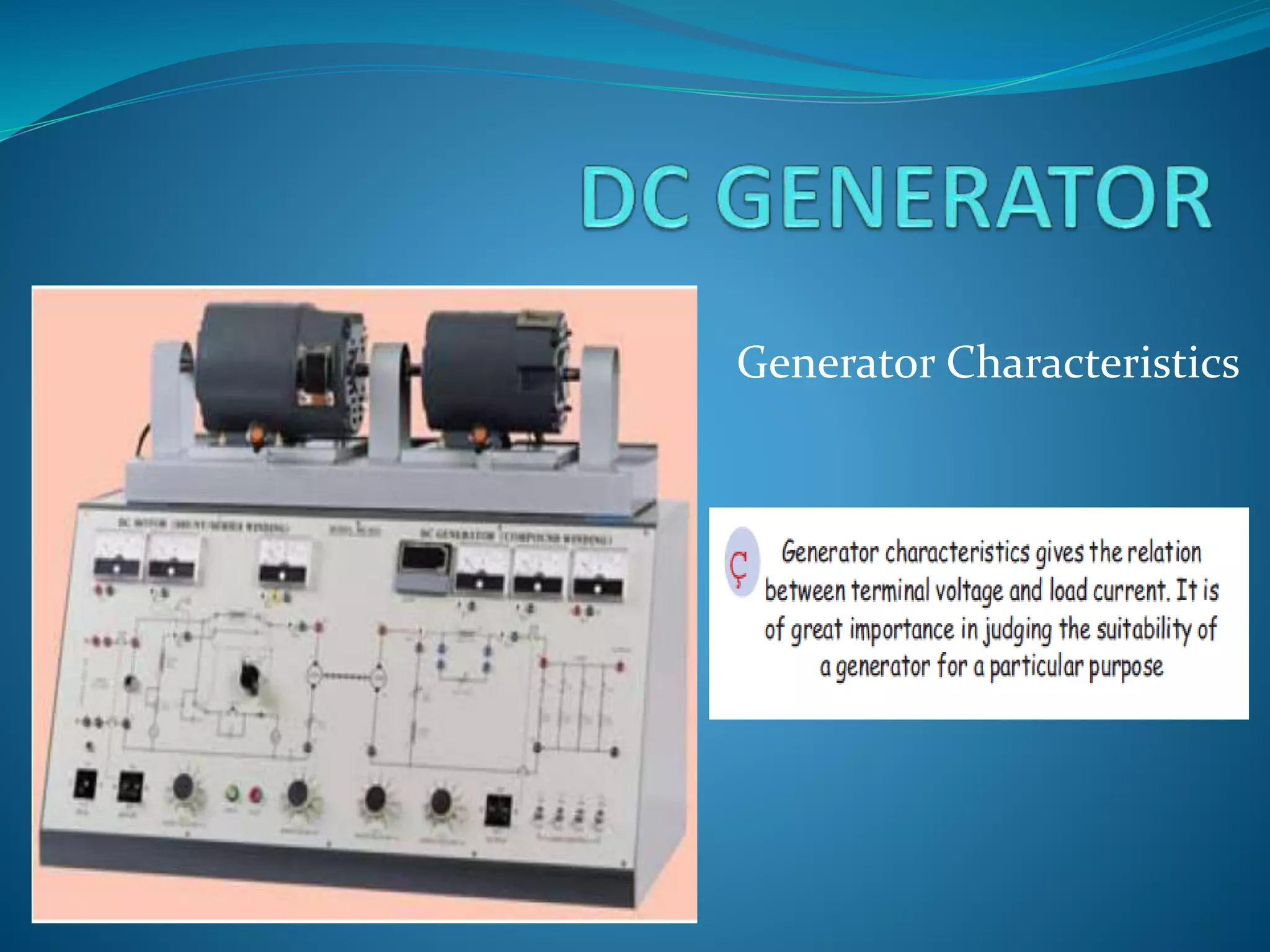
Generator Characteristics
DC Generator Characteristics
1. No-load saturation Characteristic (E0/If)
 It is also known as Magnetic Characteristic or Open-circuit
Characteristic (O.C.C.). It shows the relation between the no-
load generated e.m.f. in armature, E0 and the field or exciting
current If at a given fixed speed. It is just the magnetisation
curve for the material of the electromagnets.
 Its shape is practically the same for all generators whether
separately-excited or self-excited.
2. Internal or Total Characteristic (E/Ia)
 It gives the relation between the e.m.f. E actually induces in the
armature (after allowing for the demagnetising effect of
armature reaction) and the armature current Ia.
 This characteristic is of interest mainly to the designer
3. External Characteristic (V/I)
 It is also referred to as performance characteristic or
sometimes voltage-regulating curve.
 It gives relation between that terminal voltage V and
the load current I. This curve lies below the internal
characteristic because it takes into account the voltage
drop over the armature circuit resistance.
 The values of V are obtained by subtracting IaRa from
corresponding values of E. This characteristic is of
great importance in judging the suitability of a
generator for a particular purpose.
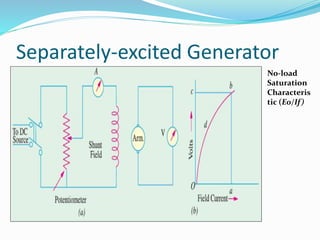
Separately-excited Generator
No-load
Saturation
Characteris
tic (E0/If)
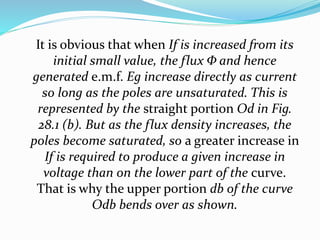
It is obvious that when If is increased from its
initial small value, the flux Φ and hence
generated e.m.f. Eg increase directly as current
so long as the poles are unsaturated. This is
represented by the straight portion Od in Fig.
28.1 (b). But as the flux density increases, the
poles become saturated, so a greater increase in
If is required to produce a given increase in
voltage than on the lower part of the curve.
That is why the upper portion db of the curve
Odb bends over as shown.
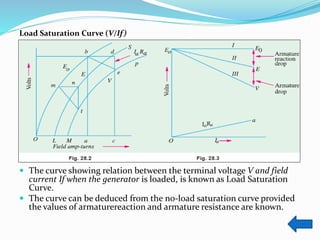
 The curve showing relation between the terminal voltage V and field
current If when the generator is loaded, is known as Load Saturation
Curve.
 The curve can be deduced from the no-load saturation curve provided
the values of armaturereaction and armature resistance are known.
Load Saturation Curve (V/If)
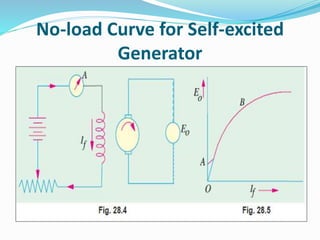
No-load Curve for Self-excited
Generator
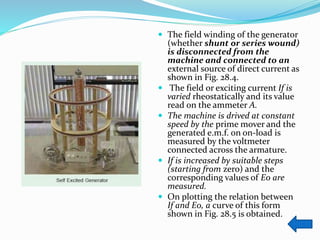
 The field winding of the generator
(whether shunt or series wound)
is disconnected from the
machine and connected to an
external source of direct current as
shown in Fig. 28.4.
 The field or exciting current If is
varied rheostatically and its value
read on the ammeter A.
 The machine is drived at constant
speed by the prime mover and the
generated e.m.f. on on-load is
measured by the voltmeter
connected across the armature.
 If is increased by suitable steps
(starting from zero) and the
corresponding values of E0 are
measured.
 On plotting the relation between
If and E0, a curve of this form
shown in Fig. 28.5 is obtained.
Critical Speed (Nc)
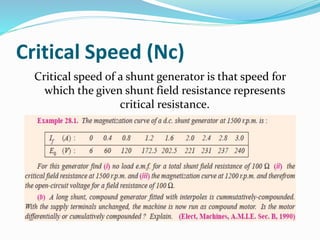
Critical speed of a shunt generator is that speed for
which the given shunt field resistance represents
critical resistance.
Solution.
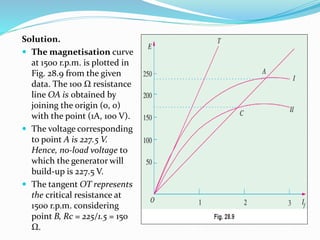
 The magnetisation curve
at 1500 r.p.m. is plotted in
Fig. 28.9 from the given
data. The 100 Ω resistance
line OA is obtained by
joining the origin (0, 0)
with the point (1A, 100 V).
 The voltage corresponding
to point A is 227.5 V.
Hence, no-load voltage to
which the generator will
build-up is 227.5 V.
 The tangent OT represents
the critical resistance at
1500 r.p.m. considering
point B, Rc = 225/1.5 = 150
Ω.
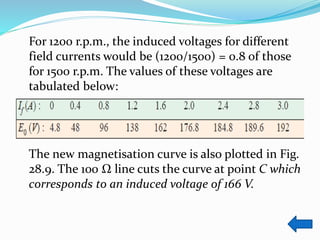
For 1200 r.p.m., the induced voltages for different
field currents would be (1200/1500) = 0.8 of those
for 1500 r.p.m. The values of these voltages are
tabulated below:
The new magnetisation curve is also plotted in Fig.
28.9. The 100 Ω line cuts the curve at point C which
corresponds to an induced voltage of 166 V.
Voltage Build up of a Shunt
Generator
 Before loading a shunt generator, it is allowed to build
up its voltage. Usually, there is always present some
residual magnetism in the poles, hence a small e.m.f. is
produced initially.
 This e.m.f. circulates a small current in the field circuit
which increases the pole flux (provided field circuit is
properly connected to armature, otherwise this current
may wipe off the residual magnetism).
 When flux is increased, generated e.m.f. is increased
which further increases the flux and so on.
We may summarize the
conditions necessary for
the build up of a(self-
excited) short generator as
follows:
 There must be some
residual magnetism in the
generator poles.
 For the given direction of
rotation, the shunt field
coils should be correctly
connected to the armature.
Conditions for Build-up of a Shunt
Generator
•If excited on open circuit,
its shunt field resistance
should be less than the
critical resistance.
• If excited on load, then its
shunt field resistance
should be more than a
certain minimum value of
resistance.
Other Factors Affecting Voltage
Building of a DC Generator
In addition to the factors mentioned above,
there are some other factors which affect the
voltage building of a self-excited d.c.
generator.
These factors are:
(i) reversed shunt field connection
(ii)reversed rotation and
(iii)reversed residual magnetism.
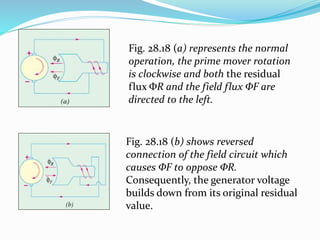
Fig. 28.18 (a) represents the normal
operation, the prime mover rotation
is clockwise and both the residual
flux ΦR and the field flux ΦF are
directed to the left.
Fig. 28.18 (b) shows reversed
connection of the field circuit which
causes ΦF to oppose ΦR.
Consequently, the generator voltage
builds down from its original residual
value.
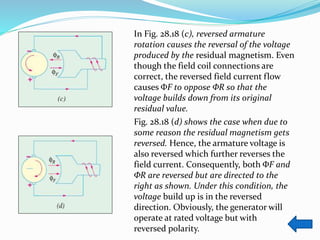
In Fig. 28.18 (c), reversed armature
rotation causes the reversal of the voltage
produced by the residual magnetism. Even
though the field coil connections are
correct, the reversed field current flow
causes ΦF to oppose ΦR so that the
voltage builds down from its original
residual value.
Fig. 28.18 (d) shows the case when due to
some reason the residual magnetism gets
reversed. Hence, the armature voltage is
also reversed which further reverses the
field current. Consequently, both ΦF and
ΦR are reversed but are directed to the
right as shown. Under this condition, the
voltage build up is in the reversed
direction. Obviously, the generator will
operate at rated voltage but with
reversed polarity.
External Characteristic
These are three main reasons for the drop in terminal voltage of a
shunt generator when under load.
 (i) Armature resistance drop :
As the load current increases, more and more voltage is
consumed in the ohmic resistance of the armature circuit.
Hence, the terminal voltage V = E − Ia Ra is decreased where
E is the induced e.m.f. in the armature under load condition.
 (ii) Armature reaction drop:
Due to the demagnetising effect of armature reaction, pole flux
is weakened and so the induced e.m.f. in the armature is
decreased.
 (iii) The drop in terminal voltage V due to (i) and (ii) results
in a decreased field current .
If which further reduces the induced e.m.f.
Voltage Regulation
By voltage regulation of a generator is meant the
change in its terminal voltage with the change in load
current when it is running at a constant speed. If the
change in voltage between no-load and full load is
small, then the generator is said to have good
regulation but if the change in voltage is large, then it
has poor regulation.
The voltage regulation of a d.c. generator is the
change in voltage when the load is reduced from
rated value to zero, expressed as percentage of the
rated load voltage.
QUESTION:
1. ___________gives the relation between terminal
voltage and load current.
2. Give the three most important characteristics or
curves of a d.c. generator.
3. What does Critical speed of a shunt generator
mean???
4. Give one condition necessary for the build-up of
(self-excited) shunt generator.
5. What are some other factors which affect the
voltage building of a self-excited d.c. generator?
6. What is Voltage Regulation?
7. If the series field amp-turns are such as to
produce the same voltage at rated load as at no-
load, then the generator is ___________.
8. If the series field amp-turns are such that the
rated-load voltage is greater than the no-load
voltage, then generator is_________.
9. If rated-load voltage is less than the no-load
voltage, then the generator is ___________.
10. Give one (1) use of a DC Generator.

DC GENERATOR

  • 1.
  • 3.
    DC Generator Characteristics 1.No-load saturation Characteristic (E0/If)  It is also known as Magnetic Characteristic or Open-circuit Characteristic (O.C.C.). It shows the relation between the no- load generated e.m.f. in armature, E0 and the field or exciting current If at a given fixed speed. It is just the magnetisation curve for the material of the electromagnets.  Its shape is practically the same for all generators whether separately-excited or self-excited. 2. Internal or Total Characteristic (E/Ia)  It gives the relation between the e.m.f. E actually induces in the armature (after allowing for the demagnetising effect of armature reaction) and the armature current Ia.  This characteristic is of interest mainly to the designer
  • 4.
    3. External Characteristic(V/I)  It is also referred to as performance characteristic or sometimes voltage-regulating curve.  It gives relation between that terminal voltage V and the load current I. This curve lies below the internal characteristic because it takes into account the voltage drop over the armature circuit resistance.  The values of V are obtained by subtracting IaRa from corresponding values of E. This characteristic is of great importance in judging the suitability of a generator for a particular purpose.
  • 5.
  • 6.
    It is obviousthat when If is increased from its initial small value, the flux Φ and hence generated e.m.f. Eg increase directly as current so long as the poles are unsaturated. This is represented by the straight portion Od in Fig. 28.1 (b). But as the flux density increases, the poles become saturated, so a greater increase in If is required to produce a given increase in voltage than on the lower part of the curve. That is why the upper portion db of the curve Odb bends over as shown.
  • 7.
     The curveshowing relation between the terminal voltage V and field current If when the generator is loaded, is known as Load Saturation Curve.  The curve can be deduced from the no-load saturation curve provided the values of armaturereaction and armature resistance are known. Load Saturation Curve (V/If)
  • 8.
    No-load Curve forSelf-excited Generator
  • 9.
     The fieldwinding of the generator (whether shunt or series wound) is disconnected from the machine and connected to an external source of direct current as shown in Fig. 28.4.  The field or exciting current If is varied rheostatically and its value read on the ammeter A.  The machine is drived at constant speed by the prime mover and the generated e.m.f. on on-load is measured by the voltmeter connected across the armature.  If is increased by suitable steps (starting from zero) and the corresponding values of E0 are measured.  On plotting the relation between If and E0, a curve of this form shown in Fig. 28.5 is obtained.
  • 10.
    Critical Speed (Nc) Criticalspeed of a shunt generator is that speed for which the given shunt field resistance represents critical resistance.
  • 11.
    Solution.  The magnetisationcurve at 1500 r.p.m. is plotted in Fig. 28.9 from the given data. The 100 Ω resistance line OA is obtained by joining the origin (0, 0) with the point (1A, 100 V).  The voltage corresponding to point A is 227.5 V. Hence, no-load voltage to which the generator will build-up is 227.5 V.  The tangent OT represents the critical resistance at 1500 r.p.m. considering point B, Rc = 225/1.5 = 150 Ω.
  • 12.
    For 1200 r.p.m.,the induced voltages for different field currents would be (1200/1500) = 0.8 of those for 1500 r.p.m. The values of these voltages are tabulated below: The new magnetisation curve is also plotted in Fig. 28.9. The 100 Ω line cuts the curve at point C which corresponds to an induced voltage of 166 V.
  • 13.
    Voltage Build upof a Shunt Generator  Before loading a shunt generator, it is allowed to build up its voltage. Usually, there is always present some residual magnetism in the poles, hence a small e.m.f. is produced initially.  This e.m.f. circulates a small current in the field circuit which increases the pole flux (provided field circuit is properly connected to armature, otherwise this current may wipe off the residual magnetism).  When flux is increased, generated e.m.f. is increased which further increases the flux and so on.
  • 14.
    We may summarizethe conditions necessary for the build up of a(self- excited) short generator as follows:  There must be some residual magnetism in the generator poles.  For the given direction of rotation, the shunt field coils should be correctly connected to the armature. Conditions for Build-up of a Shunt Generator •If excited on open circuit, its shunt field resistance should be less than the critical resistance. • If excited on load, then its shunt field resistance should be more than a certain minimum value of resistance.
  • 15.
    Other Factors AffectingVoltage Building of a DC Generator In addition to the factors mentioned above, there are some other factors which affect the voltage building of a self-excited d.c. generator. These factors are: (i) reversed shunt field connection (ii)reversed rotation and (iii)reversed residual magnetism.
  • 16.
    Fig. 28.18 (a)represents the normal operation, the prime mover rotation is clockwise and both the residual flux ΦR and the field flux ΦF are directed to the left. Fig. 28.18 (b) shows reversed connection of the field circuit which causes ΦF to oppose ΦR. Consequently, the generator voltage builds down from its original residual value.
  • 17.
    In Fig. 28.18(c), reversed armature rotation causes the reversal of the voltage produced by the residual magnetism. Even though the field coil connections are correct, the reversed field current flow causes ΦF to oppose ΦR so that the voltage builds down from its original residual value. Fig. 28.18 (d) shows the case when due to some reason the residual magnetism gets reversed. Hence, the armature voltage is also reversed which further reverses the field current. Consequently, both ΦF and ΦR are reversed but are directed to the right as shown. Under this condition, the voltage build up is in the reversed direction. Obviously, the generator will operate at rated voltage but with reversed polarity.
  • 18.
    External Characteristic These arethree main reasons for the drop in terminal voltage of a shunt generator when under load.  (i) Armature resistance drop : As the load current increases, more and more voltage is consumed in the ohmic resistance of the armature circuit. Hence, the terminal voltage V = E − Ia Ra is decreased where E is the induced e.m.f. in the armature under load condition.  (ii) Armature reaction drop: Due to the demagnetising effect of armature reaction, pole flux is weakened and so the induced e.m.f. in the armature is decreased.  (iii) The drop in terminal voltage V due to (i) and (ii) results in a decreased field current . If which further reduces the induced e.m.f.
  • 19.
    Voltage Regulation By voltageregulation of a generator is meant the change in its terminal voltage with the change in load current when it is running at a constant speed. If the change in voltage between no-load and full load is small, then the generator is said to have good regulation but if the change in voltage is large, then it has poor regulation. The voltage regulation of a d.c. generator is the change in voltage when the load is reduced from rated value to zero, expressed as percentage of the rated load voltage.
  • 20.
    QUESTION: 1. ___________gives therelation between terminal voltage and load current. 2. Give the three most important characteristics or curves of a d.c. generator. 3. What does Critical speed of a shunt generator mean??? 4. Give one condition necessary for the build-up of (self-excited) shunt generator. 5. What are some other factors which affect the voltage building of a self-excited d.c. generator?
  • 21.
    6. What isVoltage Regulation? 7. If the series field amp-turns are such as to produce the same voltage at rated load as at no- load, then the generator is ___________. 8. If the series field amp-turns are such that the rated-load voltage is greater than the no-load voltage, then generator is_________. 9. If rated-load voltage is less than the no-load voltage, then the generator is ___________. 10. Give one (1) use of a DC Generator.