Data : data is the set of static value you store in
the table of database.
Information: information is the data that is
retrieve and assigned in a way that is meaningful
to the person viewing it.
Database :a database is the collection of data
that is organized so that its content can easily be
accessed, managed and updated.
The importance of database are as follows:
-data can stored in small area.
-computerized database save time while
searching specific data.
-database can stored the data for the long
time.
-Computerized database save data from
being lost.
Database management system(DBMS)
Database management system is a collection of
software that manages data stored in database.
It is collection of software which is used to
stored data ,records , process them and obtained
desired information.
Some popular DBMS software are:
MS-Access ,FoxPro ,oracle ,FoxBASE ,dbase , my
sql ect.
Easy to add new data
Easy to modify the data.
Delete existing data.
Sorting and indexing data.
Easy to search the data.
Print the formatted report
It can use SQL and oracle
Advantage of DBMS
 It reduce data redundancy .
 It allows sharing data among different users and
programs.
 Easy for editing,adding and removing of data.
 Mass storage of data can be stored in small disc.
 It provides better interacting environment to the
user.
Disadvantage of DBMS
 Costly and time consuming procedure.
 Additional hardware and software may be required
 Qualified person required to operate.
 Data security problem may be occurred.
Elements of database.
 Field:
it is the smallest unit of database .it is a place
where many type of information are stored eg. name,
age,phone ect
 Record:
a record is a collection of multiple related field ,
which may give complete information about a person
or thing.
TABLE: a table is a collection of record or group of
records. A table contains a number of row and
columns.
Cont..
 Tuple:
a record row in database is called tuple.
INDEX:
the index is used to keep the data in organized
form and helps faster retrieval data.
CELL:
a cell is a intersection of row and columns.
Database models
 The various database models
There are four models of DBMS, which are distinguished
based on how they represent the data contained:
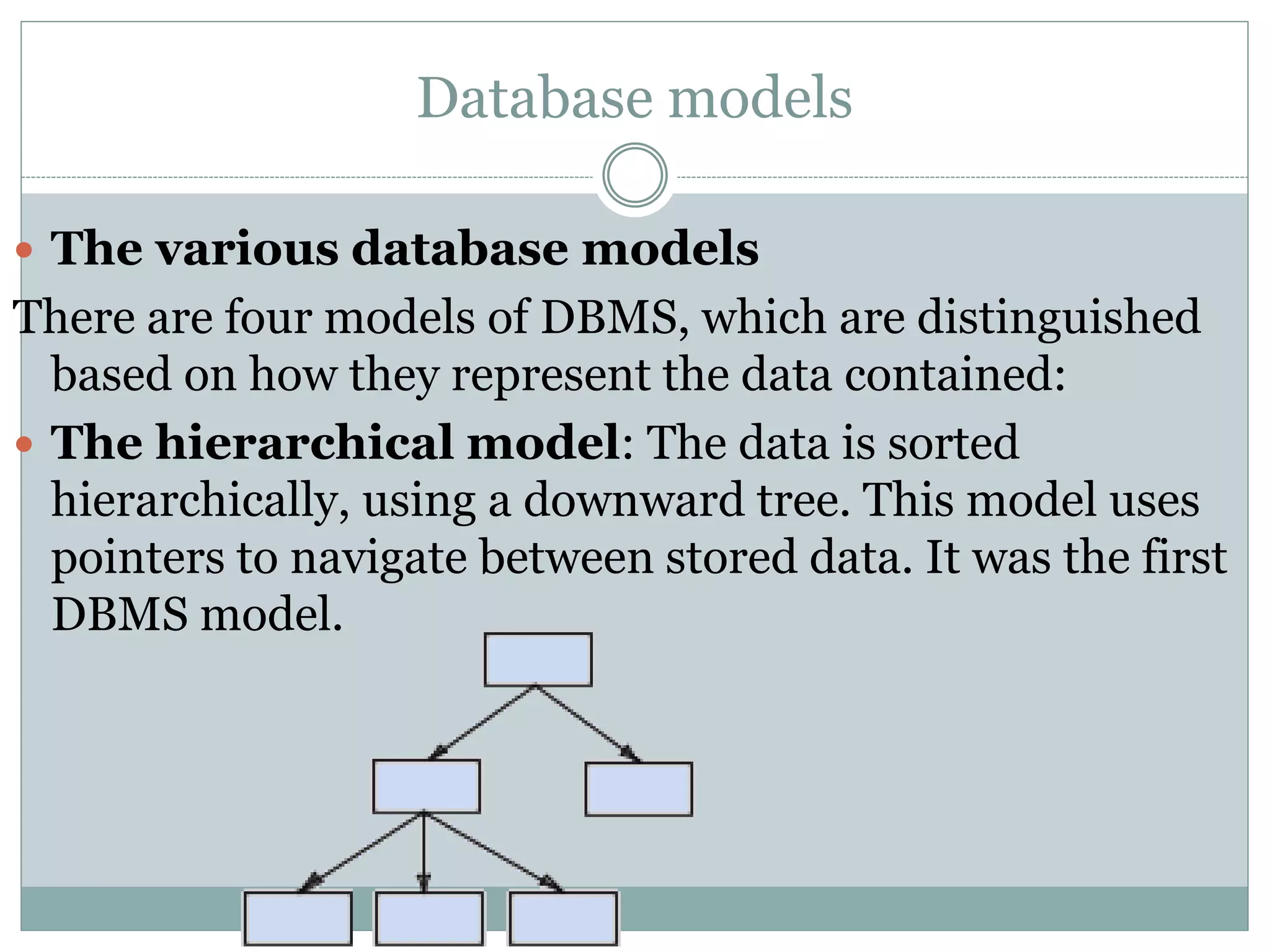
 The hierarchical model: The data is sorted
hierarchically, using a downward tree. This model uses
pointers to navigate between stored data. It was the first
DBMS model.
Cont..
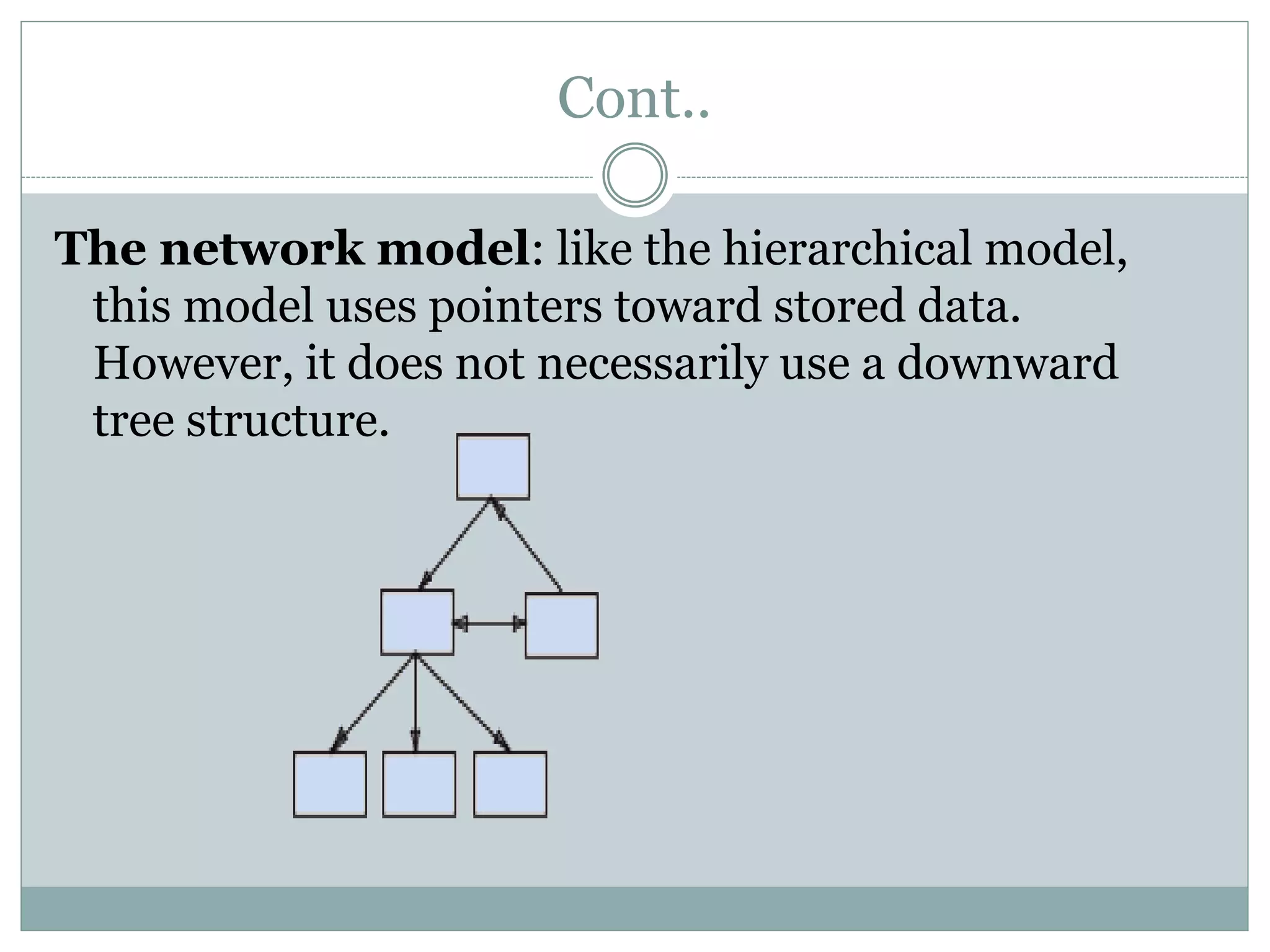
The network model: like the hierarchical model,
this model uses pointers toward stored data.
However, it does not necessarily use a downward
tree structure.
Cont..
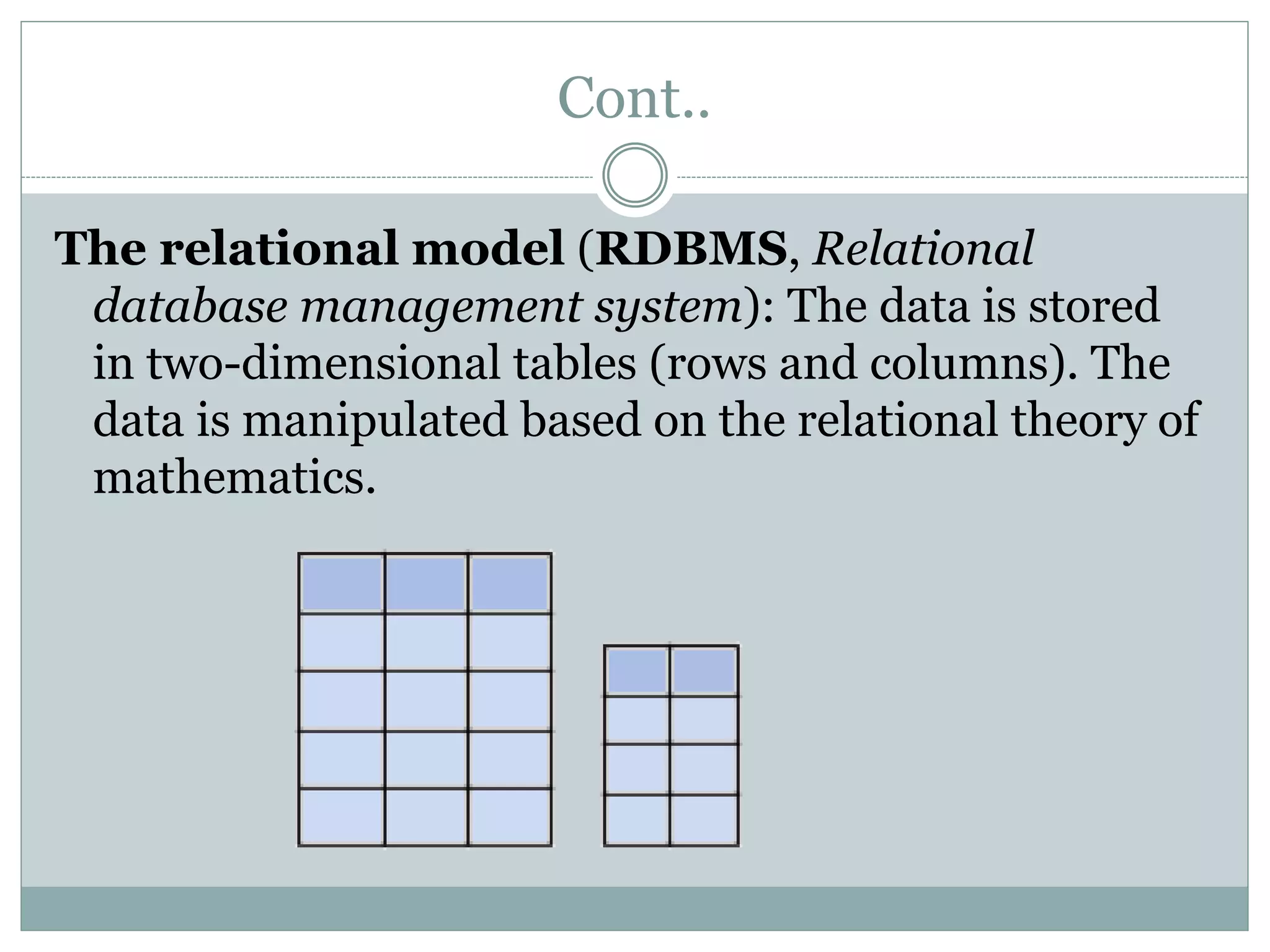
The relational model (RDBMS, Relational
database management system): The data is stored
in two-dimensional tables (rows and columns). The
data is manipulated based on the relational theory of
mathematics.
Cont..
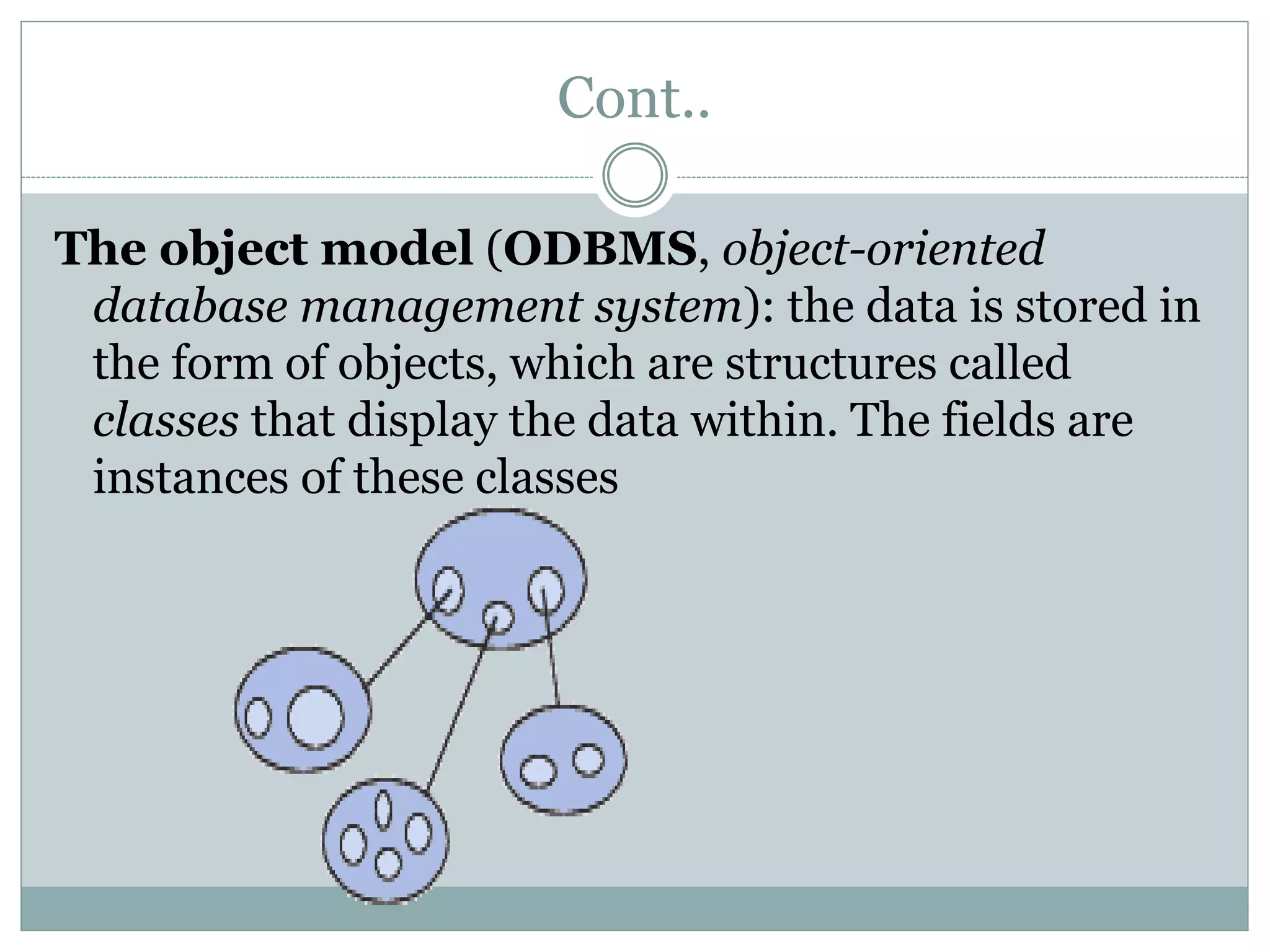
The object model (ODBMS, object-oriented
database management system): the data is stored in
the form of objects, which are structures called
classes that display the data within. The fields are
instances of these classes
DBMS
A database management system (DBMS) is a set of programs or software
which provides services for accessing a database, while maintaining all
the required features of the data. Some of the major services of a DBMS
are as given below.
(i)Transaction Management
(ii) Security Management
(iii) Recovery Management
(iv) Programming Interface
(v) Concurrency Control
(vi) Storage Manager
(vii) Application
Hence DBMS is software that creates, manages, protects, and provides
access to a database.
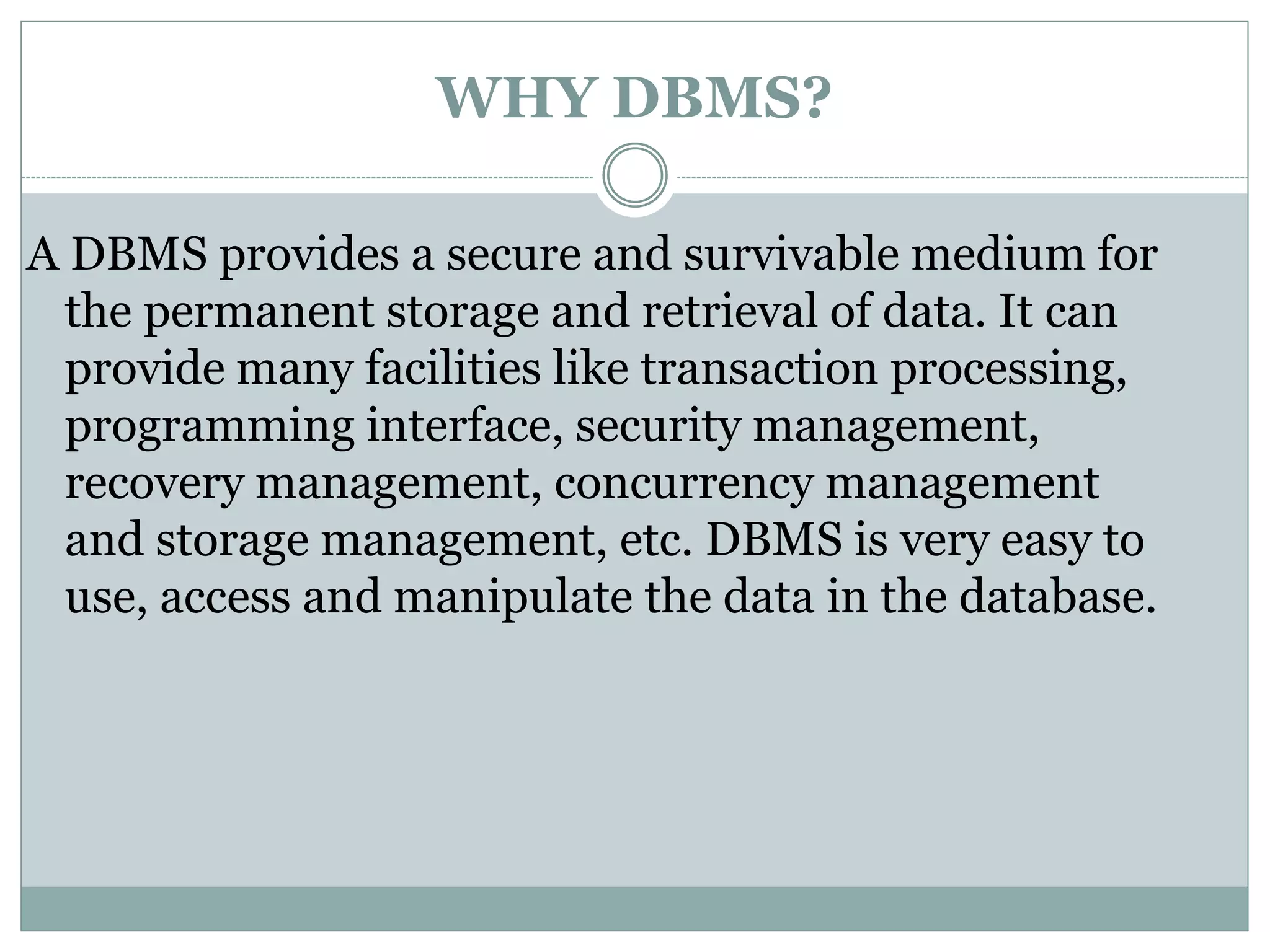
WHY DBMS?
A DBMS provides a secure and survivable medium for
the permanent storage and retrieval of data. It can
provide many facilities like transaction processing,
programming interface, security management,
recovery management, concurrency management
and storage management, etc. DBMS is very easy to
use, access and manipulate the data in the database.
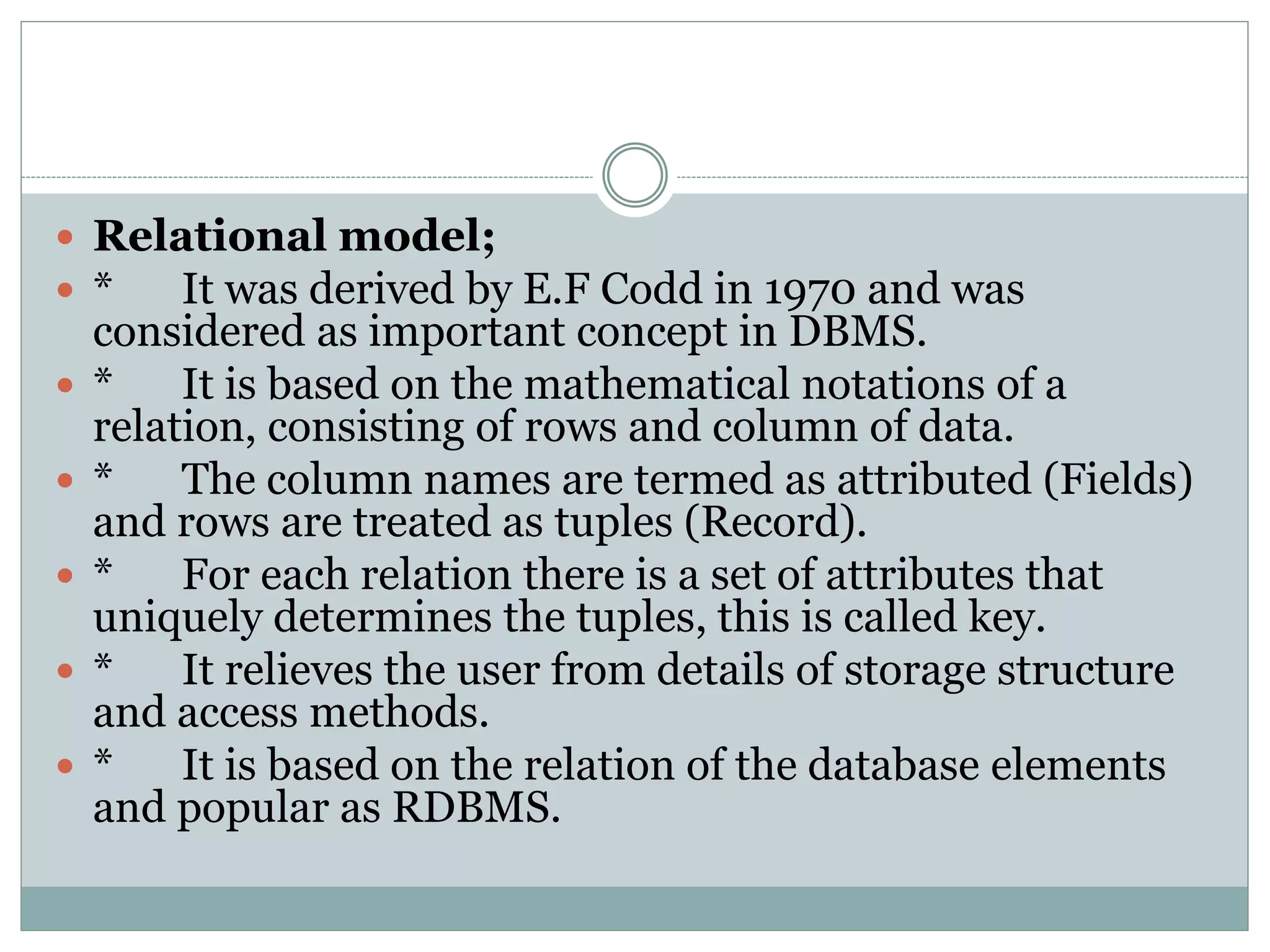
 Relational model;
 * It was derived by E.F Codd in 1970 and was
considered as important concept in DBMS.
 * It is based on the mathematical notations of a
relation, consisting of rows and column of data.
 * The column names are termed as attributed (Fields)
and rows are treated as tuples (Record).
 * For each relation there is a set of attributes that
uniquely determines the tuples, this is called key.
 * It relieves the user from details of storage structure
and access methods.
 * It is based on the relation of the database elements
and popular as RDBMS.
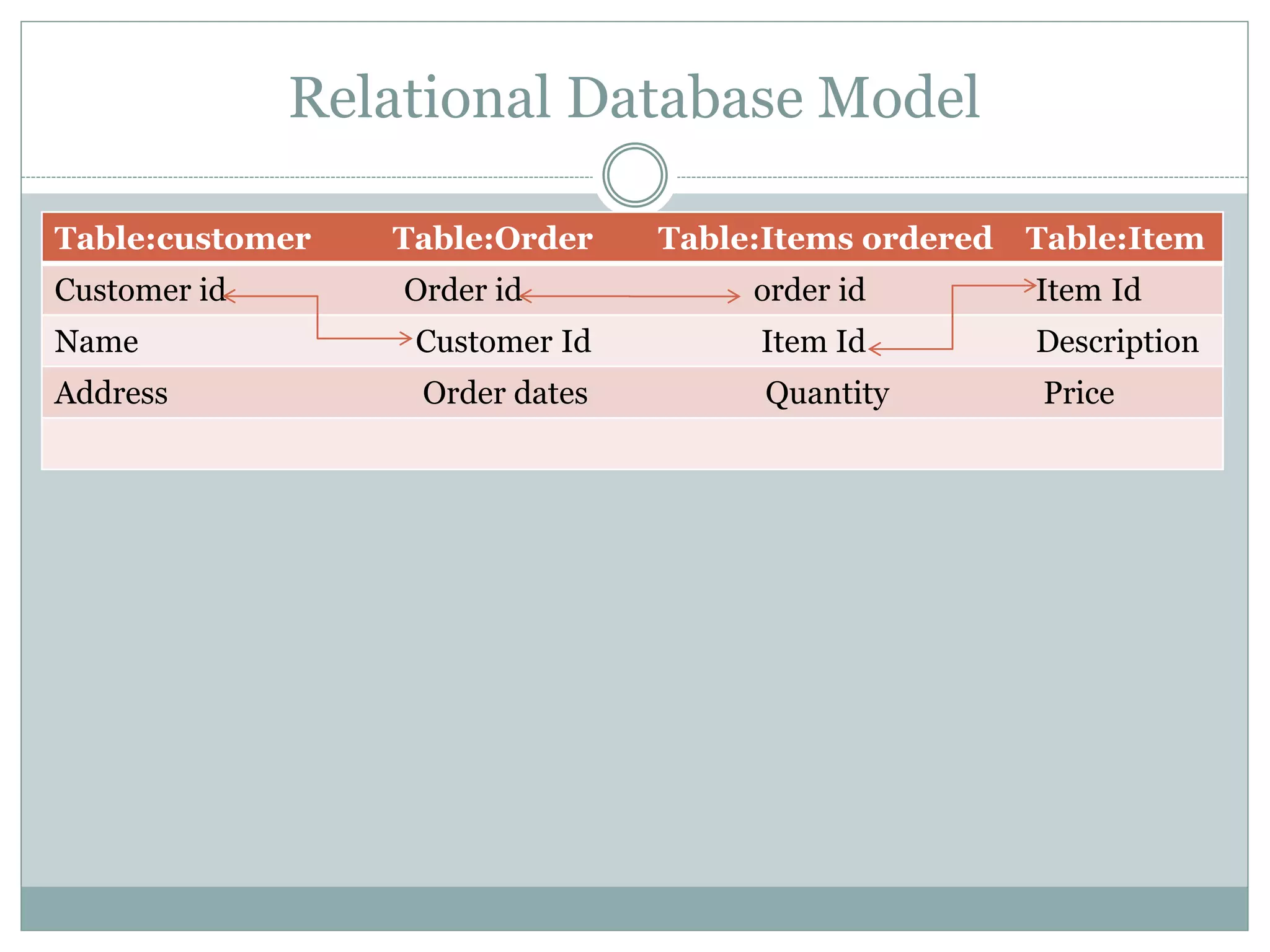
Relational Database Model
Table:customer Table:Order Table:Items ordered Table:Item
Customer id Order id order id Item Id
Name Customer Id Item Id Description
Address Order dates Quantity Price
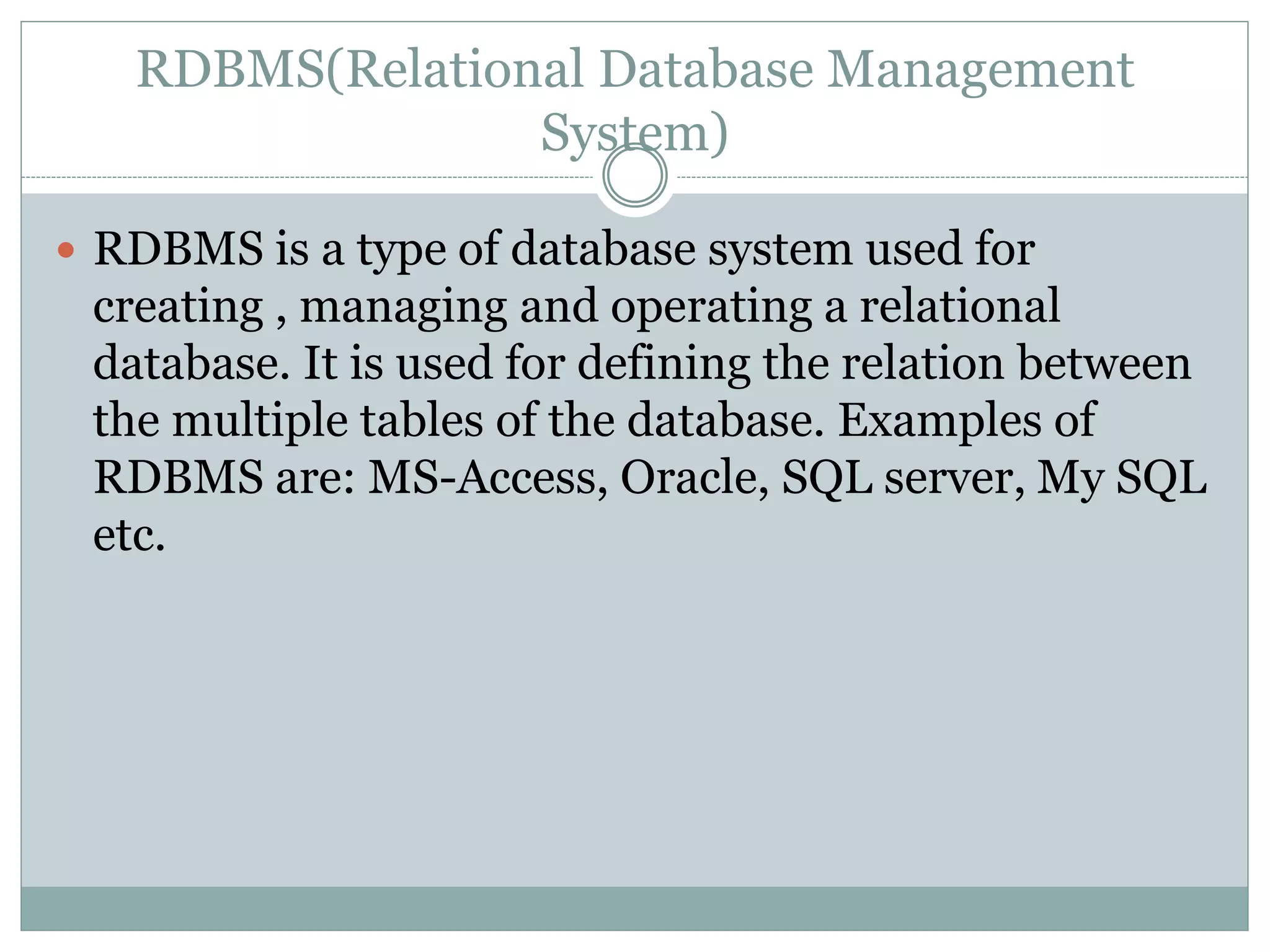
RDBMS(Relational Database Management
System)
 RDBMS is a type of database system used for
creating , managing and operating a relational
database. It is used for defining the relation between
the multiple tables of the database. Examples of
RDBMS are: MS-Access, Oracle, SQL server, My SQL
etc.
Advantages of RDBMS
 Redundancy can be reduced
 Inconsistency can be avoided: Reduced redundancy results in
avoiding inconsistent state. RDBMS ensures that the database is always in
consistent state.
 Standards can be enforces : RDBMS applies standards or rules,
which is used to minimize error during input process and maintain
security.
 Integrity can be maintained: RDBMS helps to maintain accuracy
of the data by applying standards or rules.
 Data Can be shared
 Provides security
 Provides facility for backup and recovery.
Application of DBMS
 Banking
 Business
 Airlines and ticket reservation
 University
 Manufacturing and sales
 Human resource
 Library system
 Inventory management
 Telecommunication
 Accounting and finance
 E-commerce

Database management system

  • 1.
    Data : datais the set of static value you store in the table of database. Information: information is the data that is retrieve and assigned in a way that is meaningful to the person viewing it. Database :a database is the collection of data that is organized so that its content can easily be accessed, managed and updated.
  • 2.
    The importance ofdatabase are as follows: -data can stored in small area. -computerized database save time while searching specific data. -database can stored the data for the long time. -Computerized database save data from being lost.
  • 3.
    Database management system(DBMS) Databasemanagement system is a collection of software that manages data stored in database. It is collection of software which is used to stored data ,records , process them and obtained desired information. Some popular DBMS software are: MS-Access ,FoxPro ,oracle ,FoxBASE ,dbase , my sql ect.
  • 4.
    Easy to addnew data Easy to modify the data. Delete existing data. Sorting and indexing data. Easy to search the data. Print the formatted report It can use SQL and oracle
  • 5.
    Advantage of DBMS It reduce data redundancy .  It allows sharing data among different users and programs.  Easy for editing,adding and removing of data.  Mass storage of data can be stored in small disc.  It provides better interacting environment to the user.
  • 6.
    Disadvantage of DBMS Costly and time consuming procedure.  Additional hardware and software may be required  Qualified person required to operate.  Data security problem may be occurred.
  • 7.
    Elements of database. Field: it is the smallest unit of database .it is a place where many type of information are stored eg. name, age,phone ect  Record: a record is a collection of multiple related field , which may give complete information about a person or thing. TABLE: a table is a collection of record or group of records. A table contains a number of row and columns.
  • 8.
    Cont..  Tuple: a recordrow in database is called tuple. INDEX: the index is used to keep the data in organized form and helps faster retrieval data. CELL: a cell is a intersection of row and columns.
  • 9.
    Database models  Thevarious database models There are four models of DBMS, which are distinguished based on how they represent the data contained:  The hierarchical model: The data is sorted hierarchically, using a downward tree. This model uses pointers to navigate between stored data. It was the first DBMS model.
  • 10.
    Cont.. The network model:like the hierarchical model, this model uses pointers toward stored data. However, it does not necessarily use a downward tree structure.
  • 11.
    Cont.. The relational model(RDBMS, Relational database management system): The data is stored in two-dimensional tables (rows and columns). The data is manipulated based on the relational theory of mathematics.
  • 12.
    Cont.. The object model(ODBMS, object-oriented database management system): the data is stored in the form of objects, which are structures called classes that display the data within. The fields are instances of these classes
  • 13.
    DBMS A database managementsystem (DBMS) is a set of programs or software which provides services for accessing a database, while maintaining all the required features of the data. Some of the major services of a DBMS are as given below. (i)Transaction Management (ii) Security Management (iii) Recovery Management (iv) Programming Interface (v) Concurrency Control (vi) Storage Manager (vii) Application Hence DBMS is software that creates, manages, protects, and provides access to a database.
  • 14.
    WHY DBMS? A DBMSprovides a secure and survivable medium for the permanent storage and retrieval of data. It can provide many facilities like transaction processing, programming interface, security management, recovery management, concurrency management and storage management, etc. DBMS is very easy to use, access and manipulate the data in the database.
  • 15.
     Relational model; * It was derived by E.F Codd in 1970 and was considered as important concept in DBMS.  * It is based on the mathematical notations of a relation, consisting of rows and column of data.  * The column names are termed as attributed (Fields) and rows are treated as tuples (Record).  * For each relation there is a set of attributes that uniquely determines the tuples, this is called key.  * It relieves the user from details of storage structure and access methods.  * It is based on the relation of the database elements and popular as RDBMS.
  • 16.
    Relational Database Model Table:customerTable:Order Table:Items ordered Table:Item Customer id Order id order id Item Id Name Customer Id Item Id Description Address Order dates Quantity Price
  • 17.
    RDBMS(Relational Database Management System) RDBMS is a type of database system used for creating , managing and operating a relational database. It is used for defining the relation between the multiple tables of the database. Examples of RDBMS are: MS-Access, Oracle, SQL server, My SQL etc.
  • 18.
    Advantages of RDBMS Redundancy can be reduced  Inconsistency can be avoided: Reduced redundancy results in avoiding inconsistent state. RDBMS ensures that the database is always in consistent state.  Standards can be enforces : RDBMS applies standards or rules, which is used to minimize error during input process and maintain security.  Integrity can be maintained: RDBMS helps to maintain accuracy of the data by applying standards or rules.  Data Can be shared  Provides security  Provides facility for backup and recovery.
  • 19.
    Application of DBMS Banking  Business  Airlines and ticket reservation  University  Manufacturing and sales  Human resource  Library system  Inventory management  Telecommunication  Accounting and finance  E-commerce