SUBMITTED BY:
AAYUSH VOHRA
DIPLOMA(M.E),R13ETDME001
A Project on
DBMS and RDBMS
DBMS
 DBMS is a software system that allow us to manage
the database.
 DATA BASE : It is a group of information or a
collection of data may be organized in the form of
files or tables.
 Examples: Oracle , SQL , Sybase etc.
Components of DBMS:
 User
 Hardware
 Software
 Data
Application of DBMS:
• Banking sector
• Universities
• Railway Reservation
• Finance
• Sales
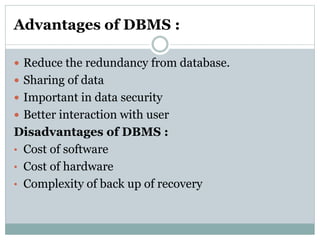
Advantages of DBMS :
 Reduce the redundancy from database.
 Sharing of data
 Important in data security
 Better interaction with user
Disadvantages of DBMS :
• Cost of software
• Cost of hardware
• Complexity of back up of recovery
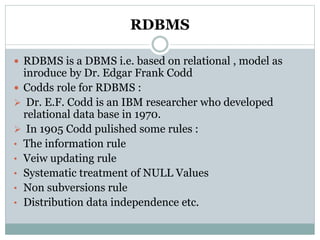
RDBMS
 RDBMS is a DBMS i.e. based on relational , model as
inroduce by Dr. Edgar Frank Codd
 Codds role for RDBMS :
 Dr. E.F. Codd is an IBM researcher who developed
relational data base in 1970.
 In 1905 Codd pulished some rules :
• The information rule
• Veiw updating rule
• Systematic treatment of NULL Values
• Non subversions rule
• Distribution data independence etc.
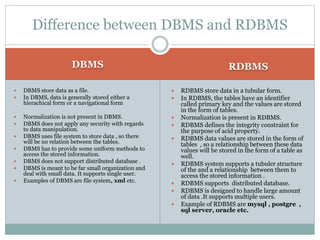
DBMS RDBMS
 DBMS store data as a file.
 In DBMS, data is generally stored either a
hierachical form or a navigational form
 Normalization is not present in DBMS.
 DBMS does not apply any security with regards
to data manipulation.
 DBMS uses file system to store data , so there
will be no relation between the tables.
 DBMS has to provide some uniform methods to
access the stored information.
 DBMS does not support distributed database .
 DBMS is meant to be far small organization and
deal with small data. It supports single user.
 Examples of DBMS are file system, xml etc.
 RDBMS store data in a tubular form.
 In RDBMS, the tables have an identifier
called primary key and the values are stored
in the form of tables.
 Normalization is present in RDBMS.
 RDBMS defines the integrity constraint for
the purpose of acid property.
 RDBMS data values are stored in the form of
tables , so a relationship between these data
values will be stored in the form of a table as
well.
 RDBMS system supports a tubuler structure
of the and a relationship between them to
access the stored information .
 RDBMS supports distributed database.
 RDBMS is designed to handle large amount
of data .It supports multiple users.
 Example of RDBMS are mysql , postgre ,
sql server, oracle etc.
Difference between DBMS and RDBMS
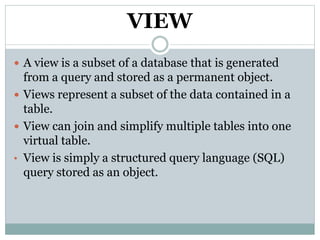
VIEW
 A view is a subset of a database that is generated
from a query and stored as a permanent object.
 Views represent a subset of the data contained in a
table.
 View can join and simplify multiple tables into one
virtual table.
• View is simply a structured query language (SQL)
query stored as an object.
Concept of Keys:
1. Super Key – An attribute or a combination of attribute
that is used to identify the records uniquely is known as
Super Key. E.g: ID, ID name, ID adress etc.
2. Candidate Key – It is an attribute or combination of
attribute that identifies the record uniquely but none of its
proper subsets can identify the records uniquely. E.g : ID,
Name , Address
3. Primary Key – A Candidate Key that is used by the
database designer for unique identification of each row in a
table is known as Primary Key.
4. Foreign Key – A foreign key is an attribute or
combination of attribute in one base table that points to the
candidate key (generally it is the primary key) of another
table.
THANK YOU

A project on DBMS and RDMS

  • 1.
  • 2.
    DBMS  DBMS isa software system that allow us to manage the database.  DATA BASE : It is a group of information or a collection of data may be organized in the form of files or tables.  Examples: Oracle , SQL , Sybase etc.
  • 3.
    Components of DBMS: User  Hardware  Software  Data Application of DBMS: • Banking sector • Universities • Railway Reservation • Finance • Sales
  • 4.
    Advantages of DBMS:  Reduce the redundancy from database.  Sharing of data  Important in data security  Better interaction with user Disadvantages of DBMS : • Cost of software • Cost of hardware • Complexity of back up of recovery
  • 5.
    RDBMS  RDBMS isa DBMS i.e. based on relational , model as inroduce by Dr. Edgar Frank Codd  Codds role for RDBMS :  Dr. E.F. Codd is an IBM researcher who developed relational data base in 1970.  In 1905 Codd pulished some rules : • The information rule • Veiw updating rule • Systematic treatment of NULL Values • Non subversions rule • Distribution data independence etc.
  • 6.
    DBMS RDBMS  DBMSstore data as a file.  In DBMS, data is generally stored either a hierachical form or a navigational form  Normalization is not present in DBMS.  DBMS does not apply any security with regards to data manipulation.  DBMS uses file system to store data , so there will be no relation between the tables.  DBMS has to provide some uniform methods to access the stored information.  DBMS does not support distributed database .  DBMS is meant to be far small organization and deal with small data. It supports single user.  Examples of DBMS are file system, xml etc.  RDBMS store data in a tubular form.  In RDBMS, the tables have an identifier called primary key and the values are stored in the form of tables.  Normalization is present in RDBMS.  RDBMS defines the integrity constraint for the purpose of acid property.  RDBMS data values are stored in the form of tables , so a relationship between these data values will be stored in the form of a table as well.  RDBMS system supports a tubuler structure of the and a relationship between them to access the stored information .  RDBMS supports distributed database.  RDBMS is designed to handle large amount of data .It supports multiple users.  Example of RDBMS are mysql , postgre , sql server, oracle etc. Difference between DBMS and RDBMS
  • 7.
    VIEW  A viewis a subset of a database that is generated from a query and stored as a permanent object.  Views represent a subset of the data contained in a table.  View can join and simplify multiple tables into one virtual table. • View is simply a structured query language (SQL) query stored as an object.
  • 8.
    Concept of Keys: 1.Super Key – An attribute or a combination of attribute that is used to identify the records uniquely is known as Super Key. E.g: ID, ID name, ID adress etc. 2. Candidate Key – It is an attribute or combination of attribute that identifies the record uniquely but none of its proper subsets can identify the records uniquely. E.g : ID, Name , Address 3. Primary Key – A Candidate Key that is used by the database designer for unique identification of each row in a table is known as Primary Key. 4. Foreign Key – A foreign key is an attribute or combination of attribute in one base table that points to the candidate key (generally it is the primary key) of another table.
  • 9.