
• Databases to improve
business performance and
decision making
• Client-server architecture
Naveen Raj D.S
Databases to improve business performance and
decision making
Businesses use their databases to:
 Keep track of basic transactions
 Provide information that will help the company run the business
more efficiently
 Help managers and employees make better decisions
Data warehouse: a database that stores current and historical
data from core operational transactional systems for use in
management analysis, but this data cannot be altered.
Data mart: A subset of a data warehouse in which a
summarized or highly focused portion of the organization's
data is placed in a separate database for a specific population
Business intelligence (BI) tools: Data analysis tools used for
consolidating, analyzing, and accessing vast stores of data to
help in decision making, such as software for database query
and reporting, tools for multidimensional data analysis (online
analytical processing), and data mining
of users.
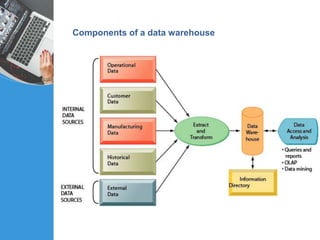
Components of a data warehouse
Client-server architecture
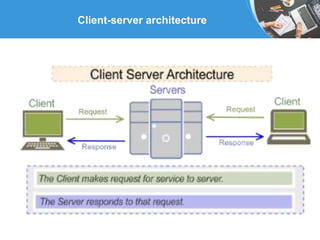
• Client-server architecture (client/server) is a network architecture
in which each computer or process on the network is either a client
or a server. Servers are powerful computers or processes
dedicated to managing disk drives (file servers), printers (print
servers), or network traffic (network servers ). Clients are PCs or
workstations on which users run applications. Clients rely on
servers for resources, such as files, devices, and even processing
power.
• Another type of network architecture is known as a peer-to-peer
architecture because each node has equivalent responsibilities.
Both client/server and peer-to-peer architectures are widely used,
and each has unique advantages and disadvantages.
• Client-server architectures are sometimes called two-tier
architectures
Client-server architecture

Databases to improve business performance and decision making Client-server architecture

  • 1.
    • Databases toimprove business performance and decision making • Client-server architecture Naveen Raj D.S
  • 2.
    Databases to improvebusiness performance and decision making Businesses use their databases to:  Keep track of basic transactions  Provide information that will help the company run the business more efficiently  Help managers and employees make better decisions
  • 3.
    Data warehouse: adatabase that stores current and historical data from core operational transactional systems for use in management analysis, but this data cannot be altered. Data mart: A subset of a data warehouse in which a summarized or highly focused portion of the organization's data is placed in a separate database for a specific population Business intelligence (BI) tools: Data analysis tools used for consolidating, analyzing, and accessing vast stores of data to help in decision making, such as software for database query and reporting, tools for multidimensional data analysis (online analytical processing), and data mining of users.
  • 4.
    Components of adata warehouse
  • 5.
    Client-server architecture • Client-serverarchitecture (client/server) is a network architecture in which each computer or process on the network is either a client or a server. Servers are powerful computers or processes dedicated to managing disk drives (file servers), printers (print servers), or network traffic (network servers ). Clients are PCs or workstations on which users run applications. Clients rely on servers for resources, such as files, devices, and even processing power. • Another type of network architecture is known as a peer-to-peer architecture because each node has equivalent responsibilities. Both client/server and peer-to-peer architectures are widely used, and each has unique advantages and disadvantages. • Client-server architectures are sometimes called two-tier architectures
  • 6.