
Advance Database Systems
Overview of RDBMS
Contents
• Database Definitions and Advantages of RDBMS
• Hierarchical Structure of DBMS
Why you Should take this Course
Jonathan Abrams Friendster fails
due to not optimized and efficient
Database System
Mark Zuckerberg Facebook did not fail
due to optimized and efficient
Database System
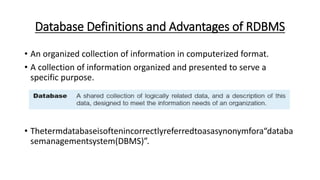
Database Definitions and Advantages of RDBMS
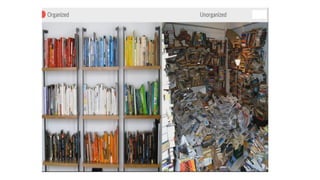
• An organized collection of information in computerized format.
• A collection of information organized and presented to serve a
specific purpose.
• Thetermdatabaseisoftenincorrectlyreferredtoasasynonymfora“databa
semanagementsystem(DBMS)”.
Data and Information
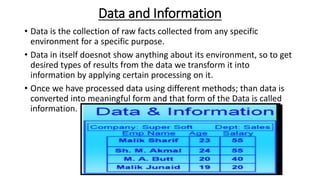
• Data is the collection of raw facts collected from any specific
environment for a specific purpose.
• Data in itself doesnot show anything about its environment, so to get
desired types of results from the data we transform it into
information by applying certain processing on it.
• Once we have processed data using different methods; than data is
converted into meaningful form and that form of the Data is called
information.
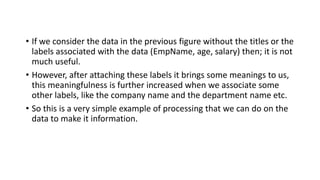
• If we consider the data in the previous figure without the titles or the
labels associated with the data (EmpName, age, salary) then; it is not
much useful.
• However, after attaching these labels it brings some meanings to us,
this meaningfulness is further increased when we associate some
other labels, like the company name and the department name etc.
• So this is a very simple example of processing that we can do on the
data to make it information.
Database Systems
• Thetermdatabasesystemisacombinationofdat
abaseandtheDatabaseManagementSystem(D
BMS).
• So, database is collection of meaningful
data/information, DBMS is a tool to manage
this data, and both jointly are called database
system.
Why Use Models?
• Models can be useful when we want to examine or manage part of the real
world.
• The costs of using a model are often considerably lower than the costs of
using or experimenting with the real world itself.
• Examples:
• Network Model Simulation for an Organization in Packet Tracer
• World Map
• ERD for Relational Database Systems.
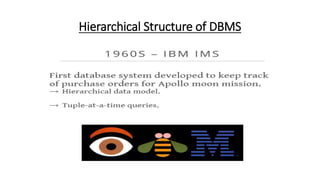
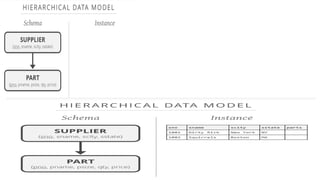
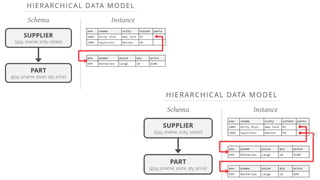
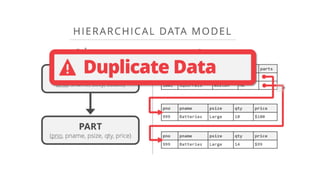
Hierarchical Structure of DBMS
Flat File Vs Relational Database System
• A flat file database is a database designed around a single table.
• The flat file design puts all database information in one table or list
with field store present all parameters.
• A flat file may contain many fields, often with duplicate data that are
prone to data corruption.
• If you decide to merge data between two flat files, you need to copy
and paste relevant information from one file to the other.
• There is no automation between flat files.
• If you have two or more flat files that contain client addresses, for
example, and a client moved, you would have to manually modify the
address parameters in each file that contains that client’s information.
Relational Database System
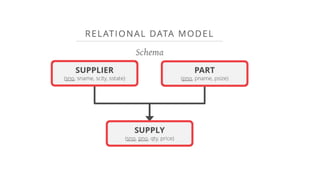
• A relational database, on the other hand, incorporates
multiple tables with methods for the tables to work
together.
• The relationships between table data can be ordered,
merged and displayed in database forms.
• These tables are to be normalized up to 3rd Normal Form
(3-NF).

Advance database systems (part 1)

  • 1.
  • 2.
    Contents • Database Definitionsand Advantages of RDBMS • Hierarchical Structure of DBMS
  • 3.
    Why you Shouldtake this Course Jonathan Abrams Friendster fails due to not optimized and efficient Database System Mark Zuckerberg Facebook did not fail due to optimized and efficient Database System
  • 4.
    Database Definitions andAdvantages of RDBMS • An organized collection of information in computerized format. • A collection of information organized and presented to serve a specific purpose. • Thetermdatabaseisoftenincorrectlyreferredtoasasynonymfora“databa semanagementsystem(DBMS)”.
  • 6.
    Data and Information •Data is the collection of raw facts collected from any specific environment for a specific purpose. • Data in itself doesnot show anything about its environment, so to get desired types of results from the data we transform it into information by applying certain processing on it. • Once we have processed data using different methods; than data is converted into meaningful form and that form of the Data is called information.
  • 7.
    • If weconsider the data in the previous figure without the titles or the labels associated with the data (EmpName, age, salary) then; it is not much useful. • However, after attaching these labels it brings some meanings to us, this meaningfulness is further increased when we associate some other labels, like the company name and the department name etc. • So this is a very simple example of processing that we can do on the data to make it information.
  • 9.
    Database Systems • Thetermdatabasesystemisacombinationofdat abaseandtheDatabaseManagementSystem(D BMS). •So, database is collection of meaningful data/information, DBMS is a tool to manage this data, and both jointly are called database system.
  • 10.
    Why Use Models? •Models can be useful when we want to examine or manage part of the real world. • The costs of using a model are often considerably lower than the costs of using or experimenting with the real world itself. • Examples: • Network Model Simulation for an Organization in Packet Tracer • World Map • ERD for Relational Database Systems.
  • 11.
  • 24.
    Flat File VsRelational Database System • A flat file database is a database designed around a single table. • The flat file design puts all database information in one table or list with field store present all parameters. • A flat file may contain many fields, often with duplicate data that are prone to data corruption. • If you decide to merge data between two flat files, you need to copy and paste relevant information from one file to the other. • There is no automation between flat files. • If you have two or more flat files that contain client addresses, for example, and a client moved, you would have to manually modify the address parameters in each file that contains that client’s information.
  • 25.
    Relational Database System •A relational database, on the other hand, incorporates multiple tables with methods for the tables to work together. • The relationships between table data can be ordered, merged and displayed in database forms. • These tables are to be normalized up to 3rd Normal Form (3-NF).