BIG DATA ANALYTICS
UNIT - I
Mrs.S.Sumathi,
Assistant Professor,
Department of Information Technology,
EMG Yadava Women’s College, Madurai – 14.
CONTENT
 What is Big Data?
 Characteristics of Big Data
 Types of Big Data
 Sources of big data
 Challenges of Big Data
 Data Environment versus Big Data Environment
BIG DATA
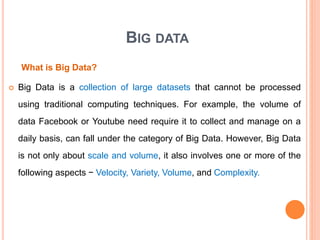
What is Big Data?
 Big Data is a collection of large datasets that cannot be processed
using traditional computing techniques. For example, the volume of
data Facebook or Youtube need require it to collect and manage on a
daily basis, can fall under the category of Big Data. However, Big Data
is not only about scale and volume, it also involves one or more of the
following aspects − Velocity, Variety, Volume, and Complexity.
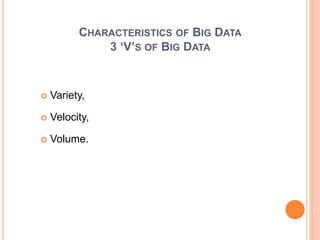
CHARACTERISTICS OF BIG DATA
3 ‘V’S OF BIG DATA
 Variety,
 Velocity,
 Volume.
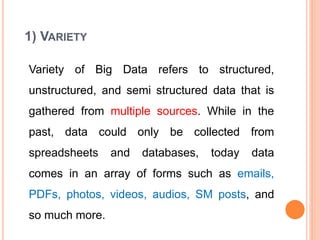
1) VARIETY
Variety of Big Data refers to structured,
unstructured, and semi structured data that is
gathered from multiple sources. While in the
past, data could only be collected from
spreadsheets and databases, today data
comes in an array of forms such as emails,
PDFs, photos, videos, audios, SM posts, and
so much more.
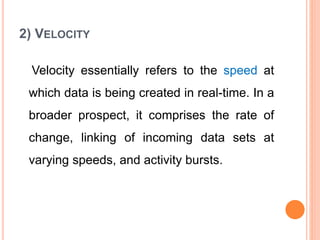
2) VELOCITY
Velocity essentially refers to the speed at
which data is being created in real-time. In a
broader prospect, it comprises the rate of
change, linking of incoming data sets at
varying speeds, and activity bursts.
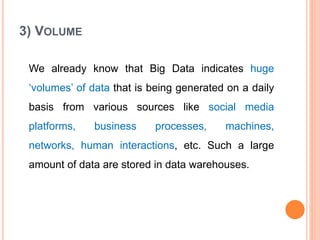
3) VOLUME
We already know that Big Data indicates huge
‘volumes’ of data that is being generated on a daily
basis from various sources like social media
platforms, business processes, machines,
networks, human interactions, etc. Such a large
amount of data are stored in data warehouses.
TYPES OF BIG DATA
 Structured
By structured data, we mean data that can be processed,
stored, and retrieved in a fixed format. It refers to highly
organized information that can be readily and seamlessly
stored and accessed from a database by simple search
engine algorithms.
For instance, the employee table in a company
database will be structured as the employee details,
their job positions, their salaries, etc., will be present
in an organized manner.
 Unstructured
Unstructured data refers to the data that lacks any
specific form or structure whatsoever. This makes it
very difficult and time-consuming to process and
analyze unstructured data. Email is an example of
unstructured data.
TYPES OF BIG DATA
 Semi-structured
Semi-structured data pertains to the data containing
both the formats mentioned above, that is, structured
and unstructured data. To be precise, it refers to the
data that although has not been classified under a
particular repository (database), yet contains vital
information or tags that segregate individual elements
within the data.
TYPES OF BIG DATA
SOURCES OF BIG DATA
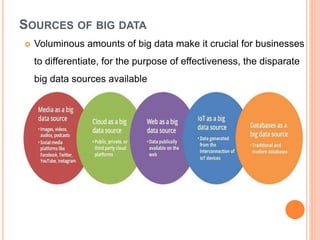
 Voluminous amounts of big data make it crucial for businesses
to differentiate, for the purpose of effectiveness, the disparate
big data sources available
MEDIA AS A BIG DATA SOURCE
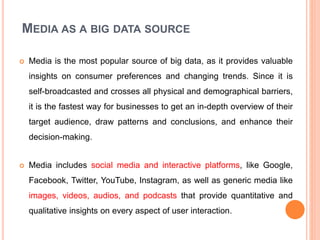
 Media is the most popular source of big data, as it provides valuable
insights on consumer preferences and changing trends. Since it is
self-broadcasted and crosses all physical and demographical barriers,
it is the fastest way for businesses to get an in-depth overview of their
target audience, draw patterns and conclusions, and enhance their
decision-making.
 Media includes social media and interactive platforms, like Google,
Facebook, Twitter, YouTube, Instagram, as well as generic media like
images, videos, audios, and podcasts that provide quantitative and
qualitative insights on every aspect of user interaction.
CLOUD AS A BIG DATA SOURCE
 Today, companies have moved ahead of traditional data sources
by shifting their data on the cloud.
 Cloud storage accommodates structured and unstructured data
and provides business with real-time information and on-demand
insights.
 The main attribute of cloud computing is its flexibility and
scalability.
 As big data can be stored and sourced on public or private
clouds, via networks and servers, cloud makes for an efficient
and economical data source.
THE WEB AS A BIG DATA SOURCE
 The public web constitutes big data that is widespread and easily
accessible. Data on the Web or ‘Internet’ is commonly available to
individuals and companies alike. Moreover, web services such as
Wikipedia provide free and quick informational insights to everyone.
 The enormity of the Web ensures for its diverse usability and is
especially beneficial to start-ups and SME’s, as they don’t have to
wait to develop their own big data infrastructure and repositories
before they can leverage big data.
IOT AS A BIG DATA SOURCE
 Machine-generated content or data created from IoT constitute a
valuable source of big data. This data is usually generated from the
sensors that are connected to electronic devices.
 The sourcing capacity depends on the ability of the sensors to provide
real-time accurate information.
 IoT is now gaining momentum and includes big data generated, not
only from computers and smartphones, but also possibly from every
device that can emit data.
 With IoT, data can now be sourced from medical devices, vehicular
processes, video games, meters, cameras, household appliances,
and the like.
DATABASES AS A BIG DATA SOURCE
 Businesses today prefer to use an amalgamation of traditional and
modern databases to acquire relevant big data. This integration
paves the way for a hybrid data model and requires low investment
and IT infrastructural costs.
 Furthermore, these databases are deployed for several business
intelligence purposes as well. These databases can then provide for
the extraction of insights that are used to drive business profits.
 Popular databases include a variety of data sources, such as MS
Access, DB2, Oracle, SQL, and Amazon Simple, among others.
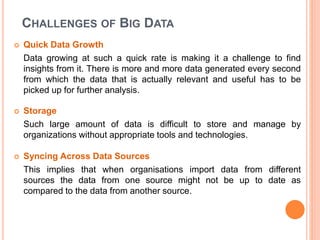
CHALLENGES OF BIG DATA
 Quick Data Growth
Data growing at such a quick rate is making it a challenge to find
insights from it. There is more and more data generated every second
from which the data that is actually relevant and useful has to be
picked up for further analysis.
 Storage
Such large amount of data is difficult to store and manage by
organizations without appropriate tools and technologies.
 Syncing Across Data Sources
This implies that when organisations import data from different
sources the data from one source might not be up to date as
compared to the data from another source.
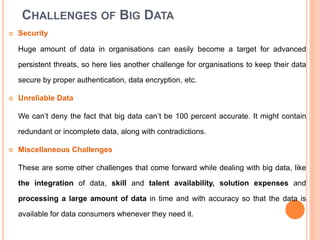
CHALLENGES OF BIG DATA
 Security
Huge amount of data in organisations can easily become a target for advanced
persistent threats, so here lies another challenge for organisations to keep their data
secure by proper authentication, data encryption, etc.
 Unreliable Data
We can’t deny the fact that big data can’t be 100 percent accurate. It might contain
redundant or incomplete data, along with contradictions.
 Miscellaneous Challenges
These are some other challenges that come forward while dealing with big data, like
the integration of data, skill and talent availability, solution expenses and
processing a large amount of data in time and with accuracy so that the data is
available for data consumers whenever they need it.
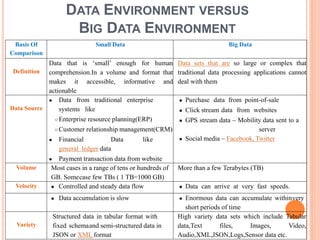
DATA ENVIRONMENT VERSUS
BIG DATA ENVIRONMENT
Basis Of
Comparison
Small Data Big Data
Definition
Data that is ‘small’ enough for human
comprehension.In a volume and format that
makes it accessible, informative and
actionable
Data sets that are so large or complex that
traditional data processing applications cannot
deal with them
Data Source
● Data from traditional enterprise
systems like
○ Enterprise resource planning(ERP)
○ Customer relationship management(CRM)
● Financial Data like
general ledger data
● Payment transaction data from website
● Purchase data from point-of-sale
● Click stream data from websites
● GPS stream data – Mobility data sent to a
server
● Social media – Facebook, Twitter
Volume Most cases in a range of tens or hundreds of
GB. Somecase few TBs ( 1 TB=1000 GB)
More than a few Terabytes (TB)
Velocity ● Controlled and steady data flow ● Data can arrive at very fast speeds.
● Data accumulation is slow ● Enormous data can accumulate withinvery
short periods of time
Variety
Structured data in tabular format with
fixed schemaand semi-structured data in
JSON or XML format
High variety data sets which include Tabular
data,Text files, Images, Video,
Audio,XML,JSON,Logs,Sensor data etc.
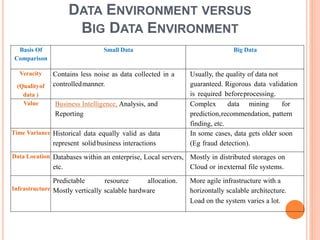
DATA ENVIRONMENT VERSUS
BIG DATA ENVIRONMENT
Basis Of
Comparison
Small Data Big Data
Veracity
(Qualityof
data )
Contains less noise as data collected in a
controlledmanner.
Usually, the quality of data not
guaranteed. Rigorous data validation
is required beforeprocessing.
Value Business Intelligence, Analysis, and
Reporting
Complex data mining for
prediction,recommendation, pattern
finding, etc.
Time Variance Historical data equally valid as data
represent solid business interactions
In some cases, data gets older soon
(Eg fraud detection).
Data Location Databases within an enterprise, Local servers,
etc.
Mostly in distributed storages on
Cloud or inexternal file systems.
Infrastructure
Predictable resource allocation.
Mostly vertically scalable hardware
More agile infrastructure with a
horizontally scalable architecture.
Load on the system varies a lot.
Big Data Analytics

Big Data Analytics

  • 1.
    BIG DATA ANALYTICS UNIT- I Mrs.S.Sumathi, Assistant Professor, Department of Information Technology, EMG Yadava Women’s College, Madurai – 14.
  • 2.
    CONTENT  What isBig Data?  Characteristics of Big Data  Types of Big Data  Sources of big data  Challenges of Big Data  Data Environment versus Big Data Environment
  • 3.
    BIG DATA What isBig Data?  Big Data is a collection of large datasets that cannot be processed using traditional computing techniques. For example, the volume of data Facebook or Youtube need require it to collect and manage on a daily basis, can fall under the category of Big Data. However, Big Data is not only about scale and volume, it also involves one or more of the following aspects − Velocity, Variety, Volume, and Complexity.
  • 4.
    CHARACTERISTICS OF BIGDATA 3 ‘V’S OF BIG DATA  Variety,  Velocity,  Volume.
  • 5.
    1) VARIETY Variety ofBig Data refers to structured, unstructured, and semi structured data that is gathered from multiple sources. While in the past, data could only be collected from spreadsheets and databases, today data comes in an array of forms such as emails, PDFs, photos, videos, audios, SM posts, and so much more.
  • 6.
    2) VELOCITY Velocity essentiallyrefers to the speed at which data is being created in real-time. In a broader prospect, it comprises the rate of change, linking of incoming data sets at varying speeds, and activity bursts.
  • 7.
    3) VOLUME We alreadyknow that Big Data indicates huge ‘volumes’ of data that is being generated on a daily basis from various sources like social media platforms, business processes, machines, networks, human interactions, etc. Such a large amount of data are stored in data warehouses.
  • 8.
    TYPES OF BIGDATA  Structured By structured data, we mean data that can be processed, stored, and retrieved in a fixed format. It refers to highly organized information that can be readily and seamlessly stored and accessed from a database by simple search engine algorithms. For instance, the employee table in a company database will be structured as the employee details, their job positions, their salaries, etc., will be present in an organized manner.
  • 9.
     Unstructured Unstructured datarefers to the data that lacks any specific form or structure whatsoever. This makes it very difficult and time-consuming to process and analyze unstructured data. Email is an example of unstructured data. TYPES OF BIG DATA
  • 10.
     Semi-structured Semi-structured datapertains to the data containing both the formats mentioned above, that is, structured and unstructured data. To be precise, it refers to the data that although has not been classified under a particular repository (database), yet contains vital information or tags that segregate individual elements within the data. TYPES OF BIG DATA
  • 11.
    SOURCES OF BIGDATA  Voluminous amounts of big data make it crucial for businesses to differentiate, for the purpose of effectiveness, the disparate big data sources available
  • 12.
    MEDIA AS ABIG DATA SOURCE  Media is the most popular source of big data, as it provides valuable insights on consumer preferences and changing trends. Since it is self-broadcasted and crosses all physical and demographical barriers, it is the fastest way for businesses to get an in-depth overview of their target audience, draw patterns and conclusions, and enhance their decision-making.  Media includes social media and interactive platforms, like Google, Facebook, Twitter, YouTube, Instagram, as well as generic media like images, videos, audios, and podcasts that provide quantitative and qualitative insights on every aspect of user interaction.
  • 13.
    CLOUD AS ABIG DATA SOURCE  Today, companies have moved ahead of traditional data sources by shifting their data on the cloud.  Cloud storage accommodates structured and unstructured data and provides business with real-time information and on-demand insights.  The main attribute of cloud computing is its flexibility and scalability.  As big data can be stored and sourced on public or private clouds, via networks and servers, cloud makes for an efficient and economical data source.
  • 14.
    THE WEB ASA BIG DATA SOURCE  The public web constitutes big data that is widespread and easily accessible. Data on the Web or ‘Internet’ is commonly available to individuals and companies alike. Moreover, web services such as Wikipedia provide free and quick informational insights to everyone.  The enormity of the Web ensures for its diverse usability and is especially beneficial to start-ups and SME’s, as they don’t have to wait to develop their own big data infrastructure and repositories before they can leverage big data.
  • 15.
    IOT AS ABIG DATA SOURCE  Machine-generated content or data created from IoT constitute a valuable source of big data. This data is usually generated from the sensors that are connected to electronic devices.  The sourcing capacity depends on the ability of the sensors to provide real-time accurate information.  IoT is now gaining momentum and includes big data generated, not only from computers and smartphones, but also possibly from every device that can emit data.  With IoT, data can now be sourced from medical devices, vehicular processes, video games, meters, cameras, household appliances, and the like.
  • 16.
    DATABASES AS ABIG DATA SOURCE  Businesses today prefer to use an amalgamation of traditional and modern databases to acquire relevant big data. This integration paves the way for a hybrid data model and requires low investment and IT infrastructural costs.  Furthermore, these databases are deployed for several business intelligence purposes as well. These databases can then provide for the extraction of insights that are used to drive business profits.  Popular databases include a variety of data sources, such as MS Access, DB2, Oracle, SQL, and Amazon Simple, among others.
  • 17.
    CHALLENGES OF BIGDATA  Quick Data Growth Data growing at such a quick rate is making it a challenge to find insights from it. There is more and more data generated every second from which the data that is actually relevant and useful has to be picked up for further analysis.  Storage Such large amount of data is difficult to store and manage by organizations without appropriate tools and technologies.  Syncing Across Data Sources This implies that when organisations import data from different sources the data from one source might not be up to date as compared to the data from another source.
  • 18.
    CHALLENGES OF BIGDATA  Security Huge amount of data in organisations can easily become a target for advanced persistent threats, so here lies another challenge for organisations to keep their data secure by proper authentication, data encryption, etc.  Unreliable Data We can’t deny the fact that big data can’t be 100 percent accurate. It might contain redundant or incomplete data, along with contradictions.  Miscellaneous Challenges These are some other challenges that come forward while dealing with big data, like the integration of data, skill and talent availability, solution expenses and processing a large amount of data in time and with accuracy so that the data is available for data consumers whenever they need it.
  • 19.
    DATA ENVIRONMENT VERSUS BIGDATA ENVIRONMENT Basis Of Comparison Small Data Big Data Definition Data that is ‘small’ enough for human comprehension.In a volume and format that makes it accessible, informative and actionable Data sets that are so large or complex that traditional data processing applications cannot deal with them Data Source ● Data from traditional enterprise systems like ○ Enterprise resource planning(ERP) ○ Customer relationship management(CRM) ● Financial Data like general ledger data ● Payment transaction data from website ● Purchase data from point-of-sale ● Click stream data from websites ● GPS stream data – Mobility data sent to a server ● Social media – Facebook, Twitter Volume Most cases in a range of tens or hundreds of GB. Somecase few TBs ( 1 TB=1000 GB) More than a few Terabytes (TB) Velocity ● Controlled and steady data flow ● Data can arrive at very fast speeds. ● Data accumulation is slow ● Enormous data can accumulate withinvery short periods of time Variety Structured data in tabular format with fixed schemaand semi-structured data in JSON or XML format High variety data sets which include Tabular data,Text files, Images, Video, Audio,XML,JSON,Logs,Sensor data etc.
  • 20.
    DATA ENVIRONMENT VERSUS BIGDATA ENVIRONMENT Basis Of Comparison Small Data Big Data Veracity (Qualityof data ) Contains less noise as data collected in a controlledmanner. Usually, the quality of data not guaranteed. Rigorous data validation is required beforeprocessing. Value Business Intelligence, Analysis, and Reporting Complex data mining for prediction,recommendation, pattern finding, etc. Time Variance Historical data equally valid as data represent solid business interactions In some cases, data gets older soon (Eg fraud detection). Data Location Databases within an enterprise, Local servers, etc. Mostly in distributed storages on Cloud or inexternal file systems. Infrastructure Predictable resource allocation. Mostly vertically scalable hardware More agile infrastructure with a horizontally scalable architecture. Load on the system varies a lot.