Introduction to DataIntroduction to Data
ManagementManagement
ICT II - BSAICT II - BSA
Makerere University Business SchoolMakerere University Business School
@2017@2017
BSA - ICT II
Data Is the Foundation on Which
Business Success is built
Successful management of data is critical to
any organizational mission to make
informed decisions.
BSA - ICT II
BSA - ICT II
Motivation/Importance of Data Mgt
Data management plays a significant role in an
organization’s ability to generate revenue, control
costs
Successfully being able to share, store, protect and
retrieve the ever-increasing amount of data can be
the competitive advantage for organizations today.
Data management helps organizations to mitigate
risks.
It enables decision making in organizations
BSA - ICT II
What Are the Benefits of Good Data
Management?
Optimum data quality
Improved user confidence
Efficient and timely access to data
Improved knowledge and understanding of
the agency’s data holdings
Improves decision making in an
organisation
BSA - ICT II
What Are the Costs of Poor Data
Management?
Misinterpretation of the data
Lost data
Inaccessible data
Indefensible data
Wasted time and money
Missed deadlines
Lost user confidence
Any of these tantamounts to business failure
BSA - ICT II
Managing data Resources:
An information system provides users with timely, accurate,
and relevant information.
The information is stored in computer files.
When files are properly arranged and maintained, users can
easily access and retrieve the information when they need.
If the files are not properly managed, they can lead to chaos in
information processing.
Even if the hardware and software are excellent, the
information system can be very inefficient because of poor file
management.
BSA - ICT II
Data Management
Data Management is a broad field of study,
but essentially is the process of managing
data as a resource that is valuable to an
organization or business.
Data management can also be the
development and execution of architectures,
policies, practices and procedures in order to
manage the information lifecycle needs of
an enterprise in an effective manner.
BSA - ICT II
Areas of Data Management
Data Modeling- Is first creating a structure for the
data that you collect and use and then organizing
this data in a way that is easily accessible and
efficient to store and pull the data for reports and
analysis.
Data warehousing - is storing data effectively so
that it can be accessed and used efficiently in future.
Data Movement - is the ability to move data from
one place to another. For instance, data needs to be
moved from where it is collected to a database and
then to an end user.
BSA - ICT II
Areas of Data Management cont
Database Administration - is extremely important in
managing data. Every organization or enterprise needs
database administrators that are responsible for the database
environment.
Data mining - is a process in which large amounts of data
are sifted through to show trends, relationships, and patterns.
Data mining is a crucial component to data management
because it exposes interesting information about the data
being collected. It is important to note that data is primarily
collected so it can be used to find these patterns,
relationships and trends that can help a business grow or
create profit.
BSA - ICT II
File Organization Terms and Concepts
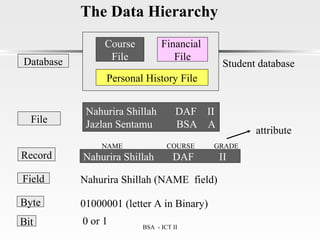
A computer system organizes data in a hierarchy that starts
with the bit.
Bit represents 0 or 1.
8 bits are grouped to form a byte. Each byte represents one
character, number , or symbol.
Bytes can be grouped to form a field. It can represent a
person’s name or age.
Related fields can be grouped to form a record. Related fields
can be student’s name, course taken and the grade.
Related records can be grouped to form a file.
Related files can be grouped to form a database
BSA - ICT II
The Data Hierarchy
Database
NAME COURSE GRADE
File
Record
Field
Byte
Bit 0 or 1
01000001 (letter A in Binary)
Nahurira Shillah (NAME field)
Nahurira Shillah DAF II
Jazlan Sentamu BSA A
Course
File
Financial
File
Personal History File
Student database
attribute
BSA - ICT II
More File Organization Terms
Key field
Every record in a file should contain at least one field that
uniquely identifies that record so that the record can be retrieved,
updated, or sorted. This identifier field is called a key field
(Primarykey).
Asimwe Joan 959010054 CIS 500 A
Nalule Miriam 969010055 IST 203 B
NAME STUDENT No COURSE GRADE
Key field
BSA - ICT II
Accessing Records from Computer Files
Computer stores files on secondary storage devices.
Records can be arranged in several ways on storage media.
How individual record can be accessed or retrieved depends on
how they are arranged on storage media.
Most computer applications utilize this method.
There are mainly two ways to organize records: sequentially or
randomly.
In sequential file organization, data records must be retrieved
in the same physical sequence in which they are stored.
BSA - ICT II
In direct or random file organization, data records can be
accessed in any sequence as users desire, without regard to
actual physical order on the storage media.
Sequential file organization is the only file organization that
can be used on magnetic tape. Example: Payroll
Direct or random file organization is utilized with magnetic
disk.
BSA - ICT II
Accessing Records from Computer Files
Traditional Approach to Data Management
(File based approach)
• The “old” way of doing things; still often used in
practice.
• Separate information stored in separate files.
• It is a way of collecting and maintaining data in an
organization that leads to each functional area or division
creating and maintaining its own data files and programs.
Changes and updates are made to these files separately
BSA - ICT II
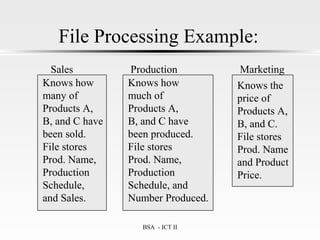
File Processing Example:
Sales Production Marketing
Knows how
many of
Products A,
B, and C have
been sold.
File stores
Prod. Name,
Production
Schedule,
and Sales.
Knows how
much of
Products A,
B, and C have
been produced.
File stores
Prod. Name,
Production
Schedule, and
Number Produced.
Knows the
price of
Products A,
B, and C.
File stores
Prod. Name
and Product
Price.
BSA - ICT II
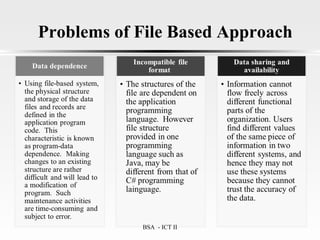
Problems of File Based Approach
BSA - ICT II
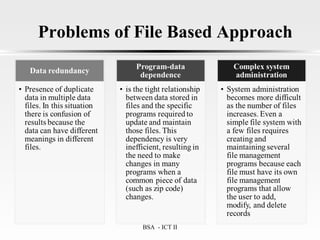
Problems of File Based Approach
BSA - ICT II
Problems of File Based Approach
BSA - ICT II
Database Management System
In order to overcome the limitations of the file-based
approach, the concept of database and the Database
Management System (DBMS) was emerged for data
management
Database management System: special software that
permits an organization to centralize data, manage it
efficiently, and provide access to the stored data by
application programs e.g. MySQL, MS Access, Oracle etc.
BSA - ICT II
Database Management System (DBMS)
• Software for creating and maintaining databases
• Permits firms to rationally manage data for the entire firm
• Acts as interface between application programs and
physical data files
• Separates logical and design views of data
• Solves many problems of the traditional data file approach
BSA - ICT II
Basic Database Definitions
Data: collection of facts a figures processed to give information
Information: processed data
Entity (table or relation): a person, place, thing, or event for which data
is collected and maintained
Field (attribute or column): a single characteristic or fact about an
entity. A field is used define and store data
Record (tuple or row): a logical collection of fields that describes one
instance of an entity (person, place or Object)
File: a set of related records that contains data about a specific entity
Database: shared collection of logically related data that is organized
so that it can be easily accessed, managed and updated. The importance
of a database is to service many applications efficiently by centralizing
the data and minimizing redundant data.
BSA - ICT II
Basic Database Definitions (Cont)
Attribute: A characteristic of an entity; something the entity is
identified by e.g. Customer name, Employee name
Keys: A field or set of fields in a record that is used to identify the
record e.g. A field or set of fields that uniquely identifies the record
Database system: A complete information system (database and
DBMS)
BSA - ICT II
Database Applications:
Banking: all transactions
Airlines: reservations, schedules
Universities: registration, grades
Sales: customers, products, purchases
Manufacturing: production, inventory, orders, supply chain
Human resources: employee records, salaries, tax deductions
BSA - ICT II
Functional Components of DBMS
Data Definition Language (DDL) - It defines each element as
it appears in the database. The DDL is the formal language
programmers use to specify the content and structure of the
database.
Data Manipulation Language (DML) - It is a set of procedural
commands that enable programmers to append, modify, update,
and retrieve data. The DML uses simple verbs like sort, delete,
insert, select, display
A query language - It enables the user to make queries from the
database. It is a standard data manipulation language for
relational database management systems. E.g SQL
BSA - ICT II
Functional Components of DBMS
Report Generators - It enables generation of reports from a
database. The programs enable reports be presented using
pictures, graphics, maps etc.
Application Generators - Most of the DBMS packages
include programming facilities available in 4th
Generation
Languages (4GLS).
User Interface - This is a shell that provides the
environment for interaction of a user with the database.
BSA - ICT II
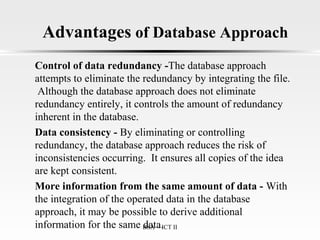
Advantages of Database Approach
Control of data redundancy -The database approach
attempts to eliminate the redundancy by integrating the file.
Although the database approach does not eliminate
redundancy entirely, it controls the amount of redundancy
inherent in the database.
Data consistency - By eliminating or controlling
redundancy, the database approach reduces the risk of
inconsistencies occurring. It ensures all copies of the idea
are kept consistent.
More information from the same amount of data - With
the integration of the operated data in the database
approach, it may be possible to derive additional
information for the same data.BSA - ICT II
Advantages of Database Approach
Sharing of data - Database belongs to the entire
organization and can be shared by all authorized users.
Improved data integrity - Database integrity provides the
validity and consistency of stored data. Integrity is usually
expressed in terms of constraints, which are consistency
rules that the database is not permitted to violate.
Improved security - Database approach provides a
protection of the data from the unauthorized users. It may
take the term of user names and passwords to identify user
type and their access right in the operation including
retrieval, insertion, updating and deletion.
BSA - ICT II
Advantages of Database Approach
Enforcement of standards -The integration of the
database enforces the necessary standards including data
formats, naming conventions, documentation standards,
update procedures and access rules.
Increased concurrency - Database can manage concurrent
data access effectively. It ensures no interference between
users that would not result any loss of information nor loss
of integrity.
Improved backing and recovery services - Modern
database management system provides facilities to
minimize the amount of processing that can be lost
following a failure by using the transaction approach.
BSA - ICT II
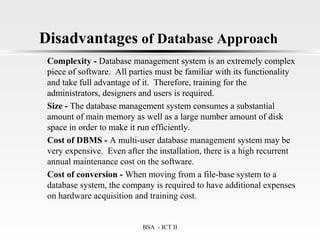
Disadvantages of Database Approach
Complexity - Database management system is an extremely complex
piece of software. All parties must be familiar with its functionality
and take full advantage of it. Therefore, training for the
administrators, designers and users is required.
Size - The database management system consumes a substantial
amount of main memory as well as a large number amount of disk
space in order to make it run efficiently.
Cost of DBMS - A multi-user database management system may be
very expensive. Even after the installation, there is a high recurrent
annual maintenance cost on the software.
Cost of conversion - When moving from a file-base system to a
database system, the company is required to have additional expenses
on hardware acquisition and training cost.
BSA - ICT II
Performance - As the database approach is to cater for
many applications rather than exclusively for a particular
one, some applications may not run as fast as before.
Higher impact of a failure - The database approach
increases the vulnerability of the system due to the
centralization. As all users and applications reply on the
database availability, the failure of any component can
bring operations to a halt and affect the services to the
customer seriously.
Disadvantages of Database Approach
BSA - ICT II
Database Principles
Data Independence-This is used to describe the separation of
data or data handling from the functional processing of the data
and the programs that use the data.
Data Integrity - This is where data is held in a single, integrated
database
Data Redundancy/Data Duplication - This describes the case
where a particular data element is individually kept at several
places (records, files, etc) in the database.
Data Security - This is the ability of a database system to
preserve and protect the data which it holds.
BSA - ICT II
Database Models
Collection of logical constructs used to
represent data structure and relationships
within the database
Conceptual models: logical nature of data
representation
Implementation models: emphasis on how the
data are represented in the database
BSA - ICT II
Relationships in Conceptual Models
One-to-one (1:1)
One-to-many (1:M)
Many-to-many (M:N)
Implementation Database Models
Hierarchical
Network
Relational
Database Models (con’t.)
BSA - ICT II
Hierarchical Database modelHierarchical Database model
• Organizes data in a tree-like structure and supports one-to-many parent-child relationships
Advantages
Conceptual simplicity
Database security and integrity
Data independence
Disadvantages
Complex implementation
Difficult to manage and lack of standards
Lacks structural independence
Applications programming and use complexity
Implementation limitations
BSA - ICT II
A Hierarchical Database for a Human Resources System
BSA - ICT II
Network Data Model
Network data model
– An expansion of the hierarchical database model with an
owner-member relationship in which a member may have many
owners
Project 1 Project 2
Department A Department B Department C
BSA - ICT II
Network Data Model
Advantages
Conceptually simple and easy to design
Handles more relationship types
Data access flexibility
Promotes database integrity: a member does not exist without an owner
Conformance to standards
Disadvantages
System complexity: a user friendly database management system cannot be created using the network
model, users need to be familiar with the internal structure.
Lack of structural independence: Making structural modifications to the database requires the
application programs to be modified before they can access data.
BSA - ICT II
Relational Data Model
Perceived by user as a collection of tables for data storage
Tables are a series of row/column intersections
Tables related by sharing common entity characteristic(s).
This model uses primary key to link records.
Advantages
Improved conceptual simplicity
Easier database design, implementation, management,
and use
Powerful database management system
Efficient
BSA - ICT II
Relational Data Model
Disadvantages
Substantial hardware and system software overhead
Poor design and implementation is made easy
May promote “islands of information” problems
BSA - ICT II
BSA - ICT II
Relational Data Model
Entity Relationship Database Model
Complements the relational data model concepts
Represented in an entity relationship diagram (ERD)
Based on entities, attributes, and relationships
Example: In a school database students, teachers, courses offered
can be entities while age, sex, name, marks, salary are attributes
BSA - ICT II
Entity Relationship Database Model
BSA - ICT II
The logical association among entities is called relationship.
E.g. student enrolls in a course
Advantages
Exceptional conceptual simplicity
Visual representation
Effective communication tool
Integrated with the relational database model
Disadvantages
Limited constraint representation
Limited relationship representation
No data manipulation language
Loss of information content
Object Oriented Database Model
BSA - ICT II
• Database system in which multiple types of data are stored
as objects along with their related code.
• Objects or abstractions of real-world entities are stored
• Attributes describe properties
• Collection of similar objects is a class
• Methods represent real world actions of classes
• Classes are organized in a class hierarchy
• Inheritance is ability of object to inherit attributes and
methods of classes above it
• Objects can be retrieved using queries (object query
language or OQL)
• Objects can be reused in other applications to create new
applications quickly
Object Oriented Database Model
BSA - ICT II
• Advantages
• Adds semantic content
• Visual presentation includes semantic content
• Database integrity
• Both structural and data independence
• Disadvantages
• Lack of OODBMS
• Complex navigational data access
• Steep learning curve
• High system overhead slows transactions
Database Types
Single-user Vs Multi-user
Single user database system
– Located on a single computer
– Designed to be accessed by one user
– Widely used for personal applications and very small
Multi-user database system
– Designed to be accessed by multiple users (most
business databases today)
BSA - ICT II
Database Types
Centralized Vs Distributed
Centralized database system is located on a single computer,
such as a server or mainframe
Distributed database system: Data is physically divided
among several computers connected by a network, but the
database logically looks like it is a single database
General-purpose Vs Special Purpose
General-purpose can be used for a large number of
applications
Special-purpose database is designed for a limited number of
applications or to serve a specific need
BSA - ICT II
Importance of a database in Organizations
Simplify the search and utilization of information in an
organization
Helps in monitoring the progress of the business operation
well, so they can take quick and appropriate steps if a
problem occurs.
Assisting in organizing organizational data such as
employees / members bios of the organization, consumer
biodata, list of products, payment of salaries, payment of
bills, and others.
Facilitate the members in the data access activities include
data acquisition and manipulation of data such as add and
delete data through the authority that has been given.
BSA - ICT II
Importance of a database in Organizations
Keeping the organization’s data security, because any data
can be protected by provide login and password for each
data.
The database can help to determine a better strategy for the
advancement of an organization in the future.
Assist marketing activities for the database to collect
customer data in a complete and detailed so as to facilitate
the marketing activities for an organization or company.
The database can save on operating costs for an
organization / company to manage information.
BSA - ICT II
DBA Personnel (Cont)DBA Personnel (Cont)
Database Administrator (DBA) Is a manager who controls and sets
standards for a database to ensure that the database operates at the peak
of efficiency.
Functions of DBA
In charge of enterprise database development
Authorizing access to the database
Coordinating and monitoring its use
Acquiring software and hardware resources
Improves the integrity and security of organizational databases
BSA - ICT II
Uses Data Definition Language (DDL) to develop and
specify data contents, relationships, and structure
Stores these specifications in a data dictionary or a
metadata repository
Input of data
Extending the database
Upgrading the database
DBA Personnel (Cont)DBA Personnel (Cont)
BSA - ICT II
Data Management

Data Management

  • 1.
    Introduction to DataIntroductionto Data ManagementManagement ICT II - BSAICT II - BSA Makerere University Business SchoolMakerere University Business School @2017@2017 BSA - ICT II
  • 2.
    Data Is theFoundation on Which Business Success is built Successful management of data is critical to any organizational mission to make informed decisions. BSA - ICT II
  • 3.
  • 4.
    Motivation/Importance of DataMgt Data management plays a significant role in an organization’s ability to generate revenue, control costs Successfully being able to share, store, protect and retrieve the ever-increasing amount of data can be the competitive advantage for organizations today. Data management helps organizations to mitigate risks. It enables decision making in organizations BSA - ICT II
  • 5.
    What Are theBenefits of Good Data Management? Optimum data quality Improved user confidence Efficient and timely access to data Improved knowledge and understanding of the agency’s data holdings Improves decision making in an organisation BSA - ICT II
  • 6.
    What Are theCosts of Poor Data Management? Misinterpretation of the data Lost data Inaccessible data Indefensible data Wasted time and money Missed deadlines Lost user confidence Any of these tantamounts to business failure BSA - ICT II
  • 7.
    Managing data Resources: Aninformation system provides users with timely, accurate, and relevant information. The information is stored in computer files. When files are properly arranged and maintained, users can easily access and retrieve the information when they need. If the files are not properly managed, they can lead to chaos in information processing. Even if the hardware and software are excellent, the information system can be very inefficient because of poor file management. BSA - ICT II
  • 8.
    Data Management Data Managementis a broad field of study, but essentially is the process of managing data as a resource that is valuable to an organization or business. Data management can also be the development and execution of architectures, policies, practices and procedures in order to manage the information lifecycle needs of an enterprise in an effective manner. BSA - ICT II
  • 9.
    Areas of DataManagement Data Modeling- Is first creating a structure for the data that you collect and use and then organizing this data in a way that is easily accessible and efficient to store and pull the data for reports and analysis. Data warehousing - is storing data effectively so that it can be accessed and used efficiently in future. Data Movement - is the ability to move data from one place to another. For instance, data needs to be moved from where it is collected to a database and then to an end user. BSA - ICT II
  • 10.
    Areas of DataManagement cont Database Administration - is extremely important in managing data. Every organization or enterprise needs database administrators that are responsible for the database environment. Data mining - is a process in which large amounts of data are sifted through to show trends, relationships, and patterns. Data mining is a crucial component to data management because it exposes interesting information about the data being collected. It is important to note that data is primarily collected so it can be used to find these patterns, relationships and trends that can help a business grow or create profit. BSA - ICT II
  • 11.
    File Organization Termsand Concepts A computer system organizes data in a hierarchy that starts with the bit. Bit represents 0 or 1. 8 bits are grouped to form a byte. Each byte represents one character, number , or symbol. Bytes can be grouped to form a field. It can represent a person’s name or age. Related fields can be grouped to form a record. Related fields can be student’s name, course taken and the grade. Related records can be grouped to form a file. Related files can be grouped to form a database BSA - ICT II
  • 12.
    The Data Hierarchy Database NAMECOURSE GRADE File Record Field Byte Bit 0 or 1 01000001 (letter A in Binary) Nahurira Shillah (NAME field) Nahurira Shillah DAF II Nahurira Shillah DAF II Jazlan Sentamu BSA A Course File Financial File Personal History File Student database attribute BSA - ICT II
  • 13.
    More File OrganizationTerms Key field Every record in a file should contain at least one field that uniquely identifies that record so that the record can be retrieved, updated, or sorted. This identifier field is called a key field (Primarykey). Asimwe Joan 959010054 CIS 500 A Nalule Miriam 969010055 IST 203 B NAME STUDENT No COURSE GRADE Key field BSA - ICT II
  • 14.
    Accessing Records fromComputer Files Computer stores files on secondary storage devices. Records can be arranged in several ways on storage media. How individual record can be accessed or retrieved depends on how they are arranged on storage media. Most computer applications utilize this method. There are mainly two ways to organize records: sequentially or randomly. In sequential file organization, data records must be retrieved in the same physical sequence in which they are stored. BSA - ICT II
  • 15.
    In direct orrandom file organization, data records can be accessed in any sequence as users desire, without regard to actual physical order on the storage media. Sequential file organization is the only file organization that can be used on magnetic tape. Example: Payroll Direct or random file organization is utilized with magnetic disk. BSA - ICT II Accessing Records from Computer Files
  • 16.
    Traditional Approach toData Management (File based approach) • The “old” way of doing things; still often used in practice. • Separate information stored in separate files. • It is a way of collecting and maintaining data in an organization that leads to each functional area or division creating and maintaining its own data files and programs. Changes and updates are made to these files separately BSA - ICT II
  • 17.
    File Processing Example: SalesProduction Marketing Knows how many of Products A, B, and C have been sold. File stores Prod. Name, Production Schedule, and Sales. Knows how much of Products A, B, and C have been produced. File stores Prod. Name, Production Schedule, and Number Produced. Knows the price of Products A, B, and C. File stores Prod. Name and Product Price. BSA - ICT II
  • 18.
    Problems of FileBased Approach BSA - ICT II
  • 19.
    Problems of FileBased Approach BSA - ICT II
  • 20.
    Problems of FileBased Approach BSA - ICT II
  • 21.
    Database Management System Inorder to overcome the limitations of the file-based approach, the concept of database and the Database Management System (DBMS) was emerged for data management Database management System: special software that permits an organization to centralize data, manage it efficiently, and provide access to the stored data by application programs e.g. MySQL, MS Access, Oracle etc. BSA - ICT II
  • 22.
    Database Management System(DBMS) • Software for creating and maintaining databases • Permits firms to rationally manage data for the entire firm • Acts as interface between application programs and physical data files • Separates logical and design views of data • Solves many problems of the traditional data file approach BSA - ICT II
  • 23.
    Basic Database Definitions Data:collection of facts a figures processed to give information Information: processed data Entity (table or relation): a person, place, thing, or event for which data is collected and maintained Field (attribute or column): a single characteristic or fact about an entity. A field is used define and store data Record (tuple or row): a logical collection of fields that describes one instance of an entity (person, place or Object) File: a set of related records that contains data about a specific entity Database: shared collection of logically related data that is organized so that it can be easily accessed, managed and updated. The importance of a database is to service many applications efficiently by centralizing the data and minimizing redundant data. BSA - ICT II
  • 24.
    Basic Database Definitions(Cont) Attribute: A characteristic of an entity; something the entity is identified by e.g. Customer name, Employee name Keys: A field or set of fields in a record that is used to identify the record e.g. A field or set of fields that uniquely identifies the record Database system: A complete information system (database and DBMS) BSA - ICT II
  • 25.
    Database Applications: Banking: alltransactions Airlines: reservations, schedules Universities: registration, grades Sales: customers, products, purchases Manufacturing: production, inventory, orders, supply chain Human resources: employee records, salaries, tax deductions BSA - ICT II
  • 26.
    Functional Components ofDBMS Data Definition Language (DDL) - It defines each element as it appears in the database. The DDL is the formal language programmers use to specify the content and structure of the database. Data Manipulation Language (DML) - It is a set of procedural commands that enable programmers to append, modify, update, and retrieve data. The DML uses simple verbs like sort, delete, insert, select, display A query language - It enables the user to make queries from the database. It is a standard data manipulation language for relational database management systems. E.g SQL BSA - ICT II
  • 27.
    Functional Components ofDBMS Report Generators - It enables generation of reports from a database. The programs enable reports be presented using pictures, graphics, maps etc. Application Generators - Most of the DBMS packages include programming facilities available in 4th Generation Languages (4GLS). User Interface - This is a shell that provides the environment for interaction of a user with the database. BSA - ICT II
  • 28.
    Advantages of DatabaseApproach Control of data redundancy -The database approach attempts to eliminate the redundancy by integrating the file. Although the database approach does not eliminate redundancy entirely, it controls the amount of redundancy inherent in the database. Data consistency - By eliminating or controlling redundancy, the database approach reduces the risk of inconsistencies occurring. It ensures all copies of the idea are kept consistent. More information from the same amount of data - With the integration of the operated data in the database approach, it may be possible to derive additional information for the same data.BSA - ICT II
  • 29.
    Advantages of DatabaseApproach Sharing of data - Database belongs to the entire organization and can be shared by all authorized users. Improved data integrity - Database integrity provides the validity and consistency of stored data. Integrity is usually expressed in terms of constraints, which are consistency rules that the database is not permitted to violate. Improved security - Database approach provides a protection of the data from the unauthorized users. It may take the term of user names and passwords to identify user type and their access right in the operation including retrieval, insertion, updating and deletion. BSA - ICT II
  • 30.
    Advantages of DatabaseApproach Enforcement of standards -The integration of the database enforces the necessary standards including data formats, naming conventions, documentation standards, update procedures and access rules. Increased concurrency - Database can manage concurrent data access effectively. It ensures no interference between users that would not result any loss of information nor loss of integrity. Improved backing and recovery services - Modern database management system provides facilities to minimize the amount of processing that can be lost following a failure by using the transaction approach. BSA - ICT II
  • 31.
    Disadvantages of DatabaseApproach Complexity - Database management system is an extremely complex piece of software. All parties must be familiar with its functionality and take full advantage of it. Therefore, training for the administrators, designers and users is required. Size - The database management system consumes a substantial amount of main memory as well as a large number amount of disk space in order to make it run efficiently. Cost of DBMS - A multi-user database management system may be very expensive. Even after the installation, there is a high recurrent annual maintenance cost on the software. Cost of conversion - When moving from a file-base system to a database system, the company is required to have additional expenses on hardware acquisition and training cost. BSA - ICT II
  • 32.
    Performance - Asthe database approach is to cater for many applications rather than exclusively for a particular one, some applications may not run as fast as before. Higher impact of a failure - The database approach increases the vulnerability of the system due to the centralization. As all users and applications reply on the database availability, the failure of any component can bring operations to a halt and affect the services to the customer seriously. Disadvantages of Database Approach BSA - ICT II
  • 33.
    Database Principles Data Independence-Thisis used to describe the separation of data or data handling from the functional processing of the data and the programs that use the data. Data Integrity - This is where data is held in a single, integrated database Data Redundancy/Data Duplication - This describes the case where a particular data element is individually kept at several places (records, files, etc) in the database. Data Security - This is the ability of a database system to preserve and protect the data which it holds. BSA - ICT II
  • 34.
    Database Models Collection oflogical constructs used to represent data structure and relationships within the database Conceptual models: logical nature of data representation Implementation models: emphasis on how the data are represented in the database BSA - ICT II
  • 35.
    Relationships in ConceptualModels One-to-one (1:1) One-to-many (1:M) Many-to-many (M:N) Implementation Database Models Hierarchical Network Relational Database Models (con’t.) BSA - ICT II
  • 36.
    Hierarchical Database modelHierarchicalDatabase model • Organizes data in a tree-like structure and supports one-to-many parent-child relationships Advantages Conceptual simplicity Database security and integrity Data independence Disadvantages Complex implementation Difficult to manage and lack of standards Lacks structural independence Applications programming and use complexity Implementation limitations BSA - ICT II
  • 37.
    A Hierarchical Databasefor a Human Resources System BSA - ICT II
  • 38.
    Network Data Model Networkdata model – An expansion of the hierarchical database model with an owner-member relationship in which a member may have many owners Project 1 Project 2 Department A Department B Department C BSA - ICT II
  • 39.
    Network Data Model Advantages Conceptuallysimple and easy to design Handles more relationship types Data access flexibility Promotes database integrity: a member does not exist without an owner Conformance to standards Disadvantages System complexity: a user friendly database management system cannot be created using the network model, users need to be familiar with the internal structure. Lack of structural independence: Making structural modifications to the database requires the application programs to be modified before they can access data. BSA - ICT II
  • 40.
    Relational Data Model Perceivedby user as a collection of tables for data storage Tables are a series of row/column intersections Tables related by sharing common entity characteristic(s). This model uses primary key to link records. Advantages Improved conceptual simplicity Easier database design, implementation, management, and use Powerful database management system Efficient BSA - ICT II
  • 41.
    Relational Data Model Disadvantages Substantialhardware and system software overhead Poor design and implementation is made easy May promote “islands of information” problems BSA - ICT II
  • 42.
    BSA - ICTII Relational Data Model
  • 43.
    Entity Relationship DatabaseModel Complements the relational data model concepts Represented in an entity relationship diagram (ERD) Based on entities, attributes, and relationships Example: In a school database students, teachers, courses offered can be entities while age, sex, name, marks, salary are attributes BSA - ICT II
  • 44.
    Entity Relationship DatabaseModel BSA - ICT II The logical association among entities is called relationship. E.g. student enrolls in a course Advantages Exceptional conceptual simplicity Visual representation Effective communication tool Integrated with the relational database model Disadvantages Limited constraint representation Limited relationship representation No data manipulation language Loss of information content
  • 45.
    Object Oriented DatabaseModel BSA - ICT II • Database system in which multiple types of data are stored as objects along with their related code. • Objects or abstractions of real-world entities are stored • Attributes describe properties • Collection of similar objects is a class • Methods represent real world actions of classes • Classes are organized in a class hierarchy • Inheritance is ability of object to inherit attributes and methods of classes above it • Objects can be retrieved using queries (object query language or OQL) • Objects can be reused in other applications to create new applications quickly
  • 46.
    Object Oriented DatabaseModel BSA - ICT II • Advantages • Adds semantic content • Visual presentation includes semantic content • Database integrity • Both structural and data independence • Disadvantages • Lack of OODBMS • Complex navigational data access • Steep learning curve • High system overhead slows transactions
  • 47.
    Database Types Single-user VsMulti-user Single user database system – Located on a single computer – Designed to be accessed by one user – Widely used for personal applications and very small Multi-user database system – Designed to be accessed by multiple users (most business databases today) BSA - ICT II
  • 48.
    Database Types Centralized VsDistributed Centralized database system is located on a single computer, such as a server or mainframe Distributed database system: Data is physically divided among several computers connected by a network, but the database logically looks like it is a single database General-purpose Vs Special Purpose General-purpose can be used for a large number of applications Special-purpose database is designed for a limited number of applications or to serve a specific need BSA - ICT II
  • 49.
    Importance of adatabase in Organizations Simplify the search and utilization of information in an organization Helps in monitoring the progress of the business operation well, so they can take quick and appropriate steps if a problem occurs. Assisting in organizing organizational data such as employees / members bios of the organization, consumer biodata, list of products, payment of salaries, payment of bills, and others. Facilitate the members in the data access activities include data acquisition and manipulation of data such as add and delete data through the authority that has been given. BSA - ICT II
  • 50.
    Importance of adatabase in Organizations Keeping the organization’s data security, because any data can be protected by provide login and password for each data. The database can help to determine a better strategy for the advancement of an organization in the future. Assist marketing activities for the database to collect customer data in a complete and detailed so as to facilitate the marketing activities for an organization or company. The database can save on operating costs for an organization / company to manage information. BSA - ICT II
  • 51.
    DBA Personnel (Cont)DBAPersonnel (Cont) Database Administrator (DBA) Is a manager who controls and sets standards for a database to ensure that the database operates at the peak of efficiency. Functions of DBA In charge of enterprise database development Authorizing access to the database Coordinating and monitoring its use Acquiring software and hardware resources Improves the integrity and security of organizational databases BSA - ICT II
  • 52.
    Uses Data DefinitionLanguage (DDL) to develop and specify data contents, relationships, and structure Stores these specifications in a data dictionary or a metadata repository Input of data Extending the database Upgrading the database DBA Personnel (Cont)DBA Personnel (Cont) BSA - ICT II

Editor's Notes

  • #4 The quality of the science can be only as good as the data it was based upon.
  • #6 All of which should be our goal.
  • #7 Any one of these can mean failure to a project!