PERCEPTIONPERCEPTION
Naveen Raj D.S
PERCEPTIONPERCEPTION
• Perception is the result of complex interaction ofPerception is the result of complex interaction of
various senses such as feeling, seeing, hearing,various senses such as feeling, seeing, hearing,
thinking and comparing with known aspects of lifethinking and comparing with known aspects of life
in order to make some sense of the world around usin order to make some sense of the world around us
• Perception is the process of receiving informationPerception is the process of receiving information
about and making sense of the world around us. Itabout and making sense of the world around us. It
involves deciding which information to notice, howinvolves deciding which information to notice, how
to categorize this information and how to interpret itto categorize this information and how to interpret it
within the framework of existing knowledge.within the framework of existing knowledge.
• The quality or accuracy of a person’s perception isThe quality or accuracy of a person’s perception is
an important factor determining the quality of thean important factor determining the quality of the
decision and actiondecision and action
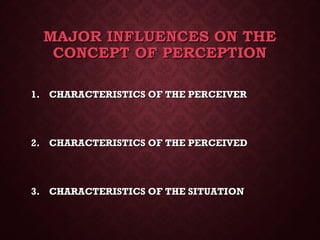
MAJOR INFLUENCES ON THEMAJOR INFLUENCES ON THE
CONCEPT OF PERCEPTIONCONCEPT OF PERCEPTION
1.1. CHARACTERISTICS OF THE PERCEIVERCHARACTERISTICS OF THE PERCEIVER
2.2. CHARACTERISTICS OF THE PERCEIVEDCHARACTERISTICS OF THE PERCEIVED
3.3. CHARACTERISTICS OF THE SITUATIONCHARACTERISTICS OF THE SITUATION
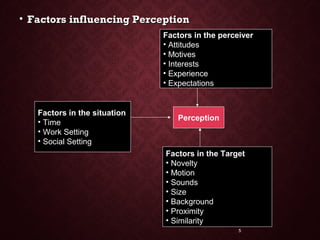
• Factors influencing PerceptionFactors influencing Perception
5
Factors in the perceiver
• Attitudes
• Motives
• Interests
• Experience
• Expectations
Perception
Factors in the Target
• Novelty
• Motion
• Sounds
• Size
• Background
• Proximity
• Similarity
Factors in the situation
• Time
• Work Setting
• Social Setting
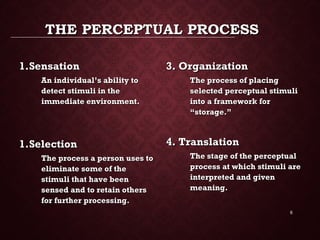
THE PERCEPTUAL PROCESSTHE PERCEPTUAL PROCESS
1.1.SensationSensation
An individual’s ability toAn individual’s ability to
detect stimuli in thedetect stimuli in the
immediate environment.immediate environment.
1.1.SelectionSelection
The process a person uses toThe process a person uses to
eliminate some of theeliminate some of the
stimuli that have beenstimuli that have been
sensed and to retain otherssensed and to retain others
for further processing.for further processing.
3. Organization3. Organization
The process of placingThe process of placing
selected perceptual stimuliselected perceptual stimuli
into a framework forinto a framework for
“storage.”“storage.”
4. Translation4. Translation
The stage of the perceptualThe stage of the perceptual
process at which stimuli areprocess at which stimuli are
interpreted and giveninterpreted and given
meaning.meaning.
6
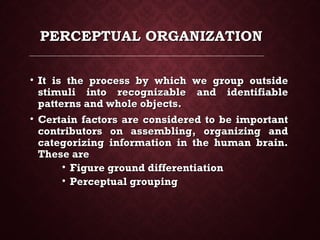
PERCEPTUAL ORGANIZATIONPERCEPTUAL ORGANIZATION
• It is the process by which we group outsideIt is the process by which we group outside
stimuli into recognizable and identifiablestimuli into recognizable and identifiable
patterns and whole objects.patterns and whole objects.
• Certain factors are considered to be importantCertain factors are considered to be important
contributors on assembling, organizing andcontributors on assembling, organizing and
categorizing information in the human brain.categorizing information in the human brain.
These areThese are
• Figure ground differentiationFigure ground differentiation
• Perceptual groupingPerceptual grouping
FIGURE-GROUND ILLUSTRATIONFIGURE-GROUND ILLUSTRATION
The tendency to distinguishThe tendency to distinguish
and focus on a stimulus that is classified as figure asand focus on a stimulus that is classified as figure as
opposed to background.opposed to background.
PERCEPTUAL GROUPINGPERCEPTUAL GROUPING
• Our tendency to group several individual stimuliOur tendency to group several individual stimuli
into a meaningful and recognizable pattern.into a meaningful and recognizable pattern.
• It is very basic in nature and largely it seems toIt is very basic in nature and largely it seems to
be inborn.be inborn.
9
PERPETUAL SELECTIVITY / SELECTIVEPERPETUAL SELECTIVITY / SELECTIVE
PERCEPTIONPERCEPTION
People selectively interpret what they
see on the basis of their interests,
background, experience attitudes and
stimulus selection
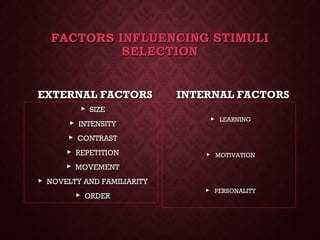
FACTORS INFLUENCING STIMULIFACTORS INFLUENCING STIMULI
SELECTIONSELECTION
EXTERNAL FACTORSEXTERNAL FACTORS
 SIZESIZE
 INTENSITYINTENSITY
 CONTRASTCONTRAST
 REPETITIONREPETITION
 MOVEMENTMOVEMENT
 NOVELTY AND FAMILIARITYNOVELTY AND FAMILIARITY
 ORDERORDER
INTERNAL FACTORSINTERNAL FACTORS
 LEARNINGLEARNING
 MOTIVATIONMOTIVATION
 PERSONALITYPERSONALITY
PERCEPTUAL DISTORTIONSPERCEPTUAL DISTORTIONS
AND ERRORSAND ERRORS
• STEREOTYPINGSTEREOTYPING:: Judging someone on the basis of one’s perceptionJudging someone on the basis of one’s perception
of the group to which that persons belongs.of the group to which that persons belongs.
• HALO EFFECT: Drawing general impressions on the basis of aHALO EFFECT: Drawing general impressions on the basis of a
single characteristic.single characteristic.
• PERCEPTUAL DEFENSE: The process by which stimuli that arePERCEPTUAL DEFENSE: The process by which stimuli that are
potentially threatening, offensive or unpleasant are either notpotentially threatening, offensive or unpleasant are either not
perceived or are distorted in perception.perceived or are distorted in perception.
• PROJECTION: Attributing one's own characteristicPROJECTION: Attributing one's own characteristic
to other people.to other people.
• EXPECTANCY: Evaluation of a person’sEXPECTANCY: Evaluation of a person’s
characteristics that are effected by comparisonscharacteristics that are effected by comparisons
with other people recently encountered who rankwith other people recently encountered who rank
higher or lower on the same characteristics.higher or lower on the same characteristics.
APPLICATIONSAPPLICATIONS
• EMPLOYMENT INTERVIEWEMPLOYMENT INTERVIEW
• PERFORMANCE APPRAISALSPERFORMANCE APPRAISALS
• ASSESSING LEVEL OF EFFORTASSESSING LEVEL OF EFFORT
• ASSESSING LOYALTYASSESSING LOYALTY
IMPLICATION OF PERCEPTION INIMPLICATION OF PERCEPTION IN
ORGANIZATIONAL FUNCTIONINGORGANIZATIONAL FUNCTIONING
•INFLUENCE PRODUCTIVITYINFLUENCE PRODUCTIVITY
•ABSENTEEISM AND TURN OVERABSENTEEISM AND TURN OVER
•IMPROVE JOB SATISFACTIONIMPROVE JOB SATISFACTION

Perception

  • 1.
  • 2.
  • 3.
    • Perception isthe result of complex interaction ofPerception is the result of complex interaction of various senses such as feeling, seeing, hearing,various senses such as feeling, seeing, hearing, thinking and comparing with known aspects of lifethinking and comparing with known aspects of life in order to make some sense of the world around usin order to make some sense of the world around us • Perception is the process of receiving informationPerception is the process of receiving information about and making sense of the world around us. Itabout and making sense of the world around us. It involves deciding which information to notice, howinvolves deciding which information to notice, how to categorize this information and how to interpret itto categorize this information and how to interpret it within the framework of existing knowledge.within the framework of existing knowledge. • The quality or accuracy of a person’s perception isThe quality or accuracy of a person’s perception is an important factor determining the quality of thean important factor determining the quality of the decision and actiondecision and action
  • 4.
    MAJOR INFLUENCES ONTHEMAJOR INFLUENCES ON THE CONCEPT OF PERCEPTIONCONCEPT OF PERCEPTION 1.1. CHARACTERISTICS OF THE PERCEIVERCHARACTERISTICS OF THE PERCEIVER 2.2. CHARACTERISTICS OF THE PERCEIVEDCHARACTERISTICS OF THE PERCEIVED 3.3. CHARACTERISTICS OF THE SITUATIONCHARACTERISTICS OF THE SITUATION
  • 5.
    • Factors influencingPerceptionFactors influencing Perception 5 Factors in the perceiver • Attitudes • Motives • Interests • Experience • Expectations Perception Factors in the Target • Novelty • Motion • Sounds • Size • Background • Proximity • Similarity Factors in the situation • Time • Work Setting • Social Setting
  • 6.
    THE PERCEPTUAL PROCESSTHEPERCEPTUAL PROCESS 1.1.SensationSensation An individual’s ability toAn individual’s ability to detect stimuli in thedetect stimuli in the immediate environment.immediate environment. 1.1.SelectionSelection The process a person uses toThe process a person uses to eliminate some of theeliminate some of the stimuli that have beenstimuli that have been sensed and to retain otherssensed and to retain others for further processing.for further processing. 3. Organization3. Organization The process of placingThe process of placing selected perceptual stimuliselected perceptual stimuli into a framework forinto a framework for “storage.”“storage.” 4. Translation4. Translation The stage of the perceptualThe stage of the perceptual process at which stimuli areprocess at which stimuli are interpreted and giveninterpreted and given meaning.meaning. 6
  • 7.
    PERCEPTUAL ORGANIZATIONPERCEPTUAL ORGANIZATION •It is the process by which we group outsideIt is the process by which we group outside stimuli into recognizable and identifiablestimuli into recognizable and identifiable patterns and whole objects.patterns and whole objects. • Certain factors are considered to be importantCertain factors are considered to be important contributors on assembling, organizing andcontributors on assembling, organizing and categorizing information in the human brain.categorizing information in the human brain. These areThese are • Figure ground differentiationFigure ground differentiation • Perceptual groupingPerceptual grouping
  • 8.
    FIGURE-GROUND ILLUSTRATIONFIGURE-GROUND ILLUSTRATION Thetendency to distinguishThe tendency to distinguish and focus on a stimulus that is classified as figure asand focus on a stimulus that is classified as figure as opposed to background.opposed to background.
  • 9.
    PERCEPTUAL GROUPINGPERCEPTUAL GROUPING •Our tendency to group several individual stimuliOur tendency to group several individual stimuli into a meaningful and recognizable pattern.into a meaningful and recognizable pattern. • It is very basic in nature and largely it seems toIt is very basic in nature and largely it seems to be inborn.be inborn. 9
  • 10.
    PERPETUAL SELECTIVITY /SELECTIVEPERPETUAL SELECTIVITY / SELECTIVE PERCEPTIONPERCEPTION People selectively interpret what they see on the basis of their interests, background, experience attitudes and stimulus selection
  • 11.
    FACTORS INFLUENCING STIMULIFACTORSINFLUENCING STIMULI SELECTIONSELECTION EXTERNAL FACTORSEXTERNAL FACTORS  SIZESIZE  INTENSITYINTENSITY  CONTRASTCONTRAST  REPETITIONREPETITION  MOVEMENTMOVEMENT  NOVELTY AND FAMILIARITYNOVELTY AND FAMILIARITY  ORDERORDER INTERNAL FACTORSINTERNAL FACTORS  LEARNINGLEARNING  MOTIVATIONMOTIVATION  PERSONALITYPERSONALITY
  • 12.
    PERCEPTUAL DISTORTIONSPERCEPTUAL DISTORTIONS ANDERRORSAND ERRORS • STEREOTYPINGSTEREOTYPING:: Judging someone on the basis of one’s perceptionJudging someone on the basis of one’s perception of the group to which that persons belongs.of the group to which that persons belongs. • HALO EFFECT: Drawing general impressions on the basis of aHALO EFFECT: Drawing general impressions on the basis of a single characteristic.single characteristic. • PERCEPTUAL DEFENSE: The process by which stimuli that arePERCEPTUAL DEFENSE: The process by which stimuli that are potentially threatening, offensive or unpleasant are either notpotentially threatening, offensive or unpleasant are either not perceived or are distorted in perception.perceived or are distorted in perception.
  • 13.
    • PROJECTION: Attributingone's own characteristicPROJECTION: Attributing one's own characteristic to other people.to other people. • EXPECTANCY: Evaluation of a person’sEXPECTANCY: Evaluation of a person’s characteristics that are effected by comparisonscharacteristics that are effected by comparisons with other people recently encountered who rankwith other people recently encountered who rank higher or lower on the same characteristics.higher or lower on the same characteristics.
  • 14.
    APPLICATIONSAPPLICATIONS • EMPLOYMENT INTERVIEWEMPLOYMENTINTERVIEW • PERFORMANCE APPRAISALSPERFORMANCE APPRAISALS • ASSESSING LEVEL OF EFFORTASSESSING LEVEL OF EFFORT • ASSESSING LOYALTYASSESSING LOYALTY
  • 15.
    IMPLICATION OF PERCEPTIONINIMPLICATION OF PERCEPTION IN ORGANIZATIONAL FUNCTIONINGORGANIZATIONAL FUNCTIONING •INFLUENCE PRODUCTIVITYINFLUENCE PRODUCTIVITY •ABSENTEEISM AND TURN OVERABSENTEEISM AND TURN OVER •IMPROVE JOB SATISFACTIONIMPROVE JOB SATISFACTION