CONFLICT
Naveen Raj D.S
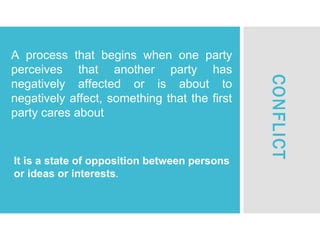
A process that begins when one party
perceives that another party has
negatively affected or is about to
negatively affect, something that the first
party cares about
CONFLICT
It is a state of opposition between persons
or ideas or interests.
TYPES OF
CONFLICT
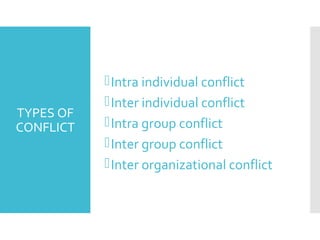
Intra individual conflict
Inter individual conflict
Intra group conflict
Inter group conflict
Inter organizational conflict
DIFFERENT
ASPECTS
OF
CONFLICT
Positive Aspects Negative Aspects
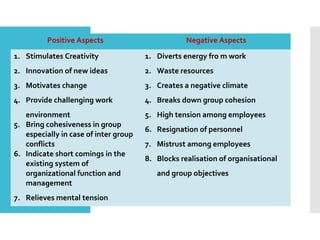
1. Stimulates Creativity
2. Innovation of new ideas
3. Motivates change
4. Provide challenging work
environment
5. Bring cohesiveness in group
especially in case of inter group
conflicts
6. Indicate short comings in the
existing system of
organizational function and
management
7. Relieves mental tension
1. Diverts energy fro m work
2. Waste resources
3. Creates a negative climate
4. Breaks down group cohesion
5. High tension among employees
6. Resignation of personnel
7. Mistrust among employees
8. Blocks realisation of organisational
and group objectives
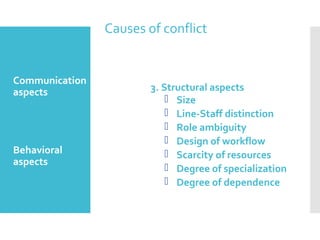
Causes of conflict
1.Communication
aspects
1.Behavioral
aspects
3. Structural aspects
 Size
 Line-Staff distinction
 Role ambiguity
 Design of workflow
 Scarcity of resources
 Degree of specialization
 Degree of dependence
5
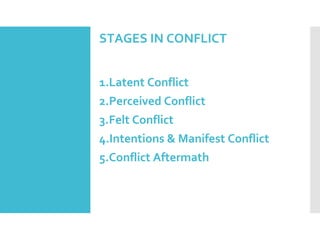
STAGES IN CONFLICT
1.Latent Conflict
2.Perceived Conflict
3.Felt Conflict
4.Intentions & Manifest Conflict
5.Conflict Aftermath
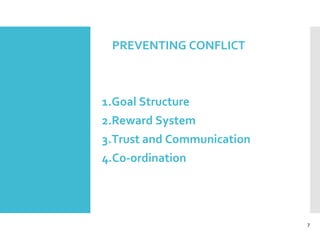
PREVENTING CONFLICT
1.Goal Structure
2.Reward System
3.Trust and Communication
4.Co-ordination
7
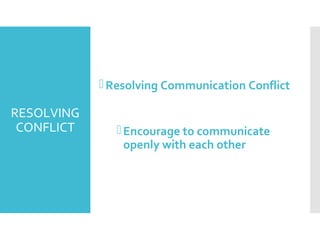
RESOLVING
CONFLICT
Resolving Communication Conflict
Encourage to communicate
openly with each other
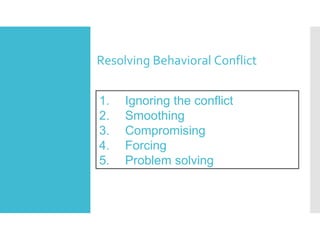
Resolving Behavioral Conflict
1. Ignoring the conflict
2. Smoothing
3. Compromising
4. Forcing
5. Problem solving
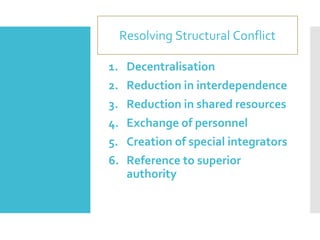
Resolving Structural Conflict
1. Decentralisation
2. Reduction in interdependence
3. Reduction in shared resources
4. Exchange of personnel
5. Creation of special integrators
6. Reference to superior
authority
NEGOTIATION
 Is often essential to decide
harmonious solution for all parties
involved in the conflict, i.e. an open
process to find a satisfactory solution
to a complex conflict.
 Is a problem solving procedure in
which 2 or more parties willingly
discuss their differences and try to
reach a joint decision on their common
concerns
Requirements Participants must recognize issues about
which they differ.
 Educate each other about their needs and
interests.
 Generate possible settlement options
 Bargain over the terms of the final
agreement
DISTRIBUTIVE BARGAINING
(positional bargaining)
It is a negotiation approach in
which a series of positions,
alternative solutions that meet
particular interests or needs are
selected by a negotiator,
ordered sequentially according
to preferred outcomes and
presented to another party in
an effort to reach agreement.
DISTRIBUTIVE BARGAINING
First (opening) position represents
the maximum gain hoped for or
expected in the negotiation.
Each following position demands
less of an opponent and results in
lower benefits for the person
advocating it.
Agreement is reached when the
negotiators position converge and
they reach an acceptable settlement
range
INTEGRATIVE
NEGOTIATION
also known as interest-based or
principled negotiation.
Interest-based bargaining which
involves parties in a collaborative
effort to jointly meet each other's
needs and satisfy mutual interests
rather than moving from positions to
counter positions to a compromise
settlement.
This approach attempt to identify their
interests or needs and those of other
parties prior to developing specific
solutions
15
INTEGRATIVE
NEGOTIATION
After the interests are identified,
the negotiators jointly search for
a variety of settlement options
that might satisfy all interests,
rather than argue for any single
position.
The parties select a solution
from these jointly generated
options.
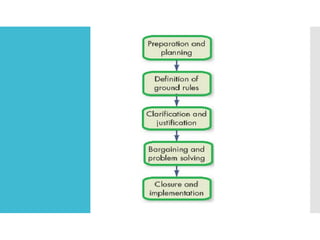
NEGOTIATION PROCESS

Conflict

  • 1.
  • 2.
    A process thatbegins when one party perceives that another party has negatively affected or is about to negatively affect, something that the first party cares about CONFLICT It is a state of opposition between persons or ideas or interests.
  • 3.
    TYPES OF CONFLICT Intra individualconflict Inter individual conflict Intra group conflict Inter group conflict Inter organizational conflict
  • 4.
    DIFFERENT ASPECTS OF CONFLICT Positive Aspects NegativeAspects 1. Stimulates Creativity 2. Innovation of new ideas 3. Motivates change 4. Provide challenging work environment 5. Bring cohesiveness in group especially in case of inter group conflicts 6. Indicate short comings in the existing system of organizational function and management 7. Relieves mental tension 1. Diverts energy fro m work 2. Waste resources 3. Creates a negative climate 4. Breaks down group cohesion 5. High tension among employees 6. Resignation of personnel 7. Mistrust among employees 8. Blocks realisation of organisational and group objectives
  • 5.
    Causes of conflict 1.Communication aspects 1.Behavioral aspects 3.Structural aspects  Size  Line-Staff distinction  Role ambiguity  Design of workflow  Scarcity of resources  Degree of specialization  Degree of dependence 5
  • 6.
    STAGES IN CONFLICT 1.LatentConflict 2.Perceived Conflict 3.Felt Conflict 4.Intentions & Manifest Conflict 5.Conflict Aftermath
  • 7.
    PREVENTING CONFLICT 1.Goal Structure 2.RewardSystem 3.Trust and Communication 4.Co-ordination 7
  • 8.
  • 9.
    Resolving Behavioral Conflict 1.Ignoring the conflict 2. Smoothing 3. Compromising 4. Forcing 5. Problem solving
  • 10.
    Resolving Structural Conflict 1.Decentralisation 2. Reduction in interdependence 3. Reduction in shared resources 4. Exchange of personnel 5. Creation of special integrators 6. Reference to superior authority
  • 11.
    NEGOTIATION  Is oftenessential to decide harmonious solution for all parties involved in the conflict, i.e. an open process to find a satisfactory solution to a complex conflict.  Is a problem solving procedure in which 2 or more parties willingly discuss their differences and try to reach a joint decision on their common concerns
  • 12.
    Requirements Participants mustrecognize issues about which they differ.  Educate each other about their needs and interests.  Generate possible settlement options  Bargain over the terms of the final agreement
  • 13.
    DISTRIBUTIVE BARGAINING (positional bargaining) Itis a negotiation approach in which a series of positions, alternative solutions that meet particular interests or needs are selected by a negotiator, ordered sequentially according to preferred outcomes and presented to another party in an effort to reach agreement.
  • 14.
    DISTRIBUTIVE BARGAINING First (opening)position represents the maximum gain hoped for or expected in the negotiation. Each following position demands less of an opponent and results in lower benefits for the person advocating it. Agreement is reached when the negotiators position converge and they reach an acceptable settlement range
  • 15.
    INTEGRATIVE NEGOTIATION also known asinterest-based or principled negotiation. Interest-based bargaining which involves parties in a collaborative effort to jointly meet each other's needs and satisfy mutual interests rather than moving from positions to counter positions to a compromise settlement. This approach attempt to identify their interests or needs and those of other parties prior to developing specific solutions 15
  • 16.
    INTEGRATIVE NEGOTIATION After the interestsare identified, the negotiators jointly search for a variety of settlement options that might satisfy all interests, rather than argue for any single position. The parties select a solution from these jointly generated options.
  • 17.