Database Systems
Khwaja Fareed University of Engineering & IT
Lecture 1Lecture 1
Fundamental Database ConceptsFundamental Database Concepts
A database is any collection of data.
A DBMS is a software system
designed to maintain a database.
We use a DBMS when
 there is a large amount of data
 security and integrity of the data are important
 many users access the data concurrently
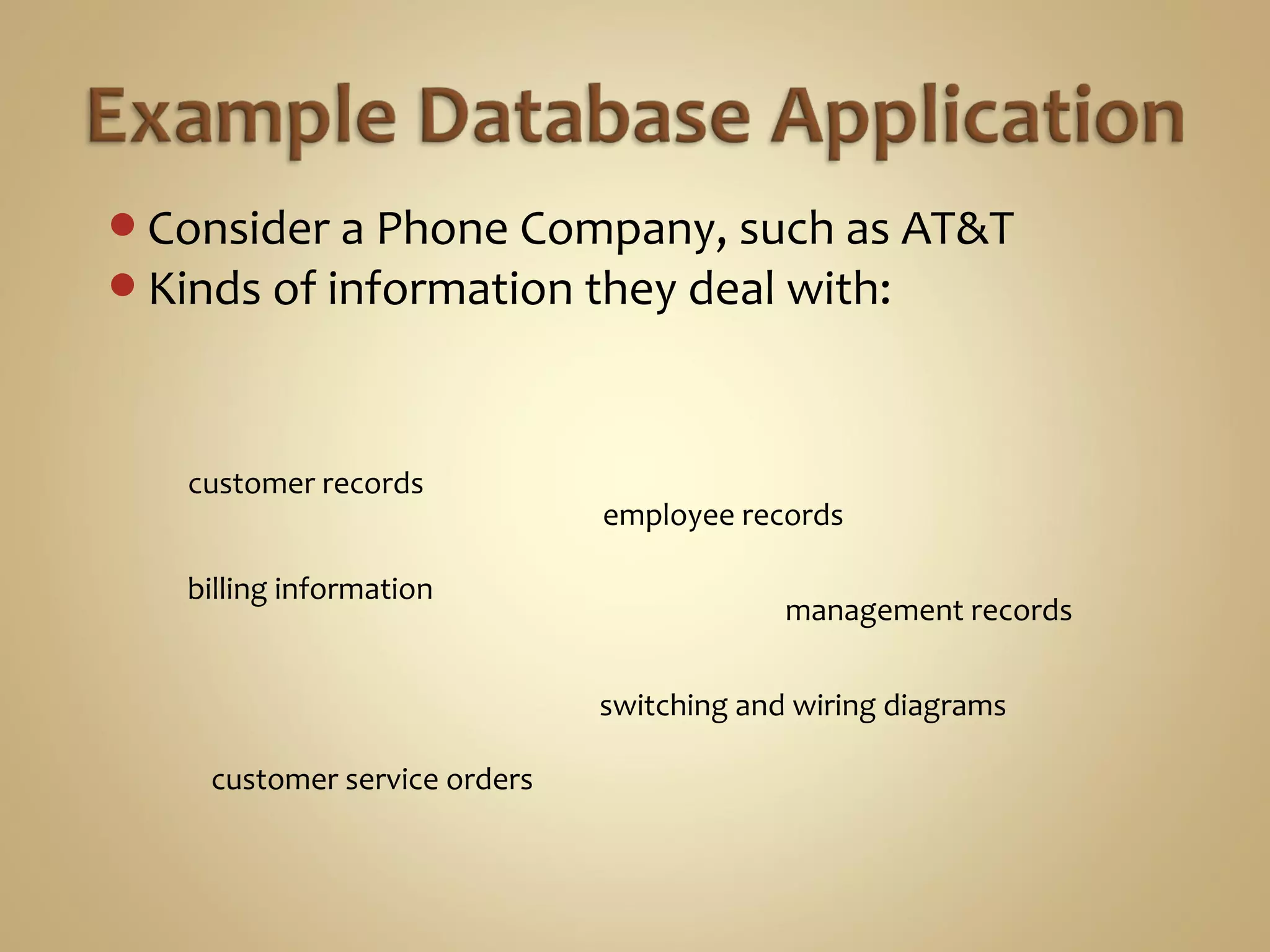
Consider a Phone Company, such as AT&T
Kinds of information they deal with:
customer records
billing information
employee records
management records
customer service orders
switching and wiring diagrams
With all that data,
AT&T must be concerned with questions such as:
 Where is the information kept?
 How is the data structured?
 How is the data kept consistent?
 How is the data described?
 How is the data kept secure?
 How do different pieces of data interrelate?
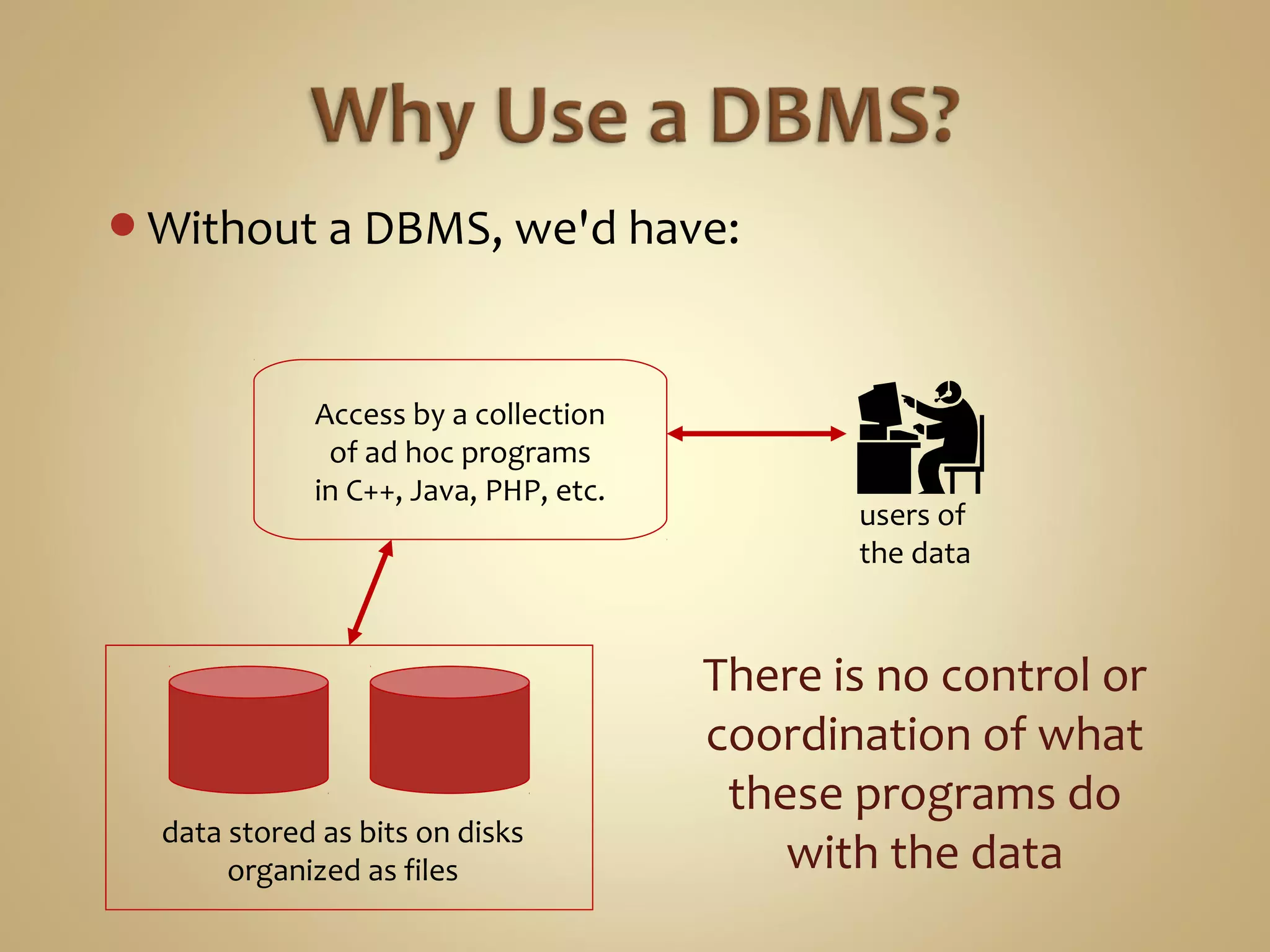
Without a DBMS, we'd have:
data stored as bits on disks
organized as files
Access by a collection
of ad hoc programs
in C++, Java, PHP, etc.
users of
the data
There is no control or
coordination of what
these programs do
with the data
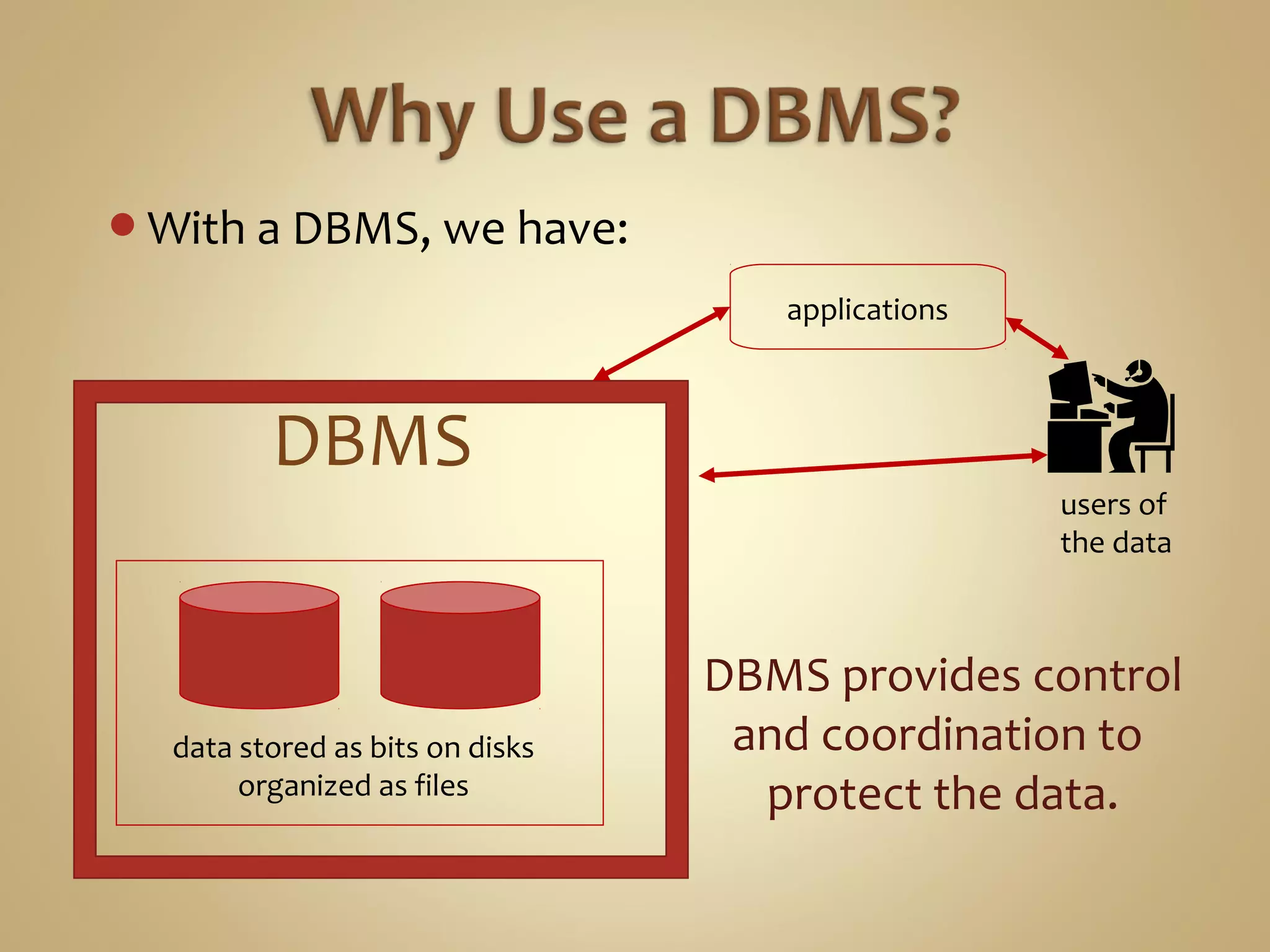
With a DBMS, we have:
data stored as bits on disks
organized as files
users of
the data
DBMS provides control
and coordination to
protect the data.
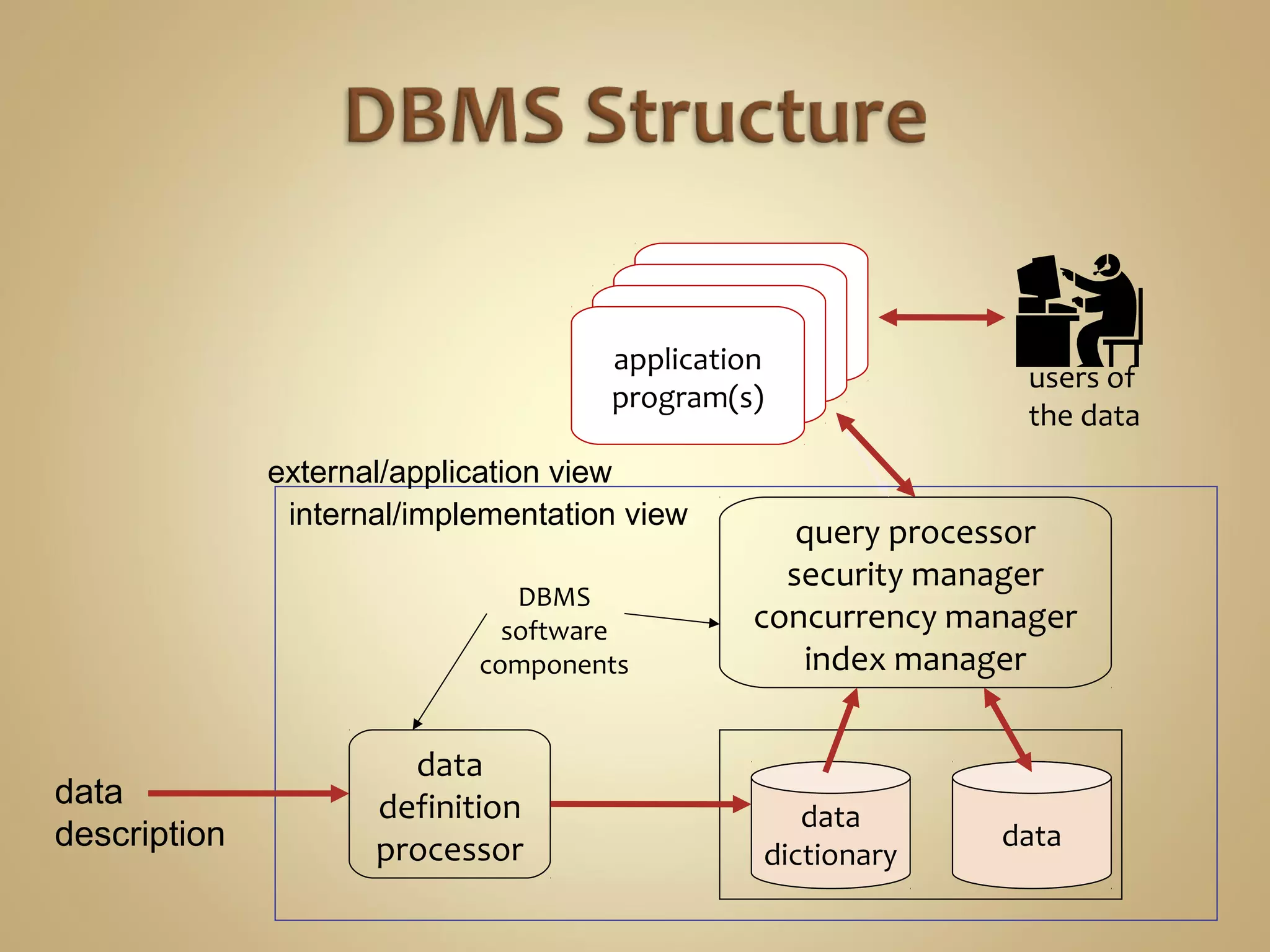
DBMS
applications
data
users of
the data
data
dictionary
data
definition
processor
query processor
security manager
concurrency manager
index manager
application
program(s)
application
program(s)
application
program(s)
application
program(s)
internal/implementation view
external/application view
DBMS
software
components
data
description
users of
the data
application
program(s)
application
program(s)
application
program(s)
application
program(s)
data
data
dictionary
data
definition
processor
query processor
security manager
concurrency manager
index manager
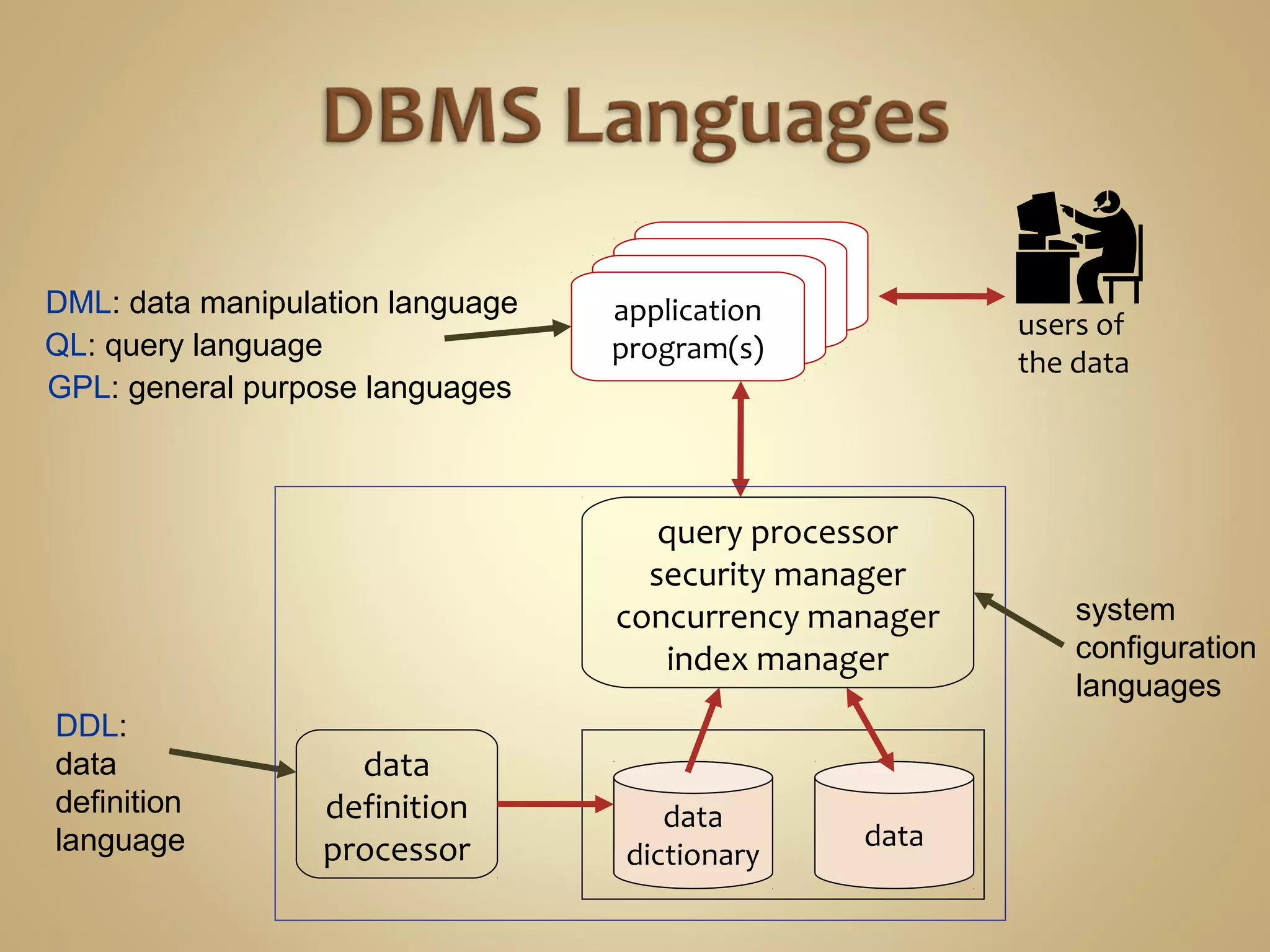
DDL:
data
definition
language
system
configuration
languages
QL: query language
DML: data manipulation language
GPL: general purpose languages
Anything you can do with a DBMS,
you can do with a file system, a network
and a heap of C code
So why spend the money to buy a DBMS?
 there is a well defined collection of capabilities common to a
certain class of applications
 for applications in this class, the DBMS already has these
capabilities and probably does them better than you could with
home-brewed code
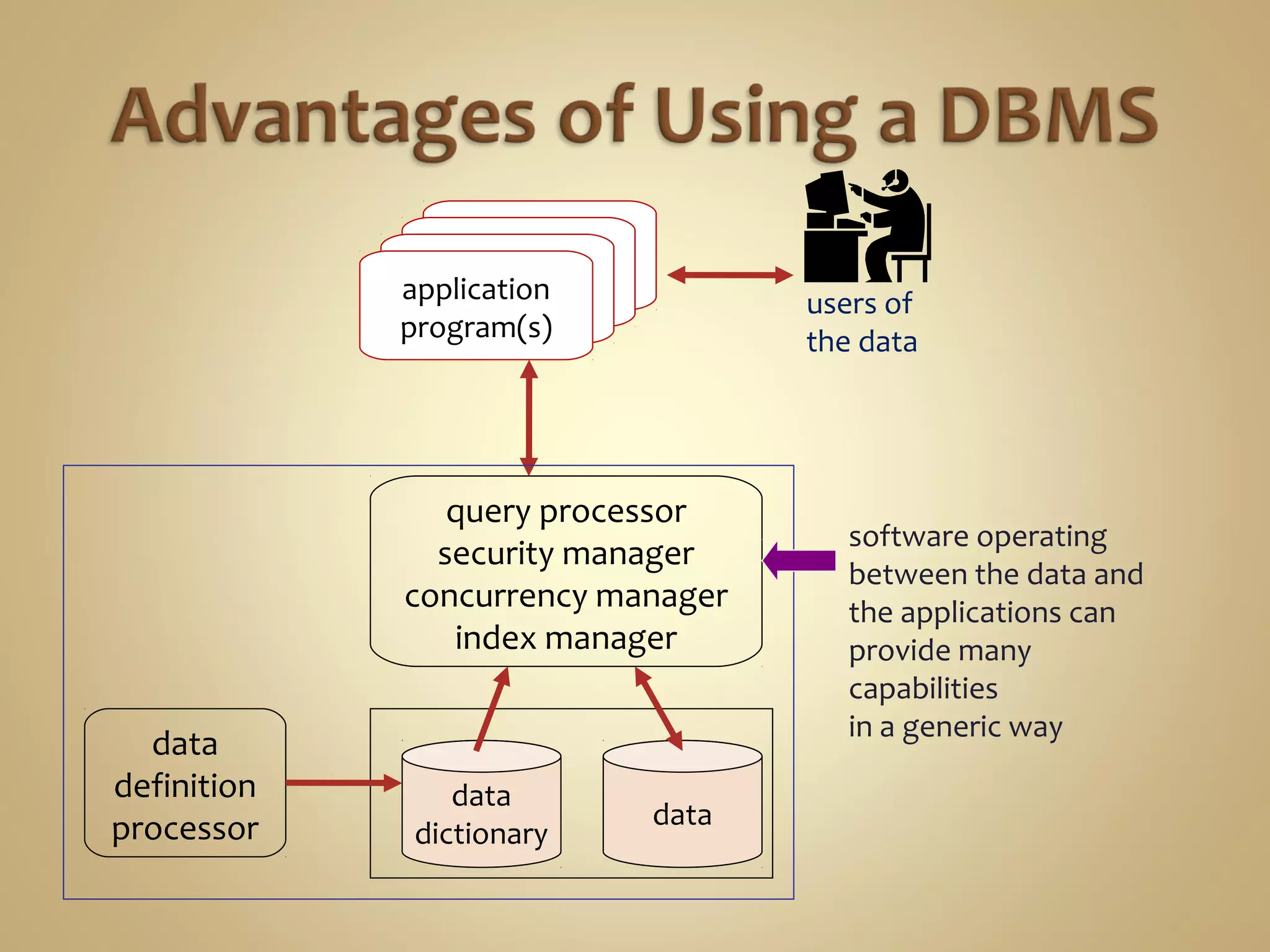
users of
the data
application
program(s)
application
program(s)
application
program(s)
application
program(s)
data
data
dictionary
data
definition
processor
query processor
security manager
concurrency manager
index manager
software operating
between the data and
the applications can
provide many
capabilities
in a generic way
A DBMS provides
persistent objects, types and data structures
 persistent = having a lifetime longer than
the programs that use the data
 any information that fits the data model
of a particular DBMS
can be made persistent with little effort
 data model = concepts that can be used to describe the data
A DBMS supports access by concurrent users
 concurrent = happening at the same time
 concurrent access, particularly writes (data changes),
can result in inconsistent states
(even when the individual operations are correct)
 the DBMS can check the actual operations of concurrent users,
to prevent activity that will lead to inconsistent states
A DBMS can restrict access to authorized users
 security policies often require control that is more fine-grained
than that provided by a file system
 since the DBMS understands the data structure, it can enforce
fairly sophisticated and detailed security policies
 on subsets of the data
 on subsets of the available operations
A DBMS can assist in controlling redundancy
 redundancy = multiple copies of the same data
 with file storage, it's often convenient to store multiple copies
of the same data, so that it's "local" to other data and
applications
 this can cause many problems:
 wasted disk space
 inconsistencies
 need to enter the data multiple times
A DBMS supports representation
of complex relationships and integrity constraints
 the semantics (meaning) of an application often
includes many relationships and rules
about the relative values of subsets of the data
 these further restrict the possible instances of the database
 relationships and constraints can be defined as part of the
schema
A DBMS can provide backup and recovery
 backup = snapshots of the data particular times
 recovery = restoring the data to a consistent state
after a system crash
 the higher level semantics (relationships and constraints)
can make it difficult to restore a consistent state
 transaction analysis can allow a DBMS to reconstruct a
consistent state from a number of backups
A DBMS can support
multiple user interfaces and user views
 since the DBMS provides a well-defined data model and a
persistent data dictionary, many different interfaces can be
developed to access the same data
 data independence ensures that these UIs will not be made
invalid by most changes to the data
 new user views can be supported as new schemas defined
against the conceptual schema
persistent objects, types and data structures
control of concurrent users
controlling of redundancy
restricting access (security)
representation of complex relationships
and integrity constraints
backup and recovery
multiple user interfaces and user views
users of
the data
application
program(s)
application
program(s)
application
program(s)
application
program(s)
data
data
dictionary
data
definition
processor
query processor
security manager
concurrency manager
index manager
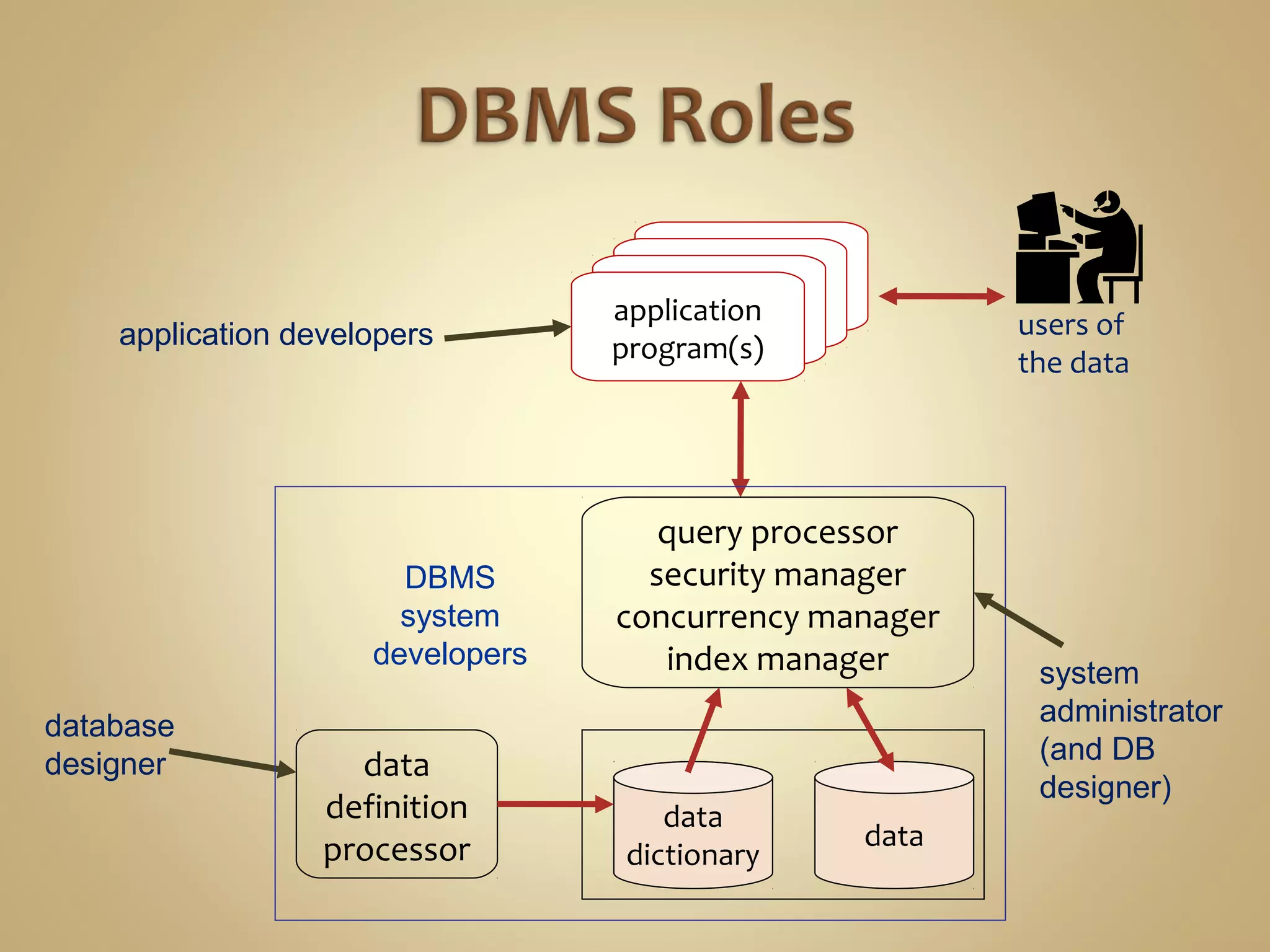
database
designer
application developers
system
administrator
(and DB
designer)
DBMS
system
developers
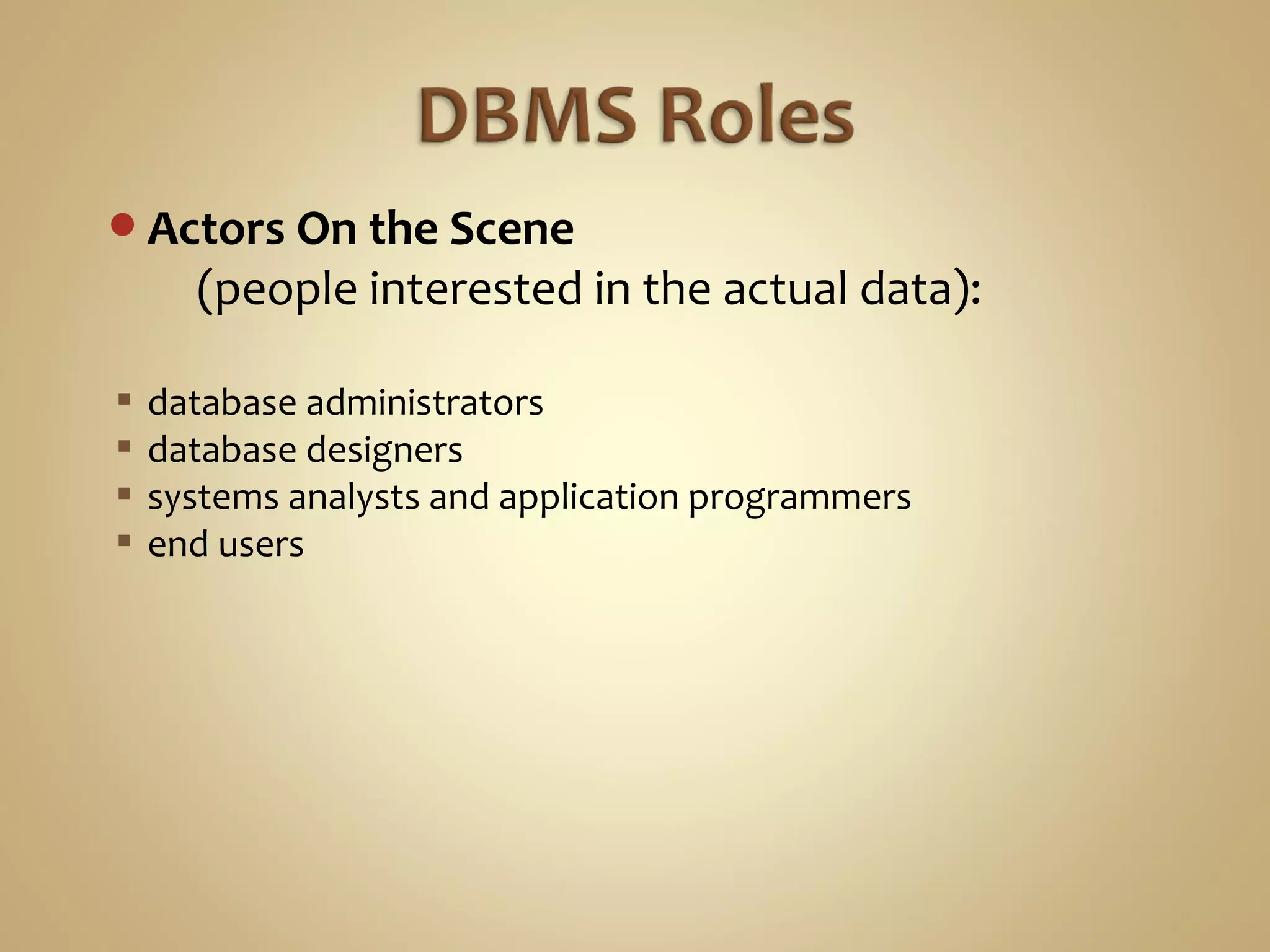
Actors On the Scene
(people interested in the actual data):
 database administrators
 database designers
 systems analysts and application programmers
 end users
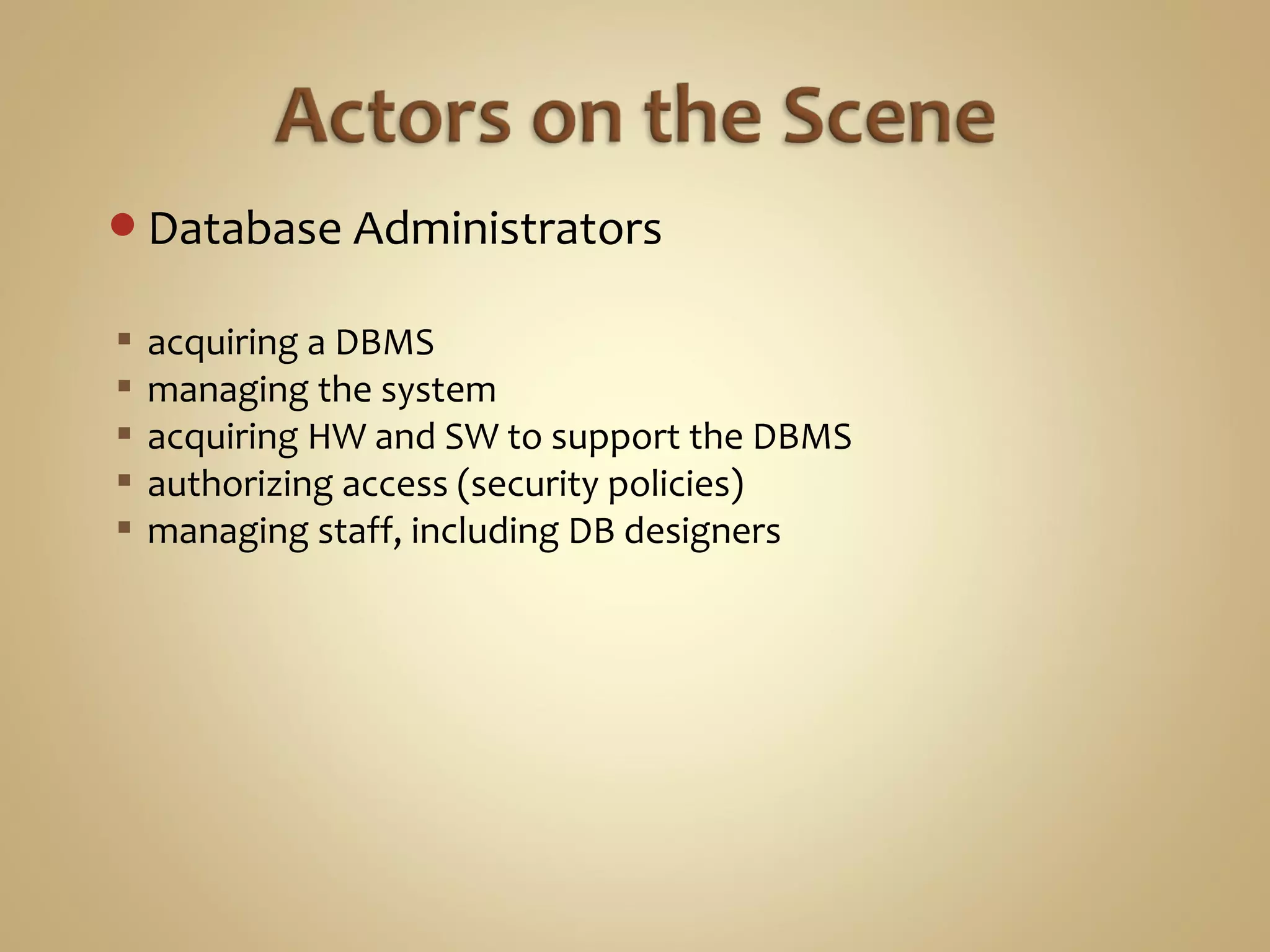
Database Administrators
 acquiring a DBMS
 managing the system
 acquiring HW and SW to support the DBMS
 authorizing access (security policies)
 managing staff, including DB designers
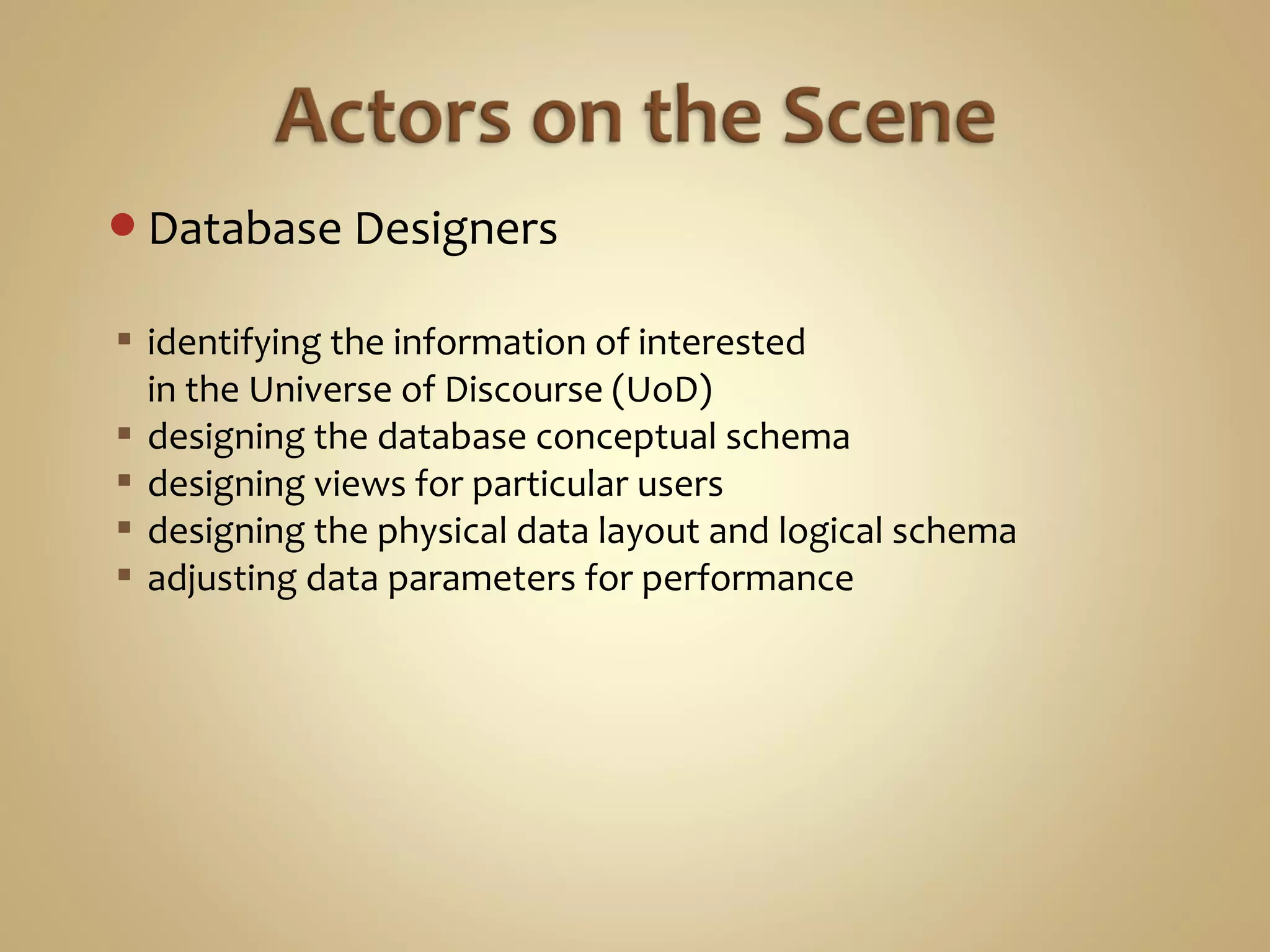
Database Designers
 identifying the information of interested
in the Universe of Discourse (UoD)
 designing the database conceptual schema
 designing views for particular users
 designing the physical data layout and logical schema
 adjusting data parameters for performance
Systems Analysts and Application Programmers
(generic database developers)
 provide specialized knowledge to optimize database usage
 provide generic (canned) application programs
End Users
 casual users: ad-hoc queries
 naïve or parametric users: canned queries such as menus for a
phone company customer service agent
 sophisticated users: people who understand the system and the
data and use it in many novel ways
 standalone users: people who use personal easy-to-use
databases for personal data
Actors Behind the Scene:
people who maintain the environment
but aren't interested in the actual data
 DBMS designers and implementers
 tools developers
 operators and maintenance personnel
 database researchers
DBMS designers and implementers
 work for the company that supplies the DBMS
(i.e. Microsoft , Oracle, Sybase, MySQL …)
 programmers and engineers
 design and implement the DBMS
Tools Developers
 design and implement DBMS add-ons or plug-ins
 may work for DBMS supplier or be independent
 kinds of tools: database design aids, performance monitoring
tools, user and designer interfaces
Operators and maintenance personnel
 run and maintain the computer environment in which a DBMS
operates
 probably work for the database administrator (DBA)
Database Researchers
 academic or industrial researchers
 develop new theory, new designs, new data models and new
algorithms to improve future database management systems
A database instance is the collective values of
all database objects at some point in time
 also called the (data) instance or (database) state
A schema describes the database and
defines the possible instances
 also called the data definition, data dictionary, or meta-data
A data model describes the possible schemas
(essentially the meta-schema)
A DBMS is designed around a particular data
model
 this is what allows all system components (and humans)
to understand the schema and data
possible data models
 relational,
object-oriented, object-relational,
entity-relationship,
semantic, network, hierarchical, etc.
A physical data model describes the way
in which data is stored in the computer
 typically only of interest to database designers, implementers
and maintainers …not end users
 must provide a well-defined structure that can be mapped to
the conceptual schema
 allows optimization strategies to be defined generically
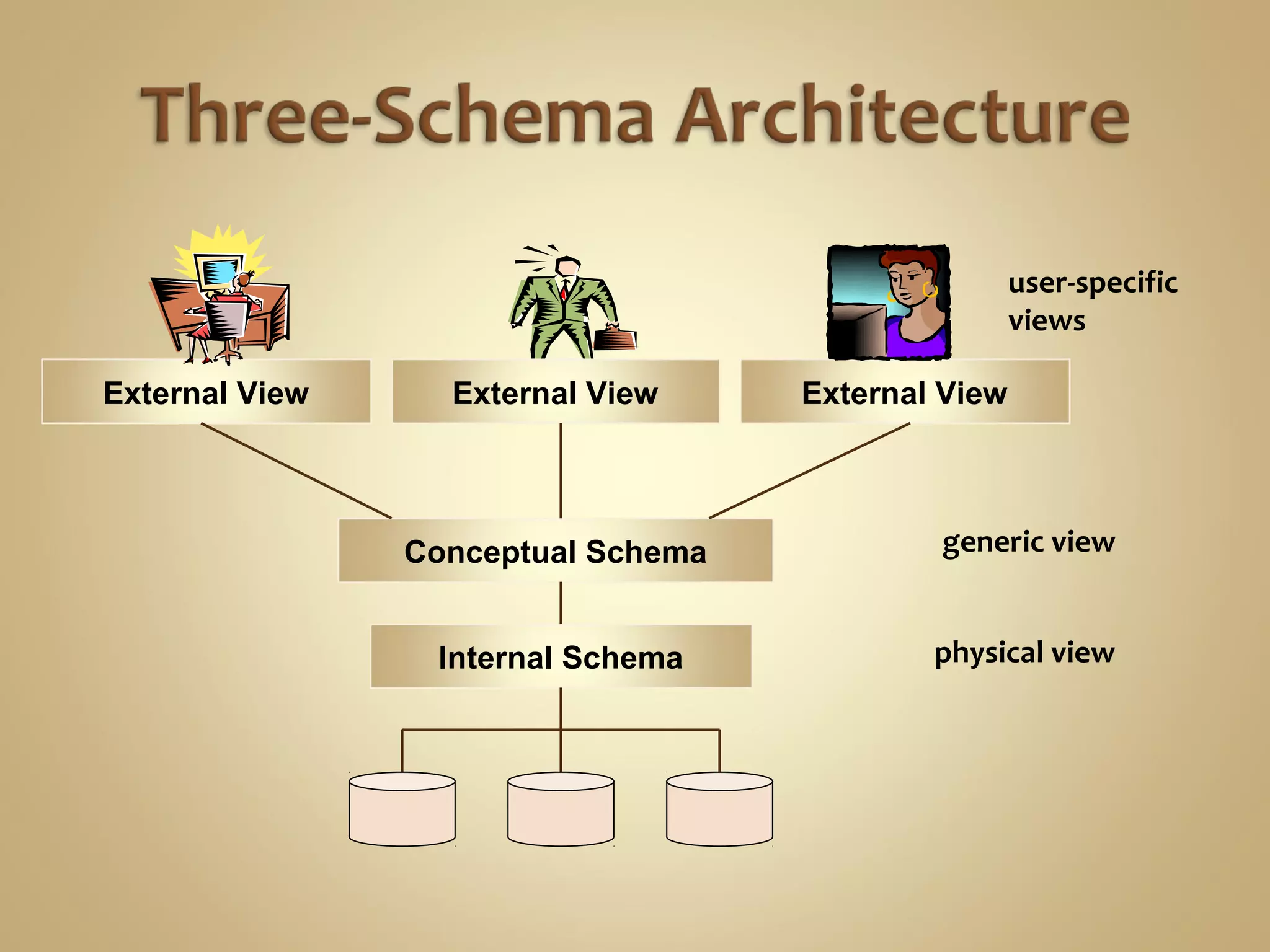
External View External View External View
Internal Schema
Conceptual Schema generic view
physical view
user-specific
views
physical data independence
 conceptual and external schema are defined
in terms of the data model,
rather than the actual data layout
 ensures that conceptual and external schemas
are not affected by changes to the physical data layout
logical data independence
 ensures that changes to the conceptual schema
don't affect the external views
 (this is not always achievable)

Lecture1

  • 1.
    Database Systems Khwaja FareedUniversity of Engineering & IT Lecture 1Lecture 1 Fundamental Database ConceptsFundamental Database Concepts
  • 2.
    A database isany collection of data. A DBMS is a software system designed to maintain a database. We use a DBMS when  there is a large amount of data  security and integrity of the data are important  many users access the data concurrently
  • 3.
    Consider a PhoneCompany, such as AT&T Kinds of information they deal with: customer records billing information employee records management records customer service orders switching and wiring diagrams
  • 4.
    With all thatdata, AT&T must be concerned with questions such as:  Where is the information kept?  How is the data structured?  How is the data kept consistent?  How is the data described?  How is the data kept secure?  How do different pieces of data interrelate?
  • 5.
    Without a DBMS,we'd have: data stored as bits on disks organized as files Access by a collection of ad hoc programs in C++, Java, PHP, etc. users of the data There is no control or coordination of what these programs do with the data
  • 6.
    With a DBMS,we have: data stored as bits on disks organized as files users of the data DBMS provides control and coordination to protect the data. DBMS applications
  • 7.
    data users of the data data dictionary data definition processor queryprocessor security manager concurrency manager index manager application program(s) application program(s) application program(s) application program(s) internal/implementation view external/application view DBMS software components data description
  • 8.
    users of the data application program(s) application program(s) application program(s) application program(s) data data dictionary data definition processor queryprocessor security manager concurrency manager index manager DDL: data definition language system configuration languages QL: query language DML: data manipulation language GPL: general purpose languages
  • 9.
    Anything you cando with a DBMS, you can do with a file system, a network and a heap of C code So why spend the money to buy a DBMS?  there is a well defined collection of capabilities common to a certain class of applications  for applications in this class, the DBMS already has these capabilities and probably does them better than you could with home-brewed code
  • 11.
    users of the data application program(s) application program(s) application program(s) application program(s) data data dictionary data definition processor queryprocessor security manager concurrency manager index manager software operating between the data and the applications can provide many capabilities in a generic way
  • 12.
    A DBMS provides persistentobjects, types and data structures  persistent = having a lifetime longer than the programs that use the data  any information that fits the data model of a particular DBMS can be made persistent with little effort  data model = concepts that can be used to describe the data
  • 13.
    A DBMS supportsaccess by concurrent users  concurrent = happening at the same time  concurrent access, particularly writes (data changes), can result in inconsistent states (even when the individual operations are correct)  the DBMS can check the actual operations of concurrent users, to prevent activity that will lead to inconsistent states
  • 14.
    A DBMS canrestrict access to authorized users  security policies often require control that is more fine-grained than that provided by a file system  since the DBMS understands the data structure, it can enforce fairly sophisticated and detailed security policies  on subsets of the data  on subsets of the available operations
  • 15.
    A DBMS canassist in controlling redundancy  redundancy = multiple copies of the same data  with file storage, it's often convenient to store multiple copies of the same data, so that it's "local" to other data and applications  this can cause many problems:  wasted disk space  inconsistencies  need to enter the data multiple times
  • 16.
    A DBMS supportsrepresentation of complex relationships and integrity constraints  the semantics (meaning) of an application often includes many relationships and rules about the relative values of subsets of the data  these further restrict the possible instances of the database  relationships and constraints can be defined as part of the schema
  • 17.
    A DBMS canprovide backup and recovery  backup = snapshots of the data particular times  recovery = restoring the data to a consistent state after a system crash  the higher level semantics (relationships and constraints) can make it difficult to restore a consistent state  transaction analysis can allow a DBMS to reconstruct a consistent state from a number of backups
  • 18.
    A DBMS cansupport multiple user interfaces and user views  since the DBMS provides a well-defined data model and a persistent data dictionary, many different interfaces can be developed to access the same data  data independence ensures that these UIs will not be made invalid by most changes to the data  new user views can be supported as new schemas defined against the conceptual schema
  • 19.
    persistent objects, typesand data structures control of concurrent users controlling of redundancy restricting access (security) representation of complex relationships and integrity constraints backup and recovery multiple user interfaces and user views
  • 21.
    users of the data application program(s) application program(s) application program(s) application program(s) data data dictionary data definition processor queryprocessor security manager concurrency manager index manager database designer application developers system administrator (and DB designer) DBMS system developers
  • 22.
    Actors On theScene (people interested in the actual data):  database administrators  database designers  systems analysts and application programmers  end users
  • 23.
    Database Administrators  acquiringa DBMS  managing the system  acquiring HW and SW to support the DBMS  authorizing access (security policies)  managing staff, including DB designers
  • 24.
    Database Designers  identifyingthe information of interested in the Universe of Discourse (UoD)  designing the database conceptual schema  designing views for particular users  designing the physical data layout and logical schema  adjusting data parameters for performance
  • 25.
    Systems Analysts andApplication Programmers (generic database developers)  provide specialized knowledge to optimize database usage  provide generic (canned) application programs
  • 26.
    End Users  casualusers: ad-hoc queries  naïve or parametric users: canned queries such as menus for a phone company customer service agent  sophisticated users: people who understand the system and the data and use it in many novel ways  standalone users: people who use personal easy-to-use databases for personal data
  • 27.
    Actors Behind theScene: people who maintain the environment but aren't interested in the actual data  DBMS designers and implementers  tools developers  operators and maintenance personnel  database researchers
  • 28.
    DBMS designers andimplementers  work for the company that supplies the DBMS (i.e. Microsoft , Oracle, Sybase, MySQL …)  programmers and engineers  design and implement the DBMS
  • 29.
    Tools Developers  designand implement DBMS add-ons or plug-ins  may work for DBMS supplier or be independent  kinds of tools: database design aids, performance monitoring tools, user and designer interfaces
  • 30.
    Operators and maintenancepersonnel  run and maintain the computer environment in which a DBMS operates  probably work for the database administrator (DBA)
  • 31.
    Database Researchers  academicor industrial researchers  develop new theory, new designs, new data models and new algorithms to improve future database management systems
  • 33.
    A database instanceis the collective values of all database objects at some point in time  also called the (data) instance or (database) state A schema describes the database and defines the possible instances  also called the data definition, data dictionary, or meta-data
  • 34.
    A data modeldescribes the possible schemas (essentially the meta-schema) A DBMS is designed around a particular data model  this is what allows all system components (and humans) to understand the schema and data possible data models  relational, object-oriented, object-relational, entity-relationship, semantic, network, hierarchical, etc.
  • 35.
    A physical datamodel describes the way in which data is stored in the computer  typically only of interest to database designers, implementers and maintainers …not end users  must provide a well-defined structure that can be mapped to the conceptual schema  allows optimization strategies to be defined generically
  • 36.
    External View ExternalView External View Internal Schema Conceptual Schema generic view physical view user-specific views
  • 37.
    physical data independence conceptual and external schema are defined in terms of the data model, rather than the actual data layout  ensures that conceptual and external schemas are not affected by changes to the physical data layout logical data independence  ensures that changes to the conceptual schema don't affect the external views  (this is not always achievable)