Lecture 02
Data-Link Protocols
Prepared by: Engr. Jeffrey Des B. Binwag

Chapter 23
Electronic Communications Sytems , Fifth Editon
By: Wayne Tomasi
ECE @Saint Louis University, Baguio City

1
CLASSIFICATONS OF DLCP
• CHARACTER ORIENTED PROTOCOLS
– Interpret a frame of data as a group of successive
bits combined into predefined patterns of fixed
length bits each representing a unique character
– Data frames for these protocols include control
characters that convey important information
pertaining to DLCP functions
– Also called BYTE ORIENTED Protocols
– Examples: X-Modem, Y-Modem, ZModem, BLAST, IBM 83B, IBM BSC
ECE @Saint Louis University, Baguio City

2
CLASSIFICATONS OF DLCP
• BIT-ORIENTED PROTOCOLS
– A discipline for serial bit-by-bit information
transfer over a data communications channel
– Information is transferred as a series of successive
bits that may be interpreted individually on a bitby-bit basis or in groups of several bits as opposed
to a fixed length group of bits
– Examples: SDLC, HDLC

ECE @Saint Louis University, Baguio City

3
CLASSIFICATONS OF DLCP
• ASYNCHRONOUS PROTOCOLS
– Simple, character oriented protocols generally
used on two-point networks using asynchronous
data and asynchronous modems
– Examples: X-MODEM, Y-MODEM, IBM 83B

• SYNCHRONOUS PROTOCOLS
– Protocols used on point to multi-point networks
using synchronous data and synchronous modems
– Examples: IBM BSC, SDLC, HDLC
ECE @Saint Louis University, Baguio City

4
ASYNCHRONOUS DLCP
• XMODEM
– Developed by Ward Christiansen in 1979
– The first file transfer protocol (FTP) designed as an
asynchronous, character-oriented protocol to
facilitate transferring data between two personal
computers
– Specifies a half-duplex stop-and-wait protocol
using a data frame comprised of four fields

ECE @Saint Louis University, Baguio City

5
ASYNCHRONOUS DLCP
• XMODEM PROCEDURAL SEQUENCE
– Destination station sends a negative acknowledgement (NAK)
to the source station
– The source sends the first data frame and waits for an
acknowledgement
– The destination receives and evaluates the data frame from
the source. It responds with an ACK if there is no error or a
NAK if an error is detected
– If the source receives an ACK it sends the next frame. If it
receives a NAK it retransmits the previous frame. If it does
not receive an ACK or a NAK after a predetermined length of
time, it times out and retransmits the previous frame
– A single cancel (CAN) character may be used to abort an
ongoing transmission
ECE @Saint Louis University, Baguio City

6
ASYNCHRONOUS DLCP
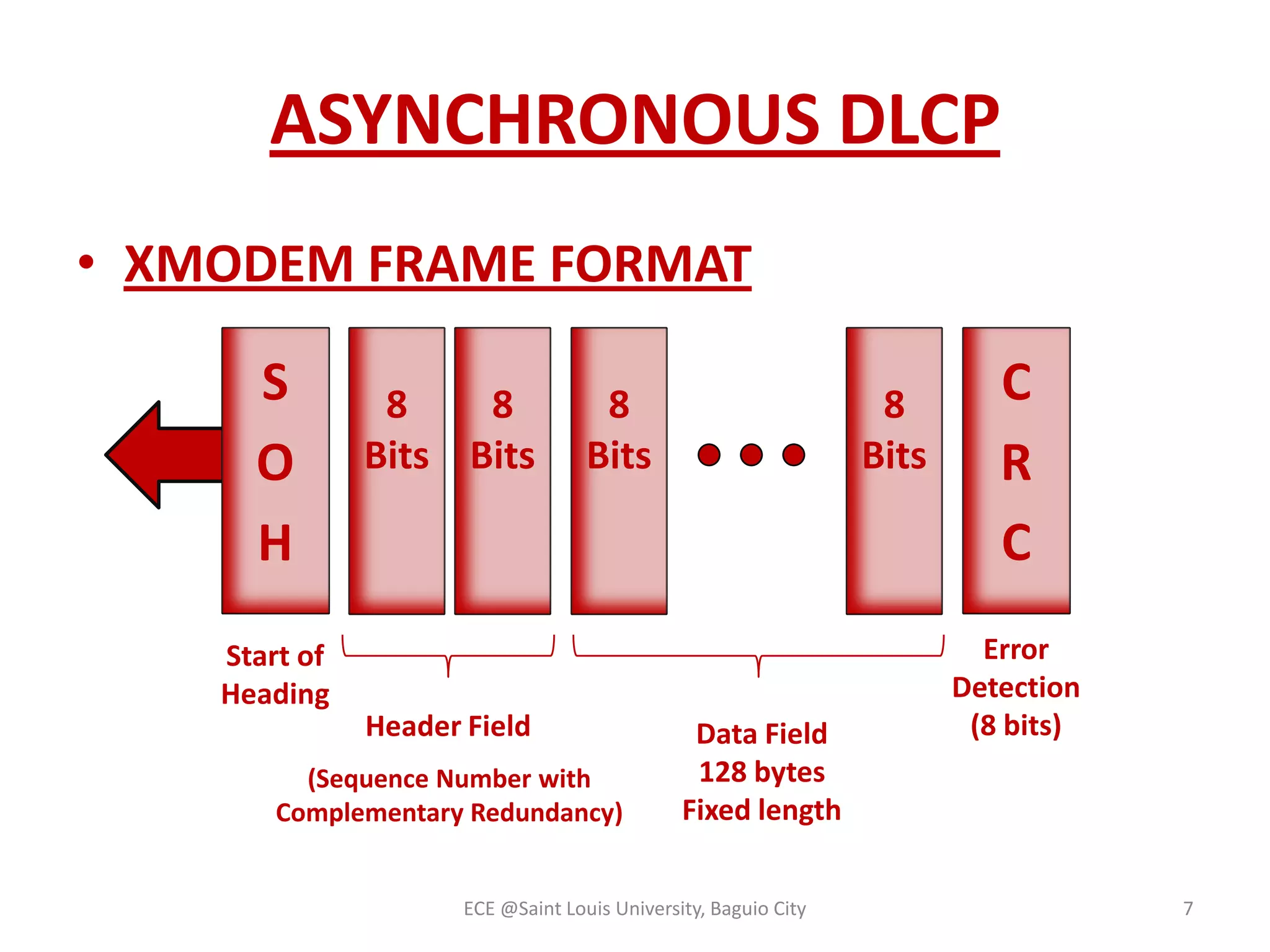
• XMODEM FRAME FORMAT
S
O
H

8
8
Bits Bits

8
Bits

8
Bits

Start of
Heading
Header Field
(Sequence Number with
Complementary Redundancy)

Data Field
128 bytes
Fixed length

ECE @Saint Louis University, Baguio City

C
R
C
Error
Detection
(8 bits)

7
ASYNCHRONOUS DLCP
• YMODEM
– Similar to XMODEM except for the following:
1. The information field has a capacity of 1024 bytes.
2. Two CAN characters are required to abort a
transmission.
3. ITU-T-CRC 16 is used to calculate the frame check
sequence.
4. Multiple frames can be sent in succession and then
acknowledged with a single ACK or NAK characters
(Sliding window flow control)

ECE @Saint Louis University, Baguio City

8
SYNCHRONOUS DLCP
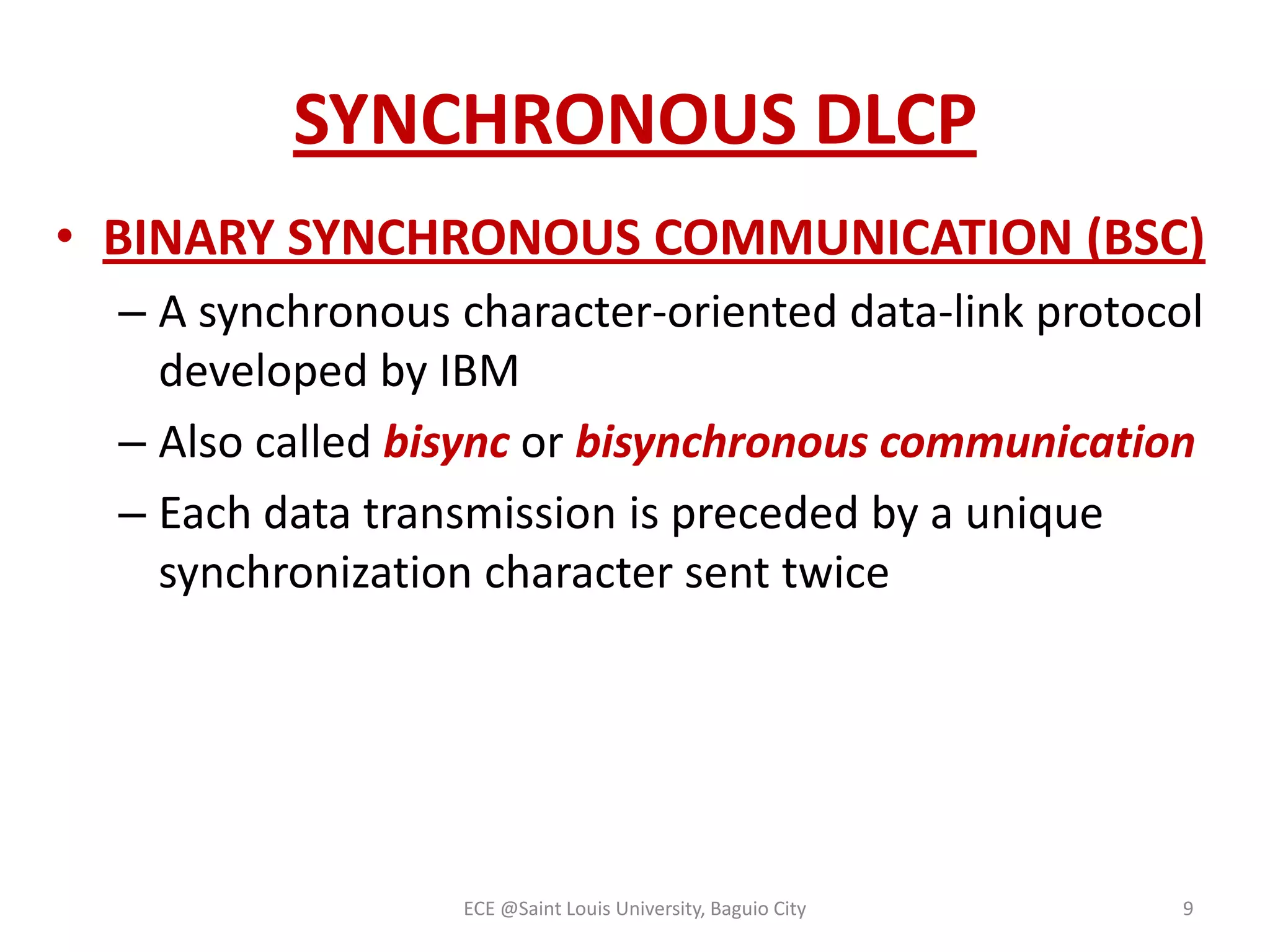
• BINARY SYNCHRONOUS COMMUNICATION (BSC)
– A synchronous character-oriented data-link protocol
developed by IBM
– Also called bisync or bisynchronous communication
– Each data transmission is preceded by a unique
synchronization character sent twice

ECE @Saint Louis University, Baguio City

9
SYNCHRONOUS DLCP
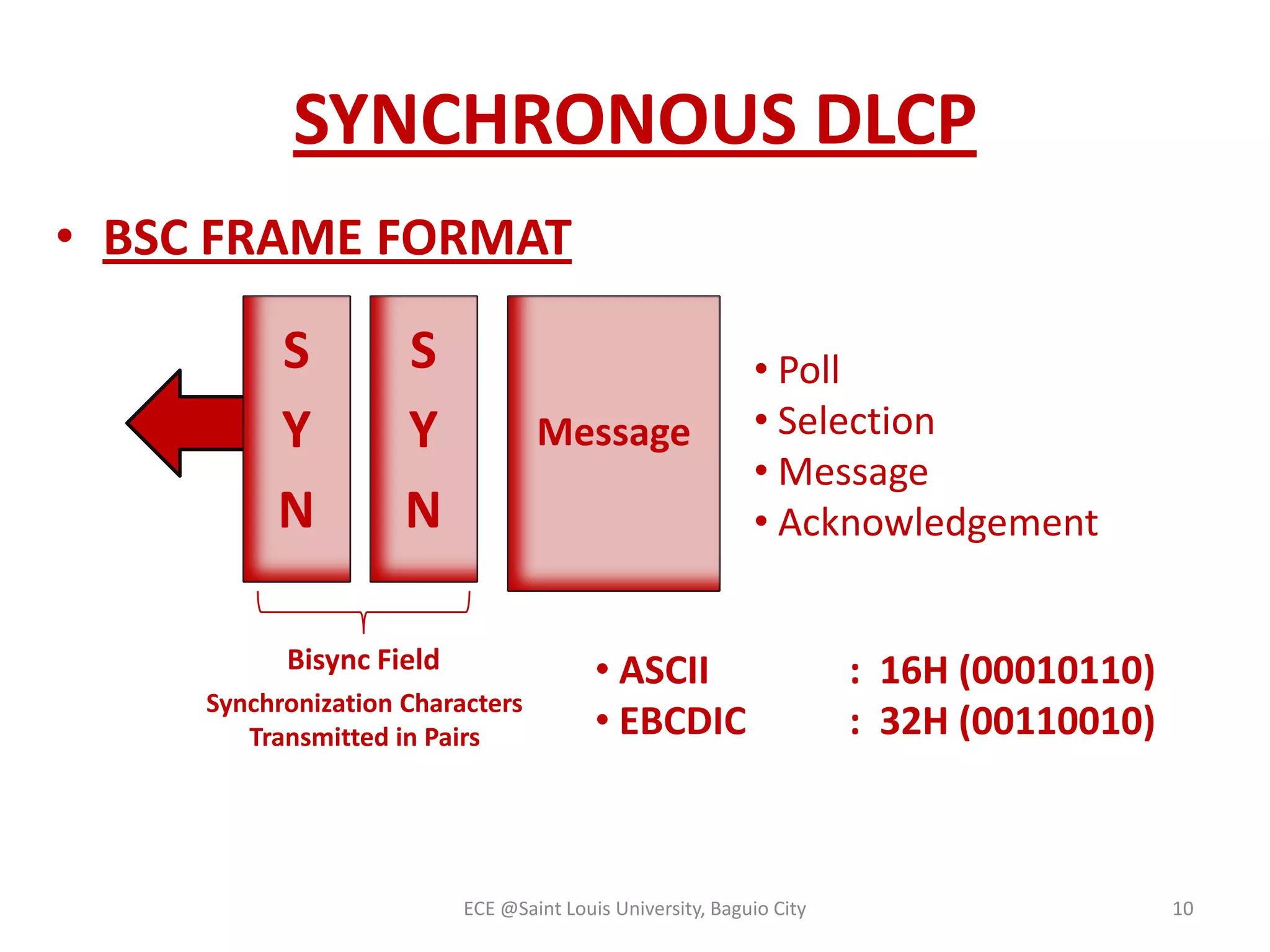
• BSC FRAME FORMAT

S
Y
N

S
Y
N

Message

Bisync Field
Synchronization Characters
Transmitted in Pairs

• Poll
• Selection
• Message
• Acknowledgement

• ASCII
• EBCDIC

ECE @Saint Louis University, Baguio City

: 16H (00010110)
: 32H (00110010)

10
BSC POLLING SEQUENCES
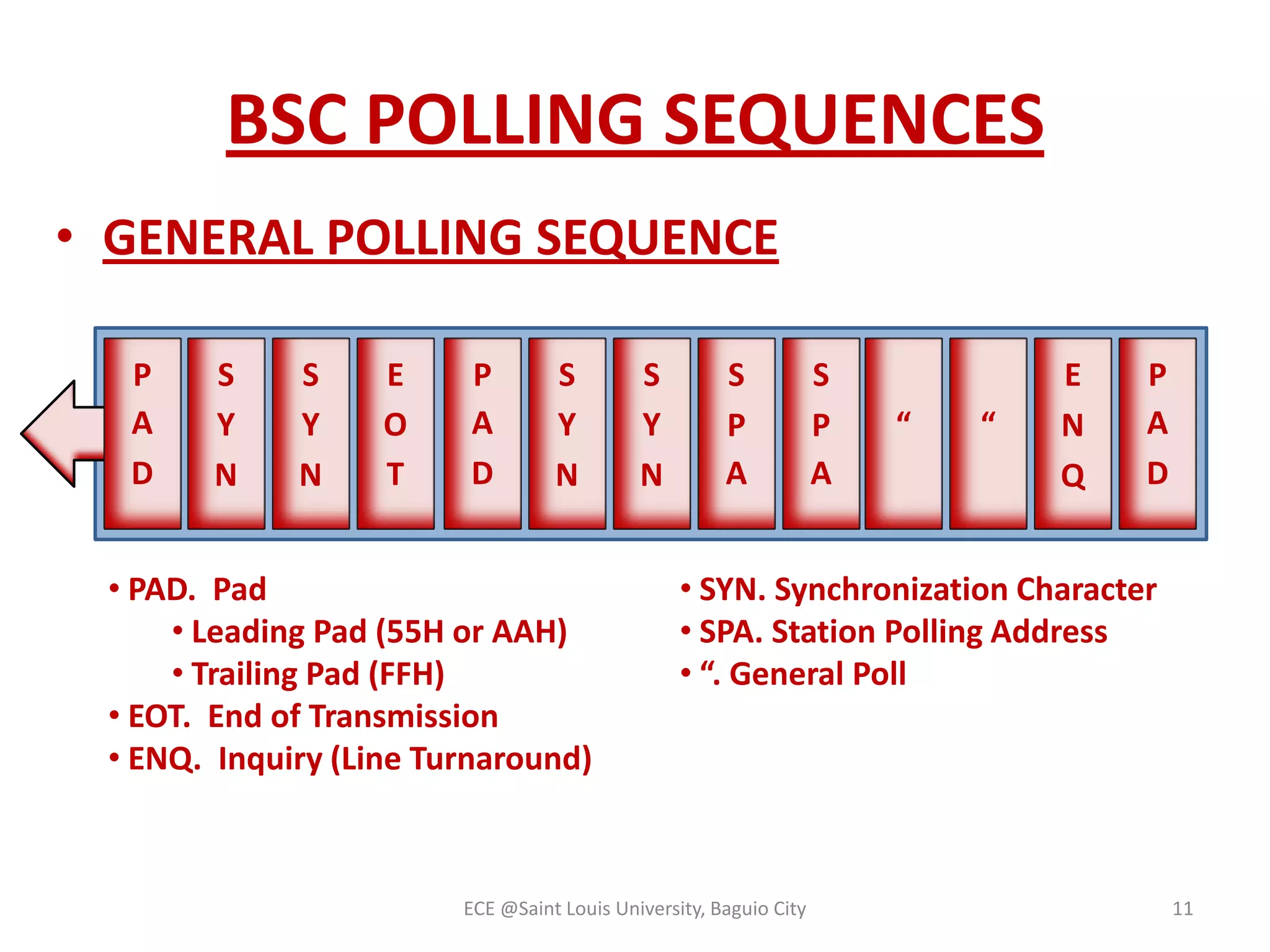
• GENERAL POLLING SEQUENCE
P
A
D

S
Y
N

S
Y
N

E
O
T

P
A
D

S
Y
N

• PAD. Pad
• Leading Pad (55H or AAH)
• Trailing Pad (FFH)
• EOT. End of Transmission
• ENQ. Inquiry (Line Turnaround)

S
Y
N

S
P
A

S
P
A

“

“

E
N
Q

P
A
D

• SYN. Synchronization Character
• SPA. Station Polling Address
• “. General Poll

ECE @Saint Louis University, Baguio City

11
BSC POLLING SEQUENCES
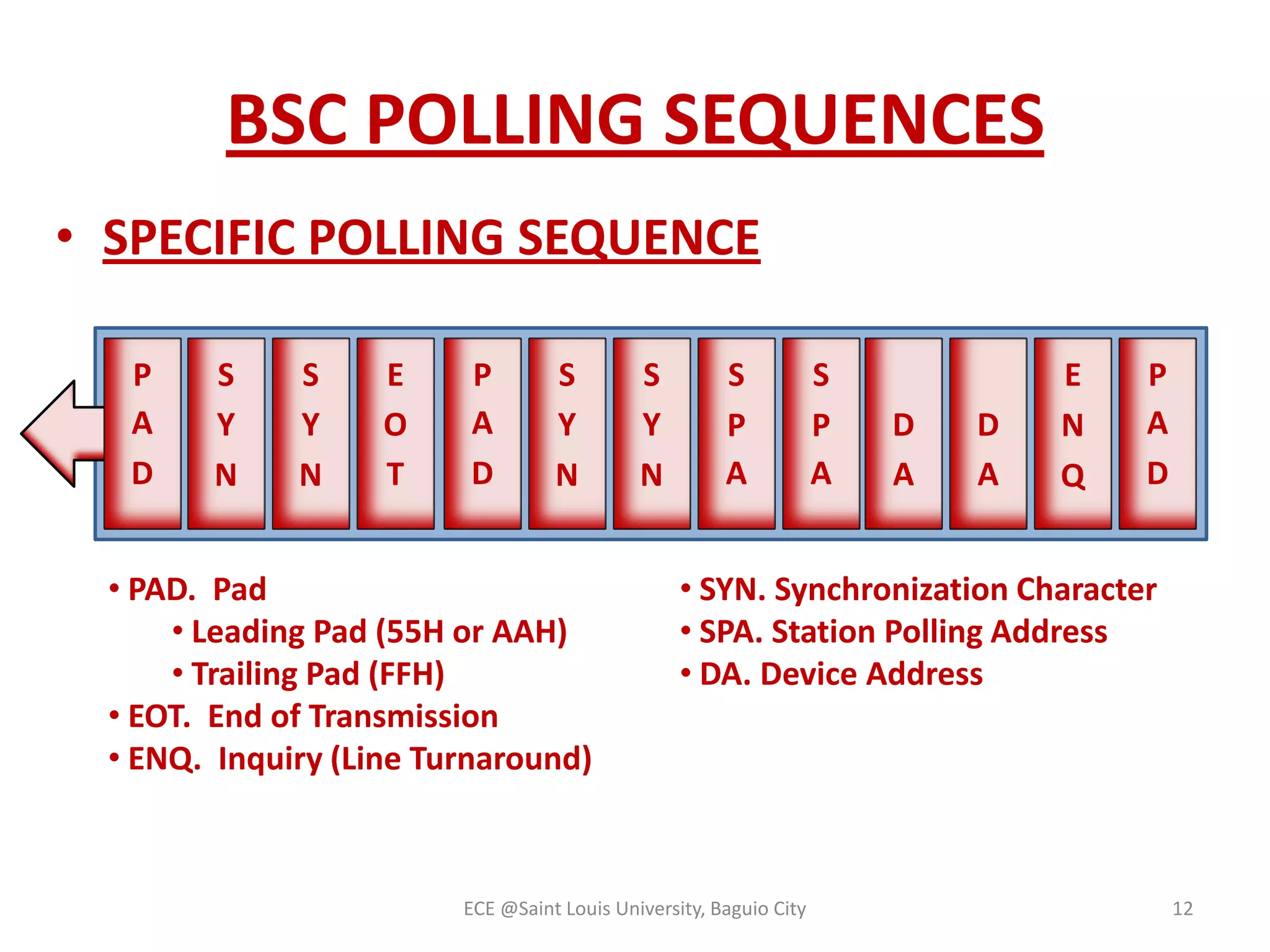
• SPECIFIC POLLING SEQUENCE
P
A
D

S
Y
N

S
Y
N

E
O
T

P
A
D

S
Y
N

• PAD. Pad
• Leading Pad (55H or AAH)
• Trailing Pad (FFH)
• EOT. End of Transmission
• ENQ. Inquiry (Line Turnaround)

S
Y
N

S
P
A

S
P
A

D
A

D
A

E
N
Q

P
A
D

• SYN. Synchronization Character
• SPA. Station Polling Address
• DA. Device Address

ECE @Saint Louis University, Baguio City

12
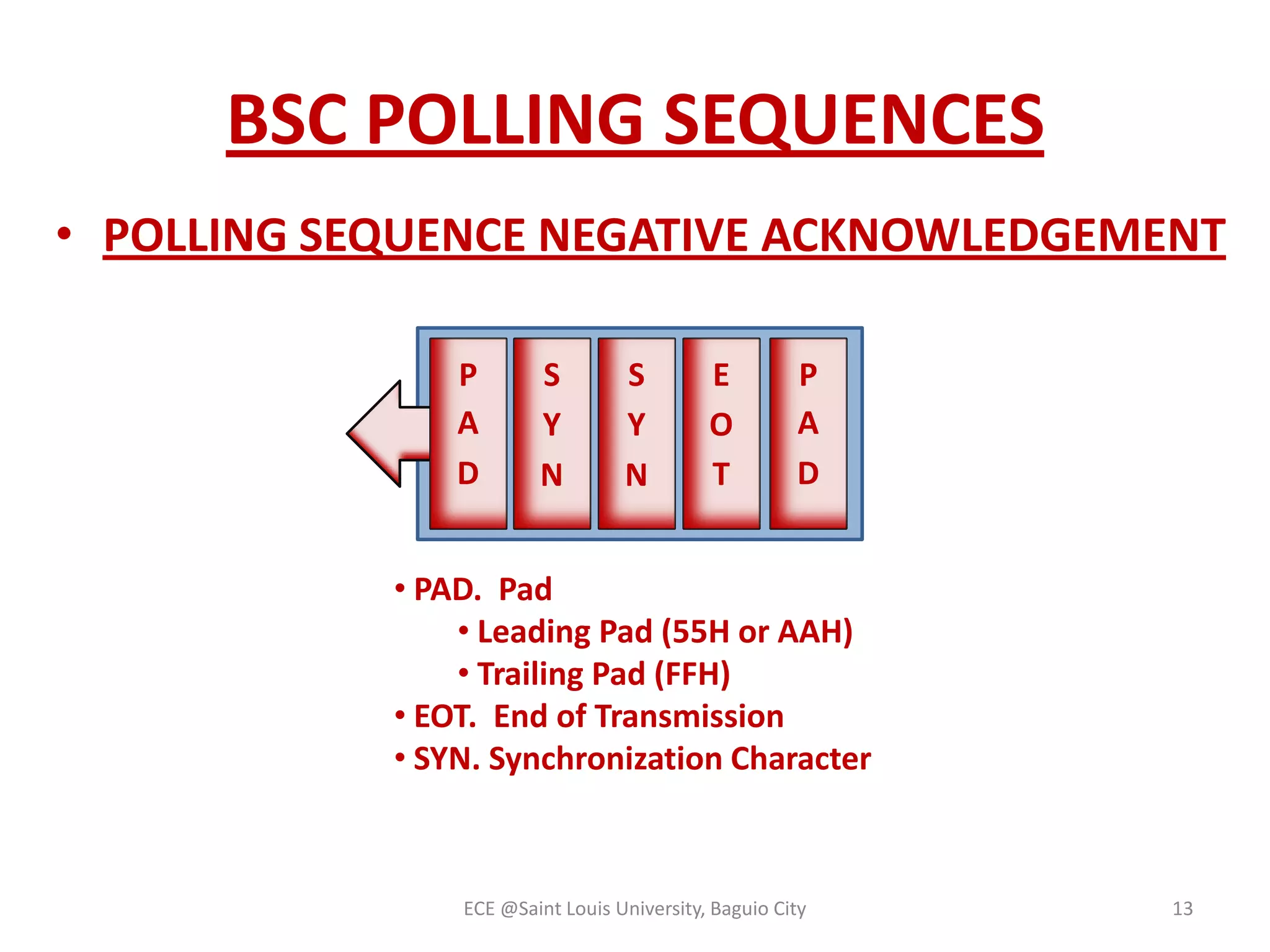
BSC POLLING SEQUENCES
• POLLING SEQUENCE NEGATIVE ACKNOWLEDGEMENT
P
A
D

S
Y
N

S
Y
N

E
O
T

P
A
D

• PAD. Pad
• Leading Pad (55H or AAH)
• Trailing Pad (FFH)
• EOT. End of Transmission
• SYN. Synchronization Character

ECE @Saint Louis University, Baguio City

13
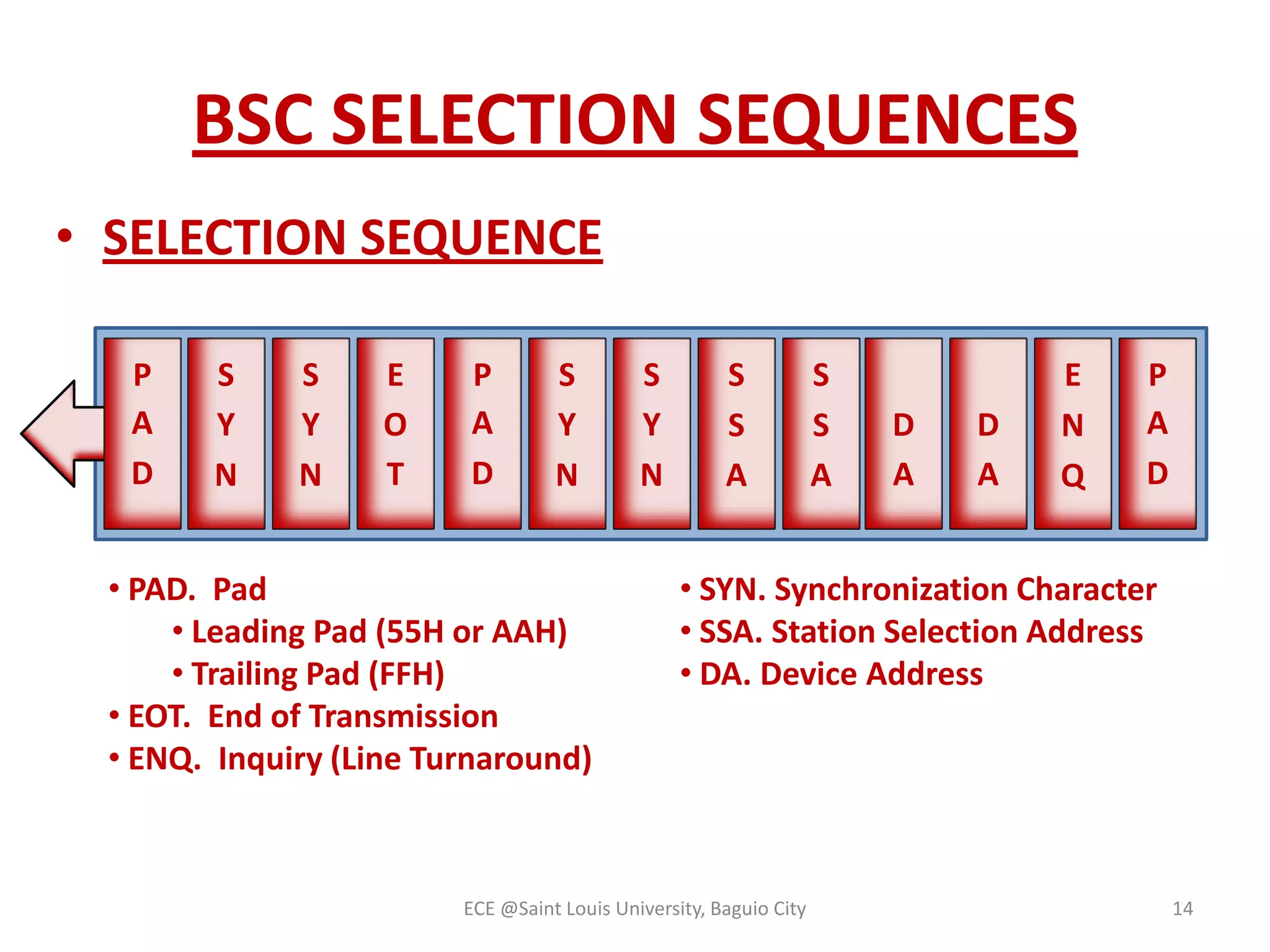
BSC SELECTION SEQUENCES
• SELECTION SEQUENCE
P
A
D

S
Y
N

S
Y
N

E
O
T

P
A
D

S
Y
N

• PAD. Pad
• Leading Pad (55H or AAH)
• Trailing Pad (FFH)
• EOT. End of Transmission
• ENQ. Inquiry (Line Turnaround)

S
Y
N

S
S
A

S
S
A

D
A

D
A

E
N
Q

P
A
D

• SYN. Synchronization Character
• SSA. Station Selection Address
• DA. Device Address

ECE @Saint Louis University, Baguio City

14
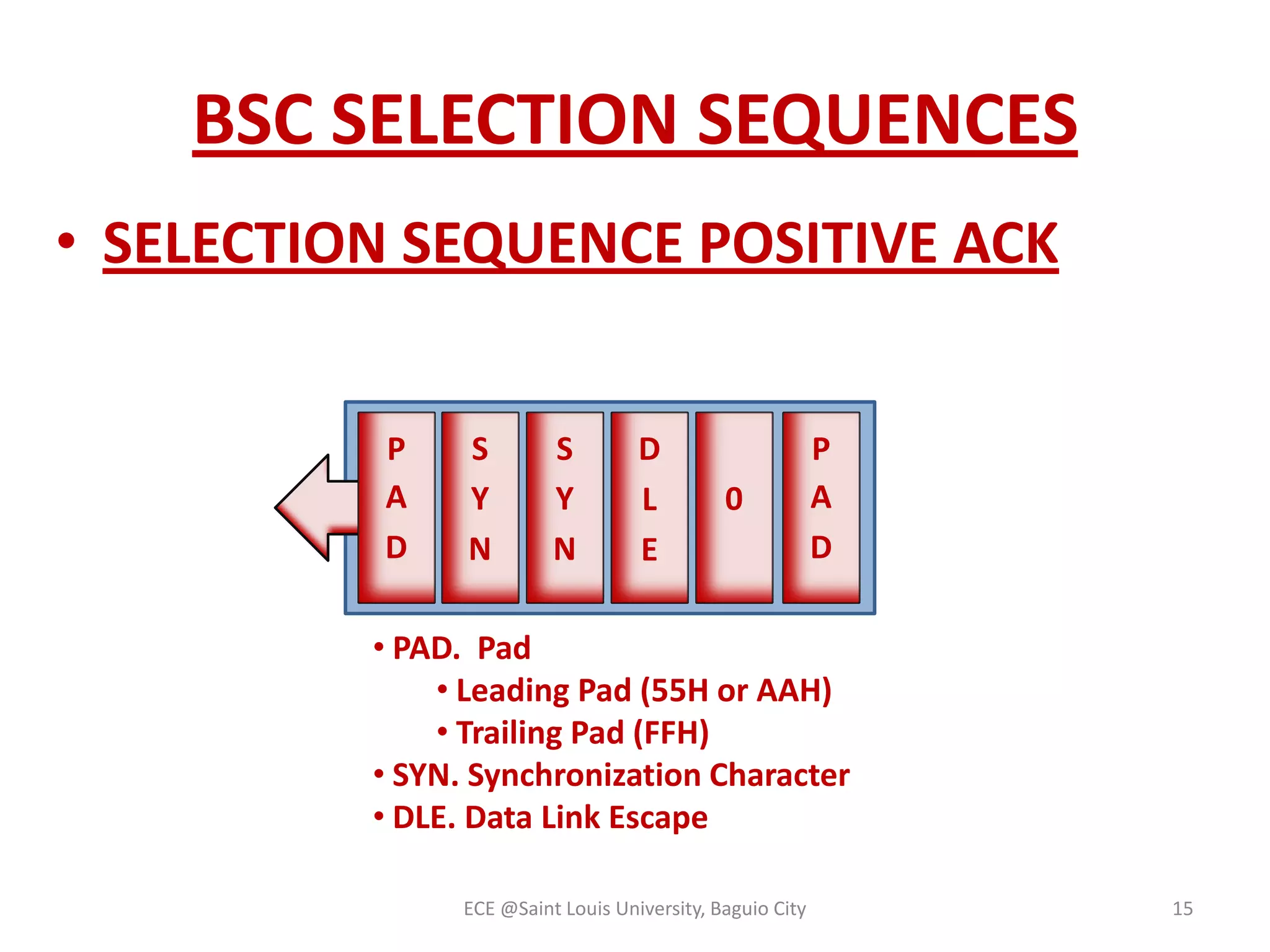
BSC SELECTION SEQUENCES
• SELECTION SEQUENCE POSITIVE ACK
P
A
D

S
Y
N

S
Y
N

D
L
E

0

P
A
D

• PAD. Pad
• Leading Pad (55H or AAH)
• Trailing Pad (FFH)
• SYN. Synchronization Character
• DLE. Data Link Escape
ECE @Saint Louis University, Baguio City

15
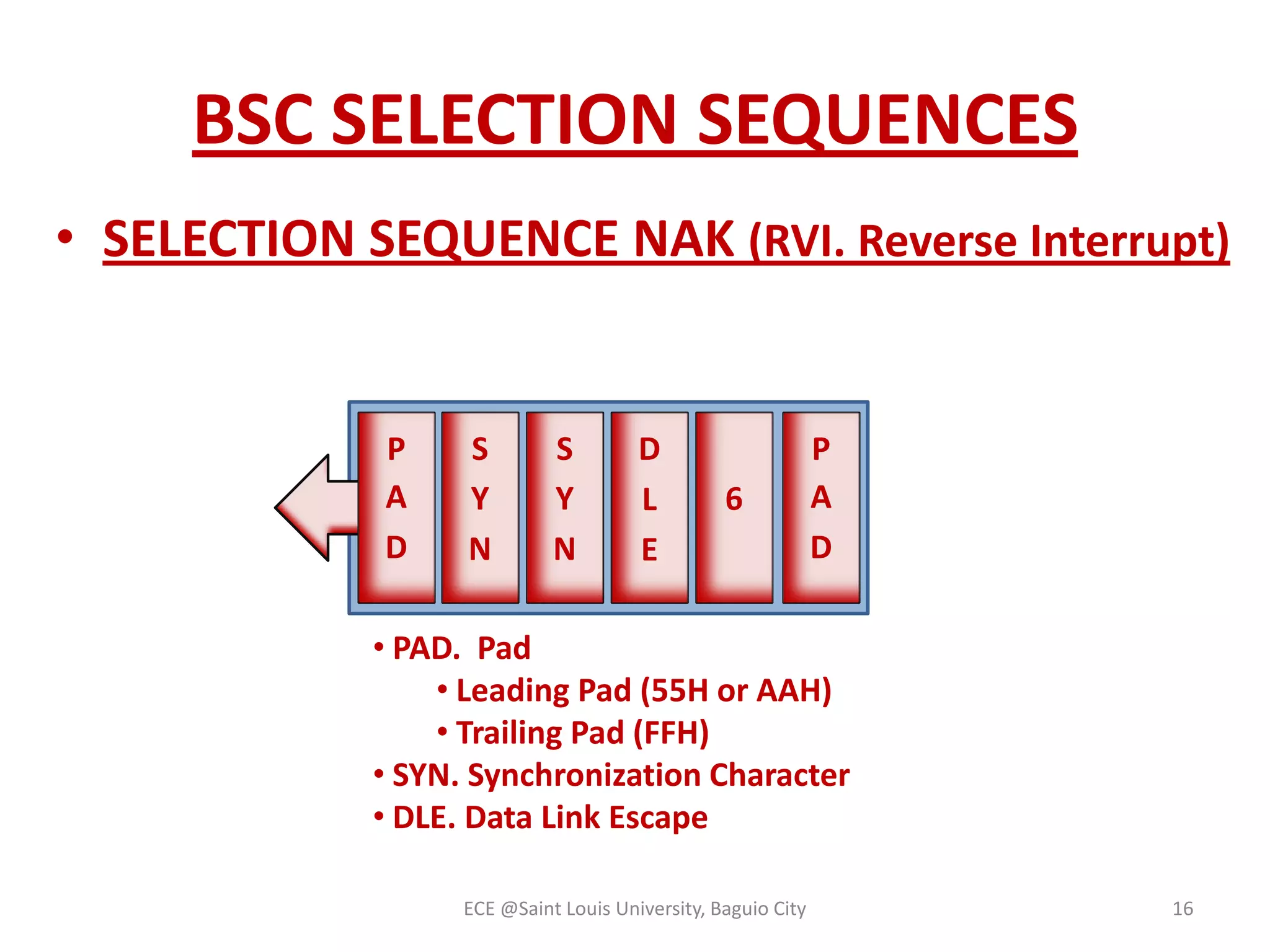
BSC SELECTION SEQUENCES
• SELECTION SEQUENCE NAK (RVI. Reverse Interrupt)

P
A
D

S
Y
N

S
Y
N

D
L
E

6

P
A
D

• PAD. Pad
• Leading Pad (55H or AAH)
• Trailing Pad (FFH)
• SYN. Synchronization Character
• DLE. Data Link Escape
ECE @Saint Louis University, Baguio City

16
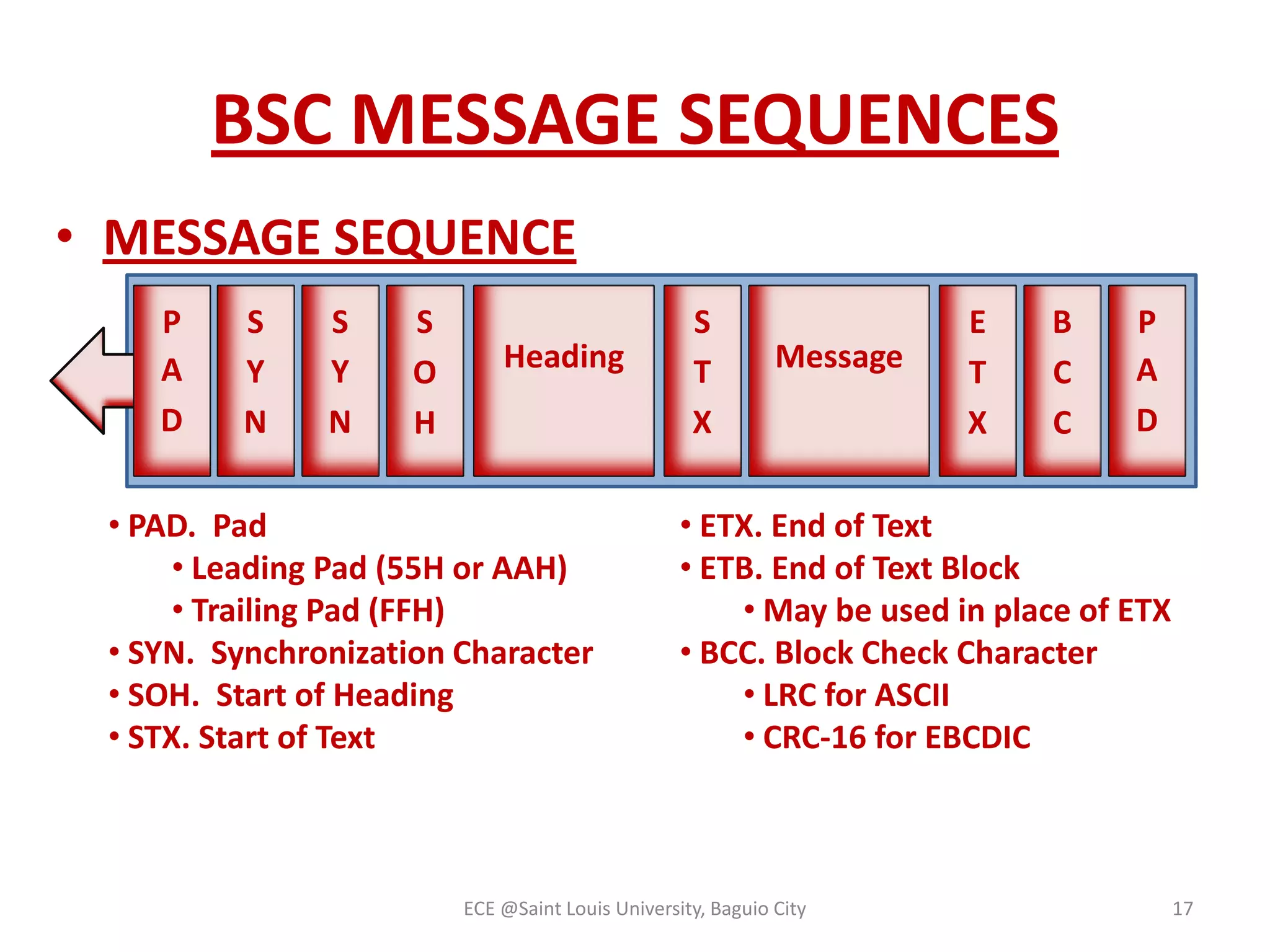
BSC MESSAGE SEQUENCES
• MESSAGE SEQUENCE
P
A
D

S
Y
N

S
Y
N

S
O
H

Heading

• PAD. Pad
• Leading Pad (55H or AAH)
• Trailing Pad (FFH)
• SYN. Synchronization Character
• SOH. Start of Heading
• STX. Start of Text

S
T
X

Message

E
T
X

B
C
C

P
A
D

• ETX. End of Text
• ETB. End of Text Block
• May be used in place of ETX
• BCC. Block Check Character
• LRC for ASCII
• CRC-16 for EBCDIC

ECE @Saint Louis University, Baguio City

17
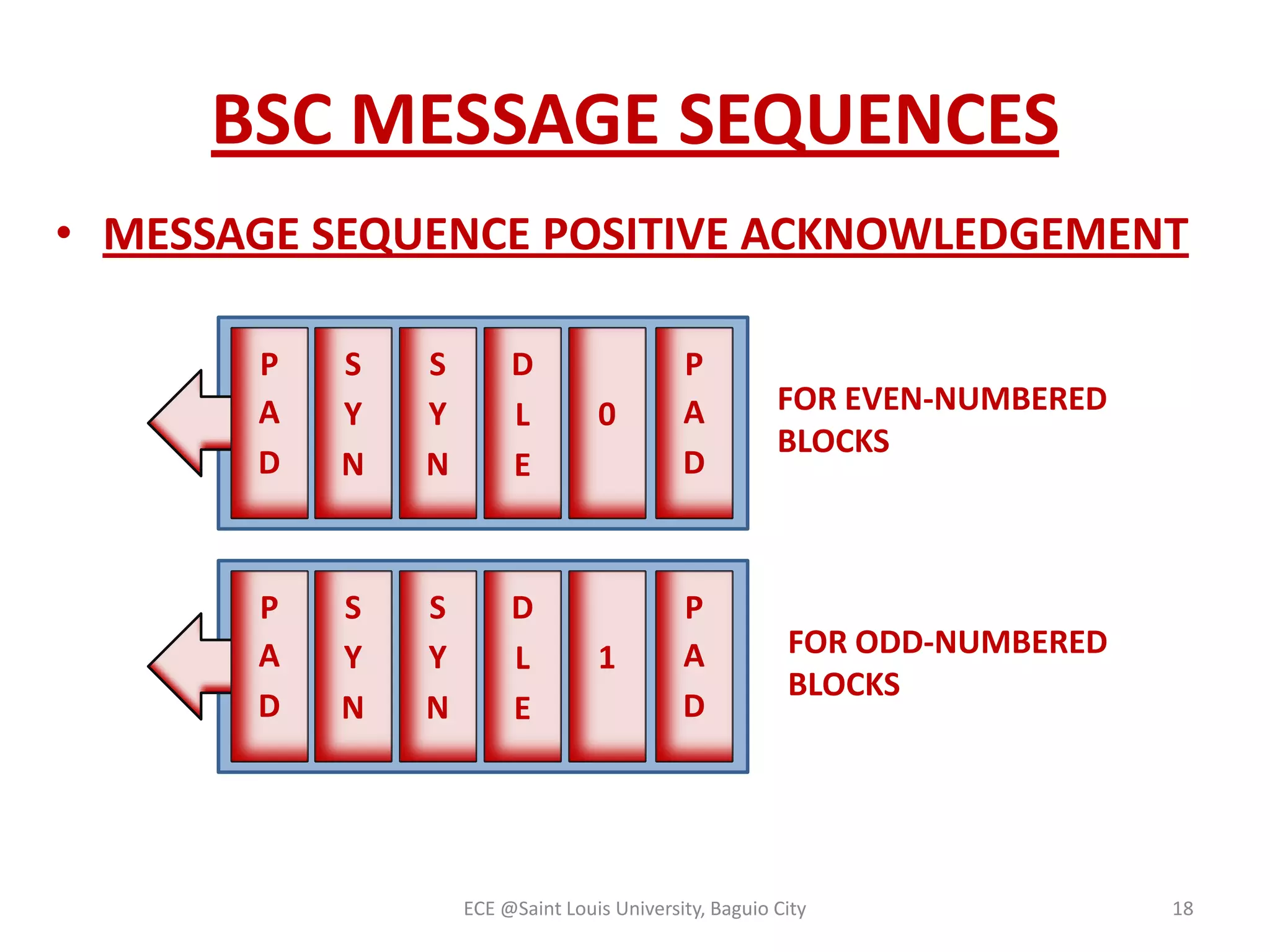
BSC MESSAGE SEQUENCES
• MESSAGE SEQUENCE POSITIVE ACKNOWLEDGEMENT
P
A
D

S
Y
N

S
Y
N

D
L
E

P
A
D

S
Y
N

S
Y
N

D
L
E

0

P
A
D

FOR EVEN-NUMBERED
BLOCKS

1

P
A
D

FOR ODD-NUMBERED
BLOCKS

ECE @Saint Louis University, Baguio City

18
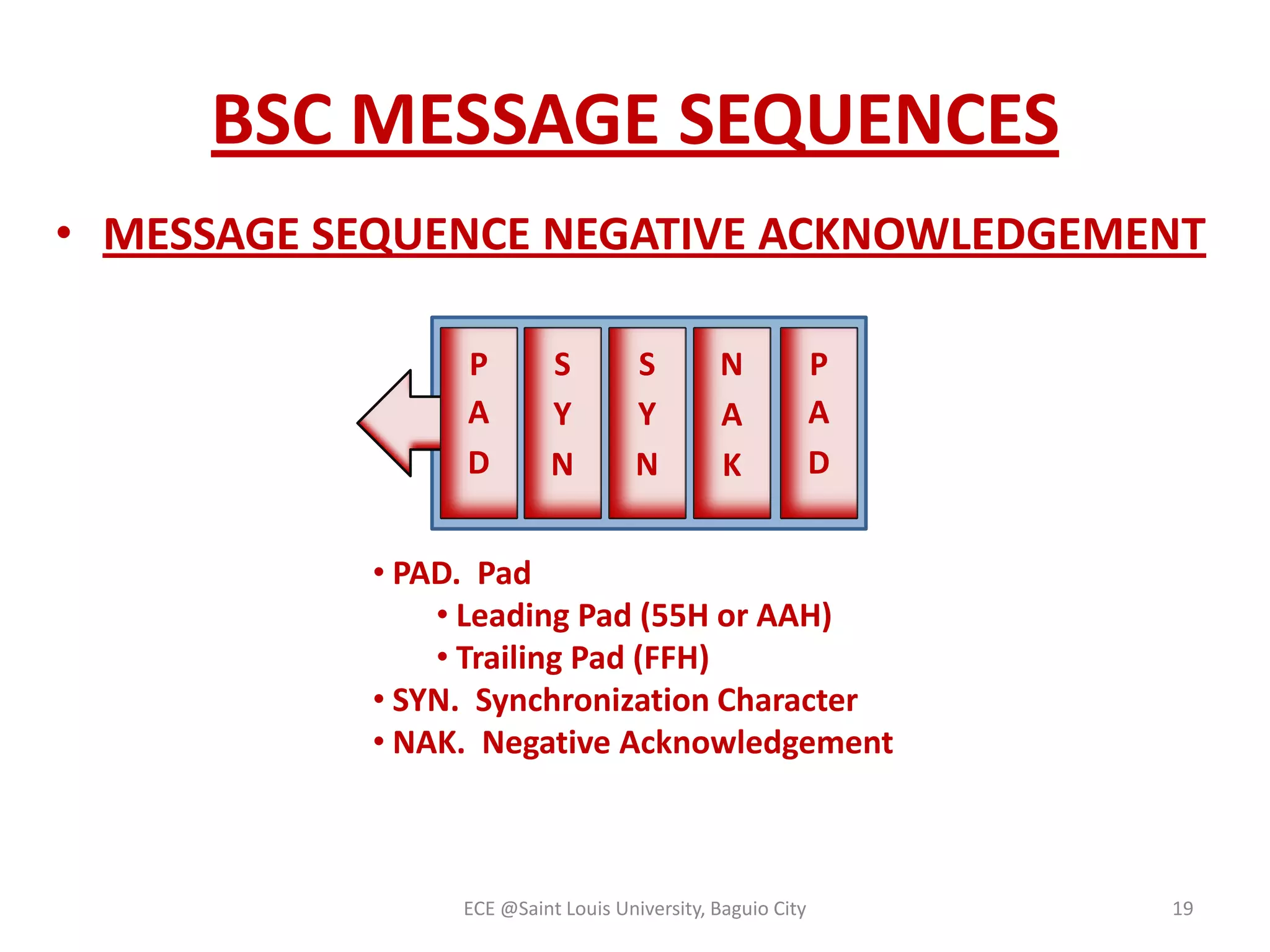
BSC MESSAGE SEQUENCES
• MESSAGE SEQUENCE NEGATIVE ACKNOWLEDGEMENT
P
A
D

S
Y
N

S
Y
N

N
A
K

P
A
D

• PAD. Pad
• Leading Pad (55H or AAH)
• Trailing Pad (FFH)
• SYN. Synchronization Character
• NAK. Negative Acknowledgement

ECE @Saint Louis University, Baguio City

19
BSC TRANSPARENCY
• A process that disables the BSC controller’s
capability to identify data link control characters
• Used for communication with devices that use
non-ASCII and non-EBCDIC codes such as those in
microprocessor controlled security alarm systems
or environmental monitoring systems
• Transparent mode is activated when the STX
character is preceded by a DLE

ECE @Saint Louis University, Baguio City

20
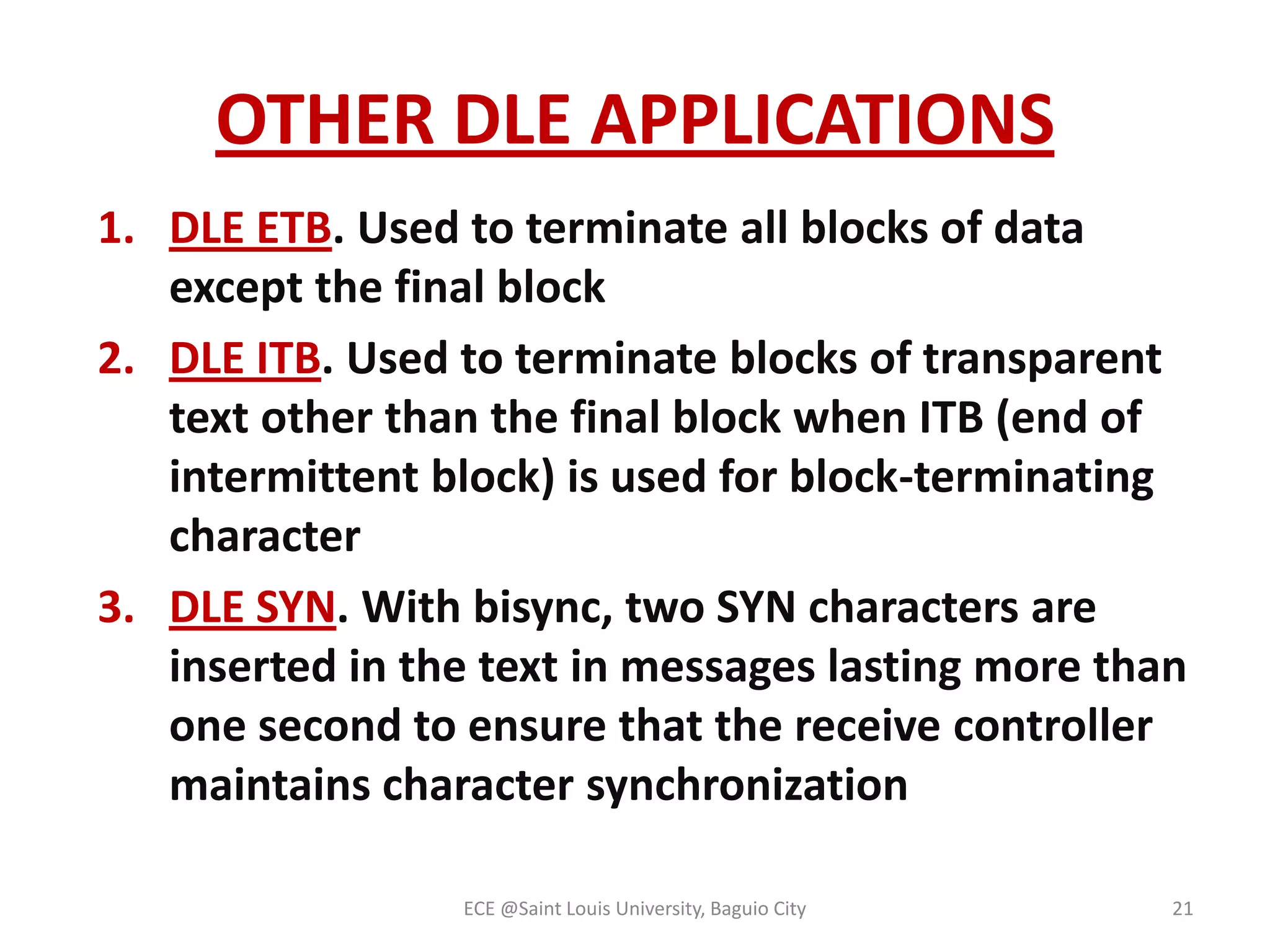
OTHER DLE APPLICATIONS
1. DLE ETB. Used to terminate all blocks of data
except the final block
2. DLE ITB. Used to terminate blocks of transparent
text other than the final block when ITB (end of
intermittent block) is used for block-terminating
character
3. DLE SYN. With bisync, two SYN characters are
inserted in the text in messages lasting more than
one second to ensure that the receive controller
maintains character synchronization
ECE @Saint Louis University, Baguio City

21
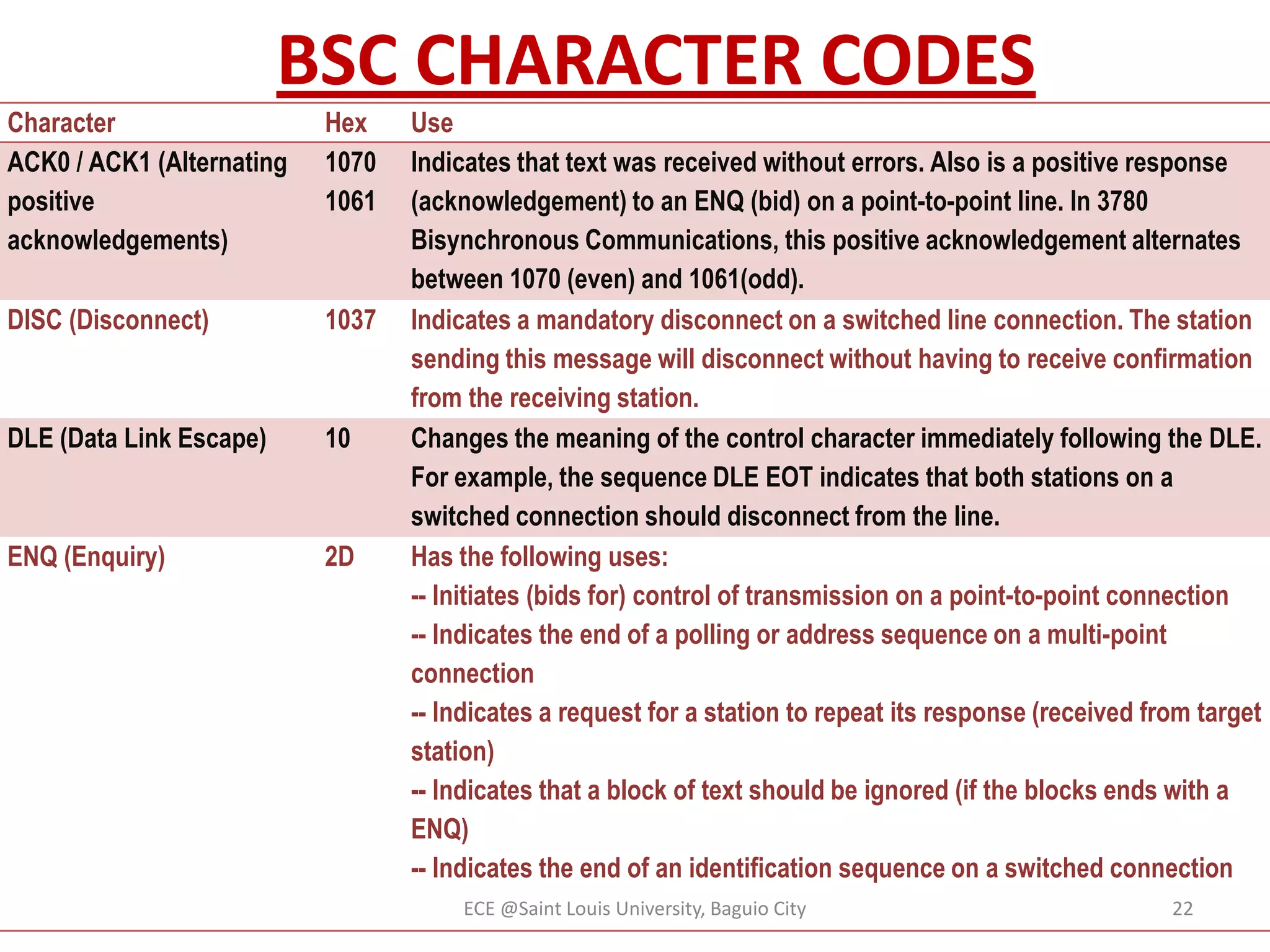
BSC CHARACTER CODES
Character
ACK0 / ACK1 (Alternating
positive
acknowledgements)

Hex
1070
1061

DISC (Disconnect)

1037

DLE (Data Link Escape)

10

ENQ (Enquiry)

2D

Use
Indicates that text was received without errors. Also is a positive response
(acknowledgement) to an ENQ (bid) on a point-to-point line. In 3780
Bisynchronous Communications, this positive acknowledgement alternates
between 1070 (even) and 1061(odd).
Indicates a mandatory disconnect on a switched line connection. The station
sending this message will disconnect without having to receive confirmation
from the receiving station.
Changes the meaning of the control character immediately following the DLE.
For example, the sequence DLE EOT indicates that both stations on a
switched connection should disconnect from the line.
Has the following uses:
-- Initiates (bids for) control of transmission on a point-to-point connection
-- Indicates the end of a polling or address sequence on a multi-point
connection
-- Indicates a request for a station to repeat its response (received from target
station)
-- Indicates that a block of text should be ignored (if the blocks ends with a
ENQ)
-- Indicates the end of an identification sequence on a switched connection
ECE @Saint Louis University, Baguio City

22
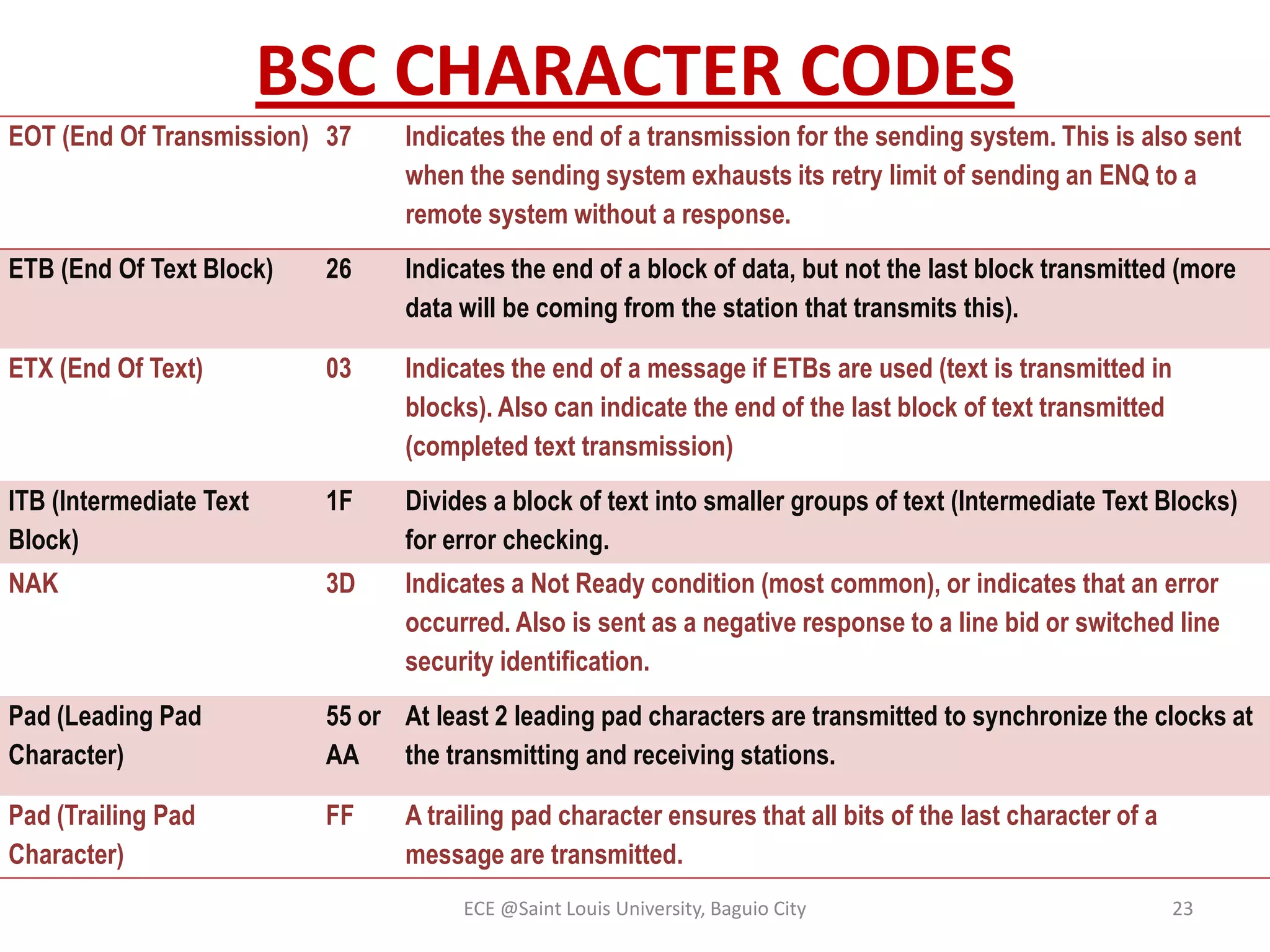
BSC CHARACTER CODES
EOT (End Of Transmission) 37

Indicates the end of a transmission for the sending system. This is also sent
when the sending system exhausts its retry limit of sending an ENQ to a
remote system without a response.

ETB (End Of Text Block)

26

Indicates the end of a block of data, but not the last block transmitted (more
data will be coming from the station that transmits this).

ETX (End Of Text)

03

Indicates the end of a message if ETBs are used (text is transmitted in
blocks). Also can indicate the end of the last block of text transmitted
(completed text transmission)

ITB (Intermediate Text
Block)

1F

Divides a block of text into smaller groups of text (Intermediate Text Blocks)
for error checking.

NAK

3D

Indicates a Not Ready condition (most common), or indicates that an error
occurred. Also is sent as a negative response to a line bid or switched line
security identification.

Pad (Leading Pad
Character)

55 or At least 2 leading pad characters are transmitted to synchronize the clocks at
AA
the transmitting and receiving stations.

Pad (Trailing Pad
Character)

FF

A trailing pad character ensures that all bits of the last character of a
message are transmitted.
ECE @Saint Louis University, Baguio City

23
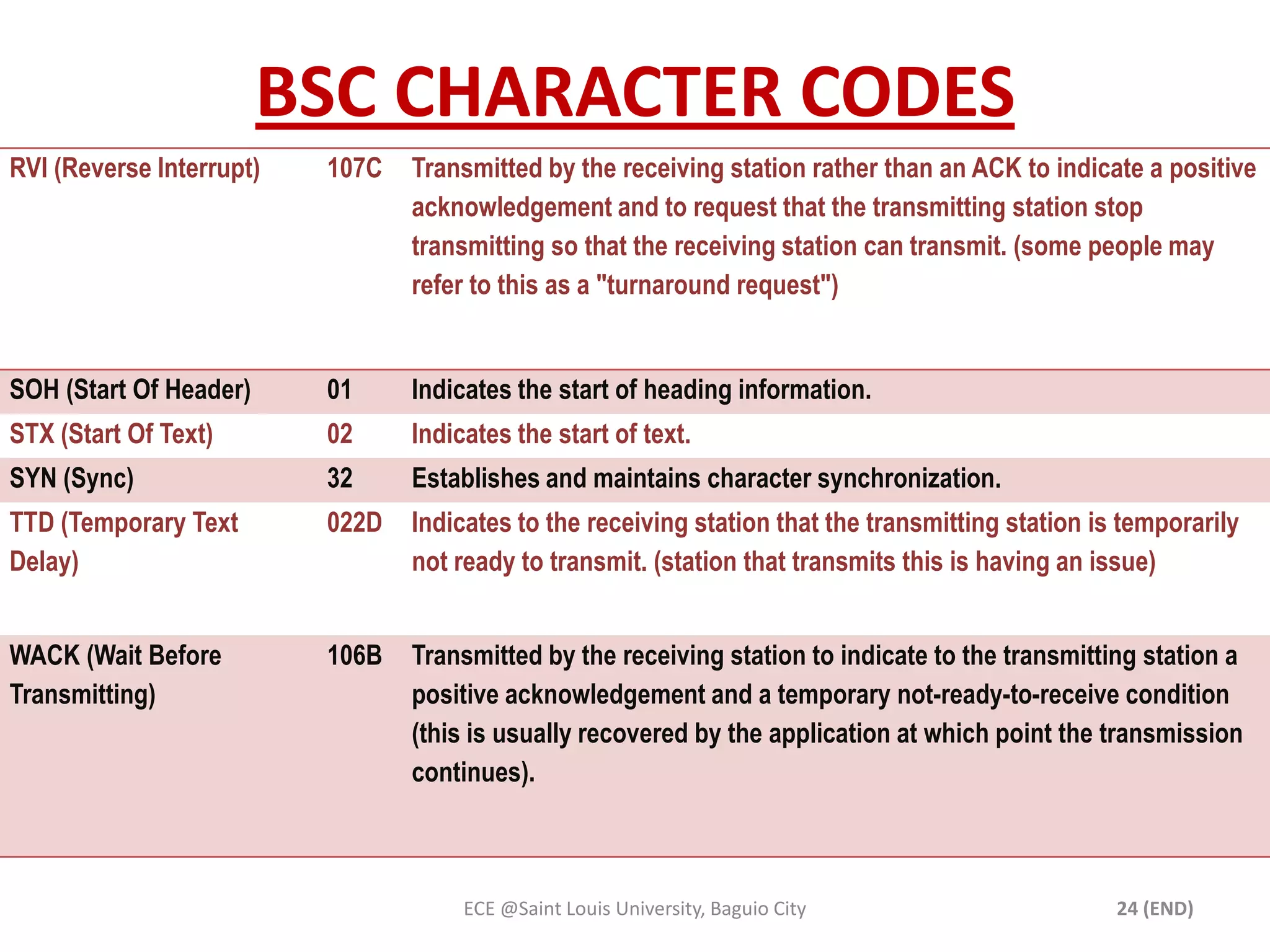
BSC CHARACTER CODES
RVI (Reverse Interrupt)

107C

Transmitted by the receiving station rather than an ACK to indicate a positive
acknowledgement and to request that the transmitting station stop
transmitting so that the receiving station can transmit. (some people may
refer to this as a "turnaround request")

SOH (Start Of Header)

01

Indicates the start of heading information.

STX (Start Of Text)

02

Indicates the start of text.

SYN (Sync)

32

Establishes and maintains character synchronization.

TTD (Temporary Text
Delay)

022D

Indicates to the receiving station that the transmitting station is temporarily
not ready to transmit. (station that transmits this is having an issue)

WACK (Wait Before
Transmitting)

106B

Transmitted by the receiving station to indicate to the transmitting station a
positive acknowledgement and a temporary not-ready-to-receive condition
(this is usually recovered by the application at which point the transmission
continues).

ECE @Saint Louis University, Baguio City

24 (END)

Data link control protocol(2)

  • 1.
    Lecture 02 Data-Link Protocols Preparedby: Engr. Jeffrey Des B. Binwag Chapter 23 Electronic Communications Sytems , Fifth Editon By: Wayne Tomasi ECE @Saint Louis University, Baguio City 1
  • 2.
    CLASSIFICATONS OF DLCP •CHARACTER ORIENTED PROTOCOLS – Interpret a frame of data as a group of successive bits combined into predefined patterns of fixed length bits each representing a unique character – Data frames for these protocols include control characters that convey important information pertaining to DLCP functions – Also called BYTE ORIENTED Protocols – Examples: X-Modem, Y-Modem, ZModem, BLAST, IBM 83B, IBM BSC ECE @Saint Louis University, Baguio City 2
  • 3.
    CLASSIFICATONS OF DLCP •BIT-ORIENTED PROTOCOLS – A discipline for serial bit-by-bit information transfer over a data communications channel – Information is transferred as a series of successive bits that may be interpreted individually on a bitby-bit basis or in groups of several bits as opposed to a fixed length group of bits – Examples: SDLC, HDLC ECE @Saint Louis University, Baguio City 3
  • 4.
    CLASSIFICATONS OF DLCP •ASYNCHRONOUS PROTOCOLS – Simple, character oriented protocols generally used on two-point networks using asynchronous data and asynchronous modems – Examples: X-MODEM, Y-MODEM, IBM 83B • SYNCHRONOUS PROTOCOLS – Protocols used on point to multi-point networks using synchronous data and synchronous modems – Examples: IBM BSC, SDLC, HDLC ECE @Saint Louis University, Baguio City 4
  • 5.
    ASYNCHRONOUS DLCP • XMODEM –Developed by Ward Christiansen in 1979 – The first file transfer protocol (FTP) designed as an asynchronous, character-oriented protocol to facilitate transferring data between two personal computers – Specifies a half-duplex stop-and-wait protocol using a data frame comprised of four fields ECE @Saint Louis University, Baguio City 5
  • 6.
    ASYNCHRONOUS DLCP • XMODEMPROCEDURAL SEQUENCE – Destination station sends a negative acknowledgement (NAK) to the source station – The source sends the first data frame and waits for an acknowledgement – The destination receives and evaluates the data frame from the source. It responds with an ACK if there is no error or a NAK if an error is detected – If the source receives an ACK it sends the next frame. If it receives a NAK it retransmits the previous frame. If it does not receive an ACK or a NAK after a predetermined length of time, it times out and retransmits the previous frame – A single cancel (CAN) character may be used to abort an ongoing transmission ECE @Saint Louis University, Baguio City 6
  • 7.
    ASYNCHRONOUS DLCP • XMODEMFRAME FORMAT S O H 8 8 Bits Bits 8 Bits 8 Bits Start of Heading Header Field (Sequence Number with Complementary Redundancy) Data Field 128 bytes Fixed length ECE @Saint Louis University, Baguio City C R C Error Detection (8 bits) 7
  • 8.
    ASYNCHRONOUS DLCP • YMODEM –Similar to XMODEM except for the following: 1. The information field has a capacity of 1024 bytes. 2. Two CAN characters are required to abort a transmission. 3. ITU-T-CRC 16 is used to calculate the frame check sequence. 4. Multiple frames can be sent in succession and then acknowledged with a single ACK or NAK characters (Sliding window flow control) ECE @Saint Louis University, Baguio City 8
  • 9.
    SYNCHRONOUS DLCP • BINARYSYNCHRONOUS COMMUNICATION (BSC) – A synchronous character-oriented data-link protocol developed by IBM – Also called bisync or bisynchronous communication – Each data transmission is preceded by a unique synchronization character sent twice ECE @Saint Louis University, Baguio City 9
  • 10.
    SYNCHRONOUS DLCP • BSCFRAME FORMAT S Y N S Y N Message Bisync Field Synchronization Characters Transmitted in Pairs • Poll • Selection • Message • Acknowledgement • ASCII • EBCDIC ECE @Saint Louis University, Baguio City : 16H (00010110) : 32H (00110010) 10
  • 11.
    BSC POLLING SEQUENCES •GENERAL POLLING SEQUENCE P A D S Y N S Y N E O T P A D S Y N • PAD. Pad • Leading Pad (55H or AAH) • Trailing Pad (FFH) • EOT. End of Transmission • ENQ. Inquiry (Line Turnaround) S Y N S P A S P A “ “ E N Q P A D • SYN. Synchronization Character • SPA. Station Polling Address • “. General Poll ECE @Saint Louis University, Baguio City 11
  • 12.
    BSC POLLING SEQUENCES •SPECIFIC POLLING SEQUENCE P A D S Y N S Y N E O T P A D S Y N • PAD. Pad • Leading Pad (55H or AAH) • Trailing Pad (FFH) • EOT. End of Transmission • ENQ. Inquiry (Line Turnaround) S Y N S P A S P A D A D A E N Q P A D • SYN. Synchronization Character • SPA. Station Polling Address • DA. Device Address ECE @Saint Louis University, Baguio City 12
  • 13.
    BSC POLLING SEQUENCES •POLLING SEQUENCE NEGATIVE ACKNOWLEDGEMENT P A D S Y N S Y N E O T P A D • PAD. Pad • Leading Pad (55H or AAH) • Trailing Pad (FFH) • EOT. End of Transmission • SYN. Synchronization Character ECE @Saint Louis University, Baguio City 13
  • 14.
    BSC SELECTION SEQUENCES •SELECTION SEQUENCE P A D S Y N S Y N E O T P A D S Y N • PAD. Pad • Leading Pad (55H or AAH) • Trailing Pad (FFH) • EOT. End of Transmission • ENQ. Inquiry (Line Turnaround) S Y N S S A S S A D A D A E N Q P A D • SYN. Synchronization Character • SSA. Station Selection Address • DA. Device Address ECE @Saint Louis University, Baguio City 14
  • 15.
    BSC SELECTION SEQUENCES •SELECTION SEQUENCE POSITIVE ACK P A D S Y N S Y N D L E 0 P A D • PAD. Pad • Leading Pad (55H or AAH) • Trailing Pad (FFH) • SYN. Synchronization Character • DLE. Data Link Escape ECE @Saint Louis University, Baguio City 15
  • 16.
    BSC SELECTION SEQUENCES •SELECTION SEQUENCE NAK (RVI. Reverse Interrupt) P A D S Y N S Y N D L E 6 P A D • PAD. Pad • Leading Pad (55H or AAH) • Trailing Pad (FFH) • SYN. Synchronization Character • DLE. Data Link Escape ECE @Saint Louis University, Baguio City 16
  • 17.
    BSC MESSAGE SEQUENCES •MESSAGE SEQUENCE P A D S Y N S Y N S O H Heading • PAD. Pad • Leading Pad (55H or AAH) • Trailing Pad (FFH) • SYN. Synchronization Character • SOH. Start of Heading • STX. Start of Text S T X Message E T X B C C P A D • ETX. End of Text • ETB. End of Text Block • May be used in place of ETX • BCC. Block Check Character • LRC for ASCII • CRC-16 for EBCDIC ECE @Saint Louis University, Baguio City 17
  • 18.
    BSC MESSAGE SEQUENCES •MESSAGE SEQUENCE POSITIVE ACKNOWLEDGEMENT P A D S Y N S Y N D L E P A D S Y N S Y N D L E 0 P A D FOR EVEN-NUMBERED BLOCKS 1 P A D FOR ODD-NUMBERED BLOCKS ECE @Saint Louis University, Baguio City 18
  • 19.
    BSC MESSAGE SEQUENCES •MESSAGE SEQUENCE NEGATIVE ACKNOWLEDGEMENT P A D S Y N S Y N N A K P A D • PAD. Pad • Leading Pad (55H or AAH) • Trailing Pad (FFH) • SYN. Synchronization Character • NAK. Negative Acknowledgement ECE @Saint Louis University, Baguio City 19
  • 20.
    BSC TRANSPARENCY • Aprocess that disables the BSC controller’s capability to identify data link control characters • Used for communication with devices that use non-ASCII and non-EBCDIC codes such as those in microprocessor controlled security alarm systems or environmental monitoring systems • Transparent mode is activated when the STX character is preceded by a DLE ECE @Saint Louis University, Baguio City 20
  • 21.
    OTHER DLE APPLICATIONS 1.DLE ETB. Used to terminate all blocks of data except the final block 2. DLE ITB. Used to terminate blocks of transparent text other than the final block when ITB (end of intermittent block) is used for block-terminating character 3. DLE SYN. With bisync, two SYN characters are inserted in the text in messages lasting more than one second to ensure that the receive controller maintains character synchronization ECE @Saint Louis University, Baguio City 21
  • 22.
    BSC CHARACTER CODES Character ACK0/ ACK1 (Alternating positive acknowledgements) Hex 1070 1061 DISC (Disconnect) 1037 DLE (Data Link Escape) 10 ENQ (Enquiry) 2D Use Indicates that text was received without errors. Also is a positive response (acknowledgement) to an ENQ (bid) on a point-to-point line. In 3780 Bisynchronous Communications, this positive acknowledgement alternates between 1070 (even) and 1061(odd). Indicates a mandatory disconnect on a switched line connection. The station sending this message will disconnect without having to receive confirmation from the receiving station. Changes the meaning of the control character immediately following the DLE. For example, the sequence DLE EOT indicates that both stations on a switched connection should disconnect from the line. Has the following uses: -- Initiates (bids for) control of transmission on a point-to-point connection -- Indicates the end of a polling or address sequence on a multi-point connection -- Indicates a request for a station to repeat its response (received from target station) -- Indicates that a block of text should be ignored (if the blocks ends with a ENQ) -- Indicates the end of an identification sequence on a switched connection ECE @Saint Louis University, Baguio City 22
  • 23.
    BSC CHARACTER CODES EOT(End Of Transmission) 37 Indicates the end of a transmission for the sending system. This is also sent when the sending system exhausts its retry limit of sending an ENQ to a remote system without a response. ETB (End Of Text Block) 26 Indicates the end of a block of data, but not the last block transmitted (more data will be coming from the station that transmits this). ETX (End Of Text) 03 Indicates the end of a message if ETBs are used (text is transmitted in blocks). Also can indicate the end of the last block of text transmitted (completed text transmission) ITB (Intermediate Text Block) 1F Divides a block of text into smaller groups of text (Intermediate Text Blocks) for error checking. NAK 3D Indicates a Not Ready condition (most common), or indicates that an error occurred. Also is sent as a negative response to a line bid or switched line security identification. Pad (Leading Pad Character) 55 or At least 2 leading pad characters are transmitted to synchronize the clocks at AA the transmitting and receiving stations. Pad (Trailing Pad Character) FF A trailing pad character ensures that all bits of the last character of a message are transmitted. ECE @Saint Louis University, Baguio City 23
  • 24.
    BSC CHARACTER CODES RVI(Reverse Interrupt) 107C Transmitted by the receiving station rather than an ACK to indicate a positive acknowledgement and to request that the transmitting station stop transmitting so that the receiving station can transmit. (some people may refer to this as a "turnaround request") SOH (Start Of Header) 01 Indicates the start of heading information. STX (Start Of Text) 02 Indicates the start of text. SYN (Sync) 32 Establishes and maintains character synchronization. TTD (Temporary Text Delay) 022D Indicates to the receiving station that the transmitting station is temporarily not ready to transmit. (station that transmits this is having an issue) WACK (Wait Before Transmitting) 106B Transmitted by the receiving station to indicate to the transmitting station a positive acknowledgement and a temporary not-ready-to-receive condition (this is usually recovered by the application at which point the transmission continues). ECE @Saint Louis University, Baguio City 24 (END)