Lecture 04
Data-Link Protocols
Prepared by: Engr. Jeffrey Des B. Binwag

Chapter 23
Electronic Communications Sytems , Fifth Editon
By: Wayne Tomasi
ECE @Saint Louis University, Baguio City

1
SDLC LOOP OPERATION

Tx
1
1
1

SDLC Loop controller Primary
Station

Rx

A

B

N

TA
A’
B’

GA

Idle 1’s

N’

TA

Go Ahead (Consecutive Logic 1’s)

GA

N

Turnaround (8 Logic 0’s)

B

Primary Data Frames

A

Copies
Frame N

Secondary Data Frames

Line Control Unit
Station N
Rx
A

Rx
Line Control Unit
Station A
Tx

Tx

B

Copies
Frame A

N
TA

1
1
1
1

GA

Copies
Frame B
A’

TA

N

B

A

Rx

Line Control Unit
Station B

ECE @Saint Louis University, Baguio City

A’
B’
Tx

GA

2
SDLC LOOP OPERATION
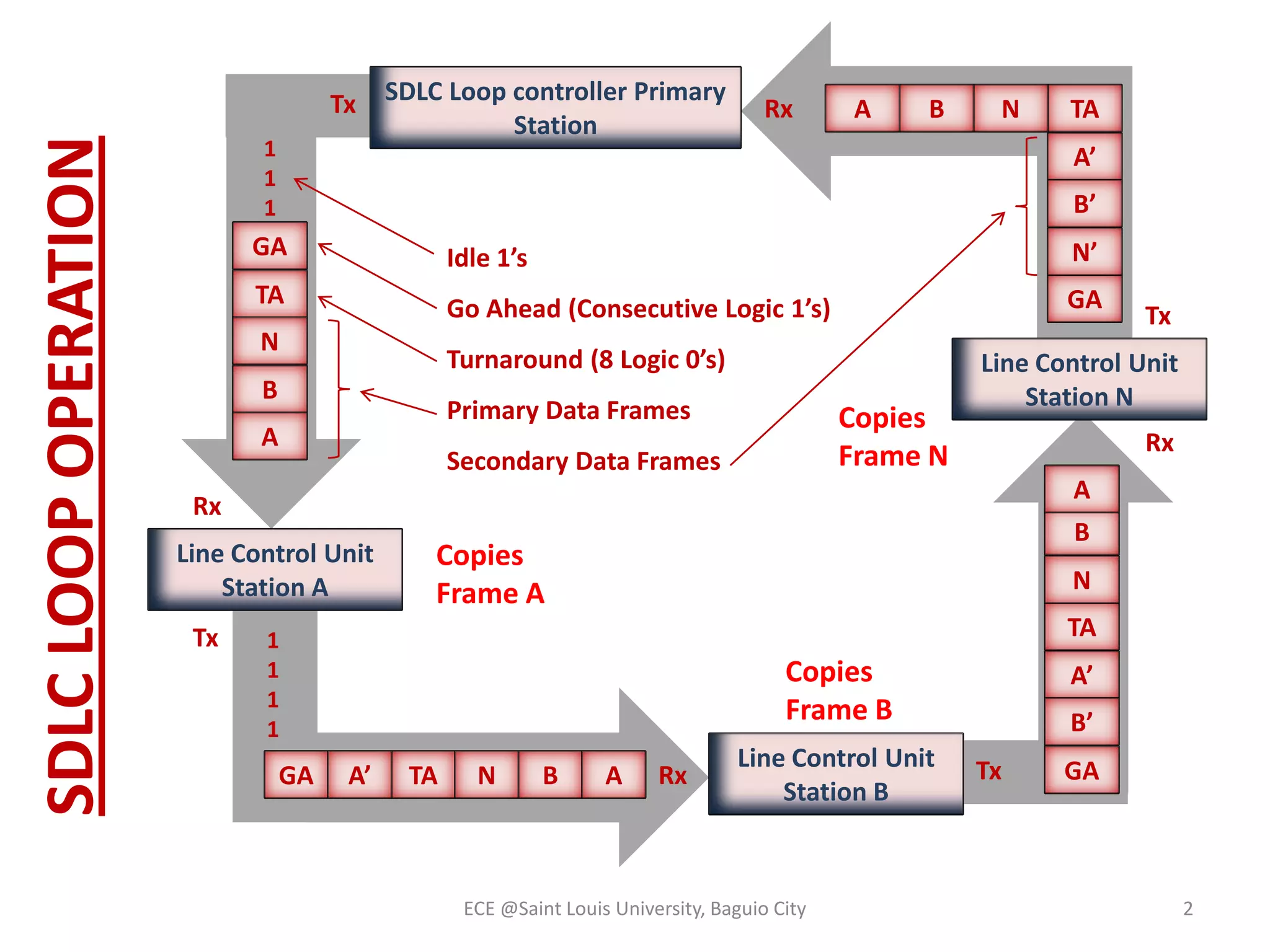
1. Primary transmits sequential frames to one or more
secondary stations.
2. Each transmitted frame contains a secondary station
address.
3. After a primary has completed transmitting, it follows the
last flag of the last frame with eight consecutive logic 0’s
(turnaround sequence) followed by continuous logic 1’s (goahead sequence.
4. The turnaround sequence alerts secondary stations of the
end of the primary’s transmissions.
5. Each secondary, in turn, decodes the address field of each
frame and removes frames addressed to them.
6. Secondary stations serve as repeaters for any down-line
secondary stations.
ECE @Saint Louis University, Baguio City

3
SDLC LOOP OPERATION
7. Secondary stations cannot transmit frames of their own
unless they receive a frame with the P bit set.
8. The first secondary station that receives a frame addressed
to it with the P bit set changes the seventh logic 1 in the goahead sequence to a logic 0, thus creating a flag.
9. The next down-loop secondary station that receives a
frame addressed to it with the P bit set detects the
turnaround sequence, any frames transmitted by other uploop secondary stations, and then the go-ahead sequence.
10. Each secondary station’s response frames are inserted
immediately after the turnaround sequence or after a
secondary response from an up-loop station.
11. The cycle is completed when the primary receives its own
turnaround sequence, a series of response frames, and the
go-ahead sequence
ECE @Saint Louis University, Baguio City

4
SDLC LOOP CONFIGURE COMMAND/RESPONSE
•
•
•
•

An unnumbered command/response (CFGR) that is used only in
SDLC loop configurations.
Contains a one byte descriptor in the information field.
A CFGR command is acknowledged by a CFGR response.
If the low order bit of the function descriptor is set, a specified
command is initiated, if reset the command is cleared

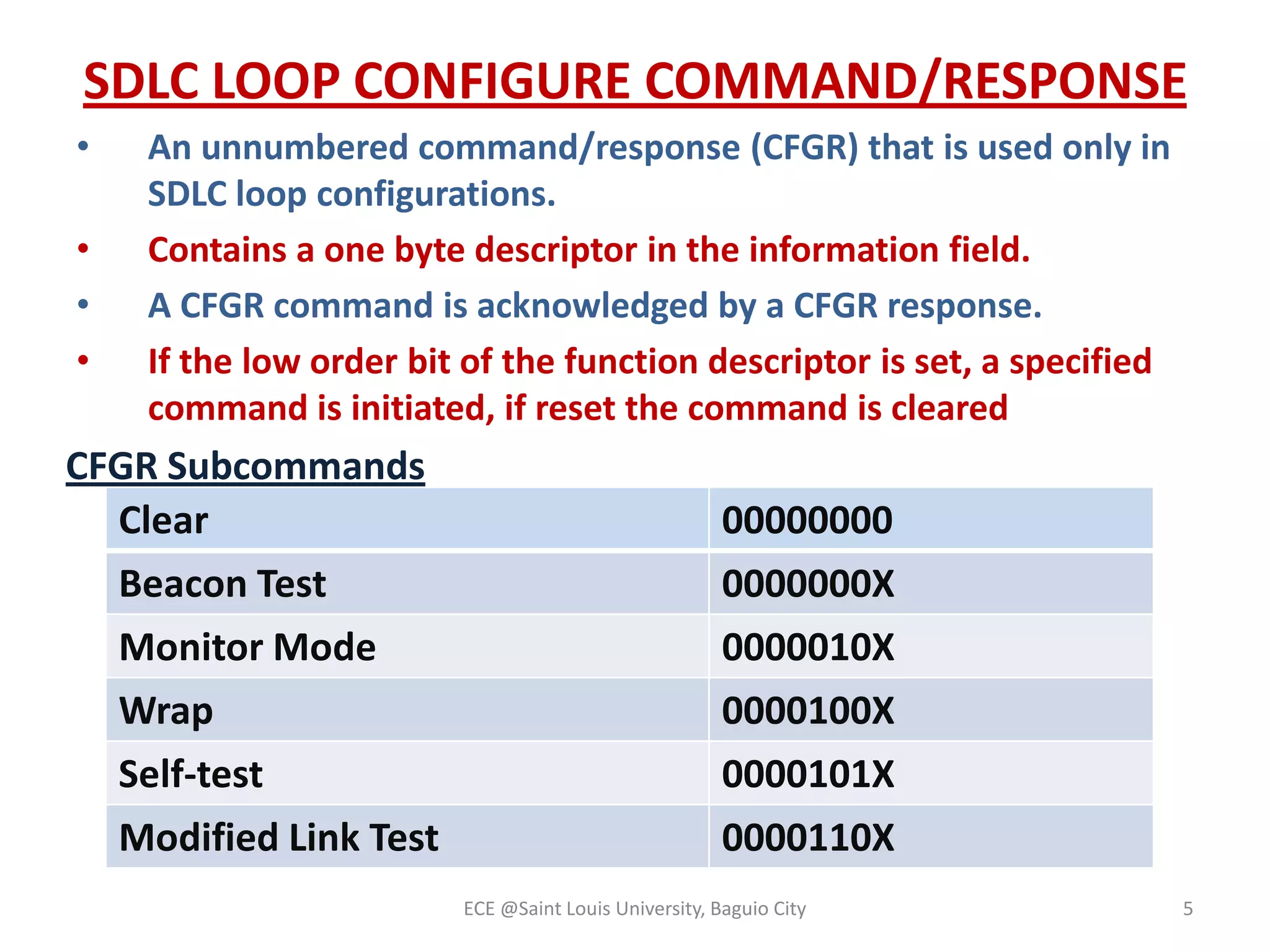
CFGR Subcommands
Clear
Beacon Test
Monitor Mode
Wrap
Self-test
Modified Link Test

00000000
0000000X
0000010X
0000100X
0000101X

0000110X
ECE @Saint Louis University, Baguio City

5
SDLC LOOP CONFIGURE COMMAND/RESPONSE
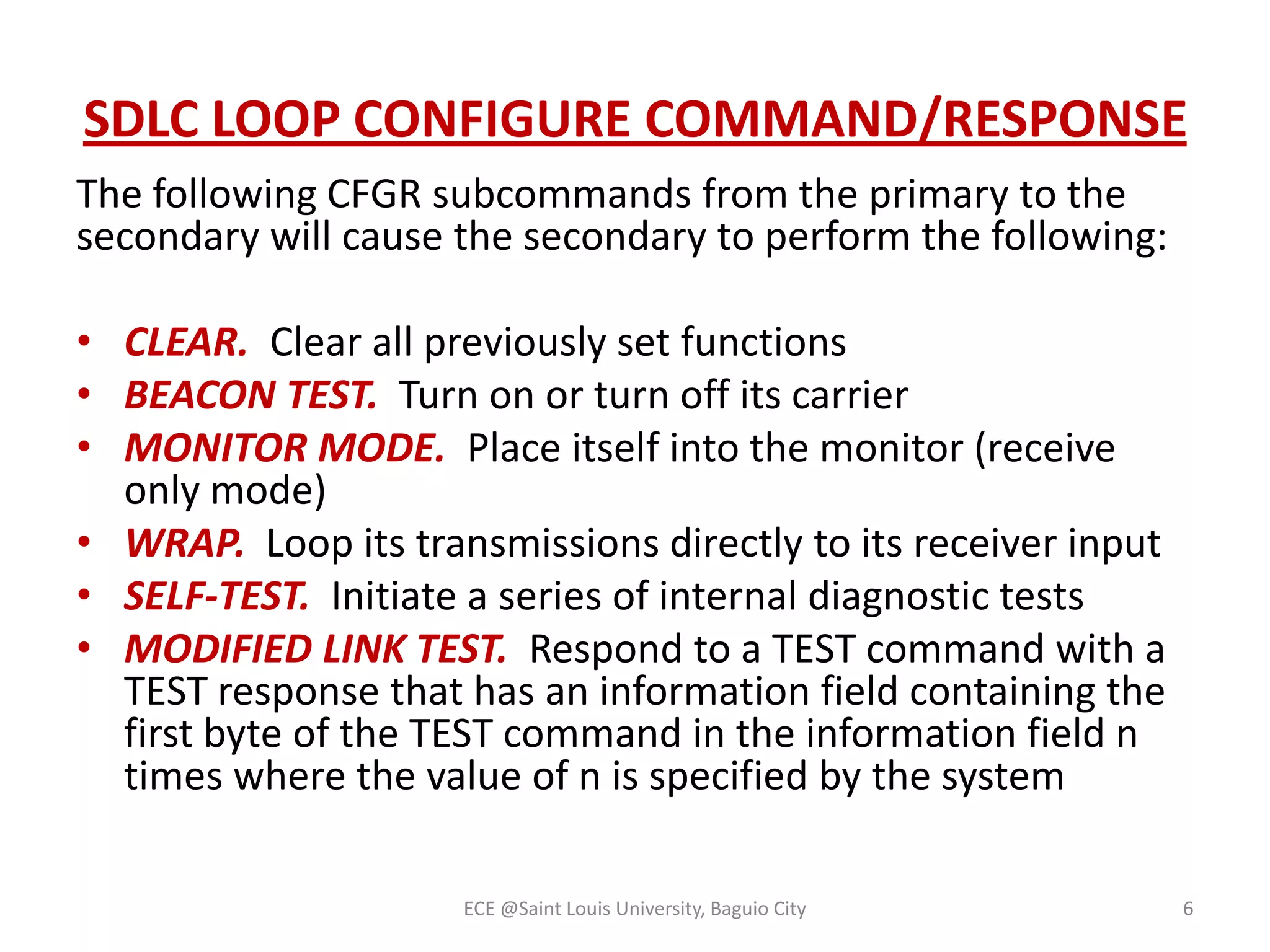
The following CFGR subcommands from the primary to the
secondary will cause the secondary to perform the following:

• CLEAR. Clear all previously set functions
• BEACON TEST. Turn on or turn off its carrier
• MONITOR MODE. Place itself into the monitor (receive
only mode)
• WRAP. Loop its transmissions directly to its receiver input
• SELF-TEST. Initiate a series of internal diagnostic tests
• MODIFIED LINK TEST. Respond to a TEST command with a
TEST response that has an information field containing the
first byte of the TEST command in the information field n
times where the value of n is specified by the system
ECE @Saint Louis University, Baguio City

6
SDLC TRANSPARENCY
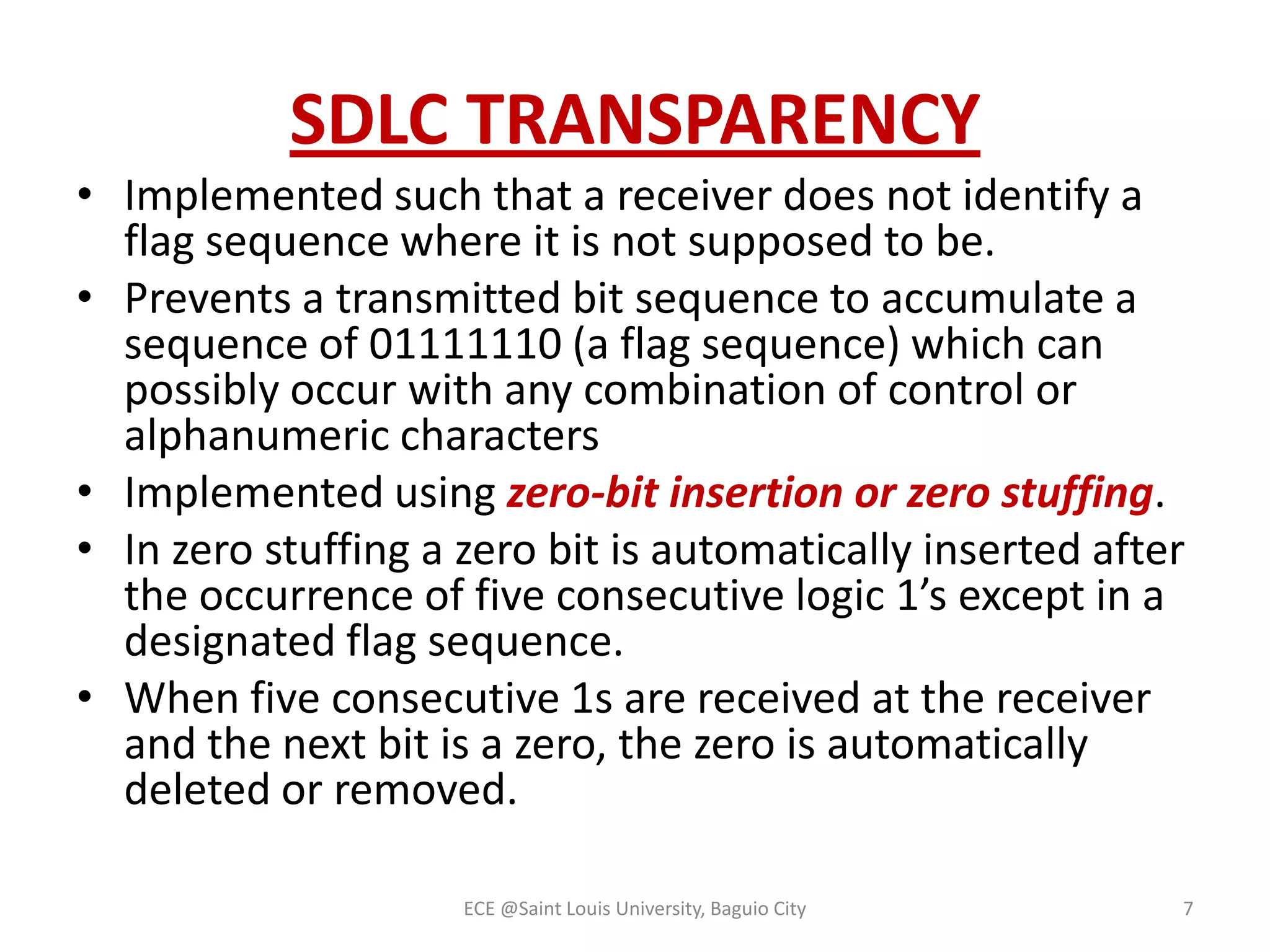
• Implemented such that a receiver does not identify a
flag sequence where it is not supposed to be.
• Prevents a transmitted bit sequence to accumulate a
sequence of 01111110 (a flag sequence) which can
possibly occur with any combination of control or
alphanumeric characters
• Implemented using zero-bit insertion or zero stuffing.
• In zero stuffing a zero bit is automatically inserted after
the occurrence of five consecutive logic 1’s except in a
designated flag sequence.
• When five consecutive 1s are received at the receiver
and the next bit is a zero, the zero is automatically
deleted or removed.
ECE @Saint Louis University, Baguio City

7
SDLC TRANSPARENCY
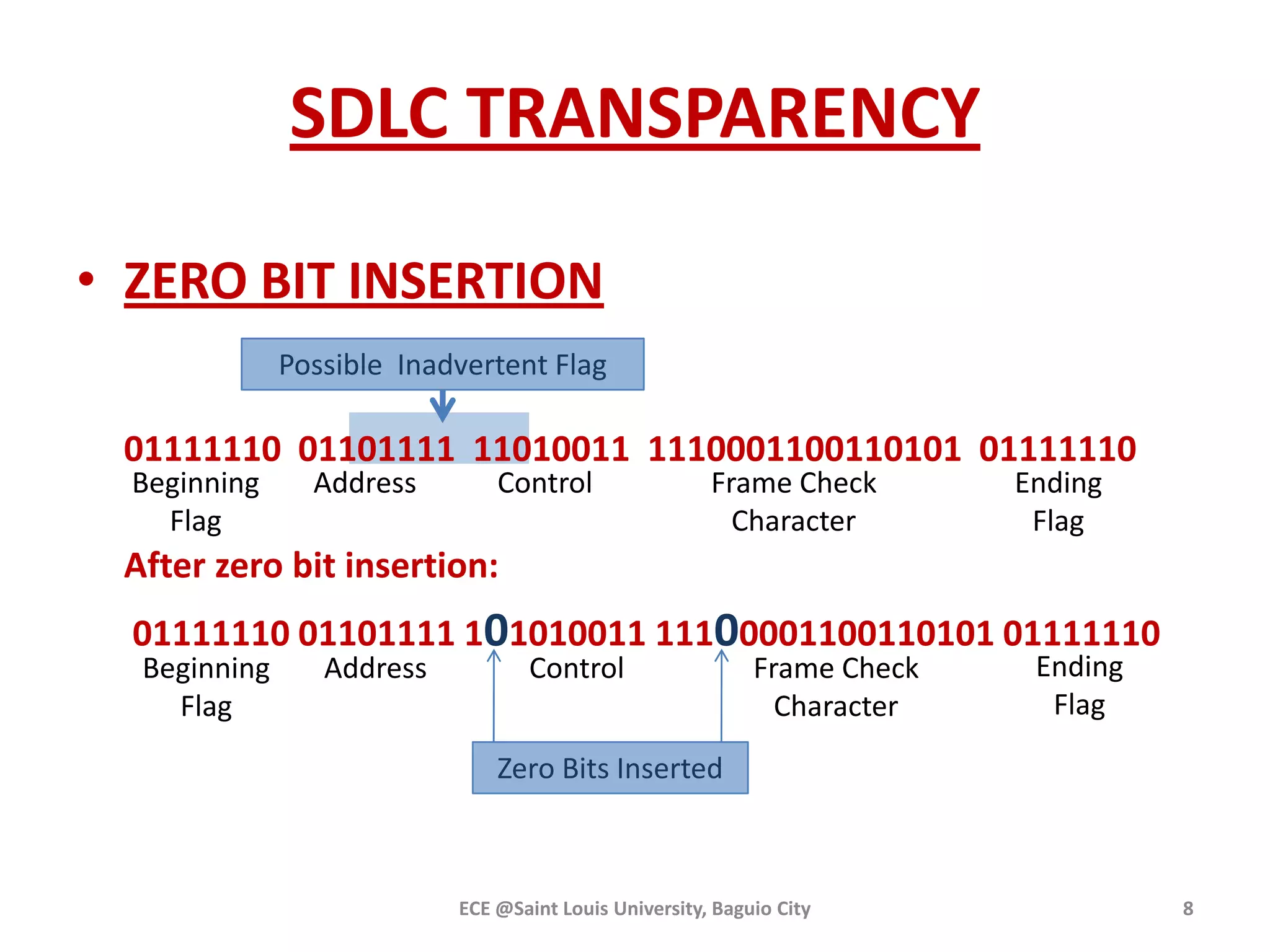
• ZERO BIT INSERTION
Possible Inadvertent Flag

01111110 01101111 11010011 1110001100110101 01111110
Beginning
Flag

Address

Control

Frame Check
Character

Ending
Flag

After zero bit insertion:
01111110 01101111 101010011 11100001100110101 01111110
Beginning
Flag

Address

Control

Frame Check
Character

Ending
Flag

Zero Bits Inserted

ECE @Saint Louis University, Baguio City

8
MESSAGE ABORT
• Used to prematurely terminate an SDLC frame
• Done only to accommodate high-priority
messages, such as emergency link recovery
procedures
• Implemented by sending and detecting exactly
14 consecutive logic 1’s
• Zeros are not inserted in an abort sequence
• Terminates an existing frame and immediately
begins the higher priority frame
ECE @Saint Louis University, Baguio City

9
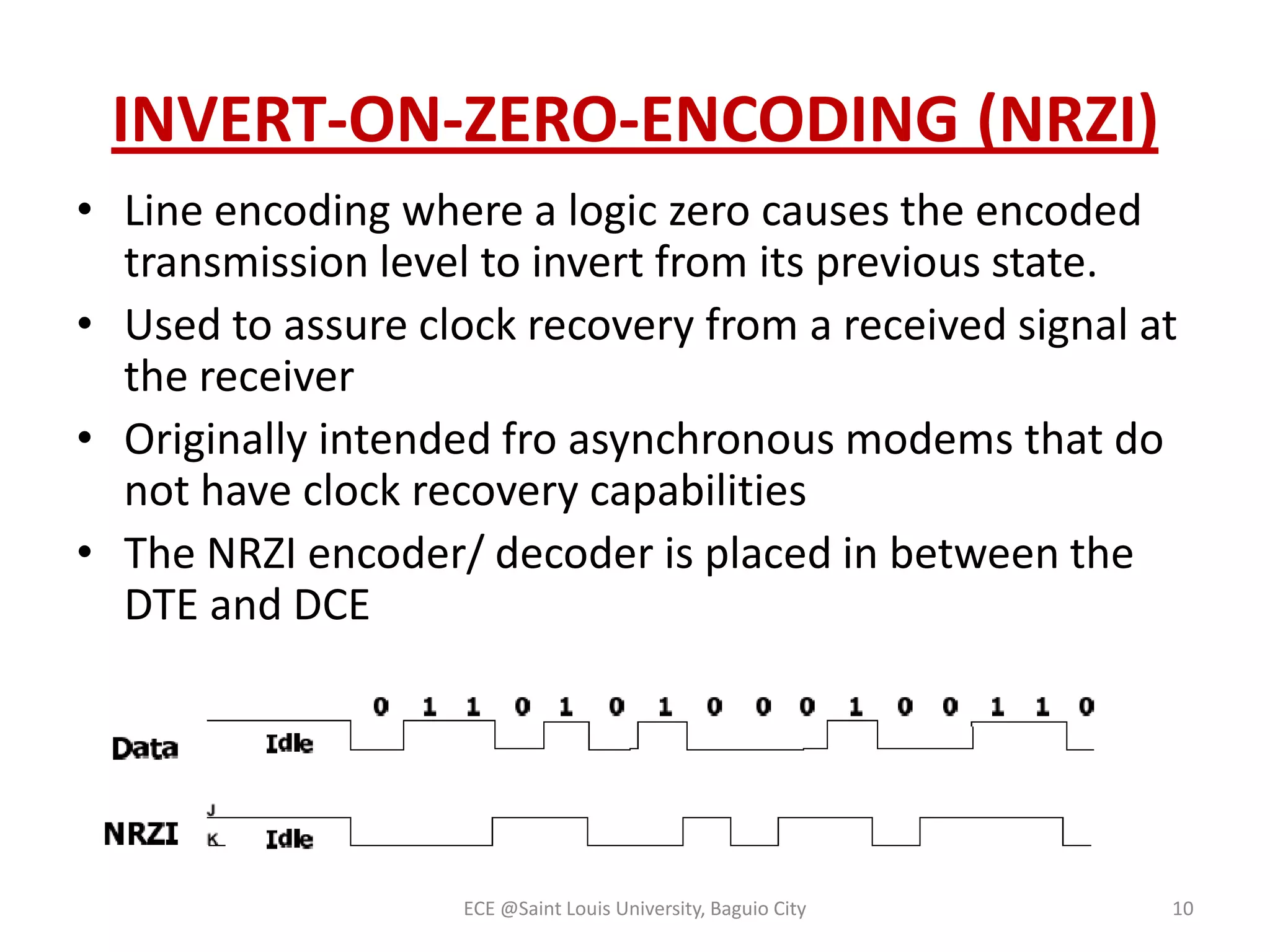
INVERT-ON-ZERO-ENCODING (NRZI)
• Line encoding where a logic zero causes the encoded
transmission level to invert from its previous state.
• Used to assure clock recovery from a received signal at
the receiver
• Originally intended fro asynchronous modems that do
not have clock recovery capabilities
• The NRZI encoder/ decoder is placed in between the
DTE and DCE

ECE @Saint Louis University, Baguio City

10
HIGH-LEVEL DATA LINK CONTROL (HDLC)
• The name given to several sets of
substandards defined by the ISO in 1975 as a
superset of SDLC including additional
capabilities
• Comprises of three standards for bit-oriented
Data Link Control:
– ISO 3309
– ISO 4335
– ISO 7809

ECE @Saint Louis University, Baguio City

11
HIGH-LEVEL DATA LINK CONTROL (HDLC)
• ISO 3309 SPECIFICATIONS
– Defines the frame structure, delimiting sequence,
transparency mechanism, and error detection method
used with HDLC
– Uses the same Flag field as SDLC
– Uses the same CRC-16 generating sequence as SDLC
as specified by CCITT V.41 although its remainder for
an errorless transmission at the receiver side is F0B8
instead of zero (checksum)
– Offers an optional 32-bit CRC checksum
– Has an option for a virtually limitless extended
addressing format in addition to the standard 8-bit
SDLC address
ECE @Saint Louis University, Baguio City

12
HIGH-LEVEL DATA LINK CONTROL (HDLC)
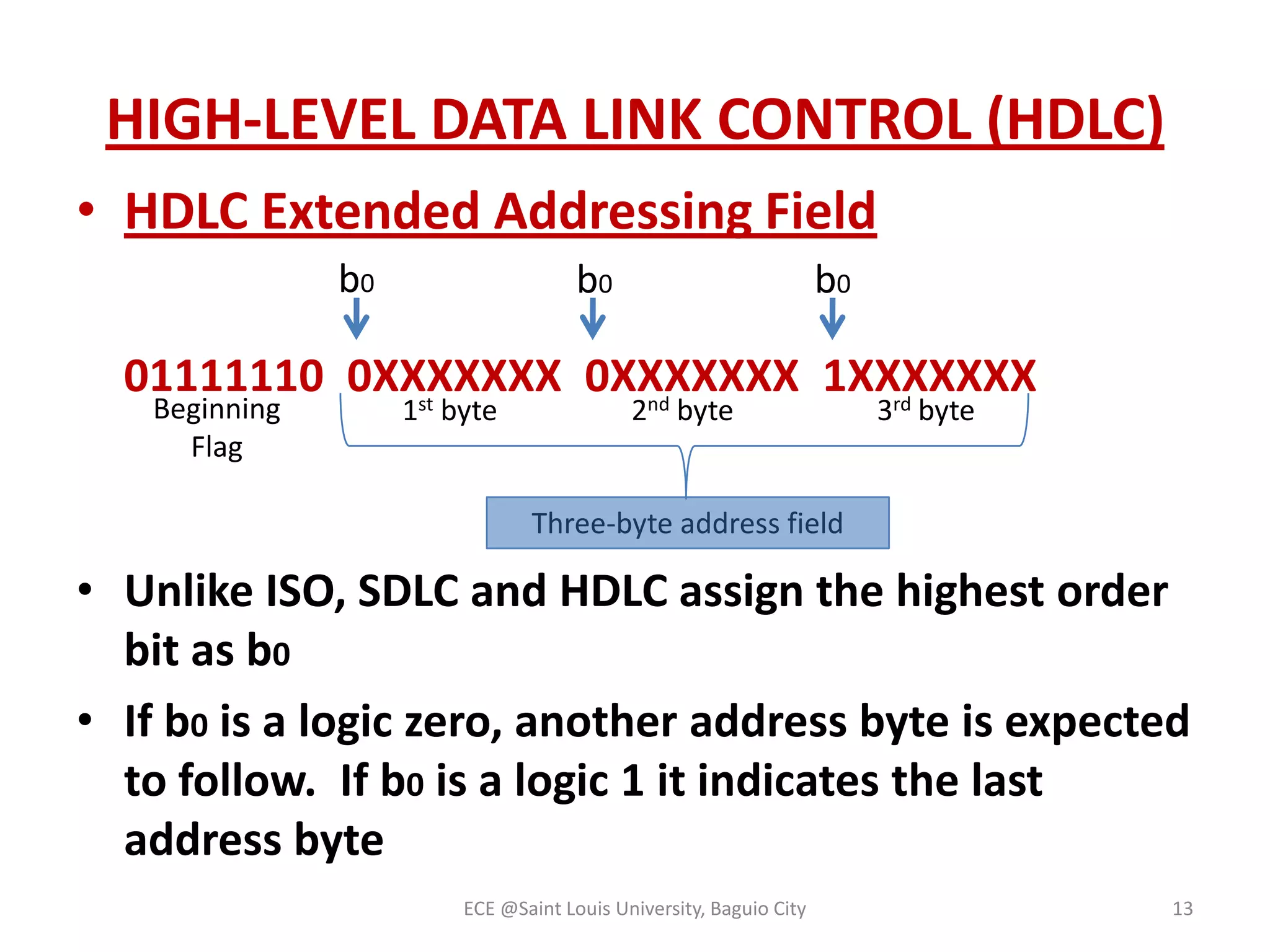
• HDLC Extended Addressing Field
b0

b0

b0

01111110 0XXXXXXX 0XXXXXXX 1XXXXXXX
st
nd
rd
Beginning
Flag

1 byte

2 byte

3 byte

Three-byte address field

• Unlike ISO, SDLC and HDLC assign the highest order
bit as b0
• If b0 is a logic zero, another address byte is expected
to follow. If b0 is a logic 1 it indicates the last
address byte
ECE @Saint Louis University, Baguio City

13
HIGH-LEVEL DATA LINK CONTROL (HDLC)
• INFORMATION FIELD
– HDLC Permits any number of bits in the
information and also permits the bits to be in
multiples other than 8 bits as long as it is
consistent throughout the HDLC frame

ECE @Saint Louis University, Baguio City

14
HIGH-LEVEL DATA LINK CONTROL (HDLC)
• CONTROL FIELD
– The HDLC control field can be extended to 16 bits, 7
bits for ns and 7 bits for nr therefore allowing up to
127 consecutive unconfirmed frames before an
acknowledgement.
– The supervisory format includes a fourth status
condition which is selective reject (SREJ) for the
combination of 11 on bit positions b4 and b5 which is
a combination previously unused in the SDLC
Supervisory frame control field.
– Selective reject allows the retransmission of only the
frames with errors one frame at a time.
ECE @Saint Louis University, Baguio City

15
HIGH-LEVEL DATA LINK CONTROL (HDLC)
• ADDITIONAL OPERATIONAL MODES
– Asynchronous Response Mode (ARM)
• Allows secondary stations to send unsolicited responses to
the secondary

– Asynchronous Balanced Mode (ABM)
• Allows network operation in a peer-to-peer network
environment where each station connected has equal data
responsibilities and can initiate data transmission without
receiving permission from any other station
• Accomplished through connection on a two-wire line using
ARM for half duplex, or on a four-wire line for full duplex .

– Asynchronous Disconnect Mode (ADM)
• Identical to the normal disconnect mode except that the
secondary can initiate a DM or RIM response at any time
ECE @Saint Louis University, Baguio City

16

Data link control protocol(4)

  • 1.
    Lecture 04 Data-Link Protocols Preparedby: Engr. Jeffrey Des B. Binwag Chapter 23 Electronic Communications Sytems , Fifth Editon By: Wayne Tomasi ECE @Saint Louis University, Baguio City 1
  • 2.
    SDLC LOOP OPERATION Tx 1 1 1 SDLCLoop controller Primary Station Rx A B N TA A’ B’ GA Idle 1’s N’ TA Go Ahead (Consecutive Logic 1’s) GA N Turnaround (8 Logic 0’s) B Primary Data Frames A Copies Frame N Secondary Data Frames Line Control Unit Station N Rx A Rx Line Control Unit Station A Tx Tx B Copies Frame A N TA 1 1 1 1 GA Copies Frame B A’ TA N B A Rx Line Control Unit Station B ECE @Saint Louis University, Baguio City A’ B’ Tx GA 2
  • 3.
    SDLC LOOP OPERATION 1.Primary transmits sequential frames to one or more secondary stations. 2. Each transmitted frame contains a secondary station address. 3. After a primary has completed transmitting, it follows the last flag of the last frame with eight consecutive logic 0’s (turnaround sequence) followed by continuous logic 1’s (goahead sequence. 4. The turnaround sequence alerts secondary stations of the end of the primary’s transmissions. 5. Each secondary, in turn, decodes the address field of each frame and removes frames addressed to them. 6. Secondary stations serve as repeaters for any down-line secondary stations. ECE @Saint Louis University, Baguio City 3
  • 4.
    SDLC LOOP OPERATION 7.Secondary stations cannot transmit frames of their own unless they receive a frame with the P bit set. 8. The first secondary station that receives a frame addressed to it with the P bit set changes the seventh logic 1 in the goahead sequence to a logic 0, thus creating a flag. 9. The next down-loop secondary station that receives a frame addressed to it with the P bit set detects the turnaround sequence, any frames transmitted by other uploop secondary stations, and then the go-ahead sequence. 10. Each secondary station’s response frames are inserted immediately after the turnaround sequence or after a secondary response from an up-loop station. 11. The cycle is completed when the primary receives its own turnaround sequence, a series of response frames, and the go-ahead sequence ECE @Saint Louis University, Baguio City 4
  • 5.
    SDLC LOOP CONFIGURECOMMAND/RESPONSE • • • • An unnumbered command/response (CFGR) that is used only in SDLC loop configurations. Contains a one byte descriptor in the information field. A CFGR command is acknowledged by a CFGR response. If the low order bit of the function descriptor is set, a specified command is initiated, if reset the command is cleared CFGR Subcommands Clear Beacon Test Monitor Mode Wrap Self-test Modified Link Test 00000000 0000000X 0000010X 0000100X 0000101X 0000110X ECE @Saint Louis University, Baguio City 5
  • 6.
    SDLC LOOP CONFIGURECOMMAND/RESPONSE The following CFGR subcommands from the primary to the secondary will cause the secondary to perform the following: • CLEAR. Clear all previously set functions • BEACON TEST. Turn on or turn off its carrier • MONITOR MODE. Place itself into the monitor (receive only mode) • WRAP. Loop its transmissions directly to its receiver input • SELF-TEST. Initiate a series of internal diagnostic tests • MODIFIED LINK TEST. Respond to a TEST command with a TEST response that has an information field containing the first byte of the TEST command in the information field n times where the value of n is specified by the system ECE @Saint Louis University, Baguio City 6
  • 7.
    SDLC TRANSPARENCY • Implementedsuch that a receiver does not identify a flag sequence where it is not supposed to be. • Prevents a transmitted bit sequence to accumulate a sequence of 01111110 (a flag sequence) which can possibly occur with any combination of control or alphanumeric characters • Implemented using zero-bit insertion or zero stuffing. • In zero stuffing a zero bit is automatically inserted after the occurrence of five consecutive logic 1’s except in a designated flag sequence. • When five consecutive 1s are received at the receiver and the next bit is a zero, the zero is automatically deleted or removed. ECE @Saint Louis University, Baguio City 7
  • 8.
    SDLC TRANSPARENCY • ZEROBIT INSERTION Possible Inadvertent Flag 01111110 01101111 11010011 1110001100110101 01111110 Beginning Flag Address Control Frame Check Character Ending Flag After zero bit insertion: 01111110 01101111 101010011 11100001100110101 01111110 Beginning Flag Address Control Frame Check Character Ending Flag Zero Bits Inserted ECE @Saint Louis University, Baguio City 8
  • 9.
    MESSAGE ABORT • Usedto prematurely terminate an SDLC frame • Done only to accommodate high-priority messages, such as emergency link recovery procedures • Implemented by sending and detecting exactly 14 consecutive logic 1’s • Zeros are not inserted in an abort sequence • Terminates an existing frame and immediately begins the higher priority frame ECE @Saint Louis University, Baguio City 9
  • 10.
    INVERT-ON-ZERO-ENCODING (NRZI) • Lineencoding where a logic zero causes the encoded transmission level to invert from its previous state. • Used to assure clock recovery from a received signal at the receiver • Originally intended fro asynchronous modems that do not have clock recovery capabilities • The NRZI encoder/ decoder is placed in between the DTE and DCE ECE @Saint Louis University, Baguio City 10
  • 11.
    HIGH-LEVEL DATA LINKCONTROL (HDLC) • The name given to several sets of substandards defined by the ISO in 1975 as a superset of SDLC including additional capabilities • Comprises of three standards for bit-oriented Data Link Control: – ISO 3309 – ISO 4335 – ISO 7809 ECE @Saint Louis University, Baguio City 11
  • 12.
    HIGH-LEVEL DATA LINKCONTROL (HDLC) • ISO 3309 SPECIFICATIONS – Defines the frame structure, delimiting sequence, transparency mechanism, and error detection method used with HDLC – Uses the same Flag field as SDLC – Uses the same CRC-16 generating sequence as SDLC as specified by CCITT V.41 although its remainder for an errorless transmission at the receiver side is F0B8 instead of zero (checksum) – Offers an optional 32-bit CRC checksum – Has an option for a virtually limitless extended addressing format in addition to the standard 8-bit SDLC address ECE @Saint Louis University, Baguio City 12
  • 13.
    HIGH-LEVEL DATA LINKCONTROL (HDLC) • HDLC Extended Addressing Field b0 b0 b0 01111110 0XXXXXXX 0XXXXXXX 1XXXXXXX st nd rd Beginning Flag 1 byte 2 byte 3 byte Three-byte address field • Unlike ISO, SDLC and HDLC assign the highest order bit as b0 • If b0 is a logic zero, another address byte is expected to follow. If b0 is a logic 1 it indicates the last address byte ECE @Saint Louis University, Baguio City 13
  • 14.
    HIGH-LEVEL DATA LINKCONTROL (HDLC) • INFORMATION FIELD – HDLC Permits any number of bits in the information and also permits the bits to be in multiples other than 8 bits as long as it is consistent throughout the HDLC frame ECE @Saint Louis University, Baguio City 14
  • 15.
    HIGH-LEVEL DATA LINKCONTROL (HDLC) • CONTROL FIELD – The HDLC control field can be extended to 16 bits, 7 bits for ns and 7 bits for nr therefore allowing up to 127 consecutive unconfirmed frames before an acknowledgement. – The supervisory format includes a fourth status condition which is selective reject (SREJ) for the combination of 11 on bit positions b4 and b5 which is a combination previously unused in the SDLC Supervisory frame control field. – Selective reject allows the retransmission of only the frames with errors one frame at a time. ECE @Saint Louis University, Baguio City 15
  • 16.
    HIGH-LEVEL DATA LINKCONTROL (HDLC) • ADDITIONAL OPERATIONAL MODES – Asynchronous Response Mode (ARM) • Allows secondary stations to send unsolicited responses to the secondary – Asynchronous Balanced Mode (ABM) • Allows network operation in a peer-to-peer network environment where each station connected has equal data responsibilities and can initiate data transmission without receiving permission from any other station • Accomplished through connection on a two-wire line using ARM for half duplex, or on a four-wire line for full duplex . – Asynchronous Disconnect Mode (ADM) • Identical to the normal disconnect mode except that the secondary can initiate a DM or RIM response at any time ECE @Saint Louis University, Baguio City 16