Huffman Coding
Huffman Coding is a technique of compressing data to reduce its size
without losing any of the details. It was first developed by David Huffman.
Huffman Coding is generally useful to compress the data in which there are
frequently occurring characters.
How Huffman Coding works?
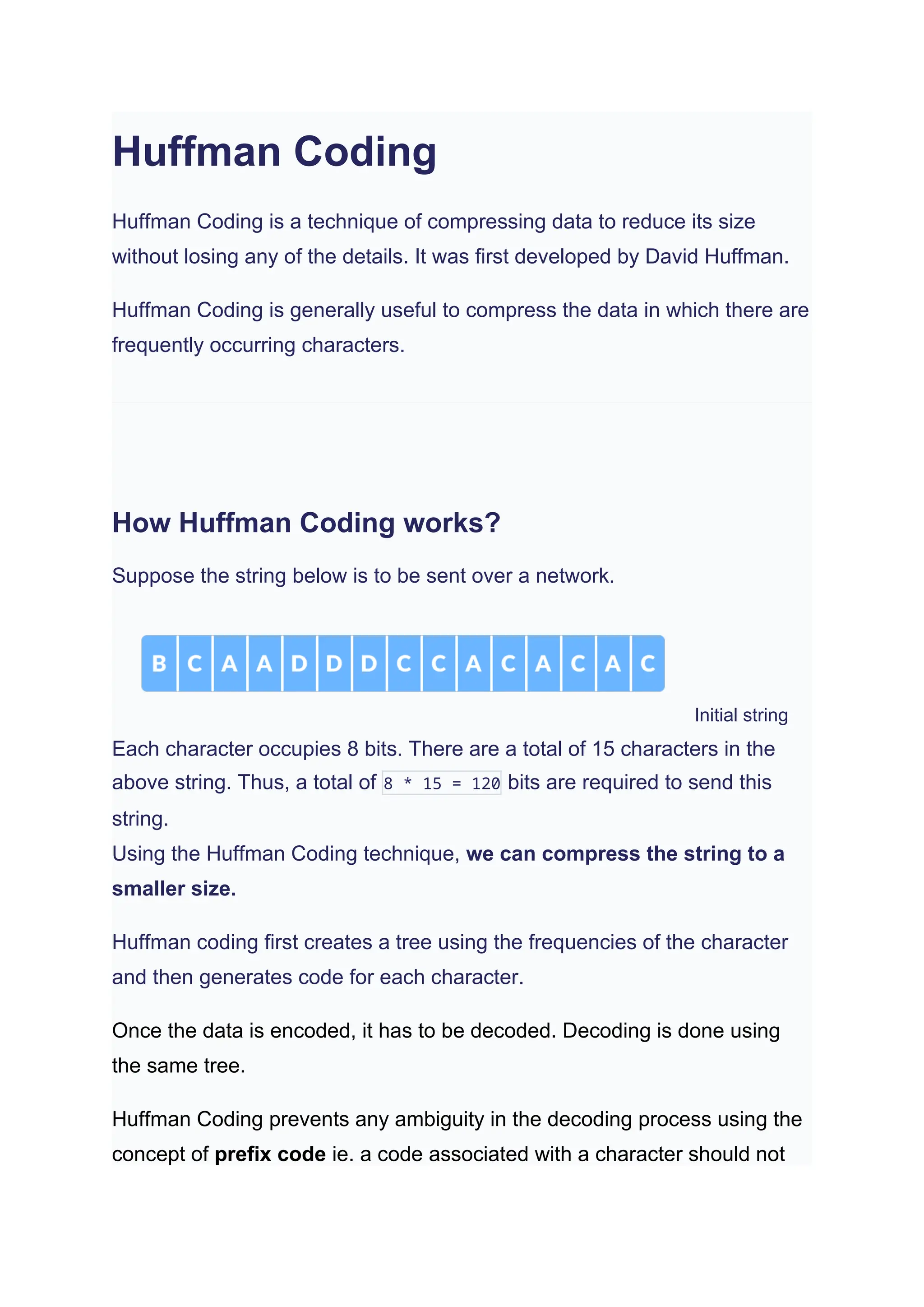
Suppose the string below is to be sent over a network.
Initial string
Each character occupies 8 bits. There are a total of 15 characters in the
above string. Thus, a total of 8 * 15 = 120 bits are required to send this
string.
Using the Huffman Coding technique, we can compress the string to a
smaller size.
Huffman coding first creates a tree using the frequencies of the character
and then generates code for each character.
Once the data is encoded, it has to be decoded. Decoding is done using
the same tree.
Huffman Coding prevents any ambiguity in the decoding process using the
concept of prefix code ie. a code associated with a character should not
be present in the prefix of any other code. The tree created above helps in
maintaining the property.
Huffman coding is done with the help of the following steps.
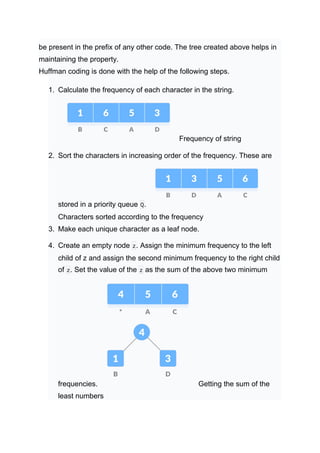
1. Calculate the frequency of each character in the string.
Frequency of string
2. Sort the characters in increasing order of the frequency. These are
stored in a priority queue Q.
Characters sorted according to the frequency
3. Make each unique character as a leaf node.
4. Create an empty node z. Assign the minimum frequency to the left
child of z and assign the second minimum frequency to the right child
of z. Set the value of the z as the sum of the above two minimum
frequencies. Getting the sum of the
least numbers
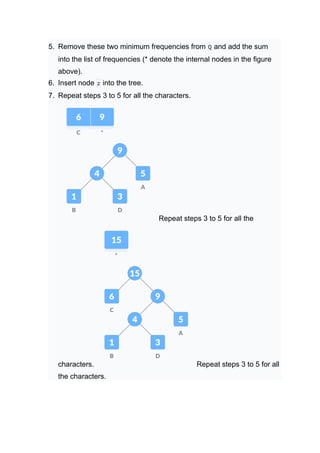
5. Remove these two minimum frequencies from Q and add the sum
into the list of frequencies (* denote the internal nodes in the figure
above).
6. Insert node z into the tree.
7. Repeat steps 3 to 5 for all the characters.
Repeat steps 3 to 5 for all the
characters. Repeat steps 3 to 5 for all
the characters.
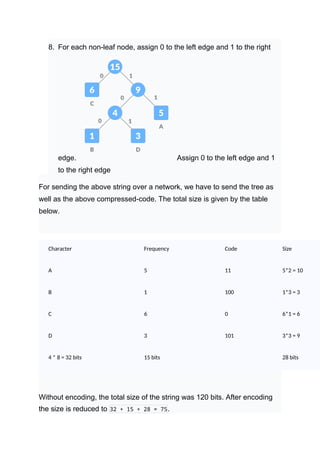
8. For each non-leaf node, assign 0 to the left edge and 1 to the right
edge. Assign 0 to the left edge and 1
to the right edge
For sending the above string over a network, we have to send the tree as
well as the above compressed-code. The total size is given by the table
below.
Character Frequency Code Size
A 5 11 5*2 = 10
B 1 100 1*3 = 3
C 6 0 6*1 = 6
D 3 101 3*3 = 9
4 * 8 = 32 bits 15 bits 28 bits
Without encoding, the total size of the string was 120 bits. After encoding
the size is reduced to 32 + 15 + 28 = 75.
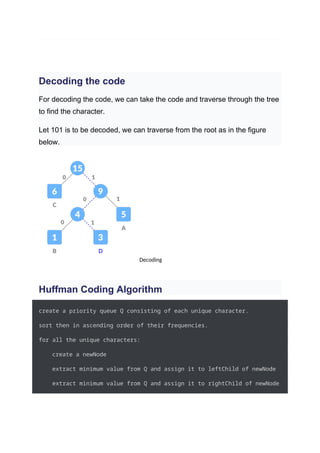
Decoding the code
For decoding the code, we can take the code and traverse through the tree
to find the character.
Let 101 is to be decoded, we can traverse from the root as in the figure
below.
Decoding
Huffman Coding Algorithm
create a priority queue Q consisting of each unique character.
sort then in ascending order of their frequencies.
for all the unique characters:
create a newNode
extract minimum value from Q and assign it to leftChild of newNode
extract minimum value from Q and assign it to rightChild of newNode
calculate the sum of these two minimum values and assign it to the
value of newNode
insert this newNode into the tree
return rootNode
Huffman Coding Complexity
The time complexity for encoding each unique character based on its
frequency is O(nlog n).
Extracting minimum frequency from the priority queue takes place 2*(n-
1) times and its complexity is O(log n). Thus the overall complexity
is O(nlog n).
Huffman Coding Applications
 Huffman coding is used in conventional compression formats like
GZIP, BZIP2, PKZIP, etc.
 For text and fax transmissions.

Huffman Coding is a technique of compressing data

  • 1.
    Huffman Coding Huffman Codingis a technique of compressing data to reduce its size without losing any of the details. It was first developed by David Huffman. Huffman Coding is generally useful to compress the data in which there are frequently occurring characters. How Huffman Coding works? Suppose the string below is to be sent over a network. Initial string Each character occupies 8 bits. There are a total of 15 characters in the above string. Thus, a total of 8 * 15 = 120 bits are required to send this string. Using the Huffman Coding technique, we can compress the string to a smaller size. Huffman coding first creates a tree using the frequencies of the character and then generates code for each character. Once the data is encoded, it has to be decoded. Decoding is done using the same tree. Huffman Coding prevents any ambiguity in the decoding process using the concept of prefix code ie. a code associated with a character should not
  • 2.
    be present inthe prefix of any other code. The tree created above helps in maintaining the property. Huffman coding is done with the help of the following steps. 1. Calculate the frequency of each character in the string. Frequency of string 2. Sort the characters in increasing order of the frequency. These are stored in a priority queue Q. Characters sorted according to the frequency 3. Make each unique character as a leaf node. 4. Create an empty node z. Assign the minimum frequency to the left child of z and assign the second minimum frequency to the right child of z. Set the value of the z as the sum of the above two minimum frequencies. Getting the sum of the least numbers
  • 3.
    5. Remove thesetwo minimum frequencies from Q and add the sum into the list of frequencies (* denote the internal nodes in the figure above). 6. Insert node z into the tree. 7. Repeat steps 3 to 5 for all the characters. Repeat steps 3 to 5 for all the characters. Repeat steps 3 to 5 for all the characters.
  • 4.
    8. For eachnon-leaf node, assign 0 to the left edge and 1 to the right edge. Assign 0 to the left edge and 1 to the right edge For sending the above string over a network, we have to send the tree as well as the above compressed-code. The total size is given by the table below. Character Frequency Code Size A 5 11 5*2 = 10 B 1 100 1*3 = 3 C 6 0 6*1 = 6 D 3 101 3*3 = 9 4 * 8 = 32 bits 15 bits 28 bits Without encoding, the total size of the string was 120 bits. After encoding the size is reduced to 32 + 15 + 28 = 75.
  • 5.
    Decoding the code Fordecoding the code, we can take the code and traverse through the tree to find the character. Let 101 is to be decoded, we can traverse from the root as in the figure below. Decoding Huffman Coding Algorithm create a priority queue Q consisting of each unique character. sort then in ascending order of their frequencies. for all the unique characters: create a newNode extract minimum value from Q and assign it to leftChild of newNode extract minimum value from Q and assign it to rightChild of newNode
  • 6.
    calculate the sumof these two minimum values and assign it to the value of newNode insert this newNode into the tree return rootNode Huffman Coding Complexity The time complexity for encoding each unique character based on its frequency is O(nlog n). Extracting minimum frequency from the priority queue takes place 2*(n- 1) times and its complexity is O(log n). Thus the overall complexity is O(nlog n). Huffman Coding Applications  Huffman coding is used in conventional compression formats like GZIP, BZIP2, PKZIP, etc.  For text and fax transmissions.