Huffman Codes
Encoding messages
 Encode a message composed of a string of
characters
 Codes used by computer systems
 ASCII
• uses 8 bits per character
• can encode 256 characters
 Unicode
• 16 bits per character
• can encode 65536 characters
• includes all characters encoded by ASCII
 ASCII and Unicode are fixed-length codes
 all characters represented by same number of bits
Problems
 Suppose that we want to encode a message
constructed from the symbols A, B, C, D, and E
using a fixed-length code
 How many bits are required to encode each
symbol?
 at least 3 bits are required
 2 bits are not enough (can only encode four
symbols)
 How many bits are required to encode the
message DEAACAAAAABA?
 there are twelve symbols, each requires 3 bits
 12*3 = 36 bits are required
Drawbacks of fixed-length codes
 Wasted space
 Unicode uses twice as much space as ASCII
• inefficient for plain-text messages containing
only ASCII characters
 Same number of bits used to represent all characters
 ‘a’ and ‘e’ occur more frequently than ‘q’ and ‘z’
 Potential solution: use variable-length codes
 variable number of bits to represent characters
when frequency of occurrence is known
 short codes for characters that occur frequently
Advantages of variable-length codes
 The advantage of variable-length codes over fixed-
length is short codes can be given to characters that
occur frequently
 on average, the length of the encoded message is
less than fixed-length encoding
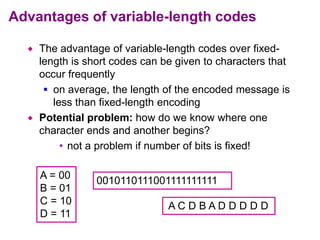
 Potential problem: how do we know where one
character ends and another begins?
• not a problem if number of bits is fixed!
A = 00
B = 01
C = 10
D = 11
0010110111001111111111
A C D B A D D D D D
Prefix property
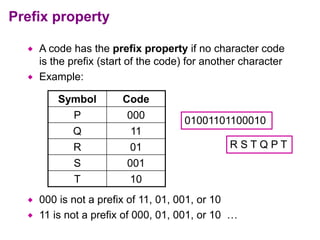
 A code has the prefix property if no character code
is the prefix (start of the code) for another character
 Example:
 000 is not a prefix of 11, 01, 001, or 10
 11 is not a prefix of 000, 01, 001, or 10 …
Symbol Code
P 000
Q 11
R 01
S 001
T 10
01001101100010
R S T Q P T
Code without prefix property
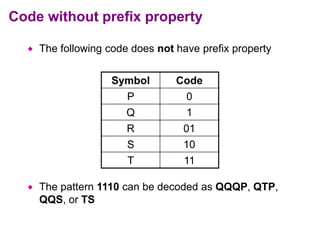
 The following code does not have prefix property
 The pattern 1110 can be decoded as QQQP, QTP,
QQS, or TS
Symbol Code
P 0
Q 1
R 01
S 10
T 11
Problem
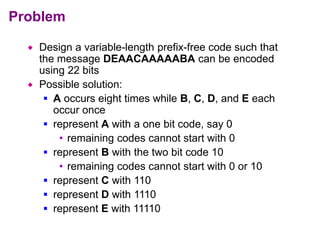
 Design a variable-length prefix-free code such that
the message DEAACAAAAABA can be encoded
using 22 bits
 Possible solution:
 A occurs eight times while B, C, D, and E each
occur once
 represent A with a one bit code, say 0
• remaining codes cannot start with 0
 represent B with the two bit code 10
• remaining codes cannot start with 0 or 10
 represent C with 110
 represent D with 1110
 represent E with 11110
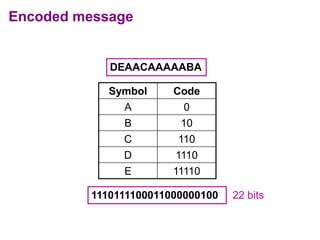
Encoded message
Symbol Code
A 0
B 10
C 110
D 1110
E 11110
DEAACAAAAABA
1110111100011000000100 22 bits
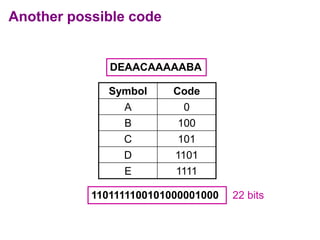
Another possible code
Symbol Code
A 0
B 100
C 101
D 1101
E 1111
DEAACAAAAABA
1101111100101000001000 22 bits
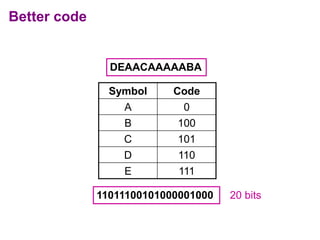
Better code
Symbol Code
A 0
B 100
C 101
D 110
E 111
DEAACAAAAABA
11011100101000001000 20 bits
What code to use?
 Question: Is there a variable-length code that makes
the most efficient use of space?
Answer: Yes!
Huffman coding tree
 Binary tree
 each leaf contains symbol (character)
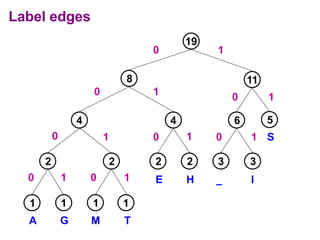
 label edge from node to left child with 0
 label edge from node to right child with 1
 Code for any symbol obtained by following path from
root to the leaf containing symbol
 Code has prefix property
 leaf node cannot appear on path to another leaf
 note: fixed-length codes are represented by a
complete Huffman tree and clearly have the prefix
property
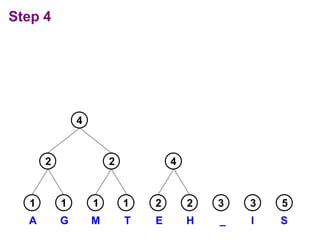
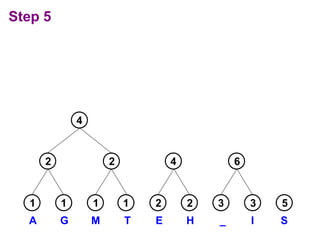
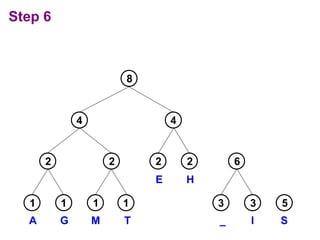
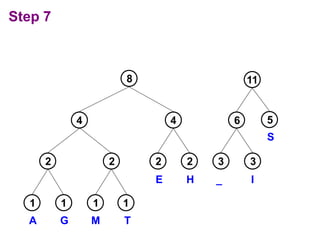
Building a Huffman tree
 Find frequencies of each symbol occurring in
message
 Begin with a forest of single node trees
 each contain symbol and its frequency
 Do recursively
 select two trees with smallest frequency at the root
 produce a new binary tree with the selected trees
as children and store the sum of their frequencies
in the root
 Recursion ends when there is one tree
 this is the Huffman coding tree
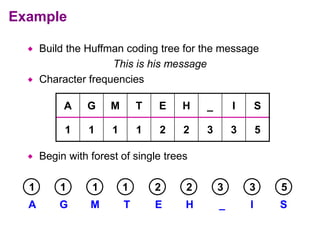
Example
 Build the Huffman coding tree for the message
This is his message
 Character frequencies
 Begin with forest of single trees
A G M T E H _ I S
1 1 1 1 2 2 3 3 5
1
1 3
1 2
1 2 3 5
A G I S
M T E H _
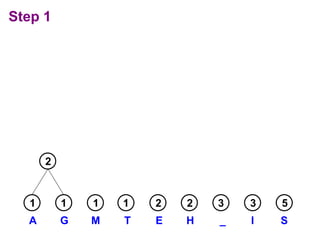
Step 1
1
1 3
1 2
1 2 3 5
A G I S
M T E H _
2
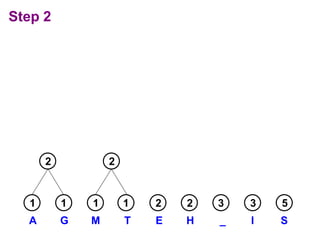
Step 2
1
1 3
1 2
1 2 3 5
A G I S
M T E H _
2 2
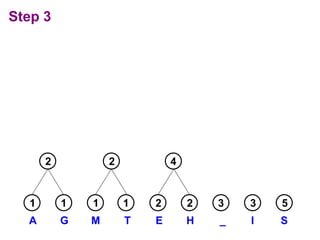
Step 3
1
1 3
1
1 3 5
A G I S
M T _
2 2
2 2
E H
4
Step 4
1
1 3
1
1 3 5
A G I S
M T _
2 2
2 2
E H
4
4
Step 5
1
1 3
1
1 3 5
A G I S
M T _
2 2
2 2
E H
4
4
6
Step 6
3 3 5
I S
_
2 2
E H
4
1
1 1
1
A G M T
2 2
4
6
8
Step 7
3 3
5
I
S
_
2 2
E H
4
1
1 1
1
A G M T
2 2
4 6
8 11
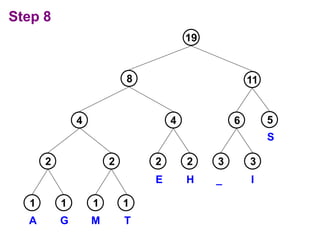
Step 8
3 3
5
I
S
_
2 2
E H
4
1
1 1
1
A G M T
2 2
4 6
8 11
19
Label edges
3 3
5
I
S
_
2 2
E H
4
1
1 1
1
A G M T
2 2
4 6
8 11
19
0
0
0
0
0
0
0
0
1
1
1
1 1
1
1
1
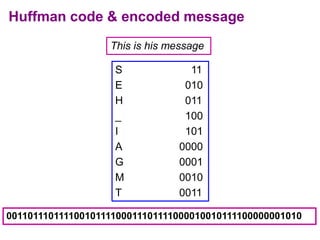
Huffman code & encoded message
S 11
E 010
H 011
_ 100
I 101
A 0000
G 0001
M 0010
T 0011
This is his message
00110111011110010111100011101111000010010111100000001010

huffman ppt

  • 1.
  • 2.
    Encoding messages  Encodea message composed of a string of characters  Codes used by computer systems  ASCII • uses 8 bits per character • can encode 256 characters  Unicode • 16 bits per character • can encode 65536 characters • includes all characters encoded by ASCII  ASCII and Unicode are fixed-length codes  all characters represented by same number of bits
  • 3.
    Problems  Suppose thatwe want to encode a message constructed from the symbols A, B, C, D, and E using a fixed-length code  How many bits are required to encode each symbol?  at least 3 bits are required  2 bits are not enough (can only encode four symbols)  How many bits are required to encode the message DEAACAAAAABA?  there are twelve symbols, each requires 3 bits  12*3 = 36 bits are required
  • 4.
    Drawbacks of fixed-lengthcodes  Wasted space  Unicode uses twice as much space as ASCII • inefficient for plain-text messages containing only ASCII characters  Same number of bits used to represent all characters  ‘a’ and ‘e’ occur more frequently than ‘q’ and ‘z’  Potential solution: use variable-length codes  variable number of bits to represent characters when frequency of occurrence is known  short codes for characters that occur frequently
  • 5.
    Advantages of variable-lengthcodes  The advantage of variable-length codes over fixed- length is short codes can be given to characters that occur frequently  on average, the length of the encoded message is less than fixed-length encoding  Potential problem: how do we know where one character ends and another begins? • not a problem if number of bits is fixed! A = 00 B = 01 C = 10 D = 11 0010110111001111111111 A C D B A D D D D D
  • 6.
    Prefix property  Acode has the prefix property if no character code is the prefix (start of the code) for another character  Example:  000 is not a prefix of 11, 01, 001, or 10  11 is not a prefix of 000, 01, 001, or 10 … Symbol Code P 000 Q 11 R 01 S 001 T 10 01001101100010 R S T Q P T
  • 7.
    Code without prefixproperty  The following code does not have prefix property  The pattern 1110 can be decoded as QQQP, QTP, QQS, or TS Symbol Code P 0 Q 1 R 01 S 10 T 11
  • 8.
    Problem  Design avariable-length prefix-free code such that the message DEAACAAAAABA can be encoded using 22 bits  Possible solution:  A occurs eight times while B, C, D, and E each occur once  represent A with a one bit code, say 0 • remaining codes cannot start with 0  represent B with the two bit code 10 • remaining codes cannot start with 0 or 10  represent C with 110  represent D with 1110  represent E with 11110
  • 9.
    Encoded message Symbol Code A0 B 10 C 110 D 1110 E 11110 DEAACAAAAABA 1110111100011000000100 22 bits
  • 10.
    Another possible code SymbolCode A 0 B 100 C 101 D 1101 E 1111 DEAACAAAAABA 1101111100101000001000 22 bits
  • 11.
    Better code Symbol Code A0 B 100 C 101 D 110 E 111 DEAACAAAAABA 11011100101000001000 20 bits
  • 12.
    What code touse?  Question: Is there a variable-length code that makes the most efficient use of space? Answer: Yes!
  • 13.
    Huffman coding tree Binary tree  each leaf contains symbol (character)  label edge from node to left child with 0  label edge from node to right child with 1  Code for any symbol obtained by following path from root to the leaf containing symbol  Code has prefix property  leaf node cannot appear on path to another leaf  note: fixed-length codes are represented by a complete Huffman tree and clearly have the prefix property
  • 14.
    Building a Huffmantree  Find frequencies of each symbol occurring in message  Begin with a forest of single node trees  each contain symbol and its frequency  Do recursively  select two trees with smallest frequency at the root  produce a new binary tree with the selected trees as children and store the sum of their frequencies in the root  Recursion ends when there is one tree  this is the Huffman coding tree
  • 15.
    Example  Build theHuffman coding tree for the message This is his message  Character frequencies  Begin with forest of single trees A G M T E H _ I S 1 1 1 1 2 2 3 3 5 1 1 3 1 2 1 2 3 5 A G I S M T E H _
  • 16.
    Step 1 1 1 3 12 1 2 3 5 A G I S M T E H _ 2
  • 17.
    Step 2 1 1 3 12 1 2 3 5 A G I S M T E H _ 2 2
  • 18.
    Step 3 1 1 3 1 13 5 A G I S M T _ 2 2 2 2 E H 4
  • 19.
    Step 4 1 1 3 1 13 5 A G I S M T _ 2 2 2 2 E H 4 4
  • 20.
    Step 5 1 1 3 1 13 5 A G I S M T _ 2 2 2 2 E H 4 4 6
  • 21.
    Step 6 3 35 I S _ 2 2 E H 4 1 1 1 1 A G M T 2 2 4 6 8
  • 22.
    Step 7 3 3 5 I S _ 22 E H 4 1 1 1 1 A G M T 2 2 4 6 8 11
  • 23.
    Step 8 3 3 5 I S _ 22 E H 4 1 1 1 1 A G M T 2 2 4 6 8 11 19
  • 24.
    Label edges 3 3 5 I S _ 22 E H 4 1 1 1 1 A G M T 2 2 4 6 8 11 19 0 0 0 0 0 0 0 0 1 1 1 1 1 1 1 1
  • 25.
    Huffman code &encoded message S 11 E 010 H 011 _ 100 I 101 A 0000 G 0001 M 0010 T 0011 This is his message 00110111011110010111100011101111000010010111100000001010