

GUIDE EXTENSION
CATHETER
Dr Virbhan Balai
FNB Interventional Cardiology
Guide Catheter Extensions
Four guide catheter extensions are currently
available.
1. Guideliner V2 catheter (Vascular Solutions) -
2009 FDA
2. Guidezilla (Boston Scientific)-2013 FDA
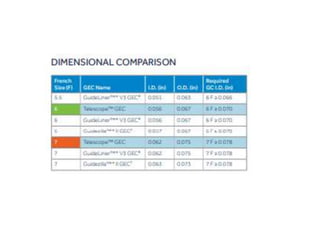
3. Telescope (Medtronic) – 2019 FDA
4. Guidion (IMDS)
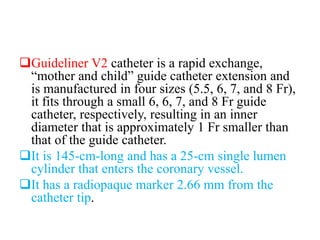
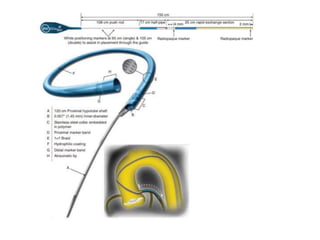
Guideliner V2 catheter is a rapid exchange,
“mother and child” guide catheter extension and
is manufactured in four sizes (5.5, 6, 7, and 8 Fr),
it fits through a small 6, 6, 7, and 8 Fr guide
catheter, respectively, resulting in an inner
diameter that is approximately 1 Fr smaller than
that of the guide catheter.
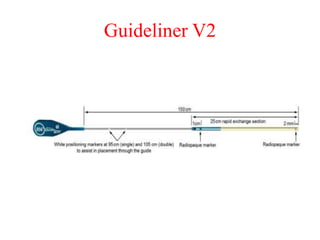
It is 145-cm-long and has a 25-cm single lumen
cylinder that enters the coronary vessel.
It has a radiopaque marker 2.66 mm from the
catheter tip.
Guideliner V2
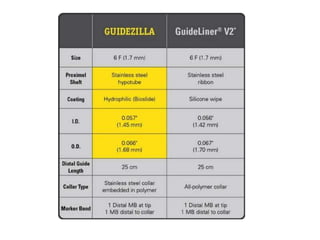
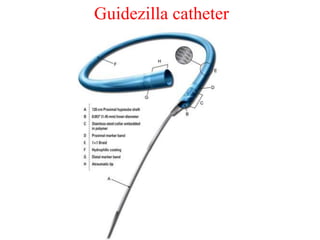
Guidezilla catheter is also a rapid exchange,
“mother and child” guide catheter extension
that was approved by the FDA in March 2013
and is manufactured in one size (6 Fr) that fits
though a 6-Fr guide catheter.
Guidezilla catheter
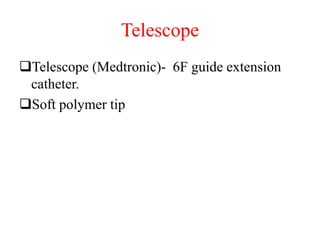
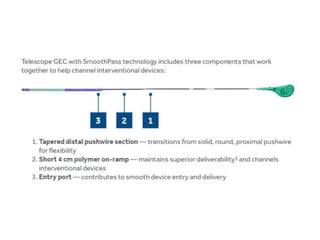
Telescope
Telescope (Medtronic)- 6F guide extension
catheter.
Soft polymer tip
Guidion
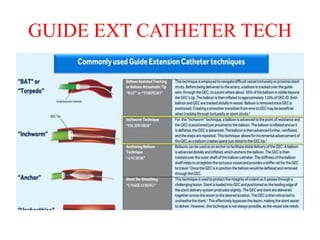
GUIDE EXT CATHETER TECH
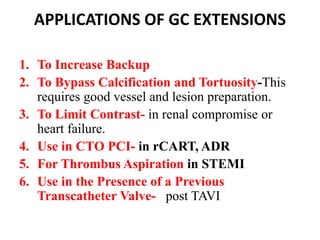
APPLICATIONS OF GC EXTENSIONS
1. To Increase Backup
2. To Bypass Calcification and Tortuosity-This
requires good vessel and lesion preparation.
3. To Limit Contrast- in renal compromise or
heart failure.
4. Use in CTO PCI- in rCART, ADR
5. For Thrombus Aspiration in STEMI
6. Use in the Presence of a Previous
Transcatheter Valve- post TAVI
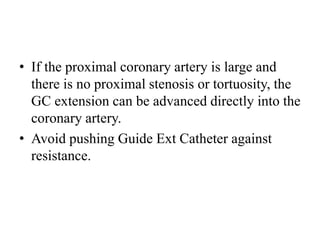
• If the proximal coronary artery is large and
there is no proximal stenosis or tortuosity, the
GC extension can be advanced directly into the
coronary artery.
• Avoid pushing Guide Ext Catheter against
resistance.
COMPLICATIONS
1) Coronary Dissection- Forceful injection to
be avoided.
2) Rewiring-loop formation when the extension
is smaller than the GC (eg, a 6-F extension in
a 7-F GC)
3) Ischemia- Pressure dampening, avoid in
vessel size < 2.5mm.
4) Air Embolism
 Ten technical tips to minimize the risk of guide catheter
extension-related complications:
1. Avoid advancing the guide catheter extension against any
resistance, especially in the setting of steep angles.
2. Avoid engaging a guide catheter extension in the presence
of ostial branch disease.
3. Avoid engaging a 6 Fr guide catheter extension in a vessel
smaller than 2.5 mm.
4. Manipulate the mother guide catheter engagement to
optimize the direction of entry of the child catheter into
the coronary branch.
5. If possible, deliver the guide catheter extension over the
shaft of a coronary balloon.
6. Safer navigation through tortuous and calcified anatomy
7. The injection rate should be dropped to at least half of the usual rate when
the guide catheter extension engages the coronary branch. If dampening
of the pressure waveform is encountered, it is absolutely important to pull
the guide catheter extension back to a location where this completely
resolves prior to selective injection.
8. Y-connector valve of the guide catheter should be tight and the external
guide catheter extension push rod should be manually held during
selective injection to avoid it from being ejected into the coronary branch.
9. Hold back pressure on the guide catheter extension external push rod
while pulling devices out of the coronary branch in order to avoid it from
diving in.
10. If the anatomy is unfavorable for the advancement of post-dilation
balloons into stented segments and if the vessel size allows, a guide
catheter extension can be advanced through the stent during stent balloon
deflation in order to secure access for post dilation.
THANKYOU

Guide Extension Catheter

  • 1.
    GUIDE EXTENSION CATHETER Dr VirbhanBalai FNB Interventional Cardiology
  • 2.
    Guide Catheter Extensions Fourguide catheter extensions are currently available. 1. Guideliner V2 catheter (Vascular Solutions) - 2009 FDA 2. Guidezilla (Boston Scientific)-2013 FDA 3. Telescope (Medtronic) – 2019 FDA 4. Guidion (IMDS)
  • 3.
    Guideliner V2 catheteris a rapid exchange, “mother and child” guide catheter extension and is manufactured in four sizes (5.5, 6, 7, and 8 Fr), it fits through a small 6, 6, 7, and 8 Fr guide catheter, respectively, resulting in an inner diameter that is approximately 1 Fr smaller than that of the guide catheter. It is 145-cm-long and has a 25-cm single lumen cylinder that enters the coronary vessel. It has a radiopaque marker 2.66 mm from the catheter tip.
  • 5.
  • 6.
    Guidezilla catheter isalso a rapid exchange, “mother and child” guide catheter extension that was approved by the FDA in March 2013 and is manufactured in one size (6 Fr) that fits though a 6-Fr guide catheter.
  • 8.
  • 9.
    Telescope Telescope (Medtronic)- 6Fguide extension catheter. Soft polymer tip
  • 13.
  • 14.
  • 15.
    APPLICATIONS OF GCEXTENSIONS 1. To Increase Backup 2. To Bypass Calcification and Tortuosity-This requires good vessel and lesion preparation. 3. To Limit Contrast- in renal compromise or heart failure. 4. Use in CTO PCI- in rCART, ADR 5. For Thrombus Aspiration in STEMI 6. Use in the Presence of a Previous Transcatheter Valve- post TAVI
  • 16.
    • If theproximal coronary artery is large and there is no proximal stenosis or tortuosity, the GC extension can be advanced directly into the coronary artery. • Avoid pushing Guide Ext Catheter against resistance.
  • 17.
    COMPLICATIONS 1) Coronary Dissection-Forceful injection to be avoided. 2) Rewiring-loop formation when the extension is smaller than the GC (eg, a 6-F extension in a 7-F GC) 3) Ischemia- Pressure dampening, avoid in vessel size < 2.5mm. 4) Air Embolism
  • 18.
     Ten technicaltips to minimize the risk of guide catheter extension-related complications: 1. Avoid advancing the guide catheter extension against any resistance, especially in the setting of steep angles. 2. Avoid engaging a guide catheter extension in the presence of ostial branch disease. 3. Avoid engaging a 6 Fr guide catheter extension in a vessel smaller than 2.5 mm. 4. Manipulate the mother guide catheter engagement to optimize the direction of entry of the child catheter into the coronary branch. 5. If possible, deliver the guide catheter extension over the shaft of a coronary balloon.
  • 19.
    6. Safer navigationthrough tortuous and calcified anatomy 7. The injection rate should be dropped to at least half of the usual rate when the guide catheter extension engages the coronary branch. If dampening of the pressure waveform is encountered, it is absolutely important to pull the guide catheter extension back to a location where this completely resolves prior to selective injection. 8. Y-connector valve of the guide catheter should be tight and the external guide catheter extension push rod should be manually held during selective injection to avoid it from being ejected into the coronary branch. 9. Hold back pressure on the guide catheter extension external push rod while pulling devices out of the coronary branch in order to avoid it from diving in. 10. If the anatomy is unfavorable for the advancement of post-dilation balloons into stented segments and if the vessel size allows, a guide catheter extension can be advanced through the stent during stent balloon deflation in order to secure access for post dilation.
  • 20.

Editor's Notes

  • #3 Guideliner approved by FDA in 2009.
  • #5 Guide extension catheter
  • #6 Guideliner V2 catheter. Guideliner V3 catheter also available- 3rd Gen.
  • #9 Illustration of the Guidezilla catheter. Source: © 2013 Boston Scientific
  • #16 rCART= reverse controlled antegrade and retrograde tracking. ADR= antegrade dissection and reentry.
  • #19 Depending on the anatomy and how balloon inflation affects centering of the guide catheter extension in the vessel, one can choose to deliver a guide catheter extension while the balloon is inflated or deflated. It is absolutely crucial to avoid advancement of the guide catheter extension if minimal resistance is encountered. In some anatomical subsets, inflation of a short balloon at a different proximal or distal location within the lesion can be attempted in order to optimize centering of the guide catheter extension in the vessel prior to advancement.