Cardiac  Resynchronisation  Therapy September 2008
The Effect of Cardiac Resynchronization on Morbidity and Mortality in Heart Failure (CARE-HF) John G.F. Cleland, M.D., Jean-Claude Daubert, M.D., Erland Erdmann, M.D., Nick Freemantle, Ph.D., Daniel Gras, M.D., Lukas Kappenberger, M.D. and Luigi Tavazzi, M.D. N Engl J Med Volume 352;15:1539-1549 April 14, 2005
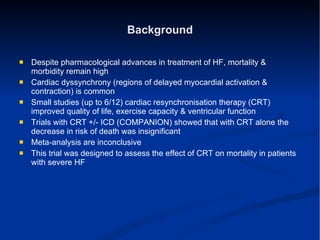
Background Despite pharmacological advances in treatment of HF, mortality & morbidity remain high Cardiac dyssynchrony (regions of delayed myocardial activation & contraction) is common Small studies (up to 6/12) cardiac resynchronisation therapy (CRT) improved quality of life, exercise capacity & ventricular function Trials with CRT +/- ICD (COMPANION) showed that with CRT alone the decrease in risk of death was insignificant Meta-analysis are inconclusive This trial was designed to assess the effect of CRT on mortality in patients with severe HF
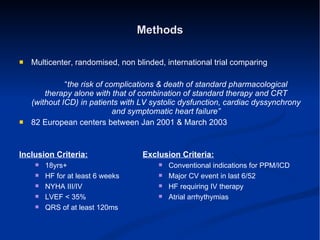
Methods Multicenter, randomised, non blinded, international trial comparing “ the risk of complications & death of standard pharmacological therapy alone with that of combination of standard therapy and CRT (without ICD) in patients with LV systolic dysfunction, cardiac dyssynchrony and symptomatic heart failure” 82 European centers between Jan 2001 & March 2003 Inclusion Criteria: 18yrs+ HF for at least 6 weeks NYHA III/IV  LVEF < 35% QRS of at least 120ms Exclusion Criteria: Conventional indications for PPM/ICD Major CV event in last 6/52 HF requiring IV therapy Atrial arrhythymias
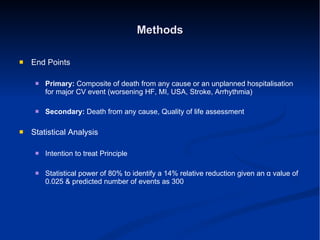
Methods End Points Primary:  Composite of death from any cause or an unplanned hospitalisation for major CV event (worsening HF, MI, USA, Stroke, Arrhythmia) Secondary:  Death from any cause, Quality of life assessment  Statistical Analysis Intention to treat Principle Statistical power of 80% to identify a 14% relative reduction given an  α  value of 0.025 & predicted number of events as 300
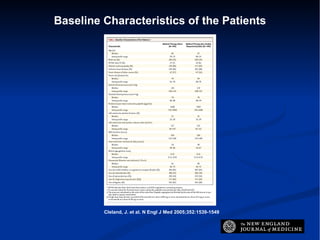
Baseline Characteristics of the Patients Cleland, J. et al. N Engl J Med 2005;352:1539-1549
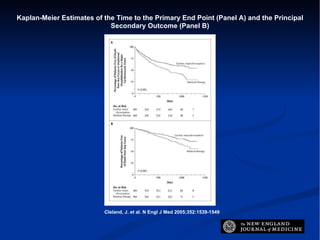
Kaplan-Meier Estimates of the Time to the Primary End Point (Panel A) and the Principal Secondary Outcome (Panel B) Cleland, J. et al. N Engl J Med 2005;352:1539-1549
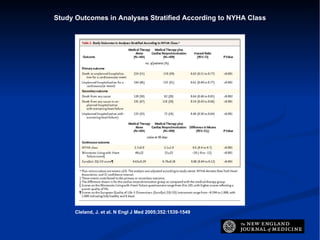
Study Outcomes in Analyses Stratified According to NYHA Class Cleland, J. et al. N Engl J Med 2005;352:1539-1549
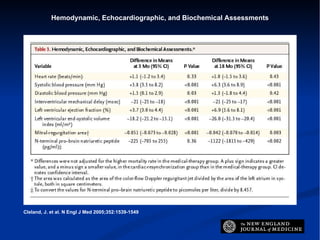
Hemodynamic, Echocardiographic, and Biochemical Assessments Cleland, J. et al. N Engl J Med 2005;352:1539-1549
Discussion CRT substantially reduced risk of complications & death among patients with moderate/severe heart failure Consistent with a reduction in cardiac dyssynchrony leading to improved physiological parameters and clinical outcome: Quality of Life Ventricular function Blood pressure Mortality For every  9  devices implanted  1  death and  3  hospitalisations are prevented
Cardiac Resynchronisation Therapy
Background 1 Approx 25% of patients with CHF have intraventricular conduction delay; commonly LBBB Electrical activation of lateral aspect of LV can be delayed in relation to that of RV and/or interventricular septum This results in  Dyssynchronous electrical activation & contraction Unequal distribution of myocardial workload Altered myocardial blood flow & metabolism Patients with conducting disease have worse prognosis from CHF Patients with a paced RV end up having an artificially induced interventricular conducting delay and overall systolic function is poorer
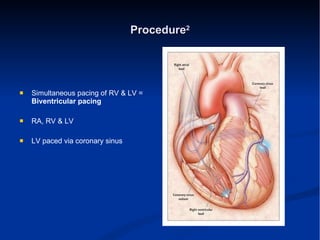
Procedure 2 Simultaneous pacing of RV & LV =  Biventricular pacing RA, RV & LV  LV paced via coronary sinus
Physiological Effects Doesn’t restore normal physiological conducting pattern RA pacing with short AV delay ensures all beats are paced RV & LV pacing reduces the delay in electrical activation of LV free wall QRS duration tends to decrease Haemodynamic response: Increase in rate of rise of LV pressure Increases pulse pressure, LV stroke volume Improves myocardial function without increasing myocardial energy consumption
Evidence Early Trials : <500 patients, up to 1 year showed increases in functional capacity & improvements in quality of life COMPANION 3   (ICD): mortality from all causes was reduced with CRT & ICD (p=0.003) but not from CRT alone (p=0.059) CARE-HF 4 : mortality from all causes was reduced (p<0.002)
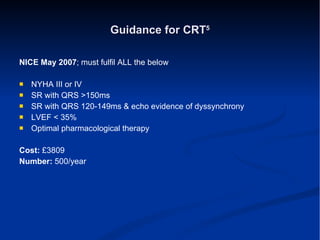
Guidance for CRT 5 NICE May 2007 ; must fulfil ALL the below NYHA III or IV SR with QRS >150ms SR with QRS 120-149ms & echo evidence of dyssynchrony LVEF < 35% Optimal pharmacological therapy Cost:  £3809 Number:  500/year
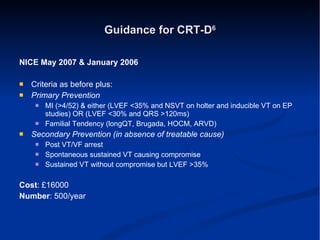
Guidance for CRT-D 6 NICE May 2007 & January 2006 Criteria as before plus: Primary Prevention MI (>4/52) & either (LVEF <35% and NSVT on holter and inducible VT on EP studies) OR (LVEF <30% and QRS >120ms) Familial Tendency (longQT, Brugada, HOCM, ARVD) Secondary Prevention (in absence of treatable cause) Post VT/VF arrest Spontaneous sustained VT causing compromise Sustained VT without compromise but LVEF >35% Cost : £16000 Number : 500/year
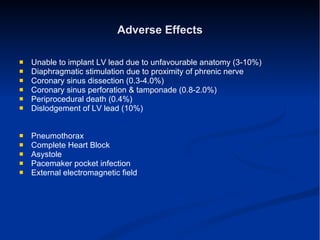
Adverse Effects Unable to implant LV lead due to unfavourable anatomy (3-10%) Diaphragmatic stimulation due to proximity of phrenic nerve Coronary sinus dissection (0.3-4.0%) Coronary sinus perforation & tamponade (0.8-2.0%) Periprocedural death (0.4%) Dislodgement of LV lead (10%) Pneumothorax Complete Heart Block Asystole Pacemaker pocket infection External electromagnetic field
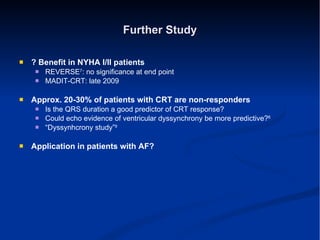
Further Study ? Benefit in NYHA I/II patients REVERSE 7 : no significance at end point MADIT-CRT: late 2009 Approx. 20-30% of patients with CRT are non-responders Is the QRS duration a good predictor of CRT response? Could echo evidence of ventricular dyssynchrony be more predictive? 8 “ Dyssynhcrony study” 9 Application in patients with AF?
References Jarcho JA. Biventricular Pacing. N Engl J Med 2006;355:288-294  http://content.nejm.org/cgi/content/full/355/3/288 Jarcho JA. Resynchronising Ventricular Contraction in Heart Failure. N Engl J Med 2005;352:1594-1597  http://content.nejm.org/cgi/content/full/352/15/1594 Bristow MR, Saxon LA, Boehmer J, et al. Cardiac-resynchronization therapy with or without an implantable defibrillator in advanced chronic heart failure. (COMPANION) N Engl J Med 2004;350:2140-2150  http://content.nejm.org/cgi/content/full/352/15/1539 Cleland JGF, Daubert J-C, Erdmann E, et al. The effect of cardiac resynchronization on morbidity and mortality in heart failure (CARE-HF) N Engl J Med 2005;352:1539-1549  http://content.nejm.org/cgi/content/full/350/21/2140 NICE: Heart Failure – Cardiac Resynchronisation; May 2007  http://www.nice.org.uk/TA120 NICE: Arrhythmias – Implantable Cardioverter defibrillators: January 2006  http://www.nice.org.uk/TA95 Linde C, Abraham WT, Gold MR, Daubert J-C. Results of the REVERSE trial. Program and abstracts from the American College of Cardiology 2008 Scientific Sessions, March 29-April 1, 2008, Chicago, Illinois  http://www.medscape.com/viewarticle/573311 Yu CM, Bax JJ, Monaghan M, Nihoyannopoulos. Echocardiographic evaluation of cardiac dyssynchrony for predicting a favourable response to cardiac resynchronisation therapy. Heart 2004;90:vi17-vi22  http://heart.bmj.com/cgi/content/full/90/suppl_6/vi17 Bax JJ, Ansalone G, Breithardt et al. Echocardiographic evaluation of CRT: ready for routine clinical use? J Am  Coll Cardiol 2004;44:1-9  http://content.onlinejacc.org/cgi/content/full/44/1/1

Cardiac Resynchronisation Therapy

  • 1.
    Cardiac Resynchronisation Therapy September 2008
  • 2.
    The Effect ofCardiac Resynchronization on Morbidity and Mortality in Heart Failure (CARE-HF) John G.F. Cleland, M.D., Jean-Claude Daubert, M.D., Erland Erdmann, M.D., Nick Freemantle, Ph.D., Daniel Gras, M.D., Lukas Kappenberger, M.D. and Luigi Tavazzi, M.D. N Engl J Med Volume 352;15:1539-1549 April 14, 2005
  • 3.
    Background Despite pharmacologicaladvances in treatment of HF, mortality & morbidity remain high Cardiac dyssynchrony (regions of delayed myocardial activation & contraction) is common Small studies (up to 6/12) cardiac resynchronisation therapy (CRT) improved quality of life, exercise capacity & ventricular function Trials with CRT +/- ICD (COMPANION) showed that with CRT alone the decrease in risk of death was insignificant Meta-analysis are inconclusive This trial was designed to assess the effect of CRT on mortality in patients with severe HF
  • 4.
    Methods Multicenter, randomised,non blinded, international trial comparing “ the risk of complications & death of standard pharmacological therapy alone with that of combination of standard therapy and CRT (without ICD) in patients with LV systolic dysfunction, cardiac dyssynchrony and symptomatic heart failure” 82 European centers between Jan 2001 & March 2003 Inclusion Criteria: 18yrs+ HF for at least 6 weeks NYHA III/IV LVEF < 35% QRS of at least 120ms Exclusion Criteria: Conventional indications for PPM/ICD Major CV event in last 6/52 HF requiring IV therapy Atrial arrhythymias
  • 5.
    Methods End PointsPrimary: Composite of death from any cause or an unplanned hospitalisation for major CV event (worsening HF, MI, USA, Stroke, Arrhythmia) Secondary: Death from any cause, Quality of life assessment Statistical Analysis Intention to treat Principle Statistical power of 80% to identify a 14% relative reduction given an α value of 0.025 & predicted number of events as 300
  • 6.
    Baseline Characteristics ofthe Patients Cleland, J. et al. N Engl J Med 2005;352:1539-1549
  • 7.
    Kaplan-Meier Estimates ofthe Time to the Primary End Point (Panel A) and the Principal Secondary Outcome (Panel B) Cleland, J. et al. N Engl J Med 2005;352:1539-1549
  • 8.
    Study Outcomes inAnalyses Stratified According to NYHA Class Cleland, J. et al. N Engl J Med 2005;352:1539-1549
  • 9.
    Hemodynamic, Echocardiographic, andBiochemical Assessments Cleland, J. et al. N Engl J Med 2005;352:1539-1549
  • 10.
    Discussion CRT substantiallyreduced risk of complications & death among patients with moderate/severe heart failure Consistent with a reduction in cardiac dyssynchrony leading to improved physiological parameters and clinical outcome: Quality of Life Ventricular function Blood pressure Mortality For every 9 devices implanted 1 death and 3 hospitalisations are prevented
  • 11.
  • 12.
    Background 1 Approx25% of patients with CHF have intraventricular conduction delay; commonly LBBB Electrical activation of lateral aspect of LV can be delayed in relation to that of RV and/or interventricular septum This results in Dyssynchronous electrical activation & contraction Unequal distribution of myocardial workload Altered myocardial blood flow & metabolism Patients with conducting disease have worse prognosis from CHF Patients with a paced RV end up having an artificially induced interventricular conducting delay and overall systolic function is poorer
  • 13.
    Procedure 2 Simultaneouspacing of RV & LV = Biventricular pacing RA, RV & LV LV paced via coronary sinus
  • 14.
    Physiological Effects Doesn’trestore normal physiological conducting pattern RA pacing with short AV delay ensures all beats are paced RV & LV pacing reduces the delay in electrical activation of LV free wall QRS duration tends to decrease Haemodynamic response: Increase in rate of rise of LV pressure Increases pulse pressure, LV stroke volume Improves myocardial function without increasing myocardial energy consumption
  • 15.
    Evidence Early Trials: <500 patients, up to 1 year showed increases in functional capacity & improvements in quality of life COMPANION 3 (ICD): mortality from all causes was reduced with CRT & ICD (p=0.003) but not from CRT alone (p=0.059) CARE-HF 4 : mortality from all causes was reduced (p<0.002)
  • 16.
    Guidance for CRT5 NICE May 2007 ; must fulfil ALL the below NYHA III or IV SR with QRS >150ms SR with QRS 120-149ms & echo evidence of dyssynchrony LVEF < 35% Optimal pharmacological therapy Cost: £3809 Number: 500/year
  • 17.
    Guidance for CRT-D6 NICE May 2007 & January 2006 Criteria as before plus: Primary Prevention MI (>4/52) & either (LVEF <35% and NSVT on holter and inducible VT on EP studies) OR (LVEF <30% and QRS >120ms) Familial Tendency (longQT, Brugada, HOCM, ARVD) Secondary Prevention (in absence of treatable cause) Post VT/VF arrest Spontaneous sustained VT causing compromise Sustained VT without compromise but LVEF >35% Cost : £16000 Number : 500/year
  • 18.
    Adverse Effects Unableto implant LV lead due to unfavourable anatomy (3-10%) Diaphragmatic stimulation due to proximity of phrenic nerve Coronary sinus dissection (0.3-4.0%) Coronary sinus perforation & tamponade (0.8-2.0%) Periprocedural death (0.4%) Dislodgement of LV lead (10%) Pneumothorax Complete Heart Block Asystole Pacemaker pocket infection External electromagnetic field
  • 19.
    Further Study ?Benefit in NYHA I/II patients REVERSE 7 : no significance at end point MADIT-CRT: late 2009 Approx. 20-30% of patients with CRT are non-responders Is the QRS duration a good predictor of CRT response? Could echo evidence of ventricular dyssynchrony be more predictive? 8 “ Dyssynhcrony study” 9 Application in patients with AF?
  • 20.
    References Jarcho JA.Biventricular Pacing. N Engl J Med 2006;355:288-294 http://content.nejm.org/cgi/content/full/355/3/288 Jarcho JA. Resynchronising Ventricular Contraction in Heart Failure. N Engl J Med 2005;352:1594-1597 http://content.nejm.org/cgi/content/full/352/15/1594 Bristow MR, Saxon LA, Boehmer J, et al. Cardiac-resynchronization therapy with or without an implantable defibrillator in advanced chronic heart failure. (COMPANION) N Engl J Med 2004;350:2140-2150 http://content.nejm.org/cgi/content/full/352/15/1539 Cleland JGF, Daubert J-C, Erdmann E, et al. The effect of cardiac resynchronization on morbidity and mortality in heart failure (CARE-HF) N Engl J Med 2005;352:1539-1549 http://content.nejm.org/cgi/content/full/350/21/2140 NICE: Heart Failure – Cardiac Resynchronisation; May 2007 http://www.nice.org.uk/TA120 NICE: Arrhythmias – Implantable Cardioverter defibrillators: January 2006 http://www.nice.org.uk/TA95 Linde C, Abraham WT, Gold MR, Daubert J-C. Results of the REVERSE trial. Program and abstracts from the American College of Cardiology 2008 Scientific Sessions, March 29-April 1, 2008, Chicago, Illinois http://www.medscape.com/viewarticle/573311 Yu CM, Bax JJ, Monaghan M, Nihoyannopoulos. Echocardiographic evaluation of cardiac dyssynchrony for predicting a favourable response to cardiac resynchronisation therapy. Heart 2004;90:vi17-vi22 http://heart.bmj.com/cgi/content/full/90/suppl_6/vi17 Bax JJ, Ansalone G, Breithardt et al. Echocardiographic evaluation of CRT: ready for routine clinical use? J Am Coll Cardiol 2004;44:1-9 http://content.onlinejacc.org/cgi/content/full/44/1/1