Research Project for the degree of Master of Arts in Education with an emphasis in Special Education, Disabilities, and Risk Studies Catie R. Chase, B.A. April 17, 2008
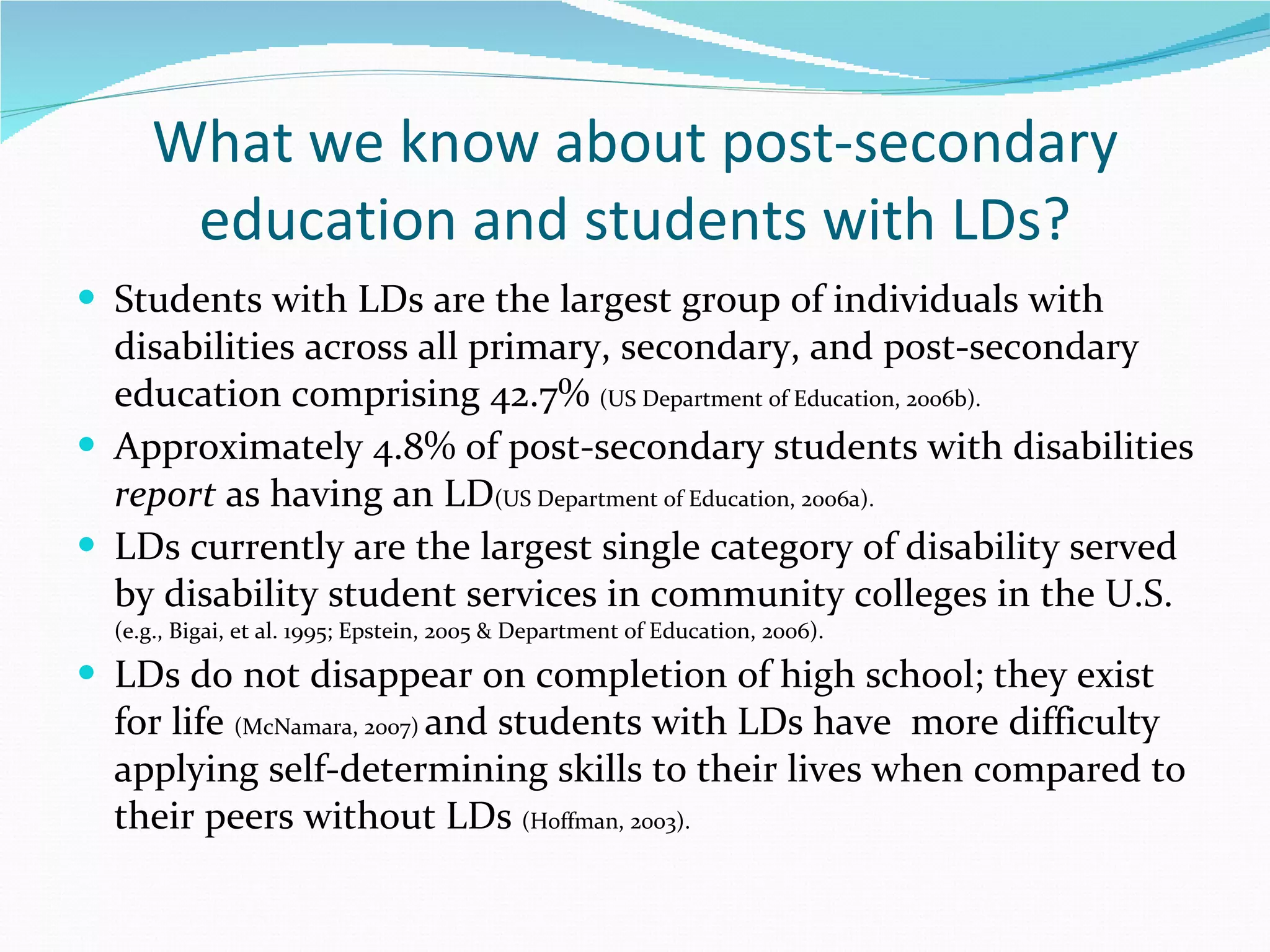
What we know about post-secondary education and students with LDs? Students with LDs are the largest group of individuals with disabilities across all primary, secondary, and post-secondary education comprising 42.7%  (US Department of Education, 2006b).  Approximately 4.8% of post-secondary students with disabilities  report  as having an LD (US Department of Education, 2006a).  LDs currently are the largest single category of disability served by disability student services in community colleges in the U.S.  (e.g., Bigai, et al. 1995; Epstein, 2005 & Department of Education, 2006).  LDs do not disappear on completion of high school; they exist for life  (McNamara, 2007)  and students with LDs have  more difficulty applying self-determining skills to their lives when compared to their peers without LDs  (Hoffman, 2003).
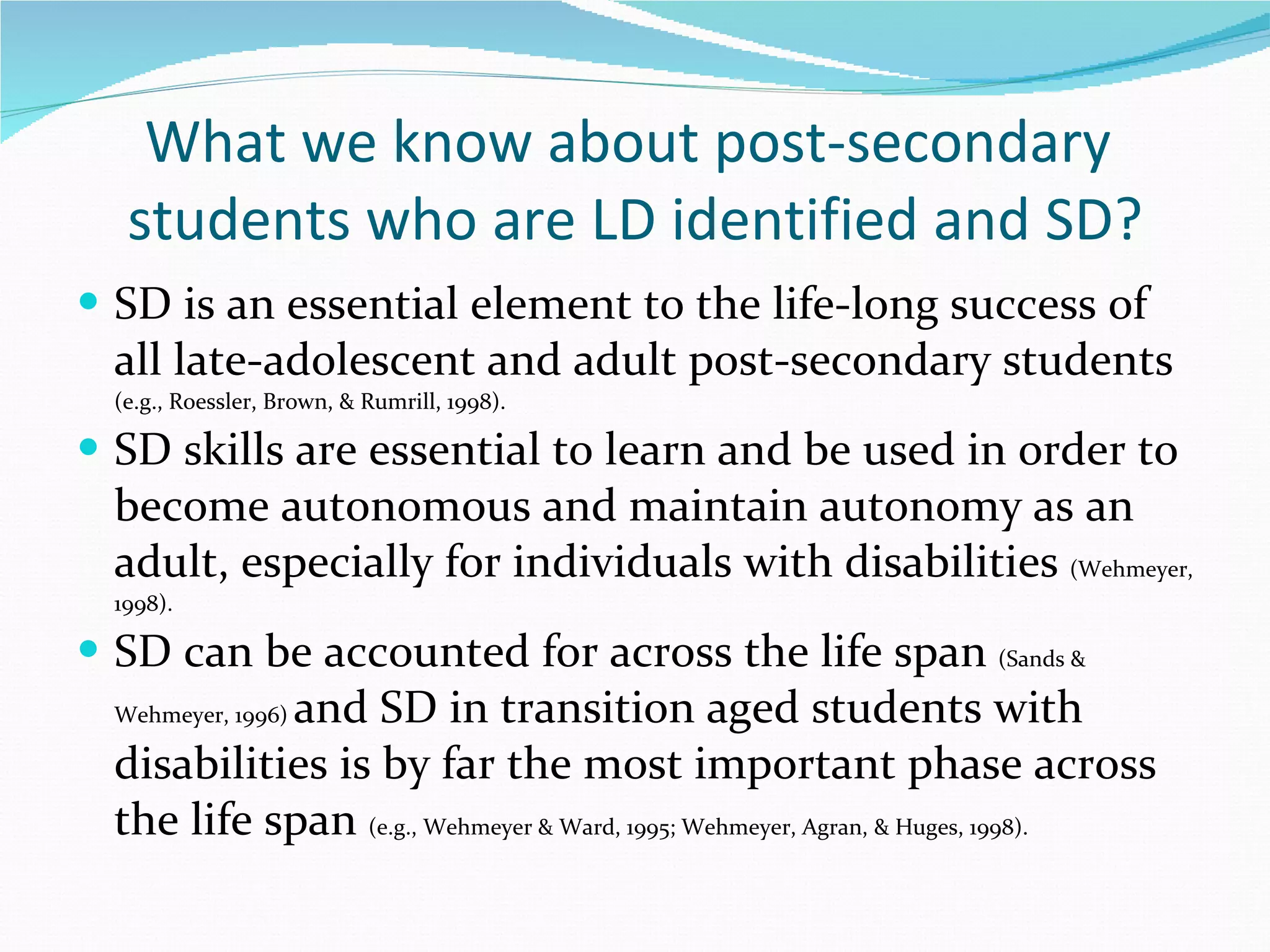
What we know about post-secondary  students who are LD identified and SD? SD is an essential element to the life-long success of all late-adolescent and adult post-secondary students  (e.g., Roessler, Brown, & Rumrill, 1998).  SD skills are essential to learn and be used in order to become autonomous and maintain autonomy as an adult, especially for individuals with disabilities  (Wehmeyer, 1998).  SD can be accounted for across the life span  (Sands & Wehmeyer, 1996)  and SD in transition aged students with disabilities is by far the most important phase across the life span  (e.g., Wehmeyer & Ward, 1995; Wehmeyer, Agran, & Huges, 1998).
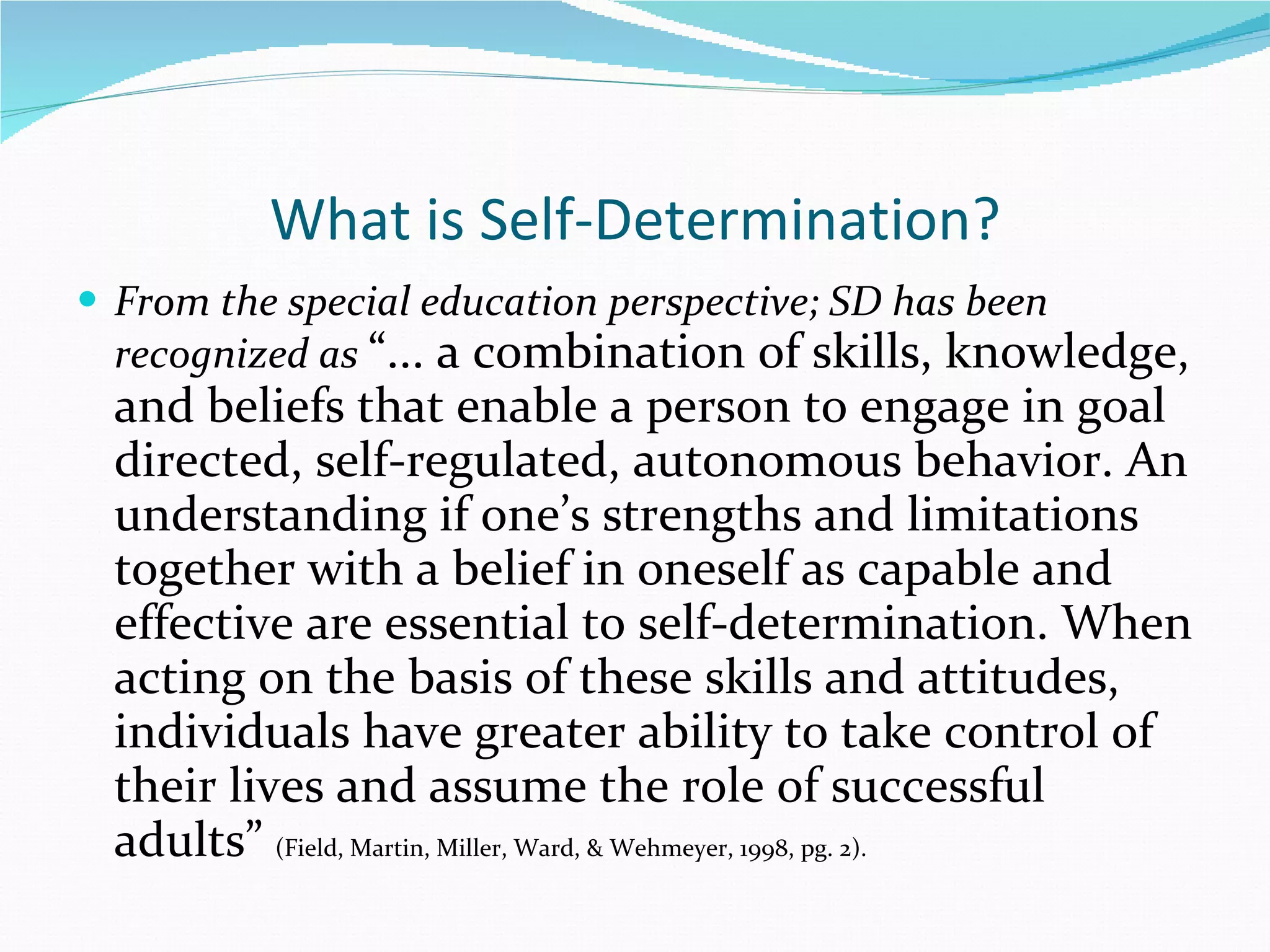
What is Self-Determination? From the special education perspective; SD has been recognized as  “... a combination of skills, knowledge, and beliefs that enable a person to engage in goal directed, self-regulated, autonomous behavior. An understanding if one’s strengths and limitations together with a belief in oneself as capable and effective are essential to self-determination. When acting on the basis of these skills and attitudes, individuals have greater ability to take control of their lives and assume the role of successful adults”  (Field, Martin, Miller, Ward, & Wehmeyer, 1998, pg. 2).
Literature Review Fostering SD is vital for post-secondary success; therefore, future research should incorporate measures of SD and its relationship to academic and professional success for students with disabilities  (Brinckerhoff, McGuire, & Shaw, 2002). Adults with disabilities who have mastered and practiced self-determining skills while growing up are more likely to have increased employment opportunities, receive higher pay, maintain successful adult relationships, and report having overall satisfaction about their lives  (Agran & Wehmeyer, 2000).  Self-determining skills are behaviors that can be learned and taught throughout all stages in life  (Wehmeyer, 1998).
Literature Review Continued Individuals with disabilities are reported to experience more of a challenge in learning and developing self-determining skills, making their own choices, and decisions for their lives when compared to those without disabilities  (Field & Hoffman, 2002).  In the past two decades, this area of research in special education has been primarily focused on individuals with more severe disabilities (e.g., mental retardation)  (Wehmeyer, 1998)  rather than on those with learning disabilities  (Field, 1997)  or adult post-secondary students  (Field, 2003). There is limited research on SD for post-secondary students with LDs and little of it is empirically-based  (Algozzine, Browder, Karvonen, Test, & Wood, 2001).
Hypotheses Three hypotheses were tested related to time of LD identification with self-determination operationalized by responses to the  Self-Determination Scale  (SDS)  (Sheldon & Deci, 1996)  as follows:  1.  Primary/secondary identified participants with LDs score higher on the  Self-Determination Scale  total score (SDSTS) when compared to adult identified participants. 2.  Primary/secondary identified participants with LDs score higher on the  Perceived Choice  (PC) subscale score when compared to adult identified participants on the SDS. 3. Primary/secondary identified participants with LDs score higher on the  Awareness of Self  (AS) subscale score when compared to adult identified participants on the SDS.
Method Participants Forty participants, 13 men (32.5%), and 27 women (67.5%) The qualifications for participating were: Ages 18 years or older (mean of age= 26.8; s.d. =11.64) Enrolled part or full time at a local community college in southern California Registered with DSPS at a local community college Identified as having an LD Two LD groups; Primary/secondary identified (PSI) or adult identified (ADI)
Method Measures The participants’ were administered: Self-Determination Scale  (SDS)  (Sheldon & Deci, 1996). A supplemental questionnaire designed to learn more about the demographics of this population (i.e., community college students with identified LDs). The scoring of the SDS proceeded as follows: Each of the ten-item questions on the SDS was based on a five- point Likert Scale, with two five-item subscales . The first five-item subscale represented  Perceived Choices  (PC).  The second five-item subscale represented  Awareness of Self  (AS).  Students’ initial responses were reverse scored so that higher scores on every item indicated a higher level of self-determination.  For purposes of analysis, the sub-scales were treated separately and as an overall SDS total score (SDSTS).
Method Procedures Recruitment strategies included posting flyers, informing students in DSPS strategy classes, & directly approaching students in the DSPS lab. Students who verified that they were eligible to participate were provided with a brief explanation of the study’s purpose and asked to sign a Participation Consent Form. Participants were asked to complete the SDS and SQ in one setting. SDS and SQ were administered only in the DSPS lab and at a designated computer station. All students were informed that participation was entirely voluntary and that they were free to withdraw from the study at any time without penalty.  The completion of the SDS and SQ ranged from eight to thirty minutes.
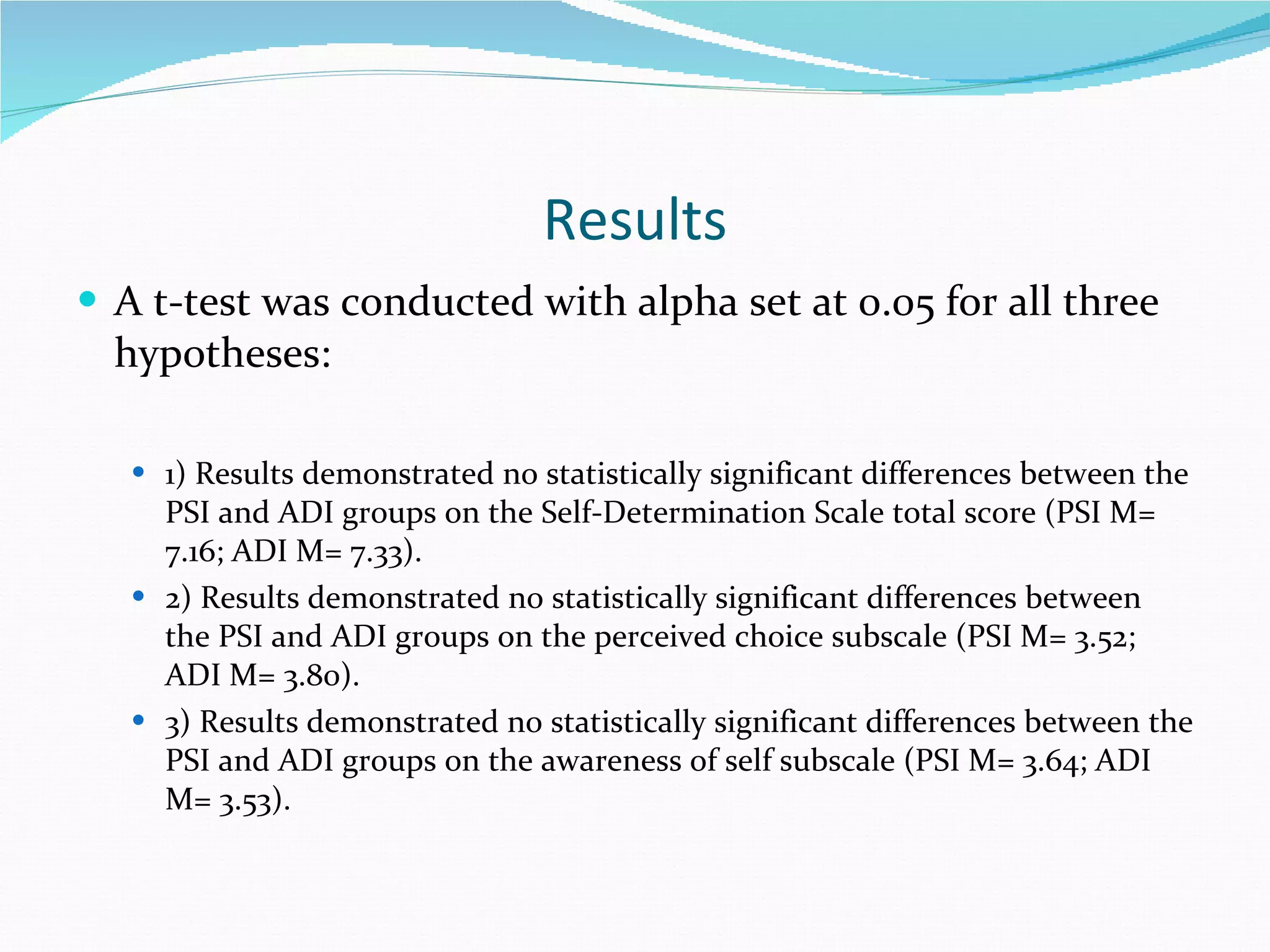
Results A t-test was conducted with alpha set at 0.05 for all three hypotheses: 1) Results demonstrated no statistically significant differences between the PSI and ADI groups on the Self-Determination Scale total score (PSI M= 7.16; ADI M= 7.33). 2) Results demonstrated no statistically significant differences between the PSI and ADI groups on the perceived choice subscale (PSI M= 3.52; ADI M= 3.80). 3) Results demonstrated no statistically significant differences between the PSI and ADI groups on the awareness of self subscale (PSI M= 3.64; ADI M= 3.53).
Results Continued An independent sample t-test was conducted to compare the  Self-Determination Scale total score  (SDSTS),  perceived choice  (PC) and  awareness of self  (AS) with PSI and ADI participants: SDSTS for PSI and ADI participants:  There was no statistically significant differences in scores for the PSI (M = 7.16, SD = 1.53) and ADI (M = 7.33, SD = 1.96); [t (38) = -.28, p = .78].  PC scores for PSI and ADI participants:  There was no statistically significant differences in scores for the PSI (M = 17.59, SD = 4.73) and ADI (M = 19, SD = 4.56); [t (38) = -.852, p = .40]. AS scores for PSI and ADI participants:  There was no statistically significant differences in scores for the PSI (M = 18.21, SD = 4.52) and ADI (M = 17.64, SD = 6.07); [t (38) = .324, p= .75).
Discussion Do adult students with LD really differ in their self-determination? How should self-determination be measured? Did the study lack statistical power? Were there negating program effects? Was there a sampling bias favoring self-determination?
Implications for future research Examination of self-determination and time of LD identification Reliable measurement of self-determination for adults with LDs The importance of a sample size  Sampling biases within departments and higher education The role of ethnicity, SES and LMS in post-secondary students with LDs

Powerpoint presentation M.A. Thesis Defence

  • 1.
    Research Project forthe degree of Master of Arts in Education with an emphasis in Special Education, Disabilities, and Risk Studies Catie R. Chase, B.A. April 17, 2008
  • 2.
    What we knowabout post-secondary education and students with LDs? Students with LDs are the largest group of individuals with disabilities across all primary, secondary, and post-secondary education comprising 42.7% (US Department of Education, 2006b). Approximately 4.8% of post-secondary students with disabilities report as having an LD (US Department of Education, 2006a). LDs currently are the largest single category of disability served by disability student services in community colleges in the U.S. (e.g., Bigai, et al. 1995; Epstein, 2005 & Department of Education, 2006). LDs do not disappear on completion of high school; they exist for life (McNamara, 2007) and students with LDs have more difficulty applying self-determining skills to their lives when compared to their peers without LDs (Hoffman, 2003).
  • 3.
    What we knowabout post-secondary students who are LD identified and SD? SD is an essential element to the life-long success of all late-adolescent and adult post-secondary students (e.g., Roessler, Brown, & Rumrill, 1998). SD skills are essential to learn and be used in order to become autonomous and maintain autonomy as an adult, especially for individuals with disabilities (Wehmeyer, 1998). SD can be accounted for across the life span (Sands & Wehmeyer, 1996) and SD in transition aged students with disabilities is by far the most important phase across the life span (e.g., Wehmeyer & Ward, 1995; Wehmeyer, Agran, & Huges, 1998).
  • 4.
    What is Self-Determination?From the special education perspective; SD has been recognized as “... a combination of skills, knowledge, and beliefs that enable a person to engage in goal directed, self-regulated, autonomous behavior. An understanding if one’s strengths and limitations together with a belief in oneself as capable and effective are essential to self-determination. When acting on the basis of these skills and attitudes, individuals have greater ability to take control of their lives and assume the role of successful adults” (Field, Martin, Miller, Ward, & Wehmeyer, 1998, pg. 2).
  • 5.
    Literature Review FosteringSD is vital for post-secondary success; therefore, future research should incorporate measures of SD and its relationship to academic and professional success for students with disabilities (Brinckerhoff, McGuire, & Shaw, 2002). Adults with disabilities who have mastered and practiced self-determining skills while growing up are more likely to have increased employment opportunities, receive higher pay, maintain successful adult relationships, and report having overall satisfaction about their lives (Agran & Wehmeyer, 2000). Self-determining skills are behaviors that can be learned and taught throughout all stages in life (Wehmeyer, 1998).
  • 6.
    Literature Review ContinuedIndividuals with disabilities are reported to experience more of a challenge in learning and developing self-determining skills, making their own choices, and decisions for their lives when compared to those without disabilities (Field & Hoffman, 2002). In the past two decades, this area of research in special education has been primarily focused on individuals with more severe disabilities (e.g., mental retardation) (Wehmeyer, 1998) rather than on those with learning disabilities (Field, 1997) or adult post-secondary students (Field, 2003). There is limited research on SD for post-secondary students with LDs and little of it is empirically-based (Algozzine, Browder, Karvonen, Test, & Wood, 2001).
  • 7.
    Hypotheses Three hypotheseswere tested related to time of LD identification with self-determination operationalized by responses to the Self-Determination Scale (SDS) (Sheldon & Deci, 1996) as follows: 1. Primary/secondary identified participants with LDs score higher on the Self-Determination Scale total score (SDSTS) when compared to adult identified participants. 2. Primary/secondary identified participants with LDs score higher on the Perceived Choice (PC) subscale score when compared to adult identified participants on the SDS. 3. Primary/secondary identified participants with LDs score higher on the Awareness of Self (AS) subscale score when compared to adult identified participants on the SDS.
  • 8.
    Method Participants Fortyparticipants, 13 men (32.5%), and 27 women (67.5%) The qualifications for participating were: Ages 18 years or older (mean of age= 26.8; s.d. =11.64) Enrolled part or full time at a local community college in southern California Registered with DSPS at a local community college Identified as having an LD Two LD groups; Primary/secondary identified (PSI) or adult identified (ADI)
  • 9.
    Method Measures Theparticipants’ were administered: Self-Determination Scale (SDS) (Sheldon & Deci, 1996). A supplemental questionnaire designed to learn more about the demographics of this population (i.e., community college students with identified LDs). The scoring of the SDS proceeded as follows: Each of the ten-item questions on the SDS was based on a five- point Likert Scale, with two five-item subscales . The first five-item subscale represented Perceived Choices (PC). The second five-item subscale represented Awareness of Self (AS). Students’ initial responses were reverse scored so that higher scores on every item indicated a higher level of self-determination. For purposes of analysis, the sub-scales were treated separately and as an overall SDS total score (SDSTS).
  • 10.
    Method Procedures Recruitmentstrategies included posting flyers, informing students in DSPS strategy classes, & directly approaching students in the DSPS lab. Students who verified that they were eligible to participate were provided with a brief explanation of the study’s purpose and asked to sign a Participation Consent Form. Participants were asked to complete the SDS and SQ in one setting. SDS and SQ were administered only in the DSPS lab and at a designated computer station. All students were informed that participation was entirely voluntary and that they were free to withdraw from the study at any time without penalty. The completion of the SDS and SQ ranged from eight to thirty minutes.
  • 11.
    Results A t-testwas conducted with alpha set at 0.05 for all three hypotheses: 1) Results demonstrated no statistically significant differences between the PSI and ADI groups on the Self-Determination Scale total score (PSI M= 7.16; ADI M= 7.33). 2) Results demonstrated no statistically significant differences between the PSI and ADI groups on the perceived choice subscale (PSI M= 3.52; ADI M= 3.80). 3) Results demonstrated no statistically significant differences between the PSI and ADI groups on the awareness of self subscale (PSI M= 3.64; ADI M= 3.53).
  • 12.
    Results Continued Anindependent sample t-test was conducted to compare the Self-Determination Scale total score (SDSTS), perceived choice (PC) and awareness of self (AS) with PSI and ADI participants: SDSTS for PSI and ADI participants: There was no statistically significant differences in scores for the PSI (M = 7.16, SD = 1.53) and ADI (M = 7.33, SD = 1.96); [t (38) = -.28, p = .78]. PC scores for PSI and ADI participants: There was no statistically significant differences in scores for the PSI (M = 17.59, SD = 4.73) and ADI (M = 19, SD = 4.56); [t (38) = -.852, p = .40]. AS scores for PSI and ADI participants: There was no statistically significant differences in scores for the PSI (M = 18.21, SD = 4.52) and ADI (M = 17.64, SD = 6.07); [t (38) = .324, p= .75).
  • 13.
    Discussion Do adultstudents with LD really differ in their self-determination? How should self-determination be measured? Did the study lack statistical power? Were there negating program effects? Was there a sampling bias favoring self-determination?
  • 14.
    Implications for futureresearch Examination of self-determination and time of LD identification Reliable measurement of self-determination for adults with LDs The importance of a sample size Sampling biases within departments and higher education The role of ethnicity, SES and LMS in post-secondary students with LDs