The International Journal Of Engineering And Science (IJES)
|| Volume || 4 || Issue || 5 || Pages || PP.32-39 || 2015 ||
ISSN (e): 2319 – 1813 ISSN (p): 2319 – 1805
www.theijes.com The IJES Page 32
A Model of Local Area Network Based Application for Inter-
office Communication
George Elechi C.1
, Israel Etu2
and Kufre Esenowo Jack3
1
Department of Computer Science, Akanu Ibiam Federal Polytechnic, Unwana Afikpo, Ebonyi State, Nigeria
2&3
Department of Electrical/Electronic Engineering, Akanu Ibiam Federal Polytechnic, Unwana Afikpo,
Ebonyi State, Nigeria
--------------------------------------------------------ABSTRACT---------------------------------------------------
In most organizations, information circulation within offices poses a problem because clerical officers and
office messengers usually dispatch letters and memos from one office to another manually. Sequel to this
circulation procedure, implementation of decisions is always difficult and slow. On one hand, clerical officers
sometimes divulge confidential information during the process of receiving and sending of mails and other
documents. On the other hand, money is wasted on the purchase of paper for printing. However, it is cheerful to
learn that technology has made it possible for staff, structures and infrastructures to control and share
organization resources; hardware; software and knowledge by means of modern electronic communication.
One cannot deny the fact that the flow of information is very imperative in every organization as it determines
the effectiveness of decision-making and implementation. This feat can be achieved using Object-Oriented
System Analysis and Design Methodology (OSADM). This is structurally analyzed with Use Case Diagram
(UCD), Class Diagram, Sequence Diagram, State Transition Diagram, and Activity Diagram. Moreover, the
system is coded with Java 1.6 version, in a client-server network running on star topology in LAN environment.
This is the concept of this paper. The system is designed to work in two parts – the control part that is installed
on the server; and the messenger part that is installed in the clients. This research work integrates the utility
and organization resources into a shared center for all users to have access to; and for free communication
during office hours.
Keywords: LAN; Client; Server; Java; Clerical officer.
---------------------------------------------------------------------------------------------------------------------------------------
Date of Submission: 27-April-2015 Date of Accepted: 15-May-2015
--------------------------------------------------------------------------------------------------------------------------------------
I. INTRODUCTION
Every functioning system must comprise active subsystems; and for the main system to comprehend its
objectives, the communication trends of the subsystem must be certainly effective. Mbam (2009) stated that
networks enable clients to share resources (printer, software, scanner, camera, files or documents, mails or
messages etc.). A communication application can be designed to work on Local Area Network, for an
organization to enable users share information concerning the organization. With this software, efficient sharing
of company resources and smooth coordination of office information are ensured. With this, all memos and
short messages can be sent between the network users even with the absence of internet facilities and telephone
line. This is to allow the staff to have free communication with each other in a more friendly and efficient way
using LAN-networked environment.
Aims
This research is aimed at developing messenger software, and ensuring that the systems are linked for effective
communication.
Objectives
The objectives of this work include:
1. To design messenger software to be installed in an organization LAN for the purpose of information
circulation.
2. To build a model to ensure the security of messages transmitted on the system.
3. To develop a model of a system that would keep track of information flow within the organization.
4. To incorporate a model for an electronic bulletin board for the organization.
A Model of Local Area Network Based Application…
www.theijes.com The IJES Page 33
II. RESEARCH MATERIALS AND METHOD
Materials
The materials used in this work include Printer, JDK 1.6, XAMPP, Inno Setup Compiler, Active LAN, Clients
and Server
Method
There are many existing methodologies for system analysis and design. However, the chosen methodology for
this work is object-oriented system analysis and design methodology as well as unified processes of prototyping
model with JDK 1.6 version of java.
Proposed System Model
According to Rajib (2010), a model is an abstraction of a real problem (or situation) and is constructed by
leaving out unnecessary details. This reduces the problem of complexity and makes it easy to understand the
problem (or situation). A model can also be said to be a simplified version of the real system. It is useful to think
of a model as capturing aspects important for some applications while omitting (or abstracting) the rest. The
considered model for the proposed system is Unified Model Language (UML).It can be used to correct nine
different types of diagrams to capture five different views of a system. UML diagrams provide different
perspectives of a software system to be developed and facilitate a comprehensive understanding of the system.
Once a system has been modeled from all the required perspectives, the constructed models can be modified to
get the actual implementation of the system. The UML diagrams capture the following views (models) of a
system:
 Users’ view
 Structural view
 Behavioral view
 Implementation view
 Environmental view
Rajib (2010) stated that the program’s control flow structure indicates the sequence in which the program’s
instructions are executed. Many programmers found it increasingly difficult not only to write correct
programs, but also to comprehend and manage codes written by others. To braze up with this problem,
experienced programmers advised others to pay attention to the design of a program’s control flow
structure. A program having a good control flow structure would be easier to develop and understand. The
main reason behind this situation is that normally one understands a program by mentally tracing its
execution sequence to understand how the output is produced from the input values. The software was
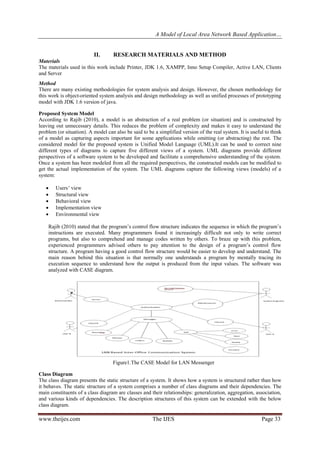
analyzed with CASE diagram.
Figure1.The CASE Model for LAN Messenger
Class Diagram
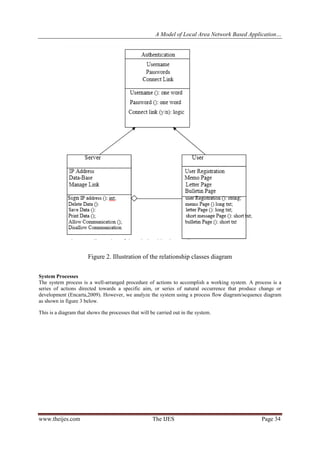
The class diagram presents the static structure of a system. It shows how a system is structured rather than how
it behaves. The static structure of a system comprises a number of class diagrams and their dependencies. The
main constituents of a class diagram are classes and their relationships: generalization, aggregation, association,
and various kinds of dependencies. The description structures of this system can be extended with the below
class diagram.
A Model of Local Area Network Based Application…
www.theijes.com The IJES Page 34
Figure 2. Illustration of the relationship classes diagram
System Processes
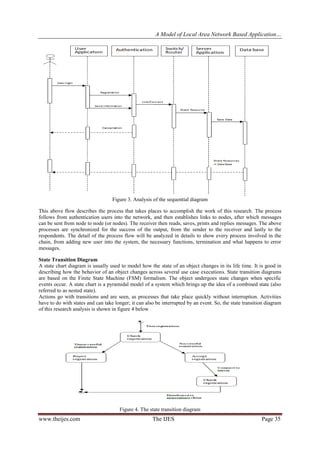
The system process is a well-arranged procedure of actions to accomplish a working system. A process is a
series of actions directed towards a specific aim, or series of natural occurrence that produce change or
development (Encarta,2009). However, we analyze the system using a process flow diagram/sequence diagram
as shown in figure 3 below.
This is a diagram that shows the processes that will be carried out in the system.
A Model of Local Area Network Based Application…
www.theijes.com The IJES Page 35
Figure 3. Analysis of the sequential diagram
This above flow describes the process that takes places to accomplish the work of this research. The process
follows from authentication users into the network, and then establishes links to nodes, after which messages
can be sent from node to node (or nodes). The receiver then reads, saves, prints and replies messages. The above
processes are synchronized for the success of the output, from the sender to the receiver and lastly to the
respondents. The detail of the process flow will be analyzed in details to show every process involved in the
chain, from adding new user into the system, the necessary functions, termination and what happens to error
messages.
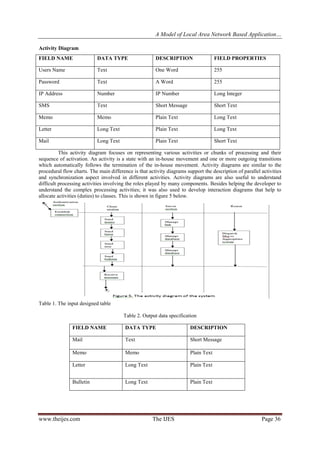
State Transition Diagram
A state chart diagram is usually used to model how the state of an object changes in its life time. It is good in
describing how the behavior of an object changes across several use case executions. State transition diagrams
are based on the Finite State Machine (FSM) formalism. The object undergoes state changes when specific
events occur. A state chart is a pyramidal model of a system which brings up the idea of a combined state (also
referred to as nested state).
Actions go with transitions and are seen, as processes that take place quickly without interruption. Activities
have to do with states and can take longer; it can also be interrupted by an event. So, the state transition diagram
of this research analysis is shown in figure 4 below
Figure 4. The state transition diagram
A Model of Local Area Network Based Application…
www.theijes.com The IJES Page 36
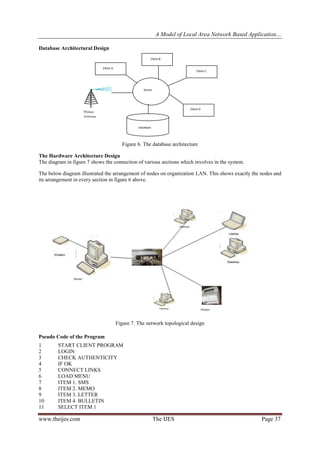
Activity Diagram
This activity diagram focuses on representing various activities or chunks of processing and their
sequence of activation. An activity is a state with an in-house movement and one or more outgoing transitions
which automatically follows the termination of the in-house movement. Activity diagrams are similar to the
procedural flow charts. The main difference is that activity diagrams support the description of parallel activities
and synchronization aspect involved in different activities. Activity diagrams are also useful to understand
difficult processing activities involving the roles played by many components. Besides helping the developer to
understand the complex processing activities; it was also used to develop interaction diagrams that help to
allocate activities (duties) to classes. This is shown in figure 5 below.
Table 1. The input designed table
Table 2. Output data specification
FIELD NAME DATA TYPE DESCRIPTION
Mail Text Short Message
Memo Memo Plain Text
Letter Long Text Plain Text
Bulletin Long Text Plain Text
FIELD NAME DATA TYPE DESCRIPTION FIELD PROPERTIES
Users Name Text One Word 255
Password Text A Word 255
IP Address Number IP Number Long Integer
SMS Text Short Message Short Text
Memo Memo Plain Text Long Text
Letter Long Text Plain Text Long Text
Mail Long Text Plain Text Short Text
A Model of Local Area Network Based Application…
www.theijes.com The IJES Page 37
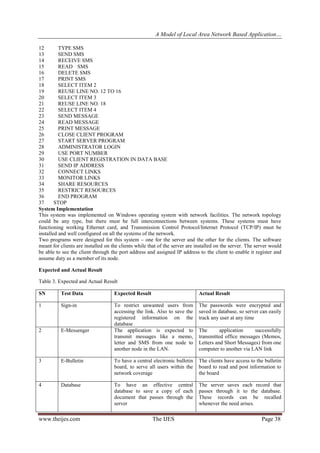
Database Architectural Design
Figure 6. The database architecture
The Hardware Architecture Design
The diagram in figure 7 shows the connection of various sections which involves in the system.
The below diagram illustrated the arrangement of nodes on organization LAN. This shows exactly the nodes and
its arrangement in every section in figure 6 above.
Figure 7. The network topological design
Pseudo Code of the Program
1 START CLIENT PROGRAM
2 LOGIN
3 CHECK AUTHENTICITY
4 IF OK
5 CONNECT LINKS
6 LOAD MENU
7 ITEM 1. SMS
8 ITEM 2. MEMO
9 ITEM 3. LETTER
10 ITEM 4. BULLETIN
11 SELECT ITEM 1
Server
Printer
Wimax
Antenna
Client A
Database
Client B
Client C
Client D
Server
A Model of Local Area Network Based Application…
www.theijes.com The IJES Page 38
12 TYPE SMS
13 SEND SMS
14 RECEIVE SMS
15 READ SMS
16 DELETE SMS
17 PRINT SMS
18 SELECT ITEM 2
19 REUSE LINE NO. 12 TO 16
20 SELECT ITEM 3
21 REUSE LINE NO. 18
22 SELECT ITEM 4
23 SEND MESSAGE
24 READ MESSAGE
25 PRINT MESSAGE
26 CLOSE CLIENT PROGRAM
27 START SERVER PROGRAM
28 ADMINISTRATOR LOGIN
29 USE PORT NUMBER
30 USE CLIENT REGISTRATION IN DATA BASE
31 SEND IP ADDRESS
32 CONNECT LINKS
33 MONITOR LINKS
34 SHARE RESOURCES
35 RESTRICT RESOURCES
36 END PROGRAM
37 STOP
System Implementation
This system was implemented on Windows operating system with network facilities. The network topology
could be any type, but there must be full interconnections between systems. These systems must have
functioning working Ethernet card, and Transmission Control Protocol/Internet Protocol (TCP/IP) must be
installed and well configured on all the systems of the network.
Two programs were designed for this system – one for the server and the other for the clients. The software
meant for clients are installed on the clients while that of the server are installed on the server. The server would
be able to see the client through the port address and assigned IP address to the client to enable it register and
assume duty as a member of its node.
Expected and Actual Result
Table 3. Expected and Actual Result
SN Test Data Expected Result Actual Result
1 Sign-in To restrict unwanted users from
accessing the link. Also to save the
registered information on the
database
The passwords were encrypted and
saved in database, so server can easily
track any user at any time
2 E-Messenger The application is expected to
transmit messages like a memo,
letter and SMS from one node to
another node in the LAN.
The application successfully
transmitted office messages (Memos,
Letters and Short Messages) from one
computer to another via LAN link
3 E-Bulletin To have a central electronic bulletin
board, to serve all users within the
network coverage
The clients have access to the bulletin
board to read and post information to
the board
4 Database To have an effective central
database to save a copy of each
document that passes through the
server
The server saves each record that
passes through it to the database.
These records can be recalled
whenever the need arises.
A Model of Local Area Network Based Application…
www.theijes.com The IJES Page 39
However, the system was designed and tested on dual core and Pentium system in a fully functioning LAN
environment.
Discussion of Results
This system was installed in a campus LAN with a cable network, and it worked efficiently except, of course, on
some systems with bad LAN cable. However, the transmission was a bit slow, despite that the LAN speed was
86kbs. For the server to manage the database, there was the need to ensure that every transmission passes
through network server instead of moving straight to the receiver system. This was what slowed down the
information transmission speed. Nevertheless, the main objectives of the system were achieved.
Conclusion
The system was analyzed in a LAN environment, and the connection was properly systemized in a linked chain.
Both the client application and server application were carefully installed and linked through the IP addresses,
though the program recognized clients through the port numbers, for sending and receiving of signals from both
ends to various units.
Recommendation
The recommendation is for any researcher that is interested in this work to study further on how to integrate
multimedia into this communication system. Also, he should work towards increasing the speed and extend this
program to work on Wide Area Network (WAN).
REFERENCES
[1]. Ajah, I. A.and Igboji, K. O. (2011).Internet Fundamentals and File Management, Willyrose& Appleseed Coy,Abakaliki Nigeria.
[2]. AmrYoussef, M. (2012).Data Communication and Computer Networks, Concordia University, Montreal.
[3]. Beaker, R. (1993). Reading in Groupware and Computer Supported Cooperative Work, Sam Meter, C.A.
[4]. Cohen J. (1988). Statistical Power Analysis for the Behavioral Science, Lawrence Erlbaum, HillDale, NJ. United State.
[5]. Deepti, M.and Alok, M. (2012).“Effective Communication, Collaboration, and Coordination in eXtreme Programming: Human-
Centric Perspective in a Small Organization” Department of Computer Engineering, Atilim University, Ankara, Turkey.
[6]. Ditte, M. F. and Rasmussen, J.(2011), What a Waste:How Your Computer Causes Health Problem in Ghana.
[7]. Ekemezie, W. N. andNgene, N.J. (2004).Computer and Information Technology, Sam press Ltd Enugu, Nigeria.
[8]. Ellis, M. (1991), Computer and Information Processing, Irwin inc, USA.
[9]. Encarta, (2009), Microsoft Encarta Dictionary, Microsoft Inc. USA.
[10]. Hutchinson, S. E. and Sawyer, S. C. (2000). Using Information Technology, 3rd Edition, Irwin, McGraw-Hill Boston, USA.
[11]. Mardav, W. (2006).Computer Networks are Essential for Day-to-day Communication, Universityof Tennessee.
[12]. Mbam, B. C. E. (2009).Internet Made Easy, Academic Treasure International,Abakaliki, Nigeria.
[13]. Mowbray, T. J., &Zahavi, R. (1995). The essential CORBA: systems integration using distributed objects (pp. I-XVI). New
York: Wiley.
[14]. Okechukwu, Oliver O. (2009).Introduction to System Analysis and Design,Madonna University Press Ltd, Uwani Enugu,
Nigeria.
[15]. Orfali, R.,Harkey,D. and Edwards, J. (1994).Essential Client/Server Survival Guide,John Wiley &Sons, United Kingdom.
[16]. Palo, A. (2003).A New Traffic Control Algorithm for Packet Switching Networks,Lixia Zhang XEROX Palo Alto Research
Center, Coyote Hill Road, Canada.
[17]. Pidd M. (1998). Computer Simulation in Management Science, John Wilet& Sons. Chichester England.
[18]. Rajib, M. (2010).Fundamentals of Software Engineering, PHI Learning private Limited, New Delhi, India.
[19]. Robinson S. (1994). Successful Simulation: A Practical Approach to Simulation Projects, McGraw-Hills Maiden, England.
[20]. Stephen M. (2008).CCNA Self-Study: Introduction to Cisco Networking Technologies, Cisco Press CA, USA.
[21]. William, B. K. (1999). The Essential Client/Server Survival Guide, John Willey and Sons Inc.Chichester, England.
[22]. Wiley,C. (2009).Periodicals InterScience, Inc. Published online, (www.interscience.wiley.com). DOI: 10.1002/hfm.20164.Zhili,
S. (2005).Satellite Networking Principles and Protocols, John Wiley & Sons Ltd, University of Surrey, England.URL:
http://www.uic.edu/depts/accc/lan/lanintro.html UIC Academic Computing & Communication Centre; the University of Illinois
Chicago, USA.

A Model of Local Area Network Based Application for Inter-office Communication

  • 1.
    The International JournalOf Engineering And Science (IJES) || Volume || 4 || Issue || 5 || Pages || PP.32-39 || 2015 || ISSN (e): 2319 – 1813 ISSN (p): 2319 – 1805 www.theijes.com The IJES Page 32 A Model of Local Area Network Based Application for Inter- office Communication George Elechi C.1 , Israel Etu2 and Kufre Esenowo Jack3 1 Department of Computer Science, Akanu Ibiam Federal Polytechnic, Unwana Afikpo, Ebonyi State, Nigeria 2&3 Department of Electrical/Electronic Engineering, Akanu Ibiam Federal Polytechnic, Unwana Afikpo, Ebonyi State, Nigeria --------------------------------------------------------ABSTRACT--------------------------------------------------- In most organizations, information circulation within offices poses a problem because clerical officers and office messengers usually dispatch letters and memos from one office to another manually. Sequel to this circulation procedure, implementation of decisions is always difficult and slow. On one hand, clerical officers sometimes divulge confidential information during the process of receiving and sending of mails and other documents. On the other hand, money is wasted on the purchase of paper for printing. However, it is cheerful to learn that technology has made it possible for staff, structures and infrastructures to control and share organization resources; hardware; software and knowledge by means of modern electronic communication. One cannot deny the fact that the flow of information is very imperative in every organization as it determines the effectiveness of decision-making and implementation. This feat can be achieved using Object-Oriented System Analysis and Design Methodology (OSADM). This is structurally analyzed with Use Case Diagram (UCD), Class Diagram, Sequence Diagram, State Transition Diagram, and Activity Diagram. Moreover, the system is coded with Java 1.6 version, in a client-server network running on star topology in LAN environment. This is the concept of this paper. The system is designed to work in two parts – the control part that is installed on the server; and the messenger part that is installed in the clients. This research work integrates the utility and organization resources into a shared center for all users to have access to; and for free communication during office hours. Keywords: LAN; Client; Server; Java; Clerical officer. --------------------------------------------------------------------------------------------------------------------------------------- Date of Submission: 27-April-2015 Date of Accepted: 15-May-2015 -------------------------------------------------------------------------------------------------------------------------------------- I. INTRODUCTION Every functioning system must comprise active subsystems; and for the main system to comprehend its objectives, the communication trends of the subsystem must be certainly effective. Mbam (2009) stated that networks enable clients to share resources (printer, software, scanner, camera, files or documents, mails or messages etc.). A communication application can be designed to work on Local Area Network, for an organization to enable users share information concerning the organization. With this software, efficient sharing of company resources and smooth coordination of office information are ensured. With this, all memos and short messages can be sent between the network users even with the absence of internet facilities and telephone line. This is to allow the staff to have free communication with each other in a more friendly and efficient way using LAN-networked environment. Aims This research is aimed at developing messenger software, and ensuring that the systems are linked for effective communication. Objectives The objectives of this work include: 1. To design messenger software to be installed in an organization LAN for the purpose of information circulation. 2. To build a model to ensure the security of messages transmitted on the system. 3. To develop a model of a system that would keep track of information flow within the organization. 4. To incorporate a model for an electronic bulletin board for the organization.
  • 2.
    A Model ofLocal Area Network Based Application… www.theijes.com The IJES Page 33 II. RESEARCH MATERIALS AND METHOD Materials The materials used in this work include Printer, JDK 1.6, XAMPP, Inno Setup Compiler, Active LAN, Clients and Server Method There are many existing methodologies for system analysis and design. However, the chosen methodology for this work is object-oriented system analysis and design methodology as well as unified processes of prototyping model with JDK 1.6 version of java. Proposed System Model According to Rajib (2010), a model is an abstraction of a real problem (or situation) and is constructed by leaving out unnecessary details. This reduces the problem of complexity and makes it easy to understand the problem (or situation). A model can also be said to be a simplified version of the real system. It is useful to think of a model as capturing aspects important for some applications while omitting (or abstracting) the rest. The considered model for the proposed system is Unified Model Language (UML).It can be used to correct nine different types of diagrams to capture five different views of a system. UML diagrams provide different perspectives of a software system to be developed and facilitate a comprehensive understanding of the system. Once a system has been modeled from all the required perspectives, the constructed models can be modified to get the actual implementation of the system. The UML diagrams capture the following views (models) of a system:  Users’ view  Structural view  Behavioral view  Implementation view  Environmental view Rajib (2010) stated that the program’s control flow structure indicates the sequence in which the program’s instructions are executed. Many programmers found it increasingly difficult not only to write correct programs, but also to comprehend and manage codes written by others. To braze up with this problem, experienced programmers advised others to pay attention to the design of a program’s control flow structure. A program having a good control flow structure would be easier to develop and understand. The main reason behind this situation is that normally one understands a program by mentally tracing its execution sequence to understand how the output is produced from the input values. The software was analyzed with CASE diagram. Figure1.The CASE Model for LAN Messenger Class Diagram The class diagram presents the static structure of a system. It shows how a system is structured rather than how it behaves. The static structure of a system comprises a number of class diagrams and their dependencies. The main constituents of a class diagram are classes and their relationships: generalization, aggregation, association, and various kinds of dependencies. The description structures of this system can be extended with the below class diagram.
  • 3.
    A Model ofLocal Area Network Based Application… www.theijes.com The IJES Page 34 Figure 2. Illustration of the relationship classes diagram System Processes The system process is a well-arranged procedure of actions to accomplish a working system. A process is a series of actions directed towards a specific aim, or series of natural occurrence that produce change or development (Encarta,2009). However, we analyze the system using a process flow diagram/sequence diagram as shown in figure 3 below. This is a diagram that shows the processes that will be carried out in the system.
  • 4.
    A Model ofLocal Area Network Based Application… www.theijes.com The IJES Page 35 Figure 3. Analysis of the sequential diagram This above flow describes the process that takes places to accomplish the work of this research. The process follows from authentication users into the network, and then establishes links to nodes, after which messages can be sent from node to node (or nodes). The receiver then reads, saves, prints and replies messages. The above processes are synchronized for the success of the output, from the sender to the receiver and lastly to the respondents. The detail of the process flow will be analyzed in details to show every process involved in the chain, from adding new user into the system, the necessary functions, termination and what happens to error messages. State Transition Diagram A state chart diagram is usually used to model how the state of an object changes in its life time. It is good in describing how the behavior of an object changes across several use case executions. State transition diagrams are based on the Finite State Machine (FSM) formalism. The object undergoes state changes when specific events occur. A state chart is a pyramidal model of a system which brings up the idea of a combined state (also referred to as nested state). Actions go with transitions and are seen, as processes that take place quickly without interruption. Activities have to do with states and can take longer; it can also be interrupted by an event. So, the state transition diagram of this research analysis is shown in figure 4 below Figure 4. The state transition diagram
  • 5.
    A Model ofLocal Area Network Based Application… www.theijes.com The IJES Page 36 Activity Diagram This activity diagram focuses on representing various activities or chunks of processing and their sequence of activation. An activity is a state with an in-house movement and one or more outgoing transitions which automatically follows the termination of the in-house movement. Activity diagrams are similar to the procedural flow charts. The main difference is that activity diagrams support the description of parallel activities and synchronization aspect involved in different activities. Activity diagrams are also useful to understand difficult processing activities involving the roles played by many components. Besides helping the developer to understand the complex processing activities; it was also used to develop interaction diagrams that help to allocate activities (duties) to classes. This is shown in figure 5 below. Table 1. The input designed table Table 2. Output data specification FIELD NAME DATA TYPE DESCRIPTION Mail Text Short Message Memo Memo Plain Text Letter Long Text Plain Text Bulletin Long Text Plain Text FIELD NAME DATA TYPE DESCRIPTION FIELD PROPERTIES Users Name Text One Word 255 Password Text A Word 255 IP Address Number IP Number Long Integer SMS Text Short Message Short Text Memo Memo Plain Text Long Text Letter Long Text Plain Text Long Text Mail Long Text Plain Text Short Text
  • 6.
    A Model ofLocal Area Network Based Application… www.theijes.com The IJES Page 37 Database Architectural Design Figure 6. The database architecture The Hardware Architecture Design The diagram in figure 7 shows the connection of various sections which involves in the system. The below diagram illustrated the arrangement of nodes on organization LAN. This shows exactly the nodes and its arrangement in every section in figure 6 above. Figure 7. The network topological design Pseudo Code of the Program 1 START CLIENT PROGRAM 2 LOGIN 3 CHECK AUTHENTICITY 4 IF OK 5 CONNECT LINKS 6 LOAD MENU 7 ITEM 1. SMS 8 ITEM 2. MEMO 9 ITEM 3. LETTER 10 ITEM 4. BULLETIN 11 SELECT ITEM 1 Server Printer Wimax Antenna Client A Database Client B Client C Client D Server
  • 7.
    A Model ofLocal Area Network Based Application… www.theijes.com The IJES Page 38 12 TYPE SMS 13 SEND SMS 14 RECEIVE SMS 15 READ SMS 16 DELETE SMS 17 PRINT SMS 18 SELECT ITEM 2 19 REUSE LINE NO. 12 TO 16 20 SELECT ITEM 3 21 REUSE LINE NO. 18 22 SELECT ITEM 4 23 SEND MESSAGE 24 READ MESSAGE 25 PRINT MESSAGE 26 CLOSE CLIENT PROGRAM 27 START SERVER PROGRAM 28 ADMINISTRATOR LOGIN 29 USE PORT NUMBER 30 USE CLIENT REGISTRATION IN DATA BASE 31 SEND IP ADDRESS 32 CONNECT LINKS 33 MONITOR LINKS 34 SHARE RESOURCES 35 RESTRICT RESOURCES 36 END PROGRAM 37 STOP System Implementation This system was implemented on Windows operating system with network facilities. The network topology could be any type, but there must be full interconnections between systems. These systems must have functioning working Ethernet card, and Transmission Control Protocol/Internet Protocol (TCP/IP) must be installed and well configured on all the systems of the network. Two programs were designed for this system – one for the server and the other for the clients. The software meant for clients are installed on the clients while that of the server are installed on the server. The server would be able to see the client through the port address and assigned IP address to the client to enable it register and assume duty as a member of its node. Expected and Actual Result Table 3. Expected and Actual Result SN Test Data Expected Result Actual Result 1 Sign-in To restrict unwanted users from accessing the link. Also to save the registered information on the database The passwords were encrypted and saved in database, so server can easily track any user at any time 2 E-Messenger The application is expected to transmit messages like a memo, letter and SMS from one node to another node in the LAN. The application successfully transmitted office messages (Memos, Letters and Short Messages) from one computer to another via LAN link 3 E-Bulletin To have a central electronic bulletin board, to serve all users within the network coverage The clients have access to the bulletin board to read and post information to the board 4 Database To have an effective central database to save a copy of each document that passes through the server The server saves each record that passes through it to the database. These records can be recalled whenever the need arises.
  • 8.
    A Model ofLocal Area Network Based Application… www.theijes.com The IJES Page 39 However, the system was designed and tested on dual core and Pentium system in a fully functioning LAN environment. Discussion of Results This system was installed in a campus LAN with a cable network, and it worked efficiently except, of course, on some systems with bad LAN cable. However, the transmission was a bit slow, despite that the LAN speed was 86kbs. For the server to manage the database, there was the need to ensure that every transmission passes through network server instead of moving straight to the receiver system. This was what slowed down the information transmission speed. Nevertheless, the main objectives of the system were achieved. Conclusion The system was analyzed in a LAN environment, and the connection was properly systemized in a linked chain. Both the client application and server application were carefully installed and linked through the IP addresses, though the program recognized clients through the port numbers, for sending and receiving of signals from both ends to various units. Recommendation The recommendation is for any researcher that is interested in this work to study further on how to integrate multimedia into this communication system. Also, he should work towards increasing the speed and extend this program to work on Wide Area Network (WAN). REFERENCES [1]. Ajah, I. A.and Igboji, K. O. (2011).Internet Fundamentals and File Management, Willyrose& Appleseed Coy,Abakaliki Nigeria. [2]. AmrYoussef, M. (2012).Data Communication and Computer Networks, Concordia University, Montreal. [3]. Beaker, R. (1993). Reading in Groupware and Computer Supported Cooperative Work, Sam Meter, C.A. [4]. Cohen J. (1988). Statistical Power Analysis for the Behavioral Science, Lawrence Erlbaum, HillDale, NJ. United State. [5]. Deepti, M.and Alok, M. (2012).“Effective Communication, Collaboration, and Coordination in eXtreme Programming: Human- Centric Perspective in a Small Organization” Department of Computer Engineering, Atilim University, Ankara, Turkey. [6]. Ditte, M. F. and Rasmussen, J.(2011), What a Waste:How Your Computer Causes Health Problem in Ghana. [7]. Ekemezie, W. N. andNgene, N.J. (2004).Computer and Information Technology, Sam press Ltd Enugu, Nigeria. [8]. Ellis, M. (1991), Computer and Information Processing, Irwin inc, USA. [9]. Encarta, (2009), Microsoft Encarta Dictionary, Microsoft Inc. USA. [10]. Hutchinson, S. E. and Sawyer, S. C. (2000). Using Information Technology, 3rd Edition, Irwin, McGraw-Hill Boston, USA. [11]. Mardav, W. (2006).Computer Networks are Essential for Day-to-day Communication, Universityof Tennessee. [12]. Mbam, B. C. E. (2009).Internet Made Easy, Academic Treasure International,Abakaliki, Nigeria. [13]. Mowbray, T. J., &Zahavi, R. (1995). The essential CORBA: systems integration using distributed objects (pp. I-XVI). New York: Wiley. [14]. Okechukwu, Oliver O. (2009).Introduction to System Analysis and Design,Madonna University Press Ltd, Uwani Enugu, Nigeria. [15]. Orfali, R.,Harkey,D. and Edwards, J. (1994).Essential Client/Server Survival Guide,John Wiley &Sons, United Kingdom. [16]. Palo, A. (2003).A New Traffic Control Algorithm for Packet Switching Networks,Lixia Zhang XEROX Palo Alto Research Center, Coyote Hill Road, Canada. [17]. Pidd M. (1998). Computer Simulation in Management Science, John Wilet& Sons. Chichester England. [18]. Rajib, M. (2010).Fundamentals of Software Engineering, PHI Learning private Limited, New Delhi, India. [19]. Robinson S. (1994). Successful Simulation: A Practical Approach to Simulation Projects, McGraw-Hills Maiden, England. [20]. Stephen M. (2008).CCNA Self-Study: Introduction to Cisco Networking Technologies, Cisco Press CA, USA. [21]. William, B. K. (1999). The Essential Client/Server Survival Guide, John Willey and Sons Inc.Chichester, England. [22]. Wiley,C. (2009).Periodicals InterScience, Inc. Published online, (www.interscience.wiley.com). DOI: 10.1002/hfm.20164.Zhili, S. (2005).Satellite Networking Principles and Protocols, John Wiley & Sons Ltd, University of Surrey, England.URL: http://www.uic.edu/depts/accc/lan/lanintro.html UIC Academic Computing & Communication Centre; the University of Illinois Chicago, USA.