CYCLONES AND INERTIAL SEPARATORS


Inertial separators are widely used for the collection of medium-sized and coarse

particles. Their relatively simple construction and absence of moving parts means that the

capital and maintenance costs are lower than the other control devices available in the

particulate control industry. However, the efficiency is not as high and thus inertial

separators are usually used as precleaners upstream of the other control devices to reduce

the dust loading and to remove larger, abrasive particles.

The general principle of inertial separation is that the particulate-laden gas is forced to

change direction. As the gas changes direction, the inertia of the particles causes them to

continue in the original direction and be separated from the gas stream (Air Pollution

Engineering Manual, 2000).


Areas of Application

Cyclones and centrifugal collectors are utilized in various industries such as chemical,

coal mining and handling, combustion fly ash, metal melting, metal working, metal

mining, rock products, plastics and wood products. Common uses of cyclones and inertial

separators are the collection of grinding, crushing, conveying, machining, mixing,

sanding, blending and materials handling dust and for particle collection.


Types

Cyclones are the most common type of inertial separators. Cyclone separators are gas

devices that employ a centrifugal force generated by a spinning gas stream to separate the

particulate matter, which could be solid or liquid, from the carrier gas. The separator unit


                                             1
may be a single large chamber, a number of small tubular chambers in parallel or series,

or a dynamic unit similar to a blower. Units in parallel provide increased volumetric

capacity while units in series provide increased removal efficiency. Cyclone separators

can be classified as vane-axial or involute. The only difference between these two is the

method of introducing the gas into the cylindrical shell in order to impart sufficient

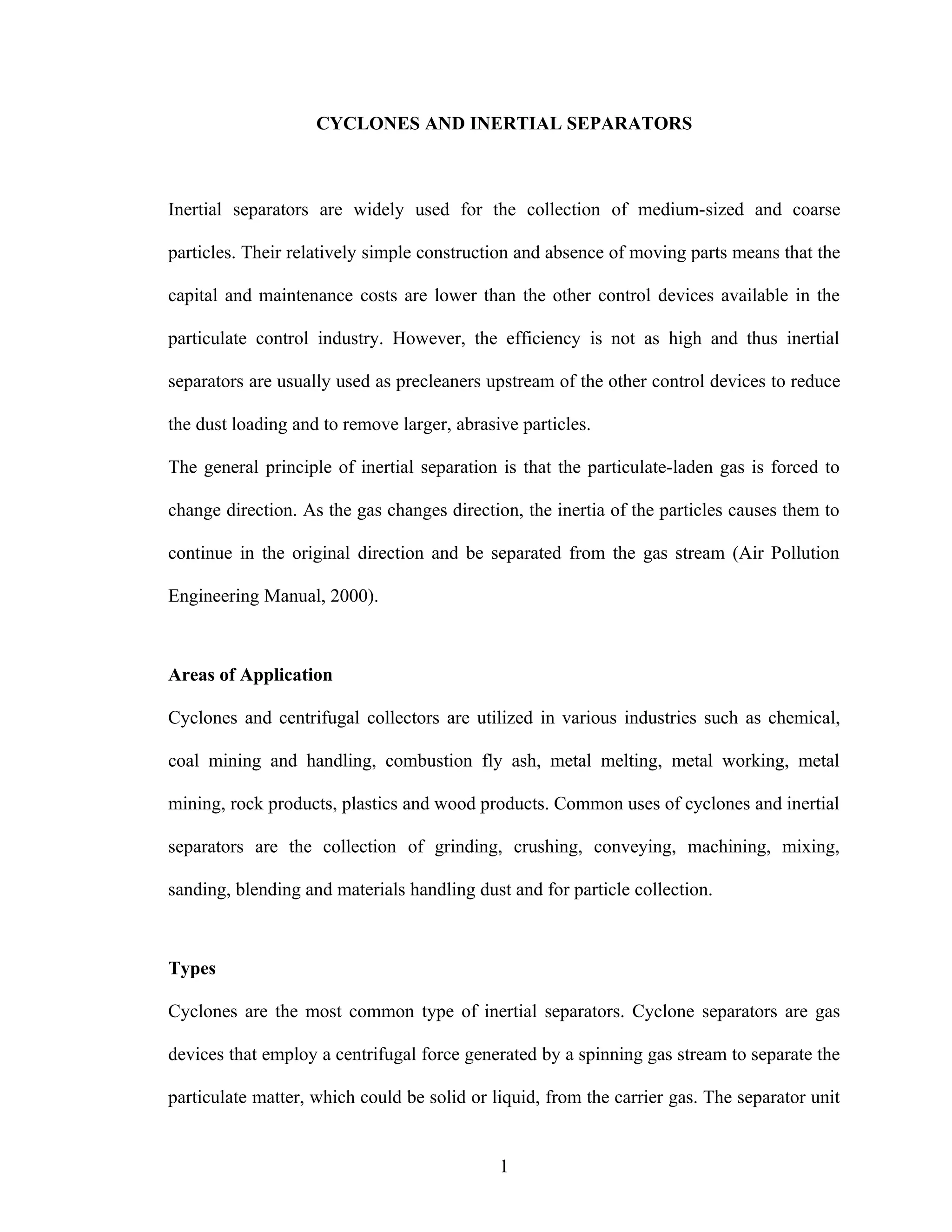
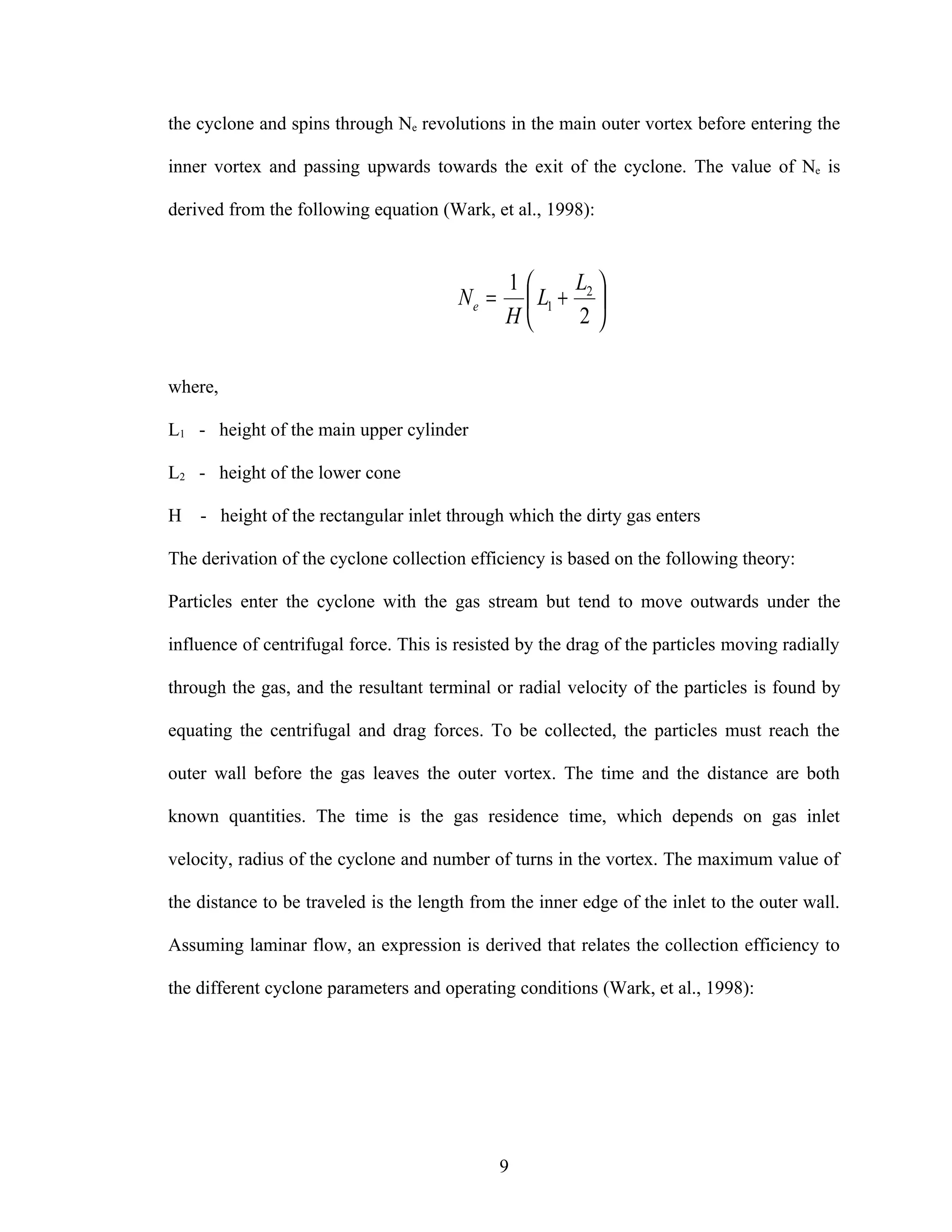
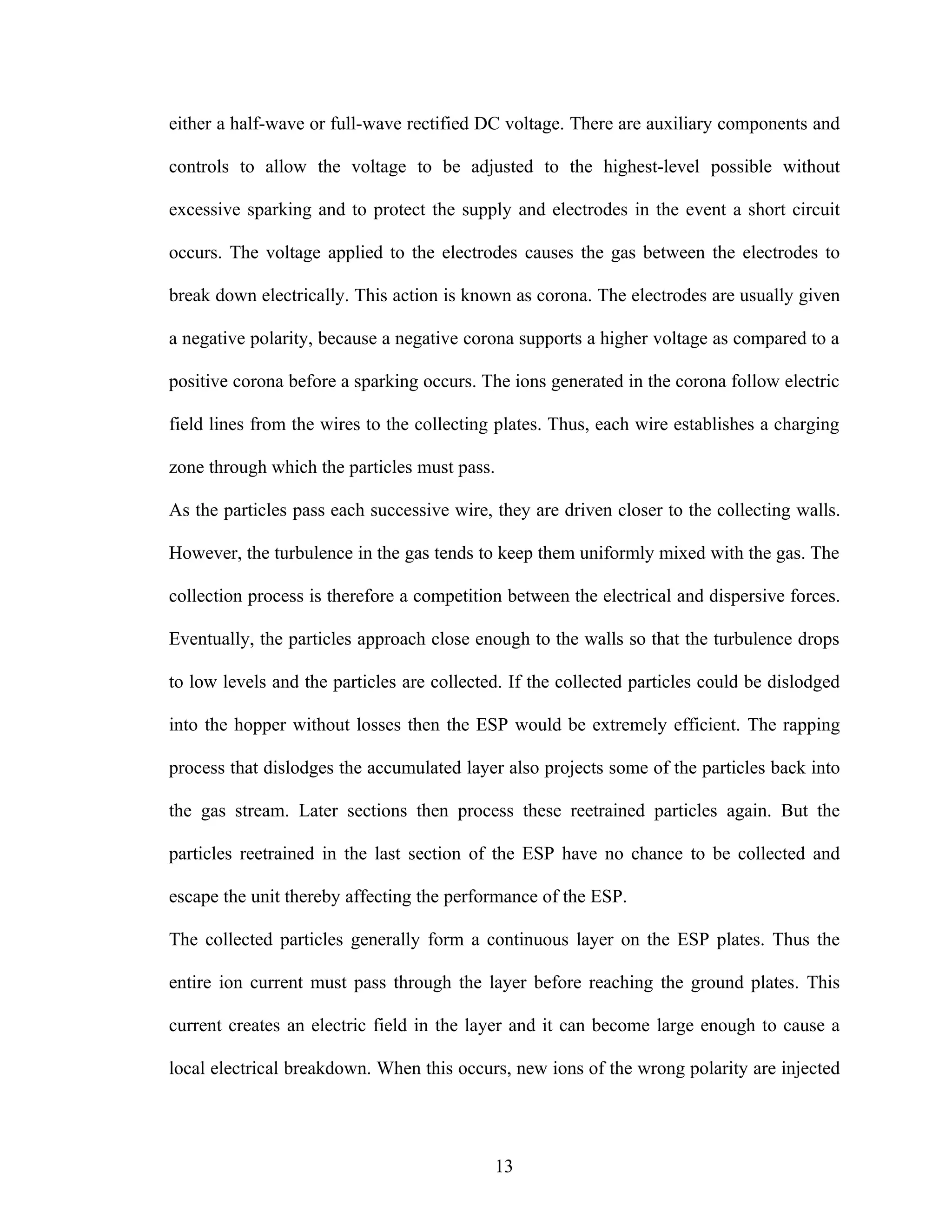
spinning motion. In the simple dry cyclone separator, shown in Figure 1, the circular

motion is attained by a tangential gas inlet. The rectangular inlet passage has its inner

wall tangent to the cylinder and the inlet is designed to blend gradually with the cylinder

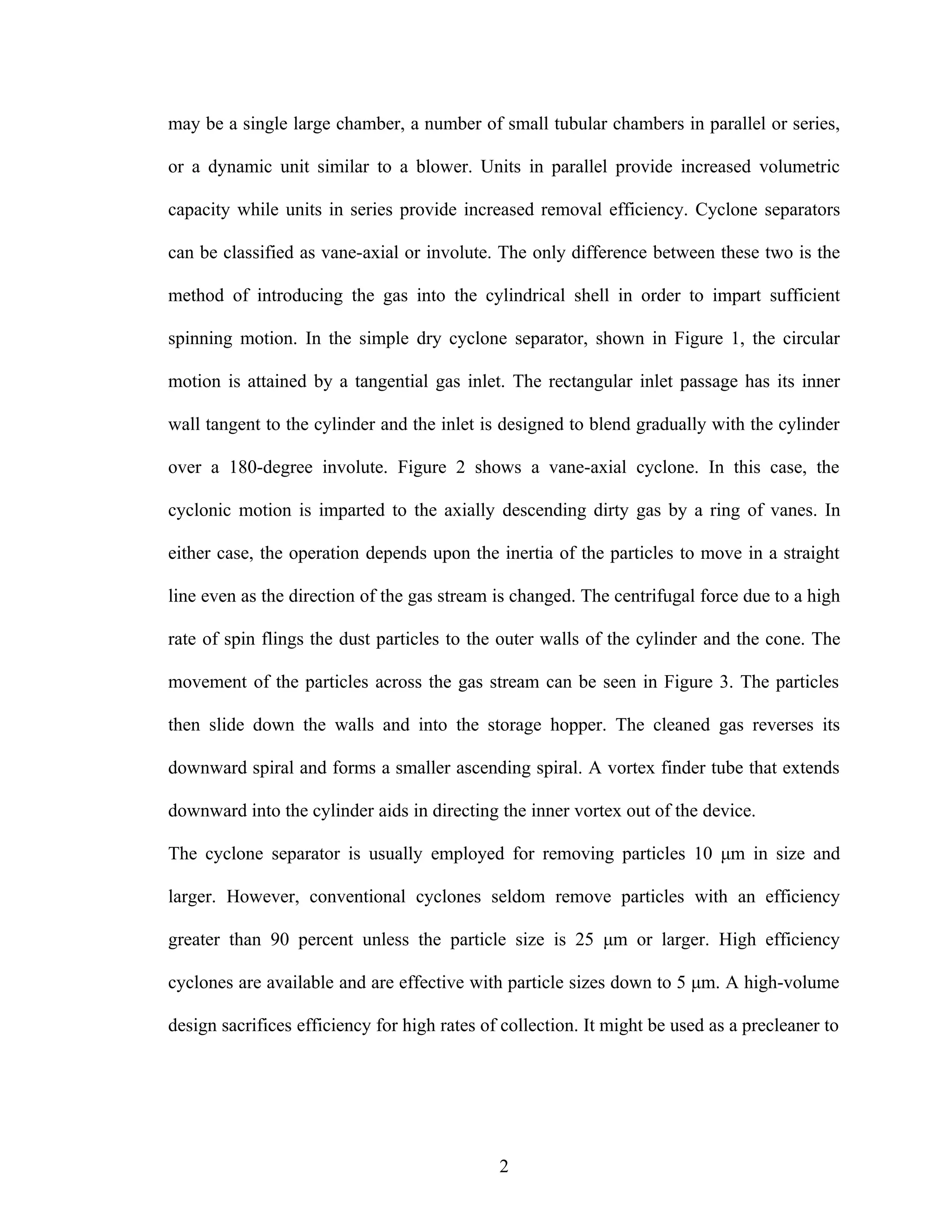
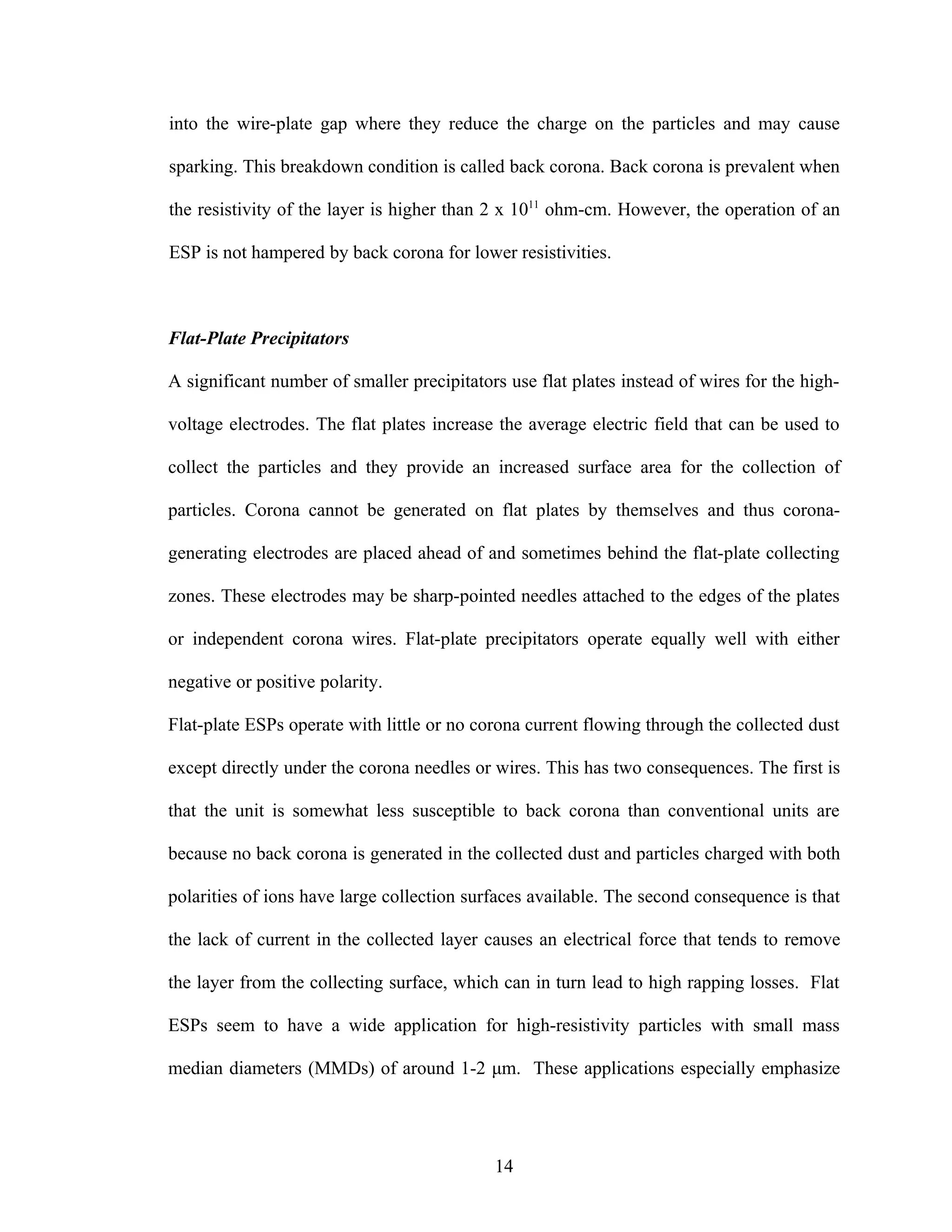
over a 180-degree involute. Figure 2 shows a vane-axial cyclone. In this case, the

cyclonic motion is imparted to the axially descending dirty gas by a ring of vanes. In

either case, the operation depends upon the inertia of the particles to move in a straight

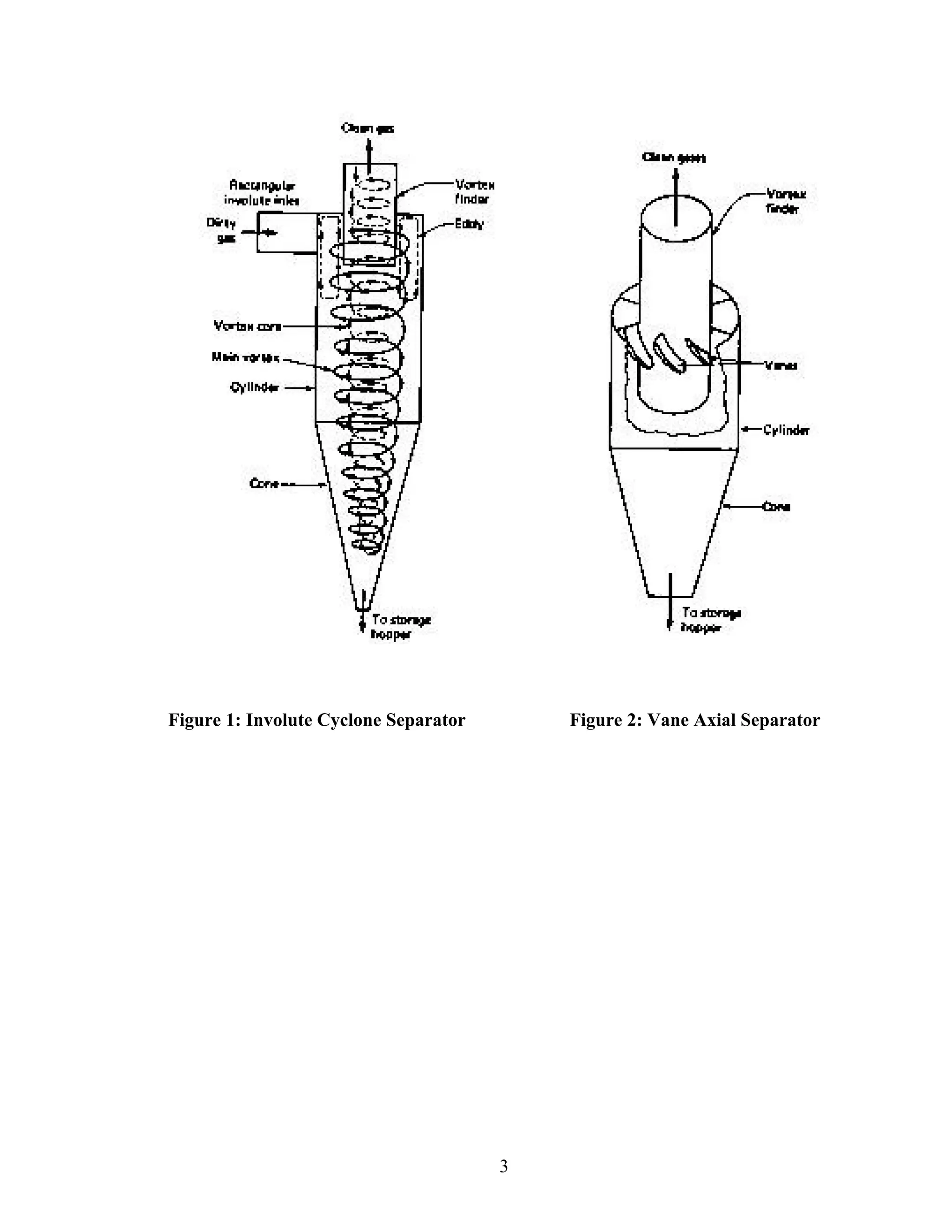
line even as the direction of the gas stream is changed. The centrifugal force due to a high

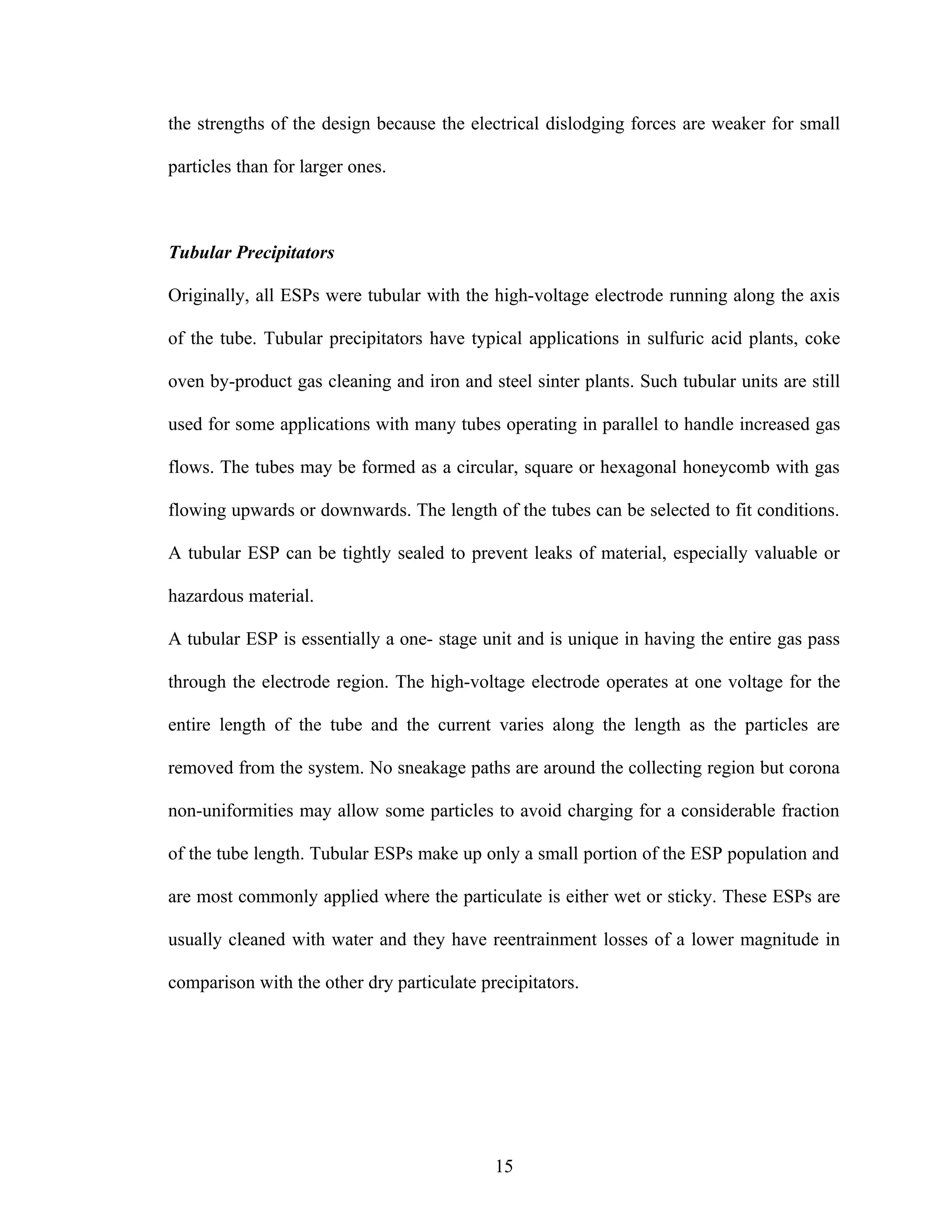
rate of spin flings the dust particles to the outer walls of the cylinder and the cone. The

movement of the particles across the gas stream can be seen in Figure 3. The particles

then slide down the walls and into the storage hopper. The cleaned gas reverses its

downward spiral and forms a smaller ascending spiral. A vortex finder tube that extends

downward into the cylinder aids in directing the inner vortex out of the device.

The cyclone separator is usually employed for removing particles 10 μm in size and

larger. However, conventional cyclones seldom remove particles with an efficiency

greater than 90 percent unless the particle size is 25 μm or larger. High efficiency

cyclones are available and are effective with particle sizes down to 5 μm. A high-volume

design sacrifices efficiency for high rates of collection. It might be used as a precleaner to


                                              2
Figure 1: Involute Cyclone Separator       Figure 2: Vane Axial Separator


                                       3
Figure 3: Movement of particles across the gas streamlines


                            4
remove the larger particles before the gas passes through another piece of collection

equipment. Cyclones can be optimized for high collection efficiencies by using small

diameters, long cylinders and high inlet velocities.


Factors Affecting Collection Efficiency

Installation Procedures

For cyclones to have good collection efficiency, proper installation procedures are of

primary importance. The cyclone collector must be airtight in order to eliminate

reentrainment of the particles back into the gas stream. Therefore, while installing

equipment such as access doors, inlet and outlet plenums and dust disposal features these

areas must be completely sealed. Any leakage in the cyclone collector can cause a 25

percent or more loss in the collection efficiency.


Erosion and Fouling

Erosion and Fouling of cyclones are problems that seriously affect the cyclone collection

efficiency and are encountered during the operation and maintenance activities.

Erosion in cyclones is caused by the striking or rubbing of dust particles on the inside

wall of the cyclone. Erosion increases with high dust loadings, high inlet velocities, high

particle specific gravity values and the strike angle (Air Pollution Engineering Manual,

2000). The area of the cylindrical shell opposite to the inlet may experience excessive

wear if the gas contains large dust particles. Welded seams in the cyclone design are also

areas that tend to be susceptible to erosion because of surface irregularities. Choosing the

proper cyclone diameter size can control erosion. Further, using thicker material in the


                                             5
cone area and abrasion resistant removable wear plates (linings) at the strike zone are

good design options that help in controlling erosion.

Fouling of a cyclone collector occurs on account of the plugging of the dust outlet or dust

buildup on the cyclone walls. Plugging of the dust outlet occurs by large pieces of

material becoming lodged in the outlet thereby forming an obstruction about which small

particles can build up. These conditions can lead to reentrainment of the dust into the gas

stream. For large-diameter cyclones, an axial cleanout opening with a bolted cover plate

in the top of the outlet pipe can be provided so that a rod can be inserted to clear a

blockage. Material buildup on the cyclone walls is a function of the dust. Soft, fine dust

has a tendency to build up on the cyclone walls. Particles below 3 µm in diameter possess

inherently greater cohesive and adhesive forces. Condensation of moisture on the cyclone

walls also contributes to the accumulation of material on the walls. Wall smoothness can

help to reduce the amount of material buildup. Electropolishing of walls has been a

successful method in minimizing buildup.


Particle Size

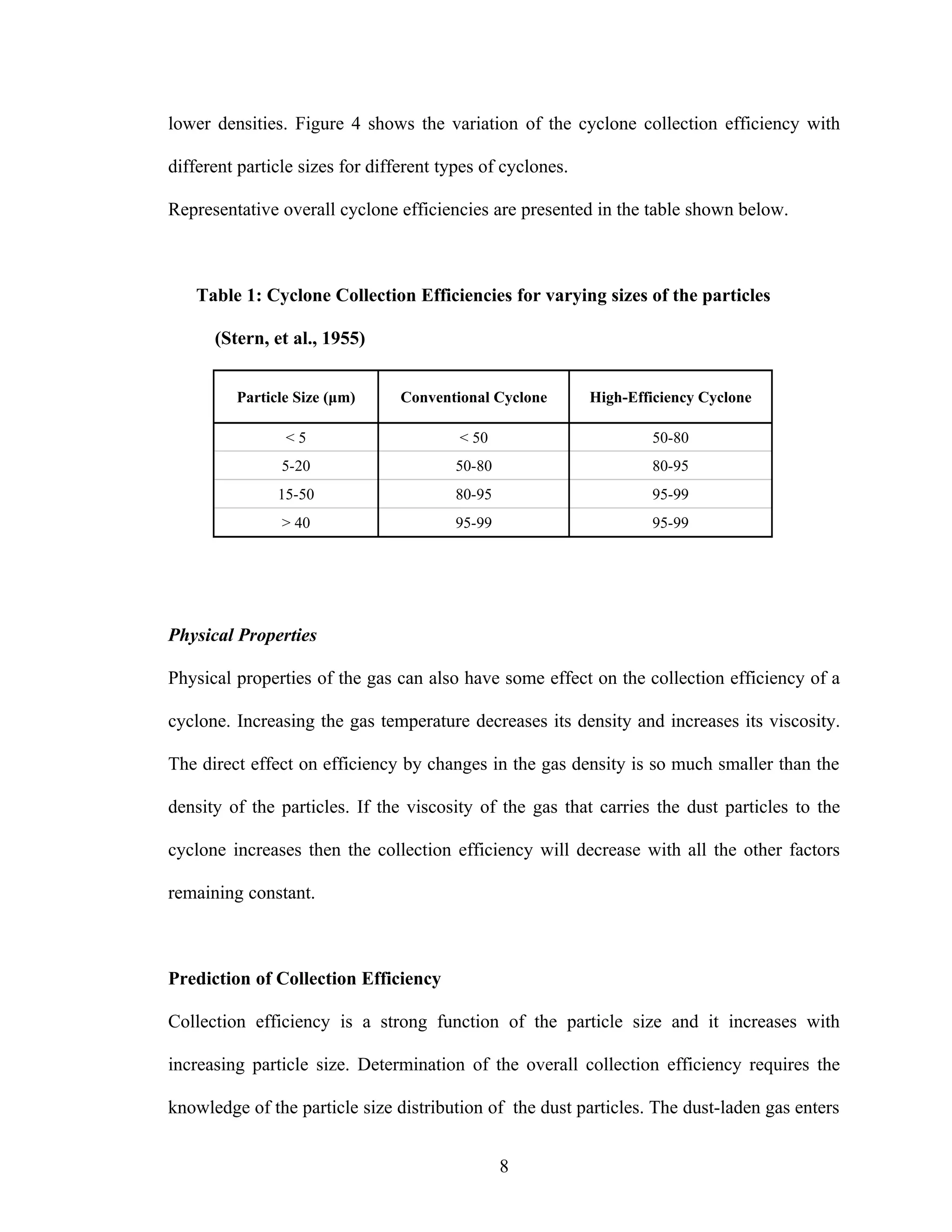
Collection efficiency is a strong function of particle size and increases with increasing

particle size. Also, the efficiency is greater for particles with higher densities than for


                                               6
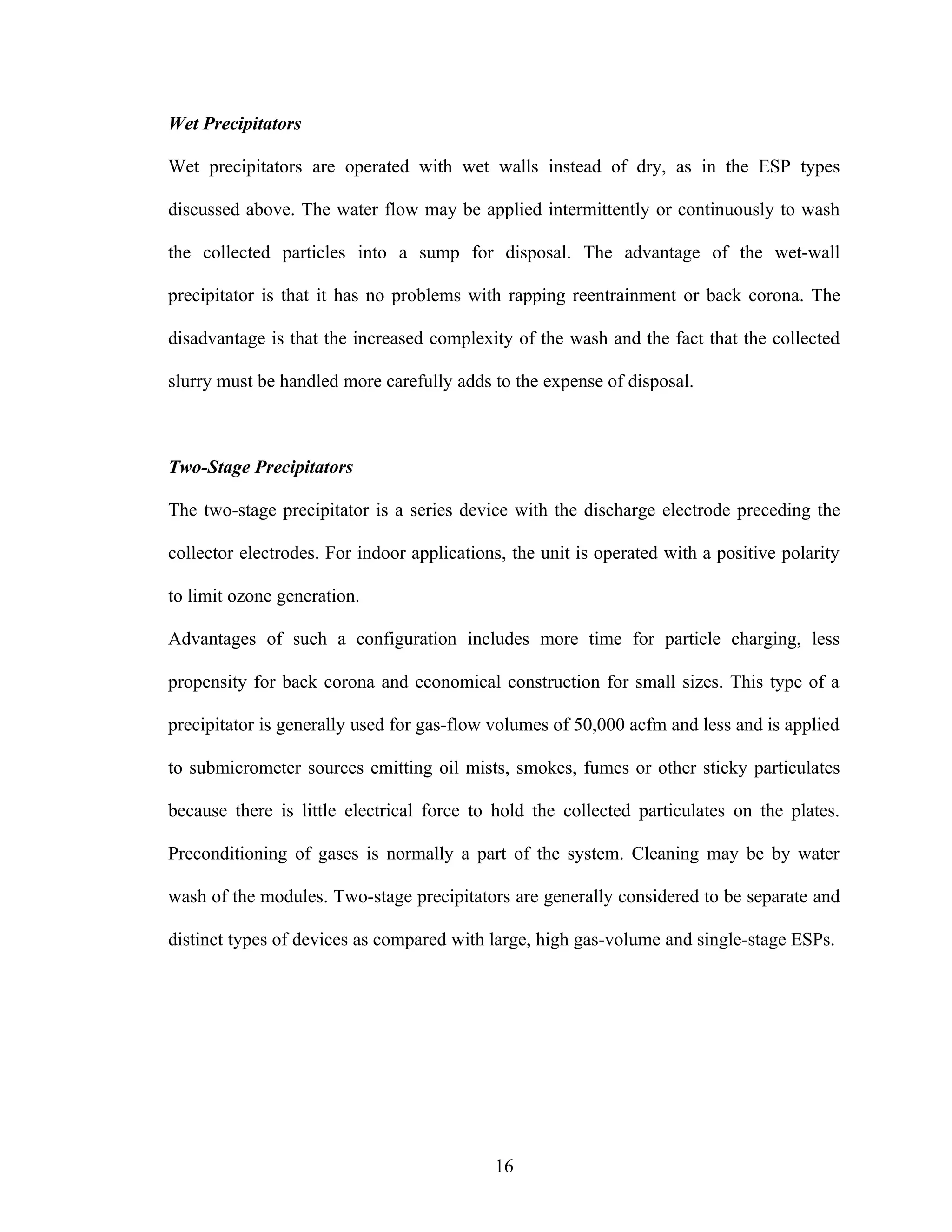
Figure 4: Collection Efficiency as a function of particle size for different types of

           cyclones


                                            7
lower densities. Figure 4 shows the variation of the cyclone collection efficiency with

different particle sizes for different types of cyclones.

Representative overall cyclone efficiencies are presented in the table shown below.


   Table 1: Cyclone Collection Efficiencies for varying sizes of the particles

      (Stern, et al., 1955)


         Particle Size (μm)      Conventional Cyclone       High-Efficiency Cyclone

                <5                       < 50                       50-80
                5-20                    50-80                       80-95
               15-50                    80-95                       95-99
                > 40                    95-99                       95-99


Physical Properties

Physical properties of the gas can also have some effect on the collection efficiency of a

cyclone. Increasing the gas temperature decreases its density and increases its viscosity.

The direct effect on efficiency by changes in the gas density is so much smaller than the

density of the particles. If the viscosity of the gas that carries the dust particles to the

cyclone increases then the collection efficiency will decrease with all the other factors

remaining constant.


Prediction of Collection Efficiency

Collection efficiency is a strong function of the particle size and it increases with

increasing particle size. Determination of the overall collection efficiency requires the

knowledge of the particle size distribution of the dust particles. The dust-laden gas enters


                                                8
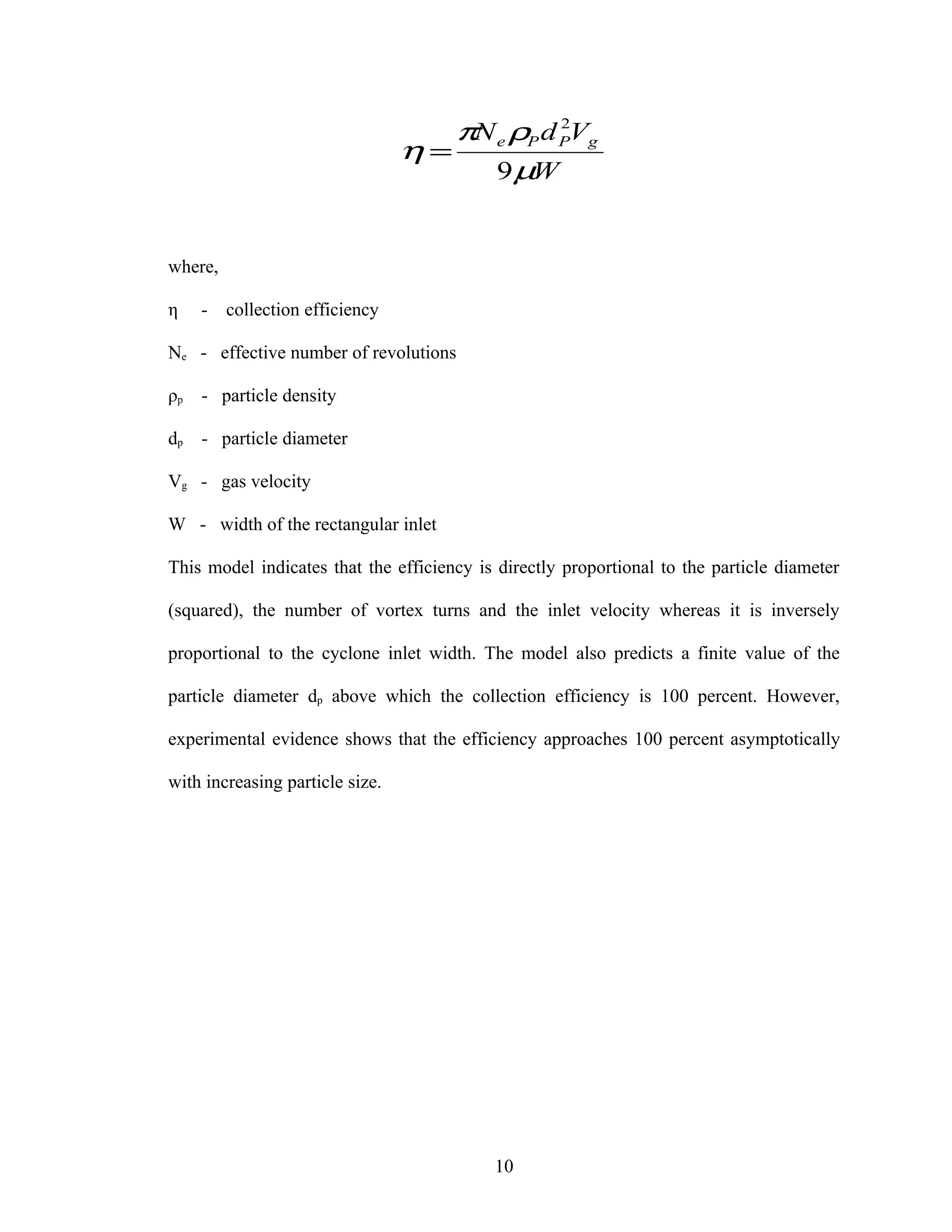
the cyclone and spins through Ne revolutions in the main outer vortex before entering the

inner vortex and passing upwards towards the exit of the cyclone. The value of Ne is

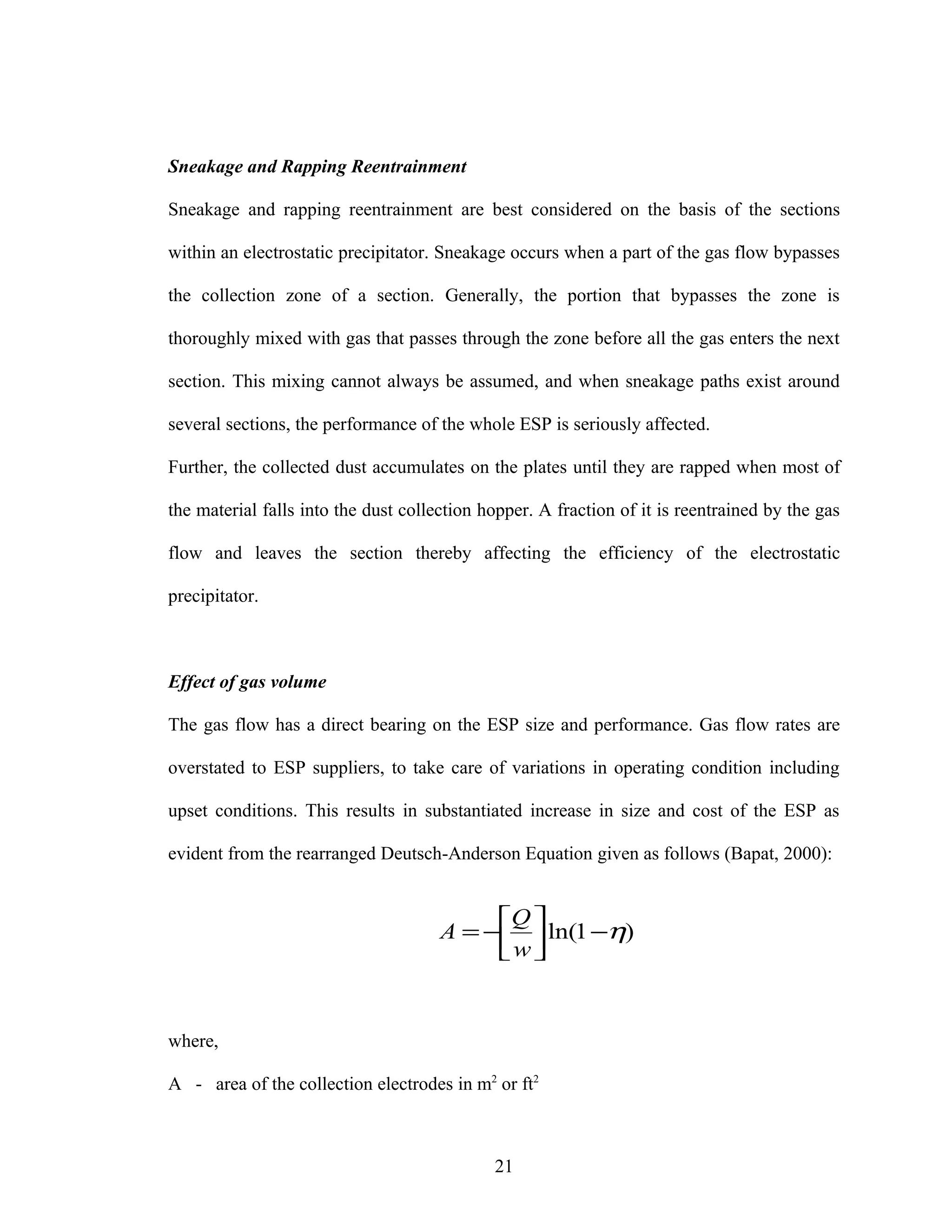
derived from the following equation (Wark, et al., 1998):


                                               1     L 
                                        Ne =     L1 + 2 
                                               H      2

where,

L1 - height of the main upper cylinder

L2 - height of the lower cone

H   - height of the rectangular inlet through which the dirty gas enters

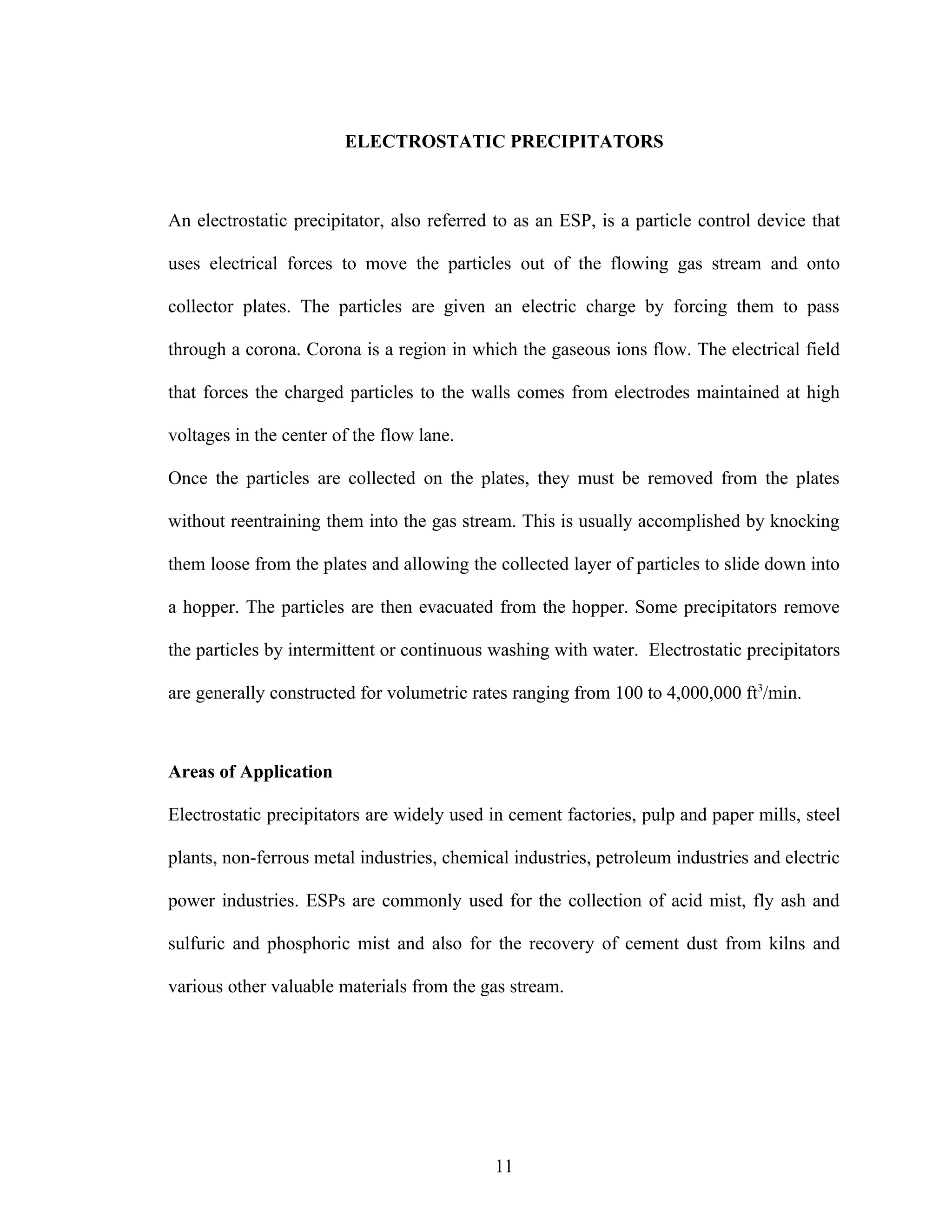
The derivation of the cyclone collection efficiency is based on the following theory:

Particles enter the cyclone with the gas stream but tend to move outwards under the

influence of centrifugal force. This is resisted by the drag of the particles moving radially

through the gas, and the resultant terminal or radial velocity of the particles is found by

equating the centrifugal and drag forces. To be collected, the particles must reach the

outer wall before the gas leaves the outer vortex. The time and the distance are both

known quantities. The time is the gas residence time, which depends on gas inlet

velocity, radius of the cyclone and number of turns in the vortex. The maximum value of

the distance to be traveled is the length from the inner edge of the inlet to the outer wall.

Assuming laminar flow, an expression is derived that relates the collection efficiency to

the different cyclone parameters and operating conditions (Wark, et al., 1998):


                                               9
πN e ρP d PVg
                                              2

                                 η=
                                       9 µW


where,

η    -   collection efficiency

Ne - effective number of revolutions

ρp   - particle density

dp   - particle diameter

Vg - gas velocity

W - width of the rectangular inlet

This model indicates that the efficiency is directly proportional to the particle diameter

(squared), the number of vortex turns and the inlet velocity whereas it is inversely

proportional to the cyclone inlet width. The model also predicts a finite value of the

particle diameter dp above which the collection efficiency is 100 percent. However,

experimental evidence shows that the efficiency approaches 100 percent asymptotically

with increasing particle size.


                                           10
ELECTROSTATIC PRECIPITATORS


An electrostatic precipitator, also referred to as an ESP, is a particle control device that

uses electrical forces to move the particles out of the flowing gas stream and onto

collector plates. The particles are given an electric charge by forcing them to pass

through a corona. Corona is a region in which the gaseous ions flow. The electrical field

that forces the charged particles to the walls comes from electrodes maintained at high

voltages in the center of the flow lane.

Once the particles are collected on the plates, they must be removed from the plates

without reentraining them into the gas stream. This is usually accomplished by knocking

them loose from the plates and allowing the collected layer of particles to slide down into

a hopper. The particles are then evacuated from the hopper. Some precipitators remove

the particles by intermittent or continuous washing with water. Electrostatic precipitators

are generally constructed for volumetric rates ranging from 100 to 4,000,000 ft3/min.


Areas of Application

Electrostatic precipitators are widely used in cement factories, pulp and paper mills, steel

plants, non-ferrous metal industries, chemical industries, petroleum industries and electric

power industries. ESPs are commonly used for the collection of acid mist, fly ash and

sulfuric and phosphoric mist and also for the recovery of cement dust from kilns and

various other valuable materials from the gas stream.


                                            11
Types

Electrostatic precipitators are configured in several ways. These configurations depend

upon the control action expected from them and on economic considerations.
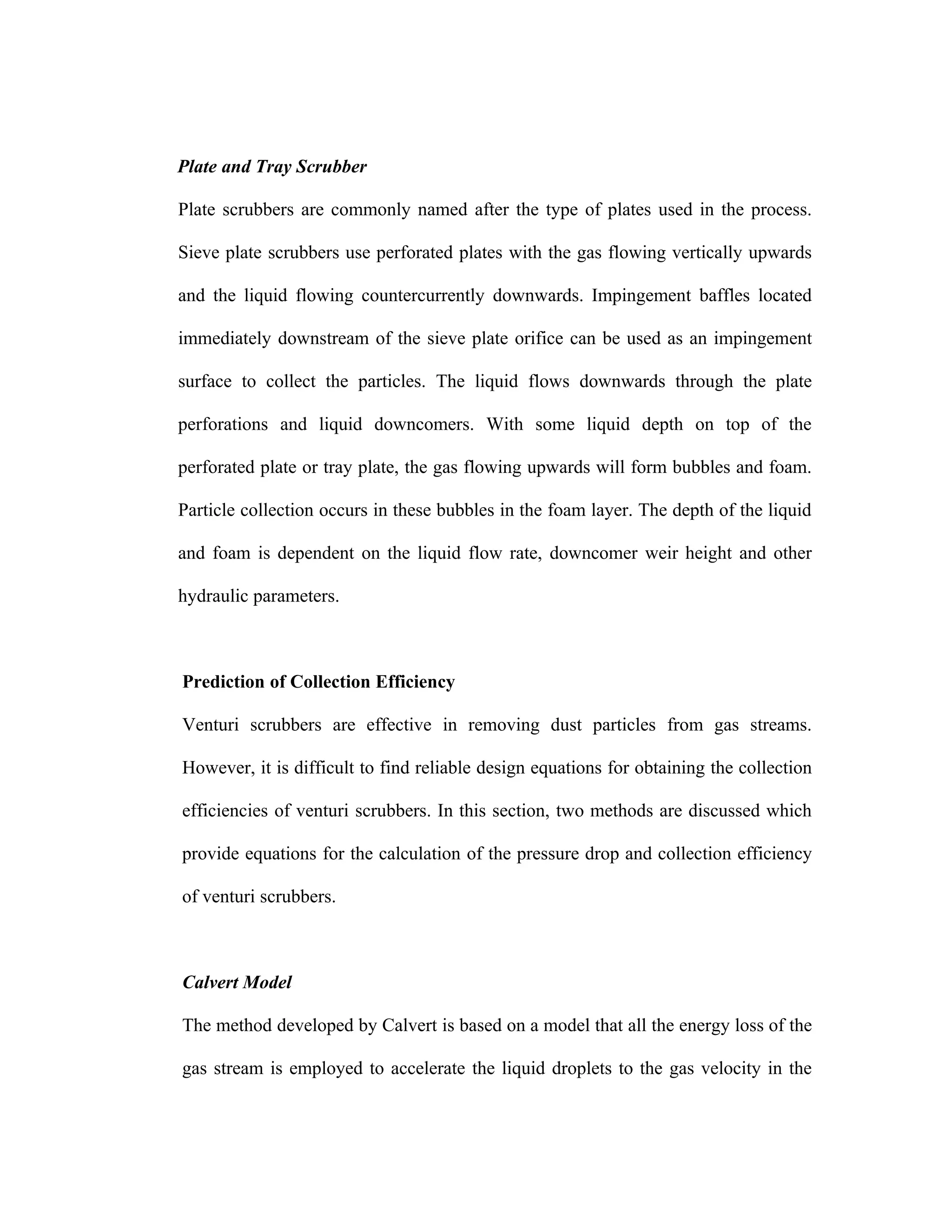


Plate-Wire Precipitator

Plate-wire ESPs are used in a wide variety of industrial applications including coal-fired

boilers, cement kilns, solid waste incinerators, paper mill recovery boilers, petroleum

refining catalytic cracking units, sinter plants, basic oxygen furnaces, open hearth

furnaces, electric arc furnaces and glass furnaces.

In a plate-wire ESP the gas flows between parallel plates of sheet metal and high-voltage

electrodes. These electrodes are long wires weighted and hanging between the plates or

are supported there by mast-like structures. Within each flow path the gas flow must pass

each wire in sequence as it flows through the unit. The plate-wire ESP allows many flow

lanes to operate in parallel and each lane can be quite tall. As a result, this type of ESP is

well suited for handling large volumes of gas. The need for rapping the plates to dislodge

the collected material has caused the plate to be divided into sections, which can be

rapped independently. The power supplies are often sectionalized in the same way to

obtain higher operating voltages. Dust also deposits on the discharge electrode wires and

must be removed periodically.

The power supplies for the ESP convert the industrial AC voltage in the range of 220-480

volts to a pulsating DC voltage of around 20,000-100,000 volts. The supply consists of a

step-up transformer, high-voltage rectifiers and filter capacitors. The unit may supply


                                             12
either a half-wave or full-wave rectified DC voltage. There are auxiliary components and

controls to allow the voltage to be adjusted to the highest-level possible without

excessive sparking and to protect the supply and electrodes in the event a short circuit

occurs. The voltage applied to the electrodes causes the gas between the electrodes to

break down electrically. This action is known as corona. The electrodes are usually given

a negative polarity, because a negative corona supports a higher voltage as compared to a

positive corona before a sparking occurs. The ions generated in the corona follow electric

field lines from the wires to the collecting plates. Thus, each wire establishes a charging

zone through which the particles must pass.

As the particles pass each successive wire, they are driven closer to the collecting walls.

However, the turbulence in the gas tends to keep them uniformly mixed with the gas. The

collection process is therefore a competition between the electrical and dispersive forces.

Eventually, the particles approach close enough to the walls so that the turbulence drops

to low levels and the particles are collected. If the collected particles could be dislodged

into the hopper without losses then the ESP would be extremely efficient. The rapping

process that dislodges the accumulated layer also projects some of the particles back into

the gas stream. Later sections then process these reetrained particles again. But the

particles reetrained in the last section of the ESP have no chance to be collected and

escape the unit thereby affecting the performance of the ESP.

The collected particles generally form a continuous layer on the ESP plates. Thus the

entire ion current must pass through the layer before reaching the ground plates. This

current creates an electric field in the layer and it can become large enough to cause a

local electrical breakdown. When this occurs, new ions of the wrong polarity are injected


                                            13
into the wire-plate gap where they reduce the charge on the particles and may cause

sparking. This breakdown condition is called back corona. Back corona is prevalent when

the resistivity of the layer is higher than 2 x 10¹¹ ohm-cm. However, the operation of an

ESP is not hampered by back corona for lower resistivities.


Flat-Plate Precipitators

A significant number of smaller precipitators use flat plates instead of wires for the high-

voltage electrodes. The flat plates increase the average electric field that can be used to

collect the particles and they provide an increased surface area for the collection of

particles. Corona cannot be generated on flat plates by themselves and thus corona-

generating electrodes are placed ahead of and sometimes behind the flat-plate collecting

zones. These electrodes may be sharp-pointed needles attached to the edges of the plates

or independent corona wires. Flat-plate precipitators operate equally well with either

negative or positive polarity.

Flat-plate ESPs operate with little or no corona current flowing through the collected dust

except directly under the corona needles or wires. This has two consequences. The first is

that the unit is somewhat less susceptible to back corona than conventional units are

because no back corona is generated in the collected dust and particles charged with both

polarities of ions have large collection surfaces available. The second consequence is that

the lack of current in the collected layer causes an electrical force that tends to remove

the layer from the collecting surface, which can in turn lead to high rapping losses. Flat

ESPs seem to have a wide application for high-resistivity particles with small mass

median diameters (MMDs) of around 1-2 μm. These applications especially emphasize


                                            14
the strengths of the design because the electrical dislodging forces are weaker for small

particles than for larger ones.


Tubular Precipitators

Originally, all ESPs were tubular with the high-voltage electrode running along the axis

of the tube. Tubular precipitators have typical applications in sulfuric acid plants, coke

oven by-product gas cleaning and iron and steel sinter plants. Such tubular units are still

used for some applications with many tubes operating in parallel to handle increased gas

flows. The tubes may be formed as a circular, square or hexagonal honeycomb with gas

flowing upwards or downwards. The length of the tubes can be selected to fit conditions.
A tubular ESP can be tightly sealed to prevent leaks of material, especially valuable or

hazardous material.

A tubular ESP is essentially a one- stage unit and is unique in having the entire gas pass

through the electrode region. The high-voltage electrode operates at one voltage for the

entire length of the tube and the current varies along the length as the particles are

removed from the system. No sneakage paths are around the collecting region but corona

non-uniformities may allow some particles to avoid charging for a considerable fraction

of the tube length. Tubular ESPs make up only a small portion of the ESP population and

are most commonly applied where the particulate is either wet or sticky. These ESPs are

usually cleaned with water and they have reentrainment losses of a lower magnitude in

comparison with the other dry particulate precipitators.


                                            15
Wet Precipitators

Wet precipitators are operated with wet walls instead of dry, as in the ESP types

discussed above. The water flow may be applied intermittently or continuously to wash

the collected particles into a sump for disposal. The advantage of the wet-wall

precipitator is that it has no problems with rapping reentrainment or back corona. The

disadvantage is that the increased complexity of the wash and the fact that the collected

slurry must be handled more carefully adds to the expense of disposal.


Two-Stage Precipitators

The two-stage precipitator is a series device with the discharge electrode preceding the

collector electrodes. For indoor applications, the unit is operated with a positive polarity

to limit ozone generation.

Advantages of such a configuration includes more time for particle charging, less

propensity for back corona and economical construction for small sizes. This type of a

precipitator is generally used for gas-flow volumes of 50,000 acfm and less and is applied

to submicrometer sources emitting oil mists, smokes, fumes or other sticky particulates

because there is little electrical force to hold the collected particulates on the plates.

Preconditioning of gases is normally a part of the system. Cleaning may be by water

wash of the modules. Two-stage precipitators are generally considered to be separate and

distinct types of devices as compared with large, high gas-volume and single-stage ESPs.


                                            16
Auxiliary Equipment

Along with the ESP itself, a control system usually includes the following auxiliary

equipment: a capture device, ductwork, dust removal equipment, fans, motors and starters

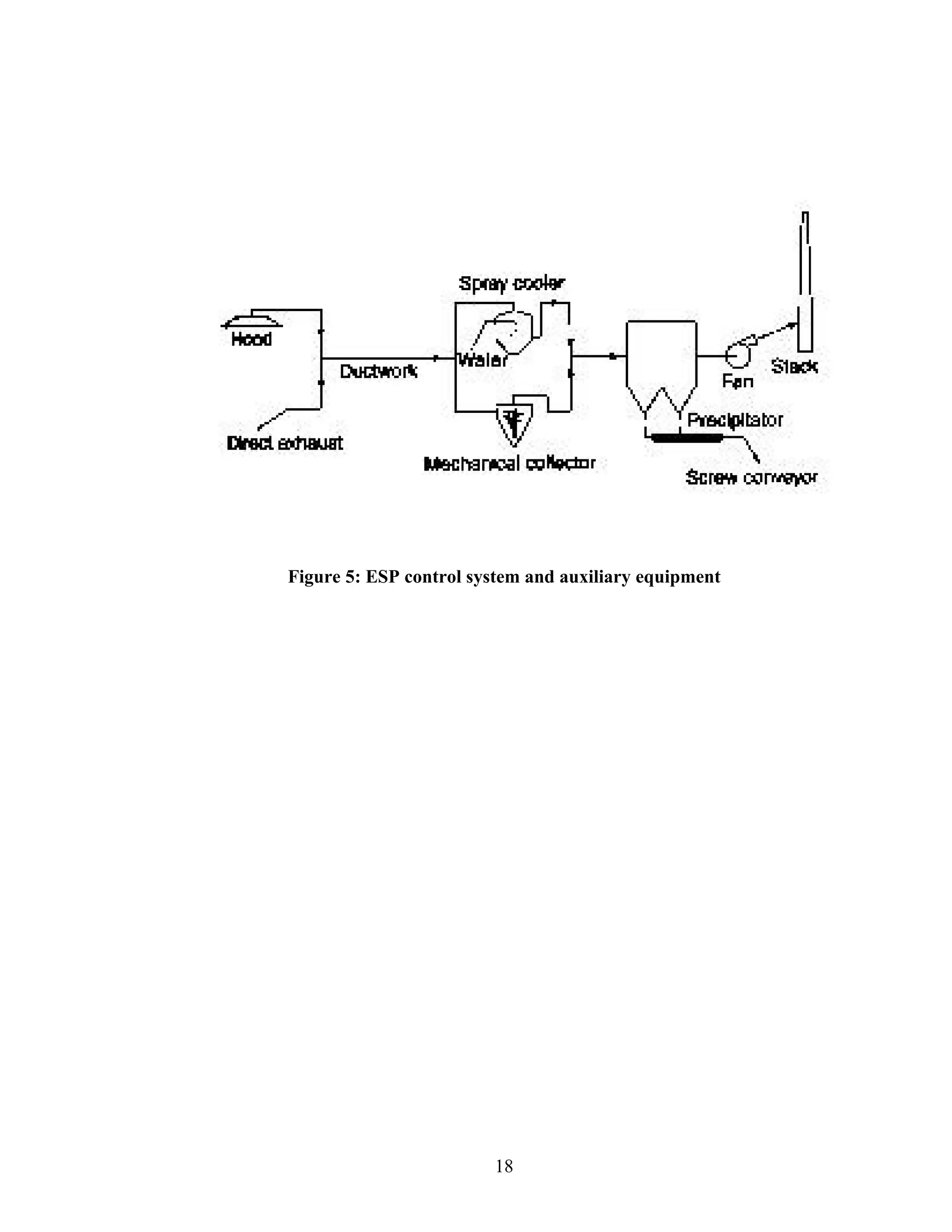
and a stack. A typical arrangement is shown in Figure 5. In addition, spray coolers and

mechanical collectors may be needed to precondition the gas before it reaches the ESP.

Capture devices are usually hoods that exhaust pollutants into the ductwork or are direct

exhaust couplings attached to a combustor or process equipment. These devices are

usually refractory lined, water cooled or simply fabricated from carbon steel depending

on the gas-stream temperatures.

Refractory or water-cooled capture devices are used where the wall temperatures exceed

800oF whereas carbon steel is used for lower temperatures. Spray chambers may be

required for processes where the addition of moisture will improve precipitation or

protect the ESP from warpage. For combustion processes with exhaust gas temperatures

below approximately 700oF, cooling would not be required and the exhaust gases can be

delivered directly to the precipitator.

When much of the pollutant loading consists of relatively large particles, mechanical

collectors such as cyclones may be used to reduce the load on the ESP especially at high

inlet concentrations. The fans provide the motive power for air movement and can be
mounted before or after the ESP. A stack vents the cleaned stream to the atmosphere.

Screw conveyors or pneumatic systems are often used to remove captured dust from the

bottom of the hoppers. Wet ESPs require a source of wash water to be sprayed at the top

of the collector plates either continuously or at timed intervals. The water flows with the


                                             17
Figure 5: ESP control system and auxiliary equipment


                        18
collected particles into a sump from which the fluid is pumped. A portion of the fluid

may be recycled to reduce the total amount of water required. The remainder is pumped

directly to a settling pond or passed through a dewatering stage with subsequent disposal

of the sludge.


Factors affecting Collection Efficiency

For most applications, the collection efficiency of electrostatic precipitators run from 90

to 99 percent. With the introduction of stricter air pollution codes, efficiencies in the

range of 99 to 99.9 percent have become quite common. Acid mists and catalyst recovery

units have efficiencies in excess of 99 percent. However, for materials like carbon black,

which have very low efficiencies due to low collection capacity, very high efficiencies

can be achieved by a proper combination of an ESP with a cyclone. Also, sometimes the

gas entering the ESP is pre-treated by using certain mechanical collectors or by adding

certain chemicals to the gas to change the chemical properties of the gas so as to increase

their capacity to collect on the discharge electrodes, thereby increasing the overall

collection efficiency.

The various factors that affect the performance of electrostatic precipitators are explained

below:


Particle Resistivity

One property of the dust layer that is extremely important in the precipitator operation is

the dust electrical resistivity. Owing to the widely varying nature of industrial dusts, the

resistivity may vary from 10-3 to 1014 ohm-cm. When the resistivity is less than 10 4 ohm-


                                            19
cm, there is a rapid movement of charge from the deposited dust to the collector plate.

Thus insufficient electrostatic charge remains on the collected dust particles to hold them

together. Reentrainment back into the gas stream frequently results and thus efficiency

suffers. Carbon black, an industrial product of importance, is an example of low-

resistivity dust. On the other hand, resistivities greater than about 1010 ohm-cm are a

major source of poor performance in precipitators. At first, a sizeable fraction of the total

voltage drop between the electrodes occurs across a high-resistivity dust layer as a result

of the electrical insulating effect. Hence only a portion of the total corona power is

available to ionize and drive the charged particles to the collection electrode. A second

problem due to high resistivity is known as back corona or back ionization. This effect

occurs when the voltage drop across the layer exceeds the dielectric strength of the layer.

Air trapped in the collected dust layer becomes ionized as a result of the large potential

drop across the layer. Any positive ions formed will tend to migrate away from the

collector plate and neutralize the ionized particles approaching the plate. This decreases

the amount of particulate matter deposited. These effects reduce the collection efficiency

of a precipitator.

Electrostatic precipitation is the most effective theory in collecting dust in the resistivity

range of 10 4 to 1010 ohm-cm. Since many industrial dusts do not fall into this range, it is

frequently necessary to change the operating conditions in order to enhance collection

efficiencies. Two gas properties that have a sizeable influence on the dust resistivities are

temperature and humidity.


                                             20
Sneakage and Rapping Reentrainment

Sneakage and rapping reentrainment are best considered on the basis of the sections

within an electrostatic precipitator. Sneakage occurs when a part of the gas flow bypasses

the collection zone of a section. Generally, the portion that bypasses the zone is

thoroughly mixed with gas that passes through the zone before all the gas enters the next

section. This mixing cannot always be assumed, and when sneakage paths exist around

several sections, the performance of the whole ESP is seriously affected.

Further, the collected dust accumulates on the plates until they are rapped when most of

the material falls into the dust collection hopper. A fraction of it is reentrained by the gas

flow and leaves the section thereby affecting the efficiency of the electrostatic

precipitator.


Effect of gas volume

The gas flow has a direct bearing on the ESP size and performance. Gas flow rates are

overstated to ESP suppliers, to take care of variations in operating condition including

upset conditions. This results in substantiated increase in size and cost of the ESP as
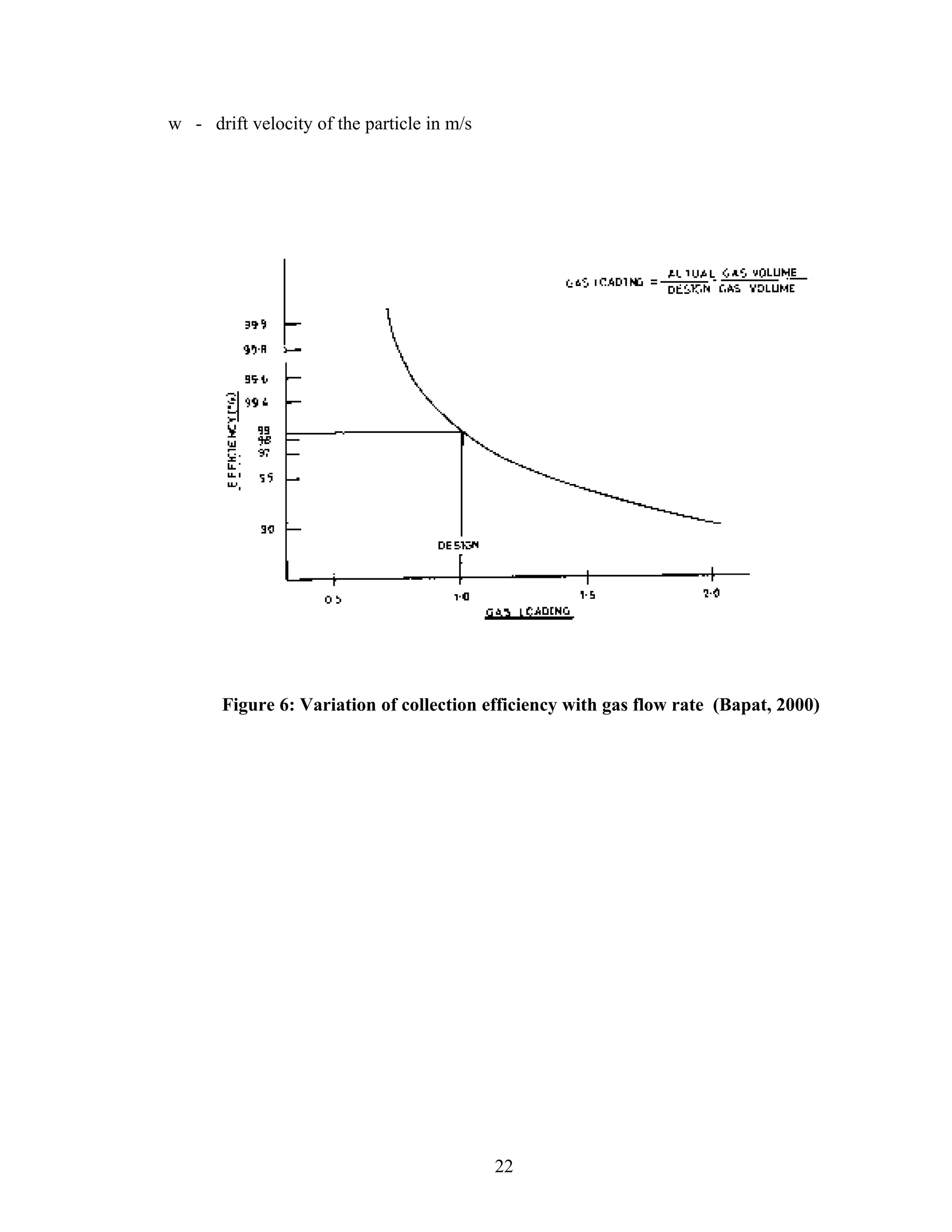
evident from the rearranged Deutsch-Anderson Equation given as follows (Bapat, 2000):


                                           Q 
                                      A = −  ln(1 −η)
                                           w 


where,

A - area of the collection electrodes in m2 or ft2


                                             21
w - drift velocity of the particle in m/s


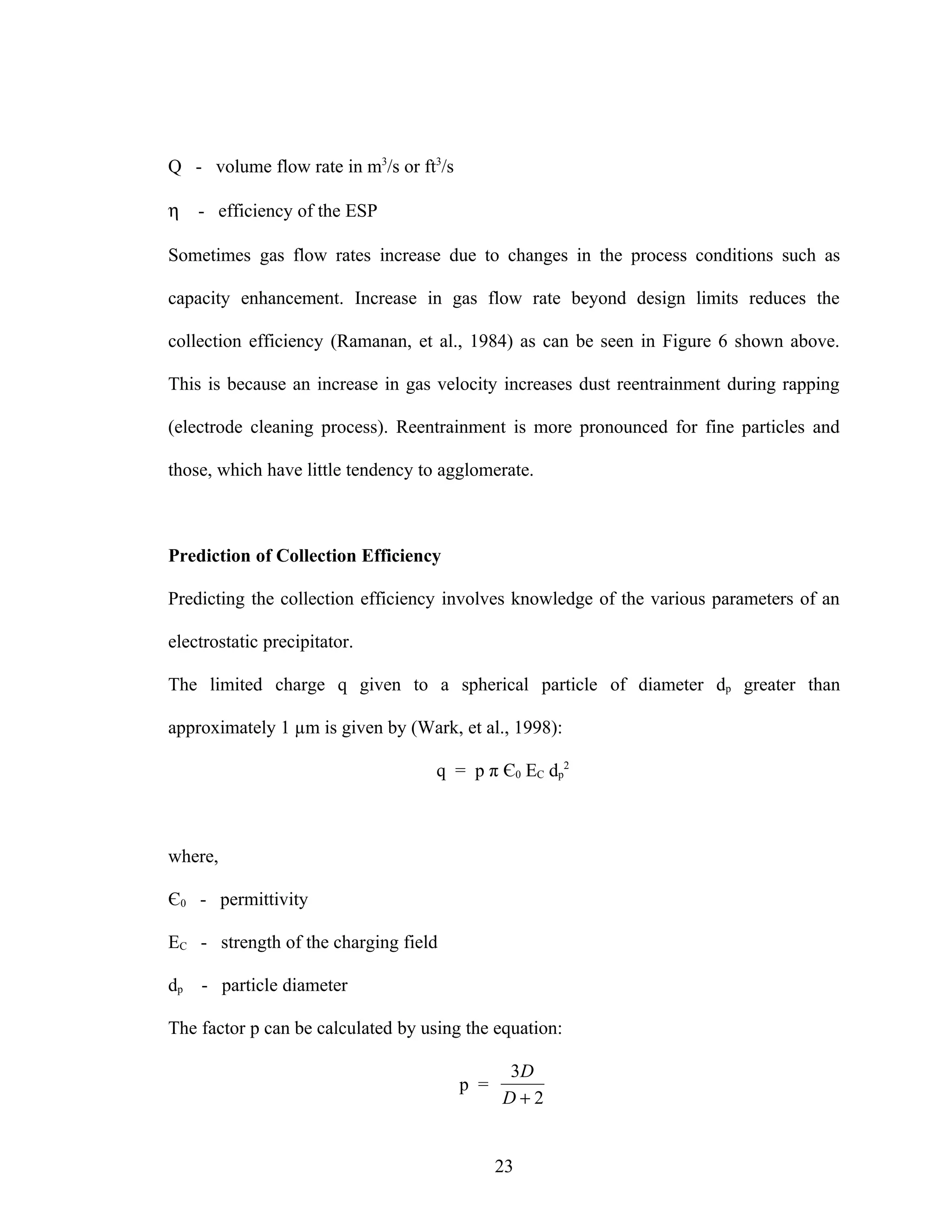
       Figure 6: Variation of collection efficiency with gas flow rate (Bapat, 2000)


                                            22
Q - volume flow rate in m3/s or ft3/s

η    - efficiency of the ESP

Sometimes gas flow rates increase due to changes in the process conditions such as

capacity enhancement. Increase in gas flow rate beyond design limits reduces the

collection efficiency (Ramanan, et al., 1984) as can be seen in Figure 6 shown above.

This is because an increase in gas velocity increases dust reentrainment during rapping

(electrode cleaning process). Reentrainment is more pronounced for fine particles and

those, which have little tendency to agglomerate.


Prediction of Collection Efficiency

Predicting the collection efficiency involves knowledge of the various parameters of an

electrostatic precipitator.

The limited charge q given to a spherical particle of diameter dp greater than

approximately 1 µm is given by (Wark, et al., 1998):

                                    q = p π Є0 EC dp2


where,

Є0 - permittivity

EC - strength of the charging field

dp   - particle diameter

The factor p can be calculated by using the equation:

                                              3D
                                        p =
                                              D+2


                                              23
where,

D - dielectric constant

Since the dielectric constant for most types of dusts falls between 2 and 8, thus the factor

p typically lies between 1.5 and 2.4.

In the collection mechanism the charged dust particles migrate to the plate electrodes,

where the dust collection occurs. The speed at which the migration takes place is known

as the migration velocity or the drift velocity w. It depends upon the electrical force on

the charged particle as well as the drag force developed as the particle attempts to move

perpendicular to the main gas flow towards the collecting electrode. The electrostatic

precipitator is proportional to the charge on the particle and the precipitating or collecting

field strength Ep. The electrostatic force Fe can thus be shown as:

                               Fe = q Ep = p π Є0 EC Ep dp2


The drag force on the particle, which is in the Stoke’s flow region, is represented by:

                                         3π g d p w
                                           µ
                                  Fd =
                                               KC

where,

KC - Cunningham correction factor which should be applied for particles with a

         diameter less than roughly 5 µm

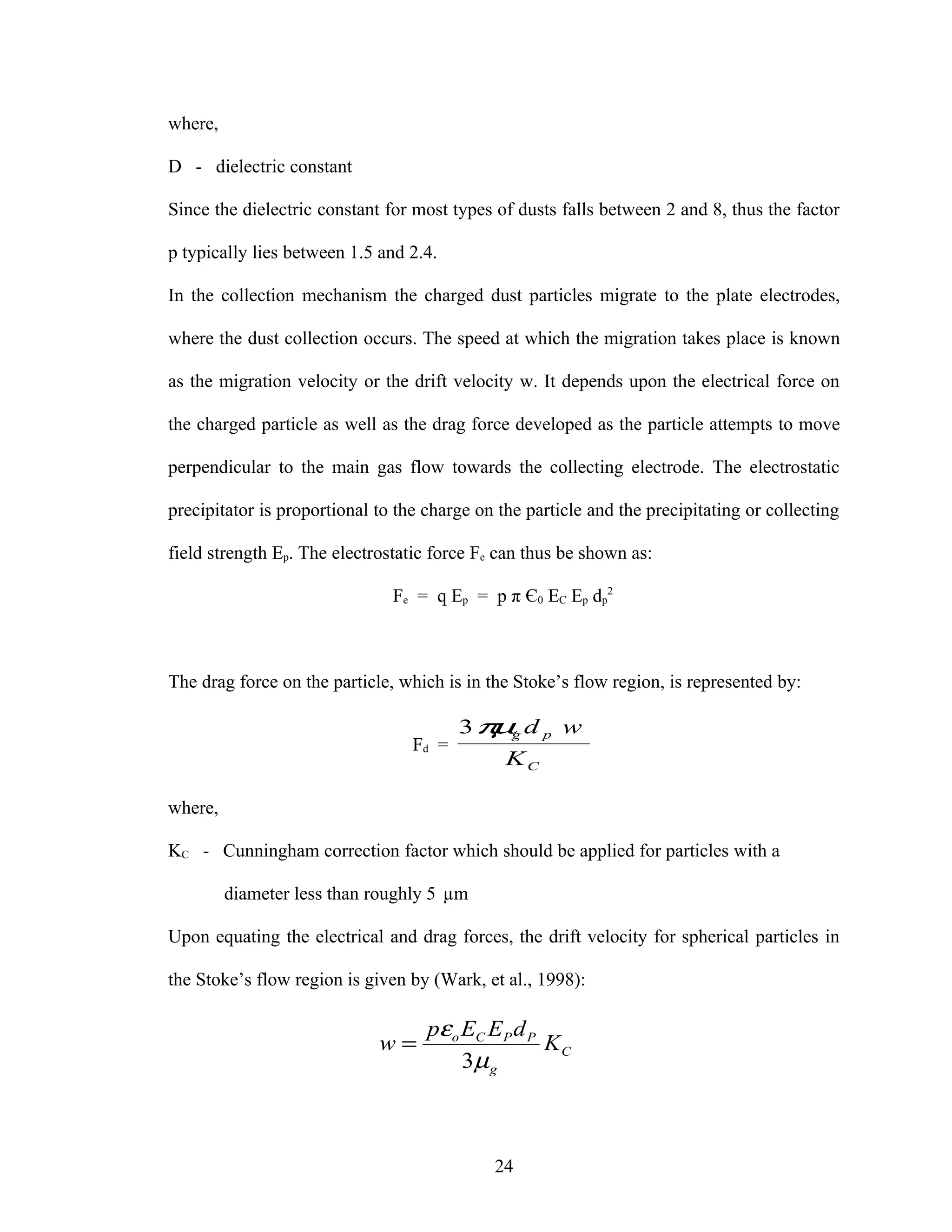
Upon equating the electrical and drag forces, the drift velocity for spherical particles in

the Stoke’s flow region is given by (Wark, et al., 1998):

                                    pεo EC EP d P
                             w=                   KC
                                        3µ g


                                             24
where,

w    - drift velocity in m/s

μg   - gas viscosity in kg/m-sec

dp   - particle diameter in m

Є0   - permittivity and is taken as 8.854 x 10⁻¹² coulombs/volt-meter.

Thus, the above equation can be modified as:

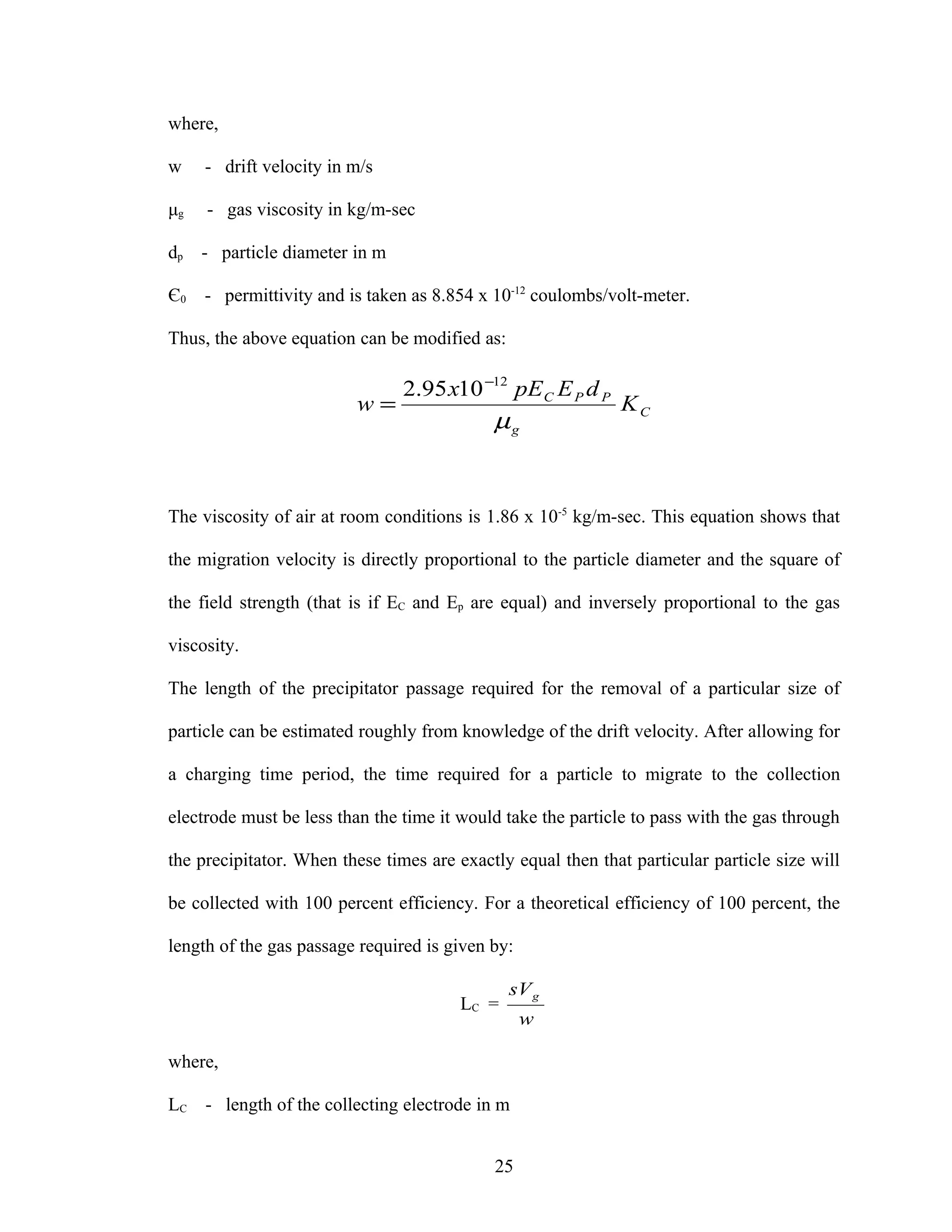
                                2.95 x10 −12 pE C E P d P
                         w=                                   KC
                                            µg


The viscosity of air at room conditions is 1.86 x 10⁻⁵ kg/m-sec. This equation shows that

the migration velocity is directly proportional to the particle diameter and the square of

the field strength (that is if EC and Ep are equal) and inversely proportional to the gas

viscosity.

The length of the precipitator passage required for the removal of a particular size of

particle can be estimated roughly from knowledge of the drift velocity. After allowing for

a charging time period, the time required for a particle to migrate to the collection

electrode must be less than the time it would take the particle to pass with the gas through

the precipitator. When these times are exactly equal then that particular particle size will

be collected with 100 percent efficiency. For a theoretical efficiency of 100 percent, the

length of the gas passage required is given by:

                                               sV g
                                        LC =
                                                  w

where,

LC - length of the collecting electrode in m


                                            25
s   - distance between the charging and collecting electrodes in m

Vg - gas velocity in the flow passage in m/s

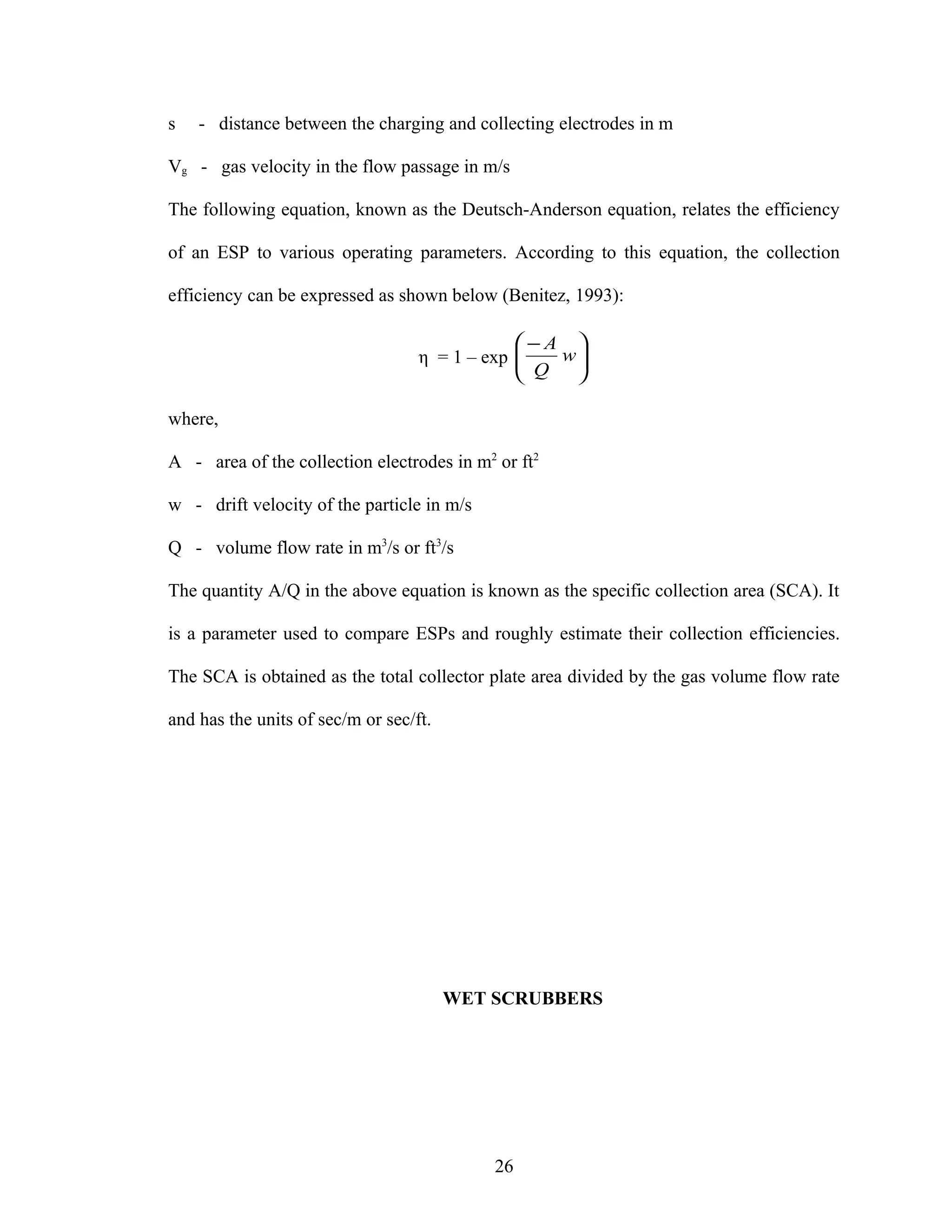
The following equation, known as the Deutsch-Anderson equation, relates the efficiency

of an ESP to various operating parameters. According to this equation, the collection

efficiency can be expressed as shown below (Benitez, 1993):

                                               −A 
                                   η = 1 – exp 
                                                Q w
                                                    
                                                   

where,

A - area of the collection electrodes in m2 or ft2

w - drift velocity of the particle in m/s

Q - volume flow rate in m3/s or ft3/s

The quantity A/Q in the above equation is known as the specific collection area (SCA). It

is a parameter used to compare ESPs and roughly estimate their collection efficiencies.

The SCA is obtained as the total collector plate area divided by the gas volume flow rate

and has the units of sec/m or sec/ft.


                                        WET SCRUBBERS


                                            26
The control of particulate air pollutant emissions with wet scrubbers involves

contacting or scrubbing the gases with a liquid. The aerosol particles are transferred

from their suspension in a gaseous medium to the surface of the scrubbing liquid via

mechanisms of inertial impaction, gravitational settling, Brownian diffusion,

diffusiophoresis, electrostatics and thermophoresis. For particles greater than about

0.5 µm diameter inertial impaction is usually the primary collection mechanism and

for particles smaller than about 0.05 µm diameter Brownian diffusion is the primary

collection mechanism. The form or geometric shape of the scrubbing liquid can be

droplets, wetted walls, liquid sheets and bubbles.

Wet scrubbers have certain disadvantages not found with other dry equipment. One

major problem is to handle and dispose off the wet sludge, which is an inherent

product of the process. However, in some applications the sludge may be easier to

manage than dry dust. If the equipment is installed in the natural environment then

the question of freezing in cold weather must be considered. The presence of water

also has a tendency to increase the corrosiveness of materials.


Areas of Application

Wet scrubbers are effectively used for the removal of sticky, wet, corrosive or liquid

particles that cannot be easily removed from dry surfaces and for explosive or

combustible particles. Further, they are useful for collecting particles while

simultaneously absorbing soluble gases such as SO2. Wet scrubbers can also be used

when there are wastewater treatment systems available on the site with adequate

reserve capacity to handle the liquid effluent.


                                        27
Types

Wet scrubbers are configured into five main types depending upon their gas-liquid

contacting methods and their geometrical shapes. The wet scrubber design and

operating parameters include gas pressure drop, liquid pressure drop, liquid-gas flow

ratio, scrubber geometrical shape, location of water sprays, gas residence time,

droplet size distribution, gas velocities, water temperature, gas temperature, water

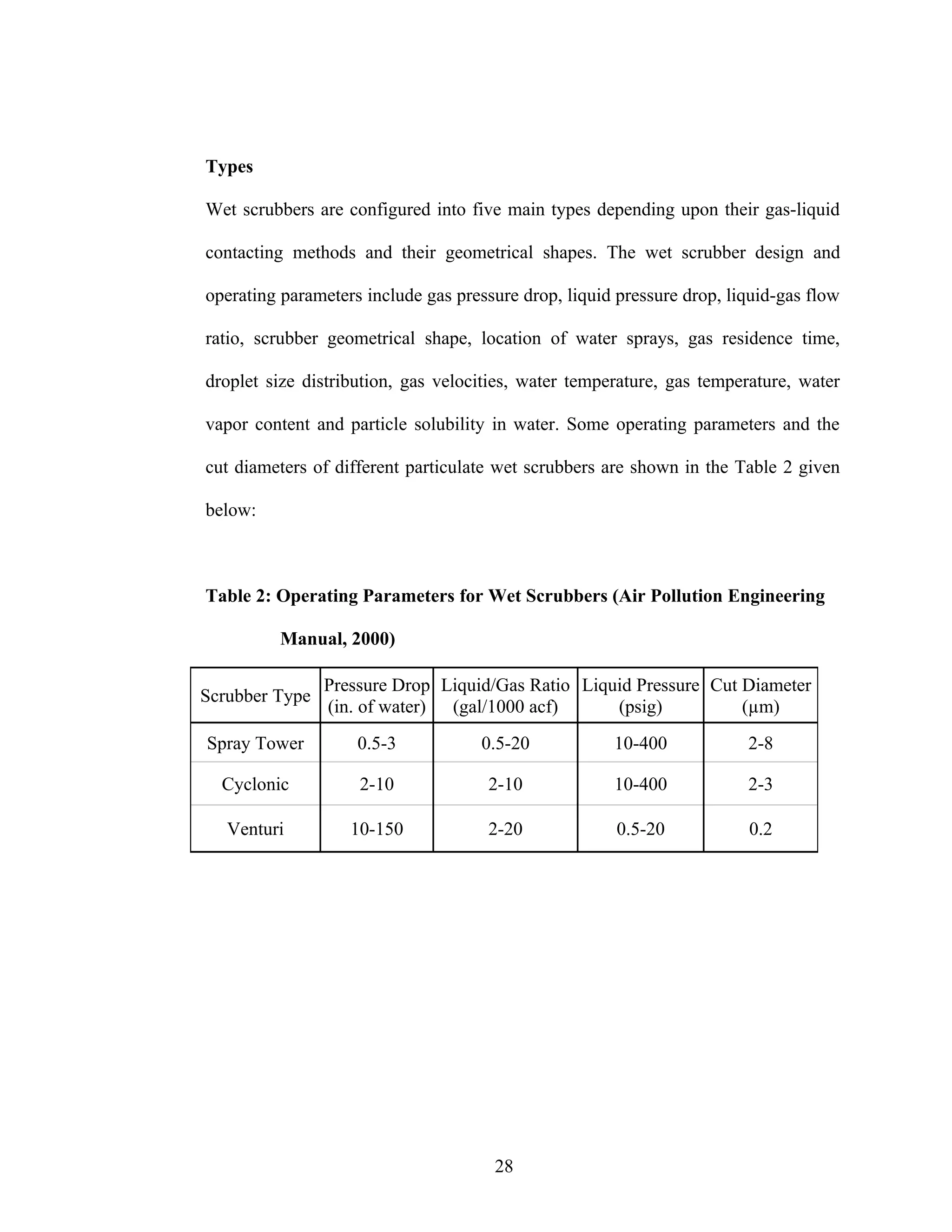
vapor content and particle solubility in water. Some operating parameters and the

cut diameters of different particulate wet scrubbers are shown in the Table 2 given

below:


Table 2: Operating Parameters for Wet Scrubbers (Air Pollution Engineering

          Manual, 2000)

                Pressure Drop Liquid/Gas Ratio Liquid Pressure Cut Diameter
Scrubber Type
                (in. of water) (gal/1000 acf)      (psig)          (µm)
Spray Tower         0.5-3           0.5-20            10-400            2-8

  Cyclonic          2-10             2-10             10-400            2-3

   Venturi         10-150            2-20              0.5-20           0.2


                                      28
Spray Towers

A spray tower uses liquid droplets formed by the liquid flowing through spray

nozzles. The aerosol particles are collected on these liquid drops. The size

distribution and spray pattern of the drops are related to the nozzle configuration, the

liquid being sprayed, the liquid pressure at the nozzle and the liquid flow rate

through the nozzle. Horizontal and vertical gas flow paths are used so that the liquid

drops travel in a countercurrent, co-current or cross-flow direction with respect to

the gas direction. In some spray scrubbers all these droplet directions occur

depending on the spray pattern, nozzle orientation and droplet size distribution.

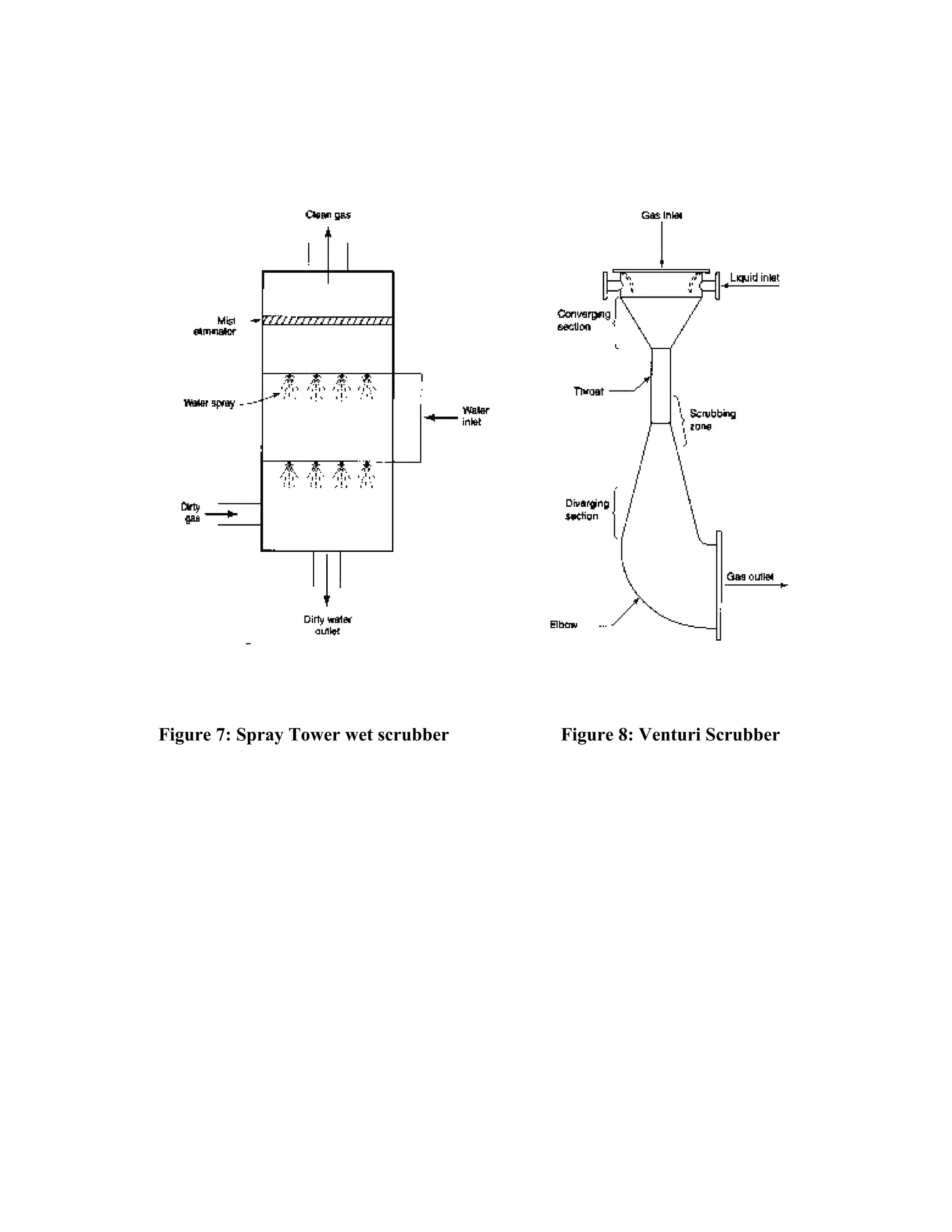
Figure 7 shows a spray scrubber with the gas flowing vertically upwards. Thus,

large drops with sufficient gravity settling velocity will travel downwards and

smaller drops with settling velocities less than the upward gas velocity will travel

upwards to the mist eliminator. Spray nozzle types and sizes and spray nozzle

locations are important for the successful operation of a spray tower.


Venturi Scrubbers

Venturi scrubbers utilize a constricted gas flow section or throat, which causes the

gas to increase in velocity followed by a diverging section where the gases decrease

in velocity. The scrubbing liquid is injected upstream of the throat or directly into

the throat. The liquid injection methods include pressurized spray nozzles and flow

through straight tubes pointed towards the center i.e. perpendicular to the direction

of the gas flow Figure 8 shows a typical venturi scrubber cross-section. It is

imperative to have a uniform droplet distribution across the venturi cross-section so
as to have the droplets properly located to sweep the incoming gases and aerosol

particles evenly. The gases and aerosol particles moving at velocities in the range of

100-400 ft/sec impact upon the slower-moving liquid droplets and the inertial

impaction particle collection mechanism predominates. The throat configuration can

be either circular or rectangular. Adjustable venturi throat openings enable the

variation of the gas velocity and gas pressure drop and are able to adjust for

variations in the total gas volumetric flow rate. Venturi scrubbers occupy the

smallest volume of wet scrubbers and accordingly have the smallest gas residence

time.
Figure 7: Spray Tower wet scrubber   Figure 8: Venturi Scrubber
Cyclonic Scrubbers

Cyclonic scrubbers are wet cyclones, usually with the inlet gas flow through a

tangential entry similar to the classic cyclone configuration. The scrubbing liquid

can be injected at a number of locations including through a center axial spray

manifold and from sprays evenly spaced throughout the tower chamber. The circular

rotating gases with the entrained droplets and the resulting centrifugal force on the

droplets cause them to migrate towards the outer scrubber walls. The droplet

velocities relative to the gas stream are higher compared to gravity spray towers and

this increases the inertial impaction particle collection mechanism which in turn

increases the particle collection efficiency but may reduce the distance the droplet

travels with respect to the gas.


Wetted Filter Scrubber

Wetted filter scrubbers are wet filters and are useful for the collection of liquid

particles or water-soluble particles. The fibers or wires in the filter collect the

particles. At the higher gas velocities in the 1-20 ft/sec range, inertial impaction is

the primary particle collection mechanism. At lower gas velocities i.e. 2-4 ft/min

and with fiber diameters in the 10-20 µm diameter range, the Brownian diffusion

collection mechanism is effective for particles in the 0.01-0.5 µm diameter size

range.
Plate and Tray Scrubber

Plate scrubbers are commonly named after the type of plates used in the process.

Sieve plate scrubbers use perforated plates with the gas flowing vertically upwards

and the liquid flowing countercurrently downwards. Impingement baffles located

immediately downstream of the sieve plate orifice can be used as an impingement

surface to collect the particles. The liquid flows downwards through the plate

perforations and liquid downcomers. With some liquid depth on top of the

perforated plate or tray plate, the gas flowing upwards will form bubbles and foam.

Particle collection occurs in these bubbles in the foam layer. The depth of the liquid

and foam is dependent on the liquid flow rate, downcomer weir height and other

hydraulic parameters.


Prediction of Collection Efficiency

Venturi scrubbers are effective in removing dust particles from gas streams.

However, it is difficult to find reliable design equations for obtaining the collection

efficiencies of venturi scrubbers. In this section, two methods are discussed which

provide equations for the calculation of the pressure drop and collection efficiency

of venturi scrubbers.


Calvert Model

The method developed by Calvert is based on a model that all the energy loss of the

gas stream is employed to accelerate the liquid droplets to the gas velocity in the
venturi throat. According to this method, the pressure drop is given by (Calvert, et

al., 1972):

                                                         
                                                    Q    
                           ∆P = 1.03 x10 −3 u
                                                2
                                                G    L   
                                                    Q
                                                         
                                                          
                                                     G   

where,

ΔP   - pressure drop across the venturi in inches of water

uG   - gas velocity in cm/sec

QL - volume flow rate of the liquid

QG - volume flow rate of the gas

Further, Calvert summarized a development for the particle penetration based upon

an analysis that takes into account the inertial impaction parameter, droplet size,

droplet concentration across the venturi throat and the continuously changing

relative velocity between the particles and the liquid droplets. The penetration can

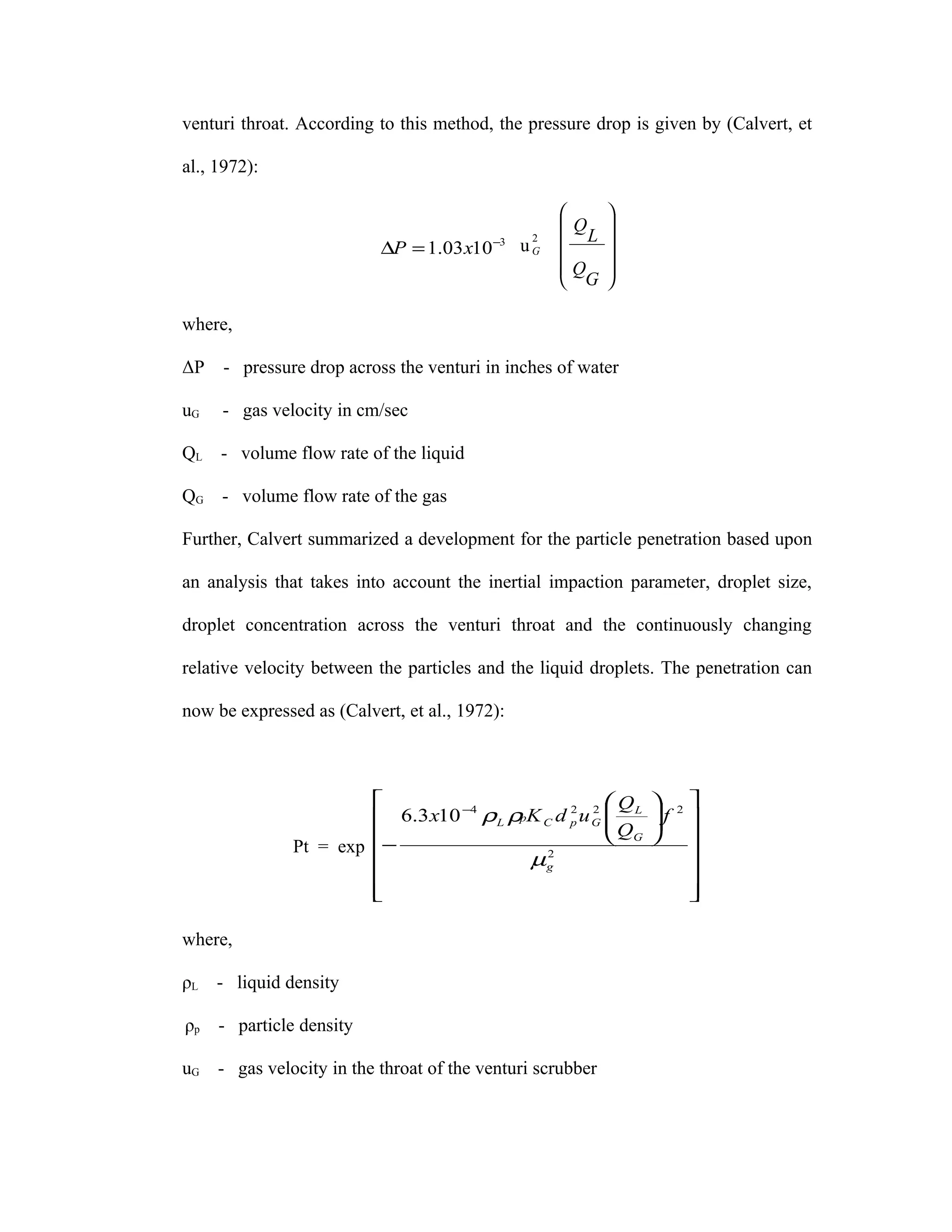
now be expressed as (Calvert, et al., 1972):


                                            2 2  QL                 
                         6.3 x10 ρL ρpK C d p u G           f
                                 −4                                2
                                                   Q                 
                                                   G                
               Pt = exp −                                             
                                       µg 2
                                                                      
                        
                                                                      
                                                                       

where,

ρL   - liquid density

ρp   - particle density

uG - gas velocity in the throat of the venturi scrubber
f     - exponential coefficient which varies from 0.1 to 0.4, typically 0.25

 μg    - gas viscosity

 The collection efficiency can be obtained by using the equation (Wark, et al., 1998):

                                          η = (1 – Pt) 100

 where,

 η    - collection efficiency of the venturi scrubber

 Pt - particle penetration


Hesketh Model

The method developed by Hesketh is based upon a correlation of experimental data

obtained from many different venturi scrubbers. Hesketh developed the following

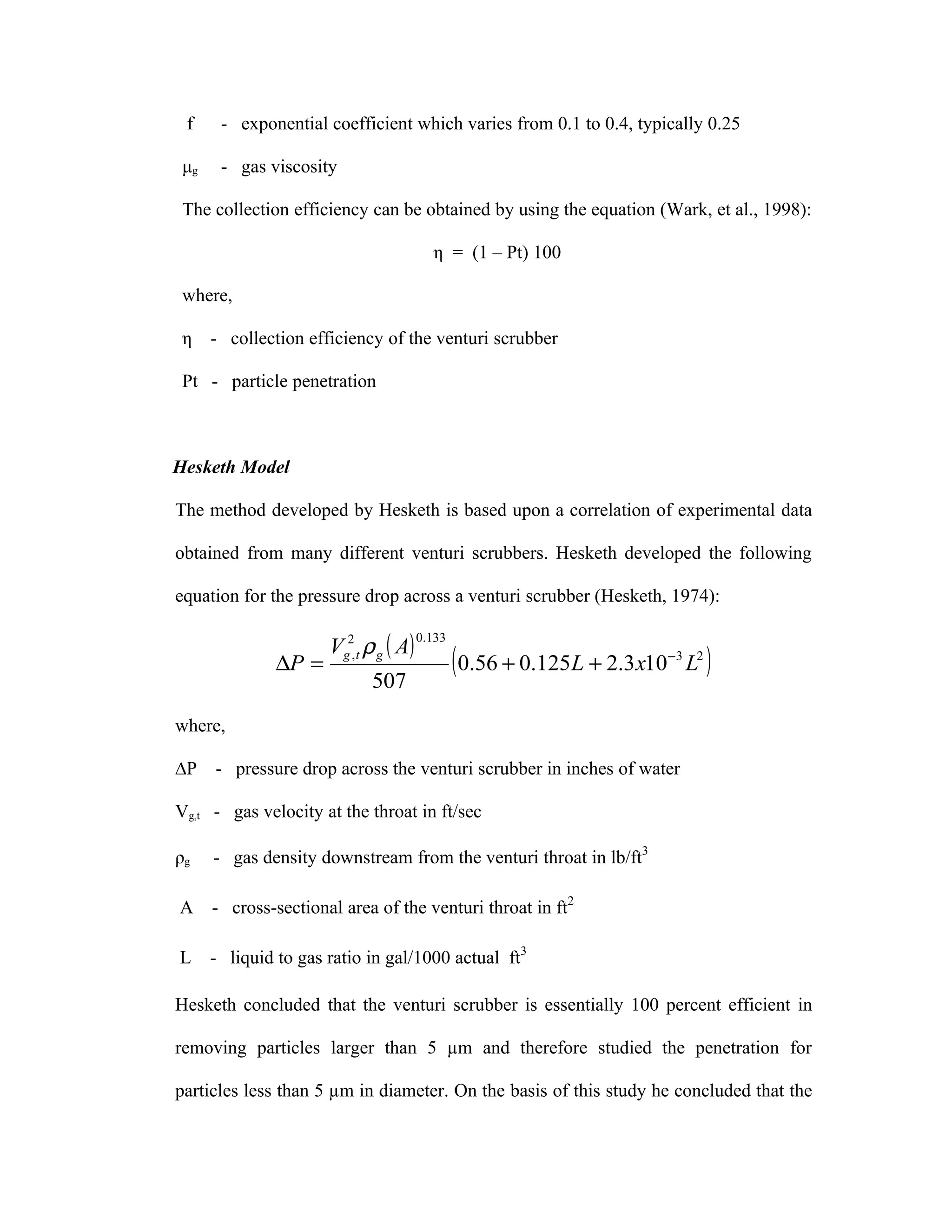
equation for the pressure drop across a venturi scrubber (Hesketh, 1974):

                      Vg2, t ρ g ( A)
                                        0.133

               ∆P =
                             507
                                                ( 0.56 + 0.125L + 2.3x10   −3
                                                                                L2   )
where,

∆P    - pressure drop across the venturi scrubber in inches of water

Vg,t - gas velocity at the throat in ft/sec

ρg    - gas density downstream from the venturi throat in lb/ft3

A     - cross-sectional area of the venturi throat in ft2

L     - liquid to gas ratio in gal/1000 actual ft3

Hesketh concluded that the venturi scrubber is essentially 100 percent efficient in

removing particles larger than 5 µm and therefore studied the penetration for

particles less than 5 µm in diameter. On the basis of this study he concluded that the
overall collection efficiency of particles less than 5 µm in diameter is approximately

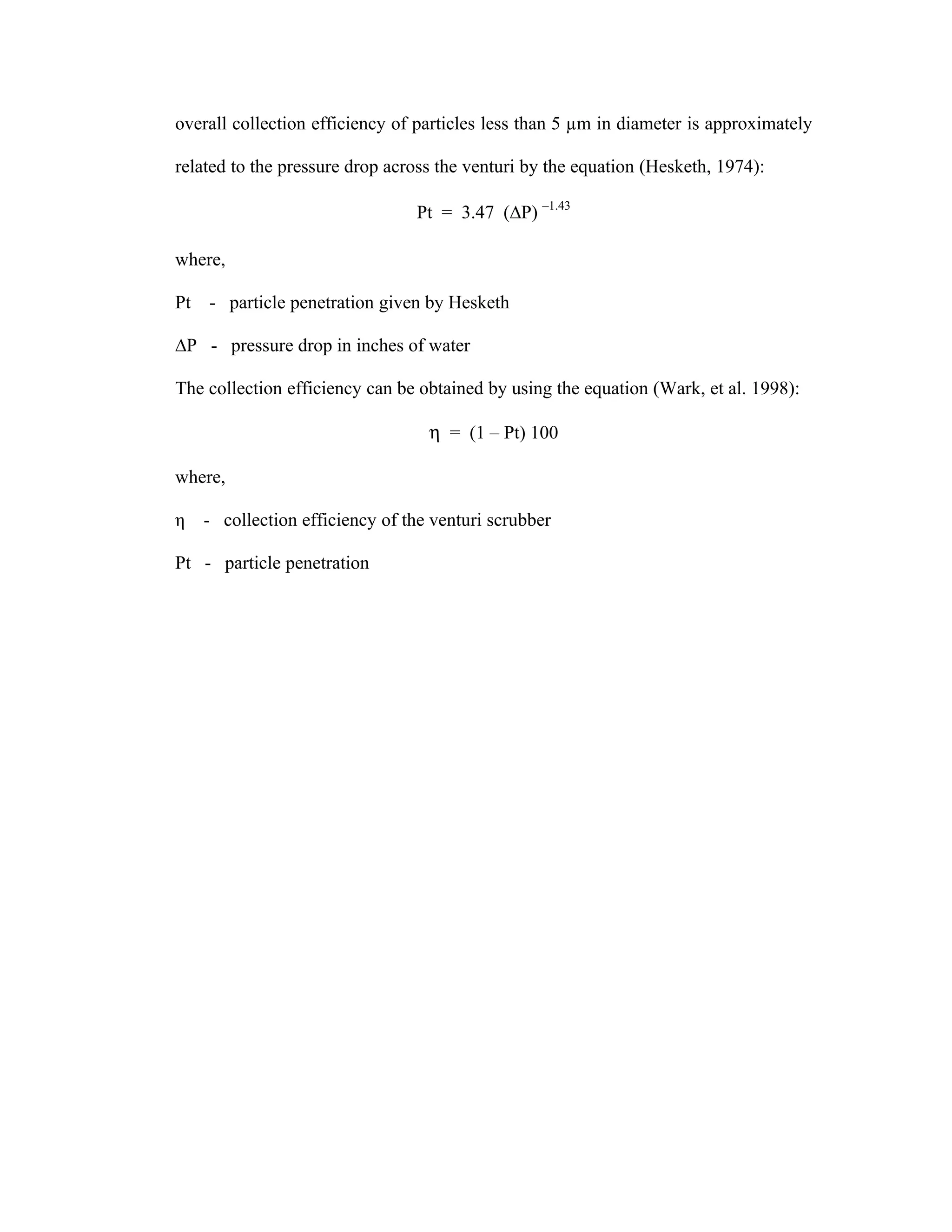
related to the pressure drop across the venturi by the equation (Hesketh, 1974):

                                Pt = 3.47 (∆P) –1.43

where,

Pt - particle penetration given by Hesketh

∆P - pressure drop in inches of water

The collection efficiency can be obtained by using the equation (Wark, et al. 1998):

                                  η = (1 – Pt) 100

where,

η   - collection efficiency of the venturi scrubber

Pt - particle penetration

Design Theory Cyclones

  • 1.
    CYCLONES AND INERTIALSEPARATORS Inertial separators are widely used for the collection of medium-sized and coarse particles. Their relatively simple construction and absence of moving parts means that the capital and maintenance costs are lower than the other control devices available in the particulate control industry. However, the efficiency is not as high and thus inertial separators are usually used as precleaners upstream of the other control devices to reduce the dust loading and to remove larger, abrasive particles. The general principle of inertial separation is that the particulate-laden gas is forced to change direction. As the gas changes direction, the inertia of the particles causes them to continue in the original direction and be separated from the gas stream (Air Pollution Engineering Manual, 2000). Areas of Application Cyclones and centrifugal collectors are utilized in various industries such as chemical, coal mining and handling, combustion fly ash, metal melting, metal working, metal mining, rock products, plastics and wood products. Common uses of cyclones and inertial separators are the collection of grinding, crushing, conveying, machining, mixing, sanding, blending and materials handling dust and for particle collection. Types Cyclones are the most common type of inertial separators. Cyclone separators are gas devices that employ a centrifugal force generated by a spinning gas stream to separate the particulate matter, which could be solid or liquid, from the carrier gas. The separator unit 1
  • 2.
    may be asingle large chamber, a number of small tubular chambers in parallel or series, or a dynamic unit similar to a blower. Units in parallel provide increased volumetric capacity while units in series provide increased removal efficiency. Cyclone separators can be classified as vane-axial or involute. The only difference between these two is the method of introducing the gas into the cylindrical shell in order to impart sufficient spinning motion. In the simple dry cyclone separator, shown in Figure 1, the circular motion is attained by a tangential gas inlet. The rectangular inlet passage has its inner wall tangent to the cylinder and the inlet is designed to blend gradually with the cylinder over a 180-degree involute. Figure 2 shows a vane-axial cyclone. In this case, the cyclonic motion is imparted to the axially descending dirty gas by a ring of vanes. In either case, the operation depends upon the inertia of the particles to move in a straight line even as the direction of the gas stream is changed. The centrifugal force due to a high rate of spin flings the dust particles to the outer walls of the cylinder and the cone. The movement of the particles across the gas stream can be seen in Figure 3. The particles then slide down the walls and into the storage hopper. The cleaned gas reverses its downward spiral and forms a smaller ascending spiral. A vortex finder tube that extends downward into the cylinder aids in directing the inner vortex out of the device. The cyclone separator is usually employed for removing particles 10 μm in size and larger. However, conventional cyclones seldom remove particles with an efficiency greater than 90 percent unless the particle size is 25 μm or larger. High efficiency cyclones are available and are effective with particle sizes down to 5 μm. A high-volume design sacrifices efficiency for high rates of collection. It might be used as a precleaner to 2
  • 3.
    Figure 1: InvoluteCyclone Separator Figure 2: Vane Axial Separator 3
  • 4.
    Figure 3: Movementof particles across the gas streamlines 4
  • 5.
    remove the largerparticles before the gas passes through another piece of collection equipment. Cyclones can be optimized for high collection efficiencies by using small diameters, long cylinders and high inlet velocities. Factors Affecting Collection Efficiency Installation Procedures For cyclones to have good collection efficiency, proper installation procedures are of primary importance. The cyclone collector must be airtight in order to eliminate reentrainment of the particles back into the gas stream. Therefore, while installing equipment such as access doors, inlet and outlet plenums and dust disposal features these areas must be completely sealed. Any leakage in the cyclone collector can cause a 25 percent or more loss in the collection efficiency. Erosion and Fouling Erosion and Fouling of cyclones are problems that seriously affect the cyclone collection efficiency and are encountered during the operation and maintenance activities. Erosion in cyclones is caused by the striking or rubbing of dust particles on the inside wall of the cyclone. Erosion increases with high dust loadings, high inlet velocities, high particle specific gravity values and the strike angle (Air Pollution Engineering Manual, 2000). The area of the cylindrical shell opposite to the inlet may experience excessive wear if the gas contains large dust particles. Welded seams in the cyclone design are also areas that tend to be susceptible to erosion because of surface irregularities. Choosing the proper cyclone diameter size can control erosion. Further, using thicker material in the 5
  • 6.
    cone area andabrasion resistant removable wear plates (linings) at the strike zone are good design options that help in controlling erosion. Fouling of a cyclone collector occurs on account of the plugging of the dust outlet or dust buildup on the cyclone walls. Plugging of the dust outlet occurs by large pieces of material becoming lodged in the outlet thereby forming an obstruction about which small particles can build up. These conditions can lead to reentrainment of the dust into the gas stream. For large-diameter cyclones, an axial cleanout opening with a bolted cover plate in the top of the outlet pipe can be provided so that a rod can be inserted to clear a blockage. Material buildup on the cyclone walls is a function of the dust. Soft, fine dust has a tendency to build up on the cyclone walls. Particles below 3 µm in diameter possess inherently greater cohesive and adhesive forces. Condensation of moisture on the cyclone walls also contributes to the accumulation of material on the walls. Wall smoothness can help to reduce the amount of material buildup. Electropolishing of walls has been a successful method in minimizing buildup. Particle Size Collection efficiency is a strong function of particle size and increases with increasing particle size. Also, the efficiency is greater for particles with higher densities than for 6
  • 7.
    Figure 4: CollectionEfficiency as a function of particle size for different types of cyclones 7
  • 8.
    lower densities. Figure4 shows the variation of the cyclone collection efficiency with different particle sizes for different types of cyclones. Representative overall cyclone efficiencies are presented in the table shown below. Table 1: Cyclone Collection Efficiencies for varying sizes of the particles (Stern, et al., 1955) Particle Size (μm) Conventional Cyclone High-Efficiency Cyclone <5 < 50 50-80 5-20 50-80 80-95 15-50 80-95 95-99 > 40 95-99 95-99 Physical Properties Physical properties of the gas can also have some effect on the collection efficiency of a cyclone. Increasing the gas temperature decreases its density and increases its viscosity. The direct effect on efficiency by changes in the gas density is so much smaller than the density of the particles. If the viscosity of the gas that carries the dust particles to the cyclone increases then the collection efficiency will decrease with all the other factors remaining constant. Prediction of Collection Efficiency Collection efficiency is a strong function of the particle size and it increases with increasing particle size. Determination of the overall collection efficiency requires the knowledge of the particle size distribution of the dust particles. The dust-laden gas enters 8
  • 9.
    the cyclone andspins through Ne revolutions in the main outer vortex before entering the inner vortex and passing upwards towards the exit of the cyclone. The value of Ne is derived from the following equation (Wark, et al., 1998): 1 L  Ne =  L1 + 2  H 2 where, L1 - height of the main upper cylinder L2 - height of the lower cone H - height of the rectangular inlet through which the dirty gas enters The derivation of the cyclone collection efficiency is based on the following theory: Particles enter the cyclone with the gas stream but tend to move outwards under the influence of centrifugal force. This is resisted by the drag of the particles moving radially through the gas, and the resultant terminal or radial velocity of the particles is found by equating the centrifugal and drag forces. To be collected, the particles must reach the outer wall before the gas leaves the outer vortex. The time and the distance are both known quantities. The time is the gas residence time, which depends on gas inlet velocity, radius of the cyclone and number of turns in the vortex. The maximum value of the distance to be traveled is the length from the inner edge of the inlet to the outer wall. Assuming laminar flow, an expression is derived that relates the collection efficiency to the different cyclone parameters and operating conditions (Wark, et al., 1998): 9
  • 10.
    πN e ρPd PVg 2 η= 9 µW where, η - collection efficiency Ne - effective number of revolutions ρp - particle density dp - particle diameter Vg - gas velocity W - width of the rectangular inlet This model indicates that the efficiency is directly proportional to the particle diameter (squared), the number of vortex turns and the inlet velocity whereas it is inversely proportional to the cyclone inlet width. The model also predicts a finite value of the particle diameter dp above which the collection efficiency is 100 percent. However, experimental evidence shows that the efficiency approaches 100 percent asymptotically with increasing particle size. 10
  • 11.
    ELECTROSTATIC PRECIPITATORS An electrostaticprecipitator, also referred to as an ESP, is a particle control device that uses electrical forces to move the particles out of the flowing gas stream and onto collector plates. The particles are given an electric charge by forcing them to pass through a corona. Corona is a region in which the gaseous ions flow. The electrical field that forces the charged particles to the walls comes from electrodes maintained at high voltages in the center of the flow lane. Once the particles are collected on the plates, they must be removed from the plates without reentraining them into the gas stream. This is usually accomplished by knocking them loose from the plates and allowing the collected layer of particles to slide down into a hopper. The particles are then evacuated from the hopper. Some precipitators remove the particles by intermittent or continuous washing with water. Electrostatic precipitators are generally constructed for volumetric rates ranging from 100 to 4,000,000 ft3/min. Areas of Application Electrostatic precipitators are widely used in cement factories, pulp and paper mills, steel plants, non-ferrous metal industries, chemical industries, petroleum industries and electric power industries. ESPs are commonly used for the collection of acid mist, fly ash and sulfuric and phosphoric mist and also for the recovery of cement dust from kilns and various other valuable materials from the gas stream. 11
  • 12.
    Types Electrostatic precipitators areconfigured in several ways. These configurations depend upon the control action expected from them and on economic considerations. Plate-Wire Precipitator Plate-wire ESPs are used in a wide variety of industrial applications including coal-fired boilers, cement kilns, solid waste incinerators, paper mill recovery boilers, petroleum refining catalytic cracking units, sinter plants, basic oxygen furnaces, open hearth furnaces, electric arc furnaces and glass furnaces. In a plate-wire ESP the gas flows between parallel plates of sheet metal and high-voltage electrodes. These electrodes are long wires weighted and hanging between the plates or are supported there by mast-like structures. Within each flow path the gas flow must pass each wire in sequence as it flows through the unit. The plate-wire ESP allows many flow lanes to operate in parallel and each lane can be quite tall. As a result, this type of ESP is well suited for handling large volumes of gas. The need for rapping the plates to dislodge the collected material has caused the plate to be divided into sections, which can be rapped independently. The power supplies are often sectionalized in the same way to obtain higher operating voltages. Dust also deposits on the discharge electrode wires and must be removed periodically. The power supplies for the ESP convert the industrial AC voltage in the range of 220-480 volts to a pulsating DC voltage of around 20,000-100,000 volts. The supply consists of a step-up transformer, high-voltage rectifiers and filter capacitors. The unit may supply 12
  • 13.
    either a half-waveor full-wave rectified DC voltage. There are auxiliary components and controls to allow the voltage to be adjusted to the highest-level possible without excessive sparking and to protect the supply and electrodes in the event a short circuit occurs. The voltage applied to the electrodes causes the gas between the electrodes to break down electrically. This action is known as corona. The electrodes are usually given a negative polarity, because a negative corona supports a higher voltage as compared to a positive corona before a sparking occurs. The ions generated in the corona follow electric field lines from the wires to the collecting plates. Thus, each wire establishes a charging zone through which the particles must pass. As the particles pass each successive wire, they are driven closer to the collecting walls. However, the turbulence in the gas tends to keep them uniformly mixed with the gas. The collection process is therefore a competition between the electrical and dispersive forces. Eventually, the particles approach close enough to the walls so that the turbulence drops to low levels and the particles are collected. If the collected particles could be dislodged into the hopper without losses then the ESP would be extremely efficient. The rapping process that dislodges the accumulated layer also projects some of the particles back into the gas stream. Later sections then process these reetrained particles again. But the particles reetrained in the last section of the ESP have no chance to be collected and escape the unit thereby affecting the performance of the ESP. The collected particles generally form a continuous layer on the ESP plates. Thus the entire ion current must pass through the layer before reaching the ground plates. This current creates an electric field in the layer and it can become large enough to cause a local electrical breakdown. When this occurs, new ions of the wrong polarity are injected 13
  • 14.
    into the wire-plategap where they reduce the charge on the particles and may cause sparking. This breakdown condition is called back corona. Back corona is prevalent when the resistivity of the layer is higher than 2 x 10¹¹ ohm-cm. However, the operation of an ESP is not hampered by back corona for lower resistivities. Flat-Plate Precipitators A significant number of smaller precipitators use flat plates instead of wires for the high- voltage electrodes. The flat plates increase the average electric field that can be used to collect the particles and they provide an increased surface area for the collection of particles. Corona cannot be generated on flat plates by themselves and thus corona- generating electrodes are placed ahead of and sometimes behind the flat-plate collecting zones. These electrodes may be sharp-pointed needles attached to the edges of the plates or independent corona wires. Flat-plate precipitators operate equally well with either negative or positive polarity. Flat-plate ESPs operate with little or no corona current flowing through the collected dust except directly under the corona needles or wires. This has two consequences. The first is that the unit is somewhat less susceptible to back corona than conventional units are because no back corona is generated in the collected dust and particles charged with both polarities of ions have large collection surfaces available. The second consequence is that the lack of current in the collected layer causes an electrical force that tends to remove the layer from the collecting surface, which can in turn lead to high rapping losses. Flat ESPs seem to have a wide application for high-resistivity particles with small mass median diameters (MMDs) of around 1-2 μm. These applications especially emphasize 14
  • 15.
    the strengths ofthe design because the electrical dislodging forces are weaker for small particles than for larger ones. Tubular Precipitators Originally, all ESPs were tubular with the high-voltage electrode running along the axis of the tube. Tubular precipitators have typical applications in sulfuric acid plants, coke oven by-product gas cleaning and iron and steel sinter plants. Such tubular units are still used for some applications with many tubes operating in parallel to handle increased gas flows. The tubes may be formed as a circular, square or hexagonal honeycomb with gas flowing upwards or downwards. The length of the tubes can be selected to fit conditions. A tubular ESP can be tightly sealed to prevent leaks of material, especially valuable or hazardous material. A tubular ESP is essentially a one- stage unit and is unique in having the entire gas pass through the electrode region. The high-voltage electrode operates at one voltage for the entire length of the tube and the current varies along the length as the particles are removed from the system. No sneakage paths are around the collecting region but corona non-uniformities may allow some particles to avoid charging for a considerable fraction of the tube length. Tubular ESPs make up only a small portion of the ESP population and are most commonly applied where the particulate is either wet or sticky. These ESPs are usually cleaned with water and they have reentrainment losses of a lower magnitude in comparison with the other dry particulate precipitators. 15
  • 16.
    Wet Precipitators Wet precipitatorsare operated with wet walls instead of dry, as in the ESP types discussed above. The water flow may be applied intermittently or continuously to wash the collected particles into a sump for disposal. The advantage of the wet-wall precipitator is that it has no problems with rapping reentrainment or back corona. The disadvantage is that the increased complexity of the wash and the fact that the collected slurry must be handled more carefully adds to the expense of disposal. Two-Stage Precipitators The two-stage precipitator is a series device with the discharge electrode preceding the collector electrodes. For indoor applications, the unit is operated with a positive polarity to limit ozone generation. Advantages of such a configuration includes more time for particle charging, less propensity for back corona and economical construction for small sizes. This type of a precipitator is generally used for gas-flow volumes of 50,000 acfm and less and is applied to submicrometer sources emitting oil mists, smokes, fumes or other sticky particulates because there is little electrical force to hold the collected particulates on the plates. Preconditioning of gases is normally a part of the system. Cleaning may be by water wash of the modules. Two-stage precipitators are generally considered to be separate and distinct types of devices as compared with large, high gas-volume and single-stage ESPs. 16
  • 17.
    Auxiliary Equipment Along withthe ESP itself, a control system usually includes the following auxiliary equipment: a capture device, ductwork, dust removal equipment, fans, motors and starters and a stack. A typical arrangement is shown in Figure 5. In addition, spray coolers and mechanical collectors may be needed to precondition the gas before it reaches the ESP. Capture devices are usually hoods that exhaust pollutants into the ductwork or are direct exhaust couplings attached to a combustor or process equipment. These devices are usually refractory lined, water cooled or simply fabricated from carbon steel depending on the gas-stream temperatures. Refractory or water-cooled capture devices are used where the wall temperatures exceed 800oF whereas carbon steel is used for lower temperatures. Spray chambers may be required for processes where the addition of moisture will improve precipitation or protect the ESP from warpage. For combustion processes with exhaust gas temperatures below approximately 700oF, cooling would not be required and the exhaust gases can be delivered directly to the precipitator. When much of the pollutant loading consists of relatively large particles, mechanical collectors such as cyclones may be used to reduce the load on the ESP especially at high inlet concentrations. The fans provide the motive power for air movement and can be mounted before or after the ESP. A stack vents the cleaned stream to the atmosphere. Screw conveyors or pneumatic systems are often used to remove captured dust from the bottom of the hoppers. Wet ESPs require a source of wash water to be sprayed at the top of the collector plates either continuously or at timed intervals. The water flows with the 17
  • 18.
    Figure 5: ESPcontrol system and auxiliary equipment 18
  • 19.
    collected particles intoa sump from which the fluid is pumped. A portion of the fluid may be recycled to reduce the total amount of water required. The remainder is pumped directly to a settling pond or passed through a dewatering stage with subsequent disposal of the sludge. Factors affecting Collection Efficiency For most applications, the collection efficiency of electrostatic precipitators run from 90 to 99 percent. With the introduction of stricter air pollution codes, efficiencies in the range of 99 to 99.9 percent have become quite common. Acid mists and catalyst recovery units have efficiencies in excess of 99 percent. However, for materials like carbon black, which have very low efficiencies due to low collection capacity, very high efficiencies can be achieved by a proper combination of an ESP with a cyclone. Also, sometimes the gas entering the ESP is pre-treated by using certain mechanical collectors or by adding certain chemicals to the gas to change the chemical properties of the gas so as to increase their capacity to collect on the discharge electrodes, thereby increasing the overall collection efficiency. The various factors that affect the performance of electrostatic precipitators are explained below: Particle Resistivity One property of the dust layer that is extremely important in the precipitator operation is the dust electrical resistivity. Owing to the widely varying nature of industrial dusts, the resistivity may vary from 10-3 to 1014 ohm-cm. When the resistivity is less than 10 4 ohm- 19
  • 20.
    cm, there isa rapid movement of charge from the deposited dust to the collector plate. Thus insufficient electrostatic charge remains on the collected dust particles to hold them together. Reentrainment back into the gas stream frequently results and thus efficiency suffers. Carbon black, an industrial product of importance, is an example of low- resistivity dust. On the other hand, resistivities greater than about 1010 ohm-cm are a major source of poor performance in precipitators. At first, a sizeable fraction of the total voltage drop between the electrodes occurs across a high-resistivity dust layer as a result of the electrical insulating effect. Hence only a portion of the total corona power is available to ionize and drive the charged particles to the collection electrode. A second problem due to high resistivity is known as back corona or back ionization. This effect occurs when the voltage drop across the layer exceeds the dielectric strength of the layer. Air trapped in the collected dust layer becomes ionized as a result of the large potential drop across the layer. Any positive ions formed will tend to migrate away from the collector plate and neutralize the ionized particles approaching the plate. This decreases the amount of particulate matter deposited. These effects reduce the collection efficiency of a precipitator. Electrostatic precipitation is the most effective theory in collecting dust in the resistivity range of 10 4 to 1010 ohm-cm. Since many industrial dusts do not fall into this range, it is frequently necessary to change the operating conditions in order to enhance collection efficiencies. Two gas properties that have a sizeable influence on the dust resistivities are temperature and humidity. 20
  • 21.
    Sneakage and RappingReentrainment Sneakage and rapping reentrainment are best considered on the basis of the sections within an electrostatic precipitator. Sneakage occurs when a part of the gas flow bypasses the collection zone of a section. Generally, the portion that bypasses the zone is thoroughly mixed with gas that passes through the zone before all the gas enters the next section. This mixing cannot always be assumed, and when sneakage paths exist around several sections, the performance of the whole ESP is seriously affected. Further, the collected dust accumulates on the plates until they are rapped when most of the material falls into the dust collection hopper. A fraction of it is reentrained by the gas flow and leaves the section thereby affecting the efficiency of the electrostatic precipitator. Effect of gas volume The gas flow has a direct bearing on the ESP size and performance. Gas flow rates are overstated to ESP suppliers, to take care of variations in operating condition including upset conditions. This results in substantiated increase in size and cost of the ESP as evident from the rearranged Deutsch-Anderson Equation given as follows (Bapat, 2000): Q  A = −  ln(1 −η) w  where, A - area of the collection electrodes in m2 or ft2 21
  • 22.
    w - driftvelocity of the particle in m/s Figure 6: Variation of collection efficiency with gas flow rate (Bapat, 2000) 22
  • 23.
    Q - volumeflow rate in m3/s or ft3/s η - efficiency of the ESP Sometimes gas flow rates increase due to changes in the process conditions such as capacity enhancement. Increase in gas flow rate beyond design limits reduces the collection efficiency (Ramanan, et al., 1984) as can be seen in Figure 6 shown above. This is because an increase in gas velocity increases dust reentrainment during rapping (electrode cleaning process). Reentrainment is more pronounced for fine particles and those, which have little tendency to agglomerate. Prediction of Collection Efficiency Predicting the collection efficiency involves knowledge of the various parameters of an electrostatic precipitator. The limited charge q given to a spherical particle of diameter dp greater than approximately 1 µm is given by (Wark, et al., 1998): q = p π Є0 EC dp2 where, Є0 - permittivity EC - strength of the charging field dp - particle diameter The factor p can be calculated by using the equation: 3D p = D+2 23
  • 24.
    where, D - dielectricconstant Since the dielectric constant for most types of dusts falls between 2 and 8, thus the factor p typically lies between 1.5 and 2.4. In the collection mechanism the charged dust particles migrate to the plate electrodes, where the dust collection occurs. The speed at which the migration takes place is known as the migration velocity or the drift velocity w. It depends upon the electrical force on the charged particle as well as the drag force developed as the particle attempts to move perpendicular to the main gas flow towards the collecting electrode. The electrostatic precipitator is proportional to the charge on the particle and the precipitating or collecting field strength Ep. The electrostatic force Fe can thus be shown as: Fe = q Ep = p π Є0 EC Ep dp2 The drag force on the particle, which is in the Stoke’s flow region, is represented by: 3π g d p w µ Fd = KC where, KC - Cunningham correction factor which should be applied for particles with a diameter less than roughly 5 µm Upon equating the electrical and drag forces, the drift velocity for spherical particles in the Stoke’s flow region is given by (Wark, et al., 1998): pεo EC EP d P w= KC 3µ g 24
  • 25.
    where, w - drift velocity in m/s μg - gas viscosity in kg/m-sec dp - particle diameter in m Є0 - permittivity and is taken as 8.854 x 10⁻¹² coulombs/volt-meter. Thus, the above equation can be modified as: 2.95 x10 −12 pE C E P d P w= KC µg The viscosity of air at room conditions is 1.86 x 10⁻⁵ kg/m-sec. This equation shows that the migration velocity is directly proportional to the particle diameter and the square of the field strength (that is if EC and Ep are equal) and inversely proportional to the gas viscosity. The length of the precipitator passage required for the removal of a particular size of particle can be estimated roughly from knowledge of the drift velocity. After allowing for a charging time period, the time required for a particle to migrate to the collection electrode must be less than the time it would take the particle to pass with the gas through the precipitator. When these times are exactly equal then that particular particle size will be collected with 100 percent efficiency. For a theoretical efficiency of 100 percent, the length of the gas passage required is given by: sV g LC = w where, LC - length of the collecting electrode in m 25
  • 26.
    s - distance between the charging and collecting electrodes in m Vg - gas velocity in the flow passage in m/s The following equation, known as the Deutsch-Anderson equation, relates the efficiency of an ESP to various operating parameters. According to this equation, the collection efficiency can be expressed as shown below (Benitez, 1993): −A  η = 1 – exp   Q w    where, A - area of the collection electrodes in m2 or ft2 w - drift velocity of the particle in m/s Q - volume flow rate in m3/s or ft3/s The quantity A/Q in the above equation is known as the specific collection area (SCA). It is a parameter used to compare ESPs and roughly estimate their collection efficiencies. The SCA is obtained as the total collector plate area divided by the gas volume flow rate and has the units of sec/m or sec/ft. WET SCRUBBERS 26
  • 27.
    The control ofparticulate air pollutant emissions with wet scrubbers involves contacting or scrubbing the gases with a liquid. The aerosol particles are transferred from their suspension in a gaseous medium to the surface of the scrubbing liquid via mechanisms of inertial impaction, gravitational settling, Brownian diffusion, diffusiophoresis, electrostatics and thermophoresis. For particles greater than about 0.5 µm diameter inertial impaction is usually the primary collection mechanism and for particles smaller than about 0.05 µm diameter Brownian diffusion is the primary collection mechanism. The form or geometric shape of the scrubbing liquid can be droplets, wetted walls, liquid sheets and bubbles. Wet scrubbers have certain disadvantages not found with other dry equipment. One major problem is to handle and dispose off the wet sludge, which is an inherent product of the process. However, in some applications the sludge may be easier to manage than dry dust. If the equipment is installed in the natural environment then the question of freezing in cold weather must be considered. The presence of water also has a tendency to increase the corrosiveness of materials. Areas of Application Wet scrubbers are effectively used for the removal of sticky, wet, corrosive or liquid particles that cannot be easily removed from dry surfaces and for explosive or combustible particles. Further, they are useful for collecting particles while simultaneously absorbing soluble gases such as SO2. Wet scrubbers can also be used when there are wastewater treatment systems available on the site with adequate reserve capacity to handle the liquid effluent. 27
  • 28.
    Types Wet scrubbers areconfigured into five main types depending upon their gas-liquid contacting methods and their geometrical shapes. The wet scrubber design and operating parameters include gas pressure drop, liquid pressure drop, liquid-gas flow ratio, scrubber geometrical shape, location of water sprays, gas residence time, droplet size distribution, gas velocities, water temperature, gas temperature, water vapor content and particle solubility in water. Some operating parameters and the cut diameters of different particulate wet scrubbers are shown in the Table 2 given below: Table 2: Operating Parameters for Wet Scrubbers (Air Pollution Engineering Manual, 2000) Pressure Drop Liquid/Gas Ratio Liquid Pressure Cut Diameter Scrubber Type (in. of water) (gal/1000 acf) (psig) (µm) Spray Tower 0.5-3 0.5-20 10-400 2-8 Cyclonic 2-10 2-10 10-400 2-3 Venturi 10-150 2-20 0.5-20 0.2 28
  • 29.
    Spray Towers A spraytower uses liquid droplets formed by the liquid flowing through spray nozzles. The aerosol particles are collected on these liquid drops. The size distribution and spray pattern of the drops are related to the nozzle configuration, the liquid being sprayed, the liquid pressure at the nozzle and the liquid flow rate through the nozzle. Horizontal and vertical gas flow paths are used so that the liquid drops travel in a countercurrent, co-current or cross-flow direction with respect to the gas direction. In some spray scrubbers all these droplet directions occur depending on the spray pattern, nozzle orientation and droplet size distribution. Figure 7 shows a spray scrubber with the gas flowing vertically upwards. Thus, large drops with sufficient gravity settling velocity will travel downwards and smaller drops with settling velocities less than the upward gas velocity will travel upwards to the mist eliminator. Spray nozzle types and sizes and spray nozzle locations are important for the successful operation of a spray tower. Venturi Scrubbers Venturi scrubbers utilize a constricted gas flow section or throat, which causes the gas to increase in velocity followed by a diverging section where the gases decrease in velocity. The scrubbing liquid is injected upstream of the throat or directly into the throat. The liquid injection methods include pressurized spray nozzles and flow through straight tubes pointed towards the center i.e. perpendicular to the direction of the gas flow Figure 8 shows a typical venturi scrubber cross-section. It is imperative to have a uniform droplet distribution across the venturi cross-section so
  • 30.
    as to havethe droplets properly located to sweep the incoming gases and aerosol particles evenly. The gases and aerosol particles moving at velocities in the range of 100-400 ft/sec impact upon the slower-moving liquid droplets and the inertial impaction particle collection mechanism predominates. The throat configuration can be either circular or rectangular. Adjustable venturi throat openings enable the variation of the gas velocity and gas pressure drop and are able to adjust for variations in the total gas volumetric flow rate. Venturi scrubbers occupy the smallest volume of wet scrubbers and accordingly have the smallest gas residence time.
  • 31.
    Figure 7: SprayTower wet scrubber Figure 8: Venturi Scrubber
  • 32.
    Cyclonic Scrubbers Cyclonic scrubbersare wet cyclones, usually with the inlet gas flow through a tangential entry similar to the classic cyclone configuration. The scrubbing liquid can be injected at a number of locations including through a center axial spray manifold and from sprays evenly spaced throughout the tower chamber. The circular rotating gases with the entrained droplets and the resulting centrifugal force on the droplets cause them to migrate towards the outer scrubber walls. The droplet velocities relative to the gas stream are higher compared to gravity spray towers and this increases the inertial impaction particle collection mechanism which in turn increases the particle collection efficiency but may reduce the distance the droplet travels with respect to the gas. Wetted Filter Scrubber Wetted filter scrubbers are wet filters and are useful for the collection of liquid particles or water-soluble particles. The fibers or wires in the filter collect the particles. At the higher gas velocities in the 1-20 ft/sec range, inertial impaction is the primary particle collection mechanism. At lower gas velocities i.e. 2-4 ft/min and with fiber diameters in the 10-20 µm diameter range, the Brownian diffusion collection mechanism is effective for particles in the 0.01-0.5 µm diameter size range.
  • 33.
    Plate and TrayScrubber Plate scrubbers are commonly named after the type of plates used in the process. Sieve plate scrubbers use perforated plates with the gas flowing vertically upwards and the liquid flowing countercurrently downwards. Impingement baffles located immediately downstream of the sieve plate orifice can be used as an impingement surface to collect the particles. The liquid flows downwards through the plate perforations and liquid downcomers. With some liquid depth on top of the perforated plate or tray plate, the gas flowing upwards will form bubbles and foam. Particle collection occurs in these bubbles in the foam layer. The depth of the liquid and foam is dependent on the liquid flow rate, downcomer weir height and other hydraulic parameters. Prediction of Collection Efficiency Venturi scrubbers are effective in removing dust particles from gas streams. However, it is difficult to find reliable design equations for obtaining the collection efficiencies of venturi scrubbers. In this section, two methods are discussed which provide equations for the calculation of the pressure drop and collection efficiency of venturi scrubbers. Calvert Model The method developed by Calvert is based on a model that all the energy loss of the gas stream is employed to accelerate the liquid droplets to the gas velocity in the
  • 34.
    venturi throat. Accordingto this method, the pressure drop is given by (Calvert, et al., 1972):   Q  ∆P = 1.03 x10 −3 u 2 G  L  Q     G  where, ΔP - pressure drop across the venturi in inches of water uG - gas velocity in cm/sec QL - volume flow rate of the liquid QG - volume flow rate of the gas Further, Calvert summarized a development for the particle penetration based upon an analysis that takes into account the inertial impaction parameter, droplet size, droplet concentration across the venturi throat and the continuously changing relative velocity between the particles and the liquid droplets. The penetration can now be expressed as (Calvert, et al., 1972):  2 2  QL    6.3 x10 ρL ρpK C d p u G  f −4 2 Q     G   Pt = exp −  µg 2       where, ρL - liquid density ρp - particle density uG - gas velocity in the throat of the venturi scrubber
  • 35.
    f - exponential coefficient which varies from 0.1 to 0.4, typically 0.25 μg - gas viscosity The collection efficiency can be obtained by using the equation (Wark, et al., 1998): η = (1 – Pt) 100 where, η - collection efficiency of the venturi scrubber Pt - particle penetration Hesketh Model The method developed by Hesketh is based upon a correlation of experimental data obtained from many different venturi scrubbers. Hesketh developed the following equation for the pressure drop across a venturi scrubber (Hesketh, 1974): Vg2, t ρ g ( A) 0.133 ∆P = 507 ( 0.56 + 0.125L + 2.3x10 −3 L2 ) where, ∆P - pressure drop across the venturi scrubber in inches of water Vg,t - gas velocity at the throat in ft/sec ρg - gas density downstream from the venturi throat in lb/ft3 A - cross-sectional area of the venturi throat in ft2 L - liquid to gas ratio in gal/1000 actual ft3 Hesketh concluded that the venturi scrubber is essentially 100 percent efficient in removing particles larger than 5 µm and therefore studied the penetration for particles less than 5 µm in diameter. On the basis of this study he concluded that the
  • 36.
    overall collection efficiencyof particles less than 5 µm in diameter is approximately related to the pressure drop across the venturi by the equation (Hesketh, 1974): Pt = 3.47 (∆P) –1.43 where, Pt - particle penetration given by Hesketh ∆P - pressure drop in inches of water The collection efficiency can be obtained by using the equation (Wark, et al. 1998): η = (1 – Pt) 100 where, η - collection efficiency of the venturi scrubber Pt - particle penetration