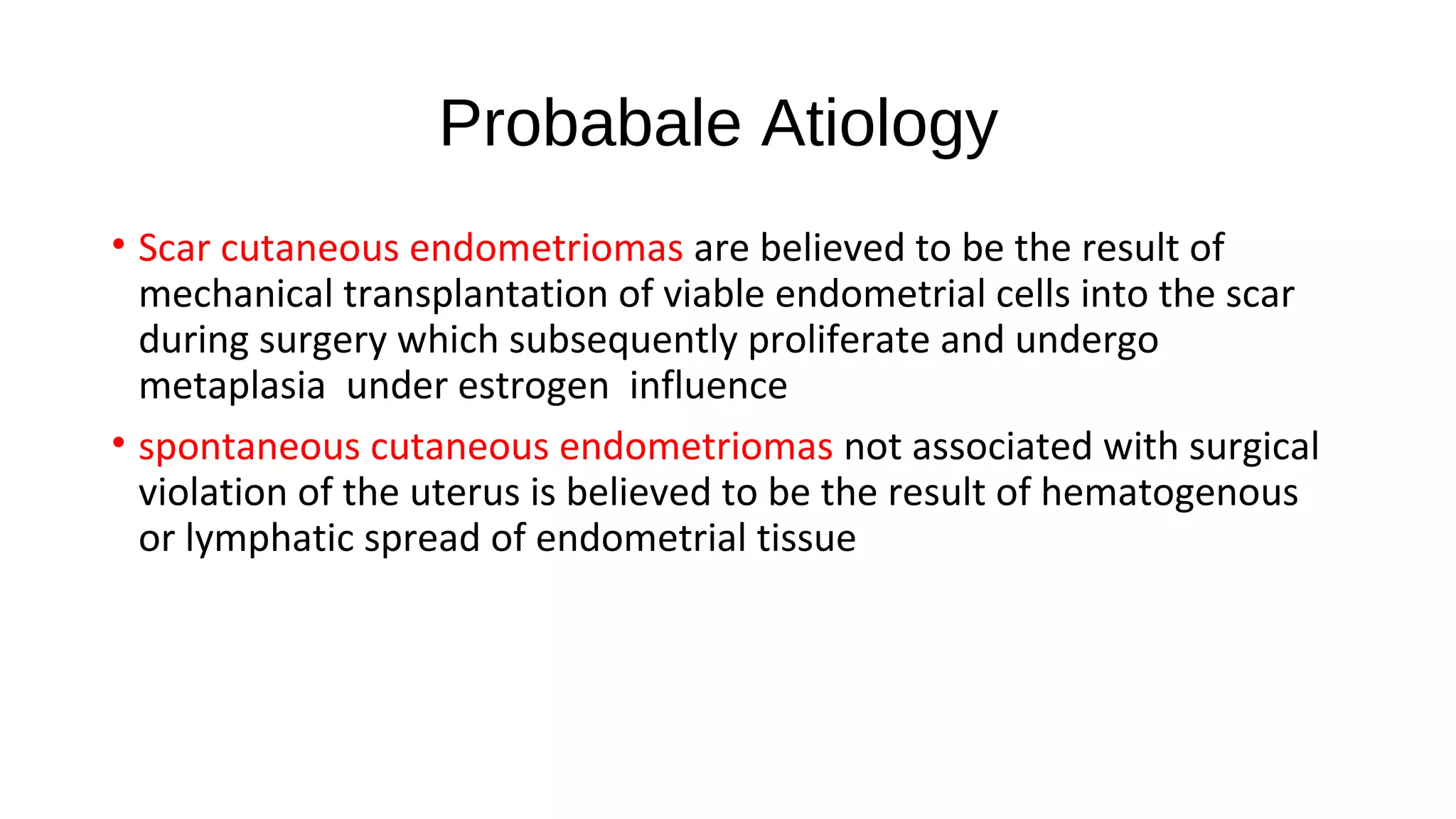
Cutaneous
Caesarean
Scar
EndometriosisDr Muhammad M Al Hennawy
Ob/gyn Consultant
Ras el bar –dumyat - egypt
Cutaneous Cesarean Scar Endometriosis
• It is a type of cutaneous endometriosis arising on or near a Cesarean
section Scar
Endometriosis is defined as a growth of ectopic endometrial tissue
outside the uterine cavity that responds to hormonal stimulation
A Caesarean Section Scar Endometriosis
• It is a rare form of extrapelvic endometriosis
• Deposits of endometrial glands and stromal cells can be located at
• the dermis of skin,
• subcutaneous tissue,
• sheath,
• rectus muscle,
• intraperitoneally, or
• in the uterine myometrium (within uterine wall Cesarean section
scars).
Types of cutaneous endometriosis
Spontaneous cutaneous endometriosis is limited to the umbilicus and
inguinal area
In other locations, such as the lower abdominal wall, it practically
always arises in surgical scars particularly those from caesarean
sections
Cutaneous Cesarean Scar endometriosis is a type of cutaneous
endometriosis arising on or near a Cesarean section Scar
Probabale Atiology
• Scar cutaneous endometriomas are believed to be the result of
mechanical transplantation of viable endometrial cells into the scar
during surgery which subsequently proliferate and undergo
metaplasia under estrogen influence
• spontaneous cutaneous endometriomas not associated with surgical
violation of the uterus is believed to be the result of hematogenous
or lymphatic spread of endometrial tissue
Incidence
• The exact incidence of scar endometriosis is unknown
• The incidence of cesarean scar endometriosis is between 0.03% and
1.7%,
• But clinical experience suggests that the actual incidence may be
higher.
Certain Risk Factors May Be Associated
With Scar Endometriosis
• Hystrectomy
• Cesarean section before onset of labour
• Anterior placenta previa
• Early hysterotomy less than 22 weeks (early decidua has more
pluripotential capababilities and lead to cellular replication )
• Heavy menstrual blood flow and
• Alcohol consumption
Macroscopy
•It is appear as whitish fibrous tissue
•with thick chocolate coloured liquid areas
Microscopy
• Major positive components of scar endometriosis are glandular
and stromal elements
• because of hormonal influence , Glandular epithelium my have
appearance proliferative endometrium or secretory
endometrium or menstrual endometrium
• Columnar or cuboidal or flat epithelial cells line the glands
• Mitoses are frequent during proliferative phase
• Intracytoplasmic vacuoles are the hallmark of secretory phase
• Intraluminal hemorrhage and degenerative changes of
epithelial cells occur in menstrual phase
• Stromal components consist of a mixture of spindle cells and
inflammatory cells including hemosiderin- laden macrophages
• Rarely , decidualisation can occur
Names
• Endometrioma
• scar endometriosis
• Cutaneous endometriosis
• Cesarean scar endometriosis
Symptoms
• Patients may complain of tenderness to palpation and a raised,
unsightly hypertrophic scar (89.0 %).
• The overlying skin may be hyper-pigmented due to deposition of
haemosiderin.
• Most patients have cyclical pain (up to 70%)
• The pain (94.0 %) is usually intermittent and associated with the
patient's menstrual cycle but it may be constant in nature.
• Some reports state that even as (50.0 %) of the patients exhibited
cyclical symptoms.
• Some patients may be asymptomatic
• The median interval between the last cesarean section and admission
to hospital was 36 month (range 12-120 mo)
• the mean length of time between onset of symptoms to surgery
being 31.7 months (range 1-62 months).
levels
• Endometriosis, in patients with scars,
• It is more common in the abdominal skin and subcutaneous tissue
• compared to muscle and fascia.
• Endometriosis involving only the rectus muscle and sheath is very rare.
lesions of scar endometrioma were more common in corner sites, i.e. 2/3 in
midline vertical incision scars and 19/23 in Pfannenstiel incision scars,
with right side predominance
This phenomenon may be due to more operators standing on their patient’s
right side during surgery and the endometrial inoculums not being easily
found and removed.
Pre-operative Diagnosis
• Ultrasound-guided fine-needle aspiration cytology (FNAC) may be
used in diagnosis and to rule out malignancy.
• Abdominal ultrasound scan (US) including power Doppler
examination (Sonographic features are not specific. A subcutaneous
nodule having relatively irregular borders, a heterogeneous
echotexture with internal scattered hyperechoic echoes surrounded
by a hyperechoic ring of variable width, and vascularity may be
present. Occasionally cystic changes may be present ),
• Pelvis ultrasound scan
• CT scan (Well defined soft tissue nodule with heterogenous post-
contrast enhancement and streakiness in the surrounding tissue )or
• MRI (Is the most sensitive imaging modality. Often accurately locates
the lesion in relation to a previous C section scar, with signal
characteristics similar to that of background endometriosis)
Post-operative diagnosis
• A detailed examination of material from cases of cutaneous
endometriosis revealed a range of histopathologic features
similar to those found within the uterine endometrium at each
of the main phases of the menstrual cycle. However, there
appeared to be a poor correlation between histologic
appearance and menstrual stage. Recognition of these cyclic
variations is important for the accurate diagnosis of cutaneous
endometriomas.
• A Biopsy specimen showed fibrotic Dermis with increased
numbers of blood vessels and Scattered glandular structures
with areas of hemosiderin deposition consistent with a
diagnosis of endometriosis.
• Microscopic examination confirmed the preoperatively
presumed diagnosis of cutaneous endometriosis
• In addition, so-called Atypical features described in
endometriosis affecting other anatomic sites may be seen in the
skin
Differential Diagnosis
• Scar endometriosis is rare and difficult to diagnose. It is often misdiagnosed as
• stitch granuloma,
• Pyogenic granuloma
• inguinal hernia,
• incisional hernia
• lipoma,
• Dermatofibroma
• abscess,
• cyst,
• a strange body,
• incisional hernia,
• desmoid tumor,
• keloid ,
• sarcoma,
• lymphoma, or
• primary and metastatic cancer.
Prevention
-There would be no obvious prevention
-the question arises again
-- do you go to the effort and expense on 100% of patients to
protect <0.5% of them from a benign, relatively easily
treated problem?
- placing some type of barrier over each layer of the abdominal wall
(especially the fascia) before conducting surgery within the
peritoneum
-the used sponge should be discarded immediately after cleaning
the uterine cavity,
-not allowing instruments and swabs which have touched the
endometrium at the time of caesarian section from coming in
contact with the subcutaneous tissues or skin.
-the suture material used for uterus should not be reused while
closing abdominal wall
- Thorough sucking out and washing of endometriomas before
ovarian cystectomy in chocolate cysts could also be useful in
avoiding endometrial tissues from reaching the abdominal wall
- the surgical area should be cleaned thoroughly and irrigated
with saline solution before wound closure and repair of
peritoneum at the time of cesarean section closure
- Also it is strongly recommended that the abdominal wound be
cleaned thoroughly at both corner sites (especially the
operator’s side).
The Treatment Of Choice
• In general, the treatment of choice for abdominal wall scar
endometriosis or CS scar endometrioma is surgical excision, even for
recurrent cases.
• Wide surgical excision with at least a 1 cm margin and/or patch
grafting for fascia defect have been emphasized to prevent hernias..
• Medical therapies used in the treatment of endometriosis include
nonsteroidal anti-inflammatory agents, oral contraceptives, and
analogs of gonadotropin releasing hormone (GnRH). All medical
treatments are equally effective, with 80% to 85% of patients having
symptomatic improvement. The major differences are their side
effects.
• A combination of surgical excision and with either GnRH-agonist or
danazol, is recommended
Surgical excision
• Total surgical excision is considered to be the gold standard for both
diagnosis and treatment. Resection must be complete with clear
margins to prevent recurrence.
• The depth of cutaneous endometriosis can only be determined at the
time of surgery,
• It is crucial to inform patients preoperatively about the possible
placement of a mesh to repair the defect in the rectus sheath. Thus far,
there have been some reports of the use of a Prolene mesh following
excision of cutaneous endometriosis.
• Functional, and cosmetic standpoints can be achieved with conservative
excision followed by mini-abdominoplasty of extensive Cesarean scar
endometriosis
Role of a gynecologist
• Primary excision of the nodule may be done by the gynaecologist.
However, sometimes the gynaecologist may be called in only after
the diagnosis of endometriosis has been made on histopathology.
• One has to decide whether a laparoscopy has to be done to rule out
pelvic endometriosis. It has to be remembered that cutaneous
endometiosis may be assossiated with pelvic endometriosis in
20±46% of cases.
• If the diagnosis of endometriosis is made preoperatively,
Delayed excision
If an abdominal wall endometriosis is encountered after CS
But the patient plans to have future pregnancy and
The symptoms are mild,
Excision of the endometrioma may be deferred until the next indicated
CS.
Follow-up
• Follow up of endometriosis patients is important because of the
chances of recurrence, which may require re-excision.
• In cases of continual recurrence, possibility of malignancy should be
ruled out.
• The incidence of concomitant pelvic endometriosis with scar
endometriosis has been reported to be ranging from 14.2% to
26%.26 Ideally,
• all patients must be examined for concomitant pelvic endometriosis
and at this point, postoperative follow-up should be done for a couple
of years and the patient should be under the observation of the
gynecologist
Malignant Transformation
• Scar endometriosis, as well as endometriosis at other sites, can
undergo malignant change.
• This malignant transformation occurs rarely
• Clear cell carcinoma is the most common histological subtype,
followed by endometrioid carcinoma.
• The outcome, after a short follow-up, is rapidly fatal with a survival
rate of only 57%
Conclusion
• Cutaneous cesarean section scar endometriosis may be caused by
iatrogenic inoculation of endometrium into the surgical wound.
• It is currently regarded as a rare disease entity. However, in the light
of the rising CS rate, it may become more common.
• So, it is strongly recommended that during obstetrical and
gynecological operations caution should be practiced.

Cutaneous cesarean scar endometriosis

  • 1.
    Cutaneous Caesarean Scar EndometriosisDr Muhammad MAl Hennawy Ob/gyn Consultant Ras el bar –dumyat - egypt
  • 2.
    Cutaneous Cesarean ScarEndometriosis • It is a type of cutaneous endometriosis arising on or near a Cesarean section Scar
  • 3.
    Endometriosis is definedas a growth of ectopic endometrial tissue outside the uterine cavity that responds to hormonal stimulation
  • 4.
    A Caesarean SectionScar Endometriosis • It is a rare form of extrapelvic endometriosis • Deposits of endometrial glands and stromal cells can be located at • the dermis of skin, • subcutaneous tissue, • sheath, • rectus muscle, • intraperitoneally, or • in the uterine myometrium (within uterine wall Cesarean section scars).
  • 5.
    Types of cutaneousendometriosis Spontaneous cutaneous endometriosis is limited to the umbilicus and inguinal area In other locations, such as the lower abdominal wall, it practically always arises in surgical scars particularly those from caesarean sections Cutaneous Cesarean Scar endometriosis is a type of cutaneous endometriosis arising on or near a Cesarean section Scar
  • 6.
    Probabale Atiology • Scarcutaneous endometriomas are believed to be the result of mechanical transplantation of viable endometrial cells into the scar during surgery which subsequently proliferate and undergo metaplasia under estrogen influence • spontaneous cutaneous endometriomas not associated with surgical violation of the uterus is believed to be the result of hematogenous or lymphatic spread of endometrial tissue
  • 7.
    Incidence • The exactincidence of scar endometriosis is unknown • The incidence of cesarean scar endometriosis is between 0.03% and 1.7%, • But clinical experience suggests that the actual incidence may be higher.
  • 8.
    Certain Risk FactorsMay Be Associated With Scar Endometriosis • Hystrectomy • Cesarean section before onset of labour • Anterior placenta previa • Early hysterotomy less than 22 weeks (early decidua has more pluripotential capababilities and lead to cellular replication ) • Heavy menstrual blood flow and • Alcohol consumption
  • 9.
    Macroscopy •It is appearas whitish fibrous tissue •with thick chocolate coloured liquid areas
  • 10.
    Microscopy • Major positivecomponents of scar endometriosis are glandular and stromal elements • because of hormonal influence , Glandular epithelium my have appearance proliferative endometrium or secretory endometrium or menstrual endometrium • Columnar or cuboidal or flat epithelial cells line the glands • Mitoses are frequent during proliferative phase • Intracytoplasmic vacuoles are the hallmark of secretory phase • Intraluminal hemorrhage and degenerative changes of epithelial cells occur in menstrual phase • Stromal components consist of a mixture of spindle cells and inflammatory cells including hemosiderin- laden macrophages • Rarely , decidualisation can occur
  • 11.
    Names • Endometrioma • scarendometriosis • Cutaneous endometriosis • Cesarean scar endometriosis
  • 12.
    Symptoms • Patients maycomplain of tenderness to palpation and a raised, unsightly hypertrophic scar (89.0 %). • The overlying skin may be hyper-pigmented due to deposition of haemosiderin. • Most patients have cyclical pain (up to 70%) • The pain (94.0 %) is usually intermittent and associated with the patient's menstrual cycle but it may be constant in nature. • Some reports state that even as (50.0 %) of the patients exhibited cyclical symptoms. • Some patients may be asymptomatic
  • 13.
    • The medianinterval between the last cesarean section and admission to hospital was 36 month (range 12-120 mo) • the mean length of time between onset of symptoms to surgery being 31.7 months (range 1-62 months).
  • 14.
    levels • Endometriosis, inpatients with scars, • It is more common in the abdominal skin and subcutaneous tissue • compared to muscle and fascia. • Endometriosis involving only the rectus muscle and sheath is very rare. lesions of scar endometrioma were more common in corner sites, i.e. 2/3 in midline vertical incision scars and 19/23 in Pfannenstiel incision scars, with right side predominance This phenomenon may be due to more operators standing on their patient’s right side during surgery and the endometrial inoculums not being easily found and removed.
  • 15.
    Pre-operative Diagnosis • Ultrasound-guidedfine-needle aspiration cytology (FNAC) may be used in diagnosis and to rule out malignancy. • Abdominal ultrasound scan (US) including power Doppler examination (Sonographic features are not specific. A subcutaneous nodule having relatively irregular borders, a heterogeneous echotexture with internal scattered hyperechoic echoes surrounded by a hyperechoic ring of variable width, and vascularity may be present. Occasionally cystic changes may be present ), • Pelvis ultrasound scan • CT scan (Well defined soft tissue nodule with heterogenous post- contrast enhancement and streakiness in the surrounding tissue )or • MRI (Is the most sensitive imaging modality. Often accurately locates the lesion in relation to a previous C section scar, with signal characteristics similar to that of background endometriosis)
  • 16.
    Post-operative diagnosis • Adetailed examination of material from cases of cutaneous endometriosis revealed a range of histopathologic features similar to those found within the uterine endometrium at each of the main phases of the menstrual cycle. However, there appeared to be a poor correlation between histologic appearance and menstrual stage. Recognition of these cyclic variations is important for the accurate diagnosis of cutaneous endometriomas. • A Biopsy specimen showed fibrotic Dermis with increased numbers of blood vessels and Scattered glandular structures with areas of hemosiderin deposition consistent with a diagnosis of endometriosis. • Microscopic examination confirmed the preoperatively presumed diagnosis of cutaneous endometriosis • In addition, so-called Atypical features described in endometriosis affecting other anatomic sites may be seen in the skin
  • 17.
    Differential Diagnosis • Scarendometriosis is rare and difficult to diagnose. It is often misdiagnosed as • stitch granuloma, • Pyogenic granuloma • inguinal hernia, • incisional hernia • lipoma, • Dermatofibroma • abscess, • cyst, • a strange body, • incisional hernia, • desmoid tumor, • keloid , • sarcoma, • lymphoma, or • primary and metastatic cancer.
  • 18.
    Prevention -There would beno obvious prevention -the question arises again -- do you go to the effort and expense on 100% of patients to protect <0.5% of them from a benign, relatively easily treated problem?
  • 19.
    - placing sometype of barrier over each layer of the abdominal wall (especially the fascia) before conducting surgery within the peritoneum -the used sponge should be discarded immediately after cleaning the uterine cavity, -not allowing instruments and swabs which have touched the endometrium at the time of caesarian section from coming in contact with the subcutaneous tissues or skin. -the suture material used for uterus should not be reused while closing abdominal wall
  • 20.
    - Thorough suckingout and washing of endometriomas before ovarian cystectomy in chocolate cysts could also be useful in avoiding endometrial tissues from reaching the abdominal wall - the surgical area should be cleaned thoroughly and irrigated with saline solution before wound closure and repair of peritoneum at the time of cesarean section closure - Also it is strongly recommended that the abdominal wound be cleaned thoroughly at both corner sites (especially the operator’s side).
  • 22.
    The Treatment OfChoice • In general, the treatment of choice for abdominal wall scar endometriosis or CS scar endometrioma is surgical excision, even for recurrent cases. • Wide surgical excision with at least a 1 cm margin and/or patch grafting for fascia defect have been emphasized to prevent hernias.. • Medical therapies used in the treatment of endometriosis include nonsteroidal anti-inflammatory agents, oral contraceptives, and analogs of gonadotropin releasing hormone (GnRH). All medical treatments are equally effective, with 80% to 85% of patients having symptomatic improvement. The major differences are their side effects. • A combination of surgical excision and with either GnRH-agonist or danazol, is recommended
  • 23.
    Surgical excision • Totalsurgical excision is considered to be the gold standard for both diagnosis and treatment. Resection must be complete with clear margins to prevent recurrence. • The depth of cutaneous endometriosis can only be determined at the time of surgery, • It is crucial to inform patients preoperatively about the possible placement of a mesh to repair the defect in the rectus sheath. Thus far, there have been some reports of the use of a Prolene mesh following excision of cutaneous endometriosis. • Functional, and cosmetic standpoints can be achieved with conservative excision followed by mini-abdominoplasty of extensive Cesarean scar endometriosis
  • 24.
    Role of agynecologist • Primary excision of the nodule may be done by the gynaecologist. However, sometimes the gynaecologist may be called in only after the diagnosis of endometriosis has been made on histopathology. • One has to decide whether a laparoscopy has to be done to rule out pelvic endometriosis. It has to be remembered that cutaneous endometiosis may be assossiated with pelvic endometriosis in 20±46% of cases. • If the diagnosis of endometriosis is made preoperatively,
  • 25.
    Delayed excision If anabdominal wall endometriosis is encountered after CS But the patient plans to have future pregnancy and The symptoms are mild, Excision of the endometrioma may be deferred until the next indicated CS.
  • 26.
    Follow-up • Follow upof endometriosis patients is important because of the chances of recurrence, which may require re-excision. • In cases of continual recurrence, possibility of malignancy should be ruled out. • The incidence of concomitant pelvic endometriosis with scar endometriosis has been reported to be ranging from 14.2% to 26%.26 Ideally, • all patients must be examined for concomitant pelvic endometriosis and at this point, postoperative follow-up should be done for a couple of years and the patient should be under the observation of the gynecologist
  • 27.
    Malignant Transformation • Scarendometriosis, as well as endometriosis at other sites, can undergo malignant change. • This malignant transformation occurs rarely • Clear cell carcinoma is the most common histological subtype, followed by endometrioid carcinoma. • The outcome, after a short follow-up, is rapidly fatal with a survival rate of only 57%
  • 28.
    Conclusion • Cutaneous cesareansection scar endometriosis may be caused by iatrogenic inoculation of endometrium into the surgical wound. • It is currently regarded as a rare disease entity. However, in the light of the rising CS rate, it may become more common. • So, it is strongly recommended that during obstetrical and gynecological operations caution should be practiced.