Adnexal Masses in reproductive age
Narendra Malhotra
Inputs from
Ashok Khurana,Sonal Panchal,
TLN Praveen,Jaideep Malhotra,Mala Sibal
ASIM KURJAK
mnmhagra3@gmail.com
• Why bother!
• The IOTA studies and trials
• Clinical background
• Ultrasound techniques
• Pattern recognition of benign disease
• Power Doppler & 3D power Doppler
THE ADNEXAL MASS
“...tumors of the
adnexa pose the
most difficult of all
diagnostic problems
and offer the least
reward for the
greatest therapeutic
effort.”
R D Mattingly.
Operative Gynecology
“...Strangely, the
ovarian tumors which
appear most frequently
are usually physiologic
in origin, produce acute
symptoms and receive
the most radical of all
surgical treatments.”
R D Mattingly.
Operative Gynecology.
“...Malignant
tumors of the ovary
are the most lethal
of all gynecologic
tumors and usually
remain silent until
untreatable.”
R D Mattingly.
Operative
Gynecology.
Of all ovarian lesions excised, 75%
were benign, 21% were malignant and
4% were of low malignant potential.
75% of ovarian masses were in the
pre-menopausal age group.
75% of ovarian cancers were in the
post-menopausal age group.
Koonings et al, 1989
CLINICAL EPIDEMIOLOGY
• Have 2 or more relatives who have had
ovarian cancer
• Have a family history of multiple cancers:
ovarian, breast or colon cancer
• Were diagnosed with breast cancer under
the age of 50
• Have a personal history of multiple
exposures to fertility drugs
• Have had uninterrupted ovulation (never
used birth control pills, or no pregnancies)
• Have the BRCA1 or BRCA2 gene mutation
• Are over the age of 50
• Are of Ashkenazi Jewish decent
Source: American Cancer Society, 2001
5
1 in 5 Women Will Develop a Pelvic Mass
• 20% of women will be diagnosed with a Pelvic mass1
• 5 - 10% of those women will have surgery for an ovarian neoplasm2
• 13 - 21% of these masses will be malignant2
1 Curtin JP. Gynecol Oncol. 1994;55:S42-S46.
2 NIH Consensus Development Conference Statement. Gynecol Oncol. 1994;55:S4-S14.
Non- Malignant
Malignant
PELVIC
EXAMINATION
Focus on the gross characteristics of the
tumor:
* bilaterality
* size
* consistency
* mobility
* ascites (“Shifting
Dullness”)
Volume
Morphology
Doppler Flow
PELVIC ULTRASOUND
Tumor Volume: ( Based on the formula for a
prolate ellipse )
Volume = Length x Width x Height x ( π / 6 )
V = L x W x H x (3.1416 / 6 )
V = L x W x H x 0.5
PELVIC ULTRASOUND
Ovarian Morphology
Size: Cut-off value of 5 cm ? 6 cm ? 8 cm ?
Consistency: Solid ? Cystic ? Complex ?
Number of Locules
Thickness of Wall
Presence and thickness of septations
PELVIC ULTRASOUND
TUMOR MARKERS
CA-125
Human Chorionic Gonadotropin
Carcinoembryonic Antigen
Alpha-Feto Protein
ROMA
HE 4
HE4
A Novel Biomarker for Ovarian Carcinoma
The requirements from ultrasound where
Doppler 3D PD help out
• Confirm or exclude a lesion
• Assign an anatomical diagnosis
• Identify pointers towards histopathology
• Assess extent and contralateral adnexa
• Look for borderline tumors
• Remember the corpus luteum!!
• Assess the rest of the abdomen and the pleura on either
side
Adnexal Masses
Histopathological / Outcome considerations
• The majority of masses are benign
• Less than one third of adnexal tumors in pregnancy need
surgery
Adnexal Masses
Evaluation perspective
• Clinical evaluation
• Biochemical markers
• Ultrasound: 2D, Doppler, 3D, 4D, 3D Power Doppler
• MRI/ CT/ PETCT
Ultrasound Evaluation
Technical considerations
• Transvaginal scans
• High frequency transducers
• Power Doppler
• 3D/ 4D studies
• Transrectal scans
• Abdominal evaluation/ Pleura
Technical Consideration
Transvaginal scanning
• Textural and resolution detail
• Better color flow maps and Doppler studies
• Sampling guidance
• Easier scheduling
• Abdominal scars
• Obese patients
• Probe tenderness
Technical Consideration
Transabdominal scanning
• Global views
• Organ relationships
• Large masses
• Extra-pelvic evaluation
• Full bladder
• Low frequency transducers
Power Doppler
Principles
• Unlike color Doppler does not
depend on flow direction, mean
velocity and range of velocities
• Detects energy and displays as
intensity
• Has slow flow sensitivity
• Detects omnidirectional vessels
Wide Sector/ Extended Field of View
Panoramic visualisation
The commonest adnexal “mass”
(Dys)functional cysts: follicular/ luteal cysts
Corpus luteum
The great mimic
General Perspective
Remember this!
• Remember the corpus
luteum
• Think ectopic!!!
• Not every adnexal mass is
ovarian
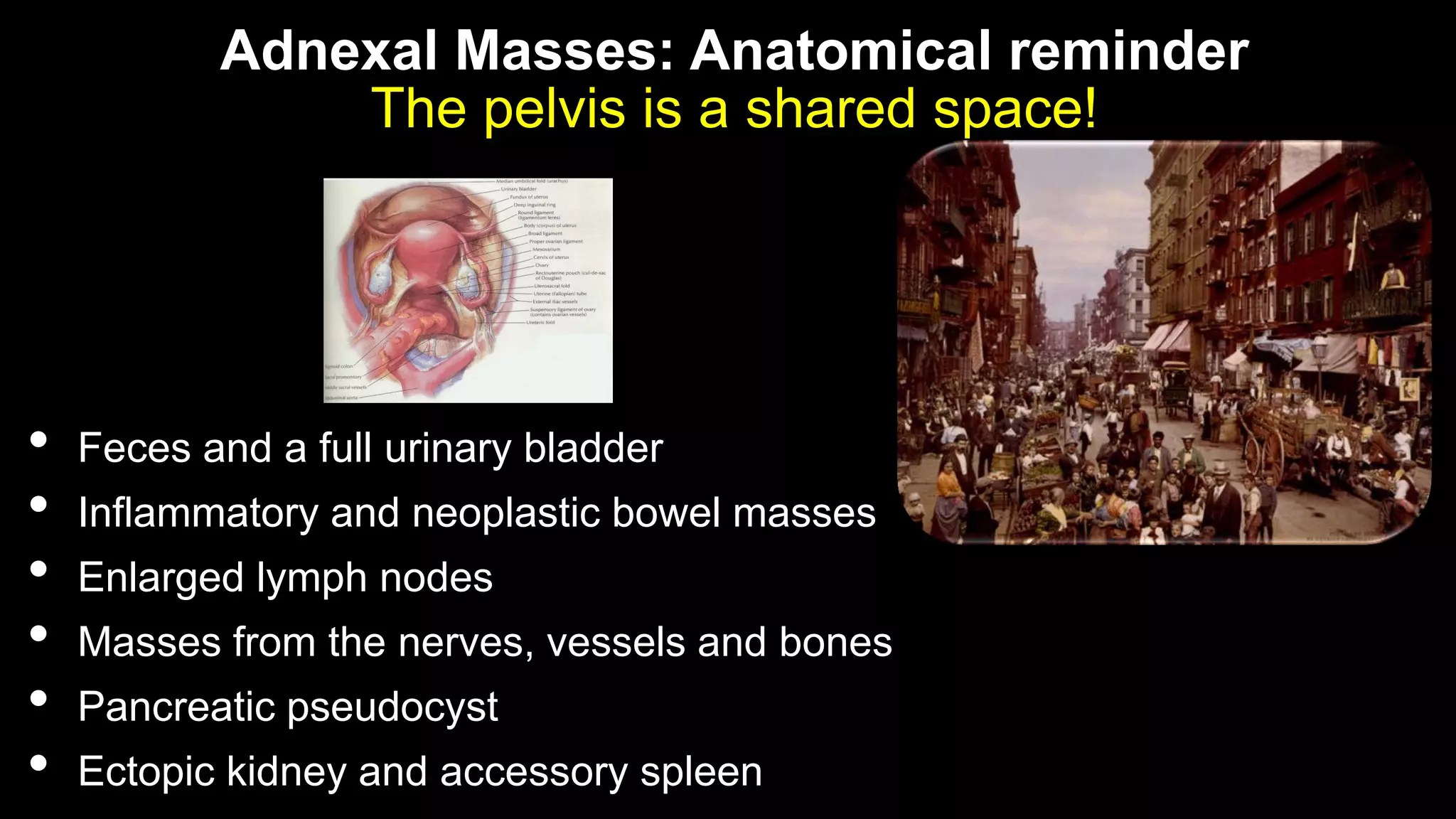
Adnexal Masses: Anatomical reminder
The pelvis is a shared space!
• Feces and a full urinary bladder
• Inflammatory and neoplastic bowel masses
• Enlarged lymph nodes
• Masses from the nerves, vessels and bones
• Pancreatic pseudocyst
• Ectopic kidney and accessory spleen
Adnexal lesions can be divided
according to morphology…
Nonseptated clear cysts
Septated clear cysts
Cysts with internal echoes
Solid tumours
Septated cysts or cysts with cystic and solid components
For any adnexal lesion, It is important
to decide its organ of origin…
And the possibilities are that the lesion may be of ovarian
or tubal origin, or may be arising from outside- i.e.
peritoneum most likely.
This can be established by two signs…
Sliding organ sign
Rim sign / beak sign
Now if we start assessing these
lesions….
Nonseptated Cystic lesions
Thin walled
Nonseptated
Anechoic, clear contents
CYST ASPIRATIONS AND
SCLEROSING AGENT INJECTIONS
Nonseptated clear cystic lesion
Intraovarian
Follicle
Follicular cyst
Simple cyst
Extraovarian
Paraovarian cyst
•Positive sliding organ
sign
•Absent rim or beak
sign
Simple cyst may change its echogenecity,
only when it gets infected or undergoes a
malignant change.
Clear cyst with septations
Intraovarian
Multiple follicles
Serous cystadenoma
Extraovarian
Complete septae
Peritoneal inclusion cyst
Septated fluid collection
Incomplete septae
hydrosalpinx
Extraovarian clear septated cystic lesion with partial
septations : Hydrosalpinx
Hydrosalpinx :US features
 Fusiform cystic lesion
 Cog wheel sign
 Incomplete septae
 Cyst wall thicker than 5mm in almost
all acute inflammations and app.3 % of
chronic lesions
3D : hydrosalpinx
inversion mode
Cystic lesions with internal echoes and thick walls
thick, echogenic, wall
internal echogenecity
No solid projections
Internal echogenecities of solid projections can be differentiated
from the clot/ debris by convex margins of solid projection and
Probe pressure will change the relationship of the clot to the
cyst wall which is not the case in solid projection.
Solid projection debris
D/D of Physiologic ovarian cysts
53 – 89 % show spontaneous regression on
follow up after 4-6 weeks.
To avoid confusing this with malignancies,
examination must be done in two different
phases of menstrual cycle.
Endometrioma
Endometriosis is detected in 15-30 % of infertile women.
1/3rd to ½ of the ovarian endometriotic cysts are bilateral, often
multiple.
Endometrioma
Adhesions common
smooth or shaggy wall may contain solid areas
punctate or linear bright echogenecities in wall
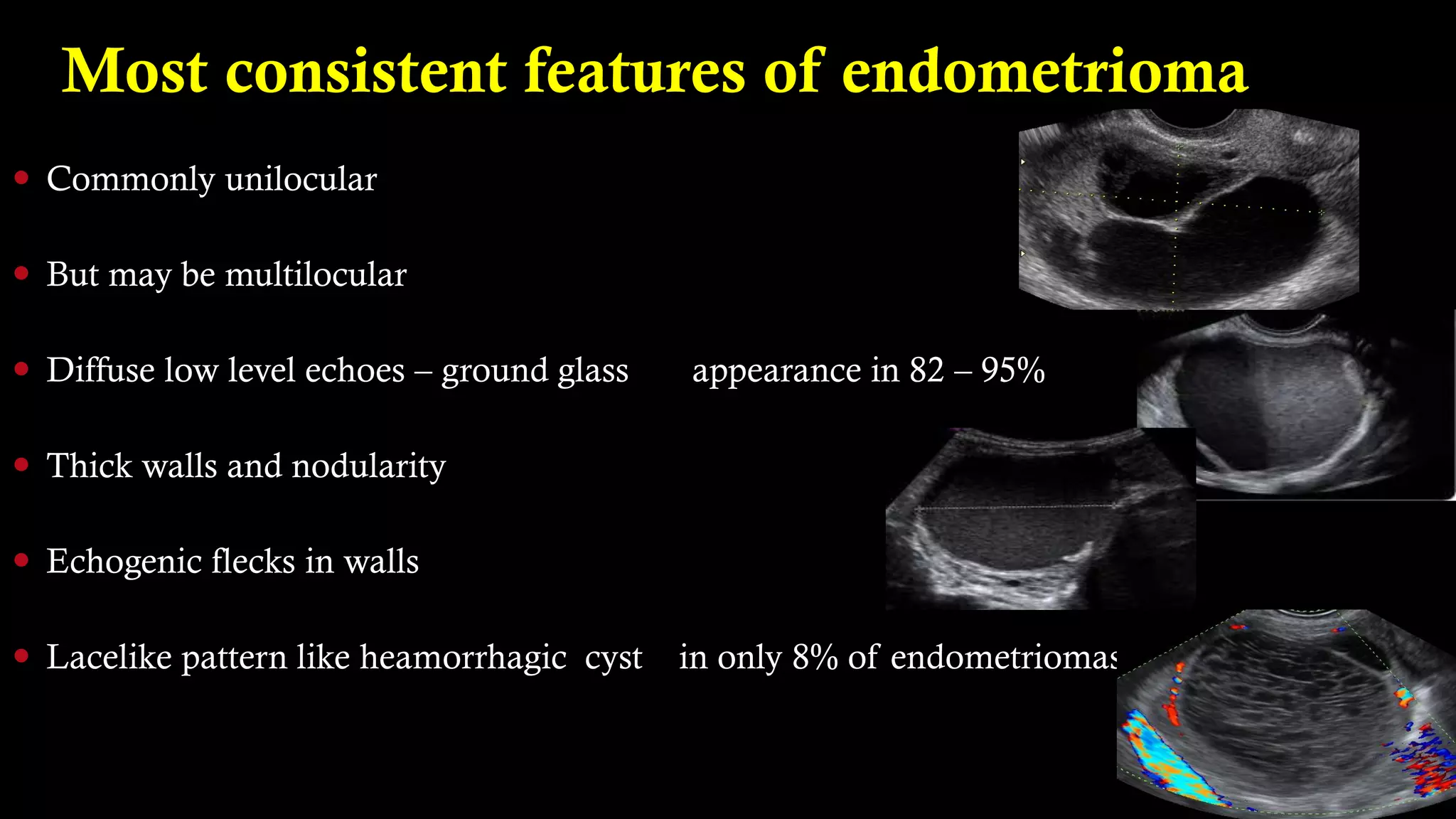
Most consistent features of endometrioma
 Commonly unilocular
 But may be multilocular
 Diffuse low level echoes – ground glass appearance in 82 – 95%
 Thick walls and nodularity
 Echogenic flecks in walls
 Lacelike pattern like heamorrhagic cyst in only 8% of endometriomas
Scattered vascularity at ov. hilus & regularly
seperated peripheral vessels is characteristic.
Solid tumours
Intraovarian
Fibroma
Thecoma
Fibrothecoma
Brenner’s tumour
Extraovarian
Broad ligament fibroid
Peduncuated subserosal fibroid
Lesions with solid and cystic components
Intraovarian
Dermoids
Epithelial tumours
Extraovarian
Tuboovarian mass
Ectopic prenancy
Tubal neoplasms
Ectopic pregnancy
USG has now
become a diagnostic
gold standard for
ectopic pregnancy.
RATRE ECTOPICS
ROLE OF ULTRASOUND IN
OVARIAN
CANCER SCREENING
Early detection of ovarian cancer in
high risk patients
Early detection of ovarian cancer in
general population of women over
the age of 50 years
21,880 estimated new cases
3% of all cancers in women
Overall 5-year survival rate of 45%
Leading cause of death from gynecologic
cancers (13,850 estimated deaths in 2010)
Lifetime risk of approximately 1.7% in the
general population
Up to 46% in those with BRCA1 & BRCA2
mutations
Ovarian carcinoma
PREOPERATIVE ASSESSMENT 0F
OVARIAN LESIONS
a picture is more than a thousand words
Morphological assessment,
Doppler characterization,3D
83 different prediction models
reported in the literature
Subjective assessment by an
expert using pattern
recognition appears remains the
best method of distinguishing
between benign and malignant
tumors
• Organ of Origin
• Benign versus Malignant
• Predicting histopathology
& guiding management
Adnexal Masses: Why do we need more than 2D?
Assessing Adnexal Masses: Why do we care?
Histopathology/Etiology & Treatment Options
• Optimal treatment requires knowledge of the exact nature of the
mass
• Some masses are best treated expectantly (e.g. functional cysts
and some cases of hydrosalpinx and uterine myoma)
• others by cyst puncture (e.g. peritoneal cysts) and yet others by
surgery (e.g. most neoplastic cysts and malignancies).
• Many benign tumors can be removed laparoscopically by a
gynecologist, whereas malignant masses require
open/laparoscopic surgery by an oncology surgeon/experienced
gynecologist
There is no evidence that any other imaging
modality will perform any better than
ultrasound
CT with contrast PET PET-CT
Ovarian carcinogenesis
The majority of high-
grade serous
cancers are of
Müllerian
not mesothelial
origin and arise in
the Fallopian tube
before
spreading to the
ovary
Adnexal Masses: Prediction of Histopath/Etiology
• Appropriate management
determines the prognosis
• Subjective assessment or
pattern recognition is the most
reliable method to distinguish
between benign and malignant
adnexal masses before
surgery, but it requires
expertise
• Simple rules have, therefore,
been proposed to discriminate
between benign and malignant
masses
Seven early cancers
detected in BRCA+ patients
over a two year period
All were in the fallopian tube
(in association with tubal
intraepithelial carcinoma)
Six of seven were in fimbria
Ovarian involvement in two
cases (surface implants)
Flow in a “cystic space”
Confirmation of nature of fluid
Delineation of an Isoechoic Lesion
Corpus Luteum
Ovarian Torsion
2D, Power Doppler & 3D Power Doppler
Ovarian Torsion
2D, Power Doppler & 3D Power Doppler
Adnexal Masses:Prediction of Malignancy
Pattern Recognition vs Rules
Characterisation of Adnexal Masses
International Ovarian Tumor Analysis Group
Accurate preoperative ultrasound characterization of adnexal
pathology helps to plan patients‟ care and optimize the surgical
approach
The International Ovarian Tumor Analysis (IOTA) group is a
multicenter collaboration whose aim is to design tools for the
pre- operative diagnosis of ovarian cancer that can be used by
non-expert ultrasound operators
By using standardized terms and definitions to describe
morphological features of ovarian tumors, the „simple-rules‟ model of
observed ultrasound features was designed
Characterisation of Adnexal Masses
International Ovarian Tumor Analysis Group
Adnexal Masses:Prediction of Malignancy
IOTA Simple Rules
•To determine the nature of an adnexal tumor there are five benign
features and five malignant features.
•If one or more benign features are found in the absence of any
malignant features then the tumor is defined as benign
•If one or more malignant features are found in the absence of any
benign features, then the tumor is defined as malignant
•If no features are seen or if both malignant and benign features are
observed then the tumor is unclassified or indeterminate.
Adnexal Masses:Prediction of Malignancy
IOTA Simple Rules
• B1, unilocular cyst
• B2, presence of solid components (largest diameter<7mm)
• B3, presence of acoustic shadowing
• B4, smooth multilocular tumor with largest diameter < 100 mm
• B5, no blood flow (color score 1)
Adnexal Masses:Prediction of Malignancy
IOTA Simple Rules
• B1, unilocular cyst
• B2, presence of solid components (largest diameter<7mm)
• B3, presence of acoustic shadowing
• B4, smooth multilocular tumor with largest diameter < 100 mm
• B5, no blood flow (color score 1)
Adnexal Masses:Prediction of Malignancy
IOTA Simple Rules
• M1, irregular solid tumor
• M2, ascites present
• M3, at least four papillary structures present
• M4, irregular, multilocular solid tumor with largest diameter ≥ 100 mm
• M5, very strong blood flow (color score 4).
Adnexal Masses:Prediction of Malignancy
IOTA Simple Rules
• M1, irregular solid tumor
• M2, ascites present
• M3, at least four papillary structures present
• M4, irregular, multilocular solid tumor with largest diameter ≥ 100 mm
• M5, very strong blood flow (color score 4).
Adnexal Masses:Prediction of Malignancy
Pattern Recognition
• Unilocular cyst: a cyst without septa and a solid component
• Unilocular solid cyst: a unilocular cyst with a solid component
• Multilocular cyst: a cyst with at least one septum but no solid component
• Multilocular solid cyst: a multilocular cyst with a solid component
• Solid tumor: a tumor where the solid components comprise 80% or more of
the tumor when assessed in two-dimensional section
Benign Versus Malignant Disease
Grey scale markers & scoring systems
“Borderline Tumors”
How do we handle these?
Benign Versus Malignant Disease
Newer markers (!)
Impedance values
regular distribution of blood vessels
• blood vessels are equally calibrated
• blood vessel walls have muscle
fibers
• moderate to high resistance index
values RI 0.42
Benign Versus Malignant Disease
Newer markers
Benign Versus Malignant Disease
Grey scale & power Doppler markers
Neovascularisation
• Dilated, saccular and tortuous
• Elongation and coiling
• Dichotomous branching
• No decrease in diameter of higher order branches
Tumor vessels
Neovascularisation
• No normal precapillary architecture
- Arteriovenous anastamoses
- Venovenous shunts
• Vascular lakes
- Incomplete vascular walls
- Increased interstitial pressure
- Increased vascular permeability
- Poor lymphatic drainage
Tumor vessels
Neovascularisation
Tumor vessels
Neovascularisation
Tumor vessels
Neovascularisation
Tumor vessels
• irregular distribution of blood
vessels
• blood vessels have irregular
diameter
• low resistance index values RI<0.42
• display of tumoral lakes and A-V
shunts
Neovascularisation
Tumor vessels
Neovascularisation
Tumor vessels
Technical Considerations
3D Power Doppler
Technical Considerations
3D Power Doppler
Quantification of Vascularisation
3D power Doppler evaluation
VI is the ratio of color voxels to the total number of
voxels inside the volume of interest and reflects the
number of vessels in the volume being studied
FI is the flow index and is the ratio of the sum of
color intensities to the number of color voxels inside
the volume being interrogated. It reflects the amount
of blood flow
VFI is the vascularisation/flow index and is the ratio
of the sum of color intensities to the total number of
voxels inside the volume of interest. This reflects
vessel presence and blood flow
Neovascularisation
Tumor vessels
Neovascularisation
Tumor vessels
Adnexal Masses: Risk of Malignancy
• Confirm or exclude a lesion
• Assign an anatomical diagnosis
• Identify pointers towards histopathology
• Assess extent and contralateral adnexa
• Look for borderline tumors
• Remember the corpus luteum!!
• Assess the enire abdomen and the pleura
The requirements from imaging
Adnexal Masses: Risk of Malignancy
To summarize...
Evaluating the adnexal mass:
Assess morphology
Decide the organ of origin
Assess the lesion in two orthogonal planes
Assess the lesion at least twice at an interval 2-3 weeks, if there is any doubt for
diagnosis.
Doppler is an important tool for definitive diagnosis.
Think of more physiological causes ....
THANK YOU FOR YOUR ATTENTION
e mail: ashokkhurana@ashokkhurana.com
For more slides and presentations
Narendra Malhotra slide share
IAN DONALD SCHOOL BOOK AND ATLAS
mnmhagra3@gmail.com

Adnexal Masses

  • 1.
    Adnexal Masses inreproductive age Narendra Malhotra Inputs from Ashok Khurana,Sonal Panchal, TLN Praveen,Jaideep Malhotra,Mala Sibal ASIM KURJAK mnmhagra3@gmail.com
  • 2.
    • Why bother! •The IOTA studies and trials • Clinical background • Ultrasound techniques • Pattern recognition of benign disease • Power Doppler & 3D power Doppler
  • 3.
    THE ADNEXAL MASS “...tumorsof the adnexa pose the most difficult of all diagnostic problems and offer the least reward for the greatest therapeutic effort.” R D Mattingly. Operative Gynecology “...Strangely, the ovarian tumors which appear most frequently are usually physiologic in origin, produce acute symptoms and receive the most radical of all surgical treatments.” R D Mattingly. Operative Gynecology. “...Malignant tumors of the ovary are the most lethal of all gynecologic tumors and usually remain silent until untreatable.” R D Mattingly. Operative Gynecology.
  • 4.
    Of all ovarianlesions excised, 75% were benign, 21% were malignant and 4% were of low malignant potential. 75% of ovarian masses were in the pre-menopausal age group. 75% of ovarian cancers were in the post-menopausal age group. Koonings et al, 1989 CLINICAL EPIDEMIOLOGY • Have 2 or more relatives who have had ovarian cancer • Have a family history of multiple cancers: ovarian, breast or colon cancer • Were diagnosed with breast cancer under the age of 50 • Have a personal history of multiple exposures to fertility drugs • Have had uninterrupted ovulation (never used birth control pills, or no pregnancies) • Have the BRCA1 or BRCA2 gene mutation • Are over the age of 50 • Are of Ashkenazi Jewish decent Source: American Cancer Society, 2001
  • 5.
    5 1 in 5Women Will Develop a Pelvic Mass • 20% of women will be diagnosed with a Pelvic mass1 • 5 - 10% of those women will have surgery for an ovarian neoplasm2 • 13 - 21% of these masses will be malignant2 1 Curtin JP. Gynecol Oncol. 1994;55:S42-S46. 2 NIH Consensus Development Conference Statement. Gynecol Oncol. 1994;55:S4-S14. Non- Malignant Malignant
  • 6.
    PELVIC EXAMINATION Focus on thegross characteristics of the tumor: * bilaterality * size * consistency * mobility * ascites (“Shifting Dullness”) Volume Morphology Doppler Flow PELVIC ULTRASOUND
  • 7.
    Tumor Volume: (Based on the formula for a prolate ellipse ) Volume = Length x Width x Height x ( π / 6 ) V = L x W x H x (3.1416 / 6 ) V = L x W x H x 0.5 PELVIC ULTRASOUND
  • 8.
    Ovarian Morphology Size: Cut-offvalue of 5 cm ? 6 cm ? 8 cm ? Consistency: Solid ? Cystic ? Complex ? Number of Locules Thickness of Wall Presence and thickness of septations PELVIC ULTRASOUND
  • 9.
    TUMOR MARKERS CA-125 Human ChorionicGonadotropin Carcinoembryonic Antigen Alpha-Feto Protein ROMA HE 4
  • 10.
    HE4 A Novel Biomarkerfor Ovarian Carcinoma
  • 11.
    The requirements fromultrasound where Doppler 3D PD help out • Confirm or exclude a lesion • Assign an anatomical diagnosis • Identify pointers towards histopathology • Assess extent and contralateral adnexa • Look for borderline tumors • Remember the corpus luteum!! • Assess the rest of the abdomen and the pleura on either side
  • 12.
    Adnexal Masses Histopathological /Outcome considerations • The majority of masses are benign • Less than one third of adnexal tumors in pregnancy need surgery
  • 13.
    Adnexal Masses Evaluation perspective •Clinical evaluation • Biochemical markers • Ultrasound: 2D, Doppler, 3D, 4D, 3D Power Doppler • MRI/ CT/ PETCT
  • 14.
    Ultrasound Evaluation Technical considerations •Transvaginal scans • High frequency transducers • Power Doppler • 3D/ 4D studies • Transrectal scans • Abdominal evaluation/ Pleura
  • 15.
    Technical Consideration Transvaginal scanning •Textural and resolution detail • Better color flow maps and Doppler studies • Sampling guidance • Easier scheduling • Abdominal scars • Obese patients • Probe tenderness
  • 16.
    Technical Consideration Transabdominal scanning •Global views • Organ relationships • Large masses • Extra-pelvic evaluation • Full bladder • Low frequency transducers
  • 17.
    Power Doppler Principles • Unlikecolor Doppler does not depend on flow direction, mean velocity and range of velocities • Detects energy and displays as intensity • Has slow flow sensitivity • Detects omnidirectional vessels
  • 18.
    Wide Sector/ ExtendedField of View Panoramic visualisation
  • 19.
    The commonest adnexal“mass” (Dys)functional cysts: follicular/ luteal cysts
  • 20.
  • 21.
    General Perspective Remember this! •Remember the corpus luteum • Think ectopic!!! • Not every adnexal mass is ovarian
  • 22.
    Adnexal Masses: Anatomicalreminder The pelvis is a shared space! • Feces and a full urinary bladder • Inflammatory and neoplastic bowel masses • Enlarged lymph nodes • Masses from the nerves, vessels and bones • Pancreatic pseudocyst • Ectopic kidney and accessory spleen
  • 23.
    Adnexal lesions canbe divided according to morphology… Nonseptated clear cysts Septated clear cysts Cysts with internal echoes Solid tumours Septated cysts or cysts with cystic and solid components
  • 24.
    For any adnexallesion, It is important to decide its organ of origin… And the possibilities are that the lesion may be of ovarian or tubal origin, or may be arising from outside- i.e. peritoneum most likely.
  • 25.
    This can beestablished by two signs… Sliding organ sign Rim sign / beak sign
  • 26.
    Now if westart assessing these lesions….
  • 27.
    Nonseptated Cystic lesions Thinwalled Nonseptated Anechoic, clear contents
  • 28.
  • 29.
    Nonseptated clear cysticlesion Intraovarian Follicle Follicular cyst Simple cyst Extraovarian Paraovarian cyst •Positive sliding organ sign •Absent rim or beak sign Simple cyst may change its echogenecity, only when it gets infected or undergoes a malignant change.
  • 30.
    Clear cyst withseptations Intraovarian Multiple follicles Serous cystadenoma Extraovarian Complete septae Peritoneal inclusion cyst Septated fluid collection Incomplete septae hydrosalpinx
  • 31.
    Extraovarian clear septatedcystic lesion with partial septations : Hydrosalpinx
  • 32.
    Hydrosalpinx :US features Fusiform cystic lesion  Cog wheel sign  Incomplete septae  Cyst wall thicker than 5mm in almost all acute inflammations and app.3 % of chronic lesions
  • 33.
  • 34.
    Cystic lesions withinternal echoes and thick walls thick, echogenic, wall internal echogenecity No solid projections
  • 35.
    Internal echogenecities ofsolid projections can be differentiated from the clot/ debris by convex margins of solid projection and Probe pressure will change the relationship of the clot to the cyst wall which is not the case in solid projection. Solid projection debris
  • 36.
    D/D of Physiologicovarian cysts 53 – 89 % show spontaneous regression on follow up after 4-6 weeks. To avoid confusing this with malignancies, examination must be done in two different phases of menstrual cycle.
  • 37.
    Endometrioma Endometriosis is detectedin 15-30 % of infertile women. 1/3rd to ½ of the ovarian endometriotic cysts are bilateral, often multiple.
  • 38.
    Endometrioma Adhesions common smooth orshaggy wall may contain solid areas punctate or linear bright echogenecities in wall
  • 39.
    Most consistent featuresof endometrioma  Commonly unilocular  But may be multilocular  Diffuse low level echoes – ground glass appearance in 82 – 95%  Thick walls and nodularity  Echogenic flecks in walls  Lacelike pattern like heamorrhagic cyst in only 8% of endometriomas
  • 40.
    Scattered vascularity atov. hilus & regularly seperated peripheral vessels is characteristic.
  • 41.
  • 42.
    Lesions with solidand cystic components Intraovarian Dermoids Epithelial tumours Extraovarian Tuboovarian mass Ectopic prenancy Tubal neoplasms
  • 43.
    Ectopic pregnancy USG hasnow become a diagnostic gold standard for ectopic pregnancy.
  • 44.
  • 45.
    ROLE OF ULTRASOUNDIN OVARIAN CANCER SCREENING Early detection of ovarian cancer in high risk patients Early detection of ovarian cancer in general population of women over the age of 50 years
  • 46.
    21,880 estimated newcases 3% of all cancers in women Overall 5-year survival rate of 45% Leading cause of death from gynecologic cancers (13,850 estimated deaths in 2010) Lifetime risk of approximately 1.7% in the general population Up to 46% in those with BRCA1 & BRCA2 mutations Ovarian carcinoma
  • 47.
    PREOPERATIVE ASSESSMENT 0F OVARIANLESIONS a picture is more than a thousand words Morphological assessment, Doppler characterization,3D 83 different prediction models reported in the literature Subjective assessment by an expert using pattern recognition appears remains the best method of distinguishing between benign and malignant tumors
  • 48.
    • Organ ofOrigin • Benign versus Malignant • Predicting histopathology & guiding management Adnexal Masses: Why do we need more than 2D?
  • 49.
    Assessing Adnexal Masses:Why do we care? Histopathology/Etiology & Treatment Options • Optimal treatment requires knowledge of the exact nature of the mass • Some masses are best treated expectantly (e.g. functional cysts and some cases of hydrosalpinx and uterine myoma) • others by cyst puncture (e.g. peritoneal cysts) and yet others by surgery (e.g. most neoplastic cysts and malignancies). • Many benign tumors can be removed laparoscopically by a gynecologist, whereas malignant masses require open/laparoscopic surgery by an oncology surgeon/experienced gynecologist
  • 50.
    There is noevidence that any other imaging modality will perform any better than ultrasound CT with contrast PET PET-CT
  • 51.
    Ovarian carcinogenesis The majorityof high- grade serous cancers are of Müllerian not mesothelial origin and arise in the Fallopian tube before spreading to the ovary
  • 52.
    Adnexal Masses: Predictionof Histopath/Etiology • Appropriate management determines the prognosis • Subjective assessment or pattern recognition is the most reliable method to distinguish between benign and malignant adnexal masses before surgery, but it requires expertise • Simple rules have, therefore, been proposed to discriminate between benign and malignant masses Seven early cancers detected in BRCA+ patients over a two year period All were in the fallopian tube (in association with tubal intraepithelial carcinoma) Six of seven were in fimbria Ovarian involvement in two cases (surface implants)
  • 54.
    Flow in a“cystic space” Confirmation of nature of fluid
  • 55.
    Delineation of anIsoechoic Lesion Corpus Luteum
  • 56.
    Ovarian Torsion 2D, PowerDoppler & 3D Power Doppler
  • 57.
    Ovarian Torsion 2D, PowerDoppler & 3D Power Doppler
  • 58.
    Adnexal Masses:Prediction ofMalignancy Pattern Recognition vs Rules
  • 59.
    Characterisation of AdnexalMasses International Ovarian Tumor Analysis Group Accurate preoperative ultrasound characterization of adnexal pathology helps to plan patients‟ care and optimize the surgical approach The International Ovarian Tumor Analysis (IOTA) group is a multicenter collaboration whose aim is to design tools for the pre- operative diagnosis of ovarian cancer that can be used by non-expert ultrasound operators
  • 60.
    By using standardizedterms and definitions to describe morphological features of ovarian tumors, the „simple-rules‟ model of observed ultrasound features was designed Characterisation of Adnexal Masses International Ovarian Tumor Analysis Group
  • 61.
    Adnexal Masses:Prediction ofMalignancy IOTA Simple Rules •To determine the nature of an adnexal tumor there are five benign features and five malignant features. •If one or more benign features are found in the absence of any malignant features then the tumor is defined as benign •If one or more malignant features are found in the absence of any benign features, then the tumor is defined as malignant •If no features are seen or if both malignant and benign features are observed then the tumor is unclassified or indeterminate.
  • 62.
    Adnexal Masses:Prediction ofMalignancy IOTA Simple Rules • B1, unilocular cyst • B2, presence of solid components (largest diameter<7mm) • B3, presence of acoustic shadowing • B4, smooth multilocular tumor with largest diameter < 100 mm • B5, no blood flow (color score 1)
  • 63.
    Adnexal Masses:Prediction ofMalignancy IOTA Simple Rules • B1, unilocular cyst • B2, presence of solid components (largest diameter<7mm) • B3, presence of acoustic shadowing • B4, smooth multilocular tumor with largest diameter < 100 mm • B5, no blood flow (color score 1)
  • 64.
    Adnexal Masses:Prediction ofMalignancy IOTA Simple Rules • M1, irregular solid tumor • M2, ascites present • M3, at least four papillary structures present • M4, irregular, multilocular solid tumor with largest diameter ≥ 100 mm • M5, very strong blood flow (color score 4).
  • 65.
    Adnexal Masses:Prediction ofMalignancy IOTA Simple Rules • M1, irregular solid tumor • M2, ascites present • M3, at least four papillary structures present • M4, irregular, multilocular solid tumor with largest diameter ≥ 100 mm • M5, very strong blood flow (color score 4).
  • 66.
    Adnexal Masses:Prediction ofMalignancy Pattern Recognition • Unilocular cyst: a cyst without septa and a solid component • Unilocular solid cyst: a unilocular cyst with a solid component • Multilocular cyst: a cyst with at least one septum but no solid component • Multilocular solid cyst: a multilocular cyst with a solid component • Solid tumor: a tumor where the solid components comprise 80% or more of the tumor when assessed in two-dimensional section
  • 67.
    Benign Versus MalignantDisease Grey scale markers & scoring systems
  • 68.
  • 69.
    Benign Versus MalignantDisease Newer markers (!) Impedance values regular distribution of blood vessels • blood vessels are equally calibrated • blood vessel walls have muscle fibers • moderate to high resistance index values RI 0.42
  • 70.
    Benign Versus MalignantDisease Newer markers
  • 71.
    Benign Versus MalignantDisease Grey scale & power Doppler markers
  • 72.
    Neovascularisation • Dilated, saccularand tortuous • Elongation and coiling • Dichotomous branching • No decrease in diameter of higher order branches Tumor vessels
  • 73.
    Neovascularisation • No normalprecapillary architecture - Arteriovenous anastamoses - Venovenous shunts • Vascular lakes - Incomplete vascular walls - Increased interstitial pressure - Increased vascular permeability - Poor lymphatic drainage Tumor vessels
  • 74.
  • 75.
  • 76.
    Neovascularisation Tumor vessels • irregulardistribution of blood vessels • blood vessels have irregular diameter • low resistance index values RI<0.42 • display of tumoral lakes and A-V shunts
  • 77.
  • 78.
  • 81.
  • 82.
  • 83.
    Quantification of Vascularisation 3Dpower Doppler evaluation VI is the ratio of color voxels to the total number of voxels inside the volume of interest and reflects the number of vessels in the volume being studied FI is the flow index and is the ratio of the sum of color intensities to the number of color voxels inside the volume being interrogated. It reflects the amount of blood flow VFI is the vascularisation/flow index and is the ratio of the sum of color intensities to the total number of voxels inside the volume of interest. This reflects vessel presence and blood flow
  • 84.
  • 85.
  • 87.
    Adnexal Masses: Riskof Malignancy • Confirm or exclude a lesion • Assign an anatomical diagnosis • Identify pointers towards histopathology • Assess extent and contralateral adnexa • Look for borderline tumors • Remember the corpus luteum!! • Assess the enire abdomen and the pleura The requirements from imaging
  • 88.
    Adnexal Masses: Riskof Malignancy
  • 89.
    To summarize... Evaluating theadnexal mass: Assess morphology Decide the organ of origin Assess the lesion in two orthogonal planes Assess the lesion at least twice at an interval 2-3 weeks, if there is any doubt for diagnosis. Doppler is an important tool for definitive diagnosis. Think of more physiological causes ....
  • 90.
    THANK YOU FORYOUR ATTENTION e mail: ashokkhurana@ashokkhurana.com For more slides and presentations Narendra Malhotra slide share IAN DONALD SCHOOL BOOK AND ATLAS mnmhagra3@gmail.com