Platelet-Rich
Plasma
In
InfertilityMuhammad M Al Hennawy
Senior Consultant Obstetrician &
Gynacologist
Ras El Bar Central Hospital ,Egypt
mmhennawy.site44.com
Introduction
• Regenerative biomedicine continues to progressively
emerge at the forefront of healthcare in a number of
medical disciplines
• Platelet-rich plasma (PRP) is becoming more popular as
a nonoperative treatment option for a broad spectrum
of medical disorders.
• PRP is widely used in orthopedic and sports medicine to
relieve pain through the natural promotion of healing in
musculoskeletal diseases such as tendonitis, arthritis,
ligament sprains, and tears.
• These growth factors have been found to promote
natural healing responses by researchers across
multiple specialties, such as dentistry, dermatology,
urology, and gynecology
What is Platelet Rich Plasma (PRP)?
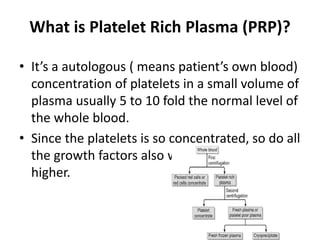
• It’s a autologous ( means patient’s own blood)
concentration of platelets in a small volume of
plasma usually 5 to 10 fold the normal level of
the whole blood.
• Since the platelets is so concentrated, so do all
the growth factors also will be 5 to 10 folds
higher.
FDA approval
• PRP does not require FDA approval
• Since
• It is not a medicine or a device.
• PRP comes from patient own body.
• Patient own blood is drawn and sterilely
processed in a highly specialized FDA
approved collection kit and centrifuge to
concentrate the platelets 6 times their natural
values in pure plasma without any red cells.
Short history
• 1905 : German surgeon August Bier discovered that, injected with their own blood, patients with bone
fractures heal faster.
• 1935 – 1980:before antibiotics, autohemotherapy (intramuscular injection of a small amount of blood
taken from the same individual) and autoserotherapy (treatment with blood from the patient’s blood) were
among the most popular secondary treatments.
• 1980 : maxillofacial surgeon Robert E. Marx was the first to use blood plasma as a gel; the discovery that
platelets contain protein factors (PRP factors) that stimulate cellular regeneration opened the way for the
autologous plasma gel production technology; this was developed mainly for use in stomatology (the
Harvest company, USA).
• 2003 : the Russian scientists Renat R. Akhmerov (Professor, Doctor of Medicine, plastic surgeon and
maxillofacial surgeon, oncodermatologist) and Roman F. Zarudy (Doctor of Medicine, maxillofacial surgeon,
implantologist) were the first in the world to use platelet-rich autologous plasma to treat inflammatory and
atrophic diseases, in the postoperative period; the technology was named Plasmolifting™.
• 2004 : Plasmolifting ™ clinical trials were carried out on the two Russian scientists and on volunteers, to
treat photodermatosis, hair loss and acne, with good results (in addition to the therapeutic effects, the
patients’ skin was rejuvenated); Roman F. Zarudy explained that the new injecting form of plasma opened
up new possibilities for them, as maxillofacial surgeons (especially for tissue regeneration), and the method
revolutionized this sphere of surgical practice; at first, their colleagues were skeptical of his new
technology’s success, but – with time – the Plasmolifting™ method began to be applied in various fields of
medicine.
• 2011 : with the support of doctors Akhmerov and Zarudy, the Plasmolifting Company was set up; it
exclusively produces and distributes the equipment necessary for the Plasmolifting™ method, wishing to
offer everyone this natural healing method; today, the Plasmolifting Company has created a vast
distribution network in Europe, develops and distributes the Plasmolifting™ tubes and organizes specialty
courses; the aim of the company is to convert autologous plasma injections into a routine biological
stimulation method.
PRP composition and activation
• Platelets contain high concentrations of cytokines and growth
factors stored within α-granules. These growth factors include
platelet-derived growth factor, insulin-like growth factor, vascular
endothelial growth factor, platelet-derived angiogenic factor,
transforming growth factor beta, fibroblast growth factor,
epidermal growth factor, connective tissue growth factor, and
interleukin-8. In addition to growth factors, platelets contain other
substances, such as fibronectin, vitronectin, and sphingosine 1-
phosphate, that initiate wound healing
• Platelet activation triggers the release of these growth factors by a
variety of substances or stimuli such as thrombin, calcium
chloride, and collagen. Each method influences both the physical
form of PRP and the amount of growth factors released, as well as
the kinetics of release. No evidence has been found regarding the
ideal concentration of activator required to trigger the optimal
release of growth factors during the activation process of PRP, and
different concentrations may therefore lead to different results
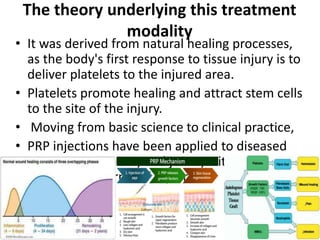
The theory underlying this treatment
modality
• It was derived from natural healing processes,
as the body's first response to tissue injury is to
deliver platelets to the injured area.
• Platelets promote healing and attract stem cells
to the site of the injury.
• Moving from basic science to clinical practice,
• PRP injections have been applied to diseased
ligaments, tendons, and joints, with superb
outcomes in terms of repair
Growth Factors In Platelets
• Platelets is part of the cell in our blood that help in the clotting
mechanisms. It’s a very tiny cells but inside the contain a lot of
important growth factors such as:-
• Platelet Derived Growth Factors (PDGF)
• Vascular Endothelial Growth Factors (VEGF)
• Insulin Like Growth Factors ( IGF 1& 2)
• Transforming Growth Factors beta( TGF-b)
• Fibroblast Growth Factors ( FGF)
• Epidermal Growth Factors ( EGF )
• Connective Tissue Growth Factors (CTGF)
• Interleukin 8 (IL 8)
• All these growth factors are very important for healing,
formation of new vessels, collagen production and regeneration!
The science of PRP
• PRP preparation
• The preparation of PRP is an outpatient procedure that involves a blood draw, preparation of the PRP,
and the injection of PRP into the diseased area.
• Multiple methods have been developed for PRP preparation, with variation in the speed and timing of
centrifugation
• The following steps present a representative method of preparing PRP:
• (1) venous blood (15–50 mL) is drawn from the patient's arm in anticoagulant-containing tubes;
• (2) the recommended temperature during processing is 21℃–24℃ to prevent platelet activation during
centrifugation of the blood;
• (3) the blood is centrifuged at 1,200 rpm for 12 minutes;
• (4) the blood separates into three layers: an upper layer that contains platelets and white blood cells, an
intermediate thin layer (the buffy coat) that is rich in white blood cells, and a bottom layer that contains
red blood cells;
• (5) the upper and intermediate buffy layers are transferred to an empty sterile tube. The plasma is
centrifuged again at 3,300 rpm for 7 minutes to help with the formation of soft pellets (erythrocytes and
platelets) at the bottom of the tube;
• (6) the upper two-thirds of the plasma is discarded because it is platelet-poor plasma;
• (7) pellets are homogenized in the lower third (5 mL) of the plasma to create the PRP;
• (8) the PRP is now ready for injection. Approximately 30 mL of venous blood yields 3–5 mL of PRP;
• (9) the affected area is disinfected before the PRP injection;
• (10) providing assurance to the patient and discussing the procedure make the injection easier and less
painful;
• (11) PRP stimulates a series of biological responses, and the injection site may become swollen and
painful for roughly 3 days.
PRP
Usage
In
Reproductive
Medicine
1-Endometrial Rejuvenation
• Asherman syndrome
(A Thin And Damaged Endometrium)
• Endometrial Rejuvenation with IVF or ICSI
(A Thin Endometrium)
• PRP in repeated implantation failure
(A normal Endometrium)
Asherman syndrome
(A Thin And Damaged Endometrium)
• Endometrial thickness (EMT) and menstrual bleeding pattern
were assessed before and 2weeks after the therapy. Intrauterine
adhesion and pain scores were recorded
• . At the end of hysteroscopy 0.5-1ml of PRP was infused into the
uterus via a Wallace catheter,
• followed by estrogen therapy
• Or
• After hysteroscopic adhesiolysis,
• injection of 5ml PRP into the wall
• then lining the uterine cavity by 5ml platelet rich plasma gel.
• Finally, Foley’s balloon catheter will be inserted intrauterine
then inflated and cutting its stem and to be left for two weeks
Endometrial Rejuvenation (A Thin
Endometrium)with IVF or ICSI
• When the subject is undergoing in vitro fertilization (IVF)
• with poor endometrial response still had thin endometrium
which is less than seven millimeters after standard hormone
replacement therapy (HRT) and
• had to cancel the embryo transfer cycle.
• Then an intrauterine infusion of PRP was performed.
• 0.5-1 ml of PRP was injected into the uterine cavity on the
tenth day of HRT cycle.
• If endometrial thickness failed to increase 72 hours later,
• PRP infusion was done 1-2 times in each cycle. Embryos were
transmitted when the endometrium thickness reached > 7
millimeters.
• Successful endometrial expansion and pregnancy were
observed in the patients after PRP infusion.
PRP in repeated implantation failure
(A Normal Endometrium)
• Repeated implantation failure (RIF) is defined as
failure to conceive following several embryo
transfers in IVF cycles.
• Numerous factors are involved in the implantation
process, including embryo quality, endometrial
receptivity, and immunological factors
• the intrauterine infusion of PRP has been
described as a way to promote endometrial growth
and receptivity
• 0.5ml of Platelet rich plasma will be placed into the
uterus at least 48 hours prior to embryo transfer.
2-Ovarian Rejuvenation with PRP
• The ideal candidates for ovarian regeneration with
PRP are the following:
• Menopausal or perimenopausal women under the
age of 50 years,
• infertile women, who are over the age of 35 years,
having low egg reserve and low AntiMullerian
Hormone levels (AMH),
• women under the age of 35 years, who have low egg
reserve and low AntiMullerian Hormone levels, and
• women with premature ovarian failure (POF).
• injection of this PRP into the ovaries= 2- 4 mL per ovary for the
intraovarian injection.
• 3 punctures per ovary, intramedullary injection, and diffusion in the
subcortical layers
• in a procedure quite similar to Egg Pick up. The PRP Therapy is
minimally invasive.
• Local anaesthesia is provided in order to ensure that you don’t feel
any pain during the procedure.
• The whole process takes a 2-3 hours
• This process is repeated once every month for a total of 2- 3 times.
• All cases underwent natural IVF cycles with follicles of 15.20±2.05
mm in diameter, the resulting oocytes were inseminated by
intracytoplasmic sperm injection (ICSI), and all resulting embryos
were cryopreserved
3) PRP in ovarian torsion
• In bilateral adnexal torsion for 3 hours.
• Intraperitoneal PRP was administered 30
minutes
• Detorsion was then done, and oxidative stress
levels, histopathological changes, and
reperfusion injuries were lower in the PRP
group than in the other group
• PRP was effective for the prevention of
ischemia and reperfusion damage in ovary
4 - Can Azoospermia Be Treated?
• In non-obstructive azoospermia,
• When stem cells are isolated -- use mesenchymal
stem cells (from the patient's own fat tissue),
they are mixed with platelet rich plasma (prp),
which is also obtained from the patient's own
blood sample.
• A mixture of mesenchymal stem cells and platelet
rich plasma are directly injected into the testicles
at four different locations, which are important
for initiation and maturation of spermatogenesis
How long does the entire process take?
• The injection takes less than 5 minutes,
• but an hour is scheduled to provide ample
time for patient
• to meet with the doctor to ensure that there
are no contraindications, review pre and post
procedure expectations, draw blood,
centrifuge the blood and prepare the
treatment in a relaxed, comfortable
environment.
What prep is given for local
anesthesia?
• After counseling, patient will empty her bladder and
• move to the treatment table where patient will undress
from the waist down, and cover with a sheet.
• doctors find that an extra injection of local pain control
often hurts more than the shot itself.
• Therefore, doctors use 20 – 30 minutes of a topical
numbing cream (Benzocaine, Lidocaine, Tetracaine).
• This is applied to the clitoral and vaginal areas, with a piece
of plastic wrap placed over the cream by the patient and the
medical assistant just before the blood draw.
• Patient MUST tell doctor BEFOREHAND if patient have any
allergic reactions to any of these medications, so doctors
can make arrangements.
Contraindications to PRP Therapy
• Acute infectious diseases.
• Viral hepatitis B and C.
• Systemic diseases.
• Allergic reactions to anticoagulants.
• Immunosuppressive conditions.
• Blood-clotting disorder.
• Pregnancy and lactation.
• Mental disorders.
• With a personal history of oncology.
• Age under 18 years.
Are there side effects?
• Be assured the treatment rarely has side effects.
• Even patients that have drug allergies can safely
opt for the procedure and enjoy significant
improvement within a few weeks following the
treatment.
• Occasionally there is a small amount of bruising
or tingling in the injected areas.
• There are no infections or cancers or other
adverse side effects known.
Recommended course of PRP Therapy
• A course of 1 to 4 procedures is recommended,
• depending on the intensity of changes,
• the time between injections being 1 month.
• doctors recommend 1 treatment to start and see
how patient response is.
• Your provider may recommend more depending
on a multitude of patient-specific factors.
• Re-evaluate after 12-18 months
What if it doesn't work?
• A majority of women experience definite improvement
in their symptoms.
• If patient have followed every instruction properly,
• doctors will review a full assessment of the potential
reasons for the sub-optimal results.
• The main issue is usually not the preparation or
performance of the injection, but a woman’s own
particular body’s ability to heal, using its own blood
components, and her following the pre and post
procedure instructions precisely.
• doctors will consider performing a second injection only
after 6 months of healing and a full assessment.
Benefits of PRP Therapy
• The PRP Therapy uses patient’s own blood, therefore, this method
has the minimum number of contraindications, and the risk of
allergy, rejection and other “side effects” is completely excluded,
which ensures complete biocompatibility of the administered
preparation.
• The PRP Therapy does not require special training and, under
certain conditions, can be performed immediately at the doctor’s
office. The whole procedure takes no more than 30 minutes. After
the autoplasma injection, the patient can continue her daily routine
at once.
• The PRP Therapy is designed to create a “favorable background” for
the successful treatment of many gynecological diseases.
• The PRP Therapy reduces the drug load (the need to take a lot of
medicines) on the body and minimizes the risk of recurring
pathology.
Recommendations after PRP Therapy
• For 3 days after the administration, it is
recommended to abstain from:
Sexual activity.
Taking steam baths.
Visiting saunas and taking baths.
• Use cotton underwear for 5 days after the PRP
Therapy.
• In order to avoid hyperpigmentation at the
injection site, it is not recommended to use a
tanning bed/booth and undergo prolonged
exposure to direct sunlight (tanning) for 1 week.
The success of this technique
• entirely depends on
• the speed of blood collection and transfer to
the centrifuge.
• In fact, without anticoagulant, the blood
sample starts to coagulate almost immediately
upon contact with the tube glass, and it does
take a minium of few minutes of
centrifugation to concentrate fibrinogen in the
middle and upper part of the tube.
• Quick handling is the only way to obtain a
Conclusion
• PRP is an innovative therapeutic modality,
• as it is affordable,
• simple,
• cheap,
• easily performed, and
• effective.
• It is also a noninvasive modality with promising results and
• no side effects.
• In the field of gynecology, the few studies that have been conducted are
pilot studies, case series, and case reports.
• The risks of PRP therapy as infection, bleeding, and nerve damage, appear
to be minimal.
• Large randomized controlled studies are required to confirm its efficacy
and safety in various gynecological disorders.

platelet rich plasma infertility

  • 1.
    Platelet-Rich Plasma In InfertilityMuhammad M AlHennawy Senior Consultant Obstetrician & Gynacologist Ras El Bar Central Hospital ,Egypt mmhennawy.site44.com
  • 2.
    Introduction • Regenerative biomedicinecontinues to progressively emerge at the forefront of healthcare in a number of medical disciplines • Platelet-rich plasma (PRP) is becoming more popular as a nonoperative treatment option for a broad spectrum of medical disorders. • PRP is widely used in orthopedic and sports medicine to relieve pain through the natural promotion of healing in musculoskeletal diseases such as tendonitis, arthritis, ligament sprains, and tears. • These growth factors have been found to promote natural healing responses by researchers across multiple specialties, such as dentistry, dermatology, urology, and gynecology
  • 3.
    What is PlateletRich Plasma (PRP)? • It’s a autologous ( means patient’s own blood) concentration of platelets in a small volume of plasma usually 5 to 10 fold the normal level of the whole blood. • Since the platelets is so concentrated, so do all the growth factors also will be 5 to 10 folds higher.
  • 4.
    FDA approval • PRPdoes not require FDA approval • Since • It is not a medicine or a device. • PRP comes from patient own body. • Patient own blood is drawn and sterilely processed in a highly specialized FDA approved collection kit and centrifuge to concentrate the platelets 6 times their natural values in pure plasma without any red cells.
  • 5.
    Short history • 1905: German surgeon August Bier discovered that, injected with their own blood, patients with bone fractures heal faster. • 1935 – 1980:before antibiotics, autohemotherapy (intramuscular injection of a small amount of blood taken from the same individual) and autoserotherapy (treatment with blood from the patient’s blood) were among the most popular secondary treatments. • 1980 : maxillofacial surgeon Robert E. Marx was the first to use blood plasma as a gel; the discovery that platelets contain protein factors (PRP factors) that stimulate cellular regeneration opened the way for the autologous plasma gel production technology; this was developed mainly for use in stomatology (the Harvest company, USA). • 2003 : the Russian scientists Renat R. Akhmerov (Professor, Doctor of Medicine, plastic surgeon and maxillofacial surgeon, oncodermatologist) and Roman F. Zarudy (Doctor of Medicine, maxillofacial surgeon, implantologist) were the first in the world to use platelet-rich autologous plasma to treat inflammatory and atrophic diseases, in the postoperative period; the technology was named Plasmolifting™. • 2004 : Plasmolifting ™ clinical trials were carried out on the two Russian scientists and on volunteers, to treat photodermatosis, hair loss and acne, with good results (in addition to the therapeutic effects, the patients’ skin was rejuvenated); Roman F. Zarudy explained that the new injecting form of plasma opened up new possibilities for them, as maxillofacial surgeons (especially for tissue regeneration), and the method revolutionized this sphere of surgical practice; at first, their colleagues were skeptical of his new technology’s success, but – with time – the Plasmolifting™ method began to be applied in various fields of medicine. • 2011 : with the support of doctors Akhmerov and Zarudy, the Plasmolifting Company was set up; it exclusively produces and distributes the equipment necessary for the Plasmolifting™ method, wishing to offer everyone this natural healing method; today, the Plasmolifting Company has created a vast distribution network in Europe, develops and distributes the Plasmolifting™ tubes and organizes specialty courses; the aim of the company is to convert autologous plasma injections into a routine biological stimulation method.
  • 6.
    PRP composition andactivation • Platelets contain high concentrations of cytokines and growth factors stored within α-granules. These growth factors include platelet-derived growth factor, insulin-like growth factor, vascular endothelial growth factor, platelet-derived angiogenic factor, transforming growth factor beta, fibroblast growth factor, epidermal growth factor, connective tissue growth factor, and interleukin-8. In addition to growth factors, platelets contain other substances, such as fibronectin, vitronectin, and sphingosine 1- phosphate, that initiate wound healing • Platelet activation triggers the release of these growth factors by a variety of substances or stimuli such as thrombin, calcium chloride, and collagen. Each method influences both the physical form of PRP and the amount of growth factors released, as well as the kinetics of release. No evidence has been found regarding the ideal concentration of activator required to trigger the optimal release of growth factors during the activation process of PRP, and different concentrations may therefore lead to different results
  • 7.
    The theory underlyingthis treatment modality • It was derived from natural healing processes, as the body's first response to tissue injury is to deliver platelets to the injured area. • Platelets promote healing and attract stem cells to the site of the injury. • Moving from basic science to clinical practice, • PRP injections have been applied to diseased ligaments, tendons, and joints, with superb outcomes in terms of repair
  • 8.
    Growth Factors InPlatelets • Platelets is part of the cell in our blood that help in the clotting mechanisms. It’s a very tiny cells but inside the contain a lot of important growth factors such as:- • Platelet Derived Growth Factors (PDGF) • Vascular Endothelial Growth Factors (VEGF) • Insulin Like Growth Factors ( IGF 1& 2) • Transforming Growth Factors beta( TGF-b) • Fibroblast Growth Factors ( FGF) • Epidermal Growth Factors ( EGF ) • Connective Tissue Growth Factors (CTGF) • Interleukin 8 (IL 8) • All these growth factors are very important for healing, formation of new vessels, collagen production and regeneration!
  • 9.
    The science ofPRP • PRP preparation • The preparation of PRP is an outpatient procedure that involves a blood draw, preparation of the PRP, and the injection of PRP into the diseased area. • Multiple methods have been developed for PRP preparation, with variation in the speed and timing of centrifugation • The following steps present a representative method of preparing PRP: • (1) venous blood (15–50 mL) is drawn from the patient's arm in anticoagulant-containing tubes; • (2) the recommended temperature during processing is 21℃–24℃ to prevent platelet activation during centrifugation of the blood; • (3) the blood is centrifuged at 1,200 rpm for 12 minutes; • (4) the blood separates into three layers: an upper layer that contains platelets and white blood cells, an intermediate thin layer (the buffy coat) that is rich in white blood cells, and a bottom layer that contains red blood cells; • (5) the upper and intermediate buffy layers are transferred to an empty sterile tube. The plasma is centrifuged again at 3,300 rpm for 7 minutes to help with the formation of soft pellets (erythrocytes and platelets) at the bottom of the tube; • (6) the upper two-thirds of the plasma is discarded because it is platelet-poor plasma; • (7) pellets are homogenized in the lower third (5 mL) of the plasma to create the PRP; • (8) the PRP is now ready for injection. Approximately 30 mL of venous blood yields 3–5 mL of PRP; • (9) the affected area is disinfected before the PRP injection; • (10) providing assurance to the patient and discussing the procedure make the injection easier and less painful; • (11) PRP stimulates a series of biological responses, and the injection site may become swollen and painful for roughly 3 days.
  • 10.
  • 11.
    1-Endometrial Rejuvenation • Ashermansyndrome (A Thin And Damaged Endometrium) • Endometrial Rejuvenation with IVF or ICSI (A Thin Endometrium) • PRP in repeated implantation failure (A normal Endometrium)
  • 12.
    Asherman syndrome (A ThinAnd Damaged Endometrium) • Endometrial thickness (EMT) and menstrual bleeding pattern were assessed before and 2weeks after the therapy. Intrauterine adhesion and pain scores were recorded • . At the end of hysteroscopy 0.5-1ml of PRP was infused into the uterus via a Wallace catheter, • followed by estrogen therapy • Or • After hysteroscopic adhesiolysis, • injection of 5ml PRP into the wall • then lining the uterine cavity by 5ml platelet rich plasma gel. • Finally, Foley’s balloon catheter will be inserted intrauterine then inflated and cutting its stem and to be left for two weeks
  • 13.
    Endometrial Rejuvenation (AThin Endometrium)with IVF or ICSI • When the subject is undergoing in vitro fertilization (IVF) • with poor endometrial response still had thin endometrium which is less than seven millimeters after standard hormone replacement therapy (HRT) and • had to cancel the embryo transfer cycle. • Then an intrauterine infusion of PRP was performed. • 0.5-1 ml of PRP was injected into the uterine cavity on the tenth day of HRT cycle. • If endometrial thickness failed to increase 72 hours later, • PRP infusion was done 1-2 times in each cycle. Embryos were transmitted when the endometrium thickness reached > 7 millimeters. • Successful endometrial expansion and pregnancy were observed in the patients after PRP infusion.
  • 14.
    PRP in repeatedimplantation failure (A Normal Endometrium) • Repeated implantation failure (RIF) is defined as failure to conceive following several embryo transfers in IVF cycles. • Numerous factors are involved in the implantation process, including embryo quality, endometrial receptivity, and immunological factors • the intrauterine infusion of PRP has been described as a way to promote endometrial growth and receptivity • 0.5ml of Platelet rich plasma will be placed into the uterus at least 48 hours prior to embryo transfer.
  • 15.
    2-Ovarian Rejuvenation withPRP • The ideal candidates for ovarian regeneration with PRP are the following: • Menopausal or perimenopausal women under the age of 50 years, • infertile women, who are over the age of 35 years, having low egg reserve and low AntiMullerian Hormone levels (AMH), • women under the age of 35 years, who have low egg reserve and low AntiMullerian Hormone levels, and • women with premature ovarian failure (POF).
  • 16.
    • injection ofthis PRP into the ovaries= 2- 4 mL per ovary for the intraovarian injection. • 3 punctures per ovary, intramedullary injection, and diffusion in the subcortical layers • in a procedure quite similar to Egg Pick up. The PRP Therapy is minimally invasive. • Local anaesthesia is provided in order to ensure that you don’t feel any pain during the procedure. • The whole process takes a 2-3 hours • This process is repeated once every month for a total of 2- 3 times. • All cases underwent natural IVF cycles with follicles of 15.20±2.05 mm in diameter, the resulting oocytes were inseminated by intracytoplasmic sperm injection (ICSI), and all resulting embryos were cryopreserved
  • 17.
    3) PRP inovarian torsion • In bilateral adnexal torsion for 3 hours. • Intraperitoneal PRP was administered 30 minutes • Detorsion was then done, and oxidative stress levels, histopathological changes, and reperfusion injuries were lower in the PRP group than in the other group • PRP was effective for the prevention of ischemia and reperfusion damage in ovary
  • 18.
    4 - CanAzoospermia Be Treated? • In non-obstructive azoospermia, • When stem cells are isolated -- use mesenchymal stem cells (from the patient's own fat tissue), they are mixed with platelet rich plasma (prp), which is also obtained from the patient's own blood sample. • A mixture of mesenchymal stem cells and platelet rich plasma are directly injected into the testicles at four different locations, which are important for initiation and maturation of spermatogenesis
  • 19.
    How long doesthe entire process take? • The injection takes less than 5 minutes, • but an hour is scheduled to provide ample time for patient • to meet with the doctor to ensure that there are no contraindications, review pre and post procedure expectations, draw blood, centrifuge the blood and prepare the treatment in a relaxed, comfortable environment.
  • 20.
    What prep isgiven for local anesthesia? • After counseling, patient will empty her bladder and • move to the treatment table where patient will undress from the waist down, and cover with a sheet. • doctors find that an extra injection of local pain control often hurts more than the shot itself. • Therefore, doctors use 20 – 30 minutes of a topical numbing cream (Benzocaine, Lidocaine, Tetracaine). • This is applied to the clitoral and vaginal areas, with a piece of plastic wrap placed over the cream by the patient and the medical assistant just before the blood draw. • Patient MUST tell doctor BEFOREHAND if patient have any allergic reactions to any of these medications, so doctors can make arrangements.
  • 21.
    Contraindications to PRPTherapy • Acute infectious diseases. • Viral hepatitis B and C. • Systemic diseases. • Allergic reactions to anticoagulants. • Immunosuppressive conditions. • Blood-clotting disorder. • Pregnancy and lactation. • Mental disorders. • With a personal history of oncology. • Age under 18 years.
  • 22.
    Are there sideeffects? • Be assured the treatment rarely has side effects. • Even patients that have drug allergies can safely opt for the procedure and enjoy significant improvement within a few weeks following the treatment. • Occasionally there is a small amount of bruising or tingling in the injected areas. • There are no infections or cancers or other adverse side effects known.
  • 23.
    Recommended course ofPRP Therapy • A course of 1 to 4 procedures is recommended, • depending on the intensity of changes, • the time between injections being 1 month. • doctors recommend 1 treatment to start and see how patient response is. • Your provider may recommend more depending on a multitude of patient-specific factors. • Re-evaluate after 12-18 months
  • 24.
    What if itdoesn't work? • A majority of women experience definite improvement in their symptoms. • If patient have followed every instruction properly, • doctors will review a full assessment of the potential reasons for the sub-optimal results. • The main issue is usually not the preparation or performance of the injection, but a woman’s own particular body’s ability to heal, using its own blood components, and her following the pre and post procedure instructions precisely. • doctors will consider performing a second injection only after 6 months of healing and a full assessment.
  • 25.
    Benefits of PRPTherapy • The PRP Therapy uses patient’s own blood, therefore, this method has the minimum number of contraindications, and the risk of allergy, rejection and other “side effects” is completely excluded, which ensures complete biocompatibility of the administered preparation. • The PRP Therapy does not require special training and, under certain conditions, can be performed immediately at the doctor’s office. The whole procedure takes no more than 30 minutes. After the autoplasma injection, the patient can continue her daily routine at once. • The PRP Therapy is designed to create a “favorable background” for the successful treatment of many gynecological diseases. • The PRP Therapy reduces the drug load (the need to take a lot of medicines) on the body and minimizes the risk of recurring pathology.
  • 26.
    Recommendations after PRPTherapy • For 3 days after the administration, it is recommended to abstain from: Sexual activity. Taking steam baths. Visiting saunas and taking baths. • Use cotton underwear for 5 days after the PRP Therapy. • In order to avoid hyperpigmentation at the injection site, it is not recommended to use a tanning bed/booth and undergo prolonged exposure to direct sunlight (tanning) for 1 week.
  • 27.
    The success ofthis technique • entirely depends on • the speed of blood collection and transfer to the centrifuge. • In fact, without anticoagulant, the blood sample starts to coagulate almost immediately upon contact with the tube glass, and it does take a minium of few minutes of centrifugation to concentrate fibrinogen in the middle and upper part of the tube. • Quick handling is the only way to obtain a
  • 28.
    Conclusion • PRP isan innovative therapeutic modality, • as it is affordable, • simple, • cheap, • easily performed, and • effective. • It is also a noninvasive modality with promising results and • no side effects. • In the field of gynecology, the few studies that have been conducted are pilot studies, case series, and case reports. • The risks of PRP therapy as infection, bleeding, and nerve damage, appear to be minimal. • Large randomized controlled studies are required to confirm its efficacy and safety in various gynecological disorders.