Labia
Minora
Adhesions
(LMA)
Muhammad M Al Hennawy
First Consultant Obstetrician & Gynacologist
Egypt 01222503011
Definition
• Labial agglutination (Adhesion) or “fused
labia”
• It is defined as the partial to complete fusion
of the labia minora (or labia majora).
• In which the opposing epithelial surfaces of
labia minora stick together without any union
of deeper tissues
Membranous structure
• Fusion of medial adjacent mucosal surfaces of
labia minora
• Ranging
• From thin , transeparent
• To thick and fibrous
• Labial fusion is almost never present at birth,
• usually develops around one to two years of age.
• Labial adhesions are usually an innocent finding
and a trivial problem, are a common finding in
the girls.
• Usually, this condition is asymptomatic
• spontaneously disappears during adolescence
• but its importance is that it is frequently
• misdiagnosed as congenital absence of the vagina
• Labial adhesion is relatively common,
• but the condition is little known among
doctors and parents.
• It is a source of great paternal anxiety
• And are commonly misdiagnosed or
unnecessary investigations may be orderd
Names
• Labial adhesion
• Labial fusion
• Labial synechia
• Labial agglutination
• synechia vulvae
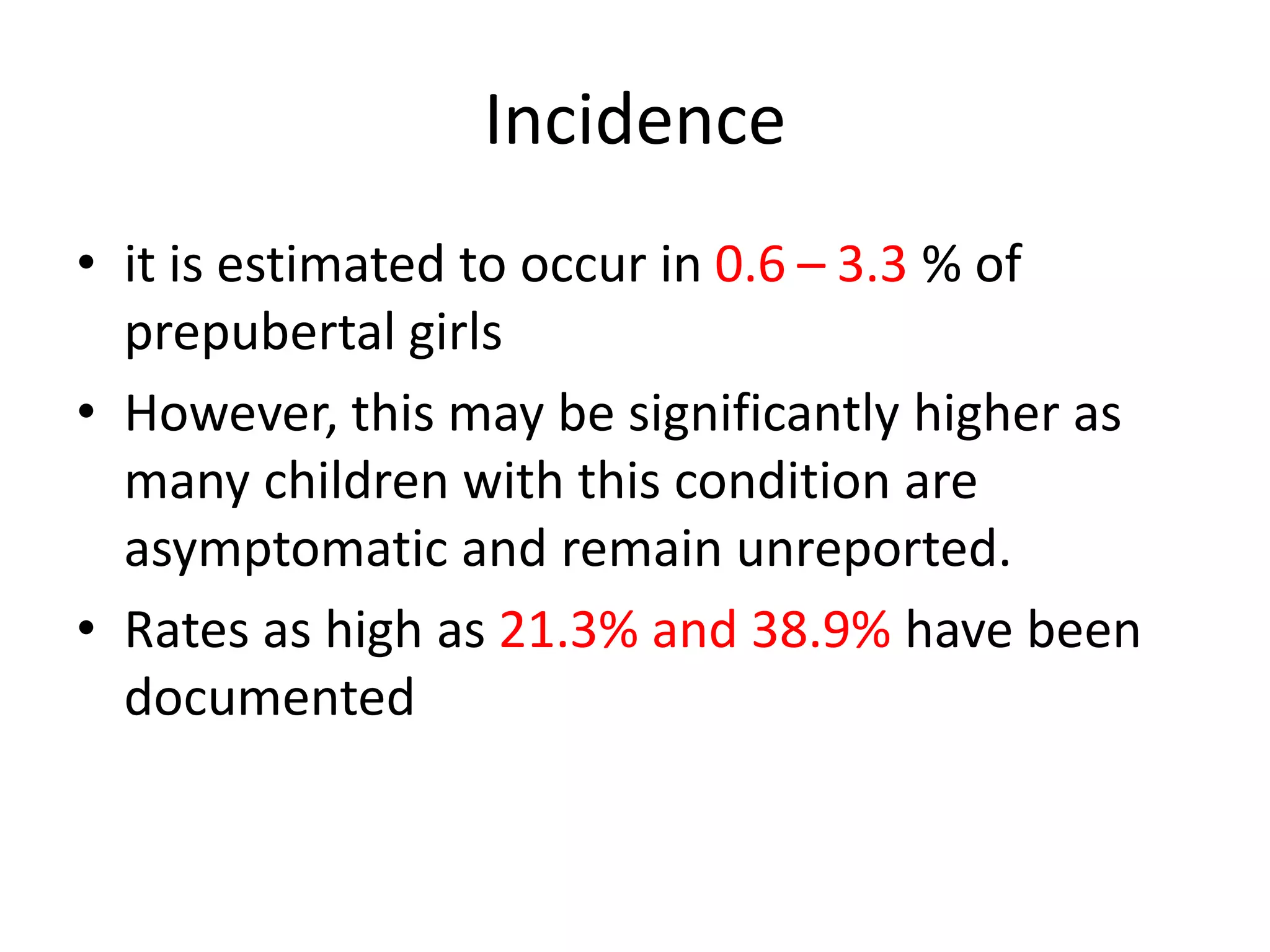
Incidence
• it is estimated to occur in 0.6 – 3.3 % of
prepubertal girls
• However, this may be significantly higher as
many children with this condition are
asymptomatic and remain unreported.
• Rates as high as 21.3% and 38.9% have been
documented
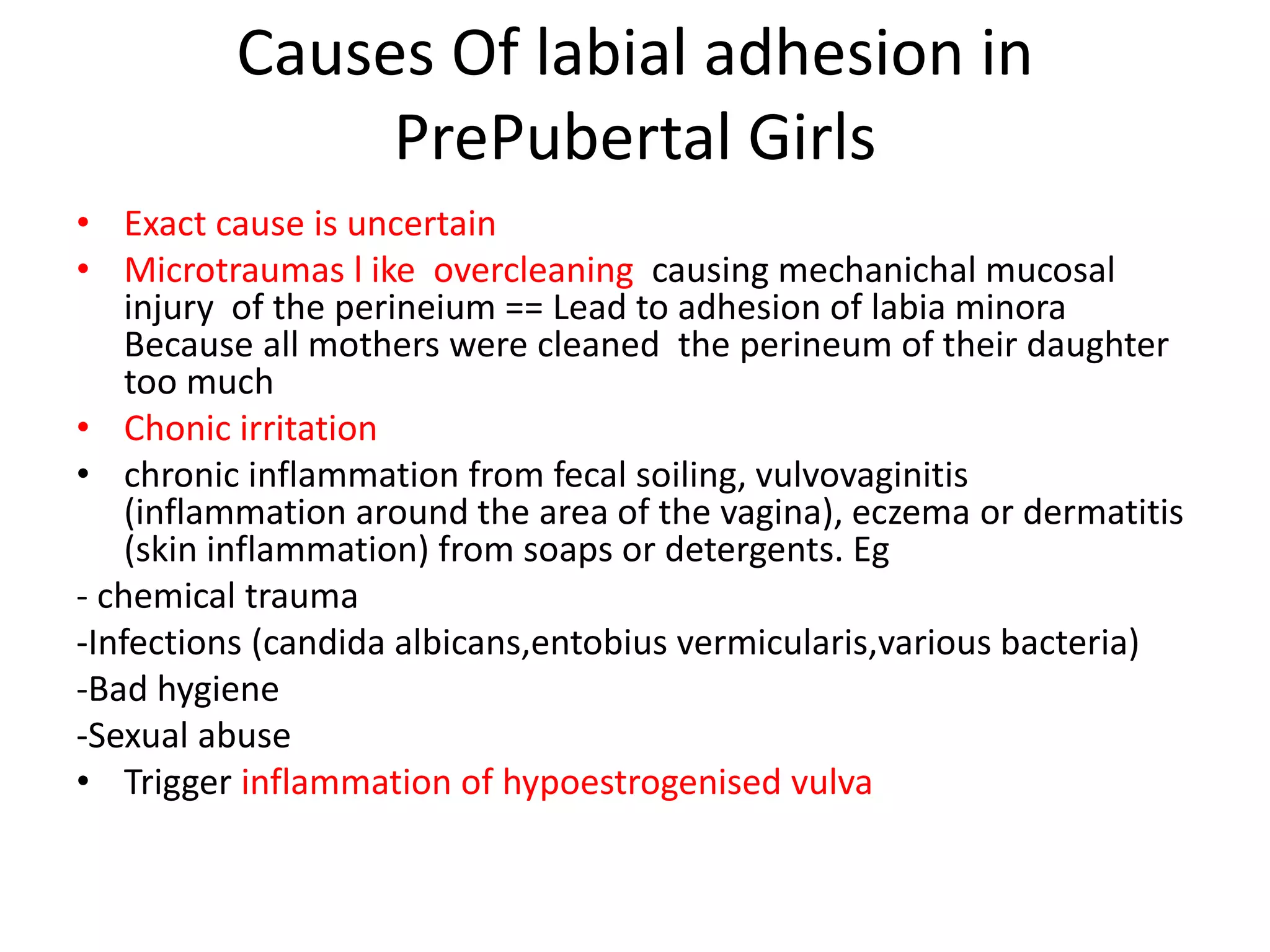
Causes Of labial adhesion in
PrePubertal Girls
• Exact cause is uncertain
• Microtraumas l ike overcleaning causing mechanichal mucosal
injury of the perineium == Lead to adhesion of labia minora
Because all mothers were cleaned the perineum of their daughter
too much
• Chonic irritation
• chronic inflammation from fecal soiling, vulvovaginitis
(inflammation around the area of the vagina), eczema or dermatitis
(skin inflammation) from soaps or detergents. Eg
- chemical trauma
-Infections (candida albicans,entobius vermicularis,various bacteria)
-Bad hygiene
-Sexual abuse
• Trigger inflammation of hypoestrogenised vulva
The most common causes of labial
adhesion in adult women
(PostPartum, PostMenopausal)
• Oestrogen deficiency associated with atrophic vaginitis
• Vulval lichen sclerosus
• Erosive lichen planus
• Mucous membrane pemphigoid
• Behcet syndrome
• Stevens-Johnson syndrome / toxic epidermal necrolysis
• Vulval cancer
• Complications of childbirth
• Female circumcision operation (illegal in many
countries)
• Complications from vulvectomy
Symptoms
• Labial adhesions are usually asymptomatic
• Symptomatic common symptoms or complaints can include:
Urinary dribbling which is due to urine that gets trapped behind the
adhesion or fused labia, later dribbling out.
• Skin or vaginal irritation or redness.
• Frequent urinary tract infections as a result of the adhesions.
• Eg
-UTI
-Pain or discomfort during activity
-Post voiding dribbling
-Abnormal urinary stream
-Urinary retension
Signs
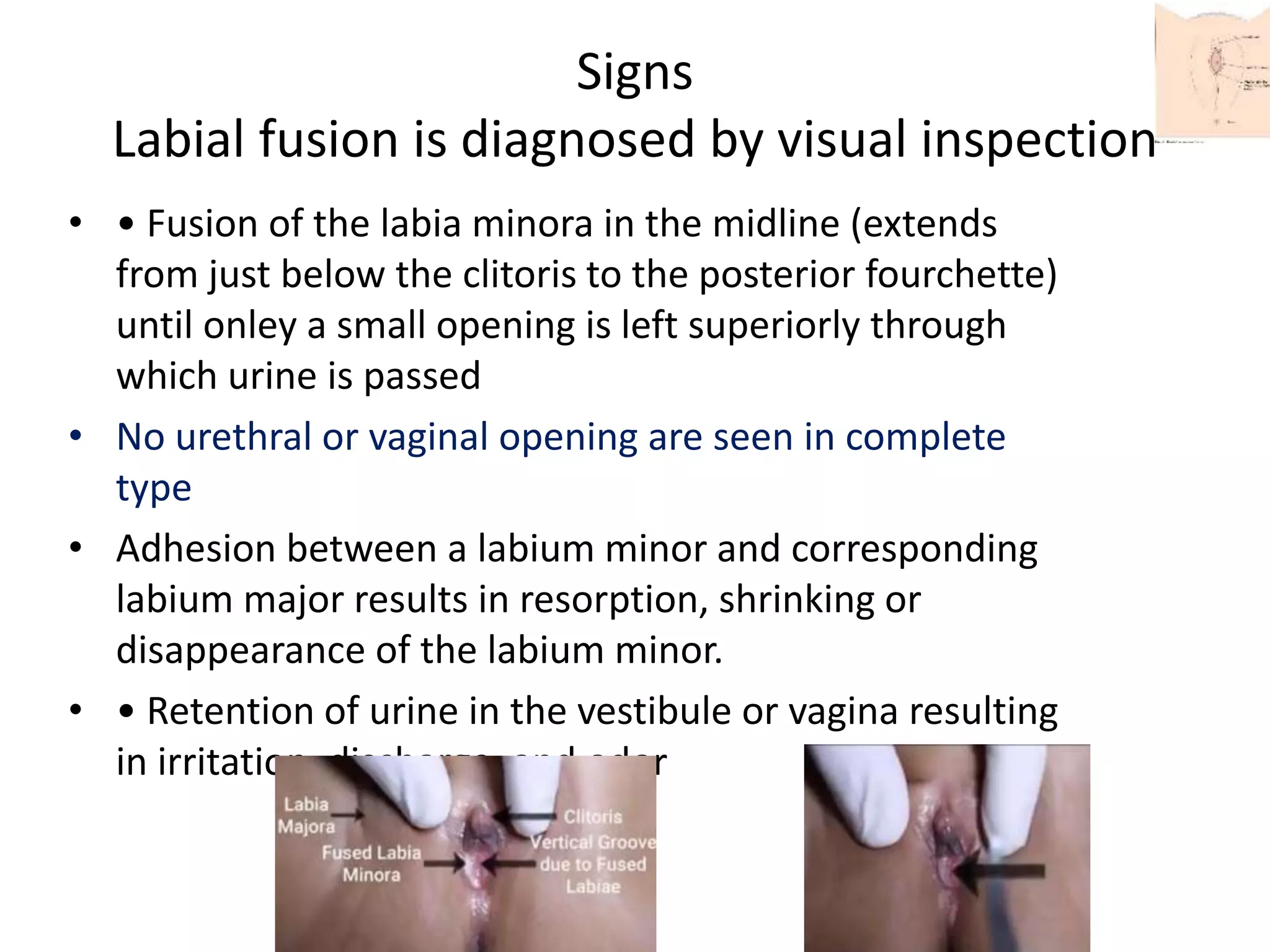
Labial fusion is diagnosed by visual inspection
• • Fusion of the labia minora in the midline (extends
from just below the clitoris to the posterior fourchette)
until onley a small opening is left superiorly through
which urine is passed
• No urethral or vaginal opening are seen in complete
type
• Adhesion between a labium minor and corresponding
labium major results in resorption, shrinking or
disappearance of the labium minor.
• • Retention of urine in the vestibule or vagina resulting
in irritation, discharge, and odor
Workup and Evaluation
• Laboratory: No evaluation indicated.
• Imaging: No imaging indicated.
• Special Tests: None indicated. Although an
endoscopic examination is frequently performed
in the diagnosis and treatment of lower and
upper urinary tract disease, the use of cystoscopy
in patients with labial fusion and urinary
retention has not been reported
• Diagnostic Procedures: History and physical
examination.
Spontaneous resolution
• 50% in cases within 6 monthes
• 90% in cases within 12 monthes
• 100% in cases within 18 monthes
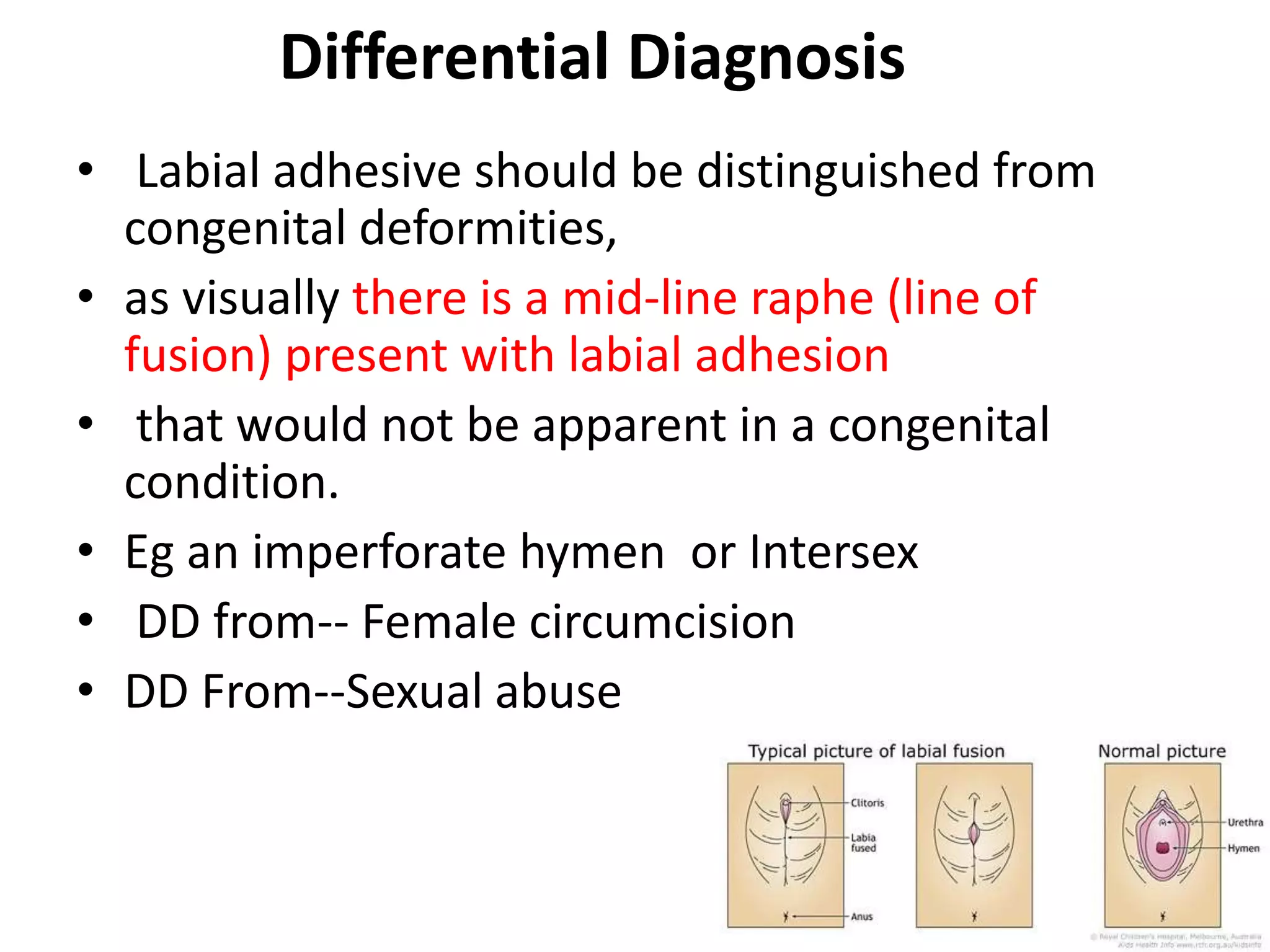
Differential Diagnosis
• Labial adhesive should be distinguished from
congenital deformities,
• as visually there is a mid-line raphe (line of
fusion) present with labial adhesion
• that would not be apparent in a congenital
condition.
• Eg an imperforate hymen or Intersex
• DD from-- Female circumcision
• DD From--Sexual abuse
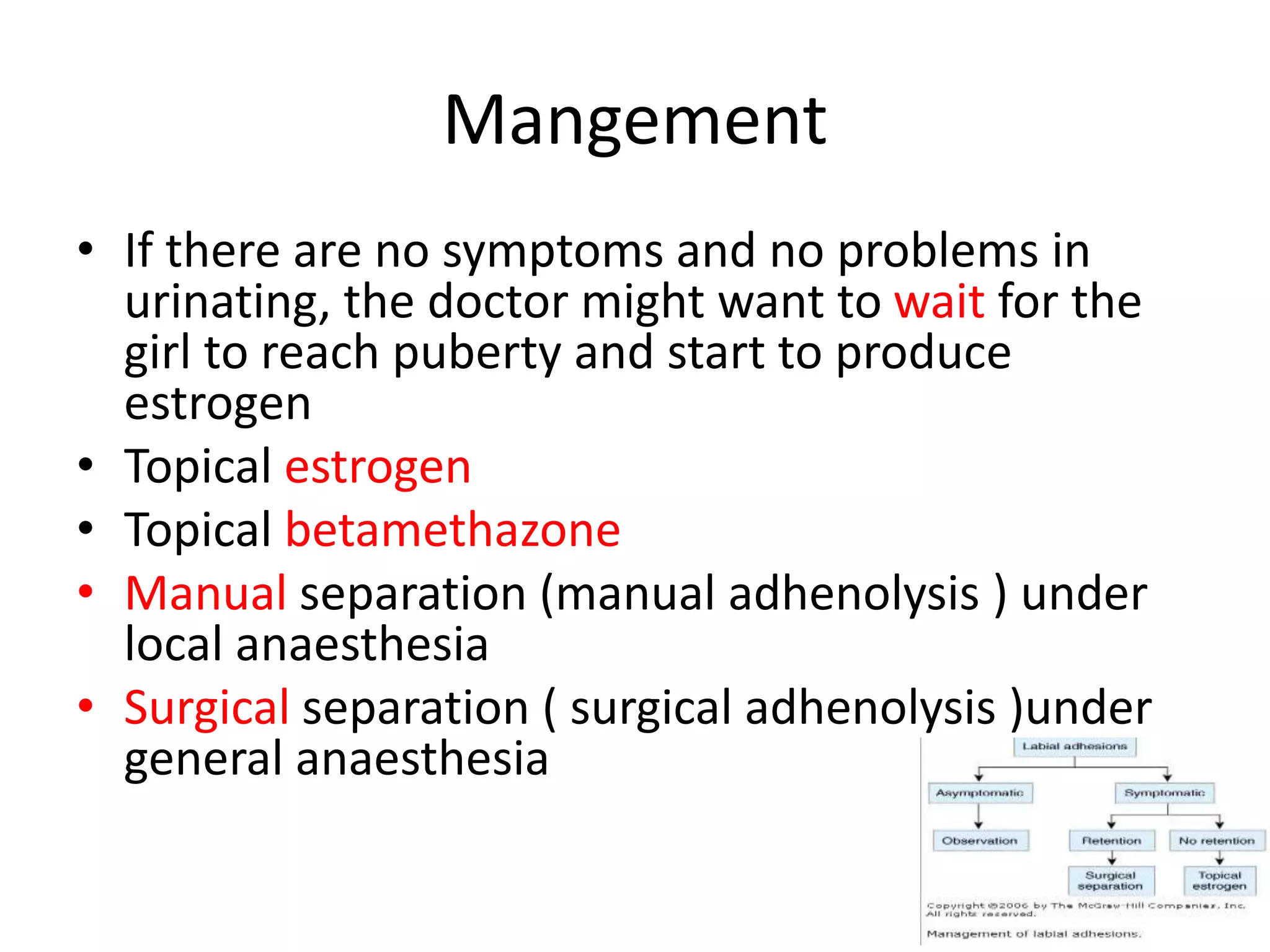
Mangement
• If there are no symptoms and no problems in
urinating, the doctor might want to wait for the
girl to reach puberty and start to produce
estrogen
• Topical estrogen
• Topical betamethazone
• Manual separation (manual adhenolysis ) under
local anaesthesia
• Surgical separation ( surgical adhenolysis )under
general anaesthesia
Leaving It alone
• Leaving labial fusion alone is the safest and
most effective treatment.
• for the girl to reach puberty and start to
produce estrogen
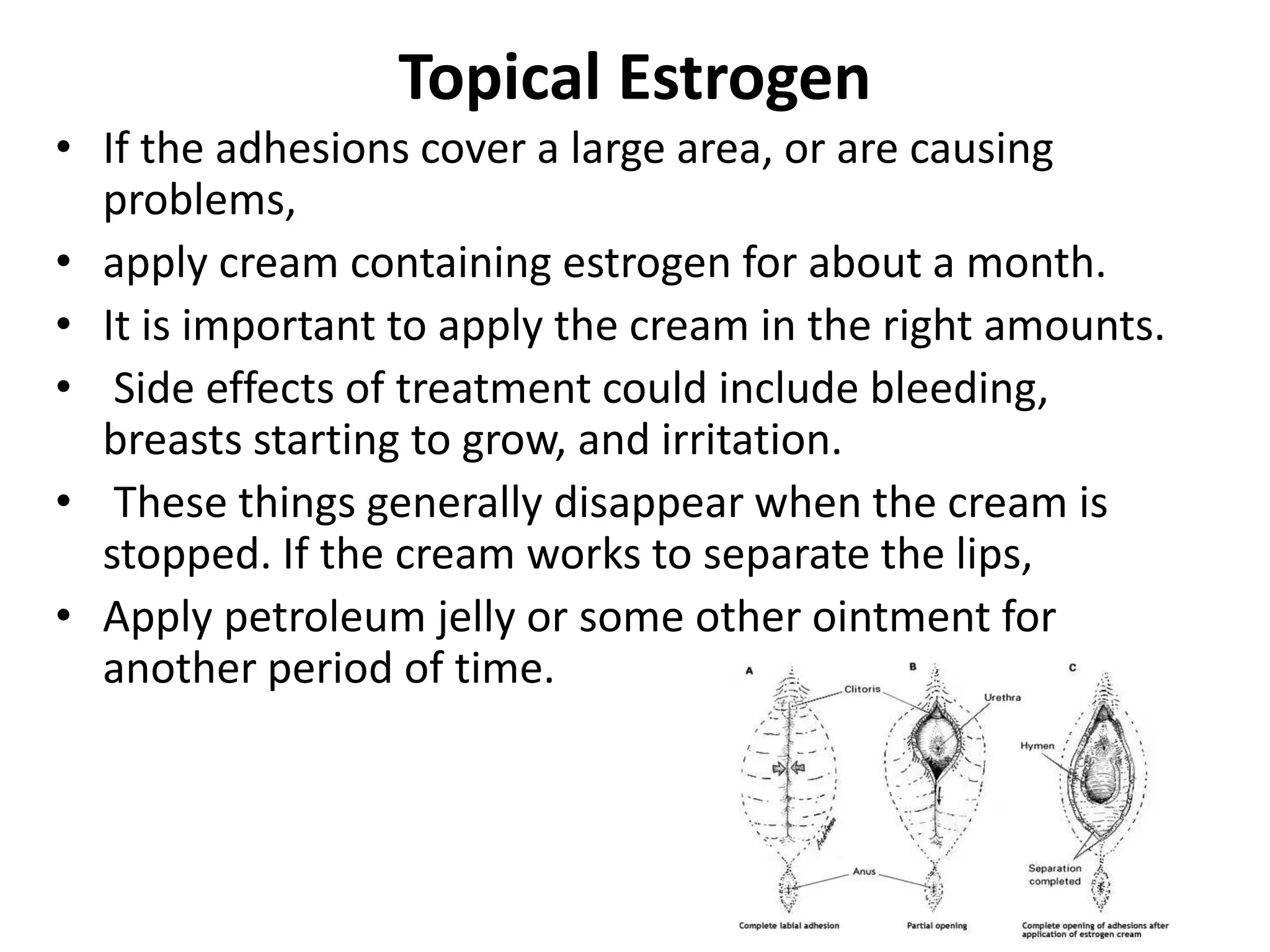
Topical Estrogen
• If the adhesions cover a large area, or are causing
problems,
• apply cream containing estrogen for about a month.
• It is important to apply the cream in the right amounts.
• Side effects of treatment could include bleeding,
breasts starting to grow, and irritation.
• These things generally disappear when the cream is
stopped. If the cream works to separate the lips,
• Apply petroleum jelly or some other ointment for
another period of time.
Topical Steroid
• betamethasone 0.5%.
• in addition to estrogen,
• or in place of estrogen.
• Betamethasone use should be limited to a
certain period of time, such as 3 months.
Manual or surgical separation
• If creams do not work, it is usually because the
adhesion is thick. In very few cases, separation
might be needed if the adhesions are causing
problems, such as blocking urine or causing many
infections. Only doctors who are experienced
should do a manual separation. The procedure
calls for local anesthesia and possibly sedation.
Surgical separation generally is only needed if the
girl cannot urinate or if other treatments do not
work. Surgery is also suggested for the rare labial
adhesion that occurs after a pregnancy.
Manual separation
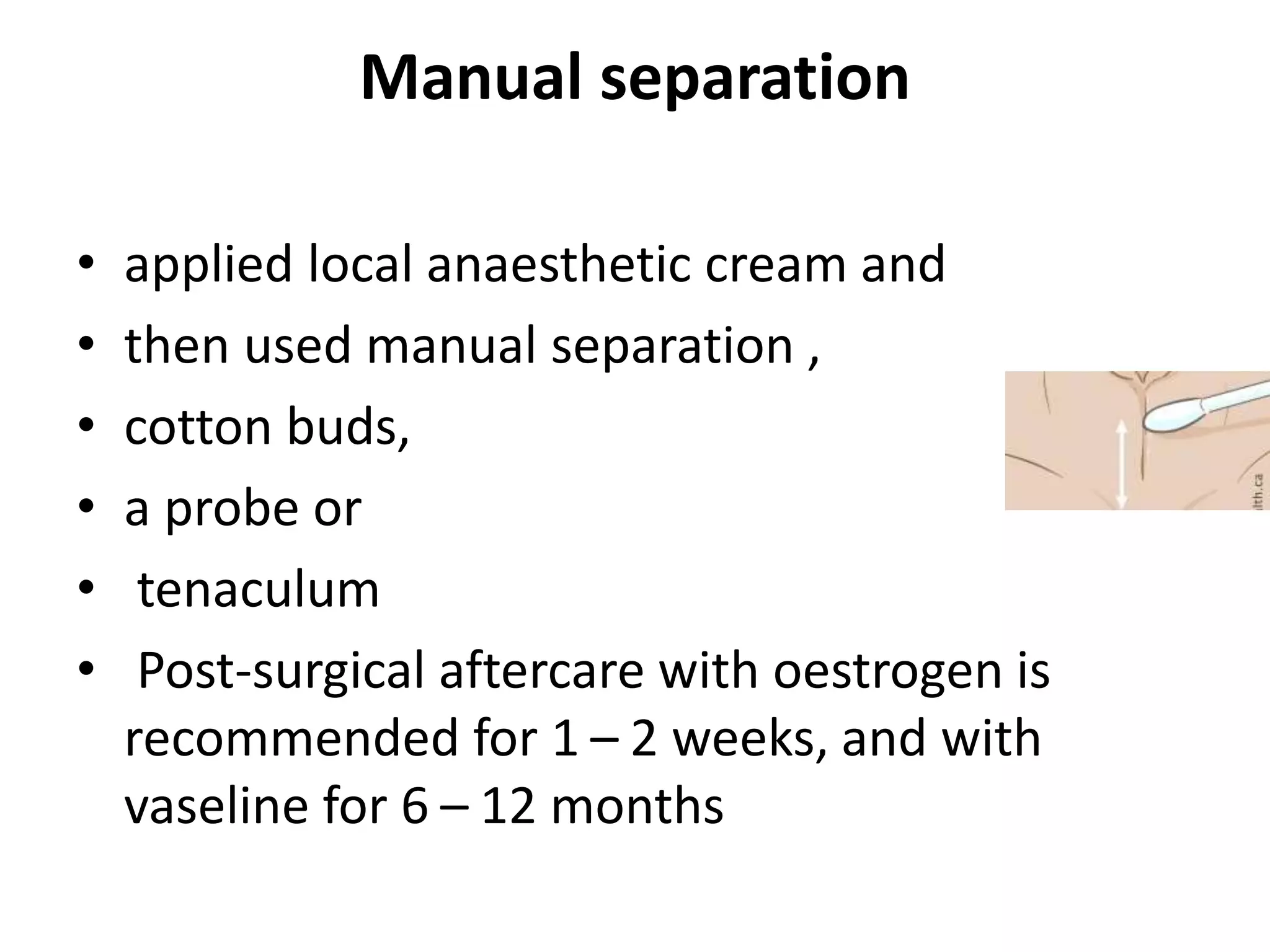
• applied local anaesthetic cream and
• then used manual separation ,
• cotton buds,
• a probe or
• tenaculum
• Post-surgical aftercare with oestrogen is
recommended for 1 – 2 weeks, and with
vaseline for 6 – 12 months
Surgical technique
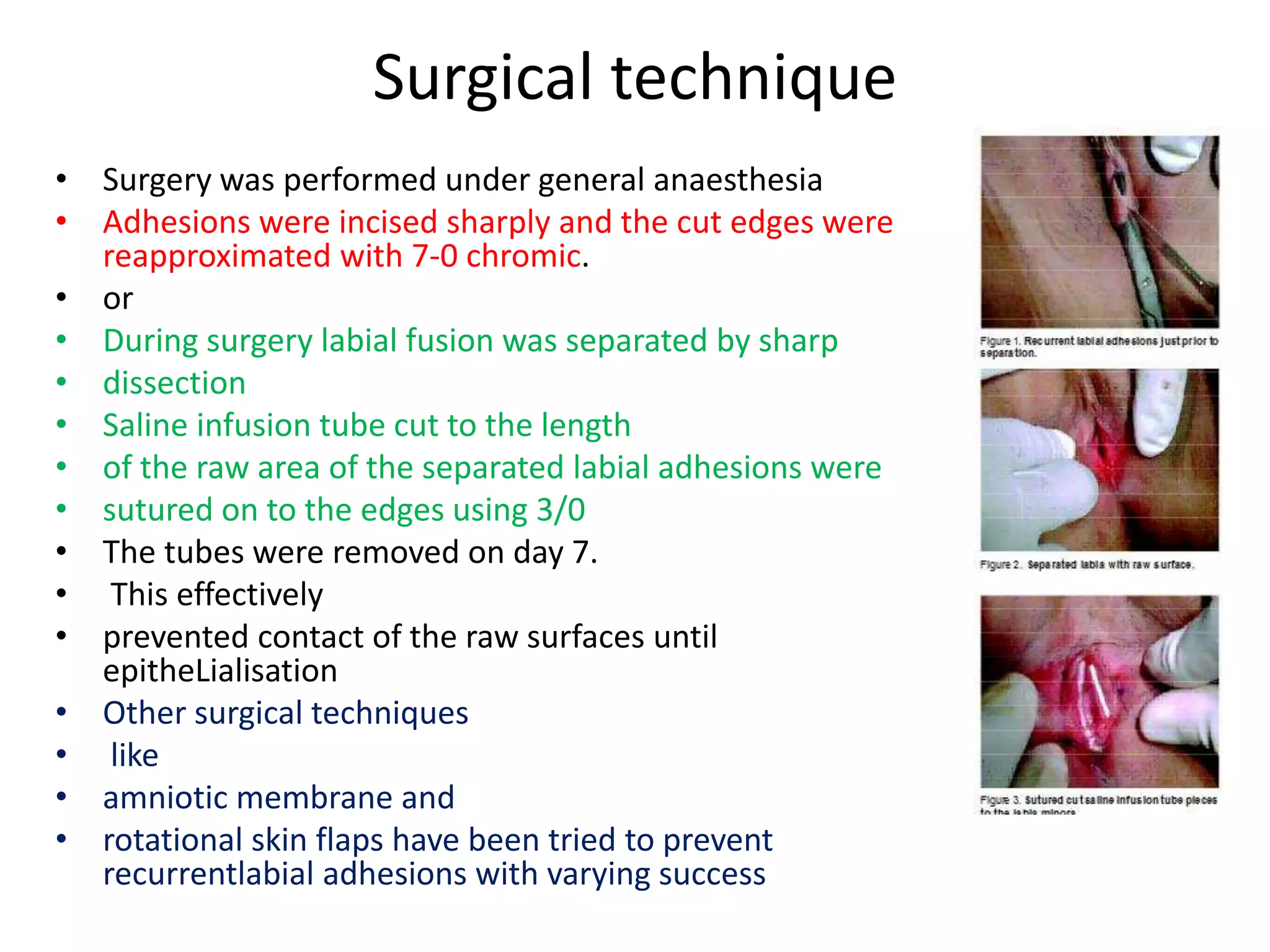
• Surgery was performed under general anaesthesia
• Adhesions were incised sharply and the cut edges were
reapproximated with 7-0 chromic.
• or
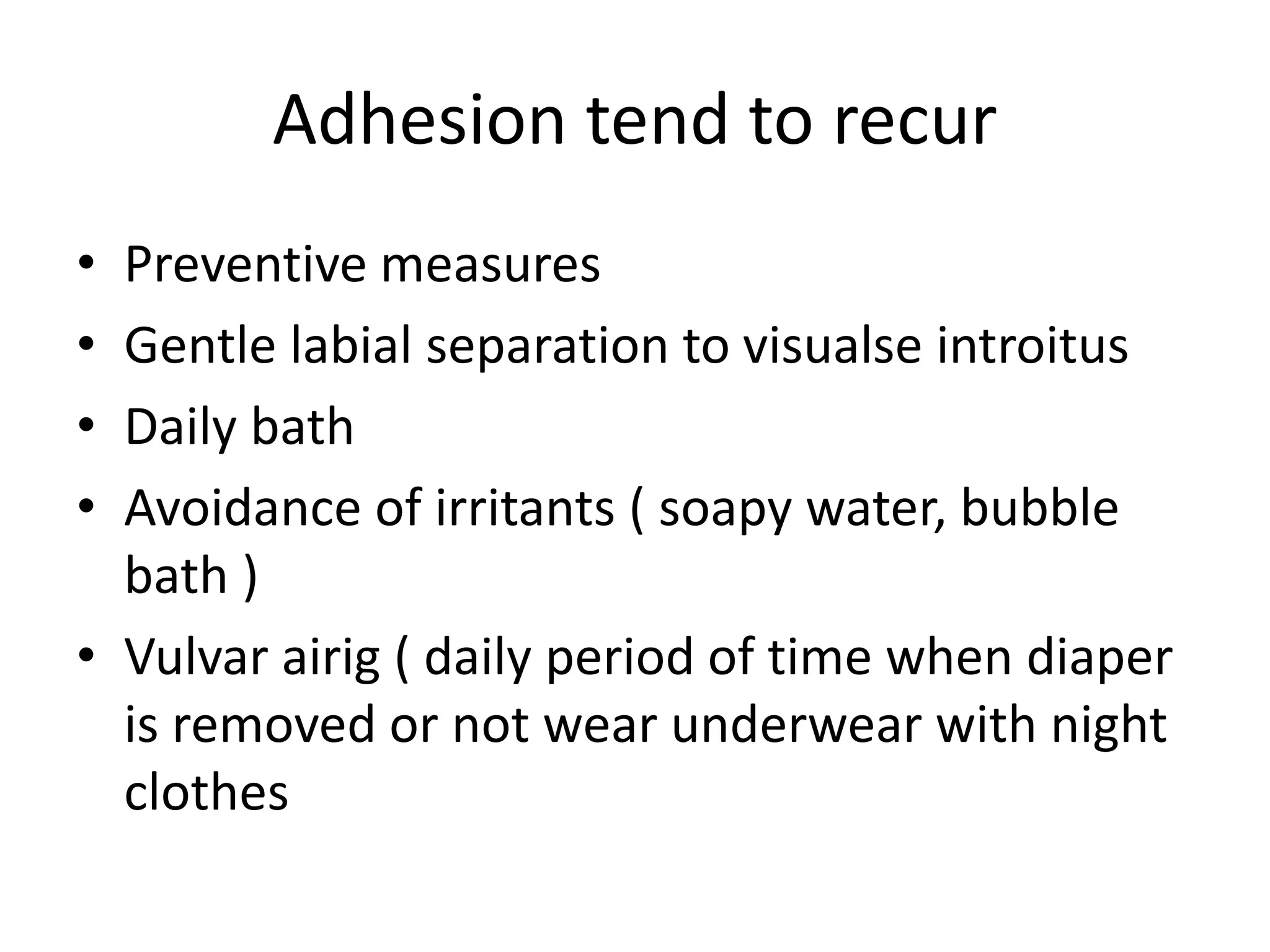
• During surgery labial fusion was separated by sharp
• dissection
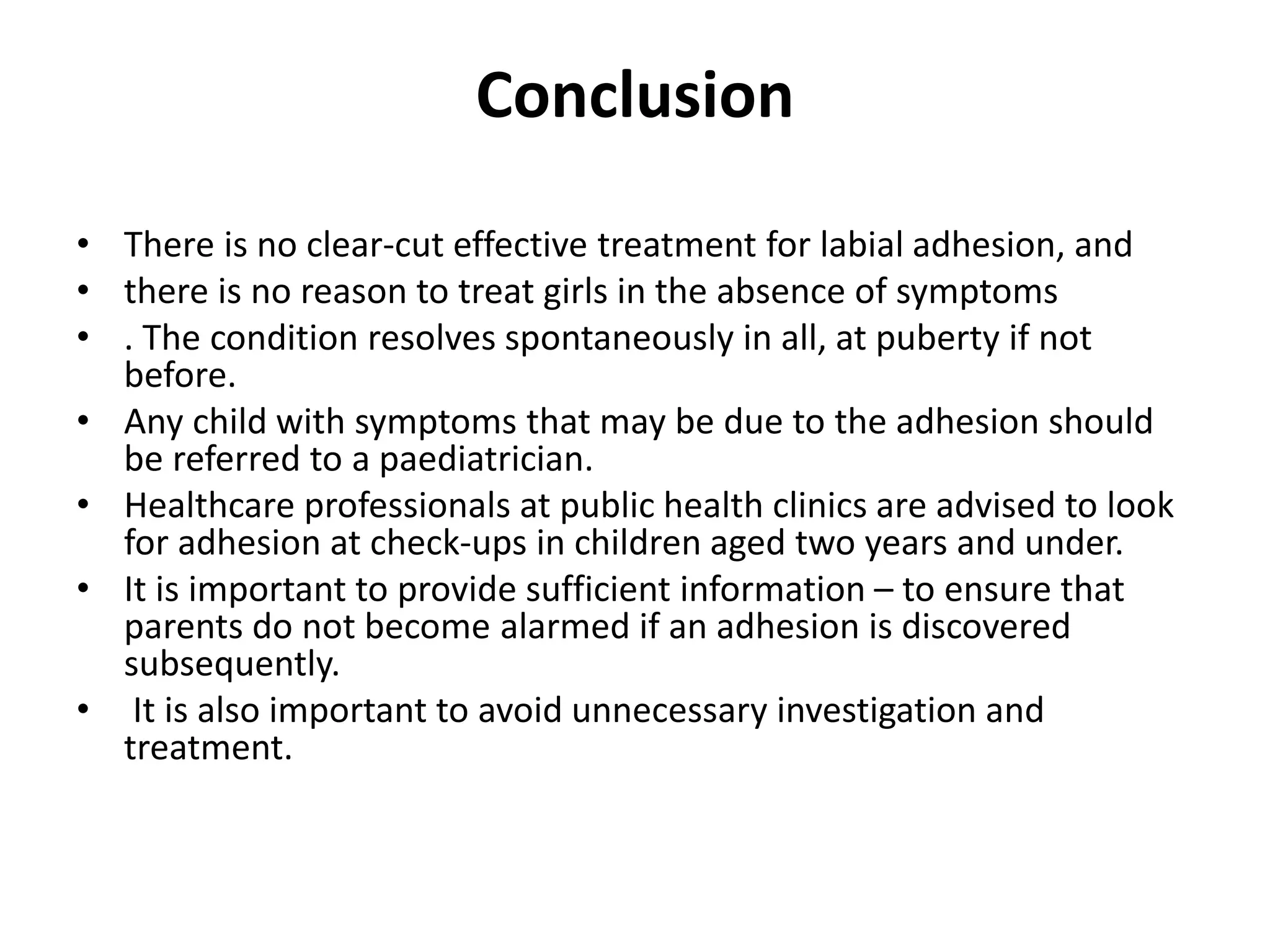
• Saline infusion tube cut to the length
• of the raw area of the separated labial adhesions were
• sutured on to the edges using 3/0
• The tubes were removed on day 7.
• This effectively
• prevented contact of the raw surfaces until
epitheLialisation
• Other surgical techniques
• like
• amniotic membrane and
• rotational skin flaps have been tried to prevent
recurrentlabial adhesions with varying success
Adhesion tend to recur
• Preventive measures
• Gentle labial separation to visualse introitus
• Daily bath
• Avoidance of irritants ( soapy water, bubble
bath )
• Vulvar airig ( daily period of time when diaper
is removed or not wear underwear with night
clothes
Conclusion
• There is no clear-cut effective treatment for labial adhesion, and
• there is no reason to treat girls in the absence of symptoms
• . The condition resolves spontaneously in all, at puberty if not
before.
• Any child with symptoms that may be due to the adhesion should
be referred to a paediatrician.
• Healthcare professionals at public health clinics are advised to look
for adhesion at check-ups in children aged two years and under.
• It is important to provide sufficient information – to ensure that
parents do not become alarmed if an adhesion is discovered
subsequently.
• It is also important to avoid unnecessary investigation and
treatment.

Labial adhesion

  • 1.
    Labia Minora Adhesions (LMA) Muhammad M AlHennawy First Consultant Obstetrician & Gynacologist Egypt 01222503011
  • 2.
    Definition • Labial agglutination(Adhesion) or “fused labia” • It is defined as the partial to complete fusion of the labia minora (or labia majora). • In which the opposing epithelial surfaces of labia minora stick together without any union of deeper tissues
  • 3.
    Membranous structure • Fusionof medial adjacent mucosal surfaces of labia minora • Ranging • From thin , transeparent • To thick and fibrous
  • 4.
    • Labial fusionis almost never present at birth, • usually develops around one to two years of age. • Labial adhesions are usually an innocent finding and a trivial problem, are a common finding in the girls. • Usually, this condition is asymptomatic • spontaneously disappears during adolescence • but its importance is that it is frequently • misdiagnosed as congenital absence of the vagina
  • 5.
    • Labial adhesionis relatively common, • but the condition is little known among doctors and parents. • It is a source of great paternal anxiety • And are commonly misdiagnosed or unnecessary investigations may be orderd
  • 6.
    Names • Labial adhesion •Labial fusion • Labial synechia • Labial agglutination • synechia vulvae
  • 7.
    Incidence • it isestimated to occur in 0.6 – 3.3 % of prepubertal girls • However, this may be significantly higher as many children with this condition are asymptomatic and remain unreported. • Rates as high as 21.3% and 38.9% have been documented
  • 8.
    Causes Of labialadhesion in PrePubertal Girls • Exact cause is uncertain • Microtraumas l ike overcleaning causing mechanichal mucosal injury of the perineium == Lead to adhesion of labia minora Because all mothers were cleaned the perineum of their daughter too much • Chonic irritation • chronic inflammation from fecal soiling, vulvovaginitis (inflammation around the area of the vagina), eczema or dermatitis (skin inflammation) from soaps or detergents. Eg - chemical trauma -Infections (candida albicans,entobius vermicularis,various bacteria) -Bad hygiene -Sexual abuse • Trigger inflammation of hypoestrogenised vulva
  • 9.
    The most commoncauses of labial adhesion in adult women (PostPartum, PostMenopausal) • Oestrogen deficiency associated with atrophic vaginitis • Vulval lichen sclerosus • Erosive lichen planus • Mucous membrane pemphigoid • Behcet syndrome • Stevens-Johnson syndrome / toxic epidermal necrolysis • Vulval cancer • Complications of childbirth • Female circumcision operation (illegal in many countries) • Complications from vulvectomy
  • 10.
    Symptoms • Labial adhesionsare usually asymptomatic • Symptomatic common symptoms or complaints can include: Urinary dribbling which is due to urine that gets trapped behind the adhesion or fused labia, later dribbling out. • Skin or vaginal irritation or redness. • Frequent urinary tract infections as a result of the adhesions. • Eg -UTI -Pain or discomfort during activity -Post voiding dribbling -Abnormal urinary stream -Urinary retension
  • 11.
    Signs Labial fusion isdiagnosed by visual inspection • • Fusion of the labia minora in the midline (extends from just below the clitoris to the posterior fourchette) until onley a small opening is left superiorly through which urine is passed • No urethral or vaginal opening are seen in complete type • Adhesion between a labium minor and corresponding labium major results in resorption, shrinking or disappearance of the labium minor. • • Retention of urine in the vestibule or vagina resulting in irritation, discharge, and odor
  • 12.
    Workup and Evaluation •Laboratory: No evaluation indicated. • Imaging: No imaging indicated. • Special Tests: None indicated. Although an endoscopic examination is frequently performed in the diagnosis and treatment of lower and upper urinary tract disease, the use of cystoscopy in patients with labial fusion and urinary retention has not been reported • Diagnostic Procedures: History and physical examination.
  • 13.
    Spontaneous resolution • 50%in cases within 6 monthes • 90% in cases within 12 monthes • 100% in cases within 18 monthes
  • 14.
    Differential Diagnosis • Labialadhesive should be distinguished from congenital deformities, • as visually there is a mid-line raphe (line of fusion) present with labial adhesion • that would not be apparent in a congenital condition. • Eg an imperforate hymen or Intersex • DD from-- Female circumcision • DD From--Sexual abuse
  • 16.
    Mangement • If thereare no symptoms and no problems in urinating, the doctor might want to wait for the girl to reach puberty and start to produce estrogen • Topical estrogen • Topical betamethazone • Manual separation (manual adhenolysis ) under local anaesthesia • Surgical separation ( surgical adhenolysis )under general anaesthesia
  • 17.
    Leaving It alone •Leaving labial fusion alone is the safest and most effective treatment. • for the girl to reach puberty and start to produce estrogen
  • 18.
    Topical Estrogen • Ifthe adhesions cover a large area, or are causing problems, • apply cream containing estrogen for about a month. • It is important to apply the cream in the right amounts. • Side effects of treatment could include bleeding, breasts starting to grow, and irritation. • These things generally disappear when the cream is stopped. If the cream works to separate the lips, • Apply petroleum jelly or some other ointment for another period of time.
  • 19.
    Topical Steroid • betamethasone0.5%. • in addition to estrogen, • or in place of estrogen. • Betamethasone use should be limited to a certain period of time, such as 3 months.
  • 20.
    Manual or surgicalseparation • If creams do not work, it is usually because the adhesion is thick. In very few cases, separation might be needed if the adhesions are causing problems, such as blocking urine or causing many infections. Only doctors who are experienced should do a manual separation. The procedure calls for local anesthesia and possibly sedation. Surgical separation generally is only needed if the girl cannot urinate or if other treatments do not work. Surgery is also suggested for the rare labial adhesion that occurs after a pregnancy.
  • 21.
    Manual separation • appliedlocal anaesthetic cream and • then used manual separation , • cotton buds, • a probe or • tenaculum • Post-surgical aftercare with oestrogen is recommended for 1 – 2 weeks, and with vaseline for 6 – 12 months
  • 22.
    Surgical technique • Surgerywas performed under general anaesthesia • Adhesions were incised sharply and the cut edges were reapproximated with 7-0 chromic. • or • During surgery labial fusion was separated by sharp • dissection • Saline infusion tube cut to the length • of the raw area of the separated labial adhesions were • sutured on to the edges using 3/0 • The tubes were removed on day 7. • This effectively • prevented contact of the raw surfaces until epitheLialisation • Other surgical techniques • like • amniotic membrane and • rotational skin flaps have been tried to prevent recurrentlabial adhesions with varying success
  • 23.
    Adhesion tend torecur • Preventive measures • Gentle labial separation to visualse introitus • Daily bath • Avoidance of irritants ( soapy water, bubble bath ) • Vulvar airig ( daily period of time when diaper is removed or not wear underwear with night clothes
  • 24.
    Conclusion • There isno clear-cut effective treatment for labial adhesion, and • there is no reason to treat girls in the absence of symptoms • . The condition resolves spontaneously in all, at puberty if not before. • Any child with symptoms that may be due to the adhesion should be referred to a paediatrician. • Healthcare professionals at public health clinics are advised to look for adhesion at check-ups in children aged two years and under. • It is important to provide sufficient information – to ensure that parents do not become alarmed if an adhesion is discovered subsequently. • It is also important to avoid unnecessary investigation and treatment.