By: Vikram.G.B
Lecturer, P.G Dept. of Commerce
V.D.C
 E-Commerce web design is generally
defined as the planning, creation and
arrangement of files, text, graphics and
processes used within an E-Commerce
enabled website.
 The files make up different sections of the
site which typically include pages,
categories, subcategories and products.
 E-Commerce web design is commonly
referred to as web design, web
development, site design, site
development, shop design/development,
store design/development, web store
design/ development.
 Web designs have evolved over the years from
plain looking designs with few graphics and
little appeal to fully interactive E-Commerce
sites using the latest in graphic design and
programming technologies.
 The days of simple layouts and designs are
pretty much done with as competition increases
and more merchants are attempting to improve
the look, feel and usability of their E-commerce
designs.
 Now it is more common to see
 gradient graphics,
 more options for shoppers,
 features surrounding customers,
 better layouts,
 faster load times,
 videos,
 more payment options and much more.
 New age E-Commerce design is about being
creative and original, pretty much anything that
can be thought of can be accomplished using
current E-Commerce design technology for an E-
Commerce business.
 Attracting visitors to the web site.
 Making the site interest enough that visitors
stay and explore.
 Convincing visitors to follow the site’s links
to obtain information
 Creating an impression consistent with the
organizations desired image.
 Building a trusting relationship with
visitors.
 Reinforcing positive images that the visitors
might already have about the organization.
 Encouraging visitors to return to the site.
 Every visitor is a potential customer
 learning about product and services.
 buying the products and services that the co-offer
 Obtaining general information about the company for
investing or credit granting.
 Obtaining financial information about the company so
that one cans incest.
 Knowing about the people who manage the company.
 Obtaining contact information about a person or a
department.
 Consistency.
 Make effective and selective use of graphics.
 Choose colors carefully.
 Page design.
 content:
 Overall objective of the company goals, mission,
vision, statement, logo.
 Objective of the web site
 Target audience-all the stake holders
 Presentation: the presentation is in the form of
text and language. It should be very simple and
clear. And also it contains images and
multimedia.
 structure:
 home page should have links to all pages
 All other pages should be meaningfully interlinked.
 Buttons, scrollbars, windows should be used with in
 aesthetics:
 appropriate font size should be used
 color scheme should be pleasing
 layout should be clear
 Multimedia-video, audio, and etc.
 Photograph could be used to increase effectiveness.
 technology: hardware, software issues
 Web design should take into account of all possible
web browsers from oldest version so that it serves
the users with oldest web browsers.
 Web page should be so design that it is well received
even on the smallest monitor.
 File format design only viewing- HTML
 File format from copying- adobe PDF
 File for computation- EXCEL
 Review and research: web site should be
periodically review and updated. They test the
usability. And it is used in the profile study.
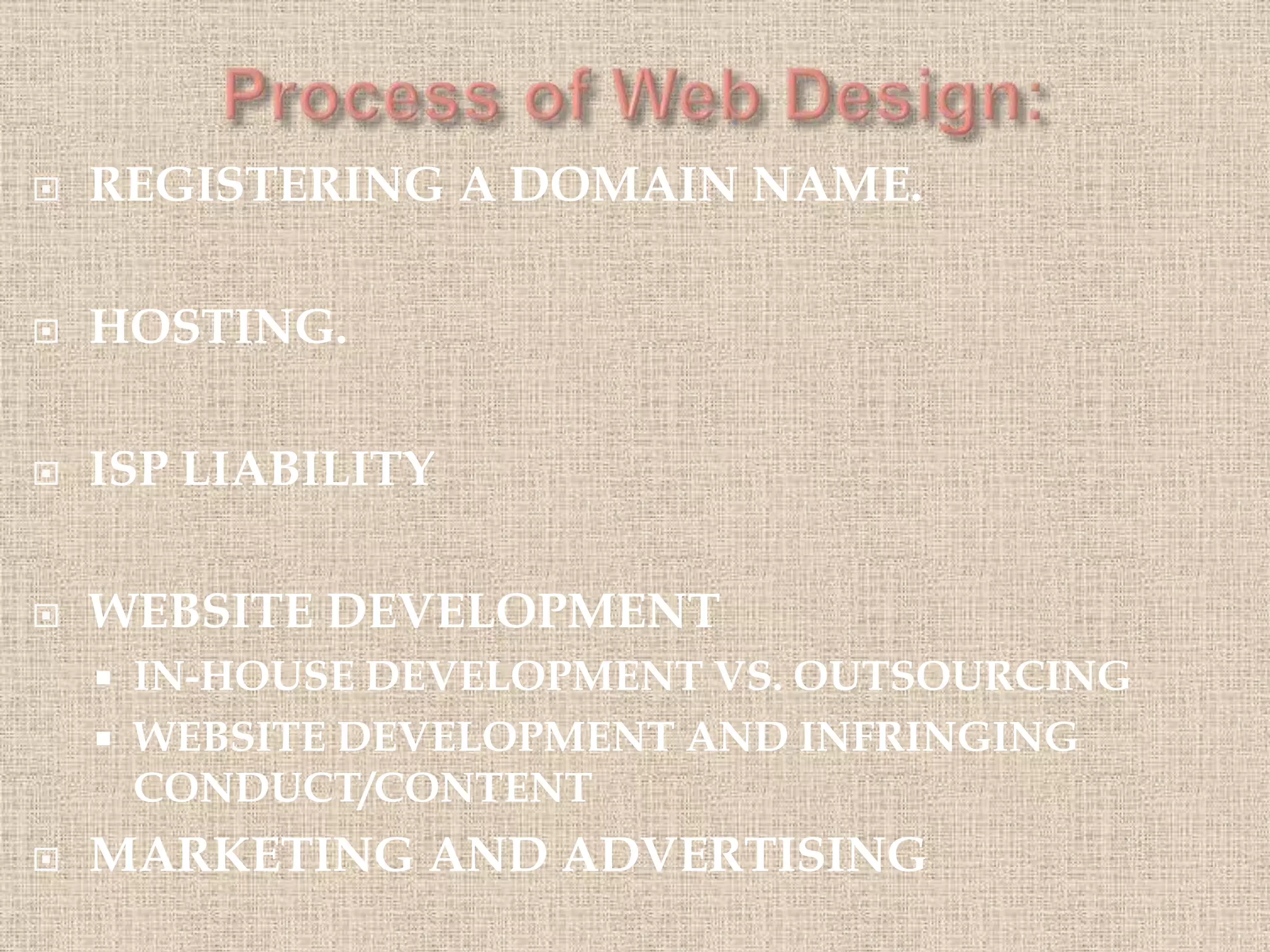
 REGISTERING A DOMAIN NAME.
 HOSTING.
 ISP LIABILITY
 WEBSITE DEVELOPMENT
 IN-HOUSE DEVELOPMENT VS. OUTSOURCING
 WEBSITE DEVELOPMENT AND INFRINGING
CONDUCT/CONTENT
 MARKETING AND ADVERTISING

Customer effective web design new

  • 1.
    By: Vikram.G.B Lecturer, P.GDept. of Commerce V.D.C
  • 2.
     E-Commerce webdesign is generally defined as the planning, creation and arrangement of files, text, graphics and processes used within an E-Commerce enabled website.  The files make up different sections of the site which typically include pages, categories, subcategories and products.
  • 3.
     E-Commerce webdesign is commonly referred to as web design, web development, site design, site development, shop design/development, store design/development, web store design/ development.
  • 4.
     Web designshave evolved over the years from plain looking designs with few graphics and little appeal to fully interactive E-Commerce sites using the latest in graphic design and programming technologies.  The days of simple layouts and designs are pretty much done with as competition increases and more merchants are attempting to improve the look, feel and usability of their E-commerce designs.
  • 5.
     Now itis more common to see  gradient graphics,  more options for shoppers,  features surrounding customers,  better layouts,  faster load times,  videos,  more payment options and much more.  New age E-Commerce design is about being creative and original, pretty much anything that can be thought of can be accomplished using current E-Commerce design technology for an E- Commerce business.
  • 6.
     Attracting visitorsto the web site.  Making the site interest enough that visitors stay and explore.  Convincing visitors to follow the site’s links to obtain information  Creating an impression consistent with the organizations desired image.
  • 7.
     Building atrusting relationship with visitors.  Reinforcing positive images that the visitors might already have about the organization.  Encouraging visitors to return to the site.
  • 8.
     Every visitoris a potential customer  learning about product and services.  buying the products and services that the co-offer  Obtaining general information about the company for investing or credit granting.  Obtaining financial information about the company so that one cans incest.  Knowing about the people who manage the company.  Obtaining contact information about a person or a department.
  • 9.
     Consistency.  Makeeffective and selective use of graphics.  Choose colors carefully.  Page design.
  • 10.
     content:  Overallobjective of the company goals, mission, vision, statement, logo.  Objective of the web site  Target audience-all the stake holders  Presentation: the presentation is in the form of text and language. It should be very simple and clear. And also it contains images and multimedia.
  • 11.
     structure:  homepage should have links to all pages  All other pages should be meaningfully interlinked.  Buttons, scrollbars, windows should be used with in  aesthetics:  appropriate font size should be used  color scheme should be pleasing  layout should be clear  Multimedia-video, audio, and etc.  Photograph could be used to increase effectiveness.
  • 12.
     technology: hardware,software issues  Web design should take into account of all possible web browsers from oldest version so that it serves the users with oldest web browsers.  Web page should be so design that it is well received even on the smallest monitor.  File format design only viewing- HTML  File format from copying- adobe PDF  File for computation- EXCEL  Review and research: web site should be periodically review and updated. They test the usability. And it is used in the profile study.
  • 13.
     REGISTERING ADOMAIN NAME.  HOSTING.  ISP LIABILITY  WEBSITE DEVELOPMENT  IN-HOUSE DEVELOPMENT VS. OUTSOURCING  WEBSITE DEVELOPMENT AND INFRINGING CONDUCT/CONTENT  MARKETING AND ADVERTISING