CHAPTER 6
DELIVERING THE ONLINE
CUSTOMER EXPERIENCE
NUR AQILAH BT ZAINUDIN
2014416824
OUTLINE
 Introduction
 Planning web site design and built
 Initiation of website project
 Defining site or app requirement
 Designing the user experience
 Development and testing of content
 Online retail merchandising
 Promote sites
 Services quality
INTRODUCTION
 Effective means that the presence must deliver relevance
and a satisfactory online.
 Online customer experience: the combination of rational
and emotional factors of using a company’s online
services that influence customer’s perception of a brand
online.
 Conversion rate optimization (CRO): Improving
commercial returns from a transactional site through
increasing conversion to key goals such as sales quotes
or booking or leads.
CONTINUE
 CRO combines customer and competitor research with
evaluation of customer behavior using web analytics and AB
and multivariate testing.
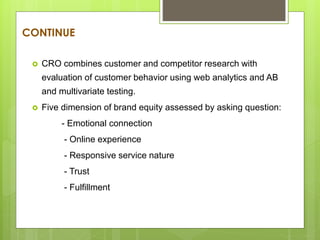
 Five dimension of brand equity assessed by asking question:
- Emotional connection
- Online experience
- Responsive service nature
- Trust
- Fulfillment
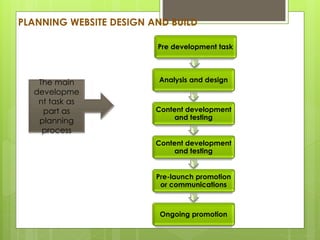
PLANNING WEBSITE DESIGN AND BUILD
Pre development task
Analysis and design
Content development
and testing
Content development
and testing
Pre-launch promotion
or communications
Ongoing promotion
The main
developme
nt task as
part as
planning
process
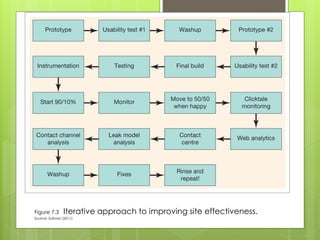
Figure 7.3 Iterative approach to improving site effectiveness.
Source: Sullivan (2011)
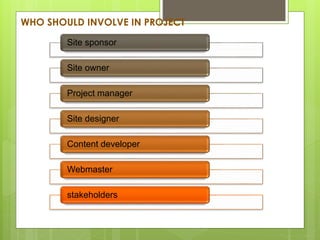
WHO SHOULD INVOLVE IN PROJECT
Site sponsor
Site owner
Project manager
Site designer
Content developer
Webmaster
stakeholders
PROTOTYPING AND AGILE SOFTWARE DEVELOPMENT
 Prototype: are trial versions of website or a framework of all of a website,
which can be reviewed by its target audience or the marketing team.
Prototype is an iterative process in which website users suggest modifications
before further prototypes and the final version of the site are developed
 Each prototype passes through stages which are:
- analysis
- design
- develop
- test and review
 Agile software development: website functionality or software applications
where it is known as agile software development. The goal is to create stable
releases more frequently
INITIATION OF THE WEBSITE PROJECT
 The phase of the project should involve a structure review of the costs and
benefits of developing a website. The successful outcome to initiation will
be decision to proceed with the site development phase,, with an agreed
budget and target completion date.
 Domain name registration: the process of reserving a unique web
address that can be used to the company website.
 Selecting a hosting provider: selecting the right partner to host a
website.
 Website performance optimization: download page performance is
essential to the success of a site.
 The availability of the website: indication of how easy it is for a user to
connect to it.
DEFINING SITE OR APP REQUIREMENT
 Analysis : the identification of the requirements of a website.
Technique to achieve this may include focus groups ,
questionnaires sent to existing customers or interview with key
account.
 In analysis seeking answer the following types of ‘who’, ’what’,
’why’, ’how’, ’when’ , ’where’ question.
 User - center design: a design approach which is based on
research of user characteristic and needs.
BUSINESS REQUIREMENT
 Customer acquisition
 Customer conversion
 Customer retention
 Service quality
 Branding
USABILITY REQUIREMENT
 Usability : an approach to website design intended to enable the
completion of user task.
 Expert review: an analysis of an existing site or prototype by an
experience usability expert.
 Usability testing: representative users are observed performing
representative task using a system.
WEB ACCESSIBILITY REQUIREMENT
 An approach to design intended to accommodate site usage using different
browsers and setting.
 Accessibility legislation : legislation intended to protect users of websites with
disabilities including visual disability.
 Main argument in favorite accessibility are:
- number of visually impaired people.
- number of users of less popular browsers or variation in screen display resolution.
- more visitors from natural listings of search engines.
- legal requirements.
LOCALISATION
 Tailoring of website information for individual countries.
 A site may need to support customers from a range of countries:
- Different product need
- Language differences
- Cultural differences
REVIEWING COMPETITORS’ WEBSITE
 Benchmarking of competitors’ websites is vital in positioning a website to compete
effectively with competitors.
 Benchmarking criteria should include:
- Financial performance
- Conversion effectively
- Marketplace performance
DESIGNING THE INFORMATION ARCHITECTURE
 The combination of organization, labeling and navigation schemes constituting an
information system.
 Benefits of creating an information architecture:
- A defined structure and categorization of information will support user and
organization goals.
- Its helps increase ‘flow’ on the site.
- Search engine optimization
CARD SORTING
 The process of arranging a way of organizing objects on the website in a
consistent manner.
BLUEPRINTS
 Shows the relationships between pages and other content components, and
can be used to portray organization, navigation and labeling systems.
WIREFRAMES
 Also known as ‘schematic’, a way of illustrating the layout of an individual web
page.
LANDING PAGES
 An entrance page to the site when a user clicks on an ad or other form of link
from a referring site.it can be a homepage but more typically and desirably, a
landing page is a page with the messaging focused on the offer in the ad.
DESIGNING THE USER EXPERIENCE
 Design phase: the design phase defines how the site will work
in the key areas of website structure, navigation and security.
EVALUATING DESIGN
 A test effective design for usability is dependent on:
- effectiveness
- productivity
- satisfaction
ELEMENT ON SITE DESIGN
 Three main areas:
- site design and structure
- page design
- content design
 Site design structure:
- the structure created by designer for websites will vary
greatly according to their audience and the site’s purpose.
- some basis factors that determine the effectiveness of an
ecommerce site are coherence, complexity, legibility.
 Site style:
 Effective site design that communicate through color,
images, typography and layout.
 Visual design:
- Constrained by a number of factors
- The speed of downloading graphics
- The screen resolutions of the computer
- The number of colors on screen
- The type of web browser used
SITE ORGANISATION
 Information organization scheme : a structure chosen to group and
categorize information.
 Information organization scheme are: - Exact
- Ambiguous
- Hybrid
SITE NAVIGATION SCHEMES
 Is a tools provided to the user to move between different information on
a website.
 Important aspects to a site that is easy to navigate:
- consistency
- simplicity
- context
CONTINUE
 Navigation
 Narrow and deep navigation
 Broad and shallow navigation
 Deep linking
 Nielson suggest that the designer of navigation system
should consider the following information that site user want
to know:
 Where am i?
 Where have I been
 Where do I want go?
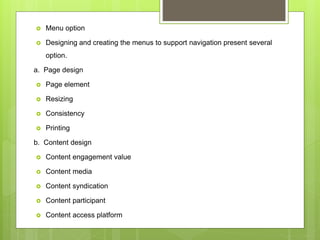
 Menu option
 Designing and creating the menus to support navigation present several
option.
a. Page design
 Page element
 Resizing
 Consistency
 Printing
b. Content design
 Content engagement value
 Content media
 Content syndication
 Content participant
 Content access platform
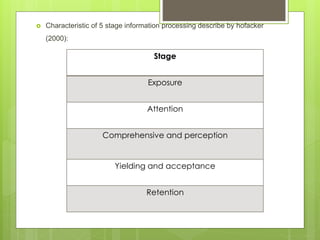
 Characteristic of 5 stage information processing describe by hofacker
(2000):
Stage
Exposure
Attention
Comprehensive and perception
Yielding and acceptance
Retention
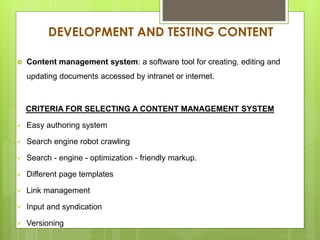
DEVELOPMENT AND TESTING CONTENT
 Content management system: a software tool for creating, editing and
updating documents accessed by intranet or internet.
CRITERIA FOR SELECTING A CONTENT MANAGEMENT SYSTEM
 Easy authoring system
 Search engine robot crawling
 Search - engine - optimization - friendly markup.
 Different page templates
 Link management
 Input and syndication
 Versioning
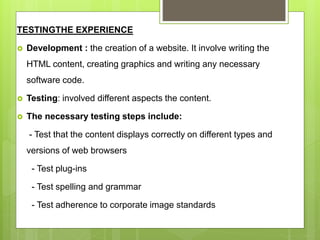
TESTINGTHE EXPERIENCE
 Development : the creation of a website. It involve writing the
HTML content, creating graphics and writing any necessary
software code.
 Testing: involved different aspects the content.
 The necessary testing steps include:
- Test that the content displays correctly on different types and
versions of web browsers
- Test plug-ins
- Test spelling and grammar
- Test adherence to corporate image standards
ONLINE RETAILING MERCHANDISING
 Some of the common used are:
- Expanding navigation through synonyms
- Applying faceted navigation or search approach
- Featuring the bestselling product prominently
- Use of bundling
- Use of customer ratings and reviews
PROMOTE SITE
 Promotion of a site is a significant topic that will be apart of
the strategy of developing a website.
 Particularly important issues that must be considered during
the course of site design are search engine optimization and
the experience delivered on landing pages where the visitors
arrives not on the home page but deeper within the site.
SERVICE QUALITY
 Delivery service quality e-commerce can be assessed through
reviewing existing marketing framework for determining levels of
services quality.
 This is still determining service quality:
 Tangible
 Reliability
 Responsiveness
 Assurance
 Confident
 Empathy
 Two of the most significant framework for assessing online service quality
1. Webqual (that consist 14 dimension)
1) Information quality
2) Functional fit to ask
3) Tailored communication
4) Trust
5) Response time
6) Ease of understanding
7) Intuitive operation
8) Visual appeal
9) Innovativeness
10) Emotional appeal
11) Consistent image
12) Online completeness
13) Relative advantage
14) Customer service
 2. e- servqual (contains 7 dimension)
1) Efficiency
2) Fulfillment
3) Reliability
4) Privacy
5) Responsiveness
6) Compensation
7) contact

Chapter 6 DIGITAL MARKETING

  • 1.
    CHAPTER 6 DELIVERING THEONLINE CUSTOMER EXPERIENCE NUR AQILAH BT ZAINUDIN 2014416824
  • 2.
    OUTLINE  Introduction  Planningweb site design and built  Initiation of website project  Defining site or app requirement  Designing the user experience  Development and testing of content  Online retail merchandising  Promote sites  Services quality
  • 3.
    INTRODUCTION  Effective meansthat the presence must deliver relevance and a satisfactory online.  Online customer experience: the combination of rational and emotional factors of using a company’s online services that influence customer’s perception of a brand online.  Conversion rate optimization (CRO): Improving commercial returns from a transactional site through increasing conversion to key goals such as sales quotes or booking or leads.
  • 4.
    CONTINUE  CRO combinescustomer and competitor research with evaluation of customer behavior using web analytics and AB and multivariate testing.  Five dimension of brand equity assessed by asking question: - Emotional connection - Online experience - Responsive service nature - Trust - Fulfillment
  • 5.
    PLANNING WEBSITE DESIGNAND BUILD Pre development task Analysis and design Content development and testing Content development and testing Pre-launch promotion or communications Ongoing promotion The main developme nt task as part as planning process
  • 6.
    Figure 7.3 Iterativeapproach to improving site effectiveness. Source: Sullivan (2011)
  • 7.
    WHO SHOULD INVOLVEIN PROJECT Site sponsor Site owner Project manager Site designer Content developer Webmaster stakeholders
  • 8.
    PROTOTYPING AND AGILESOFTWARE DEVELOPMENT  Prototype: are trial versions of website or a framework of all of a website, which can be reviewed by its target audience or the marketing team. Prototype is an iterative process in which website users suggest modifications before further prototypes and the final version of the site are developed  Each prototype passes through stages which are: - analysis - design - develop - test and review  Agile software development: website functionality or software applications where it is known as agile software development. The goal is to create stable releases more frequently
  • 9.
    INITIATION OF THEWEBSITE PROJECT  The phase of the project should involve a structure review of the costs and benefits of developing a website. The successful outcome to initiation will be decision to proceed with the site development phase,, with an agreed budget and target completion date.  Domain name registration: the process of reserving a unique web address that can be used to the company website.  Selecting a hosting provider: selecting the right partner to host a website.  Website performance optimization: download page performance is essential to the success of a site.  The availability of the website: indication of how easy it is for a user to connect to it.
  • 10.
    DEFINING SITE ORAPP REQUIREMENT  Analysis : the identification of the requirements of a website. Technique to achieve this may include focus groups , questionnaires sent to existing customers or interview with key account.  In analysis seeking answer the following types of ‘who’, ’what’, ’why’, ’how’, ’when’ , ’where’ question.  User - center design: a design approach which is based on research of user characteristic and needs.
  • 11.
    BUSINESS REQUIREMENT  Customeracquisition  Customer conversion  Customer retention  Service quality  Branding USABILITY REQUIREMENT  Usability : an approach to website design intended to enable the completion of user task.  Expert review: an analysis of an existing site or prototype by an experience usability expert.  Usability testing: representative users are observed performing representative task using a system.
  • 12.
    WEB ACCESSIBILITY REQUIREMENT An approach to design intended to accommodate site usage using different browsers and setting.  Accessibility legislation : legislation intended to protect users of websites with disabilities including visual disability.  Main argument in favorite accessibility are: - number of visually impaired people. - number of users of less popular browsers or variation in screen display resolution. - more visitors from natural listings of search engines. - legal requirements. LOCALISATION  Tailoring of website information for individual countries.  A site may need to support customers from a range of countries: - Different product need - Language differences - Cultural differences
  • 13.
    REVIEWING COMPETITORS’ WEBSITE Benchmarking of competitors’ websites is vital in positioning a website to compete effectively with competitors.  Benchmarking criteria should include: - Financial performance - Conversion effectively - Marketplace performance DESIGNING THE INFORMATION ARCHITECTURE  The combination of organization, labeling and navigation schemes constituting an information system.  Benefits of creating an information architecture: - A defined structure and categorization of information will support user and organization goals. - Its helps increase ‘flow’ on the site. - Search engine optimization
  • 14.
    CARD SORTING  Theprocess of arranging a way of organizing objects on the website in a consistent manner. BLUEPRINTS  Shows the relationships between pages and other content components, and can be used to portray organization, navigation and labeling systems. WIREFRAMES  Also known as ‘schematic’, a way of illustrating the layout of an individual web page. LANDING PAGES  An entrance page to the site when a user clicks on an ad or other form of link from a referring site.it can be a homepage but more typically and desirably, a landing page is a page with the messaging focused on the offer in the ad.
  • 15.
    DESIGNING THE USEREXPERIENCE  Design phase: the design phase defines how the site will work in the key areas of website structure, navigation and security. EVALUATING DESIGN  A test effective design for usability is dependent on: - effectiveness - productivity - satisfaction
  • 16.
    ELEMENT ON SITEDESIGN  Three main areas: - site design and structure - page design - content design  Site design structure: - the structure created by designer for websites will vary greatly according to their audience and the site’s purpose. - some basis factors that determine the effectiveness of an ecommerce site are coherence, complexity, legibility.
  • 17.
     Site style: Effective site design that communicate through color, images, typography and layout.  Visual design: - Constrained by a number of factors - The speed of downloading graphics - The screen resolutions of the computer - The number of colors on screen - The type of web browser used
  • 18.
    SITE ORGANISATION  Informationorganization scheme : a structure chosen to group and categorize information.  Information organization scheme are: - Exact - Ambiguous - Hybrid SITE NAVIGATION SCHEMES  Is a tools provided to the user to move between different information on a website.  Important aspects to a site that is easy to navigate: - consistency - simplicity - context
  • 19.
    CONTINUE  Navigation  Narrowand deep navigation  Broad and shallow navigation  Deep linking  Nielson suggest that the designer of navigation system should consider the following information that site user want to know:  Where am i?  Where have I been  Where do I want go?
  • 20.
     Menu option Designing and creating the menus to support navigation present several option. a. Page design  Page element  Resizing  Consistency  Printing b. Content design  Content engagement value  Content media  Content syndication  Content participant  Content access platform
  • 21.
     Characteristic of5 stage information processing describe by hofacker (2000): Stage Exposure Attention Comprehensive and perception Yielding and acceptance Retention
  • 22.
    DEVELOPMENT AND TESTINGCONTENT  Content management system: a software tool for creating, editing and updating documents accessed by intranet or internet. CRITERIA FOR SELECTING A CONTENT MANAGEMENT SYSTEM  Easy authoring system  Search engine robot crawling  Search - engine - optimization - friendly markup.  Different page templates  Link management  Input and syndication  Versioning
  • 23.
    TESTINGTHE EXPERIENCE  Development: the creation of a website. It involve writing the HTML content, creating graphics and writing any necessary software code.  Testing: involved different aspects the content.  The necessary testing steps include: - Test that the content displays correctly on different types and versions of web browsers - Test plug-ins - Test spelling and grammar - Test adherence to corporate image standards
  • 24.
    ONLINE RETAILING MERCHANDISING Some of the common used are: - Expanding navigation through synonyms - Applying faceted navigation or search approach - Featuring the bestselling product prominently - Use of bundling - Use of customer ratings and reviews
  • 25.
    PROMOTE SITE  Promotionof a site is a significant topic that will be apart of the strategy of developing a website.  Particularly important issues that must be considered during the course of site design are search engine optimization and the experience delivered on landing pages where the visitors arrives not on the home page but deeper within the site.
  • 26.
    SERVICE QUALITY  Deliveryservice quality e-commerce can be assessed through reviewing existing marketing framework for determining levels of services quality.  This is still determining service quality:  Tangible  Reliability  Responsiveness  Assurance  Confident  Empathy
  • 27.
     Two ofthe most significant framework for assessing online service quality 1. Webqual (that consist 14 dimension) 1) Information quality 2) Functional fit to ask 3) Tailored communication 4) Trust 5) Response time 6) Ease of understanding 7) Intuitive operation 8) Visual appeal 9) Innovativeness 10) Emotional appeal 11) Consistent image 12) Online completeness 13) Relative advantage 14) Customer service
  • 28.
     2. e-servqual (contains 7 dimension) 1) Efficiency 2) Fulfillment 3) Reliability 4) Privacy 5) Responsiveness 6) Compensation 7) contact