Rajalakshmi.K
 Overview of India’s Foreign Trade
 Direction of India’s Trade
 Composition of India’s Trade
 Balance of Trade
 Balance of Payment
 The origin of India’s Foreign trade can be traced back to the age
of the Indus Valley civilization.
 The License Raj and the large number of trade barriers were
intended to be done away with liberalization. Opening up the
economy to MNC’s and foreign investors including the core and
financial sectors to private & foreign companies transformed India
into a land of opportunities.
 In early 1990’s the Indian economy had witnessed dramatic policy
changes. The idea behind the new economic model popularly
known as LPG in India was to make the economy one of the
fastest growing economies in the world.
 The Industrial Policy of 1991.
The Direction of Trade is referred to describe the statistical analysis of the set of a
country’s trading partners and their significance in trade.
In short, the set of countries where the goods are traded to their significance on a
country’ trade is known as the Direction of Trade.
1. Direction of India’s Trade-Exports:
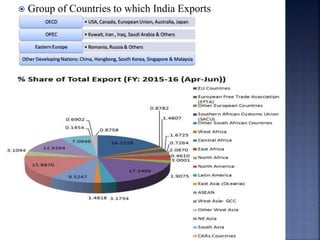
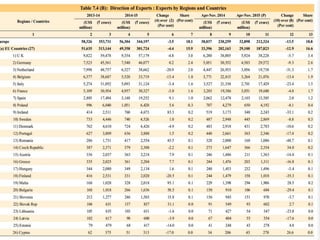
It is the analysis of group of countries to which India exports its goods. There has been
an ever-expanding geographical diversification of India’s exports since
independence. The number of countries purchasing India’s exports and the quantity
of exports to these countries are continuously increasing.
 Group of Countries to which India Exports
2. Direction of India’s Trade-Imports:
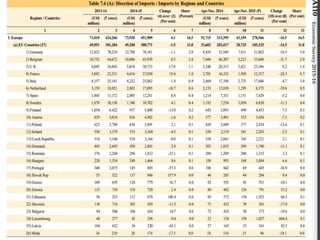
Group of Countries from which India imports its goods. Formerly, there were
many countries with whom we had no or insignificant trade. But, at present
we have trade relations with most of the countries in the world.
There has been rapid increase in the imports from almost all the countries
with spectacular increase in case of a few countries.
Prior to our independence our import trade was primarily with OECD
countries particularly with U.K. The share of OECD countries has declined
rapidly after independence and also U.K.
The main reason for these changes in the direction of India’s imports is
diversified and increasing demand for imports arising from development
requirements.
At present, India’s biggest suppliers are Germany, Belgium, UK, France, Italy,
Netherland, Spain.
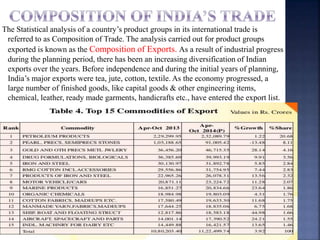
The Statistical analysis of a country’s product groups in its international trade is
referred to as Composition of Trade. The analysis carried out for product groups
exported is known as the Composition of Exports. As a result of industrial progress
during the planning period, there has been an increasing diversification of Indian
exports over the years. Before independence and during the initial years of planning,
India’s major exports were tea, jute, cotton, textile. As the economy progressed, a
large number of finished goods, like capital goods & other engineering items,
chemical, leather, ready made garments, handicrafts etc., have entered the export list.
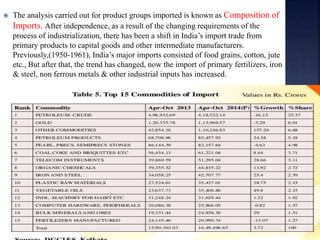
 The analysis carried out for product groups imported is known as Composition of
Imports. After independence, as a result of the changing requirements of the
process of industrialization, there has been a shift in India’s import trade from
primary products to capital goods and other intermediate manufacturers.
Previously,(1950-1961), India’s major imports consisted of food grains, cotton, jute
etc., But after that, the trend has changed, now the import of primary fertilizers, iron
& steel, non ferrous metals & other industrial inputs has increased.
 India’s service sector has grown remarkably &
contributing a major share to the GDP of a nation.
 India’s software & IT enabled services has graduated to
newer services.
 Miscellaneous services segment & education process
outsourcing are significant segment for services
exports.
 The travel & tourism sector has shown major growth in
recent years
1. Increasing share of Gross National Income
2. Oceanic Trade
3. Increase in volume and value of trade
4. Change in the composition of Exports
5. Change in the composition of Imports
6. Mounting deficit in Balance of Trade
7. Trend toward Globalization
8. Changing role of public sector
Meaning:
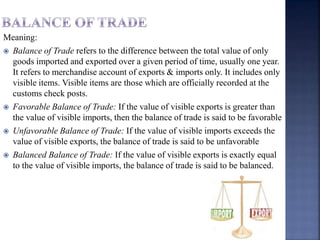
 Balance of Trade refers to the difference between the total value of only
goods imported and exported over a given period of time, usually one year.
It refers to merchandise account of exports & imports only. It includes only
visible items. Visible items are those which are officially recorded at the
customs check posts.
 Favorable Balance of Trade: If the value of visible exports is greater than
the value of visible imports, then the balance of trade is said to be favorable
 Unfavorable Balance of Trade: If the value of visible imports exceeds the
value of visible exports, the balance of trade is said to be unfavorable
 Balanced Balance of Trade: If the value of visible exports is exactly equal
to the value of visible imports, the balance of trade is said to be balanced.
Meaning:
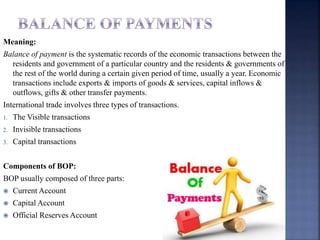
Balance of payment is the systematic records of the economic transactions between the
residents and government of a particular country and the residents & governments of
the rest of the world during a certain given period of time, usually a year. Economic
transactions include exports & imports of goods & services, capital inflows &
outflows, gifts & other transfer payments.
International trade involves three types of transactions.
1. The Visible transactions
2. Invisible transactions
3. Capital transactions
Components of BOP:
BOP usually composed of three parts:
 Current Account
 Capital Account
 Official Reserves Account
 Meaning:
Current Account consists of real and short term transactions. It contains receipts and
payments on account of exports of all types of visible and invisible items along
with unilateral transfers. Real transactions deal with the actual transfer even of
goods and services that affect the national income, output and expenditure of the
country. They are generally income generating transfers.
The following items can be found in the current account of the BOP of a nation.
1. Visible items
2. Travel
3. Transportation
4. Insurance
5. Investment income
6. Government transactions
7. Gifts grants and donations
8. Miscellaneous items
Meaning:
Capital account consists of its transactions in financial assets in the form of short-term
lending and borrowings and private and official investments. It refers to the inflow
and outflow of capital an account of capital transactions like loans and investments,
inflow and outflow of foreign capital, repayment of past debts, interest payment on
foreign debts etc. Gold transactions taking place between countries are also included
in this account.
The following items constitutes the capital account.
1. Private Loans
2. Movement in Banking Capital
3. Loans
4. Amortization
5. Miscellaneous items
It is a part of capital account. It measures the changes in a nation’s liquid and non-
liquid liabilities to foreign official holders and the change in a nation’s official
reserve assets during the year. It includes its gold stock, changes in the official
foreign exchange holdings, SDR holdings of the government and similar other
capital transactions etc are some of the other items of credit and payments are the
debit items.
Conclusion: The capital account thus, reflects the real monetary position of a country in
the international capital market. Neither current account nor the capital account
balances. But when the two accounts are taken together, they do balance. Thus, by
combining the deficit and surplus on both current and capital account, we get the
over all picture of the BOP of a nation.
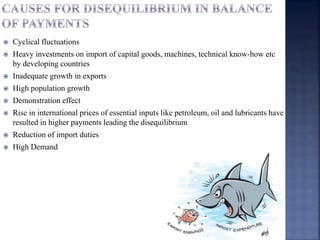
 Cyclical fluctuations
 Heavy investments on import of capital goods, machines, technical know-how etc
by developing countries
 Inadequate growth in exports
 High population growth
 Demonstration effect
 Rise in international prices of essential inputs like petroleum, oil and lubricants have
resulted in higher payments leading the disequilibrium
 Reduction of import duties
 High Demand
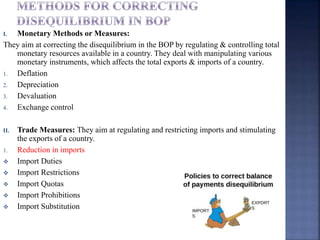
I. Monetary Methods or Measures:
They aim at correcting the disequilibrium in the BOP by regulating & controlling total
monetary resources available in a country. They deal with manipulating various
monetary instruments, which affects the total exports & imports of a country.
1. Deflation
2. Depreciation
3. Devaluation
4. Exchange control
II. Trade Measures: They aim at regulating and restricting imports and stimulating
the exports of a country.
1. Reduction in imports
 Import Duties
 Import Restrictions
 Import Quotas
 Import Prohibitions
 Import Substitution
2. Export Promotion
 Reduction or abolition of exports duties
 Granting bounties and subsidies
 Tax concessions for export industries
 Entering into bilateral or multilateral trade agreements with other nations
III. Other Measures
 Borrowings from other capital-rich nations and international financial institutions
 Encouragement to foreign investment- Private & Public
 Attracting Non-Resident Indian Deposits
 Incentives to foreign tourists.
1. Visible & Invisible items
2. Commodities & Services
3. Economic position of a country
4. Influence in rate of exchange
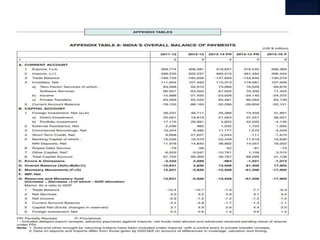
1. In 2015-16, the total trade of India has fallen due to fall in both exports & imports
resulting in lowest trade deficit in 5 years
2. Such a trend of falling exports was in tandem with growth prospects in other major
world economies.
3. Imports have decreased on the account of fall in global oil prices.
Recently, the WTO cut the global trade growth forecast to 2.8% from 3.9% earlier,
owing to slowdown in the emerging economies and worsening financial market
volatility. Around the same time, the Government of India suggested that it aims to
increase India’s share in the global trade to 3.5% from the current level of 2% by
2020, through doubling its goods & services trade. In this regard, India has
embarked on further trade liberalization by ratifying the WTO trade facilitation
agreement, which could give an impetus to foreign trade. Thus, in the long run,
India’s trade will be critically linked for achieving better market access through
WTO negotiations as well as integration into regional trade groupings.
India’s foreign trade

India’s foreign trade

  • 1.
  • 2.
     Overview ofIndia’s Foreign Trade  Direction of India’s Trade  Composition of India’s Trade  Balance of Trade  Balance of Payment
  • 3.
     The originof India’s Foreign trade can be traced back to the age of the Indus Valley civilization.  The License Raj and the large number of trade barriers were intended to be done away with liberalization. Opening up the economy to MNC’s and foreign investors including the core and financial sectors to private & foreign companies transformed India into a land of opportunities.  In early 1990’s the Indian economy had witnessed dramatic policy changes. The idea behind the new economic model popularly known as LPG in India was to make the economy one of the fastest growing economies in the world.  The Industrial Policy of 1991.
  • 4.
    The Direction ofTrade is referred to describe the statistical analysis of the set of a country’s trading partners and their significance in trade. In short, the set of countries where the goods are traded to their significance on a country’ trade is known as the Direction of Trade. 1. Direction of India’s Trade-Exports: It is the analysis of group of countries to which India exports its goods. There has been an ever-expanding geographical diversification of India’s exports since independence. The number of countries purchasing India’s exports and the quantity of exports to these countries are continuously increasing.
  • 5.
     Group ofCountries to which India Exports
  • 7.
    2. Direction ofIndia’s Trade-Imports: Group of Countries from which India imports its goods. Formerly, there were many countries with whom we had no or insignificant trade. But, at present we have trade relations with most of the countries in the world. There has been rapid increase in the imports from almost all the countries with spectacular increase in case of a few countries. Prior to our independence our import trade was primarily with OECD countries particularly with U.K. The share of OECD countries has declined rapidly after independence and also U.K. The main reason for these changes in the direction of India’s imports is diversified and increasing demand for imports arising from development requirements. At present, India’s biggest suppliers are Germany, Belgium, UK, France, Italy, Netherland, Spain.
  • 9.
    The Statistical analysisof a country’s product groups in its international trade is referred to as Composition of Trade. The analysis carried out for product groups exported is known as the Composition of Exports. As a result of industrial progress during the planning period, there has been an increasing diversification of Indian exports over the years. Before independence and during the initial years of planning, India’s major exports were tea, jute, cotton, textile. As the economy progressed, a large number of finished goods, like capital goods & other engineering items, chemical, leather, ready made garments, handicrafts etc., have entered the export list.
  • 10.
     The analysiscarried out for product groups imported is known as Composition of Imports. After independence, as a result of the changing requirements of the process of industrialization, there has been a shift in India’s import trade from primary products to capital goods and other intermediate manufacturers. Previously,(1950-1961), India’s major imports consisted of food grains, cotton, jute etc., But after that, the trend has changed, now the import of primary fertilizers, iron & steel, non ferrous metals & other industrial inputs has increased.
  • 11.
     India’s servicesector has grown remarkably & contributing a major share to the GDP of a nation.  India’s software & IT enabled services has graduated to newer services.  Miscellaneous services segment & education process outsourcing are significant segment for services exports.  The travel & tourism sector has shown major growth in recent years
  • 12.
    1. Increasing shareof Gross National Income 2. Oceanic Trade 3. Increase in volume and value of trade 4. Change in the composition of Exports 5. Change in the composition of Imports 6. Mounting deficit in Balance of Trade 7. Trend toward Globalization 8. Changing role of public sector
  • 13.
    Meaning:  Balance ofTrade refers to the difference between the total value of only goods imported and exported over a given period of time, usually one year. It refers to merchandise account of exports & imports only. It includes only visible items. Visible items are those which are officially recorded at the customs check posts.  Favorable Balance of Trade: If the value of visible exports is greater than the value of visible imports, then the balance of trade is said to be favorable  Unfavorable Balance of Trade: If the value of visible imports exceeds the value of visible exports, the balance of trade is said to be unfavorable  Balanced Balance of Trade: If the value of visible exports is exactly equal to the value of visible imports, the balance of trade is said to be balanced.
  • 14.
    Meaning: Balance of paymentis the systematic records of the economic transactions between the residents and government of a particular country and the residents & governments of the rest of the world during a certain given period of time, usually a year. Economic transactions include exports & imports of goods & services, capital inflows & outflows, gifts & other transfer payments. International trade involves three types of transactions. 1. The Visible transactions 2. Invisible transactions 3. Capital transactions Components of BOP: BOP usually composed of three parts:  Current Account  Capital Account  Official Reserves Account
  • 15.
     Meaning: Current Accountconsists of real and short term transactions. It contains receipts and payments on account of exports of all types of visible and invisible items along with unilateral transfers. Real transactions deal with the actual transfer even of goods and services that affect the national income, output and expenditure of the country. They are generally income generating transfers. The following items can be found in the current account of the BOP of a nation. 1. Visible items 2. Travel 3. Transportation 4. Insurance 5. Investment income 6. Government transactions 7. Gifts grants and donations 8. Miscellaneous items
  • 16.
    Meaning: Capital account consistsof its transactions in financial assets in the form of short-term lending and borrowings and private and official investments. It refers to the inflow and outflow of capital an account of capital transactions like loans and investments, inflow and outflow of foreign capital, repayment of past debts, interest payment on foreign debts etc. Gold transactions taking place between countries are also included in this account. The following items constitutes the capital account. 1. Private Loans 2. Movement in Banking Capital 3. Loans 4. Amortization 5. Miscellaneous items
  • 17.
    It is apart of capital account. It measures the changes in a nation’s liquid and non- liquid liabilities to foreign official holders and the change in a nation’s official reserve assets during the year. It includes its gold stock, changes in the official foreign exchange holdings, SDR holdings of the government and similar other capital transactions etc are some of the other items of credit and payments are the debit items. Conclusion: The capital account thus, reflects the real monetary position of a country in the international capital market. Neither current account nor the capital account balances. But when the two accounts are taken together, they do balance. Thus, by combining the deficit and surplus on both current and capital account, we get the over all picture of the BOP of a nation.
  • 18.
     Cyclical fluctuations Heavy investments on import of capital goods, machines, technical know-how etc by developing countries  Inadequate growth in exports  High population growth  Demonstration effect  Rise in international prices of essential inputs like petroleum, oil and lubricants have resulted in higher payments leading the disequilibrium  Reduction of import duties  High Demand
  • 19.
    I. Monetary Methodsor Measures: They aim at correcting the disequilibrium in the BOP by regulating & controlling total monetary resources available in a country. They deal with manipulating various monetary instruments, which affects the total exports & imports of a country. 1. Deflation 2. Depreciation 3. Devaluation 4. Exchange control II. Trade Measures: They aim at regulating and restricting imports and stimulating the exports of a country. 1. Reduction in imports  Import Duties  Import Restrictions  Import Quotas  Import Prohibitions  Import Substitution
  • 20.
    2. Export Promotion Reduction or abolition of exports duties  Granting bounties and subsidies  Tax concessions for export industries  Entering into bilateral or multilateral trade agreements with other nations III. Other Measures  Borrowings from other capital-rich nations and international financial institutions  Encouragement to foreign investment- Private & Public  Attracting Non-Resident Indian Deposits  Incentives to foreign tourists.
  • 21.
    1. Visible &Invisible items 2. Commodities & Services 3. Economic position of a country 4. Influence in rate of exchange
  • 23.
    1. In 2015-16,the total trade of India has fallen due to fall in both exports & imports resulting in lowest trade deficit in 5 years 2. Such a trend of falling exports was in tandem with growth prospects in other major world economies. 3. Imports have decreased on the account of fall in global oil prices. Recently, the WTO cut the global trade growth forecast to 2.8% from 3.9% earlier, owing to slowdown in the emerging economies and worsening financial market volatility. Around the same time, the Government of India suggested that it aims to increase India’s share in the global trade to 3.5% from the current level of 2% by 2020, through doubling its goods & services trade. In this regard, India has embarked on further trade liberalization by ratifying the WTO trade facilitation agreement, which could give an impetus to foreign trade. Thus, in the long run, India’s trade will be critically linked for achieving better market access through WTO negotiations as well as integration into regional trade groupings.