E-COMMERCE
By…
R.SIVA NAGESWARA RAO
III B.Com
A Presentation
on
Table of Contents
1. E-Commerce overview
1.1 Definition of e-commerce
1.2 Brief history of e-commerce
2. E-Commerce categories
2.1 Two major categories
2.2 Other categories
3. Benefits of e-commerce
3.1 Benefits to organizations
3.2 Benefits to consumers
4. Business applications
5. Online shopping
6. Interesting facts and figures
7. Summary and Conclusion
E-Commerce Overview
 Definition of E-Commerce
 Brief History of E-Commerce
1
Definition of E-Commerce
 E-Commerce or Electronic commerce is a process of
buying, selling, transferring, or exchanging products,
services, and/or information via electronic networks
and computers
Definition of Commerce
 The exchange of goods and services for money
 Consists of:
Buyers - these are people with money who want
to purchase a good or service.
Sellers - these are the people who offer goods
and services to buyers.
Producers - these are the people who create
the products and services that sellers offer to
buyers.
5
Brief History of E-Commerce
 1970s
 E- commerce meant the facilitation of commercial
transactions electronically, using technology such as
Electronic Data Interchange (EDI) and Electronic Funds
Transfer (EFT), allowing businesses to send commercial
documents like purchase orders or invoices
electronically.
Brief History of E-Commerce (cont)..
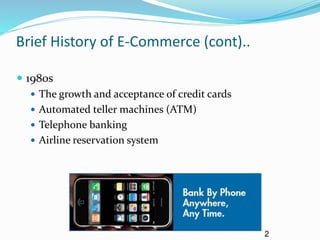
 1980s
 The growth and acceptance of credit cards
 Automated teller machines (ATM)
 Telephone banking
 Airline reservation system
2
Brief History of E-Commerce (cont)..
 1990s
 The Internet commercialized and users flocked to
participate in the form of dot-coms, or Internet start-ups
 Innovative applications ranging from online direct sales
to e-learning experiences
Brief History of E-Commerce (cont)..
 2000s
 Many European and American business companies
offered their services through the World Wide Web.
 Since then, People began to associate a word “e-
commerce”
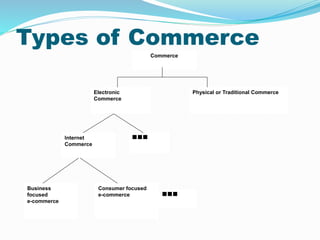
Types of Commerce
Commerce
Electronic
Commerce
Physical or Traditional Commerce
Internet
Commerce


Business
focused
e-commerce
Consumer focused
e-commerce
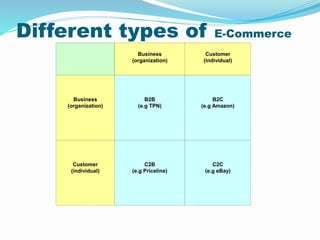
Different types of E-Commerce
Business
(organization)
Customer
(individual)
Business
(organization)
Customer
(individual)
B2C
(e.g Amazon)
C2B
(e.g Priceline)
C2C
(e.g eBay)
B2B
(e.g TPN)
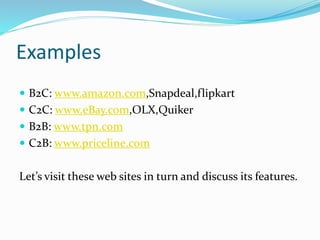
Examples
 B2C: www.amazon.com,Snapdeal,flipkart
 C2C: www.eBay.com,OLX,Quiker
 B2B: www.tpn.com
 C2B: www.priceline.com
Let’s visit these web sites in turn and discuss its features.
What are the advantages of e-
commerce?
 To consumers (think about the consumer buying
process: search, evaluate and execute):
 To businesses (think about the common objective of
every business):
Discussion
 How should different departments participate in an e-
commerce project?
 Management
 Marketing
 Production
 Finance
 Procurement
 Customer support
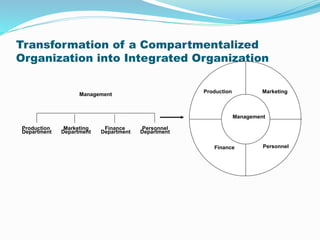
Transformation of a Compartmentalized
Organization into Integrated Organization
Management
Production
Department
Finance
Department
Marketing
Department
Personnel
Department
Management
Production Marketing
Finance Personnel
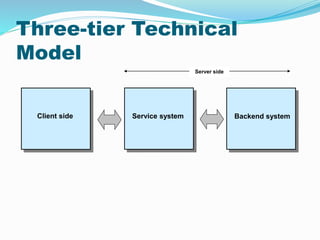
Three-tier Technical
Model
Client side Service system Backend system
Server side
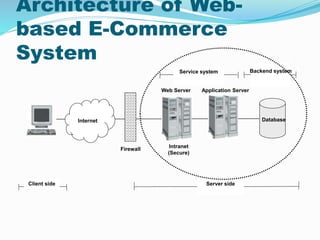
Architecture of Web-
based E-Commerce
System
Backend system
Firewall
Internet
Server side
Intranet
(Secure)
Web Server Application Server
Database
Service system
Client side
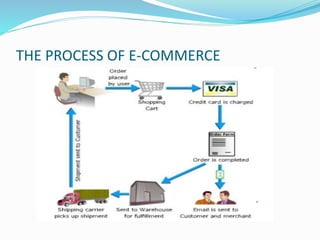
THE PROCESS OF E-COMMERCE
E-Commerce Categories
 Two major categories
 Other categories
3
Two Major Categories
 Business-to-consumer (B2C) :
Online transactions are made between businesses
and individual consumers. E.g. Amazon.com,
eBay.com.
 Business-to-business (B2B):
Businesses make online transactions with other
businesses.
Other Categories
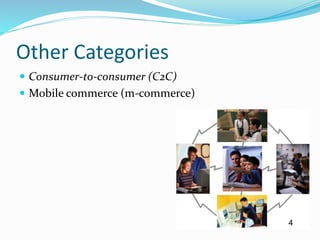
 Consumer-to-consumer (C2C)
 Mobile commerce (m-commerce)
4
Benefits of E-Commerce
 Benefits to organizations
 Benefits to consumers
5
Benefits to organizations
 Global reach
 Cost reduction
 Extended hours: 24/7/365
 Customization
 Improved customer relations
Benefits to consumers
 More products and services
 Cheaper products and services
 Instant delivery
 Information availability
Business applications
 Email
 Instant messaging
 Online shopping and order tracking
 Online banking
 Shopping cart software
 Teleconferencing
 Electronic tickets
Online Shopping
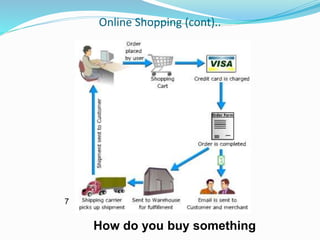
 Online shopping is the process of buying goods and
services from merchants who sell on the Internet
 Online consumers are evenly split between men and
women and tend to be better educated, younger, and
more affluent than the general population
Online Shopping (cont)..
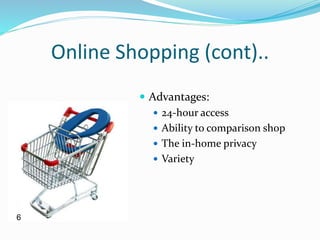
 Advantages:
 24-hour access
 Ability to comparison shop
 The in-home privacy
 Variety
6
Online Shopping (cont)..
 Favourite websites for shopping include those
featuring:
 Event tickets
 Online periodicals subscription
 Flowers and gifts
 Consumer electronics
 Travel
Online Shopping (cont)..
How do you buy something
7
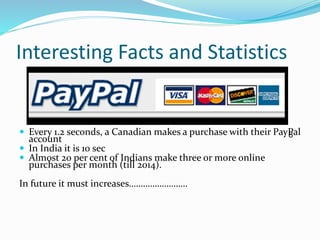
Interesting Facts and Statistics
 Every 1.2 seconds, a Canadian makes a purchase with their PayPal
account
 In India it is 10 sec
 Almost 20 per cent of Indians make three or more online
purchases per month (till 2014).
In future it must increases…………………….
8
Summary and Conclusion
 The Internet has lead to the birth and evolution E-
commerce. E-commerce has now become a key
component of many organizations in the daily
running of their business.
 As the Internet and in turn E-commerce has
developed, and continues to evolve and grow, it is
vital that any organization, in any particular
industry, must base its strategic planning around
such a rapidly growing medium.
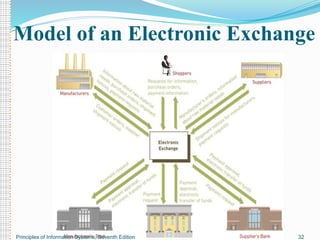
Model of an Electronic Exchange
Principles of Information Systems, Seventh Edition 32
Online
Stores
Electronic Payment Systems (continued)
 Electronic wallet: a computerized stored value that
holds credit card information, electronic cash,
owner identification, and address information
 Credit card
 Debit card
 Smart card
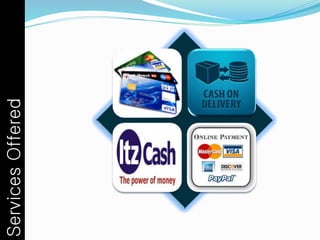
 Online banking and Cash On Delivery.
Principles of Information
Systems, Seventh Edition34
ServicesOffered
Thank You

Are there any questions?

E-Commerce PPT

  • 1.
  • 2.
    Table of Contents 1.E-Commerce overview 1.1 Definition of e-commerce 1.2 Brief history of e-commerce 2. E-Commerce categories 2.1 Two major categories 2.2 Other categories 3. Benefits of e-commerce 3.1 Benefits to organizations 3.2 Benefits to consumers 4. Business applications 5. Online shopping 6. Interesting facts and figures 7. Summary and Conclusion
  • 3.
    E-Commerce Overview  Definitionof E-Commerce  Brief History of E-Commerce 1
  • 4.
    Definition of E-Commerce E-Commerce or Electronic commerce is a process of buying, selling, transferring, or exchanging products, services, and/or information via electronic networks and computers
  • 5.
    Definition of Commerce The exchange of goods and services for money  Consists of: Buyers - these are people with money who want to purchase a good or service. Sellers - these are the people who offer goods and services to buyers. Producers - these are the people who create the products and services that sellers offer to buyers. 5
  • 6.
    Brief History ofE-Commerce  1970s  E- commerce meant the facilitation of commercial transactions electronically, using technology such as Electronic Data Interchange (EDI) and Electronic Funds Transfer (EFT), allowing businesses to send commercial documents like purchase orders or invoices electronically.
  • 7.
    Brief History ofE-Commerce (cont)..  1980s  The growth and acceptance of credit cards  Automated teller machines (ATM)  Telephone banking  Airline reservation system 2
  • 8.
    Brief History ofE-Commerce (cont)..  1990s  The Internet commercialized and users flocked to participate in the form of dot-coms, or Internet start-ups  Innovative applications ranging from online direct sales to e-learning experiences
  • 9.
    Brief History ofE-Commerce (cont)..  2000s  Many European and American business companies offered their services through the World Wide Web.  Since then, People began to associate a word “e- commerce”
  • 10.
    Types of Commerce Commerce Electronic Commerce Physicalor Traditional Commerce Internet Commerce   Business focused e-commerce Consumer focused e-commerce
  • 11.
    Different types ofE-Commerce Business (organization) Customer (individual) Business (organization) Customer (individual) B2C (e.g Amazon) C2B (e.g Priceline) C2C (e.g eBay) B2B (e.g TPN)
  • 12.
    Examples  B2C: www.amazon.com,Snapdeal,flipkart C2C: www.eBay.com,OLX,Quiker  B2B: www.tpn.com  C2B: www.priceline.com Let’s visit these web sites in turn and discuss its features.
  • 13.
    What are theadvantages of e- commerce?  To consumers (think about the consumer buying process: search, evaluate and execute):  To businesses (think about the common objective of every business):
  • 14.
    Discussion  How shoulddifferent departments participate in an e- commerce project?  Management  Marketing  Production  Finance  Procurement  Customer support
  • 15.
    Transformation of aCompartmentalized Organization into Integrated Organization Management Production Department Finance Department Marketing Department Personnel Department Management Production Marketing Finance Personnel
  • 16.
    Three-tier Technical Model Client sideService system Backend system Server side
  • 17.
    Architecture of Web- basedE-Commerce System Backend system Firewall Internet Server side Intranet (Secure) Web Server Application Server Database Service system Client side
  • 18.
    THE PROCESS OFE-COMMERCE
  • 19.
    E-Commerce Categories  Twomajor categories  Other categories 3
  • 20.
    Two Major Categories Business-to-consumer (B2C) : Online transactions are made between businesses and individual consumers. E.g. Amazon.com, eBay.com.  Business-to-business (B2B): Businesses make online transactions with other businesses.
  • 21.
    Other Categories  Consumer-to-consumer(C2C)  Mobile commerce (m-commerce) 4
  • 22.
    Benefits of E-Commerce Benefits to organizations  Benefits to consumers 5
  • 23.
    Benefits to organizations Global reach  Cost reduction  Extended hours: 24/7/365  Customization  Improved customer relations
  • 24.
    Benefits to consumers More products and services  Cheaper products and services  Instant delivery  Information availability
  • 25.
    Business applications  Email Instant messaging  Online shopping and order tracking  Online banking  Shopping cart software  Teleconferencing  Electronic tickets
  • 26.
    Online Shopping  Onlineshopping is the process of buying goods and services from merchants who sell on the Internet  Online consumers are evenly split between men and women and tend to be better educated, younger, and more affluent than the general population
  • 27.
    Online Shopping (cont).. Advantages:  24-hour access  Ability to comparison shop  The in-home privacy  Variety 6
  • 28.
    Online Shopping (cont).. Favourite websites for shopping include those featuring:  Event tickets  Online periodicals subscription  Flowers and gifts  Consumer electronics  Travel
  • 29.
    Online Shopping (cont).. Howdo you buy something 7
  • 30.
    Interesting Facts andStatistics  Every 1.2 seconds, a Canadian makes a purchase with their PayPal account  In India it is 10 sec  Almost 20 per cent of Indians make three or more online purchases per month (till 2014). In future it must increases……………………. 8
  • 31.
    Summary and Conclusion The Internet has lead to the birth and evolution E- commerce. E-commerce has now become a key component of many organizations in the daily running of their business.  As the Internet and in turn E-commerce has developed, and continues to evolve and grow, it is vital that any organization, in any particular industry, must base its strategic planning around such a rapidly growing medium.
  • 32.
    Model of anElectronic Exchange Principles of Information Systems, Seventh Edition 32
  • 33.
  • 34.
    Electronic Payment Systems(continued)  Electronic wallet: a computerized stored value that holds credit card information, electronic cash, owner identification, and address information  Credit card  Debit card  Smart card  Online banking and Cash On Delivery. Principles of Information Systems, Seventh Edition34
  • 35.
  • 36.