By: VIKRAM.G.B
Faculty, P.G dept. of Commerce
                   Bangalore-55
   Value of money refers to the purchasing power of
        money over goods and services in a country.
       A relative concept which explains the relationship
        between a unit of money and goods and services
        which can be purchased with it.


   Internal value of money: It refers to the purchasing
    power of money over domestic goods and services.
   External value of money: It refers to the purchasing
    power of money over foreign goods and services.
   The concept of the quantity theory of money (QTM)
    began in the 16th century. As gold and silver inflows
    from the Americas into Europe were being minted into
    coins, there was a resulting rise in inflation.

   The idea is that, the money supply will directly impact
    both prices and inflation rates.

   The quantity theory of money states that there is a
    direct relationship between the quantity of money in an
    economy and the level of prices of goods and services
    sold.

   According to QTM, if the amount of money in an
    economy      doubles,    price  levels    also   double,
    causing inflation (the percentage rate at which the level
    of prices is rising in an economy). The consumer
    therefore pays twice as much for the same amount of
    the good or service.
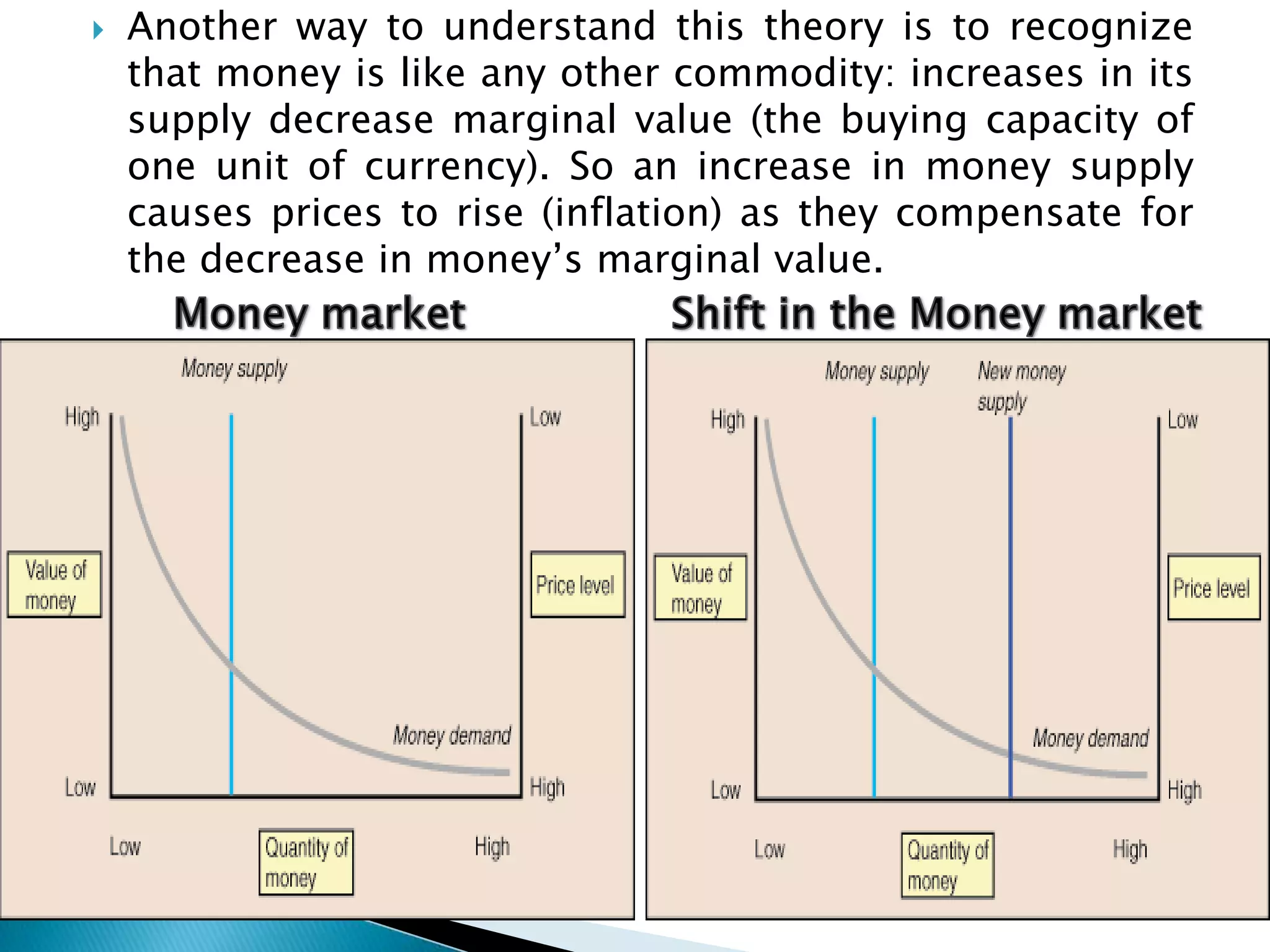
   Another way to understand this theory is to recognize
    that money is like any other commodity: increases in its
    supply decrease marginal value (the buying capacity of
    one unit of currency). So an increase in money supply
    causes prices to rise (inflation) as they compensate for
    the decrease in money‟s marginal value.
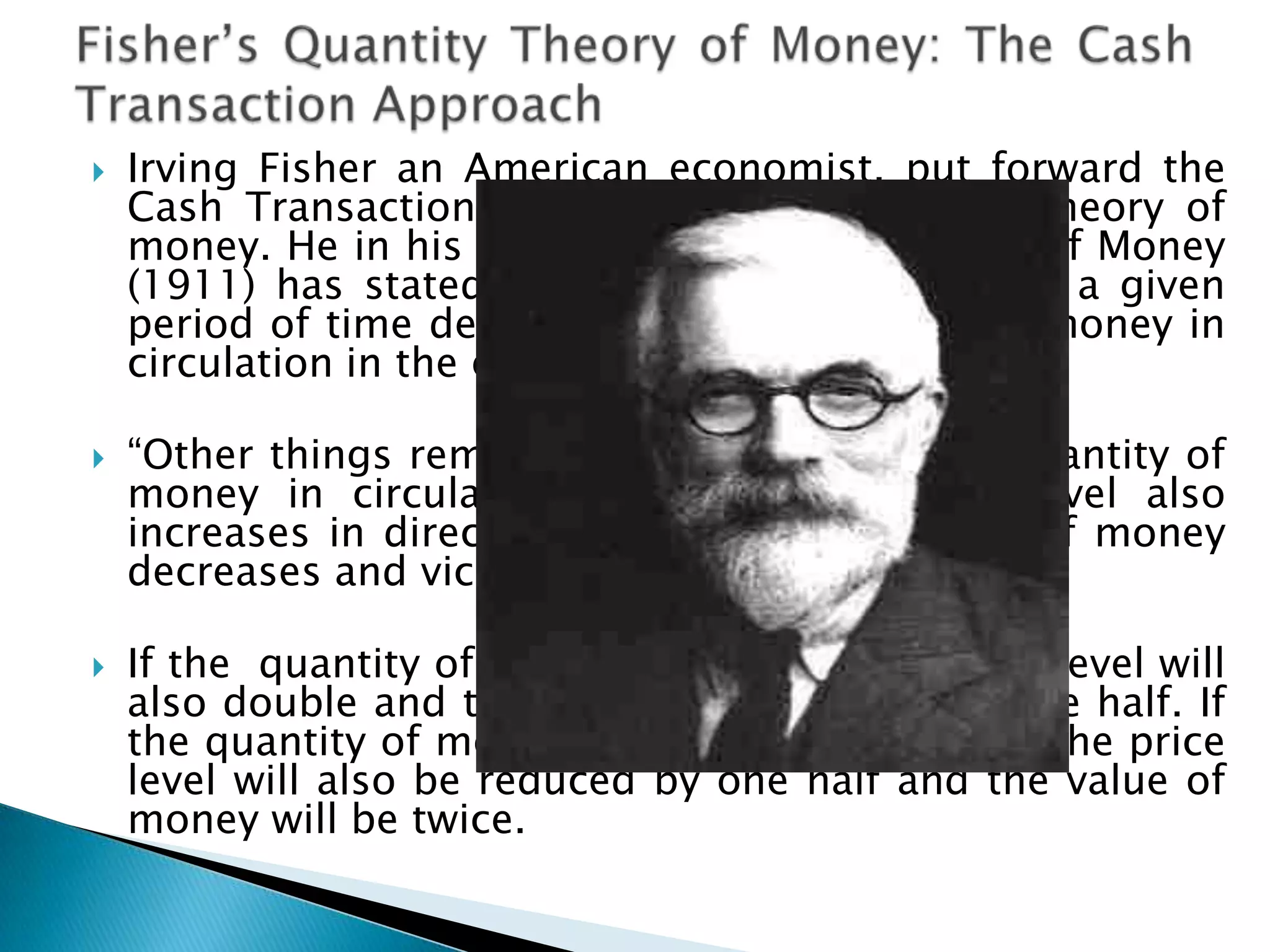
   Irving Fisher an American economist, put forward the
    Cash Transaction Approach to the quantity theory of
    money. He in his book The Purchasing Power of Money
    (1911) has stated that the value of money in a given
    period of time depends upon the quantity of money in
    circulation in the economy

   “Other things remaining unchanged, as the quantity of
    money in circulation increases, the price level also
    increases in direct proportion and the value of money
    decreases and vice versa”.

   If the quantity of money is doubled, the price level will
    also double and the value of money will be one half. If
    the quantity of money is reduced by one half, the price
    level will also be reduced by one half and the value of
    money will be twice.
   In Fisher‟s Cash Transactions Version of Money, the general
    price level in a country, like the prices of commodities, is
    determined by the supply of and demand for money.

   Supply of Money: The supply of money consists of the
    quantity of money in circulation (M) and the velocity of its
    circulation (V) i.e., the number of times the money changes
    hands. Thus MV refers to the total volume of money in
    circulation during a period of time. For example, if the total
    money supply in India Rs. 5,000 billion and its velocity per
    unit of time is 10 times, then the total money supply would
    be Rs. 5,000 x 10 = Rs.50000 billion.

   Demand for Money: People demand money not for its own
    sake. They demand money because it serves a medium of
    exchange. It is used to carry every day transactions. In
    short, the demand for money is for the exchange of goods.
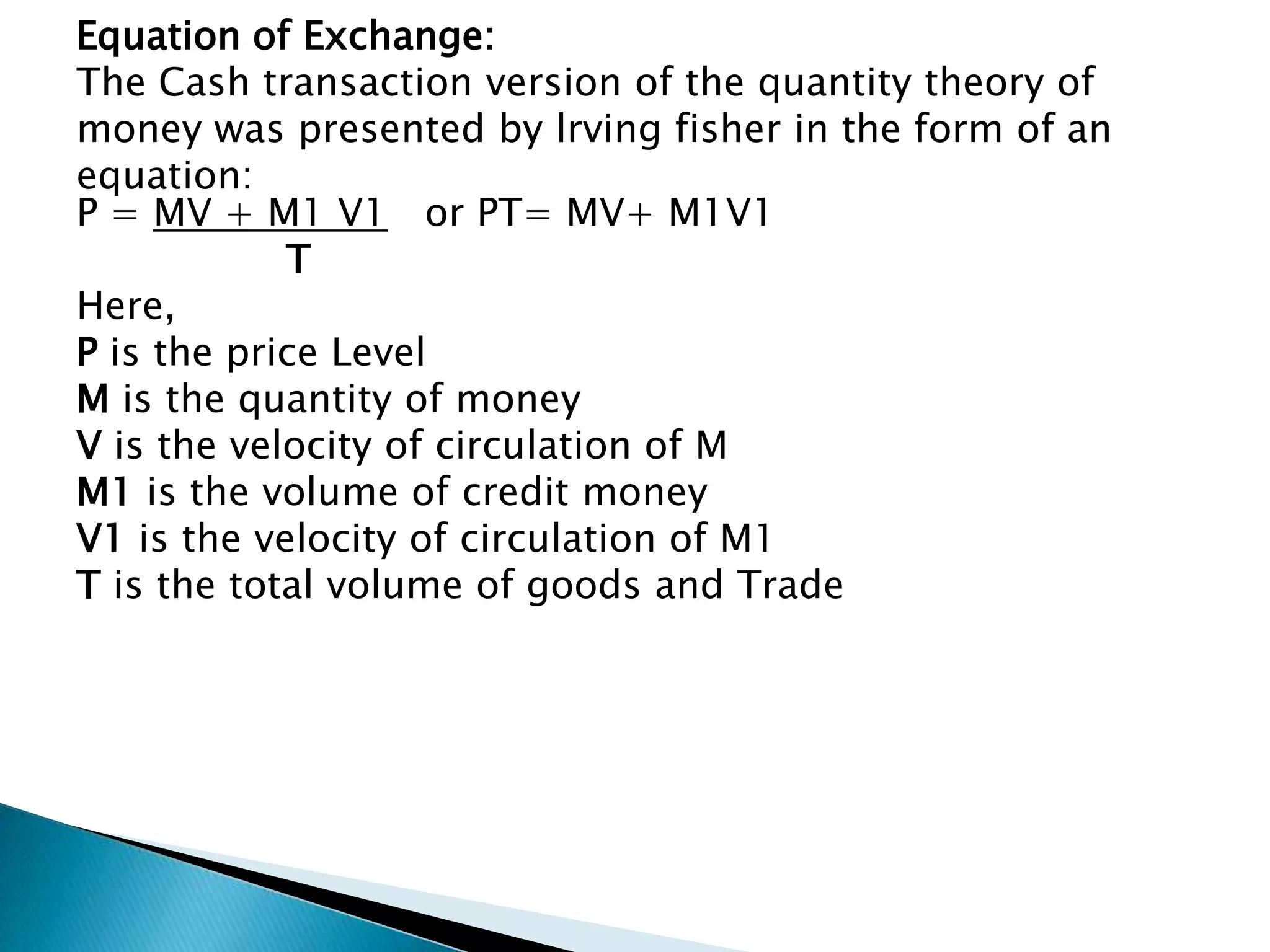
Equation of Exchange:
The Cash transaction version of the quantity theory of
money was presented by lrving fisher in the form of an
equation:
P = MV + M1 V1 or PT= MV+ M1V1
            T
Here,
P is the price Level
M is the quantity of money
V is the velocity of circulation of M
M1 is the volume of credit money
V1 is the velocity of circulation of M1
T is the total volume of goods and Trade
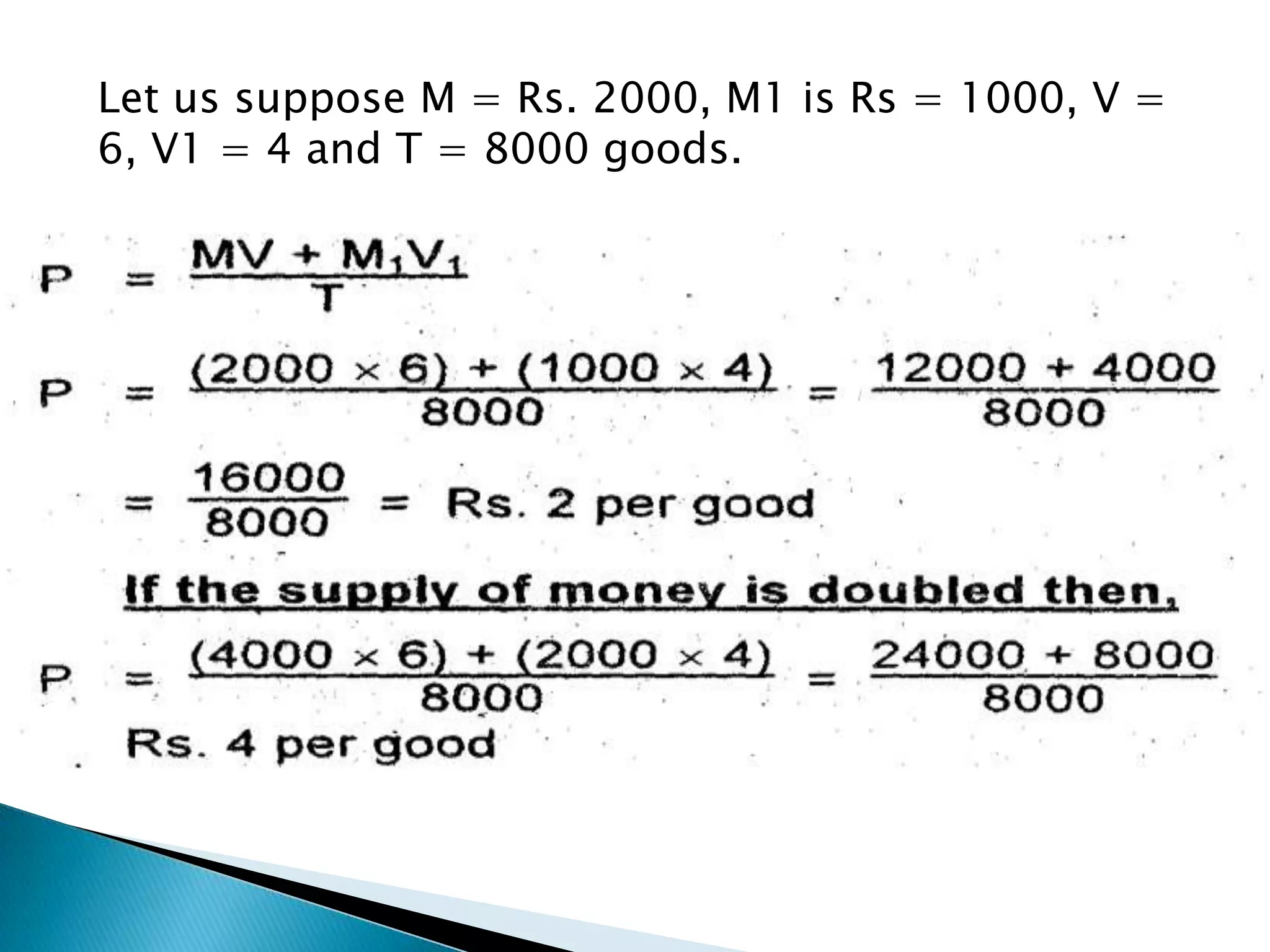
Let us suppose M = Rs. 2000, M1 is Rs = 1000, V =
6, V1 = 4 and T = 8000 goods.
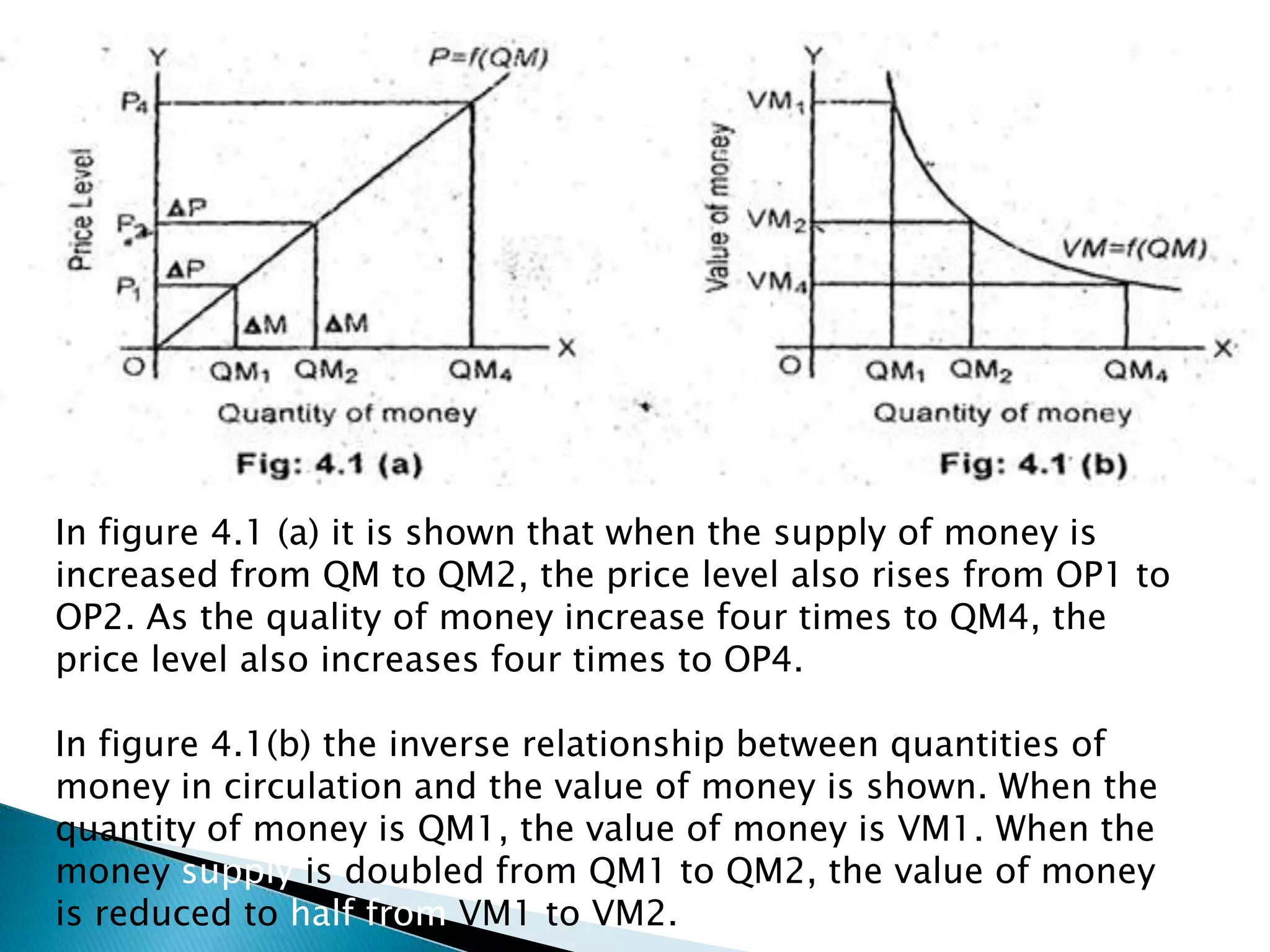
In figure 4.1 (a) it is shown that when the supply of money is
increased from QM to QM2, the price level also rises from OP1 to
OP2. As the quality of money increase four times to QM4, the
price level also increases four times to OP4.

In figure 4.1(b) the inverse relationship between quantities of
money in circulation and the value of money is shown. When the
quantity of money is QM1, the value of money is VM1. When the
money supply is doubled from QM1 to QM2, the value of money
is reduced to half from VM1 to VM2.
   Full employment: The theory is based on the
    assumption of full employment in the economy.
   T and V are constant: The theory assumes that volume
    of trade (T) in the short run remains constant. So is the
    case with velocity of money (V) which remains
    unaffected.
   Constant relation between M and M1. Fisher assumes
    constant relation between currency money M and credit
    money (M1).
   Price level (P) is a passive factor. The price level (P) is
    inactive or passive in the equation. P is affected by
    other factors in equation i.e., T, M, M1, V and V1 but it
    does not affect them.
   It is assumed that the demand for money is
    proportional to the value of transaction.
   The theory is applicable in the long run.
   Unrealistic assumptions: The theory is based on
    unrealistic assumptions. In this theory P is considered
    as a passive factor. T is independent. M1, V, V1, are
    constant in the short run. All these assumptions are
    covered under “Other things remaining the same.” In
    actual       working       of       the       economy,
    these do not remain constant; Hence, the theory is
    unrealized and misleading.

   Various Variables in the transaction are not
    independent. As assumed in the theory The fact is that
    they very much influence each other For example when
    money supply (M) increases the velocity f money (V) also
    goes up Take an other case. Fisher assumes (P) is a
    passive factor and has no effect on trade (T). In actual
    practice, when price level P) rises, it increases profitts
    and promotes trade (T).
   Assumption of full employment is wrong. J. M. Keynes
    has raised en objection that the assumption of full
    employment is a rare phenomenon in the economy and
    the theory is not real.
   Rate of interest ignored. In the quantity theory of
    Fishers, the influence of the rate of interest on the money
    supply and the level of prices have been completely
    ignored. The fact is that an increase or decrease in money
    supply has an important bearing on the rate of interest.
    An increase in money supply leads to a decline in the rate
    of interest and vice versa.
   Fails to explain trade cycles. The theory fails to explain
    the trade cycles. It does not tell as to why during
    depression, the increase in money supply has little impact
    on the price level, Similarly, in boom period the reduction
    in money supply or tight money policy may not bring
    down the price level G. Crowther is right in saying, “The
    quantity theory is at best an imperfect guide to the cause
    of the business cycle”.
   Ignores other factors of price level. There are many
    determinants other than M, V, and T which have important
    implication on the price level. These factors such as
    income, expenditure, saving, investment, population
    consumption etc have been ignored from the purview of
    the theory.
   Weak Theory: According to Crowther, QTM is weak in
    many respects.
    i. It cannot explain „why‟ there is a fluctuations in the price
    level
    ii. It gives undue importance to the price level.
    iii. Misleading emphasis on the quantity of money as the
    principal cause of changes in the price level during the
    trade cycle.
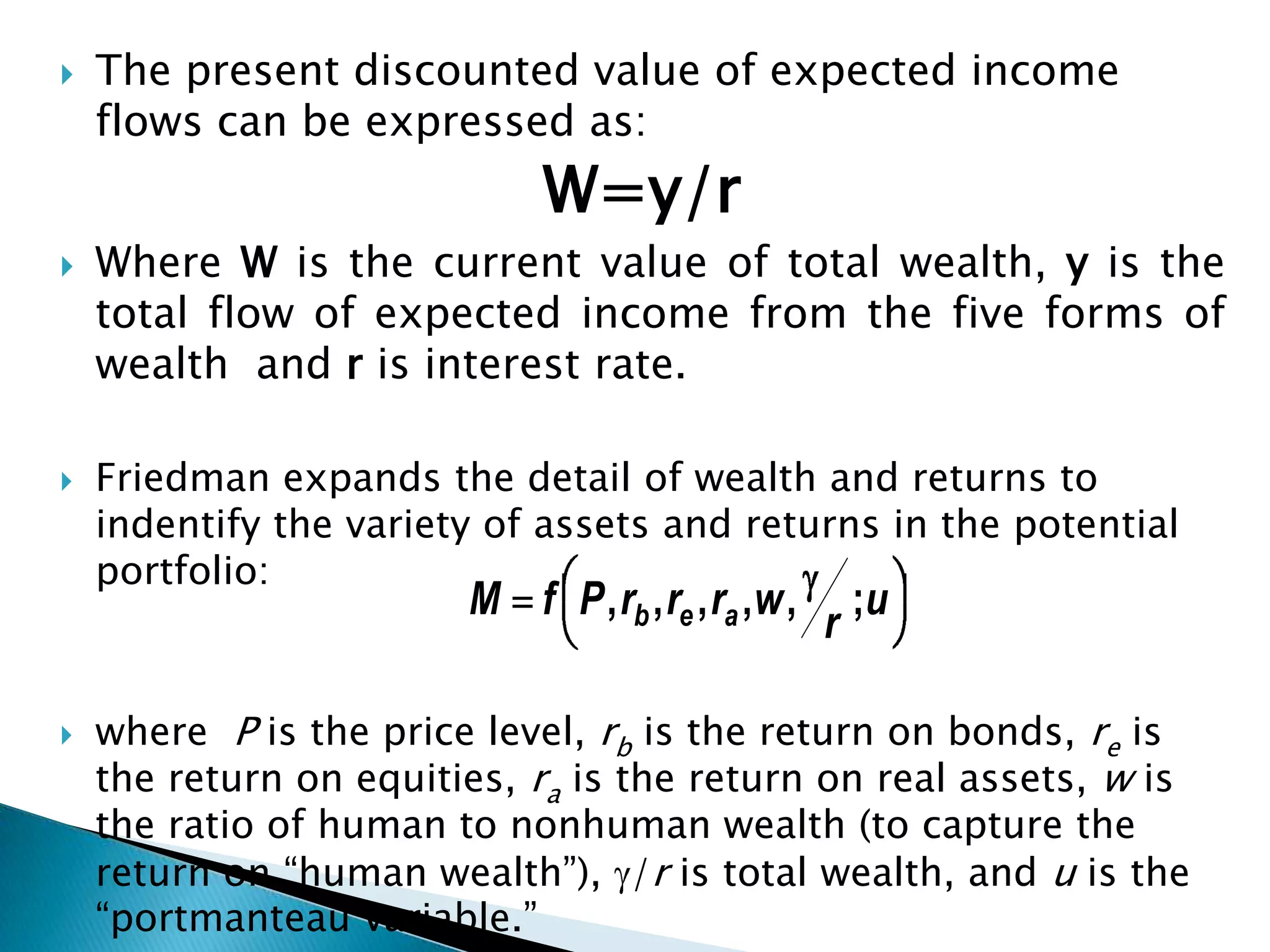
   Friedman avows that the quantity theory is fundamentally a
    theory of the demand for money. It is not a theory of output, or
    of money income, or of the price level.

   Friedman regards the amount of real cash balances as a
    commodity which is demanded because it yields services to the
    person who holds it. Thus money is an asset or capital good,
    hence demand for money forms part of capital or wealth theory.

    Acc.to Friedman total wealth includes all sources of income or
     consumable services which is capitalized income.
     wealth can be held in 5 different forms:
i.     Money
ii.    Bonds
iii.   Equities
iv.    Physical goods
v.     Human capital
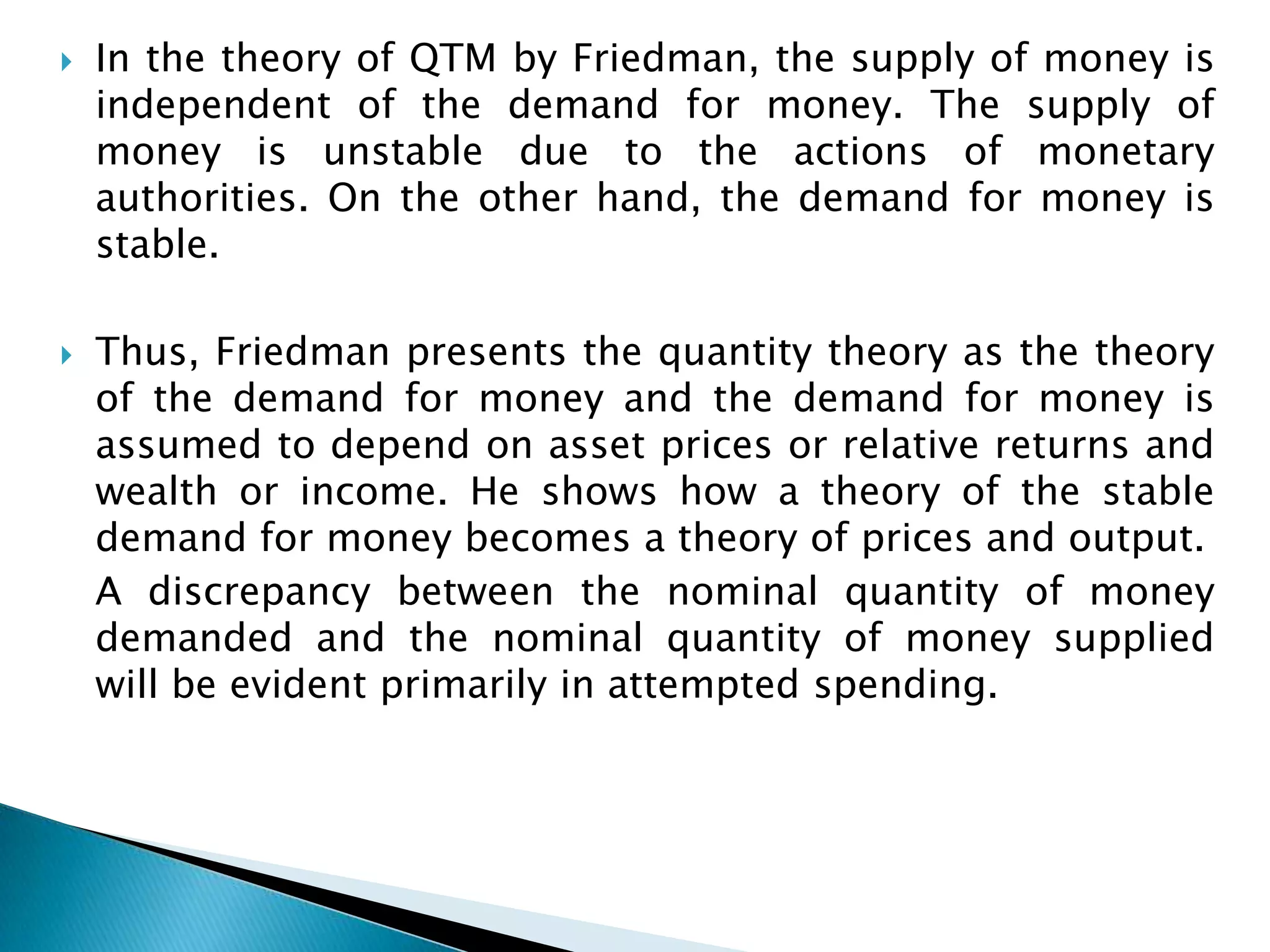
   The present discounted value of expected income
    flows can be expressed as:
                             W=y/r
   Where W is the current value of total wealth, y is the
    total flow of expected income from the five forms of
    wealth and r is interest rate.

   Friedman expands the detail of wealth and returns to
    indentify the variety of assets and returns in the potential
    portfolio:
                        M f P , rb , re , ra ,w ,       ;u
                                                    r

   where P is the price level, rb is the return on bonds, re is
    the return on equities, ra is the return on real assets, w is
    the ratio of human to nonhuman wealth (to capture the
    return on “human wealth”), /r is total wealth, and u is the
    “portmanteau variable.”
   In the theory of QTM by Friedman, the supply of money is
    independent of the demand for money. The supply of
    money is unstable due to the actions of monetary
    authorities. On the other hand, the demand for money is
    stable.

   Thus, Friedman presents the quantity theory as the theory
    of the demand for money and the demand for money is
    assumed to depend on asset prices or relative returns and
    wealth or income. He shows how a theory of the stable
    demand for money becomes a theory of prices and output.
    A discrepancy between the nominal quantity of money
    demanded and the nominal quantity of money supplied
    will be evident primarily in attempted spending.
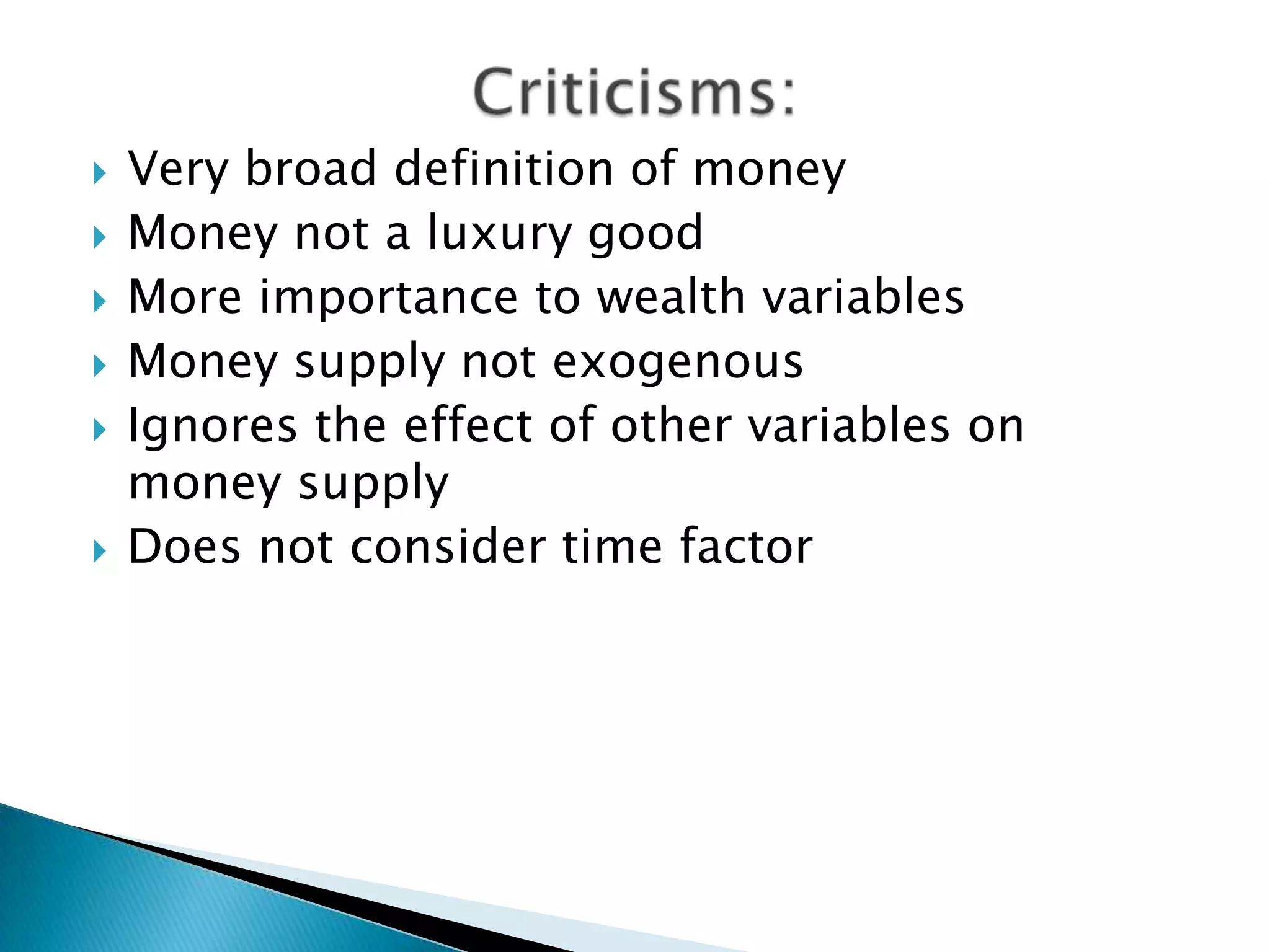
   Very broad definition of money
   Money not a luxury good
   More importance to wealth variables
   Money supply not exogenous
   Ignores the effect of other variables on
    money supply
   Does not consider time factor
Nani quantitative theory of money

Nani quantitative theory of money

  • 1.
    By: VIKRAM.G.B Faculty, P.Gdept. of Commerce Bangalore-55
  • 2.
    Value of money refers to the purchasing power of money over goods and services in a country.  A relative concept which explains the relationship between a unit of money and goods and services which can be purchased with it.  Internal value of money: It refers to the purchasing power of money over domestic goods and services.  External value of money: It refers to the purchasing power of money over foreign goods and services.
  • 3.
    The concept of the quantity theory of money (QTM) began in the 16th century. As gold and silver inflows from the Americas into Europe were being minted into coins, there was a resulting rise in inflation.  The idea is that, the money supply will directly impact both prices and inflation rates.  The quantity theory of money states that there is a direct relationship between the quantity of money in an economy and the level of prices of goods and services sold.  According to QTM, if the amount of money in an economy doubles, price levels also double, causing inflation (the percentage rate at which the level of prices is rising in an economy). The consumer therefore pays twice as much for the same amount of the good or service.
  • 4.
    Another way to understand this theory is to recognize that money is like any other commodity: increases in its supply decrease marginal value (the buying capacity of one unit of currency). So an increase in money supply causes prices to rise (inflation) as they compensate for the decrease in money‟s marginal value.
  • 5.
    Irving Fisher an American economist, put forward the Cash Transaction Approach to the quantity theory of money. He in his book The Purchasing Power of Money (1911) has stated that the value of money in a given period of time depends upon the quantity of money in circulation in the economy  “Other things remaining unchanged, as the quantity of money in circulation increases, the price level also increases in direct proportion and the value of money decreases and vice versa”.  If the quantity of money is doubled, the price level will also double and the value of money will be one half. If the quantity of money is reduced by one half, the price level will also be reduced by one half and the value of money will be twice.
  • 6.
    In Fisher‟s Cash Transactions Version of Money, the general price level in a country, like the prices of commodities, is determined by the supply of and demand for money.  Supply of Money: The supply of money consists of the quantity of money in circulation (M) and the velocity of its circulation (V) i.e., the number of times the money changes hands. Thus MV refers to the total volume of money in circulation during a period of time. For example, if the total money supply in India Rs. 5,000 billion and its velocity per unit of time is 10 times, then the total money supply would be Rs. 5,000 x 10 = Rs.50000 billion.  Demand for Money: People demand money not for its own sake. They demand money because it serves a medium of exchange. It is used to carry every day transactions. In short, the demand for money is for the exchange of goods.
  • 7.
    Equation of Exchange: TheCash transaction version of the quantity theory of money was presented by lrving fisher in the form of an equation: P = MV + M1 V1 or PT= MV+ M1V1 T Here, P is the price Level M is the quantity of money V is the velocity of circulation of M M1 is the volume of credit money V1 is the velocity of circulation of M1 T is the total volume of goods and Trade
  • 8.
    Let us supposeM = Rs. 2000, M1 is Rs = 1000, V = 6, V1 = 4 and T = 8000 goods.
  • 9.
    In figure 4.1(a) it is shown that when the supply of money is increased from QM to QM2, the price level also rises from OP1 to OP2. As the quality of money increase four times to QM4, the price level also increases four times to OP4. In figure 4.1(b) the inverse relationship between quantities of money in circulation and the value of money is shown. When the quantity of money is QM1, the value of money is VM1. When the money supply is doubled from QM1 to QM2, the value of money is reduced to half from VM1 to VM2.
  • 10.
    Full employment: The theory is based on the assumption of full employment in the economy.  T and V are constant: The theory assumes that volume of trade (T) in the short run remains constant. So is the case with velocity of money (V) which remains unaffected.  Constant relation between M and M1. Fisher assumes constant relation between currency money M and credit money (M1).  Price level (P) is a passive factor. The price level (P) is inactive or passive in the equation. P is affected by other factors in equation i.e., T, M, M1, V and V1 but it does not affect them.  It is assumed that the demand for money is proportional to the value of transaction.  The theory is applicable in the long run.
  • 11.
    Unrealistic assumptions: The theory is based on unrealistic assumptions. In this theory P is considered as a passive factor. T is independent. M1, V, V1, are constant in the short run. All these assumptions are covered under “Other things remaining the same.” In actual working of the economy, these do not remain constant; Hence, the theory is unrealized and misleading.  Various Variables in the transaction are not independent. As assumed in the theory The fact is that they very much influence each other For example when money supply (M) increases the velocity f money (V) also goes up Take an other case. Fisher assumes (P) is a passive factor and has no effect on trade (T). In actual practice, when price level P) rises, it increases profitts and promotes trade (T).
  • 12.
    Assumption of full employment is wrong. J. M. Keynes has raised en objection that the assumption of full employment is a rare phenomenon in the economy and the theory is not real.  Rate of interest ignored. In the quantity theory of Fishers, the influence of the rate of interest on the money supply and the level of prices have been completely ignored. The fact is that an increase or decrease in money supply has an important bearing on the rate of interest. An increase in money supply leads to a decline in the rate of interest and vice versa.  Fails to explain trade cycles. The theory fails to explain the trade cycles. It does not tell as to why during depression, the increase in money supply has little impact on the price level, Similarly, in boom period the reduction in money supply or tight money policy may not bring down the price level G. Crowther is right in saying, “The quantity theory is at best an imperfect guide to the cause of the business cycle”.
  • 13.
    Ignores other factors of price level. There are many determinants other than M, V, and T which have important implication on the price level. These factors such as income, expenditure, saving, investment, population consumption etc have been ignored from the purview of the theory.  Weak Theory: According to Crowther, QTM is weak in many respects. i. It cannot explain „why‟ there is a fluctuations in the price level ii. It gives undue importance to the price level. iii. Misleading emphasis on the quantity of money as the principal cause of changes in the price level during the trade cycle.
  • 14.
    Friedman avows that the quantity theory is fundamentally a theory of the demand for money. It is not a theory of output, or of money income, or of the price level.  Friedman regards the amount of real cash balances as a commodity which is demanded because it yields services to the person who holds it. Thus money is an asset or capital good, hence demand for money forms part of capital or wealth theory.  Acc.to Friedman total wealth includes all sources of income or consumable services which is capitalized income. wealth can be held in 5 different forms: i. Money ii. Bonds iii. Equities iv. Physical goods v. Human capital
  • 15.
    The present discounted value of expected income flows can be expressed as: W=y/r  Where W is the current value of total wealth, y is the total flow of expected income from the five forms of wealth and r is interest rate.  Friedman expands the detail of wealth and returns to indentify the variety of assets and returns in the potential portfolio: M f P , rb , re , ra ,w , ;u r  where P is the price level, rb is the return on bonds, re is the return on equities, ra is the return on real assets, w is the ratio of human to nonhuman wealth (to capture the return on “human wealth”), /r is total wealth, and u is the “portmanteau variable.”
  • 16.
    In the theory of QTM by Friedman, the supply of money is independent of the demand for money. The supply of money is unstable due to the actions of monetary authorities. On the other hand, the demand for money is stable.  Thus, Friedman presents the quantity theory as the theory of the demand for money and the demand for money is assumed to depend on asset prices or relative returns and wealth or income. He shows how a theory of the stable demand for money becomes a theory of prices and output. A discrepancy between the nominal quantity of money demanded and the nominal quantity of money supplied will be evident primarily in attempted spending.
  • 17.
    Very broad definition of money  Money not a luxury good  More importance to wealth variables  Money supply not exogenous  Ignores the effect of other variables on money supply  Does not consider time factor