This video is presented by USeP’s Bachelor of Science in Computer
  Science student Kevin Mendez under Mr. ND Arquillano as a partial
  fulfillment for Elective 4 – Ecommerce. It talks about:

 Introduction of E-business and E-commerce
 E-commerce Fundamentals
 E-business Infrastructure
 E-environment
 Supply Chain Management
 E-marketing
 Customer Relationship Management
 Change Management
 Analysis and Design
 M-Commerce
 Management of Mobile Commerce Services
Introduction of E-Business and E-
           Commerce
E Commerce stands for electronic commerce and
caters to trading in goods and services through the
electronic medium such as internet, mobile or any
other computer network. It involves the use of
Information and Communication Technology (ICT)
and Electronic Funds Transfer (EFT) in making
commerce between consumers and organizations,
organization and organization or consumer and
consumer.
Introduction of E-Business and E-
      Commerce: Beginnings
 First wave
   Mid-1990s to 2000: rapid growth
   “Dot-com boom” followed by “dot-com bust”
   2000 to 2003: overly gloomy news reports
 Second wave
   2003: signs of new life
   Sales growth
   Profits
Introduction of E-Business and E-
            Commerce
• Traditional Commerce
  – Exchange of goods/services of at least 2 parties
  – Seller
  – Buyer
  – Activities as Business Processes
• Electronic commerce
  – Defined as the use of electronic data transmission
  technologies to enhance business processes.
  – A subset of E-Business
  – More than shopping on the Web
  – Businesses trading with other businesses
  – Internal company processes
Introduction of E-Business and E-
            Commerce
• Electronic Business
   – defined as the utilization of ICT in support of all the
   activities of business
   – more strategic focus
   – involves business processes spanning the entire value
   chain (inter and intra firm biz processes)
        • electronic purchasing
        • supply chain management
        • conducted using the Web, the Internet, intranets,
        extranets, or some combination of these.
E-commerce Fundamental
 The most important thing online is the user experience. It can
  be argued that everything else is secondary. Websites that
  frustrate will not endear your brand to prospective customers.
  Try to create an online experience where users can easily find
  and digest the information they need in order to proceed to
  the checkout.
 Solid ‘on-site search’ functionality is vital. You need good-
  quality metadata to make it work properly. One E-consultancy
  study showed that half of all site searches returned no results
  even where products were available. Madness. ‘Prompted
  search’ is a no-brainer (a la Google Suggest and Become.com).
  We published a buyer's guide to site search tools.
E-commerce Fundamental
 Well-defined       information    architectureand       intuitive
  navigation is essential. Studies have shown that most people
  are ‘cognitive misers’. In plain English: people don’t like to
  think. Keep this in mind when wireframing your site
 Clearly label categories and pages. Talk in the same
  language as your users. This language is the language of
  search. People will type in search queries that make sense to
  them – you need to mirror these search queries on your
  website (keywords in titles, body text, internal links, etc). Use
  keyword suggestion tools to figure out which terms are most-
  searched for. You should define a keyword strategy very early
  on – figure out the top 50 keywords/phrases that you want to
  rank well on.
E-commerce Fundamental
 Trust and credibility need to be reinforced, particularly in key
  purchase areas, and especially for new or unknown brands.
  This means testimonials, customer feedback, press cuttings. It
  also means highly visible contact details (telephone / email)
  and online customer support options (FAQ / help / delivery
  options).
 Prioritise the key information users look for during the
  purchase decision-making process. Price, features, delivery
  options and the buy now button all need to be placed above
  the fold. Above. The. Fold.
E-commerce Fundamental
 Minimise distractions – keep the user focused on the
 purchase or conversion goal. This means no flashing
 ads above the fold, among other things. It means up-selling
 and cross-selling at appropriate times, and not too early (to
 avoid confusing the user before they’ve fully bought into the
 purchase decision). Yes to white space and big fonts. No to
 clutter.
 Good copy. Copywriting is just as important online as it is
 offline. Be persuasive and add value where you can. Talk to the
 user as an individual. Think about what you would want to see,
 in order to proceed to the checkout. Use an active voice, not a
 passive one. Avoid jargon and marketese.
E-commerce Fundamental
 Images. Pictures might be very important to your customers, to help
  them evaluate products. In some sectors, images aren’t needed
  whatsoever. They are absolutely crucial in others. Optimize images
  for Google when you upload them. And compress them! Keep an
  eye on page weight – slow loading times can annoy and frustrate
  users (broadband connections help, but everything is relative…).
 Service the pre-purchase consumer. The e-commerce store is often
  a place for research (I almost always look at Amazon
  recommendations when buying any kind of product). Most people
  research products and services online prior to starting out on their
  purchase journey (in a separate session). When in pre-purchase
  mode users look for comparison tools to help them weigh up the
  options. If your competitors have better feature filtering tools then
  users may prefer to use their website. ‘Watchlists’ are a good idea
  too – encourage users to ‘save items to watchlist’, to start a
  relationship with them (a simple register user account may be
  needed here, but don't ask for much more than an email address at
  this point).
E-commerce Fundamental
 No alarms and no surprises. Always let the user know what to
  expect, especially when they’ve started to purchase. Go and
  see how Amazon does it. Transparency is very important (e.g.,
  'step 2 of 4').
 Highly visible support options. This is worth mentioning again
  in case you missed it earlier. It meansprominently-displayed
  telephone numbers, emails, online customer service tools,
  delivery tracking, and so on. This is absolutely vital, especially
  to first-time customers and non-savvy internet users, who may
  have a lingering mistrust of the internet.
E-Business Infrastructure
 E-Business Infrastructure is the architecture of
  hardware, software, content and data used to deliver
  e-business services to employees, customer and
  partners.
 Defining an adequate E-business infrastructure is vital
  to all companies adopting e-business as it affects
  directly the quality of service experienced by users of
  the system in terms of speed and responsiveness.
 A key decision with managing this infrastructure is
  which elements are located within the company and
  which are managed externally as third-party manages
  applications, data servers, and networks.
E-environment
 All businesses:
   Must comply with same laws and regulations
   Face same set of penalties
 Web businesses: two additional complicating factors
   Web extends reach beyond traditional boundaries
     Subject to more laws more quickly
   Web increases communications speed and
    efficiency
     More     interactive and complex customer
      relationships
E-environment
 Web creates network of customers
   Significant levels of interaction (with each other)
 Implications of interaction for Web businesses
   Violating law or breaching ethical standards
       Face rapid and intense reactions from many
        customers
Supply Chain Management

 Supply chain management (SCM) is the management of a
 network of interconnected businesses involved in the
 provision of product and service packages required by the
 end customers in a supply chain. Supply chain
 management spans all movement and storage of raw
 materials, work-in-process inventory, and finished goods
 from point of origin to point of consumption.
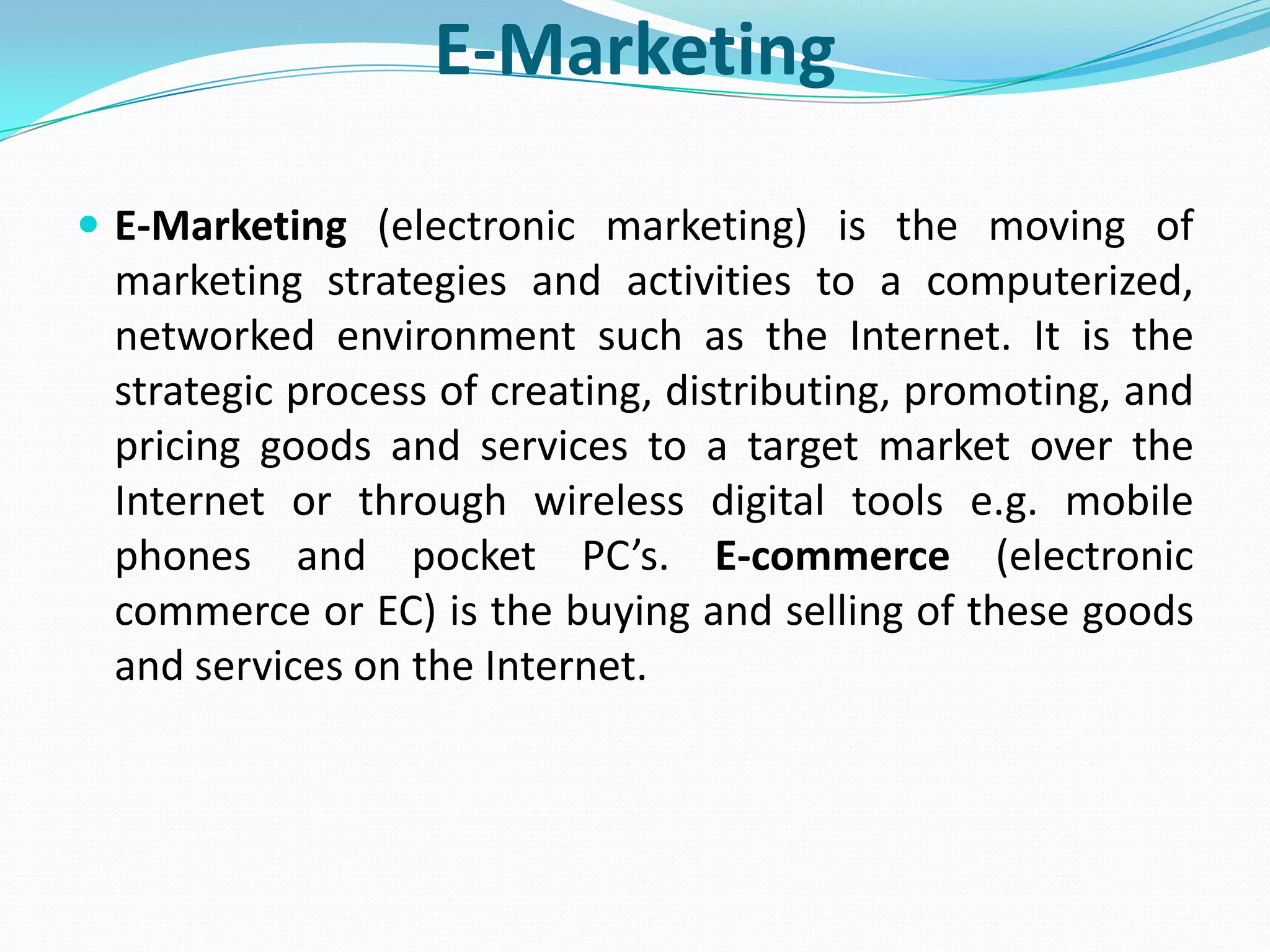
E-Marketing

 E-Marketing (electronic marketing) is the moving of
 marketing strategies and activities to a computerized,
 networked environment such as the Internet. It is the
 strategic process of creating, distributing, promoting, and
 pricing goods and services to a target market over the
 Internet or through wireless digital tools e.g. mobile
 phones and pocket PC’s. E-commerce (electronic
 commerce or EC) is the buying and selling of these goods
 and services on the Internet.
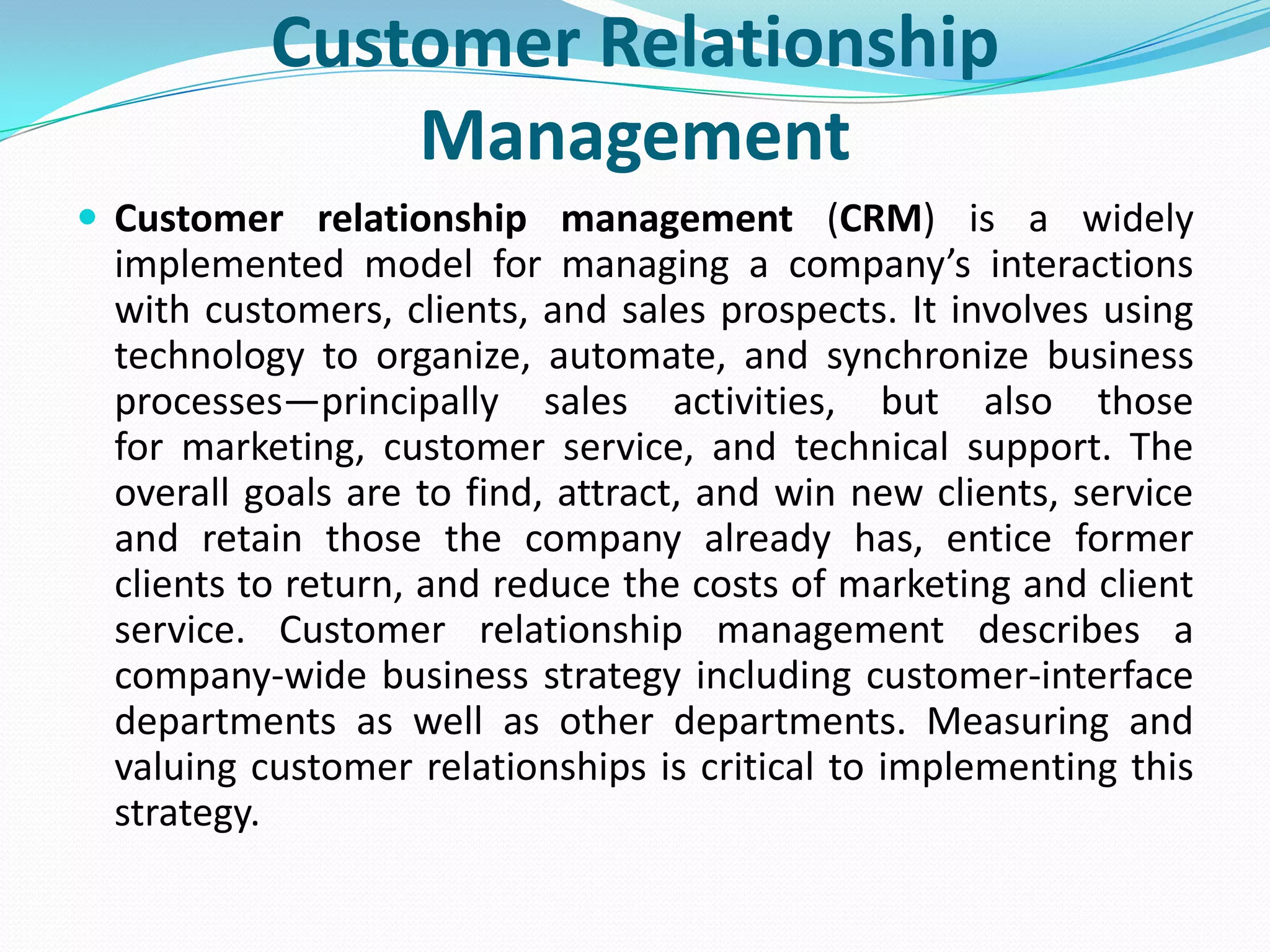
Customer Relationship
              Management
 Customer relationship management (CRM) is a widely
 implemented model for managing a company’s interactions
 with customers, clients, and sales prospects. It involves using
 technology to organize, automate, and synchronize business
 processes—principally sales activities, but also those
 for marketing, customer service, and technical support. The
 overall goals are to find, attract, and win new clients, service
 and retain those the company already has, entice former
 clients to return, and reduce the costs of marketing and client
 service. Customer relationship management describes a
 company-wide business strategy including customer-interface
 departments as well as other departments. Measuring and
 valuing customer relationships is critical to implementing this
 strategy.
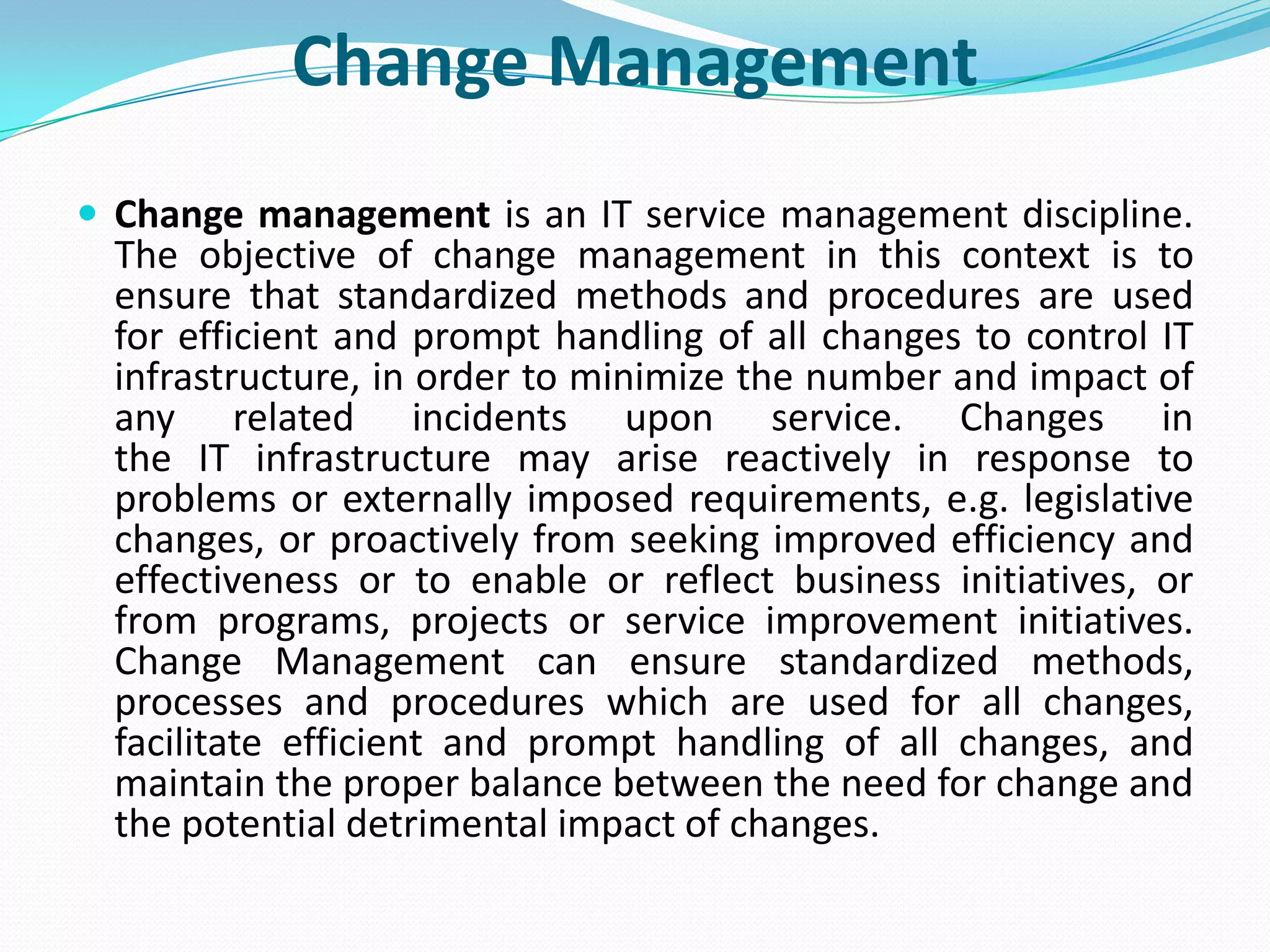
Change Management
 Change management is an IT service management discipline.
  The objective of change management in this context is to
  ensure that standardized methods and procedures are used
  for efficient and prompt handling of all changes to control IT
  infrastructure, in order to minimize the number and impact of
  any related incidents upon service. Changes in
  the IT infrastructure may arise reactively in response to
  problems or externally imposed requirements, e.g. legislative
  changes, or proactively from seeking improved efficiency and
  effectiveness or to enable or reflect business initiatives, or
  from programs, projects or service improvement initiatives.
  Change Management can ensure standardized methods,
  processes and procedures which are used for all changes,
  facilitate efficient and prompt handling of all changes, and
  maintain the proper balance between the need for change and
  the potential detrimental impact of changes.
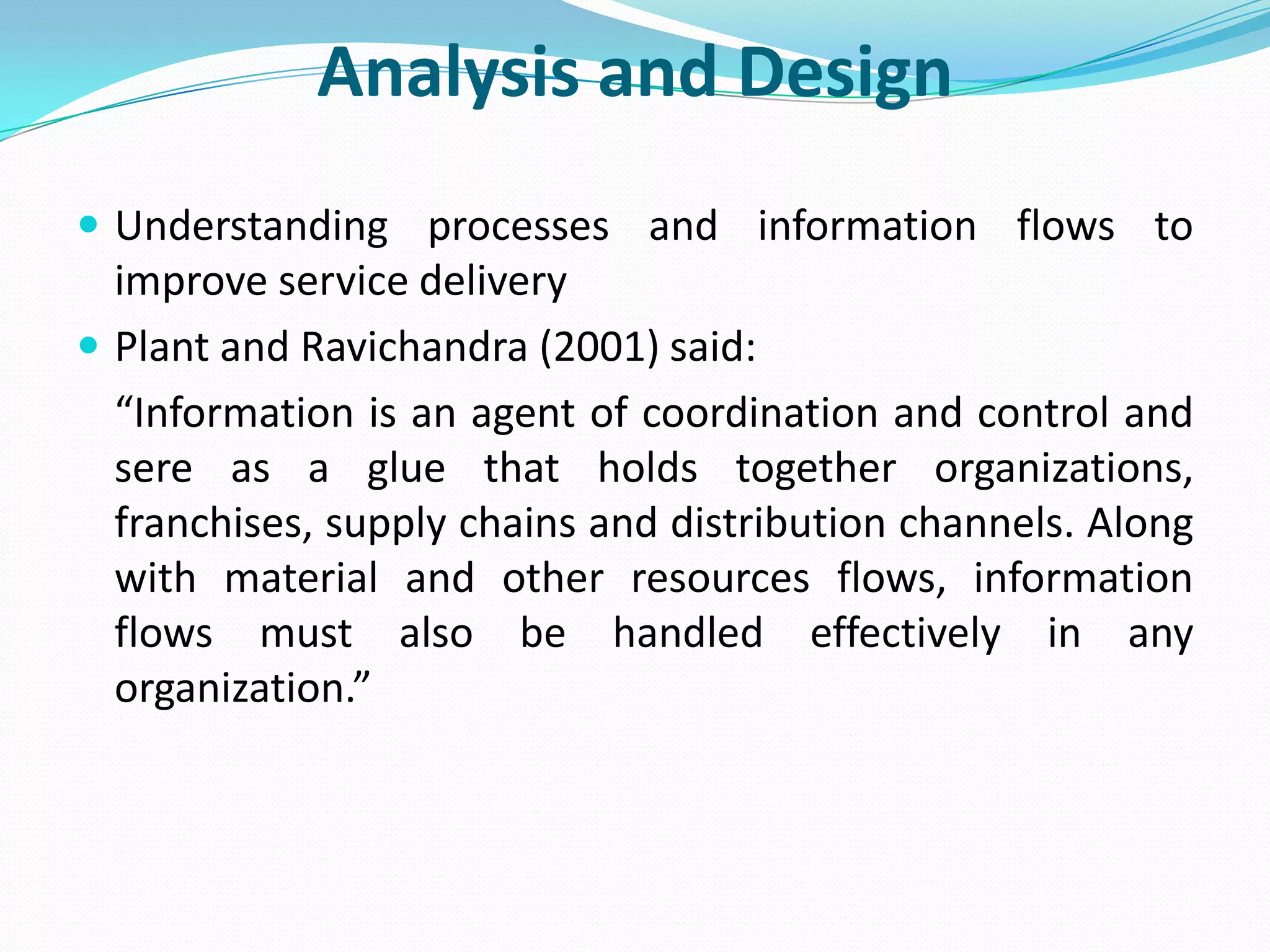
Analysis and Design
 Understanding processes and information flows to
  improve service delivery
 Plant and Ravichandra (2001) said:
  “Information is an agent of coordination and control and
  sere as a glue that holds together organizations,
  franchises, supply chains and distribution channels. Along
  with material and other resources flows, information
  flows must also be handled effectively in any
  organization.”
M-Commerce
 Mobile Commerce, or m-Commerce, is about the
 explosion of applications and services that are becoming
 accessible from Internet-enabled mobile devices. It
 involves new technologies, services and business models.
 It is quite different from traditional e-Commerce. Mobile
 phones impose very different constraints than desktop
 computers. But they also open the door to a slew of new
 applications and services. They follow you wherever you
 go, making it possible to look for a nearby restaurant, stay
 in touch with colleagues, or pay for items at a store.
Management of Mobile Commerce
          Services
   mobile device databases
   billing systems
   text messaging services
   hardware/software design
   mobile payments
   brand recognition
   distribution control
   Web site development and hosting
   Web site performance monitoring
   fulfillment management
   online marketing
   order processing and delivery

E commerce

  • 2.
    This video ispresented by USeP’s Bachelor of Science in Computer Science student Kevin Mendez under Mr. ND Arquillano as a partial fulfillment for Elective 4 – Ecommerce. It talks about:  Introduction of E-business and E-commerce  E-commerce Fundamentals  E-business Infrastructure  E-environment  Supply Chain Management  E-marketing  Customer Relationship Management  Change Management  Analysis and Design  M-Commerce  Management of Mobile Commerce Services
  • 3.
    Introduction of E-Businessand E- Commerce E Commerce stands for electronic commerce and caters to trading in goods and services through the electronic medium such as internet, mobile or any other computer network. It involves the use of Information and Communication Technology (ICT) and Electronic Funds Transfer (EFT) in making commerce between consumers and organizations, organization and organization or consumer and consumer.
  • 4.
    Introduction of E-Businessand E- Commerce: Beginnings  First wave  Mid-1990s to 2000: rapid growth  “Dot-com boom” followed by “dot-com bust”  2000 to 2003: overly gloomy news reports  Second wave  2003: signs of new life  Sales growth  Profits
  • 5.
    Introduction of E-Businessand E- Commerce • Traditional Commerce – Exchange of goods/services of at least 2 parties – Seller – Buyer – Activities as Business Processes • Electronic commerce – Defined as the use of electronic data transmission technologies to enhance business processes. – A subset of E-Business – More than shopping on the Web – Businesses trading with other businesses – Internal company processes
  • 6.
    Introduction of E-Businessand E- Commerce • Electronic Business – defined as the utilization of ICT in support of all the activities of business – more strategic focus – involves business processes spanning the entire value chain (inter and intra firm biz processes) • electronic purchasing • supply chain management • conducted using the Web, the Internet, intranets, extranets, or some combination of these.
  • 7.
    E-commerce Fundamental  Themost important thing online is the user experience. It can be argued that everything else is secondary. Websites that frustrate will not endear your brand to prospective customers. Try to create an online experience where users can easily find and digest the information they need in order to proceed to the checkout.  Solid ‘on-site search’ functionality is vital. You need good- quality metadata to make it work properly. One E-consultancy study showed that half of all site searches returned no results even where products were available. Madness. ‘Prompted search’ is a no-brainer (a la Google Suggest and Become.com). We published a buyer's guide to site search tools.
  • 8.
    E-commerce Fundamental  Well-defined information architectureand intuitive navigation is essential. Studies have shown that most people are ‘cognitive misers’. In plain English: people don’t like to think. Keep this in mind when wireframing your site  Clearly label categories and pages. Talk in the same language as your users. This language is the language of search. People will type in search queries that make sense to them – you need to mirror these search queries on your website (keywords in titles, body text, internal links, etc). Use keyword suggestion tools to figure out which terms are most- searched for. You should define a keyword strategy very early on – figure out the top 50 keywords/phrases that you want to rank well on.
  • 9.
    E-commerce Fundamental  Trustand credibility need to be reinforced, particularly in key purchase areas, and especially for new or unknown brands. This means testimonials, customer feedback, press cuttings. It also means highly visible contact details (telephone / email) and online customer support options (FAQ / help / delivery options).  Prioritise the key information users look for during the purchase decision-making process. Price, features, delivery options and the buy now button all need to be placed above the fold. Above. The. Fold.
  • 10.
    E-commerce Fundamental  Minimisedistractions – keep the user focused on the purchase or conversion goal. This means no flashing ads above the fold, among other things. It means up-selling and cross-selling at appropriate times, and not too early (to avoid confusing the user before they’ve fully bought into the purchase decision). Yes to white space and big fonts. No to clutter.  Good copy. Copywriting is just as important online as it is offline. Be persuasive and add value where you can. Talk to the user as an individual. Think about what you would want to see, in order to proceed to the checkout. Use an active voice, not a passive one. Avoid jargon and marketese.
  • 11.
    E-commerce Fundamental  Images.Pictures might be very important to your customers, to help them evaluate products. In some sectors, images aren’t needed whatsoever. They are absolutely crucial in others. Optimize images for Google when you upload them. And compress them! Keep an eye on page weight – slow loading times can annoy and frustrate users (broadband connections help, but everything is relative…).  Service the pre-purchase consumer. The e-commerce store is often a place for research (I almost always look at Amazon recommendations when buying any kind of product). Most people research products and services online prior to starting out on their purchase journey (in a separate session). When in pre-purchase mode users look for comparison tools to help them weigh up the options. If your competitors have better feature filtering tools then users may prefer to use their website. ‘Watchlists’ are a good idea too – encourage users to ‘save items to watchlist’, to start a relationship with them (a simple register user account may be needed here, but don't ask for much more than an email address at this point).
  • 12.
    E-commerce Fundamental  Noalarms and no surprises. Always let the user know what to expect, especially when they’ve started to purchase. Go and see how Amazon does it. Transparency is very important (e.g., 'step 2 of 4').  Highly visible support options. This is worth mentioning again in case you missed it earlier. It meansprominently-displayed telephone numbers, emails, online customer service tools, delivery tracking, and so on. This is absolutely vital, especially to first-time customers and non-savvy internet users, who may have a lingering mistrust of the internet.
  • 13.
    E-Business Infrastructure  E-BusinessInfrastructure is the architecture of hardware, software, content and data used to deliver e-business services to employees, customer and partners.  Defining an adequate E-business infrastructure is vital to all companies adopting e-business as it affects directly the quality of service experienced by users of the system in terms of speed and responsiveness.  A key decision with managing this infrastructure is which elements are located within the company and which are managed externally as third-party manages applications, data servers, and networks.
  • 14.
    E-environment  All businesses:  Must comply with same laws and regulations  Face same set of penalties  Web businesses: two additional complicating factors  Web extends reach beyond traditional boundaries  Subject to more laws more quickly  Web increases communications speed and efficiency  More interactive and complex customer relationships
  • 15.
    E-environment  Web createsnetwork of customers  Significant levels of interaction (with each other)  Implications of interaction for Web businesses  Violating law or breaching ethical standards  Face rapid and intense reactions from many customers
  • 16.
    Supply Chain Management Supply chain management (SCM) is the management of a network of interconnected businesses involved in the provision of product and service packages required by the end customers in a supply chain. Supply chain management spans all movement and storage of raw materials, work-in-process inventory, and finished goods from point of origin to point of consumption.
  • 17.
    E-Marketing  E-Marketing (electronicmarketing) is the moving of marketing strategies and activities to a computerized, networked environment such as the Internet. It is the strategic process of creating, distributing, promoting, and pricing goods and services to a target market over the Internet or through wireless digital tools e.g. mobile phones and pocket PC’s. E-commerce (electronic commerce or EC) is the buying and selling of these goods and services on the Internet.
  • 18.
    Customer Relationship Management  Customer relationship management (CRM) is a widely implemented model for managing a company’s interactions with customers, clients, and sales prospects. It involves using technology to organize, automate, and synchronize business processes—principally sales activities, but also those for marketing, customer service, and technical support. The overall goals are to find, attract, and win new clients, service and retain those the company already has, entice former clients to return, and reduce the costs of marketing and client service. Customer relationship management describes a company-wide business strategy including customer-interface departments as well as other departments. Measuring and valuing customer relationships is critical to implementing this strategy.
  • 19.
    Change Management  Changemanagement is an IT service management discipline. The objective of change management in this context is to ensure that standardized methods and procedures are used for efficient and prompt handling of all changes to control IT infrastructure, in order to minimize the number and impact of any related incidents upon service. Changes in the IT infrastructure may arise reactively in response to problems or externally imposed requirements, e.g. legislative changes, or proactively from seeking improved efficiency and effectiveness or to enable or reflect business initiatives, or from programs, projects or service improvement initiatives. Change Management can ensure standardized methods, processes and procedures which are used for all changes, facilitate efficient and prompt handling of all changes, and maintain the proper balance between the need for change and the potential detrimental impact of changes.
  • 20.
    Analysis and Design Understanding processes and information flows to improve service delivery  Plant and Ravichandra (2001) said: “Information is an agent of coordination and control and sere as a glue that holds together organizations, franchises, supply chains and distribution channels. Along with material and other resources flows, information flows must also be handled effectively in any organization.”
  • 21.
    M-Commerce  Mobile Commerce,or m-Commerce, is about the explosion of applications and services that are becoming accessible from Internet-enabled mobile devices. It involves new technologies, services and business models. It is quite different from traditional e-Commerce. Mobile phones impose very different constraints than desktop computers. But they also open the door to a slew of new applications and services. They follow you wherever you go, making it possible to look for a nearby restaurant, stay in touch with colleagues, or pay for items at a store.
  • 22.
    Management of MobileCommerce Services  mobile device databases  billing systems  text messaging services  hardware/software design  mobile payments  brand recognition  distribution control  Web site development and hosting  Web site performance monitoring  fulfillment management  online marketing  order processing and delivery