Inquiry Forms:
Questionnaire
Opinionnaire
Attitude Scale
Checklist
Rating Scale
Score-card
Schedule
By
Dr G R Angadi
Questionnaire
List of a research or survey questions asked to
respondents, and designed to extract specific
information from the respondents is called as
Questionnaire. It serves four basic purposes:
• Collect the appropriate data
• Make data comparable and amenable to
analysis
• Minimize bias in formulating and asking
question.
Steps in Questionnaire Construction
1. Preparation
2. Constructing the first draft
3. Self-evaluation
4. External evaluation
5. Revision
6. Pre-test or Pilot study
7. Revision
8. Second Pre-test if necessary
9. Preparing final Copy
Sample Questionnaire
Questionnaire on Teacher Effectiveness
Questionnaire - Teacher training institutions
Advantages of Questionnaire
1. Allows a wider range and distribution of the sample
than the interview method
2. Provides greater access to more educated
respondents and to persons in higher income
brackets
3. Provides an opportunity for respondents to give
frank. Anonymous answers
4. Allows greater economy of effort (i.e.. a single
instrument. duplicated and distributed to numerous
respondents. can produce a large amount of data)
Advantages of Questionnaire
5. Can be constructed so that quantitative data are relatively
easy to collect and analyze
6. Can be designed to gather background information about
respondents as well as original hard-to-obtain data
7. facilitates the collection of large amount of data in a short
period of time
8. Allows the corrections in exploratory studies, of
insightful information about a relatively unexplored
problem area or subject.
9. Can be completed at the leisure of respondents-within
time limits set by the surveyor-without imposing on
research subjects
10. Because of its fixed format, helps to eliminate
variation in the questioning process
Disadvantages of the Questionnaire
1.Precludes personal contact with respondents, perhaps
causing the investigator to gain insufficient knowledge
about participants in a study.
2. Does not allow respondents to qualify ambiguous
questions
Disadvantages of the Questionnaire
3. If the prepared instrument does not arouse respondent
emotions (i.e., when the questionnaire is too impersonal)
valid responses might not be elicited.
4. Poorly worded or direct questions might arouse
antagonism or inhibitions on the part of respondents
Disadvantages of the Questionnaire
5. Difficulty in obtaining responses from a representative
cross section of the target population
6. Because opinionated respondents might be more likely
than other subjects to complete and return it, use of a
questionnaire might lead to non response bias
Types of Question
1.Factual questions normally pertain to respondents
ages, education, library experience, memberships
in professional organizations, or any other
pertinent personal data needed in the study.
2. Opinion and Attitude Question - When the
purpose of a survey is to obtain information about
respondents beliefs. feelings, values, and related
concepts, opinion and attitude questions can be
used
Types of Question
3. Information question - In some types of survey
research, investigators might attempt to determine
how respondents know about a given topic and how
or when their research subjects gained certain
knowledge
4. Self – perception question – These questions is
about the self-perceptions of respondents in a given
topic or area.
5. Standard of action question - In some types of
surveys, investigators might attempt to determine
how respondents will act in certain circumstances or
how subjects feel about a new development or
forthcoming event.
6. Projective questions - At times, questions are used
that allow respondents to answer inquiries in an
indirect manner by imposing their personal feelings,
attitudes, or beliefs on another person or group of
persons.
Unstructured and Structured Questions
Questions can also be classified, on the basis of
form and method of response, into two major
categories: Unstructured and structured.
Unstructured Question - allow respondents to
reply freely without having to select one of several
provided responses
Structured Question – It specifies the respondents
answer in a several provided options in a question.
Ways of Administering a Questionnaire
1. Collective Administration - One of the best way of
administering a questionnaire is to obtain a captive
audience such as students in classroom, people attending
a function
2. Administration in a public places - Sometimes you can
administer a questionnaire in a public place such as a
shopping Center, health center, hospital, school or
public, it is dependent upon the type of study population
Ways of Administering a Questionnaire
3.The mailed questionnaire - The most common approach to
collecting information is to send the questionnaire to
prospective respondents by mail
OPINIONNAIRE
“Opinion polling or opinion gauging represents
a single question approach. The answers are
usually in the form of ‘yes’ or ‘no’. An
undecided category is often included.
Sometimes large number of response
alternatives if provided.”
- Anna Anastusi
The terms opinion and attitude are not
synonymous, through sometimes we used it
synonymously. Opinion is what a person says
on certain aspects of the issue under
considerations. It is an outward expression of
an attitude held by an individual. Attitudes of
an individual can be inferred or estimated
from his statements of opinions.
An opinionnaire is defined as a special form of
inquiry. It is used by the researcher to collect the
opinions of a sample of population on certain facts or
factors the problem under investigation. These
opinions on different facts of the problem under study
are further quantified, analysed and interpreted.
Purpose :
Opinionnaire are usually used in researches of the
descriptive type which demands survey of opinions of
the concerned individuals.
Public opinion research is an example of opinion
survey.
Opinion polling enables the researcher to forecast the
coming happenings in successful manner.
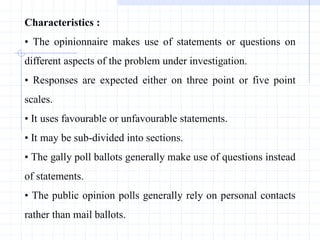
Characteristics :
• The opinionnaire makes use of statements or questions on
different aspects of the problem under investigation.
• Responses are expected either on three point or five point
scales.
• It uses favourable or unfavourable statements.
• It may be sub-divided into sections.
• The gally poll ballots generally make use of questions instead
of statements.
• The public opinion polls generally rely on personal contacts
rather than mail ballots.
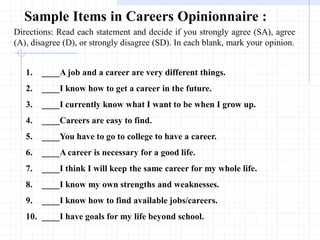
Sample Items in Careers Opinionnaire :
Directions: Read each statement and decide if you strongly agree (SA), agree
(A), disagree (D), or strongly disagree (SD). In each blank, mark your opinion.
1. ____A job and a career are very different things.
2. ____I know how to get a career in the future.
3. ____I currently know what I want to be when I grow up.
4. ____Careers are easy to find.
5. ____You have to go to college to have a career.
6. ____A career is necessary for a good life.
7. ____I think I will keep the same career for my whole life.
8. ____I know my own strengths and weaknesses.
9. ____I know how to find available jobs/careers.
10. ____I have goals for my life beyond school.

Inquiry forms questionnaire and opinionnaire

  • 1.
  • 2.
    Questionnaire List of aresearch or survey questions asked to respondents, and designed to extract specific information from the respondents is called as Questionnaire. It serves four basic purposes: • Collect the appropriate data • Make data comparable and amenable to analysis • Minimize bias in formulating and asking question.
  • 3.
    Steps in QuestionnaireConstruction 1. Preparation 2. Constructing the first draft 3. Self-evaluation 4. External evaluation 5. Revision 6. Pre-test or Pilot study 7. Revision 8. Second Pre-test if necessary 9. Preparing final Copy
  • 4.
    Sample Questionnaire Questionnaire onTeacher Effectiveness Questionnaire - Teacher training institutions
  • 5.
    Advantages of Questionnaire 1.Allows a wider range and distribution of the sample than the interview method 2. Provides greater access to more educated respondents and to persons in higher income brackets 3. Provides an opportunity for respondents to give frank. Anonymous answers 4. Allows greater economy of effort (i.e.. a single instrument. duplicated and distributed to numerous respondents. can produce a large amount of data)
  • 6.
    Advantages of Questionnaire 5.Can be constructed so that quantitative data are relatively easy to collect and analyze 6. Can be designed to gather background information about respondents as well as original hard-to-obtain data 7. facilitates the collection of large amount of data in a short period of time
  • 7.
    8. Allows thecorrections in exploratory studies, of insightful information about a relatively unexplored problem area or subject. 9. Can be completed at the leisure of respondents-within time limits set by the surveyor-without imposing on research subjects 10. Because of its fixed format, helps to eliminate variation in the questioning process
  • 8.
    Disadvantages of theQuestionnaire 1.Precludes personal contact with respondents, perhaps causing the investigator to gain insufficient knowledge about participants in a study. 2. Does not allow respondents to qualify ambiguous questions
  • 9.
    Disadvantages of theQuestionnaire 3. If the prepared instrument does not arouse respondent emotions (i.e., when the questionnaire is too impersonal) valid responses might not be elicited. 4. Poorly worded or direct questions might arouse antagonism or inhibitions on the part of respondents
  • 10.
    Disadvantages of theQuestionnaire 5. Difficulty in obtaining responses from a representative cross section of the target population 6. Because opinionated respondents might be more likely than other subjects to complete and return it, use of a questionnaire might lead to non response bias
  • 11.
    Types of Question 1.Factualquestions normally pertain to respondents ages, education, library experience, memberships in professional organizations, or any other pertinent personal data needed in the study. 2. Opinion and Attitude Question - When the purpose of a survey is to obtain information about respondents beliefs. feelings, values, and related concepts, opinion and attitude questions can be used
  • 12.
    Types of Question 3.Information question - In some types of survey research, investigators might attempt to determine how respondents know about a given topic and how or when their research subjects gained certain knowledge 4. Self – perception question – These questions is about the self-perceptions of respondents in a given topic or area.
  • 13.
    5. Standard ofaction question - In some types of surveys, investigators might attempt to determine how respondents will act in certain circumstances or how subjects feel about a new development or forthcoming event. 6. Projective questions - At times, questions are used that allow respondents to answer inquiries in an indirect manner by imposing their personal feelings, attitudes, or beliefs on another person or group of persons.
  • 14.
    Unstructured and StructuredQuestions Questions can also be classified, on the basis of form and method of response, into two major categories: Unstructured and structured. Unstructured Question - allow respondents to reply freely without having to select one of several provided responses Structured Question – It specifies the respondents answer in a several provided options in a question.
  • 15.
    Ways of Administeringa Questionnaire 1. Collective Administration - One of the best way of administering a questionnaire is to obtain a captive audience such as students in classroom, people attending a function 2. Administration in a public places - Sometimes you can administer a questionnaire in a public place such as a shopping Center, health center, hospital, school or public, it is dependent upon the type of study population
  • 16.
    Ways of Administeringa Questionnaire 3.The mailed questionnaire - The most common approach to collecting information is to send the questionnaire to prospective respondents by mail
  • 17.
    OPINIONNAIRE “Opinion polling oropinion gauging represents a single question approach. The answers are usually in the form of ‘yes’ or ‘no’. An undecided category is often included. Sometimes large number of response alternatives if provided.” - Anna Anastusi
  • 18.
    The terms opinionand attitude are not synonymous, through sometimes we used it synonymously. Opinion is what a person says on certain aspects of the issue under considerations. It is an outward expression of an attitude held by an individual. Attitudes of an individual can be inferred or estimated from his statements of opinions.
  • 19.
    An opinionnaire isdefined as a special form of inquiry. It is used by the researcher to collect the opinions of a sample of population on certain facts or factors the problem under investigation. These opinions on different facts of the problem under study are further quantified, analysed and interpreted.
  • 20.
    Purpose : Opinionnaire areusually used in researches of the descriptive type which demands survey of opinions of the concerned individuals. Public opinion research is an example of opinion survey. Opinion polling enables the researcher to forecast the coming happenings in successful manner.
  • 21.
    Characteristics : • Theopinionnaire makes use of statements or questions on different aspects of the problem under investigation. • Responses are expected either on three point or five point scales. • It uses favourable or unfavourable statements. • It may be sub-divided into sections. • The gally poll ballots generally make use of questions instead of statements. • The public opinion polls generally rely on personal contacts rather than mail ballots.
  • 22.
    Sample Items inCareers Opinionnaire : Directions: Read each statement and decide if you strongly agree (SA), agree (A), disagree (D), or strongly disagree (SD). In each blank, mark your opinion. 1. ____A job and a career are very different things. 2. ____I know how to get a career in the future. 3. ____I currently know what I want to be when I grow up. 4. ____Careers are easy to find. 5. ____You have to go to college to have a career. 6. ____A career is necessary for a good life. 7. ____I think I will keep the same career for my whole life. 8. ____I know my own strengths and weaknesses. 9. ____I know how to find available jobs/careers. 10. ____I have goals for my life beyond school.