Topic;
What is
comparative
education?
The purposes of
comparative
education.
The uses of
comparative
education
DEFINATION OF COMPARATIVE EDUCATION
 The Wiki encyclopedia defines comparative education as a fully established
academic field of study that examines education in one country (or group of
countries) by using data and insights drawn from the practices and situation in
another country or countries.
 The field of comparative education is supported by many projects associated
with UNESCO and national education ministries of various nations.
COMPARATIVE
EDUCATION
Isaac Kandel (1881-1965) took up Sandlers view
that comparative education should not emphasize
only educational set up, organization,
administration, methods, curriculum and teaching
but also the causes 2 behind educational
problems of different countries and attempted
solutions in the light of their social, political,
cultural and national ideologies
DEFINATION OF COMPARATIVE EDUCATION
 “Comparative Education is the detailed study of educational
systems to find out how a people’s values and beliefs affect their
educational system and how to provide suitable education for
those people.”
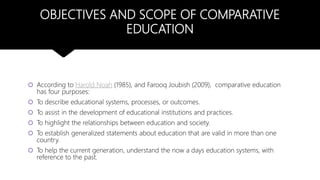
OBJECTIVES AND SCOPE OF COMPARATIVE
EDUCATION
 According to Harold Noah (1985), and Farooq Joubish (2009), comparative education
has four purposes:
 To describe educational systems, processes, or outcomes.
 To assist in the development of educational institutions and practices.
 To highlight the relationships between education and society.
 To establish generalized statements about education that are valid in more than one
country.
 To help the current generation, understand the now a days education systems, with
reference to the past.
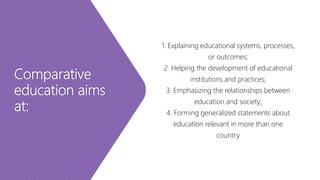
Comparative
education aims
at:
1. Explaining educational systems, processes,
or outcomes;
2. Helping the development of educational
institutions and practices;
3. Emphasizing the relationships between
education and society;
4. Forming generalized statements about
education relevant in more than one
country
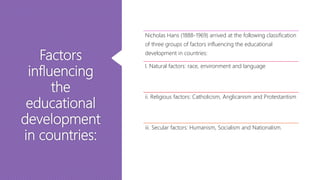
Factors
influencing
the
educational
development
in countries:
Nicholas Hans (1888-1969) arrived at the following classification
of three groups of factors influencing the educational
development in countries:
I. Natural factors: race, environment and language
ii. Religious factors: Catholicism, Anglicanism and Protestantism
iii. Secular factors: Humanism, Socialism and Nationalism.
PURPOSE OF STUDYING COMPARATIVE EDUCATION
There are various reasons why
Comparative Education should be
studied by prospective teachers and
reformers of education in any country
the world. The reasons are:
Description
 The most basic utility of comparative education is to describe education systems/learning
communities, within their social context, in order to satisfy the yearning for knowledge which is
part of human nature. The most basic utility of Comparative Education is to describe education
systems within their societal contexts in order to satisfy the yearning for knowledge which is sui
generis part of human nature
Understanding/Interpreting/Explaining
 On the next level Comparative Education also satisfies the need
to understand: education systems are explained or understood
from surrounding contextual forces which shape them.
Evaluation
 Comparative education serves the purpose of
evaluating education systems: the own education
system as well as universal evaluation of education
systems.
Planning
 Modern societies have come to appreciate the
importance of planning. Various problems that are
associated with over-population, under production,
diseases, economic nonviability, industrialization
and social ills can be tackled through planning.
Planning requires careful formulation of objectives,
establishment of priorities and the identification of
the means to achieve those objectives
Innovation in education
 There are many innovations, which are being introduced to education today. The development of
technology has facilitated new methods of organizing learning. For example the use of Radio and
Television to deliver knowledge, use of other aspects of the media, Open University, African Virtual
University (AVU) and computer assisted distance learning has been introduced to education. All
these have facilitated education in a comparative context. The U.S.A. system has facilitated the
spread of innovations in education in the world. In most of the developing countries distance
education with the use of computer assisted learning is viewed as the panacea of educational
access and the associated problems. In this regard the main problem to scarcity of qualified
teachers in most of the developing countries would be whether the new technology would replace
the real teachers in the classroom settings
Uses of comparative education
 The first use of comparative education is what is referred to as
educational borrowing. In this instance, comparative education is
used to obtain solutions to problems that are plaguing us.
 Many educational questions can be examined from an international
perspective.
 For instance, the question of what to do with girls that fall pregnant
while in school can draw on the actions that are taken in various
countries such as Zambia where the Re-entry Policy was formulated
and is being implemented to enable such girls to go back to school
whenever they are ready. Comparative education in this area is used
to borrow successful forms of education, ideas and activities from
other countries or regions to be adopted and at times adapted to
our own system of education
 The second use of comparative education is to facilitate planning of educational programs,
curricula, teaching methods and activities. Studying case studies on various educational
systems can facilitate educational planning both at national level as well as in the classroom.
 Before educational polices are made, policymakers need to evaluate the anticipated
consequences of the policy as well as identify possible constraints. Studies of educational
systems that share similar problems or those that have formulated policies to overcome
similar problems provide information for learning the possible consequences.
 Country case studies on educational systems may provide data on what other countries are
doing, planning or changing in their educational systems and thus provide invaluable
information for decision-making regarding what to adopt, modify or avoid.
 The third use of comparative education is to facilitate educational assessment or evaluation.
 Comparative education enhances evaluation of educational outcomes by showing us how we are
performing in a particular area of education compared to other countries and this evaluation ideally
should go beyond performance in national examinations.
 Noah (1984) points out that comparative education facilitates the establishment of comparative
standards. Descriptive studies provided by the country studies provide an opportunity to estimate a
country’s standing in relation to other countries on dimensions of education that are selected for
analysis.
 He further points out that the International Association for the Evaluation of Educational Achievement
is one such initiative that uses comparative data.

comparative education; meaining, defiation, aim, purpose, (TASNEEMKHOKHAR1280@GMAIL.COM)

  • 1.
    Topic; What is comparative education? The purposesof comparative education. The uses of comparative education
  • 2.
    DEFINATION OF COMPARATIVEEDUCATION  The Wiki encyclopedia defines comparative education as a fully established academic field of study that examines education in one country (or group of countries) by using data and insights drawn from the practices and situation in another country or countries.  The field of comparative education is supported by many projects associated with UNESCO and national education ministries of various nations.
  • 3.
    COMPARATIVE EDUCATION Isaac Kandel (1881-1965)took up Sandlers view that comparative education should not emphasize only educational set up, organization, administration, methods, curriculum and teaching but also the causes 2 behind educational problems of different countries and attempted solutions in the light of their social, political, cultural and national ideologies
  • 4.
    DEFINATION OF COMPARATIVEEDUCATION  “Comparative Education is the detailed study of educational systems to find out how a people’s values and beliefs affect their educational system and how to provide suitable education for those people.”
  • 5.
    OBJECTIVES AND SCOPEOF COMPARATIVE EDUCATION  According to Harold Noah (1985), and Farooq Joubish (2009), comparative education has four purposes:  To describe educational systems, processes, or outcomes.  To assist in the development of educational institutions and practices.  To highlight the relationships between education and society.  To establish generalized statements about education that are valid in more than one country.  To help the current generation, understand the now a days education systems, with reference to the past.
  • 6.
    Comparative education aims at: 1. Explainingeducational systems, processes, or outcomes; 2. Helping the development of educational institutions and practices; 3. Emphasizing the relationships between education and society; 4. Forming generalized statements about education relevant in more than one country
  • 7.
    Factors influencing the educational development in countries: Nicholas Hans(1888-1969) arrived at the following classification of three groups of factors influencing the educational development in countries: I. Natural factors: race, environment and language ii. Religious factors: Catholicism, Anglicanism and Protestantism iii. Secular factors: Humanism, Socialism and Nationalism.
  • 8.
    PURPOSE OF STUDYINGCOMPARATIVE EDUCATION There are various reasons why Comparative Education should be studied by prospective teachers and reformers of education in any country the world. The reasons are:
  • 9.
    Description  The mostbasic utility of comparative education is to describe education systems/learning communities, within their social context, in order to satisfy the yearning for knowledge which is part of human nature. The most basic utility of Comparative Education is to describe education systems within their societal contexts in order to satisfy the yearning for knowledge which is sui generis part of human nature
  • 10.
    Understanding/Interpreting/Explaining  On thenext level Comparative Education also satisfies the need to understand: education systems are explained or understood from surrounding contextual forces which shape them.
  • 11.
    Evaluation  Comparative educationserves the purpose of evaluating education systems: the own education system as well as universal evaluation of education systems.
  • 12.
    Planning  Modern societieshave come to appreciate the importance of planning. Various problems that are associated with over-population, under production, diseases, economic nonviability, industrialization and social ills can be tackled through planning. Planning requires careful formulation of objectives, establishment of priorities and the identification of the means to achieve those objectives
  • 13.
    Innovation in education There are many innovations, which are being introduced to education today. The development of technology has facilitated new methods of organizing learning. For example the use of Radio and Television to deliver knowledge, use of other aspects of the media, Open University, African Virtual University (AVU) and computer assisted distance learning has been introduced to education. All these have facilitated education in a comparative context. The U.S.A. system has facilitated the spread of innovations in education in the world. In most of the developing countries distance education with the use of computer assisted learning is viewed as the panacea of educational access and the associated problems. In this regard the main problem to scarcity of qualified teachers in most of the developing countries would be whether the new technology would replace the real teachers in the classroom settings
  • 14.
    Uses of comparativeeducation  The first use of comparative education is what is referred to as educational borrowing. In this instance, comparative education is used to obtain solutions to problems that are plaguing us.  Many educational questions can be examined from an international perspective.  For instance, the question of what to do with girls that fall pregnant while in school can draw on the actions that are taken in various countries such as Zambia where the Re-entry Policy was formulated and is being implemented to enable such girls to go back to school whenever they are ready. Comparative education in this area is used to borrow successful forms of education, ideas and activities from other countries or regions to be adopted and at times adapted to our own system of education
  • 15.
     The seconduse of comparative education is to facilitate planning of educational programs, curricula, teaching methods and activities. Studying case studies on various educational systems can facilitate educational planning both at national level as well as in the classroom.  Before educational polices are made, policymakers need to evaluate the anticipated consequences of the policy as well as identify possible constraints. Studies of educational systems that share similar problems or those that have formulated policies to overcome similar problems provide information for learning the possible consequences.  Country case studies on educational systems may provide data on what other countries are doing, planning or changing in their educational systems and thus provide invaluable information for decision-making regarding what to adopt, modify or avoid.
  • 16.
     The thirduse of comparative education is to facilitate educational assessment or evaluation.  Comparative education enhances evaluation of educational outcomes by showing us how we are performing in a particular area of education compared to other countries and this evaluation ideally should go beyond performance in national examinations.  Noah (1984) points out that comparative education facilitates the establishment of comparative standards. Descriptive studies provided by the country studies provide an opportunity to estimate a country’s standing in relation to other countries on dimensions of education that are selected for analysis.  He further points out that the International Association for the Evaluation of Educational Achievement is one such initiative that uses comparative data.